Non-Banking Financial Company (NBFCs)

A Non-Banking Financial Company (NBFC) is a company registered under the Companies Act, 1956 engaged in the business of loans and advances, acquisition of shares/stocks/bonds/debentures/securities issued by Government or local authority or other marketable securities of a like nature, leasing, hire-purchase, insurance business, chit business but does not include any institution whose principal business is that of agriculture activity, industrial activity, purchase or sale of any goods (other than securities) or providing any services and sale/purchase/construction of immovable property. A non-banking institution which is a company and has principal business of receiving deposits under any scheme or arrangement in one lump sum or in installments by way of contributions or in any other manner, is also a non-banking financial company (Residuary non-banking company).

Difference between banks & NBFCs

NBFCs lend and make investments and hence their activities are akin to that of banks; however there are a few differences as given below:

  • NBFC cannot accept demand deposits;
  • NBFCs do not form part of the payment and settlement system and cannot issue cheques drawn on itself;
  • Deposit insurance facility of Deposit Insurance and Credit Guarantee Corporation is not available to depositors of NBFCs, unlike in case of banks.

Types

NBFCs are categorized

  • In terms of the type of liabilities into Deposit and Non-Deposit accepting NBFCs,
  • Non deposit taking NBFCs by their size into systemically important and other non-deposit holding companies (NBFC-NDSI and NBFC-ND) and
  • By the kind of activity they conduct.

Within this broad categorization the different types of NBFCs are as follows:

  1. Asset Finance Company (AFC)

An AFC is a company which is a financial institution carrying on as its principal business the financing of physical assets supporting productive/economic activity, such as automobiles, tractors, lathe machines, generator sets, earth moving and material handling equipments, moving on own power and general purpose industrial machines. Principal business for this purpose is defined as aggregate of financing real/physical assets supporting economic activity and income arising therefrom is not less than 60% of its total assets and total income respectively.

  1. Investment Company (IC)

IC means any company which is a financial institution carrying on as its principal business the acquisition of securities,

  1. Loan Company (LC)

LC means any company which is a financial institution carrying on as its principal business the providing of finance whether by making loans or advances or otherwise for any activity other than its own but does not include an Asset Finance Company.

  1. Infrastructure Finance Company (IFC)

IFC is a non-banking finance company a) which deploys at least 75 per cent of its total assets in infrastructure loans, b) has a minimum Net Owned Funds of Rs 300 crore, c) has a minimum credit rating of ‘A ‘or equivalent d) and a CRAR of 15%.

  1. Systemically Important Core Investment Company (CIC-ND-SI)

CIC-ND-SI is an NBFC carrying on the business of acquisition of shares and securities.

  1. Infrastructure Debt Fund

Non- Banking Financial Company (IDF-NBFC) : IDF-NBFC is a company registered as NBFC to facilitate the flow of long term debt into infrastructure projects. IDF-NBFC raise resources through issue of Rupee or Dollar denominated bonds of minimum 5 year maturity. Only Infrastructure Finance Companies (IFC) can sponsor IDF-NBFCs.

  1. Non-Banking Financial Company

Micro Finance Institution (NBFC-MFI): NBFC-MFI is a non-deposit taking NBFC having not less than 85% of its assets in the nature of qualifying assets which satisfy the following criteria:

  • Loan disbursed by an NBFC-MFI to a borrower with a rural household annual income not exceeding Rs 1,00,000 or urban and semi-urban household income not exceeding Rs 1,60,000;
  • Loan amount does not exceed Rs 50,000 in the first cycle and Rs 1,00,000 in subsequent cycles;
  • Total indebtedness of the borrower does not exceed Rs 1,00,000;
  • Tenure of the loan not to be less than 24 months for loan amount in excess of Rs 15,000 with prepayment without penalty;
  • Loan to be extended without collateral;
  • Aggregate amount of loans, given for income generation, is not less than 50 per cent of the total loans given by the MFIs;
  • Loan is repayable on weekly, fortnightly or monthly instalments at the choice of the borrower
  1. Non-Banking Financial Company

Factors (NBFC-Factors): NBFC-Factor is a non-deposit taking NBFC engaged in the principal business of factoring. The financial assets in the factoring business should constitute at least 50 percent of its total assets and its income derived from factoring business should not be less than 50 percent of its gross income.

  1. Mortgage Guarantee Companies (MGC)

MGC are financial institutions for which at least 90% of the business turnover is mortgage guarantee business or at least 90% of the gross income is from mortgage guarantee business and net owned fund is Rs 100 crore.

  1. NBFC

Non-Operative Financial Holding Company (NOFHC) is financial institution through which promoter / promoter groups will be permitted to set up a new bank .It’s a wholly-owned Non-Operative Financial Holding Company (NOFHC) which will hold the bank as well as all other financial services companies regulated by RBI or other financial sector regulators, to the extent permissible under the applicable regulatory prescriptions.

What action can be taken against persons/financial companies making false claim of being regulated by the Reserve Bank?

It is illegal for any financial entity or unincorporated body to make a false claim of being regulated by the Reserve Bank to mislead the public to collect deposits and is liable for penal action under the Indian Penal Code. Information in this regard may be forwarded to the nearest office of the Reserve Bank and the Police. The list of registered NBFCs is available on the web site of Reserve Bank of India and can be viewed at www.rbi.org.in

Precautions should a depositor take before placing deposit with an NBFC

A depositor wanting to place deposit with an NBFC must take the following precautions before placing deposits:

  1. That the NBFC is registered with RBI and specifically authorized by the RBI to accept deposits. A list of deposit taking NBFCs entitled to accept deposits is available at www.rbi.org.in. The depositor should check the list of NBFCs permitted to accept public deposits and also check that it is not appearing in the list of companies prohibited from accepting deposits.
  2. NBFCs have to prominently display the Certificate of Registration (CoR) issued by the Reserve Bank on its site. This certificate should also reflect that the NBFC has been specifically authorized by RBI to accept deposits. Depositors must scrutinize the certificate to ensure that the NBFC is authorized to accept deposits.
  3. The maximum interest rate that an NBFC can pay to a depositor should not exceed 12.5%. The Reserve Bank keeps altering the interest rates depending on the macro-economic environment. The Reserve Bank publishes the change in the interest rates on www.rbi.org.in → Sitemap → NBFC List → FAQs.
  4. The depositor must insist on a proper receipt for every amount of deposit placed with the company. The receipt should be duly signed by an officer authorized by the company and should state the date of the deposit, the name of the depositor, the amount in words and figures, rate of interest payable, maturity date and amount.
  5. In the case of brokers/agents etc collecting public deposits on behalf of NBFCs, the depositors should satisfy themselves that the brokers/agents are duly authorized by the NBFC.
  6. The depositor must bear in mind that public deposits are unsecured and Deposit Insurance facility is not available to depositors of NBFCs.
  7. The Reserve Bank of India does not accept any responsibility or guarantee about the present position as to the financial soundness of the company or for the correctness of any of the statements or representations made or opinions expressed by the company and for repayment of deposits/discharge of the liabilities by the company.

Characteristics

The NBFCs are allowed to accept/renew public deposits for a minimum period of 12 months and maximum period of 60 months. They cannot accept deposits repayable on demand.

  • NBFCs cannot offer interest rates higher than the ceiling rate prescribed by RBI from time to time. The present ceiling is 12.5 per cent per annum. The interest may be paid or compounded at rests not shorter than monthly rests.
  • NBFCs cannot offer gifts/incentives or any other additional benefit to the depositors.
  • NBFCs should have minimum investment grade credit rating.
  • The deposits with NBFCs are not insured.
  • The repayment of deposits by NBFCs is not guaranteed by RBI.
  • Certain mandatory disclosures are to be made about the company in the Application Form issued by the company soliciting deposits.

Functions

  • Infrastructural Funding

This is the largest section where major NBFCs deal in. A lot of portion of this segment alone makes up a major portion of funds lent, amongst the different segments. This majorily includes Real Estate, railways or Metros, flyovers, ports, airports, etc.

  • Trade finance

Companies dealing in Dealer/distributor finance so that they can for working capital requirements, vendor finance, and other business loans.

  • Retail Financing

Companies that provides short term funds for Loan against shares, gold, property, primarily for consumption purposes.

Types

  • NBFCs accepting public deposit (NBFCs-D)
  • NBFCs not accepting/holding public deposit (NBFCs-ND). Residuary Non-Banking Companies (RNBCs) are another category of NBFCs whose principal business is acceptance of deposits and investing in approved securities.
  • Non deposit taking NBFCs by their size into systemically important and other non-deposit holding companies (NBFC-NDSI and NBFC-ND)
Hire Purchase Agreement, Meaning, Features, Laws, Merits, Demerits, Duties of the Parties

Hire purchase agreement is a legal contract between a buyer (hirer) and a seller (or finance company), where the buyer agrees to pay for an asset in installments over a period of time while having the right to use the asset immediately. However, ownership of the asset remains with the seller or financier until the final payment is made. Only after completing all scheduled payments does the buyer gain full ownership.

This system is commonly used to finance expensive assets such as vehicles, machinery, appliances, or equipment that individuals or businesses cannot afford to pay for upfront. Typically, the agreement starts with a down payment (usually a percentage of the asset’s price), followed by regular monthly or periodic installments that cover the remaining balance plus interest.

Hire purchase agreements usually include terms on payment schedule, interest rates, penalties for missed payments, maintenance responsibilities, insurance requirements, and repossession rights. If the buyer defaults, the seller has the right to repossess the asset, and previous payments may be forfeited.

This financing method is popular because it allows buyers to use the asset while paying for it over time, improving cash flow flexibility. However, it comes with higher overall costs due to added interest and administrative fees, and buyers face the risk of losing the asset if they default before completing all payments. Despite these drawbacks, hire purchase agreements remain a widely used method for structured asset financing.

Features of Hire Purchase Agreement:

  • Installment-Based Payment System

A key feature of a hire purchase agreement is its installment payment structure, where the buyer pays the total price of the asset over several periodic payments. This helps buyers spread the cost over time, making expensive assets more affordable without requiring a large upfront payment. Each installment usually includes both a principal and interest component. This system improves cash flow, making it easier for businesses or individuals to acquire assets they couldn’t pay for in a single lump sum.

  • Ownership Transfers After Final Payment

Under a hire purchase agreement, ownership of the asset does not pass to the buyer at the start. Instead, the seller or finance company retains ownership until all installments have been paid in full. Only after completing the final payment does the legal title transfer to the buyer. This distinguishes hire purchase from credit sales or outright purchases. Until ownership transfers, the buyer is essentially a hirer, even though they have full possession and use of the asset during the payment period.

  • Right to Use the Asset Immediately

Although ownership remains with the seller, the buyer in a hire purchase agreement has the immediate right to use the asset once the contract is signed and the initial down payment is made. This feature is crucial for businesses that need machinery, vehicles, or equipment to generate income while paying for it over time. This arrangement allows the hirer to benefit from the asset’s utility even before completing the payment schedule, helping them increase productivity or meet personal needs right away.

  • Down Payment Requirement

Hire purchase agreements usually require the buyer to make an initial down payment, typically a fixed percentage of the asset’s price. This upfront payment reduces the amount to be financed and serves as a commitment from the buyer. The remaining balance is then paid in regular installments over the agreed period. The down payment helps reduce the lender’s risk and gives the buyer immediate access to the asset, even though full ownership will only come after all payments are completed.

  • Inclusion of Interest Charges

The installment payments under a hire purchase agreement typically include not just the principal amount but also interest charges. These charges compensate the seller or finance company for providing the buyer with extended payment terms. The interest rate is usually specified in the agreement and depends on market rates, the buyer’s creditworthiness, and the asset’s value. This feature means that, over time, the total cost of the asset through hire purchase is higher than its cash price, reflecting the cost of credit.

  • Default and Repossession Rights

An important feature of hire purchase is the seller’s right to repossess the asset if the buyer defaults on installment payments. Since ownership remains with the seller during the contract period, failure to meet payment obligations allows the seller to reclaim the asset without legal proceedings. This protects the seller’s interest but poses a risk for the buyer, who may lose both the asset and the money already paid. This clause is usually outlined clearly in the agreement’s terms and conditions.

  • Flexibility in Contract Terms

Hire purchase agreements often offer flexible terms regarding the payment schedule, contract length, and down payment percentage. Buyers and sellers can negotiate these elements to suit their financial capabilities and needs. For example, some agreements may allow larger installments over a shorter term, while others may stretch smaller payments over a longer period. This flexibility makes hire purchase an attractive financing option for both individuals and businesses seeking customized payment plans based on their cash flow.

  • Responsibility for Maintenance and Insurance

Under most hire purchase agreements, the buyer is responsible for maintaining and insuring the asset, even though ownership has not yet transferred. This is because the buyer has possession and full use of the asset during the installment period. Any damage, loss, or deterioration is the buyer’s responsibility, and failing to maintain or insure the asset could result in additional penalties or breach of contract. This feature ensures that the asset retains its value for both parties until full payment.

Laws Governing Hire Purchase Agreements:

  • Indian Hire Purchase Act, 1972

The Indian Hire Purchase Act, 1972, was designed to regulate hire purchase transactions across India. It aimed to define the rights and obligations of both owners (sellers) and hirers (buyers) under such agreements. Although the Act was enacted, it has not been brought into force and therefore does not apply in practice. Despite this, its provisions are often referenced for guidance, and many terms in hire purchase contracts align with its framework, ensuring fairness and clarity in these financial arrangements.

  • Indian Contract Act, 1872

Since the Hire Purchase Act, 1972, remains unenforced, most hire purchase agreements are governed under the Indian Contract Act, 1872. This Act outlines general principles of contracts, such as offer, acceptance, consideration, capacity to contract, and free consent. Hire purchase agreements, being legally binding contracts, must comply with these requirements. If any part of the agreement violates these general principles (e.g., is based on coercion or misrepresentation), the contract can be declared void or voidable under the Indian Contract Act.

  • Sale of Goods Act, 1930

The Sale of Goods Act, 1930, also indirectly applies to hire purchase agreements. Although a hire purchase is not an outright sale, the Act’s provisions regarding conditions, warranties, and transfer of ownership guide many aspects of these transactions. For instance, the Act clarifies when ownership passes from seller to buyer and what rights the buyer has regarding defective goods. Courts sometimes refer to the Sale of Goods Act when interpreting hire purchase disputes, particularly regarding the quality or fitness of goods.

  • Transfer of Property Act, 1882

The Transfer of Property Act, 1882, governs how property is transferred between parties in India. While this Act mainly applies to immovable property, certain principles related to the transfer of rights and title can also influence hire purchase arrangements. In hire purchase, ownership remains with the seller until the final payment. The Transfer of Property Act helps clarify when, legally, rights pass from one party to another, ensuring both parties understand their roles and the timing of ownership transfer.

  • Consumer Protection Act, 2019

The Consumer Protection Act, 2019, protects the rights of consumers involved in hire purchase agreements. Buyers, as consumers, can file complaints against unfair trade practices, defective products, or misleading information under this Act. If a hire purchase seller fails to provide goods of acceptable quality or misleads the buyer, the buyer can seek redressal through consumer forums. This Act strengthens the consumer’s position and ensures they receive fair treatment and protection, even though they do not yet own the asset.

Merits of Hire Purchase Agreements:

  • Easy Access to Assets

Hire purchase agreements allow buyers to access expensive goods without paying the full price upfront. This system enables individuals and businesses to acquire machinery, vehicles, or equipment they might otherwise be unable to afford. By spreading payments over time, it reduces the financial burden, making assets accessible even to small businesses or low-income buyers. This boosts business operations, improves personal convenience, and allows users to benefit from the asset’s use before full ownership is secured.

  • Flexible Payment Terms

One major merit of hire purchase is the flexibility of its payment structure. Buyers can negotiate installment schedules that fit their income flow or business revenue. Whether through monthly, quarterly, or other periodic payments, this flexibility eases budgeting and financial planning. It prevents sudden cash outflows, helping businesses maintain liquidity and ensuring personal buyers avoid straining their finances. The structured, predictable payment plan also makes it easier for buyers to meet their obligations without undue stress.

  • Facilitates Business Growth

For businesses, hire purchase agreements play a vital role in growth and expansion. Companies can obtain essential machinery, vehicles, or technology immediately, putting them to productive use while paying gradually. This allows businesses to generate income from the hired assets even before completing the purchase. By enhancing production capacity or service delivery without exhausting capital reserves, businesses can invest in other areas, maintain working capital, and pursue expansion opportunities without waiting for full asset ownership.

  • Encourages Asset Use Before Ownership

Hire purchase agreements let the buyer use the asset while still paying for it, offering immediate benefits. Unlike outright purchases, where full payment is needed upfront, or rentals, where there’s no ownership transfer, hire purchase blends use with eventual ownership. This arrangement is especially useful for those needing immediate use of the asset but lacking sufficient funds. It provides users with the ability to enjoy the product, generate revenue, or meet needs while paying gradually.

  • Boosts Credit Reputation

Successfully completing hire purchase agreements can help individuals and businesses build or improve their credit history. Timely payments signal financial responsibility to lenders, making it easier to secure future loans or credit lines. For businesses, a good credit reputation boosts investor confidence and facilitates access to larger financing options. This positive credit impact encourages responsible financial behavior, reinforcing good payment habits and expanding the buyer’s financial opportunities beyond the initial hire purchase arrangement.

  • Tax Benefits for Businesses

In many cases, businesses using hire purchase agreements may qualify for certain tax advantages. The interest portion of hire purchase payments is often considered a business expense, which can be deducted from taxable income. Additionally, depreciation on the asset may be claimed even while the asset is under hire purchase, depending on jurisdictional tax rules. These tax benefits reduce the overall financial cost of acquiring the asset, making hire purchase an economically attractive financing option.

  • Low Risk of Asset Loss

Unlike rental or lease agreements where missing payments may lead to immediate loss of use, hire purchase agreements typically allow the buyer more security. Although the seller retains ownership until full payment, the buyer’s right to use the asset is protected as long as they meet payment terms. This provides a sense of security, knowing that regular payments keep the asset in use and the buyer on the path to eventual ownership, minimizing sudden disruptions.

  • Supports Cash Flow Management

Hire purchase agreements help both individuals and businesses manage cash flow effectively. Instead of tying up large amounts of money in one purchase, buyers can allocate funds over time. This preserves cash reserves for other operational needs, emergencies, or investment opportunities. By balancing payments across periods, buyers avoid liquidity crises and maintain financial flexibility. This benefit is particularly critical for businesses that need to keep cash on hand for wages, raw materials, or unexpected costs.

  • Offers Ownership Incentive

Hire purchase agreements offer the added psychological incentive of eventual ownership. Unlike leases, where payments never lead to ownership, hire purchase installments build toward becoming the legal owner of the asset. This motivates buyers to keep up with payments, knowing the asset will eventually belong to them. The ownership promise encourages responsible financial planning and gives buyers a clear goal, adding value to the arrangement beyond mere use or temporary possession

Demerits of Hire Purchase Agreements:

  • Higher Overall Cost

One of the biggest drawbacks of hire purchase agreements is the higher overall cost compared to outright purchases. While the installment system seems affordable, the inclusion of interest and administrative fees increases the total amount paid over time. Buyers often end up paying significantly more than the original price of the asset. For businesses, this added cost reduces profit margins, and for individuals, it can strain personal finances, especially if they fail to account for the true long-term expense.

  • Ownership Delay

In a hire purchase agreement, ownership of the asset remains with the seller until the final payment is made. This means the buyer does not have full legal rights over the asset during the installment period. As a result, they cannot resell or modify the asset without the seller’s permission. This delay in ownership can be frustrating, especially for businesses that want full control over their equipment or for individuals who may need to liquidate the asset quickly.

  • Risk of Repossession

A serious disadvantage of hire purchase is the risk of repossession. If the buyer fails to make payments on time, the seller has the right to seize the asset. This can result in significant financial and operational disruption, particularly for businesses relying on the asset for production or service delivery. Repossession not only leads to asset loss but also wastes the money already paid, causing both financial loss and reputational damage, especially if public repossession occurs.

  • Limited Flexibility

Hire purchase agreements are often rigid, with fixed payment schedules and terms that cannot be easily altered. If a buyer’s financial situation changes, such as reduced income or unexpected expenses, it can be difficult to renegotiate terms. This inflexibility can cause stress and increases the risk of default. Unlike leases, where termination may be easier, or loans, which sometimes offer refinancing, hire purchase agreements usually lock buyers into strict, long-term commitments with limited exit options.

  • Depreciation Risk

The buyer bears the risk of depreciation during the hire purchase period, even though they don’t yet own the asset. For example, vehicles or machinery can lose significant value over time due to wear, tear, or market changes. By the time full ownership is transferred, the asset may have depreciated heavily, reducing its resale value or usefulness. This can make hire purchase unattractive for rapidly depreciating assets, as buyers end up paying more for something that is worth less.

  • Impact on Credit Rating

Failure to meet payment obligations under a hire purchase agreement can harm the buyer’s credit rating. Missed or delayed payments are often reported to credit bureaus, affecting the buyer’s ability to secure future loans, credit cards, or financing. For businesses, poor credit ratings can reduce investor confidence and limit access to essential working capital. This long-term financial impact extends beyond the hire purchase arrangement, potentially affecting broader financial goals and opportunities.

  • Restriction on Usage

Some hire purchase agreements include clauses that restrict how the asset can be used during the payment period. For example, a vehicle under hire purchase may have limits on mileage or use in certain industries. Violating these restrictions can lead to penalties or termination of the agreement. Such usage limits reduce operational flexibility, especially for businesses that need to adapt quickly to changing circumstances. These constraints can make the arrangement less attractive compared to owning the asset outright.

  • Complex Documentation

Hire purchase agreements often involve complex legal documentation that may be difficult for buyers to fully understand without legal advice. Misunderstanding terms, such as penalty clauses, maintenance obligations, or insurance requirements, can lead to unexpected liabilities. Small businesses or individuals may find the process intimidating, increasing the risk of entering agreements that do not fully match their needs. Without professional guidance, buyers might overlook unfavorable terms, leading to financial or legal complications later.

  • Long-term Financial Commitment

Hire purchase agreements lock buyers into long-term financial commitments, which can become burdensome over time. Even if the asset’s usefulness declines or better options become available in the market, the buyer remains obligated to complete the payments. This reduces financial flexibility and can prevent buyers from upgrading equipment or switching to more cost-effective solutions. The long-term nature of these commitments requires careful financial planning, as unexpected downturns or challenges can make the arrangement a liability

Duties of the Parties in Hire Purchase Agreements:

  • Duties of the Seller: Delivery of Goods

The seller has the duty to deliver the agreed-upon goods to the buyer as specified in the hire purchase agreement. The goods must match the description, quality, and condition promised at the time of signing. Any delay or failure in delivery can breach the contract and expose the seller to legal action. The seller must also ensure the goods are suitable for the intended use, meeting all applicable warranties and standards set in the agreement.

  • Duties of the Seller: Maintain Ownership Until Full Payment

The seller retains ownership of the goods until the buyer has made all payments as per the agreement. It is the seller’s duty to safeguard their ownership rights by including clear clauses regarding payment defaults and repossession. While the buyer uses the goods, the seller cannot interfere unless there’s a breach. However, the seller must be prepared to reclaim the goods if the buyer defaults, following legal procedures and respecting the buyer’s partial payment rights.

  • Duties of the Seller: Provide Accurate Information

The seller must provide complete and truthful information about the goods, pricing, installment structure, interest rates, and any other costs involved. This ensures the buyer makes an informed decision. Misrepresentation or withholding important details may result in legal liabilities. The seller should also explain terms like maintenance responsibilities, insurance requirements, or usage restrictions. Transparency builds trust and ensures the buyer fully understands the financial and legal commitments they are entering.

  • Duties of the Seller: Ensure Legal Compliance

It is the seller’s duty to draft the hire purchase agreement in accordance with applicable laws and regulations. This includes complying with consumer protection laws, hire purchase acts, and financial disclosure requirements. The seller must ensure the agreement clearly outlines the rights and obligations of both parties, including what happens in case of default. Failure to comply with legal standards may result in penalties, invalid agreements, or reputational damage for the seller.

  • Duties of the Buyer: Timely Payment

The primary duty of the buyer is to make timely payments of installments as agreed in the hire purchase contract. Delays or defaults can result in penalties, additional charges, or even repossession of the goods. The buyer should keep track of payment dates and amounts, ensuring they meet their financial obligations without reminders. Consistent payment builds good credit standing and secures the path to full ownership, reducing the risk of legal action by the seller.

  • Duties of the Buyer: Care and Maintenance of Goods

The buyer is responsible for properly caring for and maintaining the goods while under the hire purchase agreement. Even though ownership has not yet transferred, the buyer must use the goods responsibly, ensuring they do not suffer unnecessary damage or neglect. Some agreements specify maintenance duties or require the buyer to follow manufacturer instructions. Negligence may result in penalties, cancellation of the agreement, or liability for repair costs.

  • Duties of the Buyer: Use Goods Within Agreed Terms

The buyer has a duty to use the goods only within the scope permitted by the hire purchase agreement. For example, a vehicle may have mileage restrictions or be prohibited from commercial use. Violating these terms can trigger penalties or breach the contract. The buyer must carefully read and understand all usage clauses to avoid misuse, ensuring they stay within the agreed conditions throughout the payment period.

  • Duties of the Buyer: Notify Seller of Issues

The buyer has the responsibility to promptly inform the seller of any defects, malfunctions, or issues with the goods. Early communication allows the seller to repair, replace, or address the problem under warranty or agreement terms. Ignoring issues or failing to report them can make the buyer liable for additional damages. This duty ensures that the buyer’s rights are protected while helping the seller maintain accountability over the goods.

  • Duties of the Buyer: Arrange for Insurance

In many hire purchase agreements, the buyer is required to insure the goods against theft, damage, or loss. This duty protects both the buyer’s use and the seller’s ownership interests. The buyer must ensure the insurance policy meets the minimum requirements specified in the agreement and remains active for the entire payment period. Failure to insure the goods can result in breach of contract, financial liability, or loss of use if damage occurs.

Leasing Decision

Parties to Lease Agreement:

There are two parties under any lease agreement:

Lessor: Owner of the asset is known as Lessor.

Lessee: The party who uses the asset is known as Lessee.

Calculation of Equated Annual Install

When question specifies that loan is payable in Equal Installment then EAI should be calculated.

EAI = (Principle Amount)/PVAF(Interest  Rate, No. of Years)

Note: Discount Rate or Interest for Calculation of EAI = Interest Rate on Loan amount without taking any effect of Tax on it.

Tax Shield on Expenses done at zero period will be taken during first year (Leasing Topic Only).

Present Value Factor of Annuity when Inflow/Outflow is at beginning of Year then

PVAF(r,n) = PVAF[r, (n-1)] + 1

Calculation of Lease Rent

When a leasing company desires a certain percentage on gross value of assets then,

Lease Rent = (Cost of Assets)/Annuity factor at rate desire of leasing co.

When Value of Machine and other Expenses given then,

Lease Rent = [PV of Cash Out Flow – PV of Inflow (Tax Shield on Depreciation/Expenses)]/Annuity Factor at Interest Rate

Salvage Value is deducted only when question specifies the method of depreciation as SLM.

Steps to Take Decision Whether Buy or at Assets on Lease by Lessee Point of view

Step I: Calculate PV of Cash Outflow if Assets by Funding from Loan.

Step II: Calculate PV of Cash Outflow if Assets is taken on Lease.

Step III: Comparing PV Cash Outflow in both cases.

Step IV: Decision: Option which has lower Cash Outflow should be chosen.

Note: Any Expenses which is common in both cases then those expenses is irrelevant for decision making.

Steps to take Decision whether Assets should be leased out or not by Lessor Point of view

Step I: Calculate PV of Cash Inflow (After Tax Lease Rent).

Step II: Calculate PV of Cash Outflow (Initial Cash Outflow and Recurring Expenses)

Step III: Calculate NPV (PV of Cash Inflow – PV of Cash Outflow).

Step IV: Decision: If NPV is positive then Assets should be leased out otherwise not.

Step to decision for which option to choose for Sale and Buy Back Case     

Step I: Calculate NPV at each option.

Step II: Compare NPV at each options.

Step III: Decision: Option which has Highest NPV should be chosen. 

Discount Rate to be used:

For Lessee: Kd(1 – Tax Rate)

For Lessor: Weighted Average Cost of Capital.

Factoring, Functions, Types, Process, Advantages and Disadvantages

Factoring is a financial service in which a business sells its accounts receivable (invoices) to a third party, known as a factor, at a discount. This provides immediate cash flow to the business, helping it manage working capital and liquidity without waiting for customers to pay. The factor assumes the risk of collecting the receivables and may offer additional services such as credit risk management and debt collection. Factoring is commonly used by businesses facing cash flow constraints or those needing quick access to funds to meet operational expenses or invest in growth opportunities.

Functions of Factoring:

1. Financing Receivables

The core function of factoring is providing immediate cash by purchasing a business’s receivables at a discount. This helps businesses maintain liquidity, manage working capital, and meet short-term obligations without waiting for customers to clear outstanding payments.

  • Example: A company with long credit periods can improve cash flow through factoring.

2. Credit Risk Protection

In non-recourse factoring, the factor assumes the credit risk associated with the receivables. This means that if the debtor defaults, the factor bears the loss. This protects businesses from bad debts and reduces the need for credit insurance.

  • Benefit: Businesses can focus on growth without worrying about customer defaults.

3. Accounts Receivable Management

Factors often take over the responsibility of managing accounts receivable, which includes maintaining records, tracking payments, and ensuring timely collections. This allows businesses to focus on core operations without being burdened by administrative tasks.

  • Key Feature: Reduces operational costs and administrative workload for businesses.

4. Collection of Receivables

One of the significant functions of factoring is collecting payments from customers on behalf of the client. Factors employ professional collection methods, ensuring timely payments while maintaining customer relationships.

  • Advantage: Improves efficiency in collections and reduces the chances of delayed payments.

5. Credit Screening and Monitoring

Factoring firms often perform credit screening and monitoring of the client’s customers. They assess the creditworthiness of customers before approving the receivables for factoring. This helps businesses accept only those customers who are financially sound.

  • Result: Minimizes the risk of default and enhances the overall credit quality of the receivables.

6. Advisory Services

Factors provide valuable financial advisory services related to credit management, customer evaluation, and working capital optimization. Their expertise in the field helps businesses improve financial planning and reduce risks.

  • Value Addition: Offers strategic guidance on improving cash flow and managing risks effectively.

7. Enhancing Business Growth

Factoring helps businesses focus on expansion by providing consistent cash flow and freeing up resources from managing receivables. It allows companies to take on larger orders or more clients without the fear of cash shortages.

  • Impact: Promotes faster growth by improving financial flexibility and stability.

Types of Factoring:

  • Recourse Factoring

In recourse factoring, the business selling the receivables remains liable if the customer fails to pay the invoice. If the debtor defaults, the business must repay the factor for the unpaid amount. While this option is generally less expensive because the factor assumes less risk, it places more financial responsibility on the business. Recourse factoring is suitable for companies with stable customer bases and lower default risks.

  • Non-Recourse Factoring

Non-recourse factoring shifts the risk of bad debts to the factor. If the customer defaults, the factor absorbs the loss, not the business. This type of factoring offers greater security to the business, as it does not need to repay the factor for unpaid invoices. Non-recourse factoring is typically more expensive due to the higher risk assumed by the factor, but it provides a higher level of protection for businesses.

  • Invoice Discounting

Invoice discounting is a form of factoring where businesses retain control over their receivables and collections. The factor provides an advance against the receivables but does not take over the collection process. The business remains responsible for chasing payments, but it benefits from immediate access to funds. This type is typically used by businesses that prefer to maintain customer relationships and manage their own receivables while improving cash flow.

  • Maturity Factoring

Maturity factoring is a form of factoring where the factor provides an advance against invoices, but the full payment is only due on the invoice maturity date. This option allows businesses to access immediate funding while extending the payment terms for customers. The factor assumes the responsibility of collecting payments on the due date. Maturity factoring can help businesses manage cash flow while offering flexibility to their customers.

  • Asset-Based Factoring

Asset-based factoring involves using a company’s assets, such as receivables or inventory, as collateral to secure funding. In this type of factoring, the business receives an advance against its receivables or inventory, which helps in accessing immediate liquidity. The factor assesses the assets and provides funding based on their value. This is a flexible form of factoring that provides financing options beyond just receivables.

  • Supply Chain Factoring

Supply chain factoring is a specialized form of factoring where businesses involved in supply chain operations receive immediate financing for their invoices from the factor. This type focuses on the entire supply chain, enabling suppliers to receive faster payments for their products or services. The factor provides financing to suppliers while ensuring that the buyer’s payment obligations are met on time. This option is beneficial for suppliers who face long payment cycles and need to improve cash flow.

  • International Factoring

International factoring involves the sale of receivables arising from international transactions. This type of factoring is beneficial for businesses engaged in global trade, as it helps manage the risks of dealing with foreign customers, such as currency fluctuations and cross-border payment delays. International factoring includes both recourse and non-recourse options and may also involve additional services like foreign exchange management and credit risk assessment for international markets.

Factoring Process:

  • Agreement Between the Business and the Factor

The first step in the factoring process is for the business to enter into an agreement with the factor. This agreement outlines the terms and conditions of the factoring arrangement, including the fees charged, the percentage of the receivables that the factor will purchase, and the responsibilities of both parties. Businesses typically negotiate a factoring rate based on factors such as the volume of receivables and the perceived risk of the clients.

  • Submission of Invoices

Once the agreement is in place, the business submits its invoices to the factor. These invoices represent money owed by the business’s customers for goods or services already provided. The factor reviews the invoices and the associated accounts receivable to determine their eligibility for factoring. This process also involves verifying the creditworthiness of the business’s customers. The factor may refuse to purchase invoices if the customer is deemed too risky or the receivables do not meet the factor’s criteria.

  • Verification of Accounts Receivable

After receiving the invoices, the factor typically verifies the legitimacy of the receivables. This involves checking that the invoices are valid, the goods or services have been delivered, and that the customers are expected to pay. The factor may contact the business’s clients directly to confirm the terms of the invoices and the amounts owed. Verification also involves checking the payment history of the customers to assess the likelihood of timely payments.

  • Initial Payment (Advance) from the Factor

Once the invoices are verified and approved, the factor advances a percentage of the total invoice value to the business. This is usually between 70-90% of the total receivable value, depending on the agreement. This advance provides the business with immediate cash flow, which can be used to cover operational expenses, pay debts, or invest in growth opportunities. The advance allows the business to continue its operations without waiting for customers to pay their invoices.

  • Collection of Payment from Customers

At this stage, the factor takes over the responsibility of collecting the payments from the business’s customers. The factor typically informs the customers that the payment should be made directly to them. The factor then handles the collections process, including following up with customers, sending reminders, and managing any late payments. The factor earns money by charging fees for these services, which are often included in the factoring agreement.

  • Final Payment to the Business

Once the factor collects the full payment from the customer, they will deduct their fees and the advance amount provided earlier. The remaining balance is paid to the business. This final payment typically happens once the customer settles the invoice in full, and the factor has completed its collection process. The remaining amount may be called the “reserve” or “rebate” and is the difference between the advance paid to the business and the total invoice value minus the factoring fees.

  • Continuous Process (if recurring)

If the business has recurring invoices and factoring is ongoing, this process repeats with each new batch of invoices submitted. As the factor collects payments from one batch of receivables, they advance a new round of payments for the next batch, keeping the business’s cash flow consistent. This cycle continues as long as the factoring agreement remains in place, allowing businesses to manage their cash flow and focus on operations without worrying about delayed payments from customers.

Advantages of Factoring:

  • Improved Cash Flow

The primary advantage of factoring is that it provides businesses with immediate cash by selling their receivables. This helps companies maintain positive cash flow, especially when dealing with long payment cycles or customers who delay payments. By converting invoices into cash quickly, businesses can meet operational expenses, invest in growth, and manage day-to-day costs without depending on external loans.

  • Reduces Credit Risk

In non-recourse factoring, the factor assumes the risk of customer default, protecting businesses from bad debts. This minimizes the financial impact of non-payment by customers, especially for businesses that deal with high-risk clients or face uncertainty in collecting payments. With the risk of bad debts transferred to the factor, businesses can focus on operations and growth without worrying about unpaid invoices.

  • Focus on Core Business Operations

Factoring companies take over the task of managing accounts receivable, including collection and credit management. This allows businesses to concentrate on their core activities, such as sales and production, without being bogged down by administrative tasks. The factor’s professional handling of collections often leads to improved efficiency and timeliness in payment collection, which enhances overall business productivity.

  • Access to Expertise and Credit Management

Factoring firms provide credit risk assessment, client screening, and account monitoring services. Their expertise in managing receivables, understanding credit risks, and ensuring timely payments can be a valuable asset for businesses, especially those lacking in-house credit management skills. This professional support helps businesses mitigate risks and build stronger customer relationships by ensuring prompt collections.

  • No Additional Debt

Unlike loans or lines of credit, factoring does not involve taking on additional debt. Since factoring is not a loan but a sale of receivables, businesses are not required to repay the factor unless the customer fails to pay. This means that businesses do not incur any interest charges or monthly payments, making it a more flexible and cost-effective financing option compared to traditional debt solutions.

  • Flexible Financing Option

Factoring is a flexible form of financing, as it adapts to a business’s cash flow needs. The amount of funding a business can access depends on the value of its receivables, meaning that the more a business sells, the more financing it can obtain. This scalability makes factoring an ideal option for businesses experiencing fluctuating cash flow or rapid growth, as they can receive financing based on their current financial needs.

Disadvantages of Factoring:

  • High Costs

One of the major drawbacks of factoring is the cost. Factoring companies typically charge fees based on the value of the invoices being factored, and these fees can be significant. The fees usually include a discount rate (a percentage of the invoice value) and additional charges for services such as credit checks or collections. These costs can add up, especially if the business frequently factors large volumes of receivables, reducing the overall profitability.

  • Loss of Control Over Customer Relationships

When a business sells its receivables to a factor, the factor usually takes over the task of collecting the payments from customers. While this can relieve the business from administrative burdens, it also means that the business loses direct control over how customers are treated during the collections process. Customers may not appreciate the involvement of a third party, and in some cases, this can negatively impact the business’s relationship with its clients.

  • Impact on Profit Margins

The fees charged by factoring companies can significantly erode a business’s profit margins. In exchange for immediate liquidity, the business must pay a portion of its receivables to the factor, which may result in the business receiving less money than it originally invoiced. This reduced cash flow, combined with high factoring fees, can affect the company’s overall profitability, especially for businesses with thin profit margins.

  • Short-Term Financing Solution

Factoring is a short-term financing solution, and while it provides immediate liquidity, it does not solve long-term funding issues. Businesses that rely too heavily on factoring may find themselves in a cycle of constant borrowing, as they must continually factor invoices to maintain cash flow. This can limit their ability to pursue other, more sustainable financing options and create dependency on the factor.

  • Eligibility Criteria and Restrictions

Not all businesses may qualify for factoring. Factors often have strict eligibility criteria, including requirements related to the business’s financial health, customer creditworthiness, and the type of invoices being factored. Small or newly established businesses may struggle to qualify for factoring services, particularly if they have a limited customer base or are in industries that pose higher risks. Additionally, factors may impose restrictions on the types of receivables they are willing to purchase, making it less flexible for certain businesses.

  • Potential for Overdependence

If a business becomes overly reliant on factoring, it may neglect other financial strategies or long-term planning. Relying on factoring can prevent a business from developing better internal cash flow management practices, seeking more sustainable financing options, or improving customer payment terms. Overdependence on factoring might also prevent the business from building up a healthy balance sheet, which could hinder its growth and access to lower-cost financing options in the future.

Credit Card Services

A credit card is a payment card issued to users (cardholders) to enable the cardholder to pay a merchant for goods and services based on the cardholder’s promise to the card issuer to pay them for the amounts plus the other agreed charges. The card issuer (usually a bank) creates a revolving account and grants a line of credit to the cardholder, from which the cardholder can borrow money for payment to a merchant or as a cash advance.

A credit card is different from a charge card, which requires the balance to be repaid in full each month. In contrast, credit cards allow the consumers to build a continuing balance of debt, subject to interest being charged. A credit card also differs from a cash card, which can be used like currency by the owner of the card. A credit card differs from a charge card also in that a credit card typically involves a third-party entity that pays the seller and is reimbursed by the buyer, whereas a charge card simply defers payment by the buyer until a later date.

The credit company provider may also grant a line of credit (LOC) to cardholders, enabling them to borrow money in the form of cash advances. Issuers customarily pre-set borrowing limits, based on an individual’s credit rating. A vast majority of businesses let the customer make purchases with credit cards, which remain one of today’s most popular payment methodologies for buying consumer goods and services.

Credit cards feature higher annual percentage rates (APRs) than other forms of consumer loans. Interest charges on the unpaid balance charged to the card are typically imposed one month after a purchase is made.

By law, credit card issuers must offer a grace period of at least 21 days before interest on purchases can begin to accrue. That’s why paying off balances before the grace period expires is a good practice when possible. It is also important to understand whether your issuer accrues interest daily or monthly, as the former translates into higher interest charges for as long as the balance is not paid.

Types of Credit Cards

Most major credit cards, which include Visa, MasterCard, Discover, and American Express, are issued by banks, credit unions, or other financial institutions. Many credit cards attract customers by offering incentives such as airline miles, hotel room rentals, gift certificates to major retailers and cash back on purchases. These types of credit cards are generally referred to as rewards credit cards.

To generate customer loyalty, many retail establishments issue branded versions of major credit cards, with the store’s name emblazoned on the face of the cards. Although it’s typically easier for consumers to qualify for a store credit card than for a major credit card, store cards may only be used to make purchases from the issuing retailers, which may offer cardholders perks such as special discounts, promotional notices, or special sales.

Secured credit cards are a type of credit card where the cardholder secures the card with a security deposit. Such cards offer limited lines of credit that are equal in value to the security deposits, which are refunded after cardholders demonstrate repeated and responsible card usage. Also known as “prepaid” and “semi-secured” credit cards, these cards are frequently sought by individuals with poor credit histories.

Similar to a secured credit card, a prepaid debit card is a type of secured payment card, where the available funds match the money someone already has parked in a linked bank account. By contrast, unsecured credit cards do not require security deposits or collateral. These cards tend to offer higher lines of credit and lower interest rates on unpaid balances.

Transaction steps

  1. Authorization

The cardholder presents the card as payment to the merchant and the merchant submits the transaction to the acquirer (acquiring bank). The acquirer verifies the credit card number, the transaction type and the amount with the issuer (card-issuing bank) and reserves that amount of the cardholder’s credit limit for the merchant. An authorization will generate an approval code, which the merchant stores with the transaction.

  1. Batching

Authorized transactions are stored in “batches”, which are sent to the acquirer. Batches are typically submitted once per day at the end of the business day. If a transaction is not submitted in the batch, the authorization will stay valid for a period determined by the issuer, after which the held amount will be returned to the cardholder’s available credit (see authorization hold). Some transactions may be submitted in the batch without prior authorizations; these are either transactions falling under the merchant’s floor limit or ones where the authorization was unsuccessful but the merchant still attempts to force the transaction through. (Such may be the case when the cardholder is not present but owes the merchant additional money, such as extending a hotel stay or car rental.)

  1. Clearing and Settlement

The acquirer sends the batch transactions through the credit card association, which debits the issuers for payment and credits the acquirer. Essentially, the issuer pays the acquirer for the transaction.

  1. Funding

Once the acquirer has been paid, the acquirer pays the merchant. The merchant receives the amount totaling the funds in the batch minus either the “discount rate”, “mid-qualified rate”, or “non-qualified rate” which are tiers of fees the merchant pays the acquirer for processing the transactions.

  1. Chargebacks

A chargeback is an event in which money in a merchant account is held due to a dispute relating to the transaction. Chargebacks are typically initiated by the cardholder. In the event of a chargeback, the issuer returns the transaction to the acquirer for resolution. The acquirer then forwards the chargeback to the merchant, who must either accept the chargeback or contest it.

Merchant Banking and advisory services

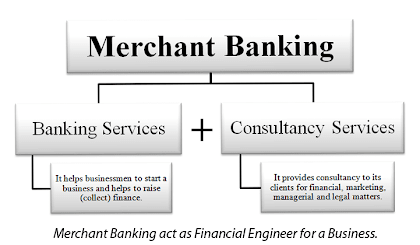
Merchant Banking is a combination of Banking and consultancy services. It provides consultancy to its clients for financial, marketing, managerial and legal matters. Consultancy means to provide advice, guidance and service for a fee. It helps a businessman to start a business. It helps to raise (collect) finance. It helps to expand and modernize the business. It helps in restructuring of a business. It helps to revive sick business units. It also helps companies to register, buy and sell shares at the stock exchange.

Functions of Merchant Banking

The functions of merchant banking are listed as follows:

  1. Raising Finance for Clients

Merchant Banking helps its clients to raise finance through issue of shares, debentures, bank loans, etc. It helps its clients to raise finance from the domestic and international market. This finance is used for starting a new business or project or for modernization or expansion of the business.

  1. Broker in Stock Exchange

Merchant bankers act as brokers in the stock exchange. They buy and sell shares on behalf of their clients. They conduct research on equity shares. They also advise their clients about which shares to buy, when to buy, how much to buy and when to sell. Large brokers, Mutual Funds, Venture capital companies and Investment Banks offer merchant banking services.

  1. Project Management

Merchant bankers help their clients in the many ways. For e.g. Advising about location of a project, preparing a project report, conducting feasibility studies, making a plan for financing the project, finding out sources of finance, advising about concessions and incentives from the government.

  1. Advice on Expansion and Modernization

Merchant bankers give advice for expansion and modernization of the business units. They give expert advice on mergers and amalgamations, acquisition and takeovers, diversification of business, foreign collaborations and joint-ventures, technology up-gradation, etc.

  1. Managing Public Issue of Companies

Merchant bank advice and manage the public issue of companies. They provide following services:

  • Advise on the timing of the public issue.
  • Advise on the size and price of the issue.
  • Acting as manager to the issue, and helping in accepting applications and allotment of securities.
  • Help in appointing underwriters and brokers to the issue.
  • Listing of shares on the stock exchange, etc.
  1. Handling Government Consent for Industrial Projects

A businessman has to get government permission for starting of the project. Similarly, a company requires permission for expansion or modernization activities. For this, many formalities have to be completed. Merchant banks do all this work for their clients.

  1. Special Assistance to Small Companies and Entrepreneurs

Merchant banks advise small companies about business opportunities, government policies, incentives and concessions available. It also helps them to take advantage of these opportunities, concessions, etc.

  1. Services to Public Sector Units

Merchant banks offer many services to public sector units and public utilities. They help in raising long-term capital, marketing of securities, foreign collaborations and arranging long-term finance from term lending institutions.

  1. Revival of Sick Industrial Units

Merchant banks help to revive (cure) sick industrial units. It negotiates with different agencies like banks, term lending institutions, and BIFR (Board for Industrial and Financial Reconstruction). It also plans and executes the full revival package.

  1. Portfolio Management

A merchant bank manages the portfolios (investments) of its clients. This makes investments safe, liquid and profitable for the client. It offers expert guidance to its clients for taking investment decisions.

  1. Corporate Restructuring

It includes mergers or acquisitions of existing business units, sale of existing unit or disinvestment. This requires proper negotiations, preparation of documents and completion of legal formalities. Merchant bankers offer all these services to their clients.

  1. Money Market Operation

Merchant bankers deal with and underwrite short-term money market instruments, such as:

  • Government Bonds.
  • Certificate of deposit issued by banks and financial institutions.
  • Commercial paper issued by large corporate firms.
  • Treasury bills issued by the Government (Here in India by RBI).
  1. Leasing Services

Merchant bankers also help in leasing services. Lease is a contract between the lessor and lessee, whereby the lessor allows the use of his specific asset such as equipment by the lessee for a certain period. The lessor charges a fee called rentals.

  1. Management of Interest and Dividend

Merchant bankers help their clients in the management of interest on debentures / loans, and dividend on shares. They also advise their client about the timing (interim / yearly) and rate of dividend.

Services offered by Merchant Banks

Merchant Banks offers a range of financial and consultancy services, to the customers, which are related to:

  • Marketing and underwriting of the new issue.
  • Merger and acquisition related services.
  • Advisory services, for raising funds.
  • Management of customer security.
  • Project promotion and project finance.
  • Investment banking
  • Portfolio Services
  • Insurance Services.

Merchant Banker

Any person, indulged in issue management business by making arrangements with respect to trade and subscription of securities or by playing the role of manager/consultant or by providing advisory services, is known as a merchant banker. The activities carried out by merchant bankers are:

  • Private placement of securities.
  • Managing public issue of securities
  • Satellite dealership of government securities
  • Management of international offerings like Depository Receipts, bonds, etc.
  • Syndication of rupee term loans
  • Stock broking
  • International financial advisory services.

Objectives

Provide funds to companies: This usually includes loans for startup companies. They decide how much money a company needs to function through proposals created by these companies. They also help their clients raise funds through the stock exchange and other activities. Merchant banks act as a foundation for small scale companies in terms of their finances.

Underwriting: This is like insurance where banks sign into documents that agree to provide financial payment to their clients in case of any damage or losses. This is very important for clients to ensure that the bank will help them gain more income. If not, in case they would incur losses, the bank will pay them for the losses.

Manage their portfolios: The bank will look into the companies’ assets and will do the computation of their credits and debits to ensure they are not incurring any losses. They also provide other kinds of services to check on the liquidation of assets to track the income made by these companies and study how they can make it better.

Offering corporate advisory: They offer advises specially to starting companies and those that would want to expand. This advice involves financial aid to ensure that the company will be successful and will not have any problems along the way.

Managing corporate issues: Help incorporate securities management; they also serve as an intermediary bank in transferring capitals.

Qualities of A Good Merchant Bankers

  • Ability to analyse
  • Abundant knowledge
  • Ability to build up relationship
  • Innovative approach
  • Integrity
  • Capital Market facilities
  • Liaisoning ability
  • Cooperation and friendliness
  • contacts
  • Attitude toward problem Solving

Advisory Services

In this competitive era of vast modernization, maintaining your existence in the business industry is a tough task. In every vertical whether it be services, education, legal or business; there is an arduous competition. Every organization is trying to step on its rivals to move ahead and stay at the curve. In this world of prodigious opportunities and complexities, business organizations are looking forward to establish new connections and are finding new ways for innovation.

Advisory services are provided with the goal to support undertakings and overcome weakness in specific areas like finance, business, legal etc. A range of business advisors are bestowing best-in-class services to help organizations perform up to the ballpark and become a sovereign. Nowadays, start-ups are showing rapid growth in the industry, but the thing they lack is advisory service. Proper advisory services are required by every organization out there to leave a blemish on the audiences mind and the stakeholders too.

There are a plethora of advisory services like business advisory services, finance advisory services, legal advisory services, investment advisory services, corporate advisory services and much more.

Importance of Advisory services for your business

Advisory services are the keys to unlock your success.

Are you aware where your business is going? Are you aware who your target customers are? If you said no, it’s high time. You should definitely look for advisory consultants in order to save your sinking boat.

These days it’s arduous to talk about accounting profession without incorporating the words “business advisory services”. Advisory services are a huge need for every business organization out there. No mater you are a corporate giant or a just born start-up, you need advisory services at every step towards your success.

We’ve listed up some major factors that show how advisory services can help your organization to perform next level.

  1. Advice on Financial aspects

Financial aspects are the backbone of every business organization. Whether you want to invest in your previous infrastructure or looking to expand your venture, you need proper financial strategies to remain at the top. Some financial advisors are offering services like investment advisory services, accounting advisory services and numerous others.

  1. Increase the profit

If your organization’s profits were good but are suddenly facing downfall, it’s good time to get assistance from business advisories. Business advisors will re-imagine your business structure and with their strong ideation they’ll help you to manage and re-organize strategies to thrust your business like never before.

  1. Structure and effective business plan

Business Advisory services will help you to prevent some crucial mistakes that your company often makes while trying to expand its venture. Expanding your venture is a major decision. In some cases, the urge to increase profits forces business owners to take early decisions which in-return brings huge losses and destruction. A proper planning is indispensable before taking such huge steps.

  1. Identifying market growth

For business possessors it can be very fruitful, when their business thrive and they’re able to expand their business. But they lack somehow in identifying the market growth. The rigorous pace of growing market is really volatile and business owners face difficulties to cope up with the changing needs and requirements. A reliable business advisory firm can help business organizations with formulated techniques and strategies to conquer the difficulties.

  1. Technology-driven Solutions

Technologies are revolutionizing every sector with its fast pace of evolution. Some businesses fail to take the advantages of technology and start losing their customers to others, who are more technologically advanced. Business advisors not only help you to cope with financial difficulties but also muster you for technological advancements to again hold the grasp and rule the market.

Having a reliable advisory firm at your side is a plus point. There are several companies offering best-in-class financial advisory services in Delhi and other regions and you should definitely avail one to charge up your business.

Initial Public Offering (IPO), Terms, Process, Advantages, Disadvantages

An Initial Public Offering (IPO) is the process by which a private company becomes publicly traded by offering its shares to investors for the first time on a stock exchange. This allows the company to raise capital for expansion, debt repayment, or other financial needs. The IPO process involves regulatory approvals, pricing, and underwriting by investment banks. Once listed, the company’s shares are freely traded in the stock market. IPOs provide investors with an opportunity to own equity in a growing company while enabling businesses to access public funding and enhance their market visibility and credibility.

General Terms involved in an initial public offering (IPO):

  1. Issuer: The company that offers its shares to the public through an IPO to raise capital. It transitions from private to public ownership.

  2. Underwriter: Investment banks or financial institutions that manage and facilitate the IPO process, including pricing, marketing, and share allocation.

  3. Prospectus: A legal document providing detailed information about the company’s financials, business model, risks, and IPO details, helping investors make informed decisions.

  4. Offer Price: The price at which shares are initially issued to investors. It is determined through book-building or fixed price methods.

  5. Book Building: A price discovery process where investors place bids within a price range, and the final issue price is determined based on demand.

  6. Fixed Price Issue: The company sets a pre-determined price for its shares, and investors subscribe at that price. Demand is known only after the issue closes.

  7. Lot Size: The minimum number of shares an investor can apply for in an IPO, defined by the issuing company.

  8. Subscription: The demand for IPO shares. If demand exceeds supply, the IPO is oversubscribed; otherwise, it is undersubscribed.

  9. Allotment: The process of distributing shares to investors based on their IPO applications. If oversubscribed, shares are allotted via a lottery system.

  10. Listing: The process where IPO shares get listed on a stock exchange (NSE, BSE), enabling public trading of the company’s stock.

Process involved in an initial public offering (IPO)

  1. Underwriting

IPO is done through the process called underwriting. Underwriting is the process of raising money through debt or equity.

The first step towards doing an IPO is to appoint an investment banker. Although theoretically a company can sell its shares on its own, on realistic terms, the investment bank is the prime requisite. The underwriters are the middlemen between the company and the public. There is a deal negotiated between the two.

E.g. of underwriters: Goldman Sachs, Credit Suisse and Morgan Stanley to mention a few.

The different factors that are considered with the investment bankers include:

  • The amount of money the company will raise
  • The type of securities to be issued
  • Other negotiating details in the underwriting agreement

The deal could be a firm commitment where the underwriter guarantees that a certain amount will be raised by buying the entire offer and then reselling to the public, or best efforts agreement, where the underwriter sells securities for the company but doesn’t guarantee the amount raised. Also to off shoulder the risk in the offering, there is a syndicate of underwriters that is formed led by one and the others in the syndicate sell a part of the issue.

  1. Filing with the Sebi

Once the deal is agreed upon, the investment bank puts together a registration statement to be filed with the SEBI. This document contains information about the offering as well as company information such as financial statements, management background, any legal problems, where the money is to be used etc. The SEBI then requires cooling off period, in which they investigate and make sure all material information has been disclosed. Once the SEBI approves the offering, a date (the effective date) is set when the stock will be offered to the public.

  1. Red Herring

During the cooling off period, the underwriter puts together there herring. This is an initial prospectus that contains all the information about the company except for the offer price and the effective date. With the red herring in hand, the underwriter and company attempt to hype and build up interest for the issue. With the red herring, efforts are made where the big institutional investors are targeted (also called the dog and pony show).

As the effective date approaches, the underwriter and the company decide on the price of the issue. This depends on the company, the success of the various promotional activities and most importantly the current market conditions. The crux is to get the maximum in the interest of both parties.

Finally, the securities are sold on the stock market and the money is collected from investors.

Advantages of coming up with an IPO:

  • Access to Capital for Growth

An Initial Public Offering (IPO) enables a company to raise substantial capital from public investors. This funding can be used for business expansion, research and development, acquisitions, debt repayment, and infrastructure growth. Unlike bank loans or private equity, IPO funds do not require repayment, reducing financial burdens. With more capital, companies can invest in innovation, expand into new markets, and increase operational capacity, ensuring long-term sustainability and competitiveness in their industry.

  • Increased Public Awareness and Market Credibility

Going public enhances a company’s brand visibility and credibility in the market. Being listed on a stock exchange like NSE or BSE attracts media attention, analysts, and institutional investors, boosting the company’s reputation. This credibility helps in gaining customer trust, attracting new business opportunities, and securing strategic partnerships. A public company is perceived as more transparent and financially stable, which strengthens investor confidence and improves long-term business prospects.

  • Liquidity and Exit Opportunity for Early Investors

An IPO provides an exit strategy for early investors, founders, and venture capitalists who seek to realize returns on their investments. Unlike private funding, where selling shares can be complex, a public listing allows shareholders to sell their stakes in the open market. This liquidity increases investor interest in the company, making it easier to attract future investments. Employees with stock options (ESOPs) also benefit by monetizing their shares post-listing.

  • Ability to Use Stock as Currency

Publicly listed companies can use their shares as non-cash currency for mergers, acquisitions, and employee compensation. This means that instead of paying cash for acquisitions, they can issue new shares, preserving liquidity while expanding their business. Additionally, offering stock-based incentives to employees improves retention and motivation, aligning employee interests with company performance. This flexibility makes IPOs an attractive option for companies looking to grow strategically without heavy financial burdens.

  • Improved Corporate Governance and Transparency

Going public requires companies to adhere to stricter regulations and disclosure norms, improving corporate governance. Listed companies must publish financial reports, undergo audits, and follow SEBI guidelines, ensuring transparency and accountability. This structured governance framework enhances investor confidence, reduces operational risks, and leads to better decision-making. Improved governance also helps in securing further investments from institutional investors, ensuring long-term sustainability and trust in the financial markets.

Disadvantages of Coming up with an IPO:

  • High Costs and Expenses

Launching an IPO involves significant costs, including underwriting fees, legal expenses, regulatory compliance costs, and marketing expenses. Companies must hire investment banks, auditors, and legal advisors, making the IPO process expensive. Additionally, after listing, ongoing costs for financial reporting, compliance, and shareholder communication increase the financial burden. These costs may outweigh the benefits, especially for smaller firms with limited capital, making IPOs a less viable option compared to other funding sources.

  • Loss of Control and Ownership Dilution

When a company goes public, founders and existing shareholders lose a portion of their ownership as shares are distributed among public investors. This dilution can lead to a loss of control, especially if institutional investors or activist shareholders acquire a significant stake. Public companies must also consider shareholder interests in decision-making, which can limit flexibility and independence in business operations. Major decisions may require board approval, reducing management’s autonomy in strategic planning.

  • Regulatory and Compliance Burden

Public companies must adhere to strict regulations imposed by SEBI (Securities and Exchange Board of India) and stock exchanges. They are required to disclose financial statements, conduct regular audits, and follow corporate governance norms. Any failure to comply can result in penalties, legal actions, or delisting. The increased scrutiny demands transparency in operations, making it difficult for companies to keep certain strategic or financial information confidential, which could impact their competitive edge.

  • Market Volatility and Stock Price Fluctuations

Once listed, a company’s stock price is subject to market conditions, investor sentiment, and economic factors. External events such as economic downturns, political instability, or industry trends can lead to extreme fluctuations in share prices, affecting the company’s valuation. A declining stock price may create negative investor perception, reducing the company’s ability to raise additional funds. Management may also face pressure to meet short-term earnings expectations rather than focusing on long-term growth strategies.

  • Increased Public and Investor Pressure

A public company is accountable to shareholders, analysts, and regulators, which increases pressure on management to deliver consistent financial performance. Investors expect regular profits, dividends, and stock price growth, forcing companies to prioritize short-term performance over long-term strategies. Additionally, the risk of hostile takeovers increases as external investors accumulate shares. Management must spend significant time handling shareholder concerns, investor relations, and public disclosures, which can divert attention from core business operations.

  • Risk of Underperformance and Delisting

Not all IPOs succeed. If a company fails to meet investor expectations or generates lower-than-expected profits, its stock price may decline. Poor market conditions, weak financials, or mismanagement can lead to low demand for shares, resulting in poor post-IPO performance. In extreme cases, if a company fails to maintain compliance standards or sustains financial losses, it may face delisting from stock exchanges, leading to a loss of investor confidence and reputation damage.

E-Business, Features, Players, Challenges

E-business, or electronic business, refers to the practice of conducting business processes over the internet. It encompasses a wide range of activities, including buying and selling products or services, serving customers, collaborating with business partners, and conducting electronic transactions. e-business involves the entire business ecosystem, integrating internal and external processes.

E-business leverages digital technologies to enhance productivity, efficiency, and the customer experience. It covers a broad spectrum of applications such as supply chain management, customer relationship management (CRM), enterprise resource planning (ERP), online marketing, and more. The adoption of e-business allows companies to operate globally, reduce operational costs, and improve market responsiveness.

Features of E-Business

  • Global Reach

One of the most significant advantages of e-business is its ability to reach a global audience. With the internet as its primary medium, businesses can expand beyond geographic boundaries and tap into international markets without the need for a physical presence. This helps businesses increase their customer base and revenue potential.

  • Cost Efficiency

E-business reduces operational costs by minimizing the need for physical infrastructure, reducing paperwork, and automating business processes. For example, online platforms eliminate the need for physical stores, which significantly lowers overhead costs. Additionally, automated systems streamline inventory management, order processing, and customer support.

  • 24/7 Availability

e-business operates around the clock. Customers can browse, place orders, and make inquiries at any time, increasing customer convenience and satisfaction. This continuous availability provides a competitive edge in terms of customer service and responsiveness.

  • Personalization and Customization

E-business platforms can use data analytics and artificial intelligence to offer personalized experiences to customers. By tracking user behavior and preferences, businesses can recommend relevant products, customize marketing messages, and enhance customer engagement.

  • Interactivity

E-business fosters direct interaction between businesses and customers. Through online channels such as websites, social media, chatbots, and email, businesses can engage with customers in real-time. This interactive capability helps build stronger relationships and improves customer loyalty.

  • Integration with Business Processes

E-business is not limited to front-end operations; it integrates seamlessly with back-end processes, including supply chain management, finance, and human resources. By digitizing these processes, businesses can improve coordination, reduce errors, and enhance decision-making.

  • Scalability

E-business models are highly scalable. Companies can easily increase or decrease their operations to meet market demand. Whether it’s expanding product offerings, adding new features, or reaching new markets, e-business allows for quick and cost-effective scalability.

Key Players in E-Business

  • E-Retailers (B2C Players)

E-retailers are businesses that sell products or services directly to consumers through online platforms. Popular examples include Amazon, Flipkart, Alibaba, and eBay. These platforms offer a wide range of products, competitive pricing, and customer-friendly return policies, making them highly popular among consumers.

  • B2B Platforms

Business-to-business (B2B) platforms facilitate transactions between businesses. These platforms help companies source products, find suppliers, and manage bulk orders efficiently. Alibaba and IndiaMART are prominent examples of B2B platforms that enable businesses to connect and transact.

  • Service Providers

Service providers in the e-business ecosystem offer services such as web hosting, payment gateways, cloud storage, and logistics. Examples include PayPal and Stripe for online payments, AWS (Amazon Web Services) for cloud services, and FedEx for logistics and shipping.

  • Technology Enablers

Technology enablers are companies that provide the infrastructure and software necessary for e-business operations. This includes firms offering e-commerce platforms, website development tools, and digital marketing solutions. Shopify, WooCommerce, and Google (with its suite of advertising and analytics tools) are leading players in this category.

  • Social Media Platforms

Social media platforms play a crucial role in marketing, customer engagement, and brand building for e-businesses. Platforms like Facebook, Instagram, LinkedIn, and Twitter allow businesses to reach a large audience, interact with customers, and drive traffic to their websites.

  • Search Engines

Search engines such as Google, Bing, and Yahoo are integral to e-business success. They drive organic traffic to business websites through search engine optimization (SEO) and paid advertising. By appearing in top search results, businesses can increase visibility and attract more customers.

  • Consumers

Consumers are at the core of the e-business ecosystem. They play a dual role as buyers and promoters. Satisfied customers often share their positive experiences through reviews and social media, contributing to word-of-mouth marketing. In addition, their feedback helps businesses improve products and services.

Challenges of E-Business

  • Cybersecurity Threats

One of the most significant challenges for e-businesses is ensuring the security of customer data and online transactions. E-business platforms are prime targets for cyberattacks, such as hacking, phishing, and ransomware. Ensuring robust cybersecurity measures, such as encryption, firewalls, and secure payment gateways, is essential but costly. A single breach can damage a company’s reputation and result in legal penalties.

  • Lack of Personal Touch

Unlike traditional businesses where face-to-face interactions build trust, e-businesses operate in a digital environment where personal touch is minimal. This lack of direct interaction may lead to lower customer trust and loyalty, especially for high-value purchases or services that require personalized assistance.

  • Technical issues and Downtime

E-business operations are heavily reliant on technology, including websites, apps, and servers. Technical glitches, server crashes, or slow load times can disrupt business operations and negatively affect customer experience. Regular maintenance, software updates, and ensuring high uptime are critical but require significant investment.

  • Logistics and Delivery issues

For e-businesses that deal with physical products, efficient logistics and timely delivery are crucial. However, ensuring reliable shipping across various regions, managing inventory, and handling returns pose significant challenges. Factors such as delays, lost packages, and damaged goods can lead to customer dissatisfaction and increased operational costs.

  • High Competition

The online business environment is highly competitive, with numerous players vying for customer attention. Large players like Amazon and Alibaba dominate the market, making it difficult for smaller businesses to compete on price, delivery speed, and product variety. Standing out in such a competitive space requires innovative marketing strategies and exceptional service.

  • Legal and Regulatory Compliance

E-businesses must comply with various local and international regulations, such as data privacy laws (e.g., GDPR), taxation rules, and consumer protection acts. Navigating the complex legal landscape can be challenging, especially for businesses operating in multiple countries with differing regulations.

  • Digital Divide and Accessibility issues

While internet penetration is increasing, there is still a significant digital divide in many parts of the world. Limited internet access and lack of digital literacy among certain populations restrict market reach. Moreover, ensuring that e-business platforms are accessible to users with disabilities requires additional investment in technology and design.

Environmental Forces Affecting Planning and Practice of E-Business

The Ecommerce industry has seen immense growth in the recent years and apart from some fluctuations in the global economy like demonetization in India, the situation has remained favorable for its growth. China and US are the largest of the e-markets. However, growth rate is expected to be even higher than US in the Asia Pacific region this year. The US e-retail market is among the largest ones in the world.  Apart from Amazon, Ebay and Alibaba, there are a number of important players in the market like Fipkart, Walmart, Coles and Best Buy. The technological factors have also supported the growth of the Ecommerce industry. Growth in the use of mobile gadgets has also pushed the ecommerce sales high. A larger number of people are now shopping using their mobile phones.  There are several factors apart from economic and political that affect the global ecommerce industry.  This is a PESTEL analysis of the ecommerce industry that analyzes how these various forces can affect the ecommerce industry and how deep can their impact be on it.

Political factors

While the threats may not be the same before the e-retailers as the physical retailers, still there are several political hurdles before them. There are several risk factors affecting the e-businesses. For example for the global leaders like Amazon and E-bay growth in Asia pacific region can be made difficult by the Red tape. Several news reports highlight how Red Tape in India can become major difficulty in the way of new businesses trying to extend their presence there. The political and regulatory challenges before the e-businesses have kept rising.  The growth of Ecommerce in EU has also been challenged by political factors. EU has kept targeting technology giants from US. Google and Amazon have already been targeted by EU. Such issues can be a threat to the growth of ecommerce in Europe and it is why several sources predict that the growth rate of ecommerce in Europe is going to be low. Political issues are not limited to just those discussed above but there are many more. Political stability in most regions of the world leads to economic stability. Political chaos can result .to disruption of business both online and physical. Overall, political issues can have a significant impact on ecommerce and its growth.

Economic factors

Economic factors are very significant in terms of business. Whether it is an online business or physical, economic factors can have a significant effect on it. It is because economic factors are directly related to business and their effect is also direct on business revenue and profits.  During the period of recession, spending had decreased. People had adopted cost cutting measures as the level of economic activity and employment had gone down. During such periods when economic activity has gone down, the profits and revenue of businesses can go down. E-businesses too cannot remain unaffected. Economic fluctuations since the recession have also kept affecting businesses from time to time since the recession. In several economies like Russia, Brazil and India, these economic fluctuations affected both global and local businesses. Now that the recession has passed and economic activity has returned on track, the ecommerce industry has flourished in the recent years. Higher economic activity means faster growth and higher revenue for the Ecommerce industry whereas lower economic activity means just its opposite. In this way, economic factors can have a direct and deep impact in the ecommerce industry.

Social factors

Socio cultural factors too have a deep impact in ecommerce industry. Most importantly e-retail brands find it the easiest to flourish locally. Growth in foreign markets can be full of challenges. Changing trends can also have an impact on businesses. The growing use of mobile technology has affected ecommerce. In most societies the mobile technology has been very popular and a larger number of people worldwide are now using mobile gadgets for shopping and other purposes. Socio cultural factors affect businesses in other ways too. Cultural factors have an impact on how these ecommerce businesses market themselves. In several societies of the world ecommerce is still seen as a sign of Westernization due to which it has seen low growth in these areas.

Technological factors

Technological factors are very important in the context of the ecommerce industry.  It is because the industry relies heavily on technology. Everything is based on technology in e-retail from sales to customer service. All the ecommerce brands are in a race to be technologically ahead of their competitors. From Amazon to E-bay and Flipkart, every brand is investing a lot in technology to find faster growth. Technology decides several things in the ecommerce world from popularity to profits. The reason that Amazon is ahead of the others is because it is technologically ahead of the others. It has managed its customer experience so well that its popularity is very high.  In this way, technology is a major influence on businesses and in case of ecommerce technological factors acquire a very special importance.

Environmental factors

Environmental factors too have a special importance in the context of Ecommerce industry. While the direct environmental impact of this industry is very low and nearly zero, it still focuses heavily on sustainability. Brands like Amazon have invested heavily in technology. Even in Ecommerce there are several areas where investing in sustainability can be highly productive. From sustainable packaging to waste reduction and renewable energy there are several areas where the e-retailers can invest in sustainability. Amazon has invested in renewable energy to gain freedom from the use of non-renewable energy resources.

Legal

Legal compliance is just as important for the businesses globally. Any tussle with the law can be a costly affair and even the e-retail brands can become a target unless they take care of compliance. It is why the big E-retail brands have separate teams to take care of the legal issues. Non compliance can result in financial losses as well as loss of image and reputation. From labor laws to sustainability laws, there are several areas where the e-retail brands have to be careful regarding compliance. Moreover, these laws differ from nation to nation and market to market and compliance in every area is important. So, in case of the companies operating internationally law can lead to major pressures and an increase in operational costs. The e-retail brands also have to be careful about the applicable laws and compliance.

error: Content is protected !!