Material costing

Material costing is the process of determining the costs at which inventory items are recorded into stock, as well as their subsequent valuation in the accounting records. We deal with these concepts separately.

Material Costing for Initial Inventory Acquisition

A company must decide whether it will record acquired materials at their purchased prices, or if additional costs will be added, such as freight in, sales taxes, and customs duties. The addition of these other costs is allowable, but may require a certain amount of additional work. It is easier to charge these additional costs to expense as incurred, so they appear immediately in the cost of goods sold.

Overhead is not allocated to raw materials, since these items have not undergone any production activities (with which overhead is associated). Overhead is only allocated to work-in-process and finished goods inventory.

Material Costing for Subsequent Valuation

Once inventory has been received into stock, it is subject to the lower of cost or market (LCM) rule. In essence, this rule states that the recorded cost of inventory should be at the lower of its recorded cost or the market rate. From a practical perspective, this rule is usually only applied to those inventory items having the largest extended costs. Its application to low-value items would not result in any material changes, and so is avoided from an efficiency perspective.

A cost layering concept must also be applied to inventory. Cost layering refers to the order in which inventory items are charged to the cost of goods sold when units are sold to customers. Several possible cost layering concepts that can be used are:

  • Specific identification method. Assign costs to specific units of inventory, and charge these costs to expense when the specific units are sold. Usually only applies to expensive and unique inventory items.
  • First in, first out method. Assign costs based on the assumption that the earliest goods acquired are the first ones sold. If prices are increasing, this tends to result in higher profits.
  • Last in, first out method. Assign costs based on the assumption that the last goods acquired are the first ones sold. If prices are increasing, this tends to result in lower profits. This method is not allowed under international financial reporting standards.
  • Weighted average method. Uses an average of the costs of all units in stock when charging costs to the cost of goods sold.

The following are essential for ascertainment of accurate material cost:

(I) Computation of total cost of material purchased.

(II) Systematised material issue procedure.

(III) Appropriate methods of pricing material issues.

(I) Computation of Total Cost of Material Purchased:

Most of the details needed to ascertain the total cost of material purchased can be obtained from the invoice sent by the supplier.

The basic purchase price has to be adjusted in the light of delivery and forwarding charges, sales tax, excise duty, etc. Similarly, transport charges and cost of containers have to be included. Any discounts receivable have to be appropriately subtracted.

(a) Discounts:

There are three types of discounts to be considered:

(i) Trade Discount:

This is a discount allowed by the supplier to compensate the buyer for the costs of ‘breaking bulk’, selling in small lots to customers, repacking, etc. The supplier is relieved from all these costs by the buyer by purchasing a large quantity. This discount is usually given by the wholesalers.

(ii) Quantity Discount or Bulk Discount:

This discount is allowed by the supplier as a measure of savings in cost which arise from the production of longer runs and the distribution of larger quantities. Part of the savings accruing to the supplier out of a large order is passed on to the buyer by means of quantity discount.

(iii) Cash Discount:

This discount is offered by the supplier to the buyer as an option. The discount is linked to payment of the invoice amount before a specified due date or within a specified number of days. The purchaser may make use of the option and obtain the discount if his cash position permits it. Generally, this discount is considered as a matter of ‘financial policy’ and not taken into account for computation of material cost.

(b) Transport and Storage Costs:

If transport cost and cost of storage in transit are not included in the invoiced price of the supplier, they may be added as the direct costs of purchase to the cost of material. If it is not possible to identify such costs with specific materials because of paying a combined amount for several materials, they may be treated as indirect expenditure and included in the overhead.

(c) Cost of Containers:

The supplier may or may not charge separately for containers. If no charges are made, no accounting treatment is required.

(II) Material Issue Procedure:

Materials kept in the stores are to be issued to production departments whenever the departments require them. The store keeper is to issue materials only when a material requisition is presented to him.

(a) Material Requisition:

It is a properly authorised document initiated by the production departments to draw the required material from stores. It has to be initiated by properly authorised person to avoid misappropriation of material.

The requisition serves as authority to the store keeper to issue materials. The store keeper puts serial number on the requisition and makes entries in the issue column of the bin card. After this the requisitions are sent to the cost office where the value of material issued is also filled up and credit is given to the material issued in the stores ledger and the job receiving the material in the job ledger is debited.

(b) Bill of Materials:

It is a document listing all the materials required with quantities required for a particular job, order or process. The bill of material serves the purpose of material requisition. The bill of material is prepared for a job of non standardised type so that estimate of all materials required for the job is made by the production department before the job is started. This is helpful to estimate material cost of the job for submitting tenders or quotations.

Treatment of Surplus Materials:

(a) Return of Surplus Material:

Sometimes, excess materials maybe issued to production departments. When these materials are returned to stores a Material Return Note is to be prepared by the department which has the excess materials. Generally, three copies are prepared. One copy is retained by the department which is returning the material. Two copies are sent to the store keeper. The store keeper keeps one copy for making entries in the Bin card and the second copy is sent to the cost office for making entries in the stores ledger and for giving credit to the job where the material is in excess.

(b) Transfer of Surplus Materials:

Transfer of excess materials from one job to another job is to be avoided as far as possible. This is because record for transfer may not be made and actual material cost of jobs may be inaccurate. However, sometimes the material may be allowed to be transferred to avoid delays and handling charges. The transfer is to be allowed only with preparation of material transfer note so that the cost of material transferred is debited to the job receiving the material and credited to the job transferring the material.

(III) Methods of Pricing Material Issues:

The purchase prices of materials fluctuate on account of changes in the product prices, buying from different suppliers and on account of quantity discounts. Because of price fluctuations, the stock may include several lots of the same material purchased at different prices. When these materials are issued to production, it is important to consider the correct price at which these materials are charged to production.

Stock Levels, Calculation, Reasons

Stock Level refers to the different levels of stock which are required for an efficient and effective control of materials and to avoid over and under-stocking of materials. The purpose of materials control is to maintain the sock of raw materials as low as possible and at the same time they may be available as and when required. To avoid over and under-stocking, the storekeeper must fix the inventory level, which is also known as a demand and supply method of stock control. In a scientific system of inventory control the following levels of materials are fixed.

Re-order Level

Re-order level is a level of material at which the storekeeper should initiate the purchase requisition for fresh supplies. When the stock-in-hand comes down to the re-ordering level, it is an indication that an action should be taken for replenishment or purchase.

The re-order level is calculated as follows:

Re-order Level = Minimum Level(Safety stock) + (Average lead time x Average consumption)

Re-order Level = Maximum Consumption x Maximum Re-ordering Period

Minimum Level Or Safety Level

Minimum level or safety stock level is the level of inventory, below which the stock of materials should not be fall. If the stock goes below minimum level, there is a possibility that the production may be interrupted due to shortage of materials. In other words, the minimum level represents the minimum quantity of the stock that should be held at all times.

The minimum level is determined by using the following formula:

Minimum Level = Re-order level -(Normal consumption x Normal Re-order Point)

Calculation OF Minimum Level Or Safety Stock

Illustration

Re-order Period = 8 to 12 days

Daily consumption = 400 to 600 units

Minimum Level = ?

Solution,

Minimum Level = Re-order Level – (Normal Consumption x Normal Re-order Point)

= 7200 – (500 x 10)

= 2200 units.

Working Notes:

1. Re-order Level = Maximum consumption x Maximum Re-order Point = 600 x 12 = 7200 units

  1. Normal consumption = (Maximum Consumption + Minimum Consumption)/2

    = (600+400)/2 = 1000/2= 500 units

  2. Normal Re-order Period = (Maximum Re-order Period + Minimum Re-order Period)/2

    = (12+8)/2 = 10 days.

Average stock Level

Average Stock level shows the average stock held by a firm. The average stock level can be calculated with the help of following formula.

Average Stock Level = Minimum Level + (1/2Re-order Quantity)

OR

Average Stock Level = (Minimum Level + Maximum Level) / 2

Illustration

Re-order quantity = 2000 units
Minimum Level = 500 units
Average stock level = ?

Solution,

Average stock level = Minimum level + 1/2 x Re-order quantity
= 500 + 1/2 x 2000
= 500+ 1000
= 1500 units.

Danger Level

Danger level is a level of fixed usually below the minimum level. When the stock reaches danger level, an urgent action for purchase is initiated. When stock reaches the minimum level, the storekeeper must make special arrangements to get fresh materials, so that the production may not be interrupted due to the shortage of materials.

The formula for calculating the danger level is:

Danger Level = Normal consumption x Maximum re-order period for emergency purchase

illustration,

Daily Consumption = 100 to 200 units

Maximum re-order period for emergency purchase = 5 days

Danger Level = ?

Solution,

Danger Level = Normal consumption x Maximum re-order period for emergency purchase = 150 x 5 = 750 units.

Maximum Level

Maximum level is that level of stock, which is not normally allowed to be exceeded. Beyond the maximum stock level, a blockage of capital should be exercised to check unnecessary stock. The factory should not keep materials more than the maximum stock level. It increases the carrying cost of holding unnecessary inventory level. It is the opportunity cost of holding inventory.

The maximum stock level can be calculated by using the following formula:

Maximum Level = Re-order Level + Re-order quantity – (Minimum consumption x Minimum Delivery Time)

illustration

Re-order quantity = 1000 units

Re-order Level = 1500 units

Re-ordering period = 4 to 6 days

Daily consumption = 150 to 250 units

Maximum Level = ?

Solution,

Maximum Level = Re-order level + Re-order quantity – (Minimum consumption x Minimum Re-ordering period)

= 1500+1000(150 x 4)

= 1900 units.

Reasons of Maintaining Optimal Stock Level:

  • Avoiding Stockouts and Production Delays

Maintaining an optimal stock level ensures that raw materials and finished goods are always available when needed, preventing production stoppages and order fulfillment delays. Stockouts can lead to missed sales opportunities, customer dissatisfaction, and reduced profitability. By keeping adequate inventory, businesses avoid disruptions in manufacturing, maintain a steady supply chain, and enhance customer trust. Inventory management techniques like Just-in-Time (JIT) and Economic Order Quantity (EOQ) help maintain the right balance of stock without overburdening storage capacity.

  • Reducing Excess Inventory Costs

Holding excess stock increases costs related to storage, insurance, depreciation, and obsolescence. Overstocking ties up capital, which could be used for other business operations. It also increases the risk of damage, spoilage, or products becoming outdated, especially for perishable or technology-based goods. By maintaining optimal stock levels, businesses reduce warehousing costs, handling expenses, and potential write-offs while improving cash flow and financial efficiency. Demand forecasting and inventory turnover analysis help in maintaining appropriate stock levels.

  • Enhancing Customer Satisfaction

Customers expect quick and reliable deliveries, and maintaining an optimal stock level ensures that orders are fulfilled on time. A lack of stock can lead to lost sales and customers switching to competitors. On the other hand, having excess stock can lead to outdated products that customers may no longer want. A well-managed inventory system ensures that products are available as per market demand, strengthening customer relationships and enhancing brand loyalty.

  • Improving Supply Chain Efficiency

An optimized stock level streamlines procurement, production, and distribution processes. It prevents disruptions caused by supply chain issues such as delayed shipments, supplier shortages, or transportation bottlenecks. Proper inventory control ensures a smooth material flow, reducing lead times and ensuring uninterrupted operations. Techniques like Vendor-Managed Inventory (VMI) and Just-in-Time (JIT) help maintain balance in the supply chain, reducing waste and increasing overall operational efficiency.

  • Preventing Material Wastage and Obsolescence

Overstocking increases the risk of perishable goods expiring, raw materials deteriorating, or finished products becoming obsolete due to changes in demand or technology. Maintaining optimal stock levels helps minimize waste, ensuring that older stock is utilized first through FIFO (First-In-First-Out) or LIFO (Last-In-First-Out) techniques. This is particularly crucial for industries dealing with food, pharmaceuticals, and electronics, where outdated inventory results in significant financial losses.

  • Enhancing Working Capital Management

Inventory represents a significant portion of a company’s working capital, and excessive stock ties up funds that could be used for other critical business operations. Maintaining the right stock levels ensures that money is not locked in unsold goods, improving liquidity and financial flexibility. Proper inventory management allows businesses to reinvest in product development, marketing, and operational growth, leading to higher profitability and financial stability.

  • Reducing Ordering and Carrying Costs

Ordering too frequently increases procurement costs, administrative work, and supplier dependency, while carrying excess stock raises storage, insurance, and handling costs. An optimal stock level strikes a balance, reducing both ordering and holding expenses. Inventory control techniques like EOQ (Economic Order Quantity), reorder point methods, and demand-based replenishment help in minimizing unnecessary expenses while ensuring a consistent supply of materials and goods.

EOQ, EOQ with Discounts

Economic order quantity (EOQ) is the ideal order quantity a company should purchase for its inventory given a set cost of production, demand rate and other variables. This is done to minimize variable inventory costs, and the equation for EOQ takes into account storage, ordering costs and shortage costs.

The full equation is:

EOQ = √(2SD / H), or the square root of (2 x S x D / H).

S = Setup costs (per order, generally includes shipping and handling)

D = Demand rate (quantity sold per year)

H = Holding costs (per year, per unit)

EOQ applies only when demand for a product is constant over the year and each new order is delivered in full when inventory reaches zero. There is a fixed cost for each order placed, regardless of the number of units ordered. There is also a cost for each unit held in storage, commonly known as holding cost, sometimes expressed as a percentage of the purchase cost of the item.

The economic order quantity is computed by both manufacturing companies and merchandising companies. Manufacturing companies compute it to find the optimal order size of raw materials inventory and

merchandising companies compute it to find the optimal order size of ready to use merchandise inventory.

The ordering and holding costs

The two significant factors that are considered while determining the economic order quantity (EOQ) for any business are the ordering costs and the holding costs.

Ordering costs

The ordering costs are the costs that are incurred every time an order for inventory is placed with the supplier. Examples of these costs include telephone charges, delivery charges, invoice verification expenses and payment processing expenses etc. The total ordering cost usually varies according to the frequency of placing orders. Mostly, it is directly proportional to the number of orders placed during the year which means If the number of orders placed during the year increases, the annual ordering cost will also increase and if, on the other hand, the number of orders placed during the year decreases, the annual ordering cost will also decrease.

Holding costs

The holding costs (also known as carrying costs) are the costs that are incurred to hold the inventory in a store or warehouse. Examples of costs associated with holding of inventory include occupancy of storage space, rent, shrinkage, deterioration, obsolescence, insurance and property tax etc. The total holding cost usually depends upon the size of the order placed for inventory. Mostly, the larger the order size, the higher the annual holding cost and vice versa. The total holding cost is some time expressed as a percentage of total investment in inventory.

EOQ with Discounts

Quantity discount is a reduction in price offered by seller on orders of large quantities. Quantity discounts exist in different forms and in certain scenarios they may not be obvious. The well-known buy-1-get-1-free sale is actually a 50% quantity discount since you effectively purchase a unit at half the normal price.

Different forms of quantity discounts provide different purchase incentives to buyers. For example, the one discussed above has a tentency to compel the buyer to purchase more than they need at the moment i.e. the seller will not allow you to purchase just one unit at 50% of the full price. Another form of quantity discount which is based on the cumulative quantity purchased during a specific time period actually induces the buyer to continue purchasing from the current supplier and restricts switching to other suppliers.

Implication for Decision Making

When purchasers following Economic Order Quantity (EOQ) model for ordering inventory have the opportunity to avail a quantity discount on order sizes greaters than their EOQ, they need to base their decision, apart from qualitative factors, on the net effect of the decision on the their income. A typical quantity discount has the following three effects on the income of a purchaser:

  1. A saving in the form of reduced price
  2. A saving in the form of reduced ordering costs
  3. A loss in the form of increased total holding costs of inventory

A decision to avail the quantity discount should be taken only if the net effect of the above components on the income is positive.

EOQ Assumptions

If the economic order quantity model is applied, the following assumptions should be met:

  • The rate of demand is constant, and total demand is known in advance.
  • The ordering cost is constant.
  • The unit price of inventory is constant, i.e., no discount is applied depending on order quantity.
  • Delivery time is constant.
  • Replacement of defective units is instantaneous.
  • There is no safety stock level, i.e., the minimum stock level is zero.
  • Restocking is made by the whole batch

Limitations

  • Erratic changes usages: the formula presumes the usage of materials is both predictable and evenly distributed. When this is not the case, the formula becomes useless.
  • Faulty basic information: order cost varies from commodity to commodity and the carrying cost can vary with the company’s opportunity cost of capital. Thus the assumption that the ordering cost and the carrying cost remains constant is faulty and hence EOQ calculations are not correct.
  • Costly calculations: the calculation required to find out EOQ is extremely time consuming. More elaborate formulae are even more expensive. In many cases, the cost of estimating the cost of possession and acquisition and calculating EOQ exceeds the savings made by buying that quantity.
  • No formula is a substitute for common sense: sometimes the EOQ may suggest that we order a particular commodity every week (six-year supply) based on the assumption that we need it at the same rate for the next six years. However, we have to order it in the quantities according to our judgement. Some items can be ordered every week; some can be ordered monthly, depends on how feasible it is for the firm.
  • EOQ ordering must be tempered with judgement: Sometimes guidelines provide a conflict in ordering. Where an order strategy conflicts with an operational goal, order strategy restrictions should be developed to permit honouring the goal.

Advantages

  • The economic order quantity helps in reducing the holding costs of inventory. The company does not have to order excess stocks that need to be stored in warehouses and thus saves money that would have to be spent on rent and other expenses related to storage.
  • The economic order quantity equation helps an organization to determine the number of units and the number of units it needs to purchase. This reduces the ordering costs as the company orders in fewer times and saves on costs related to transportation, packing, etc.
  • The EOQ helps the organization to manage its inventory in a better manner. It is now able to minimize its operational costs, and this ultimately leads to profits.
  • It makes restocking an easy process as the formula helps to determine how often you should be placing orders.
  • The EOQ model helps the company to find the best deal because now you are purchasing only what you require and not any excess that can become a waste.

Labour costing: Bonus and incentive plan

  1. Payroll Accounting:

It is concerned with the maintenance of records for the amounts due to the employees like salaries, wages, allowances, contributions to provident fund and E.S.I, etc. and the deduction to be made from the employees’ earnings. Payroll accounting requires the information relating to employee’s attendance, leaves, rates of pay, amounts to be deducted etc.

  1. Labour Cost Accounting:

It is concerned with identifying the amount of labour cost to be charged to individual jobs and overhead accounts. For this purpose, information relating to the time spent on each job or process or number of units produced is obtained from the job cards, piece work tickets etc. The idle time analysis is also necessary for labour cost accounting.

The main objective of it is to record the time spent by all workers on each activity on a separate job card or time sheet and then apply the appropriate hourly rate. The labour costs are then charged to each of these activities. The job cards, time sheets, idle time cards are the important documents for analyzing production labour costs to various jobs and overhead accounts.

  1. Time Keeping:

Time keeping means to note the attendance of workers for wage payments. It is the marking of attendance of a worker when he comes and leaves the factory. This record is generally kept at the factory gate and the workers coming in and going out have to record their time in it. Based on their attendance in the factory, they receive the wages.

The prime objectives of time keeping are as follows:

(a) Preparation of Payroll:

The wage bills of the organization are prepared by the payroll department on the basis of information given by the time keeping department.

(b) Computation of Cost:

The Costing department will compute the labour cost of different jobs, departments, cost centres etc. basing on the data of time spent provided by the time keeping department.

The time record will give us an idea about the total time for which the workers were present in the factory and for which they are paid. There are various methods of time keeping – hand written record, disc or token system, punch card system etc.

With the advancement of technology, the computers are also being used for time recording and analysis. The person who looks after time keeping is called ‘time keeper’ and his place of work is called ‘time office’. The time records are the basic data used for calculation of salaries and wages, overtime premium etc.

  1. Time Booking:

It is necessary to account for labour cost against each job, department, process, contract, cost centre etc. for which time booking records are kept to ascertain the labour time spent. Time booking means to know how much time is effectively spent by the worker on each job or in each department or on a process or on each contract etc. It is the recording of time spent within the working day upon different jobs.

It is the keeping of record of particulars of work done, or time spent on each job, process, operation etc. It is used to ascertain the labour time spent on each job, analysis of idle time, labour cost of various jobs and products. The time booking record is kept in the form of time cards for each worker, recording therein the actual time spent by him on the work.

The objectives of time booking are as follows:

(a) To ascertain the labour time spent on the job and the idle labour hours.

(b) To ascertain labour cost of various jobs and products.

(c) To calculate the amount of wages and bonus payable under the wage incentive scheme.

(d) To compute and determine overhead rates and absorption of overheads under the labour and machine hour methods.

(e) To evaluate the performance of labour by comparing actual time booked with standard time.

Bonus and Labour incentives

Incentive Scheme: Type # 1. Halsey Premium Plan:

This plan was introduced by F. A. Halsey, an American engineer, in 1891. It recognises individual efficiency and pays bonus on the basis of lime saved. Under the method a worker is given wages at the time rate for the time he actually worked and also paid a bonus if he can complete the work in less than the time allotted to do the work.

The bonus is paid at a fixed percentage of the time saved, usually 50%, (though the percentage varies from 30% to 70% of time saved). The remaining 50% of the time saved is shared by the employer.

Thus,

Total Earnings = T.T. × H.R. + 50% (T.S. × H.R.)

where, T.T. = Time Taken

H.R. = Hourly Rate

T.S. = Time Saved

The main advantages of the method are:

(i) The method is simple to operate and easy to understand.

(ii) The slow workers are not penalised, as time wage is guaranteed.

(iii) It provides incentives to more efficient workers.

(iv) Worker’s efficiency means reduction in cost per unit.

(v) The benefit of time saved is shared between employer and employee equally.

The main disadvantages of the method are:

(i) Many employees organisations do not like to share the benefit of time saved equally.

(ii) Attraction of bonus reduces the quality of work.

(iii) Reduction of quality means chances of more wastage, spoilage, defective and break down etc. and more supervision cost.

(iv) It is not so much attractive as in the case of piece rate payments.

(v) It offers less incentive to the workers as compared to other incentive plans.

(vi) If the time rate is not fixed properly, this may lead to a higher bonus.

Incentive Scheme: Type # 2. Halsey-Weir Premium Scheme:

The scheme was introduced by Weir Ltd. of Glasgow in about 1900. It is similar to Halsey Scheme except that under this scheme the employee gets 33⅓% (often 30%) of the time saved as bonus and the remaining 66⅔% goes to the employer.

Thus:

Total Earnings = T.T. × H.R. + 33⅓% (T.S. × H.R.)

where, T.T. = Time Taken

H.R. = Hourly Rate

T.S. = Time Saved

Incentive Scheme: Type # 3. Rowan Plan:

Grames Rowan first introduced this plan in Glasgow in 1898. Under this scheme also the worker gets his guaranteed time wages for the hours of his actual work, like Halsey Scheme. But here the premium is calculated by a different method.

If the worker can complete the job in less than the time allowed, his bonus becomes equal to his time wages for that proportion of the time taken as the time saved bears to the time allowed.

Thus, the bonus is calculated as:

and, Total Earnings = T.T × H.R. + (T.T. × H.R.) × T.S./T.A.

where, T.T. = Time Taken

H.R. = Hourly Rate

T.S. = Time Saved

T.A. = Time Allowed

The following are the main advantages of the scheme:

(i) It provides incentives to learners and slow workers.

(ii) Since the premium is proportionate to the time saved, the employers get protection if the rate is not fixed properly.

(iii) From the point of view of employer the Rowan Scheme is safer than the Halsey Scheme.

(iv) Up to 50% of the time saved, bonus under the scheme is higher than that under Halsey Scheme.

(v) As the bonus increases at a decreasing rate; the employees do not rush for rapid completion of job, hence lesser chances of wastage etc.

(vi) Due to higher output, fixed overhead per unit will be lower.

The main disadvantages are:

(i) Method is complicated.

(ii) At the level of higher production, incentive is low.

(iii) Employees are not willing to share their time savings with their employers.

Comparison between Halsey and Rowan Scheme:

(1) Up to 50% of time saved, the premium will be same under the two schemes.

(2) Under Rowan Scheme bonus rises faster than Halsey Scheme until the job performed in half than the standard time.

(3) But when the time taken to perform the work is less than half of the standard time, premium and total earnings under the Halsey Scheme are both greater than those under Rowan Scheme.

(4) On the other hand, when the time taken to perform the work is more than half of the standard time, bonus and total earning under the Rowan Scheme are both greater than those under the Halsey Scheme.

(5) The Halsey Scheme provides more incentive to speed up production but there is an automatic check under the Rowan Scheme after certain stage.

(6) Halsey Scheme proves to be costlier if more than half the time is saved, while Rowan Scheme is costlier if less than half the standard time is saved.

Incentive Scheme: Type # 4. Taylor’s Differential Piece Rate System:

This system was first introduced by F. W. Taylor, the Father of Scientific Management. This system provides no minimum guaranteed time wages.

But under the system two piece rates are fixed:

(a) A low piece rate for output below the standard is paid to the workers, and

(b) A higher rate is paid to the workers who produce equal or more than the standard. Thus, this system penalises the inefficient workers and rewards the efficient workers.

The efficiency of a worker may be determined as a percentage, either:

(i) Of the time allowed for a job to the actual time taken, or

(ii) Of actual output to the standard output, within a specified time.

Incentive Scheme: Type # 5. Merrick Differential Piece Rate Plan:

This is a slight modification of Taylor’s System and uses three rates instead of two. Under this system also day wages are not guaranteed.

The three piece rates are:

Efficiency – Piece rate applicable

Up to 83% – Normal rate

Up to 100% – 10% above normal rate

Above 100% – 20% above normal rate

The main feature of this system is that it does not penalise the workers who produce below the standard output up to 83% and the earnings increase with increased efficiency at two stages.

Incentive Scheme: Type # 6. Gantt Task and Bonus Plan:

The plan is a good combination of time-work and piecework. Under the scheme the day wages of the worker are guaranteed.

The main features of the bonus scheme are:

Output – Bonus

At 100% – 20% on the total output

Above 100% – 20% of the wages of the standard time, or High piece rate on the worker’s whole output.

This scheme protects and encourages the less efficient workers who cannot produce the standard output. It offers a good incentive to the efficient workers.

Incentive Scheme: Type # 7. Emerson’s Efficiency Plan:

This scheme is also a combination of time wage, piece rate wage and bonus plans. Under this method a standard time is set for each job, or task or volume of output is fixed as the standard. The standard efficiency is set at 66⅔ or 67%. For efficiency up to 67% the worker gets his day wage only.

If he crosses the standard task, he becomes entitled to bonus and the rate of bonus increases with the increase in efficiency. At 100% level of efficiency, the bonus becomes 20%. Again, if the efficiency exceeds 100%, bonus increases by 1% for every 1% increase of efficiency above 100%.

Incentive Scheme: Type # 8. Group Bonus Plans:

The incentive schemes explained so far are applicable to individual workers only. But, sometimes it becomes necessary to introduce Group Bonus Scheme. Under the scheme bonus is paid to the group as a whole, depending upon the performance of the group and the amount of bonus is shared by themselves equally or at an agreed proportion.

The group bonus is suitable in the following circumstances:

(a) When it is very difficult to measure the performance of individual worker, but the production through collective efforts of a group of workers can be measured.

(b) The nature of the work requires collective effort.

(c) Where it is desirable to develop a team spirit.

(d) Where both the direct and indirect workers are to be rewarded.

(e) When bonus scheme cannot be operated successfully for individual workers.

However, before introducing a group bonus scheme, following points must be considered very carefully:

(i) Well combination among the group.

(ii) The size of the group should be economic.

(iii) The group should be homogeneous.

(iv) The production of the group should be within its control.

Thus, a group bonus scheme encourages team spirit, reduces wastage, assures cooperation, lessens supervisory work and reduces overall costs.

Illustration 1:

Time allowed for a job = 5 hrs

Time taken to complete the job = 4 hrs

Rate Per hour = Rs. 1

Calculate the total earnings of a worker under the Halsey Premium Scheme.

Solution:

Total Earnings = Hours worked × Rate per hour + 50/100 × (time saved × hourly rate)

= Rs. 4 × 1 + (50/100 × 1) × 1

= Rs. (4 + 1/2) = Rs. 4.50

Illustration 2:

Time allowed for a work = 10 hrs

Time taken to complete the job = 8 hrs

Rate per hour = Rs. 2

Calculate the total earnings of a worker under the Halsey Premium Scheme.

Solution:

Total Earnings = Time Taken × Hourly Rate + 33⅓ (T.S. × H.R.)

Where T.S. = Time Saved, H.R. = Hourly Rate

Total Earnings = 8 × Rs. 2 + 33⅓/100 × 2 × Rs. 2

= Rs. 16 + Rs. ⅓ × 4 = Rs. 16 + Rs. 1.33 = Rs. 17.33

Illustration 3:

Standard time is 20 hrs, Time taken is 16 hrs, Hourly Rate is Re. 0.50

Find out total earnings under Rowan Plan.

Solution:

Total Earnings = Time Taken × Hourly Rate + (Time Taken x Hourly Rate) × Time Saved/Time Taken

Time Saved = Time Allowed – Time Taken

= (20 – 16) hrs. = 4 hrs

... Total Earnings = 16 × Re. 0.50 + (Re. 0.50 × 16) × 4 × Rs. 0.50/20

= Rs. 8 + Rs. 8 × 2/20 = Rs. (8 + 0.80)

= Rs. 8.80

A factory works 8 hours a day. The standard output is 10 units per hour and normal rate is Rs. 5 per hour. The factory has introduced the following differentials in the matter of wage payment:

80% of piece rate when below standard.

120% of piece rate when at or above standard.

Find out piece rate at below and above standard.

Solution:

Normal piece rate = Rs. 5/10 = 0.50

When below standard the piece rate will be = 0.50 × 80/100 = Re. 0.40

When above standard the piece rate will be = 120/100 × 0.5 = Re. 0.60

Standard Production:

80 units per week. No. of men working in the group = 10. Bonus for every 25% increase in production, a bonus of Rs. 10 will be shared prorata among the 10 members of the group.

Actual production during a week = 110 units.

Solution:

Increase in production over standard = (110 -80) units = 30 units

i.e. 30/80 × 100 or 37.5%

... Bonus = Rs. 10 + 12.5/25 × Rs. 10

= Rs. 10 + 5 = Rs. 15

Each member of the group, therefore, receives = Rs. 15 ÷ 10 = Rs. 1.50

Worked-out Problems:

Problem 1:

Calculate by the Halsey Premium Plan and determine on this basis the total earnings of a worker by the given data:

Standard time for work – 20 hours

Actual time – 16 hours

Rate per hour – Rs. 2

Solution:

Total Earnings = Time taken × Rate per hour + 50% (Time saved x Rate per hour).

Standard time = 20 hours

Time taken = 16 hours

... Time Saved = Standard time – Time taken i.e. 20 hours – 16 hours = 4 hours.

... Total Earnings = 16 × 2 + 50/100 (4 × 2) = 32 + 4 = Rs. 36

Total Earnings under Halsey Premium Plan = Rs. 36

Problem 2:

From the following particulars, calculate the cash required for wages in a company, during the month of January 2007:

Solution:

Problem 3:

From the following calculate the total monthly remuneration of each of three workers A, B and C:

(i) Standard production per month per worker = 1,000 units

(ii) Actual production during a month: A = 890 units, B = 720 units, C = 960 units.

(iii) Piece work rate per unit of actual production = 20 paise

(iv) Dearness wages Rs. 50 per month (fixed)

(v) House Rent allowance Rs. 20 per month (fixed)

(vi) Additional production bonus at the rate of Rs. 5 for each percentage of actual production exceeding 80% of the standard.

Solution:

Working Notes:

  1. Calculation of Bonus:

(i) Worker A:

Actual Production = 890 units i.e. 890/1,000 × 100 = 89% efficiency

... Bonus = (89 – 80) × Rs. 5 = Rs. 45

(ii) Worker B:

Actual Production = 720 units i.e. 720/1,000 × 100 = 72% efficiency

... Bonus = Nil

(iii) Worker C:

Actual Production = 960 units i.e. 960/1,000 × 100 = 96% efficiency

... Bonus = (96 – 80) × Rs. 5 = Rs. 80

Problem 5:

During a certain week in September 2006, a worker manufactured 240 articles. Working hours during a week are 48 hours, standard rate Rs. 5 per hour and standard time to manufacture an article is 15 minutes.

Calculate his gross wages for the week according to (a) Piece work with guaranteed weekly wages, (b) Rowan Premium Bonus Plan, (c) Halsey Premium Bonus Plan.

Solution:

(a) Under Piece work with guaranteed weekly wages:

Actual Wages = Time Taken × Rate per hour

= 48 hours × Rs. 5 = Rs. 240

Guaranteed weekly wages = Standard Time × Rate per hour

= 60 hours × Rs. 5 = Rs. 300

Therefore, actual wages is less than guaranteed wages. So the worker will receive guaranteed wages Rs. 300 for the week.

... Rate per hour = Rs. 300/48 hrs. = Rs. 6.25

Working Notes:

(i) Standard time for 240 articles = 240 × 15 minutes

= 3,600 minutes or 60 hours.

Problem 6:

From the following data ascertain the total earnings of each worker separable under (i) Halsey Scheme (50%), (ii) Rowan Scheme. Also calculate the effective hourly rate of wages of the workers under both the schemes:

Solution:

Problem 7:

From the following particulars you are required to calculate under ‘Average Wage Rate’ the labour cost chargeable to Job No. ‘A’ which was completed in 1990:

Basic Wage Rate is Rs. 2 per hour and overtime rates are:

Before or after working hours 150% of basic wage rate.

Sundays and holidays – 200% of basic wage rate.

During the year 1990 the following hours were worked:

Solution:

... Average Wage Rate = 5,70,000/2,50,000 = Rs. 2.28

Now, computation of labour cost under ‘Average Wage Rate’

Items – Job No. ‘A’

Hours Spent – 3,500

Average Wage Rate – Rs. 2.28

... Labour Cost Chargeable = 3,500 hours × Rs. 2.28 = Rs. 7,980

Overhead costing: Primary and Secondary

Primary distribution involves apportionment or allocation of overhead to all departments in a factory on logical and rational basis. This process of apportionment is also known as departmentalisation of overhead. It is to be carefully noted that at the time of making primary distribution, the distinction between production and service departments is ignored.

Following points should be considered for primary distribution of items of overheads:

(i) Basis for distribution should be equitable and practicable;

(ii) Method adopted for distribution should not be time-consuming;

(iii) Overhead expenses should be distributed among different departments on the basis of benefits received by departments;

For the purpose of primary distribution, a departmental distribution summary is prepared in the following way:

Basis of Apportionment of Factory Overhead:

Expenses:

  1. Lighting, heating, rent, rates and taxes, depreciation on building, repair cost of building, caretaking etc.
  2. Insurance on Plant and Machinery, Building; Depreciation on Plant and Machinery; Maintenance of Plant and Machinery.
  3. Insurance on tools and fixtures, power, repairs and maintenance cost etc.
  4. Canteen subsidy or expenses, pension, medical expenses, personnel department expenses, cost of recreational facilities. Expenses of wage department
  5. Cost of supervision.

Base:

  1. Floor area occupied by each department. Light points for lighting.
  2. Capital values of Assets.
  3. Direct Labour hours or Machinery hours.
  4. Number of employees or workers.
  5. Time devoted.

Apportionment of Overhead

Secondary Distribution:

In a factory a product does not pass through Service department (S), but service department renders service to production departments for carrying on production function. It is, therefore, logical that the product cost should bear the equitable share of cost of service department. Under this backdrop, the second step is to distribute the total cost of service departments among the production departments.

The process of redistributing the cost of service departments among production departments is known as secondary distribution. Here, the cost of service department means the apportioned overheads plus direct materials plus direct labour and direct expenses of concerned service department.

Bases for Secondary Distribution:

Service Department Costs:

(i) Employment department

(ii) Maintenance department

(iii) Purchase department

(iv) Store keeping

(v) Canteen, welfare and recreation

Basis of Redistribution:

(i) Rate of labour-turnover or number of employees.

(ii) Hours worked for each department.

(iii) No. of purchase orders or value of materials purchased.

(iv) No. of requisitions.

(v) No. of employees of each department.

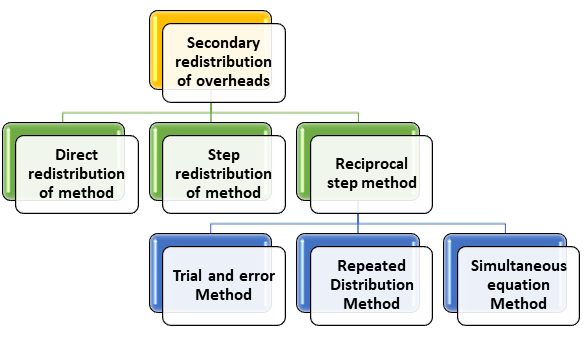
(i) Direct Redistribution Method:

Under this method, service department’s costs are apportioned to production depart­ments only ignoring service rendered by one service department to another. When this method is followed, the number of secondary distribution will be equal to number of secondary department.

(ii) Step Method:

This method of redistribution gives cognizance to the service rendered by one service department to another service department. The cost of service department which renders service to the largest number of other departments is distributed first.

After this is done, the cost of service department serving the next largest number of department is apportioned. This process continues till the cost of last service department is apportioned. The cost of last service department is apportioned among production departments only.

(iii) Reciprocal Distribution Method:

There may be two or more service departments in a factory and they may render service to each other. In that situation it is logical to give weight to inter-departmental services while distributing the expenses of service departments.

There are three methods for dealing with the distribution of inter-departmental services:

(A) Trial and Error Method

(B) Repeated Distribution Method

(C) Simultaneous Equation Method.

Stock Valuation

Stock Valuation refers to the process of determining the value of inventory held by a business at the end of an accounting period. Accurate stock valuation is crucial for financial reporting, profit calculation, and proper cost management. Inventory is classified as a current asset on the balance sheet, and its valuation directly affects both the cost of goods sold (COGS) and the net income of the business.

Objectives of Stock Valuation:

  • Accurate Profit Determination

Proper valuation of inventory ensures accurate determination of COGS and, consequently, the correct profit or loss for the period.

  • True Financial Position

Inventory is a significant asset, and its correct valuation is essential for presenting a true and fair financial position of the company.

  • Efficient Cost Control

Stock valuation helps in monitoring and controlling production and operational costs by providing insights into material consumption and wastage.

  • Compliance with Accounting Standards

Accurate stock valuation ensures adherence to accounting principles and standards, such as the Generally Accepted Accounting Principles (GAAP) and International Financial Reporting Standards (IFRS).

Methods of Stock Valuation:

There are several methods for valuing stock, depending on the nature of the business and accounting policies adopted. The commonly used methods are:

1. First-In, First-Out (FIFO)

The FIFO method assumes that the oldest inventory items are sold first. Therefore, the ending inventory consists of the most recent purchases.

Advantages:

  • Provides a realistic view of ending inventory value, as it is based on the most recent prices.
  • Useful in periods of inflation, as the cost of goods sold is lower, resulting in higher profits.

Disadvantages:

  • Higher profits may result in higher tax liability during inflationary periods.

Example:

Date Units Purchased Cost per Unit (₹) Total Cost (₹)
1 Jan 100 10 1,000
5 Jan 200 12 2,400
Total Units Sold = 150

COGS for 150 units:

  • 100 units @ ₹10 = ₹1,000
  • 50 units @ ₹12 = ₹600

Total COGS = ₹1,600

2. Last-In, First-Out (LIFO)

LIFO method assumes that the most recent inventory items are sold first, and the ending inventory consists of the oldest purchases.

Advantages:

  • In periods of inflation, LIFO results in higher COGS and lower profits, which can reduce tax liability.

Disadvantages:

  • The ending inventory may be undervalued since it consists of older costs, which may not reflect current market prices.
  • LIFO is not permitted under IFRS.

Example:

Using the same data as in the FIFO example:
COGS for 150 units:

  • 150 units @ ₹12 = ₹1,800

    Total COGS = ₹1,800

3. Weighted Average Cost (WAC)

WAC method calculates the cost of ending inventory and COGS based on the average cost of all units available for sale during the period.

Formula:

Weighted Average Cost per Unit = Total Cost of Inventory / Total Units

Example:

Using the same data:

Total units = 100 + 200 = 300

Total cost = ₹1,000 + ₹2,400 = ₹3,400

Weighted average cost per unit = ₹3,400 ÷ 300 = ₹11.33

COGS for 150 units = 150 × ₹11.33 = ₹1,699.50

Comparison of Methods

Criteria FIFO LIFO WAC
Cost Flow Assumption Oldest items sold first Newest items sold first Average cost
Ending Inventory Value Higher during inflation Lower during inflation Moderate
Profit Impact Higher profit Lower profit Average profit
Permitted by IFRS Yes No Yes

Importance of Consistency

Once a method of stock valuation is adopted, it should be consistently applied across accounting periods. Changing methods frequently can distort financial results and reduce comparability. However, any change in the valuation method must be disclosed, along with its financial impact, as per accounting standards.

Cost Sheet: Current and Estimated

A cost sheet is a statement prepared at periodical intervals of time, which accumulates all the elements of the costs associated with a product or production job. It is used to compile the margin earned on a product or job and forms the basis for the setting of prices on similar products in the future.

Objects of Cost Sheet

  1. For determining the selling price

A cost sheet helps in determination of selling price of a product or of a service. Cost sheet ascertains cost at each stage of the product and also the total cost of the product, where a margin of profit is added and thus the selling price is ascertained.

  1. Facilitating in managerial decision making

Preparation of cost sheet helps managers at various levels in their decision-making process such as

  • To produce or buy a component,
  • What price of goods to quote in the tender,
  • Whether to retain or replace an existing machine,
  • How to reduce costsand maximize profit.
  • Identify and make decisions whether they need to continue with the product or not.
  1. Preparation of budgets

Organizations can prepare a budget with the help of a cost sheet. We can prepare the budget by using the current or previous year’s data.

Elements of Cost

Prime Cost: It comprises of direct material, direct wages, and direct expenses. Alternatively, the Prime cost is the cost of material consumed, productive wages, and direct expenses.

Factory Cost: Factory cost or works cost or manufacturing cost or production cost includes in addition to the prime cost the cost in indirect material, indirect labor, and indirect expenses. It also includes amount or units of WIP or incomplete units at the end of the period.

Cost of Production: When Office and administration cost at the end of the period are added to the Factory cost, we arrive at the cost of production or cost of goods sold. Here, we make an adjustment for opening and Closing finished goods.

Total Cost: Total cost or alternatively cost of sales is the cost of production plus selling and distribution overheads.

  • A Cost Sheet depicts the following facts:
  • Total cost and cost per unit for a product.
  • The various elements of cost such as prime cost, factory cost, production cost, cost of goods sold, total cost, etc.
  • Percentage of every expenditure to the total cost.
  • Compare the cost of any two periods and ascertain the inefficiencies if any.
  • Information to management for cost control
  • Calculate and summarize the total cost of the product.

Proforma of a Cost Sheet

  PARTICULARS  AMOUNT  AMOUNT
 TOTAL
  DIRECT MATERIAL-PURCHASED
ADD OP STOCK OF RAW MATERIAL
LESS CL STOCK OF RAW MATERIAL
  MATERIAL CONSUMED
ADD DIRECT WAGES
ADD DIRECT EXPENSES
  PRIME COST
ADD WORKS OR FACTORY OVERHEADS
   Factory Overheads
ADD OP STOCK OF WIP
LESS CL STOCK OF WIP
  WORK COST
ADD ADMINISTRATION OR OFFICE OVERHEADS
  COST OF PRODUCTION
ADD SELLING AND DISTRIBUTION OVERHEADS
 
ADD OP STOCK OF FG
LESS CL STOCK OF FG
  COST OF SALES
ADD PROFIT MARGIN
SELLING PRICE  

Method of Preparation of Cost Sheet

Step I Prime Cost =  Direct Material Consumed + Direct Labour + Direct Expenses

Direct Material= Material Purchased + Opening stock of raw material-Closing stock of raw material.

Step II  Works Cost = Prime Cost + Factory Overheads (Indirect Material + Indirect Labour + Indirect Expenses)+opening Work in progress-Closing Work in progress
Step III Cost of Production = Works Cost + Office and Administration overheads + Opening finished goods-Closing finished goods
Step IV Total Cost = Cost of Production + Selling and Distribution Overheads
Profit Sales – Total Cost

Reconciliation of Financial accounts and Cost accounting

Reconciliation of financial accounts and cost accounts refers to the process of matching and comparing the data recorded in the financial accounting system with that in the cost accounting system. While financial accounts focus on preparing financial statements for external reporting, cost accounts are designed to provide detailed cost information for internal management purposes. Since these systems may use different methods and principles, reconciliation is essential to ensure accuracy, identify discrepancies, and provide a unified view of financial and operational performance.

Need for Reconciliation:

  • Differences in Objectives

Financial accounting aims at reporting an organization’s financial position and performance to external stakeholders, adhering to standardized rules like Generally Accepted Accounting Principles (GAAP). Cost accounting, on the other hand, focuses on internal decision-making, cost control, and efficiency improvements.

  • Variations in Treatment of Costs

Financial accounting categorizes costs into fixed, variable, and mixed costs for reporting purposes. Cost accounting uses classifications like direct and indirect costs, product costs, and period costs for analysis and control.

  • Separate Sets of Books

Often, organizations maintain separate records for financial and cost accounting, leading to differences that necessitate reconciliation.

  • Compliance and Accuracy

Reconciling financial and cost accounts ensures compliance with statutory requirements, eliminates errors, and provides reliable data for stakeholders.

Causes of Discrepancies:

  • Valuation of Inventory

Financial accounts typically value inventory using methods like FIFO, LIFO, or weighted average. Cost accounts may use different valuation bases, such as standard cost or marginal cost.

  • Depreciation Methods

Financial accounts might use straight-line or reducing-balance methods for depreciation, whereas cost accounts may allocate depreciation based on machine hours or production units.

  • Overhead Allocation

Overheads are distributed differently in financial and cost accounts. Financial accounts allocate actual overheads, while cost accounts often use predetermined overhead rates.

  • Inclusion of Non-Cost Items

Financial accounts include items such as interest, dividends, and abnormal losses or gains. Cost accounts exclude these as they are not directly related to production or operations.

  • Treatment of Profits

Cost accounts may calculate profit differently, excluding certain incomes or allocating costs differently than financial accounts.

Steps in Reconciliation:

  1. Preparation of Cost and Financial Statements
    Gather the financial profit and loss account and the cost accounting profit statement to begin the reconciliation process.
  2. Identify Variances
    Examine differences in treatment of costs, incomes, overheads, and inventory valuation between the two systems.
  3. Categorize Discrepancies
    Classify discrepancies as either:

    • Additions: Costs or expenses recorded in financial accounts but not in cost accounts.
    • Deductions: Costs or expenses recorded in cost accounts but not in financial accounts.
  4. Reconcile Profits
    Adjust the profit reported in cost accounts by adding or subtracting the variances identified to arrive at the financial profit figure.
  5. Prepare a Reconciliation Statement
    Create a structured statement showing the adjustments made to reconcile the cost accounts profit with the financial accounts profit.

Format of Reconciliation Statement

Particulars Amount
Profit as per Cost Accounts XXXX
Add: Items in Financial Accounts only
– Income not recorded in Cost Accounts XXXX
– Overheads undercharged in Cost Accounts XXXX
– Abnormal Gains XXXX
Total Additions XXXX
Less: Items in Cost Accounts only
– Overheads overcharged in Cost Accounts XXXX
– Non-cost Items (e.g., interest) XXXX
– Abnormal Losses XXXX
Total Deductions XXXX
Adjusted Profit as per Financial Accounts XXXX

Benefits of Reconciliation

  • Accuracy in Reporting

Ensures that both cost and financial data are aligned, enhancing the reliability of financial statements.

  • Enhanced Decision-Making

Reconciled data provides management with a clear understanding of cost structures, enabling better strategic decisions.

  • Error Detection

Identifies discrepancies, errors, or omissions in either set of accounts, ensuring that they are rectified promptly.

  • Regulatory Compliance

Supports compliance with statutory requirements by aligning cost and financial data for audit and reporting purposes.

  • Improved Efficiency

Streamlines processes by identifying inefficiencies in cost allocation and financial reporting.

Challenges in Reconciliation

  • Complexity in Large Organizations

Reconciling data in large firms with numerous transactions and cost centers can be time-consuming and complex.

  • Variability in Accounting Policies

Differences in policies, such as depreciation or inventory valuation, can complicate the reconciliation process.

  • Resource-Intensive Process

Requires skilled personnel and dedicated resources, which might be a constraint for smaller businesses.

error: Content is protected !!