Sampling and Sampling Distribution

Sample design is the framework, or road map, that serves as the basis for the selection of a survey sample and affects many other important aspects of a survey as well. In a broad context, survey researchers are interested in obtaining some type of information through a survey for some population, or universe, of interest. One must define a sampling frame that represents the population of interest, from which a sample is to be drawn. The sampling frame may be identical to the population, or it may be only part of it and is therefore subject to some under coverage, or it may have an indirect relationship to the population.

Sampling is the process of selecting a subset of individuals, items, or observations from a larger population to analyze and draw conclusions about the entire group. It is essential in statistics when studying the entire population is impractical, time-consuming, or costly. Sampling can be done using various methods, such as random, stratified, cluster, or systematic sampling. The main objectives of sampling are to ensure representativeness, reduce costs, and provide timely insights. Proper sampling techniques enhance the reliability and validity of statistical analysis and decision-making processes.

Steps in Sample Design

While developing a sampling design, the researcher must pay attention to the following points:

  • Type of Universe:

The first step in developing any sample design is to clearly define the set of objects, technically called the Universe, to be studied. The universe can be finite or infinite. In finite universe the number of items is certain, but in case of an infinite universe the number of items is infinite, i.e., we cannot have any idea about the total number of items. The population of a city, the number of workers in a factory and the like are examples of finite universes, whereas the number of stars in the sky, listeners of a specific radio programme, throwing of a dice etc. are examples of infinite universes.

  • Sampling unit:

A decision has to be taken concerning a sampling unit before selecting sample. Sampling unit may be a geographical one such as state, district, village, etc., or a construction unit such as house, flat, etc., or it may be a social unit such as family, club, school, etc., or it may be an individual. The researcher will have to decide one or more of such units that he has to select for his study.

  • Source list:

It is also known as ‘sampling frame’ from which sample is to be drawn. It contains the names of all items of a universe (in case of finite universe only). If source list is not available, researcher has to prepare it. Such a list should be comprehensive, correct, reliable and appropriate. It is extremely important for the source list to be as representative of the population as possible.

  • Size of Sample:

This refers to the number of items to be selected from the universe to constitute a sample. This a major problem before a researcher. The size of sample should neither be excessively large, nor too small. It should be optimum. An optimum sample is one which fulfills the requirements of efficiency, representativeness, reliability and flexibility. While deciding the size of sample, researcher must determine the desired precision as also an acceptable confidence level for the estimate. The size of population variance needs to be considered as in case of larger variance usually a bigger sample is needed. The size of population must be kept in view for this also limits the sample size. The parameters of interest in a research study must be kept in view, while deciding the size of the sample. Costs too dictate the size of sample that we can draw. As such, budgetary constraint must invariably be taken into consideration when we decide the sample size.

  • Parameters of interest:

In determining the sample design, one must consider the question of the specific population parameters which are of interest. For instance, we may be interested in estimating the proportion of persons with some characteristic in the population, or we may be interested in knowing some average or the other measure concerning the population. There may also be important sub-groups in the population about whom we would like to make estimates. All this has a strong impact upon the sample design we would accept.

  • Budgetary constraint:

Cost considerations, from practical point of view, have a major impact upon decisions relating to not only the size of the sample but also to the type of sample. This fact can even lead to the use of a non-probability sample.

  • Sampling procedure:

Finally, the researcher must decide the type of sample he will use i.e., he must decide about the technique to be used in selecting the items for the sample. In fact, this technique or procedure stands for the sample design itself. There are several sample designs (explained in the pages that follow) out of which the researcher must choose one for his study. Obviously, he must select that design which, for a given sample size and for a given cost, has a smaller sampling error.

Types of Samples

  • Probability Sampling (Representative samples)

Probability samples are selected in such a way as to be representative of the population. They provide the most valid or credible results because they reflect the characteristics of the population from which they are selected (e.g., residents of a particular community, students at an elementary school, etc.). There are two types of probability samples: random and stratified.

  • Random Sample

The term random has a very precise meaning. Each individual in the population of interest has an equal likelihood of selection. This is a very strict meaning you can’t just collect responses on the street and have a random sample.

The assumption of an equal chance of selection means that sources such as a telephone book or voter registration lists are not adequate for providing a random sample of a community. In both these cases there will be a number of residents whose names are not listed. Telephone surveys get around this problem by random-digit dialling but that assumes that everyone in the population has a telephone. The key to random selection is that there is no bias involved in the selection of the sample. Any variation between the sample characteristics and the population characteristics is only a matter of chance.

  • Stratified Sample

A stratified sample is a mini-reproduction of the population. Before sampling, the population is divided into characteristics of importance for the research. For example, by gender, social class, education level, religion, etc. Then the population is randomly sampled within each category or stratum. If 38% of the population is college-educated, then 38% of the sample is randomly selected from the college-educated population.

Stratified samples are as good as or better than random samples, but they require fairly detailed advance knowledge of the population characteristics, and therefore are more difficult to construct.

  • Non-probability Samples (Non-representative samples)

As they are not truly representative, non-probability samples are less desirable than probability samples. However, a researcher may not be able to obtain a random or stratified sample, or it may be too expensive. A researcher may not care about generalizing to a larger population. The validity of non-probability samples can be increased by trying to approximate random selection, and by eliminating as many sources of bias as possible.

  • Quota Sample

The defining characteristic of a quota sample is that the researcher deliberately sets the proportions of levels or strata within the sample. This is generally done to insure the inclusion of a particular segment of the population. The proportions may or may not differ dramatically from the actual proportion in the population. The researcher sets a quota, independent of population characteristics.

Example: A researcher is interested in the attitudes of members of different religions towards the death penalty. In Iowa a random sample might miss Muslims (because there are not many in that state). To be sure of their inclusion, a researcher could set a quota of 3% Muslim for the sample. However, the sample will no longer be representative of the actual proportions in the population. This may limit generalizing to the state population. But the quota will guarantee that the views of Muslims are represented in the survey.

  • Purposive Sample

A purposive sample is a non-representative subset of some larger population, and is constructed to serve a very specific need or purpose. A researcher may have a specific group in mind, such as high level business executives. It may not be possible to specify the population they would not all be known, and access will be difficult. The researcher will attempt to zero in on the target group, interviewing whoever is available.

  • Convenience Sample

A convenience sample is a matter of taking what you can get. It is an accidental sample. Although selection may be unguided, it probably is not random, using the correct definition of everyone in the population having an equal chance of being selected. Volunteers would constitute a convenience sample.

Non-probability samples are limited with regard to generalization. Because they do not truly represent a population, we cannot make valid inferences about the larger group from which they are drawn. Validity can be increased by approximating random selection as much as possible, and making every attempt to avoid introducing bias into sample selection.

Sampling Distribution

Sampling Distribution is a statistical concept that describes the probability distribution of a given statistic (e.g., mean, variance, or proportion) derived from repeated random samples of a specific size taken from a population. It plays a crucial role in inferential statistics, providing the foundation for making predictions and drawing conclusions about a population based on sample data.

Concepts of Sampling Distribution

A sampling distribution is the distribution of a statistic (not raw data) over all possible samples of the same size from a population. Commonly used statistics include the sample mean (Xˉ\bar{X}), sample variance, and sample proportion.

Purpose:

It allows statisticians to estimate population parameters, test hypotheses, and calculate probabilities for statistical inference.

Shape and Characteristics:

    • The shape of the sampling distribution depends on the population distribution and the sample size.
    • For large sample sizes, the Central Limit Theorem states that the sampling distribution of the mean will be approximately normal, regardless of the population’s distribution.

Importance of Sampling Distribution

  • Facilitates Statistical Inference:

Sampling distributions are used to construct confidence intervals and perform hypothesis tests, helping to infer population characteristics.

  • Standard Error:

The standard deviation of the sampling distribution, called the standard error, quantifies the variability of the sample statistic. Smaller standard errors indicate more reliable estimates.

  • Links Population and Samples:

It provides a theoretical framework that connects sample statistics to population parameters.

Types of Sampling Distributions

  • Distribution of Sample Means:

Shows the distribution of means from all possible samples of a population.

  • Distribution of Sample Proportions:

Represents the proportion of a certain outcome in samples, used in binomial settings.

  • Distribution of Sample Variances:

Explains the variability in sample data.

Example

Consider a population of students’ test scores with a mean of 70 and a standard deviation of 10. If we repeatedly draw random samples of size 30 and calculate the sample mean, the distribution of those means forms the sampling distribution. This distribution will have a mean close to 70 and a reduced standard deviation (standard error).
Data preparation & preliminary analysis

Data preparation is the process of cleaning and transforming raw data prior to processing and analysis. It is an important step prior to processing and often involves reformatting data, making corrections to data and the combining of data sets to enrich data.

Data preparation is often a lengthy undertaking for data professionals or business users, but it is essential as a prerequisite to put data in context in order to turn it into insights and eliminate bias resulting from poor data quality.

For example, the data preparation process usually includes standardizing data formats, enriching source data, and/or removing outliers.

Benefits of Data Preparation

76% of data scientists say that data preparation is the worst part of their job, but the efficient, accurate business decisions can only be made with clean data. Data preparation helps:

  • Fix errors quickly: Data preparation helps catch errors before processing. After data has been removed from its original source, these errors become more difficult to understand and correct.
  • Produce top-quality data: Cleaning and reformatting datasets ensures that all data used in analysis will be high quality.
  • Make better business decisions: Higher quality data that can be processed and analyzed more quickly and efficiently leads to more timely, efficient and high-quality business decisions.

Additionally, as data and data processes move to the cloud, data preparation moves with it for even greater benefits, such as:

  • Superior scalability: Cloud data preparation can grow at the pace of the business. Enterprise don’t have to worry about the underlying infrastructure or try to anticipate their evolutions.
  • Future proof: Cloud data preparation upgrades automatically so that new capabilities or problem fixes can be turned on as soon as they are released. This allows organizations to stay ahead of the innovation curve without delays and added costs.
  • Accelerated data usage and collaboration: Doing data prep in the cloud means it is always on, doesn’t require any technical installation, and lets teams collaborate on the work for faster results.

Additionally, a good, cloud-native data preparation tool will offer other benefits (like an intuitive and simple to use GUI) for easier and more efficient preparation.

Data Preparation Steps

The specifics of the data preparation process vary by industry, organization and need, but the framework remains largely the same.

1. Gather data

The data preparation process begins with finding the right data. This can come from an existing data catalog or can be added ad-hoc.

2. Discover and assess data

After collecting the data, it is important to discover each dataset. This step is about getting to know the data and understanding what has to be done before the data becomes useful in a particular context.

3. Cleanse and validate data

Cleaning up the data is traditionally the most time consuming part of the data preparation process, but it’s crucial for removing faulty data and filling in gaps. Important tasks here include:

  • Removing extraneous data and outliers.
  • Filling in missing values.
  • Conforming data to a standardized pattern.
  • Masking private or sensitive data entries.

Once data has been cleansed, it must be validated by testing for errors in the data preparation process up to this point. Often times, an error in the system will become apparent during this step and will need to be resolved before moving forward.

4. Transform and enrich data

Transforming data is the process of updating the format or value entries in order to reach a well-defined outcome, or to make the data more easily understood by a wider audience. Enriching data refers to adding and connecting data with other related information to provide deeper insights.

5. Store data

Once prepared, the data can be stored or channeled into a third party application such as a business intelligence tool clearing the way for processing and analysis to take place.

Preliminary Steps in Quantitative Data Analysis

After collecting and before analyzing survey data, we recommend closely examining the data set to ensure the accuracy and representativeness of the information and the integrity of subsequent analyses. Data conditioning involves attending to detailed components of both an actual data set and the particular analytic techniques chosen to examine the data. This often requires more time and attention to detail than either the data collection or the subsequent analytic procedures. Though data conditioning can be a time-intensive step, carefully executing these practices allows one to responsibly proceed with accurately analyzing, interpreting, and reporting quantitative data. In addition, it offers a more fine-grained picture of the study abroad student sample, which can be quite informative even before more focused statistical analyses are begun.

Data Accuracy

The initial step in data conditioning attends to the issue of accurate data entry. This step requires an examination of how data have been entered (or uploaded) into a data file and a consideration of issues that could yield inaccurate analyses. Comparing the actual obtained data to the final data file is an essential step; however, the size of the sample under study affects the method by which this is typically executed. Tabachnick and Fidell (2013) outlined several components to consider in ensuring data accuracy; for example with small data sets, careful proofreading of all variable values is recommended, but for larger data sets, analyzing particular descriptive statistics and graphic representations of variables is typically more efficient in ensuring appropriate variable value ranges (e.g., possible minimum and maximum values). Analyzing descriptive statistics of variables differs depending on the types of variables examined (i.e., categorical or continuous variables). Categorical variables consist of data that are grouped into discrete categories: either nominal classifications devoid of any particular order or ordinal classifications that have a meaningful ranked order. For example, the location of a study abroad program (e.g., Asia, Europe, or South America) is a nominal variable, whereas asking participants to rate their responses to questions along a Likert-type rating scale (e.g., 1 = strongly disagree to 5 = strongly agree, or 1 = poor to 7 = excellent) is an example of an ordinal variable. Though Likert-type scale responses are technically categorical variables, these responses are often treated as continuous variables in data conditioning and later analyses. Continuous variables take on numeric values within a defined range and have equal intervals between data points (e.g., a student’s age or number of months immersed in a host country).

To check data accuracy for categorical variables, evaluators and researchers must examine the frequencies of responses in each possible category. For example, utilizing the frequency function in SPSS will display tables that include the number and percentage of responses in each of a variable’s categories, as well as the number of valid and missing values (after opening SPSS and loading your data file, follow these SPSS menu choices: Analyze > Descriptive Statistics > Frequencies). In addition, various types of charts can also be generated through the same SPSS navigation menu to graphically display frequencies, including bar charts, pie charts, and histograms. In looking at the frequency tables, we can find several questions that are helpful to ask. Are any values out of the range of the numbered categories (e.g., there are three categories of study abroad program types arbitrarily numbered 1 through 3 but the frequency chart or table indicates other number categories beyond these three values)? Finding nonexistent categories easily brings to light these types of data-entry errors. What do the frequencies suggest? How many responses are in each category? Which category contains the lowest and highest number of responses? What are the implications of low or high frequencies in particular categories?

To examine data accuracy for continuous variables (including Likert-type scales), we must analyze other descriptive statistics beyond frequencies. For instance, we often analyze the mean values (the averages) and dispersion (i.e., ranges and minimum-maximum values) of the continuous variables in SPSS (follow these SPSS menu choices: Analyze > Descriptive Statistics > Descriptives > Options) to answer important questions about the accuracy of the data. Do all of the values fall within the range of possible scores? If not, this points to data-entry errors. Do the mean values for the variables make sense based on what is already known about the population under study? The dispersion of a variable is also important to examine, particularly if there are any out-of-range values (i.e., below the minimum or beyond the maximum possible values). In addition, the standard deviation (the amount of variation from the mean) is also important to consider, as this indicates how closely values are dispersed around the sample’s mean. A low standard deviation value suggests that overall scores are generally clustered around the mean with little variation, making the likelihood of finding differences across the sample relatively small. Conversely, a high standard deviation value indicates that the sample’s scores are more widely dispersed across a wider range of scores, indicating a greater likelihood of differences in scores within a sample.

Finally, it is important to ensure that missing data are properly entered and coded in the data file. Data are missing from data files for several reasons, and these must be identified for accurate analyses and reporting. Participants, for instance, may choose not to answer particular questions on a survey, whereas others may have inadvertently skipped several questions or run out of time to complete the survey, leaving some answers blank. Finally, the nature of some survey questions may require participants to legitimately skip particular questions or blocks of questions. In SPSS, missing values are indicated by either an asterisk or the absence of any values. A more thorough discussion of missing data is found later.

Participant Response Rates

Once the data are checked for accuracy, response rates must be carefully examined to understand the representativeness of the sample. For several reasons, it is often not possible to survey, interview, or otherwise investigate every individual from a population of interest. Comparing the sample participants to the larger overall population of interest examining how representative the sample is and discussing any significant distinctions between the two is critical before findings can be understood and applied more broadly. Furthermore, external validity which considers the generalizability of one’s findings or the extent to which one’s findings generalize beyond the current sample to the overall population under study is an important aim of quantitative inquiry.

It is essential to know and report a participant response rate by determining the total number of individuals invited to participate in a study and those who actually participated. This is a simple proportion to calculate by dividing those who participated by the total invited, although it is important to take into account those who never received the initial invitation because of invalid e-mail addresses or returned mail. Beyond understanding response rates, it is necessary to consider how representative a sample is relative to the overall population of interest. How many and what types of individuals compose the overall population under study, and how does this compare to your final sample? Is the sample representative of important demographics of the total population, including race, ethnicity, gender, age, and other salient characteristics? Are there over- or underrepresented groups in your sample? What are the implications of these disparities? If these data are not readily accessible, campus institutional research or enrollment management areas can typically provide assistance in obtaining population data. Although beyond the scope of this chapter, weighting techniques can also be applied to correct for nonresponse biases (see NSSE, 2014).

Missing Data

The issue of missing data is one of the most prevalent quandaries in quantitative research and assessment efforts. In an extended discussion on the implications of and strategies for handling missing data, Tabachnick and Fidell (2013) stated that it is essential to first determine the severity of any missing data, particularly the patterns of missing data, the amount of data missing, and the reasons why the data may be missing. In quantitative research, missing data are often categorized as MCAR (missing completely at random), MAR (missing at random, which constitutes ignorable nonresponses), and MNAR (missing not at random, which constitutes nonignorable nonresponses) (Little, Jorgensen, Lang, & Moore, 2014). Randomly scattered missing values are less serious than nonrandom missing values, as the latter can affect the generalizability of results.

We can determine random from nonrandom missing data by testing for patterns in the missing data. Tabachnick and Fidell (2013) recommended two ways to test for this: First, one can construct a new variable that represents cases with missing and nonmissing values for an independent variable (e.g., a new variable could be created and coded as 0 = missing and 1 = not missing) and then test for mean differences on a continuous outcome measure between the groups using an independent-samples t-test (follow these SPSS menu choices: Analyze > Compare Means > Independent Samples t-Test). We can then examine the SPSS output and determine whether the two means differ significantly. The second strategy Tabachnick and Fidell (2013) outlined is SPSS’s missing value analysis (follow these SPSS menu choices: Analyze > Missing Value Analysis), which highlights the numbers and patterns of missing values by providing statistics including frequencies of missing values, t-tests, and missing patterns.

Once the missing data patterns have been identified, there are a few different approaches and resulting implications in handling missing data that emphasize either excluding or substituting missing values. Excluding cases (participants) with missing data from analyses is a reasonable option if there is a random pattern of missing values, very few participants have missing data, and the participants are missing data on different variables and it appears that the missing cases represent a random subsample of the aggregate sample (Tabachnick & Fidell, 2013). By default, cases with missing values are usually excluded from most analyses in SPSS based on a listwise deletion technique.  Although an acceptable approach  provided that the previous points are considered excluding cases with extensive missing values (over 10% in most cases) can compromise the external validity of the results.

Tabachnick and Fidell (2013) recommended a number of different imputation or substitution approaches to use if a variable is missing extensive data yet is important to the analysis: First, one can use prior knowledge to replace missing values with an informed estimate if the sample is large and the number of missing values is small. For instance, if given experience or expertise in a field one is sure that the missing values would equate to the median, mean, or most frequent response, it is acceptable to substitute those values and note the reasons for doing so. Second, one can transform an ordinal or continuous variable into a dichotomous variable (e.g., participated or did not participate in study abroad; low or high engagement) and predict into which category to place the missing case. For longitudinal data, one can use the last observed value to fill in missing data, but this implies that there was no change over time. Third, one can substitute missing values by inserting an overall sample mean or a subsample mean defined by a particular grouping variable. Finally, one can utilize a regression-based technique on those cases with complete data to generate an equation that substitutes estimated missing values for incomplete cases. In the long run, effective methods of reducing missing data may focus on well-constructed surveys in which students are less likely to leave data blank and exhortations for students to leave no answers blank as they work through the questions.

For those interested in a much more in-depth discussion of missing data analysis, see Enders (2010) for quite thorough overviews and methods of different techniques to handle various types of missing data.

Detecting Outliers (Extreme Values)

Occasionally, outliers or extreme, unexpected values surface in the data and must be addressed, especially with small sample sizes. Participants can randomly respond to questions or represent genuinely rare cases, so it is often helpful to examine the other items attached to a particular participant to see a fuller picture and possibly explain any extreme values. Univariate outliers (an extreme value on one variable) and multivariate outliers (an unusual combination of scores on two or more variables) distort sample statistics (i.e., can lead to either stating there is a relationship or effect when there is not one or failing to detect a relationship or effect when there is one) and interfere with generalizability.

Tabachnick and Fidell (2013) discussed several reasons for outliers: First, incorrect data entry can produce incorrect values, some of which may be outliers (e.g., accidentally typing a value of 22 instead of 2). Second, failure to specify missing-value codes for data that should be read as real data can also produce outliers. Third, an outlier could be from outside of the population from which we wish to sample; we should delete these cases once they are detected, as they are not relevant to our analyses. Finally, an outlier could be from the population of interest, but the distribution of the variable has more extreme values than expected in a normal distribution. In this final case, we can retain these outliers but change the value on the variable so that the outlier’s impact on the analyses is attenuated. Given the more advanced nature of identifying and handling multivariate outliers, we recommend referring to Tabachnick and Fidell 2013) for a more extended discussion.

Looking for Correlations Among Variables

Data conditioning also involves examining the degree to which continuous variables (including Likert-type scales) are correlated – or related – to one another. Note that correlations are not viable using categorical data, as the numerical values of those variables are not meaningful (the numerical values solely serve to categorize data into discrete groups). When examining correlations between continuous variables, correlation coefficients in SPSS will indicate the direction and strength of the correlation between the variables. Correlation coefficients are reported as values between -1.0 and +1.0. (Note: A positive relationship indicates that as one variable either increase or decreases, the other variable increases or decreases in the same manner; a negative relationship indicates that as one variable either increases or decreases, the other variable moves in the opposite direction.) To examine the correlations among all of the continuous variables in a data set, we can produce a correlation matrix in SPSS (follow these SPSS menu choices: Analyze > Correlate > Bivariate), which is simply a table that allows one to see the correlation coefficients for the specified variables to determine the direction (positive or negative) and degree to which they are related with each other.  The closer correlation coefficients are to a value of -1.0 or +1.0, the stronger the negative or positive relationships, whereas the closer these values are to zero, the weaker the relationships.

For example, using responses from two survey items found on the GPI, we are interested in understanding the relationship between the number of multicultural courses taken at college and the degree to which students felt informed of current issues that impact international relations. Intuitively, it might seem that there could be a relationship between these two items, but whether this is statistically significant – and if so, the strength of this relationship – will be useful to understand.  Using the SPSS navigation described earlier, we ran a bivariate (two-variable) correlation on these two items and found a correlation coefficient of 0.058 that was statistically significant. This value indicates that there is a statistically significant and positive (the correlation coefficient was greater than zero) relationship between these variables; in other words, as students complete more multicultural courses, their understanding of current global issues also increase. This correlation coefficient also illustrates, though, that although statistically significant, it is a weak relationship, as the value is very close to zero at 0.058. In this case, our intuition was correct in that these GPI items are, indeed, related, but the weak relationship between them is not that meaningful.

Of particular concern in the data conditioning stage for multivariate analyses is when two or more variables are strongly correlated with each other. For instance, problems can occur when independent variables are highly correlated with each other in the same multivariate model, which may lead to unstable findings, larger standard errors, and a reduced likelihood of statistical significance (see Grimm & Yarnold, 1995, for an expanded discussion of multicollinearity issues). As such, it is important to examine a correlation matrix prior to engaging in multivariate analyses.

Multivariate Analysis of Data

  1. Univariate Data:

This type of data consists of only one variable. The analysis of univariate data is thus the simplest form of analysis since the information deals with only one quantity that changes. It does not deal with causes or relationships and the main purpose of the analysis is to describe the data and find patterns that exist within it. The example of a univariate data can be height.

Heights (in cm) 164 167.3 170 174.2 178 180 186

Suppose that the heights of seven students of a class is recorded (figure 1), there is only one variable that is height and it is not dealing with any cause or relationship. The description of patterns found in this type of data can be made by drawing conclusions using central tendency measures (mean, median and mode), dispersion or spread of data (range, minimum, maximum, quartiles, variance and standard deviation) and by using frequency distribution tables, histograms, pie charts, frequency polygon and bar charts.

  1. Bivariate Data:

This type of data involves two different variables. The analysis of this type of data deals with causes and relationships and the analysis is done to find out the relationship among the two variables. Example of bivariate data can be temperature and ice cream sales in summer season.

Temperature (in celsius)

ICE CREAM Sales

20

2000

25

2500

35

5000

43

7800

Suppose the temperature and ice cream sales are the two variables of a bivariate data (figure 2). Here, the relationship is visible from the table that temperature and sales are directly proportional to each other and thus related because as the temperature increases, the sales also increase. Thus bivariate data analysis involves comparisons, relationships, causes and explanations. These variables are often plotted on X and Y axis on the graph for better understanding of data and one of these variables is independent while the other is dependent.

  1. Multivariate Data:

When the data involves three or more variables, it is categorized under multivariate. Example of this type of data is suppose an advertiser wants to compare the popularity of four advertisements on a website, then their click rates could be measured for both men and women and relationships between variables can then be examined.

It is similar to bivariate but contains more than one dependent variable. The ways to perform analysis on this data depends on the goals to be achieved.Some of the techniques are regression analysis,path analysis,factor analysis and multivariate analysis of variance (MANOVA).

Additional Statistical Methods

1. Mean

The arithmetic mean, more commonly known as “the average,” is the sum of a list of numbers divided by the number of items on the list. The mean is useful in determining the overall trend of a data set or providing a rapid snapshot of your data. Another advantage of the mean is that it’s very easy and quick to calculate.

Pitfall:

Taken alone, the mean is a dangerous tool. In some data sets, the mean is also closely related to the mode and the median (two other measurements near the average). However, in a data set with a high number of outliers or a skewed distribution, the mean simply doesn’t provide the accuracy you need for a nuanced decision.

2. Standard Deviation

The standard deviation, often represented with the Greek letter sigma, is the measure of a spread of data around the mean. A high standard deviation signifies that data is spread more widely from the mean, where a low standard deviation signals that more data align with the mean. In a portfolio of data analysis methods, the standard deviation is useful for quickly determining dispersion of data points.

Pitfall:

Just like the mean, the standard deviation is deceptive if taken alone. For example, if the data have a very strange pattern such as a non-normal curve or a large amount of outliers, then the standard deviation won’t give you all the information you need.

3. Regression

Regression models the relationships between dependent and explanatory variables, which are usually charted on a scatterplot. The regression line also designates whether those relationships are strong or weak. Regression is commonly taught in high school or college statistics courses with applications for science or business in determining trends over time.

Pitfall:

Regression is not very nuanced. Sometimes, the outliers on a scatterplot (and the reasons for them) matter significantly. For example, an outlying data point may represent the input from your most critical supplier or your highest selling product. The nature of a regression line, however, tempts you to ignore these outliers. As an illustration, examine a picture of ANSCOMBE’S QUARTET, in which the data sets have the exact same regression line but include widely different data points.

4. Sample Size Determination

When measuring a large data set or population, like a workforce, you don’t always need to collect information from every member of that population – a sample does the job just as well. The trick is to determine the right size for a sample to be accurate. Using proportion and standard deviation methods, you are able to accurately determine the right sample size you need to make your data collection statistically significant.

Pitfall:

When studying a new, untested variable in a population, your proportion equations might need to rely on certain assumptions. However, these assumptions might be completely inaccurate. This error is then passed along to your sample size determination and then onto the rest of your statistical data analysis

5. Hypothesis Testing

Also commonly called t testing, hypothesis testing assesses if a certain premise is actually true for your data set or population. In data analysis and statistics, you consider the result of a hypothesis test statistically significant if the results couldn’t have happened by random chance. Hypothesis tests are used in everything from science and research to business and economic

Pitfall:

To be rigorous, hypothesis tests need to watch out for common errors. For example, the placebo effect occurs when participants falsely expect a certain result and then perceive (or actually attain) that result. Another common error is the Hawthorne effect (or observer effect), which happens when participants skew results because they know they are being studied.

Overall, these methods of DATA ANALYSIS add a lot of insight to your DECISION-MAKING PORTFOLIO, particularly if you’ve never analyzed a process or data set with statistics before. However, avoiding the common pitfalls associated with each method is just as important. Once you master these fundamental techniques for statistical data analysis, then you’re ready to advance to more powerful data analysis tools.

Model Building & Decision Making

The Classical Model 

On confrontation of a manager with a certain decision making situation, the manager would collect all the critical information and the data that is required for performing a particular activity and also would take the decision that will certainly be for the betterment of the organization.

The Administrative Model 

In such a model, the manager has more concern for himself.
b. On confrontation of a manager with a certain decision making situation, the manager would collect whatever information or the data that will be available and then will take a decision, which may not be in the best interests of the organization but will certainly be good for fulfilling his personal interests.
c. Expediency and the opportunism, both act as the hallmarks of the Administrative Model.

The Herbert Simon Model

  1. This model is linked with the decision making process.
    b. Explains the core of the decision making.
    c. Used as the base for explaining the decision making process.
    d. According the Herbert Simon Model, the process of the decision making consists of the following phases:

A) The Intelligence Phase

In this phase, the various activities for finding out the problems related to the searching of the operating environment are involved. By this, the identification of the various conditions can be done which ultimately helps in taking the decisions at the different levels. Extensive and the comprehensive database is must for the intelligence phase, making this phase very suitable for searching or scanning of the environment.

In this phase, the type of the environment forms a very major factor and hence the types of the environment can be categorized as the follows:

  1. The Societal Environment: Mainly includes the economic, the legal and the social environment and it is this type of the environment in which the organization operates.
  2. The Competitive Environment: Includes the understanding and the analyzing of the characteristics, the trends and the behavior of or at the market place and also the various players of the market in which the organization operates.
  3. The Organizational Environment: Includes the various capabilities, the strengths, the weaknesses, the constraints and the various other factors that affect the ability of the organization to discharge or operate its various types of the activities.

B) The Design Phase

  • The inventing, the developing and the analyzing of the various alternatives or the solutions to the particular problem forms a major part of this phase. The various steps that are to be followed in this phase can be summarized as the follows:
  • Support in getting the in depth knowledge of the problem.
    A correct model of the situation can be made and the assumptions of the model need to be tested.

Support for the generation of the solutions can be obtained by:
I. Manipulation of the model for the development of the insights.
II. Creation of the database retrieval system.

  • Support for testing the feasibility of the solutions.

C) The Choice Phase

The selection of a specific alternative or the course of the action from the ones which have been generated and considered during the design phase, takes place during this phase. The choice procedure and the implementation of the chosen alternative form a very major part of the Choice phase.

The flow of the activities takes place from the intelligence phase to the design phase and then finally to the choice phase. But one very important point that must be remembered here is that at any phase there may be a return to a previous phase.

Limitations of the Simon Model
1. This model does not go further than the choice model.
2. Does not include the cognizance of the implementation and also of the feedback aspects.

Main types

There are many types of decision making and these can be easily categorized into the following 4 groups:

  • Rational
  • Intuitive
  • Combinations
  • Satisficing
  • Decision Support Systems
  • Recognition primed decision making

Types

Rational

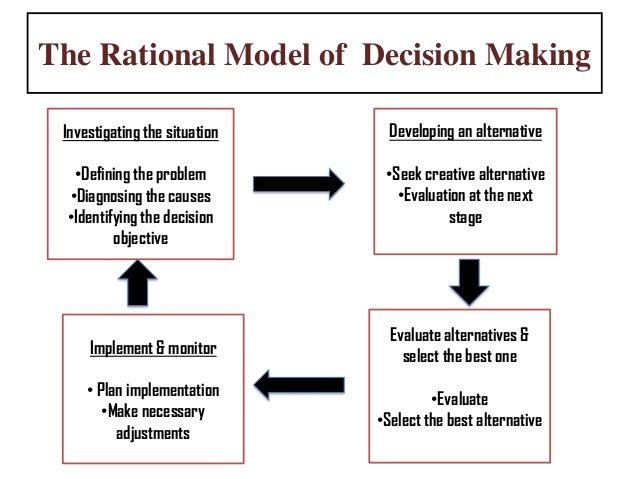
Rational decision making is the commonest of the types of decision making that is taught and learned when people decide that they want to improve their decision making. These are logical, sequential models where the emphasis is on listing many potential options and then working out which is the best. Often the pros and cons of each option are also listed and scored in order of importance.

The rational aspect indicates that there is considerable reasoning and thinking done in order to select the optimum choice. Because we put such a heavy emphasis on thinking and getting it right in our society, there are many of these models and they are very popular. People like to know what the steps are and many of these models have steps that are done in order.

People would love to know what the future holds, which makes these models popular. Because the reasoning and rationale behind the various steps is that if you do x, then y should happen. However, most people have personal experience that the world usually doesn’t work that way!

Intuitive

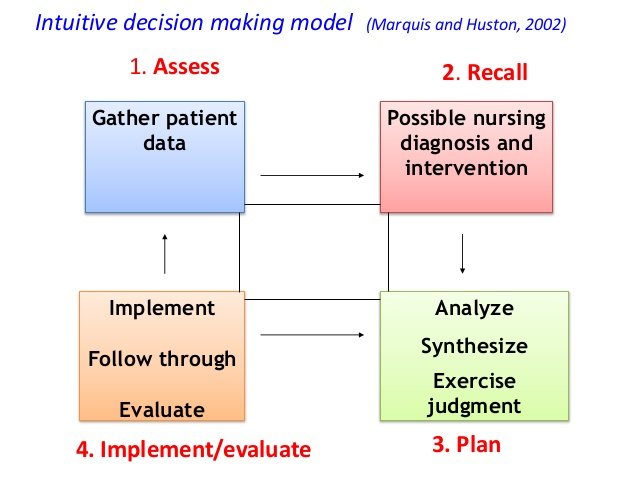
The second of the types of decision making are the intuitive models. The idea here is that there may be absolutely no reason or logic to the decision making process. Instead, there is an inner knowing, or intuition, or some kind of sense of what the right thing to do is.

And there are probably as many intuitive types of decision making as there are people. People can feel it in their heart, or in their bones, or in their gut and so on. There are also a variety of ways for people to receive information, either in pictures or words or voices.

People talk about extra sensory perception as well. However, they are still actually picking up the information through their five senses. Clair sentience is where people feel things, clair audience is hearing things and clairvoyance is seeing things.

And of course we have phrases such as ‘I smell a rat’, ‘ it smells fishy’ and ‘I can taste success ahead’.

Other types of decision making in the intuitive category might include tossing a coin, throwing dice, tarot cards, astrology, and so on.

Decision wheels are usually more humorous than intuitive but they do have a serious application.

Combinations

Many decisions are actually a result of combinations of rational and intuitive processes. This can be deliberate where a person combines aspects of both, or it can occur unwittingly.

For example, a person has listed the pros and cons of the options, assigned numerical values and added them all up. (The rational part.) But the end result is not really satisfactory, they are uneasy somehow (the intuitive part), so they change the parameters, and the numbers add up differently. This new result is more ‘satisfactory’, so they go with that one.

Satisficing

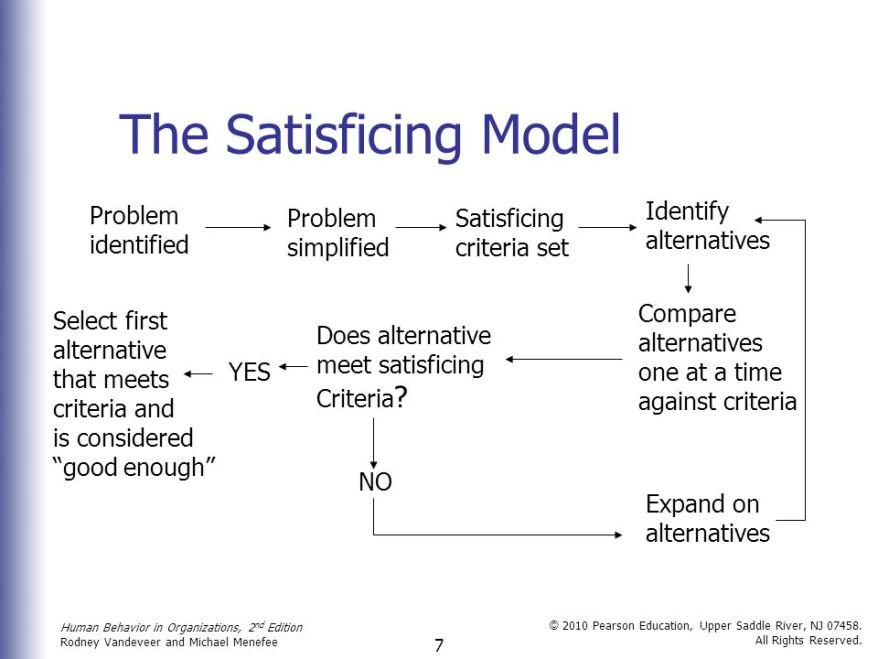
Instead of evaluating all the possible options and choosing the best, satisficing is where we pick the first one that will give us the result. We choose an option that is ‘good enough’, one that satisfies our needs and sacrifices other potentially better options. Hence, satisfice.

simplified. Satisficing. criteria set. Compare. alternatives. one at a time. against criteria. Select first. alternative. that meets. criteria and. is considered. good enough Does alternative. meet satisficing. Criteria? YES. NO. Expand on. alternatives.

Decision Support Systems

Because computers can process large amounts of data quickly, they were soon put to use to help make decisions. Decision Support Systems range from a simple spreadsheet to organize information graphically, to very complex programs organizing info in international companies and including artificial intelligence that can suggest alternative options and solutions.

There are various types of decision making systems depending on how many people are involved, the form of the information being processed, what type of result is required, and so on.

There are pros and cons to using computers in this way, and of course, the computer is only as good as the information that it is processing. Which means that it still comes down to the humans…!

Recognition primed

Gary Klein has spent considerable time studying human decision making and his results are very interesting. He believes that we make 90 to 95% of our decisions in a pattern recognition way. He suggests that what we actually do is gather information from our environment in relation to the decision we want to make. We then pick an option that we think will work. We rehearse it mentally and if we still think it will work, we go ahead.

If it does not work mentally, we choose another option and run that through in our head instead. If that seems to work, we go with that one. We pick scenarios one by one, mentally check them out, and as soon as we find one that works, we choose it.

He also points out that as we get more experience, we can recognise more patterns, and we make better choices more quickly.

Of interest here is that the military in many countries have adapted his methods because they are considerably more effective than any of the types of decision making we’ve discussed already. In fact, you could say that his model is a combination of the rational and intuitive approaches. (That’s why I said above that there are only 4 groups!) It’s also an example of satisficing!

Writing & formatting of Reports

  1. Title Page

The very first page in a business report should be the title page. And since this is the first thing the reader will see, the title should clearly set out the subject of the report. It is also standard to include the report author’s name and the date the report was completed.

  1. Report Summary

Most business reports begin with a short summary. This is so readers can digest key points from the report quickly without having to read the entire thing. Try to include the following:

  • A brief description of what the report is about
  • How the report was completed (e.g. data collection and analysis methods)
  • Your main findings from the research
  • Key conclusions and recommendations

A paragraph or two should be enough for this in shorter business reports. However, for longer or more complex reports, you should consider including a full executive summary.

  1. Table of Contents

In any report more than a few pages long, you will need a table of contents. This should set out the title of each section and where readers can find them in the report. If you are writing your report in Microsoft Word, moreover, you can use the Heading styles to create a table of contents.

  1. Introduction

The introduction is the first part of the report proper. Use it to set out the brief you received when you were asked to compile the report. This will frame the rest of the report by providing:

  • Background information (e.g. market information or business history)
  • The aims of the report (i.e. what you set out to achieve)
  • The scope of the report (i.e. what it will cover and what it will ignore)

These are sometimes known as the ‘terms of reference’ for a report.

  1. Methods and Findings

The next section should set out your research methods (i.e. what you did to collect information). This may be as simple as specifying where you found the information you used in the report, but make sure to provide a more detailed explanation if you have conducted any original research.

After this, you can set out your findings. Try to focus on information directly relevant to your brief here, as packing too much detail into your report may make it hard to follow. One good tip on this front is to use visual aids to present key data, such as by adding charts or illustrations.

  1. Conclusions and Recommendations

Once you have explained your findings, you will need to make conclusions based on your research (i.e. set out what you have learned from writing the report). You may also need to recommend a plan or course of action based upon your findings, especially if this was part of the brief.

Anything you include in this section should be related to your brief. For example, if you were asked to write a report about expanding into a new country, your conclusions and recommendations would be about the viability of such an expansion and what the company could do to achieve its goals.

  1. References and Appendices

Most business reports will draw information from a variety of sources. These should be cited in the text of the report itself, but you should also list your sources in a bibliography.

And finally, if required, you can include extra information in your report by adding an appendix (or multiple appendices if you have a lot of material to include). This is a good place to put in-depth data that does not fit easily into the main report, such as interview transcripts or survey results.

Summary: The Structure of a Business Report

Typically, most business reports will be structured along the following lines:

  • Title Page: Give a clear, informative title that sets out what the report is about, as well as the report author’s name and a date of publication.
  • Summary: A rundown of key points from the report, including research methods, findings, and any conclusions or recommendations.
  • Table of Contents: In longer reports, include a table of contents. This should list the title of each section in the report and where it can be found.
  • Introduction: A summary of the brief you received for the report.
  • Methods and Findings: A more detailed look at data collection and analysis methods, along with the main findings of your research.
  • Conclusions and Recommendations: What you have learned from your research and recommendations for what to do next (if required).
  • References and Appendices: At the end of your report, include a bibliography detailing the sources you have used. You can add any extra material (e.g. interview transcripts or raw data) to an appendix.

Cost Accounting, Meaning, Definitions, Objectives, Scope, Functions, Uses, Advantages and Limitations

Cost Accounting is a specialized branch of accounting that deals with the classification, recording, allocation, and analysis of costs associated with the production of goods and services. Its main objective is to ascertain the cost of a product, process, job, or service and to help management in cost control, cost reduction, and decision-making.

Cost Accounting collects cost data from financial accounts and other sources, analyzes it systematically, and presents it in a meaningful manner to management. It helps in determining cost per unit, fixing selling prices, measuring efficiency, and improving profitability. Unlike financial accounting, which focuses on overall profit and loss, cost accounting focuses on detailed cost information for internal management use.

In modern business, cost accounting plays a vital role in planning, budgeting, standard costing, and variance analysis, enabling management to take corrective actions and improve operational efficiency.

Definitions of Cost Accounting

  • According to the Institute of Cost and Management Accountants (ICMA), London

“Cost accounting is the process of accounting for costs from the point at which expenditure is incurred or committed to the establishment of its ultimate relationship with cost centres and cost units.”

  • According to CIMA (Chartered Institute of Management Accountants)

“Cost accounting is the application of costing and cost accounting principles, methods and techniques to the science, art and practice of cost control and the ascertainment of profitability.”

  • According to Wheldon

“Cost accounting is the classifying, recording and appropriate allocation of expenditure for the determination of costs of products or services, and for the presentation of suitably arranged data for purposes of control and guidance of management.”

  • According to J. Batty

“Cost accounting is the application of costing and cost accounting methods and techniques for the purpose of ascertaining costs and providing information to management for decision-making.”

Objectives of Cost Accounting

  • Ascertainment of Cost

One of the main objectives of cost accounting is to ascertain the accurate cost of products, services, jobs, or processes. It involves systematic collection and analysis of data relating to material, labour, and overheads. Determination of cost per unit helps management understand the actual expenditure incurred in production. This information is useful for comparing costs with estimates or standards and forms a sound basis for pricing, profit measurement, and efficiency evaluation.

  • Cost Control

Cost control is an important objective of cost accounting which aims at keeping costs within predetermined limits. This is achieved through techniques such as standard costing, budgetary control, and variance analysis. By comparing actual costs with standard or budgeted costs, deviations can be identified quickly. Management can then take corrective action to reduce wastage, inefficiency, and unnecessary expenses, thereby improving overall cost efficiency and profitability.

  • Cost Reduction

Cost accounting also aims at reducing the cost of production on a continuous basis. Cost reduction focuses on lowering unit costs permanently without affecting quality or performance. By analyzing cost data in detail, areas of inefficiency and avoidable expenditure can be identified. Improved methods of production, better use of materials, and effective utilization of labour and machinery help in achieving sustainable cost reduction.

  • Fixation of Selling Price

Another key objective of cost accounting is to assist management in fixing appropriate selling prices. Accurate cost information enables management to determine a fair price by adding a reasonable margin of profit to the cost of production. This is especially useful in competitive markets, tender pricing, and government contracts. Proper pricing ensures recovery of costs while remaining competitive and profitable.

  • Measurement of Efficiency

Cost accounting helps in measuring the efficiency of labour, machinery, and production processes. Through performance reports and variance analysis, it highlights idle time, wastage, and inefficiencies. Management can evaluate whether resources are being used optimally. Identifying inefficient areas allows corrective steps to be taken, leading to improved productivity, better utilization of resources, and enhanced operational performance.

  • Profit Planning and Decision Making

Cost accounting provides valuable information for profit planning and managerial decision making. Decisions such as make or buy, continuation or shutdown of operations, product mix selection, and expansion plans depend on accurate cost data. Techniques like marginal costing, break-even analysis, and contribution analysis help management choose the most profitable alternatives and ensure effective financial planning.

  • Preparation of Budgets and Forecasts

Cost accounting assists in preparing budgets, estimates, and forecasts for future periods. Past cost records are used to predict future expenses and revenues. Budgeting helps in planning and controlling business activities by setting targets and standards. It ensures proper allocation of resources and provides a basis for comparing actual performance with planned performance for effective control.

  • Aid to Management and Policy Formulation

Cost accounting acts as an important tool for management in policy formulation and strategic planning. It supplies detailed cost information required for framing pricing, production, and cost control policies. By presenting data in a systematic and understandable manner, cost accounting enables management to evaluate performance, improve decision making, and achieve long-term organizational objectives efficiently.

Scope of Cost Accounting

  • Cost Ascertainment

The scope of cost accounting includes the systematic ascertainment of costs related to products, services, jobs, or processes. It involves identifying, classifying, and recording various elements of cost such as material, labour, and overheads. Accurate cost ascertainment helps management know the exact cost of production per unit. This forms the basis for pricing decisions, profitability analysis, and comparison with standard or estimated costs for effective cost management.

  • Cost Control

Cost control is an important area within the scope of cost accounting. It ensures that actual costs incurred do not exceed predetermined standards or budgets. Techniques such as standard costing, budgetary control, and variance analysis are used to monitor expenses. By identifying deviations and inefficiencies, management can take timely corrective actions to reduce wastage and control unnecessary expenditure, leading to improved operational efficiency.

  • Cost Reduction

Cost accounting covers continuous cost reduction by identifying areas where costs can be minimized without affecting quality or productivity. Detailed cost analysis helps in improving methods of production, better utilization of resources, and elimination of avoidable expenses. Cost reduction focuses on long-term efficiency and profitability, making it an essential part of the scope of cost accounting in a competitive business environment.

  • Budgeting and Forecasting

Preparation of budgets and forecasts is another significant aspect of cost accounting. Past cost data is used to estimate future costs and revenues. Budgets act as a plan of action and a tool for control by setting cost limits and performance standards. Forecasting helps management anticipate future conditions and allocate resources effectively, ensuring smooth and efficient business operations.

  • Decision Making Support

Cost accounting provides valuable information to management for decision making. Decisions related to make or buy, acceptance of special orders, product mix, pricing, and shutdown of operations rely heavily on cost data. Techniques like marginal costing, break-even analysis, and contribution analysis fall within this scope. Accurate cost information ensures rational and informed managerial decisions.

  • Measurement of Efficiency

The scope of cost accounting includes measuring the efficiency of labour, machines, and production processes. Through cost reports, ratios, and variance analysis, it helps identify idle time, waste, and inefficiencies. Management can evaluate departmental and individual performance and take corrective measures. Improved efficiency leads to reduced costs, higher productivity, and better utilization of organizational resources.

  • Profitability Analysis

Cost accounting helps in analyzing the profitability of different products, departments, processes, or markets. By comparing costs and revenues, management can identify profitable and unprofitable areas. This information is useful for expansion, discontinuation of products, or reallocation of resources. Profitability analysis supports effective planning and helps maximize overall business profits.

  • Cost Reporting and Record Keeping

Maintaining cost records and preparing cost reports is an important part of the scope of cost accounting. These reports provide detailed cost information in a clear and systematic manner for management use. Proper cost records ensure transparency, accountability, and effective monitoring of costs. They also help in internal control and provide a basis for audit and performance evaluation.

Functions of Cost Accounting

  • Collection of Cost Data

One of the primary functions of cost accounting is the collection of cost data relating to materials, labour, and overheads. This data is gathered from various departments and cost records in a systematic manner. Proper collection ensures accuracy and reliability of cost information. It forms the foundation for further analysis, classification, and allocation of costs, enabling management to understand the cost structure of products and services.

  • Classification and Analysis of Costs

Cost accounting involves classification of costs into different categories such as fixed and variable, direct and indirect, and controllable and uncontrollable costs. Analysis of costs helps management understand the behavior of costs under different levels of activity. Proper classification and analysis assist in effective cost control, decision making, and application of suitable costing techniques for various business situations.

  • Allocation and Apportionment of Costs

Another important function is the allocation and apportionment of overhead costs to different cost centers and cost units. Allocation assigns whole costs directly to a cost center, while apportionment distributes common costs on a suitable basis. Accurate distribution of overheads ensures correct cost determination and prevents under or over-absorption of costs in products or services.

  • Ascertainment of Cost per Unit

Cost accounting helps in determining the cost per unit of product or service. By compiling all elements of cost and assigning them to cost units, management can know the exact cost of production. Cost per unit information is essential for pricing decisions, profit calculation, cost comparison, and evaluation of operational efficiency across different periods or departments.

  • Cost Control and Cost Reduction

A key function of cost accounting is to control and reduce costs. This is achieved by comparing actual costs with standards or budgets and analyzing variances. Areas of inefficiency, wastage, and excess expenditure are identified, allowing management to take corrective actions. Continuous cost reduction improves productivity, profitability, and competitive strength of the organization.

  • Preparation of Cost Statements and Reports

Cost accounting involves preparation of various cost statements and reports for management use. These reports present cost data in a clear and meaningful form, helping management monitor performance and control expenses. Cost reports may relate to material usage, labour efficiency, overhead absorption, and departmental performance, supporting informed decision making and effective internal control.

  • Assistance in Decision Making

Cost accounting provides relevant cost information required for managerial decision making. Decisions such as make or buy, acceptance of special orders, product mix selection, pricing, and continuation or shutdown of operations depend on cost analysis. Techniques like marginal costing and break-even analysis help management evaluate alternatives and choose the most profitable course of action.

  • Support in Planning and Budgeting

Cost accounting plays a significant role in planning and budgeting. It helps in setting cost standards, preparing budgets, and forecasting future costs and revenues. Budgetary control ensures coordination among departments and efficient use of resources. This function supports management in achieving organizational objectives through systematic planning and financial discipline.

Uses of Cost Accounting

  • Determination of Cost and Profit

Cost accounting is used to determine the accurate cost of products, services, jobs, or processes. By analyzing material, labour, and overhead costs, it helps in calculating cost per unit and overall cost of production. This information enables management to ascertain profit or loss for each product or activity, ensuring better control over expenses and improving overall profitability.

  • Fixation of Selling Price

One of the important uses of cost accounting is in fixing selling prices. Accurate cost data helps management add a suitable margin of profit to the cost of production. This ensures that prices are neither too high nor too low. Proper pricing based on cost information is essential in competitive markets, tenders, and government contracts to ensure profitability and market acceptance.

  • Cost Control and Reduction

Cost accounting is widely used for controlling and reducing costs. By comparing actual costs with standard or budgeted costs, inefficiencies and wastages can be identified. Management can take corrective measures to control excessive expenditure. Continuous cost reduction helps in improving operational efficiency, increasing productivity, and maintaining competitiveness in the long run.

  • Planning and Budgeting

Cost accounting provides a sound basis for planning and budgeting. Past cost records are used to prepare budgets and cost estimates for future periods. Budgets help in setting performance targets and allocating resources efficiently. Cost accounting ensures that business activities are planned in advance and carried out within the limits set by management.

  • Managerial Decision Making

Cost accounting is an important aid in managerial decision making. Decisions such as make or buy, acceptance of special orders, product mix selection, and continuation or shutdown of operations depend on cost information. Techniques like marginal costing and break-even analysis help management evaluate alternatives and choose the most profitable option.

  • Measurement of Efficiency

Cost accounting is used to measure the efficiency of labour, machinery, and production processes. Through variance analysis and performance reports, it highlights inefficiencies, idle time, and wastage. Management can assess departmental and individual performance and take corrective action, leading to improved productivity and better utilization of resources.

  • Profit Planning and Control

Cost accounting helps in profit planning and control by providing detailed cost and revenue data. Management can analyze contribution, break-even point, and margin of safety to plan profits. Regular monitoring of costs ensures that profit targets are achieved. This use of cost accounting supports sound financial management and business stability.

  • Formulation of Policies and Strategies

Cost accounting is useful in formulating pricing, production, and cost control policies. It provides reliable cost information required for strategic planning and long-term decision making. By analyzing cost trends and profitability, management can frame effective business strategies to improve efficiency, growth, and competitive strength.

Advantages of Cost Accounting

  • Enhanced Cost Control

Cost accounting helps monitor and control costs by identifying inefficiencies and waste. Through techniques like standard costing and variance analysis, managers can compare actual costs with predefined standards, identify deviations, and take corrective actions. This ensures optimal resource utilization and minimizes unnecessary expenses.

  • Accurate Pricing Decisions

Cost accounting provides precise cost data that supports effective pricing strategies. By determining the cost of production and adding a suitable profit margin, businesses can set competitive prices. It also helps in revising prices based on changes in cost structures, ensuring profitability while maintaining market competitiveness.

  • Improved Profitability Analysis

Analyzing profitability at different levels, such as product lines, services, or departments, is a significant advantage of cost accounting. It helps businesses identify high-performing and underperforming areas, guiding decisions on product mix, resource allocation, and market focus. Contribution margin and break-even analysis further enhance profitability insights.

  • Facilitation of Decision-Making

Cost accounting equips managers with critical data for informed decision-making. Whether it’s a make-or-buy decision, selecting the most profitable product line, or determining optimal production levels, cost accounting provides actionable insights. Cost-volume-profit analysis and relevant costing are key tools in this context.

  • Efficient Budgeting and Planning

Cost accounting aids in preparing detailed budgets by analyzing past cost trends and forecasting future expenses. Budgets for labor, materials, and overheads ensure financial discipline and resource allocation align with organizational goals. It also provides a roadmap for achieving operational and strategic objectives.

  • Supports Cost Reduction

Cost accounting identifies opportunities to reduce costs systematically without compromising quality or efficiency. By analyzing workflows, processes, and resource utilization, it highlights areas for improvement. Techniques like value analysis and process optimization contribute to sustained cost savings and increased competitiveness.

  • Better Performance Evaluation

Cost accounting facilitates effective performance evaluation by comparing actual results with planned targets and standards. It provides detailed reports on material usage, labour efficiency, and overhead control for different departments and responsibility centers. This helps management assess individual and departmental performance objectively. Timely identification of deviations enables corrective measures, motivates employees to improve efficiency, and ensures accountability across various levels of the organization.

  • Improved Internal Control and Transparency

Another important advantage of cost accounting is improved internal control and transparency in operations. Proper cost records, regular reporting, and systematic analysis reduce the chances of errors, fraud, and misuse of resources. Management gets clear and reliable cost information, which enhances coordination between departments. Strong internal control systems ensure accuracy in cost data and support sound managerial and financial decision-making.

Limitations of Cost Accounting

  • Costly and Time-Consuming

Implementing and maintaining a cost accounting system requires significant financial and human resources. From setting up systems to training personnel and generating detailed reports, it can be expensive and time-consuming, particularly for small businesses with limited resources.

  • Complex and Difficult to Understand

Cost accounting involves intricate methods, classifications, and terminologies that can be difficult for non-specialists to understand. Techniques such as process costing, activity-based costing, and variance analysis require a high degree of expertise, making it challenging for managers without a strong accounting background to interpret the results effectively.

  • Subjectivity in Allocation of Costs

The allocation of indirect costs, such as overheads, is often subjective and based on arbitrary assumptions. Different methods of cost allocation can produce varying results, potentially leading to inaccuracies and misinterpretation. This subjectivity reduces the reliability of cost accounting data for decision-making.

  • Limited Focus on Non-Monetary Factors

Cost accounting primarily focuses on monetary aspects of business operations, often neglecting non-monetary factors such as employee morale, customer satisfaction, and market trends. These qualitative aspects are equally important for overall business success but are not addressed by cost accounting methods.

  • Historical Data Dependence

Cost accounting relies heavily on historical data for analysis and decision-making. While it provides insights into past performance, it may not always reflect current market conditions or future trends. This dependence on outdated information can limit its relevance in dynamic business environments.

  • Not a Substitute for Financial Accounting

Cost accounting is designed for internal decision-making and does not replace financial accounting, which is essential for statutory reporting and compliance. This limitation means that businesses must maintain separate accounting systems, leading to duplication of effort.

  • Limited Applicability Across Industries

The applicability of cost accounting methods varies across industries. While manufacturing firms benefit significantly, service-based industries often face challenges in accurately allocating costs, limiting the effectiveness of cost accounting in such sectors.

  • Lack of Uniformity and Standardization

There is no universally accepted system or method of cost accounting applicable to all organizations. Different firms adopt different costing techniques based on their nature, size, and management needs. This lack of uniformity makes comparison of cost data between companies or industries difficult. Absence of standard procedures may also lead to inconsistency in cost records and reduce the usefulness of cost information for external comparison.

  • Possibility of Inaccurate Data and Misleading Results

Cost accounting depends heavily on accurate data collection and proper recording of costs. Any errors in data entry, estimation, or classification can lead to inaccurate cost information. Inaccurate cost data may mislead management and result in wrong decisions regarding pricing, production, or cost control. Thus, the effectiveness of cost accounting is limited by the quality and reliability of the data used.

Objectives of Cost Accounting

Objectives of cost accounting are ascertainment of cost, fixation of selling price, proper recording and presentation of cost data to management for measuring efficiency and for cost control and cost reduction, ascertaining the profit of each activity, assisting management in decision making and determination of break-even point.

The aim is to know the methods by which expenditure on materials, wages and overheads is recorded, classified and allocated so that the cost of products and services may be accurately ascertained; these costs may be related to sales and profitability may be determined. Yet with the development of business and industry, its objectives are changing day by day.

Following are the main objectives of cost accounting:

  1. To ascertain the cost per unit of the different products manufactured by a business concern;
  2. To provide a correct analysis of cost both by process or operations and by different elements of cost;
  3. To disclose sources of wastage whether of material, time or expense or in the use of machinery, equipment and tools and to prepare such reports which may be necessary to control such wastage;
  4. To provide requisite data and serve as a guide for fixing prices of products manufactured or services rendered;
  5. To ascertain the profitability of each of the products and advise management as to how these profits can be maximised;
  6. To exercise effective control if stocks of raw materials, work-in-progress, consumable stores and finished goods in order to minimise the capital locked up in these stocks;
  7. To reveal sources of economy by installing and implementing a system of cost control for materials, labour and overheads;
  8. To advise management on future expansion policies and proposed capital projects;
  9. To present and interpret data for management planning, evaluation of performance and control;
  • To help in the preparation of budgets and implementation of budgetary control;
  • To organise an effective information system so that different levels of management may get the required information at the right time in right form for carrying out their individual responsibilities in an efficient manner;
  • To guide management in the formulation and implementation of incentive bonus plans based on productivity and cost savings;
  • To supply useful data to management for taking various financial decisions such as introduction of new products, replacement of labour by machine etc.;
  • To help in supervising the working of punched card accounting or data processing through computers;
  • To organise the internal audit system to ensure effective working of different departments;
  • .To organise cost reduction programmes with the help of different departmental managers;
  • To provide specialised services of cost audit in order to prevent the errors and frauds and to facilitate prompt and reliable information to management; and
  • To find out costing profit or loss by identifying with revenues the costs of those products or services by selling which the revenues have resulted.

Advantages and Disadvantages of cost Accounting

The advantages of cost accounting are:

Disclosure of profitable and unprofitable activities

Since cost accounting minutely calculates the cost, selling price and profitability of product, segregation of profitable or unprofitable items or activities becomes easy.

Guidance for future production policies

On the basis of data provided by costing department about the cost of various processes and activities as well as profit on it, it helps to plan the future.

Periodical determination of profit and losses

Cost accounting helps us to determine the periodical profit and loss of a product.

To find out exact cause of decrease or increase in profit

With the help of cost accounting, any organization can determine the exact cause of decrease or increase in profit that may be due to higher cost of product, lower selling price or may be due to unproductive activity or unused capacity.

Control over material and supplies

Cost accounting teaches us to account for the cost of material and supplies according to department, process, units of production, or services that provide us a control over material and supplies.

Relative efficiency of different workers

With the help of cost accounting, we may introduce suitable plan for wages, incentives, and rewards for workers and employees of an organization.

Reliable comparison

Cost accounting provides us reliable comparison of products and services within and outside an organization with the products and services available in the market. It also helps to achieve the lowest cost level of product with highest efficiency level of operations.

Helpful to government

It helps the government in planning and policy making about import, export, industry and taxation. It is helpful in assessment of excise, service tax and income tax, etc. It provides readymade data to government in price fixing, price control, tariff protection, etc.

Helpful to consumers

Reduction of price due to reduction in cost passes to customer ultimately. Cost accounting builds confidence in customers about fairness of price.

Classification and subdivision of cost

Cost accounting helps to classify the cost according to department, process, product, activity, and service against financial accounting which give just consolidate net profit or loss figure of any organization without any classification or sub-division of cost.

To find out adequate selling price

In tough marketing conditions or in slump period, the costing helps to determine selling price of the product at the optimum level, neither too high nor too low.

Proper investment in inventory

Shifting of dead stock items or slow moving items into fast moving items may help company to invest in more proper and profitable inventory. It also helps us to maintain inventory at the most optimum level in terms of investments as well as variety of the stock.

Correct valuation of inventory

Cost accounting is an accurate and adequate valuation technique that helps an organization in valuation of inventory in more reliable and exact way. On the other hand, valuation of inventory merely depends on physical stock taking and valuation thereof, which is not a proper and scientific method to follow.

Decision on manufacturing or purchasing from outside

Costing data helps management to decide whether in-house production of any product will be profitable, or it is feasible to purchase the product from outside. In turn, it is helpful for management to avoid any heavy loss due to wrong decision.

Reliable check on accounting

Cost accounting is more reliable and accurate system of accounting. It is helpful to check results of financial accounting with the help of periodic reconciliation of cost accounts with financial accounts.

Budgeting

In cost accounting, various budgets are prepared and these budgets are very important tools of costing. Budgets show the cost, revenue, profit, production capacity, and efficiency of plant and machinery, as well as the efficiency of workers. Since the budget is planned in scientific and systemic way, it helps to keep a positive check over misdirecting the activities of an organization.

Disadvantages

  1. Lack Of Fixed Principles

Generally, cost accounting system is practiced on presumed notions. It does not follow fixed accounting principles. So, there is a lack of uniformity in this system.

  1. Costly System

This is another major drawback of cost accounting. There is a need of highly skilled and qualified manpower and resources to maintain cost accounting system in the organization. A lot of clerical works and various procedure make cost accounting more expensive.

  1. Complex System

It is very complicated system of accounting. It requires various formulas to record cost related data. It needs specific knowledge to prepare different reports. Due to numerous steps and rules, it is considered as complex system of accounting.

  1. Not Suitable for Small Business

Small business firms with less number of production or transactions do not prefer cost accounting because of higher cost and complexity. 

  1. Ignores Financial Items

Actual profit or loss of the business cannot be ascertained by cost accounting because it ignores income and expenses of financial nature.

  1. Lack Of Accuracy

Cost accounting avoids financial character expenses at the time of cost calculation. It does not follow double entry system to check the accuracy. So, result obtained from cost accounting may lack accuracy.

  1. Not Helpful In Decision Making

Only cost related past data and information can be obtained from cost accounting. So, top level management cannot be benefited from cost accounting to make future decision and plans. Delay in data and information may also hamper decision making process.

  1. Dependent

Cost accounting cannot be installed and maintained without other accounting system. It is totally dependent with other branches of accounting, especially with financial accounting.

Installation of Cost Accounting System

Cost Accounting System (CAS) is a structured framework used by organizations to record, analyze, and allocate costs to products, services, or activities. It helps in tracking expenses, controlling costs, and determining profitability. The system includes methods for collecting cost data, classifying costs (fixed, variable, direct, indirect), and assigning them to cost centers or units.

There are two main types of cost accounting systems:

  1. Job Costing System: Tracks costs for specific jobs or projects.

  2. Process Costing System: Allocates costs to continuous production processes.

Basic Consideration or Requisites of a Good Costing System:

  • Suitability to Business

A good costing system should be tailored to the nature and size of the business. It must align with the production process, organizational structure, and operational requirements. For example, job costing is suitable for customized production, while process costing fits mass production industries. A system that does not match business needs may lead to inaccurate cost determination, poor cost control, and ineffective decision-making. Thus, the system should be flexible and adaptable to industry-specific requirements.

  • Simplicity and Clarity

The system should be easy to understand and operate. Complex or overly technical costing systems can lead to errors and inefficiencies. A simple system ensures that employees can easily follow procedures without extensive training. Clarity in cost classification, allocation, and reporting enhances accuracy and transparency. A well-designed, user-friendly system minimizes errors, saves time, and increases efficiency in cost management, ensuring that even non-experts can interpret cost data effectively.

  • Accuracy and Reliability

A good costing system must provide precise and reliable cost data. Inaccurate cost information can mislead management and result in poor financial decisions. To ensure reliability, costs should be recorded systematically, with well-defined allocation methods for direct and indirect expenses. Regular audits and reconciliations should be conducted to verify data accuracy. Reliable cost data helps businesses in budgeting, pricing, and cost control, leading to better financial planning and profitability.

  • Cost Control and Reduction

An effective costing system must help in monitoring, controlling, and reducing costs. It should highlight areas where costs exceed budgets and provide insights into cost-saving opportunities. Tools such as standard costing, variance analysis, and budgetary control assist in identifying inefficiencies. By analyzing cost behavior and trends, businesses can implement corrective actions to minimize wastage, improve productivity, and enhance profitability. A system that lacks cost control measures may fail to support long-term financial sustainability.

  • Timeliness and Quick Reporting

Cost information should be provided promptly to facilitate quick decision-making. Delayed cost reports can lead to missed opportunities or incorrect strategic decisions. A well-structured costing system enables real-time tracking of expenses and generates timely reports for management. With advancements in technology, automated costing software enhances efficiency by reducing manual effort and ensuring fast processing. Quick access to cost data supports effective planning, pricing strategies, and operational adjustments, keeping the business competitive.

  • Integration with Financial Accounting

A good costing system should complement the financial accounting system to ensure consistency and accuracy. Integration helps in reconciling cost accounts with financial statements, reducing discrepancies. It also ensures compliance with accounting standards and regulatory requirements. A disconnected costing system can create confusion and errors in financial reporting. Proper synchronization between cost and financial accounts enhances overall financial control and provides a complete picture of the company’s financial health.

Steps Involved in the Installation of Costing System:

  • Study of Business Requirements

Before installing a costing system, a thorough analysis of the business structure, nature of operations, and cost elements is necessary. Understanding production processes, cost centers, and financial reporting needs ensures that the system is aligned with business goals. This step also identifies whether job costing, process costing, or activity-based costing is suitable. A system that does not fit the business model may lead to inefficiencies and inaccurate cost tracking.

  • Defining Cost Objectives

The purpose of the costing system must be clearly defined to ensure it meets business needs. Objectives may include cost control, pricing decisions, profitability analysis, or financial planning. Defining cost objectives helps in structuring the system appropriately, ensuring that it captures relevant cost data for decision-making. Without clear objectives, the system may collect unnecessary data, leading to complexity and inefficiencies in cost management.

  • Classification of Costs

Proper cost classification is crucial for meaningful cost analysis. Costs should be categorized into direct and indirect, fixed and variable, controllable and uncontrollable to facilitate accurate allocation. Standardizing classifications ensures consistency in recording and analyzing cost data. A lack of clear classification may result in incorrect cost allocation, affecting pricing decisions and financial planning. This step helps in setting up a framework for effective cost measurement and reporting.

  • Determination of Cost Centers

A cost center refers to a department, section, or unit where costs are incurred and recorded. Identifying cost centers helps in assigning costs accurately, improving cost control and performance evaluation. Different cost centers, such as production, administration, sales, and distribution, must be clearly defined. Without well-established cost centers, it becomes difficult to track expenses, analyze profitability, and implement cost reduction strategies.

  • Selection of Costing Method and Techniques

The appropriate costing method must be chosen based on business operations. For example, job costing is used for customized orders, while process costing is suitable for mass production. Techniques such as marginal costing, standard costing, and activity-based costing should also be considered. Selecting an inappropriate method may lead to misallocation of costs, affecting pricing and financial decisions. Proper selection ensures accurate cost determination and effective cost management.

  • Design and Implementation of Costing System

After selecting the method, the costing system is designed, incorporating necessary documents, reports, and software. Forms for material requisition, labor time tracking, and overhead allocation must be prepared. The system should be automated using cost accounting software to enhance efficiency. Poor system design may lead to errors and inefficiencies. Implementing the system with proper workflows ensures smooth operations and effective cost control.

  • Employee Training and Awareness

For successful implementation, employees handling the costing system must be well-trained. Training should cover cost classification, data recording, report generation, and system usage. Without proper training, employees may struggle with cost data entry and analysis, leading to errors. Regular workshops and refresher courses help in improving efficiency. A well-trained workforce ensures that the costing system functions accurately and delivers reliable cost information.

  • Continuous Monitoring and Improvement

Once installed, the system must be regularly reviewed to identify gaps, inefficiencies, and areas for improvement. Changes in business operations, costs, or technology may require modifications in the system. Regular audits ensure accuracy and reliability. Without continuous monitoring, the system may become outdated and ineffective in cost control. Adapting to evolving business needs enhances the system’s effectiveness and ensures long-term cost efficiency.

Requisite of Good Costing System:

  • Suitability to Business Operations

A good costing system must be designed according to the nature and scale of the business. It should align with production processes, financial requirements, and organizational structure. A system unsuitable for the industry may lead to inefficiencies and incorrect cost allocation. It should be flexible enough to adapt to changing business needs while ensuring that cost data remains relevant and accurate for decision-making and performance evaluation.

  • Simplicity and Ease of Use

The system should be simple, easy to understand, and user-friendly. A complex system may lead to confusion, errors, and inefficiencies. Employees should be able to use the system without extensive training. Standardized procedures for cost collection, classification, and reporting enhance clarity. Simplicity ensures smooth operations, quick decision-making, and better cost control. If a system is too complicated, employees may resist using it, reducing its effectiveness in cost tracking and financial planning.

  • Accuracy and Reliability

A costing system should provide precise and reliable cost data to support management decisions. Errors in cost calculations can lead to incorrect pricing, budgeting, and financial planning. To ensure accuracy, systematic cost recording and allocation methods should be followed. Regular audits and reconciliations should be conducted to verify data consistency. Reliable cost data helps businesses in evaluating profitability, optimizing resource utilization, and ensuring financial stability over the long term.

  • Cost Control and Efficiency

The system should help in monitoring, controlling, and reducing costs. It must identify cost overruns, inefficiencies, and wastage in operations. Techniques such as standard costing, variance analysis, and budgetary control should be integrated into the system. A good costing system provides cost-saving opportunities by highlighting areas of excess spending. Without effective cost control mechanisms, businesses may experience financial losses and reduced competitiveness in the market.

  • Timely Cost Reporting

A good costing system should generate cost reports promptly to support quick decision-making. Delays in cost data reporting can lead to missed opportunities or financial mismanagement. Real-time tracking of expenses through automated systems improves efficiency. The system should be capable of producing regular reports for management, ensuring transparency and accountability. Timely access to cost information helps in formulating pricing strategies, production planning, and budget adjustments as per market conditions.

  • Integration with Financial Accounting

The costing system should be well-integrated with the financial accounting system to ensure consistency and accuracy in reporting. Proper coordination between cost and financial accounts eliminates discrepancies and enhances financial analysis. Integration ensures compliance with accounting standards and regulatory requirements. A system that operates separately from financial records may create confusion and lead to incorrect financial statements. A well-synchronized costing system improves overall financial control and decision-making.

error: Content is protected !!