Network Topology

Network Topology refers to the arrangement or layout of different elements (such as nodes, links, and devices) in a computer network. It defines how devices are connected and how data flows within the network. Common network topologies include bus, star, ring, mesh, tree, and hybrid. Each topology has its own advantages and disadvantages in terms of cost, scalability, reliability, and performance. The choice of network topology impacts the network’s efficiency, fault tolerance, and ease of maintenance. A well-designed topology is crucial for optimizing network performance and ensuring smooth communication.

Types of Network Topology:

The arrangement of a network which comprises of nodes and connecting lines via sender and receiver is referred as network topology. The various network topologies are:-

  1. Mesh Topology

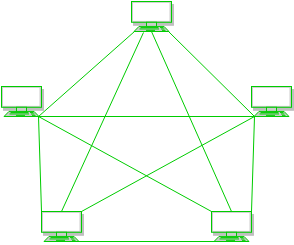
In mesh topology, every device is connected to another device via particular channel.

Every device is connected with another via dedicated channels. These channels are known as links.

  • If suppose, N number of devices are connected with each other in mesh topology, then total number of ports that is required by each device is ​ N-1. In the Figure 1, there are 5 devices connected to each other, hence total number of ports required is 4.
  • If suppose, N number of devices are connected with each other in mesh topology, then total number of dedicated links required to connect them is NC2 i.e. N(N-1)/2. In the Figure 1, there are 5 devices connected to each other, hence total number of links required is 5*4/2 = 10.

Advantages of Mesh Topology

  • It is robust.
  • Fault is diagnosed easily. Data is reliable because data is transferred among the devices through dedicated channels or links.
  • Provides security and privacy.

Problems with Mesh Topology

  • Installation and configuration is difficult.
  • Cost of cables are high as bulk wiring is required, hence suitable for less number of devices.
  • Cost of maintenance is high.
  1. Star Topology

​ In star topology, all the devices are connected to a single hub through a cable. This hub is the central node and all others nodes are connected to the central node. The hub can be passive ​in nature i.e. not intelligent hub such as broadcasting devices, at the same time the hub can be intelligent known as active ​hubs. Active hubs have repeaters in them.

A star topology having four systems connected to single point of connection i.e. hub.

Advantages of Star Topology

  • If N devices are connected to each other in star topology, then the number of cables required to connect them is N. So, it is easy to set up.
  • Each device require only 1 port i.e. to connect to the hub.

Problems with Star Topology

  • If the concentrator (hub) on which the whole topology relies fails, the whole system will crash down.
  • Cost of installation is high.
  • Performance is based on the single concentrator i.e. hub.
  1. Bus Topology

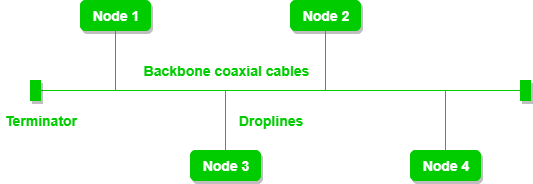
​ Bus topology is a network type in which every computer and network device is connected to single cable. It transmits the data from one end to another in single direction. No bi-directional feature is in bus topology.

A bus topology with shared backbone cable. The nodes are connected to the channel via drop lines.

Advantages of Bus Topology

  • If N devices are connected to each other in bus topology, then the number of cables required to connect them is 1 ​which is known as backbone cable and N drop lines are required.
  • Cost of the cable is less as compared to other topology, but it is used to built small networks.

Problems with Bus Topology

  • If the common cable fails, then the whole system will crash down.
  • If the network traffic is heavy, it increases collisions in the network. To avoid this, various protocols are used in MAC layer known as Pure Aloha, Slotted Aloha, CSMA/CD etc.
  1. Ring Topology

​ In this topology, it forms a ring connecting a devices with its exactly two neighbouring devices.

A ring topology comprises of 4 stations connected with each forming a ring..

The following operations takes place in ring topology are:-

One station is known as monitor station which takes all the responsibility to perform the operations.

To transmit the data, station has to hold the token. After the transmission is done, the token is to be released for other stations to use.

When no station is transmitting the data, then the token will circulate in the ring.

There are two types of token release techniques: Early token release releases the token just after the transmitting the data and Delay token release releases the token after the acknowledgement is received from the receiver.

Advantages of Ring topology

  • The possibility of collision is minimum in this type of topology.
  • Cheap to install and expand.

Problems with Ring topology

  • Troubleshooting is difficult in this topology.
  • Addition of stations in between or removal of stations can disturb the whole topology.
  1. Hybrid Topology

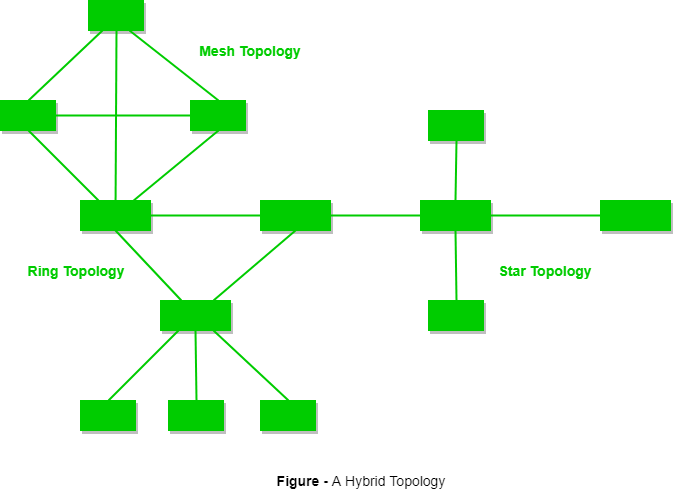
​This topology is a collection of two or more topologies which are described above. This is a scalable topology which can be expanded easily. It is reliable one but at the same it is a costly topology.

A hybrid topology which is a combination of ring and star topology.

Local Area Network (LAN)

A local area network (LAN) is a collection of devices connected together in one physical location, such as a building, office, or home. A LAN can be small or large, ranging from a home network with one user to an enterprise network with thousands of users and devices in an office or school.

Regardless of size, a LAN’s single defining characteristic is that it connects devices that are in a single, limited area. In contrast, a wide area network (WAN) or metropolitan area network (MAN) covers larger geographic areas. Some WANs and MANs connect many LANs together.

A LAN comprises cables, access points, switches, routers, and other components that enable devices to connect to internal servers, web servers, and other LANs via wide area networks.

The rise of virtualization has also fueled the development of virtual LANs, which enable network administrators to logically group network nodes and partition their networks without a need for major infrastructure changes.

For example, in an office with multiple departments, such as accounting, IT support, and administration, each department’s computers could be logically connected to the same switch but segmented to behave as if they are separate.

Types of LAN

Ethernet is the most common type of LAN. Different Lan can be differentiated on the behalf of following characteristics.

  • Topology: The topology is the geometric arrangement of a network elements. For example, Network devices can be interconnected in a ring topology or in a bus topology or linear bus.
  • Protocols: It is a guidelines for communicating data between two devices. The protocols also determine type of error and data compression.
  • Media: The cable used in Lan to connect devices are twisted-pair wire, coaxial cables, or fiber optic.

Benefits of a LAN

The advantages of a LAN are the same as those for any group of devices networked together. The devices can use a single Internet connection, share files with one another, print to shared printers, and be accessed and even controlled by one another.

LANs were developed in the 1960s for use by colleges, universities, and research facilities (such as NASA), primarily to connect computers to other computers. It wasn’t until the development of Ethernet technology (1973, at Xerox PARC), its commercialization (1980), and its standardization (1983) that LANs started to be used widely.

While the benefits of having devices connected to a network have always been well understood, it wasn’t until the wide deployment of Wi-Fi technology that LANs became commonplace in nearly every type of environment. Today, not only do businesses and schools use LANs, but also restaurants, coffee shops, stores, and homes.

Wireless connectivity has also greatly expanded the types of devices that can be connected to a LAN. Now, nearly everything imaginable can be “connected,” from PCs, printers, and phones to smart TVs, stereos, speakers, lighting, thermostats, window shades, door locks, security cameras–and even coffeemakers, refrigerators, and toys.

The Evolution of LAN

As there is a tremendous use of PC or desktop computers in the office environment, it became apparent that attaching a printer or FAX machine to each and every computer is highly expensive. Further, copying files to a disk and moving from one computer to another to print the file is also time consuming. Connecting computers so that they could share a printer and share files translated into big savings.

In 1982, 10 Mbps Ethernet cards came into existence and they were very expensive. By 1988, 10 Mbps Ethernet had acceptable performance for large LANs and was still good for small installations. By 1990, large installations were beginning to see congestion. Hence, alternatives to 10 Mbps cards were becoming popular. One of these alternatives was to install a switched architecture, rather than constructing architecture with hubs.

In 1996, 10Mbps switched LANs were providing acceptable service for smaller installations. The awesome technology at this point was 100Mbps shared Ethernet. By 1998 switched 10Mbps Ethernet was common in small LANs and switched 100 Mbps Ethernet was common in large LANs. Large LANs are beginning to see limitations of 100 Mbps when everyone on the LAN starts doing video conferencing.

Now, Gigabyte Ethernet cards are available for sale. The 10 Mbps cards are not used anymore. Now-i-days 10/100, 10/100/1000 auto-sensing cards are available in the market. Everything is moving to dual mode auto-sensing technology. Even though Gigabyte Ethernet is getting more popular now-a-days, Gigabyte LANs are 10 times faster than a 100Mbps LAN. Ethernet was evolved from a protocol called ALOHA. ALOHA was mainly used in packet radio network which communicate using satellites. In brief, an earth station sends some data, as soon as the data is ready it waits for an acknowledgement (ACK). If it fails to get an ACK, it would time out and sends the same thing again. The sender keeps trying until the transmission is successful. The lesson to be learned here is that it is important to limit the number of users on a shared network medium. Traffic analysis can help determine the maximum number of users to ensure a reasonable Quality of Service (QOS).

LAN Advantages and Services

A LAN has the following advantages:

  • They work on higher operating speed than WAN and MAN.
  • They suit the requirements of a specific organization.
  • They are easy to install and maintain.
  • They exist as connected (wired) and wireless configurations.

LAN can provide the following services. They are:

(i) File-based service

Transfer of files from one node to another within the LAN area. For example, in a typical LAN used for local banking, the file containing the detailed transactions of a specific customer is transferred form sever to the client, whenever new transactions are made on behalf of the customer. It also provides efficient ways of storing and retrieving the data. When multiple copies of the same file exist, it provides necessary synchronization in updating the files. LAN also provides backup for the critical data so that safe recovery is possible when a failure occurs. It also provides data encryption facility to control the access to certain data to only selected persons.

(ii) Print services

There can be one or more printers, modems, and fax machines attached to a LAN and used by applications. A number of clients can share these devices. Print services allow many clients to safely share printers and other such devices. All modem LANs provide these services.

(iii) Application-based services

Applications run on a client may require higher computational capabilities. Servers are more powerful than the clients. In a LAN, more than one client can share the computational power of a server. Application servers are good examples for this.

(iv) Mail and message-based services

Electronic-mail is an important service used for exchanging information between people on a network. Mails can be stored or forwarded to another user. Many free mail servers are available on the Internet to provide free mail services to its clients.

(v) Database services

Storing and retrieving of data in databases is another requirement of a client to control and manipulate the data. Database servers are the most popular ones that service the need of clients.

(vi) Distributed data services

When data is distributed, it is possible for more than one client system to share the data. Though the databases appear physically distributed, there is a single logical view given by the database server. There are so many issues involved in sharing a single file by more than one client. Consistency issue is very seriously tackled when updating shared files.

(vii) Remote services

Linking a LAN with a remote computer or a mainframe is another service required. This feature is used to access remote databases available in large mainframes.

Characteristics of a LAN

A LAN can be characterized by means of hardware and software components and a set of protocols.

Hardware components of a LAN are:

  1. The Server

Server is a computer that provides services to other computers (workstations or clients) on the network. The primary goal of a LAN server is data management. It stores, retrieves, and protects the data. A server also sends data to the requesters on the network and also to authorized remote users. The type and configurations needed for the server, depends mainly on the purpose for which the LAN is being constructed. Servers may be classified, based on the type of service they provide. A single server may provide a number of services also. The following are the list of servers categorized, based on the type of service.

(i) File server and disk server

A file server makes the disk storage space (in the order of several Gigabytes), to various client PCs. The file server satisfies the request for data from application programs running in client workstations. It also keeps the consistency of data when more than one client makes simultaneous data requests. In a LAN, working with a file server, all application running in a workstation may request for a file with involving the local operating system. The workstation sends its file request to the server and the server processes the request and sends the required file directly to the workstation.

(ii) Disk servers

Disk servers are similar to file servers. The difference is that, in a file server when an application running in a workstation requests for a specific file, the local operating system, running on the workstation interacts with the file server and gets the information required. In a disk server, the application can directly access the required file without the intervention of the local operating system.

(iii) Database server

These servers are a subset of the file server category. They provide access to huge databases for clients. Database information is stored in hard disk storage or CD ROM or optical disk drives. It contains the DBMS, which is more sophisticated than the basic file I/O access method. DBMS eliminates data redundancy and allows the user, transparent data distribution. The database server extracts only the relevant data and passes it to the requesting client, rather than passing the entire file like a file server.

(iv) Print server

Every LAN has one or more printers shared by all the nodes or workstations. The role of a print server is to collect the information from several workstations, store them on the disk and send it to the printer. This processing is known as print spooling. Print services become a part of the file server nowadays. In many LAN architectures, any PC on the LAN can act as a print server.

(v) Backup server

Such servers provide backup in case the main server fails. Every network must have a back up server to keep all the information safe. Periodically, these servers must be updated so that reliability can be improved.

(vi) Gateway server

A gateway server is used to provide connectivity to other networks. The GIAS (Gateway server of VSNL, India) is a gateway server, which provides connectivity to all other networks on the Internet for the Indian segment of the Internet. A gateway server also provides connectivity to dissimilar networks.

(vii) Communication server

Communication servers are more diverse than the other servers. The main functions of a communication server are linking client workstations on the LAN with mainframe computers, sharing a pool of modems among the client stations, and communicating with other LANs as well.

Examples of the most popular LAN servers are Novell Netware LAN Server, Microsoft Windows NT Server or Windows 2000, IBMOS2 Server, etc.

  1. Workstations

Workstations or nodes are the clients that use the services provided by the network server. Workstations are loaded with special software to interact with the server to access the services. Examples of workstations include the Microsoft Windows NT workstation, Windows 2000 workstation, IBM workstation, Sun workstation, etc.

  1. The Transmission Media for LAN

Various transmission media are used for constructing a LANs. The most popular among them are twisted pair, coaxial cable, or optical fibers. LANs operated with any such transmission media is known as wired LAN. LANs can also be constructed without a transmission media or cable. Such LANs are known as wireless LANs.

  1. Communication Equipments

(i) Repeater

A repeater operates at layer-I. It has just enough intelligence to find out the layer-l incoming signals are and then send out a clean stream of signals built from scratch. Noise is eliminated from the signals in this manner. A repeater has one incoming and one outgoing line. It extends the distance that a signal may be sent over a transmission media.

(ii) Hub

A hub is a multi-port repeater. Any incoming signal is repeated on all other outgoing lines. A hub functions at layer-I.

(iii) Bridge

A bridge has more intelligence than a hub or repeater. This device separates two segments of a single LAN. A bridge operates at layer-2 by looking at the destination address in the frame header. Consulting a table, the bridge will determine if the frame needs to pass on to the other segment. Only certain frames may pass those with the correct MAC address.

(iv) Switch

A switch is a multi-port bridge. It performs its functions at layer two. It looks at MAC layer addresses just like a bridge, consults a table, and determines if a frame needs to be sent on one of the attached lines. Multiple connections can occur through a switch simultaneously as long as they don’t compete for the same line. A switch, just like a bridge, does not divide a LAN into two LANs. It merely reduces unnecessary traffic on LAN segments.

(v) Router

A router is more intelligent than bridges and switches. It functions at layer-3. At layer-2 all incoming frames are checked for errors and then they are delivered to layer-3. A layer-3 datagram has an address that permits it to be sent across internet works (interconnected networks). This requires a single global addressing scheme. The router finds the layer-3 address and consults a table that it keeps. There the router will learn which attached line to send the datagram on. A router provides facilities to the stations on the LAN, to access other networks.

Wide Area Network (WAN)

A WAN is a network that uses various links – private lines, Multiprotocol Label Switching (MPLS), virtual private networks (VPNs), wireless (cellular), the Internet  to connect smaller metropolitan and campus networks in diverse locations into a single, distributed network. The sites they connect could be a few miles apart or halfway around the globe. In an enterprise, the purposes of a WAN could include connecting branch offices or even individual remote workers with headquarters or the data center, in order to share corporate resources and communications.

A wide area network (WAN) is a network that exists over a large-scale geographical area. A WAN connects different smaller networks, including local area networks (LANs) and metro area networks (MANs). This ensures that computers and users in one location can communicate with computers and users in other locations. WAN implementation can be done either with the help of the public transmission system or a private network.

A WAN connects more than one LAN and is used for larger geographical areas. WANs are similar to a banking system, where hundreds of branches in different cities are connected with each other in order to share their official data.

A WAN works in a similar fashion to a LAN, just on a larger scale. Typically, TCP/IP is the protocol used for a WAN in combination with devices such as routers, switches, firewalls and modems.

WAN architecture

Initially, WANs were built with meshed webs of private lines bought from telecommunications carriers, but WAN architectures have advanced to include packet-switched services such as frame relay and ATM as well as MPLS. With these services, a single connection to a site can be connected to many others via switching within service-provider networks. For certain types of traffic, the Internet can also be woven into the mix to provide less expensive WAN connections.

History of WANs

WANs have been around since the early days of computing networks. The first examples of WANs included circuit-switched telephone lines, but advances in technologies now include wireless transmissions and fiber-optic transmissions. Data can also be moved via leased lines, or even via satellite transmission.

As technologies changed, so did transmission rates. The early days of 2400 bps modems evolved to 40 Gbps and 100 Gbps connectivity today. These speed increases have allowed more devices to connect to networks, witnessed by the explosion of computers, phones, tablets and smaller Internet of Things devices.

In addition, speed improvements have allowed applications to utilize larger amounts of bandwidth that can travel across WANs at super-high speed. This has allowed enterprises to implement applications such as videoconferencing and large-file data backup. Nobody would have considered conducting a videoconference across a 28K bps modem, but now workers can sit in a cubicle and participate in a global company meeting via video.

Many WAN links are supplied via carrier services in which customers’ traffic rides over facilities shared by other customers. Customers can also buy dedicated links that nail up circuits point-to-point and are used for just one customer’s traffic. These are typically used for top-priority traffic or delay-sensitive applications that have high-bandwidth needs such as videoconferencing.

Connections between WAN sites may be protected by virtual private networking (VPN) technology that overlays security functions including authentication, encryption, confidentiality and non-repudiation.

WAN Management and optimization

Because data transmission is still reliant on the rules of physics, the greater the distance between two devices, the longer it will take for data to travel between them. The greater the distance, the greater the delay. Network congestion and dropped packets can also introduce performance problems.

Some of this can be addressed using WAN optimization, which makes data transmissions more efficient. This is important because WAN links can be expensive, so technologies have sprung up that reduce the amount of traffic crossing WAN links and ensure that it arrives efficiently. These optimization methods include abbreviating redundant data (known as deduplication), compression, and caching (putting frequently used data closer to the end user).

Traffic can be shaped, giving some applications (such as VoIP) a higher priority over other, less urgent traffic (such as email), which in turn helps improve the overall WAN performance. This can be formalized into quality of service settings that define classes of traffic by the priority each class receives relative to others, the type of WAN connection that each traffic type will travel, and the bandwidth that each receives.

Data Communication

Data communications (DC) is the process of using computing and communication technologies to transfer data from one place to another, and vice versa. It enables the movement of electronic or digital data between two or more nodes, regardless of geographical location, technological medium or data contents.

Data communications incorporates several techniques and technologies with the primary objective of enabling any form of electronic communication. These technologies include telecommunications, computer networking and radio/satellite communication. Data communication usually requires existence of a transportation or communication medium between the nodes wanting to communicate with each other, such as copper wire, fiber optic cables or wireless signals.

For example, a common example of data communications is a computer connected to the Internet via a Wi-Fi connection, which uses a wireless medium to send and receive data from one or more remote servers.

Some devices/technologies used in data communications are known as data communication equipment (DCE) and data terminal equipment (DTE). DCE is used at the sending node, and DTE is used at the receiving node.

Components of Data Communication System

A Communication system has following components:

  1. Message

It is the information or data to be communicated. It can consist of text, numbers, pictures, sound or video or any combination of these.

  1. Sender

It is the device/computer that generates and sends that message.

  1. Receiver

It is the device or computer that receives the message. The location of receiver computer is generally different from the sender computer. The distance between sender and receiver depends upon the types of network used in between.

  1. Medium

It is the channel or physical path through which the message is carried from sender to the receiver. The medium can be wired like twisted pair wire, coaxial cable, fiber-optic cable or wireless like laser, radio waves, and microwaves.

  1. Protocol

It is a set of rules that govern the communication between the devices. Both sender and receiver follow same protocols to communicate with each other.

The effectiveness depends on four fundamental characteristics of data communications

  • Delivery: The data must be deliver in correct order with correct destination.
  • Accuracy: The data must be deliver accurately.
  • Timeliness: The data must be deliver in a timely manner.late delivered Data useless.
  • Jitter: It is the uneven delay in the packet arrival time that cause uneven quality.

A protocol performs the following functions:

  1. Data sequencing

It refers to breaking a long message into smaller packets of fixed size. Data sequencing rules define the method of numbering packets to detect loss or duplication of packets, and to correctly identify packets, which belong to same message.

  1. Data routing

Data routing defines the most efficient path between the source and destination.

  1. Data formatting

Data formatting rules define which group of bits or characters within packet constitute data, control, addressing, or other information.

  1. Flow control

A communication protocol also prevents a fast sender from overwhelming a slow receiver. It ensures resource sharing and protection against traffic congestion by regulating the flow of data on communication lines.

  1. Error control

These rules are designed to detect errors in messages and to ensure transmission of correct messages. The most common method is to retransmit erroneous message block. In such a case, a block having error is discarded by the receiver and is retransmitted by the sender.

  1. Precedence and order of transmission

These rules ensure that all the nodes get a chance to use the communication lines and other resources of the network based on the priorities assigned to them.

  1. Connection establishment and termination

These rules define how connections are established, maintained and terminated when two nodes of a network want to communicate with each other.

  1. Data security

Providing data security and privacy is also built into most communication software packages. It prevents access of data by unauthorized users.

  1. Log information

Several communication software are designed to develop log information, which consists of all jobs and data communications tasks that have taken place. Such information may be used for charging the users of the network based on their usage of the network resources.

MIS for Finance

We all know the invaluable worth of computers in our daily lives and our work. But did you know computers are also essential to an organization’s decision making? There are computer software and systems that help businesses analyze data in a scientific way to ease the decision-making process.

Like MIS, Accounting Information System (AIS) is also a computer-based system, which an organization uses to take important financial decisions. An AIS will collect, process, analyze and store financial data of a company. And when called upon it will retrieve and report such data to its users, namely accountants, consultants, financial officers CFO, auditors, government tax authorities etc.

There are three basic objectives of an AIS, which are:

  • It helps an organization fulfill its statutory obligations of preparing and publishing certain accounting statements and information
  • It analyses financial data and provides reliable and accurate financial information to the users of the AIS
  • Protects a firms accounting data from breach or theft (which can be a significant problem)

Components of Accounting Information System

An AIS, like most computer systems, consists of six basic components.

  • People: These are the users of the AIS. Internal users include accountants and other financial officers o the company. Then there are also users outside the organization, that can be given access to the AIS. Some such external users are auditors, consultants, tax authorities etc.
  • Procedures: These are the procedures the system follows to collect and process data. The database for such a process can be internal (like employee names, sales figures) or external databases (like customer orders, tax slabs etc). The feeding of the data can be both manual as well as automated.
  • Data: An AIS mainly deals with all kinds of financial and commercial data. Any data that is pertinent to the accounting of the firm will be input data for an AIS. Care must be taken that the data entered is accurate and complete. Examples of such data include invoices, orders, payroll, bills etc.
  • Software: AIS software performs all the functions of storing, processing, analyzing, retrieving financial data of a company. The software can be generalized software that is available in the market (Tally, Oracle etc) or can be specialized software created specifically for a particular company and it’s accounting needs. Some of this software has an inbuilt internal control and audit options. They even help in tax management.
  • Hardware: Like any other information system, AIS will also require some hardware components. these can include computers, laptops, servers, printers, scanners, secondary storage hardware etc.

Financial Management Information Systems (FMIS) support the automation and integration of public financial management processes including budget formulation, execution (e.g. commitment control, cash/debt management, treasury operations), accounting, and reporting. FMIS solutions can significantly improve the efficiency and equity of government operations, and offer a great potential for increasing participation, transparency and accountability. Whenever FMIS and other PFM information systems (for example, e-procurement, payroll, debt management) are linked with a central data warehouse (DW) to record and report all daily financial transactions, offering reliable consolidated platforms can be referred to as integrated FMIS (or IFMIS). The World Bank is a leading provider of financing and technical assistance for FMIS development.

MIS for Marketing

No marketing activity can be carried out in isolation, know when we say it doesn’t work in isolation that means there are various forces could be external or internal, controllable or uncontrollable which are working on it. Thus to know which forces are acting on it and its impact the marketer needs to gathering the data through its own resources which in terms of marketing we can say he is trying to gather the market information or form a marketing information system.

This collection of information is a continuous process that gathers data from a variety of sources synthesizes it and sends it to those responsible for meeting the market places needs. The effectiveness of marketing decision is proved if it has a strong information system offering the firm a Competitive advantage. Marketing Information should not be approached in an infrequent manner. If research is done this way, a firm could face these risks:

  • Opportunities may be missed.
  • There may be a lack of awareness of environmental changes and competitors’ actions.
  • Data collection may be difficult to analyze over several time periods.
  • Marketing plans and decisions may not be properly reviewed.
  • Data collection may be disjointed.
  • Previous studies may not be stored in an easy to use format.
  • Time lags may result if a new study is required.
  • Actions may be reactionary rather than anticipatory.

The total information needs of the marketing department can be specified and satisfied via need of internal management of marketing intelligence network, which contains three components and advantages.

  1. Continuous monitoring is the procedure by which the changing environment is regularly viewed.
  2. Marketing research is used to obtain information on particular marketing issues.
  3. Data warehousing involves the retention of all types of relevant company records, as well as the information collected through continuous monitoring and marketing research that is kept by the organization.

Depending on a firm’s resources and the complexity of its needs, a marketing intelligence network may or may not be fully computerized. The ingredients for a good MIS are consistency, completeness, and orderliness. Marketing plans should be implemented on the basis of information obtained from the intelligence network.

Marketing Information System offers many advantages

  • Organized data collection
  • A broad perspective
  • The storage of important data
  • An avoidance of crises
  • Coordinated marketing plans
  • Speed in obtaining sufficient information to make decisions
  • Data amassed and kept over several time periods
  • The ability to do a cost-benefit analysis

The disadvantages of a Marketing information system are high initial time and labor costs and the complexity of setting up an information system. Marketers often complain that they lack enough marketing information or the right kind, or have too much of the wrong kind.

The solution is an effective marketing information system

The information needed by marketing managers comes from three main sources:

  1. Internal company information

E.g. sales, orders, customer profiles, stocks, customer service reports etc.

  1. Marketing intelligence

This can be information gathered from many sources, including suppliers, customers, and distributors. Marketing intelligence is a catchall term to include all the everyday information about developments in the market that helps a business prepare and adjust its marketing plans. It is possible to buy intelligence information from outside suppliers (e.g. IDC, ORG, MARG) who set up data gathering systems to support commercial intelligence products that can be profitably sold to all players in a market.

  1. Market Research

Management cannot always wait for information to arrive in bits and pieces from internal sources. Also, sources of market intelligence cannot always be relied upon to provide relevant or up-to-date information (particularly for smaller or niche market segments). In such circumstances, businesses often need to undertake specific studies to support their marketing strategy this is market research.

MIS for Production

Management information system helps production to performs an integrating role with in the production system of any organization. Management of activities/operations in a production system is concerned with decision making related to different components of the system so as to accomplish the desired output.

These decisions can be divided as periodic-decisions viz. selection, design and updating of resources, transformation process and methods, and continual decisions about day-to-day operation and control of various activities/operations in the system. These decisions can also be divided in planning, implementation and control categories.

Production information system is a network to generate necessary information and process it to make various decisions related to some production system. It consists of communication channels and information processing centres collecting information from its sources of origin, storing, updating, collating and processing it and then supplying the processed information to the various users of the system.

A production information system can be viewed as an independent group of sub-systems each related to its successor, each performing a different function though yet united with others for achievement of the overall objective. It interacts with both its internal and external environments.

The components of the system can be described as:

  1. Long Term Planning

This implies planning the conversion system specifying the sequence of operations, capacity of the system, plant location and its layout aspects. The decisions derived have long term impact and are difficult to undo once implemented. Information for taking such decisions is compiled periodically for determination of appropriate product mix.

  1. Annual Production Plan

These are meant to plan the use of transformation process. These plans are drawn from sales programmes by optimizing inventory-carrying costs, costs on labour with hiring and firing of personnel etc. These plans are revised periodically.

  1. Inventory Control

It is generally expressed in terms of money and number of units produced. It deals with preparation of master inventory and production schedules.

  1. Production Scheduling

These decisions are to determine: what to make, when to make, how to make, how much time is required to make it, production plan, bill of materials and operations sheets providing the necessary information for the preparation of production schedules.

  1. Dispatching

Time standards are formulated through operation/route sheets supplied by planning and engineering departments. Cost standards are calculated through cost cards and job tickets and the quality standards are prescribed by design & engineering sections.

Characteristics of Production Information System

  1. It should always be tailored to the need of a particular organization. It can never be specific or general.
  2. The involvement of top management in the formulation of production information system is essential.
  3. Data base should be wide.
  4. It must be flexible and should be supplied timely.
  5. Data should be capable of easy interpretation & presentation.
  6. The cost of procuring the information must not over-ride the relative advantage accrued.

In production system most of the information needs are in the area of:

(i) Production, Planning and Control

(ii) Materials management viz. purchase, stores and inventory Control etc. with an objective to optimize production by identifying the variances so that these could be closely monitored.

MacNeice has subdivided these records into three types:-

  1. Records of Basic Information
  • Blue Prints
  • Bill of materials
  • Time value of fundamental operations
  • Production routing
  1. Records showing what is available
  • Raw material records
  • Work in process
  • Semi-processed stock
  • Finished goods stock
  • Information about tools, jigs, fixtures, gauges and personnel available
  • Machinery and equipment details
  1. Historical Records
  • Records of production
  • Records of waste and reject
  • Records of machine performance
  • Records of sales
  • Records of absenteeism

The nature of these records can vary for different type of plants and production systems as well as according to the situation and needs of the management. In a small organization the preparation and maintenance of these records is the job of shop floor.

But it becomes an important function in medium and large scale organizations having separate section for collection and preservation of such records. Usually this Work is done by dispatchers who continually observe the actual implementation and compare it with the programme previously intimated.

MIS for Human Resource Management

Human Resource Information System or HRIS manages the hr policies, processes, and people in an organization. Its powerful set of features work together to tackle the multi-faceted complexities of HR processes. Every HRIS comes with an array of so-called ‘indispensable features’ that are said to cover other vital processes and services.

However, only a few of the HR software features are even marginally useful for SMBs. Most of them are mere marketing tactics. So, it is essential to tread carefully while choosing an HRIS vendor.

Nine core functionalities

  1. Centralized Database

With an automated database that collects, stores, and displays up-to-date, consistent information about the personnel, policies, and procedures in an organization, HR leaders can finally break up with spreadsheets and paper files.

A centralized database that is seamlessly integrated with other HR modules will not just facilitate virtualization but also offer great accessibility to all end-users. Any updates or changes made to the master database will reflect immediately across all modules, saving a considerable amount of time and effort human resources department put into matching and duplicating all records manually.

  1. Recruitment Automation

This feature offers a complete applicant tracking system with a reporting engine to analyze trends and patterns in recruitment. It also seamlessly integrates with job-portals, internal website, and employment-service providers to reduce the chaos in hiring.

  1. Employee Onboarding

With an employee self-service portal that is connected to a cloud-based database removes the necessary evil paperwork out of the onboarding equation. Employees can complete the onboarding process using scanned documents, automated workflow, predefined checklist, and easy-to-use digital forms in 15 minutes.

  1. Talent Management

Employees are the most valuable resources in any organization. However, the process of talent management, i.e, attracting, recruiting, engaging, developing, and retaining employees is a complicated process. Also, employee turnover cost is expensive. An HRIS with an exclusive talent management system will help the organization take better care of their employees.

  1. Payroll

Several SMBs already use a stand-alone system to manage their payroll process. And, no one is eager to switch it to an HRIS. Also, there may be concerns as to whether the payroll module in an HRIS is efficient enough to handle all the full spectrum of services like a dedicated payroll system.

In addition, an HRIS integrates seamlessly with the accounting module and attendance management system. So, the need for manual reconciliation is eliminated, reducing the room for manual errors and legal/financial compliance issues caused by them.

  1. Employee Self-Service

SMBs often find it hard to keep their employee-related data updated. Employee Self-Service (ESS) is an effective way to manage this problem. Giving employees access to view and manage their personal information (profile, time off, benefits, or payroll) can reduce the time HR staff spend on mundane clerical tasks.

Employees don’t have to engage in a mail chase to retrieve their leave balance or payslips. With a self-service portal, every HR process from employee onboarding to reporting will become more efficient. If the HRIS has multi-channel accessibility, employees can view, edit, and retrieve all work-related information right from their mobile phones.

  1. Time and Absence Management

Managing employee timesheets, schedules, and tracking attendance manually involves an immense amount of HR labor. Keeping up with leave request emails and tracking employee absence while sketching out a schedule to manage the changing workload is a huge ordeal. On top of that, exporting all attendance data to the payroll system is time-consuming and tedious.

If not handled properly, timesheets and vacation requests have the potential to stir up a lot of trouble. Mishandled time-off requests can leave a bad impression on the quality of life in the organization, and reduce employee satisfaction. So, streamlining the timesheet management and time-off process with an HRIS can control the manual errors and prevent possible disasters.

  1. Training

A training module can enable organizations to offer blended training experience to their staff to improve engagement, job satisfaction, and retention. They can also plan, track, and measure the impact of their training program to ensure its effectiveness.

  1. Succession Planning

This particular module enables organizations to map talent pipeline and rankings. Once key positions are identified, it would be easy to create employee-specific development plans.

Replacing of items that deteriorate with Time

Reasons for Replacement of Equipment’s:

Equipment are generally considered for replacement for the following reasons:

(i) Deterioration:

It is the decline in performance due to wear and tear or misalignment indicated by;

(i) Increase in maintenance costs.

(ii) Reduction in product quality and rate of production.

(iii) Increase in labour costs, and

(iv) Loss of operating time due to breakdowns.

(ii) Obsolescence:

Technology is progressing fast, newer and better equipment are being developed and produced every year.

The equipment gets obsolete due to advancement in technology and the unwarranted manufacturing costs arising from such obsolete equipment will:

(i) Reduce profits.

(ii) Impair competition.

(iii) Cause loss in value of machinery.

(iii) Inadequacy:

When the existing equipment becomes inadequate to meet the demand or it is not able to increase the production rate to desired level, the question of replacement arises.

(iv) Working Conditions:

It may be thought of replacing the old equipment and machinery which creates unpleasantness i.e. give rise to unsafe conditions for workers and leads to accidents, making the environment noisy and smoky etc.

(v) Economy:

The existing units/equipment have outlived their effective life and it is not economical to continue with them.

Factors Necessary for Replacement of Equipment:

The factors which necessitate the replacement of machinery and equipment can be classified as:

(i) Technical Factors.

(ii) Financial or Cost Factors.

(iii) Tangible Factors.

(i) Technical Factors:

They tend to consider:

(i) Whether the present equipment has become obsolete due to technological developments,

(ii) If the present equipment is inadequate in meeting increased product demand.

(iii) Whether the present equipment has deteriorated due to wear and tear. It may be indicated by increase in maintenance costs, reduction in product quality, rate of output, and increase in labour cost and down time etc.

(iv) Reduced safety as compared to new machine available/developed.

(v) Can the present equipment provide desired surface finish?

(vi) If the present equipment is polluting or spoiling working condition of the industry.

(vii) Possibility of performing additional operations by new machine.

(viii) Does the present equipment make noise and vibrations and thus causing diversion of the workers.

(ix) How often the present equipment requires maintenance and repairs.

(ii) Financial/Cost Factors:

These are:

(i) High repair and maintenance cost of the existing equipment/machinery).

(ii) Possibility of combining some operations and resulting increase in productivity by challenger (new machine).

(iii) The initial cost of challenger.

(iv) Salvage value of existing equipment and challenger at the end of its useful life.

(v) Improvement in productivity and quality by use of challenger.

(vi) Saving in space by use of new machine.

(vii) Reduction in scrap and waste by use of new machine.

(viii) Down time cost of present machine.

(ix) Reduction in cost of jigs and fixtures by using challenger.

(x) Effect on consumption of power by replacing the existing machine by new machine.

(iii) Tangible Factors:

These factors involve sociological and humanitarian considerations with far reaching effects:

(i) Like replacing the existing machine which causes unpleasantness (may be noise and smoke pollution) and unsafe working conditions leading to accidents.

(ii) Replacement may cause displacement of workers.

At the time of replacement a well-designed replacement policy should be adopted, rather than considering only the factors pertaining to the particular equipment involved, should compare thoroughly all the existing equipment with its possible replacement.

For the purpose of sound economic comparison all factors should be converted into cost and possible increase in revenue. Break even analysis can be utilized for the purpose of taking replacement decision or selection of investment alternatives.

Problems in Replacement of Equipment:

The problem of equipment replacement is a routine phenomenon of industrial enterprises. Normally, it is experienced in systems where machines, individuals or the capital assets are the main job performing units. It is the common phenomena that performance or efficiency of an item in a system deteriorates with the passage of time.

The remedy is either to adopt maintenance measures to resort to the requisite level of performance or to replace the item with some new items. Thus it is required to formulate a most economic replacement policy which is in the best interest of the enterprise or system.

The various types of replacement problems can be expressed broadly in the following situations:

(i) Replacement of Equipment/Machine/Item which Deteriorate with Time:

This situation arises when the efficiency is measured as the discounted value of all future costs associated with each alternative. The simplest replacement model in such cases is one where the deterioration rate is predictable in terms of increasing maintenance costs and decreasing salvage value with time.

The maintenance cost of the machine/assets/equipment always increases with time and a stage comes when maintenance cost is so high that it is more economical to replace it by new one.

In such cases the decision may not be to re-palace the equipment if the next year maintenance cost is less than the average cost of the previous year and replace the equipment if the next year’s maintenance expenses is more than the average cost of the previous year.

There are two methods to find the appropriate solution in this case i.e.:

(i) Annual cost method.

(ii) Present worth method.

(ii) Replacements of Items that Fail Completely are Expensive to be Replaced:

In general it is a common characteristic that the probability of failure of any item in a system increases with the period of use or passage of time. A machine or equipment consisting of a number of parts/items may be considered as a system.

The system may be such that the whole system may result in breakdown with the failure of any item. This break down implies loss in production, idle labour, idle inventory and other units of the system.

It is possible that the nature of item which requires replacement may be such that immediate replacement is not available or possible. Thus there is necessity of formulating some appropriate replacement policy in such cases.

There are two possible solutions:

(a) Individual Replacement Policy:

Whenever any item fails, it should be immediately replaced.

(b) Group Replacement Policy:

All the items/parts are replaced after a certain period of time T inspite of these being in working condition, with a provision that if any item fails before this time T it can be replaced immediately. This approach decreases the probability of breakdown in the system. This approach is essential if the sudden breakdown of the equipment/machine is hazardous.

Such policy requires two fold considerations namely:

(i) The rate of individual replacement during the period.

(ii) The total cost incurred on individual and group replacements during the selected/chosen period of replacement.

The period for which the total cost is minimum is considered as optimal.

The following information is required to take decision in this procedure in such cases:

(A) Probability of failure at different periods of time

(B) Loss incurred due to these failures

(C) Cost of individual replacement and

(D) Cost of group replacement.

This model is represented by:

  • Increasing maintenance cost.
  • Decreasing salvage value.

Assumption

  • Increased age reduces efficiency

Generally, the criteria for measuring efficiency is the discounted value of all future costs associated with each policy.

Let
C = the capital cost of a certain item, say a machine
S(t) = the selling or scrap value of the item after t years.
F(t) = operating cost of the item at time t
n = optimal replacement period of the time

Now, the annual cost of the machine at time t is given by C – S(t) + F(t) and since the total maintenance cost incurred on the machine during n years is F(t) dt, the total cost T, incurred on the machine during n years is given by:

T = C – S(t) + F(t) dt

Thus, the average annual total cost incurred on the machine per year during n years is given by

TA = 1
—–
n
C – S(t) + F(t) dt

To determine the optimal period for replacing the machine, the above function is differentiated with respect to n and equated to zero.

dTA
——
dn
= -1
—–
n2
C – S(t) -1
—–
n2
F(t) dt + F(n)
——
n


Equating dTA
——
dn
= 0, we get


F(n) = 1
—–
n
C – S(t) + F(t) dt

That is, F(n) = TA

Thus, we conclude that an item should be replaced when the average cost to date becomes equal to the current maintenance cost.

Replacement and Time Value of Money

The time value of money is generally a principle within a financial theory which states that the people if given a preference, would like to receive the money as sooner as possible. It lays the foundation for many of the theories which mainly determines the discount rate that one should expect during the future cash flows.

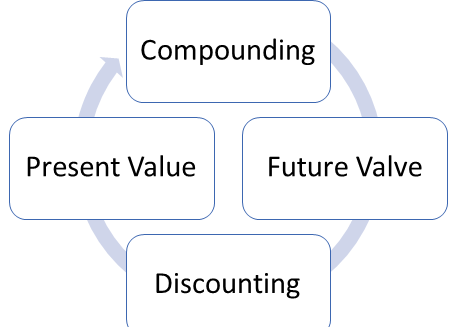
Time Value of Money says that the worth of a unit of money is going to be changed in future. Put simply, the value of one rupee today will be decreased in future. The whole concept is about the present value and future value of money. There are two methods used for ascertaining the worth of money at different points of time, namely, compounding and discounting. Compounding method is used to know the future value of present money. Conversely, discounting is a way to compute the present value of future money.

This principle does not calculate the market value of that asset, instead, it calculates the intrinsic value. Intrinsic value is nothing but the total value that is required to own the asset for the entirety of its lifetime. For better understanding, let’s consider an example. Every business to operate requires machinery for its operations.

The machinery is the necessity for every business and thus whenever the machine or in business terms, assets reaches its life, it needs to replace. Now, the machine that we used to replace the current one reaches its life, also requires to be replaced at the end of that asset’s life. And so the process goes on and on till the business is being run.

This replacement of machines results into the outflow of the cash and thus the whole amount can be added to get a depreciation amount. This is called the depreciation value. There are many methods to calculate this depreciation of any machinery. These methods include the write-down value method, the straight-line method, etc.

Compounding

Discounting

Meaning

The method used to determine the future value of present investment is known as Compounding. The method used to determine the present value of future cash flows is known as Discounting.

Concept

If we invest some money today, what will be the amount we get at a future date. What should be the amount we need to invest today, to get a specific amount in future.

Use of

Compound interest rate. Discount rate

Known

Present Value Future Value

Factor

Future Value Factor or Compounding Factor Present Value Factor or Discounting Factor

Formula

FV = PV (1 + r)^n PV = FV / (1 + r)^n

Assumptions

While talking about the time value of money principle, there are many assumptions that you need to make so that the depreciation can be demonstrated in a simple manner. Some of these assumptions include:

  • Each machinery that will be replaced will have the same cost
  • The productivity of all the assets remains the same during its lifetime
  • The asset and its replacement have the same total lifetime
  • There will be no residual value of the asset at the end of its lifetime
  • The asset that is used for replacement will have the same productivity
  • The assets that are used does not require any repairs or maintenance during its lifetime
  • No taxation is involved in the transaction
  • The payment done for the asset which is replaced will be upfront
  • The replacement of the asset will be immediately done

Present Value and Future Value

While compounding value for the depreciation of the assets, you need to keep in mind two important values: present value and future value. Future value is the value of the asset after a certain time period. While the present value is the value of the asset that we calculate after deducting the residual value.

FV = PV(1 + r)n

where FV= future value,PV = present value, r = rate of interest, n = equal number of periods.

PV = FV / (1 + r)n

Compounding

For understanding the concept of compounding, first of all, you need to know about the term future value. The money you invest today, will grow and earn interest on it, after a certain period, which will automatically change its value in future. So the worth of the investment in future is known as its Future Value. Compounding refers to the process of earning interest on both the principal amount, as well as accrued interest by reinvesting the entire amount to generate more interest.

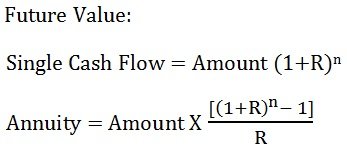
Compounding is the method used in finding out the future value of the present investment. The future value can be computed by applying the compound interest formula which is as under:

Where n = number of years
R = Rate of return on investment.

Discounting

Discounting is the process of converting the future amount into its Present Value. Now you may wonder what is the present value? The current value of the given future value is known as Present Value. The discounting technique helps to ascertain the present value of future cash flows by applying a discount rate. The following formula is used to know the present value of a future sum:

Where 1,2,3,…..n represents future years
FV = Cash flows generated in different years,
R = Discount Rate

error: Content is protected !!