Calculation of Cash Price

Calculation of cash price refers to the process of determining the actual amount a buyer needs to pay upfront to purchase a product or asset outright, without any financing, credit, or deferred payment arrangement. It reflects the pure value of the item, excluding any added costs such as interest, administrative fees, service charges, or future installment costs.

When goods are sold under credit or hire purchase arrangements, the total amount payable over time (often called the hire purchase price) includes both the cash price and additional charges for the convenience of paying later. To calculate the cash price from such deals, one must subtract all extra costs—primarily the finance or interest component.

For example, if a buyer agrees to pay ₹30,000 over 12 months under a hire purchase deal, but the interest charges total ₹5,000, the cash price is ₹25,000. This represents the amount they would have paid if they bought the item outright in cash.

Calculation of cash price is important for accounting, taxation, and financial decision-making. It helps buyers understand the true cost of the product without borrowing costs and enables businesses to assess profit margins and set clear pricing structures. Moreover, legal agreements often require the cash price to be stated explicitly, ensuring clarity and transparency between the buyer and the seller.

In some cases, die cash price is not given. Since the assets purchased cannot be capitalized at more than the cash price, it will be necessary to find out what it is. The way to proceed is to take up die final instalment first and to deduct interest from it. Interest for one year can be found out by multiplying the sum due at the end of the year by the formula Rate of Interest / 100 + Rate of Interest.

Suppose A owes B Rs 100 the interest being 15%. At the end of one year B will have to pay Rs 115 out of which Rs 15 is for interest. Hence, 15/115 of the sum due at the end of the year will be interest. Deducting interest, the sum due in the beginning of the year can be ascertained. This will also be the amount due at the end of the last but one year after paying the annual instalment. The total of these two will give the total sum due at the end of the last but one year.

That year’s interest can again be ascertained by multiplying the total amount due by the formula:

Rate of Interest/100 + Rate of Interest

The cash price can also be calculated, if the annual payments are uniform by the formula:

Where r is the rate of interest per cent per annum and n is the number of years over which payment is to be made. This really amounts to finding out the present value of the amount to be paid or received, taking into account the concerned rate of interest. Tables are available for ready calculation.

Example:

On 1st April, 2008, Bihar Collieries obtained a machine on the hire purchase system, the total amount payable being Rs 2, 50,000. Payment was to be made Rs 50,000 down and the balance in four annual installments of Rs 50,000 each. Interest charged was at the rate of 15 per cent. At what value should the machine be capitalized?

Solution:

If amount due in the beginning of a year is Rs 100, interest for the year will be Rs 15 and the amount of instalment due at the end of the year will be Rs 115. Thus, interest is 15/115 or 3/23 of the amount due at the end of each year.

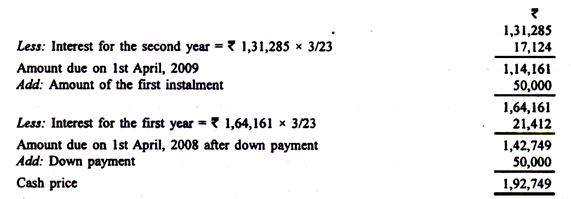
Keeping this in mind, the cash price of the machine can be calculated in the following manner:

Alternatively, the present value at 15% per annum of one rupee received annually at the end of four years is Rs 2-85498. Thus, the present value of Rs 50,000 is Rs 50,000 x 2.85498 = Rs 1, 42,749. To this, we add down payment of Rs 50,000. Therefore, the cash price is Rs 1, 42,749 + Rs 50,000 = Rs 1, 92,749.

Calculation of Interest

Calculating interest rate is not at all a difficult method to understand. Knowing to calculate interest rate can solve a lot of wages problems and save money while taking investment decisions. There is an easy formula to calculate simple interest rates. If you are aware of your loan and interest amount you can pay, you can do the largest interest rate calculation for yourself.

Using the simple interest calculation formula, you can also see your interest payments in a year and calculate your annual percentage rate.

Here is the step by step guide to calculate the interest rate.

How to calculate interest rate?

Know the formula which can help you to calculate your interest rate.

Step 1

To calculate your interest rate, you need to know the interest formula I/Pt = r to get your rate. Here,

I = Interest amount paid in a specific time period (month, year etc.)

P = Principle amount (the money before interest)

t = Time period involved

r = Interest rate in decimal

You should remember this equation to calculate your basic interest rate.

Step 2

Once you put all the values required to calculate your interest rate, you will get your interest rate in decimal. Now, you need to convert the interest rate you got by multiplying it by 100. For example, a decimal like .11 will not help much while figuring out your interest rate. So, if you want to find your interest rate for .11, you have to multiply .11 with 100 (.11 x 100).

For this case, your interest rate will be (.11 x 100 = 11) 11%.

Step 3

Apart from this, you can also calculate your time period involved, principal amount and interest amount paid in a specific time period if you have other inputs available with you.

Calculate interest amount paid in a specific time period, I = Prt.

Calculate the principal amount, P = I/rt.

Calculate time period involved t = I/Pr.

Step 4

Most importantly, you have to make sure that your time period and interest rate are following the same parameter.

For example, on a loan, you want to find your monthly interest rate after one year. In this case, if you put t = 1, you will get the final interest rate as the interest rate per year. Whereas, if you want the monthly interest rate, you have to put the correct amount of time elapsed. Here, you can consider the time period like 12 months.

Please remember, your time period should be the same time amount as the interest paid. For example, if you’re calculating a year’s monthly interest payments then, it can be considered you’ve made 12 payments.

Also, you have to make sure that you check the time period (weekly, monthly, yearly etc.) when your interest is calculated with your bank.

Step 5

You can rely on online calculators to get interest rates for complex loans, such as mortgages. You should also know the interest rate of your loan when you sign up for it.

For fluctuating rates, sometimes it becomes difficult to determine what a certain rate means. So, it is better to use free online calculators by searching “variable APR interest calculator”, “mortgage interest calculator” etc.

Calculation of interest when rate of interest and cash price is given

  • Where Cash Price, Interest Rate and Instalment are Given:

Illustration:

On 1st January 2003, A bought a television from a seller under Hire Purchase System, the cash price of which being Rs 10.450 as per the following terms:

(a) Rs 3,000 to be paid on signing the agreement.

(b) Balance to be paid in three equal installments of Rs 3,000 at the end of each year,

(c) The rate of interest charged by the seller is 10% per annum.

You are required to calculate the interest paid by the buyer to the seller each year.

Solution:

Note:

  1. there is no time gap between the signing of the agreement and the cash down payment of Rs 3,000 (1.1.2003). Hence no interest is calculated. The entire amount goes to reduce the cash price.
  2. The interest in the last installment is taken at the differential figure of Rs 285.50 (3,000 – 2,714.50).

(2) Where Cash Price and Installments are Given but Rate of Interest is Omitted:

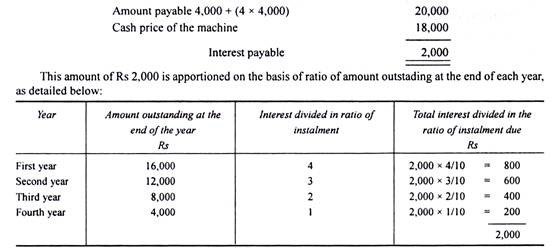
Where the rate of interest is not given and only the cash price and the total payments under hire purchase installments are given, then the total interest paid is the difference between the cash price of the asset and the total amount paid as per the agreement. This interest amount is apportioned in the ratio of amount outstanding at the end of each period.

Illustration:

Mr. A bought a machine under hire purchase agreement, the cash price of the machine being Rs 18,000. As per the terms, the buyer has to pay Rs 4,000 on signing the agreement and the balance in four installments of Rs 4,000 each, payable at the end of each year. Calculate the interest chargeable at the end of each year.

(3) Where installments and Rate of Interest are Given but Cash Value of the Asset is Omitted:

In certain problems, the cash price is not given. It is necessary that we must first find out the cash price and interest included in the installments. The asset account is to be debited with the actual price of the asset. Under such situations, i.e. in the absence of cash price, the interest is calculated from the last year.

It may be noted that the amount of interest goes on increasing from 3rd year to 2nd year, 2nd year to 1st year. Since the interest is included in the installments and by knowing the rate of interest, we can find out the cash price.

Thus:

Let the cash price outstanding be: Rs 100

Interest @ 10% on Rs 100 for a year: Rs 10

Installment paid at the end of the year 110

The interest on installment price = 10/110 or 1/11 as a ratio.

Illustration:

I buy a television on Hire Purchase System.

The terms of payment are as follows:

Rs 2,000 to be paid on signing the agreement;

Rs 2,800 at the end of the first year;

Rs 2,600 at the end of the second year;

Rs 2,400 at the end of the third year;

Rs 2,200 at the end of the fourth year.

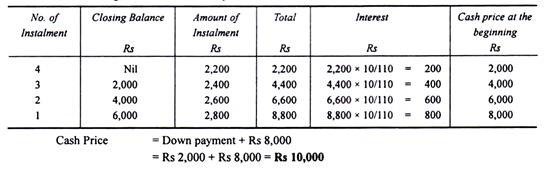
If interest is charged at the rate of 10% p.a., what was the cash value of the television?

Solution:

(4) Calculation of Cash Price when Reference to Annuity Table, the Rate of Interest and Installments are Given:

Sometimes in the problem a reference to annuity table wherein present value of the annuity for a number of years at a certain rate of interest is given. In such cases the cash price is calculated by multiplying the amount of installment and adding the product to the initial payment.

Illustration:

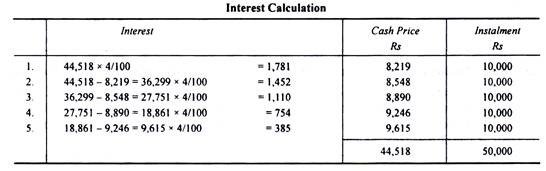
A agrees to purchase a machine from a seller under Hire Purchase System by annual installment of Rs 10,000 over a period of 5 years. The seller charges interest at 4% p.a. on yearly balance.

N.B. The present value of Re 1 p.a. for five years at 4% is Rs 4.4518. Find out the cash price of the machine.

Solution:

Installment Re 1 Present value = Rs 4.4518

Installment = Rs 10,000 Present value = Rs 4.4518 x 10,000 = Rs 44,518

Hire Purchase Charges, Meaning, Objectives, Features, Needs

Hire purchase charges refer to the total additional costs a buyer pays over and above the original cash price of an asset when purchasing it through a hire purchase agreement. These charges are primarily made up of interest or finance costs, which compensate the seller or financing company for allowing the buyer to pay in installments over an agreed period. Since the seller does not receive the full cash price upfront, hire purchase charges account for the time value of money and the risk of default.

Typically, when a buyer enters into a hire purchase agreement, the total amount payable is higher than the cash price because it includes both the principal (cash price) and the hire purchase charges. These charges are spread across the monthly or periodic installments, meaning each payment includes a part of the principal and a part of the charges.

Hire purchase charges may also include administrative fees, processing fees, insurance costs, and sometimes late payment penalties if the buyer misses installments. The specific amount of hire purchase charges depends on the length of the agreement, the interest rate applied, and the terms negotiated between the buyer and seller.

Objectives of Hire Purchase Charges:

  • Compensating the Seller for Deferred Payment

The primary objective of hire purchase charges is to compensate the seller or financier for not receiving the full payment upfront. By offering the asset on credit, the seller carries the risk of delayed payments and potential default. The hire purchase charges, often calculated as interest or finance costs, ensure that the seller is fairly rewarded for allowing the buyer to spread payments over time. Without these charges, sellers would face losses due to inflation, opportunity cost, and the absence of immediate liquidity.

  • Covering Administrative and Processing Costs

Hire purchase transactions involve considerable administrative work, such as preparing contracts, maintaining payment records, and monitoring customer accounts. The hire purchase charges include components to cover these operational and administrative expenses. This ensures that the seller or financing institution can efficiently manage multiple hire purchase agreements without suffering a financial burden. These charges ultimately make the system sustainable by distributing the indirect costs across the many buyers who benefit from installment purchase facilities.

  • Reflecting the Cost of Credit Provision

Another key objective is to reflect the true cost of providing credit to buyers. Hire purchase charges act as the price for availing a credit facility, similar to interest in loans. By transparently disclosing the charges, buyers can understand how much extra they are paying to spread their payments over months or years. This clarity promotes responsible borrowing and allows buyers to compare different credit offers, fostering a fair and competitive marketplace.

  • Encouraging Sellers to Offer Credit Sales

Sellers are more willing to offer goods on hire purchase when there is a clear system to recover additional costs through hire purchase charges. These charges incentivize sellers to take the risk of deferred payments, knowing they will receive compensation for the risk and time involved. As a result, more products become available under hire purchase, expanding customer choice and boosting sales volume for businesses, especially in industries like automobiles, electronics, and machinery.

  • Protecting Against Buyer Default Risks

A critical objective of hire purchase charges is to mitigate the risk posed by buyers who may default on payments. Since ownership remains with the seller until the final installment, the hire purchase charges provide additional financial cushioning in case of partial recovery or asset repossession. This helps sellers offset potential losses and ensures that the business remains financially stable even if some customers fail to meet their obligations.

  • Promoting Wider Access to Expensive Goods

By including hire purchase charges, sellers make it possible for more customers to afford high-value products. Many individuals and small businesses may lack the cash to make upfront purchases but can handle manageable monthly payments. The hire purchase system, supported by these charges, broadens access and increases market participation, allowing consumers to upgrade their standard of living or businesses to enhance their operations without major financial strain.

  • Generating Profit for Financiers

For financing companies or banks that handle hire purchase agreements, the charges represent a major source of revenue. These entities provide the upfront capital to sellers and recover it in installments from buyers, profiting through the hire purchase charges built into the payment plan. Without these charges, financiers would lack the incentive to fund hire purchase transactions, limiting the availability of such schemes to the public.

  • Supporting Legal and Contractual Clarity

Hire purchase charges play a crucial role in ensuring legal clarity in agreements. Clearly defining the charges helps both parties understand their obligations, minimizes disputes, and ensures enforceability in courts if conflicts arise. This clarity benefits the buyer by protecting them from hidden costs and benefits the seller by ensuring the recoverability of the agreed compensation over time.

Features of Hire Purchase Charges:
  • Additional to Cash Price

One of the main features of hire purchase charges is that they are added on top of the asset’s cash price. When a buyer purchases goods through hire purchase, they agree to pay not only the original cost but also additional charges that reflect the cost of financing. This total becomes the hire purchase price, which is paid in installments. Without these added charges, sellers or financiers would receive no benefit for extending credit over time.

  • Spread Across Installments

Hire purchase charges are spread over the entire period of the agreement, included within each installment payment. Every installment consists of two components: a portion of the principal (cash price) and a portion of the hire purchase charges. This structure allows buyers to gradually pay off both the asset and the financing cost over time, making large purchases more manageable. The structured breakdown provides transparency and predictability for both the buyer and the seller.

  • Covers Interest and Finance Costs

A key feature is that hire purchase charges primarily cover the interest and finance costs associated with delayed payment. Since the seller or financier does not receive the entire payment upfront, the charges compensate them for the time value of money and associated risks. These costs vary depending on the duration of the hire purchase period, the agreed-upon interest rate, and the buyer’s creditworthiness, making each agreement uniquely structured.

  • Legally Defined and Binding

Hire purchase charges are legally defined in the hire purchase agreement, making them enforceable under law. Both parties — the buyer and seller — must agree on the total charges and how they are calculated before signing the contract. This clarity protects buyers from unexpected fees and ensures that sellers or financiers can recover their full compensation if disputes arise. Well-documented charges improve the trustworthiness and credibility of the hire purchase system.

  • Varies with Duration and Risk

The total amount of hire purchase charges often depends on the duration of the agreement and the perceived risk level. Longer repayment periods typically attract higher charges because they involve more extended credit exposure. Similarly, buyers with lower credit ratings or riskier profiles may face higher charges to offset the risk of non-payment. This flexible nature makes hire purchase adaptable to various buyer profiles and repayment capacities.

  • Includes Administrative and Service Fees

Beyond just interest, hire purchase charges may include various administrative and service fees. These cover the costs of processing the agreement, managing accounts, and providing customer support throughout the hire purchase period. These additional components ensure that the seller or financier can offer comprehensive services without incurring losses, making the entire process efficient and smooth for both parties involved.

  • Non-refundable Once Paid

Once hire purchase charges are paid, they are generally non-refundable. Even if the buyer returns the goods or defaults midway, the charges already collected usually remain with the seller or financier as compensation for the credit risk, service provision, and depreciation of the asset. This feature protects the interests of the credit provider and ensures they are not financially disadvantaged due to early contract termination or repossession.

  • Transparent and Pre-disclosed

Hire purchase charges are transparently disclosed before the agreement is finalized. Buyers are provided with a clear schedule that outlines the total hire purchase price, the number of installments, and how much of each installment represents charges versus principal repayment. This transparency allows buyers to make informed decisions, compare offers, and plan their finances accordingly. It also enhances trust between the parties involved.

Needs of Hire Purchase Charges:

  • To Compensate for Credit Risk

Hire purchase charges are needed to compensate sellers or financiers for the risk they assume by allowing buyers to pay over time. There’s always a chance the buyer might default or delay payments, causing financial strain for the seller. The charges act as a built-in cushion to balance this risk, ensuring that sellers or financiers are rewarded for the uncertainty and do not face losses while extending credit to customers under hire purchase agreements.

  • To Cover Capital and Interest Costs

The seller or financier ties up capital when they let the buyer pay in installments rather than upfront. To make up for the opportunity cost of this delayed payment, hire purchase charges are necessary. These charges reflect the interest that could have been earned if the capital were used elsewhere, like in investments or other business activities. Without these charges, extending credit would not be financially sustainable for sellers or lenders.

  • To Maintain Profitability

Hire purchase is not just a convenience for the buyer; it’s also a business model for the seller or financier. To keep this model profitable, hire purchase charges are required. They ensure that the costs of providing credit — including administrative costs, handling risks, and opportunity costs — are fully recovered. Without these charges, the hire purchase system would fail to generate profits and would eventually become unviable for businesses to offer.

  • To Encourage Wider Use of Credit Facilities

The availability of hire purchase credit widens access to goods for buyers who may not have the cash to pay upfront. However, sellers need a financial incentive to offer such credit. Hire purchase charges provide this incentive by ensuring the seller earns a reasonable return over the duration of the agreement. Without these charges, many sellers might avoid offering hire purchase, limiting consumer access to costly items like vehicles, appliances, or machinery.

  • To Fund Administrative and Service Operations

Managing hire purchase agreements involves paperwork, account management, collections, customer service, and legal oversight. All these require resources and staff, which generate costs. Hire purchase charges are necessary to fund these operations and ensure that service quality is maintained. Without these fees, companies would struggle to cover the indirect expenses associated with administering credit, potentially compromising their ability to offer effective support to customers.

  • To Provide Financial Security Against Defaults

Hire purchase charges create a financial buffer for sellers or financiers if a buyer defaults on their payments. Since ownership often stays with the seller until full payment, recovering the asset may cover part of the loss, but additional charges help further safeguard the financier’s bottom line. These charges are needed to absorb the administrative, legal, and recovery costs that arise from defaults or repossessions, protecting the long-term health of the business.

  • To Reflect the Time Value of Money

Money today is worth more than the same amount in the future due to inflation and opportunity costs. Hire purchase charges are needed to reflect this time value of money. They ensure that when payments are spread over months or years, the seller or financier still receives the equivalent value they would have obtained through an immediate cash sale. Without these adjustments, sellers would effectively lose money over time.

  • To Maintain Market Competitiveness

Hire purchase charges are also necessary to keep the credit market competitive and fair. By transparently including these charges in agreements, buyers can compare different offers and select the most cost-effective financing options. Without standard charges, some sellers might hide costs in unclear terms, leading to market distortions and unfair competition. Well-defined hire purchase charges promote transparency, benefiting both businesses and consumers.

Cash Price, Meaning, Objectives, Works

Cash price refers to the actual amount of money required to purchase an asset or good outright, without any financing or credit arrangement. It is the price paid when the buyer pays the full amount upfront, usually at the point of sale, and takes immediate ownership of the product. This amount excludes any additional costs such as interest, finance charges, or administrative fees that may apply under credit arrangements like hire purchase or installment plans.

In simple terms, the cash price is the amount that a buyer would need to pay if they are not using any deferred payment system. For example, if a refrigerator is sold at a cash price of ₹20,000, it means the buyer can take it home immediately by paying ₹20,000 without any extra costs. However, if the same product is bought through a hire purchase or installment scheme, the total amount paid over time (called the hire purchase price) will usually be higher because it includes interest and other charges.

The concept of cash price is important for both buyers and sellers because it serves as the base value of the product. It helps buyers compare whether it’s more economical to buy outright or use financing. For accounting and legal purposes, the cash price must be clearly stated in credit agreements to ensure transparency.

Objectives of Cash Price:

  • To Determine the Base Value of Goods

One key objective of the cash price is to establish the actual, base value of a product or asset without any added financial costs. This allows both buyers and sellers to understand what the item is worth when paid in full, upfront. It serves as the starting point for pricing, enabling clear comparisons between outright purchases and financed purchases. Without a clear cash price, buyers might struggle to evaluate whether credit options or hire purchase terms offer them good value.

  • To Provide Transparent Pricing

Another important objective of setting a cash price is to promote transparency in transactions. Buyers need to know how much they are paying for the product itself, separate from any interest or credit charges. This clear distinction allows consumers to make informed decisions about how to pay — whether to choose an upfront payment or opt for installment schemes. Transparent cash pricing protects buyers from hidden costs and ensures fairness in the market.

  • To Serve as a Benchmark for Credit Pricing

The cash price acts as a benchmark against which credit or hire purchase prices are calculated. Credit purchases always involve extra costs like interest, administrative fees, or service charges. By knowing the cash price, buyers can assess how much extra they will pay for the convenience of deferred payments. For sellers, it helps set accurate financing terms, ensuring that credit options reflect fair and reasonable additional charges over the base cash value.

  • To Help in Financial Planning

Cash price plays a critical role in helping both buyers and businesses plan their finances. Buyers can evaluate if they have enough funds to make an outright purchase or if they should spread payments over time. For businesses, knowing the cash price allows them to calculate profit margins, manage cash flows, and decide how much capital they will receive from immediate sales. It creates clarity for planning purchases, sales strategies, and budget allocations.

  • To Simplify Accounting and Record-Keeping

From an accounting perspective, the cash price simplifies record-keeping by providing a clear, unambiguous value to record in the books. When businesses sell items for cash, the transaction is straightforward and requires no complex adjustments for interest or finance charges. This objective ensures that sales records, profit calculations, and tax reporting are easier to manage. It also helps avoid confusion or misstatement of values in financial statements and company accounts.

  • To Attract Price-Sensitive Customers

Cash price targets customers who prefer to avoid additional charges and pay upfront. Many buyers, especially price-sensitive ones, are looking for the best possible deal and want to avoid financing costs. By offering a clear and attractive cash price, businesses can appeal to this segment and increase sales volume. This objective helps companies balance between serving credit customers and maximizing sales among buyers who prioritize cost savings.

  • To Speed Up Sales Transactions

Another objective of setting a cash price is to accelerate sales by encouraging upfront payments. When buyers pay in cash, there’s no need for lengthy paperwork, credit checks, or approval processes. This speeds up the transaction process, reduces administrative burden for the seller, and results in immediate cash inflow. Faster transactions also mean that sellers can move inventory more quickly, improving their overall business efficiency and reducing stock-holding costs.

  • To Establish Fair Market Competition

Having a clear cash price ensures fair competition in the market. When all sellers display transparent upfront pricing, buyers can compare offers and choose the most cost-effective option. This prevents unfair practices where some sellers might hide extra costs in unclear financing terms. The objective here is to maintain a level playing field where businesses compete on the true value of their products, not just on clever or confusing payment schemes.

  • To Fulfill Legal and Regulatory Requirements

In many countries, displaying or disclosing the cash price is a legal requirement under consumer protection laws. This objective ensures that sellers comply with regulations designed to protect buyers from deceptive or unfair pricing practices. It also ensures that financial agreements, such as hire purchase contracts, clearly differentiate between the cash price and the total credit cost, reducing disputes and maintaining transparency in commercial transactions.

How Cash Price Work?

Cash price is the actual price of a product or asset when paid fully at the time of purchase, without using any credit, installment, or financing option. When a buyer pays the cash price, they pay only for the value of the item itself, without any additional costs such as interest, service charges, or processing fees. This is usually the lowest total amount a buyer can pay for an item.

For example, if a washing machine has a cash price of ₹25,000, it means the buyer can own it immediately by paying ₹25,000 upfront. There are no hidden costs, no future payments, and no conditions attached. Once the cash price is paid, ownership is fully transferred from the seller to the buyer.

In contrast, if the buyer opts for a hire purchase or installment scheme, they might pay over time, but the total amount (known as the hire purchase price or total installment cost) will include extra charges like interest or administrative fees. This total will always be more than the original cash price.

Cash price works as a benchmark in sales, helping buyers understand the base value of a product and decide if they want to pay upfront or over time. It also helps sellers set fair credit terms, ensuring the extra charges on credit sales are transparent and justifiable.

Hire Purchase Price, Meaning, Objectives, Features, Needs

Hire purchase price refers to the total amount a buyer agrees to pay under a hire purchase agreement in order to eventually own a particular asset. It is more than just the cash price of the asset because it also includes additional costs like interest, service charges, administrative fees, and sometimes insurance. This total is usually spread out over a series of fixed monthly or quarterly installments, making it easier for buyers to afford expensive items without paying the full price upfront.

Under a hire purchase system, the buyer pays a down payment at the beginning, followed by regular installments over a fixed period. While the buyer gains the right to use the asset immediately after signing the agreement, ownership remains with the seller or finance company until all payments are completed. Only after the final installment is paid does ownership legally transfer to the buyer.

For example, if the cash price of machinery is ₹500,000 and the buyer agrees to a hire purchase plan with a ₹100,000 down payment and 24 monthly installments of ₹20,000 (which includes interest), the hire purchase price would be ₹100,000 + (₹20,000 × 24) = ₹580,000. This amount reflects both the principal and the financing cost.

Objectives of Hire Purchase Price:

  • Facilitate Asset Acquisition

One of the primary objectives of the hire purchase price is to enable buyers to acquire expensive assets without paying the full cash price upfront. By allowing payment in installments, the hire purchase price helps individuals and businesses access goods like vehicles, machinery, and equipment that might otherwise be unaffordable. This objective promotes economic activity by making costly purchases more accessible to a wider range of buyers, facilitating consumption and business growth.

  • Recover the Cost and Interest

The hire purchase price aims to ensure the seller recovers not only the cost of the asset but also the interest or finance charges over the installment period. Since the buyer enjoys the use of the asset immediately but ownership transfers only after full payment, the price includes compensation for credit risk and time value of money. This objective balances affordability for the buyer with profitability for the seller or financier, enabling sustainable credit arrangements.

  • Promote Flexible Payment Terms

Another objective is to provide flexible payment options tailored to the buyer’s financial capability. The hire purchase price is structured to allow manageable periodic payments, reducing the immediate financial burden on the buyer. This flexibility encourages timely payments and reduces defaults, ensuring the contract’s smooth functioning. By setting a clear, predetermined total price, both parties understand their obligations throughout the agreement’s term.

  • Ensure Legal Clarity and Security

The hire purchase price is established to provide legal clarity regarding the total payment obligation of the buyer. It clearly defines the sum due, including principal and interest, preventing disputes about payment amounts. This objective protects both the seller’s ownership rights until full payment and the buyer’s rights to use the asset. It also aids in legal enforcement if payment terms are breached, fostering trust in hire purchase transactions.

  • Encourage Credit Sales and Economic Growth

By setting an all-inclusive hire purchase price, sellers can confidently offer credit sales without upfront cash, stimulating demand. This pricing objective helps expand the market for high-value goods, encourages consumption, and supports economic growth. Buyers benefit from immediate use, while sellers increase sales volume. The hire purchase price balances risks and rewards, making credit sales viable and beneficial for the overall economy.

  • Simplify Financial Planning for Buyers

The hire purchase price objective includes simplifying financial planning for buyers by specifying the total payable amount upfront. Buyers can budget their finances by knowing exact installment amounts and payment durations. This predictability reduces financial uncertainty and helps buyers manage cash flows better. Clear knowledge of the hire purchase price assists buyers in comparing different credit offers, promoting informed decision-making.

  • Manage Risk and Default

The hire purchase price helps manage risks associated with non-payment by including interest charges and fees that compensate sellers for credit risks. It acts as a deterrent against default by making buyers aware of the financial consequences of missed payments. The price also reflects provisions for repossession costs and administrative expenses. This objective ensures the seller’s protection while maintaining buyer accountability throughout the agreement.

  • Promote Transparency and Fairness

Lastly, the hire purchase price aims to promote transparency and fairness in credit sales. By clearly stating the total cost, including interest and fees, buyers are not misled by low installment amounts alone. This transparency helps prevent hidden charges or unfair pricing practices. Clear hire purchase pricing builds trust between buyers and sellers and encourages ethical business practices in the credit market.

Features of Hire Purchase Price:

  • Inclusive of Cash Price and Interest

The hire purchase price is not just the cash price of the asset; it includes the cash price plus interest and other charges. This means the buyer pays more than the asset’s upfront cost because they are purchasing on credit, compensating the seller for the time value of money and credit risk. This combined amount is divided into installments over the hire purchase period.

  • Payable in Installments

Unlike a lump-sum payment, the hire purchase price is paid in installments, usually monthly or quarterly. This feature allows buyers to spread out payments over time, making expensive assets more affordable. Each installment includes a portion of the principal and interest, easing cash flow management for buyers while ensuring gradual recovery for sellers.

  • Ownership Transfers After Full Payment

A key feature is that the buyer does not own the asset until the entire hire purchase price is paid. Despite using the asset during the agreement, legal ownership remains with the seller until the last installment. This protects the seller’s interests, allowing repossession if the buyer defaults before full payment.

  • Includes Additional Charges

Besides the cash price and interest, the hire purchase price may include other charges such as administrative fees, insurance, and processing costs. These extra fees are incorporated to cover expenses related to managing the credit and safeguarding the asset, ensuring sellers do not incur losses during the contract.

  • Fixed and Pre-determined Amount

The total hire purchase price is fixed and agreed upon at the start of the contract. Both parties know the exact amount to be paid and the payment schedule, ensuring transparency. This prevents disputes over payment amounts and protects buyers from sudden price hikes during the term.

  • Reflects Credit Risk and Time Value

Since payment extends over time, the hire purchase price factors in credit risk—the risk of buyer default—and the time value of money. Interest charged compensates sellers for delaying full payment and assuming the risk of non-payment, making this pricing feature essential to the credit sales mechanism.

  • Facilitates Budgeting and Financial Planning

By clearly stating the total price and installment structure, the hire purchase price helps buyers plan their finances. They can allocate funds accordingly, ensuring timely payments and avoiding defaults. This feature provides predictability, making credit purchases less stressful.

  • Supports Legal and Contractual Clarity

The hire purchase price is explicitly mentioned in the agreement, providing legal clarity on financial obligations. It serves as a reference point for enforcement if payments are missed, aiding in dispute resolution. This clarity protects both buyers and sellers throughout the contract’s duration.

Need for Hire Purchase Price:

  • Facilitates Purchase of Expensive Assets

The hire purchase price is essential because it enables buyers to acquire costly assets without paying the full cash price upfront. Many individuals and businesses cannot afford large one-time payments, so spreading the cost over installments makes ownership feasible and affordable.

  • Covers Cost of Credit and Interest

The hire purchase price ensures sellers recover not only the asset’s cash price but also interest and finance charges. This compensates sellers for the delayed payment and risks involved in providing credit, making hire purchase agreements financially viable.

  • Provides Clear Payment Terms

Having a fixed hire purchase price sets clear payment obligations for buyers. This transparency reduces confusion or disputes about installment amounts and total costs, making transactions smoother and more trustworthy.

  • Protects Seller’s Ownership Rights

Until the hire purchase price is fully paid, ownership remains with the seller. The need for the hire purchase price helps legally enforce this arrangement, protecting sellers against default or loss of property before full payment.

  • Encourages Credit Sales and Market Growth

By defining a clear price structure, hire purchase agreements stimulate demand for expensive goods. Buyers are encouraged to make purchases on credit, which boosts sales and promotes economic growth by expanding consumer access.

  • Helps Buyers Budget Payments

Knowing the total hire purchase price and installment schedule assists buyers in financial planning. This need for defined pricing allows them to manage cash flow effectively, ensuring timely payments and reducing defaults.

  • Reflects True Cost of Credit

The hire purchase price reveals the actual cost of buying on credit, including interest and fees. This transparency prevents hidden charges and educates buyers about the financial implications of hire purchase agreements.

  • Ensures Legal and Contractual Clarity

A clearly stated hire purchase price in agreements is necessary for legal enforceability. It defines the buyer’s obligations and supports dispute resolution if payments are missed, safeguarding both parties.

Hire Purchase and Installment Purchase

Hire Purchase (HP) is a popular method of purchasing goods through installment payments over a period of time. Under this system, the buyer takes possession and use of the goods immediately but does not own them outright until all installments, including the final payment, are completed. Essentially, it is a contract between the buyer (hirer) and the seller (owner) where the ownership of the goods is transferred only after the last installment is paid.

In a hire purchase agreement, the buyer pays an initial down payment or deposit, followed by regular installments which include the principal amount and interest. The buyer enjoys the use of the asset during this period but the legal ownership remains with the seller or finance company until the full payment is made.

This system is widely used for purchasing expensive items such as vehicles, machinery, and consumer electronics, making it easier for buyers who may not have the full purchase price upfront. Hire purchase allows buyers to spread the cost over time while benefiting from immediate use.

Features of Hire Purchase

  • Ownership Transfer

In a hire purchase agreement, the ownership of the goods remains with the seller or the finance company until the buyer completes all installment payments. Even though the buyer gains immediate possession and use of the goods, legal ownership is transferred only after the final payment is made. This condition ensures that if the buyer defaults on the payments, the seller has the legal right to repossess the goods, reducing the risk of loss. It differentiates hire purchase from outright purchases or credit sales where ownership transfers immediately.

  • Down Payment Requirement

Hire purchase agreements typically require the buyer to make an initial down payment or deposit. This upfront payment reduces the total amount to be financed and lowers the seller’s risk. The remaining balance is paid over agreed installment periods. The down payment also shows the buyer’s commitment to the purchase and can influence the terms of the contract, such as the interest rate or length of the payment schedule. This initial payment is usually a fixed percentage of the total price, depending on the agreement.

  • Fixed Installments

Under a hire purchase system, the buyer agrees to pay the outstanding amount in fixed, regular installments over a specified period. These installments typically include both the principal repayment and the interest charged on the outstanding balance. The installment schedule is predetermined in the agreement and may be monthly, quarterly, or annually. Fixed installments provide predictability for both the buyer and seller, allowing the buyer to plan finances accordingly and the seller to anticipate regular cash inflows from the arrangement.

  • Right to Use the Asset

A key feature of hire purchase is that the buyer gains the right to use the asset or goods immediately after the agreement is signed and the initial payment is made. This benefit allows individuals and businesses to access and benefit from the goods without having to pay the full purchase price upfront. For example, a business can start using machinery or vehicles in its operations while paying over time. However, since ownership is not transferred immediately, the buyer must comply with the contract terms to retain this right.

  • Repossession on Default

If the buyer fails to make the agreed installment payments, the seller or finance company has the right to repossess the goods. This feature safeguards the seller’s interests and ensures that the asset can be recovered if the buyer defaults. The risk of repossession motivates buyers to fulfill their payment obligations and protects sellers from potential financial loss. However, repossession also involves costs and legal procedures, so sellers often prefer to negotiate or settle before taking this action.

  • Inclusion of Interest Charges

The hire purchase system includes interest on the unpaid balance, which compensates the seller or finance provider for extending credit over time. The interest rate is agreed upon at the start of the contract and is usually calculated on a reducing balance or flat rate basis. The inclusion of interest makes hire purchase slightly more expensive than cash purchases, but it offers the buyer the advantage of spreading payments over time. Understanding the interest component is crucial when comparing hire purchase deals.

  • Contractual Agreement

A hire purchase transaction is governed by a formal contractual agreement that outlines all terms and conditions, including the payment schedule, interest rate, repossession rights, maintenance responsibilities, and other obligations. Both the buyer and the seller must comply with these terms throughout the duration of the agreement. This contract provides legal clarity and protects the rights of both parties, ensuring that disputes can be resolved based on documented terms. It is important that buyers carefully review and understand the agreement before signing.

  • Applicability to Durable Goods

Hire purchase is most commonly used for purchasing durable and high-value goods, such as vehicles, industrial machinery, home appliances, and equipment. These items typically have a long useful life, making it practical for buyers to pay over time while using the goods. Hire purchase allows consumers and businesses to access products that may be otherwise unaffordable upfront, thereby supporting economic activity and enhancing productivity. However, it is generally not used for consumable or perishable goods, as they do not retain value over time.

Advantages of Hire Purchase

  • Easy Access to Expensive Assets

One major advantage of hire purchase is that it allows individuals and businesses to acquire expensive assets without needing to pay the full amount upfront. Instead of waiting to save the entire purchase price, buyers can make a small down payment and spread the remaining cost over time. This is especially useful for small businesses or startups needing essential machinery, equipment, or vehicles to operate effectively. Consumers can also benefit by obtaining household goods like appliances or electronics without financial strain. By reducing the barrier to ownership, hire purchase boosts economic activity and makes products accessible to a broader market segment, enabling users to benefit immediately from the use of the asset.

  • Flexible Payment Options

Hire purchase offers flexible payment options tailored to the buyer’s financial capacity. The installments are usually fixed and can be scheduled monthly, quarterly, or as agreed between the parties, making it easier to manage cash flow. This flexibility helps buyers plan their budgets efficiently, as they know exactly how much needs to be paid and when. Some agreements even allow early settlement, enabling buyers to clear the balance ahead of time and sometimes enjoy interest reductions. This advantage makes hire purchase suitable for both individuals and businesses with fluctuating incomes, ensuring they can meet payment obligations without severe financial strain or cash shortages.

  • Immediate Use of the Asset

Under hire purchase, buyers can use the asset immediately after signing the agreement and paying the initial deposit. They do not need to wait until the entire payment is completed to benefit from the asset’s use. For businesses, this means they can start generating revenue or improving productivity right away, using the machinery, equipment, or vehicles acquired. For individuals, it provides instant access to desired goods like cars or home appliances. This immediate access to resources enhances operational efficiency and consumer satisfaction, making hire purchase an attractive alternative to saving up or seeking large loans for outright purchases.

  • Encourages Business Growth

Hire purchase helps businesses grow by enabling them to acquire the necessary resources for expansion without draining working capital. Rather than using lump-sum funds to buy expensive machinery, vehicles, or equipment, businesses can use hire purchase to spread the cost over several years. This approach frees up funds for other essential activities like marketing, staffing, or product development. As a result, companies can scale operations and improve competitiveness in the market. Additionally, the predictable installment payments make it easier for businesses to manage their financial planning and maintain steady cash flow, supporting long-term growth and sustainability.

  • Easier Credit Access Than Loans

Compared to bank loans or other credit facilities, hire purchase arrangements are often easier to access, especially for individuals or businesses with limited credit history or collateral. The asset itself typically serves as security for the transaction, reducing the need for additional guarantees. This makes hire purchase an appealing financing method for those who may face difficulties securing traditional bank loans. Additionally, since the credit approval process focuses largely on the asset’s value and the buyer’s repayment ability, approvals are generally faster and simpler. As a result, buyers can quickly obtain the goods they need without undergoing complex loan application procedures.

  • Fixed Interest Rates and Predictable Costs

Most hire purchase agreements come with fixed interest rates, ensuring that the buyer’s installment amounts remain consistent throughout the contract term. This predictability makes financial planning easier, as buyers can calculate their monthly expenses without worrying about fluctuating rates or hidden charges. Unlike some variable-rate loans, where interest costs may rise unexpectedly, hire purchase provides stability and transparency. Buyers know upfront the total amount they will pay, including interest, making it easier to assess affordability and avoid surprises. This feature enhances trust in the agreement and supports better financial management for both individuals and businesses.

  • No Additional Collateral Required

In a hire purchase agreement, the purchased asset itself acts as security for the transaction. This means that buyers usually do not need to pledge additional collateral or provide personal guarantees, as is often required in bank loans or other financing methods. This is particularly advantageous for small businesses or individuals who may have limited assets or prefer not to risk other property. Since the seller retains ownership until all installments are paid, the risk to the seller is reduced, and the buyer gains access to goods without putting other valuable assets at stake. This reduces financial pressure on the buyer.

  • Potential Tax Benefits for Businesses

Businesses using hire purchase agreements may enjoy certain tax benefits, depending on local tax laws. The interest portion of the installment payments is often considered an allowable business expense, reducing the company’s taxable income. Additionally, businesses can sometimes claim depreciation on the asset, further lowering their tax liability. These tax advantages help improve the overall cost-effectiveness of hire purchase agreements, making them an attractive option for acquiring capital goods. By reducing tax burdens, businesses can reinvest saved funds into further growth activities, enhance profitability, and improve their financial health over time, leveraging the hire purchase system’s full potential.

Disadvantages of Hire Purchase

  • Higher Overall Cost

One of the main disadvantages of hire purchase is that the total cost of the asset is usually much higher than if it were bought outright. This is because hire purchase agreements include interest charges on the outstanding balance, and over time, these charges accumulate significantly. Even though the buyer pays in smaller installments, the added interest makes the total payment far exceed the original price. Buyers often underestimate this cost and focus only on the monthly payments, but in reality, they may end up paying 20–40% more than the asset’s cash price, making hire purchase an expensive financing method compared to cash purchases or some bank loans.

  • Risk of Repossession

Since ownership of the asset remains with the seller or finance company until the final installment is paid, there is always the risk of repossession if the buyer defaults on payments. If a buyer faces financial hardship or misses several installments, the seller has the legal right to reclaim the goods without refunding the payments already made. This can lead to significant losses for the buyer, who may have paid a large portion of the price but ends up with nothing. The threat of repossession puts pressure on buyers and can result in financial and operational disruptions, especially for businesses relying on the asset.

  • Limited Ownership Rights

During the hire purchase period, the buyer does not have full ownership rights over the asset. Even though they can use the asset, they are limited in making certain decisions, such as selling, modifying, or leasing it out, without the seller’s consent. This limitation can affect how businesses manage their assets or how individuals use purchased goods. Buyers must remember that any breach of contract terms could result in penalties or repossession. Essentially, the asset remains under the seller’s control, reducing the buyer’s freedom compared to full ownership, and restricting some financial or operational decisions.

  • Long-Term Financial Commitment

Hire purchase agreements lock the buyer into a long-term financial commitment, often stretching over several years. While the small monthly installments may seem manageable at the start, unforeseen personal or business financial difficulties can make it hard to keep up with the regular payments. Unlike a one-time purchase, where payment is complete, hire purchase binds the buyer into an ongoing obligation that must be met consistently. Failing to plan for such long-term commitments can lead to cash flow issues, stress, or even defaults. This disadvantage makes hire purchase less suitable for buyers with uncertain or irregular income sources.

  • Depreciation Risk

Assets purchased under hire purchase, especially vehicles or machinery, often depreciate in value rapidly. By the time the buyer completes all installment payments, the market value of the asset may be significantly lower than the total amount paid. This results in a poor return on investment, especially if the buyer intends to resell the item later. Additionally, since the seller retains ownership until the final payment, the buyer carries the burden of maintenance, repairs, and insurance throughout the hire purchase term, even though they do not yet own the asset. This combination of depreciation and cost makes hire purchase financially less attractive.

  • Potential for Over-Borrowing

Because hire purchase makes it easy to acquire goods without a large upfront payment, there’s a risk that individuals or businesses may over-commit financially. Buyers might sign multiple hire purchase agreements, assuming they can handle the monthly installments, but collectively, these obligations can strain cash flow and lead to over-indebtedness. This can create a dangerous financial situation where buyers struggle to meet all their commitments, potentially leading to defaults, damaged credit ratings, and even legal actions. Without careful financial planning, hire purchase can encourage poor borrowing behavior, increasing long-term financial vulnerability.

  • Limited Negotiation on Terms

Hire purchase agreements often come with fixed terms set by the seller or finance company, leaving little room for buyers to negotiate better conditions, such as lower interest rates or flexible repayment schedules. Particularly for individuals or small businesses without strong bargaining power, the terms may be rigid and heavily favor the seller. This disadvantage means buyers must accept standard contract terms, even if they are not the most favorable or cost-effective. Additionally, some contracts impose hefty penalties for early settlement or missed payments, further reducing the buyer’s ability to manage the agreement flexibly.

  • Not Suitable for Short-Term Needs

Hire purchase is generally designed for long-term financing of durable goods and is not ideal for short-term needs. If a buyer only needs an asset temporarily or intends to use it for a short period, hire purchase becomes a costly and inefficient choice. This is because the structure of the agreement assumes full payment over several years, regardless of whether the asset’s usefulness to the buyer decreases over time. For businesses or individuals with short-term projects or seasonal needs, leasing or renting may be more cost-effective, whereas hire purchase could result in paying for an asset long after its use has ended.

Installment Purchase

Some companies will sell you something that costs quite a bit of money and let you make an installment purchase. This kind of purchase lets you pay for the item in several future payments. You get to enjoy the item while you pay for it.

You might see an advertisement for a knife set where you pay just four payments of $59.95. Installment purchases can be simple like that knife set or they can be more complicated. That all depends on the kinds of terms involved. Some installment purchases will have interest included while others won’t.

Terms

The terms are the conditions of the installment purchase. They tell you what kinds of payments to expect and when you need to pay them. For the knife set, our terms are very simple. All we need to do is to make 4 monthly payments of $59.95 and we are done. There is no interest mentioned here. These are simple terms.

More complicated terms may have an interest payment involved. They might say that you need to make monthly payments for 5 years and also pay an annual interest of 5%. These more complicated terms are for much larger purchases, such as a car costing you $20,000.

Formula

Because there is an interest involved in our terms now, our monthly payment won’t be the cost of our car divided by the number of months. We also have to include the interest payment. Good thing for us math learners, we have a formula that allows us to calculate our fixed monthly:

Here, P stands for our fixed monthly payment, L stands for the cost of the item, r stands for the interest rate, and n the total number of payments. To use this formula, we plug in our values for L, r, and n to calculate our P.
Total Creditors Account

A creditor could be a bank, supplier or person that has provided money, goods, or services to a company and expects to be paid at a later date. In other words, the company owes money to its creditors and the amounts should be reported on the company’s balance sheet as either a current liability or a non-current (or long-term) liability.

Examples of Creditors

Some creditors, such as banks and other lenders, have lent money to the company and will require the company to sign a written promissory note for the amount owed. When a promissory note is required, the company borrowing the money will record and report the amount owed as Notes Payable.

If the creditor is a vendor or supplier that did not require the company to sign a promissory note, the amount owed is likely to to be reported as Accounts Payable or Accrued Liabilities.

Other creditors include the company’s employees (who are owed wages and bonuses), governments (who are owed taxes), and customers (who made deposits or other prepayments).

Some creditors are referred to as secured creditors because they have a registered lien on some of the company’s assets. A creditor without a lien (or other legal claim) on the company’s assets is an unsecured creditor.

Total Debtors Account

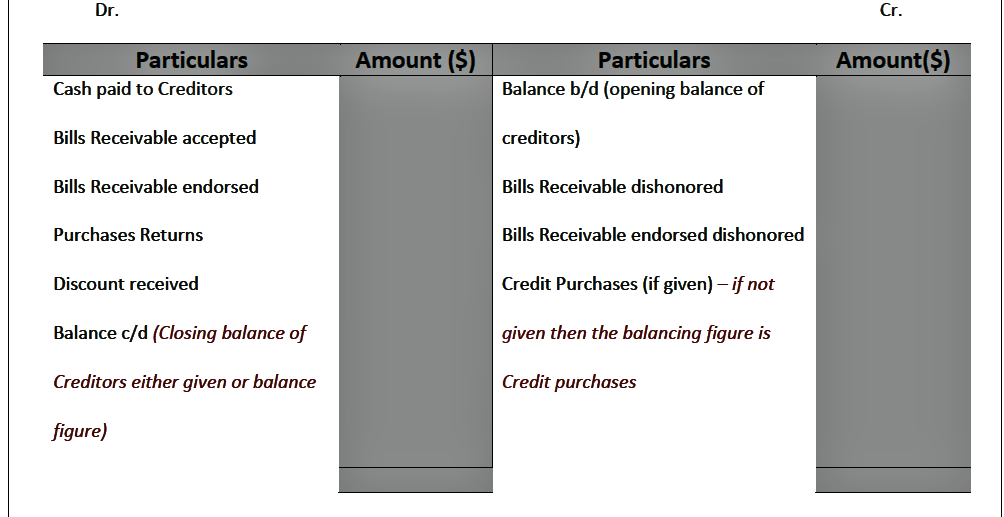
When you purchase goods on credit it is entered in the purchase book. The entries in the purchases book is sumedup and journal entries passed as purchases a/c Dr. to Sundry Debtors a/c.at the end of the month. Similar method followed in sales book and entries are sumed up Sundry Debtors a/c is debited and sales account is credited. Similarly bills payable are entered in the bills payable book and bills receivable are entered in the bills receivable book and synes up respectively and Bills receivable a/c is debited with sundry debtors and sundry creditors are debited bills payables a/ c is credited .In the book -keeping various books are maintained such as cashbook purchases book sales book sundry debtors book sundry creditors book bills payable book ,bills receivable book , general ledger petty cashbook and journal entry register.

From the credit sales as ascertained from total debtors account, the sales returns should be deducted from gross credit sales to get net credit sales.

Preparation of Statement of Affairs

Correct final accounts of a business can be prepared in the records are maintained under the double entry system. How every where the record is incomplete, and it is not all possible to complete it by double entry, in such cases the final accounts can be only approximately prepared by means of a statement of affairs. In appearance the statement of affairs is similar to a balance sheet. For this purpose, two comparative statement of affairs are prepared – one at the commencement of the year and other at the end of the year. The excess of the assets over the liabilities as shown by the statement will represent the capital of the firm. If capital at the end shows an increase as compared to the amount of capital at the start the difference will represent profit and if the capital at the end is less than the capital at the beginning the difference will be loss. In this calculation, however, two more factors should be taken into account.

  1. Where fresh capital has been introduced into the business during the account period, the closing capital may be taken to have been increased to that extent. To arrive at the true profit or loss, therefore, the amount of fresh capital introduced is deducted from the closing assets as determined under such circumstances.
  2. Where drawings have been made by the proprietor during the accounting period, such drawings reduce the amount of capital at the close. In order to calculate net profit, it is necessary, therefore, that amount withdrawal should be added to the capital at the close before deducting from it the capital at the beginning.

FORMULA:

Formula for determining the net profit is put as follows:

(CAPITAL AT THE END + DRAWINGS – ADDITIONAL CAPITAL INTRODUCED) – CAPITAL IN THE BEGINNING

Example: 1

Sri Gobinda Chandra Sadhu khan is appointed liquidator of Sun Co. Ltd in voluntary liquidation on 1st July 1993.

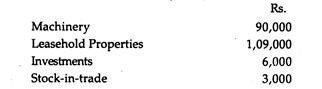
Following balances are extracted from the books on that date:

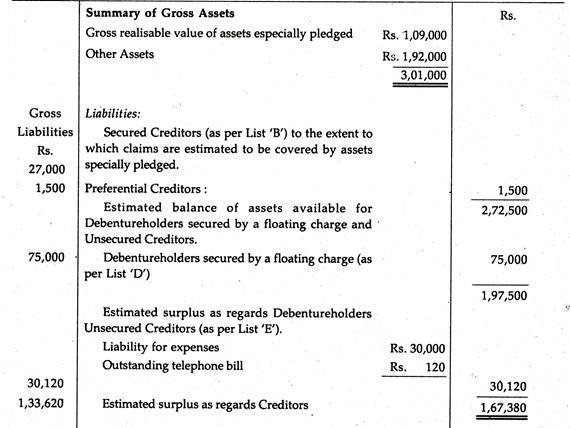
You are required to prepare a Statement of Affairs to the meeting of Creditors.

The following assets are valued as:

Bad Debts are Rs. 3,000 and the doubtful debts are Rs. 6,000 which are estimated to realize Rs. 3,000. The Bank Overdraft secured by deposit of title deeds of Leasehold Properties. Preferential Creditors are Rs. 1,500. Telephone rent outstanding is Rs. 120.

Example: 2

Bad Debts are Rs. 3,000 and the doubtful debts are Rs. 6,000 which are estimated to realize Rs. 3,000. The Bank Overdraft secured by deposit of title deeds of Leasehold Properties. Preferential Creditors are Rs. 1,500. Telephone rent outstanding is Rs. 120.

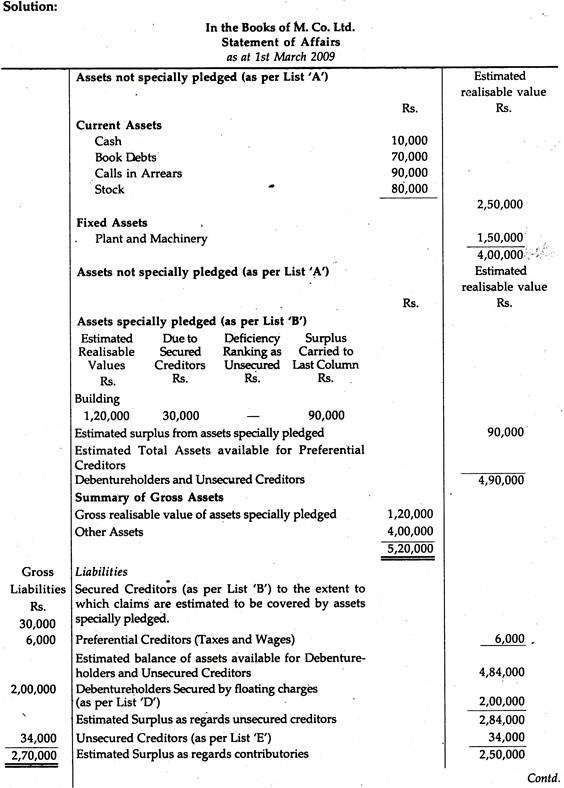
Plant and Machinery and Building are valued at Rs. 1, 50,000, and Rs. 1, 20,000, respectively. On realization, losses of Rs. 15,000 are expected on Stock. Book-Debts will realise Rs. 70,000. Calls-in- arrear are expected to realise 90%. Bank Overdraft is secured against Buildings. Preferential Creditors for taxes and wages are Rs. 6,000 and Miscellaneous Expenses outstanding Rs. 2,000.

Prepare a Statement of Affairs to be submitted to the meeting of creditors.


Conversion into Double Entry System, Need for Conversion

Steps to Convert Single Entry into Double Entry

If, at the end of a trading period, it is desired that the books should be written up so as to give complete information, as is the case under the Double Entry System, the following steps will be necessary:

Step 1. Take up the Statement of Affairs at the end of the previous trading period and open all those accounts which have not already been opened. Generally, under the Single Entry System, cash, bank and personal accounts are maintained. Now, it will be necessary to open/the remaining accounts and debit or credit them with the opening balances as the case may be.

Step 2. From the debit side of the Cash Account, accounts other than the bank account and accounts of customers (on the presumption that such accounts are already maintained) should be credited. For example, if one finds that Rs 5,000 was received by sale of furniture, one should credit Furniture Account with Rs 5,000.

If an entry shows that Rs 4,500 was received from X, no further treatment will be necessary because the account of the customer would already be there and it must have been credited with the amount. A frequent item will be cash sales. Cash Sales Account should be opened and credited with the amounts of case sales.

Step 3. From the credit side of the Cash Account, various accounts (other than the bank account and accounts of creditors) should be debited. On this side of the Cash Account, will be found amounts paid for cash purchases, for various expenses and for various assets acquired. All these accounts will be debited.

Step 4. Treatment similar to (2) and (3) above will be required for Bank Account. Cash paid in or cash drawn for office-use, payment made to suppliers by cheques or receipts from debtors will already have been entered in these accounts; hence, double entry will be required to be completed only in other accounts that may figure. For instance, one will know from Bank Account what bills have been discounted and what discounted bills have been dishonoured, or what the bank charges are.

Step 5. If a Petty Cash Book is maintained, the monthly analysis will have to be posted in the ledger—various accounts for expenses debited and the total credited to Petty Cash Account. The debit to the Petty Cash Account must already have been completed from the Cash or Bank Account.

Step 6. A complete analysis of the customers’ accounts will have to be prepared. This will give vital information regarding credit sales, sales returns, discounts allowed, bills received, bills dishonoured, etc.

Suppose, the following are the various customers’ accounts:

To complete double entry now, what is required is to:

(i) Credit Sales Account with Rs 14,190, Freight (or charges) Account with Rs 140 and Bills Receivable Account with Rs 1,480 and

(ii) Debit Discount Account with Rs 80, Bills Receivable Account with Rs 6,480, Returns Inwards Account with Rs 400, Allowances Account with Rs 50 and Bad Debts Account with Rs 200. No further entry is required regarding cash or bank, as this must already have been completed.

Step 7. A similar analysis of suppliers’ accounts will reveal purchases made, bills payable dishonoured or other charges debited by the suppliers (from the credit side of the accounts) and discounts earned, returns outwards, bills issued to creditors, etc. (from the debit side of the accounts). Accounts other than those relating to cash paid or cheques issued will debit or credited, as the case may be.

Step 8. The proprietor will have to remember other items which require entries in the books. To take an example, if a piece of machinery has been disposed of, any loss or profit resulting from such disposal will have to be brought into the books.

Step 9. A trial balance should then be prepared to see that there is no arithmetical mistake.

Need for Conversion into Double Entry System

  • Ensures Complete and Accurate Records

The double entry system ensures that every financial transaction is recorded with a corresponding debit and credit, providing complete and accurate records. Unlike the single entry system, which often misses important details, double entry guarantees that all aspects of a transaction are captured. This completeness reduces the risk of omissions, mistakes, and inconsistencies. Accurate records are essential not only for internal decision-making but also for satisfying external stakeholders like banks, tax authorities, and investors who require reliable financial information.

  • Enables Preparation of Financial Statements

One major reason for converting to the double entry system is that it allows businesses to prepare full financial statements, including the profit and loss account, balance sheet, and cash flow statement. These statements provide a comprehensive picture of a company’s financial health, showing profitability, asset values, liabilities, and equity. Without these, it’s difficult to evaluate business performance accurately. Financial statements are also required for loan applications, investor presentations, audits, and regulatory compliance, making double entry essential.

  • Facilitates Detection of Errors and Fraud

The double entry system has built-in checks that make it easier to detect errors and prevent fraud. Because each transaction affects two accounts, discrepancies become apparent when the trial balance fails to match. This system offers a clear trail for auditing and verification, discouraging fraudulent activities and reducing the risk of intentional or unintentional mistakes. Businesses relying on incomplete records cannot easily spot such issues, which increases vulnerability to losses or mismanagement over time.

  • Provides Accurate Profit and Loss Determination

Accurately determining profit or loss is difficult under the single entry system because many expenses and revenues are not properly recorded. The double entry system, however, ensures all income and expenses are accounted for, enabling precise profit or loss calculation. This is vital for evaluating whether a business is making progress, where costs can be cut, or where improvements are needed. Without this clarity, businesses may overestimate their profitability or fail to identify financial weaknesses.

  • Enables Better Financial Planning and Control

Double entry accounting provides detailed insights into different components of the business, such as sales, purchases, assets, liabilities, and expenses. This detailed data is essential for effective financial planning, budgeting, and cost control. Business owners can use this information to analyze trends, forecast future performance, and make data-driven decisions. Without such structured records, financial planning becomes guesswork, increasing the risk of poor decisions that can negatively impact growth and sustainability.

  • Assists in Legal and Tax Compliance

Many businesses are legally required to maintain detailed and systematic financial records for tax filings, audits, and regulatory purposes. The double entry system aligns with accounting standards and legal frameworks, making it easier to comply with such requirements. Without it, businesses may struggle to produce necessary documentation or risk penalties due to incomplete or inaccurate reporting. Conversion to double entry ensures that all statutory obligations are met smoothly, reducing legal complications and enhancing business reputation.

  • Enhances Credibility with Stakeholders

Lenders, investors, suppliers, and even customers often assess a business’s credibility based on its financial transparency. Using the double entry system demonstrates professionalism and commitment to accurate reporting, enhancing trust with external parties. In contrast, incomplete records from a single entry system may raise doubts about the reliability of financial information, discouraging partnerships or financing opportunities. Converting to double entry can improve a business’s image and open up more opportunities for growth and collaboration.

  • Allows Systematic Tracking of Assets and Liabilities

Under the double entry system, businesses maintain detailed records of all assets and liabilities, including depreciation, outstanding loans, inventories, and fixed assets. This enables systematic tracking and helps businesses manage their resources effectively. In the single entry system, such tracking is either absent or poorly maintained, leading to mismanagement or underutilization of resources. Conversion ensures businesses know exactly what they own and owe, supporting better decision-making regarding investments, debt repayments, and asset usage.

  • Provides a Basis for Internal and External Audits

Audit processes require clear, complete, and verifiable records, which are best provided by the double entry system. Auditors need to trace transactions across accounts, verify balances, and ensure financial integrity. Without proper books, businesses may fail audits or face difficulties during financial reviews. Conversion to double entry establishes a formal structure for internal checks and external audits, enhancing accountability and ensuring that financial operations can withstand scrutiny from regulators and stakeholders.

  • Prepares Business for Future Growth

As businesses grow, their transactions become more complex, involving credit sales, multiple bank accounts, inventories, fixed assets, and varied expense categories. The single entry system cannot handle such complexity, making double entry essential for scalable operations. Converting to the double entry system prepares businesses for expansion, ensuring they can manage larger volumes of transactions, comply with higher reporting standards, and attract larger investors or partners. It builds a strong financial foundation for sustainable long-term success.

error: Content is protected !!