Assets and Liabilities not Taken Over by the Purchasing Company

Amalgamation is defined as the combination of one or more companies into a new entity. It includes:

  • Two or more companies join to form a new company
  • Absorption or blending of one by the other

Thereby, amalgamation includes absorption.

However, one should remember that Amalgamation as its name suggests, is nothing but two companies becoming one. On the other hand, Absorption is the process in which the one powerful company takes control over the weaker company.

Generally, Amalgamation is done between two or more companies engaged in the same line of activity or has some synergy in their operations. Again the companies may also combine for diversification of activities or for expansion of services

Transfer or Company means the company which is amalgamated into another company; while Transfer Company means the company into which the transfer or company is amalgamated.

How is Amalgamation different from a Merger?

Amalgamation is different from Merger because neither of the two companies under reference exists as a legal entity. Through the process of amalgamation a completely new entity is formed to have combined assets and liabilities of both the companies.

Types of Amalgamation

  1. Amalgamation in the nature of merger:

In this type of amalgamation, not only is the pooling of assets and liabilities is done but also of the shareholders’ interests and the businesses of these companies. In other words, all assets and liabilities of the transferor company become that of the transfer company. In this case, the business of the transfer or company is intended to be carried on after the amalgamation. There are no adjustments intended to be made to the book values. The other conditions that need to be fulfilled include that the shareholders of the vendor company holding atleast 90% face value of equity shares become the shareholders’ of the vendee company.

  1. Amalgamation in the nature of purchase

This method is considered when the conditions for the amalgamation in the nature of merger are not satisfied. Through this method, one company is acquired by another, and thereby the shareholders’ of the company which is acquired normally do not continue to have proportionate share in the equity of the combined company or the business of the company which is acquired is generally not intended to be continued.

If the purchase consideration exceeds the net assets value then the excess amount is recorded as the goodwill, while if it is less than the net assets value it is recorded as the capital reserves.

Why Amalgamate?

  • To acquire cash resources
  • Eliminate competition
  • Tax savings
  • Economies of large scale operations
  • Increase shareholders value
  • To reduce the degree of risk by diversification
  • Managerial effectiveness
  • To achieve growth and gain financially

Procedure for Amalgamation

  • The terms of amalgamation are finalized by the board of directors of the amalgamating companies.
  • A scheme of amalgamation is prepared and submitted for approval to the respective High Court.
  • Approval of the shareholders’ of the constituent companies is obtained followed by approval of SEBI.
  • A new company is formed and shares are issued to the shareholders’ of the transferor company.
  • The transferor company is then liquidated and all the assets and liabilities are taken over by the transferee company.

Accounting of Amalgamation

  1. Pooling of Interests Method

Through this accounting method, the assets, liabilities and reserves of the transfer or company are recorded by the transferee company at their existing carrying amounts.

  1. Purchase Method

In this method, the transfer company accounts for the amalgamation either by incorporating the assets and liabilities at their existing carrying amounts or by allocating the consideration to individual assets and liabilities of the transfer or company on the basis of their fair values at the date of amalgamation.

Computation of purchase consideration

For computing purchase consideration, generally two methods are used:

  1. Purchase Consideration using net asset method

Total of assets taken over and this should be at fair values minus liabilities that are taken over at the agreed amounts.

Particulars Rs.
Agreed value of assets taken over XXX
Less: Agreed value of liabilities taken over XXX
Purchase Consideration XXX

Agreed value means the amount at which the transfer or company has agreed to sell and the transferee company has agreed to take over a particular asset or liability.

  1. Purchase consideration using payments method

Total of consideration paid to both equity and preference shareholders in various forms.

Example: A. Ltd takes over B. Ltd and for that it agreed to pay Rs 5,00,000 in cash. 4,00,000 equity shares of Rs 10 each fully paid up at an agreed value of Rs 15 per share. The Purchase consideration will be calculated as follows:

Particulars Rs.
Cash 5,00,000
4,00,000 equity shares of Rs10 fully paid up at Rs15 per share 60,00,000
Purchase Consideration 65,00,000

Advantages of Amalgamation

  • Competition between the companies gets eliminated
  • R&D facilities are increased
  • Operating cost can be reduced
  • Stability in the prices of the goods is maintained

Disadvantages of Amalgamation

  • Amalgamation may lead to elimination of healthy competition
  • Reduction of employees may take place
  • There could be additional debt to pay
  • Business combination could lead to monopoly in the market, which is not always positive
  • The goodwill and identity of the old company is lost

Recently announced Amalgamation

One of the recent amalgamations announced on the corporate front is of PVR Ltd. Multiplex operator PVR Ltd has approved an amalgamation scheme between Bijli Holdings Pvt Ltd and itself to simplify PVR’s shareholding structure. As per the management, the purpose of the amalgamation is to simplify the shareholding structure of PVR and reduction of shareholding tiers. It also envisages demonstrating Bijli Holdings’ direct engagement with PVR. After the amalgamation, individual promoters will directly hold shares in PVR and there will be no change in the total promoters’ shareholding of PVR.

Other examples of Amalgamations

  1. Maruti Motors operating in India and Suzuki based in Japan amalgamated to form a new company called Maruti Suzuki (India) Limited.
  2. Gujarat Gas Ltd (GGL) is an amalgamation of Gujarat Gas Company Ltd (GGCL) and GSPC Gas.
  3. Satyam Computers and Tech Mahindra Ltd
  4. Tata Sons and the AIA group of Hongkong amalgamated to form Tata AIG Life Insurance.
Unrecorded Assets and Liabilities

At the time of retirement or death of a partner, there may be some assets and liabilities which are not recorded in books at their current values. Also, there may be some unrecorded assets and liabilities which need to be recorded in the books.

A Revaluation Account is prepared in order to ascertain net gain or loss on revaluation of assets and liabilities and bringing unrecorded items into books. The Revaluation profit or loss is transferred to the capital account of all partners including retiring or deceased partners in their old profit sharing ratio.

The following Journal entries are passed:

  1. For the increase in the value of Assets

Assets A/c (Individually) Dr.

To Revaluation A/c

(Being increase in the value of assets on revaluation)

  1. For a decrease in the value of Assets

Revaluation A/c Dr.

To Assets A/c (Individually)

(Being decrease in the value of assets on revaluation)

  1. For an increase in the value of Liabilities

Revaluation A/c Dr.

To Liabilities A/c (Individually)

(Being increase in the value of liabilities on revaluation)

  1. For a decrease in the value amount of Liabilities

Liabilities A/c (Individually) Dr.

To Revaluation A/c

(Being decrease in the value of liabilities on revaluation)

  1. For an unrecorded Asset

Assets A/c Dr.

To Revaluation A/c

(Being unrecorded asset recorded in books)

  1. For an unrecorded Liability

Revaluation A/c Dr.

To Liability A/c

(Being unrecorded liability recorded in books)

  1. For transferring Profit on Revaluation

Revaluation A/c Dr.

To All Partners’ Capital A/c (Individually)

(Being Profit on revaluation transferred to all partner’s capital A/c in old ratio)

  1. For transferring Loss on Revaluation

All Partners’ Capital A/c (Individually) Dr.

To Revaluation A/c

(Being Loss on revaluation transferred to partner’s capital A/c in old ratio)

The partners may decide that the revalued figures of assets and liabilities will not appear in the books of the firm. In this case, the share of retiring or deceased partner of profit or loss from revaluation of assets and liabilities are adjusted in the remaining partners capital A/cs in their gaining ratio.

The journal entries that will be passed are:

  1. In case of Revaluation Profit

Remaining Partners Capital A/c (Individually)                   Dr.

To Retiring Partners Capital A/c

(Being the share of retiring partner in revaluation profit adjusted in remaining partners capital in gaining ratio)

  1. In case of Revaluation Loss

Remaining Partners Capital A/c (Individually)                   Dr.

To Retiring Partners Capital A/c

(Being the share of retiring partner in revaluation profit adjusted in remaining partners capital in gaining ratio)

Dissolution Expenses

Dissolution of firm means complete breakdown of the relation of partnership among all the partners. When all the partners resolve to dissolve the partnership, the dissolution of firm occurs, i.e. the firm is wound up.

If the business comes to an end, it is said that the firm has been dissolved. Dissolution of firm means the closing down of the business. Firm’s dissolution implies partnership dissolution but not vice versa.

That is dissolution of partnership does not mean dissolution of firm, but the dissolution of firm will be dissolved on any one of the following ways:

  1. Dissolution by Agreement (Sec. 40)

A firm may be dissolved at any time with the consent of all partners. For instance, when a firm does not expect good prospects in the future, a firm can be dissolved by mutual consent of all partners.

  1. Compulsory Dissolution (Sec. 41)

A firm is compulsorily dissolved by operation of law when all the partners except one become insolvent or when all the partners become insolvent or when business becomes illegal or when the number of partners exceeds twenty in case of ordinary business or ten in case of banking.

  1. Dissolution on the Happening of Certain Contingencies (Sec. 42)

A firm is dissolved, in the absence of contrary, in the event of any of the following circumstances:

(i) The expiry of the term for which it was formed.

(ii) The completion of the venture for which the partnership was constituted.

(iii) The death of a partner

(iv) The adjudication of a partner as an insolvent.

  1. Dissolution by Notice of Partnership at Will (Sec. 43)

Where a partnership is at will, the firm may be dissolved by any partner giving notice in writing to all the other partners of his intention to dissolve the firm.

  1. Dissolution by the Court (Sec. 44):

The court is empowered to order the dissolution of a firm consequent on a suit by a partner in the following cases:

(i) When a partner becomes insane or unsound of mind.

(ii) When a partner becomes permanently incapable of performing his duties, be it mental or physical.

(iii) When a partner is proved guilty of misconduct which is likely to affect adversely the busi­ness of the firm.

(iv) When a partner conduct himself in such a way that it is not possible for the other partners to carry on partnership with him.

(v) When a partner transfers his interest or share to third party.

(vi) When the business cannot be carried out except at a loss. (It must be remembered that the object of partnership is to earn profits and if that object is not fulfilled, the firm can be dissolved).

(vii) When it appears to be just and equitable. For instance, continued quarrelling, deadlock in the management, refusal to attend matters of business, absence of cooperation etc. among the partners. (The court has wide discretionary powers).

Liability for Acts Done After Dissolution (Sec. 45)

When a firm is dissolved a public notice must be given of the dissolution. If it is not done, the partners continue to be liable as such to third parties for any act done by any of them after the disso­lution, and in such a case, the act of a partner done after dissolution is deemed to be an act done before the dissolution.

Settlement of Accounts (Sec. 48)

As soon as a firm is dissolved, it ceases to transact normal business. The mode of settlement of accounts between partners after the dissolution of a firm is determined by the partnership agreement. In the absence of any specific agreement as to the mode of settlement of accounts after the dissolu­tion of the firm, the Partnership Act laid down the following provisions (Sec. 48) for settlement of accounts.

(a) Losses, including deficiencies of capital, shall be paid first out of profit, next out of capital, and lastly, if necessary, by the partners individually in their profit-sharing ratio.

(b) The assets of the firm including any sums contributed by the partners to make up deficien­cies of capital shall be applied in the following manner and order:

(i) In paying the debts of the firm to third parties.

(ii) In paying each partner rateably what is due to him from the firm for advances.

(iii) In paying to each partner rateably what is due to him on account of capital, and

(iv)The surplus, if any, will be divided among the partners in their profit sharing ratio.

Dissolution Accounts

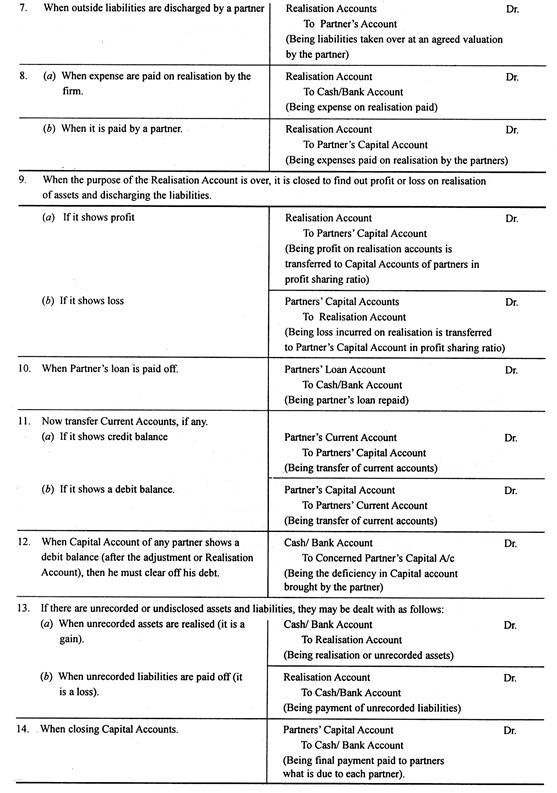
When a business is discontinued, the firm is said to be dissolved. As a result, all the accounts be closed. It is, therefore, necessary to open Realisation Account, Cash or Bank Account and Partners Capital Accounts.

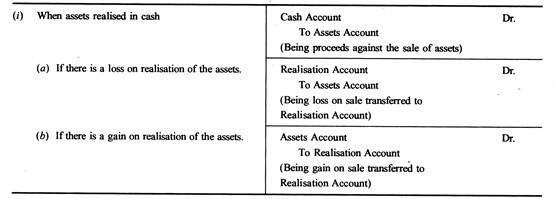
 (i) Realisation Accounts is opened for all transactions relating to realisation of assets and payment of liabilities. That is, on dissolution, it is essential to make sale of assets of the firm, realize cash and paying off the liabilities.

Realisation of assets and settlement of liabilities are centred round the Realisation Account. It is a nominal Account. The transactions realisation and settlement are over, the difference, being gain or loss will be transferred to Capital Accounts.

(ii) Cash/Bank Account is opened to record all cash transactions. When the purpose is over the Cash Account shows a balance, which is equal to the amounts due to partners.

(iii) Capital Accounts are opened to make all entries connected with the partners’ accounts. Current Accounts, if any, are transferred to Capital Accounts. Finally the Capital Accounts are closed by receiving or paying cash.

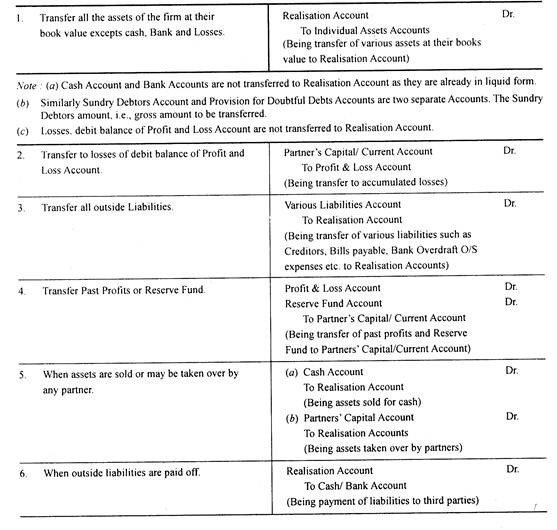
The following steps are taken to close the books of accounts:

To sum up, when all the assets are realized and the liabilities are paid off, the balance of cash or Bank must be equal to the amount due finally to the partners’ capital account, after transferring the current account, if any. Sometimes, the capital account shows a debit balance, representing the amount due to the firm by the concerned partner.

The principle of unlimited liability is applied, that is, the partner, whose capital account shows a debit balance, should bring the amount to clear off the debit balance in his capital account. Then the cash in hand plus the amount so received, is applied in paying off all the partners whose accounts show credit balances. Thus, all the accounts of assets, liabilities, partners’ capital, and cash are closed.

The above method of preparation of Realisation Account is called Total Method. Alternatively, there is another method, known as Balance Method to prepare the Realisation Account.

Under the Balance Method, the assets appearing in the Balance sheet are not transferred to Realisation Account at their book value. But, only the difference between the Book Value of Assets and the amount realized by their sale is transferred to Realisation.

The sales proceeds are not taken through Realisation Ac­count. The liabilities too are not transferred to Realisation Account but only the difference between the book value and payments paid is transferred to Realisation Accounts.

For instance, consider the following:

Note: Return of Premium on Premature Dissolution:

Where a partner has paid a premium on entering into partnership for a fixed term, and the firm is dissolved before the expiration on the term otherwise than by the death of a partner, he shall be entitled to repayment of the premium or of such part thereof as may be reasonable unless the dissolu­tion is mainly due to his own misconduct, or the dissolution is in pursuance of an agreement contain­ing no provision for the return of the premium or any part of it.

Purchase Consideration, Meaning, Methods, Features, Merits and Demerits

Purchase consideration refers to the total amount that a purchasing company agrees to pay to the shareholders or owners of the vendor (selling) company in exchange for taking over its business. It is the price paid for acquiring all the assets and liabilities of another business, usually during mergers, acquisitions, or amalgamations.

The consideration can take several forms, including cash payments, issue of shares or debentures, or a combination of these. Sometimes, additional elements like preference shares, bonds, or other securities may also be part of the deal. The exact mode of settlement is usually agreed upon between the parties and detailed in the agreement of sale or merger.

For accounting purposes, purchase consideration is critical because it determines how the transaction is recorded in the books. It affects the journal entries, calculation of goodwill or capital reserves, and balance sheet adjustments. The determination of the correct purchase consideration ensures that both parties reflect the transaction fairly and transparently in their financial statements.

Methods of Purchase Consideration:

Method 1. Lump Sum Method

The purchasing company may agree to pay a lump-sum to the vendor company on account of the purchase of its business. In fact, this method is not based on any scientific thoughts and techniques. This method is an unscientific and non-mathematical method of ascertaining purchase consideration.

Example:

A purchasing company agreed to take over a business of selling company for Rs. 5, 00,000. In such a case, the purchase consideration is Rs. 5,00,000. No calculations are needed.

Method 2. Net Worth or Net Assets Method

Under this method, purchase consideration is calculated by adding up the values of various assets taken over by the purchasing company and then deducting there from the values of various liabilities taken over by the purchasing company. The values of assets and liabilities for the purpose of calculation of purchase consideration are those which are agreed upon between the purchasing company and the vendor company and not the values at which the various assets and liabilities appear in the Balance Sheet of the vendor company.

(Agreed value of Assets taken over) – (Agreed value of liabilities taken over) = Net Assets

The following relevant points are to be noted while ascertaining the purchase price under this method:

(i) If the transferee company agrees to take over all the assets of the transferor company, it would mean inclusive of cash and Bank balances.

(ii) The term all assets, however, does not include fictitious assets, like Debit balance of Profit and Loss Account, Preliminary Expenses Account, Discount and other expenses on issue of shares and Debentures, Advertising Expenses Account etc.

(iii) Any specific asset, not taken over by transferee company, should be ignored while computing the purchase price,

(iv) If there is any goodwill, pre-paid expenses etc. the same are to be included in the assets taken over unless otherwise stated,

(v) The term liabilities will always signify all liabilities to third parties. Trade liabilities are those incurred for the purchase of goods such as Trade Creditors or Bills Payable,

(vi) Other liabilities like Bank Overdrafts, Tax payable, Outstanding expenses etc. are not a part of trade liabilities.

(vii) Liabilities do not include accumulated or undistributed profits like, General Reserve, Securities Premium, Workmen Accident Fund, Insurance Fund, Capital Reserve, Dividend Equilisation Fund etc.

Method 3. Net Payment Method

The agreement between selling company and purchasing company may specify the amount payable to the share-holders of the selling company in the form of cash or shares or debentures in purchasing company. AS – 14 states that consideration for amalgamation means the aggregate of shares and other securities issued and the payment made in the form of cash or other assets by transferee company to the share-holders of transferor company. Thus, under net payment method purchase consideration is the total of shares, debentures and cash which are to be paid for claims of Equity and Preference share-holders of the transferor company.

The following points are to be noted while ascertaining the purchase price under net payment method:

(i) The assets and liabilities taken over by the transferee company and the values at which they are taken over are not relevant to compute the purchase consideration.

(ii) All payments agreed upon should be added, whether it is for equity share holders or preference share-holders.

(iii) If any liability is taken over by purchasing company to be discharged later on, such amount should not be deducted or added while computing purchase consideration.

(iv) When liabilities are not take over by the transferee company, they are neither added or deducted while computing consideration.

(v) Any payment made by transferee company to some other party on behalf of transferor company are to be ignored.

Method 4. Intrinsic Value Method (Shares Exchange Method)

Under this method, net value of assets is calculated according to net assets method and it is divided by the value of one share of transferee company which gives the total number of shares to be received by the share-holders of transfer or company from the transferee company. When the number of shares to be received by the transferor company is known then it is divided by the existing shares of the transferor company and thus the ratio of shares can be found out.

Suppose, in exchange of 50 shares of transfer or company, 100 shares of transferee company is available, then everyone share in the transferor company, two shares in the transferee company is available. Therefore, the ratio is 1: 2. This method is also known as Share Proportion Method.

Intrinsic Value = Assets available for equity shareholders/Number of equity shares

Features of Purchase Consideration

  • Based Nature

Purchase consideration refers to the total payment made by the purchasing company to acquire the business of the selling company. It is determined through negotiation and agreement between the buyer and seller. This amount is crucial in mergers, amalgamations, and acquisitions because it reflects the value both parties assign to the assets, liabilities, and goodwill involved. Whether paid in cash, shares, debentures, or a mix, the purchase consideration becomes the legal and accounting foundation of the takeover, directly impacting the acquiring company’s financial statements and the seller’s return on investment.

  • Multiple Modes of Payment

A key feature of purchase consideration is its flexibility in payment modes. It can be settled through cash payments, equity shares, preference shares, debentures, bonds, or a combination of these. The choice depends on the agreement between the parties and can influence the seller’s future stake or involvement in the new entity. For example, issuing shares allows former owners to become part of the new company, while a cash settlement completely severs the relationship. This flexibility allows businesses to structure deals strategically, considering liquidity, control, and long-term interests.

  • Based on Valuation of Assets and Liabilities

Purchase consideration is usually determined after careful valuation of the vendor company’s assets and liabilities. This includes tangible assets like property, machinery, and inventory, as well as intangible assets like goodwill, trademarks, or patents. Liabilities like loans, creditors, and outstanding expenses are deducted. Accurate valuation ensures that the purchasing company neither overpays nor underpays and that the vendor’s shareholders receive fair compensation. External valuers, auditors, and financial analysts often assist in this process to ensure transparency and objectivity in determining the final consideration.

  • Legal and Contractual Agreement

The amount and terms of purchase consideration are clearly documented in a legal agreement or sale deed. This contract specifies the consideration amount, payment method, timing, and any conditions or warranties associated with the transfer. This ensures legal enforceability and protects both parties against disputes or misunderstandings later. The agreement also includes details on how non-transferred assets or liabilities are to be handled. Without proper contractual backing, even a mutually agreed purchase consideration may lead to conflicts or non-compliance with regulatory requirements.

  • Impact on Financial Statements

For accounting purposes, purchase consideration plays a critical role in recording the business combination. The purchasing company uses it to calculate goodwill or capital reserve by comparing the consideration paid with the net assets acquired. If the purchase consideration exceeds the net assets, the difference is recorded as goodwill; if it’s lower, it creates a capital reserve. This directly affects the balance sheet and profitability of the acquiring company. Correct treatment ensures transparency and compliance with accounting standards, particularly under frameworks like Ind AS, IFRS, or GAAP.

  • Subject to Adjustments

Purchase consideration is not always a fixed amount; it may be subject to adjustments. These adjustments can arise from post-acquisition audits, identified contingencies, or performance-based conditions (like earn-out clauses). For example, if the acquired company performs better than expected, additional consideration may be paid. Conversely, if liabilities turn out higher, the buyer may deduct amounts. Such adjustments ensure that both parties are fairly protected against unexpected changes in value after the initial agreement, making purchase consideration a dynamic rather than static figure.

  • Influences Ownership and Control

The structure of purchase consideration can significantly impact ownership and control in the combined entity. For example, if the consideration is largely paid through equity shares, the vendor’s shareholders may become major shareholders or even gain board representation in the purchasing company. In contrast, a cash deal leaves the ownership structure unchanged. This feature allows parties to negotiate not just the financial terms but also future governance roles, making purchase consideration both a financial and strategic tool in corporate restructuring.

  • Compliance with Regulatory Norms

Purchase consideration must comply with various legal, tax, and regulatory frameworks, including the Companies Act, Income Tax Act, SEBI regulations, and accounting standards. Any misreporting, undervaluation, or non-compliance can lead to legal penalties or disqualification of the transaction. Additionally, when shares or securities are issued as part of the consideration, regulations regarding share valuation, shareholder approvals, and listing requirements must be followed. Ensuring that the purchase consideration process aligns with legal norms safeguards the interests of all stakeholders and upholds corporate governance standards.

Merits of Purchase Consideration:

  • Facilitates Smooth Business Acquisition

One of the major merits of purchase consideration is that it enables a smooth transfer of ownership from the seller to the buyer. By clearly defining the amount to be paid and the mode of payment, both parties can enter into a fair and transparent agreement. This reduces conflicts, builds trust, and ensures that all stakeholders, including creditors and employees, are aware of the transaction’s value. Without a properly calculated purchase consideration, the process of acquisition could be chaotic, uncertain, or legally challenged, delaying the transaction.

  • Provides Flexibility in Structuring Deals

Purchase consideration offers flexibility in how deals are structured, as the payment can be made in cash, shares, debentures, or a combination. This helps both the purchasing and selling companies meet their financial and strategic objectives. For example, the seller may prefer shares to retain involvement in the new company, while the buyer may prefer shares to conserve cash. This flexibility also allows better negotiation, as parties can tailor the consideration to meet tax advantages, regulatory compliance, or long-term investment goals.

  • Ensures Fair Compensation to Sellers

A key advantage of purchase consideration is that it ensures the selling company or its shareholders receive fair compensation for transferring ownership. Proper valuation of assets, liabilities, and goodwill is done before finalizing the consideration, ensuring the seller is neither underpaid nor exploited. This fairness builds goodwill between both parties and ensures that sellers are adequately rewarded for the value they created over time. It also improves the reputation of the buyer, which can help in future acquisition deals.

  • Helps Determine Goodwill or Capital Reserve

For the purchasing company, purchase consideration is critical in determining whether the deal generates goodwill or a capital reserve. If the consideration paid exceeds the net assets acquired, the difference is recorded as goodwill; if the net assets exceed the consideration, the surplus is shown as a capital reserve. This accounting clarity helps maintain accurate balance sheets and financial reporting. It also allows stakeholders to understand whether the company has paid a premium for the acquisition or made a bargain purchase.

  • Strengthens Post-Acquisition Integration

Properly determined purchase consideration ensures smoother post-acquisition integration. When sellers feel they have been fairly compensated, they are more willing to cooperate during the transition, sharing vital operational knowledge, customer relationships, or technical expertise. Similarly, the buyer can confidently make strategic plans knowing they have fairly acquired the necessary assets and liabilities. This mutual confidence helps achieve the merger’s objectives, reduces friction, and speeds up the realization of synergies and cost savings.

  • Supports Regulatory and Legal Compliance

A well-defined purchase consideration is essential for complying with various legal, regulatory, and tax frameworks. It ensures that the transaction aligns with company law, securities regulations, tax authorities, and accounting standards. This reduces the risk of legal challenges, penalties, or audits, ensuring that the transaction is recognized as valid and binding. Additionally, when shares or other securities form part of the consideration, clear records help meet corporate governance standards and maintain investor confidence.

  • Aids in Financial Planning and Budgeting

From the buyer’s perspective, knowing the exact purchase consideration helps in proper financial planning and budgeting. It allows the acquiring company to assess funding requirements, arrange financing, and manage liquidity effectively. Whether the payment is to be made in cash, shares, or a combination, the finance team can plan ahead to ensure the deal does not strain the company’s resources. It also helps in evaluating the return on investment (ROI) and the payback period of the acquisition.

  • Enhances Transparency and Stakeholder Confidence

A clearly calculated and fairly structured purchase consideration increases transparency, which builds confidence among various stakeholders such as investors, creditors, employees, and regulators. When stakeholders understand how much is being paid, how it is being paid, and what value is being acquired, they are more likely to support the transaction. Transparency also reduces the chances of disputes or misunderstandings later. Overall, purchase consideration acts as a communication tool that reinforces trust and accountability throughout the acquisition process.

Demerits of Purchase Consideration:

  • Risk of Overvaluation or Undervaluation

One major drawback of purchase consideration is the possibility of overvaluing or undervaluing the assets and liabilities of the target company. If the purchasing company overpays, it leads to excessive goodwill that may later result in impairment losses. If the consideration is too low, it may cause dissatisfaction or legal disputes with the sellers. Accurate valuation requires expertise and time, and errors or misjudgments can significantly affect the financial health and profitability of the acquiring company after the transaction.

  • Complexity in Determining Fair Value

Calculating fair purchase consideration is often complex, involving detailed valuation of tangible and intangible assets, liabilities, and contingent obligations. Disputes may arise over the value of goodwill, brand reputation, intellectual property, or ongoing contracts. This complexity can delay the deal, increase legal and professional costs, and create friction between parties. Additionally, fluctuating market conditions or incomplete financial information can make it challenging to arrive at a fair and final amount, adding uncertainty to the acquisition process.

  • Impact on Cash Flow and Liquidity

If the purchase consideration is paid entirely or largely in cash, it can create cash flow stress for the acquiring company. Significant outflows may weaken the company’s liquidity, limiting its ability to meet operational needs, service debts, or invest in future growth opportunities. This financial strain can reduce the company’s flexibility and even affect its creditworthiness. Companies must therefore carefully balance how much to pay in cash and how much to cover through shares or other instruments.

  • Potential Shareholder Dilution

When purchase consideration is settled using shares, it often leads to dilution of existing shareholders’ ownership and voting power. Issuing new shares increases the total number of shares outstanding, which reduces the proportionate stake of current shareholders. This can create dissatisfaction among existing investors and may negatively affect the company’s stock price. Furthermore, if the sellers gain significant ownership through share-based consideration, it can lead to shifts in control or influence over company decisions.

  • Post-Acquisition Integration Challenges

Even with a well-calculated purchase consideration, integrating the acquired company’s operations, systems, and culture can be difficult. Employees, customers, and suppliers may react negatively if they perceive the acquisition as unfair or disruptive. Hidden liabilities or operational inefficiencies might surface after the deal, increasing costs and reducing expected benefits. Poor post-acquisition management can undermine the value of the purchase, turning a seemingly fair consideration into an unprofitable or unsuccessful acquisition over time.

  • Legal and Regulatory Risks

Improperly structured purchase consideration can lead to legal and regulatory problems. If the deal violates tax laws, securities regulations, or company laws, the parties involved may face fines, penalties, or transaction reversals. Additionally, any lack of transparency in disclosing the consideration to shareholders, regulators, or tax authorities can damage corporate reputation and invite lawsuits. Ensuring full compliance adds legal complexity, increasing both the cost and risk associated with determining and executing the purchase consideration.

  • Potential for Future Payment Obligations

In some cases, purchase consideration includes contingent payments like earn-outs or performance-based bonuses. While these mechanisms aim to balance risk, they can create future financial burdens for the acquiring company. If the acquired business performs exceptionally well, the buyer may have to make large additional payments that were not fully anticipated. These future obligations complicate financial planning and may strain the acquiring company’s resources, particularly if market conditions or internal priorities change.

  • Limited Flexibility Once Finalized

Once purchase consideration has been agreed upon and finalized in legal agreements, there is little room for flexibility or renegotiation. If the acquiring company later discovers new information about hidden liabilities, operational problems, or market downturns, it generally cannot adjust the agreed consideration without facing legal hurdles. This inflexibility puts pressure on buyers to conduct thorough due diligence upfront, as any mistakes or oversights can lead to financial losses or unfavorable long-term commitments.

Conversion of Partnership Firm into a Limited Company

(i) Registered Partnership firm with minimum 2 or more Partners

(ii) Minimum Share Capital shall be Rs. 100,000 (INR One Lac) for conversion into a Private Limited Company

(iii) There must be provision in the Partnership deed for converting the firm into Company

(iv) There must be an agreement between the partners to convert the firm into Company.

(v) If the above requirement is not fulfilled by the firm, then the Partnership deed should be altered

(vi) Minimum 2 Shareholders and Directors. However, Directors and shareholders can be same person.

(vii) Director Identification Number (DIN) for all the Directors.

(viii) Digital Signature Certificate (DSC) for two of the Directors.

Procedure of Conversion

  1. Hold a meeting of the members

 Hold a meeting of all the partners of Partnership Firm and take assent for the conversion from its partners. Since the liability of the members of the firm is unlimited, when a firm desires to register itself as a company as a limited company, the assent of the majority is required, not less than three-forth of the partners should be present in person.

  1. Consent from secured creditors of firm

Also Written consent or No Objection Certificate is to be obtained from the secured creditors of the firm, if any.

  1. Obtaining the Name Approval in RUN for Proposed Company

 An application needs to be filed with the Registrar of Companies (ROC) to obtain the name for the proposed company after conversion, with various attachments stating the fact that the partnership firm is pro­posed to be converted under the Companies Act, 2013.

  1. Publishing the Advertisement in Two Newspaper (English Daily and Vernacular)

Pursuant to clause (b) of section 374 of the Act, firm seeking registration under the provision of Part I of Chapter XXI shall publish an advertisement about registration under the said Part, seeking objections, if any within twenty one (21) clear days from the date of publication of notice and the said advertisement shall be in Form No. URC. 2, which shall be published in a newspaper, in English and in the principal vernacular language of the district in which office of such firm situated and should be circulated in that district.

  1. Affidavit

File an affidavit, duly notarised, from all the partners to provide that in the event of registration, necessary documents or papers shall be submitted to authority with which the firm was earlier registered, for its dissolution as partnership firm consequent to its conversion into private limited company.

  1. Filing of necessary forms with ROC

Filing of necessary forms with ROC for the approval of conversion and for registration of firm into the Private Limited Company along with all the necessary attachments which specifies the fact of conversion and also all the other basis charter documents like MOA, AOA, etc which are required in case of registration of company under the Companies Act, 2013

Clarification in respect of registered office of the Proposed Company post-conversion:

There is no restriction upon the location of registered office of the proposed company after getting converted from partnership firm under the Companies Act, 2013. Proposed company may opt for different address for its registered office other than the address of the Partnership firm before conversion. Further, owner of the registered office of proposed company should also provide No Objection Certificate in favor of such proposed company to use the premises as a Registered Office by the proposed company. However, it may also be noted that, all the partners of the firm should also provide the consent with requisite majority in their meeting held for conversion of firm into private limited company in respect of details of address of the registered office of the company post-conversion so as to avoid future disputes.

Journal Entries and Ledger Accounts Including Minimum Rent Account

Journal entries are systematic records of business transactions made in the journal (or book of original entry), capturing the date, accounts involved, debit, and credit amounts. They ensure that every financial event is properly documented and aligned with the double-entry system, where total debits always equal total credits. Each entry reflects the nature of the transaction, such as rent payments, royalties, sales, purchases, or adjustments.

Once journal entries are recorded, they are posted to ledger accounts. A ledger is the principal book where transactions related to each account (like cash, sales, rent, royalties, minimum rent) are grouped, showing cumulative balances. This structured organization helps businesses track account-wise financial activities and prepare financial statements accurately.

Minimum Rent (also known as Dead Rent) is a guaranteed payment that the lessee (tenant) must make to the lessor (landlord) irrespective of the actual production or sales. If the actual royalty based on production or sales exceeds the minimum rent, the lessee will pay the higher amount. However, if the royalty is lower than the minimum rent, short workings occur, which may be recouped in future periods when the actual royalty exceeds the minimum rent.

Specifically, in royalty agreements, the Minimum Rent Account comes into play when the agreed minimum rent or dead rent is higher than the actual royalty based on production or sales. The lessee is obligated to pay this minimum amount even if actual output is low. If the royalties fall short, the shortfall is recorded as a shortworkings expense, often carried forward for recoupment in future years.

Journal entries for such cases typically include:

  • Debit: Royalty Expense / Production Account

  • Debit (if applicable): Shortworkings Account

  • Credit: Minimum Rent Account or Landlord’s Account

Key Terms:

1. Minimum Rent (Dead Rent)

Minimum Rent, also known as Dead Rent, is the fixed minimum amount that a lessee (tenant or user) agrees to pay to the lessor (owner) under a royalty agreement, regardless of the actual level of production or sales. This concept is commonly used in mining leases, publishing contracts, or patents where the lessee uses a resource or intellectual property that generates royalties.

The idea behind minimum rent is to ensure that the lessor receives a guaranteed minimum income even if the lessee’s production or sales are low in a particular year. It acts as a safeguard for the lessor’s financial security, providing them with a fixed return for granting the lease or usage rights.

For example, if a mining company leases land to extract minerals, the owner wants assurance that even if the mining output is low, they will still receive a minimum payment. So, if the royalty based on production is less than the agreed minimum rent, the lessee must still pay the minimum rent amount.

2. Actual Royalty

Actual Royalty refers to the amount calculated and payable by the lessee (user) to the lessor (owner) based on the real quantity of production or sales during a specific period, according to the agreed royalty rate. It is the variable part of the payment in a royalty agreement and directly depends on how much the lessee produces, extracts, sells, or earns from the leased asset, property, or right.

For example, in a mining lease, the lessee agrees to pay the lessor a royalty of ₹50 per ton of coal extracted. If they extract 2,000 tons in a year, the actual royalty would be ₹100,000. Similarly, in a publishing agreement, an author may receive a royalty of 10% on book sales, so if ₹500,000 worth of books are sold, the actual royalty will be ₹50,000.

3. Short Workings

Short Workings refer to the excess amount paid by the lessee (tenant or user) to the lessor (owner) when the minimum rent (dead rent) payable under a royalty agreement exceeds the actual royalty earned during a given period. It represents the difference between the minimum rent and the actual royalty when actual production or sales fall short.

In simple terms, when a lessee is obligated to pay a guaranteed minimum amount (minimum rent) regardless of production, but their actual production or sales generate a smaller royalty, they still pay the minimum rent. This excess payment is known as short workings. Importantly, many contracts allow the lessee to recoup or recover these short workings in future years when actual royalties exceed the minimum rent.

Example

  • Minimum Rent: ₹150,000

  • Actual Royalty (based on production): ₹120,000

  • Short Workings = ₹150,000 – ₹120,000 = ₹30,000

The lessee pays ₹150,000 to the lessor but has an excess payment of ₹30,000, recorded as short workings. This amount may be recouped in future periods if actual royalty exceeds minimum rent, subject to the contract terms.

4. Recoupment of Short Workings

Recoupment of Short Workings refers to the process where a lessee (user) recovers the excess payments (short workings) made in earlier years under a royalty agreement when actual royalties fall below the minimum rent. This recovery is done in future periods when the actual royalty exceeds the minimum rent, allowing the lessee to adjust or offset the earlier shortfall.

In a typical royalty agreement, if the lessee pays more than the actual royalty (due to minimum rent obligations), the extra amount is recorded as short workings. Many agreements give the lessee a right to recoup these short workings within a specified period (usually 2–3 years). If, during that period, the lessee’s actual royalties rise above the minimum rent, the surplus can be used to recoup the past excess payments.

Example

  • Year 1: Minimum Rent ₹150,000, Actual Royalty ₹120,000 → Short Workings ₹30,000

  • Year 2: Minimum Rent ₹150,000, Actual Royalty ₹180,000 → Excess Royalty ₹30,000

In Year 2, the lessee can recoup ₹30,000 of short workings from Year 1 by adjusting it against the excess royalty. The lessee now pays only the minimum rent, as the extra royalty offsets the past shortfall.

Example Scenario:

  • Minimum Rent: ₹100,000
  • Actual Royalty for Year 1: ₹80,000 (Short Workings: ₹20,000)
  • Actual Royalty for Year 2: ₹120,000 (Recoupment of Short Workings: ₹20,000)

Journal Entries in the Books of Lessee:

Year 1: Actual Royalty is Less than Minimum Rent (Short Workings)

Date Particulars Debit (₹) Credit (₹)
Year 1 Royalty Account Dr. 80,000
To Lessor’s Account 80,000
(Being actual royalty payable to lessor)
Minimum Rent Account Dr. 100,000
To Lessor’s Account 100,000
(Being minimum rent payable)
Short Workings Account Dr. 20,000
To Minimum Rent Account 20,000
(Being short workings transferred)
Lessor’s Account Dr. 100,000
To Bank Account 100,000
(Being payment made to the lessor)

Year 2: Actual Royalty Exceeds Minimum Rent (Recoupment of Short Workings)

Date Particulars Debit (₹) Credit (₹)
Year 2 Royalty Account Dr. 120,000
To Lessor’s Account 120,000
(Being actual royalty payable to lessor)
Minimum Rent Account Dr. 100,000
To Lessor’s Account 100,000
(Being minimum rent payable)
Short Workings Recouped Account Dr. 20,000
To Short Workings Account 20,000
(Being short workings recouped)
Lessor’s Account Dr. 120,000
To Bank Account 120,000
(Being payment made to the lessor)

Ledger Accounts in the Books of Lessee:

1. Minimum Rent Account

Date Particulars Debit (₹) Credit (₹)
Year 1 Lessor’s Account 100,000
Year 1 Short Workings Account 20,000
Year 2 Lessor’s Account 100,000

2. Royalty Account

Date Particulars Debit (₹) Credit (₹)
Year 1 Lessor’s Account 80,000
Year 2 Lessor’s Account 120,000

3. Short Workings Account

Date Particulars Debit (₹) Credit (₹)
Year 1 Minimum Rent Account 20,000
Year 2 Short Workings Recouped Account 20,000

4. Lessor’s Account

Date Particulars Debit (₹) Credit (₹)
Year 1 Bank Account 100,000
Year 1 Royalty Account 80,000
Year 1 Minimum Rent Account 100,000
Year 2 Bank Account 120,000
Year 2 Royalty Account 120,000
Year 2 Minimum Rent Account 100,000

5. Short Workings Recouped Account

Date Particulars Debit (₹) Credit (₹)
Year 2 Short Workings Account 20,000

6. Bank Account

Date Particulars Debit (₹) Credit (₹)
Year 1 Lessor’s Account 100,000
Year 2 Lessor’s Account 120,000

Explanation of Journal Entries:

1. Year 1 (Short Workings)

    • The Royalty Account is debited with the actual royalty amount (₹80,000), and the Lessor’s Account is credited.
    • The Minimum Rent Account is debited with the guaranteed minimum rent (₹100,000), and the lessor is credited again.
    • The shortfall of ₹20,000 (short workings) is recorded by debiting the Short Workings Account and crediting the Minimum Rent Account.
    • The total amount due to the lessor is paid by debiting the Lessor’s Account and crediting the Bank Account.

2. Year 2 (Recoupment of Short Workings)

    • The actual royalty exceeds the minimum rent, so ₹120,000 is debited to the Royalty Account and credited to the Lessor’s Account.
    • The Minimum Rent Account is debited with ₹100,000, reflecting the minimum amount payable.
    • The Short Workings Recouped Account is debited with ₹20,000 (the amount of short workings recouped), and the Short Workings Account is credited.
    • Finally, the total payment of ₹120,000 is made to the lessor.

Accounting Treatment in the Books of Lessor

Lessor is the party that owns the asset and grants the lessee the right to use it for a specific period in exchange for periodic payments. The accounting treatment in the books of the lessor is essential to correctly reflect the transaction’s financial position, and it primarily follows the standards outlined by Ind AS 17 (now replaced by Ind AS 116) and IFRS 16 in certain cases. This treatment involves various entries for lease income, depreciation, and asset management.

1. Recognition of Lease Income

For a lessor, the primary income generated is the lease rent paid by the lessee. The lease income recognition follows the systematic approach over the lease term. There are two main categories of lease income, depending on the type of lease: operating lease and finance lease.

A. Operating Lease

An operating lease is one where the risks and rewards of ownership remain with the lessor. In this type of lease, the lessor continues to recognize the asset on its balance sheet and records the income over the lease term.

  • Journal Entries for Operating Lease Income:
    • Receipt of lease rent:
      • Debit: Bank/Cash Account (for the amount received)
      • Credit: Lease Income Account (for the amount of lease rent)
    • Recognizing lease income: The lessor records income on a straight-line basis unless another systematic and rational method is more representative of the time pattern of the lessee’s benefit.
      • Debit: Lease Income Account
      • Credit: Unearned Rent Account (in case of advance receipts or deferred income)

This means that the lessor earns consistent revenue during the lease term, irrespective of the actual payment schedule (unless it is variable in nature).

B. Finance Lease

In a finance lease, the risks and rewards of ownership are transferred to the lessee. The lessor, therefore, recognizes the lease as a receivable equal to the net investment in the lease (i.e., the present value of lease payments plus the unguaranteed residual value). It is treated as a financing arrangement rather than a rental agreement.

  • Journal Entries for Finance Lease Income:
    • Recognition of Lease Receivable (at the start of the lease):
      • Debit: Lease Receivable Account (net investment in the lease)
      • Credit: Asset Account (for the cost of the asset or its carrying amount)
    • Recognizing Interest Income (Interest on Lease Receivable):
      • Debit: Lease Receivable Account (reducing principal)
      • Credit: Interest Income Account (recognizing interest earned)
    • Lease Payments Received:
      • Debit: Bank/Cash Account (for the amount received)
      • Credit: Lease Receivable Account (reducing the principal balance)

In a finance lease, the lessor earns both interest income and lease principal payments over the lease term. This results in a front-loaded interest income pattern.

2. Depreciation of Asset

In the case of an operating lease, the lessor retains ownership of the leased asset and is responsible for depreciating the asset over its useful life. The depreciation method and the estimated useful life of the asset should comply with the lessor’s accounting policies, following standard depreciation methods like straight-line or declining balance method.

  • Journal Entry for Depreciation:
    • Debit: Depreciation Expense (in the Income Statement)
    • Credit: Accumulated Depreciation (on the Balance Sheet)

The depreciation charge is recorded by the lessor for each period until the asset’s useful life is exhausted or it is sold or disposed of.

In a finance lease, the lessor may not record depreciation on the asset as the lease effectively transfers the ownership risks to the lessee. However, some lessors might continue to depreciate the asset if they do not transfer ownership entirely or have a residual interest.

3. Initial Direct Costs

In the case of a lease agreement, the lessor may incur certain initial direct costs that are directly attributable to negotiating and arranging the lease. These costs could include legal fees, commissions, and any other expenses directly related to the lease agreement.

  • Journal Entry for Initial Direct Costs:
    • Debit: Lease Receivable (in case of finance lease)
    • Debit: Expense Account (in case of operating lease)
    • Credit: Bank/Cash Account

These initial direct costs are recognized over the lease term. In an operating lease, they are amortized on a straight-line basis unless a different systematic basis is appropriate.

4. Recognition of Residual Value

In both operating and finance leases, the lessor may expect to receive a residual value of the asset at the end of the lease term. If the lease has a guaranteed residual value, it is included in the lease receivable. For an operating lease, the lessor will revalue the asset based on its estimated residual value and take appropriate measures for depreciation.

5. Sale and Leaseback Transactions

In cases where a lessor sells an asset and leases it back, the transaction is treated as a sale and leaseback. The accounting treatment in this case depends on whether the transaction is classified as a finance lease or operating lease. If it is an operating lease, the sale is recognized and the leaseback terms are accounted for as a lease.

Accounting Treatment in the Books of Lessee

In a royalty agreement, the lessee (tenant) pays the lessor (landlord) for the use of land, property, or other resources. The lessee records journal entries for royalty payments, minimum rent (also known as dead rent), short workings, and recoupment of short workings in their books of accounts. These transactions are reflected in both the Journal Entries and Ledger Accounts.

Key Components in Lessee’s Books:

  • Lease Liability

In the lessee’s books, lease liability refers to the present value of future lease payments the lessee is obligated to make under the lease contract. This liability is recorded at the inception of the lease and reflects the financial obligation over the lease term. It includes fixed payments, variable payments based on an index or rate, and amounts expected under residual guarantees. Lease liability is subsequently measured by reducing it through lease payments and increasing it by the accretion of interest expense.

  • Right-of-Use (ROU) Asset

The right-of-use (ROU) asset represents the lessee’s right to control and use the leased asset for the lease term. This asset is initially measured at the amount of the lease liability, adjusted for initial direct costs, lease incentives, or advance payments. Over time, the ROU asset is depreciated systematically, typically on a straight-line basis, over the shorter of the lease term or the asset’s useful life. The ROU asset ensures the lessee properly reflects the economic benefit derived from the leased asset.

  • Lease Payments

Lease payments in the lessee’s books refer to the regular periodic payments made to the lessor, covering the use of the leased asset. These payments usually include both principal and interest components. The principal portion reduces the lease liability, while the interest portion is charged as an expense to the profit and loss account. The schedule of lease payments is crucial for managing cash flow and ensuring compliance with contractual obligations over the entire lease term.

  • Interest Expense

Interest expense arises from the unwinding of the discount on the lease liability over time. As lease liabilities are measured on a present value basis, each lease payment reduces the liability and incurs an interest cost. The interest expense is recognized in the profit and loss account and gradually decreases over the lease term as the liability reduces. This accounting treatment ensures the lessee’s financial statements reflect the time value of money related to future lease obligations.

  • Depreciation Expense

Depreciation expense refers to the systematic allocation of the cost of the right-of-use (ROU) asset over the lease term. In the lessee’s books, depreciation is charged to the profit and loss account, usually on a straight-line basis, unless another method better reflects the asset’s consumption pattern. The depreciation period is typically the lease term, or the useful life of the underlying asset if ownership transfers. This expense ensures the gradual write-down of the asset’s value over time.

  • Initial Direct Costs

Initial direct costs are the incremental costs directly attributable to negotiating and securing the lease agreement, such as legal fees or commissions. In the lessee’s books, these costs are included as part of the ROU asset’s initial measurement. Instead of expensing these costs immediately, they are capitalized and amortized over the lease term through the depreciation of the ROU asset. Proper treatment of initial direct costs ensures accurate representation of the total cost of obtaining the lease.

  • Lease Modifications

Lease modifications involve changes to the lease terms, such as extending the lease, changing payment amounts, or modifying the asset’s scope. In the lessee’s books, lease modifications may require remeasurement of both the lease liability and the ROU asset, depending on whether they create a separate lease or adjust the existing agreement. Accounting standards provide specific guidance on recognizing and adjusting for modifications, ensuring that financial records remain accurate and reflect current contractual terms.

  • Disclosures in Financial Statements

Lessee’s books must include detailed disclosures about leases in the financial statements, such as the nature of the leases, total lease liabilities, maturity analysis, lease expenses, and any significant assumptions or judgments used. These disclosures provide transparency to stakeholders, helping them understand the impact of leasing activities on the company’s financial position and performance. Proper disclosure ensures compliance with accounting standards like IFRS 16 or ASC 842 and improves the reliability of reported financial information.

Example Scenario:

Consider a situation where:

  • Minimum Rent (Dead Rent) = ₹100,000
  • Actual Royalty (based on production) = ₹80,000 in Year 1, ₹120,000 in Year 2
  • Short Workings in Year 1 = ₹20,000 (₹100,000 – ₹80,000)
  • Recoupment of Short Workings in Year 2 = ₹20,000

Journal Entries in the Books of Lessee:

Date Particulars Debit (₹) Credit (₹)
Year 1
Royalty Account Dr. 80,000
To Lessor’s Account 80,000
(Being actual royalty payable to lessor)
Minimum Rent Account Dr. 100,000
To Lessor’s Account 100,000
(Being minimum rent payable)
Short Workings Account Dr. 20,000
To Minimum Rent Account 20,000
(Being short workings transferred)
Lessor’s Account Dr. 100,000
To Bank Account 100,000
(Being payment made to lessor)
Year 2
Royalty Account Dr. 120,000
To Lessor’s Account 120,000
(Being actual royalty payable to lessor)
Minimum Rent Account Dr. 100,000
To Lessor’s Account 100,000
(Being minimum rent payable)
Lessor’s Account Dr. 120,000
To Bank Account 120,000
(Being payment made to lessor)
Short Workings Recouped Account Dr. 20,000
To Short Workings Account 20,000
(Being short workings recouped)

Ledger Accounts in the Books of Lessee:

1. Royalty Account

Date

Particulars Debit (₹) Credit (₹)
Year 1 Lessor’s Account 80,000
Year 2 Lessor’s Account 120,000

2. Minimum Rent Account

Date Particulars Debit (₹) Credit (₹)
Year 1 Lessor’s Account 100,000
Year 1 Short Workings Account 20,000
Year 2 Lessor’s Account 100,000

3. Short Workings Account

Date Particulars Debit (₹) Credit (₹)
Year 1 Minimum Rent Account 20,000
Year 2 Short Workings Recouped Account 20,000

4. Lessor’s Account

Date Particulars Debit (₹) Credit (₹)
Year 1 Bank Account 100,000
Year 1 Royalty Account 80,000
Year 1 Minimum Rent Account 100,000
Year 2 Bank Account 120,000
Year 2 Royalty Account 120,000
Year 2 Minimum Rent Account 100,000

5. Short Workings Recouped Account

Date Particulars Debit (₹) Credit (₹)
Year 2 Short Workings Account 20,000

6. Bank Account

Date Particulars Debit (₹) Credit (₹)
Year 1 Lessor’s Account 100,000
Year 2 Lessor’s Account 120,000

Explanation of Journal Entries:

1. Year 1 Entries

    • The first entry records the royalty amount based on actual production.
    • The second entry records the minimum rent payable to the lessor.
    • The short workings are recorded when the actual royalty is less than the minimum rent.
    • Finally, the payment to the lessor is recorded by crediting the bank account.

2. Year 2 Entries

    • The actual royalty exceeds the minimum rent, so no short workings are created.
    • The short workings from Year 1 are recouped by reducing the royalty payment in Year 2.

Explanation of Ledger Accounts:

  • Royalty Account reflects the actual royalty amounts based on production.
  • Minimum Rent Account shows the minimum rent payable each year.
  • Short Workings Account records the shortfall between minimum rent and actual royalty.
  • Lessor’s Account tracks payments made to the lessor and any amounts owed.
  • Short Workings Recouped Account tracks the amount of short workings recovered in subsequent years.
  • Bank Account reflects the cash payments made to the lessor.

Royalty Accounts Introduction, Types, Parties, Important Terms

Royalty agreement is a formal legal contract between two parties, where one party (the licensor) grants another party (the licensee) the right to use its asset, property, or intellectual property in exchange for periodic payments called royalties. These assets can include patents, trademarks, copyrights, natural resources, or even brand names. The royalty is typically calculated as a percentage of the revenue, sales, or production generated by using the licensor’s asset.

This agreement clearly outlines the terms, such as the duration of the contract, the rights granted, the method of calculating royalties, minimum royalty guarantees, payment timelines, and conditions under which the agreement can be terminated. It helps ensure that the licensor is fairly compensated for the commercial use of their property while allowing the licensee to benefit from leveraging the licensor’s resources or reputation.

Royalty agreements are commonly seen in industries like publishing, mining, music, entertainment, franchising, and technology licensing. For example, a publishing company pays royalties to an author for each book sold, or a mining company pays royalties to a landowner for extracting minerals from their land. These agreements help maintain legal protection, establish financial arrangements, and define the obligations and rights of both parties involved in the use of valuable intangible or tangible assets.

Types of Royalties:

  • Patent Royalties

Patent royalties are paid by a licensee to a patent owner for the right to use, manufacture, or sell products or services based on the patented technology. These payments are usually a percentage of revenue or a fixed amount per unit sold. Companies that want to avoid developing proprietary technologies often pay patent royalties to leverage existing innovations.

  • Copyright Royalties

Copyright royalties are paid for the use of creative works like books, music, films, and software. Writers, musicians, and content creators earn these royalties when their work is used by others, such as publishers, broadcasters, or digital platforms. The payments are often a percentage of revenue generated from sales, downloads, or streaming.

  • Trademark Royalties

Trademark royalties are payments for the use of a registered trademark or brand. Companies may license their brand names or logos to others in exchange for royalties, typically in industries like franchising or merchandising. This helps maintain brand identity while generating income for the trademark owner.

  • Natural Resource Royalties

These royalties are paid to the owners of land or mineral rights for extracting natural resources like oil, gas, minerals, or timber. The payments are usually based on the volume or value of resources extracted. This type of royalty is common in the energy, mining, and forestry sectors.

  • Franchise Royalties

Franchise royalties are recurring payments made by a franchisee to the franchisor for using the brand, operational systems, and business model. They are usually a percentage of the franchisee’s gross revenue.

Parties in Royalties Accounting:

1. Licensor (Lessor)

The licensor is the party that owns the asset or rights being licensed. This could be intellectual property like patents, copyrights, trademarks, or physical assets such as land, minerals, or oil resources. The licensor allows the licensee to use these rights or assets in exchange for a royalty payment. The licensor benefits by earning revenue without having to directly exploit the asset themselves.

Accounting Treatment for the Licensor:

The royalty payments received by the licensor are recorded as income in their books. This income is typically recognized based on the royalty agreement, which could involve a fixed percentage of sales, production, or output.

  • The journal entry for royalty income for the licensor is:
    • Debit: Bank or Accounts Receivable (when the payment is due or received)
    • Credit: Royalty Income Account (for the amount earned)

If there are minimum guaranteed royalties (MGRs) in the agreement, the licensor records the minimum amount as income even if the actual royalties fall short of the agreed threshold. Adjustments can be made in future periods if royalties exceed the minimum. 

2. Licensee(Lessee)

Licensee is the party that pays the royalties for the right to use the licensor’s asset or intellectual property. The licensee might use a patent to manufacture products, extract minerals from land, or distribute copyrighted content. The licensee benefits by gaining access to valuable assets or intellectual property without the need to develop or acquire them directly.

Accounting Treatment for the Licensee:

  • The royalty payments made by the licensee are treated as an operating expense and are recorded in their books under a royalty expense account.
  • The journal entry for royalty payments for the licensee is:
    • Debit: Royalty Expense Account (for the amount paid or due)
    • Credit: Bank or Accounts Payable (depending on when the payment is made)

Similar to the licensor, if there is a minimum royalty payment clause in the agreement, the licensee must record the payment of the minimum amount even if the actual usage or output does not generate sufficient royalties.

3. Other Potential Parties

In more complex royalty arrangements, there could be additional parties, such as sub-licensees (who acquire rights from the original licensee) or intermediaries involved in collecting and distributing royalties. However, the primary relationship is between the licensor and licensee.

Important Terms in Royalties Accounting:

  • Royalty

Royalty is a payment made by a licensee to a licensor for the right to use an asset, intellectual property (IP), or natural resource. Royalties are typically calculated as a percentage of revenue, sales, or production, or as a fixed payment per unit.

  • Licensor (Lessor)

Licensor is the owner of the asset or IP that is being licensed. The licensor receives royalty payments in exchange for allowing the licensee to use the asset.

  • Licensee (Lessee)

Licensee is the party that pays royalties to the licensor in exchange for the right to use the licensor’s asset or IP. The licensee records royalty payments as an operating expense.

  • Minimum Guaranteed Royalty (MGR)

MGR is a minimum amount that the licensee agrees to pay the licensor, regardless of the actual revenue or usage of the licensed asset. If royalties based on actual sales fall below the minimum amount, the licensee must still pay the MGR.

  • Advance Royalties

Advance royalties are payments made by the licensee in advance, often before any revenue or production occurs. These advances are typically recouped by deducting them from future royalty payments.

  • Recoupable Royalties

This refers to the arrangement where the licensee can recover advance royalty payments from future earnings generated by the asset or IP.

  • Royalty Rate

Royalty rate is the percentage or fixed amount used to calculate the royalty payments. It is often defined in the royalty agreement and can vary based on revenue, units sold, or resources extracted.

  • Dead Rent

Dead rent is a fixed minimum amount of royalty paid by a lessee (in case of natural resource extraction, like mining) even if the production is less than expected or zero.

  • Short-workings

Short-workings refer to the difference when the actual royalty calculated is lower than the minimum guaranteed royalty (MGR). The licensee may be able to carry forward this amount and adjust it against future royalty payments.

  • Normal and Abnormal Losses

In the context of royalties based on production, normal losses are expected losses during the extraction or production process, while abnormal losses are unexpected and beyond the usual course of business. These affect royalty payments, especially in industries like mining and oil extraction.

  • Royalty Expense

For the licensee, royalty expense represents the amount paid to the licensor as per the royalty agreement. This is recorded as an operating expense in the licensee’s financial statements.

  • Royalty Income

For the licensor, royalty income represents the earnings received from the licensee. This is recorded as revenue or income in the licensor’s financial statements.

  • Overriding Commission

An Overriding commission is an additional commission paid to a party, often an agent, for overseeing a royalty agreement or managing consignment or franchise sales. This is separate from the basic royalty or commission.

  • Sub-License

Sub-license occurs when the original licensee grants permission to a third party to use the licensed asset. The original licensor may receive additional royalties from such agreements.

  • Exploitation Rights

These are the rights granted by the licensor to the licensee to use, sell, or otherwise exploit the licensed property or asset.

Journal Entries and Ledger Accounts in the Book of Hire Purchase and Hire Vendor

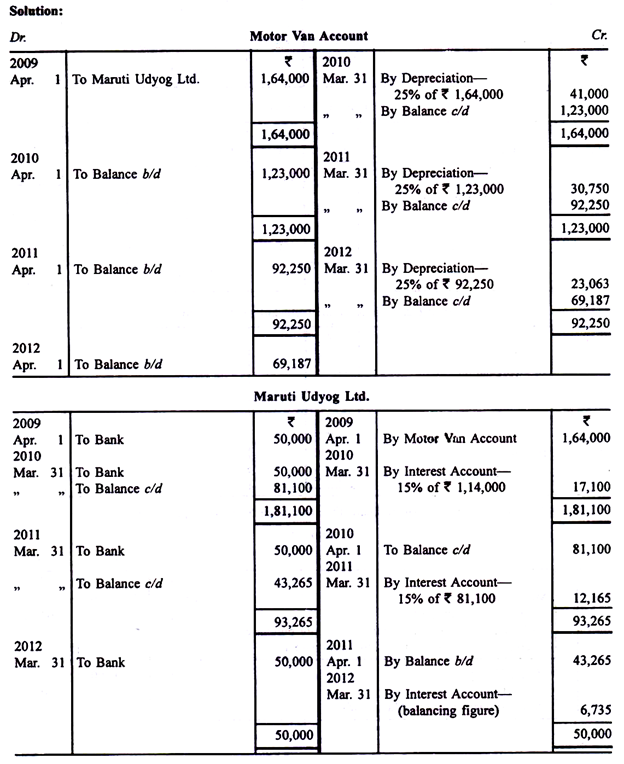
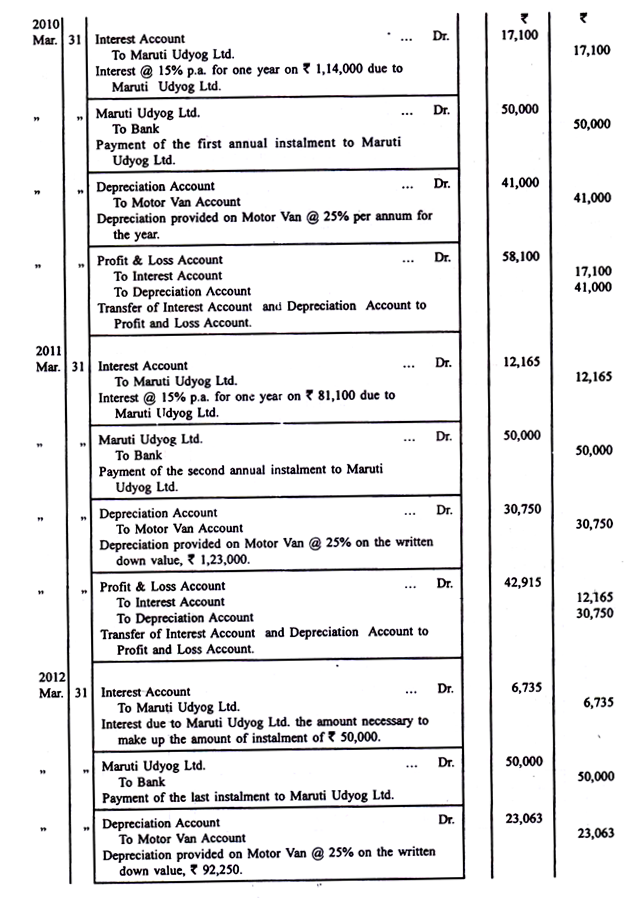
There are two methods for entering hire purchase transactions in the books of the hire- purchaser. The first is to enter transactions like ordinary purchases with the difference that interest is to be provided. This method recognizes the fact that the intention of the parties is to complete the purchase and to pay all the instalments. Hence, on purchase of machinery, machinery is debited and the hire vendor is credited with the cash price. When payment is made, the hire vendor is debited. At the end of each financial year, interest is credited to the hire vendor and debited to Interest Account. Depreciation is charged in the ordinary manner.

illustration 1:

Delhi Tourist Service Ltd. purchased from Maruti Udyog Ltd. a motor van on 1st April, 2009 the cash price being Rs 1,64,000. The purchase was on hire purchase basis, Rs 50,000 being paid on the signing of the contract and, thereafter, Rs 50,000 being paid annually on 31st March, for three years, Interest was charged at 15% per annum. Depreciation was written off at the rate of 25 per cent per annum on the reducing instalment system. Delhi Tourist Service Ltd. closes its books every year on 31st March. Prepare the necessary ledger accounts in the books of Delhi Tourist Service Ltd.

The other method of passing entries in the books of the hire purchaser seeks to recognize the fact that no property passes to the hire-purchaser till the final payment is made. Hence, no entry is passed when the contract is signed.

Entries are made at the time of payment of each instalment. The interest included in the instalment is debited to the interest account; the remaining amount is debited to the asset. Thus, if a payment is made down, the entry is to debit the asset and credit Bank, there being no interest when payment is made on the signing of the contract.

When the next instalment is paid, the entries will be:

1. Debit Asset Account

  • Debit Interest Account
  • Credit Hire Vendor; and

2. Debit Hire Vendor Credit Bank

Depreciation must be allowed on the basis of the full cash price. This is because the whole asset is being used and because ultimately the asset must be paid for wholly.

The journal entries for the illustration number 3 given above, under this method will be as under:

Entries in Interest Account, Depreciation Account and Profit & Loss Account will be the same as have been passed under the first method.

Books of Hire-Vendor:

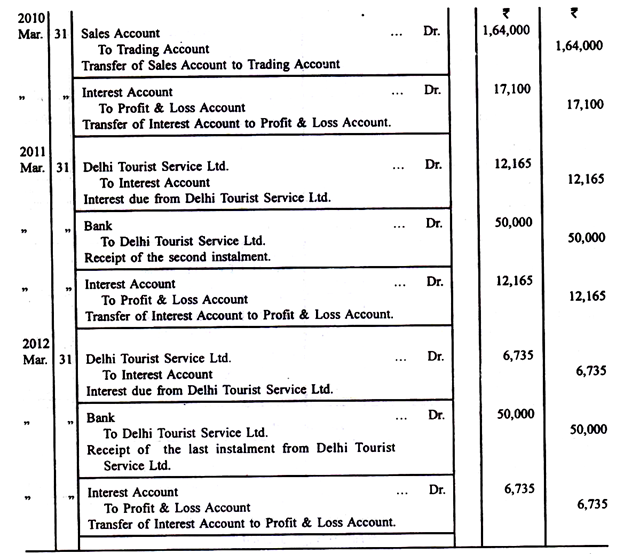
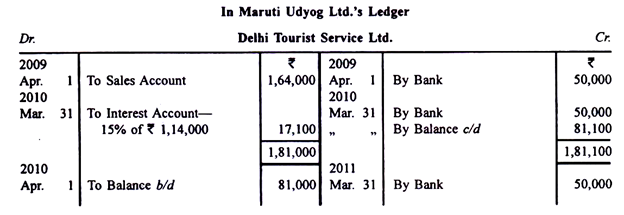
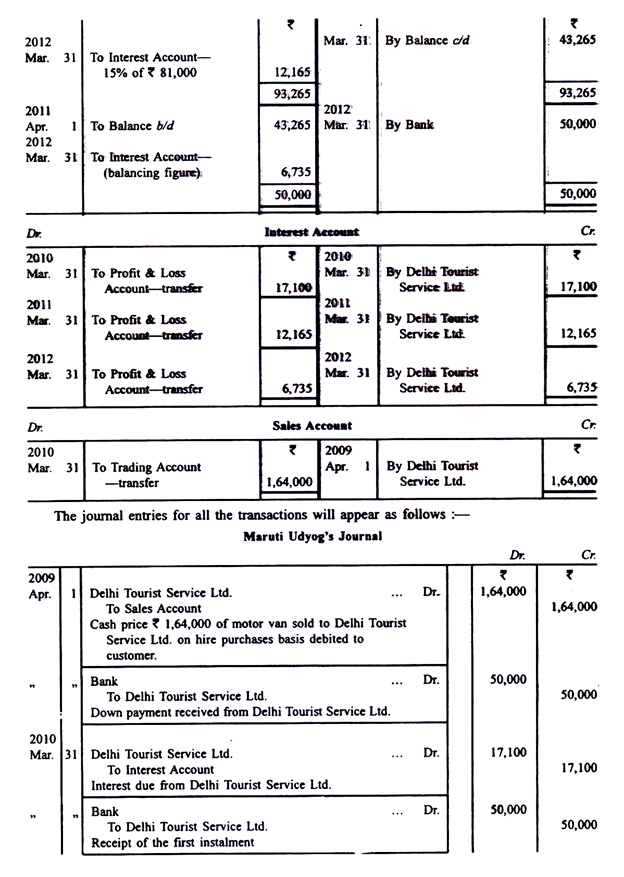
The hire-vendor treats the hire purchase sale like an ordinary sale. He debits the hire purchaser with the full cash price and credits the Sales Account. Interest is debited to the hire purchaser when instalments become due. Cash received is, of course, credited to the hire purchaser.

In the books of the hire-vendor, the accounts pertaining to the above illustration will be as follows:

Illustration 2:

On 1st April, 2008, Ashok acquired machinery on hire purchase system from Modmac Ltd., agreeing to pay four annual instalments of Rs 60,000 each payable at the end of each year. There is no down payment. Interest is charged @ 20% per annum and is included in the annual instalments.

Because of financial difficulties, Ashok, after having paid the first and second instalments, could not pay the third yearly instalment due on 31st March, 2011, whereupon the hire vendor repossessed the machinery. Ashok provides depreciation on the Machinery @ 10% per annum according to the written down value method. He closes his books of account every year on 31st March. Show Machinery Account and the account of Modmac Ltd. for all the years in the books of Ashok. All workings should form part of your answer. [B.Com. (Hons.) Delhi, 1995 Modified]

error: Content is protected !!