Real Numbers, HCF & LCM

Real Numbers

The type of number we normally use, such as 1, 15.82, −0.1, 3/4, etc.

Positive or negative, large or small, whole numbers or decimal numbers are all Real Numbers.

They are called “Real Numbers” because they are not Imaginary Numbers.

HCF & LCM (Simple Problems)

LCM

The LCM of a set of two or more numbers is the smallest of their common multiples. Multiples mean the numbers which follow as the result of multiplying the number with numbers like 1,2,3 etc. To find the common multiples all we need to do is see what numbers end up to be the common multiple for all the given numbers.

For example, when we find the LCM of 9 and 12 we need to find the common multiples. The common multiples of 9 are 36,72,108 etc… The smallest of these is 36, hence 36 shall be the LCM of 9 and 12.

LCM by Prime factorization

To find the LCM using prime factorization method we need to follow the below-mentioned steps:

  • Find the prime factors of numbers individually.
  • From all the factors, identify the maximum number of times each prime factor appears.
  • The product of the prime factors occurring in maximum numbers is the LCM of the given set of numbers.

Let us use the steps in the following example: find the LCM of 8 and 24.

Step 1: First find the prime factors of the numbers 8 and 24

  • Prime factors of 8 = 2×2×2
  • Prime Factors of 24= 2×2×2×3

Step 2: Choose out the number occurring a maximum number of times. The number 2 occurs 3 times and 3 occurs 1 time. number occurring the maximum number of times is 2×2×2×3.

Step 3: The product of these numbers is 24. So the LCM of 8 and 24 is 24.

LCM by Division Method

For calculating the LCM by division method we need to follow the below mentioned steps:

  • First, write all the given numbers in a single row but separated by commas.
  • Find the least prime number that divides at least two numbers from the set of given numbers.
  • Write the quotients exactly below the respective number. The numbers which are not divisible by that prime number have to be written as they are, below the respective number.
  •  Keep repeating the step 2 till no two numbers are divisible by the same number.
  • To find the LCM, multiply the divisors and remaining quotients. The product of all is the LCM of the given set of numbers.

HCF

The HCF or Highest Common Factor of two or more numbers is the greatest common factor of the given set of numbers. In other words, HCF is the greatest number which exactly divides two or more given numbers.

HCF by Listing Method

The listing method involves the process of listing the factors of the given numbers. For example, find the HCF of 20 and 35.

  • All possible factors of 20 are 1,2,4,5,10 and 20
  • All possible factors of 60 are 1,3,4,5,6,10,12,15,20,30,60

The common factors of the given numbers are : 1,2,4,5,10,20. The greatest among all other numbers is 20, so it shall be the HCF of both the numbers.

HCF by Prime Factorization

Before finding HCF by prime factorization we need to know the concept of the same. Let’s take a number say, 45. Now the factors of 45 are 1,3,5,9,15 and 45 itself. Now, apart from 3 and 5 the other numbers 9 and 15 are composite numbers. We hence further factorize them with 9= 3×3 and 15=3×5.

So the factors of 45 shall be only 1,3,3, and 5. This is prime factorization. We now define prime factorization as the process of expressing the number as the product of its prime factors. The prime factors include only prime numbers and not composite numbers.

When we find HCF by prime factorization method, we are finding the greatest common factor among the prime factors or numbers. Steps to be followed for the method are:

  1. Find the prime factors of each of the given number.
  2. Next, we identify the common prime factors of the given numbers
  3. We then multiply the common factors. The product of these common factors is the HCF of the given numbers.

Let us use these steps in the example below: find the HCF of  36 and 48.

Step 1: Finding prime factors individually:

  • All possible factors of 36 are: 2×2×3×3×1
  • All possible factors of 48 are: 2×2×2×2×3×1

Step 2: Choose out the common factors: 2×2×3

Step 3: Multiply all the common factors to get the HCF of the given numbers:

Here the given numbers are 36 and 48. The product of the common factors: 2×2×3 = 12. So the HCF for the numbers 36 and 48 is 12.

Rational & Irrational numbers

Rational Numbers

A Rational Number can be written as a Ratio of two integers (ie a simple fraction).

Example: 1.5 is rational, because it can be written as the ratio 3/2

Example: 7 is rational, because it can be written as the ratio 7/1

Example 0.333… (3 repeating) is also rational, because it can be written as the ratio 1/3

Irrational numbers

But some numbers cannot be written as a ratio of two integers they are called Irrational Numbers.

π (Pi) is a famous irrational number

π = 3.1415926535897932384626433832795… (and more)

We cannot write down a simple fraction that equals Pi.

The popular approximation of 22/7 = 3.1428571428571… is close but not accurate.

Natural Numbers, Even Numbers, Odd Numbers

Natural Numbers

The natural numbers are the counting numbers. It goes like 1, 2, 3, 4, …, and so on. It is interesting to know that if we subtract 1 from any natural number, we get its predecessor (previous number). If we add 1 to any natural numbers, it gives its successor (next number).

The predecessor of 5 is 5 − 1 = 4. The successor of 5 is 5 + 1 = 6. Is there any natural number that has no predecessor? The predecessor of 2 is 1. What is the predecessor of 1? Does that predecessor is also a natural number? No, no natural number is the predecessor of 1.

Whole Numbers

Suppose you have 5 chocolates and you distribute them among your friends. How many chocolates do you have? Zero. Zero is denoted by the symbol 0. When we add 0 to the group of natural numbers, we get whole numbers. The predecessor of 1 is 1 − 1 = 0. 1 has the predecessor which is a whole number and not a natural number.

0 + Natural Numbers = Whole Numbers

Properties of Zero

  • Any number, when multiplied by 0, gives 0.
  • When 0 is added to any number, nothing changes.
  • When 0 is subtracted from any number, it remains the same.
  • 0 is the smallest whole number.

The whole numbers are said to consist of two types of numbers – even numbers and odd numbers.

Even Numbers

A whole number exactly divisible by 2 is called even numbers.

For example:

2, 4, 6, 8, 10, 12, 14, 16……………………..are even number. Or a number having 0, 2, 4, 6, 8 at its units place is called an even number.

246, 1894, 5468, 100 are even number.

Any two even numbers which differ from one another by 2 are called consecutive even number.

Odd Numbers

Odd numbers are the numbers which are not completely divisible by 2. The odd numbers leave 1 as a remainder when divided by 2. They have 1, 3, 5, 7, and 9 as their unit digit. 1, 3, 5, 7, 9, 11, 13, 15, etc. are odd numbers. The sets of odd number are expressed as Odd = {2n + 1: n ∈ integer (number)}.

Steps to Check for Odd and Even Numbers

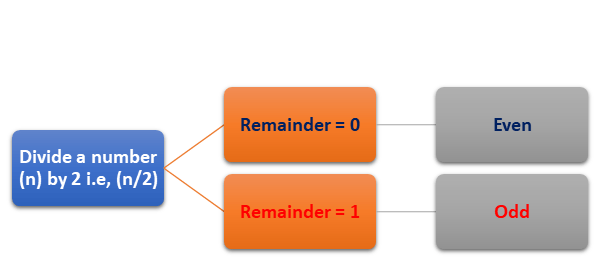
  • Divide the number by 2.
  • Check the remainder.
  • If the remainder is 0, it is an even number else if the remainder is 1, it is an odd number.

Check Odd & Even

Integers, Prime Numbers

Integers

Integers are like whole numbers, but they also include negative numbers … but still no fractions allowed!

So, integers can be negative {−1, −2,−3, −4, … }, positive {1, 2, 3, 4, … }, or zero {0}

We can put that all together like this:

Integers = { …, −4, −3, −2, −1, 0, 1, 2, 3, 4, … }

Examples: −16, −3, 0, 1 and 198 are all integers.

(But numbers like ½, 1.1 and 3.5 are not integers)

Prime Numbers

Number s which have only two factors namely 1 and the number itself are called prime numbers.

For example:

2, 3, 5, 7, 11, 19, 37 etc are prime numbers.

Composite Numbers

Numbers having more than two factors are called as composite numbers.

For example:

4, 6, 8, 10 etc are composite numbers.

Notes:

(a) 1 is neither prime nor composite.

(b) 2 is the lowest and the only even prime number.

(c) 9 is the lowest odd composite number.

Co-prime Numbers

Two numbers are said to be co-prime if they do not have a common factor other than 1 or two numbers whose HCF is 1 called co-prime numbers.

Co-prime numbers needs not be prime numbers.

For example:

  • 7 and 10 are co-prime.
  • 15 and 17 are co-prime.

Twin Prime Numbers

Twin prime numbers are the two prime numbers whose difference is 2.

For example:

  • 3 and 5
  • 17 and 19
  • 41 and 43
  • 29 and 31
  • 71 and 73.

Treatment of Special Items

1. Interest on Debentures:

Debentures interest is a business expensed and therefore, it is a charge against profit and as such profit and loss account is debited with the total amount of interest payable during the accounting year whether the company has earned the profit or not.

Trial Balance of Sharp Ltd. As on 31.3.2012
Dr.   Cr.
  Rs. Rs.
14% Debentures   20,00,000
Interest on debentures 70,000  

Interest for the full year on Rs. 20,00,000 at 14 per cent p.a. is Rs. 2,80,000. Since an amount of Rs. 70,000 is shown in the trial balance against interest, we may assume that an amount of Rs. 2,10,000 is outstanding. Usually, debenture interest is payable every six months.

In the given illustration we may assume the due dates of interest to be June 30 and December 31 of every year. While the interest due on June 30, 2011 has been paid, the amount due on December 31, 2011 has not been paid and in addition, interest has accrued for the three months period up to March 31, 2012.

In the profit and loss account, the interest on debentures will be shown as follows:

Profit and Loss Account of Sharp Limited
  Rs. Rs.
To debentures interest 70,000  
Add: Outstending interest 2,10,000 2,80,000

The interest of Rs. 1,40,000 being the interest due for the six month period up to December 31, 2011, is termed as “interest accrued and due and though this outstanding amount is a short- term liability, as per Companies Act, it must be shown in the balance sheet along with the amount outstanding in respect of debentures.

The interest of Rs. 70,000 being the interest due for the three month period up to March 31, 2012, is ‘termed as interest accrued but not due’ since the next due date for payment of interest is only June 30, 2012. Interest Accrued but not due should be shown in the Balance Sheet as a current liability.

Balance Sheet of Sharp Limited as on 31.03.2012
  Rs. Rs.
Liabilities:

Secured Loans 14% Debentures

Add: Interest Accrued and Due


20,00,000

1,40,000


21,40,000

Current Liabilities and Provisions

Interest Accrued but not due on Debentures


70,000

2. Income Tax on Interest on Debentures:

Payment of interest on debentures is subject to compulsory deduction of income tax at the current prescribed rates given in the Finance Act. The Accounting entry is

Interest on Debentures Account

Dr.

(with the gross account)

   To Debentures holders Account

(with the net amount payable)

  To income-tax payable account

(with the amount of the tax on the gross amount)

3. Discount on the Issue of Debentures:

Discount or costs, e.g., commission, brokerage, etc. incurred on the issue of debentures should normally be written off as early as possible but in no case later than the date of redemption. The unwritten balance will be shown in the balance sheet under ‘Miscellaneous Expenditure’ on the Asset side.

4. Preliminary Expenses:

Such expenses include the costs of formation of a company and since their amount is usually large, it is not desirable to write off them in one year. Instead preliminary expenses are spread over a number of years and profit and loss a/c is debited with certain fraction every year. The unwritten amount is shown under Miscellaneous Expenditures on the asset side of the Balance Sheet.

5. Call-in-Arrears:

This item represents the amount not paid by the shareholders on the calls made on them by the company. If this item is given in the trial balance, it is shown in the balance sheet on the liabilities side as a deduction from the called up amount under the main head of share capital. But if this item is given outside the trial balance as an adjustment, it would mean that the trial balance shows only the paid up capital and not called up capital. The amount of call-in-arrears is then added to the paid up capital to make the later as called up capital and then deducted again.

6. Calls-in-Advance:

It is a debt on the company until the calls are made and the amount received in advance is adjusted. A company may also pay interest on calls-in-advance and the rate of interest is usually stated in the articles. It should be treated as a current liability and shown under the heading current liabilities and provisions.

7. Auditors’ Payments:

Payments made to auditors for auditing the accounts and for doing any other work for the company should be mentioned separately.

8. Managerial Remuneration:

The remuneration paid to managerial personal (e.g., directors, managing directors or manager) of a company in any form or mode is a charge against profits and thus shown in the debit side of the profit and loss account. The mode of payment of the remuneration may include the fee for attending the meetings of the Board, monthly salary, a fixed percentage of profit and so on.

The Companies Act has imposed severe restrictions on the managerial remuneration payable by a public company or a private company which is a subsidiary of a public company.

Section 198 (i) provides that the total managerial remuneration in respect of any year is subject to an overall limit of 11 percent of the net profits of the company in that year.

9. Income-Tax:

Dividends to both the equity and the preference shareholders can be paid only out of profits available after taking into account the income-tax. The profits on which income-tax is payable is termed as taxable profits and the calculation of taxable profits is based on the provisions as per the Income-Tax Act.

Though the actual amount of tax can be calculated only when the books of accounts are closed for the accounting period and profits are ascertained, the Income-Tax Act requires a business to pay advance tax by forecasting the likely profits that would accrue during the year.

Another point to be noted in the case of Income-tax is that though a company may determine the tax liability, pay the tax and file its return, the income-tax officer will scrutinize the return and assess the tax payable by even re-computing the taxable profits.

If the income-tax officer arrives at taxable profits which differ from that stated by the company in its return, then the tax assessed and to be settled will also differ. The process of assessment may take quite some time to be completed and until such completion the exact tax liability will not be known to the company.

Thus, the accounting treatment of income-tax must take into account the following three stages:

(i) Payment of advance income-tax.

(ii) Determination of the tax liability by the company from its books of accounts, making a provision for such liability and payment of difference, if any, between advance tax and tax now computed.

(iii) Completion of the assessment by the income-tax officer.

The concepts of ‘previous year’ and ‘assessment year’ have also to be understood to follow the accounting treatment of income-tax. Assessment year means the period of twelve months starting from April 1 of every year and ending on March 31 of the next year.

The income of the previous year of a business is taxed during the following assessment year at the rates prescribed for such assessment year by the Finance Act. The previous year is defined as the financial year or the period of twelve months starting from April 1 of every year and ending on March 31 of the next year.

When advance tax is paid, the journal entry to record this would be

Advance Income-tax Accounts Dr.  
To Bank A/C    

For example, if an advance tax of Rs. 3, 50,000 is paid by a company for the previous year 2012 in 2012-13, the entry to record this would be

Advance Tax for Assessment Year 2012-13 Account Dr. 3,50,00  
  To Bank Account     3,50,000

Though the above transaction has been journalized to explain the dual aspects in reality, the payment of advance tax would be recorded in the cash book and the debit aspect posted into the ledger from the cash book. Thus, while preparing the trial balance as on March 31, 2012, the advance tax for assessment year, 2012-13, will be included in the trial balance at debit balance of Rs. 3, 50,000.

Let us assume that in the example cited above, the company determines its tax liability as Rs. 3, 42,500 after drawing up the Profit and Loss Account for the year ending March 31, 2012. This liability must be provided for by passing the entry as,

Profit and loss Account Dr. 3,42,500  
  To provisions for income-tax account     3,42,500

While the tax liability will appear as an expense in the profit and loss account, the provision for income-tax will be shown in the Balance Sheet as a current liability and the Advance Tax of Rs. 3, 50,000 paid will be shown as an advance on the asset side of the balance sheet.

Another acceptable method of presentation is to set off the advance and the provision relating to the same assessment year against each other and take only the net amount either to the liability or asset side of the balance sheet. In the example given above, since the advance exceeds the provision, the net amount would be presented as follows.

Balance Sheet as on March 31,2012
Assets Rs. Rs.
Loan and advances    
Advance tax for Assessment year 2012-13 3,50,000  
Less: Provisions for tax for Assessment year 2012-13 3,42,000 7,500

Till such time the assessment is completed, the balances in the advance and provision accounts will be carried forward. To continue with the above example, if the assessment is completed in December 2012 and the tax liability is arrived at by the Income-tax Officer at Rs. 3, 60,000,

The accounting treatment will be as follows:

  1. The provision for tax is short of the actual liability by Rs. 17,500. The company will have to provide for this extra liability. In the Profit and Loss Account for the year ended March 31, 2013 the increase in liability will be provided for by making the following entry.
Profit and loss Account Dr. 17,500  
  To provisions for income-tax account year 2012-13     17,500

The above entry will be in addition to the entry required to be passed in respect of tax payable for the financial year 2012-13.

  1. Since the assessment has been completed, the advance tax account can be closed by transfer to the Provision account.

The journal entry for the transfer will be:

Provisions for income-tax account year 2012-13 Dr. 3,50,000  
  To advance tax for Assessment year 2012-13     3,50,000
  1. The balance of tax payable amounting to Rs. 10,000 (Rs. 3,60,000 – 3,50,000) must be paid shortly after the completion of assessment. When the short-fall in tax is paid, the entry will be
Provisions for income-tax account year 2012-13 Dr. 10,000  
  To Bank a/c     10,000

With the recording of the above entries, the balance sheet as on March 31, 2013, will not list any items pertaining to tax payable for Assessment Year 2012-13.

The ledger accounts are given below:


Dr. Advance Tax for Assessment Year 2012-13 Cr.
2012 Particulars Rs. 2013 Particulars Rs.
  To balance b/d 3,50,000 March, 31 By provision for Income-tax Account 3,50,000
    3,50,000     3,50,000
Dr. Provisions for Income tax Account Year 2012 Cr.
Date Particulars Rs. Date Particulars Rs.
2012

Dec.


2013

March 31


To Bank a/c.

To advance for year 12-13


10,000


3,50,000

2012

April 1


2013

March 31


By balance b/d

By Profit & Loss account


3,42,500


17,500

    3,60,000     3,60,000

Note:

Adjustments relating to income tax of the previous year is normally done by debiting or crediting the P/L appropriation a/c so that current operating profits are not distorted. Provision for current year’s tax is, however, debited above the line.

10. Dividends:

Dividends may be defined as the share of profits that is payable to each shareholder of the company. The Companies Act lays down that dividends can be paid out of profits only and prohibits the payment of any dividend out of capital. Also, dividends shall be paid in cash only.

A company may pay dividends from any or all of the three following sources:

(i) Profits of the current year

(ii) Undistributed profits of previous years

(iii) Moneys provided by the Central or any State Government for the payment of dividends in pursuance of a guarantee given by the government concerned.

The directors generally recommend the percentage of dividend payable on the equity shares. The shareholders in the annual general meeting may pass a resolution adopting the recommendation or may lower the percentage recommended. The shareholders do not have the power to enhance the dividend recommended by the Directors. The percentage adopted must be applied only on the paid-up capital.

For example, let us assume that the Directors of Sunshine Limited propose a dividend of 15 per cent for the equity shareholders which is adopted by the shareholders. The called up equity capital of the company is Rs. 50, 00,000 and there are calls in arrears to the extent of Rs. 40,000.

The dividend payable in the example would be calculated as (15/100) × (50, 00,000 – 40,000) = Rs. 7, 44,000. Of late, companies have started declaring dividends as a percentage of the Profit After Tax also.

The dividend recommended by the directors is termed as ‘Proposed Dividend’ till such time it is adopted by the shareholders in the annual general meeting. The entry to record proposed dividend is,

Profit and Loss A/c Cr.

  To proposed dividend A/c

The proposed dividend will be classified as a provision and shown on the liability side of the balance sheet. The dividend finally decided by the shareholders in the annual general meeting as payable is termed as ‘declared dividend’.

Any dividend declared must be paid within forty-two days from the date of declaration. Hence, a declared dividend must be classified as a current liability in the balance sheet of the company.

Though dividends can be declared only by a resolution of the shareholders, if the articles of the company permit, the Directors can declare an interim dividend between two annual general meetings. When interim dividend is paid the entry to record the payment will be,

Interim Dividend A/c Dr.

  To Bank A/c

The interim dividend paid during a year will appear in the Trial Balance of the Company as on the last date of the accounting period and will be transferred to the debit side of the profit and loss appropriation a/c as it is an item of appropriation of profits.

Dividend is generally paid by posting the dividend warrants to the shareholders. The dividend warrants must then be presented to the company’s bank which will make the payment. Sometimes, a portion of the dividend declared may remain as unpaid simply due to the fact that such dividend has not been claimed by certain shareholders.

Any unpaid or unclaimed dividend is a current liability and is shown on the liabilities side of the balance sheet. The company should transfer any unpaid dividend within forty-nine days from the date of declaration of the dividend to a special bank account.

If the dividend is not claimed for a period of three years from the date of transfer to the special bank account than the unclaimed amount must be transferred by the company to the general revenue account of the Central Government. After such a transfer, any shareholder entitled to claim such dividend may claim it from the Government.

11. Interest Out of Capital:

Though the Companies Act provides that dividends to shareholders are payable only out of profits, in certain circumstances with the previous sanction of the Central Government, interest may be paid to shareholders out of capital.

The circumstances as specified by Section 208 of the Companies Act are as below:

  1. Where any shares in a company are issued for the purpose of raising money to defray the expenses of the construction of any work or building, or the provision of any plant, and
  2. Such construction or provision of plant cannot be made profitable for a lengthy period.

In the above circumstances, if the company is authorized by the articles or by a special resolution, it may pay interest on so much of that share capital as is for the time being paid-up, for a specified period and charge such interest to capital as part of the cost of the construction of the work or building or the provision of the plant.

The payment of interest shall be made only for such period as may be determined by the central government. The period, in any case, cannot extend beyond the close of the half year next after the half year during which the work or building has been actually completed or the plant provided. The rate of interest cannot exceed four per cent per annum or such other rate as the Central Government may notify.

Transfer to Reserves, Types, Reasons

Transfer to Reserves refers to the allocation of a portion of a company’s profits to a reserve account instead of distributing it as dividends. Reserves are retained earnings set aside for future needs, such as business expansion, debt repayment, legal requirements, or unforeseen contingencies. They strengthen the financial stability of the company and act as a buffer during economic downturns. Reserves can be general reserves (for any purpose) or specific reserves (for a particular use, like debenture redemption). The decision to transfer profits to reserves is made by the board of directors and approved by shareholders. This practice ensures long-term sustainability while maintaining shareholder confidence in the company’s growth and risk management strategies.

Types of Transfer to Reserves:

Reserves are an essential part of a company’s financial management, ensuring stability, growth, and compliance with legal requirements. They represent retained earnings set aside for specific or general purposes. The different types of reserves can be classified based on their nature, purpose, and legal requirements.

  • General Reserve

General Reserve is created out of profits without any specific purpose. It strengthens the financial position of the company and acts as a safety net during financial difficulties. Unlike specific reserves, it can be used for any business need, such as expansion, working capital, or absorbing future losses. Companies transfer a portion of their net profits to this reserve voluntarily, as it is not mandated by law. The general reserve improves creditworthiness and investor confidence since it reflects prudent financial management. It is shown under “Reserves & Surplus” in the balance sheet and can be utilized for dividend distribution in lean years.

  • Specific Reserve

Specific Reserve is created for a particular purpose and cannot be used for other expenses. Examples include the Debenture Redemption ReserveCapital Redemption Reserve, and Investment Fluctuation Reserve. These reserves ensure that funds are available for defined obligations, such as repaying debentures or covering losses from market fluctuations. Regulatory authorities or company policies may mandate certain specific reserves. For instance, companies issuing debentures must maintain a Debenture Redemption Reserve as per SEBI guidelines. Such reserves enhance financial discipline and ensure that funds are allocated for critical future liabilities.

  • Capital Reserve

Capital Reserve is created from capital profits, not revenue profits. It arises from transactions like the sale of fixed assets at a profit, premium on share issuance, or profits from the revaluation of assets. Unlike revenue reserves, it is not available for dividend distribution. Instead, it is used for capital-related purposes like writing off capital losses, issuing bonus shares, or financing long-term projects. Since it is not generated from normal business operations, it remains a separate reserve in the balance sheet and contributes to the company’s net worth without affecting distributable profits.

  • Revenue Reserve

Revenue Reserves are created from revenue profits (earned through regular business operations) and can be distributed as dividends if needed. These include General Reserves and Dividend Equalization Reserves. Unlike capital reserves, revenue reserves are flexible and can be used for business expansion, debt repayment, or stabilizing dividend payouts. They improve liquidity and financial health, ensuring that profits are reinvested wisely rather than being entirely distributed to shareholders. Companies with strong revenue reserves can better withstand economic downturns and fund growth initiatives without excessive borrowing.

  • Statutory Reserve

Statutory Reserve is legally required under company law, banking regulations, or insurance acts. For example, banks must maintain a Cash Reserve Ratio (CRR) and Statutory Liquidity Ratio (SLR) as per RBI guidelines. Similarly, insurance companies create reserves to meet future claim liabilities. These reserves ensure financial stability and protect stakeholders’ interests by preventing excessive profit distribution. Non-compliance can result in penalties, making statutory reserves a mandatory aspect of financial reporting in regulated industries.

  • Secret Reserve

Secret Reserve is an undisclosed reserve not visible in the balance sheet, often used by banks and financial institutions to strengthen financial stability discreetly. It is created by undervaluing assets or overstating liabilities, reducing reported profits. While it provides a cushion during crises, its lack of transparency can mislead investors. Regulatory bodies often discourage or restrict secret reserves to ensure fair financial disclosures.

Each type of reserve serves distinct financial, legal, and strategic purposes, ensuring a company’s long-term sustainability and compliance. Proper reserve management enhances credibility, operational flexibility, and risk mitigation.

Reasons of Transfer to Reserves:

  • Financial Stability & Risk Mitigation

Companies transfer profits to reserves to strengthen financial stability. Reserves act as a cushion during economic downturns, unexpected losses, or cash flow shortages. By setting aside funds, businesses ensure continuity without relying on external borrowing. This practice enhances creditworthiness and investor confidence, as reserves reflect prudent financial management and preparedness for uncertainties.

  • Legal & Regulatory Compliance

Certain reserves, like the Debenture Redemption Reserve or Statutory Reserves, are mandatory under corporate laws or industry regulations. Non-compliance can lead to penalties. Transferring profits to these reserves ensures adherence to legal requirements, protecting the company from regulatory actions and maintaining operational legitimacy.

  • Business Expansion & Reinvestment

Reserves provide internal funding for growth initiatives like new projects, R&D, or market expansion. Instead of depending on loans or equity dilution, companies use retained earnings (reserves) to finance expansion. This reduces debt burden and interest costs while promoting sustainable, self-funded growth.

  • Dividend Equalization

To maintain consistent dividend payouts despite fluctuating profits, companies transfer surplus earnings to reserves. A Dividend Equalization Reserve ensures shareholders receive stable returns even in lean years, enhancing investor trust and preventing stock price volatility due to irregular dividends.

  • Debt Repayment & Obligations

Reserves like the Debenture Redemption Reserve or Sinking Fund Reserve are created to repay long-term liabilities. By systematically allocating profits, companies avoid last-minute financial strain when repaying debts or redeeming securities, ensuring smooth liability management.

  • Asset Replacement & Modernization

Businesses set aside reserves for replacing outdated machinery or upgrading technology. A Capital Replacement Reserve ensures funds are available for asset modernization without disrupting cash flow, maintaining operational efficiency and competitiveness.

  • Contingency Planning

Unforeseen events like lawsuits, natural disasters, or economic crises require emergency funds. A Contingency Reserve helps companies manage sudden financial shocks without destabilizing operations, ensuring business resilience and continuity.

  • Bonus Shares & Employee Benefits

Reserves like the Capital Redemption Reserve or Employee Welfare Reserve fund bonus share issuances or employee benefit schemes. This rewards stakeholders without cash outflows, boosting morale and shareholder value while conserving liquidity.

  • Tax Efficiency

Retaining profits in reserves can defer dividend distribution, potentially reducing immediate tax liabilities. While reserves themselves aren’t tax-exempt, strategic profit retention helps optimize tax planning and cash flow management.

  • Enhancing Market Reputation

A robust reserve position signals financial health to investors, lenders, and customers. It reflects disciplined profit utilization, reducing perceived risk and improving the company’s market reputation, credit ratings, and access to capital.

Tax deducted at source

TDS stands for tax deducted at source. As per the Income Tax Act, any company or person making a payment is required to deduct tax at source if the payment exceeds certain threshold limits. TDS has to be deducted at the rates prescribed by the tax department.

In India, under the Indian Income Tax Act of 1961, income tax must be deducted at source as per the provisions of the Income Tax Act, 1961. Any payment covered under these provisions shall be paid after deducting a prescribed percentage of income tax. It is managed by the [Central Board for Direct Taxes] (CBDT) and is part of the Department of Revenue managed by Indian Revenue Service. It has a great importance while conducting tax audits. Assessee is also required to file quarterly return to CBDT. Returns states the TDS deducted & paid to government during the Quarter to which it relates.

In the Ireland and the United Kingdom, the term used for payroll withholding tax is pay-as-you-earn tax (PAYE); in Australia and the United States, the term pay-as-you-go is used.

Objectives of income tax deducted at source

  • To enable the salaried people to pay the tax as they earn every month. This helps the salaried persons in paying the tax in easy installments and avoids the burden of a lump sum payment.
  • To collect the tax at the time of payment of income to various assesses such as contractors, professionals etc.
  • Government requires funds throughout the year. Hence, advance tax and tax deducted at source help the government to get funds throughout the year and run the government well

The company or person that makes the payment after deducting TDS is called a deductor and the company or person receiving the payment is called the deductee. It is the deductor’s responsibility to deduct TDS before making the payment and deposit the same with the government. TDS is deducted irrespective of the mode of payment cash, cheque or credit–and is linked to the PAN of the deductor and deducted.

TDS is deducted on the following types of payments:

  • Salaries
  • Interest payments by banks
  • Commission payments
  • Rent payments
  • Consultation fees
  • Professional fees

Note:

Where tax is deducted/collected by government office, it can remit tax to the Central Government without production of income-tax challan. In such case, the Pay and Accounts Officer or the Treasury Officer or the Cheque Drawing and Disbursing Officer or any other person by whatever name called to whom the deductor reports the tax so deducted and who is responsible for crediting such sum to the credit of the Central Government, shall submit a statement in Form No. 24G.to NSDL with prescribed time-limit.

Statutory Provisions regarding preparation of Company Final Accounts

The books of accounts showing true and fair financial statements and relevant papers shall be kept at the registered address of the company. The books shall be kept on accrual basis and according double entry system of accounting. The books of accounts and relevant papers may be kept at other place in India as BOD may decide. A seven days’ notice shall be given to ROC for communication of new address. The accounts can be kept in electronic mode.

The books of accounts related to branch office can be kept at the branch however proper summarised returns shall be sent to registered office periodically.

The books of accounts shall be open for director’s inspection at registered office or other place during business hours. The copies of financial information maintained outside India shall be produced for inspection. The inspection of subsidiary can be done only after authorization from BOD.

The books of accounts of the company shall be kept in good order for a period of 8 FYs and in case investigations ordered by CG it may direct a longer period.

MD, WTD in charge of finance, CFO and such other person charged by the BOD with compliance of this section, contravenes the provisions shall be punishable with imprisonment for maximum 1 year or with fine ( Rs. 50,000 to Rs. 5,00,000 ).

Financial Statements (Section 129)

  • Shall be prepared in Schedule III format,
  • Shall comply with the accounting standards specified in section 133 and
  • Shall give a true and fair view of the state of affairs of the company
  • Shall be laid before AGM by BOD along with the consolidated financials (prepared on the basis of same principles of standalone) in case of subsidiary, associate and JV.
  • If do not comply with accounting standards, shall disclose the deviation, reasons and financial effect

Contravention of the provisions of this section; MD, WTD in charge of finance, CFO and such other person charged by the BOD with compliance of this section and in the absence of any such officers all the directors shall be punishable with imprisonment for maximum 1 year or with fine ( Rs. 50,000 to Rs. 5,00,000 ).

Reopening of accounts on court’s or Tribunal’s orders (Sec. 130)

Application made by CG, Income tax authority, SEBI, any other regulatory body, authority or any person concerned and an order made by a court or the tribunal stating that the accounts were prepared in fraudulent manner and the affairs of the company were mismanaged during the relevant period casting a doubt the doubt on reliability of financial statements., then a company can re-open and recast its financial statements. Court or Tribunal shall give the notice to the specified authorities and the representations made by the applicant shall be considered before passing the order. The accounts revised or recast shall be final.

Voluntary revision of financial statements or Board’s report (Section 131)

If it appears to the directors of a company that the financial statements of the company or the board’s report do not comply with the provisions of Section 129 or section 134, financial statements or the board reports for the 3 preceding financial years may be revised. For this purpose company shall make an application to Tribunal and Tribunal will pass an order. The order shall be filed with ROC by the company. Tribunal shall give notice to CG & Income Tax authorities and the representations shall be considered before passing an order by tribunal. Revised financials and report can be filed once in a financial year. Details of reasons for revision shall be stated. If the previous financial statement and board report copies are already sent to the members or ROC or laid in AGM the revision must be confined to the correction and consequential alterations.

Constitution of National Financial Reporting Authority (Section 132)

CG may constitute NFRA.

NFRA shall:

  • Make recommendation to CG on formulation and laying down of accounting and auditing policies and standards for adoption by companies or class of companies or their auditors
  • Monitor and enforce compliance with accounting and auditing standards
  • Oversee the quality of service of the professionals associated with ensuring compliance with the standards

NFRA shall consist 1 chairperson having expertise in the field of accountancy, auditing, finance or law appointed by CG and other members maximum 15. Conflict of interest and lack of independence in respect of appointment shall be declared by the member. Chairperson and members in full time employment shall not be associated with any audit firm (including consultancy firms) during the course of their appointment after ceasing their appointment.

Powers of NFRA will be:

  • To investigate professional or other misconduct done by member or firm of CAs. No other body or institute can investigate the same matter. NFRA shall have exclusive jurisdiction.
  • Have the same powers as are vested in a civil court under the Code of Civil Procedures, 1908 while trying a suit
  • To impose penalty ( Individual – Rs. 1 Lacs to 5 times of fees received Firms – Rs. 10 Lacs to 10 times of fees received ) or debar member or firm for a period of 6 months to 10 years, if professional or other misconduct is proved.

Any person aggrieved by any order of NFRA may prefer appeal before appellate authority as prescribed.

Central Government to prescribe accounting standards (Section 133)

AS shall be prescribed by CG, recommended by ICAI in consultation with and after examination of the recommendations made by NFRA.

Financial Statements, board’s report etc.

FS including CFS (if any) shall be approved by BOD. FS shall be signed at least by the chairperson of the company or by two directors out of which one shall be MD and CEO if he is director, CFO and CS of the company. Auditors’ report shall be attached with FS.

FS and board’s report shall be laid before the company in AGM. Board’s report shall include:

  • Extract of annual return
  • Number of meetings of the board
  • Directors responsibility statement
  • Statement on declaration given by independent directors
  • Company’s policy on directors’ remuneration
  • Comment on qualifications raised in statutory audit report or secretarial report
  • Particulars of loans, guarantees or investments under section 186
  • Particulars of contracts or arrangement with related parties mentioned in sec. 188
  • State of the company’s affairs
  • Amounts proposed to be carried forward to reserves
  • Recommended dividend
  • Material changes and commitments affecting the financial position
  • Conservation of energy, technology absorption, foreign exchange earnings and outgo
  • Statement indicating development and implementation of a risk management policy
  • Details of CSR policy developed & implemented
  • Annual evaluation of the board

Board report shall be attached to FS. Board report shall be signed by Chairperson if authorised by board otherwise by at least two directors.

Corporate Social Responsibility (CSR) (Section 135)

Company having net worth Rs. 500 crores or more, turnover Rs. 1000 crores or more net profit of Rs. 5 crores or more during any financial year shall constitute a CSR Committee of the board consisting of 3 or more directors, one shall be independent director.

Right of the member to copies of audited financial statement (Section 136)

Financial Statements including Consolidated Financial Statements, auditors’ report and other documents which are to be laid down before AGM shall be sent to every member and trustee of debenture holder and all other required persons at least before 21 days of AGM. In case of listed company these documents can be kept for inspection at least before 21 days of AGM.

Copy of FS to be filed with Registrar (Section 137)

The financial statements including consolidated financial statements shall be filed with Registrar within 30 days from the date of AGM.

Rules regarding Payment of Dividends

Dividends are a portion of a company’s profits distributed to its shareholders as a reward for their investment in the company. The decision to declare dividends is made by the board of directors, but the process is governed by several legal and regulatory frameworks to ensure fairness, transparency, and adherence to corporate governance norms. In India, the declaration and distribution of dividends are primarily regulated by the Companies Act, 2013, along with rules set forth by the Securities and Exchange Board of India (SEBI) for listed companies.

Meaning and Types of Dividends:

Dividend is a return on investment for shareholders, paid from the profits of the company. It can be issued in several forms:

  1. Interim Dividend:

Declared by the board of directors during the financial year before the finalization of accounts. This is typically paid out of the profits earned during the current financial year.

  1. Final Dividend:

Declared at the company’s Annual General Meeting (AGM) after the financial year has ended and the accounts are finalized. It is recommended by the board but requires shareholder approval.

  1. Special Dividend:

Paid in extraordinary circumstances when the company has a significant surplus of profits or cash. This dividend is not a regular payout.

  1. Stock Dividend (Bonus Shares):

Instead of cash, the company issues additional shares to its shareholders in proportion to their existing holdings.

  1. Scrip Dividend:

The company issues a promissory note to the shareholders, promising to pay the dividend at a later date, which can be considered a form of deferred payment.

Legal Provisions for Declaration of Dividends Under the Companies Act, 2013

The provisions governing the declaration and distribution of dividends are laid down under Section 123 of the Companies Act, 2013, along with the Companies (Declaration and Payment of Dividend) Rules, 2014.

  1. Declaration of Dividend

Profit Requirement:

Dividends can only be declared out of the following:

    • Current year profits after providing for depreciation and any necessary reserves.
    • Previous year profits that have not been transferred to reserves or used for dividends earlier.
    • Government Grant: If a company has received government assistance in certain situations, this may be considered in specific circumstances.

Free Reserves:

If the company’s profits are insufficient, it can declare a dividend out of its accumulated profits or free reserves, provided that:

    • The rate of dividend does not exceed the average rate of dividends declared in the preceding three financial years.
    • The amount withdrawn from the reserves is not more than 10% of the paid-up share capital and free reserves of the company.

Interim Dividend:

The board may declare an interim dividend out of profits available after providing for depreciation. However, if the company suffers a loss up to the quarter immediately preceding the interim dividend declaration, the interim dividend cannot be declared at a rate higher than the average dividend declared during the preceding three financial years.

  1. Depreciation
  • The company must provide for depreciation in accordance with Schedule II of the Companies Act, 2013 before declaring dividends.
  • Any dividend declared without taking into account depreciation can be considered illegal and can attract penalties for the company and its directors.
  1. Transfer to Reserves

Before declaring dividends, companies are required to transfer a certain percentage of their profits to reserves, as per the discretion of the board of directors. However, the Companies Act no longer mandates a specific minimum percentage to be transferred.

  1. Dividend on Preference Shares

Preference shareholders are entitled to dividends at a fixed rate before any dividends are declared for equity shareholders. The dividend for preference shares must be paid first, and any arrears of preference dividends must be cleared if applicable.

  1. Payment in Cash

Dividends must be paid in cash, cheque, or electronic means. A company cannot declare dividends in kind (i.e., through assets). However, stock dividends (bonus shares) are permissible.

  1. Dividend Distribution Tax (DDT)

Finance Act, 2020, abolished the Dividend Distribution Tax (DDT). Earlier, companies were required to pay tax on the dividends distributed. Now, shareholders are liable to pay tax on the dividends they receive based on their individual income tax slabs.

  1. Timeframe for Payment

Once a dividend is declared at the AGM, the company must pay the dividend to the shareholders within 30 days from the date of declaration. If the company fails to do so, it attracts penalties and interest charges.

  1. Unpaid or Unclaimed Dividend

  • If a dividend remains unpaid or unclaimed for 30 days from the date of declaration, it must be transferred to a special Unpaid Dividend Account within 7 days of the expiration of the 30-day period.
  • If the dividend remains unclaimed for seven years, it must be transferred to the Investor Education and Protection Fund (IEPF).

Process for Dividend Distribution:

  1. Board Meeting:

The process begins with a board meeting where the directors review the financial performance of the company. Based on profitability and liquidity, the board decides whether to recommend a dividend to the shareholders.

  1. Declaration at AGM:

In the case of a final dividend, the declaration is made at the Annual General Meeting (AGM) of the company. The shareholders must approve the dividend recommended by the board. Without this approval, the company cannot distribute the dividend.

  1. Record Date:

Company must set a record date, which is the cut-off date for determining the shareholders who are entitled to receive the dividend. Only those shareholders whose names appear in the company’s register on this date are eligible for the dividend.

  1. Payment of Dividend:

Dividend can be paid via cheque, demand draft, or electronic transfer. The payment must be completed within 30 days of the declaration, failing which the company is subject to penalties.

Penalties for Non-Compliance:

Failure to comply with the rules regarding dividend declaration and distribution can result in penalties for both the company and its officers.

  • Imprisonment and Fines:

Under Section 127 of the Companies Act, if the company fails to pay the dividend within 30 days of its declaration, every director who is knowingly a party to this default may be punished with imprisonment for up to 2 years and a fine of ₹1,000 for each day the default continues.

  • Interest:

In case of a delayed payment, the company is liable to pay interest on the unpaid dividend at the rate of 18% per annum until the payment is made.

error: Content is protected !!