Merchandise Management

In the fierce competition of retail, it is very crucial to attract new customers and to keep the existing customers happy by offering them excellent service. Merchandising helps in achieving far more than just sales can achieve.

Merchandising is critical for a retail business. The retail managers must employ their skills and tools to streamline the merchandising process as smooth as possible.

Merchandising

Merchandising is the sequence of various activities performed by the retailer such as planning, buying, and selling of products to the customers for their use. It is an integral part of handling store operations and e-commerce of retailing.

Merchandising presents the products in retail environment to influence the customer’s buying decision.

Types of Merchandise

There are two basic types of merchandise:

  1. Staple Merchandise
  • It has predictable demand
  • Fashion Merchandise
  • It provides relatively accurate forecasts
  1. Fashion Merchandise
  • It has unpredictable demand
  • Limited past sales history is available
  • It is difficult to forecast sales

Factors Influencing Merchandising

The following factors influence retail merchandising:

  1. Size of the Retail Operations

This includes issues such as how large is the retail business? What is the demographic scope of business: local, national, or international? What is the scope of operations: direct, online with multilingual option, television, telephonic? How large is the storage space? What is the daily number of customers the business is required to serve?

  1. Shopping Options

Today’s customers have various shopping channels such as in-store, via electronic media such as Internet, television, or telephone, catalogue reference, to name a few. Every option demands different sets of merchandising tasks and experts.

  1. Separation of Portfolios

Depending on the size of retail business, there are workforces for handling each stage of merchandising from planning, buying, and selling the product or service. The small retailers might employ a couple of persons to execute all duties of merchandising.

Functions of a Merchandising Manager

A merchandising manager is typically responsible to:

  • Lead the merchandising team.
  • Ensure the merchandising process is smooth and timely.
  • Coordinate and communicate with suppliers.
  • Participate in budgeting, setting and meeting sales goals.
  • Train the employees in the team.

Merchandise Planning

Merchandise planning is a strategic process in order to increase profits. This includes long-term planning of setting sales goals, margin goals, and stocks.

Step 1: Define merchandise policy

Get a bird’s eye view of existing and potential customers, retail store image, merchandise quality and customer service levels, marketing approach, and finally desired sales and profits.

Step 2: Collect historical information

Gather data about any carry-forward inventory, total merchandise purchases and sales figures.

Step 3: Identify Components of Planning

  • Customers: Loyal customers, their buying behavior and spending power.
  • Departments: What departments are there in the retail business, their subclasses?
  • Vendors: Who delivered the right product on time? Who gave discounts? Vendor’s overall performance with the business.
  • Current Trends: Finding trend information from sources including trade publications, merchandise suppliers, competition, other stores located in foreign lands, and from own experience.
  • Advertising: Pairing buying and advertising activities together, idea about last successful promotions, budget allocation for Ads.

Step 4: Create a long-term plan

Analyze historical information, predict forecast of sales, and create a long-term plan, say for six months.

Merchandise Buying

This activity includes the following:

  • Step 1 Collect Information: Gather information on consumer demand, current trends, and market requirements. It can be received internally from employees, feedback/complaint boxes, demand slips, or externally by vendors, suppliers, competitors, or via the Internet.
  • Step 2 Determine Merchandise Sources: Know who all can satisfy the demand: vendors, suppliers, and producers. Compare them on the basis of prices, timeliness, guarantee/warranty offerings, payment terms, and performance and selecting the best feasible resource(s).
  • Step 3 Evaluate the Merchandise Items: By going through sample products, or the complete lot of products, assess the products for quality.
  • Step 4 Negotiate the Prices: Realize a good deal of purchase by negotiating prices for bulk purchase.
  • Step 5 Finalize the Purchase: Finalizing the product prices and buying the merchandise by executing buying transaction.
  • Step 6 Handle and Store the Merchandise: Deciding on how the vendor will deliver the products, examining product packing, acquiring the product, and stocking a part of products in the storehouse.
  • Step 7 Record the Buying Figures: Recording details of transactions, number of unit pieces of products according to product categories and sub-classes, and respective unit prices in the inventory management system of the retail business.

Merchandise Performance

The following methods are commonly practiced to analyze merchandise performance:

ABC Analysis

It is a process of inventory classification in which the total inventory is classified into three categories:

  • Extremely Important Items: Very crucial inventory control on order scheduling, safety, prompt inspection, consumption pattern, stock balance, refill demands.
  • Moderately Important Items: Average attention is paid to them.
  • Less important Items: Inventory control is completely stress free.

This approach of segregation gives importance to each item in the inventory. For example, the telescope retailing company might be having small market share but each telescope is an expensive item in its inventory. This way, a company can decide its investment policy in particular items.

Sell-Through Analysis

In this method, the actual sales and forecast sales are compared and the difference is analyzed to determine whether to apply markdown or to place a fresh request for additional merchandise to satisfy current demand.

This method is very helpful in evaluating fashion merchandise performance.

Multi-Attribute Method

This method is based on the concept that the customers consider a retailer or a product as a set of features and attributes. It is used to analyze various alternatives available with regard to vendors and select the best one, which satisfies the store requirements.
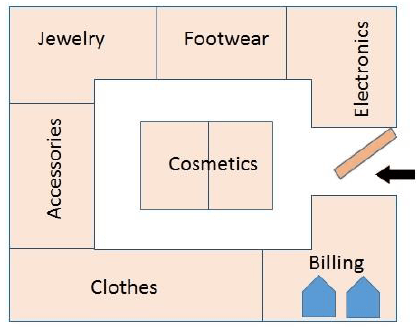
Space Planning

Space planning is an art and practice that refers to the manner in which you utilize the space in your store, and how you place your merchandise. It is about using your space efficiently to meet your sales goals and create a great retail experience for your customers. Retail space planning is concerned with factors such as store fixture layout, product placement, and cross-merchandising.

Space planning had been in the retail structure since the time of inception of the retail business, but its applications, benefits, and dimensions keep evolving, reaching new heights with the passage of time. A well arranged store display attracts the shoppers, making them to check out the apparel merchandise, and influencing them to buy the clothing. Using the available space in a right manner will enable the retailer to accentuate his merchandise and arrange them in an optimum position.

A retailer’s goal is to drive sales and improve the customer’s shopping experience. They use a mixture of aisle navigation, product displays, and shelving to maximize sales per square meter while creating the ultimate shopping destination.

Space Planning Techniques get shoppers

  1. Enter the Decompression Zone

The first space you step into when you enter the store is designed to open your mind to the shopping experience, inviting you to browse and explore. A place designed to make you feel safe and secure. The decompression zone prepares you for what lies ahead, helping you focus.

A good decompression zone:

  • Provides a wide, open space, that’s free from clutter;
  • Allows easy entrance into the store with an overview of the merchandise;
  • Has no distracting marketing or advertising gimmicks;
  • Welcomes you by giving you a little space; and
  • Flower displays at the entrance that usually entice customers to come inside

Nordstrom, an upscale fashion retailer, rolls out a long red carpet from their decompression zone, guiding customers to their merchandise.

  1. Clockwise vs Counter-clockwise

It’s critical for retailers to make it easy for shoppers to find the products they’re looking for. Retail stores opt for space planning that goes counter-clockwise, from right to left, because most of the population is right-handed and will instinctively turn to the right.

However, recently many stores have opted for the more unfamiliar clockwise layout, left to right, hoping it may arouse shoppers’ attention and stimulate them more than the familiar counter-clockwise layout.

  1. Slow Down

Many retailers create little visual breaks, known as speed bumps, to give shoppers the opportunity to make seasonal or impulse buys. “Speed Bumps” are created using signage, specials or placing popular items halfway along a section, so people have to walk all along the aisle looking for them.

Retailers stock the items shoppers buy most frequently (staple items) at the back of the store, to maximise the amount time you spend inside the store, increasing basket size and impulse buying opportunities. This makes it difficult for shoppers to resist grabbing other items when making a quick trip to the grocery store.

Another space planning technique used to slow customers down, is by removing windows. Disconnecting you from the outside world, so you forget that time is passing, essentially keeping you in the store longer.

  1. Visual Appeal by Blocking

Retailers create a triangular composition, otherwise known as tiered formation, using style or color, blocking certain products together high at the back, tumbling to low in the front.

They start with a center feature and merchandise out symmetrically, placing best seller items in a prominent visual location, enticing you to buy through visual appeal.

  1. Shelf Spacing

Shelf space is positioned to manipulate shoppers into buying more. This is a highly debatable space planning technique amongst retailers, with some believing eye-level to be the top spot for a product while others reckon higher is better. Some retailers prefer the ‘end caps’ where products are displayed at the end of an aisle, believing those products receive the best visibility.

Benefits of Space Planning

By implementing above space planning techniques, retail stores create an aesthetically pleasing layout, allowing shoppers to find the products they’re looking for while eliminating out of stock items.

Products sell at a more even speed, creating less need for product ordering and shelf restocking.

A retail store might opt to first test these techniques by doing realograms beforehand and then once planograms have been implemented, evaluated the two against one another to determine technique effectiveness.

Of course, an increase in sales would also be an indicator of space planning success.

  1. It ensures that you use your store efficiently

If you have a small store, for instance, you need to place your merchandise strategically so as to prevent your store from feeling cluttered; if the space feels too small and overloaded with products, the customer may feel uncomfortable and leave before exploring your store. There should be enough space for your customer to browse freely, and there should be enough space for your sales assistants to walk around and assist customers.

  1. It ensures that customers feel at home:

One of the major concerns of space planning is the customer’s experience. Your goal as a retailer should be to ensure that the customer feels at home and that they are comfortable from the moment they walk into your store, to the moment they check out. Customers must be able to find what they are looking for easily and quickly.

  1. It can improve your revenue

Space planning has the potential to improve shopper spend and basket size. Strategic placement of your products will make it easy for your customers to find what they are looking for and discover something they never knew they needed!

Space planning refers to the efficient flow of used space, ensuring you’re comfortable while shopping and that the overall experience will lead you to linger longer.

Retail stores spend a lot of time creating the perfect flow across different departments and products, persuading you to spend more money.

Stores Designing

Planning the layout of your store is both an art and a science it requires creativity, psychological insights, and testing.

  1. Use the right floor plan

Your floor plan plays a critical role in managing store flow and traffic. The choice of which one is right for you will depend on a number of factors including the size of your store, the products that you sell, and more importantly, your target market.

What are your customers like? Are they shopping in a hurry or can they take their time? Do they prefer self-service features or will your associates guide them throughout the store? Do want to find exactly what they need efficiently, or are they open to discovering items along the way?

These are just some of the questions you have to ask when deciding on your floor plan.

While there are plenty of store arrangements that you can adopt, here are the most common ones in retail:

  • Straight floor plan: This floor plan involves positioning shelves or racks in straight lines to create an organized flow of traffic. It’s one of the most economical store layouts and is mostly used in large retail spaces, supermarkets, and in stores that primarily use shelving to showcase their merchandise.
  • Racetrack or loop plan: This layout encourage customers to “loop” your store. You position your fixtures and merchandise in such a way that you create a path to guide that guides shoppers around your shop.
  • Angular floor plan: This store layout consists of curves and angles to give off a sophisticated vibe. According to the Houston Chronicle, the angular floor plan is usually adopted by high-end retailers and it “reduces the amount of display area you have but focuses instead on fewer, more popular lines.”
  • Geometric floor plan: The geometric floor plan utilizes racks and fixtures to create a unique store feel and design. Go with this layout if you’re showcasing trendy products.
  • Free flow plan: A free flow layout affords you the most creativity. You’re not limited to floor patterns or shelves that have to be placed at certain angles. And unlike the other layouts, you’re not prodding people to use a path around your store; instead, shoppers are encourage to browse and go in any direction.
  1. Be aware of where you “lead” shoppers

There’s quite a bit of debate about whether or not retailers should lead customers in a clockwise or counter-clockwise fashion inside their stores.

On one hand, some claim that since most people are right-handed, they instinctively turn to the right and explore the store in a counter-clockwise direction.

However, other studies indicate that shopper direction has more to do with their vehicle traffic patterns. Consumers in the UK and Australia for instance, drive on the left side of the road so they have a tendency to explore stores in a clockwise manner while consumers from right-hand driving countries like the US usually turn right when they enter a shop.

So which shopping direction theory should you believe? It looks like there is stronger evidence supporting the theory about driving behavior. As Herb Sorensen, author of Inside the Mind of the Shopper noted:

The pattern of movement in the supermarket is counterclockwise in the United States, but PathTracker studies in the UK, Australia, and Japan show a much greater tendency for shoppers to move in a clockwise pattern there… traffic patterns in the store may also be affected by vehicle traffic patterns outside. In these small studies, we noted that in countries with right-hand driving, where traffic circles move in a clockwise pattern, shoppers in stores may be more comfortable moving in the same direction.

  1. Ensure that your product quantities are appropriate

The question of how much merchandise to have on display is an important one and the answer is not clear-cut.

Having too much product on the sales can lead to a decline in brand perception, especially if you’re trying to position yourself as a boutique or high-end retailer.

The amount of stock to display in your store will depend on the size of your shop, the image you want to project, and the type of experience you want to create.

If you’re a discount retailer who wants to make the most out of your store space, then packing your shop with merchandise could be a good strategy for you. But if you’re a high-end boutique, then it’s best to keep your selection curated and just put a few select items up for display.

  1. Have enough space between products and fixtures

It’s ok to have shelves that are packed with merchandise (if that’s what you’re going for) as long as you still give your customers their personal space.

You want to avoid the butt-brush effect, which according to Underhill, is a phenomenon where shoppers would abandon a display or product they were looking at when they were bumped once or twice from behind.

  1. Freshen up your displays regularly

The rules around how often to change up your displays will vary depending on who you’re talking to and the type of store you run.

That said, most experts recommend changing some part of your store around once a week. You could, for example, change the outfits of your mannequins or feature a different upsell every week.

And for obvious reason, you want to switch up your merchandising whenever new products come in.

Also take into account the amount (and nature) of traffic that you’re getting in your store or shopping center. Do you get a lot of the same shoppers walking by? Are you on a busy street corner that’s on the way to people’s work locations? If so, then you’ll need to change up your displays more frequently in order to grab people’s attention on a consistent basis.

The last thing you want is for customers to get too accustomed to your store that it doesn’t even register when they pass by.

  1. Find ways to appeal to multiple senses

While the majority of a location’s design is made up of visual components, other factors including scent, touch, sound, and taste can also make an impact on a store’s look and feel. If you wish to create a truly immersive in-store experience, design your store to appeal to as many shopper senses as possible.

Here are a few ideas on what you can do:

  • Sound: Pick your playlist wisely. Determine the atmosphere that you want to create and pick songs that enhance (and not overpower) the ambiance. Volume and beat can influence behavior, depending on who you’re selling to. For instance, while loud music may work well for retailers that target younger shoppers, the same thing can’t be said for merchants catering to adults.
  • Scent: Bakeries and cafes may have a slight edge here, as they can use the smell of their products to draw customers in. But you can still cater to people’s sense of smell even if you aren’t in the food industry.
  • Touch: Having a “hands-on” vibe can enhance shopper experience. One way of doing this is to take out sample products from their boxes to encourage customers to test or play with them. Apple pioneered this approach in the electronics retail space when they launched stores that had their products out in the open instead of being inside big brown boxes (which was the norm at the time).
  • Taste: If you sell food in your store, see if you can have taste testing stations. Again, this encourages a more hands-on shopping experience and makes it less intimidating for people.
  1. Don’t forget to cross-merchandise

Grouping your merchandise into neat categories or departments is a great strategy, but see if you can find room to cross-merchandise different items. Identify products in your store that would go well together and put them in a single display.

View your merchandise from a customer’s perspective. For example, if you were a shopper looking at a particular dress, is there anything in the store that would go well with it?

  1. Make sure your employees are on point

Don’t forget that your staff also plays a role in your store’s design and layout. How they are positioned in your shop can make or break your store’s appeal. Having your employees move around on the sales floor instead of staying behind the counter is a good way to make the place more inviting.

As the Retail Doctor Bob Phibbs said on his blog, “Get your employees out from behind the counter and keep them active, especially if you have windows.”

Consumers looking into your shop will be more enticed to walk in if they see people moving about. That’s why Bob recommends that merchants instruct employees to “act as if they were customers” if a store is empty in order to make it more enticing.

  1. Track and measure your efforts

Last not but not least, always ask whether or not you’re making the right floor plan, design, or arrangement decisions. This is critical to making sure that you’re implementing the best strategies possible.

You and your staff should be very observant with how people behave in your store. Pay attention to where they go, where they linger, and what they do while they’re inside. Also ask questions on what they think of your shop and what you can do to improve.

Let’s say you’re implementing a major layout or merchandising change in your store. You want to benchmark metrics like sales, traffic, and dwell time before you make the updates, and then measure the results once the changes are implemented.

Also, consider making use of foot traffic analytics solutions such as people counters, beacons, heat sensors, and more. These tools can give you deeper analytics and insights on shopper habits and behavior, so you can make data-driven decisions.

Finally, you need to ensure that your layouts and displays are being executed correctly, so conduct store audits whenever you make changes to your store. Consider using a tool such as Compliantia to evaluate your stores.

Retail Operations Stores Layout and Visual Merchandising

Store layouts speak to the design of a store’s retail floor space and merchandising is the display of items, within the store layout, in such a way that shoppers are enticed to purchase. The layout and the merchandising of a store are both critical and connected. In this post, we will be sharing some basics on store layouts and how they are connected to merchandising.

We will also share how you can create efficient retail spaces which attract customers and encourage more purchases.

How store layouts and merchandising mix?

In retail, the speed at which you move merchandise is the name of the game. Moving merchandise effectively is dependent on several things, with the most critical being product placement how and where you place certain items. This is where store layouts and merchandising mix.

Retailers, with the help of space planners, plan out their retail space in such a way that they maximise on floor space yet give customers enough space to easily access merchandise.

Merchandising, which is the display of merchandise in an appealing manner to encourage customers to make purchases, relies on the store layout to have shoppers walk through more than just one section of a store. Smart store layouts also reduct congestion during peak shopping hours. The two are inseparable, and to maximise profit, retailers need to take both into consideration.

Optimal store layouts

To achieve an optimal store layout, there are certain key principles which must be taken into consideration, namely:

When it comes to store layouts, the physical arrangement of items must account for not just the customer who will purchase the item, but also for the “influencer” causing the purchase. For example, parents make a vast majority of purchases with their children in mind, meaning that children are influencing how they shop and what they buy.

A store’s layout and merchandising must take this into consideration and make sure children who accompany parents while shopping, influence them into making purchases ultimately increasing profit.

There are many secrets to successful retailing for retailers, and understanding how to guide customers’ movements through stores is an important one.

Traffic flow, which is the movement of customers through a store, psychologically affects the shopping behaviour of customers. A store’s layout, as well as the merchandising of items in-store, influence not just how customers move through the store, but how they shop too. For example, when grocery shopping, where do you find staples like eggs, bread or milk?

They are often deliberately placed at the back of the store, forcing customers to walk through aisles and past several other items on the way one of the most effective store layout and merchandising strategies in retail.

When it comes to store layouts, the physical arrangement of items must account for not just the customer who will purchase the item, but also for the “influencer” causing the purchase. For example, parents make a vast majority of purchases with their children in mind, meaning that children are influencing how they shop and what they buy.

A store’s layout and merchandising must take this into consideration and make sure children who accompany parents while shopping, influence them into making purchases ultimately increasing profit.

There are many secrets to successful retailing for retailers, and understanding how to guide customers’ movements through stores is an important one.

Traffic flow, which is the movement of customers through a store, psychologically affects the shopping behaviour of customers. A store’s layout, as well as the merchandising of items in-store, influence not just how customers move through the store, but how they shop too. For example, when grocery shopping, where do you find staples like eggs, bread or milk?

They are often deliberately placed at the back of the store, forcing customers to walk through aisles and past several other items on the way one of the most effective store layout and merchandising strategies in retail.

Store layout

It is the process of managing the floor space adequately to facilitate the customers and to increase the sale. Since store space is a limited resource, it needs to be used wisely.

Space management is very crucial in retail as the sales volume and gross profitability depends on the amount of space used to generate those sales.

Optimum Space Use

While allocating the space to various products, the managers need to consider the following points:

(i) Product Category

  • Profit builders: High profit margins-low sales products. Allocate quality space rather than quantity.
  • Star performers: Products exceeding sales and profit margins. Allocate large amount of quality space.
  • Space wasters: Low sales-low profit margins products. Put them at the top or bottom of shelves.
  • Traffic builders: High sales-low profit margins products. These products need to be displayed close to impulse products.

(ii) Size, shape, and weight of the product.

(iii) Product adjacencies − It means which products can coexist on display?

(iv) Product life on the shelf.

Retail Floor Space

Here are the steps to take into consideration for using floor space effectively:

  • Measure the total area of space available.
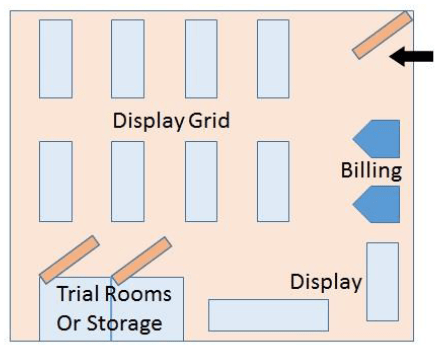
  • Divide this area into selling and non-selling areas such as aisle, storage, promotional displays, customer support cell, (trial rooms in case of clothing retail) and billing counters.
  • Create a Planogram, a pictorial diagram that depicts how and where to place specific retail products on shelves or displays in order to increase customer purchases.
  • Allocate the selling space to each product category. Determine the amount of space for a particular category by considering historical and forecasted sales data. Determine the space for billing counter by referring historical customer volume data. In case of clothing retail, allocate a separate space for trial rooms that is near the product display but away from the billing area.
  • Determine the location of the product categories within the space. This helps the customers to locate the required product easily.
  • Decide product adjacencies logically. This facilitates multiple product purchase. For example, pasta sauces and spices are kept near raw pasta packets.
  • Make use of irregular shaped corner space wisely. Some products such as domestic cleaning devices or garden furniture can stand in a corner.
  • Allocate space for promotional displays and schemes facing towards road to notify and attract the customers. Use glass walls or doors wisely for promotion.

Store Layout and Design

Customer buying behavior is an important point of consideration while designing store layout. The objectives of store layout and design are −

  • It should attract customers.
  • It should help the customers to locate the products effortlessly.
  • It should help the customers spend longer time in the store.
  • It should motivate customers to make unplanned, impulsive purchases.
  • It should influence the customers’ buying behavior.

Store Layout Formats

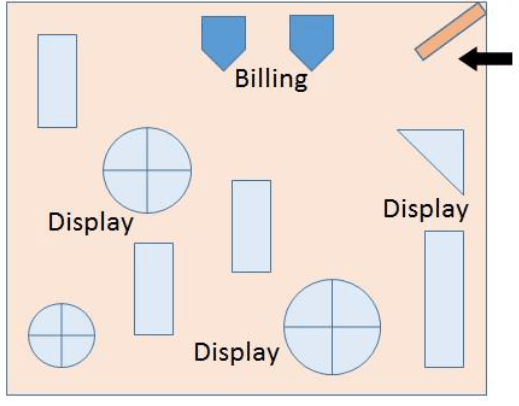
The retail store layouts are designed in way to use the space efficiently. There are broadly three popular layouts for retail stores

Grid Layout: Mainly used in grocery stores.

Loop Layout: Used in malls and departmental stores.

Free Layout: Followed mainly in luxury retail or fashion stores.

Design and Visual Merchandising, Atmospherics

Visual Merchandising

It is the activity of developing floor plans and three-dimensional displays in order to engage customers and boost sales. Both, products or services can be displayed to highlight their features and benefits.

It is based on the idea that good looks pay off. It requires creativity and an eye for presenting the products or services aesthetically so that the customers find it appealing and are motivated towards buying. Visual merchandising involves displaying products or services aesthetically using various objects, colors, shapes, materials, designs, and styles to attract the customers.

Market Area Analysis

Evaluation of Retail Trade Area

To begin the evaluation of retail opportunities, the market analysis study should be done to understand demand and supply of major catego­ries to determine market potential. Demand refers to the amount of retail space (in square feet) that could be supported by consumers residing in the trade area, based on estimates of their spending potential.

Supply refers to the actual square feet of retail space, sometimes called Gross Leasable Area (GLA), that currently exists in the trade area. A comparison of demand and supply by store type can help identify gaps (demand exceeds supply).

After considering other more qualitative market factors including how and where local residents/people shop, conclusions can be drawn regarding potential business categories worthy of business expan­sion or recruitment efforts.

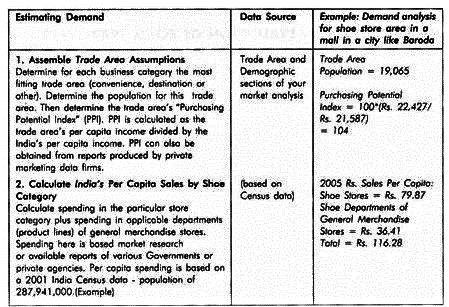
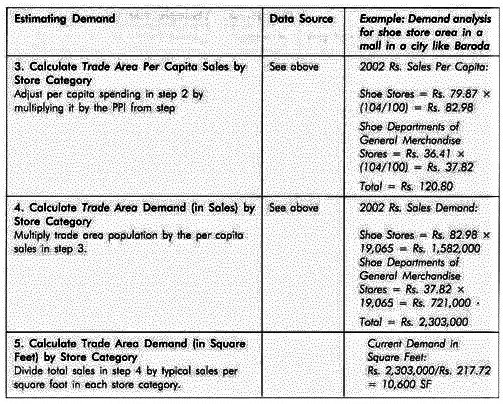
A flowchart describing this method is presented below:

Estimating Retail Demand:

Estimating Retail Supply

To analyze supply, a database of existing businesses needs to be con­structed for each of the store categories under investigation. The database for each store category should include all of the retail businesses within the trade area used to calculate demand. The database should include a list of the names and addresses of all the current retailers in the primary trade area.

For each retail store, include a reasonable estimate of store size in square feet. For general merchandise stores, include the approxi­mate number of square feet devoted to that product line. While calcula­tions of retail space in a market area are often based on observation and rough estimates, they do provide a reasonable and important “ballpark” figure for this analysis.

Square feet of store space is often called gross leasable area (GLA). It can be estimated by actual measurement of a building’s street-front width and estimate of its depth.

Other Market Considerations

Examining quantitative aspects of demand and supply is only part of the analysis. There are also a number of qualitative considerations that require local knowledge and insight about the market. The previously calculated differences in retail space demand and supply need to be analyzed in context of other market factors.

The following provide additional consid­erations that add to the analysis of each category.

  1. Survey and Focus Group Findings

What have we learned from local research about consumer behaviour and perceptions of the downtown? We must use findings from “Study of Con­sumer Attitudes”.

  1. Trade Area Demographic and Lifestyle Findings

Does lifestyle segmentation data indicate that local residents are more likely to purchase goods within this store category? Use findings from “Study Customer Demographics and Lifestyles”.

  1. Analysis of Non-Local Market Segments

Is there significant market potential from non-resident customer segments such as tourists and commuters?

  1. Retail Mix Analysis

How many businesses in the category are located in the downtown areas of comparison communities?

  1. Competitiveness of Existing Stores in Trade Area

Are existing stores/markets/malls in this category providing the merchan­dise and service local shoppers demand?

  1. Competitiveness of Existing Stores Outside of the Trade Area

Do surrounding communities with regional shopping centers and big box stores siphon business in this category out of the trade area?

  1. Consumer Behaviour and Trends in Store Category

Are purchases driven by convenience or comparison-shopping? Do stores of this type locate in downtown districts anymore?

  1. Drawing Conclusions

The quantitative comparison or retail space demand and supply by store type provide an initial measure of market opportunities (i.e. demand greater than supply). However, demand and supply must be analyzed in combi­nation with many other market considerations.

If there appears to be a significant amount of unmet demand, there may be opportunity for an existing business to expand or a new business to be recruited. Business development opportunities may also exist in areas where supply is greater than demand, especially in those communities that are successful in draw­ing customers from outside their trade area because of a special product niche they have created.

Analyzing Trade Area

A trade area is simply the geographic area that generates the majority of the customers for a community, business district or downtown. Knowing the boundaries of the trade area defines the number of potential custom­ers that may patronage your downtown.

Furthermore, knowing the trade area allows for demographic and lifestyle information to be gathered from a variety of public and private sources. This information provides insight into the people in the trade area and eventually will allow consumer demand for products and services to be calculated.

Therefore, defining the trade area is an important step in market analysis. A trade area often extends beyond the municipal boundaries of a community. Defining this extent is important, but it is also necessary to recognize how a trade area can vary.

In other words, a downtown may have a number of different trade areas depending on a variety of factors. Often, the variability can be attributed to either different types of products and businesses, or different market segments of customers.

How Trade Areas Differ?

Different business types will have different trade areas, that is, people will travel from greater distances to purchase certain goods and services than others. While each individual store may have its own unique trade area, these areas can often be generalized into two different types: convenience shopping trade areas and comparison shopping trade areas.

Local convenience trade areas are based on the ease of access to these types of products. That is, people will obtain these products (apparel, groceries, etc.) based on travel distances or travel time.

Conversely, comparison shopping trade areas are based on price, selec­tion, quality and style. People are more likely to compare these types of goods (appliances, furniture, etc.) as well as travel longer distances for their purchase. Subsequently, the trade area will shrink or grow depending on the products sold. In addition to different types of shopping goods, there are also different types, or market segments, of customers frequent­ing a downtown.

Three common market segments are local residents, day­time employees and tourists. Local residents live within the trade area. As they reside year-round, they provide the majority of spending potential for most downtowns. Daytime employees may live in the trade area, but may also commute from other outside areas.

However, while these employees are in the downtown, they provide the potential to stay and make pur­chases. Furthermore, depending on the community, tourists can provide a large amount of spending potential. While they are not permanent cus­tomers, tourists make purchases while they visit the area.

Simple Methods of Trade Area Definition:

Even though trade areas vary by store type and market segment, one or possibly two general trade areas are needed to proceed with the market analysis. To define these trade areas, there are several techniques avail­able. These techniques have different uses as well as their own advantages and disadvantages.

Each of these methods is described in detail below.

  1. Reilly’s Law of Gravitation:

Reilly’s Law of Retail Gravitation is a theoretical means of trade area definition. It is based on the premise that that people are attracted to larger places to do their shopping, but the time and distance they must travel influence their willingness to shop in a given city.

In other words, people are more likely to travel shorter distances when possible. Addition­ally, customers are more likely to shop in larger communities, as they provide a greater opportunity for goods and services.

Reilly’s Law provides a mathematical formula that can be used to calculate hard numbers relating the distance people will travel. However, a simple map and commonsense can be combined to use the concepts behind Reilly’s Law and generate general trade area boundaries.

  1. Pin code Tabulation:

Another simple method for trade area definition is to tabulate the number of customers by their pin codes. As later explained, pin code data can be collected using a variety of methods and sources.

However, regardless of how the data is obtained, there are a number of advantages to the pin code tabulation method:

  1. Collecting information from customers allows the trade area to be based on real business data, instead of created from a theoretical basis.
  2. Comparing the trade area maps of different businesses can identify opportunities to increase market size and penetration. For instance, the trade areas for businesses that primarily sell convenience items can be compared with each other to identify differences. These differences could indicate potential market expansion opportunities for some of the businesses. The same can be done for comparising shopping businesses.

iii. Trade areas for different market segments can be compared. Businesses serving residents can be compared to the origins of employees at a major employer. Furthermore, pin codes are ideal for tracking the origins of non-local tourists.

While tabulating customer zip codes has the ability to capture trade area variability, an appropriate sample of participating businesses must be incorporated. For instance, stores that serve both convenience and com­parison shopping segments are necessary to understand the local market. Businesses that serve tourists are needed to examine the tourist market

Factors Influencing Location of Store

Where you choose to locate your retail business will have a major impact on your public presence, walk-in traffic, the potential for future income, and other elements. Choosing a location that does not account for such factors may limit the business’s ability to succeed and grow.

Before choosing a retail store location, define how you see your business now and in the future.

  • What are the demographics of your core customers?
  • Can you visualize your building?
  • Do you know what you want to sell and what you want your business to be known for?
  • Have you determined how much retail space, storage area, or the size of the office you need?

If you do not answer these basic questions, it will be hard to find the perfect location for generating the maximum amount of profit for your retail store.

  1. Type of Goods Sold

Examine what kind of products you sell, as some goods will require certain types of locations. Would your store be considered a convenience store, a specialty shop or a shopping store?

Convenience goods require easy access to let the customer quickly make a purchase. These products are also of general interest among consumers. A mall might not be a good location for convenience goods because this product type may be priced on a different scale compared with other retailers on the property. Consumers might be inclined to patronize convenience stores located on the path of their daily commutes. This can mean occupying space situated in or near a transit hub or along heavily trafficked routes.

Specialty goods fulfill more unique needs than general purpose products. Customers generally won’t mind traveling out of their way to purchase this type of product because they cannot procure them through convenience or general goods retailers. This type of store may perform well near other shopping locations because their offerings may complement each other.

A big-ticket shopping store usually sells items at a higher price that are bought infrequently by the customer. Furniture, cars, and upscale clothing are examples of goods found at a big-ticket shopping store. Because the prices of these items are higher, this type of customer will want to compare prices before making a purchase. Retailers in this segment will do well to locate their stores far away from their rivals.

  1. Population and Your Customer

When choosing a city or state to locate your retail store, research the area thoroughly before making a final decision. Read local papers and speak to other small businesses in the area. Obtain location demographics from the local library, chamber of commerce or the Census Bureau. Specialty research firms that cater to retailers could also provide demographic information. Any of these sources should have information on the area’s population, income brackets, and median age. You know who your customers are, so make sure you find a location near where your customers live, work and shop.

  1. Accessibility, Visibility, and Traffic

Don’t confuse a lot of traffic for a lot of customers. Retailers want to be located where there are many shoppers but only if those shoppers meet the definition of their target market. Small retail stores may benefit from the traffic generated by nearby larger stores. There are several aspects retailers should consider along these lines.

  • How many people walk or drive past the location?
  • How well is the area served by public transportation?
  • Can customers and delivery trucks easily get in and out of the parking lot?
  • Is there adequate parking?

Depending on the type of business, it would be wise to have somewhere between 5 to 8 parking spaces per 1,000 square feet of retail space.

When considering visibility, look at the location from the customer’s viewpoint. In many cases, the better visibility your retail store has, the less advertising is needed. A specialty retail store located six miles out of town in a free-standing building will need more marketing than a shopping store located in a mall.

  1. Signage, Zoning, and Planning

Before signing a lease, be sure you understand all the rules, policies and procedures related to your retail store location. Contact the local city hall and zoning commission for information on regulations regarding signage. There may be limits on the size and imagery used in signs that advertise your business. Ask about any restrictions that may affect your retail operation and any future planning that could change traffic, such as highway construction.

  1. Competition and Neighbors

Other area businesses in your prospective location can actually help or hurt your retail shop. Determine if the types of businesses nearby are compatible with your store. For example, a high-end fashion boutique may not be successful next door to a discount variety store. Position it next to a nail or hair salon, which tend to draw the same demographic of customers, to more optimal results.

  1. Location Costs

Along with the base rent, consider all location-based costs involved when choosing a retail store location.

  • Who pays for lawn care and security?
  • Who pays for the upkeep and repair of the heating/air units?
  • Will you need to do any painting or remodeling to have the location fit your needs?
  • Will the retailer be responsible for property taxes?

The location you can afford now and what you can afford in the future may vary. It is difficult to create sales projections for a new business. One way to determine how much rent you can pay is to find out how much sales similar retail businesses generate and how much rent they pay.

  1. Personal Factors

If you plan to work in your store, think about work-life balance issues such as the distance from the shop to home and other personal considerations. If you spend much of your time traveling to and from work, the commute may overshadow the benefits of being your own boss. Also, many restrictions placed on a tenant by a landlord, management company, or community can hamper a retailer’s independence.

Final Considerations

Your retail shop may require additional handling when it comes to choosing a location. Make a list of any special characteristic of your business that may need to be addressed.

  • Will the store require distinct lighting, fixtures or other hardware installed?
  • Are restrooms for staff and customers available?
  • Is there adequate fire and police protection for the area?
  • Is there a sanitation service available?
  • Does the building have a canopy that provides shelter if raining?
  • Are there (blue laws) restrictions on Sunday sales?

Don’t feel rushed into making a decision on where to put your retail store. Take your time and research the area. If you have to change your schedule and push back the date of the store’s opening, then do so. Waiting to find the perfect store location is better than just settling for the first place that comes along.

Implementation

Implementation is the process that turns strategies and plans into actions in order to accomplish strategic objectives and goals. Implementing your strategic plan is as important, or even more important, than your strategy. The video The Secret to Strategic Implementation is a great way to learn how to take your implementation to the next level.

Critical actions move a strategic plan from a document that sits on the shelf to actions that drive business growth. Sadly, the majority of companies who have strategic plans fail to implement them. According to Fortune Magazine, nine out of ten organizations fail to implement their strategic plan for many reasons:

  • 60% of organizations don’t link strategy to budgeting
  • 75% of organizations don’t link employee incentives to strategy
  • 86% of business owners and managers spend less than one hour per month discussing strategy
  • 95% of the typical workforce doesn’t understand their organization’s strategy.

A strategic plan provides a business with the roadmap it needs to pursue a specific strategic direction and set of performance goals, deliver customer value, and be successful. However, this is just a plan; it doesn’t guarantee that the desired performance is reached any more than having a roadmap guarantees the traveler arrives at the desired destination.

Getting Your Strategy Ready for Implementation

For those businesses that have a plan in place, wasting time and energy on the planning process and then not implementing the plan is very discouraging.  Although the topic of implementation may not be the most exciting thing to talk about, it’s a fundamental business practice that’s critical for any strategy to take hold.

The strategic plan addresses the what and why of activities, but implementation addresses the who, where, when, and how. The fact is that both pieces are critical to success. In fact, companies can gain competitive advantage through implementation if done effectively.  In the following sections, you’ll discover how to get support for your complete implementation plan and how to avoid some common mistakes.

Avoiding the Implementation Pitfalls

Because you want your plan to succeed, heed the advice here and stay away from the pitfalls of implementing your strategic plan.

Here are the most common reasons strategic plans fail:

  • Lack of ownership: The most common reason a plan fails is lack of ownership. If people don’t have a stake and responsibility in the plan, it’ll be business as usual for all but a frustrated few.
  • Lack of communication: The plan doesn’t get communicated to employees, and they don’t understand how they contribute.
  • Getting mired in the day-to-day: Owners and managers, consumed by daily operating problems, lose sight of long-term goals.
  • Out of the ordinary: The plan is treated as something separate and removed from the management process.
  • An overwhelming plan: The goals and actions generated in the strategic planning session are too numerous because the team failed to make tough choices to eliminate non-critical actions. Employees don’t know where to begin.
  • A meaningless plan: The vision, mission, and value statements are viewed as fluff and not supported by actions or don’t have employee buy-in.
  • Annual strategy: Strategy is only discussed at yearly weekend retreats.
  • Not considering implementation: Implementation isn’t discussed in the strategic planning process. The planning document is seen as an end in itself.
  • No progress report: There’s no method to track progress, and the plan only measures what’s easy, not what’s important. No one feels any forward momentum.
  • No accountability: Accountability and high visibility help drive change. This means that each measure, objective, data source, and initiative must have an owner.
  • Lack of empowerment: Although accountability may provide strong motivation for improving performance, employees must also have the authority, responsibility, and tools necessary to impact relevant measures. Otherwise, they may resist involvement and ownership.

It’s easier to avoid pitfalls when they’re clearly identified. Now that you know what they are, you’re more likely to jump right over them!

Covering All Your Bases

As a business owner, executive, or department manager, your job entails making sure you’re set up for a successful implementation. Before you start this process, evaluate your strategic plan and how you may implement it by answering a few questions to keep yourself in check.

Take a moment to honestly answer the following questions:

  • How committed are you to implementing the plan to move your company forward?
  • How do you plan to communicate the plan throughout the company?
  • Are there sufficient people who have a buy-in to drive the plan forward?
  • How are you going to motivate your people?
  • Have you identified internal processes that are key to driving the plan forward?
  • Are you going to commit money, resources, and time to support the plan?
  • What are the roadblocks to implementing and supporting the plan?
  • How will you take available resources and achieve maximum results with them?

Factors to Consider in Preparing a Business Plan

Whether you have just started your business or developing it day-by-day, a business plan is what you would need throughout your journey. The crucial factors that you would write down on a piece of paper will help you going towards your desired success. So, the question that arises here is How to write an effective business plan that will take your company to the expected height?

Basically, your business plan should be nothing but your answers to a comprehensive question list. To begin with, ask yourself:

Where do you want your business to go?

Find out how would you like to see your business in the next five, ten, or fifteen years down the lines?

What is your expected revenue and profit in future?

How many employees will you hire?

How would you like to expand your business?

And the list goes on.

Similar to the plan of long-term, create a short-term plan that would be applied to a shorter period of time, particularly a year. For example: What are your goals for the current year? What are the targets that you must accomplish to reach that ultimate goal?

Seven important factors to consider before starting a business

  1. A great idea

“No business can develop in the absence of a great idea. A great and a practical idea is the only thing on which the development of your business will depend. Moreover, as a lot of companies are involved in the market, you need to have a unique idea that stands out.”

Not sure what your great idea is? Explore our business ideas hub and get inspired.

  1. Funding and budget

“The next important factor that should be considered involves the funding of your business. You need to properly identify the sources through which you will be able to get the funding for your business. Moreover, it is better to have a plan so that the budget of a company can be properly maintained.”

What are the options for funding your business? Discover the different ways of raising finance.

  1. Analysis of competitors

“You need to know what your competitors are doing and what are their strategies? With this knowledge, you will be able to take appropriate decisions about your company. It will also help you in developing a much more effective strategy for your business.”

  1. An effective business plan

“No business can develop fully in the absence of a business plan. Writing a business plan can help you determine if your idea is feasible and provide direction. With a business plan, you will be able to know every next step that should be taken.”

  1. Legal documentation

“The next factor that needs to be considered is the completion of legal documents. For the sale of some specific products and services, there are some requirements for the preparation of legal documents. Make sure you have already done all the legal documentations for your business.”

Our legal issues section can help you to understand some of the common concerns.

  1. Positive attitude

“It is one of the most important things that will help you in passing all the challenges and difficulties. There will be a lot of risks and hurdles you will face in this process and the only thing that can save you will be your positive attitude. You will have to work hard to develop a company of your own.”

  1. Know when you need help

“The development of a business is not a matter of seconds, it will involve a lot of time that is spent with hard work. However, in this process, you will be needing the help of some experts. Make sure you already have an adviser who can provide you with the best advice at the hour of need.

“These are the seven most important factors you need to consider while starting a business of your own.”

Retail Planning Process

In the retail planning process, a retailer decides about the planning strategies of the retail business, learn about the competition in the market, and create and implement strategies accordingly.

Retail planning is crucial for every retail business. Otherwise, you will always find yourself to dilemma while making decisions for your store.

Seven Steps involved in Retail Planning Process

  1. Set objectives

Setting Objectives is important for the success of the business. It is not necessary that the goal of a business is to maximize sales. An organization can pursue multiple goals at the same for example, expansion of business in a year, revenue generation, and more product lines, etc. it is apparent that all goals mentioned above are focused on multiplying sales.

Broadly the objective of an organization can be divided into two categories:

(i) External Objectives

The external objectives of an organization include the performance of the organization in an external environment focused on customers.

Such as providing customer satisfaction and increasing their loyalty for the products, selling quality products at lower prices, providing better customer service, etc.

(ii) Internal Objectives

On the other hand, internal objectives consist of sales goals, revenue generation, maximizing the sales using existing resources, etc.

Both objectives are important for an organization. But only clear objectives can be easy to achieve, and planning can be done accordingly to attain these objectives. Therefore, it is important for a retailer to set annual objectives to ensure success and to measure it.

  1. Analysis of the market

After the objective for the organization is defined. The next step is to analyze the situation of the market you are planning to enter.

The analysis can help you to make an effective decision. you can learn about the competitors’ strategies and plan your strategies accordingly, what are the expectations of your customers and how you can fulfill them, how you can stay ahead in competition in the market, etc.

The analysis can help you to learn about the threats and opportunities in the market and what actions you should take. In addition to this, analysis can help you to learn about the strengths and weaknesses of your own business.

In this way, you can work on to strengthen your strengths and work on your weaknesses to turn them into your strengths. You can make decisions about how you can use your resources such as financial resources, human resources, intangible and physical resources, etc.

  1. Analysis of Customers

Analysis of customers is the most important activity of the retail planning process. You can’t simply like a product, design it and throw in the market and expect customers to buy it and like it.

By analyzing the customers, you need that what are the expectations and requirements of customers and you select a segment of potential customers who are most likely to buy your products. You can plan your business strategies better if you know your customers.

You can optimize your marketing mix to satisfy your customers. Customers analysis helps the organization to innovate and create services to satisfy its customers and retain them for a long period.

Hence, you avoid the chances of getting out of fashion as you keep updating your strategies with the changing demands and requirements of customers.

  1. Frame Retail Strategies

After you have decided key objectives and learned about the market situation and customers’ requirement, next, you should prepare your retail strategy for marketing positioning and retail mix.

The market strategies should be prepared based on kind of products sold in your store or the segmentation of the market you are dealing with.

The meaning of retail mix is to have the balanced amalgamation of retail activities, and the meaning of retail positioning is the strategy of the retailer to enter the target market and establish his business to compete with the competitors.

It is important to pay attention to these processes to grab the attention of your potential customers and make establish a positive image of your retail business.

You need to prepare effective retail strategies to stay ahead in the game of retailing. Work on various elements such as the location of the store, pricing policy, merchandise assortment, advertisement, customer service, etc. for example, you can attract customers by offering good quality of products at lower prices than your competitors or central location of the store can be a key element to attract more customers.

  1. Strategic Short-term Planning

In the next step, the retailer must think and plan about the short-term plans to grow your business. For example, you can attract more customers in your store during the festive season by using tactic advertising and marketing strategies.

You can run a short-term TV advertisement or can circulate advertising pamphlets in the local market. Strategic short-term plans are important for boosting sales instantly. Therefore, you should start planning short-term plans before the beginning of the festive season.

Your planning should be as per the requirement of the event. For example, an advertisement plan for valentine’s day can’t be the same as the advertisement plan for Christmas.

  1. Implementation of the Strategies

Once you have decided strategies, the final step is to implement those strategies and control them. In this step, you will also check whether your strategies are working or not and how much they have helped in boosting the sales.

Implementing strategies is not easy, it requires thorough planning, and you need to make changes in the store, and you may also need to change the role of your employees.

You might face some reluctance from your employees but if you plan smartly. You can divide the work among your employees in such a way so that they don’t feel burdened. In addition to this, you can also give them a bonus if their work pays off.

  1. Analyzing the performance of the strategies

Your job does not end with the implementation of strategies. You should analyze its performance and see where did you face most difficulties and what kind of issues did you face. Learn about them and take your lessons and implement them in your future strategy planning.

Customer Satisfaction Meaning, Definition, Scope, Importance, Challenges

Customer Satisfaction refers to the measure of how products and services supplied by a company meet or surpass customer expectation. It is a crucial indicator of consumer purchase intentions and loyalty. In a competitive business environment, customer satisfaction is seen as a key differentiator and increasingly has become a key element of business strategy. By gauging customer satisfaction, companies can determine the effectiveness of their offerings, services, and interactions from the consumer’s perspective. This assessment often involves collecting feedback through surveys, direct feedback, and other communication channels. High levels of customer satisfaction are typically linked to customer retention, loyalty, and advocacy, which are vital for sustained business success and growth. Understanding and improving customer satisfaction can lead to enhanced customer relationships and a stronger competitive position.

Definition of Customer Satisfaction:

  1. Philip Kotler

Philip Kotler, a prominent figure in marketing, defines customer satisfaction as “a person’s feelings of pleasure or disappointment resulting from comparing a product’s perceived performance (or outcome) in relation to his or her expectations.”

  1. American Marketing Association (AMA)

The American Marketing Association defines customer satisfaction as “the state that occurs when an individual’s perception of a product or service meets or exceeds their expectations.”

  1. Fornell et al., 1996

According to Fornell and his colleagues, customer satisfaction is “the number of customers, or percentage of total customers, whose reported experience with a firm, its products, or its services (ratings) exceeds specified satisfaction goals.”

  1. Oliver, 1980

Richard Oliver defines it as “a judgment that a product or service feature, or the product or service itself, provided (or is providing) a pleasurable level of consumption-related fulfillment.”

  1. Hill, Nigel

Nigel Hill, an expert in customer satisfaction and loyalty, describes it as “the extent to which a product’s perceived performance matches a buyer’s expectations. If the product’s performance falls short of expectations, the buyer is dissatisfied. If performance matches or exceeds expectations, the buyer is satisfied or delighted.”

  1. ISO 9000

ISO 9000, the set of standards related to quality management systems and designed to help organizations ensure they meet the needs of customers and other stakeholders, refers to customer satisfaction as “The customer’s perception of the degree to which the customer’s requirements have been fulfilled.”

Scope of Customer Satisfaction:

  • Product Quality

Customer satisfaction is heavily influenced by the perceived quality of a product. High-quality products that meet or exceed expectations tend to generate higher customer satisfaction levels, contributing to brand loyalty and positive word-of-mouth.

  • Service Delivery

The quality, efficiency, and friendliness of service delivery play critical roles in shaping customer satisfaction. This includes every interaction during the service process, from initial contact through post-service support.

  • Pricing Strategy

The perception of whether a product or service offers value for money can significantly affect customer satisfaction. Competitive and transparent pricing that aligns with customer expectations of product value helps in maintaining high satisfaction levels.

  • Customer Expectations Management

Managing and sometimes shaping customer expectations is vital for achieving satisfaction. This involves clear communication, setting realistic expectations, and consistently meeting or exceeding those expectations.

  • Customer Feedback and Resolution

The scope of customer satisfaction also includes how businesses handle customer feedback, complaints, and queries. A responsive, fair, and quick resolution process is crucial for maintaining high satisfaction levels.

  • Brand Image and Reputation

Customer satisfaction is closely tied to a brand’s image and reputation. Brands perceived as trustworthy and customer-centric are more likely to enjoy higher customer satisfaction scores.

  • Loyalty Programs

Loyalty programs that reward repeat customers can enhance customer satisfaction by making customers feel valued and appreciated. Effective loyalty programs can increase customer retention rates and promote positive referral behavior.

  • Market Position and Competitiveness

In highly competitive markets, customer satisfaction can be a key differentiator. Companies that excel in satisfying their customers often achieve better market positions and have a competitive edge over those that do not prioritize customer satisfaction.

  • Innovation and Improvement

Organizations that continuously innovate and improve their products and services in response to customer feedback tend to see higher levels of customer satisfaction. This proactive approach can help companies stay relevant and desirable in their markets.

  • Employee Engagement

Employee satisfaction and engagement also play a crucial role in customer satisfaction. Engaged employees are more likely to provide superior service and contribute positively to the customer experience.

Importance of Customer Satisfaction:

  • Customer Retention

Satisfied Customers are more likely to remain loyal to a brand, leading to higher customer retention rates. Retaining existing customers is generally more cost-effective than acquiring new ones, making customer satisfaction a crucial factor in reducing churn and maintaining a stable revenue stream.

  • Brand Loyalty

High levels of customer satisfaction foster strong brand loyalty. Loyal customers are more likely to repurchase from the same brand, choose it over competitors, and recommend it to others. This loyalty enhances brand reputation and increases customer lifetime value.

  • Positive Word-of-Mouth

Satisfied Customers become brand advocates, sharing positive experiences with friends, family, and peers. Word-of-mouth recommendations from satisfied customers can significantly influence purchasing decisions and contribute to brand awareness and credibility.

  • Revenue Growth

Customer Satisfaction is closely linked to revenue growth. Satisfied customers tend to spend more, make repeat purchases, and are willing to pay premium prices for products or services they perceive as valuable. As a result, businesses with high customer satisfaction levels often experience increased sales and profitability.

  • Reduced Marketing Costs

Satisfied Customers require less marketing effort to convince them to repurchase or engage with the brand again. By focusing on retaining existing customers through exceptional service and experiences, businesses can reduce marketing expenses associated with acquiring new customers.

  • Competitive Advantage

In today’s competitive marketplace, customer satisfaction can serve as a significant differentiator. Businesses that consistently deliver exceptional customer experiences outperform competitors, attract more customers, and gain a sustainable competitive advantage.

  • Improved Customer Relationships

Positive Customer experiences foster stronger relationships between businesses and their customers. By prioritizing customer satisfaction, organizations can build trust, loyalty, and mutual respect, leading to long-term partnerships and collaborations.

  • Continuous Improvement

Customer feedback is invaluable for identifying areas of improvement and innovation. By listening to customer concerns, preferences, and suggestions, businesses can refine their products, services, and processes to better meet customer needs and stay ahead of the competition.

  • Enhanced Employee Satisfaction

Satisfied Customers contribute to a positive work environment by providing recognition and appreciation for employees’ efforts. Happy and engaged employees are more likely to deliver exceptional customer service, creating a cycle of satisfaction that benefits both customers and employees.

  • Regulatory Compliance and Reputation Management

Meeting or exceeding customer expectations is essential for maintaining regulatory compliance and safeguarding the reputation of the business. Satisfied customers are less likely to file complaints or negative reviews, helping businesses maintain a positive public image and avoid reputational damage.

Challenges of Customer Satisfaction:

  • High Customer Expectations

Customer expectations are continually evolving and often increasing. With the rise of digital technology, customers expect quick responses, personalized services, and innovative solutions. Meeting these high standards consistently across all touchpoints can be challenging for businesses.

  • Maintaining Consistency Across Channels

Customers engage with brands through multiple channels — in-store, online, via social media, etc. Providing a consistent experience across all these platforms is essential for customer satisfaction but can be difficult to achieve due to varied channel dynamics and operational capabilities.

  • Diverse Customer Needs

Customers have diverse preferences, needs, and values. Tailoring services and products to match the specific expectations of different customer segments requires deep insights and flexible operational capabilities, which can be resource-intensive.

  • Balancing Cost and Quality

Maintaining high-quality customer service and products while also managing costs is a persistent challenge. Businesses need to find cost-effective ways to deliver value without compromising the quality that customers expect.

  • Handling Negative Feedback

Negative feedback and complaints are inevitable, regardless of how effective a business is. The challenge lies in addressing these issues promptly and effectively without letting them damage the business’s reputation.

  • Technological Integration

Incorporating new technologies to improve customer experience is essential but can be fraught with challenges. These include high implementation costs, the complexity of integration with existing systems, and ensuring that all staff are trained to use new technologies effectively.

  • Data Management and Privacy

Collecting and utilizing customer data to enhance satisfaction is critical, yet it poses privacy and security risks. Businesses must navigate these challenges while ensuring compliance with data protection regulations, which vary by region.

  • Cultural Differences

For global businesses, cultural differences can pose significant challenges in maintaining customer satisfaction. Practices that please customers in one part of the world may not be effective or even acceptable in another.

  • Employee Training and Motivation

Ensuring that all employees are adequately trained and motivated to deliver excellent customer service is crucial. However, achieving this can be difficult, particularly in larger organizations or those with high employee turnover rates.

  • Economic Fluctuations

Economic downturns can tighten customers’ spending and elevate their expectations simultaneously. Businesses must adapt to these changes swiftly to maintain customer satisfaction without drastically impacting profitability.

error: Content is protected !!