Customer Service

Customer satisfaction (CSAT) is a metric used to quantify the degree to which a customer is happy with a product, service, or experience. This metric is usually calculated by deploying a customer satisfaction survey that asks on a five or seven-point scale how a customer feels about a support interaction, purchase, or overall customer experience, with answers between “highly unsatisfied” and “highly satisfied” to choose from.

Customer service is the direct one-on-one interaction between a consumer making a purchase and a representative of the company that is selling it. Most retailers see this direct interaction as a critical factor in ensuring buyer satisfaction and encouraging repeat business.

Even today, when much of customer care is handled by automated self-service systems, the option to speak to a human being is seen as necessary to most businesses. It is a key aspect of servant-leadership.

Basics of Good Customer Service

Successful small business owners understand the need for good customer service instinctively. Larger businesses study the subject in-depth, and they have some basic conclusions about the key components:

  • Timely attention to issues raised by customers is critical. Requiring a customer to wait in line or sit on hold sours an interaction before it begins.
  • Customer service should be a single-step process for the consumer. If a customer calls a helpline, the representative should whenever possible follow the problem through to its resolution.
  • If a customer must be transferred to another department, the original representative should follow up with the customer to ensure that the problem was solved.

Customer Services Job Requirements

Much is expected of customer service representatives. Yet the pay for the job is low. The average salary in 2018 was about $33,750, according to the Bureau of Labor Statistics.

Some of the job expectations:

  • Customer service representatives must be accessible, knowledgeable, and courteous. They require excellent listening skills and a willingness to talk through a resolution. Training in conflict resolution can be beneficial.
  • Strong speaking skills are important. For phone staff, this means speaking clearly and slowly while maintaining a calm demeanor even if the customer doesn’t.

Employer Responsibilities

Poor management can doom any customer service operation. A couple of important tips for managers:

  • Make sure your customer service representatives are fully informed and have the latest information and the company’s products and policies.
  • Periodically assess the customer service experience you are providing to ensure that it’s an asset to the company.
  • Consider conducting regular surveys to give customers the chance to provide feedback about the service they receive and suggest areas for improvement.

Using Mobile Services Effectively

In recent years, studies of customer service have centered on creating the perfect online experience.

The first and most difficult factor is the multiplicity of channels. Today’s customers expect to get service through whatever app or device they happen to be using at the moment. That may be a mobile device or a laptop, a social media site, text app, or live chat.

Once again, the focus has been on packaging how-to content and related resources that are designed for self-service. Increasingly sophisticated data analytics also are being used to identify dissatisfied or low-engagement customers.

But, as always, the most effective customer service apps need to incorporate human contact, if only as a last resort.

  • Customer service is the interaction between the buyer of a product and the company that sells it.
  • Good customer service is critical to business success, ensuring brand loyalty one customer at a time.
  • Recent innovations have focused on automating customer service systems but the human element is, in some cases, indispensable.

Customer Shopping Behaviour

Consumer Buying Behavior refers to the actions taken (both on and offline) by consumers before buying a product or service. This process may include consulting search engines, engaging with social media posts, or a variety of other actions. It is valuable for businesses to understand this process because it helps businesses better tailor their marketing initiatives to the marketing efforts that have successfully influenced consumers to buy in the past.

A variety of factors go into the consumer buyer behavior process, but here we offer just a few. Taken separately, they may not result in a purchase. When put together in any number of combinations, the likelihood increases that someone will connect with a brand and make a purchase. Four factors influencing consumer buying behavior are:

  • Cultural Factors: Culture is not always defined by a person’s nationality. It can also be defined by their associations, their religious beliefs or even their location.
  • Social Factors: Elements in a person’s environment that impact the way they see products.
  • Personal Factors: These may include someone’s age, marital status, budget, personal beliefs, values, and morals.
  • Psychological Factors: A person’s state of mind when they are approached with a product will often determine how they feel not only about the item itself but the brand as a whole.

Studying consumer behavior is important because this way marketers can understand what influences consumers’ buying decisions. By understanding how consumers decide on a product they can fill in the gap in the market and identify the products that are needed and the products that are obsolete. Studying consumer behaviour also helps marketers decide how to present their products in a way that generates maximum impact on consumers. Understanding consumer buying behaviour is the key secret to reaching and engaging your clients, and convert them to purchase from you.

A consumer behavior analysis should reveal:

  • What consumers think and how they feel about various alternatives (brands, products, etc.);
  • What influences consumers to choose between various options;
  • Consumers’ behavior while researching and shopping;
  • How consumers’ environment (friends, family, media, etc.) influences their behavior.

Consumer behavior is often influenced by different factors. Marketers should study consumer purchase patterns and figure out buyer trends. In most cases, brands influence consumer behavior only with the things they can control; like how IKEA seems to compel you to spend more than what you intended to every time you walk into the store.

Factors affects consumer behavior

Many things can affect consumer behavior, but the most frequent factors influencing consumer behavior are:

  1. Marketing campaigns

Marketing campaigns influence purchasing decisions a lot. If done right and regularly, with the right marketing message, they can even persuade consumers to change brands or opt for more expensive alternatives. Marketing campaigns can even be used as reminders for products/services that need to be bought regularly but are not necessarily on customers’ top of mind (like insurance for example). A good marketing message can influence impulse purchases.

  1. Economic conditions

For expensive products especially (like houses or cars) economic conditions play a big part. A positive economic environment is known to make consumers more confident and willing to indulge in purchases irrespective of their personal financial liabilities. Consumers make decisions in a longer time period for expensive purchases and the buying process can be influenced by more personal factors at the same time.

  1. Personal preferences

Consumer behavior can also be influenced by personal factors, likes, dislikes, priorities, morals, and values. In industries like fashion or food personal opinions are especially powerful. Advertisement can, of course, help but at the end of the day consumers’ choices are greatly influenced by their preferences. If you’re vegan, it doesn’t matter how many burger joint ads you see, you’re probably not gonna start eating meat because of that.

  1. Group influence

Peer pressure also influences consumer behavior. What our family members, classmates, immediate relatives, neighbors, and acquaintances think or do can play a significant role in our decisions. Social psychology impacts consumer behaviour. Choosing fast food over home-cooked meals, for example, is just one of such situations. Education levels and social factors can have an impact.

Four types of Buyers

  1. The Analytical Buyer

Motivated by logic and information, this buyer will look at all the data on competing brands and products before making an informed decision.

  1. The Amiable Buyer

Warm and friendly, this buyer just wants everyone to be happy. That is why they are often paralyzed by big decisions when there is the perception of a win/lose outcome.

  1. The Driver Buyer

Drivers are most concerned with how others view them and whether they follow. The trendsetters, Drivers are most concerned with their appearance rather than the relationships that are formed during a transaction.

  1. The Expressive Buyer

Relationships are key to the Expressive Buyer. They cannot stand feeling isolated or ignored during a transaction. Instead, they want to feel like your most important asset.

It’s hard to distill something as complex as consumer buying behavior into four neat and tidy categories. Most people will find they are a combination of these types of consumer buying behavior.

Individual Factors Affecting Consumer Behaviour

The Personal Factors are the individual factors to the consumers that strongly influences their buying behaviors. These factors vary from person to person that results in a different set of perceptions, attitudes and behavior towards certain goods and services.

Some of the important personal factors are:

  1. Age

The consumer buying behavior is greatly influenced by his age, i.e. the life cycle stage in which he falls. The people buy different products in different stages of the life cycle. Such as the purchase of confectionaries, chocolates is more when an individual is a child and as he grows his preferences for the products also changes.

Age and human lifecycle also influence the buying behaviour of consumers. Teenagers would be more interested in buying bright and loud colours as compared to a middle aged or elderly individual who would prefer decent and subtle designs.

A bachelor would prefer spending lavishly on items like beer, bikes, music, clothes, parties, clubs and so on. A young single would hardly be interested in buying a house, property, insurance policies, gold etc. An individual who has a family, on the other hand would be more interested in buying something which would benefit his family and make their future secure.

  1. Income

The income of the person influences his buying patterns. The income decides the purchasing power of an individual and thus, the more the personal income, the more will be the expenditure on other items and vice-versa.

  1. Occupation

The occupation of the individual also influences his buying behavior. The people tend to buy those products and services that advocate their profession and role in the society. For example, the buying patterns of the lawyer will be different from the other groups of people such as doctor, teacher, businessman, etc.

  1. Lifestyle

The consumer buying behavior is influenced by his lifestyle. The lifestyle means individual’s interest, values, opinions and activities that reflect the manner in which he lives in the society. Such as, if the person has a healthy lifestyle then he will avoid the junk food and consume more of organic products.

Lifestyle, a term proposed by Austrian psychologist Alfred Adler in 1929, refers to the way an individual stays in the society. It is really important for some people to wear branded clothes whereas some individuals are really not brand conscious. An individual staying in a posh locality needs to maintain his status and image. An individual’s lifestyle is something to do with his style, attitude, perception, his social relations and immediate surroundings.

  1. Personality

An individual’s personality also affects his buying behaviour. Every individual has his/her own characteristic personality traits which reflect in his/her buying behaviour.A fitness freak would always look for fitness equipments whereas a music lover would happily spend on musical instruments, CDs, concerts, musical shows etc.

  1. Economic Condition

The buying tendency of an individual is directly proportional to his income/earnings per month. How much an individual brings home decides how much he spends and on which products?

Individuals with high income would buy expensive and premium products as compared to individuals from middle and lower income group who would spend mostly on necessary items. You would hardly find an individual from a low income group spending money on designer clothes and watches. He would be more interested in buying grocery items or products necessary for his survival.

These are some of the personal factors that influence the individual’s buying behavior, and the marketer is required to study all these carefully before designing the marketing campaign.

Influence of Group on Buying Decisions Process

Consumers are a tribal bunch, and the groups they choose to belong to are significant to how those consumers view themselves and live their lives. Much the way they pick like-minded friends, consumers also purchase brands they believe represent standards they relate to. This is a key component of reference group marketing. Convincingly associating your product or service with a group your target market admires is how you can use group influence to boost your brand’s sales.

Consumers Trust Reference Groups

Consumers are influenced by different types of reference groups they believe they are a part of or aspire to be. Group influence goes both ways; sometimes, consumers avoid brands they believe would put them into a group they don’t want to be included in. People buy things to help form and express their self-concept and their connections with like-minded people. Many things a person buys, especially showy items such as clothing, accessories, vehicles, restaurants or club memberships, are symbolic of what he thinks is acceptable to a certain reference group such as his family, social circle, workplace, community or culture.

An individual buyer might make purchases that appeal to a few different types of reference groups. For example, a consumer who wants to appear eco-friendly may purchase a Toyota Prius. That same consumer might also feel connected to Nintendo’s gaming community and opt to buy Nintendo consoles over Sony or Microsoft products. Group influence comes from many directions and in most cases, different types of reference groups do not clash in the buyer’s mind because the products that signify them are in completely separate categories.

Branded Upbringings Make Lifetime Buyers

Kids influence their parents’ purchases, and reference group marketing can be quite effective with children and teenagers. Marketers aim their messages at children via television, apps and internet to establish early brand familiarity and inspire direct sales. While parents may refer to other parents and groups for the final decision on household purchases, teens and children are typically driving forces behind their parents’ purchasing decisions.

Consumers Buy Peer Status

Wealthy consumers influence non-wealthy consumers. Certain brands keep luxury consumers believing they’re part of an elite club. The trick for marketers of high-end luxury goods and services is to appeal to the wealthier consumers who want to feel distinguished from the non-wealthy while at the same time appealing to the larger audience of consumers who want to emulate the wealthy, according to research on consumer behavior. For example, a high-end watchmaker may release a limited edition luxury watch for its targeted consumers followed by a more affordable version of the product, under the same brand name, for a wider market.

Cause Affiliations and Purchasing

Movements in society can influence consumer behavior. Media reports associated with a brand can fuel consumer activism for or against it, making social media an important asset for any brand engaging in reference group marketing. For example, an injustice involving a manufacturer that is publicized in the media may trigger a consumer to join a boycott of the manufacturer’s brand. Conversely, a company’s association with a charitable cause or heroic deed may compel the consumer to purchase the company’s brand just to show support. People favor brands that resonate with what they believe in and what they think like-minded believers accept.

Buying Decision Process and its Implication on Retailing

Buying decision process, also known as the consumer decision-making process, is a series of steps that individuals go through when making purchasing choices. Understanding this process is crucial for retailers as it helps them tailor their marketing strategies, enhance customer experiences, and influence consumers at each stage of the journey.

The buying decision process typically involves five stages: Problem recognition, Information search, Evaluation of alternatives, Purchase decision, and Post-purchase behavior.

Understanding the intricacies of the buying decision process is fundamental for retailers aiming to succeed in a competitive marketplace. By aligning marketing strategies, product offerings, and customer experiences with the various stages of consumer decision-making, retailers can enhance their appeal, build customer loyalty, and drive sustainable business growth. The integration of technology, the emphasis on personalization, and a commitment to ethical practices further contribute to a positive and impactful retailing experience.

1. Problem Recognition

This is the initial stage where consumers recognize a need or problem that can be satisfied by making a purchase. It could be triggered by internal stimuli (e.g., running out of a product) or external stimuli (e.g., advertising).

Implications for Retailing:

  • Retailers must understand the factors influencing problem recognition and identify triggers that prompt consumers to consider a purchase.
  • Effective advertising, promotions, and product displays can stimulate the recognition of needs.

2. Information Search

Once the need is recognized, consumers seek information to find possible solutions. This can involve internal sources (memory, past experiences) and external sources (friends, family, online reviews).

Implications for Retailing:

  • Retailers should provide accessible and relevant information through multiple channels, including websites, social media, and in-store displays.
  • Reviews and recommendations play a crucial role, so encouraging and showcasing positive customer feedback is beneficial.

3. Evaluation of Alternatives

Consumers evaluate various product options based on attributes such as quality, price, brand reputation, and features. They create a consideration set of alternatives.

Implications for Retailing:

  • Retailers need to ensure their products or services stand out in terms of quality, value, and uniqueness.
  • Creating product bundles, offering discounts, or providing personalized recommendations can influence the evaluation process.

4. Purchase Decision

At this stage, the consumer makes the final decision and selects a particular product or service. Factors like pricing, availability, and promotions influence this decision.

Implications for Retailing:

  • Retailers should optimize pricing strategies, provide transparent information about costs, and offer convenient purchasing options (online, in-store, mobile).
  • Promotions, discounts, and loyalty programs can be effective in nudging consumers towards a purchase.

5. Post-Purchase Behavior

After the purchase, consumers assess their satisfaction. If expectations are met or exceeded, it leads to positive post-purchase behavior; otherwise, dissatisfaction may occur.

Implications for Retailing:

  • Ensuring a positive post-purchase experience is critical for customer loyalty and repeat business.
  • Effective customer service, easy returns, and follow-up communication can enhance customer satisfaction.

Additional Considerations:

Digital and Omnichannel Influences:

  • The digital landscape has transformed the buying decision process. Consumers often use online channels for information search, reviews, and comparisons.
  • Retailers must have a strong online presence, ensuring that their websites are user-friendly and mobile-optimized.

Social Media Influence:

  • Social media platforms play a significant role in shaping consumer perceptions and decisions.
  • Retailers should engage with customers on social media, use influencers, and leverage user-generated content to enhance brand image.

Personalization and Customer Relationship Management (CRM):

  • Personalized experiences cater to individual preferences, enhancing the overall customer journey.
  • Retailers can use CRM systems to track customer interactions, personalize marketing messages, and offer targeted promotions.

Supply Chain and Inventory Management:

  • An efficient supply chain ensures product availability, reducing the likelihood of consumers choosing alternatives due to stockouts.
  • Retailers need robust inventory management systems to optimize stock levels and fulfill customer demands promptly.

Post-Purchase Communication:

  • Continued communication post-purchase, through newsletters or loyalty programs, can reinforce the customer’s decision.
  • Retailers should encourage customer feedback and address any concerns promptly to build trust.

Customer Reviews and Ratings:

  • Online reviews heavily influence the evaluation stage of the buying process.
  • Retailers should actively manage and respond to customer reviews, showcasing a commitment to customer satisfaction.

Sustainability and Ethical Considerations:

  • Growing consumer awareness about sustainability and ethical practices impacts purchasing decisions.
  • Retailers adopting sustainable practices and communicating these efforts can appeal to environmentally conscious consumers.

Challenges and Opportunities for Retailers

  • Increased Consumer Empowerment

Consumers now have access to vast information and options, making it challenging for retailers to influence decisions. However, it also provides opportunities to engage and educate consumers through effective marketing and communication.

  • Rise of E-commerce

The growing prominence of online shopping has altered traditional retail dynamics. Retailers must invest in seamless online experiences and omnichannel strategies to remain competitive.

  • Data Privacy Concerns

While personalized experiences can enhance the buying process, concerns about data privacy and security are on the rise. Retailers need to be transparent about data usage and implement robust security measures.

  • Globalization and Cultural Sensitivity

Retailers expanding internationally must be mindful of cultural differences and adapt their strategies to resonate with diverse consumer preferences.

  • Dynamic Consumer Trends

Rapid changes in consumer preferences and trends require retailers to stay agile and responsive. Regular market research and monitoring of industry trends are essential.

International Perspective in Retail Business

Retail internationalization is the transfer of retail operations outside the home market. It involves the international transfer of retail concepts, management skills, technology and even the buying function.

International trade and commerce has existed for centuries and played a very important part in the World History. However International Retailing has been in existence and has gained ground in the past two to three decades. The economic boom in several countries, coupled with globalization have given way to Organizations looking at setting up retailing across borders. The advent of internet and multimedia has further changed the dimensions as far as International Retailing is concerned.

The international perspective in retail business involves understanding and navigating the complexities of operating in diverse global markets. Retailers expanding internationally must consider cultural nuances, regulatory environments, consumer behaviors, and economic conditions unique to each country.

The international perspective in retail business involves a nuanced understanding of diverse markets and the ability to adapt strategies to local conditions. Successful global retailers prioritize cultural sensitivity, comply with local regulations, and leverage technology to navigate the complexities of operating on a global scale. By combining a deep understanding of local markets with a strategic and flexible approach, retailers can establish a strong international presence and capitalize on global opportunities.

Factors involved in International Retailing

A careful examination of the definition for international retailing reveals certain concepts which are key to the process of international retailing. These include operations, concepts, management expertise, technology and buying.

  1. Operations

Retail internationalization is the expansion of a retailer’s operations into a foreign market. The store format may or may not be similar to that in the home market. Identical operations may well trade under a different brand than that operated in the domestic market. This decision is largely dependent upon the method of market entry. On the acquisition of a foreign retail operation, the new owner may retain the original brand if it is a respected brand.

For example, in 1999 Wal-Mart (the retail giant) bought UK grocery chain ASDA and retained the original ASDA brand. When a retailer enters a new market by franchise, it may transfer an established domestic brand. Sometimes, a new foreign brand is perceived as more fashionable than its competitors.

  1. Concepts

Retail concepts lay emphasis on innovations in the industry. The self service concept first emerged in California in 1912. Later, the concept was followed in a number of international markets in the next two decades. Similarly, the convenience store format which originated in USA in 1920s was taken up in Europe in the 1970s. Now, the focus in on globalization. The retail concept currently by operated by retailers may also become successful in a foreign market.

The internationalization of “the body shops” popularized the idea of environmentally sensitive products. The success of such concepts have been adopted by competitors spawning of similar retail offers in natural toiletries and cosmetics.

  1. Management expertise

The transfer of concepts is linked with the internationalization of management expertise. This encompassed the internationalization of skills and techniques used in the management of the business. Formation of alliances is an important means of transferring management functions. Retail alliances are prompted by operational synergies, buying economies of scale, increased retailer power over manufacturer, the development of retailer own labels and joint defense building against the market entry of foreign competitors.

International retail alliances are the direct outcome of growing globalization. Successful alliance management rests on close cooperation, communication, synergistic performance measures and an agreement to common objectives.

  1. Technology

Retailers who operate internationally require the use of technology advances. Use IT in central management of retail operations has improved its decision making in areas such as finance, personnel and logistics. Technologies such as EPOS (Electronic Point of Sale) are also used at operational levels of retail stores.

Generally, internationalization will employ relatively advanced technology. It is preferable for retailers to move into a market where they have a technological advantage. Technological advantage in turn, would confer a competitive advantage over indigenous retailers.

  1. Buying

The proportion of consumer expenditure on retail is considerably important. As the population becomes more wealthy a greater proportion of income is spent on non-essentials. Only a small percentage of total spend goes on food and clothing. A higher share of spending power is directed towards non-essentials such as holidays and leisure activities. In retail operations the function of buying is indeed sourcing. Sourcing has had the greatest impact in terms of internationalization.

Alliances are formed to attain efficiency and leverage in sourcing. International retailers use their collective influence with suppliers to reduce prices and improve quality. For example, the European alliance EMD has stated exerting the combined purchasing power of its members as its primary objective.

Reason for Internationalization of retailing

  1. Inadvertent internationalization

Inadvertent internationalization is due to political instability. Sometimes, changes in the demarcation of national borders take place. This may mean a retail company is operating in a different market although its stores have not physically moved. Changes in Eastern Europe are the examples of this kind. The US retailer KMart entered Czechoslovakia. Within a year it found itself operating in two district markets, the Czech and Slovak republics.

  1. Non-commercial reasons

Non-commercial reasons of political, personal, ethical or social responsibility have motivated retailers to move into foreign markets. For example, retailers foray into markets for reasons of social and environmental responsibility. Notably, the Body Shop’s “trade not aid” sourcing policy helped develop infrastructures in order to stabilize economics.

  1. Commercial objectives

It include entering the market which gives retailers competitive edge. Gaining important market knowledge before moving in on a larger scale learning about innovations may be other commercial objectives of retail internationalization.

  1. Government regulations

Government regulations influence the choice of market by retailers. It is not a prerequisite to internationalization. Retailers prefer the markets with fewer restrictions on their growth. Severe regulations at home push retailers into the international arena. Loi Royer in France severely restricted the development of large out of town stores. As a result the French hypermarkets turned to less restrictive markets to continue their expansion.

  1. Growth potential

Retailers seek the best growth potential possible. If they perceive profitable opportunities in overseas markets, they are likely to capitalize on them.

International Perspective in Retail Business

  1. Globalization and Market Expansion:

  • Market Entry Strategies:

Retailers may choose from various entry strategies, including franchising, joint ventures, acquisitions, or establishing wholly-owned subsidiaries, depending on the level of control desired and the nature of the market.

  • Global Supply Chains:

Managing global supply chains is crucial, involving coordination of sourcing, production, and distribution across different countries. Retailers often optimize supply chain efficiency to reduce costs and enhance flexibility.

  1. Cultural Sensitivity and Localization:

  • Understanding Cultural Differences:

Cultural factors significantly impact consumer preferences, shopping habits, and communication styles. Successful retailers adapt their strategies to align with local cultural norms and values.

  • Localization of Products and Services:

Retailers often tailor their product offerings and services to meet local tastes and preferences. This may involve adapting packaging, marketing messages, and even the assortment of products.

  1. Regulatory and Legal Considerations:

  • Compliance with Local Regulations:

International retailers must navigate diverse regulatory landscapes, including tax laws, employment regulations, and trade restrictions. Understanding and complying with local laws are critical for sustained success.

  • Trade Barriers and Tariffs:

Retailers need to be aware of trade barriers, tariffs, and import/export regulations that may impact the cost and availability of goods.

  1. Economic Conditions:

  • Currency Fluctuations:

Global retailers face exposure to currency fluctuations, which can impact pricing, profitability, and financial performance. Hedging strategies may be employed to manage currency risk.

  • Economic Stability:

Economic conditions in different countries influence consumer purchasing power and spending behavior. Retailers must be adaptable to economic fluctuations and tailor strategies accordingly.

  1. Technology and E-commerce:

  • E-commerce and Digital Platforms:

The growth of e-commerce enables retailers to reach international consumers without significant physical infrastructure. Online platforms provide opportunities for market entry and global reach.

  • Technology Adoption:

The adoption of technology varies globally. Retailers need to assess the digital maturity of each market and adapt their technology strategies accordingly.

  1. Competitive Landscape:

  • Local and Global Competition:

Retailers face competition from both local players and other international brands. Understanding the competitive landscape is crucial for market positioning and differentiation.

  • Partnerships and Collaborations:

Forming strategic partnerships with local businesses or entering collaborations with established players can facilitate market entry and enhance competitiveness.

  1. Consumer Behavior and Trends:

  • Diverse Consumer Behaviors:

Consumer preferences and behaviors differ across countries. Retailers must conduct thorough market research to understand local trends, shopping habits, and preferences.

  • Global Trend Impact:

Some consumer trends, such as sustainability and ethical consumption, have global resonance. Retailers can leverage such trends for consistent messaging across international markets.

  1. Social and Environmental Responsibility:

  • CSR and Sustainability:

Social and environmental responsibility are increasingly important globally. Retailers are expected to demonstrate commitment to sustainable and ethical practices, aligning with global expectations.

  1. Logistics and Distribution:

  • Efficient Distribution Networks:

Establishing efficient logistics and distribution networks is critical for timely and cost-effective delivery of products. Retailers often optimize distribution strategies based on the geography and infrastructure of each market.

  • Last-Mile Challenges:

Last-mile delivery challenges can vary significantly, and retailers must address them to provide a seamless customer experience.

  1. Adaptability and Agility:

  • Agile Business Models:

International retailers need to adopt agile business models to respond to changing market conditions, consumer preferences, and competitive landscapes.

  • Crisis Management:

Effective crisis management is essential for navigating unexpected challenges, such as geopolitical events, economic downturns, or public health crises.

Influencing Factors Present: Indian Retail Scenario

Retail Business today is one of the quickly growing channels & playing an important role in emerging economic growth of the country. In the recent times customers are getting more & more attracted towards Retail Markets. Change in income structure, consumer tastes & preference, demographic & geographic profile are some of the key factors that are driving towards growth in Retail Business.

Some other main factors responsible for the growth in Retail Industry are as follows:

  1. Growth of Consumers

Nowadays there is tremendous growth in number of consumers in India, especially the middle class. Consumer demand & income structure has also increased further raising their expectations for quality products at reasonable prices. Retail outlets offer a wide variety of products & services to the customers to meet their demands thus resulting into the growth of Retail Sector.

  1. Working Population

In recent times the graph of working population has seen a steep increase in urban as well as rural areas thus changing their spending habits & income structure. It becomes very difficult for the working people to spend enough time in shopping at different locations. This enables a retailer to provide them various products at one place, creating a platform for development.

  1. Value for Money

Big & organized retail outlets basically deal in volumes & can offer a good range of products at reasonable price thus attracting customers at a very large scale. This in return also creates a good opportunity for retailers to get more profits & enables new business groups to enter into this sector.

  1. Rural Market

Today’s Indian Retail market has entered in rural areas creating a big competition, as the rural population has become more literate & quality conscious. These high potential rural populations have thus enabled the retailers to enter rural market & develop new products & strategies to meet their demands. Also it has created employment opportunities for the rural people thus heading towards growth & development.

  1. Corporate Sector

Corporate sectors have also entered into the retail business to cater the customers demand & provide them better quality products at reasonable price. This is one of the reasons that have brought revolution to the retail sector thus driving it towards the growth.

  1. Foreign Retailers

Rapid expansion & the race to cater the demand of every customer is catching the interest of foreign retailers to enter the market &provide good quality products & services through joint ventures or franchising. This will further boost the retail sector & will help in developing economy of the country.

  1. Technological Impact

Advance technology has made it easier for the retailers to handle large scale business & cater the needs of consumers. With the introduction of computerized billing system, electronic media & marketing techniques, barcode system has changed the face of retailing in providing products & services to customers. Also the use of online market has driven the retail sector towards advanced growth structure.

  1. Income Structure

Increase in the number of working population has resulted in increase in the income structure in cities as well as remote areas. This has further led to increase in the demand for quality products & services. People nowadays tend to try new things & improve their look thus increasing the spending habits & giving an opportunity to grow & expand their business.

The rise and growth of the Indian retail industry

Over the years, retailing in India has been one of the most dynamic and fast paced industries, which has travelled through different phases. Origins of retailing in India can be traced back to the emergence of kirana and mom & pop stores, but with Indian economy getting liberalised in early 1990s, many indigenous franchise stores propped up. Many domestic players like Raymond, Bombay Dyeing etc. started to forward integrate from manufacturing to retailing thereby catering to a larger base of customers.

In the backdrop of evolutionary times coupled with day to day disruptions, retail outlets like Shoppers Stop, Planet M, Crosswords, Pantaloons etc. entered the market in the 1990s, followed by a few shopping malls, department stores and supermarkets. Thus, from early 90s to about 2005, shoots of organized retail started emerging in India. 2005 onwards marked a phase of growth and stabilization where large corporates like Reliance, Aditya Birla, Godrej etc. entered and grew their retail business. Retail became the ‘buzzword’ and the industry to be in. In the decade the industry saw many ups and downs and a few groups also exited retail who were not being able to grow and compete in the sector. A large number of International brands and retailers also entered India during this phase, many of them like Zara and H&M becoming extremely successful while the others still struggle to find a foothold.

Currently, driven by strong macroeconomic factors, India is one of the fastest growing economies globally and the fourth largest retail market in the world. It thus holds a very strong position as far as its market potential is concerned. It provides a strong platform for consumers, distributors, manufacturers and ancillary sectors like transportation, logistics, cold chains etc. Retailers are continuously trying to fully tap the depth of this potential by making use of latest technologies along with next gen tools like data analytics, social commerce, CRM solutions etc. which form the backbone of modern retailing.

The burgeoning millennial population, growing middle income households and increasing women workforce provide a highly positive outlook for the retail businesses in India. Fuelled by these factors, the Indian retail industry is expected to grow from US$ 790 billion in FY 2019 to US$ 1400 billion by FY 2024, as the overall economy crosses the US$ 5 trillion mark.

As internet penetration increases, more international retailers set up shops in India and established Indian brands and retailers set themselves on a high growth trajectory, the share of organised retail market is expected to increase from 12 percent in FY 2019 to 25 percent in FY 2024.The e-commerce market itself is estimated to grow from US$ 24 billion in FY 2019 to US$ 98 billion in FY 2024. Going forward, given the strong retail and consumer outlook, India is expected to witness redefining trends which will shape the future of the retail market.

Consumer experience will be the key focus of the retailers, while technology will play an important part in increasing sales as well as facilitating the enhancement of consumer experience throughout their shopping journey. The next 10-12 years will be the defining years for Indian retail as the market will mature and organized retail will penetrate deeper into smaller cities and towns. While on one side more international brands and retailers across categories and formats will aggressively enter and grow the Indian business, India will become the key growth market for the ones already present. Technology will replace many ‘human roles’ in retail and new ways to emotionally connect with consumer will evolve. New markets will develop, and new channels will disrupt and reshape the markets.

This article focuses on the some of the above points and throws light on trends expected to disrupt Indian retail industry in the near future.

Growth of Indian Economy & Consumption

Just days after coming to power, the current government spelt out its key priorities, which were focused on laying the foundation for making India a US$ 5 trillion economy by FY 2024. As per IMF too, India’s GDP will grow at 7.4 percent in FY 2020, with medium term growth projection expected to remain strong at 8 percent due to ongoing structural reforms and a favourable demographic dividend.

These factors are largely scripted on the strength of India’s growing domestic consumption. This high rate of growth in consumption is accompanied by a substantial decline in India’s poverty rate and increase in formal employment, due to growing proportion of jobs in services and declining share of employment in agriculture. The growing contribution of services sector towards India’s overall GDP, has resulted in creating improved working conditions and better income for Indian households. As a result of this, India’s GDP per capita has crossed US$ 2,000 mark in FY 2019.

The government now intends to focus on the manufacturing sector to create new jobs and has launched many initiatives like “Make in India” for this. This will further help in increasing the GDP per capita, thereby putting more money into the hands of people to improve their lifestyle, thereby supporting consumption and the retail market.

It has been seen in the case of China that when the per capita GDP reaches US$ 2,000 mark and the basic requirements of shelter, food and clothing are met, people start spending many other categories and the retail market consumption prospects improve and investment momentum increases significantly. At this level of per capita income, basic needs are met and income available for discretionary spend increases. As India has crossed this US$ 2,000 mark in FY 2019, it can be expected that Indian retail has reached its inflexion point. With rapidly growing economy and higher GDP per capita, it can be assumed that Indian retail industry has started to change its gears, just like China did in the last 15 years.

Indian retail is thus expected to reach US$ 1400 billion by FY 2024 from US$ 790 billion in FY 2019, growing at a CAGR of 12 percent.

Growth of Organized Retail

Due to the sharp rise and changing consumption pattern of Indian consumers, share of organized segment is growing rapidly. While traditional formats or unorganized retail formats continue to dominate the retail market, organized retail is growing at a faster pace and eating up into traditional retail. A major driver of this high growth trajectory has been online retail which is projected to grow at a CAGR of 33 percent between FY 2019-24. Growth in online retail is majorly attributed to factors including:-

  • Increasing internet penetration
  • Growth in number of smartphone users
  • Growing number of online shoppers

Although mobile, tablets and electronics as a category continue to be the dominant one in the online market of India, new breed of online players are targeting other categories like food & grocery, pharmacy etc. These will be the categories where we will see 40 percent plus year on year growth in the online space.

Factors Driving the Growth of Indian Retail Market

Indian consumption and retail market growth is largely supported by the following factors:

  1. Burgeoning Millennial Population and Changing Outlook towards Spending

With median age of 27 years, India is home to world’s largest Millennial population. With 440 million of them, they make 34 percent of the total population in India. Further, their contribution to the Indian workforce is significantly higher at nearly 48 percent in FY 2019.

This set of consumers are more confident of future success and earning at a much younger age than their parents. As they are more urban in their approach, these consumers are career driven and well-travelled people. They aspire high, with fewer things seems to be out of bound for them. Millennials no longer feel guilty about spending too much on self, instead they believe in investing towards fulfilling their needs more thoroughly. They spend on things that make them look good in a “selfie” world. They also spend on things that improve their lives and their “image”. The focus is shifting from high capex items like house and cars that the last generation saved and spent on, to spending more on experiences and on day to day things, buying better products and brands in a more convienent way.

Also, Millennials are known to be marrying late, with average age of marriage for women in urban India increasing from 20-22 years to 25-26 years, while for men it has increased from 25-26 years to 29-30 years in the past few years. This has resulted in young Millenials having more disposable income to spend on “self”, therby growing various categories like personal gadgets, solo holidays etc.

  1. Increasing Women Workforce

With changing societal mind set and increasing gender equality at office, women entering workforce has been on the rise in past few years. From FY 2014 to FY 2019, women workforce in India has increased from 5 million to 7 million respectively and is expected to reach 10 million by FY 2024. This has led to the increase in earning members and family income, thereby giving rise to discretionary spending. Today, women in India are getting independent in terms of their purchase decisions. This coupled with increasing time pressures and aspirations to spend on self-development, is giving rise to the consumption of new categories like personal care, readymade products etc.‘ Convenience’ is again a theme that comes up very strongly here. Across categories, products and brands that can make the consumer life more convenient will continue to grow very rapidly.

  1. Growing Wallet Share and Price Trade-Off

With growing GDP per capita and higher disposable incomes, consumers have become more aspirational and are open to buying new categories. This hasled to a change in wallet share of Indian consumers. Earlier wallet share of Indian consumers was largely dominated by food and clothing only, but with evolving buying behaviour, new categories like mobile and communication, beauty & grooming, personal gadgets etc. have now become a part of Indian consumer’s wallet share.

Many new categories of spend have thus emerged in the last few years and many others have redefined themselves.

Consumers have traded “durability” for “price” and “fashion”. E.g. in the 80s and 90s, consumers purchased a TV or a refrigerator or furniture only once or twice in their lifetime, largely when the older product became irrepairable. However, Millenials buy these products every 5-7 years as products with new features and designs are launched. Thus, the market for these products has grown tremendously as first-time buyers purchase these products driven by greater affordability and there is a high replacement driven demand. There is also a great growth in the second-hand market, which is also becoming online with many online players entering the market.

  1. Growth of Markets

With online players now delivering to the smallest of towns, consumers in these cities are aware of many international and indigenous brands available in the market. This spells a big opportunity for the modern retailers who are looking to enter into Tier III & IV markets. Many consumers living in Tier III &IV towns have now experienced the brands, through online purchases. Leading national brands are now looking at 500 plus cities as their market and are already opening stores. Other international and indigenous brands are planning expansion into these cities based on factors like changing lifestyle, digital connectivity etc.

  1. Growth of Malls

With wide variety of international and domestic brands available and with growing consumer desire to own these brands at a more organised, better and bigger destinations, there has been a sharp rise in the number of malls operating in India. Earlier the mall development was confined to top tier cities like Delhi- NCR, Mumbai, Hyderabad, Chennai, Pune etc. However the next round of mall development is expected to come from Tier III cities like Allahabad, Coimbatore, Jamshedpur, Panaji, Udaipur etc.

Malls have also progressively become bigger and are considered to be destinations or experience centres instead of just shopping or transactional places. Today, malls are focusing more to become a community or public interaction centres by creating meeting places, entertainment areas, providing better shopping experiences through enhanced ambience, brand selection etc. By bidding farewell to the categories like books and music, and mobile, that have moved online, malls have started to focus on the growing significance of offering a good line-up of experiential categories like food and beverage, entertainment options like multiplexes, gaming centres along with other amusement options to encourage greater footfalls and more return visits.

Retail business in India

Most Profitable Retail Business in India For 2020

If you are looking for the most profitable retail business in India for 2020 and beyond, you are on the right page. We have identified 10 retail businesses that are extremely profitable as well as easy to start with. So, stay tuned.

Retail business generally refers to the items that are required for daily consumption or daily use. Hence retail outlets are needed for every company. However, on an initial basis, it is not possible to spend a lot of money or invest a lot of money to set up a retail business. This can hence be started with low investment, with the objective to earn some good profit.

Top 10 Most Profitable Retail Business in India

Out of all the forms of businesses, the retail business is one of the most profitable ideas of business in a metropolitan city like that of India. People require commodities on a daily basis and they search for shops located nearby.

So, retail companies would best help to employ a large number of people under the outlets and they would really be able to work and seek service better. In such a scenario, it will help the market segment to seek profits better.

On the other hand, the employees get happy to work and provide efficient services by working next to their doorstep. India also has an agrarian economy. So, many of the retail businesses are best suitable here.

Based on these criteria, this article will mainly focus on some of the most profitable forms of retail businesses in India. Some of the most profitable retail business in India is the distribution of fertilizers, Setting up a car washing zone, Setting up a fuel station or pump station for servicing of vehicles or servicing, Setting up of a blouse shop for women, Setting up of laundry, to name a few.

Apart from this, they should think about Setting up of convenience store or a book store for students to procure school, college books, Setting up a tuition center, Setting up a nursing training center are yet again very important.

  1. Setting up of medicine store

An important retail business is that of a medicine shop. People often do not live near a doctor’s residence and hence a medicine shop is required for people so as to help them during any emergency or illness.

On average, the profit earned by selling important medicines can stand as 60000-80000 profit by investing in around 3-4 lacs in medicines, hence there can be overall earnings of 20-30 percent of the overall value.

So, a medicine company can earn huge profits if it is earned in the right way. However, it entirely depends upon the kind of drugs being sold by a particular medical store upon how much profit it can earn.

This is no doubt one of the most profitable retail business that you can start right now.

  1. Setting up of seed store

The second most important retail business can be set up a seed store. This is important for a large number of farmers as farmers require seeds to grow plants and earn money. On an average basis, one can earn an average profit of at least 8-10 percent of the overall business.

However in this case too, the overall profit deeds upon the quality of seeds that one is using for business. Obviously, if the quality of seeds is good, and then there would be more demand to buy such seeds. This will raise profit further. Hence one can expect a minimum of 10-20,000 INR profit to start with.

  1. Setting up of fertilizer store

The third is the utilization and sale of fertilizers. Farmers can buy fertilizers from outlets at a convenient price and prevent the plants’ groom pesticides, insecticides and other harmful things.

In recent days, there are more than 300-400 dealers selling fertilizers in various rural areas. People need to decide on how they can invest in Organic fertilizers. Currently fertilizer business is popular in over 160 countries and hence India can even proper by investing in this area.

  1. Setting up of car washing zone

The fourth retail business is that of the car washing zone. The car washing zone is a very popular retail business in areas like Australia, New Zealand and other parts of the world. In India also, with growing numbers of private cars, the necessity of washing cars daily has become a common scenario.

Under such a situation, people are constantly in a lookout where cars can be washed instantly without having to cost much. So the automobile industry is growing in large numbers in India and people are constantly buying new cars.

They are constantly searching for some trustworthy outlets where they can wash their cars are get their cars checked. For each car wash, one can earn an average of 500 INR  to 1500 INR and hence, more than a number of cars, more than the number of profits earned by that washing zone.

  1. Setting up of ladies garment store

The fifth entity in the retail business in India is that of the ladies’ garments store. Women are completely fascinated to buy new dresses for themselves almost. They can wear these dresses in their workplaces, colleges, and universities or for other professional or personal parties. So a retail business can be a help to them.

A garment store in the form of a retail business can be a necessity for every woman. Men and women living in India are culturally bound to each other and in such a situation, a retail-based garment store can be a source of connecting people and their culture together.

If one decides to set up a retail outlet in India, then it would definitely be much profitable. Next to a ladies’ garment store, the next is that of a leather fashion store. In cities, towns as well as in villages, people are constantly in search of leather items, and leather jackets, leather belts, for leather bags.

These are in fashion. One can also think of developing a retail outlet that consists of several items like that of a leather jacket, leather gloves, leather bags and other items that men and women require every day. One can step inside and select some of the best leather-based utility items for his/her family partner.

In such cases, people also do not think of the price criteria as they are ready to buy leather items that are unique and that is a specialty of the country. A number of reports suggest that this business can earn from 4-5 percent to 14-15th percent of the overall income.

  1. Setting up of perfume store

The sixth important unit in the retail segment is that of a perfume shop. This can offer excellent smell for the shop owner of this kind of retail shop. For customers too, it is an interesting thing to buy and start a day fresh.

So perfume again a very important area and a perfume retailing business can work quite well in this country. However, business managers have to first understand the requirements of people and then develop their market segment accordingly. If a perfume store can work well, then it can earn at least 3-4 lacs per month.

  1. Setting up of mobile store

The seventh important retail business is that of setting up a shop equipped with mobile phone-based accessories. The mobile phone is a requirement of each and every people and hence setting up a mobile phone-based shop would be highly profitable.

By selling mobile phones to customers by being located in some well-populated urban place, a mobile store can earn around one-two lakh per month out of the total sale. However, this might reach crores, depending upon the products being sold and other factors.

  1. Setting up of laundry store

The eighth important retail business is that of a laundry. This is a basic requirement of a city, village or town. Every civilized person requires laundry where their dresses can be cleaned. People also do not have time to clean their dresses regularly.

So a laundry can be set up in prime areas where the population is high. So people can give their clothes and get them washed.

  1. Setting up of furniture store

The ninth important retail business is that of a furniture shop. Furniture is quite important for housing, and people need furniture for personal spaces as well as workspaces in order to decorate their flats or offices. The recent rates for profit earned in the furniture sector are around forty-five percent in India.

This shows that there have been fewer opportunities for furniture and demand is also moderate. Hence under such a scenario, furniture owners should take this as a challenge and develop this area for more profit. They would face much less competition from other competitors.

  1. Setting up a convenience store

This kind of store is extremely useful for a country like India, where people want to get useful things under the same shelter. They can acquire things from a convenience store.

These stores can easily earn a profit of around 2-4 lakh per month if the owner of the convenience store can handle the store well. This is also based on the location of the store and urban places will earn more people to purchase.

So you can buy coffee, snacks, groceries or anything that you require for your monthly consumption from a convenience store placed near your residence.

Retail Theories

Retail theories encompass a wide range of concepts and models that help explain the dynamics, strategies, and challenges within the retail industry. These theories are developed to provide insights into consumer behavior, market trends, and effective retail management.

Retail theories provide valuable frameworks for understanding and navigating the complex dynamics of the retail industry. From consumer behavior and store location to marketing strategies and the impact of technology, these theories guide retailers in making informed decisions and staying competitive in an ever-evolving marketplace. The retail landscape continues to transform, and the application of these theories allows retailers to adapt, innovate, and meet the evolving needs of consumers.

This session deals with the following theories namely:

  • Wheel of Retailing
  • Retail Accordian Theory
  • Theory of Natural Selection
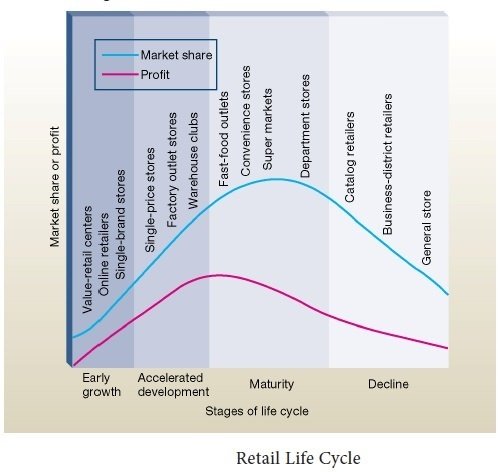
  • Retail life cycle
  1. Wheel of Retailing

This theory talks about the structural changes in retailing. The theory was proposed by Malcomb McNair and according to this theory it describes how retail institutions change during their life cycle. In the first stage when new retail institutions start business they enter as low status, low price and low margin operations. As the retail firms achieve success they look in for increasing their customer base.

They begin to upgrade their stores, add merchandise and new services are introduced. Prices are increased and margins are raised to support the higher costs. New retailers enter the market place to fill the vacuum, while this continues to move ahead as a result of the success. A new format emerges when the store reaches the final stage of the life cycle. When the retail store started it started low but when markets grew their margins and price changed. The theory has been criticized because they do not advocate all the changes that happen in the retail sector and in the present scenario not all firms start low to enter the market

  1. Retail Accordian Theory

This theory describes how general stores move to specialized stores and then again become more of a general store. Hollander borrowed the analogy ‘accordian’ from the orchestra. He suggested that players either have open accordion representing the general stores or closed accordions representing narrow range of products focusing on specialized products. This theory was also known as the general-specific-general theory. The wheel of retailing and the accordion theory are known as the cyclical theories of retail revolution

  1. Theory of Natural selection

According to this theory retail stores evolve to meet change in the microenvironment. The retailers that successfully adapt to the technological, economic, demographic and political and legal changes are the ones who are more likely to grow and prosper. This theory is considered as a better one to wheel of retailing because it talks about the macro environmental variables as well, but the drawback of this theory is that if fails to address the issues of customer taste, expectations and desires

  1. Retail Life cycle

Like products, brands retail organizations pass through identifiable stages of innovation, accelerated development, maturity and decline. This is commonly known as the retail life cycle. Any organization when in the innovation stage is nascent and has few competitors. They try to create a distinctive advantage to the final customers. Since the concepts are new at this stage organizations try to grow rapidly and the management tries to experiment. Profits will be moderate and the stage may last for a couple of years. When we talk about our country e-buying or online shopping is in the innovation stage.

In the accelerated growth phase the organizations face rapid increase in sales, competitors begin to emerge and the organizations begin to use leadership and their presence as a tool in stabilizing their position. The investment level will be high as there are others who will be creating a lot of competition. This level may go up to eight years. Hypermarkets, Dollar stores are in this stage. In the maturity stage as competition intensifies newer forms of retailing begin to emerge, the growth rate starts to decline. At this stage firms should start work on strategies and reposition techniques to be in the market place. Supermarkets, cooperative stores are in this stage. In the final stage of the retail life cycle is the declining phase where firms begin to loose their competitive advantage. Profitability starts to decline further and the overheads starts to rise. Thus we see that organizations needs to adopt different strategies at each level in order to sustain in the marketplace.

  1. Consumer Behavior Theories:

  • Wheel of Retailing:

The Wheel of Retailing theory, proposed by Malcolm P. McNair in the 1950s, suggests that retail firms evolve through predictable stages. Retailers initially enter the market with low-status, low-margin operations and gradually add services and amenities as they succeed. Over time, this process may lead to higher prices and increased competition, eventually prompting the entry of new low-status retailers. The cycle continues.

  • Retail Life Cycle:

Building on the Wheel of Retailing, the Retail Life Cycle theory posits that retail formats go through distinct life stages, including introduction, growth, maturity, and decline. Each stage is associated with specific challenges and opportunities. Understanding the life cycle helps retailers adapt strategies based on their position in the market.

  • Customer Decision-Making Process:

The Consumer Decision-Making Process theory outlines the steps consumers go through when making purchasing decisions. These steps include problem recognition, information search, evaluation of alternatives, purchase decision, and post-purchase evaluation. Retailers use this theory to tailor marketing strategies to influence consumers at each stage.

  1. Store Location Theories:

  • Central Place Theory:

The Central Place Theory, developed by Walter Christaller, explores the optimal spatial arrangement of retail centers within a geographic area. It posits that consumers will travel to the nearest central place (retail center) to fulfill their shopping needs. Larger retail centers offering a broader range of goods and services are located less frequently but serve a larger population.

  • Huff’s Gravity Model:

The Huff’s Gravity Model predicts the probability of a consumer choosing a particular store based on its attractiveness (size, offerings) and distance. This model is valuable for retailers in understanding consumer behavior related to store choice and optimizing their location strategies.

  1. Retail Marketing Theories:

  • Retail Mix:

The Retail Mix theory, also known as the 6 Ps of retailing (Product, Price, Place, Promotion, Presentation, and Personnel), emphasizes the interconnected elements that retailers must consider when creating a marketing strategy. Balancing these elements is essential for a cohesive and effective retail marketing approach.

  • STP Marketing:

STP stands for Segmentation, Targeting, and Positioning. In retail, this theory involves identifying market segments, selecting target segments that align with the retailer’s strengths, and positioning the store to meet the specific needs and preferences of those target customers.

  • Retail Atmospherics:

Retail Atmospherics theory explores how the physical environment of a store, including lighting, colors, scents, and layout, affects consumer perceptions and behavior. Creating a pleasant and engaging atmosphere enhances the overall shopping experience and influences purchasing decisions.

  1. Retail Evolution Theories:

  • Wheel of Retailing Evolution:

The Wheel of Retailing Evolution theory builds on the Wheel of Retailing, proposing that retailers evolve through stages of innovation, growth, maturity, and decline. New retailers often introduce innovative formats, challenging existing structures and leading to a continuous cycle of evolution in the retail industry.

  • Retail Life Cycle Evolution:

Similar to the Retail Life Cycle, this theory suggests that retail formats evolve through stages of introduction, growth, maturity, and decline. The evolution may involve changes in format, strategies, and consumer offerings to adapt to market conditions and competition.

  1. Technology and Omnichannel Retailing Theories:

  • Technology Adoption Curve:

The Technology Adoption Curve, developed by Everett Rogers, categorizes consumers into innovators, early adopters, early majority, late majority, and laggards based on their readiness to adopt new technologies. Retailers use this theory to guide their adoption of technology and innovation strategies.

  • Omnichannel Retailing:

Omnichannel Retailing theory emphasizes the integration of various channels (online, offline, mobile, etc.) to provide a seamless and unified shopping experience for consumers. It recognizes that consumers may engage with retailers through multiple channels and aims to create a cohesive brand experience across all touchpoints.

  1. Retail Strategy Theories:

  • Porter’s Generic Strategies:

Developed by Michael Porter, this theory outlines three generic strategies for competitive advantage: cost leadership, differentiation, and focus. Retailers can pursue one of these strategies to position themselves in the market and gain a competitive edge.

  • Wheel of Retailing Strategy:

The Wheel of Retailing Strategy theory suggests that retailers should strategically choose their positioning within the Wheel’s evolution stages. For example, a retailer may opt for a low-cost strategy as a low-status entrant or differentiate through innovation as a higher-status player.

  1. Sustainability in Retailing:

  • Green Retailing:

With a growing emphasis on sustainability, Green Retailing theory focuses on environmentally friendly retail practices. This includes sustainable sourcing, energy-efficient operations, waste reduction, and efforts to appeal to environmentally conscious consumers.

  • Circular Economy in Retailing:

The Circular Economy theory promotes a regenerative approach where products, materials, and resources are kept in use for as long as possible. Retailers adopting circular economy principles aim to reduce waste, recycle materials, and create more sustainable product life cycles.

Forms of Retail Business Ownership

The term ‘retail sales by ownership’ refers to the basic system or basic format of doing business. In India, around 12 million retail outlets are covered under this format. Under this format, proprietor is responsible for the success and failure of the store. It is a type of format, which legally has no separate existence from its owner. Opportunities in retail ownership are in plenty. From market positioning and operating perspectives, each ownership format serves a particular market and has its own advantages and disadvantages.

Over Ninety percent retail firms / outlets in India are independent and hence unorganized. With the globalization and borderless economies, this percentage is coming down but still unorganized stores (mom and pop stores) are in plenty. This number may be because of ease of entry. Ownership pattern has its own competitive advantages and disadvantages. Among independent competitive advantages, main are flexibility, low investments, less interference, quick decisions, direct strategic control, image, consistency, personal attention and entrepreneurial spirit.

Among disadvantages, common are limited finance, less bargaining power, labor intensity, reduced media access, few economies of scale, less expertise, over-dependence on the owner, excess workload and limited planning and supervision due to individual’s limitations.

The retail sale by ownership is classified as under:

  • Independent Retailer
  • Chain stores
  • Franchising
  • Leased department stores
  • Vertical Marketing system
  • Consumer co-operatives
  1. Independent Retailer

An Independent Retailer usually is a small retailer (always not true) and is found in all lines of trade and in all communities. He may be a young man, fresh graduate just starting his own business or he may be a man of advanced years with many of them spent in the field of retailing. In India, many of the independent stores tend to be passed on from one generation to another. In either case he has a business of his own. He is independent in-fact as well as in name. The high numbers of independent retailers is associated with the ‘ease of entry’ into the market place. The entry and growth of independent retailers in India is a big reason in the high rate of new retail outlets failure.

Merits of Independent Retailer

  • The independent retailer has no restrictions on who, how or where the business to be set up. He is free to do what he wants and to select a convenient location.
  • The independent retailer takes all decisions related to the store functioning. It drastically saves the time that usually exist between decision-making and the implementation process. Therefore, an independent retailer can respond quickly to the environmental changes and adopt proper strategies.
  • The independent retailer can concentrate on a local area to achieve its business goals.
  • To serve the local demand, a retailer can decide the trading hours, merchandise to be sold / removed and prices as and when desired.
  • It avoids duplication of work, ambiguity of role and excess stock due to clarity of role, thus resulting in increased productivity and time utilization.
  • To start an independent store is comparatively an easy task as it requires low investment, modest fixtures and merchandise.
  • The independent store by providing limited but deep merchandise can act as a specialized store to serve a particular consumer segment.

Demerits of Independent Retailer

  • Due to limited exposure and small investments, in most of the cases, they don’t stand in competition with the emergence of giant retailers and international store outlets.
  • As independent stores are dependent on labor intensive techniques, they find themselves difficult to improve store-productivity when it comes to stock-keeping, ordering, merchandising, displays, accounting and dispatching.
  • Undoubtedly, the bargaining power of independent retailers is comparatively less as they offer limited merchandise. On the other hand, big retailers (like supermarkets, hypermarkets and chain stores) due to bulk buying, negotiate vendors effectively and offer less prices, better quality goods and great service at short notice or in small lots create problem for independent stores.
  • Due to limited operations, less working capital, improper logistic arrangements, retailers are not able to have benefits of economies of scale.
  • Independent retailers due to limited funds cannot go for mass sales promotion programs resulting in limited target market and geographical coverage.
  1. Chain Store/Chain Retailer

A chain retailer or a chain store is a group of two or more outlets carrying the same sort of merchandise assortment, owned and controlled jointly and usually supplied from one or more central warehouses. The main advantage of such a retail format is to make retailer enable to bargain well with the suppliers. Another advantage is cost effectiveness in advertising and sales promotions. Thus, a very small number of stores constitute a chain-store system.

Merits of Chain stores

  • Good bargaining power with suppliers
  • Cost effectiveness due to centralized operations
  • Ease of managing store operations
  • Use of advanced technology increases their working efficiency

Demerits of Chain stores

  • The establishment cost to set up such chain of outlets requires huge money and expertise.
  • Difficulty in managerial control due to geographically dispersed branches/outlets
  • Due to centralized decision-making, some outlets may have difficulty in adapting to local needs.
  • Due to huge network of outlets, it is difficult for management to monitor their day to day activities resulting in communication gap, inefficiencies, and delay in decision making.
  • Expense on safety stock remains high.
  1. Franchising

A Franchise is a contractual agreement between the franchiser and the franchisee that allows the franchisee the right to supply its brand (goods and services) exclusively within a defined area, as per a particular format for a specified period of time. In return, franchisee pays a fixed fee in advance and a monthly percentage of gross sales made by him under franchiser name and fame in the form of royalty. In India, franchising business is becoming very popular and growing rapidly.

The small businesses find it convenient by being a part of large, multinational firm because franchiser provides great assistance to franchisee for locating and constructing the retail store (including interiors, and exteriors), developing the goods and services for selling, hiring employees, training, advertising and administering the store effectively.

Types of Franchising

In commerce, franchising structure can vary according to the goods and services provided. In most of the agreements, the franchisee is prohibited from selling goods and/ or services of other brands from the same retail outlet in any circumstances.

The franchising may be of three categories:

(i) Product or a trademark franchising

In this sort of franchising, a franchisee with mutual consent acquires the name and identity of the franchiser by agreeing to sell the franchiser’s goods and services exclusively made and supplied by him under his name. In actual, under such an arrangement, franchisee use the franchiser’s business methods, selling techniques, standardized product lines and advertising on co-operative basis.

Although, franchisee adheres to certain operating rules and regulations, but still is independent in their day-to-day operations. In consultation with the franchiser, franchisee can decide the store hours according to the locality needs. Archie’s Gallery, Hallmark stores, which are spread all over India, is the best suitable examples of a product/ trademark franchisee.

(ii) Business Format Franchising

In business format franchising, there is a more synergetic relationship between a franchiser and the franchisee. The franchisee receives assistance on the issue of site location, building the store, quality control, accounting practices, training to store employees, and the problems faced in conducting the store.

Besides these services, a franchisee enjoys the benefits of prototype stores, standardized product lines, selling and presenting skills and co-operative advertising. McDonald’s outlets, Domino’s, Pizza Hut are the best suited examples of business format franchising. In India, since 2000, most growth has been observed under this type of franchising format.

(iii) Area Development Franchising System

In an area development franchisee system, the franchiser grants development rights of a particular area to the franchisee in turn for a front-end development fee. The franchisee on his part is responsible for developing a certain number of units within a given period of time. Excel InfoTech EIIT has adopted this unique mode of franchising.

  1. Leased Department Stores

A leased department which is also known as shop-in-shops or store-in-store, is a section of a department in a retail store in the form of specialty/discount store given to any outside party on monthly rental basis. The person who provides the store space to outside party is known as lessor, and the person who takes the shop/store space is known as lessee.

The payment made by lessee to lessor for the use of store space is decided in a contract in the form of monthly rent. The lessee (the proprietor) is usually responsible for all aspects of business such as managing fixtures and furniture. In order to maintain the overall consistency and co-ordination, the store has some operating and administrative restrictions for each lessee in a uniform manner. For a lessee (retailer), the main reason to have rented premises is the property price that usually is so high that buying the premises is beyond the reach of the retailer.

Leased Departments in India:

In India, leased departments are an emerging trend in the field of retail business. Most of the renowned retail chain stores set up their outlets or extension counters in commercial complexes of residential areas, malls, PVR multiplexes, public places like bus terminals, railway stations, metro stations, airports and on national highways. The reason behind their popularity is the business and marketing philosophy of the retail chains that insures the availability of their brands to the consumers near their place of work or home.

Advantages of leased departments

  • Following are the advantages of having leased departments from stores’ point of view:
  • It provides one-stop shopping experience.
  • Leased stores pay for property, personnel and other expenses resulting in fewer burdens on lessor.
  • Lessor gets regular monthly income in the form of rent.
  • Employees’ management, merchandise displays and arrangement, reordering of items, complaint handling and so on are handled by individual lessees.

Disadvantages of leased departments

  • Operating hours may vary from store to store on the basis of goods and /or services sold.
  • Items sold /business lines are restricted.
  • If lessees are performing well, the store owner may increase the rent or lessees themselves can create problems by changing /not obeying agreements’ rules and regulations.
  • The bad image of one lessee can spoil the image of entire store.
  1. Vertical Marketing System

A Vertical Marketing System (VMS) is a system in which almost all the members of distribution channel such as manufacturers, wholesalers and retailers work together to satisfy human needs and wants by facilitating the smooth flow of goods and services from manufacturer to ultimate consumer.

In traditional marketing system, manufacturers, wholesalers and retailers are separate entities that try to maximize their own profits. The philosophy behind developing vertical marketing system is that when one member of distribution channel tries to maximize its profits on the expense of rest of the members, it will create conflicts resulting in decline in profits for the whole channel of distribution. To avoid these conflicts, now retail firms have started forming vertical marketing systems. Three types of VMS are in existence through which goods and services are usually distributed to customers.

These are:

  • Independent firm VMS
  • Partially integrated VMS
  • Fully integrated VMS
  1. Consumer Cooperatives

Consumer Cooperatives are retail outlets owned and managed by its customer members. A group of interested customers (members) start retail operations by investing money, receive stock certificates, elect members to run day to day activities and share the profits on the basis of investment made or certificates held.

The reason to setup consumer cooperative is that local retailers are not able to satisfy consumers’ needs (whatever the reason may be). Therefore, consumers are left with no option but to open their own store. Examples of cooperatives in India are the ‘Kendriya Bhandaars’, owned and managed by government, ‘Apna Bazaar’ shops in Mumbai and ‘Super Bazaar’ stores in Delhi. In some cases, these stores are run by the local residents of society/colony/apartment residents.

error: Content is protected !!