Management Information System (MIS), Concept, Features, Components, Types, Process, Advantages and Disadvantages

Management Information System (MIS) is a computer-based system that provides managers with the tools to organize, evaluate, and efficiently manage departments within an organization. Its primary purpose is to transform raw data from Transaction Processing Systems (TPS) into structured, summarized reports to support tactical decision-making. MIS focuses on monitoring, controlling, and planning current operations by presenting historical data in routine, scheduled formats like dashboards, summary reports, and trend analyses. By delivering relevant, timely information on key performance indicators (KPIs), it empowers middle management to compare actual performance against targets, identify issues, and ensure the smooth, efficient running of the business.

Features of Management Information Systems (MIS):

1. Management-Oriented and Driven

The design and development of an MIS are top-down, initiated by the needs of management. The system is built with the explicit purpose of serving the information requirements of managers at various levels—strategic, tactical, and operational. This ensures that the system outputs (reports, dashboards) are tailored to support specific managerial functions like planning, controlling, and decision-making. It is not a byproduct of operational data but a deliberate architecture to provide actionable intelligence, making it an essential tool for directing organizational performance and achieving business objectives.

2. Integrated System from Disparate Sources

A core feature of MIS is its ability to integrate data from various functional departments and Transaction Processing Systems (TPS) across the organization. It consolidates inputs from finance, marketing, production, and human resources into a unified database. This breaks down information silos and provides a holistic, cross-functional view of the organization. Integration ensures consistency, eliminates data redundancy, and allows managers to see the interconnected impact of decisions across different units, fostering coordinated and aligned actions throughout the enterprise.

3. Timely and Scheduled Reporting

MIS is designed to provide information when it is needed, following a structured reporting schedule. It generates reports daily, weekly, monthly, or quarterly, ensuring managers receive consistent updates on performance metrics. While not always real-time like a TPS, its timeliness is aligned with managerial review cycles. For example, a weekly sales summary allows a regional manager to take corrective action promptly. This predictable, scheduled flow of information supports routine planning and control activities, enabling proactive rather than reactive management.

4. Exception-Based Reporting

Beyond standard summaries, a sophisticated MIS includes exception reporting. It is programmed to highlight significant deviations from planned performance or predefined thresholds. For instance, it can automatically flag a product line where sales have fallen 15% below target or a department that has exceeded its budget. This feature directs managerial attention to areas requiring immediate intervention, improving efficiency by allowing managers to focus on critical issues and exceptions rather than sifting through volumes of routine data.

5. Support for Structured and Semi-Structured Decisions

MIS primarily aids in making structured and semi-structured decisions at the tactical and operational levels. These are recurring decisions with known information requirements, such as inventory reordering, budget allocation, or staff scheduling. By providing summarized historical data and comparative analyses, MIS reduces uncertainty and provides a factual basis for these decisions. It supports “what-if” analysis for semi-structured scenarios, helping managers evaluate the potential outcomes of different choices within a defined framework.

6. Use of Internal and Historical Data

MIS primarily relies on internal, historical data sourced from the organization’s own TPS and databases. It processes and summarizes past transactions to identify trends, patterns, and performance over time. While some systems may incorporate limited external data (e.g., market indices), the focus is on leveraging internal records to assess efficiency, productivity, and compliance with internal plans and budgets. This inward-looking analysis is crucial for internal control and operational optimization.

7. User-Friendly Output and Presentation

Effective communication of information is key. MIS provides outputs in easily understandable formats for non-technical managers. This includes structured reports, graphical dashboards, charts, and summaries. The presentation is designed to highlight key metrics and trends at a glance, facilitating quick comprehension and decision-making. The focus is on transforming complex data sets into clear, actionable intelligence, making the system accessible and valuable to its primary users—the management team.

8. Flexibility and Future-Oriented Design

While based on historical data, a well-designed MIS is built with flexibility to adapt to changing information needs. It should allow for the generation of ad-hoc reports and be scalable to include new data sources or reporting modules as the business evolves. This future-oriented design ensures the system remains relevant, supporting not just current operational control but also aiding in the formulation of future plans and strategies based on analyzed trends.

Components of Management Information Systems (MIS):

1. Data Resources

The data resource is the foundational component of any MIS. It comprises the structured collection of internal transactional data from TPS, as well as relevant external data (market reports, competitor information). This data is stored, organized, and managed in databases and data warehouses. Its quality—accuracy, timeliness, and relevance—directly determines the value of the system’s output. The data resource is the raw material that the MIS transforms into meaningful information, making its effective governance and management critical for reliable reporting and analysis.

2. Hardware

Hardware refers to the physical technology infrastructure required to operate the MIS. This includes servers for processing and storing data, computers and workstations for user access, networking equipment (routers, switches) for internal connectivity, and data centers to house the equipment. The choice of hardware influences the system’s processing speed, storage capacity, reliability, and scalability. In modern contexts, this increasingly includes cloud infrastructure, where hardware resources are provided as a service, offering flexibility and reducing the need for large capital investments in physical assets.

3. Software

Software is the set of programs and applications that process data and generate information. This includes the Database Management System (DBMS) that organizes data, the application software for generating specific reports and dashboards, and analytical tools for data mining and querying. The software component dictates the system’s functionality, user interface, and ability to transform raw data into usable formats for managers. It acts as the “brain” of the MIS, executing the logic for summarization, comparison, and presentation.

4. Procedures

Procedures are the formalized rules and guidelines that define how the MIS is used and managed. This includes operational procedures for data entry, validation, and storage; guidelines for generating standard and ad-hoc reports; and protocols for system access, security, and backup. Clear, documented procedures ensure consistency, data integrity, and effective utilization of the system by both technical staff and end-users, turning technology into a reliable business process.

5. People

People are the most vital component, encompassing all human elements involved. This includes end-users (managers, executives) who consume the information to make decisions, technical specialists (system analysts, database administrators) who design, implement, and maintain the system, and support staff. The system’s success depends entirely on the skills, training, and acceptance of these individuals. Their ability to define information needs, interpret outputs, and act on insights determines the MIS’s ultimate value to the organization.

6. Communication Networks

Communication networks are the digital pathways that enable the flow of data between all other components. This includes Local Area Networks (LANs), Wide Area Networks (WANs), and internet connectivity. Networks allow for the collection of data from remote sources, provide access to centralized databases for distributed users, and facilitate the delivery of reports and dashboards to managers’ devices. Robust, secure networking is essential for ensuring timely, reliable, and accessible information across the organization.

7. Information Products (Output)

This component is the tangible result of the MIS—the reports, dashboards, alerts, and analyses delivered to management. These information products, such as sales summaries, performance scorecards, or budget variance reports, are tailored to support specific managerial functions. Their design—clarity, relevance, and timeliness—is critical. They represent the culmination of the entire system’s work, transforming processed data into actionable intelligence that informs planning, control, and decision-making.

8. Control and Feedback Mechanisms

A mature MIS incorporates feedback loops to monitor its own effectiveness and accuracy. Control mechanisms track whether the system is meeting managerial information needs and identify errors or gaps in data. User feedback on report relevance and system usability is collected to drive continuous improvement. This component ensures the MIS remains aligned with evolving business goals and adapts to new requirements, maintaining its role as a vital management tool.

Types of Information Systems
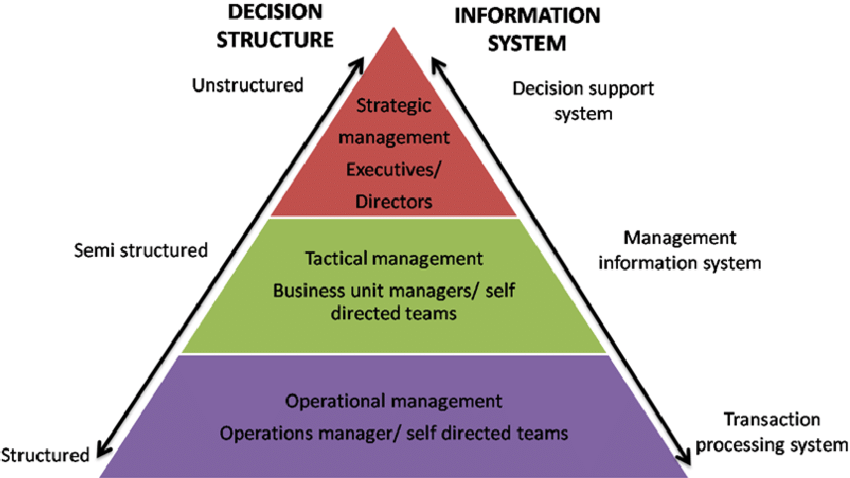
 

  1. Transaction Processing Systems (TPS): Used to record and manage day-to-day business transactions. An example is a Point of Sale (POS) system, which tracks daily sales.
  2. Management Information Systems (MIS): These systems guide middle-level managers in making semi-structured decisions. They use data from the Transaction Processing System as input.
  3. Decision Support Systems (DSS): Utilized by top-level managers for semi-structured decision-making. DSS systems receive data from the Management Information System and external sources like market forces and competitors.

Process of Management Information System (MIS):

1. Determination of Information Needs

The first step is a systematic analysis to define what information managers need to perform their roles effectively. This involves identifying key decision areas, strategic objectives, and performance indicators for different management levels. Questions like “What data is critical for inventory control?” or “Which KPIs does a sales head need weekly?” are answered. This stage aligns the MIS design directly with managerial requirements, ensuring the system delivers relevant, actionable intelligence rather than just raw data, and involves collaboration between end-users (managers) and system designers.

2. Data Collection and Input

This process involves gathering raw data from identified internal and external sources. Internally, data is sourced continuously from Transaction Processing Systems (TPS) across departments (sales, production, finance). Externally, data may be collected from market feeds, economic reports, or competitor analysis. This data is then validated and entered into the system’s databases. Accurate collection and error-free input are critical, as the quality of all subsequent information depends on the integrity of this foundational data.

3. Data Processing and Transformation

Here, the collected raw data is converted into meaningful information. This involves a series of operations: classification, sorting, calculating, summarizing, and aggregating. For instance, thousands of daily sales transactions are totaled into weekly revenue figures. Data is processed using predefined business rules and models. This transformation is the core function where disparate data points are synthesized into structured summaries, trends, and comparisons that managers can understand and use for decision-making.

4. Storage and Management of Processed Data

Processed information is organized and stored for immediate and future access. This involves managing databases or data warehouses where summarized data, historical trends, and performance metrics are retained. Effective storage ensures data integrity, security, and efficient retrieval. This stage creates an organizational memory—a repository of past performance and trends that managers can query to analyze historical patterns and support longitudinal analysis for planning.

5. Information Generation and Retrieval

In this stage, the system produces the required outputs for management. Based on scheduled needs or ad-hoc queries, the MIS retrieves stored data and formats it into standardized reports, dashboards, or graphical analyses. These outputs—such as a monthly profit & loss statement or a real-time inventory status dashboard—are tailored to the user’s role. The system must provide timely, accurate, and easily interpretable information that managers can retrieve on-demand to support their specific activities.

6. Dissemination and Distribution of Information

The generated information must be communicated effectively to the right managers at the right time. This process involves distributing reports via email, publishing them on intranet portals, or pushing alerts to mobile devices. Distribution protocols ensure that sensitive information reaches only authorized personnel. Efficient dissemination closes the loop, ensuring the intelligence produced by the MIS is delivered into the hands of decision-makers who can act upon it, thereby fulfilling the system’s primary purpose.

7. Utilization and Feedback for System Refinement

The final, cyclical stage involves managers actively using the information for planning, control, and decision-making. Their experience and the outcomes of their decisions generate critical feedback. This feedback on the information’s relevance, accuracy, timeliness, and format is communicated back to the MIS team. This input is used to continuously refine the system—adjusting data sources, processing rules, or report formats—ensuring the MIS evolves to meet changing managerial needs and remains a dynamic, valuable organizational tool.

Advantages of Management Information System (MIS):

1. Enhanced Decision-Making Efficiency

MIS transforms raw data into structured, summarized information, providing managers with a fact-based foundation for decisions. By delivering timely reports on key performance indicators (KPIs), budgets, and trends, it reduces reliance on intuition and guesswork. This leads to faster, more accurate, and confident decisions at tactical and operational levels. For example, a sales manager can quickly identify underperforming regions based on comparative reports and reallocate resources. The system minimizes uncertainty, allowing managers to focus on analysis and action rather than data collection and manual calculation.

2. Improved Operational Control and Planning

MIS serves as a vital tool for monitoring and controlling day-to-day operations. It provides regular performance reports that compare actual results against plans and budgets, highlighting variances. This enables managers to identify bottlenecks, inefficiencies, or deviations early and take corrective action promptly. Furthermore, by analyzing historical trends and current performance data, MIS supports effective short-term and medium-term planning, such as setting realistic sales targets or production schedules, ensuring resources are aligned with organizational goals.

3. Strategic Insight and Competitive Advantage

By integrating data from across the organization, MIS provides a holistic view of business performance and market position. Analysis of long-term trends, customer behavior, and operational efficiency can reveal strategic opportunities and threats. This insight helps senior management in formulating long-term strategies, such as entering new markets or discontinuing unprofitable products. A well-implemented MIS can thus become a source of sustainable competitive advantage by enabling proactive, data-driven strategy rather than reactive management.

4. Increased Organizational Efficiency and Coordination

MIS eliminates information silos by integrating data from all functional areas (finance, marketing, HR, production). This creates a single source of truth, improving coordination between departments. For instance, production can align output with sales forecasts, and procurement can plan based on inventory levels. Streamlined information flow reduces redundancy, minimizes errors, and accelerates processes. The resulting efficiency gains lower operational costs, improve resource utilization, and enhance the organization’s overall agility and responsiveness.

5. Better Communication and Collaboration

MIS acts as a centralized platform for information dissemination, standardizing communication across management levels. Reports and dashboards ensure all managers work from the same, up-to-date data set, fostering alignment and shared understanding. This transparency improves vertical and horizontal collaboration, as teams can easily access the information needed to coordinate projects and make interdependent decisions. Enhanced communication reduces conflicts stemming from misinformation and builds a more cohesive, informed organizational culture.

6. Cost Reduction and Resource Optimization

Automating the collection, processing, and reporting of management information significantly reduces administrative and clerical costs associated with manual report generation. MIS also enables data-driven resource optimization. By providing clear visibility into operations, it helps identify areas of waste, overstaffing, or underutilized assets. Managers can optimize inventory levels, streamline workflows, and improve workforce productivity, leading to direct bottom-line savings and a higher return on investment in both human and capital resources.

7. Support for Performance Management

MIS provides the objective data necessary for effective performance measurement and management. It tracks individual, departmental, and organizational KPIs, facilitating fair and transparent performance evaluations. This data supports management by objectives (MBO), helps in setting benchmarks, and identifies training or development needs. By linking performance data to outcomes, it motivates employees, aligns individual goals with corporate strategy, and creates a culture of accountability and continuous improvement.

Disadvantages of Management Information System (MIS):

1. Fast and Accurate Data Processing

Transaction Processing Systems handle a large number of business transactions quickly and without errors. They record sales, payments, payroll, and inventory updates in real time. In Indian banks and retail stores, TPS ensures every transaction is saved correctly. This reduces manual work and mistakes. Fast processing helps businesses serve customers better and keep records up to date. Accurate data also supports better reporting and decision making.

2. Improved Operational Efficiency

TPS automates routine business activities such as billing, order processing, and salary payments. This saves time and reduces paperwork. Indian companies use TPS in supermarkets, railway booking systems, and online payments. Automation allows employees to focus on more important tasks. As work becomes faster and smoother, overall business efficiency increases and operating costs reduce.

3. Better Record Keeping and Data Security

TPS stores transaction data in organized digital databases. Businesses can easily retrieve past records for audits, tax filing, and analysis. Indian firms benefit during GST reporting and financial reviews. Modern TPS also includes security features like passwords and access control to protect sensitive information. Proper record keeping improves transparency and trust.

4. Real Time Information Availability

TPS updates information instantly after every transaction. For example, when a product is sold, inventory levels change immediately. This helps managers track stock, cash flow, and customer activity in real time. Indian retail and logistics companies rely on real time data to avoid shortages and delays. Quick information supports better operational decisions.

Management Information System Role in Decision making Process:

1. Providing a Structured Factual Foundation

MIS transforms disparate, raw data from operational systems into organized, summarized information. It delivers structured reports on sales, inventory, finances, and productivity. This provides managers with a reliable, objective, and comprehensive factual base, replacing intuition or fragmented data with concrete evidence. By presenting clear metrics and historical trends, MIS eliminates ambiguity and establishes a shared truth, allowing managers to confidently frame problems and evaluate the current state of operations before proceeding with any analysis or choice.

2. Enabling Identification of Problems and Opportunities

Through routine and exception-based reporting, MIS acts as an early warning system. It highlights deviations from plans, such as a drop in regional sales, a cost overrun, or a spike in customer complaints. By systematically tracking KPIs, it helps managers identify negative trends (problems) and spot positive patterns (opportunities), such as an unexpectedly successful product line. This proactive identification ensures that decision-making is triggered by timely, data-driven insights rather than by crisis or chance, allowing for strategic intervention at the optimal moment.

3. Supporting the Generation and Evaluation of Alternatives

Once a problem or opportunity is identified, MIS aids in exploring solutions. It allows for “what-if” scenario analysis by modeling the potential outcomes of different courses of action. Managers can use historical data to simulate the impact of a price change, a new marketing spend, or a shift in production schedules. By providing predictive reports and comparative analyses, MIS helps generate viable alternatives and objectively evaluate their projected consequences on key metrics like revenue, cost, and market share, leading to more informed and rational choice selection.

4. Facilitating the Implementation of Decisions

After a decision is made, MIS plays a crucial role in translating the choice into actionable plans. It provides the detailed operational data needed to create implementation schedules, allocate budgets, and assign resources. For instance, launching a new product requires coordinated data from production capacity, inventory levels, and marketing budgets—all supplied by the MIS. By serving as the central information hub, it ensures all departments work from synchronized data, enabling clear communication of tasks and responsibilities for effective execution.

5. Enabling Monitoring, Control, and Feedback

Post-implementation, MIS is essential for tracking the results of the decision. It generates follow-up reports that measure actual performance against the expected outcomes defined during planning. This continuous monitoring allows managers to control the process, identify any implementation gaps or unforeseen issues, and make necessary mid-course corrections. The feedback loop created by this monitoring turns the decision-making process into a cycle of continuous improvement, where the results of past decisions inform and refine future ones.

Role of Management Information System (MIS)

Simply MIS stand For Management Information System. For Simply Understanding Management Information System (MIS) we can divide in to three Word and Understand Part by part

  • Management: “Management is function to do the work at the Right time, by the right Person, For the Right Job.”
  • Information: “Information is the Collection of Organized data which plays a Vital Role for decision making.”
  • System: “System Consist for a set of elements which Provides a Framework to convert Unorganized (Data) into Organized Information.”

Role of Management Information System

Management information system (MIS) has become Very Necessary due to Emergence of high complexity in Business Organization. It is all to know that without information no Organization can take even one step properly regarding the decision making process. Because it is matter of fact that in an organization decision plays an essential role for the achievement of its objectives and we know that every decision is based upon information. If gathered information are irrelevant than decision will also incorrect and Organization may face big loss & lots of Difficulties in Surviving as well.

  1. Helps in Decision making

Management Information System (MIS) plays a significant Role in Decision making Process of any Organization. Because in Any organization decision is made on the basis of relevant Information and relevant information can only be Retrieving from the MIS.

  1. Helps in Coordination among the Department

Management information System is also help in establishing a sound Relationship among the every persons of department to department through proper exchanging of Information’s.

  1. Helps in Finding out Problems

As we know that MIS provides relevant information about the every aspect of activities. Hence, If any mistake is made by the management then Management Information Systems (MIS) Information helps in Finding out the Solution of that Problem.

  1. Helps in Comparison of Business Performance

MIS store all Past Data and information in its Database. That why management information system is very useful to compare Business organization Performance. With the help of Management information system (MIS) Organization can analyze his Performance means whatever they do last year or Previous Years and whatever business performance in this year and also measures organization Development and Growth.

Components

A Management Information System (MIS) comprises five key components – people, business processes, data, hardware, and software. These components work collaboratively to achieve the organization’s objectives and ensure smooth operations.

People:

Users of the information system, such as accountants, human resource managers, etc., record day-to-day business transactions. The ICT department supports these users, ensuring the system’s proper functioning.

Business Procedures:

Agreed-upon best practices that guide users and other components in working efficiently. These procedures are developed by various stakeholders, including users and consultants.

Data:

Recorded day-to-day business transactions, collected from various activities like deposits and withdrawals for a bank.

Hardware:

The physical equipment like computers, printers, and networking devices that provide computing power for data processing, as well as networking and printing capabilities. Hardware accelerates the transformation of data into valuable information.

Software:

Programs that run on the hardware. Software is divided into system software (e.g., operating systems like Windows, Mac OS, Ubuntu) and applications software (e.g., Payroll program, banking system, point of sale system) that facilitate specific business tasks.

In an MIS, these components form an interconnected ecosystem, with people using business procedures to interact with and record data. The hardware, along with the software, processes this data, transforming it into meaningful information accessible to users. The effective collaboration of all these components ensures the MIS serves its purpose, providing valuable insights for decision-making and supporting business operations.

Objective of Management Information System

An MIS is a system designed to provide selected decision oriented information needed by management to plan, control and evaluate the activities of the corporation. It is designed within a framework that emphasizes profit planning, performance planning and control at all levels.

A formal method of collecting timely information in a presentable form in order to facilitate effective decision making and implementation, in order to carryout organizational operations for the purpose of achieving the organizational goal.

Information processing beyond doubt is the dominant industry of the present century. Following factors states few common factors that reflect on the needs and objectives of the information processing:

  • Increasing impact of information processing for organizational decision making.
  • Dependency of services sector including banking, financial organization, health care, entertainment, tourism and travel, education and numerous others on information.
  • Changing employment scene world over, shifting base from manual agricultural to machine-based manufacturing and other industry related jobs.
  • Information revolution and the overall development scenario.
  • Growth of IT industry and its strategic importance.
  • Strong growth of information services fuelled by increasing competition and reduced product life cycle.
  • Need for sustainable development and quality life.
  • Improvement in communication and transportation brought in by use of information processing.
  • Use of information processing in reduction of energy consumption, reduction in pollution and a better ecological balance in future.
  • Use of information processing in land record managements, legal delivery system, educational institutions, natural resource planning, customer relation management and so on.
  • MIS is very useful for efficient and effective planning and control functions of the management. Management is the art of getting things done through others. MIS will be instrumental in getting the things done by providing quick and timely information to the management.
  • Reports give an idea about the performance of men, materials, machinery, money and management. Reports throw light on the utilization of resources employed in the organization.
  • MIS is helpful in controlling costs by giving information about idle time, labour turnover, wastages and losses and surplus capacity.
  • By making comparison of actual performance with the standard and budgeted performance, variances are brought to the notice of the management by MIS which can be corrected by taking remedial steps.
  • MIS brings to the notice of the management strength (i.e., strong points) of the organisation, to take advantage of the opportunities available.
  • MIS reports on production statistics regarding rejection, defective and spoilage and their effect on costs and quality of the products.

Emergence of Management Information System

A management information system, or MIS, is any computer system used to collect and store information, with tools for analyzing that information so that you can monitor operations and make informed business decisions. Software that tracks sales data, produces weekly reports and expands on past sales to provide you with sales forecasts would be one example of a management information system. More sophisticated systems could track production in different departments, monitor inventory, keep track of costs and even monitor the company’s stocks.

In the past, MIS was often a system that ran independently of other company systems. At one time, it would be found almost exclusively on mainframe computers and the information it processed was used exclusively by management. Today, MIS is often used interchangeably with information systems (IS) as well as information technology (IT).

The Five Eras of MIS

In order to make sense of the evolution of management information systems, it’s helpful to break down the history into four or five eras.

First Era (mid-1960s to mid-1970s)

During the first years of computerized MIS, information systems were centralized and concerned solely with governance and the needs of management. Most information systems and their reports were under the control of accounting departments. Technology included third-generation mainframe computers, like the IBM 360. Languages included Assembler, Fortran, COBO and, Database e. Ethernet networks were developed during this time.

Second Era (mid-1970s to mid-1980s)

While MIS was still mainly concerned with governance and the needs of management, more departments were beginning to benefit from the technology. In many companies, steering committees and user-led initiatives determined the shape and scope of additional IS projects. Technology included the first personal computers (PCs), minicomputers and mid-range computers.

Third Era (mid-1980s to late 1990s)

During the third era, centralized information systems began to spread out and information became decentralized. Each department had its own computer system. Managing information was often referred to as “herding cats.” It was during this era that a new position emerged in many companies to oversee the acquisition and management of multiple information systems: the Chief Information Officer, or CIO. Technology during this era included internetworking and the beginning of the internet.

Fourth Era (late 1990s to today)

During the current era, information systems are still tightly tied to governance and management, however the systems are widely distributed, within the reach of nearly every employee who needs it across multiple platforms. Many information systems are integrated between different companies, so that a client business can readily access supplier information and their customers, in turn, can access that information. Technology now includes social media, search engines and ubiquitous computing through a variety of platforms including laptops, tablets and smartphones.

Fifth Era (today forward)

The increase in internet bandwidth over recent years has led to a substantial reliance on cloud computing. As a result, some maintain that this marks a new era in worker’s ascendancy and that we are now in a fifth era for management information systems. Today, practically any employee is now in a position to make informed decisions with tools that are readily available across multiple platforms. Furthermore, the line between who produces and who consumes MIS information is increasingly blurred.

Evolution of Management due to Technology

This could mark the end of controlling top-down management styles, which are being replaced by more autonomy of employees. Management expert Peter Druker predicted this as an inevitable back in 1954 in his theory on Management by Objectives. In this paradigm, top-down management can actually harm a company because, being in the trenches, employees are more and more likely to understand customer needs better than their supervisors and, being in specialized fields, may have more understanding of the nuts and bolts behind a business than those supervisors.

“Knowledge workers have to manage themselves,” Drucker said. “They have to have autonomy.”

Origin of Management Information Systems

The history of information management can be traced back to the industrial exhibition of Paris in 1801. There, Joseph Marie Charles Jacquard introduced the world to punch cards. These cards, which were similar to the computer punch cards used through much of the 20th century, were used in weaving looms to make intricate patterns in cloth.

The Creation of Punch Card Systems

At that time, looms were hand-operated and if you wanted to create a complex pattern in cloth, you had to know – and remember – the order that different color threads were to be weaved into the fabric. Jacquard’s punch cards had multiple rows of holes punched into them. Each card represented a single row of threads in the cloth. The cards, when strung together and inserted into the loom, would determine the pattern in the cloth.

If you changed the order in which the cards were inserted, you would change the pattern. If you used the same order every time, every piece of cloth would have the exact same pattern.

Thus, for the first time, Jacquard’s punch cards could automate the storage and management of the information used to specify how a loom was to be operated.

Evolution of Punch Cards

The use of punch cards expanded in the following decades and in the 1880s, punch cards were used to compile information. Cards were “programmed” with information by punch card machines and other machines would process these cards, tally them and print out the results.

By 1911, IBM emerged, then called the Computing-Tabulating-Recording Company. By this time, punch cards were used for recording and storing all sorts of information, including time tracking and recording weights on scales. Even the U.S. Census was using punch cards to manage its information.

The Emergence of MIS in Computers

When computers began to emerge in the 1940s and 1950s, punch cards were still a big part of information systems. They continued to play a role until the 1970s when they were replaced by magnetic storage media like tapes and disks. These storage devices greatly increased the speed of calculating data Consequently, MIS began to develop for accounting. Calculating data and compiling it into reports could now be done in a fraction of the time it would have taken before.

MIS Developing Beyond Accounting

From the 1970s to the early 1990s, as computers became smaller, faster and more affordable, MIS developed beyond accounting to other business areas, like inventory systems, sales, marketing, manufacturing processes and engineering. Most of these systems ran independently of each other, each using different software on different computers. For a large company to get a complete picture of its progress, reports from different departments would be re-entered into another system, often in a mainframe computer. Small businesses simply didn’t have the resources to complete such an endeavor and would have to compile different reports manually, often on paper.

Even as computers could be connected in networks in the 1990s, the different software systems were often not compatible. Companies then began upgrading their systems so that different department systems could communicate with each other. By the end of the 1990s, even small businesses could afford integrated information systems and even connect different office systems together using the internet.

Management Information System and Computer

Translating the real concept of the MIS into reality is technically, an infeasible proposition unless computers are used. The MIS relies its ability to store, process, retrieve and communicate with no serious limitations.

The variety of the hardware having distinct capabilities make it possible to design the MIS for a specific situation. For example, if the organization needs a large database and very little processing, a computer system is available for such a requirement. Suppose the organization has multiple business locations at long distances and if the need is to bring the data at one place, process, and then send the information to various locations, it is possible to have a computer system with a distributed data processing capability.  If the distance is too long, then the computer system can be hooked through a satellite communication system.

Role of Computers in Management Information Systems

Computers play a central role in a business’s management information system, or MIS. In past decades, most companies had a few computers that served as information hubs. Today, a range of computing devices funnel important data from a variety of sources, from sales to time cards to inventory. The MIS software gathers the data and generates actionable information to guide the business.

  1. Guiding the Business

Business doesn’t stand still. Internal and external circumstances change daily, and you need a road map of good information to guide you through the twists and turns. The whole purpose of MIS is to use the hard data of your business to inform day-to-day and long-term decisions. Computers ease the task of processing the data.

  1. Capturing the Data

The most sophisticated computers in the world can’t help your business if they’re not “fed”. Before an MIS can provide useful information, data must first enter the system.

Sales and accounting systems, for example, typically capture data when a customer places an order. Workers on the factory floor can enter manufacturing data into tablets or PCs, or the production machines themselves can capture data automatically. These detailed, nuts-and-bolts numbers are the raw materials that eventually become useful management information.

  1. Calculating, Sorting and Searching

Modern computers excel at repetitive number crunching, accurately processing many thousands of data items per second. To summarize a month’s business transactions by hand might take hours or days, while a computer can do this task in moments. Useful operations include arithmetic calculations, sorting data numerically or alphabetically and searching for a single record among thousands in a file.

  1. Database Management Systems

Many MIS systems rely on database management systems to organize, process and protect data. The database is a special program that acts as a data warehouse, storing the raw data and also cataloging it. The database has levels of security to guard against unauthorized access. It gives the various MIS applications accounting, payroll, inventory management and others added efficiency, reliability and flexibility.

  1. Reports for Managers

An MIS delivers information to managers in the form of reports. They may take many forms, including printed lists, informative screens or alerts by text or email. Generally, reports may have details, listing individual records sorted by date or other criteria, and summary figures that show totals and averages.

For example, a monthly sales report shows customer names and what they bought. The MIS may generate the reports on demand, on a schedule or when preset conditions are met.

  1. Ad Hoc Reporting

Many of the reports in an MIS system are “canned”, as software developers wrote the specifications when the system was first created. Ad hoc (improvised) reports are also possible. In this instance, you can use database software to create a custom report.

For example, in a certain month, an item you make may have been painted the wrong color. An ad hoc report can pull useful information from the MIS, such as who bought the item and when or which production machine made the item. The manager may create the report herself from a menu-driven reporting system, or she may ask a data technician to do it for her.

  1. Computer Storage and Big Data

With the falling price of computer hard drives, it’s now possible to store enormous amounts of information cheaply. Even small businesses can afford to keep reams of detailed records on hand and use them to study customer buying patterns, production quality statistics and the actions of competitors.

  1. Garbage In, Garbage Out

With tongue in cheek, computer professionals use the term “garbage in, garbage out” to sum up how errors in data or mistakes in programming can lead to disastrous outcomes. Because computers deal with large amounts of information, it’s possible that small arithmetic errors, for example, may give wildly incorrect results. Savvy businesspeople must be aware of the potential pitfalls of relying too much on computerized reports.

Impact of MIS

The impact of MIS on the functions is in its management.  With a good MIS support, the management of marketing, finance, production and personnel becomes more efficient, the tracking and monitoring the functional targets becomes easy. The functional managers are informed about the progress, achievements and shortfalls in the activity and the targets. The manager is kept alert by providing certain information indicating the probable trends in the various aspects of business. This helps in forecasting and long-term perspective planning.  The manager” attention is brought to a situation which is exceptional in nature, inducing him to take an action or a decision in the matter. A disciplined information reporting system creates a structured database and a knowledge base for all the people in the organization. The information is available in such a form that it can be used straight away or by blending and analysis, saving the manager’s valuable time.

The MIS creates another impact in the organization which relates to the understanding of the business itself. The MIS begins with the definition of a data entity and its attributes. It uses a dictionary of data, entity and attributes, respectively, designed for information generation in the organization. Since all the information systems use the dictionary, there is common understanding of terms and terminology in the organization bringing clarity in the communication and a similar understanding of an event in the organization.

The MIS calls for a systemization of the business operations for an effective system design. This leads to streamlining of the operations which complicate the system design.  It improves the administration of the business by bringing a discipline in its operations everybody is required to follow and use systems and procedures. This process brings a high degree of professionalism in the business operations.

Since the goals and objective of the MIS are the products of business goals and objectives, it helps indirectly to pull the entire organization in one direction towards the corporate goals and objectives by providing the relevant information to the people in the organization.

A well designed system with a focus on the manager makes an impact on the managerial efficiency.  The fund of information motivates an enlightened manager to use a variety of tools of the management. It helps him to resort to such exercises as experimentation and modeling. The use of computers enables him to use the tools and techniques which are impossible to use manually. The ready-made packages make this task simpler. The impact is on the managerial ability to perform. It improves the decision making ability considerably.

Advantage and Disadvantage of Computer based MIS

Advantage of Computer-Based Management Information System

Compute-based Management information systems have been in widespread use since the 1990s in industry, non-profit organizations and government agencies. These systems provide fast, centralized access to databases of personnel information, reference reading, best practices and on-the-job training, and are easily customizable to meet an organization’s needs. With the Internet and technology boom of the early 21st century, use of computer-based information networks is growing faster each year.

  1. Data Centrality

Access to data via a computer network information system is central, providing a “one-stop” location to find and access pertinent computer data. Most large-scale businesses and organizations use some sort of central database to manage user information, manage advertisement lists, store product information and keep track of orders. Examples of central database solutions are MySQL, PostgreSQL or Microsoft SQL database solutions, coupled with custom software which provides user interfaces.

  1. Information Coverage

Central information systems provide organizations with the advantages of having large amounts of data, covering many different fields, all accessible via a central source. Information coverage is a huge advantage for any organization, because having vast amounts of useful data from every different department streamlines access and increases productivity. For users, having access to a networked information system is analogous to having a digital library of shared knowledge. Recent developments in database information systems link company information access with larger databases of academic and professional research, such as Google Scholar, to provide even more information capability to personnel.

  1. Access Efficiency

Efficiency of access is a crucial advantage to networked information systems over more traditional information management systems, such as paper cataloging and filing. Computer-based information systems catalog and file documents in a set logical way, making data access very efficient and fast. Data can be manually categorized, and filters created to automatically file documents that match certain patterns. This increases employee productivity time by allowing workers to focus more on the task at hand rather than filing paperwork.

  1. Extensibility

Computer-based information systems are completely extensible and customizable to an organization’s needs. Upon installation, customized computer information systems use configuration files that are tailor-made to an organization’s needs to file and categorize data. Computer software engineers frequently design custom database interfaces and information storage/recovery systems for enterprise clients. As a company grows, modifications and additions to this filing configuration allow easy extensibility. Computer information systems are not limited in scale or possibility. They are uniquely designed for maximum organizational benefit for each customer.

Disadvantage of Computer-Based Management Information System

  1. Lack of common sense

Computer is only an electronic device. It cannot think. If we provide an incorrect data, it does not have the commonsense to question the correctness of the data. For overcoming this problem, several Software Specialists are engaged in the project of developing intelligence to the computer. To it, they have given name as Artificial Intelligence. They are willing to develop the feeling and inhumation in this device.

We hope that in near future the artificial intelligence will help this device to function in more interactive way. Today, software’s are available which may convert our speech into text. This is the beginning of an era where computer may be quite interactive with human beings. In addition, to execute the function, operator will give verbal instructions.

  1. Memory without brain

Computer can store data in its memory. However, if a wrong instruction is provided, it does not have a brain to correct the wrong instructions

  1. Slavery

A computer is a slave; it cannot execute the program by itself. It requires instructions to execute the program and generate information. Thus, we see that the computer cannot do anything by itself. It has a relationship of master and slave. Until master is not instructing, slave will not perform any function. In the same way computer does.

Classification of Information

Information classification is a process in which organizations assess the data that they hold and the level of protection it should be given.

Organizations usually classify information in terms of confidentiality i.e. who is granted access to see it. A typical system will include four levels of confidentiality:

  • Confidential (only senior management have access)
  • Restricted (most employees have access)
  • Internal (all employees have access)
  • Public (everyone has access)

As you might expect, larger and more complex organizations will need more levels.

Take hospitals, for example: doctors and nurses need access to patients’ medical histories, which are highly sensitive, but they shouldn’t have access to other types of information that would fit that criteria, such as the hospital’s financial records.

Classification by Characteristic

Based on Anthony’s classification of Management, information used in business for decision-making is generally categorized into three types:

  1. Strategic Information

Strategic information is concerned with long term policy decisions that defines the objectives of a business and checks how well these objectives are met. For example, acquiring a new plant, a new product, diversification of business etc, comes under strategic information.

  1. Tactical Information

Tactical information is concerned with the information needed for exercising control over business resources, like budgeting, quality control, service level, inventory level, productivity level etc.

  1. Operational Information

Operational information is concerned with plant/business level information and is used to ensure proper conduction of specific operational tasks as planned/intended. Various operator specific, machine specific and shift specific jobs for quality control checks comes under this category.

Classification by Application

In terms of applications, information can be categorized as:

  1. Planning Information

These are the information needed for establishing standard norms and specifications in an organization. This information is used in strategic, tactical, and operation planning of any activity. Examples of such information are time standards, design standards.

  1. Control Information

This information is needed for establishing control over all business activities through feedback mechanism. This information is used for controlling attainment, nature and utilization of important processes in a system. When such information reflects a deviation from the established standards, the system should induce a decision or an action leading to control.

  1. Knowledge Information

Knowledge is defined as “information about information”. Knowledge information is acquired through experience and learning, and collected from archival data and research studies.

  1. Organizational Information

Organizational information deals with an organization’s environment, culture in the light of its objectives. Karl Weick’s Organizational Information Theory emphasizes that an organization reduces its equivocality or uncertainty by collecting, managing and using these information prudently. This information is used by everybody in the organization; examples of such information are employee and payroll information.

  1. Functional/Operational Information

This is operation specific information. For example, daily schedules in a manufacturing plant that refers to the detailed assignment of jobs to machines or machines to operators. In a service oriented business, it would be the duty roster of various personnel. This information is mostly internal to the organization.

  1. Database Information

Database information construes large quantities of information that has multiple usage and application. Such information is stored, retrieved and managed to create databases. For example, material specification or supplier information is stored for multiple users.

Level of Information

Information, as required at different levels of manage­ment can be classified as operational, tactical and strategic.

  1. Strategic information

While the operational information is needed to find out how the given activity can be performed better, strategic information is needed for making choices among the busi­ness options.

The strategic information helps in identifying and evaluating these options so that a manager makes informed choices which are different from the competitors and the limita­tions of what the rivals are doing or planning to do. Such choices are made by leaders only.

Strategic information is used by man­agers to define goals and priorities, initiate new programmes and develop policies for acquisition and use of corporate resources. For example, information regarding the long-term needs of funds for on-going and future projects of the company may be used by top level managers in taking decision regarding going public or approaching financial institutions for term loan.

Strategic infor­mation is predictive in nature, relies heavily on external sources of data, has a long-term perspective, and is mostly in summary form. It may sometimes include ‘what if’ scenarios. However, the strategic information is not only external information.

For long, it was believed that strategic information are basically information regarding the external environment. However, it is now well rec­ognised that the internal factors are equally responsible for suc­cess or failures of strategies and thus, internal information is also required for strategic decision making.

Figure represents the types of information required at different levels of managerial hierarchy.

It may be remembered that each type of information has its role to play in managerial effectiveness. Each type of information is needed with varying degree by the managers at all levels. Thus, a part of operational information may be used even by the chief executive of­ficer of a company.

The difference lies in the proportion of each type of information in the total information needs of managers at different levels of managerial hierarchy.

  1. Tactical information

Tactical information helps middle level man­agers allocating resources and establishing controls to implement the top level plans of the organisation. For example, information regarding the alternative sources of funds and their uses in the short run, opportunities for deployment of surplus funds in short- term securities, etc. may be required at the middle levels of man­agement.

The tactical information is generally predictive, focusing on short-term trends. It may be partly current and partly histori­cal, and may come from internal as well as external sources.

  1. Operational information

Operational information relates to the day-to-day operations of the organization and thus, is useful in ex­ercising control over the operations that are repetitive in nature. Since such activities are controlled at lower levels of management, operational information is needed by the lower management.

For example, the information regarding the cash position on day-to-day basis is monitored and controlled at the lower levels of manage­ment. Similarly, in marketing function, daily and weekly sales in­formation is used by lower level manager to monitor the perform­ance of the sales force.

It may be noted that operational informa­tion pertains to activities that are easily measurable by specific standards. The operational information mainly relates to current and historical performance, and is based primarily on internal sources of data. The predictive element in operational information is quite low and if at all it is there, it has a short term horizon.

Methods of Data and Information Collection

  1. Observation

Observation method has occupied an important place in descriptive sociological research. It is the most significant and common technique of data collection. Analysis of questionnaire responses is concerned with what people think and do as revealed by what they put on paper. The responses in interview are revealed by what people express in conversation with the interviewer. Observation seeks to ascertain what people think and do by watching them in action as they express themselves in various situations and activities.

Observation is the process in which one or more persons observe what is occurring in some real life situation and they classify and record pertinent happenings according to some planned schemes. It is used to evaluate the overt behaviour of individuals in controlled or uncontrolled situation. It is a method of research which deals with the external behaviour of persons in appropriate situations.

According to P.V. Young, “Observation is a systematic and deliberate study through eye, of spontaneous occurrences at the time they occur. The purpose of observation is to perceive the nature and extent of significant interrelated elements within complex social phenomena, culture patterns or human conduct”.

From this definition it is clearly understood that observation is a systematic viewing with the help of the eye. Its objective is to discover important mutual relations between spontaneously occurring events and explore the crucial facts of an event or a situation. So it is clearly visible that observation is not simply a random perceiving, but a close look at crucial facts. It is a planned, purposive, systematic and deliberate effort to focus on the significant facts of a situation.

According to Oxford Concise Dictionary, “Observation means accurate watching, knowing of phenomena as they occur in nature with regard to cause and effect or mutual relations”.

This definition focuses on two important points:

Firstly, in observation the observer wants to explore the cause-effect relationships between facts of a phenomenon.

Secondly, various facts are watched accurately, carefully and recorded by the observer.

  1. Interview

Interview as a technique of data collection is very popular and extensively used in every field of social research. The interview is, in a sense, an oral questionnaire. Instead of writing the response, the interviewee or subject gives the needed information verbally in a face-to-face relationship. The dynamics of interviewing, however, involves much more than an oral questionnaire.

Interview is relatively more flexible tool than any written inquiry form and permits explanation, adjustment and variation according to the situation. The observational methods, as we know, are restricted mostly to non-verbal acts. So these are understandably not so effective in giving information about person’s past and private behaviour, future actions, attitudes, perceptions, faiths, beliefs thought processes, motivations etc.

The interview method as a verbal method is quite significant in securing data about all these aspects. In this method a researcher or an interviewer can interact with his respondents and know their inner feelings and reactions. G.W. Allport in his classic statement sums this up beautifully by saying that “if you want to know how people feel, what they experience and what they remember, what their emotions and motives are like and the reasons for acting as they do, why not ask them”.

Interview is a direct method of inquiry. It is simply stated as a social process in which a person known as the interviewer asks questions usually in a face to face contact to the other person or persons known as interviewee or interviewees. The interviewee responds to these and the interviewer collects various information from these responses through a very healthy and friendly social interaction.

However, it does not mean that all the time it is the interviewer who asks the questions. Often the interviewee may also ask certain questions and the interviewer responds to these. But usually the interviewer initiates the interview and collects the information from the interviewee.

Interview is not a simple two-way conversation between an interrogator and informant. According to P.V. Young, “interview may be regarded as a systematic method by which a person enters more or less imaginatively into the life of a comparative stranger”. It is a mutual interaction of each other.

The objectives of the interviewer are to penetrate the outer and inner life of persons and to collect information pertaining to a wide range of their experiences in which the interviewee may wish to rehearse his past, define his present and canvass his future possibilities. These answers of the interviewees may not be only a response to a question but also a stimulus to progressive series of other relevant statements about social and personal phenomena.

In similar fashion, W.J. Goode and P.K Hatt have observed that “interviewing is fundamentally a process of social interaction”. In the interview two persons are not merely present at the same place but also influence each other emotionally and intellectually.

  1. Schedule

Schedule is one of the very commonly used tools of data collection in scientific investigation. P.V. Young says “The schedule has been used for collection of personal preferences, social attitudes, beliefs, opinions, behaviour patterns, group practices and habits and much other data”. The increasing use of schedule is probably due to increased emphasis by social scientists on quantitative measurement of uniformly accumulated data.

Schedule is very much similar to questionnaire and there is very little difference between the two so far as their construction is concerned. The main difference between these two is that whereas the schedule is used in direct interview on direct observation and in it the questions are asked and filled by the researcher himself, the questionnaire is generally mailed to the respondent, who fills it up and returns it to the researcher. Thus the main difference between them lies in the method of obtaining data.

Goode and Hatt says, “Schedule is the name usually applied to a set of questions which are asked and filled by an interviewer in a face to face situation with other person”. Webster defines a schedule as “a formal list, a catalogue or inventory and may be a counting device, used in formal and standardized inquiries, the sole purpose of which is aiding in the collection of quantitative cross-sectional data”.

The success of schedule largely depends on the efficiency and tactfulness of the interviewer rather than the quality of questions posed. Because the interviewer himself asks all the questions and fills the answers all by himself, here the quality of question has less significance.

  1. Questionnaire

Questionnaire provides the most speedy and simple technique of gathering data about groups of individuals scattered in a wide and extended field. In this method, a questionnaire form is sent usually by post to the persons concerned, with a request to answer the questions and return the questionnaire.

According to Goode and Hatt “It is a device for securing answers to questions by using a form which the respondent fills in himself. According to GA. Lundberg “Fundamentally the questionnaire is a set of stimuli to which illiterate people are exposed in order to observe their verbal behaviour under these stimuli”.

Often the term “questionnaire” and “schedule” are considered as synonyms. Technically, however, there is a difference between these two terms. A questionnaire consists of a set of questions printed or typed in a systematic order on a form or set of forms. These form or forms are usually sent by the post to the respondents who are expected to read and understand the questions and reply to them in writing in the spaces given for the purposes on the said form or forms. Here the respondents have to answer the questions on their own.

On the other hand schedule is also a form or set of forms containing a number of questions. But here the researcher or field worker puts the question to the respondent in a face to face situation, clarifies their doubts, offers the necessary explanation and most significantly fills their answers in the relevant spaces provided for the purpose.

Since the questionnaire is sent to a selected number of individuals, its scope is rather limited but within its limited scope it can prove to be the most effective means of eliciting information, provided that it is well formulated and the respondent fills it properly.

A properly constructed and administered questionnaire may serve as a most appropriate and useful data gathering device.

  1. Projective Techniques

The psychologists and psychiatrists had first devised projective techniques for the diagnosis and treatment of patients afflicted by emotional disorders. Such techniques are adopted to present a comprehensive profile of the individual’s personality structure, his conflicts and complexes and his emotional needs. Adoption of such techniques is not an easy affair. It requires intensive specialized training.

The stimuli applied in projective tests may arouse in the individuals, undergoing the tests, varieties of reaction. Hence, in projective tests the individual’s responses to the stimulus situation are not considerate at their face value because there are no ‘right’ or ‘wrong’ answers. Rather emphasis is laid on his perception or the meaning he attaches to it and the way in which the endeavors to manipulate it or organizes it.

The purpose is never clearly indicated by the nature of the stimuli and the way of their presentation. This also does not provide the way of interpretation of the responses. Since the individual is not asked to describe about himself directly and since he is provided with stimulus in the form of a photograph or a picture or on ink- blot, etc., the responses to these stimuli are construed as the indicators of the individual’s own view of the world, his personality structure, his needs, tensions and anxieties etc. says Bell.

  1. Case Study Method

According to Biesanz and Biesenz “the case study is a form of qualitative analysis involving the very careful and complete observation of a person, a situation or an institution.” In the words of Goode and Hatt, “Case study is a way of organizing social data so as to preserve the unitary character of the social object being studied.” P.V. young defines case study as a method of exploring and analyzing the life of a social unit, be that a person, a family, an institution, cultural group or even entire community.”

In the words of Giddings “the case under investigation may be one human individual only or only an episode in first life or it might conceivably be a Nation or an epoch of history.” Ruth Strong maintains that “the case history or study is a synthesis and interpretation of information about a person and his relationship to his environment collected by means of many techniques.”

Shaw and Clifford hold that “case study method emphasizes the total situation or combination of factors, the description of the process or consequences of events in which behaviour occurs, the study of individual behaviour in its total setting and the analysis and comparison of cases leading to formulation of hypothesis.”

error: Content is protected !!