Strategies on Product, Price, Promotion and Distribution

The concept of “marketing mix” was introduced over 60 years ago. In 1953, Neil Borden mentioned it in his presidential address to the American Marketing Association (AMA).

In general terms, marketing mix is a variety of different factors that can influence a consumer’s decision to purchase a product or use a service. It most commonly refers to the 4Ps of marketing product, price, promotion and place.

These four factors can be controlled by a business to a certain extent. When “mixed” or blended strategically, they can produce desired behaviors from your target audiences (i.e. signing up as a subscriber or making a purchase).

It can also help businesses further understand their product and service offerings and the best ways to plan for a successful launch and marketing strategy.

The 4Ps were created by marketing professor E. Jerome McCarthy in 1960, seven years after Borden’s speech. They are a framework that marketers and businesses can use when designing strategies and campaigns to promote their products and services.

Instead of leaving it up to chance and hoping that people will do what you want, you can increase your conversions by using a framework. Each P stands for a different element that influences a consumer’s decision-making process.

  1. Product

Product refers to the physical goods or the intangible services that you offer, but there’s more to it than that. It’s also about the experience that users and customers have with your product. What makes customers choose your product over others? What problem does it solve? What attracts people to your products or services?

They may be attracted to the product packaging, features, ease-of-use, name, quality, design or support. The transaction may be for the physical product. But, the purchase is influenced by the entire buying experience.

All of the four elements are centered around the customer. It is important to know who your audience is and what they care about. Create buyer personas. Conduct customer research. Learn as much about your current or potential customer base as you can. This will help you make decisions that are more likely to resonate and appeal to your target audiences.

  1. Price

It is critical to choose the right price for your product or service. If your product is underpriced, consumers may question its effectiveness or think that it’s “too good to be true”. On the other hand, if you price your product too high, consumers may see it as overpriced and unnecessary. Unless you are an established luxury brand like Coach or Chanel, you’ll find it hard to make a sell.

There are a number of pricing strategies that businesses employ. Some models are: bundle, subscription, competitive, economy, discount, and psychological pricing.

At grocery stores, generic food brands are priced lower than name-brands. This is an example of economy pricing. In department stores, prices with odd decimals like “53.99” or “3.97” are psychological pricing. People tend to perceive it as less expensive than an even “$54.00” or “4.00”. It’s also a common practice in auto sales.

The strategy that you choose should be based on the value of your product, the production and distribution costs, consumer demand and competitive landscape.

Price is also heavily influenced by your consumers. Of course, you need to price to make a profit. However, if your target market is in the middle-income bracket, charging $900+ for a handbag is unrealistic.

  1. Promotion

How are you going to tell people about your products and services? Promotion covers all of the communication tactics that you will use to spread the word.

Note that promotion isn’t synonymous with marketing. Promotion focuses on how you will communicate your product to people. It doesn’t only encompass the entire marketing function. It also addresses the sales process and other areas such as public relations and advertising.

Also, the purpose of promotion isn’t to simply sell your products and services. (Yes, that would be an ideal result.) Before you can jump to the transaction part, you need to let people know what your products and services are, what they offer customers, and why they are worth buying.

Promotion lets people know that your product solves a specific need. In the promotion stage, your message should be clear and geared towards your target audiences. Tell them why they need your product and how it will benefit them. What makes your business different from the competitors? Is it a lower-price? Higher quality? Faster service? More flexibility?

Identify what sets you apart from everyone else. It is key to include those differentiators into your promotional messages. When selecting which channels to use for promotion, remember that your audience is the focus. What types of content do they consume on a daily basis? Where are they located? What times are they most actively consuming content?

Some channels that you may use for promotion are: word-of-mouth, podcasts, radio, social media, email, press releases, public relations, print, television ads, and pay-per-click (PPC) ads.

  1. Place or Distribution

Place refers to the distribution of your product. How will customers find and purchase what you’re trying to sell? Will it be sold in retail stores or exclusively online? Two of the most common distribution channels are: direct sales and wholesalers.

If you run a local retail business, you will likely use direct sales at your location. You may also offer certain items through an online store. Whether in-store or online, you are the primary contact managing and shaping the customer experience.

Another option for businesses is to sell through an intermediary a wholesaler or reseller. If you sell through Walmart or Amazon, you would fit into this category. The advantage of working with a wholesaler is that they tend to have a wider distribution network and larger customer-base.

Although it makes it possible to reach more customers, you lose some of that customer connection that is associated with direct sales. It can also be extremely difficult and lengthy process to land a deal with big name wholesalers like Walmart.

If your business doesn’t have a year-round consistent supply of products, it is not an ideal fit for intermediary sales. If your sales are more seasonal or available for a limited-time only, then direct sales are a more suitable option.

There’s a difference between knowing the framework and actually putting it into practice in your strategy. Below, we’ll take you through the process step by step with examples.
Debt Market: Evolution of debt market in India

Primary market

Primary market is that market where the debt instruments are issued for the first time. Which can be issued as follows:

Public prospectus: invites public to buy

Private placement: Invites few selected individuals, as the cost of public issuing is quite a large

Rights issue: to the already exciting members, but they can refer to their beneficiaries in case of unwillingness to buy

However, the issuer has to inform the exchanges in case of issuing debts. To notify the investors, about associated risk changes

Secondary market

Secondary market is where the debt instruments can be traded. It can take place by the following two ways based on the characteristics of the investors and the structure of the market are :

Wholesale debt market segment of NSE & Over the counter of BSE : Where the investors are mostly Banks , Financial Institutions , RBI , Primary dealers , Insurance companies , Provident Funds , MFs , Corporates and FIIs .

Retail debt Market: involves participation by individual investors, small trusts and other legal entities in addition to the wholesale investor’s classes.

Types of debt Instruments

Government Securities

  • It is the Reserve Bank of India that issues Government Securities or G-Secs on behalf of the Government of India.
  • These securities have a maturity period of 1 to 30 years. G-Secs offer fixed interest rate, where interests are payable semi-annually.
  • For shorter term, there are Treasury Bills or T-Bills, which are issued by the RBI for 91 days, 182 days and 364 days

Corporate Bonds

  • These bonds come from PSUs and private corporations and are offered for an extensive range of tenures up to 15 years.
  • Comparing to Government Securities, corporate bonds carry higher risks, which depend upon the corporation, the industry where the corporation is currently operating, the current market conditions, and the rating of the corporation

Certificate of Deposit

  • Certificate of Deposits (CDs), which usually offer higher returns than Bank term deposits, are issued in Demat form
  • Banks can offer CDs which have maturity between 7 days and 1 year.
  • CDs from financial institutions have maturity between 1 and 3 years

Commercial Papers

  • There are short term securities with maturity of 7 to 365 days.

Structured Debt

  • Structured debt is some type of debt instrument that the lender has created and adapted to fit the needs and circumstances of the borrower.
  • A debt package of this type usually includes one or more incentives that encourage the debtor to do business with the lender, rather than seeking to develop a working relationship with other lenders.
  • While the overall structure of the debt is adapted to the needs of the borrower, the terms also benefit the lender in the long term.
  • The main goal of structured debt is to create a debt situation that provides the debtor with as many benefits as possible, while also keeping the overall debt load as low as possible
  • At the same time, the lender receives an equitable return for the structured debt arrangement
Types Issuers Instruments
Government Securities Central Government:
State Government:
1. Zero Coupon bonds
2. Coupon bearing bonds
3. Treasury bills
4. Floating rate bonds
5. STRIPs
1. Coupon bearing bond
Public sectors bonds Government agencies, statutory bodies, public sector undertakings 1. Debentures
2. Government guaranteed bonds
3. Commercial papers
4. PSU bonds
Private sector bonds Corporates: 
Bank:
Financial Institutions:
1. Debentures
2. Commercial papers
3. Fixed floating rate
4. Zero coupon bonds
5. Inter-corporate deposits
1. Certificate of debentures
2. Debentures
3. Bonds
1. Certificate of deposits
2. Bonds

The Indian debt market has traditionally been a wholesale market with participation restricted to few institutional players mainly banks. The banks were the major participants in the government securities market due to statutory requirements. The turnover in the debt market
too was quite low a few hundred crores till the early 1990s. The debt market was fairly underdeveloped due to the administrated interest rate regime and the availability of investment avenues which gave a higher rate of return to investors.

In the early 1990s, the government needed a large amount of money for investment in development and infrastructure projects. The government realized the need of a vibrant, efficient and healthy debt market and undertook reform measures. The Reserve Bank put in substantial efforts to develop the government securities market but its two segments, the private corporate debt market and public sector undertaking bond market, have not yet fully developed in terms of volume and liquidity.

It is debt market which can provide returns commensurate to the risk, a variety of instruments to match the risk and liquidity preferences of investors, greater safety and lower volatility. Hence the debt market has a lot of potential for growth in the future. The debt market is critical to the development of a developing country like India which requires a large amount of capital for achieving industrial and infrastructure growth.

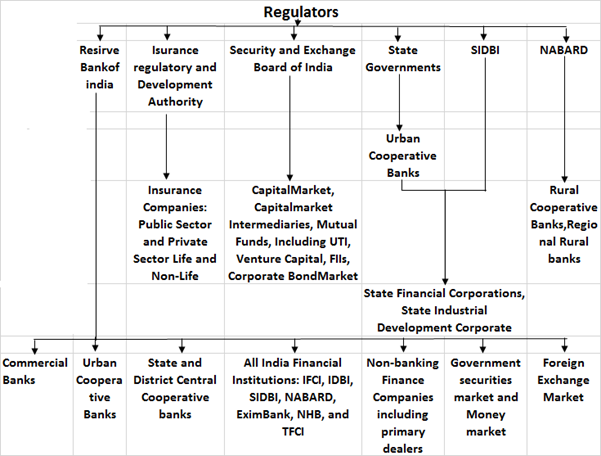
Regulation of Debt Market: The Reserve Bank of India regulates the government securities market and money market while the corporate debt market comes under the purview of the Securities Exchange and Board of India (SEBI).

In order to promote an orderly development of the market, the government issued a notification on March 2, 2000 delineating the areas of responsibility between the Reserve Bank and SEBI. The contracts for sale and purchase of government securities, gold related securities, Money market securities and securities derived from these securities and ready forward contracts in debt securities shall be regulated by the Reserve Bank. Such contracts, if executed on the stock exchanges shall, however, be regulated by SEBI in manner that is consistent with the guidelines issued by the Reserve Bank.

Link between Money Market and Debt Market:

The money market is market dealing in short term debt instruments (up to one year) while the debt market is a market for long term instruments (more than one year) The money market supports the long term debt market by increasing the liquidity of securities. A developed money market is a prerequisite of the development of a debt market.

Characteristics of Debt Market:

The characteristics of an efficient debt market are a competitive market structure, low transaction costs, a strong and safe market infrastructure and a high level of heterogeneity among market participants.

Debt market in India

There are different kinds of Debt Instruments available in India such as;
Below given are the important debt instruments available in India:

  • Bonds
  • Certificates of Deposit
  • Commercial Papers
  • Debentures
  • FD
  • G – Secs (Government Securities)
  • National savings Certificate (NSC)

Bonds

A Bond is simply an ‘IOU’ in which an investor agrees to lend money to a company or government in exchange for a predetermined interest rate. If a business wants to expand, one of its options is to borrow money from individual investors. The company issues bonds at different interest rates and sells them to the public. Investors purchase them with the understanding that the company will pay back their original principal with some interest that is due by a set date (this is known as the “maturity”). The interest a bondholder earns depends on the strength of the corporation.

For example, a blue chip is more stable and has a lower risk of defaulting on its debt. Sometimes some big companies issue bonds and they may only pay 7% interest, but some other small companies may pay you 10%. A general rule of thumb when investing in bonds is that “the higher the interest rate, the riskier the bond.”

Following are allowed to issue bonds

  1. Governments
  2. Municipalities
  3. Variety of institutions
  4. Corporations

There are many types of bonds, each having diverse features and characteristics. Bonds and stocks are both securities, but the major difference between the two is that stockholders have an equity stake in the company (i.e., they are owners), whereas bondholders have a creditor stake in the company (i.e., they are lenders). Another difference is that bonds usually have a defined term, or maturity, after which the bond is redeemed, whereas stocks may be outstanding indefinitely.

Returns in Bonds Returns is depends on the nature of the bonds that have been purchased by the investor. Bonds may be secured or unsecured. Firstly, always check up the credit rating of the issuing company before purchasing the bond. This gives you a working knowledge of the company’s financial health and an idea about the risk considerations of the instrument itself. Interest payments depend on the health and credit rating of the issuer. Therefore, it is essential to check the credit rating and financial health of the issuer before loosening up the bond. If you do invest in bonds issued by the top-rated Corporates, there is no guarantee that you will receive your payments on time.

Risks in Bonds In certain cases, the issuer has a call option mentioned in the prospectus. This means that after a certain period, the issuer has the choice of redeeming the bonds before their maturity. In that case, while you will receive your principal and the interest accrued till that date, you might lose out on the interest that would have accrued on your sum in the future had the bond not been redeemed. Always remember that if interest rates go up, bond prices go down and vice-versa.

Buying and Holding of Bonds Investors can subscribe to primary issues of Corporates and Financial Institutions (FIs). It is common practice for FIs and corporates to raise funds for asset financing or capital expenditure through primary bond issues. Some bonds are also available in the secondary market. The minimum investment for bonds can either be Rs 5,000 or Rs 10,000. However, this amount varies from issue to issue. There is no prescribed upper limit to your investment. The duration of a bond issue usually varies between 5 and 7 years.

Selling of Bonds Selling bonds in the secondary market has its own drawbacks. First, there is a liquidity problem which means that it is a tough job to find a buyer. Second, even if you find a buyer, the prices may be at a sharp discount to its intrinsic value. Third, you are subject to market forces and, hence, market risk. If interest rates are running high, bond prices will be down and you may well end up incurring losses. On the other hand, Debentures are always secured.

Liquidity of a Bond: Selling in the debt market is an obvious option. Some issues also offer Put and Call option.

  • In Put option, the investor has the option to approach the issuing entity after a specified period (say, three years), and sell back the bond to the issuer.
  • In Call option, the company has the right to recall its debt obligation after a particular time frame.

Debenture

A debenture is similar to a bond except the securitization conditions are different. A debenture is generally unsecured in the sense that there are no liens or pledges on specific assets. It is defined as a certificate of agreement of loans which is given under the company’s stamp and carries an undertaking that the debenture holder will get a fixed return (fixed on the basis of interest rates) and the principal amount whenever the debenture matures.

In finance, a debenture is a long-term debt instrument used by governments and large companies to obtain funds. The advantage of debentures to the issuer is they leave specific assets burden free, and thereby leave them open for subsequent financing. Debentures are generally freely transferrable by the debenture holder. Debenture holders have no voting rights and the interest given to them is a charge against profit.

Debentures vs. Bonds

Debentures and bonds are similar except for one difference bonds are more secure than debentures. In case of both, you are paid a guaranteed interest that does not change in value irrespective of the fortunes of the company. However, bonds are more secure than debentures, but carry a lower interest rate. The company provides collateral for the loan. Moreover, in case of liquidation, bondholders will be paid off before debenture holders.

A debenture is more secure than a stock, but not as secure as a bond. In case of bankruptcy, you have no collateral you can claim from the company. To compensate for this, companies pay higher interest rates to debenture holders. All investment, including stocks bonds or debentures carry an element of risk.

Commercial Papers

Commercial Paper (CP) is an unsecured money market instrument issued in the form of a promissory note. It was introduced in India in 1990 with a view to enable highly rated corporate borrowers/ to diversify their sources of short-term borrowings and to provide an additional instrument to investors. Subsequently, primary dealers and satellite dealers were also permitted to issue CP to enable them to meet their short-term funding requirements for their operations. CP can be issued in denominations of Rs.5 lakh or multiples thereof. Amount invested by a single investor should not be less than Rs.5 lakh (face value). It will be issued foe a duration of 30/45/60/90/120/180/270/364 days. Only a scheduled bank can act as an Issuing and Paying Agent IPA for issuance of CP.

Features of Commercial Papers

Following are the important features of commercial papers

  • They are unsecured debts of corporates and are issued in the form of promissory notes, redeemable at par to the holder at maturity.
  • Only corporates who get an investment grade rating can issue CPs, as per RBI rules.
  • It is issued at a discount to face value
  • Attracts issuance stamp duty in primary issue
  • Has to be mandatorily rated by one of the credit rating agencies
  • It is issued as per RBI guidelines
  • It is held in Demat form
  • CP can be issued in denominations of Rs.5 lakh or multiples thereof. Amount invested by a single investor should not be less than Rs.5 lakh (face value).
  • Issued at discount to face value as may be determined by the issuer.
  • Bank and FI’s are prohibited from issuance and underwriting of CP’s.
  • Can be issued for a maturity for a minimum of 15 days and a maximum upto one year from the date of issue.

Development of Equity culture in India & current position

Indian equity culture is a notorious concoction of temptation, noise, and information scarcity.

India is indeed a statistical marvel! A country of over a billion people with a $1 trillion plus economy, a middle class population of between 300 million-500 million, around 117 million Smartphone users, and a stock market that boasts capitalization of over a $1 trillion. It’s a country that for some time now has been a data hub to the world owing to its burgeoning BPO, KPO, and IT analytics establishments.

It wouldn’t be an exaggeration then if we call India a land of hopes and promise largely because of her compelling statistics and vast body of data about her economics, consumers, and demographic trends. Ironically, a country washed over by such great proportion of data points has failed brilliantly so far in arming her citizens with actionable information on a wide range of matters. One such class of citizens is the ever vulnerable retail investors and the matter here is about building an equity culture.

The market regulatory bodies SEBI, AMFI have worked hard with the market participants like brokerage and fund houses to push the envelope on investor education since the last two decades. Interestingly, SEBI over the past few years have incentivized the equity culture through a slew of benefits like IPO quotas, price discounts, and tax breaks et al. Nevertheless, the success of these initiatives is highly debatable at best.

Investor Awareness Programs – Temptation or Education?
The brokerage, fund houses, and financial media in India are but dubious stakeholders in the grand project of building equity culture in India. Building an equity culture is an idea and not a trend. Retail investors are often flooded with NFOs and MF schemes when much of the milk has already been skimmed by the fat cats, namely FIIs and HNIs. Recall, not many schemes and NFOs were launched between 2009-2013, when the valuations were cheap and upside price opportunities for long-term retail investors were immense.

Unsurprisingly, during these years Sensex rose over 100% where as retail investors participation grew by just 33%. Come 2014 we have been flooded by a plethora of NFOs and MF schemes when many stocks already have gained, on an average, by well over 30%-60%. Of course, there is immense potential for India’s economy to grow in the next 5 years but isn’t investing supposed to be independent of fads, trends, and upturns?

Building a culture of investing is about being disciplined and regularity. The stakeholders intending to build a robust Indian equity culture must focus on values that are totally independent of market fads and trends. Importantly, investor education is not about tempting gullible investors into overbought and overvalued markets, which has sadly been the only form of education imparted by the equity culture stakeholders.

Financial Media: Noise or News

Indian financial news media (print and TV) has done little in terms helping retail investors understand markets better. Much of what is spoken on business TVs and print media is about events with great importance to the momentum driven portfolios of FIIs than the long-term retail investors. The brilliant case in point is turbulence in Iraq. While oil import risk arising out of the deadly humanitarian crisis in Iraq could potentially affect inflation levels, but the risk to the Indian economy is overblown.

Geopolitical developments are akin to arbitrage opportunities as in they last for a very short duration of time. Investors with flamboyant investment styles are most likely to be affected by such short-term developments than the long-term retail investors. Moreover, not many media or publishing houses aid retail investors by conducting studies on long-term performance of different investment styles, MF schemes (hybrid, capital protection, and arbitrage et al) that could possibly serve as a reference point for small investors for making informed investment decisions.

On the other hand, major data releases like economic indicators, industrial production, Sensex/Nifty movements, and market outlook are expressed in a technical parlance about which much of the retail investors are oblivious. The fact that a major chunk of retail investors make their investment decisions based on tips, advice, and suggestions from a heterogeneous group of brokers, friends, and family members talks a lot about the ineffectiveness of the Indian financial media companies.

As the things stands now the nexus of brokerage, fund houses and financial news companies have succeeded in luring retail investors into yet another Indian bull rally. As I wrap this article the Indian equity culture is a notorious concoction of temptation, noise, and information scarcity!

Broad Constituents in the Indian Capital Markets

Quick summary with stories

Fund Raisers

Fund Raisers are companies that raise funds from domestic and foreign sources, both public and private. The following sources help companies raise funds.

Fund Providers

Fund Providers are the entities that invest in the capital markets. These can be categorized as domestic and foreign investors, institutional and retail investors. The list includes subscribers to primary market issues, investors who buy in the secondary market, traders, speculators, FIIs/ sub-accounts, mutual funds, venture capital funds, NRIs, ADR/GDR investors, etc.

Intermediaries

Intermediaries are service providers in the market, including stock brokers, sub-brokers, financiers, merchant bankers, underwriters, depository participants, registrar and transfer agents, FIIs/ sub-accounts, mutual Funds, venture capital funds, portfolio managers, custodians, etc.

Organizations

Organizations include various entities such as MCX-SX, BSE, NSE, other regional stock exchanges, and the two depositories National Securities Depository Limited (NSDL) and Central Securities Depository Limited (CSDL).

Market Regulators

Market Regulators include the Securities and Exchange Board of India (SEBI), the Reserve Bank of India (RBI), and the Department of Company Affairs (DCA).

Role and Importance Of Capital Market In India

The capital market has a crucial significance to capital formation. For a speedy economic development, the adequate capital formation is necessary. The significance of capital market in economic development is explained below:

Mobilization of Savings And Acceleration Of Capital Formation:

In developing countries like India, the importance of capital market is self-evident. In this market, various types of securities help to mobilize savings from various sectors of the population. The twin features of reasonable return and liquidity in stock exchange are definite incentives to the people to invest in securities. This accelerates the capital formation in the country.

Raising Long-Term Capital

The existence of a stock exchange enables companies to raise permanent capital. The investors cannot commit their funds for a permanent period but companies require funds permanently. The stock exchange resolves this dash of interests by offering an opportunity to investors to buy or sell their securities, while permanent capital with the company remains unaffected.

Promotion Of Industrial Growth

The stock exchange is a central market through which resources are transferred to the industrial sector of the economy. The existence of such an institution encourages people to invest in productive channels. Thus it stimulates industrial growth and economic development of the country by mobilizing funds for investment in the corporate securities.

Ready And Continuous Market

The stock exchange provides a central convenient place where buyers and sellers can easily purchase and sell securities. Easy marketability makes an investment in securities more liquid as compared to other assets.

Technical Assistance

An important shortage faced by entrepreneurs in developing countries is technical assistance. By offering advisory services relating to the preparation of feasibility reports, identifying growth potential and training entrepreneurs in project management, the financial intermediaries in capital market play an important role.

Reliable Guide to Performance

The capital market serves as a reliable guide to the performance and financial position of corporate, and thereby promotes efficiency.

Proper Channelization of Funds

The prevailing market price of a security and relative yield are the guiding factors for the people to channelize their funds in a particular company. This ensures effective utilization of funds in the public interest.

Provision of Variety Of Services:

The financial institutions functioning in the capital market provide a variety of services such as a grant of long-term and medium-term loans to entrepreneurs, provision of underwriting facilities, assistance in the promotion of companies, participation in equity capital, giving expert advice etc.

Development of Backward Areas

Capital Markets provide funds for projects in backward areas. This facilitates economic development of backward areas. Long-term funds are also provided for development projects in backward and rural areas.

Foreign Capital

Capital markets make possible to generate foreign capital. Indian firms are able to generate capital funds from overseas markets by way of bonds and other securities. The government has liberalized Foreign Direct Investment (FDI) in the country. This not only brings in the foreign capital but also foreign technology which is important for economic development of the country.

Easy Liquidity

With the help of secondary market, investors can sell off their holdings and convert them into liquid cash. Commercial banks also allow investors to withdraw their deposits, as and when they are in need of funds.

Divorce between ownership and management in companies

Divorce between Ownership and Control

Divorce between ownership and control refers to a situation where the owners of a company or corporation (i.e., the shareholders) do not have direct control over the day-to-day operations and decision-making of the company. This can occur when shareholders elect a board of directors to oversee the company’s management and make decisions on their behalf.

The separation of ownership and control is often seen in large corporations where there are numerous shareholders who are not actively involved in the company’s operations. In these cases, the board of directors is responsible for hiring the management team, setting strategic direction, and making decisions on behalf of the shareholders.

While this separation can lead to more efficient decision-making and a greater focus on long-term goals, it can also create conflicts of interest between shareholders and management. For example, managers may prioritize their own interests over those of the shareholders, leading to a misalignment of incentives. Additionally, the board of directors may not always act in the best interests of the shareholders, leading to concerns about corporate governance and accountability.

Ownership and Control of a Business

Ownership and control of a business refer to two different aspects of the management and decision-making of a company. Ownership refers to the legal right to control a business or property and to reap its benefits, usually represented by ownership of shares or equity in the company. Control, on the other hand, refers to the power to manage and direct the day-to-day operations of the business.

In a small business, the owner(s) typically have both ownership and control, making all major decisions and managing the operations of the business. However, in larger companies, ownership and control may be separated. In such cases, the owners of a business are the shareholders, while the management team, led by the CEO or other top executives, exercises control over the company’s operations and decision-making.

The relationship between ownership and control is often a balancing act, as shareholders seek to maximize the value of their investments while the management team aims to grow the business and make decisions that benefit the company as a whole. This can sometimes lead to conflicts of interest, particularly when there is a misalignment of incentives or when shareholders believe that management is not acting in their best interests.

Effective corporate governance mechanisms, such as a board of directors, can help to mitigate these conflicts and ensure that the interests of shareholders and management are aligned. Ultimately, the success of a business depends on finding the right balance between ownership and control and creating a culture of trust and transparency between shareholders and management.

The Principal Agent Problem

The principal-agent problem is a common issue that arises when one person or entity (the principal) hires another person or entity (the agent) to act on their behalf, and the interests of the principal and agent are not perfectly aligned. This problem can occur in various contexts, including corporate governance, public policy, and even personal relationships.

In corporate governance, for example, shareholders (the principals) elect a board of directors to oversee the company’s management and make decisions on their behalf. However, the board of directors (the agents) may not always act in the best interests of the shareholders. Instead, they may prioritize their own interests, such as maintaining their position on the board or pursuing personal gain, over maximizing shareholder value.

The principal-agent problem can also arise in public policy, where elected officials (the principals) hire bureaucrats and other government officials (the agents) to implement policies on their behalf. In this case, the agents may prioritize their own interests or those of special interest groups over the interests of the public.

To mitigate the principal-agent problem, various mechanisms can be put in place, such as performance-based compensation, transparency, and accountability mechanisms. These mechanisms aim to align the interests of the principal and agent and ensure that the agent acts in the best interests of the principal. However, it is often difficult to fully eliminate the principal-agent problem, and it remains an ongoing challenge in many areas of decision-making.

Dealing with the Divorce between Ownership & Control

Dealing with the divorce between ownership and control can be challenging, as it requires finding a way to align the interests of shareholders and management to ensure that the company is being run in the best interests of all stakeholders. Here are some ways that companies can mitigate the issues associated with the separation of ownership and control:

  • Strong Corporate Governance: Having a strong board of directors, including independent directors who are not involved in day-to-day operations, can help to ensure that management is held accountable and that decisions are made in the best interests of shareholders.
  • Performance-Based Compensation: Tying executive compensation to performance metrics that align with shareholder interests can incentivize management to act in the best interests of shareholders.
  • Shareholder Activism: Shareholders can exercise their rights by engaging in proxy contests or shareholder proposals, which can help to influence decision-making by the board and management.
  • Transparency and Disclosure: Companies can be transparent about their operations and decision-making, providing regular updates to shareholders about financial performance, strategic direction, and key decisions.
  • Social Responsibility: Emphasizing social responsibility and environmental, social, and governance (ESG) considerations can help to align the interests of shareholders and management around long-term sustainability and value creation.

Activist Shareholders

Activist shareholders are individuals or groups of investors who use their ownership stake in a company to advocate for changes that they believe will improve the company’s performance or align it with their values. They typically have a more active approach to investing than passive investors, who simply hold shares of a company without seeking to influence its direction.

Activist shareholders may push for a range of changes, such as board or management changes, strategic shifts, asset sales, share buybacks, or dividend increases. They may also seek to influence a company’s environmental, social, or governance (ESG) practices, such as by advocating for more sustainable or ethical business practices.

Activist shareholders may take a variety of actions to push for change, such as filing shareholder proposals, engaging in public campaigns or media outreach, or even seeking to replace board members through proxy battles. Some activist shareholders may be viewed as aggressive or disruptive by management and other stakeholders, while others may be seen as constructive partners in driving long-term value creation.

Equity Market Meaning & Definition of equity share

Mark Twain once divided the world into two kinds of people:

those who have seen the famous Indian monument, the Taj Mahal, and those who haven’t. The same could be said about investors.

There are two kinds of investors: those who know about the investment opportunities in India and those who don’t. India may look like a small dot to someone in the U.S., but upon closer inspection, you will find the same things you would expect from any promising market. Here we’ll provide an overview of the Indian stock market and how interested investors can gain exposure.

The BSE and NSE

Most of the trading in the Indian stock market takes place on its two stock exchanges: the Bombay Stock Exchange (BSE) and the National Stock Exchange (NSE). The BSE has been in existence since 1875. The NSE, on the other hand, was founded in 1992 and started trading in 1994. However, both exchanges follow the same trading mechanism, trading hours, settlement process, etc. At the last count, the BSE had about 4,700 listed firms, whereas the rival NSE had about 1,200. Out of all the listed firms on the BSE, only about 500 firms constitute more than 90% of its market capitalization; the rest of the crowd consists of highly illiquid shares.

Almost all the significant firms of India are listed on both the exchanges. NSE enjoys a dominant share in spot trading, with about 70% of the market share, as of 2009, and almost a complete monopoly in derivatives trading, with about a 98% share in this market, also as of 2009. Both exchanges compete for the order flow that leads to reduced costs, market efficiency and innovation. The presence of arbitrageurs keeps the prices on the two stock exchanges within a very tight range. 

Trading Mechanism

Trading at both the exchanges takes place through an open electronic limit order book, in which order matching is done by the trading computer. There are no market makers or specialists and the entire process is order-driven, which means that market orders placed by investors are automatically matched with the best limit orders. As a result, buyers and sellers remain anonymous. The advantage of an order driven market is that it brings more transparency, by displaying all buy and sell orders in the trading system. However, in the absence of market makers, there is no guarantee that orders will be executed.

All orders in the trading system need to be placed through brokers, many of which provide online trading facility to retail customers. Institutional investors can also take advantage of the direct market access (DMA) option, in which they use trading terminals provided by brokers for placing orders directly into the stock market trading system.

Settlement Cycle and Trading Hours

Equity spot markets follow a T+2 rolling settlement. This means that any trade taking place on Monday, gets settled by Wednesday. All trading on stock exchanges takes place between 9:55 am and 3:30 pm, Indian Standard Time (+ 5.5 hours GMT), Monday through Friday. Delivery of shares must be made in dematerialized form, and each exchange has its own clearing house, which assumes all settlement risk, by serving as a central counterparty.

Market Indexes

The two prominent Indian market indexes are Sensex and Nifty. Sensex is the oldest market index for equities; it includes shares of 30 firms listed on the BSE, which represent about 45% of the index’s free-float market capitalization. It was created in 1986 and provides time series data from April 1979, onward.

Another index is the S&P CNX Nifty; it includes 50 shares listed on the NSE, which represent about 62% of its free-float market capitalization. It was created in 1996 and provides time series data from July 1990, onward.

Market Regulation

The overall responsibility of development, regulation and supervision of the stock market rests with the Securities & Exchange Board of India (SEBI), which was formed in 1992 as an independent authority. Since then, SEBI has consistently tried to lay down market rules in line with the best market practices. It enjoys vast powers of imposing penalties on market participants, in case of a breach.

Primary and Secondary Market

Primary Market

Primary market is the place where new shares or bonds are issued. Hence primary market is also called as new issue market. In primary market company sells the shares to investors to generate the fund. In primary market the trading is directly between investors and company. Here the price of share is decided by company and is fixed. In primary market investors can only buy shares, they cannot sell them. Shares purchased in primary market are sold in secondary market. In primary market company can raise the fund by three types that is public issue, private placement or right issue.

Secondary Market

Secondary market is also called as After market. Stock exchange is the secondary market. The stock exchange is the medium through which the exchange of shares, Equities takes place between the seller and the buyer. Secondary market is the place where most of the trading takes place. The trading of shares and capital in secondary market takes place between the buyer and the seller, company is not involved in transactions. The price of share is decided by demand and supply of the shares and price keeps on fluctuating. In secondary market no new stocks are issued, only trading of stocks is there.

Equity Shares

Equity shares are the main source of finance of a firm. It is issued to the general public. Equity share­holders do not enjoy any preferential rights with regard to repayment of capital and dividend. They are entitled to residual income of the company, but they enjoy the right to control the affairs of the business and all the shareholders collectively are the owners of the company.

Features of Equity Shares

  1. They are permanent in nature.
  2. Equity shareholders are the actual owners of the company and they bear the highest risk.
  3. Equity shares are transferable, i.e. ownership of equity shares can be transferred with or without consideration to other person.
  4. Dividend payable to equity shareholders is an appropriation of profit.
  5. Equity shareholders do not get fixed rate of dividend.
  6. Equity shareholders have the right to control the affairs of the company.
  7. The liability of equity shareholders is limited to the extent of their investment.

Advantages of Equity Shares

Equity shares are amongst the most important sources of capital and have certain advantages which are mentioned below:

  1. Advantages from the Shareholders’ Point of View

(a) Equity shares are very liquid and can be easily sold in the capital market.

(b) In case of high profit, they get dividend at higher rate.

(c) Equity shareholders have the right to control the management of the company.

(d) The equity shareholders get benefit in two ways, yearly dividend and appreciation in the value of their investment.

  1. Advantages from the Company’s Point of View:

(a) They are a permanent source of capital and as such; do not involve any repayment liability.

(b) They do not have any obligation regarding payment of dividend.

(c) Larger equity capital base increases the creditworthiness of the company among the creditors and investors.

Disadvantages of Equity Shares:

Despite their many advantages, equity shares suffer from certain limitations. These are:

  1. Disadvantages from the Shareholders’ Point of View:

(a) Equity shareholders get dividend only if there remains any profit after paying debenture interest, tax and preference dividend. Thus, getting dividend on equity shares is uncertain every year.

(b) Equity shareholders are scattered and unorganized, and hence they are unable to exercise any effective control over the affairs of the company.

(c) Equity shareholders bear the highest degree of risk of the company.

(d) Market price of equity shares fluctuate very widely which, in most occasions, erode the value of investment.

(e) Issue of fresh shares reduces the earnings of existing shareholders.

  1. Disadvantage from the Company’s Point of View:

(a) Cost of equity is the highest among all the sources of finance.

(b) Payment of dividend on equity shares is not tax deductible expenditure.

(c) As compared to other sources of finance, issue of equity shares involves higher floatation expenses of brokerage, underwriting commission, etc.

Different Types of Equity Issues:

Equity shares are the main source of long-term finance of a joint stock company. It is issued by the company to the general public. Equity shares may be issued by a company in different ways but in all cases the actual cash inflow may not arise (like bonus issue).

The different types of equity issues have been discussed below:

  1. New Issue:

A company issues a prospectus inviting the general public to subscribe its shares. Generally, in case of new issues, money is collected by the company in more than one installment— known as allotment and calls. The prospectus contains details regarding the date of payment and amount of money payable on such allotment and calls. A company can offer to the public up to its authorized capital. Right issue requires the filing of prospectus with the Registrar of Companies and with the Securities and Exchange Board of India (SEBI) through eligible registered merchant bankers.

  1. Bonus Issue:

Bonus in the general sense means getting something extra in addition to normal. In business, bonus shares are the shares issued free of cost, by a company to its existing shareholders. As per SEBI guidelines, if a company has sufficient profits/reserves it can issue bonus shares to its existing shareholders in proportion to the number of equity shares held out of accumulated profits/ reserves in order to capitalize the profit/reserves. Bonus shares can be issued only if the Articles of Association of the company permits it to do so.

Advantage of Bonus Issues:

From the company’s point of view, as bonus issues do not involve any outflow of cash, it will not affect the liquidity position of the company. Shareholders, on the other hand, get bonus shares free of cost; their stake in the company increases.

Disadvantages of Bonus Issues:

Issue of bonus shares decreases the existing rate of return and thereby reduces the market price of shares of the company. The issue of bonus shares decreases the earnings per share.

Rights Issue:

According to Section 81 of The Company’s Act, 1956, rights issue is the subsequent issue of shares by an existing company to its existing shareholders in proportion to their holding. Right shares can be issued by a company only if the Articles of Association of the company permits. Rights shares are generally offered to the existing shareholders at a price below the current market price, i.e. at a concessional rate, and they have the options either to exercise the right or to sell the right to another person. Issue of rights shares is governed by the guidelines of SEBI and the central government.

Rights shares provide some monetary benefits to the existing shareholders as they get shares at a concessional rate—this is known as value of right which can be computed as:

Value of right = Cum right market price of a share – Issue price of a new share / Number of old shares + 1

Advantages of Rights Issue:

Rights issues do not affect the controlling power of existing share­holders. Floatation costs, brokerage and commission expenses are not incurred by the company unlike in the public issue. Shareholders get some monetary benefits as shares are issued to them at concessional rates.

Disadvantages of Rights Issue:

If a shareholder fails to exercise his rights within the stipulated time, his wealth will decline. The company loses cash as shares are issued at concessional rate.

Sweat Issue:

According to Section 79A of The Company’s Act, 1956, shares issued by a company to its employees or directors at a discount or for consideration other than cash are known as sweat issue. The purpose of sweat issue is to retain the intellectual property and knowhow of the company. Sweat issue can be made if it is authorized in a general meeting by special resolution. It is also governed by Issue of Sweet Equity Regulations, 2002, of the SEBI.

Advantages of Sweat Issue:

Sweat equity shares cannot be transferred within 3 years from the date of their allotment. It does not involve floatation costs and brokerage.

Disadvantage of Sweat Issue:

As sweat equity shares are issued at concessional rates, the com­pany loses financially.

Regulatory framework in the Indian Debt Market

Regulations are very important for the growth of capital markets all through the world. The development of a market economy is dependent on the growth of the capital market. The regulation of a capital market encompasses the regulation of securities. These rules enable the capital market to function more competently and fairly.

A well regulated market has the prospective to boost additional investors to participate, and contribute in, promoting the development of the economy.

Capital Market Regulatory Authorities Worldwide: The chief capital market regulatory authorities worldwide are as follows:

  • Securities and Exchange Board of India
  • U.S. Securities and Exchange Commission
  • Canadian Securities Administrators, Canada
  • Australian Securities and Investments Commission
  • Securities and Exchange Commission, Pakistan
  • Securities and Exchange Commission, Bangladesh
  • Securities and Exchange Surveillance Commission
  • Securities and Futures Commission, Hong Kong
  • Financial Supervision Authority, Finland
  • Financial Supervision Commission, Bulgaria
  • Financial Services Authority, UK
  • Commission Nacional del Mercado de Valores, Spain
  • Authority of Financial Markets

It has been well established that there is a growing network of financial intermediaries that operate in a highly competitive environment while being directed by strict norms. India has one of the most refined new equity issuance markets. Disclosure requirements and the accounting policies followed by listed companies to offer financial information are comparable to the best systems in the world. In Indian scenario, the securities market is regulated by various agencies such as department of economic affairs, department of company affairs, and the reserve bank of India. The capital markets and protection of investor’s interest is now primarily the responsibility of the Securities and Exchange Board of India (SEBI), which is located in Bombay. The activities of these agencies are coordinated by high level committee on capital and financial market. The high level coordinated committee for financial market discusses various policy level issues which require inter regularity coordination between the regulators in financial market such as RBI, SEBI, insurance, regulatory and development authority (IRDA) and pension regulatory and development authority. The committee is chaired by Governor, RBI, secretary minister of finance, chairman SEBI, chairman IRDA, and chairman, PRDA are members of committee.

The capital market is market of equity and debt securities is regulated by Securities and Exchange Board of India (SEBI). Securities and Exchange Board of India (SEBI) has full autonomy and authority to regulate and develop capital market. The government has framed rules under securities controls act, the SEBI act and depositories act.

SEBI’s functions include:

  1. Regulating the business in stock exchange and any other securities markets.
  2. Registering and regulating the working of collective investment schemes, including mutual funds.
  3. Barring fraudulent and unfair trade practices relating to securities markets.
  4. Promoting investor’s education and training of intermediaries of securities markets.
  5. Prohibiting insider trading in securities, with the imposition of monetary penalties, on erring market intermediaries.
  6. Regulating substantial acquisition of shares and takeover of companies.
  7. Calling for information from, carrying out inspection, conducting inquiries and audits of the stock exchanges and intermediaries and self-regulatory organizations in the securities market.

To summarize, Capital market is controlled by financial supervisors and their own governance organization. Major grounds of regulation are to keep investors away from scam and deception. Financial regulatory organizations are also charged with decreasing the losing rate of financial, providing licenses to financial service providers, and executing applicable regulations.

Money Market in India

Money market in India plays a vital role in maintaining liquidity in the financial system, facilitating short-term borrowing and lending, and ensuring the smooth functioning of the economy. It acts as an intermediary between entities needing short-term funds and those with surplus funds. The market deals in instruments with a maturity period of one year or less, offering a platform for the government, financial institutions, and corporations to meet their short-term funding needs. The money market in India is regulated by the Reserve Bank of India (RBI), which oversees its operations to maintain stability and liquidity.

Structure of the Money Market in India

The Indian money market is well-diversified, comprising various institutions and instruments. It functions through two main sectors: the organized money market and the unorganized money market.

a) Organized Money Market

The organized money market in India is regulated and operates within a structured framework. It includes government securities, financial institutions, and commercial banks. The key components of the organized money market are:

  • Commercial Banks: Banks play a crucial role by borrowing and lending in the money market, managing liquidity, and dealing in money market instruments like treasury bills and call money.
  • Reserve Bank of India (RBI): The central bank of India regulates the money market, implements monetary policy, and maintains liquidity through tools such as open market operations, repo rates, and reverse repo rates.
  • Primary Dealers: These are specialized institutions authorized to deal in government securities. They support liquidity in the money market by buying and selling treasury bills and government bonds.
  • Financial Institutions: Non-banking financial institutions (NBFCs) also participate in the money market by issuing short-term debt instruments like commercial papers (CPs) and certificates of deposit (CDs).

b) Unorganized Money Market

The unorganized money market comprises informal sources of credit, such as moneylenders, indigenous bankers, and pawnbrokers. These entities operate without government regulation and typically charge high-interest rates. Although they play a crucial role, especially in rural areas where formal banking infrastructure is limited, they are less transparent and riskier compared to the organized market.

Instruments in the Indian Money Market

Several financial instruments are used in the Indian money market, allowing participants to raise short-term funds, invest, and manage liquidity. Some key instruments:

a) Treasury Bills (T-Bills)

Issued by the Government of India through the RBI, T-Bills are short-term securities with maturities of 91, 182, or 364 days. They are issued at a discount and redeemed at face value upon maturity. T-Bills are highly liquid and are a common instrument in the money market for managing government finances and liquidity.

b) Commercial Papers (CP)

Commercial papers are unsecured short-term debt instruments issued by corporations, financial institutions, and other large entities to raise funds. These papers are issued at a discount and are typically used for funding working capital requirements. CPs have a maturity period of 7 days to 1 year.

c) Certificates of Deposit (CD)

Issued by commercial banks and financial institutions, certificates of deposit are short-term fixed deposits offered to investors with maturities ranging from 7 days to 1 year. They offer higher interest rates than savings accounts and can be traded in the secondary market.

d) Call Money and Notice Money

  • Call Money is the overnight borrowing and lending of funds between commercial banks in the money market, typically at a very short maturity (1 day). It helps manage liquidity between banks.
  • Notice Money is a type of short-term loan with a maturity period of 2 to 14 days, where the lending institution must give notice before the funds are repaid.

e) Repurchase Agreements (Repos)

Repo is an agreement in which one party sells securities to another with the promise to repurchase them at a specified price on a future date. This instrument is used to inject or absorb liquidity in the money market. Reverse repos serve the opposite purpose of repos, where the RBI or a bank buys securities and agrees to sell them later.

f) Bankers’ Acceptances (BA)

Banker’s acceptance is a short-term credit instrument issued by a company and guaranteed by a bank. It is used mainly in international trade to finance transactions between buyers and sellers.

Role of the Reserve Bank of India (RBI) in the Money Market

Reserve Bank of India (RBI) plays a critical role in regulating and overseeing the money market. The RBI is responsible for controlling the money supply, maintaining price stability, and ensuring financial stability. Its major functions:

  • Monetary Policy Implementation: The RBI uses tools like repo rates, reverse repo rates, and CRR (cash reserve ratio) to influence liquidity and manage inflation. It also conducts open market operations (OMO) to buy and sell government securities to control liquidity.
  • Lender of Last Resort: RBI acts as the lender of last resort to financial institutions in case of liquidity shortages.
  • Liquidity Management: Through instruments such as repo and reverse repo operations, the RBI controls excess or deficient liquidity in the system.

Importance of the Money Market in India

  • Liquidity Management: It helps banks and financial institutions manage their liquidity needs efficiently, ensuring that they can meet their short-term obligations.
  • Monetary Policy Transmission: It facilitates the transmission of monetary policy by adjusting interest rates and liquidity, thus helping the RBI control inflation and stabilize the economy.
  • Government Financing: The money market is an essential tool for the government to raise short-term funds, through the issuance of treasury bills and other instruments.
  • Credit Control: The money market is vital for controlling inflation and influencing the overall level of credit in the economy.

Primary Equity Market

The primary market is the financial market where new securities are issued and become available for trading by individuals and institutions. The trading activities of the capital markets are separated into the primary market and secondary market.

In a primary market, securities are created for the first time for investors to purchase. New securities are issued in this market through a stock exchange, enabling the government as well as companies to raise capital.

For a transaction taking place in this market, there are three entities involved. It would include a company, investors, and an underwriter. A company issues security in a primary market as an initial public offering (IPO), and the sale price of such new issue is determined by a concerned underwriter, which may or may not be a financial institution. An underwriter also facilitates and monitors the new issue offering. Investors purchase the newly issued securities in the primary market. Such a market is regulated by the Securities and Exchange Board of India (SEBI).

The entity which issues securities may be looking to expand its operations, fund other business targets or increase its physical presence among others. Primary market example of securities issued includes notes, bills, government bonds or corporate bonds as well as stocks of companies.

The primary market is where companies issue a new security, not previously traded on any exchange. A company offers securities to the general public to raise funds to finance its long-term goals. The primary market may also be called the New Issue Market (NIM). In the primary market, securities are directly issued by companies to investors. Securities are issued either by an Initial Public Offer (IPO) or a Further Public Offer (FPO).

An IPO is the process through which a company offers equity to investors and becomes a publicly-traded company. Through an IPO, the company is able to raise funds and investors are able to invest in a company for the first time. Similarly, an FPO is a process by which already listed companies offer fresh equity in the company. Companies use FPOs to raise additional funds from the general public.

Raising Funds from the Primary Market

Below are some of the ways in which companies raise funds from the primary market:

  1. Public Issue

This is the most common way to issue securities to the general public. Through an IPO, the company is able to raise funds. The securities are listed on a stock exchange for trading purposes.

  1. Rights Issue

When a company wants to raise more capital from existing shareholders, it may offer the shareholders more shares at a price discounted from the prevailing market price. The number of shares offered is on a pro-rata basis. This process is known as a Rights Issue.

  1. Preferential Allotment

When a listed company issues shares to a few individuals at a price that may or may not be related to the market price, it is termed a preferential allotment. The company decides the basis of allotment and it is not dependent on any mechanism such as pro-rata or anything else.

Why companies issue shares to the public?

Companies come to the primary market to raise money for expansion. As each and every company requires capital for expansion and growth.

The capital can be in the form of:

  • Equity: It is termed as the stock capital of the company, also known as share capital.
  • Debt: it is termed as the loans taken by the business

The money raised in the primary market goes directly to issuing company. It is a place where capital formation takes place.

The issue can be in the form of a public issue, private placement, preferential issue, rights, and bonus issue.

A public issue does not limit anyone (individual, organization, or corporate) in investing, while in private placement, the issuance is done to select a number of people.

  • Allotment done to more than 200 people, becomes public allotment
  • Allotment done to less than 200 people, becomes private allotment

Since the securities are directly issued by the companies to its investors, the company receives the money and issues certificate of security to the investor.

The securities issued to the investors in the primary market in:

  • Face value
  • Premium value
  • Par value

When the issue of securities closes, then the securities are traded on the secondary market such as stock exchange, bonds market, derivative exchange.

Primary Market

Secondary Market

It is a way of issuing fresh shares in the market. It is also called New Issue Market. A major component of the primary market is the IPO. It is a place where already issued or existing shares are traded. It is called After Issue Market.
The amount received from the issue of shares goes to the company for their business expansion purposes. The amount invested by the buyer of shares goes to the seller, and hence the company doesn’t receive anything.
Securities are issued by the companies to the investors. Securities are exchanged between buyers and sellers, and stock exchanges facilitates the trade.
The securities are all issued at one price for all investors participating in the offering. Securities are exchanged at the market price.
The primary market doesn’t provide liquidity for the stock. The secondary market provides liquidity to the stock.
Underwriters act as intermediaries. Brokers act as intermediaries.
On the primary market, security can be sold just once. On the secondary market, securities can be sold innumerable times.

Functions of Primary Market

To understand the primary market definition in depth, let’s also discuss the functions of primary market. The general function of primary market is to channelize funds in to industrial enterprises. There are three functions of primary market which are given below:

  1. Origination

The term origination refers to the work of investigation and analysis and processing of new proposals. Specialist agencies perform these functions which act as sponsors of the issue. The preliminary investigation entails careful study of technical, economical, financial, and legal aspects of the issuing companies.

This is to ensure that it warrants the backing of the issue houses in the sense of lending their name to the company. Thus, give the issue the stamp of respectability. It shows company is strong, has good market prospects and is worthy of stock exchange quotation.

In the process of origination the sponsoring institutions render, as a second function, some service of an advisory nature which goes to improve the quality of capital issues. These services include advice on such aspects of capital issues as:

  • Determination of the class of securities that are going to issue and price of the issues in the light of market conditions”
  • The timing and magnitude of issues
  • Methods of flotation, and
  • Technique of selling, and so on market.
  1. Underwriting

In order to get the success of the issue, underwriters came into role. They guarantee the selling of the issue in case it is not subscribe by public. Hence eliminates the risk of uncertainty. Underwriting service is significant for both company as well as public. Company gets money and public get free of over stress.

  1. Distribution

The sale of securities to the ultimate investors is known as distribution. It is a specialist job which is performed by brokers and dealers in securities. They maintain direct and regular contact with the direct investors.

Significance of Primary Market

The key function of the primary market is to facilitate capital growth by enabling individuals to convert savings into investments. It facilitates companies to issue new stocks to raise money directly from households for business expansion or to meet financial obligations. It provides a channel for the government to raise funds from the public to finance public sector projects. Unlike the secondary market, such as the stock market which trades listed shares between buyers and sellers, the primary market exists for the issuance of new securities by corporations and the government directly to investors.

  1. Household Savings

Companies raise funds in the primary market by issuing initial public offerings (IPOs). These stock offerings authorize a share of ownership in the company to the extent of the stock value. Companies can issue IPOs at par (market value) or above par (a premium), depending on past performance and future prospectus. In a booming economy, a greater number of corporations float IPOs since more investors have surplus funds for investment purposes. Thus, the number of IPOs issued is indicative of the health of the economy. Invariably, smaller companies seeking funds for business expansion are the ones typically that float IPOs. But large, well-established firms also become publicly traded companies to gain visibility and to expand. Companies can raise an additional round of funding in the primary market by floating a secondary public offering.

  1. Global Investments

The primary market enables business expansion and growth for domestic and foreign companies. International firms issue new stocks–American Depository Receipts (ADRs -to investors in the U.S., which are listed in American stock exchanges. By investing in ADRs, which are dollar-denominated, you can diversify the risk associated with putting all your savings in just one geographical market.

  1. Sale of Government Securities

The government directly issues securities to the public via the primary market to fund public works projects such as the construction of roads, building schools etc. These securities are offered in the form of short-term bills, notes that mature in two to seven years, longer-term bonds and treasury inflation-protected securities (TIPS) linked to the Consumer Price Index. Visit the U.S. Treasury website for information about interest rates and maturity dates.

  1. Primary Market Participants

An investment bank sets the offer price of the corporate security as opposed to market forces, which determines the price in the secondary market. While brokerage firms and online licensed dealers sell IPOs to the public, you may not be allotted IPO shares because of the large demand for a small number of shares typically issued by the company. Moreover, institutional investors (large mutual funds and banks) usually get the lion’s share of much anticipated IPOs.

  1. Marker Risk

Government-issued U.S. Treasury bonds are free of credit risk. However, the Securities and Exchange Commission cautions investors that IPOs are inherently risky and therefore unsuited for low network individuals who typically are risk-averse.

Book Building

Companies all over the world use either fixed pricing or book building as a mechanism to price their shares. Over the period of time, the fixed price mechanism has become obsolete and book building has become the de-facto mechanism used in pricing shares while conducting an initial public offer (IPO). In this article, we will study how book building process works i.e. how are shares priced in an IPO:

Book building is a price discovery mechanism that is used in the stock markets while pricing securities for the first time. When shares are being offered for sale in an IPO, it can either be done at a fixed price. However, if the company is not sure about the exact price at which to market its shares, it can decide a price range instead of an exact figure. This process of discovering the price by providing the investors with a price range and then asking them to bid on it is called the book building process. It is considered to be one of the most efficient mechanisms of pricing securities in the primary market. This is the preferred method which is recommended by all major stock exchanges and as a result is followed in all major developed countries in the world.

Book Building Process

The detailed process of book building is as follows:

  1. Appointment of Investment Banker: The first step starts with appointing the lead investment banker. The lead investment banker conducts due diligence. They propose the size of the capital issue that must be conducted by the company. Then they also propose a price band for the shares to be sold. If the management agrees with the propositions of the investment banker, the prospectus is issued with the price range as suggested by the investment banker. The lower end of the price range is known as the floor price whereas the higher end is known as the ceiling price. The final price at which securities are indeed offered for sale after the entire book building process is called the cut-off price.
  2. Collecting Bids: Investors in the market are requested to bid to buy the shares. They are requested to bid the number of shares that they are willing to buy at varying price levels. These bids along with the application money are supposed to be submitted to the investment bankers. It must be noted that it is not a single investment banker who is engaged in the collection of bids. Rather, the lead investment banker can appoint sub-agents to tap into their network especially for receiving the bids from a larger group of individuals.
  3. Price Discovery: Once all the bids have been aggregated by the lead investment banker, they begin the process of price discovery. The final price chosen in simply the weighted average of all the bids that have been received by the investment banker. This price is declared as the cut-off price. For any issue which has received substantial publicity and which is being anticipated by the public, the ceiling price is usually the cut-off price.
  4. Publicizing: In the interest of transparency, stock exchanges all over the world require that companies make public the details of the bids that were received by them. It is the lead investment banker’s duty to run advertisements containing the details of the bids received for the purchase of shares for a given period of time (let’s say a week). The regulators in many markets are also entitled to physically verify the bid applications if they wish to.
  5. Settlement: Lastly, the application amount received from the various bidders has to be adjusted and shares have to be allotted. For instance, if a bidder has bid a lower price than the cut-off price then a call letter has to be sent asking for the balance money to be paid. On the other hand, if a bidder has bid a higher price than the cut-off, a refund cheque needs to be processed for them. The settlement process ensures that only the cut-off amount is collected from the investors in lieu of the shares sold to them.

Partial Book Building

Partial book building is another variation of the book building process. In this process, instead of inviting bids from the general population, investment bankers invite bids from certain leading institutions. Based on their bids, a weighted average of the prices is created and cut-off price is decided. This cut-off price is then offered to the retail investors as a fixed price. Therefore, the bidding only happens at an institutional level and not at a retail level.

This is also an efficient mechanism to discover prices. Also the cost and complications involved in conducting a partial book building are substantially low.

First of all, the book building process brings flexibility to the pricing of IPO’s. Prior to the introduction of book building, a lot of IPO’s were either underpriced or overpriced. This created problems because if the issue was underpriced, the company was losing possible capital. On the other hand, if the issue was overpriced it would not be fully subscribed. In fact, if it was subscribed below a given percentage, the issue of securities had to be cancelled and the substantial costs incurred over the issue would simply have to be written off. With the introduction of book building process, such events no longer happen and the primary market functions more efficiently.

error: Content is protected !!