The Changing Face of Retail Industry in India

India is fast becoming the retail destination of the world. According to the international management consultant AT Kearney, India has emerged as the leader in terms of retail opportunities. The retail market in India is anticipated to grow to 900 billion USD by the year 2020.

However, the face of the Indian retail industry is changing. India is passing through a retail boom today. A number of changes have taken place on the Indian retail front such as increasing availability of international brands, increasing number of malls and hypermarkets and easy availability of retail space. With the Indian government having opened up the doors for FDI, the entry of foreign retailers into the country has become easier. India has come a long way from the traditional Kirana stores and is on its way to becoming a ‘mall country’. The emphasis has shifted from reasonable pricing to convenience, efficiency and ambience.

The major factors fuelling this change are the increase in disposable income of the people, improving lifestyles, increasing international exposure and increasing awareness among the customers. India has a large middle class as well as youth population, which has contributed greatly to the retail phenomenon. The middle class is considered to be a major potential customer group. The youth are perceived as trend setters and decision makers. Tourist spending in India is increasing, which has also prompted the retail boom.

Food and grocery are the two categories in the Indian retail sector which offer the most promising opportunities. Apart from this, the other areas where there are vast possibilities for Indian retailers are jewellery, apparel and consumer durables. Indian retailers are also trying to create a niche for themselves in areas such as books, gifts and music.

Although organized retail is only a decade old to India but the pace at which the retail scenario and practices are getting tried and tested has been quite remarkable.

We have seen good adoptability to absorb some of the best practices with a touch of appropriateness of local preferences and style. It has come a long way and Indian Retail market has become the next frontier for most of the retail and brands practices.

Changes are good and need to be handled with care. Some of the prominent drivers in vogue are:

Retail Experience

Stores are no more just buying and selling but also to provide unique experience to customers. It’s a trend that has quickly become the pinnacle of retail success for both the big brands and the smaller start-ups.

From customer experience perspective, bricks and mortar stores are still extremely relevant; however, customer experience doesn’t rest entirely in the hands of physical retail.

In this digital era, it’s equally important to ensure that your brand resonates with the consumer online. Digital marketing is often the beginning of the brand journey and is built to assist with brand exposure; hopefully diving the in-store footfall.

Promotional features like use of technology, displays and in-store designs, personalization along with service and operational excellence have been adopted and implemented by brands to attract footfall at retail store. These help in building an important connect with the consumers.

How?

One of the large apparel brands Raymond recently launched its flagship store with that boasts of a double height ‘Live’ façade with LED curtains displaying digital content. This store has a unique fitting room trial experience with ‘Ipad’. The selection appears in the desired size inside the trial room.

Confluence of online and offline retail

Typically referred as Omni-channel phenomenon where physical and digital channels merging, is fast catching up, shopping centers in India are encountering the need to complement physical ambience with online stores. E-commerce and brick-and-mortar will co-exist and finally reach a level of maturity, translating into sound business sense for Omni-channel players.

Example: One of the leading footwear brands in India has introduced endless-aisle technology at one of their stores.

This endless-aisle technology allows consumers to browse, research and pick up their products with convenience. In addition to that, it also allows the retailer to sell products that are not available in stores.

Research based investments

Big Data, fast data and the data deluge are taking the world of digital businesses, especially the customer-focused ones, by storm. Retail is no exception as more and more customers leave digital footprints with every transaction, interaction and engagement at every retail touch-point online, mobile, social channels, in-store and even contact centers.

Technology is enabling businesses to collect shopper data from these touch-points, analyze it and derive insights to make informed decisions, whether it is to provide a better customer experience, run marketing promotions or decide product assortment or gain tighter stock control.

Monitoring and measuring the impact of data-driven initiatives against company-specific metrics such as gross profit, revenue and inventory carrying costs, can offer significant benefits.

Example

Shoppers Stop studied the buying patterns of members of its loyalty program called First Citizen. Based on the insights from it, they shortlisted 900,000 people for a trouser promotion. The insight gained led to significant increase in the sales.

Brand visibility and communication

Focus on brand visibility is the way to make a brand enter our subconscious mind by making it visible through out customer journey.

Brand visibilityis the single, most powerful message that encourages and motivates the customer to look at the product along with the brand attributes. Frequent advertising, and brand activation can help increasing the brand to enter the subconscious mind.

Example: Lots of brands in the mobile space have vastly captured the consumer mind as they are visible on the road as OOH, at the airports, at multi brand outlets as glow sign boards etc.

Digital transactions/Economy

Unlike the West, Indians tend to deal majorly in cash, using debit cards if required with even lesser reliance on credit cards. But post demonetization, consumers have been forced to use digital channels across various walks of life.

The transition from traditional commerce to e-commerce and now m-commerce has been driven by the retail segments. Mobile today is more than just a calling device as the internet-enabled smartphone is becoming a point of commerce — it has transformed into a host of retail outlets in customer hands. We see consumers now shopping across websites, apps and in-store as per their convenience. The growth is fueled by the availability of affordable smart phones and mobile data plans backed by improving telecom infrastructure. Consumers are split into two categories: those who shop online and those who don’t because they prefer experiencing the look and feel of a product.

The second type of consumer opts for cash transactions, being new to the concept of using technology as an enabler for financial transactions. Demonetization has thus formalized the process of going digital for financial transactions where concepts such as UPI (unified payments interface) have become easily available to consumers with the regulatory and policy push accelerating the process.

Example: Reliance Retail became the first organized retail chain in India to offer customers the option of mobile-based UPI app payments at its stores. The new UPI Payments facility is currently live across more than 200 Reliance retail stores across various formats, including Reliance Fresh, Reliance Trends, and Reliance Digital, among others, in Mumbai. The pan-India rollout of this offering at Reliance is also in the pipeline.

Retail sector is poised for substantial growth. Organized retailing will be growing at a rate of more than 18-20% CAGR. E-tailing will form a significant part of the revenue for various retailers. Apart from cashless transactions, changes in the regulatory environment with FDI, GST and ease of doing business, will obviously augur well for the retail industry.
Retail Market Segment

Retail Marketing deals with identifying and meeting human and social needs. Retail marketing is typically seen as the task of creating promotion and delivering goods and services to retail consumers. The marketer has two options to satisfy the consumers’ needs first he should approach to all customers with identical marketing approach or adopt a differentiated approach for different sets of customers. The first approach in the world of retailing is known as mass marketing, the latter is turned as market segmentation. This chapter is an attempt to discuss the concept of market segmentation and highlights the criteria for market segmentation to gain competitive advantage.

Concept of Market Segmentation

Market segmentation is the process breaking down an entire heterogeneous market into small markets or segments of customers that are identical in terms of some characteristics like needs wants and buying behavior. Retail markets like any other sort of business, may enjoy the benefits of segmenting the markets. Due to increased competition, mass marketing approach is not feasible all the time.

Consumers have various retail formats to shop and distance is not an obstacle these days. A consumer can buy any consumer electronic item form a nearby shop or from a super bazaar; he may also visit to electronic Gallery to buy the same. Therefore, in order to attract customers and sustain them requires market segmentation where a retailer divides his customers into smaller groups and approaches them with different set of promotional programmes.

In evaluating different market segments, retailer considers two factors:

(i) The segment’s overall attractiveness

(ii) The firm’ objectives and overall resources.

It helps a retailer to customize the goods & services vis a vis its promotional campaigns according to the needs of narrowly defined customer group.

Significance of Market Segmentation

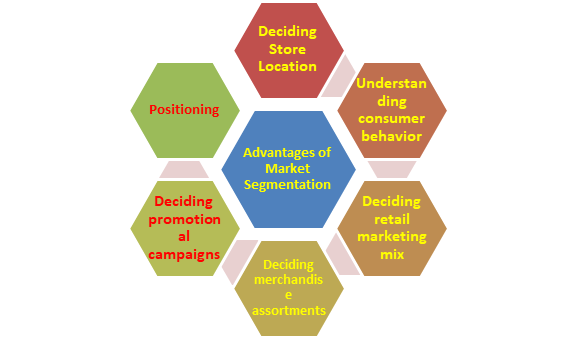
Retailers segment the market to identify particular groups of Customers in their trading areas so that selling and promotional efforts may be concentrated. The purpose of such exercise is to make the retailer the most attractive destination. Segmenting a market has following advantages:

  1. Deciding Store Location

Market segmentation helps a retailer in deciding locations for its new outlets in case of expansion. The retail stores may be set up as per the concentration of target population. A location which is attractive and has good traffic flow but serves no target market is of new use to a retailer.

  1. Understanding consumer behavior

Market segmentation helps a retailer to understand why consumers behave differently in a same set of marketing and promotional efforts. Once a heterogeneous market is divided into few homogeneous groups, it becomes easy for a retailer to develop an effective marketing & promotional strategy.

  1. Deciding retail marketing mix

Marketing segmentation helps a retailers in deciding 7ps (Product, Price, Place, promotion, People, Procedure and presentation) depending upon the target market to serviced.

  1. Deciding merchandise assortments

A retailer is always bothered about which item of inventory should be bought and displayed on the store’s shelves. Once the market is segmented, retailer can decide which item will go on the shelves. For a merchandise decision to be made successful, a perfect understanding of particular target market is essential.

  1. Deciding promotional campaigns

Segmentation helps a retailer in deciding and developing accurate promotional campaigns that hit target at right time and at right place.

  1. Positioning

Segmentation helps a retailer in positioning itself in a particular target market. For Instance, Ebony and Shopper’s stop have positioned themselves for higher income level while Vishal Mega Mart and Big Bazaar have targeted the Indian middle class.

Strategies for Effective Market Segmentation

For effective market segmentation, the following two strategies are used by the marketing force of the organization:

  1. Concentration (Niche) Strategy

Under this strategy, an organization focuses going after large share of only one or very few segment(s). This strategy provides a differential advantage over competing organizations which are not solely concentrating on one segment.

For example, Toyota employs this strategy by offering various models under hybrid vehicles market.

  1. Multi-segment Strategy

Under this strategy, an organization focuses its marketing efforts on two or more distinct market segments.

For example, Johnson and Johnson offers healthcare products in the range of baby care, skin care, nutritionals, and vision care products segmented for the customers of all ages.

Segmentation, Targeting & Positioning

Segmentation

Segmentation means to divide the marketplace into parts, or segments, which are definable, accessible, actionable, and profitable and have a growth potential. In other words, a company would find it impossible to target the entire market, because of time, cost and effort restrictions. It needs to have a ‘definable’ segment a mass of people who can be identified and targeted with reasonable effort, cost and time.

Once such a mass is identified, it has to be checked that this mass can actually be targeted with the resources at hand, or the segment should be accessible to the company. Beyond this, will the segment respond to marketing actions by the company (ads, prices, schemes, promos) or, is it actionable by the company? After this check, even though the product and the target are clear, is it profitable to sell to them? Is the number and value of the segment going to grow, such that the product also grows in sales and profits?

Segmentation takes on great significance in today’s cluttered marketplace, with thousands of products, media proliferation, ad-fatigue and general economic problems around the world markets. Rightly segmenting the market place can make the difference between successes and shut down for a company.

Segmentation allows a seller to closely tailor his product to the needs, desires, uses and paying ability of customers. It allows sellers to concentrate on their resources, money, time and effort on a profitable market, which will grow in numbers, usage and value.

Targeting

Targeting in marketing is a strategy that breaks a large market into smaller segments to concentrate on a specific group of customers within that audience. It defines a segment of customers based on their unique characteristics and focuses solely on serving them.

Instead of trying to reach an entire market, a brand uses target marketing to put their energy into connecting with a specific, defined group within that market.

The types of target markets are often segmented by characteristics such as:

  • Demographics: age, gender, education, marital status, race, religion, etc.
  • Psychographics: values, beliefs, interests, personality, lifestyle, etc.
  • Business Industry: Business industry or vertical
  • Geographic Areas: neighborhood, area code, city, region, country, etc.

Why Is Targeting in Marketing So Important?

Targeting in marketing is important because it’s a part of a holistic marketing strategy. It impacts advertising, as well as customer experience, branding, and business operations. When your company focuses on target market segmentation, you can do the following:

  1. Speak directly to a defined audience

Marketing messages resonate more deeply with audiences when readers can relate directly to the information. Brands that have a large, varied market of customers often struggle with creating marketing campaigns that speak directly to their audience. Because their viewers are very different, few slogans or stories can resonate with each person on a personal level. Through target marketing, you can alleviate this problem and focus on crafting messages for one specific audience.

  1. Attract and convert high-quality leads

When you speak directly to the people you want to target, you are more likely to attract the right people. Your marketing will more effectively reach the people most likely to want to do business with you. When you connect with the right people, you are then more likely to get high-quality, qualified leads that will turn into paying customers.

  1. Differentiate your brand from competitors

When you stop trying to speak to every customer in your market and start focusing on a smaller segment of that audience, you also start to stand out from competitors in your industry. When customers can clearly identify with your brand and your unique selling propositions, they will choose you over a competitor that isn’t specifically speaking to or targeting them. You can use your positioning in marketing to make your brand more well-known and unique.

  1. Build deeper customer loyalty

The ability to stand out from competitors by reaching your customers on a more personal, human level also creates longer-lasting relationships. When customers identify with your brand and feel like you are an advocate for their specific perspectives and needs, they will likely be more loyal to your brand and continue to do business with you over a longer period of time.

  1. Improve products and services

Knowing your customers more intimately also helps you look at your products and services in a new way. When you have a deep understanding of your target audience, you can put yourself in their shoes and see how you can improve your offerings. You can see what features you can add to better serve your customers.

  1. Stay focused

Finally, the benefit of using targeting in marketing is that it also serves to help your brand and team. Target marketing allows you to get more specific about your marketing strategies, initiatives, and direction of your brand. It helps you clarify your vision and get everyone in the organization on the same page. You have more direction when it comes to shaping upcoming plans for both marketing and the business as a whole. A focused approach helps you fully optimize your resources, time, and budget.

Positioning

A marketing strategy that aims to make a brand occupy a distinct position, relative to competing brands, in the mind of the customer. Companies apply this strategy either by emphasizing the distinguishing features of their brand (what it is, what it does and how, etc.) or they may try to create a suitable image (inexpensive or premium, utilitarian or luxurious, entry-level or high-end, etc.) through advertising. Once a brand is positioned, it is very difficult to reposition it without destroying its credibility. Also called product positioning.

Kinds of Market

The types of market you are in determines the type of business strategy you need to have. Strategies for consumer markets are completely different from that of industrial markets. Industrial markets deal in bulk product selling whereas consumer products generally involve breaking the bulk. Costing and marketing is a critical function for both types of markets.

Furthermore, with the rise of globalization, companies have themselves gone global and thus their marketing strategies have adapted accordingly. There are several factors which are added to normal business strategies when you are considering going global. And last but not the least, the Government and Institutional business which are the real revenue generators because of their huge orders.

Types of Markets are:

  1. Consumer Markets

As the name suggests, the consumer market involves marketing of consumer goods such as Television, Refrigerator, Air conditioners etc. As awareness and knowledge of consumers rises, marketing of consumer goods gets tougher. Today a lot of focus has shifted to consumer goods marketing because a consumer has a lot of choices. The brand loyalty is at its lowest and the worst fear a brand can face now is a high rate of brand defection.

Along with the branding part, the costing part too needs to be considered in the consumer market. The cost of operations is too high with various departments and specialities coming together to form a consumer goods companies. There is inventory management, logistics, manufacturing, promotions, strategies and whatnot. The presence of a tangible product increases the importance of proper planning without which a consumer goods company is sure to fail. Consumer durable market is characterized by the presence of high competition, penetration pricing, dynamics of channel management and finally a high expense on manufacturing and distribution.

  1. Business Markets

Similar to consumer markets, nowadays even the organizational buyer has numerous options in his kitty. Just at the number of software and hardware services providers in the Market. For software there’s IBM, Accenture, Oracle and several other top brands. For hardware there’s Microsoft, Dell, and others. The competition is increasing. Furthermore, the organizational buyer will think 4–5 times before purchasing a product because of the cost involved. An order for computers for an multinational company’s office will probably go in crores.

Because of the cost involved, Organizational buyers make it a point to be much more knowledgeable than any average customer. Organizational buyers have a group of dedicated people who form the “Purchase department”. These people are responsible for buying at the lowest possible price they can. The other characteristics of business markets is the time taken to close the deal. Business markets involve selling of projects too. Projects take time to be analysed and to fix up a price as they consider the cost of inflation while the project is in progress. Thus they need proper planning else the cost of the project would take a hit on the profits for the company.

Finally, In case of business markets, the sales force, the price and the product have a much upper value than the promotions. This is absolutely opposite to consumer markets where promotions makes a huge difference to the consumer buying process. Some services such as Accenture and Intel hardly advertise their products nowadays. They just advertise their presence in the market. The rest is done by the quality of products they have. Same goes for Microsoft. Of the 4 P’s of the marketing mix, promotions is the most ignored in case of business markets.

  1. Global Markets

The changes in the cost of transportation, government policies and the overall need for expansion have given an impetus to globalization. The strategies of global market companies may differ from each other but the core concept is the same. Most global marketing companies work on one fundamental. “Think local, act global”. The company which comes at the top of my mind is McDonalds and Coca Cola. Both known for their global presence as well as for the way they customize their message based on the country they are in.

Companies may be global on the basis of both – business to business as well as business to consumers. The challenges faced by global companies are much more than those faced by local companies. Firstly lets look at the options they have for modes of entry. How do they enter a country? Do they partner with some local company? Do they export their product? Or they shift a part of their operations in the country to directly establish their presence? Multiply these questions with the cost of operations involved as well as the amount of information which needs to be accessed.

Nonetheless, Global expansion is an excellent option for any company provided it has deep pockets to sustain the initial expenditure required to establish yourself in another country.

  1. Government or Non profit Market

The government market mainly involves Government offices, ordnance factories, army, navy and other government departments. The non profits on the other hand may involve groups based on different beliefs some of which really have an excellent brand name and are recognised by several companies. Both of these entities have a limited purchasing budget and hence the price of products is important. Accordingly the purchase process is organized.

Most government and non profit organizations involve the issuance of tenders and bids. The one to bid the lowest is known as L1 and the one to bid the highest is known as H1. Naturally, L1 wins the bid. There are several companies which have modified their products specifically for the government markets to come L1 in these tenders and bids. The products may be a bit inferior, nonetheless they do meet the government’s requirement and that is what matters in the end.

Each of these markets can be tapped separately by companies. In fact, some consumer durable companies have different departments for corporate sales and government sales. Tapping each of these markets provides an avenue for the company to expand their market share and overall revenue generated by the company.

Dimensions of Segmentation

How would you describe your store’s ideal customer? Would you be able to map out where they came from, how they ended up on your site, and what products they first purchased?

Finding answers for these sorts of questions can help your team understand which new customers are the best to acquire, but surfacing the answers to those questions can be hard.

The number of data points that a marketing team can bring to bear continues to expand, and it takes time to know which variables to focus on. It’s easy to get bogged down in this process and let valuable customer information go to waste.

To help jump-start your explorations, I’ve listed the following “essential seven” variables that we’ve found are most predictive of a customer’s lifetime value, regardless of industry or vertical.

Try segmenting on these seven key variables in different combinations to figure out which are most meaningful for your business. Then you can use that information (for example, your best customers live in rural areas and come from paid search) to find more customers like your best ones.

The Seven Essential Segmentation Variables

  1. Acquisition Path

How a customer ended up on your site to make the first purchase says a good deal about how he or she is likely to shop over time. Do some digging on your own as the implications fluctuate from retailer to retailer.

Example: A retailer could cut spending on Facebook after discovering that subscribers acquired through that channel converted to paying customers at a much lower rate than those acquired elsewhere.

  1. First Purchase

A shopper’s first purchase says a lot about what type of customer he or she is likely to become. Brand, category and sub-category can give you strong conclusions on things like price sensitivity, shopping persona, and level of attachment to your store.

Example: A fashion retailer could change its retention marketing program after learning that customers whose first purchase was a sweater were over three times more likely to repeat in their first 90 days than customers who started by buying in other categories.

  1. Device Type

For many retailers, shoppers who come in on certain device types are inherently different from those who arrive through the more conventional desktop route.

Example: A daily deal site might discover that its iPhone customers are worth twice as much as desktop customers – and change the way it targets and communicate with these customers accordingly.

  1. Geography

Geography gives a surprising amount of valuable info on your customers. Beyond the low-hanging fruit (e.g., cities like New York and San Francisco tend to be both wealthier and more fashion-forward), geography can also give insight into the density of brick-and-mortar shopping options as well as regional shopping preferences.

Example: An apparel retailer might discover that its Midwestern customers are worth far more than average because they tend to buy pricey knits and outerwear during the cold winter months so its acquisition marketing team could begin targeting new customers from the region.

  1. Income

Product preferences and even repeat rate can vary widely with disposable income. Tip on finding this info: Many data providers will provide you with their best guess on an individual’s income or assets by looking at median income or median home price in particular ZIP+4’s.

Example: A retailer could use a customer’s predicted income level to determine the right items to show him or her in emails.

  1. Gender

Gender can say a lot about a shopper’s predicted spend. For example, a lifestyle retailer may be surprised to discover that although its target demographic is male, its female customers are actually more valuable.

Example: This luxury retailer’s marketing team could use this insight to transform the messaging and creative of their display advertisements.

  1. Age

The relationship between age and lifetime value tends to vary from retailer to retailer, but is almost always a source of insight for lifetime value segmentation. Some retailers may find that their younger customers skew more valuable because of a greater level of comfort with e-commerce transactions. Other retailers may find that older customers tend to be more affluent, more brand-loyal, and less prone to price comparison.

Example: A fashion retailer could start targeting an older demographic after discovering that its older customers tend to be more affluent, more brand-loyal, and less prone to comparison shopping.

Retailing Strategy

A detailed marketing plan related to the of the business, its targets and ways and methods to achieve it, in relation to retail is known as retail strategy.

It is important for a retail store to form a strategy to promote its goods and services and reach the right set of customers the primary objective of the retail strategies to increase sales as well as customer satisfaction equally.

Generally speaking, a retail plan is dependent on a lot of factors like products the store location of the store nature of customers and other multiple external factors like competition, physical and political restraints, seasonality, etc.

It is crucial that one considers all of these factors while planning and deciding the retail strategy.

Factors to consider while designing a retail strategy

While designing and retail strategy, it is important to consider many factors which influence the retail business. The retailer should consider these factors keep in mind the cell project and then design the retail strategy.

Although retail strategy would be different for different retailers near is a common guideline that is followed by almost all retailers while designing a successful retail sales strategy are as follows:-

  1. Know thy customers

Almost every retailer would agree with the fact that knowing the customer is the foremost important factor for designing the retail strategy.

The customer is the one who is going to purchase the material which is why knowing the customer would mean knowing the likes and dislikes of the customer the preferences and tastes of different types of customers and the current trends in the market.

E-commerce websites are much ahead as compared to brick and mortar store in this category. The retail store opens at a particular time and closes at a particular time and also the best of the service can be provided during the working hours the brick and mortar store fails to provide service after hours.

This is when e-commerce websites come into the picture you not only send reminders to the customer to buy a particular product when in stock but also show the products related to the ones that are browsed by the customer again and again to ensure that the customer buys the product.

E-commerce apps show related products to the ones that are selected by the customer and try to increase the span of choice of the customer. No matter what strategy the retailer employs, knowing the customer will always be a significantly important part.

  1. Get new and retain old

It is essential that the retailer retains the customers. With the use of advertising and marketing campaigns retailer can get new customers, but similarly, the focus should be equally on retaining the existing customers as well.

The existing customers important for repeat purchases, what is the new customers will be important from the point of view of the expansion of the business. Existing customers will form the base of the business, and the retailer has to look to grow beyond the base by capturing the new customers.

Different strategies can be used to track new customers by promoting on the website or associated with social media.

  1. Know your business

Knowing the retail business is also an important factor in designing the retail strategy. It is crucial that the retailer considered the nature of the business and the nature of the goods that are sold.

For example, the retail business of having vegetables and other perishable items is very different from the retail business of having grocery, which is also very different from the retail business of furniture.

All of these businesses require a different strategy, and the important part of this is to know the product and the business. Knowing the business also means knowing the story of the location and how the to impact that is on the customers.

Location plays a very crucial role in the retail business. More than 50% of the business depends on the location and the convenience of the customers, which is why the retail strategy should be designed by keeping the location and mind.

These sentences are not a problem in case of e-commerce websites which are available 24/7 at the convenience of the customers.

For them knowing the business would mean using the right marketing strategy and targeting the right set of customers. Customer targeting is the most important part in case of e-commerce retailers. Social media is the platform used by e-commerce websites in order to promote their products to the target audience.

  1. Know the competition

Retail store with multiple competitors in the neighborhood, and it is important that the retail store knows about its competition and the unique offerings of that competition.

The retailer should invest time in understanding the strategy of the competition and what is it that the competition is getting right so that the retailer can incorporate those changes in his own store.

The retailer himself also should try to get an edge over the competition by unique offerings over the competition. Focusing on services is another important strategy that the retailer should apply in order to have the edge over the competition since servicing the customers is the only differentiating factor which the retailer an employ.

In terms of service, the retailer can provide free home deliveries for assisting the customers with their purchases are specialized offers for the customers who regularly shop at the retailer for providing membership cards on membership points for privileged customers.

Retail strategies to boost sales

Multiple strategies adopted by multiple retailers in order to boost the volume of sales in the business. Although most of the retail businesses differ from each other more often than not, their employee the following common strategies in order to increase their sales.

  1. Partnerships

The easiest way to promote yourself would be to partner with similar businesses. This store can achieve this by using different techniques like partnering with different retailers of different businesses in the same location who will provide a reference to that particular retailer when the customer walks to other retailers of different businesses.

The associate retailers with the direct customer to that particular retailer and he will get a new customer. Partnerships can also be done with different stores in a different area so that the customers are directed to the retailer.

This partnership can be mutually decided for paid depending on the terms of business. Every customer referral may be chargeable by the other retailers, or the retailer can return the favor by directing the customers to his reference when they ask for a product which the retailer does not have.

  1. Social media

The easiest way to reach a particular set of the targeted audience is social media.

With the help of social media, unwanted advertising expenses can be avoided, and only specifically filtered customers can be targeted, and the store can be positioned. Using Facebook has become very common to promote a business.

Facebook offers large exposure to multiple people in the neighborhood and with a customer is set of targeting an audience selection preferences in Facebook advertising it is easier and effective for an advertiser to promote his product or service or in case of the retailer is business.

Starting a facebook group is also not uncommon where the retailer can promote different offers and schemes that are running in order to pull the customers. Paid Facebook ads are also another retail sales strategy wherein the business can be promoted with minimum cost and reach a tremendously high number of audience.

Instagram these days is in the neck to neck competition with Facebook, and most of the businesses from fashion industry prefer Instagram over facebook in order to target their audience. With high-quality photos on Instagram, it is easy to promote the business to a particular set of audience.

Different tools from Instagram like using proper hashtags making different stories in the Instagram profile, help to promote the business effectively. Many businesses also use other social media like Twitter, YouTube, LinkedIn, and even Google PayPerClick campaigns in order to promote their retail businesses.

  1. Referral campaigns

The existing customers of a retail store can be asked to refer for new customer after which both the existing and referred customer will get a discount on a few products, or the retailer can also offer freebies. Referral campaigns proved to be successful because getting a new customer would be the job of the existing customer, whereas the retailer can focus only on strategies to retain the existing customer.

Referral campaigns are similar to word of mouth campaign which is promoting two different customers by the existing customers, but the difference is that in case of referral campaigns the customers get paid for every successful referral which is not the case in word of mouth campaign.

  1. Instore advertising

Many retail stores have fantastic advertising inside the store, which instantly converts walk-in customers. These stores utilize their windows with large displays of the products highlighting offers and the best of their stuff so that it attracts the window shoppers.

Window advertising is seen commonly in tourist places where the tourists are unaware of the local products, and the store can help themselves promote with window advertising. Part of in-store advertising is also to have multiple variations of the same product which will cater and be to the liking of most of the customers.

Using merchandise which matches the products is also seen in many stores and can be used as a strategy. Use of bright lighting, bright interiors which compliment the store and the products can help in faster conversion of the customers.

Location of Retailing, Types, Strategy, Tips, Importance

The location of retailing refers to the specific geographical spot where a retail store is situated. This choice is crucial as it significantly influences the store’s accessibility to its target customers, visibility, and overall success. Factors affecting retail location decisions include foot traffic, proximity to complementary and competing stores, demographics of the surrounding area, ease of access, and the cost of the premises. An optimal retail location can enhance customer influx, brand visibility, and sales, while a poorly chosen location can limit customer access and negatively impact the business’s profitability and growth.

Types of Retail Store location

The primary three types of retail locations that can be considered depending on the nature of the business.

  1. Solitary sites

These are single small outlets of shops which are separated from different writers, and they are positioned near other retailers on the roads on the way to shopping centers. Many of the food and non-food retailers use this type of solitary sites.

The primary advantage of having a solitary site is that it is away from the competition and provides the services to the customers, which help the customer to zero down on the product offered by that particular retailer.

However, the shortcomings of having a solitary site are the pedestrian traffic will always be so as compared to a shopping center or a convenience store and the visibility will also business along with the huge amount of investment since the site will be solitary.

  1. Unplanned shopping areas

These are the locations of retail stores which have evolved over a long period of time and have multiple outlets in nearby proximities. These are further divided into:

  • Central business district such as the downtown areas in major cities
  • Secondary business districts on main or high Street
  • District neighborhood
  • Location switch on the street or on the motorway which is also known as strip locations.

The advantages of having unplanned shopping areas are that there is very high pedestrian traffic during working hours and also because of my residential areas. This ensures a constant pull of customers.

The disadvantage of having unplanned shopping area is that there is a threat of shoplifting because of which high security is required. Also, it may cause inconvenience to other customers, and there are high chances of traffic blocking because of the unavailability of parking facilities.

  1. Planned shopping areas

The retail locations which are well planned according to the architecture and provide multiple out that are under the same roof are called as planned shopping areas. They have huge land spaces and the collection of major retail brands. Malls, Speciality, and Lifestyle centers are classified under planned shopping areas.

High visibility to customers and harmful of customers is a major advantage of planned shopping areas. But the disadvantages are that why security is required, and the cost of occupancy is also high.

Retail Location Strategy

1. Understanding the Target Market

  • Demographics and Psychographics: Analyze the characteristics, preferences, and behaviors of the target customers. This includes age, income, lifestyle, and shopping habits.
  • Market Size and Potential: Estimate the size of the target market and its purchasing power in different locations.

2. Analyzing Trade Areas

  • Primary, Secondary, and Tertiary Markets: Identify the geographic areas from which the majority of the store’s customers will come, including the core market and areas of diminishing returns.
  • Competition Analysis: Evaluate the presence, strength, and market share of competitors within these areas to assess market saturation and opportunities.

3. Site Selection Criteria

  • Visibility and Accessibility: Choose locations that are easily seen and reached by the target market, considering factors like foot traffic, vehicle traffic, and public transportation access.
  • Proximity to Complementary Businesses: Being near businesses that offer complementary products or services can attract additional foot traffic.
  • Lease Terms and Costs: Evaluate the affordability and terms of leasing or purchasing property, considering long-term financial sustainability.

4. Evaluating Location Types

  • Shopping Centers and Malls: These can offer high foot traffic and the advantage of being a shopping destination.
  • High Street Locations: Offer visibility and foot traffic in urban or densely populated areas.
  • Out-of-Town Locations: Suitable for larger stores requiring more space, often with better parking and accessibility by car.
  • Pop-up Stores and Temporary Locations: Can be used to test markets, products, or to take advantage of seasonal shopping trends.

5. Use of Technology and Data

  • Geographic Information Systems (GIS): Utilize GIS for mapping demographics, traffic patterns, and competitor locations to aid in decision-making.
  • Customer Data Analysis: Leverage data from online sales, social media, and loyalty programs to understand customer preferences and behaviors in different regions.

6. Legal and Regulatory Considerations

Investigate zoning laws, permits, and other regulatory requirements that could affect the choice of location or the timing of store openings.

7. Flexibility and Scalability

Consider the potential for future expansion, rebranding, or pivoting business models based on market trends and customer feedback.

8. Cost-Benefit Analysis

Perform a comprehensive cost-benefit analysis, comparing the projected revenue and growth potential of a location against the investment and ongoing operational costs.

9. Long-Term Strategic Fit

Ensure the location aligns with the retailer’s long-term strategic goals, brand image, and desired market position.

10. Post-Opening Evaluation

After opening, continuously monitor the performance of the retail location, collecting data on sales, foot traffic, and customer satisfaction to validate the location decision or to inform future expansions or relocations.

Tips to have a good Retail Location

Choosing the right education is crucial in terms of business, as stated above. As such, there are different rules which govern choosing of location for retail store depending on the nature of the business and the target audience.

However, the following are a few of the steps which can be applied by almost all the retailers in order to find the right retail location.

  1. Market analysis

The company has to analyze the market in terms of their product and industry along with the nature of competition and the presence of competition. The company also has to consider how old are there in the market and how many some other businesses are there in the current location.

They have to check and analyze the market to know how far is the competition been successful in satisfying the customers. The company also has to analyze how convenient is the location in terms of supply chain management and warehousing in order to make the products available on a daily basis.

  1. Demographics of the market

The demographics of locality is essential to be considered in order to choose the retail location. The age group of the customer, profession, Lifestyle, profession, religion income groups, etc.

  1. Market potential evaluation

The paying capacity of the population plays an important role in the evaluation of the potential of the market, along with the impact of the competition and the product estimation and demand. The retailer should also have the knowledge of regulations and laws of the country in which the store is being operated.

Other things such as communal festivals which have an impact on the demand should also be considered by the business such as Christmas.

  1. Identification of alternatives

Most of the times it so happens that the retailers in hurry of starting the business finalize a location which costs them a fortune within fact a similar location with similar business potential would’ve been available somewhere very close which was neglected or overlooked.

In such cases, the retailer should not carry on finalizing the retail location and should also go out for alternatives and evaluate that location with similar parameters as stated above.

  1. Allocation of marketing budget

A retail store should have a marketing budget depending on the cost of the location, which is in the third to build the brick and mortar place. The store which is occupying a prime location and has a good inflow of customers has indeed cost a fortune for the retailer.

In such cases, the marketing budget will be very less since the story is visible to most of the customers and passers-by. On the contrary, a store which is located away from the main street should use more marketing campaigns and spend on marketing collaterals in order to attract more customers to the store.

With the advent of social media marketing, the store has become even cheaper. People can advertise about their Store on Google with a very small budget and can ensure every I reach to potential customers not only across the neighborhood but also across other neighborhoods as well.

How to Measure the Success of Retail Location?

  • Sales Revenue

Track the total sales revenue over specific periods (monthly, quarterly, annually) to gauge the store’s performance. An increasing trend indicates a successful location.

  • Foot Traffic

Measure the number of people entering the store. Higher foot traffic usually correlates with higher sales potential. Tools like foot traffic counters can provide these insights.

  • Conversion Rate

Calculate the percentage of visitors who make a purchase (sales transactions divided by foot traffic). A high conversion rate signifies effective customer engagement and product appeal.

  • Profit Margins

Evaluate the store’s profitability by analyzing the profit margins. This considers not just sales but also the costs of goods sold and operational expenses tied to the location.

  • Customer Satisfaction and Loyalty

Use customer feedback, surveys, and loyalty program participation to assess customer satisfaction and repeat business. High satisfaction and loyalty levels are indicators of a successful retail location.

  • Competitive Position

Assess the store’s performance relative to nearby competitors. A strong competitive position in the local market indicates a successful location strategy.

  • Lease and Operating Costs

Compare the cost of leasing and operating the retail space against revenue. Locations where the sales revenue significantly exceeds operational costs contribute positively to the overall success.

  • Local Market Penetration

Analyze market share and penetration within the local area. A growing market share signifies a successful expansion and customer base development.

  • Inventory Turnover

High inventory turnover rates can indicate strong sales and effective stock management, reflecting positively on the location’s success.

  • Digital Engagement

For retailers integrating online and physical sales, assess how the location contributes to digital engagement and online sales pickups, if applicable.

Tools and Techniques for Measurement:

  • Sales Data Analysis: Regularly review sales reports and financial statements.
  • Customer Feedback Tools: Utilize surveys, feedback forms, and online reviews to gather customer insights.
  • Foot Traffic Counting Technologies: Implement sensors or manual counting methods to measure store visits.
  • Market Analysis: Conduct market research to understand your position relative to competitors.

Importance of a Good Retail Store Location

  • Customer Accessibility

A prime location is easily accessible to a large number of potential customers. Accessibility increases the likelihood of spontaneous visits and can significantly boost foot traffic, leading to higher sales opportunities.

  • Brand Visibility

A good location ensures high visibility to passersby, helping to build brand awareness and attract new customers. Being in a prominent spot can serve as free advertising, keeping the brand in the minds of consumers.

  • Market Presence

Being situated in a desirable area can enhance a retailer’s presence in the market. It places the store among other successful businesses, contributing to a positive brand image and reputation.

  • Sales and Profitability

The right location directly influences the store’s sales volumes and profitability. High-traffic locations can lead to more customers and sales, which, even considering potentially higher rent costs, can significantly improve profit margins.

  • Customer Experience

A convenient and appealing location enhances the customer experience. Easy access, ample parking, safety, and proximity to other complementary businesses make shopping more enjoyable and can increase customer satisfaction and loyalty.

  • Operational Efficiency

A strategically chosen location can also contribute to operational efficiency. It can facilitate easier logistics and supply chain management, especially if it’s well-connected to transportation networks and close to suppliers or distribution centers.

  • Competition

A good location can give a retailer a competitive edge. Being located in a popular shopping area or district can attract more customers than being situated in a less frequented area, especially if competitors are not as well-located.

  • Real Estate Value

The location of a retail store can be a valuable asset in itself. Prime real estate not only benefits current business operations but can also be a significant investment, appreciating over time and providing long-term financial benefits.

  • Target Market Alignment

The right location aligns with the retailer’s target market demographics. By choosing a location that matches the profile of its desired customers, a retailer can ensure that its product offerings meet the needs and preferences of the local population.

  • Adaptability and Growth Potential

Finally, a good location offers room for adaptability and growth. It provides the potential to expand the store or adjust its offerings based on customer demand and market trends, ensuring long-term sustainability and success.

Types of Retailing

Retailing is a distribution process, in which all the activities involved in selling the merchandise directly to the final consumer (i.e. the one who intends to use the product) are included. It encompasses sale of goods and services from a point of purchase to the end user, who is going to use that product.

Any business entity which sells goods to the end user and not for business use or for resale, whether it is a manufacturer, wholesaler or retailer, are said to be engaged in the process of retailing, irrespective of the manner in which goods are sold.

Retailer implies any organization, whose maximum part of revenue comes from retailing. In the supply chain, retailers are the final link between the manufacturers and ultimate consumer.

Types of Retailing

  1. Store Retailing

Department store is the best form of store retailing, to attract a number of customers. The other types of store retailing includes, speciality store, supermarket, convenience store, catalogue showroom, drug store, super store, discount store, extreme value store. Different competitive and pricing strategy is adopted by different store retailers.

  1. Non-store Retailing

It is evident from the name itself, that when the selling of merchandise takes place outside the conventional shops or stores, it is termed as non-store retailing.

It is classfied as under:

  • Direct marketing: In this process, consumer direct channels are employed by the company to reach and deliver products to the customers. It includes direct mail marketing, catalog marketing, telemarketing, online shopping etc.
  • Direct selling: Otherwise called as multilevel selling and network selling, that involves door to door selling or at home sales parties. Here, in this process the sales person of the company visit the home of the host, who has invited acquaintances, the sales person demonstrate the products and take orders.
  • Automatic vending: Vending machines are primarily found in offices, factories, gasoline stations, large retail stores, restaurants etc. which offer a variety of products including impulse goods such as coffee, candy, nnewspaper, soft drinks etc.
  • Buying service: The retail organization serves a number of clients collectively, such as employees of an organization, who are authorized to purchase goods from specific retailers that have contracted to give discount, in exchange for membership.
  1. Corporate Retailing

It includes retail organizations such as corporate chain store, franchises, retailer and consumer cooperatives and merchandising conglomerates. There are a number of advantages that these organizations can achieve jointly, such as economies of scale, better and qualified employees, wider brand recognition, etc.

With the emergence of new forms of retailing, competition is also increasing between them. It is one of the fast-growing and challenging industry.

Importance of Retailing

Importance of retail marketing cannot be denied for today’s manufacturers. Retail stores play an important role in high-level exposure of businesses and widespread distribution of products. In retail stores, retailers get opportunities to interact with customers (the ultimate consumers of your products).

In addition to this, you can promote products to them and also provide chances to them view and test products before making a purchase decision.

The Importance of Retailing

  1. Sales to Ultimate consumers of the products

In a retail transaction, the goods and services are sold to ultimate or final consumers. The products don’t get resold after this transaction. Goods and services sold at this point can be used for various purposes such as for domestic use, household use or for industrial use.

Hence, at this point manufacturer can interact with his consumers through retailer and know about their views.

  1. A convenient form of selling quantity-wise

The meaning of word retail is to break down the goods in small pieces and reselling them. The goods are bought by the retailer in large quantities from the middleman or manufacturer and bulk is divided into small quantities and sold to consumers as per their requirements.

To do this, the retailer can repack goods in various quantities and shapes so that it is convenient for consumers to choose and carry them to their homes.

  1. Convenient Place and Location

Retailer stores are generally set up at locations which are convenient for consumers to reach. A retail store can be of various forms such as it could be a small shop, small store, or a multiplex. Goods can be sold through internet and mobile apps as per the convenience of consumers.

Moreover, shopping online is becoming a new trend because of the advancement in technology and courier services. Therefore, more and more companies are taking their business online where customers can view products at the comfort of their home and buy them.

  1. The lifestyle of the people are shaped by retailing

Retailing is an integral part of modern society. People highly depend on retail stores to lead a comfortable life. In the past time, goods and service were made available through the process of trading.

But in present times trading is replaced by buying and selling goods which makes retail stores an important part of the society.

  1. Retail businesses contribute to the economy

In many countries, the retail business is one of the biggest contributors to the Gross Domestic Product (GDP) and its contribution has increased as compared to past and is also increasing by leap and bounds. Retailing is a driving force of the economy and its ambition is to encourage sustained growth.

  1. Retail dominates the supply chain

In a supply chain, goods and services flow from the manufacturer or a service provider to final consumers and when there is a huge number of consumers and they are distributed worldwide then the role of retail stores become much more important. Retailers play the role of a connecting link between a manufacturer and final consumers.

Because of their crucial importance in the supply chain the structure of retail stores has improved gradually over the years. In modern times, retailing is categorized by large multiple chains and not by small scale independent retail stores. The increasing importance and formalization of retailing have made it a powerful part of the supply chain.

Moreover, the comparison of retailers is being made with manufacturers which shows the increasing dominance of retailers in the distribution channel. In addition to this, the annual turnover of a few retailers such as Wal-Mart is much more than the annual turnover of companies.

All these points show that retail is the most dominating part of the whole supply chain.

  1. Retail is interdisciplinary

Retailing has developed from a number of interrelated disciplines such as economics, geography, management, economics, and marketing. Economics is useful to manage the finances of a store. The good knowledge of geography is important to make the right choice of location to open a store.

Management plays an important role in managing your staff and inventory and similarly, right marketing helps you to penetrate in the market.

  1. Retailers provide maximum employment

At the present time, the retail world employs maximum people. As per an estimation, one in nine of the workforces is employed in the retail industry. Moreover, two third of the total workforce in the retail world is women and more than half employees in retailing are part-time employees, which provides flexibility to workers to adapt to the particular needs of any employer

In the past, the salaries paid to employees were very low. Therefore, people worked on a temporary basis in the retail sector. But as the work conditions and salaries paid in the retail sector are improving more and more people are considering retail jobs as a permanent career.

  1. Retailing is an important subject area of study

Because of the importance of retailing more and more emphasis is being paid to the area of retailing. Retailing is a separate subject of studies like management and marketing. Researches have been conducted and professionals being hired to make this sector flourish.

In addition to this, academic journals concentrating on retailing are being published worldwide.

  1. Retailing offers scope for expansion in other countries

Retail provides a great opportunity to expand in international markets. A retailer who wants to extend their business by selling their goods in other countries opens stores in different countries to increase the number of consumers of their products.

However, it is not easy to expand your business as it requires a lot of paperwork and formalities to be done to be able to get clearance to take your business to other countries.

  1. Retailers rule the channel of distribution

Retailers are becoming the rulers of a channel of distribution. In past times, the power was in the hand of suppliers because of a limited number of suppliers in the market. Retailers had no other option than getting goods from the supplier to sell in their stores. But in present times there are many suppliers for a single type of product.

Therefore, a retailer can make a decision for which brand to stock in their stores and consumers buys products stock provided by the retailers. Therefore, retailers play an important role in shaping the demands of consumers.

  1. Provides Comfort and facilities for shopping

Shopping has become a pleasant experience because of all the facilities and comfort provided by chain stores, shopping malls, multiplexes, etc. people now don’t think shopping as work but they look forward to it and consider it as a stress releasing and family activity.

The giant retailers provide various facilities such as air conditioning, parking, entertainment, kids play section, lifts, trolleys to carry goods, and food facilities, etc. and retailing through mobile phones ensures doorstep delivery on all orders placed through the website or mobile apps.

  1. Provide services to the manufacturer

The retailer is the end part of the supply chain and he is the one who interacts with the customers. Therefore, he has the opportunity to know about the views of customers and their likings and disliking. Retailer gathers this information from his customers and shares it with the manufacturer.

This helps the manufacturer to make the required changes in the quality of the product and improve its services to satisfy their customers. Therefore, a retailer plays an important role in helping the manufacturer to increase his revenue generation.

  1. Provision of warehousing and storage

Warehousing is a big problem for a manufacturer. A retailer buys goods in advance from the manufacturer and reduces the problems of warehousing and storage for the manufacturer.

In addition to this, the retailer helps in increasing the sales of goods by displaying them nicely in the retail store.

  1. Advantage of an expert and specialist

Retailers are experts and have experience in selling products to customers. he has a better understanding of customers and their likes and dislikes because of this regular contact with them. He stores products as per the need of customers and sells them to customers in different sizes and shapes.

In addition to this, with their experience of selling and knowledge about the product they assist customers to choose the right product for them.

  1. Creates utilities and value

Retailer increases the value of the product by creating a place, time, and utility in the distribution of goods. Retailers buy products in bulk and break them in small quantities and sell them in small packs. In this way, he creates form utilities.

Goods manufactured in one corner of the world are consumed in other parts of the world. He buys products from manufacturers and sells them in the local market thereby creating place utility.

The retailer buys products in advance and place them in his store and sell them to the consumers whenever the need arises. By creating these three utility value of goods is increased. The retailer makes sure the regular production and consumption of goods.

Determining Factors of Retailing

Even though non store retailing is growing, most of the retailers are still selling from retail store space. Some of these retailers are very small single-store operators, and some are huge superstore discounters. Each location selected resulted from an effort to satisfy the needs of the particular market each was designed to serve. Whether it was the customer’s need for convenience, their desire to do comparison shopping, the extent of the purchasing power in a market area, of the transportation facilities available, many factors together led to the development of different kinds of retail locations. There is an old saying that the value of real estate is determined by three things: location, location, and location.  A wall street journal study looked at the largest store as measured by gross sales of the twenty largest brands. Not surprisingly, in nearly every case, a unique location was a major factor.

Retail stores should be located where market opportunities are best. After a country, region city or trade area, and neighborhood have been identified as satisfactory, a specific site must be chosen that will best serve the desired target market.  Site selection can be the difference between success and failure. A through study of customers and their shopping behavior should be made before a location is chosen.  The finest store in the world will not live up to it potential if it is located where customers cannot or will not travel to shop. The primary role of the retail store or center is to attract the shopper to the location. Alternatively, retailers must take the store to where the people are, either at home or in crowds. Examples of taking the store to where the crowds are include airport location, theme parks and vending machines.

Every retail store strives for its competitive advantage. For some stores, it is price. For others, it is promotional expertise of the special services that are offered.  Despite any differences among the various stores that may competing for the shopper’s penny  location offers a unique asset for all stores because once a site is selected, it  cannot be occupied by another store. This advantage, however, points to the importance of location analysis and site selection. Once a facility is built, purchased, or leased, the ability to relocate may be restricted for a number of years. In short, location and site selection is one of the most important decisions made by a retail owner.

There are many factors, need to be considered in the retail location analysis. The key ones include:

Macro Factors Affecting Retail Location Decisions (Country and Regional Analysis)

There is a need to recognize that country analysis will be an increasingly important aspect of the location strategy as merchants look for growth opportunities.  After the decision is made as to what country or countries are to be considered, a regional analysis will need to be done. Most countries are not completely homogeneous and need to be broken down into regions in order for a retailer to better understand the market characteristics.  Regions may differ in many characteristics such as population demographics and density, climate, cultures, and distribution infrastructure.  The importance of examining countries and regions by their macro characteristics can be illustrated by the importance of today’s distribution infrastructure to the concept of flow-through replenishment. This concept is based on having information on consumer demand that allows the flow of goods to be regulated by actual needs in the retail stores. Consumer demand is acquired at the point of sale terminal when the UPC bar code is scanned for each product sold. Computers maintain continuous records of product flow. Daily or weekly reorders go directly. To manufactures so that exact quantity replacement can be shipped to each individual store or routed to the retailers central distribution center. If this is a part of the firm’s competitive advantage, the country or region must have the transportation, computer, and warehousing infrastructure necessary to support the strategy.

  1. Demographic Characteristics

Demography is the study of population characteristics that are used to describe consumers. Retailers can obtain information about the consumer’s age, gender, income, education, family characteristics, occupation, and many other items. These demographic variables may be used to select market segments, which become the target markets for the retailer. Demographics aid retailers in identifying and targeting potential customers in certain geographic locations. Retailers are able to track many consumer trends by analyzing changes in demographics. Demographics provide retailers with information to help locate and describe customers. Linking demographics to behavioral and lifestyle characteristics helps retailers find out exactly who their consumers are. Retailers who target certain specific demographics characteristics should make sure that those characteristics exist in enough abundance to justify locations in new countries or regions.

  1. Economic Characteristics

Businesses operate in an economic environment and base many decisions on economic analysis. Economic factors such as a country’s gross domestic product, current interest rates, employment rates, and general economic conditions affect how  retailers in general perform financially. For example, employment rates can affect the quantity and quality of the labor pool available for retailers as well as influence the  ability of customers to buy.  Normally, growth in a country’s gross domestic product indicates growth in retail sales and disposable income. Retailers want to locate in countries or regions that have steadily growing gross national products. As interest rate rise, the cost of carrying inventory on credit rises for retailers and the cost of purchasing durable goods arises for consumers. Countries that have projected significant increases in interest rates should be evaluated very carefully by retailers. Retailers will also be affected by a rise in employment rates; this lowers the supply of available workers to staff and support retail locations.

  1. Cultural Characteristics

Cultural characteristics impact how consumers shop and what goods they purchased. The values, standards, and language that a person is exposed to while growing up are indicates of future consumption behavior.  Consumers want to feel comfortable in the environment in which they shop. To accomplish this, retailers must understand the culture and language of their customers. In a bilingual area, a retailer may need to hire employees who are capable of speaking both of the languages spoken by the customers.  Some retailers have found it useful to market to the cultural heritage of their consumers, while other retailers seek to market cross-culturally. Normally larger cultures are made of many distinct subcultures. Retailers need to be aware of the different aspects of culture that will affect the location decision. For example, greeting cards sold in the United States normally have verses on the inside, while greeting cards sold in Europe normally do not.

  1. Demand

The demand for a retailer’s goods and services will influence where the retailer will locate its stores. Not only must consumers want to purchase the goods, but they must have the ability or money to do so as well. Demand characteristics are a function of the population and the buying power of the population that the retailer is targeting.  Population and income statistics are available for most countries and regions with developed economics. In developing countries the income data may be little more than an informed guess. These statistics allow the comparisons of population and a basic determination of who will be able to purchase the goods carried in the store. This is of utmost importance for retailers, whether they carry higher-priced goods such as  durables, furniture, jewellery, and electronics or lower-priced goods-such as basic  apparels or toys.

  1. Competition

Levels of competitions vary by nation and region. In some areas, retailers will face much stiffer competition than in other areas. Normally, the more industrialized a nation is, the higher the level of competition that exists between its borders. One of the environmental influences on the success or failure of a retail establishment is how the retailer is able to handle the competitive advantages of its competition. A retailer must be knowledgeable concerning both direct and indirect competitors in the marketplace, what goods and services they provide, and their image in the mind of the consumer population. Sometimes a retailer may decide to go head to head with a competitor when the reasons are not entirely clear.

  1. Infrastructure

Infrastructure characteristics deal with the basic framework that allows business to operate. Retailers require some form of channel to deliver the goods and services to their door. Depending on what type of transportation is involved, distribution relies heavily on the existing infrastructure of highways, roads, bridges, river ways, and railways. Legal infrastructures such as laws, regulations and court rulings and technical infrastructures such as level of  computerization, communication systems, and electrical power availability also  influence store location decisions.  Distributions play a key role in the location decision especially for countries and regions. There is a significant variance in quantity and quality of infrastructures across countries. A retailer whose operation depends on reliable computerization and communications would not need to even consider a country or a region that did not meet those criteria.  The legal environment is a part of the overall infrastructure a firm must consider. For example, many countries require non-native businesses to have a native partner before establishing retail locations. The legal requirements a retailer operates under in one country will not be the same for another country or  region and may be different from state to state within the United States.

In conclusion, the demographic, demand, competition, cultural, infrastructure and economic characteristics are important in analyzing  a country  or region.

Micro Factors Affecting Retail Location Decisions (Trade Area Analysis)

It is important to define the market area of any potential location. You know that a retail market is any group of individuals who possess the ability,  desire and willingness to buy retail goods or services. The residents of any neighborhood, city, region, country, or group of countries may constitute a retail  market. The retail trade is defined as the geographic area within which the retail customers for a particular kind of store live or work. The customer profile of a segment of the people within the geographic area that the store decides to serve is the target market.

  1. Demographic Factors

We have said that perhaps no variables are more important to the retail manager than the demographic dimensions of a market. Whether the retail trade area is the central city, a growing suburb, or a quiet rural area, you must understand the people who live and work there.  Once the basic characteristics are identified and a judgement is made as to how far one of the customers would travel for the goods, the total market has been determined.  Factors, such as current population, potential population, population density, age, income, gender, occupation, race, proportion of home ownership, average home value, and proportion of single versus multifamily dwellings are important considerations.  Where consumers live, their commuting patterns, and whether their numbers are increasing or decreasing are but a few of the dynamic characteristics of the trade area population that the retailer must consider. It may be quite helpful to construct maps that display where certain types of customers reside.

As you learned, market segmentation is the process of grouping individuals according to characteristics that help define their needs. Each of these groups of similar individuals is called a market segment. No matter how many different segments you may find within any given retail market, you may choose to satisfy only one or just a few of them. Each segment that a retailer attempts to satisfy is a target market.

  1. Economic Factors

Economic characteristics have a significant impact on country and region selection. The impact on trade area is even greater. The local unemployment rate will effect the local labor pool and the amount of money that consumers have to  purchase products. The most important economic characteristics for the retailerare per capita income and employment rates.

  1. Subculture

Subculture have more of an impact on market and trade area selection than on country or region selection. One must normally be at the market or trade level in order to accurately gauge the location and characteristics of a subculture.  An ethnic subculture creates market segments for goods ranging from food and cosmetics to clothing and entertainment. At the same time religion, language, and family structure create both opportunities and problems.

  1. Demand

The economy of an area under consideration for location should provide a general indicator of the long —range retail opportunities present within an area.  The number, type, trends, and stability of industries that might affect business in the market area need to considered. Employment rates, total retail sales, segment retail sales, household income, and household expenditures all provide information from which the economic stability of the area can be ascertained. The buying power index (BPI) indicates the relative ability of consumers to make purchases. The BPI for most metropolitan statistical areas (MSAs) in U.S. is published yearly by Sales and Marketing Management in their survey of buying power. The BPI for potential markets can be directly compared to help make a choice of market area.

  1. Market Potential

Once the retail trade area has been identified and the relative segmenting variables applied, certain quantitative factors must be considered to decide if the area is suitable. These factors include the retail market potential of a retail trade area and the retail sales potential. Retail market potential is the total dollar sale that can be obtained by all stores selling a particular retail product, product line, or group of services within the retail trade area if everything was maximized.  Therefore, retail sales potential is a part of retail market potential. A retail sales forecast is the specific estimate of sales volume that a retailer expects. Because the retailer is new in the area or because of the entry of a new competitor, the sales forecast may be less than the estimate of retail sales potential.  There are two major determinants of the market potential for a trade area:  the number of potential customers within the area and the amount of money consumers spend for the product or product line in question. For example, a retailer can estimate the market potential by multiplying the number of potential  consumers in the trade area by the average amount they spend for the product.  Generally, market potential figures are based on yearly estimates. Suppose, for example, that 50,000 potential customers reside in the trade area. If it is known that each potential customer spends approximately $79 per year on gifts, the retail  market potential for gift sales in that retail trade area would be $3,900,000.  Population statistics are commonly used in arriving at market potential and are expressed on a per capita, a per household, or a per family basis. The other factor is per capita expenditure.

A retail trade area may have little relationship to these political boundaries. The merchant may be able to get a more detailed breakdown of population by checking with:-

  • The local chamber of commerce for any detailed studies it any have made.
  • The local newspaper for circulation statistics
  • The local post office for the number of box holders on delivery routes
  • The local public utilities office for information on the number of residential electric or gas meters
  • The city planning office, fire department, and police department for information on the number of residents within a specific retail trade area.

Regardless of the sources used, however, the merchant will probably find it necessary to adjust population information for a retail trade area by using the data collected in combination with individual judgement about the area.  In addition to population information, the retailer must collect data on the number of dollars being spent by consumers for the product or product line in question.

  1. Sales Potential

You learned that the retail sales potential for a firm is the estimated dollar sales that a retailer expects to obtain in a particular retail trade area over a given  period. An accurate appraisal of sales is important, because it will dictate the amount of inventory that will be purchased, the number of employees that will be  needed, the dollars that can be spent for expenses, and the amount to debt capital  the business can comfortably afford. To arrive at such a figure, one must consider.

  • The competitive strengths in the market
  • The amount of business that can be drawn from substitute products
  • Management’s own expertise

To assess the competitive strengths in the market, the retailer can start with an assessment of the total market potential. If the retailer assumes that the business will obtain at least average amount of sales being realized by the competitive business in the trade area, an estimate of the sales potential can be made. If there are five business (the new retail establishment makes six), each business might be expected to have one-sixth of the business available in the trade area.  Although this approach may not seem as sound as that used in measuring market potential, it does provide an analysis of competitive strength, and the  figure derived is usually conservative. This approach can be useful in particular situations.

  1. Index of Retail Saturation

Competition exists when more than one store compete for the same market segment or target market. In some situations, a firm might like to be only one of its type in a given market area. This is particularly the case for specialty or convenience goods. On other occasions, however, good strong competition will enhance the overall business potential of a given area because it will draw shoppers from a greater distance to compare prices or stores. This is particularly the case with goods for which people often make shopping comparisons. Maps may be developed to show retail locations of competitors by relative size and merchandise mix.

  1. Infrastructure

We have talked about how the infrastructure including roads and highways, distribution warehouses, communications facilities, and labour pool must be adequate for a country or region. The same is even more true for trade area analysis. The legal infrastructure can also impact the trade area selected for your store. State and local laws vary concerning advertising, zoning, and sign restrictions for retailers.

error: Content is protected !!