Meaning, Types of Sales budget

A sales budget estimates the sales in units as well as the estimated earnings from these sales. Budgeting is important for any business. Without a budget companies can’t track process or improve performance. The first step in creating a master company while budget is to create a sales budget.

Like every department, even the Sales department has a budget and adhering to that budget is very important since the Sales Budget is a basic component of the master budget. Sales Budget shows the expenses that have to be made to achieve sales in a defined period of time.

Sales Budget is also associated with determining average estimated earnings after the pre-determined period. A company, at the start of the year, carefully analyzes economic conditions, competition, production capacity, and expenses when determining the sales budget. All of these factors play a crucial role in the company’s future performance. Sales Budget is what the company expects to sell and generate business from.

Cambridge dictionary defines Sales Budget as: “a plan of the money that a company must spend in order to produce and sell goods or provide services in a particular period.”

While determining Sales Budget, one must be aware of the term Sales Forecasting, which means predicting the amount of sales that may happen in a defined period. This is much more than “gut-feeling” and it is determined on the basis of Previous Sales Achieved, Market conditions, industry growth rate, customer analysis, and such factors. Giving a proper forecast for Sales is important since Sales Budget depends on proper forecasting

A sales budget is an estimate of expected total sales revenue and selling expenses of the firm. It is known as a nerve centre or backbone of the enterprise. It is the starting point on which other budgets are also based. It is a forecasting of sales for the period both in quantity and value. It shows what product will be sold, in what quantities, and at what prices.

The forecast not only relates to the total volume of sales but also its break-up product wise and area wise. The responsibility for preparing sales budget lies with the sales manager who takes into account several factors for making the sales budget.

Some of these factors are:

(i) Past sales figures and trend

(ii) Estimates and reports by salesmen

(iii) General economic conditions

(iv) Orders in hand

(v) Seasonal fluctuations

(vi) Competition

(vii) Government’s control

Importance of Sales Budget:

1) Business Budgeting:

The budgeting of different departments might be dependent on the Sales Budget. This is especially true in a production company where the production expenses are proportional to the amount of sales you hope to achieve. Without expected Sales Budget, the company doesn’t know how much to spend on Marketing, how much to spend on production and in any other department. While these are variable expenses, the fixed expenses like rent and utilities also have to be covered from sales budget.

2) Growth Goals:

Another aspect of Sales Budget is that it sets targets for the Sales team and achieving those targets will help the company to grow economically and expand. The Sales team is motivated by giving incentives on hitting numbers and crossing them. The company can expect an overall growth in every department once Sales numbers are achieved.

3) Performance:

Sales Budget is prescribed to the Sales team at the beginning of the year and the targets are distributed accordingly. At the end of the year, this budget can be used to know the performance of the sales team and, in turn, the performance of the organization. This depends on the forecasting done and also on the market conditions and competitor activities. But Sales Budget helps analyze the performance of every sales team member quantitatively.

Process of Sales Budget

Most organizations use a bottom-up planning method to determine Sales Budget. All the budgets from every Salesperson are collated and sent to the manager, every manager’s budget is sent to Regional in charge and so on and so forth till a single collective statement is generated. The top management then makes necessary changes and adjustments and syncs it with organizations vision and percolates the budget top-bottom.

The total Sales Forecast with unit price will give gross sales. Sales discounts and allowances, if any, are deducted and the final figure will the Net Sales realized.

To chalk out a few common steps carried out in Sales Budget would be:

  1. Research and Analysis: Check the status of the market for scenarios
  2. Sales Forecast: The Sales team then prepares a forecast based on past achievement and market conditions put together. Generally, a growth is expected.
  3. Collecting Forecasts: All the forecasts are collected together and sent to higher management as a single file.
  4. Modification and review: The top management then decides on the Sales Budget obtained, takes reviews and suggestions and decides a final figure.

Although these are the common steps in every sales budget, every company may modify according to their needs.

Methods of Sales Budgeting

There are a variety of methods which can be used to prepare a sales budget.

The following are some of the popular methods to prepare a sales budget:

Affordable Budgeting

This is a method generally used by organizations dealing in industrial goods. Also, firms, which do not give importance to budgeting or firms which are having small size of operation, make use of this judgmental method.

Rule of Thumb

Such as a given percentage of sales. Companies involved in mass selling of goods and companies dominated by the finance function are the major users of this method.

Competitive Method

A few companies, the products of which face tough competition and many challenges in selling and which need effective marketing strategy to maintain profits, make use of this method. Using this method needs knowledge of how our competitor is working with regards to resource allocation.

Companies make use of a combination of the above methods. Depending upon the past experiences, budgeting approaches are refined time to time. The status of the sales & marketing helps the organization to figure out the extent of sophistication needed in approaching sales budgeting.

Advantages

Planning: Sales Budget helps in the proper planning of the organizational budget.

Resource allocation: Sales Budget helps in the allocation of resources for all other departments based on Sales forecast, sales plan and other factors.

Expense Check: Sales Budget is also helpful to keep a check on the expenses of the company.

Yardstick: Sales Budget serves as a yardstick for evaluation of Forecast vs achievement or Target vs Achievement and overall economy of the company.

Weak areas: Sales Budget also helps identify weak links and areas in the organization which are a hindrance in achieving the sales budget. Necessary actions can be taken to correct those weak links and strengthen the front line.

Guide: Sales Budget acts as a guide and constant reminder throughout the year for the organization about the agreed budgets and helps everyone to be on track.

Disadvantages

Sales budget cannot always be 100% accurate since no one can predict future events or sudden market trends for the company.

A sales budget decided by authority or management may not go well for various reasons. The unrealistic sales budget is a common complaint by the front line executives.

Preparing, editing, modifying, re-working, and getting the approval of sales budget can take up too much of managerial time, in which time actual sales can be realized.

Unforeseen expenses are not considered in Sales Budget which may arise out of any calamity or unpredicted market conditions.

Preliminaries in establishing system of Standard Costing

Following preliminaries should be gone through before a standard costing system is established:

  1. Establishment of cost centres
  2. Types of standard
  3. Setting the standards

Establishment of Cost Centres:

As defined earlier in this book, a cost centre is a location, person or item of equipment for which costs may be ascertained and used for the purpose of cost control. Establishment of cost centres is necessary for fixing responsibilities for unfavourable variances.

Types of Standard:

There are three types of standards:

(a) Current Standard:

A standard which is related to current conditions and is established for use over a short period of time. This standard may be fixed on the basis of ideal standard or expected standard.

Ideal Standard:

This is the standard which can be attained under the most favourable conditions possibly. In other words, this standard is based upon a very high degree of efficiency which is rather impossible to achieve.

In this standard, it is assumed that there will be the most desirable conditions of performance and that there will be no wastage of materials or time and no inefficiencies in the manufacturing processes. This standard is not likely to be achieved because ideal conditions of performance will not prevail. It is, therefore, a theoretical standard.

The utility of this standard is that it sets a target which, though not attainable in practice, is always aimed at. The criticism of the standard is that when actual costs are compared with such standard costs, large unfavourable variances are shown and these variances become a permanent feature of the concern.

The ideal standard will breed frustration among employees because such standard is never to be attained. Nobody will pay serious attention to such standard and setting up of this standard will become a farce.

Expected or Attainable Standard, This is the standard which is anticipated during a future specified budget period. In fixing this type of standard present conditions and circumstances prevailing within a particular industry are taken into consideration. Besides, due weight-age is given to the expected changes in the present circumstances and conditions.

In setting up this standard, a reasonable allowance is also made for unavoidable (normal) wastages. This standard is, therefore, considered to be more realistic than the ideal standard because this standard is based on realities rather than on the most ideal conditions. Hence, this type of standard is best suited from control point of view because this standard reveals real variances from the attainable performance.

(b) Basic Standard:

It is a standard which is established for use unaltered over a long period of time. This standard is fixed for long periods so as to help forward planning. Basic standard is established for some base year and is not changed for a long period of time as material prices, labour rates and other expenses change.

Deviations of actual costs from basic standards will not serve any practical purpose because basic standards remain unaltered over a long period of time and are not adjusted to current market conditions. Thus, this type of standard is not suitable from cost control point of view. However, variances calculated on the basis of basic standards will help in studying the trends in manufacturing costs over a long period of time.

Comparison of Current Standard and Basic Standard:

Current standards relate to current conditions and operate only for a short period before they are revised when conditions change. On the other hand, basic standards are set for a long period and there is no need for constant revision for such standards. Deviation of actual costs from basic standard costs will not serve any practical purpose because standards are not adjusted to current market conditions.

However, such standards will be helpful in studying the trends of variances over a long period of time which is not possible in case of current standards which go on changing. Current standards will take care of inflationary tendencies because they are adjusted to current market conditions. On the other hand, basic standards are static and do not take care of inflationary tendencies.

(c) Normal Standard:

This standard is defined as “the average standard which it is anticipated can be attained over a future period of time, preferably long enough to cover one trade cycle”. Such standards are established on the basis of average estimated performance over a future period of time (say 5 years) covering one trade cycle.

It is difficult to follow normal standards in practice as it is not possible to forecast performances with a reasonable degree of accuracy for a long period of time. Such standards are attainable under anticipated normal conditions and are not attainable if anticipated conditions do not prevail over a future period of time. That is why normal standards may not be a useful device for the purpose of cost control.

Setting the Standards or Establishment of Standard Cost:

Just like a Budget Committee, there should be a Standard Committee which should be entrusted with the work of setting standard costs. This Committee will include General Manager, Purchase Officer, Production Engineer, Production Manager, Sales Manager, Cost Accountant, and other functional heads, if any.

Of all the persons, the cost accountant plays a very important role in setting the standards because he is to supply the necessary costs figures and coordinate the activities of the committee so that standards set are as accurate as possible.

It may be noted that standards set should neither be too high nor too low. Nobody will take interest in the standards if these are too high because such standards are not capable of being achieved and employees will always have an opportunity to excuse the failure to reach such standards.

Such standards are not realistic and, therefore, cannot be used in inventory valuation, product costing and pricing, planning and control, and capital investment decisions.

Low standards, on the other hand, will not induce employees and management to put more efforts because they can be achieved very easily. They defeat the objectives of standard costing and fail to disclose inefficiencies because they can be attained by poor performance.

As a general rule, currently attainable standards should be set which can be attained if employees and management become more efficient or put some more efforts. Such standards motivate employees and are most appropriate for performance appraisal, cost control and decision making.

According to the National Association of Accountants (U.S.A.), “Such standards provide definite goals which employees can usually be expected to reach and also appear to be fair bases from which to measure deviations for which the employees are held responsible. A standard set at a level which is high yet still attainable with reasonable diligent effort and attentive to the correct methods of doing the job may also be effective for stimulating efficiency.”

The success of standard costing depends upon the establishment of correct standards. Thus, every possible care should be taken in the establishment of standards and standards should be established for each element of cost as follows:

(a) Direct Material Cost:

Standard material cost for each product should be predetermined. This will include:

(i) Determination of standard quantity of materials needed for the production.

(ii) Determination of standard price per unit of material.

In ascertaining standard quantity of materials, the standard specification of materials should be planned by the engineering department after consulting the past records. While setting standards an allowance should be made for the normal wastage of materials.

The purpose of determining standard quantities of materials should be to achieve maximum economies in material usage.

A detailed listing of all materials required for a product is made on a Standard Material specification, the specimen of which may be as follows:

Standard Material Specification
No……     Date……
Description of the Product……….    
Code No. Description of The Product Quantity of the Product per Material Remarks
       
Prepared By…      
Checked By…      

The standard prices of materials should be determined for the various types of material needed for the production. This is done by the cost accountant in collaboration with the purchase officer. Standard price for each item of material is established after carefully studying the market conditions and forecasting the trend of prices for a future period.

While setting standard material price, the cost of purchasing and storekeeping should also be included in the price of materials. The object of fixing standard prices of materials is to increase efficiency in the purchasing so that prices of materials may be kept down.

Any difference between standard price and actual price is to be referred to the Purchasing Department for explanation, so before setting standards for material prices, it is advisable to see that purchasing functions are efficiently managed. Setting up of standard prices of materials required is a difficult task because it depends on so many factors beyond anybody’s control. Generally standard prices are based on current prices adjusted to expected changes in future.

(b) Direct Labour Cost:

Determination of standard direct labour cost will include determination of:

(i) Standard time.

(ii) Standard rate.

It becomes necessary to standardise the time to be taken for each category of labour and for each operation involved. Time and motion study will determine how much time is to be allowed for each operation involved. While fixing the standard time, due allowance should be made for fatigue, tool setting, receiving instructions and normal idle time. Standard time can also be determined on the basis of the average of the past performance. Though this method is simple, it is not scientific.

Thus, standard time is established on the basis of time and motion study and this is done in conjunction with the work study engineers. Standard times established according to time and motion study are independent of previous performances. It is good for the development of objective standards. Standard time can also be set by taking trial runs for new products. This method is not satisfactory as real conditions are not available in such runs.

The fixation of standard labour rates is not as difficult as the fixation of standard prices of materials is because labour rates are usually pre-established.

Standard rates of pay should be established for every category of labour. Labour rates in the past may not be reliable basis for determination of rates if the labour rates are subject to fluctuating demand and supply of the labour force. Any expected increase in rates should be considered in the determination of standard rates.

Establishment of standard rates of pay do not present ay problem in those industries where wage rates have been fixed by contracts, Law, Wages Tribunals and Wages Boards. Fixation of standard rates will depend upon the method of wage payment.

Standard rates per hour or per day will be fixed if wages are paid according to time wages system and when the method of wage payment is piece rate, standard wages per piece will be fixed. Personnel department will help the cost accountant in determining standard rates of pay.

Overheads:

Broadly speaking overheads are segregated into fixed and variable and standard overhead rate should be determined for fixed as well as variable overhead. Standard fixed overhead rate and standard variable overhead rate should also be determined according to the function-wise classification of overheads manufacturing, administrative and selling and distribution so that exact place of overhead variance may be located and corrective action may be taken.

Standard overhead rate is determined keeping in view past experience, present conditions and future trends. Fixation of standard overhead rate involves determination of standard overhead costs, estimation of standard level of production reduced to a common base such as units of production, direct labour hours, machine hours, etc. and finally determination of standard overhead rate by dividing standard overhead costs by standard level of production.

The formula for the calculation of standard rate is:

Standard variable overhead rate:

Standard Hours:

Production is generally expressed in physical units such as kilos, tons, gallons, units, dozens etc. But it is difficult to express all the products in one common unit when different types of products which are measured in different units are manufactured in a factory. In such a case, it is essential to have a common unit in which all the products can be measured.

Time factor is common to all the products, and, therefore, production can be expressed in standard hours. A standard hour can be defined as an hour which measures the amount of work that should be performed in one hour under standard conditions. 

Historical Costing

Historical cost is the preferred method of valuing assets because it can be proven. It is easy for a company to look at the title of a piece of property and see what was paid for it. Other valuation or costing methods like replacement cost or current cost fluctuate with the market and economy. If these methods were used, the company would report the same piece of property at different values every year based on the market. This fluctuation violates the accounting concept or consistency.

The assets and liabilities recorded in the balance sheet with its original acquisition cost, the i.e. amount spent at the time of its acquisition are called as the Historical Cost. In other words, the historical cost is an accounting method in which the assets of the firm are recorded in the books of accounts at the same value at which it was first purchased.

The purpose behind the use of historical cost is to ascertain the total amount spent on purchasing the asset and determining the opportunity cost lost in the past. Also, the amount spent on the purchase of the asset is compared with the changes in profits and expenses incurred as a result of the purchase of such asset.

Historical cost values don’t change from year to year, so the consistency concept is not violated. There are some problems with the historical costing method. For instance, it doesn’t take into consideration time value of money or inflation. The historical cost concept assumes that inflation is not relevant and only values assets based on the purchase price.

Importance of historical cost concept

An important advantage of historical cost concept is that the records kept on the basis of it are considered consistent, comparable, verifiable and reliable.

Any valuation basis other than historical cost may create serious issues for companies. For example, if a company uses current market value or sales value rather than historical cost, each member of accounting department is likely to suggest a different value for each asset of the company.

Further, current market or sales value is not appropriate for entities that prepare their financial statements more than once a year. For example, companies computing net income or preparing balance sheet on monthly basis would have to establish a new sales value for inventory and other assets at the end of each month which is usually inconvenient.

For example, if a company purchases the building worth Rs 15,00,000 in the year 2000, then the value of the building will be recorded in the balance sheet of the year 2000 at Rs 15,00,000. If the company still owns the building in the year 2016, then it will be recorded in the balance sheet of 2016 at the same value, i.e. 15,00,000 irrespective of the current market value of the building (even if the building value has increased to Rs 50,00,000, as per the current standards).

The historical cost method is the most widely used methods of accounting as it is easy for a firm to ascertain what price was paid for the asset. Also, the value of the asset remains same from year to year, thereby complying with the concept of consistency.

But, however, the historical cost method does not take into consideration the current market value of the asset and also ignores the time value of money or inflation. The historical cost is based on the assumption that the inflation is not relevant, and the asset is valued on the basis of its purchase price.

Benefits of Historical Cost Accounting:

  1. Accounting data under HCA are generally considered free from bias, independently verifiable, and hence more reliable by the investing public, and other external users. Financial statements can easily be verified with the help of relevant documentary and other evidence. Because of the verifiability feature, accounting profession has more preference for traditional accounting
  2. Historical accounting reduces to a minimum the extent to which the accounts may be affected by the personal judgements of those who prepare them. Being based on actual transactions, it provides data that are less disputable than are found in alternative accounting systems.
  3. It has been generally found that users, internal and external, have preferences for HCA and financial statements prepared under it. According to Mautz,if those who make management and investment decisions had not found financial reports based on historical cost useful over the years, changes in accounting would long since have been made”.

Ijiri, a strong supporter of HCA, argues that HCA has played a significant role in the past and will continue to be important in financial reporting in the future. Berkin favours historical cost because of its ability to present actual events without arbitrary adjustments by management. According to him, if corporate income was arbitrarily adjusted to show the impact of inflation, labour would be in an untenable bargaining position.

  1. Historical accounting is also defended on the ground that it is only the legally recognised accounting system accepted as a basis for taxation, dividend declaration, defining legal capital, etc.
  2. Historical cost valuation is, among all valuation methods currently proposed, the method that is least costly to society considering the social costs of recording, reporting, auditing and settling disputes.

Limitations of Historical Cost Accounting:

In an economic environment, where prices are constantly rising, as has been the case in most countries of the world, HCA suffers from some limitations.

The drawbacks of HCA are listed as follows:

  1. In times of inflation, the value of money declines and, therefore, the monetary unit (e.g., rupee in India) which is used as a standard of measurement does not have a constant value and shrinks in value as the prices rise.

The HCA ignores this decline in the value of rupee and keeps adding transactions acquired at different dates with rupees of varying purchasing power. Thus, in historical accounts, the monetary unit (e.g., rupee in India) used to measure incomes and expenditures, assets and liabilities, has a mixture of values depending on the date at which each item was originally brought into the accounts.

The HCA is based on the assumption of stable monetary unit which assumes that:

(i) There is no inflation, or

(ii) The rate of inflation can be ignored.

This assumption does not prove true during inflation because of the change in general purchasing power of the monetary unit. This creates serious problems in measuring and communicating results of a business enterprise.

  1. Secondly, HCA does not match current revenues with the current costs of operations. Revenues are measured in inflated (current) rupees whereas production costs are a mix of current and historical costs.

Some costs are measured in very old rupees (e.g., depreciation), other tend to be in more recent rupees (e.g., inventories), while still others reflect current rupees (e.g., wages, salary, selling expenses and similar current operating expenses).

In general, whenever there is a time lag between acquisition and utilisation, historical cost may well differ significantly from current cost. Accordingly, HCA tends to report ‘inflated’ or “inventory’ profits and lower costs of consuming stocks and fixed assets during a period of increasing prices.

‘Overstated’ profits become harmful in the following respects:

(a) Over-distribution of dividends.

(b) Settlement of wage claims on terms which companies could not afford.

(c) Excessive taxation on the corporate sector in general and inequitable distribution of tax burden between companies.

(d) Under-pricing of sales.

(e) Investors being misled as to the performance of companies.

  1. The ‘inflated’ profits resulting under HCA are not the real profits but exaggerated and illusory. This causes the depreciation allowance to become inadequate to replace fixed assets and finance growth and expansion.

In periods of inflation, therefore, inflated profits result in substantial fall in the operating capital and in turn, in the operating capability of a business enterprise. This is a major problem and is best illustrated by two examples.

Overhead Variance

The analysis of factory overhead variances is more complex than variance analysis for direct materials and direct labour. There is no standardisation of the terms or methods used for calculat­ing overhead variances. For this reason, it is necessary to be familiar with the different approaches which can be applied in overhead variances.

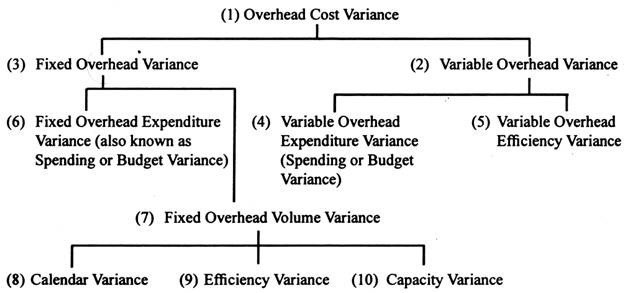
Generally, the computation of the following overhead variances are suggested:

13.1.jpg

(1) Total Overhead Cost Variance:

This overall overhead variance is the difference between the actual overhead cost incurred and the standard cost of overhead for the output achieved.

This can be computed by applying the following formula:

(Actual overhead incurred) – (Standard hours for the actual output x Standard overhead rate per hour)

Or

(Actual overhead incurred) – (Actual output x Standard overhead rate per unit)

(2) Variable Overhead Variance:

It is the difference between actual variable overhead cost and standard variable overhead allowed for the actual output achieved.

The formula for computing this variance is as follows:

(Actual Variable Overhead Cost) – (Actual Output x Variable Overhead rate per unit)

Or

(Actual Variable Overhead Cost) – (Std. hours for actual output x Std. Variable overhead rate per hour)

(3) Fixed Overhead Variance:

This variance indicates the difference between the actual fixed overhead cost and standard fixed overhead cost allowed for the actual output.

This variance is found by using the following formula:

Fixed Overhead Variance = (Actual Fixed Overhead Cost – Fixed Overhead absorbed)

Or

(Actual Fixed Overhead Cost) – (Actual Output x Fixed Overhead rate per unit)

Or

(Actual fixed overhead cost) – (Std. hours for actual output x Std. fixed overhead rate per hour)

(4) Variable Overhead Expenditure (Spending or Budget) Variance:

This variance indicates the difference between actual variable overhead and budgeted variable overhead based on actual hours worked.

This variance is found by using the following:

(Actual variable overhead – Budgeted variable overhead)

(5) Variable Overhead Efficiency Variance:

This variance is like labour efficiency variance and arises when actual hours worked differ from standard hours required for good units produced. The actual quantity produced and standard quantity fixed might be different because of higher or lower efficiency of workers employed in the manufacturing of goods.

This variance is found by us­ing the following formula:

(Actual hours – Standard hours for actual output) x Standard variable overhead rate per hour

(6) Fixed Overhead Expenditure (Spending or Budget) Variance:

This variance indicates the difference between actual fixed overhead and budgeted fixed overhead.

The formula for comput­ing this variance is as follows:

(Actual fixed overhead – Budgeted fixed overhead)

(7) Fixed Overhead Volume Variance:

Volume variance relates to only fixed overhead. This variance arises due to the difference between the standard fixed overhead cost allowed (absorbed) for the actual output and the budgeted fixed overhead based on standard hours allowed for actual output achieved during the period. The variance shows the over-or-under-absorption of fixed overheads dur­ing a particular period. If the actual output is more than the standard output, there is over-absorption and variance is favourable. If actual output is less than the standard output, the volume variance is unfavourable.

The formula for computing this variance is as follows:

(Budgeted fixed overhead applied to actual output – Budgeted fixed overhead based on standard hours allowed for actual output)

Or

(Actual production – Budgeted production) x Std. fixed overhead rate per unit

Volume variance is further sub-divided into three variances:

(8) Fixed Overhead Calendar Variance:

It is that portion of volume variance which is due to the difference between the number of actual working days in the period to which the budget is applicable and budgeted number of days in the budget period.

If actual working days is more than the budgeted working days, the variance is favourable as work has been done on days more than budgeted or allowed and vice-versa.

The formula is as follows:

(No. of actual working days – No. of budgeted working days) x Std. fixed overhead rate per day. Calendar variance can be computed based on hours or output.

Then the formulae are:

Hours Basis:

Calendar Variance = (Revised Budget Capacity hours – Budget Hours) x Std. Fixed Overhead rate per hour

If revised budgeted capacity hours are more than the budgeted hours, the variance will be favourable. In the reverse situation, the variance will be unfavourable.

Output Basis:

Calendar Variance = (Revised budgeted quantity in terms of actual number of days worked – Budgeted quantity) x Standard fixed overhead rate per unit

If revised budgeted quantity is more than the budgeted quantity; the variance is favourable; if revised budgeted quantity is less, the variance will be unfavourable.

(9) Fixed Overhead Efficiency Variance:

It is that portion of volume variance which arises when actual hours of production used for actual output differ from the standard hours specified for that output. If actual hours worked are less than the standard hours, the variance is favourable and when actual hours are more than the standard hours, the variance is unfavourable.

The formula is:

Fixed Overhead Efficiency Variance = (Actual hours – Standard hours for actual production) x Fixed overhead rate per hour

Fixed Overhead Efficiency Variance = (Actual production – Standard production as per actual time available) x Fixed overhead rate per unit

(10) Fixed Overhead Capacity Variance:

It is that part of fixed overhead volume variance which is due to the difference between the actual capacity (in hours) worked during a given period and the budgeted capacity (expressed in hours). The formula is

Capacity Variance = (Actual Capacity Hours – Budgeted Capacity) x Standard fixed overhead rate per hour

This variance represents idle time also. If actual capacity hours are more than the budgeted capacity hours, the variance is favourable and if actual capacity hours are less than the budgeted capacity hours the variance will be unfavourable.

In case actual number of days and budgeted number of days are also given, then budgeted capacity hours will be calculated in terms of actual number of days and it will be known as revised budgeted capacity hours, i.e., budgeted hours in actual days worked.

In this situation, the formula for calculating capacity variance will be as follows:

Capacity Variance = (Actual Capacity hours – Revised Budgeted Capacity hours) x Standard fixed overhead rate per hr.

In the above formula, the variance will be favourable if actual capacity hours are more than the revised budgeted hours. However, if actual capacity hours are lesser than the revised budgeted hours, the variance will be adverse as lesser hours means that lesser actual hours have been worked taking the actual days utilised into account.

Two-way, Three-way and Four-way Variance Analysis:

The above overhead variances are also classified as Two-way, Three-way and Four-way variance.

The different variances under these categories are listed below:

(A) Two-way Variance Analysis:

The two-way analysis computes two variances budget variance (sometimes called flexible budget or controllable variance) and volume variance, which means:

(i) Budget variance = Variable spending variance + Fixed spending (budget) Variance + Variable efficiency variance

(ii) Volume variance = Fixed volume variance

(B) Three -Way Variance Analysis:

The three-way analysis computes three variances spending, efficiency and volume variances. Therefore,

(i) Spending variance = Variable spending variance + Fixed spending (budget) variance

(ii) Efficiency variance = Variable efficiency variance

(iii) Volume variance = Fixed volume variance

(C) Four-way Variance Analysis:

The four-way analysis includes:

(i) Variable spending variance

(ii) Fixed spending (budget) variance

(iii) Variable efficiency variance

(iv) Fixed volume variance.

Need for Marginal Costing, Against and in favour of marginal costing

Need for Marginal Costing

Variable cost per unit remains constant; any increase or decrease in production changes the total cost of output.

Total fixed cost remains unchanged up to a certain level of production and does not vary with increase or decrease in production. It means the fixed cost remains constant in terms of total cost.

Fixed expenses exclude from the total cost in marginal costing technique and provide us the same cost per unit up to a certain level of production.

Against and in favour of marginal costing

Favour

  • Easy to operate and simple to understand.
  • Marginal costing is useful in profit planning; it is helpful to determine profitability at different level of production and sale.
  • It is useful in decision making about fixation of selling price, export decision and make or buy decision.
  • Break even analysis and P/V ratio are useful techniques of marginal costing.
  • Evaluation of different departments is possible through marginal costing.
  • By avoiding arbitrary allocation of fixed cost, it provides control over variable cost.
  • Fixed overhead recovery rate is easy.
  • Under marginal costing, valuation of inventory done at marginal cost. Therefore, it is not possible to carry forward illogical fixed overheads from one accounting period to the next period.
  • Since fixed cost is not controllable in short period, it helps to concentrate in control over variable cost.

Against

1. The total costs cannot be easily segregated into fixed costs and variable costs.

  1. Moreover, it is also very difficult to per-determine the degree of variability of semi-variable costs.
  2. Under marginal costing, the fixed costs remain constant and variable costs are varying according to level of output. The fixed costs do not remain constant and the variable costs are not varying according to level of output.
  3. There is no meaning in the exclusion of fixed costs from the valuation of finished goods since the fixed costs are incurred for the purpose of manufacture of products.
  4. In the case of loss by fire, the full amount of loss cannot be recovered from the insurance company since the stocks are undervalued.
  5. Tax authorities do not accept the valuation of stock since the shock does not show true value.
  6. The calculation of variable overheads does not include all the variable overheads.
  7. The profit fluctuates as per the fluctuation of sales volume. Hence, the preparation of periodic operating statements becomes unrealistic.
  8. The elimination of fixed costs renders cost comparison of jobs difficult.
  9. The management cannot take a quality decision with the help of contribution alone. The contribution may vary if new techniques followed in the production process.
  10. The fixed costs are constant only for short period. In the long run, all the costs are variable.
  11. Firms may find it difficult to cover up costs and earn a fair return on capital employed when they follow marginal cost principle in times of recession when demand is slack and price reduction becomes inevitable to retain business.
  12. Marginal cost pricing requires a better understanding of marginal cost technique. Some accountants are not fully conversant with the marginal techniques themselves. Therefore, they are not capable of explaining their use to the management.

In spite of its advantages, due to its inherent weakness of not ensuring the coverage of fixed costs, marginal pricing has not been adopted extensively. It is confined to cases of special orders only.

Key differences between Marginal Costing and Absorption Costing

Marginal Costing

Marginal Costing is a cost accounting technique that focuses on analyzing the behavior of costs in relation to changes in production volume. It classifies costs into fixed and variable components, where only variable costs are considered in determining the cost of production. Fixed costs are treated as period costs and charged to the profit and loss account. The technique is based on the contribution margin, calculated as sales revenue minus variable costs, which aids in assessing profitability and decision-making. Marginal costing is widely used for break-even analysis, pricing decisions, and evaluating the impact of production changes on overall profitability.

Characteristics of Marginal Costing:

  • Separation of Fixed and Variable Costs

In marginal costing, costs are clearly divided into fixed and variable components. Variable costs change in direct proportion to changes in production levels, while fixed costs remain constant regardless of output. This distinction enables businesses to focus on the costs that fluctuate with production and determine their contribution to profit.

  • Fixed Costs Treated as Period Costs

Marginal costing treats fixed costs as period costs, meaning they are not allocated to the cost of production. Fixed costs are directly charged to the profit and loss account in the period in which they are incurred, rather than being absorbed into the cost of goods sold.

  • Contribution Margin

The key concept in marginal costing is the contribution margin, which is calculated as sales revenue minus variable costs. The contribution margin reflects the amount available to cover fixed costs and generate profit. It helps in analyzing the profitability of individual products or services and assists in making decisions about pricing and production.

  • Helps in Break-even Analysis

Marginal costing is particularly useful for conducting break-even analysis. By calculating the contribution margin, businesses can determine the level of sales required to cover both fixed and variable costs. This aids in assessing the minimum sales needed to avoid losses and helps set realistic sales targets.

  • Simplifies Decision-Making

Marginal costing provides clear insights into the impact of variable costs on profitability. It helps management make informed decisions regarding pricing, product mix, make-or-buy decisions, and determining the optimal production level. Since fixed costs are considered period costs and do not affect the decision-making process, it simplifies complex decisions.

  • Short-Term Focus

Marginal costing is primarily used for short-term decision-making. It provides valuable information for day-to-day operations and helps businesses analyze the immediate impact of decisions such as pricing adjustments, special orders, and cost control measures. It is less suitable for long-term strategic decisions involving large investments or capital expenditures.

  • Flexibility

Marginal costing offers flexibility in cost allocation. It is adaptable to different types of businesses and production processes, making it an effective tool for cost analysis across various industries. Its simplicity in classifying costs makes it easier to adjust and implement as needed.

  • Non-compliance with Financial Accounting Standards

Marginal costing does not adhere to traditional financial accounting principles, which require the allocation of both fixed and variable costs to the cost of goods sold. As a result, marginal costing is not suitable for external reporting, but it is invaluable for internal decision-making and performance analysis.

Absorption Costing

Absorption Costing, also known as full costing, is a cost accounting method that allocates all manufacturing costs—both fixed and variable—to the cost of a product. This includes direct materials, direct labor, and both variable and fixed manufacturing overheads. Under absorption costing, the total cost of production is charged to units produced, ensuring that all incurred costs are absorbed by the products. It is widely used for financial reporting and compliance with accounting standards, as it provides a complete view of production costs. However, it may obscure cost behavior, as fixed costs are distributed across all units, affecting cost analysis.

Characteristics of Absorption Costing:

  • Inclusion of All Manufacturing Costs

Absorption costing considers all production-related costs, including both fixed and variable costs. Direct costs such as materials and labor, as well as indirect costs (overheads), are included in the product cost. These indirect costs are apportioned across all units produced, ensuring that each unit absorbs a portion of the fixed costs.

  • Fixed Costs are Included in Product Cost

A defining characteristic of absorption costing is that fixed costs (e.g., rent, salaries of permanent employees) are included in the product cost. Unlike marginal costing, where fixed costs are treated as period expenses, absorption costing distributes fixed costs over all units produced, adding them to the unit cost of the product.

  • Used for External Financial Reporting

Absorption costing is a generally accepted accounting practice (GAAP) and is required for external financial reporting under international accounting standards (IFRS) and generally accepted accounting principles (GAAP) in many countries. It ensures that the total production cost, including both variable and fixed costs, is reflected in the valuation of inventory and cost of goods sold (COGS).

  • Inventory Valuation

Since both fixed and variable costs are included in the cost of production, absorption costing influences the valuation of inventories. Inventory on hand is valued at the full absorption cost, which includes all manufacturing costs incurred to produce the goods, affecting both the balance sheet and profit and loss account.

  • Impact on Profitability

The treatment of fixed costs in absorption costing can affect profitability, particularly when production levels fluctuate. When production increases, fixed costs are spread over more units, which can reduce the per-unit cost and increase profitability. Conversely, low production levels may result in higher per-unit fixed costs, reducing profitability.

  • Complex Cost Allocation

Absorption costing requires the allocation of fixed manufacturing overheads across all units produced. This allocation can be complex, as it often involves multiple cost drivers (e.g., labor hours, machine hours, or material costs) to determine how fixed costs should be assigned. This complexity may require detailed calculations and estimates.

  • Long-Term Focus

Absorption costing is more suited for long-term decision-making as it provides a comprehensive view of the cost structure of a business. By allocating fixed costs to products, it helps in evaluating long-term pricing strategies, profitability, and capacity planning.

  • Less Suitable for Short-Term Decision Making

Although absorption costing is useful for long-term financial analysis, it is less suitable for short-term decision-making, such as pricing decisions or make-or-buy analyses. Since fixed costs are absorbed into product costs, managers may overlook the impact of variable costs in short-term decision-making. Marginal costing is often preferred for such decisions.

Key differences between Marginal Costing and Absorption Costing

Basis of Comparison

Marginal Costing Absorption Costing
Cost Classification Variable vs. Fixed Costs Total Costs (Fixed + Variable)
Fixed Costs Treatment Not included in cost of production Included in cost of production
Inventory Valuation Based on variable costs Based on total costs
Profit Measurement Contribution margin method Full cost method
Costing Focus Variable costs only All production costs
Profit Impact Profits vary with output level Profits are fixed, irrespective of output
Impact of Inventory Change Profit is affected by inventory changes Profit is not affected by inventory changes
Cost Behavior Direct relation with production volume Indirect relation with production volume
Suitability Short-term decision making Long-term decision making
Contribution Margin Used for decision-making Not used in decision-making
Break-even Analysis Key tool in marginal costing Not emphasized in absorption costing
Cost per Unit Variable cost per unit Total cost per unit
Financial Statements Simple, based on variable cost Complex, includes fixed costs
Internal Decision Making Used for pricing and decisions Used for external reporting
Fixed Costs Allocation Not allocated to products

Allocated to products

Marginal cost equation

Marginal cost formula helps in calculating the value of increase or decrease of the total production cost of the company during the period under consideration if there is a change in output by one extra unit and it is calculated by dividing the change in the costs by the change in quantity.

Marginal cost is the change in the total cost of production upon a change in output that is the change in the quantity of production. In short, it is the change in total cost that arises when the quantity produced changes by one unit. Mathematically, it is expressed as a derivative of the total cost with respect to quantity.

Marginal Cost = (Change in Costs) / (Change in Quantity)

where,

  • Change in Total Cost = Total Cost of Production including additional unit – Total Cost of Production of normal unit
  • Change in Quantity = Total quantity product including additional unit – Total quantity product of normal unit

Calculation of Marginal Cost

Step 1: Consider the total output, fixed cost, variable cost, and total cost as input.

Step 2: Prepare a production graph considering a different quantity of output.

Step 3: Find the change in cost i.e. difference of the total cost of production including additional unit and total cost of production of the normal unit.

Step 4: Find the change in quantity i.e. total quantity product including additional unit and total quantity product of normal unit.

Step 5: Now, as per the formula of Marginal cost divide change in cost by a change in quantity and we will get marginal cost.

This produces a dollar amount for each additional unit of a product that is produced.

The change in costs will greatly depend on the scale of production that is already in place. For instance:

  • A baker working out of their home kitchen may be able to produce anywhere from one to fifty baguettes without a significant change in costs since they can continue using the same oven in the same room. (Their largest cost increase in going from a single loaf to a 50-loaf production run would be the extra flour, salt, water, and yeast all quite low as far as raw materials go.)
  • However, if the baker wants to scale up to producing hundreds of baguettes, they will probably need to start working in a much larger space than their home kitchen. In this case, increasing the quantity of output will result in a much greater fixed cost, since they will probably have to lease space in a larger facility, and perhaps purchase new equipment.
  • Increased production costs do not necessarily indicate diminished total revenue. To the contrary, most businesses lower their per-unit cost of production by increasing their level of output. This ties to the principle of “economies of scale.” As the level of production increases, the average cost per unit produced tends to go down provided, of course, that there is a sufficient market for consumers willing to purchase your product.

Uses and Limitations of Marginal Costing

Managerial Uses of Marginal Costing:

(a) Cost Ascertainment:

Marginal costing technique facilitates not only the recording of costs but their reporting also. The classification of costs into fixed and variable components makes the job of cost ascertainment easier. The main problem in this regard is only the segregation of the semi-variable cost into fixed and variable elements. However, this may be overcome by adopting any of the methods in this regard.

(b) Cost Control:

Marginal cost statements can be understood easily by the management than those presented under absorption costing. Bifurcation of costs into fixed and variable enables management to exercise control over production cost and thereby affect efficiency.

In fact, while variable costs are controllable at the lower levels of management, fixed costs can be controlled at the top level. Under this technique, management can study the behaviour of costs at varying conditions of output and sales and thereby exercise better control over costs.

(c) Decision-Making:

Modern management is faced with a number of decision-making problems every day. Profitability is the main criterion for selecting the best course of action. Marginal costing through ‘contribution’ assists management in solving problems.

Some of the decision-making problems that can be solved by marginal costing are:

(a) Profit planning

(b) Pricing of products

(c) Make or buy decisions

(d) Product mix etc.

Limitations of Marginal Costing:

(a) Segregation of all costs into fixed and variable costs is very difficult. In practice, a major technical difficulty arises in drawing a sharp line of demarcation between fixed and variable costs. The distinction between them hold good only in the short run. In the long run, however, all costs are variable.

(b) In marginal costing, greater importance is attached to the sales function thereby relegating the production function largely to a secondary position. But, the real efficiency of a business is to be assessed only by considering the selling and production functions together.

(c) The elimination of fixed costs from the valuation of inventories is illogical since costs are also incurred in the manufacture of goods. Further, it results in the understatement of the value of stock, which is neither the cost nor the market price.

(d) Pricing decision cannot be based on contribution alone. Sometimes, the contribution will be unrealistic when increased production and sales are effected, either through extensive use of existing machinery or by replacing manual labour by machines. Another possibility is that there is danger of too many sales being affected at marginal cost, resulting in denial to the business of inadequate profits.

(e) Although the problem of over or under absorption of fixed overheads can be overcome to a certain extent, the same problems still persists with regard to variable overheads.

(f) The application of the technique is limited in the case of industries in which, according to the nature of business, large stocks have to be carried by way of work-in-progress (e.g. contracting firms).

Areas covered by cost control and cost reduction

Some of the areas where a cost control is essential in a Business are:

(I) Labour

(ii) Materials

(iii) Sales

(iv) Overheads

(v) Energy

Costs have been rising faster than ever before. The business executives have neglected the more important task of providing effective information to management for the control and reduction of costs. The management and control of the resources used in most business firms leaves a great deal to be desired.

(i) Labour:

Labour costs have risen in three ways:

(a) Higher basic pay,

(b) Shorter working hours, and

(c) Reduced output.

Reducing labour cost is a little tricky question. It is not possible to reduce wage rates due to the existence of trade unions and minimum wage legislations. The policy of wage reduction is also counter­productive for a management. So to motivate the workers, wage rates would need to be revised up­wards. The reduction in labour costs would be possible only if over time, the rate of output per worker increases faster than the wage rate increase. This is possible by raising labour productivity.

Productivity schemes aimed at paying for more output are self-defeating unless the net result is a reduction in unit cost.

Productivity must be seen as one or other of the following:

(i) Producing more for the same cost, or

(ii) producing the same for a lower cost.

Productivity should mean lower unit costs it is, in other words, cost reduction. This means finding better ways of doing things so that production increases for each hour’s efforts expanded. This is the only way to defeat rising labour costs.

(ii) Material:

The inefficient use of materials is one of the prime causes of increased costs. Wastage through poor control and design has risen to such an extent that waste recovery is now a major industry. Waste must be controlled if costs are to be contained.

The price paid for materials is affected by commodity markets. There are different ways of reducing material cost. If purchasing of materials is done properly, the firm can get various types of discounts. A number of decisions are involved in the case of materials used by a firm.

  • Firstly, the sources where materials are available will have to be identified.
  • Secondly, a cheaper substitute available to the material being presently used by the firm has to be found out.
  • Thirdly, the cost of freight has to be examined.
  • Fourthly, a suitable product design to reduce the material usage is needed.
  • Fifthly, alternative process of production has to be examined.

Since material cost form a major part of the total cost of production, control and reduction of material cost in these cases is of vital importance. R&D efforts, inventory management, improved production planning, elimination of slow moving stocks, and improved flow of parts and materials, etc. can be effective in controlling and reducing these costs.

(iii) Sales:

Sales are another area which needs monitoring of costs. Sales control requires making sure that the company is not over-spending to achieve its sales goals. In order to sell, a firm maintains a sales force and spends on advertisement, etc. The key ratio to watch is marketing expense to sales.

It consists of five component expenses to sales ratios:

(i) Sales force to sales

(ii) Advertising to sales

(iii) Sales promotion to sales

(iv) Marketing research to sales

(v) Sales administration to sales.

Management needs to monitor these marketing expense ratios. Sales cost can be controlled by rearranging market segments as the basis of demand. It should reschedule the sales force based on suitability of each member of the team. Peculiarities of consumer choices must be ascertained and communicated to the management, so that products are altered according to consumer needs.

(iv) Overheads:

Overhead costs are fixed costs. Fixed costs are defined as those which remain the same at a given capacity and do not vary with output. These costs will exist even if no output is produced. A proper selection of capacity, a right choice of equipment and its proper maintenance are likely to keep over­heads down.

The costs of plant, equipment and building, etc. are examples of fixed cost. Included in them are costs that require a fixed amount of funds in each period without reference to output such as rent, depreciation charges, property taxes and salaries of employees who cannot be retrenched during peri­ods of reduced demand. Careful planning is required regarding the complete layout of the plants. The overhead costs can be reduced by means of effective planning and implementation.

(v) Energy:

Faulty designs result in excessive use of power and materials. Lighting costs can be reduced by high quality electronic energy saving light bulbs. The increase in oil prices has shown the very high levels of waste. The problem of energy conservation is attracting considerable interest because high prices warrant some action.

The costs of reducing the consumption of energy can now be offset by the savings. Yet there has always been value in reducing energy consumption. Changing attitudes towards the use of what has always been cheap and plentiful is difficult, yet the task must be tackled if the pressure on profits is to be reduced.

It is stated that, in India, there is no economy in the use of fuel, energy or power. Fuel wastage in Indian industry is as high as 25 per cent. All these areas of rising costs must be tackled if industry and commerce hope to survive intact. They can only be tackled if a continuous examination of resource consumption is instituted. Only a well thought out and continuous cost reduction programme will produce the necessary long term benefits.

Cost Reduction Program

Followings are the essentials of a cost reduction program:

  • Cost reduction program should be according to requirement of the company.
  • Cost reduction program is a continuous activity that cannot be treated as one time or short-term activity. Success of any cost reduction program may lie in only continuous improvement of efforts.
  • Cost reduction program should be real and permanent.
  • Example setter of cost reduction program should be top management employee. Success of this program depends on co-operation of all employees and department of an organization.
  • Employees should be rewarded for their participation in cost reduction program and for giving innovative ideas related to this program.

Fields Covered under the Cost Reduction Program

A number of fields come under the scope of cost reduction. They are discussed below.

Design

Manufacturing of any product starts with the design of product. At the time of improvement in design of old product as well as at the time of designing new product, some investment is recommended to find a useful design that may reduce the cost of the product in following terms:

Material Cost

Design of product should encourage to find out possibility of cheaper raw material as a substitute, maximum production, less quantity etc.

Labor Cost

Design of product may reduce time of operation, cost of after-sale service, minimum tolerance, etc.

Organization

Employees should be encouraged for cost reduction scheme. There should be no scope for doubts and frictions; there should be no communication gap between any department or any level of management; and there must be proper delegation of responsibilities with defined area of functions of an organization.

Factory Layout and Equipment

There should be a proper study about unused utilization of material, manpower and machines, maximum utilization of all above may reduce cost of any product effectively.

Administration

An organization should make efforts to reduce the cost of administrative expenses, as there is ample scope to do so. A company may evaluate and reduce the cost of following expenses, but not the cost of efficiency:

  • Telephone expenses
  • Travelling expenses
  • Salary by reducing staff
  • Reduction in cost of stationery
  • Postage and Telegrams

Marketing

Following areas can be covered under the cost reduction program:

  • Advertisement
  • Warehouse
  • Sales Promotion
  • Distribution Expenses
  • Research & Development Program

Any cost accountant should keep the following points in mind while focusing on cost reduction for the Marketing segment:

  • Check the distribution system of an organization about the overall efficiency of the system and how economically that system is working.
  • Find out the efficiency of the sales promotion system
  • Find out if the costs can reduced from the sales and distribution system of an organization and whether the research and development system of market is sufficient.
  • A cost accountant should also do an ABC analysis of customers in which customers may be divided into three categories. For example:

ABC Analysis of Customers

Category Number of Dispatches Volume of Sale Covered
Customer…A About 10% 60% to 80%
Customer…B About 20% 20% to 30%
Customer…C About 70% 5% to 10%

After performing this analysis, the organization can focus on the customers who are covering most of the sales volume. According to it, the cost reduction program may be run successfully in the area of category B and C.

Financial Management

Attention should be given to the following areas:

  • If there is any over-investment.
  • How much economical is the cost of capital received?
  • If the organization is getting maximum returns for the capital employed.
  • If there is any over-investment, that should be sold and similarly, unutilized fixed assets should be eliminated. Slow-moving or non-moving inventories should be removed and should transfer this surplus to the working capital to re-invest it in a cycle of more profitable area of business.

Personal Management

Cost reduction programs can be run using staff welfare measures and improving labor relation. Introduction of incentive schemes for labor and giving them better working conditions is very important to run an efficient cost reduction program.

Material Control

Cost reduction program should be run by purchasing economical and more useful material. Economic Order Quantity (EOQ) technique should be used. Inventory should be kept low. Proper check on inward material, control over warehouse and proper issuance of material, and effective material yield should be done.

Production

Using effective control over material, labor, and machine a better cost reduction program may be run.

Cost control and Cost Reduction, Meaning, Objectives, Techniques, Steps, Components and Key differences

COST CONTROL

Cost control refers to the process of regulating and monitoring costs to ensure that they remain within predetermined limits or standards. It involves setting cost standards or budgets in advance and comparing actual costs with these standards. Any deviations or variances are analyzed, and corrective actions are taken to prevent unnecessary expenditure. Cost control focuses on preventing wastage, improving efficiency, and maintaining costs at an acceptable level. It is a continuous and preventive function aimed at achieving planned cost targets without compromising operational efficiency.

Cost control makes use of techniques such as standard costing, budgetary control, variance analysis, and responsibility accounting. It helps management maintain financial discipline, ensures optimal utilization of resources, and supports smooth functioning of business operations. However, cost control does not aim at reducing costs beyond the established standards; it mainly ensures that costs do not exceed the predetermined limits.

Objectives of Cost Control

  • Reduction of Wastage and Inefficiency

One of the primary objectives of cost control is to reduce wastage and inefficiency in the use of materials, labour, and other resources. By setting standards and monitoring actual performance, management can identify losses arising from spoilage, idle time, or poor supervision. Effective cost control ensures optimum utilization of resources and prevents unnecessary expenditure, thereby improving operational efficiency and lowering overall production costs.

  • Achievement of Cost Standards

Cost control aims to ensure that actual costs remain within the limits of predetermined cost standards or budgets. Standards act as benchmarks against which actual performance is measured. Any deviation from these standards is promptly analyzed and corrective action is taken. This objective helps organizations maintain financial discipline and ensures that operations are carried out according to planned cost levels.

  • Improvement in Profitability

Another important objective of cost control is to improve profitability by keeping costs under check. When costs are controlled effectively, savings are generated without affecting output quality or efficiency. Reduced costs directly contribute to higher profit margins. By controlling expenses at every stage of production and operation, businesses can enhance their financial performance and long-term sustainability.

  • Facilitation of Efficient Planning

Cost control supports efficient planning by providing accurate cost data and setting cost targets in advance. Budgets and standards prepared under cost control act as guides for future activities. This objective helps management plan production levels, resource requirements, and expenditure systematically. Proper planning ensures smooth operations and avoids unexpected financial strain due to uncontrolled costs.

  • Assistance in Managerial Decision Making

Cost control provides relevant cost information required for effective managerial decision making. Decisions related to pricing, production volume, product mix, and cost-saving measures depend on reliable cost data. By controlling and analyzing costs, management can make informed decisions that align with organizational objectives and ensure optimal use of available resources.

  • Promotion of Cost Consciousness

An important objective of cost control is to develop cost consciousness among employees at all levels of management. When cost standards are set and performance is regularly reviewed, employees become aware of the importance of controlling costs. This creates a sense of responsibility and encourages efficient working practices, resulting in reduced wastage and improved overall performance.

  • Maintenance of Competitive Pricing

Cost control helps organizations maintain competitive pricing by preventing unnecessary cost escalation. When production and operating costs are kept under control, products can be priced competitively without sacrificing profit margins. This objective is especially important in highly competitive markets where price plays a crucial role in attracting and retaining customers.

  • Ensuring Effective Internal Control

Cost control aims to strengthen the internal control system by ensuring proper authorization, recording, and monitoring of costs. Regular comparison of actual costs with standards helps detect errors, inefficiencies, and irregularities at an early stage. This objective improves transparency, accountability, and reliability of cost information, supporting effective management control and organizational efficiency.

Techniques of Cost Control

  • Budgetary Control

Budgetary control is an important technique of cost control in which budgets are prepared for various activities and departments in advance. Actual performance is compared with budgeted figures to identify deviations. Variances are analyzed and corrective actions are taken to control excessive expenditure. This technique helps in planning, coordination, and control of costs, ensuring that resources are utilized efficiently and organizational objectives are achieved.

  • Standard Costing

Standard costing involves setting standard costs for materials, labour, and overheads and comparing them with actual costs incurred. Variances between standard and actual costs are calculated and analyzed to identify reasons for inefficiencies. This technique helps management take timely corrective action, improve performance, and maintain cost discipline. Standard costing is widely used as an effective tool for controlling production and operating costs.

  • Variance Analysis

Variance analysis is a technique used to analyze the differences between standard costs and actual costs. These variances may relate to material price, material usage, labour efficiency, or overheads. By identifying favorable and unfavorable variances, management can locate problem areas and take corrective measures. Variance analysis provides valuable feedback for improving cost efficiency and operational performance.

  • Responsibility Accounting

Responsibility accounting divides the organization into responsibility centers such as cost centers, profit centers, and investment centers. Each center is assigned responsibility for controlling costs under its control. Performance is evaluated by comparing actual costs with targets for each center. This technique promotes accountability, improves managerial efficiency, and ensures effective cost control at various levels of management.

  • Inventory Control Techniques

Inventory control techniques such as EOQ, ABC analysis, and stock level determination help control material costs. Proper inventory management reduces carrying costs, avoids stock shortages, and minimizes wastage or obsolescence. By maintaining optimum stock levels and monitoring material usage, organizations can control material costs effectively and ensure smooth production operations.

  • Cost Control through Labour Control

Labour control techniques focus on controlling labour costs by improving productivity and efficiency. Methods such as time keeping, time booking, incentive wage plans, and control of idle time and overtime are used. Efficient labour control ensures optimal utilization of workforce, reduces unnecessary labour costs, and contributes significantly to overall cost control.

  • Overhead Control

Overhead control involves controlling indirect costs such as factory, office, and selling overheads. This is achieved through proper classification, allocation, apportionment, and absorption of overheads. Budgeting and standard costing help monitor overhead expenses. Effective overhead control prevents cost escalation and ensures accurate product costing and improved profitability.

  • Cost Reporting and Review

Regular cost reports and reviews are essential techniques of cost control. Cost reports provide detailed information on costs incurred, variances, and performance trends. Continuous review of these reports enables management to detect inefficiencies, take timely corrective actions, and improve decision making. Effective reporting strengthens internal control and supports efficient cost management.

Steps Involved in Cost Control

Step 1. Establishment of Cost Standards

The first step in cost control is the establishment of cost standards or targets for materials, labour, and overheads. These standards are based on past performance, technical studies, and management policies. Cost standards serve as benchmarks against which actual costs are compared. Properly set standards help management plan operations efficiently and provide a clear basis for controlling costs.

Step 2. Preparation of Budgets

Preparation of budgets is an important step in cost control. Budgets estimate future costs and revenues for different departments and activities. They define the permissible limits of expenditure and guide operational planning. Budgets ensure coordination among departments and help management allocate resources effectively. Budgeted figures also act as control tools for measuring actual performance.

Step 3. Recording of Actual Costs

Accurate recording of actual costs incurred during production or operations is essential for effective cost control. Costs relating to materials, labour, and overheads are collected systematically through cost accounting records. Proper recording ensures reliability of cost data and facilitates meaningful comparison with standards or budgets for identifying deviations.

Step 4. Comparison of Actual Costs with Standards

In this step, actual costs are compared with predetermined standards or budgeted figures. The purpose of this comparison is to identify variances between expected and actual performance. This helps management understand whether costs are under control or exceeding limits. Timely comparison enables early detection of inefficiencies and cost overruns.

Step 5. Analysis of Variances

Variance analysis involves identifying the causes of differences between standard costs and actual costs. Variances may arise due to price changes, inefficient usage of resources, or operational issues. Analyzing variances helps management locate responsibility and understand problem areas. This step provides valuable information for improving efficiency and cost management.

Step 6. Taking Corrective Action

After analyzing variances, management takes corrective actions to eliminate inefficiencies and prevent recurrence of unfavorable variances. Corrective measures may include improving supervision, revising procedures, training employees, or changing suppliers. Prompt corrective action ensures that costs remain under control and organizational performance improves.

Step 7. Continuous Monitoring and Reporting

Cost control is a continuous process that requires regular monitoring and reporting of cost performance. Periodic cost reports provide feedback to management on cost trends and deviations. Continuous monitoring helps maintain cost discipline, supports informed decision making, and ensures long-term control over costs.

Components of Cost Control

  • Material Control

Material control is a key component of cost control, focusing on the efficient use and management of raw materials, components, and consumables. It involves proper purchasing, storage, issuing, and accounting of materials. Techniques like inventory control, ABC analysis, and standard pricing help prevent wastage, pilferage, and overstocking, ensuring that material costs are minimized and resources are optimally utilized.

  • Labour Control

Labour control aims to manage and reduce labour costs while maintaining productivity. It includes timekeeping, time booking, monitoring efficiency, and controlling idle time and overtime. Incentive schemes and proper workforce allocation are also part of labour control. Effective labour control ensures optimal utilization of human resources and contributes significantly to overall cost reduction and operational efficiency.

  • Overhead Control

Overhead control involves managing indirect costs such as factory, administrative, and selling overheads. It includes proper classification, allocation, apportionment, and absorption of overheads. Monitoring actual overheads against standards or budgets helps identify inefficiencies and prevent unnecessary expenditure. Effective overhead control ensures accurate costing of products and supports profitability improvement.

  • Budgetary Control

Budgetary control is a systematic approach to planning and controlling costs by setting budgets for various departments and activities. Actual performance is compared with budgeted figures to identify variances. This component ensures that resources are allocated efficiently, expenditures are kept within limits, and financial discipline is maintained across the organization.

  • Standard Costing and Variance Analysis

Standard costing and variance analysis form an important component of cost control. Cost standards are predetermined for materials, labour, and overheads, and actual costs are compared against them. Variances are analyzed to identify reasons for deviations and corrective actions are taken. This helps maintain cost efficiency, prevent wastage, and achieve operational targets.

  • Performance Measurement

Performance measurement involves assessing the efficiency of materials, labour, and overhead utilization. Key performance indicators, efficiency ratios, and cost reports help management evaluate departmental and individual performance. Identifying underperformance allows corrective action, motivating employees, improving productivity, and ensuring that cost control objectives are achieved.

  • Reporting and Monitoring

Regular reporting and continuous monitoring of cost performance are essential for effective cost control. Detailed cost reports provide insights into material consumption, labour efficiency, and overhead expenditure. Continuous monitoring helps management detect deviations early, take corrective action promptly, and maintain overall control over costs.

  • Responsibility Accounting

Responsibility accounting assigns cost control accountability to different departments, cost centers, or managers. Each responsible person is evaluated based on their ability to control costs within their area. This component ensures accountability, promotes cost-conscious behavior, and supports overall organizational cost control objectives.

COST REDUCTION

Cost reduction is a systematic and continuous process of lowering the unit cost of production or operation without affecting the quality, performance, or usefulness of the product or service. Unlike cost control, which focuses on maintaining costs within set limits, cost reduction aims at permanently reducing costs. It involves identifying and eliminating unnecessary or avoidable expenses through improved methods, better utilization of resources, and adoption of new techniques.

Cost reduction uses tools such as value analysis, work study, process improvement, and standardization. It encourages innovation, efficiency, and cost consciousness at all levels of management. The objective of cost reduction is to achieve long-term savings, enhance competitiveness, and improve profitability by making operations more efficient and economical.

Objectives of Cost Reduction

  • Minimize Production Costs

The primary objective of cost reduction is to minimize production costs without affecting the quality of products or services. By analyzing the cost structure, management identifies areas of inefficiency, wastage, and unnecessary expenditure. Implementing improved methods, optimizing resources, and controlling unnecessary overheads helps in reducing unit costs. Lower production costs increase profitability, enhance competitiveness, and allow the organization to allocate resources more efficiently across various operations.

  • Improve Operational Efficiency

Cost reduction aims to improve operational efficiency by streamlining production processes and eliminating unnecessary activities. This involves optimizing material usage, labour productivity, and machine utilization. By reducing idle time, minimizing defects, and improving workflow, organizations can achieve higher output with the same or fewer resources. Enhanced operational efficiency contributes to cost savings, better resource utilization, and overall performance improvement, making the organization more competitive in the market.

  • Enhance Profitability

A key objective of cost reduction is to enhance profitability by decreasing overall expenses. Reduced production and operational costs directly increase profit margins. By controlling material wastage, labour inefficiencies, and overhead expenditures, businesses can retain more revenue as profit. Consistent cost reduction efforts help organizations maintain sustainable growth, fund expansion projects, and improve financial stability, thereby ensuring long-term success and shareholder value.

  • Encourage Resource Optimization

Cost reduction promotes optimum utilization of available resources, including materials, manpower, and machinery. It encourages management to use resources efficiently, reduce wastage, and avoid overproduction. By allocating resources judiciously, organizations can produce more output at lower costs, conserve valuable inputs, and maintain production sustainability. Effective resource optimization reduces unnecessary expenditure and contributes to better financial and operational performance.

  • Maintain Product Quality

Cost reduction seeks to lower costs without compromising product quality. Techniques such as value analysis, process improvement, and standardization aim to eliminate waste while maintaining or improving product standards. By controlling costs intelligently, organizations can ensure customer satisfaction, build brand reputation, and remain competitive. Maintaining quality alongside cost efficiency ensures long-term market success and customer loyalty.

  • Promote Continuous Improvement

Cost reduction encourages continuous improvement in processes, methods, and resource management. Organizations regularly review operations to identify areas where costs can be minimized. This objective instills a culture of efficiency and innovation within the organization. Continuous cost reduction efforts lead to better productivity, reduced wastage, and streamlined operations, contributing to sustained competitiveness and financial health.

  • Strengthen Competitive Advantage

Reducing costs enables organizations to price products more competitively while maintaining profitability. Cost reduction helps businesses respond effectively to market competition, attract more customers, and increase market share. By lowering costs strategically, companies can offer better value without sacrificing margins, strengthening their position in the market and ensuring long-term sustainability.

  • Facilitate Strategic Decision-Making

Cost reduction provides management with detailed insights into areas of excessive expenditure and inefficiency. This information supports strategic decision-making regarding process improvement, resource allocation, production planning, and investment. By understanding cost drivers, management can make informed decisions that reduce expenses, enhance profitability, and align operations with organizational goals. Cost reduction ensures that decisions are financially sound and operationally efficient.

Techniques of Cost Reduction

  • Value Analysis

Value analysis is a technique used to reduce costs by examining products and processes to eliminate unnecessary expenses while maintaining quality and functionality. It involves analyzing each component of a product or service to determine its value contribution. By removing or modifying non-essential elements, organizations can lower production costs, improve efficiency, and offer competitive pricing without compromising customer satisfaction.

  • Process Improvement

Process improvement focuses on enhancing production or operational processes to reduce waste, defects, and inefficiencies. Techniques such as workflow optimization, automation, and lean management help streamline operations. By improving processes, organizations can achieve higher output with fewer resources, minimize delays, and reduce labour and material costs. This technique ensures sustainable cost savings and increased operational efficiency.

  • Standardization

Standardization involves setting uniform specifications for materials, components, and processes to minimize variations and inefficiencies. By using standard sizes, methods, and procedures, organizations can reduce material wastage, simplify production, and lower procurement costs. Standardization ensures consistency, reduces errors, and enhances productivity, contributing significantly to overall cost reduction.

  • Budgetary Control

Budgetary control is a technique where budgets are prepared for departments, activities, or projects to limit expenses. Actual costs are compared with budgeted figures, and deviations are analyzed. This helps identify areas of excessive expenditure and take corrective measures. Budgetary control ensures that costs are kept within planned limits and resources are allocated efficiently, supporting long-term cost reduction objectives.

  • Efficient Material Management

Efficient material management techniques such as inventory control, ABC analysis, and Economic Order Quantity (EOQ) help reduce material costs. Proper purchasing, storage, and issue practices prevent overstocking, stockouts, and wastage. By controlling material usage and maintaining optimal inventory levels, organizations can significantly reduce costs associated with storage, spoilage, and obsolescence.

  • Labour Productivity Improvement

Labour productivity improvement techniques aim to enhance workforce efficiency and reduce labour costs. Methods include training, incentive schemes, performance monitoring, and proper workforce allocation. By improving labour output per unit of input and minimizing idle time or overtime, organizations can reduce overall labour expenditure while maintaining high-quality output.

  • Technological Upgradation

Adopting new technologies and modern equipment can reduce production costs in the long run. Automation, mechanization, and advanced machinery improve efficiency, reduce manual errors, and optimize resource usage. Though initial investment may be high, technological upgradation leads to substantial cost savings through higher productivity, reduced wastage, and lower labour costs.

  • Outsourcing and Make-or-Buy Decisions

Outsourcing non-core activities or making strategic make-or-buy decisions can reduce costs. By sourcing goods or services from specialized vendors at lower costs, organizations can save on labour, overheads, and capital expenditure. Cost-effective outsourcing ensures that resources are focused on core activities while minimizing operational expenses.

  • Waste Minimization

Waste minimization involves reducing scrap, defects, and unnecessary consumption of resources in production or operations. Techniques such as lean manufacturing, Kaizen, and continuous improvement help identify and eliminate waste. Minimizing waste lowers material, labour, and overhead costs, contributing directly to cost reduction and improved profitability.

Steps in Cost Reduction

Step 1. Identify Cost Centers

The first step in cost reduction is to identify the cost centers or departments where costs are incurred. These centers may include production, administration, sales, or services. By pinpointing areas where significant expenses occur, management can focus efforts on analyzing and reducing costs effectively. Identifying cost centers ensures that cost reduction measures are applied systematically to the most impactful areas.

Step 2. Analyze Cost Components

Once cost centers are identified, the next step is to analyze various cost components such as materials, labour, and overheads. Detailed examination helps detect areas of wastage, inefficiency, and unnecessary expenditure. By understanding the contribution of each component to total cost, management can prioritize areas that offer maximum potential for cost reduction.

Step 3. Set Cost Reduction Targets

After analyzing costs, specific cost reduction targets are set for each department or cost component. These targets serve as benchmarks for performance evaluation. Clear objectives guide employees and managers in adopting measures to achieve savings. Setting realistic and measurable targets ensures accountability and helps monitor the progress of cost reduction initiatives.

Step 4. Explore Cost Reduction Methods

Management identifies suitable methods and techniques for reducing costs. This may include value analysis, process improvement, standardization, automation, and outsourcing. Selecting the right approach depends on the nature of operations and the type of costs involved. Properly chosen methods ensure effective and sustainable cost reduction without compromising quality or efficiency.

Step 5. Implement Cost Reduction Measures

The next step is the practical implementation of the selected cost reduction methods. This involves reorganizing processes, improving workflow, introducing new technology, or adopting better resource management practices. Successful implementation requires cooperation from all departments and active participation of employees to achieve the desired cost savings.

Step 6. Monitor and Measure Results

After implementation, continuous monitoring of cost performance is essential. Actual costs are compared with targets to assess the effectiveness of cost reduction measures. Regular reporting and performance analysis help management identify areas needing further improvement and ensure that cost reduction objectives are met consistently.

Step 7. Take Corrective Action

If cost reduction targets are not achieved, management must take corrective action. This may involve modifying processes, retraining staff, adjusting resource allocation, or adopting alternative techniques. Timely corrective measures ensure that cost reduction efforts remain on track and desired savings are realized without affecting operational efficiency.

Step 8. Encourage Continuous Improvement

Cost reduction is a continuous process. Organizations must foster a culture of cost consciousness and continuous improvement. Regular review of processes, adoption of best practices, and employee involvement help sustain cost reduction over time. Continuous improvement ensures long-term efficiency, competitiveness, and profitability.

Components of Cost Reduction

  • Material Cost Reduction

Material cost reduction focuses on minimizing expenses related to raw materials, components, and consumables. Techniques include bulk purchasing, standardization of materials, improved inventory management, and reducing wastage or spoilage. Proper material handling and supplier negotiation also help lower costs. Efficient material cost management ensures that production expenses are reduced without compromising the quality of the final product.

  • Labour Cost Reduction

Labour cost reduction aims to optimize the use of human resources while minimizing wage and overhead expenditures. Methods include improving workforce productivity, training, performance-based incentives, reducing idle time, and avoiding unnecessary overtime. Efficient labour management ensures higher output at lower costs, contributing directly to overall cost reduction.

  • Overhead Cost Reduction

Overhead cost reduction involves controlling indirect expenses such as rent, utilities, depreciation, administrative expenses, and factory overheads. Techniques include energy conservation, better allocation of resources, automation, and outsourcing non-core activities. Proper management of overheads ensures that fixed and variable costs are minimized, improving profitability.

  • Process and Operational Improvement

Improving production and operational processes is a key component of cost reduction. Streamlining workflows, eliminating inefficiencies, and adopting lean practices help reduce waste and optimize resource utilization. Continuous process improvement leads to lower production costs, better quality, and higher operational efficiency.

  • Technological Upgradation

Investing in modern machinery, automation, and advanced production technologies helps reduce long-term costs. Although the initial investment may be significant, technological upgradation minimizes labour, time, and material wastage, resulting in higher efficiency and sustainable cost savings.

  • Standardization

Standardization reduces costs by using uniform materials, components, and methods in production. It minimizes variations, simplifies procurement, and reduces wastage. Standardized processes also help in achieving consistent quality while lowering costs associated with errors and rework.

  • Waste Minimization

Minimizing waste in materials, labour, and processes is an essential component of cost reduction. Techniques like lean manufacturing, Kaizen, and process optimization help identify and eliminate unnecessary consumption, scrap, and defects. Reducing waste directly decreases production costs and enhances profitability.

  • Outsourcing and Make-or-Buy Decisions

Outsourcing non-core functions or making strategic make-or-buy decisions helps reduce costs by leveraging external expertise and economies of scale. It allows organizations to focus on core activities while reducing expenditure on less critical operations. Efficient outsourcing contributes to lower operational costs and improved overall efficiency.

Key differences between Cost Control and Cost Reduction

Aspect Cost Control Cost Reduction
Focus Limits Minimization
Objective Maintain Lower
Approach Preventive Corrective
Timing Continuous Periodic
Effect on Standard Within limits Below limits
Scope Narrow Broad
Quality Impact Neutral Considered
Methodology Standardization Innovation
Measurement Variances Cost savings
Resource Focus Efficiency Optimization
Management Role Supervisory Strategic
Long-Term Benefit Stability Profitability
Tools Budgets, Standards Process improvement
Dependency Standards Analysis
Nature Routine Improvement
error: Content is protected !!