Non-Performing Asset (NPA), Meaning, Types, Circumstances and Impacts

NonPerforming Asset (NPA) is a loan or advance in which the borrower has stopped paying interest or principal for a specified period, typically 90 days or more, as per RBI guidelines. NPAs reduce bank profitability, erode capital, and limit lending capacity. They are classified as substandard, doubtful, or loss assets based on the duration and recovery prospects. NPAs arise due to defaults, economic slowdown, poor credit appraisal, or fraud. Managing NPAs is crucial for financial stability, as high NPAs affect liquidity, investor confidence, and the overall health of the Indian banking system.

Types of NPA:

  • Substandard Assets

Substandard assets are loans or advances that have remained non-performing for less than or equal to 12 months. They show initial signs of financial stress in the borrower’s account, and recovery may still be possible with monitoring. Banks classify these loans as substandard to signal potential risk and take precautionary measures like higher provisioning and frequent review. Examples include delayed payments due to business slowdowns, temporary liquidity issues, or operational inefficiencies. Proper assessment and intervention at this stage can prevent escalation to more serious categories. In India, substandard NPAs require banks to make a provision of at least 15% of the outstanding loan, ensuring financial prudence and compliance with RBI norms.

  • Doubtful Assets

Doubtful assets are loans that have remained non-performing for more than 12 months. At this stage, the probability of recovery becomes uncertain, and the bank faces higher risk of loss. Doubtful NPAs require greater provisioning, often ranging from 25% to 100%, depending on the duration of default. These assets may result from prolonged financial stress, weak management, or economic downturns. Banks continuously monitor doubtful assets and may initiate legal recovery actions or restructuring to mitigate losses. In India, classifying loans as doubtful helps banks manage risk, comply with RBI regulations, and maintain transparency in reporting financial health.

  • Loss Assets

Loss assets are loans that are considered unrecoverable, either wholly or partially, despite efforts by the bank. These are identified after inspection, audit, or legal proceedings, where recovery is deemed impossible. The loss may result from fraud, insolvency of the borrower, or prolonged default. Banks must write off or provision 100% of such assets from their balance sheet, reducing reported profit but maintaining transparency. In India, loss assets indicate weak credit quality and highlight the importance of careful credit appraisal, monitoring, and risk management. Though written off, banks may continue recovery efforts through legal channels, emphasizing disciplined lending and financial prudence.

Circumstances of NPA:

  • Borrower’s Financial Distress

One of the main causes of NPAs is the financial distress of the borrower. When individuals, companies, or institutions face insufficient cash flow, declining profits, or operational losses, they are unable to meet interest or principal payments on time. Temporary setbacks, such as business slowdowns, poor management, or economic downturns, can worsen repayment capacity. In India, banks monitor borrowers’ financial health through credit reports, audits, and financial statements. Early detection of distress can help in restructuring loans or offering rescheduling options, potentially preventing loans from becoming NPAs. Failure to address financial distress timely increases the risk of substandard or doubtful assets, affecting bank profitability and liquidity.

  • Willful Default by Borrower

NPAs may arise due to willful default, where the borrower deliberately avoids repayment despite having the capacity to pay. This could be due to diversion of funds, unwillingness to repay, or fraudulent activities. Willful defaulters often misuse bank loans for personal gain or speculative investments. In India, banks identify willful defaulters using credit histories, inspections, and legal recourse. Such cases may lead to legal action, recovery suits, or reporting to credit bureaus. Willful default affects not only the individual bank but also the broader financial system by creating distrust among lenders, increasing provisioning requirements, and highlighting the importance of stringent credit appraisal and monitoring mechanisms.

  • Economic Downturn or Market Conditions

External factors like economic slowdowns, inflation, interest rate hikes, or market volatility can adversely affect borrowers’ ability to repay loans. Industries such as textiles, steel, or agriculture may suffer losses due to reduced demand, price fluctuations, or export challenges, leading to delayed or defaulted payments. In India, banks monitor sectoral performance and adopt priority sector lending and risk diversification to mitigate these impacts. Economic downturns can convert performing assets into NPAs, requiring higher provisioning. Early intervention through restructuring, moratoriums, or financial advice helps reduce the impact. These circumstances underline that NPAs are not always due to borrower negligence but can arise from systemic and macroeconomic factors.

  • Poor Credit Appraisal and Monitoring

NPAs often result from inadequate credit appraisal and weak monitoring by banks. If the borrower’s repayment capacity, financial position, or project feasibility is not thoroughly evaluated, loans may be sanctioned without proper safeguards. Lack of follow-up, inspection, or monitoring allows small delays to escalate into defaults. In India, banks rely on credit scoring, borrower history, and periodic reviews to prevent such occurrences. Poor appraisal increases exposure to substandard and doubtful assets. Strengthening credit appraisal systems, continuous monitoring, and timely intervention are essential to minimize NPAs. Effective risk management ensures that only creditworthy borrowers receive loans and repayment issues are addressed before becoming serious defaults.

  • Fraudulent Activities and Mismanagement

Fraud or mismanagement by the borrower can also lead to NPAs. Borrowers may divert funds, inflate accounts, or falsify financial statements, making repayment impossible. Poor internal management, lack of planning, or operational inefficiencies can also cause defaults. In India, banks implement audit checks, legal scrutiny, and fraud detection mechanisms to reduce such NPAs. Fraudulent NPAs are harder to recover and often require legal intervention. Mismanagement in business or projects can disrupt cash flow, affecting loan repayment. Identifying potential frauds early, strengthening governance, and continuous monitoring of borrowers are crucial measures for banks to prevent such NPAs and maintain financial stability.

Impact of NPA:

  • Impact on Bank Profitability

NPAs directly reduce a bank’s profitability because interest income from these loans is not realized. Banks must provision a portion of NPAs, which is deducted from profits, reducing net earnings. High NPAs increase operational costs related to loan recovery, legal proceedings, and monitoring. They also affect interest rates on other loans, as banks may raise rates to compensate for losses. Persistent NPAs can lead to lower shareholder confidence and reduced dividend payments. In India, rising NPAs in public sector banks have historically impacted profitability, making prudent credit appraisal, timely monitoring, and recovery mechanisms essential. A high NPA ratio signals financial weakness, affecting the bank’s long-term growth and stability.

  • Impact on Liquidity

NPAs lock bank funds, making them unavailable for further lending or investment. When significant portions of assets are non-performing, banks face liquidity shortages, affecting their ability to meet deposit withdrawals or provide fresh loans. This limits credit flow to individuals, businesses, and the economy, slowing growth. In India, NPAs in key sectors like agriculture, industry, or infrastructure can disrupt regional liquidity. Banks must maintain higher Cash Reserve Ratio (CRR) and Statutory Liquidity Ratio (SLR) to manage liquidity, further tying up resources. Effective NPA management ensures that funds remain available for productive use, maintaining operational efficiency, customer trust, and economic stability.

  • Impact on Credit Availability

High NPAs restrict a bank’s capacity to issue new loans, as funds are tied up in non-performing assets. Banks may adopt stricter lending norms, raise interest rates, or reduce credit to high-risk sectors. This affects businesses, especially SMEs and start-ups, who rely on timely credit for operations and expansion. In India, regions or industries with high NPAs often face limited access to formal banking, leading to reliance on informal lenders with higher interest rates. Reducing NPAs through recovery, restructuring, or write-offs ensures that banks can maintain healthy credit flow, support economic growth, and provide adequate financing for productive sectors.

  • Impact on Banking Sector Reputation

High NPAs harm a bank’s reputation and credibility. Customers and investors perceive banks with rising NPAs as inefficient or risky. In India, public sector banks with large NPAs have faced challenges attracting deposits and investment. Reduced trust can result in account closures, lower deposits, and decreased market confidence. Reputational damage also affects the bank’s ability to raise funds in capital markets or issue bonds. Strong NPA management, transparency in reporting, and robust recovery mechanisms are critical to restoring confidence. Maintaining a healthy loan portfolio enhances public perception, ensures trust in the banking system, and supports sustainable growth.

  • Impact on Economy

High NPAs have a negative macroeconomic impact, as they reduce the banking sector’s lending capacity, slowing economic growth. Businesses may face credit crunches, limiting expansion, employment generation, and infrastructure development. NPAs also affect government finances, as recapitalization of public sector banks may be required. In India, systemic NPAs in industries like power, steel, and infrastructure have constrained economic activity, delayed projects, and increased non-performing loans across sectors. Efficient NPA management, loan recovery, and credit appraisal are crucial to maintain banking sector health. Reduced NPAs ensure smooth credit flow, investment, and economic growth, supporting financial stability and overall development.
RBI Organization & Management

RBI is managed by the Central Board of Directors.

Presently, there are 21 members:

Governor for a period of 5 years

Four Deputy Governors for a period of 5 years

Four Directors (Each nominated by four Local Boards)

Ten Directors (Nominated by Government of India)

Two government officers (Nominated by Government of India)

GOVERNORS OF RBI

First Governor of RBI – Sir Osborne Smith

First Indian Governor of RBI – Sir CD Deshmukh
Current Govenor – 25th Shaktikanta Das (who took charge from Dr D Subbarao )

SUBSIDIARIES

RBI’s fully owned subsidiaries are:

  • National Housing Bank (NHB)
  • Deposit Insurance and Credit Guarantee Corporation (DICGC)
  • Bhartiya Reserve Bank Note Mudran Private Limited (BRBNMPL)
  • Majority stake in National Bank of Agriculture and Rural Development (NABARD)

DEPARTMENTS OF RBI

Departments

Functions

Currency Management Responsible for administration of currency issuance. (Core function of RBI, RBI Act, 1934)
Banking Operations and Development Responsible for regulations of Commercial Bank under provisions of Banking Regulation Act,1934 and RBI Act, 1934
Rural Planning and Credit Formulates policies related to rural population (Rural credit and employment programmes)
Foreign Exchange Facilitate external trade and payment and promote the development and maintain the foreign exchange market in India. (FEMA, 1999)
Inspection Assign duties on behalf of top management and provide feedback to top management for efficient and effective working of organisation.

Departments of RBI

The various departments of the Reserve Bank of India are listed below:

  1. Information Technology.
  2. Economic Analysis and Policy.
  3. Statistical Analysis and Computer Services.
  4. Monetary Policy.
  5. Premises Department.
  6. Secretary’s Department.
  7. Press Relations.
  8. Exchange Control.
  9. Rural Planning and Credit.
  10. Financial Institutions Division.
  11. Banking Supervision.
  12. Banking Operations and Development.
  13. Financial Companies.
  14. Non-banking Supervision.
  15. Administration and Personnel Management.
  16. Human Resources Development.
  17. Deposit Insurance and Credit Guarantee Corporation.
  18. Inspection.
  19. Urban Banks.
  20. Currency Management.
  21. External Investments and Operations.
  22. Expenditure and Budgetary Control.
  23. Government and Bank Accounts.
  24. Internal Debt Management Cell.
  25. Industrial and Export Credit.
  26. Legal.

Need and emergence of Development financial institutions in India

Capital Formation:

The significance of Development Finance Institutions or DFIs lies in their making available the means to utilize savings generated in the economy, thus helping in capital formation. Capital formation implies the diversion of the productive capacity of the economy to the making of capital goods which increases future productive capacity. The process of Capital Formation involves three distinct but interdependent activities, viz., saving financial intermediation and investment.

However, poor country/economy may be, there will be a need for institutions which allow such savings, as are currently forthcoming, to be invested conveniently and safely and which ensure that they are channeled into the most useful purposes. A well-developed financial structure will therefore aid in the collections and disbursements of investible funds and thereby contribute to the capital formation of the economy. Indian capital market although still considered to be underdeveloped has been recording impressive progress during the post-interdependence period.

Support to the Capital Market

The basic purpose of DFIs particularly in the context of a developing economy, is to accelerate the pace of economic development by increasing capital formation, inducing investors and entrepreneurs, sealing the leakages of material and human resources by careful allocation thereof, undertaking development activities, including promotion of industrial units to fill the gaps in the industrial structure and by ensuring that no healthy projects suffer for want of finance and/or technical services.

Hence, the DFIs have to perform financial and development functions on finance functions, there is a provision of adequate term finance and in development functions there include providing of foreign currency loans, underwriting of shares and debentures of industrial concerns, direct subscription to equity and preference share capital, guaranteeing of deferred payments, conducting techno-economic surveys, market and investment research and rendering of technical and administrative guidance to the entrepreneurs.

Rupee Loans

Rupee loans constitute more than 90 per cent of the total assistance sanctioned and disbursed. This speaks eloquently on DFI’s obsession with term loans to the neglect of other forms of assistance which are equally important. Term loans unsupplemented by other forms of assistance had naturally put the borrowers, most of whom are small entrepreneurs, on to a heavy burden of debt-servicing. Since term finance is just one of the inputs but not everything for the entrepreneurs, they had to search for other sources and their abortive efforts to secure other forms of assistance led to sickness in industrial units in many cases.

Foreign Currency Loans

Foreign currency loans are meant for setting up of new industrial projects as also for expansion, diversification, modernization or renovation of existing units in cases where a portion of the loan was for financing import of equipment from abroad and/or technical know-how, in special cases.

Subscription to Debentures and Guarantees

Regarding guarantees, it is well-known that when an entrepreneur purchases some machinery or fixed assets or capital goods on credit, the supplier usually asks him to furnish some guarantee to ensure payment of installments by the purchaser at regular intervals. In such a case, DFIs can act as guarantors for prompt of installments to the supplier of such machinery or capital under a scheme called ‘Deferred Payments Guarantee’.

Assistance to Backward Areas

Operations of DFI’s in India have been primarily guided by priorities as spelt out in the Five-Year Plans. This is reflected in the lending portfolio and pattern of financial assistance of development financial institutions under different schemes of financing. Institutional finance to projects in backward areas is extended on concessional terms such as lower interest rate, longer moratorium period, extended repayment schedule and relaxed norms in respect of promoters’ contribution and debt-equity ratio.

Such concessions are extended on a graded scale to units in industrially backward districts, classified into the three categories of A, B and c depending upon the degree of their backwardness. Besides, institutions have introduced schemes for extending term loans for project/area-specific infrastructure development.

Moreover, in recent years, development banks in India have launched special programmes for intensive development of industrially least developed areas, commonly referred to as the No-industry Districts (NID’s) which do not have any large-scale or medium-scale industrial project. Institutions have initiated industrial potential surveys in these areas.

Promotion of New Entrepreneurs

Development banks in India have also achieved a remarkable success in creating a new class of entrepreneurs and spreading the industrial culture to newer areas and weaker sections of the society.

Special capital and seed Capital schemes have been introduced to provide equity type of assistance to new and technically skilled entrepreneurs who lack financial resources of their own even to provide promoter’s contribution in view of long-term benefits to the society from the emergence of a new class of entrepreneurs. Development banks have been actively involved in the entrepreneurship development programmes and in establishing a set of institutions which identify and train potential entrepreneurs.

Again, to make available a package of services encompassing preparation of feasibility of reports, project reports, technical and management consultancy etc. at a reasonable cost, institutions have sponsored a chain of 16 Technical Consultancy organizations covering practically the entire country.

Promotional and development functions are as important to institutions as the financing role. The promotional activities like carrying out industrial potential surveys, identification of potential entrepreneurs, conducting entrepreneurship development programmes and providing technical consultancy services have contributed in a significant manner to the process of industrialization and effective utilization of industrial finance by industry.

IDBI has created a special technical assistance fund to support its various promotional activities. Over the years, the scope of promotional activities has expanded to include programmes for up gradation of skill of State level development banks and other industrial promotion agencies, conducting special studies on important issues concerning industrial development, encouraging voluntary agencies in implementing their programmes for the uplift of rural areas, village an cottage industries, artisans and other weaker sections of the society.

Impact on Corporate Culture

The project appraisal and follow-up of assisted projects by institutions through various instruments, such as project monitoring and report of nominee directors on the Boards of directors of assisted units, have been mutually rewarding.

Through monitoring of assisted projects, the institutions have been able to better appreciate the problems faced by industrial units. It also has been possible for the corporate managements to recognize the fact that interests of the assisted units and those of institutions do not conflict but coincide.

Over the years, institutions have succeeded in infusing a sense of constructive partnership with the corporate sector. Institutions have been going through a continuous process of learning by doing and are effecting improvements in their systems and procedures on the basis of their cumulative experience.

The promoters of industrial projects now develop ideas into specific projects more carefully and prepare project reports more systematically. Institutions insist on more critical evaluation of technical feasibility demand factors, marketing strategies and project location and on application of modern techniques of discounted cash flow, internal rate of return, economic rate of return etc., in assessing the prospects of a project.

This has produced a favorable impact on the process of decision-making in the corporate seeking financial assistance from institutions. In fact, such impact is not continued to projects assisted by them but also spreads over to projects financed by the corporate sector on its own.

The association of institutions in the management of corporate bodies has considerably facilitated the process of progressive professionalism of the corporate management. Institutions have been able to convince the corporate managements to appropriately re-orient their organizational structure, personal policies and planning and control systems. In many cases, institutions have successfully inducted experts on the Boards of assisted companies.

As part of their project follow-up work and through their nominee directors, institutions have also been able to bring about progressive adoption of modern management techniques, such as corporate planning and performance budgeting in the assisted units. The progressive professionalism of industrial management in India reflects one of the major qualitative changes brought about by the institutions.

Components of financial system

The financial system of an economy provides the way to collect money from the people who have it and distribute it to those who can use it best. So, the efficient allocation of economic resources is achieved by a financial system that distributes money to those people and for those purposes that will yield the best returns.

The financial system is composed of the products and services provided by financial institutions, which includes banks, insurance companies, pension funds, organized exchanges, and the many other companies that serve to facilitate economic transactions. Virtually all economic transactions are effected by one or more of these financial institutions. They create financial instruments, such as stocks and bonds, pay interest on deposits, lend money to creditworthy borrowers, and create and maintain the payment systems of modern economies.

These financial products and services are based on the following fundamental objectives of any modern financial system:

  1. To provide a payment system
  2. To give time value to money
  3. To offer products and services to reduce financial risk or to compensate risk-taking for desirable objectives
  4. To collect and disperse information that allows the most efficient allocation of economic resources
  5. To create and maintain financial markets that provide prices, which indicates how well investments are performing, determines the subsequent allocation of resources, and to maintain economic stability in the markets

Components of Financial System

A financial system refers to a system which enables the transfer of money between investors and borrowers. A financial system could be defined at an international, regional or organizational level. The term “system” in “Financial System” indicates a group of complex and closely linked institutions, agents, procedures, markets, transactions, claims and liabilities within an economy. There are five components of Financial System which is discussed below:

  1. Financial Institutions: It ensures smooth working of the financial system by making investors and borrowers meet. They mobilize the savings of investors either directly or indirectly via financial markets by making use of different financial instruments as well as in the process using the services of numerous financial services providers. They could be categorized into Regulatory, Intermediaries, Non-intermediaries and Others. They offer services to organizations looking for advises on different problems including restructuring to diversification strategies. They offer complete series of services to the organizations who want to raise funds from the markets and take care of financial assets, for example deposits, securities, loans, etc.
  2. Financial Markets: A Financial Market can be defined as the market in which financial assets are created or transferred. As against a real transaction that involves exchange of money for real goods or services, a financial transaction involves creation or transfer of a financial asset. Financial Assets or Financial Instruments represent a claim to the payment of a sum of money sometime in the future and /or periodic payment in the form of interest or dividend. There are four components of financial market are given below:
  • Money Market: The money market is a wholesale debt market for low-risk, highly-liquid, short-term instrument.  Funds are available in this market for periods ranging from a single day up to a year.  This market is dominated mostly by government, banks and financial institutions.
  • Capital Market: The capital market is designed to finance the long-term investments.  The transactions taking place in this market will be for periods over a year.
  • Foreign Exchange Market: The Foreign Exchange market deals with the multicurrency requirements which are met by the exchange of currencies.  Depending on the exchange rate that is applicable, the transfer of funds takes place in this market.  This is one of the most developed and integrated markets across the globe.
  • Credit Market: Credit market is a place where banks, Financial Institutions (FIs) and Non-Bank Financial Institutions (NBFCs) purvey short, medium and long-term loans to corporate and individuals.

3. Financial Instruments: This is an important component of financial system. The products which are traded in a financial market are financial assets, securities or other types of financial instruments. There are a wide range of securities in the markets since the needs of investors and credit seekers are different. They indicate a claim on the settlement of principal down the road or payment of a regular amount by means of interest or dividend. Equity shares, debentures, bonds, etc. are some examples.

4. Financial Services: It consists of services provided by Asset Management and Liability Management Companies. They help to get the required funds and also make sure that they are efficiently invested. They assist to determine the financing combination and extend their professional services up to the stage of servicing of lenders. They help with borrowing, selling and purchasing securities, lending and investing, making and allowing payments and settlements and taking care of risk exposures in financial markets. These range from the leasing companies, mutual fund houses, merchant bankers, portfolio managers, bill discounting and acceptance houses. The financial services sector offers a number of professional services like credit rating, venture capital financing, mutual funds, merchant banking, depository services, book building, etc. Financial institutions and financial markets help in the working of the financial system by means of financial instruments. To be able to carry out the jobs given, they need several services of financial nature. Therefore, financial services are considered as the 4th major component of the financial system.

5. Money: It is understood to be anything that is accepted for payment of products and services or for the repayment of debt. It is a medium of exchange and acts as a store of value. It eases the exchange of different goods and services for money.

Hence it can be said that a financial provides a platform to the lenders and borrowers to interact with each other for their mutual benefits. The ultimate profits of this interaction come in the form of capital accumulation (which is very crucial for the developing countries like India, who faces the problem of capital crunch) and economic development of the country.

Financial Markets, Meaning, Objectives, Functions, Classifications and Importance

Financial Markets are platforms that facilitate the exchange of financial instruments, such as stocks, bonds, commodities, currencies, and derivatives, between investors. These markets play a critical role in channeling surplus funds from savers to borrowers, promoting efficient allocation of resources. Financial markets are broadly categorized into capital markets, money markets, derivatives markets, and foreign exchange markets. They enhance liquidity, provide investment opportunities, determine asset prices through supply and demand, and contribute to economic growth by supporting businesses and governments in raising capital. Efficient functioning of financial markets is vital for financial stability and economic development globally.

Objectives of Financial Markets

  • Efficient Allocation of Resources

One key objective of financial markets is to allocate scarce financial resources to their most productive uses. They help match surplus units (savers/investors) with deficit units (borrowers/entrepreneurs), ensuring funds are directed toward projects or businesses with the best potential for growth and returns. By providing a platform for assessing risks, returns, and investment opportunities, financial markets promote efficient capital allocation, preventing the waste of resources. This efficient matching ultimately boosts productivity and contributes to the overall health of the economy.

  • Mobilization of Savings

Financial markets aim to mobilize savings from households, businesses, and institutions, channeling them into investments. Without financial markets, much of the savings in an economy might remain idle, reducing growth potential. By offering a variety of investment options—like stocks, bonds, mutual funds, and deposits—financial markets attract savers with diverse risk appetites and return expectations. This process helps convert unproductive savings into productive investments, fueling business expansion, infrastructure development, and technological progress, all of which support long-term economic growth.

  • Providing Liquidity

Another major objective is to ensure liquidity in the system, meaning investors can easily buy or sell financial instruments without causing drastic price changes. Liquid markets allow investors to convert their holdings into cash quickly, reducing the risks associated with long-term or illiquid investments. Financial markets, particularly secondary markets like stock exchanges, provide this liquidity, encouraging greater participation by investors. High liquidity builds investor confidence, supports active trading, and ensures that financial assets are priced fairly and efficiently.

  • Facilitating Price Discovery

Financial markets serve as mechanisms for determining the prices of financial instruments through the continuous interaction of buyers and sellers. The objective here is to reflect the collective assessment of value, risk, and future prospects. For example, the price of a share or bond in the market provides critical information to both investors and issuers. Efficient price discovery ensures resources flow to the best opportunities, enhances market transparency, and enables participants to make informed investment or borrowing decisions.

  • Risk Management and Hedging

Financial markets aim to help participants manage and distribute financial risks through various instruments and strategies. The derivatives market, for instance, allows investors and businesses to hedge against price fluctuations in commodities, currencies, or interest rates. By spreading risks across a wide range of participants, financial markets increase the system’s resilience and encourage investment in riskier but potentially high-reward ventures. Effective risk management protects investors, stabilizes markets, and helps maintain confidence during times of uncertainty or volatility.

  • Reducing Transaction Costs

A core objective of financial markets is to minimize transaction costs associated with buying, selling, or transferring financial assets. Markets achieve this by centralizing trading, standardizing procedures, and using intermediaries like brokers and dealers. By reducing search, negotiation, and enforcement costs, financial markets make it easier and cheaper for investors and borrowers to interact. Lower transaction costs improve market efficiency, broaden access to financial services, and enable even small investors or businesses to participate confidently.

  • Supporting Economic Growth

Financial markets directly contribute to economic development by facilitating the flow of funds into productive sectors. They provide the necessary capital for businesses to expand, innovate, and generate employment. Additionally, by funding infrastructure projects, government initiatives, and private enterprises, financial markets drive industrialization, modernization, and urbanization. By making it easier to finance long-term growth, financial markets act as a backbone for the economy, raising income levels, improving living standards, and strengthening the country’s global competitiveness.

  • Encouraging Corporate Governance and Transparency

An important objective of financial markets is to promote good corporate governance and transparency among public companies. By requiring regular disclosures, financial statements, and regulatory compliance, markets ensure that companies operate responsibly and are accountable to shareholders. Investors can evaluate company performance, assess risks, and make decisions based on accurate information. This focus on governance not only protects investors but also improves operational efficiency and reputation, ultimately strengthening the trust and integrity of the financial system.

  • Facilitating International Trade and Investment

Financial markets also aim to promote global integration by facilitating cross-border trade and investment. Forex markets, international bond markets, and global equity markets provide businesses and investors with access to foreign capital, currency hedging, and diversified investment opportunities. This international dimension helps countries tap into global financial flows, strengthen foreign exchange reserves, and attract foreign direct investment (FDI). By supporting global interconnectedness, financial markets contribute to more stable and diversified economic growth.

Functions of Financial Markets
  • Mobilization of Savings

Financial markets help mobilize individual and institutional savings by offering various investment instruments like stocks, bonds, mutual funds, and deposits. Instead of letting money sit idle, they channel these savings into productive sectors, boosting capital formation. This process ensures that surplus funds in the economy are directed toward areas where they are most needed, supporting entrepreneurship, business expansion, and infrastructure development. By efficiently connecting savers and borrowers, financial markets play a key role in economic growth.

  • Facilitation of Price Discovery

Financial markets determine the prices of financial instruments through the interaction of supply and demand. For example, stock prices reflect the collective assessment of a company’s value by investors. This continuous price discovery process ensures that securities are fairly valued, providing critical signals to buyers, sellers, and the overall economy. Accurate price discovery helps allocate resources efficiently, improves transparency, and supports informed investment and borrowing decisions across businesses, governments, and households.

  • Provision of Liquidity

Financial markets provide liquidity by enabling investors to buy or sell assets quickly without significantly affecting their prices. Stock exchanges, bond markets, and money markets offer mechanisms for converting investments into cash whenever needed. High liquidity enhances investor confidence, encourages greater participation, and reduces the risk of holding long-term or less-divisible assets. It also ensures that funds remain flexible and can be redirected toward emerging opportunities or urgent financial needs in the economy.

  • Risk Transfer and Management

Financial markets help participants manage, share, and transfer various types of risks—such as credit risk, interest rate risk, or currency risk—through specialized instruments like derivatives, insurance products, and hedging strategies. Investors, businesses, and financial institutions use these tools to protect themselves against unfavorable price movements or financial uncertainties. By facilitating risk management, financial markets enhance economic stability, encourage investment in riskier ventures, and help create a more resilient financial system.

  • Efficient Allocation of Resources

Financial markets ensure that capital flows to the most promising and efficient uses by rewarding productive businesses and projects with funding. Investors assess risks, returns, and future potential, directing funds toward high-performing companies or sectors. This allocation function supports innovation, entrepreneurship, and competitiveness in the economy. Efficient resource allocation prevents the wastage of capital, maximizes economic output, and fosters sustainable long-term growth by aligning investment with the areas of greatest need and opportunity.

  • Reduction of Transaction Costs

By centralizing and standardizing trading activities, financial markets reduce transaction costs for both buyers and sellers. They provide platforms, regulatory frameworks, and intermediaries like brokers and dealers to streamline trades, improve access to information, and enforce contracts. Reduced transaction costs make it easier for investors and businesses to participate, improving market efficiency and expanding the range of available investment and funding opportunities. This contributes to a more dynamic and interconnected financial ecosystem.

  • Capital Formation and Economic Growth

Financial markets play a direct role in capital formation by turning savings into investments. Companies and governments access the funds they need for new projects, expansion, infrastructure, and technological innovation. This fuels job creation, income generation, and overall economic growth. Strong financial markets create a multiplier effect, where increased investment leads to higher productivity and improved living standards. Without efficient capital formation, economic development would slow, limiting progress and societal advancement.

  • Promotion of Corporate Governance

Publicly traded companies are subject to continuous scrutiny by investors, regulators, and analysts in the financial markets. This creates pressure for companies to adhere to good governance practices, such as transparency, accountability, and ethical conduct. Financial markets encourage companies to disclose relevant financial information, follow legal standards, and act in the best interests of shareholders. Strong governance improves investor confidence, reduces fraud, and ensures that companies operate efficiently, benefiting both the market and the broader economy.

  • Facilitation of International Trade and Investment

Financial markets enable cross-border trade and investment by providing access to foreign exchange, international capital, and global investment instruments. They help businesses hedge currency risks, access foreign investors, and participate in international supply chains. Global financial integration supports economic diversification, enhances competitiveness, and promotes global economic cooperation. By connecting domestic markets with international flows of capital and investment, financial markets help countries tap into new growth opportunities and achieve broader economic resilience.

Classifications of Financial Markets

Financial markets can be classified based on different criteria such as the type of financial instruments traded, the stage of financing, and the nature of transactions.

1. Based on Instruments Traded

(a) Capital Market

  • Deals with long-term securities like stocks and bonds.
  • Comprises two sub-markets:
    • Primary Market (for new securities issuance)
    • Secondary Market (for trading existing securities)

(b) Money Market

  • Deals with short-term financial instruments (less than one year) like treasury bills, commercial papers, and certificates of deposit.
  • Highly liquid and involves low-risk instruments.

2. Based on Maturity Period

  • Spot Market

Involves immediate delivery and settlement of financial instruments.

  • Futures Market

Involves contracts for future delivery of financial instruments at pre-agreed prices and dates.

3. Based on Issuer

  • Government Market

Deals with government-issued securities such as treasury bonds and bills.

  • Corporate Market

Involves securities issued by private and public corporations, such as shares and corporate bonds.

4. Based on Trading Mechanism

(a) Exchange-Traded Market

  • Securities are traded on formal exchanges like stock exchanges (e.g., NYSE, NSE).
  • Highly regulated with transparent trading mechanisms.

(b) Over-the-Counter (OTC) Market

  • Trading takes place directly between parties without a centralized exchange.
  • Includes derivatives and customized financial instruments.

5. Based on Geographical Boundaries

  • Domestic Market

Financial instruments are traded within the boundaries of a country.

  • International Market

Involves cross-border trading of financial instruments, including Eurobonds and global stocks.

6. Based on Functionality

(a) Derivatives Market

Deals with derivative instruments such as futures, options, and swaps.

(b) Forex Market

  • Facilitates the exchange of foreign currencies.
  • One of the largest and most liquid financial markets in the world.

Importance of Financial Markets

  • Capital Formation

Financial markets play a pivotal role in capital formation by mobilizing savings from individuals and institutions and directing them towards productive investments. They enable businesses to raise funds for expansion and innovation through various financial instruments such as equity, bonds, and debentures. This process fosters economic growth by enhancing the availability of capital for different sectors of the economy.

  • Efficient Resource Allocation

Financial markets ensure that resources are allocated efficiently by channeling funds to sectors and companies that offer the highest returns and growth potential. Investors seek opportunities where they can earn the best returns, which encourages competition among businesses to improve performance and innovation.

  • Liquidity Provision

One of the key functions of financial markets is to provide liquidity to investors. Investors can easily buy or sell financial instruments such as stocks, bonds, and derivatives in organized markets. The availability of liquidity increases investor confidence and encourages more participation in the financial system.

  • Price Determination

Financial markets act as platforms for determining the prices of various financial instruments. Prices are established through the interaction of supply and demand forces. The market’s ability to price assets efficiently helps investors make informed decisions and ensures that capital flows to the most promising ventures.

  • Risk Management

Financial markets facilitate risk management through various instruments such as derivatives, including options, futures, and swaps. These instruments allow investors and businesses to hedge against various financial risks, such as fluctuations in interest rates, exchange rates, and commodity prices, thereby stabilizing the financial system.

  • Economic Growth

By promoting investment, capital formation, and risk diversification, financial markets contribute significantly to economic growth. They provide long-term and short-term financing options to businesses and governments, enabling infrastructure development, technological advancement, and employment generation, all of which are crucial for sustained economic progress.

  • Facilitation of International Trade and Investment

Financial markets, particularly foreign exchange markets, facilitate international trade and investment by providing mechanisms for currency conversion and international payment settlements. This enables businesses to engage in cross-border trade and attract foreign investments, enhancing global economic integration.

  • Encouraging Savings and Investment

Financial markets offer a wide range of investment options with varying risk and return profiles, encouraging individuals to save and invest their surplus income. These savings, when pooled and invested in various sectors, boost overall economic activity and wealth creation. Additionally, the presence of well-regulated financial markets enhances public trust, encouraging long-term financial planning and investment.

Financial products

Financial “products” or “instruments” are contracts that can be negotiated on capital markets. There are several ways to classify such products. The approach taken in this website is to focus on the technical characteristics of such instruments. However, we also present an alternative classification based on market segment which more closely reflects economic realities.

Technical viewpoint: Securities / balance sheet transactions / derivatives

Securities

Securities cover all direct financing instruments of companies, banks, states or public entities. A security represents a share of a medium or short-term (Medium term note, commercial paper) claim or long term claim (bonds), or a share in the capital of a company (equities or shares). For the issuer of the security, it is a financing instrument and for the buyer an investment instrument. Securities can be traded over the counter or through organised markets (such as the NYSE or Euronext) in variable amounts, either whole numbers (shares), decimals (certain shares in UCITS) or nominal amounts for bonds. Securities are negotiable instruments, in other words they can change hand after they have been issued on what is called the secondary market, provided of course that a counterparty exists for the exchange. In this section we will deal with related subjects such as securitisation and corporate actions.

Balance sheet transactions

Balance sheet transactions include all transactions involving an immediate or deferred recognition in the balance sheet of operators (purchase/sale transactions or issuance of securities, but we have chosen to isolate the “securities” section given the extent of the subject…). Loans/cash borrowings, uncovered or guaranteed by collateral (repos) represent the simplest element as basically simply cash loans or borrowings. Currency transactions concern currency markets and cover purchase/sale transactions in currencies, either spot or futures. These products are only traded over the counter.

Derivatives

Derivative products include all transactions generally referred to as “off-balance sheet” as not recorded in the balance sheet of the financial institution. They are referred to as “derivative” because they have been developed from or in some way “out of” basic financial instruments. As the imagination of markets is limitless, the number and variety of such products is practically infinite and it is therefore difficult to make an exhaustive presentation. In addition, derivative products usually mix various types of basic asset: equities and bonds, currencies and interest rates. Derivative products are traded on organised markets (options markets and futures markets) or over the counter: interest rate swaps, credit derivatives, FRAs.

Risk approach: classification by economic characteristic

A presentation that is closer to economic reality consists in classifying products by market or by the type of risk traded.

Interest-rate products

Interest-rate products include all those whose income and valuation depends on an interest-rate and which therefore fluctuate according to market rates. The associated risk is an interest-rate risk. In this category can be found securities representative of claims such as bonds and MTNs, cash loans and borrowings, repos and derivative products whose underlying asset is interest-rate sensitive: interest-rate swaps, FRAs, interest-rate futures, interest-rate options and caps and floors etc.

Equities

The equity and equity derivatives markets are based on securities (shares, investment securities and hybrid securities) which represent a share in the capital of a company or which provide access in the case of hybrids (convertible bonds, bonds with equity warrants). Equities can change hand through purchase and sale transactions but also temporarily through the lending/borrowing of securities. Equity derivatives (futures, options and warrants) facilitate hedging transactions or enable investors to take a position on market fluctuations or associated equity risk.

Foreign exchange

The forex market (or foreign exchange market) is the place where spot or term trading of currencies occurs. In this market, prices, i.e. the currency exchange rate, can fluctuate very rapidly. FX options and futures enable operators to hedge against currency fluctuations, in other words to hedge FX risk. Traders specialised in currency transactions are called forex brokers.

Credit derivatives

Credit derivatives enable operators to take a position (speculation or hedging) vis-a-vis the credit risk of a company, country or market sector.

Commodities

Commodities are raw materials traded spot or more frequently derivative products (futures) traded on international markets.

Structured products

Shares in funds, asset-backed securities (ABS) and other structured products are composite products that are difficult to classify in a particular category. In the case of an ABS or CDO, for example, the main risk is related to securitised assets and can take many forms. Furthermore, if the structure includes a CDS or a guarantee provided by a monoline insurance company, the quality of the security also depends on the CDS underlying risk or the guarantor. Such instruments, by their nature composite, cannot like the others be assimilated to a specific economic risk.

Definition, Objectives and Functions, Components of the Financial System

Financial System is a network of institutions, markets, instruments, and regulations that facilitate the flow of funds within an economy. It enables savings, investments, credit allocation, and risk management. The system comprises financial institutions (banks, NBFCs, insurance companies), financial markets (money market, capital market, forex market), financial instruments (stocks, bonds, derivatives), and regulatory bodies (RBI, SEBI, IRDAI). A well-functioning financial system promotes economic stability and growth by ensuring efficient capital allocation and liquidity management. In India, the financial system plays a crucial role in mobilizing savings and channeling them into productive sectors, fostering economic development.

Objectives of the Financial System:

  • Mobilization of Savings

The financial system encourages individuals and businesses to save money by offering various financial instruments such as bank deposits, mutual funds, and insurance. These savings are pooled and directed towards productive investments, fostering capital formation. Efficient mobilization ensures that idle money is put to use, enhancing economic growth. It also provides security to depositors and ensures financial stability in the economy by channeling funds into sectors that require capital for expansion and development.

  • Efficient Allocation of Resources

A well-structured financial system ensures that funds are allocated to their most productive uses. It helps businesses and industries acquire the necessary capital for growth and innovation. Through financial markets, capital is transferred from surplus sectors to deficit sectors, promoting overall economic efficiency. Banks, stock exchanges, and financial institutions play a key role in evaluating investment opportunities and directing funds to areas with high returns, reducing the risk of misallocation of resources and ensuring optimal utilization of available financial assets.

  • Facilitating Investment and Economic Growth

The financial system provides a framework for investment by connecting investors with businesses in need of funds. It offers various investment options such as bonds, stocks, and mutual funds, enabling capital accumulation. This process fuels entrepreneurship, industrialization, and infrastructure development, which in turn drives economic growth. By reducing transaction costs and risks, the financial system enhances investor confidence and ensures long-term sustainability, contributing to national development through the continuous cycle of investment and wealth generation.

  • Maintaining Financial Stability

A primary objective of the financial system is to ensure economic stability by regulating financial activities and preventing market disruptions. Regulatory bodies like the Reserve Bank of India (RBI) and the Securities and Exchange Board of India (SEBI) oversee banking and capital markets to minimize risks such as inflation, credit crises, and fraud. Stability is maintained through monetary policies, interest rate adjustments, and liquidity management. A stable financial system builds public confidence, prevents financial crises, and ensures smooth economic functioning even during periods of uncertainty.

  • Providing Liquidity and Credit Facilities

The financial system ensures liquidity by allowing individuals and businesses to convert their financial assets into cash quickly. It provides credit facilities through banks and financial institutions, enabling businesses to operate smoothly and expand their activities. Various credit instruments, such as loans, overdrafts, and credit lines, help meet short-term and long-term financial needs. By ensuring the availability of credit, the financial system supports consumption, production, and investment activities, promoting overall economic stability and growth.

  • Encouraging Financial Inclusion

The financial system aims to bring all sections of society under its umbrella by promoting financial inclusion. It ensures access to banking, insurance, and credit facilities for rural and economically weaker sections. Government initiatives like Jan Dhan Yojana and microfinance institutions play a vital role in expanding financial services. Financial inclusion enhances economic equality, reduces poverty, and empowers individuals by providing them with the means to save, invest, and secure their financial future, thereby improving overall economic well-being.

  • Regulating Financial Markets and Institutions

A well-functioning financial system establishes regulations to ensure transparency, efficiency, and fairness in financial transactions. Regulatory authorities like RBI, SEBI, and IRDAI monitor financial institutions to prevent fraudulent activities and protect investors’ interests. These regulations promote corporate governance, enhance investor confidence, and maintain financial discipline. By ensuring compliance with laws and guidelines, the financial system prevents market failures and irregularities, fostering trust and stability in the economic framework.

  • Promoting Innovation and Technological Advancement

The financial system encourages innovation by supporting startups and research-oriented businesses through venture capital, crowdfunding, and fintech solutions. It plays a key role in the adoption of digital banking, online payments, and blockchain technology, enhancing the efficiency of financial transactions. Technological advancements improve financial accessibility, reduce transaction costs, and enable global financial integration. By fostering innovation, the financial system ensures continuous economic progress and adapts to evolving market needs in a dynamic business environment.

Functions of the Financial System:

  • Mobilization of Savings

The financial system mobilizes savings from households, businesses, and governments, channeling them into productive investments. This function enables the allocation of resources from savers to investors, facilitating economic growth. Financial intermediaries, such as banks and mutual funds, play a crucial role in mobilizing savings and providing a platform for investment.

  • Allocation of Resources

The financial system allocates resources efficiently by directing funds to the most productive sectors and projects. This function ensures that resources are utilized optimally, promoting economic growth and development. The financial system achieves this through various mechanisms, including interest rates, credit allocation, and risk assessment.

  • Providing Liquidity

The financial system provides liquidity to facilitate the smooth functioning of economic transactions. Liquidity enables individuals and businesses to meet their short-term financial obligations, reducing the risk of default and promoting economic stability. Financial markets, such as stock and bond markets, provide liquidity by allowing investors to buy and sell securities easily.

  • Risk Management

The financial system manages risk by providing various instruments and mechanisms to mitigate uncertainty. This function enables individuals and businesses to manage their exposure to risk, promoting economic stability and growth. Financial derivatives, such as options and futures, are examples of risk management instruments.

  • Facilitating Transactions

The financial system facilitates transactions by providing a platform for the exchange of goods and services. This function enables individuals and businesses to conduct economic transactions efficiently, promoting economic growth and development. Payment systems, such as credit cards and electronic funds transfer, facilitate transactions by providing a convenient and secure means of payment.

  • Providing Information

The financial system provides information to facilitate informed decision-making by investors and other stakeholders. This function enables individuals and businesses to make informed decisions about investments, credit, and other financial matters. Financial statements, such as balance sheets and income statements, provide information about a company’s financial performance and position.

  • Monitoring and Regulation

The financial system monitors and regulates financial institutions and markets to promote stability and prevent abuse. This function ensures that financial institutions operate in a safe and sound manner, protecting the interests of depositors and investors. Regulatory bodies, such as central banks and securities commissions, monitor and regulate financial institutions and markets.

  • Promoting Economic Growth

The financial system promotes economic growth by providing the necessary financial infrastructure and services to support economic development. This function enables individuals and businesses to access capital, manage risk, and conduct transactions efficiently, promoting economic growth and development. A well-functioning financial system is essential for promoting economic growth and reducing poverty.

Components of the Financial System:

  • Financial Institutions

Financial institutions act as intermediaries between savers and borrowers, ensuring efficient capital allocation. They include banks, non-banking financial companies (NBFCs), insurance companies, mutual funds, and pension funds. These institutions provide various services like accepting deposits, granting loans, managing investments, and offering insurance. The Reserve Bank of India (RBI) regulates financial institutions to maintain stability and transparency. By facilitating credit availability and financial transactions, they contribute to economic development and promote financial inclusion, ensuring that funds are directed toward productive and growth-oriented sectors.

  • Financial Markets

Financial markets facilitate the buying and selling of financial assets like stocks, bonds, derivatives, and foreign exchange. They are broadly classified into money markets (short-term financial instruments) and capital markets (long-term financial instruments). The stock market, where companies issue shares to raise funds, is a crucial part of the capital market. The bond market allows governments and corporations to borrow money through debt instruments. These markets provide liquidity, determine asset prices, and ensure efficient capital allocation, enabling businesses and governments to meet their funding needs.

  • Financial Instruments

Financial instruments are contracts that represent a financial claim or obligation. They include equity (stocks), debt (bonds, loans), derivatives (futures, options), and insurance policies. These instruments help individuals and businesses raise funds, invest in growth opportunities, and manage risks. Equity instruments allow investors to become partial owners of a company, while debt instruments provide fixed-income returns. Derivatives help in hedging against price fluctuations. Financial instruments enable efficient capital mobilization, facilitate investment diversification, and play a crucial role in stabilizing the financial system.

  • Financial Services

Financial services include a range of economic activities provided by banks, insurance firms, investment companies, and asset management firms. These services include banking, wealth management, insurance, mutual funds, and financial advisory. Financial services help individuals and businesses manage their financial resources efficiently by offering customized investment solutions, risk management strategies, and credit facilities. They enhance the overall functioning of the financial system by ensuring financial stability, providing innovative financial products, and supporting economic growth through capital formation and investment management.

  • Regulatory Bodies

Regulatory bodies oversee and control financial institutions, markets, and transactions to ensure stability, transparency, and investor protection. In India, key regulatory bodies include the Reserve Bank of India (RBI) for banking, the Securities and Exchange Board of India (SEBI) for capital markets, the Insurance Regulatory and Development Authority of India (IRDAI) for insurance, and the Pension Fund Regulatory and Development Authority (PFRDA) for pension funds. These institutions enforce regulations, monitor financial activities, and prevent fraudulent practices, ensuring a well-functioning financial system that promotes sustainable economic development and public confidence.

Major financial intermediaries

A financial intermediary is an entity that facilitates a financial transaction between two parties. Such an intermediary or a middleman could be a firm or an institution. Some examples of financial intermediaries are banks, insurance companies, pension funds, investment banks and more.

One can also say that the primary objective of the financial intermediaries is to channel savings into investments. These intermediaries charge a fee for their services.

Examples of Financial Intermediaries

Bank: These intermediaries are licensed to accept deposits, give loans and offer many other financial services to the public. They play a major role in the economic stability of a country, and thus, face heavy regulations.

Mutual Funds: They help pool savings of individual investors into financial markets. A fund manager oversees a mutual fund and allocates the funds to different investment products.

Financial advisors: Such intermediaries may or not offer a financial product, but advises investors to help them achieve their financial objectives. These advisors usually undergo special training.

Credit Union: It is also a type of bank, but works to serve its members and not public. They may or may not operate for profit purposes.

Other financial intermediaries are pension funds, insurance companies, investment banks and more.

Functions of Financial Intermediaries

A financial intermediary performs the following functions:

  • As said before, the biggest function of these intermediaries is to convert savings into investments.
  • Intermediaries like commercial banks provide storage facilities for cash and other liquid assets, like precious metals.
  • Giving short and long-term loans is a primary function of the financial intermediaries. These intermediaries accept deposits from the entities with surplus cash and then loan them to entities in need of funds. Intermediaries give the loan at interest, part of which is given to the depositors, while the balance is retained as profits.
  • Another major function of these intermediaries is to assist clients to grow their money via investment. Intermediaries like mutual funds and investment banks use their experience to offer investment products to help their clients maximize returns and reduce risks.

Advantages of Financial Intermediaries

  • They help in lowering the risk of an individual with surplus cash by spreading the risk via lending to several people. Also, they thoroughly screen the borrower, thus, lowering the default risk.
  • They help in saving time and cost. Since these intermediaries deal with a large number of customers, they enjoy economies of scale.
  • Since they offer a large number of services, it helps them customize services for their client. For instance, banks can customize the loans for small and long term borrowers or as per their specific needs. Similarly, insurance companies customize plans for all age groups.
  • They accumulate and process information, thus lowering the problem of asymmetric information.

Structure of financial market

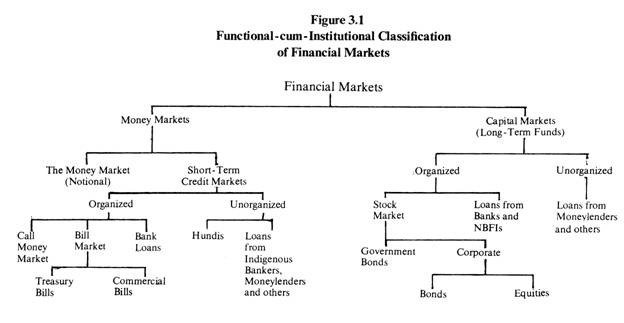
The structure of financial markets can be studied from different angles, namely, functional, institutional, or sectoral. Accordingly, financial markets, institutions, and instruments can be classified in any one or more of these ways. The functional classification is based on the term of credit, whether the credit supplied is short-term or long-term. Accordingly, markets are called money markets or capital markets.

The institutional classification tells us whether the financial institutions are organized on commercial or cooperative principles and whether they belong to the organized or unorganized sector. The sectoral classification identifies credit arrangements for various sectors of the economy: agriculture, manufacturing industry, trade and others.

Various classifications are not intended to be water-tight or mutually exclusive. Their aim is to give a broad idea of the scope of financial markets, their several dimensions and functions. Combining the first two bases of study, we give a single functional- cum-institutional classification in Figure 3.1

Functionally, financial markets are broadly sub-divided under two heads money markets and capital markets. The former are markets in short-term funds; the latter in long-term funds. We have interpreted the term money market more broadly to include within its folds also the notional money market of monetary theory.

This market is co-terminus with the entire economy. The asset it deals in is money; the demanders are the holders of money (the public) and the suppliers are the government, the RBI and banks. Money itself is acquired in the normal process of selling goods, services, and assets in all markets, as money is the common medium of exchange (in all monetised transactions).

There is no special or separate market for money like the ones we have for bills, bonds, or equity shares. In academic discussions of monetary theory and policy whenever the term money market is used, we mean the market for money as explained above. But in business parlance the term money market is almost always used in the sense of short-term credit market.

Structurally, the short-term credit market is divisible under two sectors: organized and unorganized. The organized market com­prises the RBI and banks. It is called organized because its parts are systematically coordinated by the RBI.

Non-bank financial institu­tions such as the LIC, the GIC and subsidiaries, the UTI also operate in this market, but only indirectly through banks and not directly. Quasi-government bodies and large companies may also make their short-term surplus funds available to the market through banks.

Besides commercial banks that dominate the organized money market, there are co-operative banks. They are a part of co-operative credit institutes that have a three-tier structure. At the top there are state co-operative banks (co-operation being a state subject). At the district level there are central co-operative banks. At local level there are primary credit societies and urban co-operative banks. The whole co-operative credit system is linked with the RBI and is dependent on it for funds. The RBI deals directly with only state co-operative banks. For reasons of size, methods of operation and dealings with the RBI and commercial banks, only state and central co-operative banks need be counted into the organized money market; the rest (co-operative credit societies at local level) are only loosely linked with it.

The unorganized market is largely made up of indigenous bankers and moneylenders, professional and non-professional. It is unorganized because the activities of its parts are not systematically coordinated by the RBI or any other authority.

Private moneylenders operate throughout the length and breadth of the country, but without any link among themselves. Indigenous bankers are better organized on local basis, as in Bombay and Ahmedabad. But this kind of organization is also only a loose association.

For the success of monetary and credit policy, the character of the money market is important. The unorganized sector of the market is practically insulated from monetary and credit controls. It is neither subject to reserve requirements, nor capital or investment require­ments. Its dependence on the RBI or banks for funds is very limited.

Therefore, it is not affected directly by (say) the policy of monetary restraint of the economy. The RBI has no control over the quality and composition of credit in this market either. This works as an important limitation to the working of monetary policy in India. But since 1947 the situation is rapidly changing with the fast expansion of banking in the country and the relative shrinkage of the unorganized sector of the money market. There are three main components of the organized sector of the money markets.

They are:

(i) Inter-bank call money market

(ii) Bill market, and

(iii) Bank loan market.

The unorganized sector also has its comparable markets. But its call money market is very small and restricted only to the Gujarati shroffs (one component of indigenous bankers). The other two markets are quite important. The indigenous bills are called hundis, and the hundi market is quite active. The indigenous bankers and moneylenders are still the major source of short-term loans for the small borrower.

The main function of the money market is to provide short-term funds to deficit spenders, whether the government or others. It does this mainly by mobilising short-term surpluses of both financial and non-financial units, including state governments, local governments, and quasi-government bodies.

Banks do it by ‘selling’ deposits of various kinds, participation Certificates and bills discounted. Then, there are treasury bills sold ‘on tap’ by the RBI. The RBI itself serves as the lender of last resort to the market. Funds have also to be moved between regions and from one place to another according to demand. An efficient and well- developed system does it fast and at low cost.

Also, it does not allow regional or sectoral scarcities of funds to emerge. The surpluses in some centres or sectors get immediately transferred to others in short supply. Thereby an even supply of funds and liquidity is maintained throughout the economy. For this, banks and other constituents of money market must have an inter-connected network of branches and offices, rapid communication and remittance-of-funds system, and well-trained staff.

The real economy may also nave a seasonal pattern, giving rise to seasonal ups and downs in the demand for funds. In the Indian economy this kind of seasonality mainly arises from the seasonal character of agriculture and some agro based industries (such as sugar) and their large weight in the overall economy. Thus, traditionally, the Indian money market has been facing two seasons’ busy season from October to April and slack season from May to September.

During the busy season the main (Kharif) crops are harvested and marketed and sugarcane is crushed. So, the demand for bank credit to traders and sugar manufacturers goes up. During the slack season this demand for funds goes down. The RBI has been following a pro seasonal monetary policy so that any special stringency of funds does not arise during the busy season which may hurt legitimate economic activity.

For some time past, with increased double cropping of cultivated land, hefty increases in the output of wheat (a major rabi crop) and autumn rice, growth of perennial industries, and a higher proportion of bank credit going to manufacturing industries, the previous seasonal ups and downs in the demand for funds have largely lost their importance. This trend is likely to gain in strength over time.

The capital market deals in medium-term and long-term funds. Like money market, the capital market also is divisible into two sectors organized and unorganized. The organized sector comprises the stock market, the RBI, banks, development banks (such as the Industrial Develop­ment Bank of India), LIC, GIC and subsidiaries, and the UTI.

The unorganized sector is mainly made up of indigenous bankers and money-lenders chit funds, nidhis and similar other financial institu­tions; investment companies, finance companies and hire purchase companies; and company deposits. The role of the unorganized sector in the capital market is of very limited importance.

Types of Social Security Benefits

When most people hear about Social Security benefits, they think of retirement benefits. In fact there are many types of Social Security benefits that a wide variety of people are eligible for.

Retirement Benefits

About 71% of people receiving Social Security benefits do so as retirees. Retirement benefits are available for people who are at least age 62 and have worked enough in their lifetime to become eligible. To be eligible, you must have earned at least 40 work credits. 4 credits are available each year that you work (in 2015, 1 credit is available for every $1220 in earnings). Although you can begin collecting partial benefits at 62, maximum benefits are not available until age 70, so it is important to understand the benefit amounts and make an educated decision. The amount of your benefit is based on an average of your earnings in the 35 years in which you worked the most, but there is a cap on how much you can receive.

Social Security benefits eligibility for the spouse of a living retired worker occurs if the spouse is at least 62 years old, has a child who is under age 16, or a child who is disabled. Divorced spouses are entitled to collect retirement benefits through their former spouses if the marriage lasted at least 10 years, they’ve been divorced at least 2 years, and have not remarried. Spouse can receive up to half of the amount the worker receives or their own SSI benefit, whichever is higher. Note that the spouse’s benefit does not come out of the worker’s benefit. It is a separate amount.

Survivor Benefits

The Social Security death benefit is a one-time payment of $255 that may be available to the spouse and children of a deceased worker. Ongoing survivor benefits are payable to the family of a worker who is deceased in the following situations. The spouse can collect SSI if he or she is at least 60 years old, if he or she is disabled and at least age 50, or if he or she is the parent of a child younger than 16 or a disabled child. Spouses receive either their widow/er payment (which may be 100% of the spouse’s amount if the survivor waits to claim it at full retirement age) or their own SSI payment, whichever is higher. The parent of a deceased worker is also eligible for a Social Security benefit if the parent is at least age 62 and was dependent on the worker for at least 50% of his or her support.

There are also Social Security benefits for children (including adopted children or dependent stepchildren) of a deceased worker. Children are eligible for benefits if they are under 18, under 19 and still in high school, or an adult who was disabled before reaching the age of 22.

Disability Benefits

Social Security is not just for retired people. Social Security disability benefits are available for people who have been working but become disabled and unable to work. If you are under 24 when you become disabled, you must have worked one and a half years during the three years before your disability began. For people over age 24, there must be a medical condition that is severe. The disability must be on is on the Social Security impairment list, the person must be unable to do any of their previous jobs, or be unable to any other job they qualify for. The disability must last, or expect to last, at least one year.

There are also benefits available for the spouse and child of a disabled worked. A spouse is eligible if he or she is at least 62, has a child under age 16 or a disabled child, or is divorced but was married to the worker for 10 years. Children (including adopted children or dependent stepchildren) of disabled workers are also eligible if they are under 18, under 19 and still in high school, or are adults who were disabled before age 22.

Supplemental Security Income Benefits

Another special category of benefits is provided for people who are aged (age 65 or older), blind, or disabled and who have limited income and resources. To find out if you or a family member is eligible use the online screening tool.

error: Content is protected !!