Barriers to e-commerce

Back in the day, you can sell just about anything and make crazy money.  Competition was minimal, technology wasn’t as affordable as it is now and access to product was limited.

Now, Amazon is a major competitor to everyone.  China is opening up to the world and technology is now affordable.

Here are the top 10 most common challenges faced by eCommerce businesses of all sizes.

  1. Finding the right products to sell

Shopping cart platforms like Shopify have eliminated many barriers of entry.  Anyone can launch an online store within days and start selling all sorts of products.

Amazon is taking over the eCommerce world with their massive online product catalog.  Their marketplace and fulfillment services have enabled sellers from all over the world to easily reach paying customers.

Let’s not forget about Aliexpress. They’ve simplified product sourcing by giving access to Chinese manufacturers within a couple of clicks.

All of this has made it very difficult for retailers to source unique products unless you they decide to manufacture your own.

  1. Attracting the perfect customer

Online shoppers don’t shop the same way as they used to back in the day.  They use Amazon to search for products (not just Google).  They ask for recommendations on Social Media. hey use their smartphones to read product reviews while in-store and pay for purchases using all sorts of payment methods.

Lots has changed including the way they consume content and communicate online. They get easily distracted with technology and social media.

Retailers must figure out where their audience is and how to attract them efficiently without killing their marketing budget.

  1. Generating targeted traffic

Digital marketing channels are evolving. Retailers can no longer rely one type of channel to drive traffic to their online store.

They must effectively leverage SEO, PPC, email, social, display ads, retargeting, mobile, shopping engines and affiliates to help drive qualified traffic to their online store. They must be visible where their audience is paying attention.

  1. Capturing quality leads

Online retailers are spending a significant amount of money driving traffic to their online store. With conversion rates ranging between 1% to 3%, they must put a lot of effort in generating leads in order to get the most out of their marketing efforts.

The money is in the list. Building an email subscribers list is key for long term success. Not only will help you communicate your message, but it will also allow you to prospect better using tools such as Facebook Custom Audiences.

Not all leads are created equally. Retailers must craft the right message for the right audience in order to convert them into leads with hopes of turning them into customers.

  1. Nurturing the ideal prospects

Having a large email list is worthless if you’re not actively engaging with subscribers.

A small percentage of your email list will actually convert into paying customers. Nonetheless, retailers must always deliver value with their email marketing efforts.

Online retailers put a lot of focus on communicating product offering as well as promotions, but prospects need more than that.  Value and entertainment goes a long way but that requires more work.

  1. Converting shoppers into paying customers

Driving quality traffic and nurturing leads is key if you want to close the sale.  At a certain point, you need to convert those leads in order to pay for your marketing campaigns.

Retailers must constantly optimize their efforts in converting both email leads as well as website visitors into customers.  Conversion optimization is a continuous process.

  1. Retaining customers

Attracting new customers is more expensive than retaining the current ones you already have.

Retailers must implement tactics to help them get the most out of their customer base in increase customer lifetime value.

  1. Achieving profitable long-term growth

Increasing sales is one way to grow the business but in the end, what matters most is profitability.

Online retailers must always find ways to cut inventory costs, improve marketing efficiency, reduce overhead, reduce shipping costs and control order returns.

  1. Choosing the right technology & partners

Some online retailers may face growth challenges because their techonology is limiting them or they’ve hired the wrong partners/agencies to help them manage their projects.

Retailers wanting to achieve growth must be built on a good technology foundation. They must choose the right shopping cart solution, inventory management software, email software, CRM systems, analytics and so much more.

In addition, hiring the wrong partners or agencies to help you implement projects or oversee marketing campaigns may also limit your growth.  Online retailers must choose carefully who to work with.

  1. Attracting and hiring the right people to make it all happen

Let’s face it, online retailers may have visions and aspirations but one true fact remains, they need the right people to help them carry out their desires.

Attracting the right talent is key in order to achieve desirable online growth. Also, having the right leader plays an even bigger role.

Retailers should be out there getting their name out within the online community by attending eCommerce conferences, speaking at events and networking. Employees want to work for companies that care about them and their future.  Having a sense of purpose is key.

Internet and e-commerce

We are living in the age of technological advances. Development in our society began to happen post the World Wars, where in Industrial revolution started changing the face of economies. With evolution of Information Technology we first heard the Radio and later the TV that could capture pictures from the air and show it on the TV box. Then came the ‘Computer’ which was aptly the magic box. Computers and advancement of information and communication technology heralded the arrival of ‘Internet’ or ‘World Wide Web’ technology.

What a difference the Internet has made to our lives. No other invention has had such a mass transformational power over the entire human society, enterprise, business, economy as well as the political systems, education and the world communities and nations at large. The internet is rightly called the highway that has managed to erase the borders between countries and societies and taken the human society to a different level altogether.

Take a look at our lives today. There is no aspect of our life that is not interfaced with internet in one way or the other. From an individual’s need to find a date or a suitable life partner to one’s banking, insurance and other payments as well as dining out and not to forget the online shopping, internet has managed to become the mainstream facilitator to each and every individual.

Today millions of users access and use the internet for various purposes throughout the day. They use the internet for searching, browsing, writing & communication, listening, watching news, videos, publishing copying, printing, discussions, trading and selling etc. The list of activities and choices that the internet has got to offer to individuals is ever expanding. With millions of users actively looking for various products, information and services, there is a huge opportunity for the businesses to jump on to the internet bandwagon and cash in on the business opportunity that is presenting itself every minute.

Technology has helped build a platform that has enabled the businesses to cash in on the huge population and market that is now accessible over the internet and sell to them. Take the case of Online Banking, Mobile Banking, Debit| Credit Cards, ATMs as well as online trading and other business transactions, all these have grown and happened as a result of technological advancement in terms of communication, software as well as hardware technologies. From the time that one connected to Internet using a desktop, model and a telephone line to the Wi-Fi technology of today, we have graduated very fast making it possible to buy and sell at the click of a button. At another level the Business Processes as well as ERP coupled with various software and applications besides EDI, have enabled businesses to go ‘On Line’ with their business models.

Today no business, be it Business to Business or Business to Consumer, can ignore the huge ‘Online Market’ that exists on the internet. E Commerce was inevitable. Physical markets have literally been replaced with ‘Virtual Markets’. E Commerce has had far reaching impact on business organizations for it has redefined ‘Market’. E Commerce has made it possible for sellers to reach out to planet wide markets and consumers, thus changing the way business is conducted. For every prospective Management Professional, the in depth understanding of ‘Online Marketing’ and ‘E Commerce’ have become very important. Marketing managers have got to go back to the class rooms to learn the new rules of game in handling Online Marketing which is drastically and totally different from the traditional marketing, selling, distribution and advertising strategies. Understanding all about Internet, E Commerce mechanisms, technologies, learning how to market online, understanding E Customer and learning to identify, build and nurture a relationship with the E Customer become the building blocks of one’s new learning.

The Internet is a worldwide, publicly accessible series of interconnected computer networks that transmit data by packet switching using the standard Internet Protocol (IP). It is a “network of networks” that consists of millions of smaller domestic, academic, business, and government networks, which together carry various information and services, such as electronic mail, online chat, file transfer, and the interlinked web pages and other resources of the World Wide Web (WWW).

The Internet and the World Wide Web are not synonymous. The Internet is a collection of interconnected computer networks, linked by copper wires, fiber-optic cables, wireless connections, etc. In contrast, the Web is a collection of interconnected documents and other resources, linked by hyperlinks and URLs. The World Wide Web is one of the services accessible via the Internet, along with various others including e-mail, file sharing, online gaming and others described below.

America Online, Comcast, Earthlink, etc. are examples of Internet service providers. They make it physically possible for you to send and access data from the Internet. They allow you to send and receive data to and from their computers or routers which are connected to the Internet.

World Wide Web is an example of an information protocol/service that can be used to send and receive information over the Internet. It supports:

  • Multimedia Information (text, movies, pictures, sound, programs . . . ).
  • Hypertext Information (information that contains links to other information resources)
  • Graphic User Interface (so users can point and click to request information instead of typing in text commands).

The server software for the World Wide Web is called an HTTP server (or informally a Web server). Examples are Apache and IIS. The client software for World Wide Web is called a Web browser. Examples are: Netscape, Internet Explorer, Safari, Firefox, and Mozilla. These examples are particular “brands” of software that have a similar function, just like Lotus 123 and Excel are both spreadsheet software packages.

Business Uses of Internet

More than 1.8 billion people worldwide use the Internet in some way, shape or form, according to a December, 2009 study on internetworldstats.com. A significant portion of users are business owners who have learned the power of connecting with customers and colleagues electronically. Over time, a business owner’s consistent use of the Internet can help propel his company to the next level.

Research Competition

Some businesses use the Internet to research competitors. For instance, Hoovers.com allows searches for detailed information on businesses across the country. An Internet search on a competing company results in articles and news stories about the competition that may help a business owner prepare for changes in the industry.

Buy and Sell

One of the basic uses of the Internet for businesses is to sell products and services. Businesses create E-commerce websites to sell anything from cell phone contracts to books and CDs. Online selling eliminates the need for the business to maintain a brick-and-mortar store and in some cases they don’t have to hold an inventory. A business can also use the Internet to buy items and services online, such as bulk-buying office supplies or printed materials.

Gauge Customer Interest

Business owners use the Internet to monitor customer purchasing trends and interests. To discover what everyday people think about a particular product or service, business owners can visit online social networking sites and message boards. Taking in this feedback helps business owners make their products better. For example, car accessory businesses can visit car forums to find out what car enthusiasts want. A business owner can also use the Internet to connect and communicate with his customers through these same websites.

Advertising

Businesses also use the Internet to find new customers through online advertising. Offering text and banner ads on websites as well as informational pieces, the Internet allows advertisers to reach potential customers quickly and efficiently. Pay-per click advertisements are distributed on Internet search engines and websites, allowing business owners to reach potential customers using search terms related to their business. As the business pays only for each ad click, costs are lower. The affordability and reach of some Internet advertising puts even the smallest business owner in a position to compete with larger businesses.

Provide a Superior Customer Experience

Digital technologies enable businesses to attract, retain and engage their customers in a more effective manner and for lower costs. You can use your website and social media pages to connect with prospects and market your products to those who are most likely to buy. With pay-per-click advertising, you can reach the right people at the right time and adapt your campaigns to the needs of your target audience. Marketing automation allows you to track the customer journey and reach potential clients across multiple channels.

Customer relationship management software enables users to keep accurate records of their customers’ needs, transactions and buying behavior. With this data, you can personalize the customer experience and provide better service. According to Accenture, 91 percent of people are more likely to purchase from brands that remember their preferences and provide relevant offers.

Reach a Global Audience

The rise of e-commerce, social networking and other digital technologies allows companies to reach a global audience. Geographical boundaries are no longer an issue. Small businesses can now advertise and sell their products to customers worldwide. A well-designed social media campaign can go viral within hours, generating leads and revenue.

It’s estimated that over 1.9 billion people will make an online purchase in 2019. Regardless of your budget, you can put your business in front of millions of potential customers to raise brand awareness and generate revenue. Furthermore, you can leverage the power of email and video marketing, blogging, search engine optimization and other technologies to turn prospects into buyers. Without the internet, none of these things would be possible.

Other Business Advantages

There are many other advantages of using the internet in business. Web-based technologies can improve teamwork, free up employees’ time and increase your productivity. Depending on your needs, you may use collaboration tools, project management tools, website builders, video conferencing and much more.

The internet has changed the business world forever, becoming an indispensable part of our lives. Companies that want to remain competitive and grow can no longer ignore its impact.

Protocol

A protocol is a standard set of rules that allow electronic devices to communicate with each other. These rules include what type of data may be transmitted, what commands are used to send and receive data, and how data transfers are confirmed.

You can think of a protocol as a spoken language. Each language has its own rules and vocabulary. If two people share the same language, they can communicate effectively. Similarly, if two hardware devices support the same protocol, they can communicate with each other, regardless of the manufacturer or type of device. For example, an Apple iPhone can send an email to an Android device using a standard mail protocol. A Windows-based PC can load a webpage from a Unix-based web server using a standard web protocol.

Protocols exist for several different applications. Examples include wired networking (e.g., Ethernet), wireless networking (e.g., 802.11ac), and Internet communication (e.g., IP). The Internet protocol suite, which is used for transmitting data over the Internet, contains dozens of protocols. These protocols may be broken up into four catagories:-

  • Link layer: PPP, DSL, Wi-Fi, etc.
  • Internet layer: IPv4, IPv6, etc.
  • Transport layer: TCP, UDP, etc.
  • Application layer: HTTP, IMAP, FTP, etc.

Link layer protocols establish communication between devices at a hardware level. In order to transmit data from one device to another, each device’s hardware must support the same link layer protocol. Internet layer protocols are used to initiate data transfers and route them over the Internet. Transport layer protocols define how packets are sent, received, and confirmed. Application layer protocols contain commands for specific applications. For example, a web browser uses HTTPS to securely download the contents of a webpage from a web server. An email client uses SMTP to send email messages through a mail server.

Protocols are a fundamental aspect of digital communication. In most cases, protocols operate in the background, so it is not necessary for typical users to know how each protocol works. Still, it may be helpful to familiarize yourself with some common protocols so you can better understand settings in software programs, such as web browsers and email clients.

Network Protocols

Network protocols are sets of established rules that dictate how to format, transmit and receive data so computer network devices from servers and routers to endpoints can communicate regardless of the differences in their underlying infrastructures, designs or standards.

To successfully send and receive information, devices on both sides of a communication exchange must accept and follow protocol conventions. Support for network protocols can be built into software, hardware or both.

Standardized network protocols provide a common language for network devices. Without them, computers wouldn’t know how to engage with each other. As a result, except for specialty networks built around a specific architecture, few networks would be able to function, and the internet as we know it wouldn’t exist. Virtually all network end users rely on network protocols for connectivity.

How network protocols work?

Network protocols break larger processes into discrete, narrowly defined functions and tasks across every level of the network. In the standard model, known as the Open Systems Interconnection (OSI) model, one or more network protocols govern activities at each layer in the telecommunication exchange.

A set of cooperating network protocols is called a protocol suite. The TCP/IP suite includes numerous protocols across layers such as the data, network, transport and application layers working together to enable internet connectivity. These include:

Transmission Control Protocol (TCP), which uses a set of rules to exchange messages with other internet points at the information packet level;

User Datagram Protocol (UDP), which acts as an alternative communication protocol to TCP and is used to establish low-latency and loss-tolerating connections between applications and the Internet.

Internet Protocol (IP), which uses a set of rules to send and receive messages at the Internet address level; and

additional network protocols that include the Hypertext Transfer Protocol (HTTP) and File Transfer Protocol (FTP), each of which has defined sets of rules to exchange and display information.

Every packet transmitted and received over a network contains binary data. Most protocols will add a header at the beginning of each packed in order to store information about the sender and the message’s intended destination. Some protocols may also include a footer at the end with additional information. Network protocols process these headers and footers as part of the data moving among devices in order to identify messages of their own kind.

Network protocols are often set forth in an industry standard — developed, defined and published by groups such as:

  • The International Telecommunication Union
  • The Institute of Electrical and Electronics Engineers
  • The Internet Engineering Task Force
  • The International Organization for Standardization
  • The World Wide Web Consortium.

Major types of network protocols

Generally speaking, networks have three types of protocols communication, such as Ethernet; management, such as the Simple Mail Transfer Protocol (SMTP); and security, such as Secure Shell (SSH).

Falling into these three broad categories are thousands of network protocols that uniformly handle an extensive variety of defined tasks, including authentication, automation, correction, compression, error handling, file retrieval, file transfer, link aggregation, routing, semantics, synchronization and syntax.

Implementing network protocols

In order for network protocols to work, they must be coded within software, either a part of the computer’s operating system (OS) or as an application, or implemented within the computer’s hardware. Most modern operating systems possess built-in software services that are prepared to implement some network protocols. Other applications, such as web browsers, are designed with software libraries that support whatever protocols are necessary for the application to function. Furthermore, TCP/IP and routing protocol support is implemented in direct hardware for enhanced performance.

Whenever a new protocol is implemented, it is added to the protocol suite. The organization of protocol suites is considered to be monolithic since all protocols are stored in the same address and build on top of one another.

Vulnerabilities of network protocols

One major vulnerability found in network protocols is that they are not designed for security. Their lack of protection can sometimes allow malicious attacks, such as eavesdropping and cache poisoning, to affect the system. The most common attack on network protocols is the advertisement of false routes, causing traffic to go through compromised hosts instead of the appropriate ones.

Network protocol analyzers have been designed and installed in response to these vulnerabilities. Network protocol analyzers protect systems against malicious activity by supplementing firewalls, anti-virus programs and anti-spyware software.

Uses of network protocols

Network protocols are what make the modern Internet possible since they allow computers to communicate across networks without users having to see or know what background operations are occurring. Some specific examples of network protocols and their uses are:

  • Post Office Protocol 3 (POP3), which is the most recent version of a standard protocol that is used for receiving incoming e-mails.
  • Simple main transport Protocol, which is used to send and distribute outgoing e-mails.
  • File Transfer Protocol (FTP), which is used to transfer files from one machine to another.
  • Telnet, which is a collection of rules used to connect one system to another via a remote login. In this protocol, the system that send the request for connection is the local computer and the system that accepts the connection is the remote computer.

Intranet

Intranet is defined as private network of computers within an organization with its own server and firewall. Moreover we can define Intranet as:

Intranet is system in which multiple PCs are networked to be connected to each other. PCs in intranet are not available to the world outside of the intranet.

Usually each company or organization has their own Intranet network and members/employees of that company can access the computers in their intranet.

Every computer in internet is identified by a unique IP address.

Each computer in Intranet is also identified by a IP Address, which is unique among the computers in that Intranet.

Advantage of Intranet

Intranet is very efficient and reliable network system for any organization. It is beneficial in every aspect such as collaboration, cost-effectiveness, security, productivity and much more.

(i) Communication

Intranet offers easy and cheap communication within an organization. Employees can communicate using chat, e-mail or blogs.

(ii) Time Saving

Information on Intranet is shared in real time.

(iii) Collaboration

Information is distributed among the employees as according to requirement and it can be accessed by the authorized users, resulting in enhanced teamwork.

(iv) Platform Independency

Intranet can connect computers and other devices with different architecture.

(v) Cost Effective

Employees can see the data and other documents using browser rather than printing them and distributing duplicate copies among the employees, which certainly decreases the cost.

(vi) Workforce Productivity

Data is available at every time and can be accessed using company workstation. This helps the employees work faster.

(vii) Business Management

It is also possible to deploy applications that support business operations.

(viii) Security

Since information shared on intranet can only be accessed within an organization, therefore there is almost no chance of being theft.

(ix) Specific Users

Intranet targets only specific users within an organization therefore, once can exactly know whom he is interacting.

(x) Immediate Updates

Any changes made to information are reflected immediately to all the users.

Issues in Intranet

Apart from several benefits of Intranet, there also exist some issues.. These issues are shown in the following diagram:

Applications

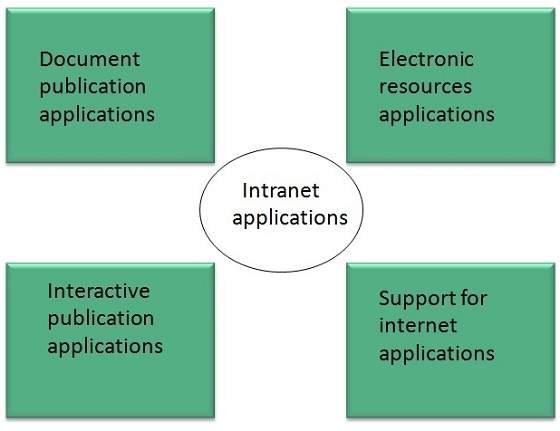
Intranet applications are same as that of Internet applications. Intranet applications are also accessed through a web browser. The only difference is that, Intranet applications reside on local server while Internet applications reside on remote server. Here, we’ve discussed some of these applications:

(i) Document publication applications

Document publication applications allow publishing documents such as manuals, software guide, employee profits etc without use of paper.

(ii) Electronic resources applications

It offers electronic resources such as software applications, templates and tools, to be shared across the network.

(iii) Interactive Communication applications

Like on internet, we have e-mail and chat like applications for Intranet, hence offering an interactive communication among employees.

(iv) Support for Internet Applications

Intranet offers an environment to deploy and test applications before placing them on Internet.

Electronic Payment System Meaning and Methods

An e-payment system is a way of making transactions or paying for goods and services through an electronic medium, without the use of checks or cash. It’s also called an electronic payment system or online payment system.

The electronic payment system has grown increasingly over the last decades due to the growing spread of internet-based banking and shopping. As the world advances more with technology development, we can see the rise of electronic payment systems and payment processing devices. As this increase, improve, and provide ever more secure online payment transactions the percentage of check and cash transactions will decrease.

Methods of electronic payment system

One of the most popular payment forms online is credit and debit cards. Besides them, there are also alternative payment methods, such as bank transfers, electronic wallets, smart cards or bitcoin wallet (bitcoin is the most popular crypto currency).

E-payment methods could be classified into two areas, credit payment systems and cash payment systems.

  1. Credit Payment System

  • Credit Card: A form of the e-payment system which requires the use of the card issued by a financial institute to the cardholder for making payments online or through an electronic device, without the use of cash.
  • E-wallet: A form of prepaid account that stores user’s financial data, like debit and credit card information to make an online transaction easier.
  • Smart card: A plastic card with a microprocessor that can be loaded with funds to make transactions; also known as a chip card.
  1. Cash Payment System

  • Direct debit: A financial transaction in which the account holder instructs the bank to collect a specific amount of money from his account electronically to pay for goods or services.
  • E-check: A digital version of an old paper check. It’s an electronic transfer of money from a bank account, usually checking account, without the use of the paper check. E-cash is a form of an electronic payment system, where a certain amount of money is stored on a client’s device and made accessible for online transactions.
  • Stored-value card: A card with a certain amount of money that can be used to perform the transaction in the issuer store. A typical example of stored-value cards are gift cards.

Advantages of electronic payment systems

  1. Time savings

Money transfer between virtual accounts usually takes a few minutes, while a wire transfer or a postal one may take several days. Also, you will not waste your time waiting in lines at a bank or post office.

  1. Expenses control

Even if someone is eager to bring his disbursements under control, it is necessary to be patient enough to write down all the petty expenses, which often takes a large part of the total amount of disbursements. The virtual account contains the history of all transactions indicating the store and the amount you spent. And you can check it anytime you want. This advantage of electronic payment system is pretty important in this case.

  1. Reduced risk of loss and theft

You can not forget your virtual wallet somewhere and it can not be taken away by robbers. Although in cyberspace there are many scammers, in one of the previous articles we described in detail how to make your e-currency account secure.

  1. Low commissions

If you pay for internet service provider or a mobile account replenishment through the UPT (unattended payment terminal), you will encounter high fees. As for the electronic payment system: a fee of this kind of operations consists of 1% of the total amount, and this is a considerable advantage.

  1. User-friendly

Usually every service is designed to reach the widest possible audience, so it has the intuitively understandable user interface. In addition, there is always the opportunity to submit a question to a support team, which often works 24/7. Anyway you can always get an answer using the forums on the subject.

  1. Convenience

All the transfers can be performed at anytime, anywhere. It’s enough to have an access to the Internet.

Disadvantages of electronic payment systems

  1. Restrictions

Each payment system has its limits regarding the maximum amount in the account, the number of transactions per day and the amount of output.

  1. The risk of being hacked

If you follow the security rules the threat is minimal, it can be compared to the risk of something like a robbery. The worse situation when the system of processing company has been broken, because it leads to the leak of personal data on cards and its owners. Even if the electronic payment system does not launch plastic cards, it can be involved in scandals regarding the Identity theft.

The problem of transferring money between different payment systems- Usually the majority of electronic payment systems do not cooperate with each other. In this case, you have to use the services of e-currency exchange, and it can be time-consuming if you still do not have a trusted service for this purpose. Our article on how to choose the best e-currency exchanger greatly facilitates the search process.

  1. The lack of anonymity

The information about all the transactions, including the amount, time and recipient are stored in the database of the payment system. And it means the intelligence agency has an access to this information. You should decide whether it’s bad or good.

  1. The necessity of Internet access

If Internet connection fails, you can not get to your online account.

Electronic Payment System: Issues

  1. Sophisticated (and Zero-Day) Malware

Malware has gotten very sophisticated, tracking everything from keystrokes to learning passwords, to infiltrating laptop cameras and microphones. URL scraping can see where you’ve been online, and bots can be installed in your system without you ever knowing it. This all adds up to bad actors knowing who you are, what you do, your passwords, etc. This is all bad news.

With malware and ransomware (encrypting your files until you pay a ransom to a hacker) on the rise, you must have the latest and greatest security software installed and running. You also must be vigilant in the links you click, the pages you visit and the people you interact with online.

  1. Poor Patching

Patching is a critical activity for any progressive, security-conscious organization. Unfortunately, patching demands must be addressed on operating systems, applications and network infrastructure, making it a bit of a hindrance in some minds.

It’s important to patch often and completely. Back in 2014, about half of all exploits went from the publishing of the vulnerability to being hacked in less than a month. Last year, 99.99 percent of vulnerabilities compromised were done so more than one year after they were identified.. You must patch frequently and patch often.

  1. Application/Middleware Vulnerabilities

Breaching the perimeter is no longer the preferred attack vector. Attackers are now taking advantage of the proliferation of applications across the typical enterprise. Most vendors will do the right thing with vulnerabilities and patches, but you must remain vigilant.

Establish an application security program to address this need. Scan internal apps and do frequent code reviews. Keep your security program up to date by always installing the latest versions of all security solutions.

  1. Service Providers

Third parties have become a large part of many infrastructures owing to their cost-savings, expertise and capabilities. Many are trusted with sensitive info, making them a very tight extension of your organization. Sadly, the Ponemon Institute states that third-party organizations accounted for (or were involved in) 42 percent of all data breaches.

Be strict in your third-party service provider evaluations. Ensure they have a solid track record of security.

  1. Failed Understanding of InfoSec and Cyber Risk

We’re sometimes our own worst enemies and what we don’t know can hurt our organizations. Risk is always seen through the eyes of the risk-taker, and if you’re unable to articulate the risks, people won’t see them.

Make education a priority. Don’t assume that everyone will value security as highly as you do. Put yourself in the shoes of the risk-taker and formulate a plan to address their risks.

  1. Mobile and BYOD

Mobile devices are prevalent in our enterprises, and not all of them are company issued (bring your own device). Unmanaged mobile devices present many threats. Non-compliant and jail-broken devices are often easy to exploit, and employees frustrated by multiple-authorization requests may simply get around your controls.

Anticipate this by developing a comprehensive mobile device management (MDM) strategy and stick to it. Work to understand how your employees are using these devices and implement policies to address said usage. Also, make it a priority to know all the devices using your network.

  1. Smarter Phishing and Spear Phishing

Phishing used to be easy to identify. Poor spelling and grammar were dead giveaways, as was the non-personal nature of the email. Well the “Dear sir/madam” intro has been replaced by very targeted messaging. “CEO Wire Fraud” attacks accounted for $2.3 billion in losses, according to the FBI. This “spear phishing” features language that is very specific to the recipient, and often high-level folks with top access and the ability to authorize payments.

Never authorize access or payments to people you don’t recognize. Follow up with people in your organization responsible for such things.

  1. Cloud Unpreparedness

Everybody is rushing to put their data into the cloud, and it makes sense. The cloud offers many benefits and is undeniably the way forward, but migrating to the cloud should be done with care.

It all starts with asking the right questions. Who will own the data? What data should be in the cloud? What data should be omitted from the cloud? How is data handled once it is no longer needed? Finally, take the time to understand what data protection controls YOU are responsible to provide.

  1. Over-trusting Encryption

Encryption is a great thing, but it’s not everything. Encryption of data is only as safe as the encryption type you use and how the keys are managed. Payment Card Industry (PCI) compliance does not allow encryption to take data out of PCI scope.

Simply put, encryption should be employed as part of a total solution, not as the only solution.

  1. Internet of Things (IoT) Attacks

As a society, we certainly don’t seem to have trust issues when it comes to IoT devices. But the fact is, if something is internet-enabled, it can be hacked. Cars, refrigerators and even children’s toys can be accessed by bad actors.

With Gartner estimating that 50 trillion gigs of data will be sent by IoT devices by 2020, hackers are sensing a massive opportunity. Always change passwords and factory security settings when employing these devices.

Electronic Banking

Electronic banking has many names like e banking, virtual banking, online banking, or internet banking. It is simply the use of electronic and telecommunications network for delivering various banking products and services. Through e-banking, a customer can access his account and conduct many transactions using his computer or mobile phone.

Types of Electronic Banking

Banks offer various types of services through electronic banking platforms. These are of three types:-

Level 1: This is the basic level of service that banks offer through their websites. Through this service, the bank offers information about its products and services to customers. Further, some banks may receive and reply to queries through e-mail too.

Level 2: In this level, banks allow their customers to submit instructions or applications for different services, check their account balance, etc. However, banks do not permit their customers to do any fund-based transactions on their accounts.

Level 3: In the third level, banks allow their customers to operate their accounts for funds transfer, bill payments, and purchase and redeem securities, etc.

Most traditional banks offer e-banking services as an additional method of providing service. Further, many new banks deliver banking services primarily through the internet or other electronic delivery channels. Also, some banks are ‘internet only’ banks without any physical branch anywhere in the country.

Importance of e-banking

We will look at the importance of electronic banking for banks, individual customers, and businesses separately.

For Banks

  • Lesser transaction costs: electronic transactions are the cheapest modes of transaction
  • A reduced margin for human error: since the information is relayed electronically, there is no room for human error
  • Lesser paperwork: digital records reduce paperwork and make the process easier to handle. Also, it is environment-friendly.
  • Reduced fixed costs: A lesser need for branches which translates into a lower fixed cost.
  • More loyal customers: since e-banking services are customer-friendly, banks experience higher loyalty from its customers.

For Customers

  • Convenience: a customer can access his account and transact from anywhere 24x7x365.
  • Lower cost per transaction: since the customer does not have to visit the branch for every transaction, it saves him both time and money.
  • No geographical barriers: In traditional banking systems, geographical distances could hamper certain banking transactions. However, with e-banking, geographical barriers are reduced.

For Businesses

  • Account reviews: Business owners and designated staff members can access the accounts quickly using an online banking interface. This allows them to review the account activity and also ensure the smooth functioning of the account.
  • Better productivity: Electronic banking improves productivity. It allows the automation of regular monthly payments and a host of other features to enhance the productivity of the business.
  • Lower costs: Usually, costs in banking relationships are based on the resources utilized. If a certain business requires more assistance with wire transfers, deposits, etc., then the bank charges it higher fees. With online banking, these expenses are minimized.
  • Lesser errors: Electronic banking helps reduce errors in regular banking transactions. Bad handwriting, mistaken information, etc. can cause errors which can prove costly. Also, easy review of the account activity enhances the accuracy of financial transactions.
  • Reduced fraud: Electronic banking provides a digital footprint for all employees who have the right to modify banking activities. Therefore, the business has better visibility into its transactions making it difficult for any fraudsters to play mischief.

E-banking in India

In India, since 1997, when the ICICI Bank first offered internet banking services, today, most new-generation banks offer the same to their customers. In fact, all major banks provide e-banking services to their customers.

Popular services under e-banking in India

  • ATMs (Automated Teller Machines)
  • Telephone Banking
  • Electronic Clearing Cards
  • Smart Cards
  • EFT (Electronic Funds Transfer) System
  • ECS (Electronic Clearing Services)
  • Mobile Banking
  • Internet Banking
  • Telebanking
  • Door-step Banking

Further, under Internet banking, the following services are available in India:

  1. Bill payment

Every bank has a tie-up with different utility companies, service providers, insurance companies, etc. across the country. The banks use these tie-ups to offer online payment of bills (electricity, telephone, mobile phone, etc.). Also, most banks charge a nominal one-time registration fee for this service. Further, the customer can create a standing instruction to pay recurring bills automatically every month.

  1. Funds transfer

A customer can transfer funds from his account to another with the same bank or even a different bank, anywhere in India. He needs to log in to his account, specify the payee’s name, account number, his bank, and branch along with the transfer amount. The transfer is effected within a day or so.

  1. Investing

Through electronic banking, a customer can open a fixed deposit with the bank online through funds transfer. Further, if a customer has a demat account and a linked bank account and trading account, he can buy or sell shares online too. Additionally, some banks allow customers to purchase and redeem mutual fund units from their online platforms as well.

  1. Shopping

With an e-banking service, a customer can purchase goods or services online and also pay for them using his account.

Electronic Stock Trading

Electronic trading is easy: Log in to your account. Select the security you wish to buy or sell. Click the mouse or tap your screen, and the transaction takes place. From an investor’s perspective, it’s simple and easy. But behind the scenes, it is a complex process backed by an impressive array of technology. What was once associated with shouting traders and wild hand gestures has now become more closely associated with statisticians and computer programmers.

First Step: Open an Account

The first step is to open an account with a brokerage firm. This can be done electronically or by completing and mailing the appropriate forms. You will need to provide personal information, such as your name and address, that enables the firm to identify you, along with a bit of information about your investing experience level. Then the brokerage firm can evaluate whether the account you are seeking is appropriate. For example, if you have no experience trading stocks but wish to open an account that lets you trade using borrowed money (a margin account), your application may be denied.

The account-opening process also enables you to designate electronic pathways between your bank account and brokerage account so that money can move in either direction. Should you wish to add more money to your investable pool, you can move it from your bank account to your brokerage account simply by logging in to your account. Similarly, if your investments have generated gains and you need that money to pay bills, you can move from your brokerage account to your bank without making any phone calls. If you don’t have a bank account, you can set up a money market account with the brokerage firm and use it in a manner similar to a bank account.

These electronic conveniences require computer equipment, such as servers, and human oversight to make sure everything is set up properly and works as planned. The technological requirements become even more complex when you are ready to trade.

Research before Trading

Before you place an order, you will likely want to learn about the security you are considering for purchase. Most brokerage websites offer access to research reports that will help you make your decision and real-time quotes that tell how much the security is trading for at any given time. The research reports are updated periodically and loaded to the website when you access them. The quotes are a far more complex issue, as the technology must keep track of thousands of data points relating to stock prices and deliver that data to you instantly upon request.

When you actually place an order, the infrastructure level required to support the process increases. Programming and technology must facilitate order entry and the variety of choices that it entails.

First, you have the option to select your choice of order types. Market orders execute immediately. Limit orders can be set to execute only at a certain price, within a certain time limit ranging from immediately to anytime within a period of months. These choices are available simultaneously to all investors using the system and must work in real-time.

The purchase price and share quantity requested must be conveyed to the marketplace, which requires the computer system at the brokerage firm where the order was placed to interact with computer systems on the securities exchange where the shares will be purchased. The systems at the exchange must instantly and simultaneously interact with the systems at all of the brokerage firms, either offering shares for sale or seeking to purchase shares.

To complicate matters further, the electronic interface must include all exchanges (Nasdaq, NYSE, etc.) from which an investor may choose to purchase a security. The interaction between systems must execute transactions and deliver the best price for the trade. To prove to regulators like the Securities and Exchange Commission (SEC) that the trade was executed in a timely and cost-effective fashion, the systems must maintain a record of the transaction.

The computerized matching engine must perform a high volume of transactions every minute the market is open for business and do so instantly and flawlessly. Backup systems are necessary to make sure investors have access to their accounts and can trade every minute the markets are open. Security industry regulators, such as the SEC, also need access to the information contained in investors’ accounts.

How Information Is Protected?

That data is held at the Depository Trust Company, which is a recordkeeper responsible for maintaining details for all shareholders in the United States. The DTCC is a holding company consisting of five clearing corporations and one depository, making it the world’s largest financial services corporation dealing in post-trade transactions. This central repository serves as a backstop, enabling investors to recover account information in the event the brokerage firm responsible for facilitating the investor’s trades goes out of business.

Once the trade has been made, the transaction must be confirmed with both buyer and seller. The data must be sent back out to the systems that collect and display pricing to other market participants to facilitate trading in the broader marketplace.

Trading Records Kept

A record of the transaction must be stored, so that data is available for client statements and for clients to access online when they log into their brokerage accounts. On an ongoing basis, the system must capture data for corporate actions like dividends and capital gains, not only to keep the investor’s account balance up to date and accurate but also to facilitate tax reporting. Enormous volumes of data must continually be tracked, captured and transmitted.

The system must also be able to facilitate both periodic and regularly scheduled recurring transactions. Everything from transfers to and from the investor’s personal bank account to ongoing transfers between accounts for account funding, bill payment, estate settlement and a variety of other transactions must be supported.

Risks

Electronic trading is integral to the financial markets. Everything from technological glitches to outright fraud can impair the smooth and efficient functioning of those markets, costing brokerage firms money and calling into question the credibility of the financial system. Even minor glitches, such as the “flash crash” of May 6, 2010, can wreak havoc. The flash crash was a brief trading glitch that caused the Dow Jones Industrial Average to plunge 998.5 points in just 20 minutes. More than $1 trillion in market value disappeared. To rectify the situation and make investors whole, 21,000 trades were canceled—all because of a single glitch, triggered by an order placed in the futures market on a brokerage firm’s computer system, which caused panic trading to spill over to the equity markets.

Electronic trading is amazingly complex and extraordinarily fast. It offers instant access to an impressive array of securities and markets. The data support includes all the reporting functions an investor needs and all the data that regulators require. It includes a secure environment for personal account details and an industrywide repository designed to ensure no data is lost. Despite the high trading volume, the system is incredibly reliable. It’s a modern technological marvel, and it’s available to you to use for just a few dollars per trade.

  • Electronic trading involves setting up an account with a brokerage of your choice, including providing your contact and financial information to facilitate electronic transfers between your bank and the brokerage.
  • When you place an order, the complex technology enables the brokerage to interact with all the securities exchanges looking to execute trades, while those exchanges simultaneously interact with all the brokerages.
  • A computerized matching engine performs a high volume of trades each minute, and all work is backed up and accessible to be reviewed by investors, market makers and government regulators.
  • All information is protected and stored by the Depository Trust Company, a recordkeeper of all financial transactions made by U.S. shareholders, therefore guaranteeing that no information is lost.

Online share Trading Advantages

Convenience: In order to become a successful online trader or investor, all you need to do is to open a trading account on a reliable brokerage platform. So long as you have a reliable internet connection, you are not bound by time or place. You can transact successfully and make money from your home, office or your child’s annual theatre performance. Online share trading or investment does not force you to take time away from your other obligations. Hence, online trading offers greater convenience, accessibility and comfort. Additionally, it enables you to save time that would have been otherwise wasted in traveling to brick-and-mortar brokerage offices.

Affordability: In online share trading, the fee charged by the share-brokers is lower than the commission expected by traditional brokerages. Additionally, if you trade in a substantial volume of stocks, you can even negotiate the broker’s fees. Thus, the above reasons make online trading or investing more affordable than the traditional method.

Ease of monitoring: Online share trading offers investors advanced interfaces through which they can remotely monitor how their money is doing throughout the day. They can trade, invest, buy and sell shares at their leisure and can use their phone or computer to evaluate their profit or loss. Online trading ensures that investors never have to leave their money unsupervised on the market and it allows the trading process to be continuous and uninterrupted.

Faster: Online trading is faster and more efficient than traditional methods of trading. This is because online transactions are almost instantaneous and stocks can be bought and sold at a moment’s notice over the internet. Online traders can trade whenever they want to, instead of being hamstrung until they are able to contact their brokers and the broker is able to place their order. Additionally, when working online, investors can easily review all their options and make independent choices instead of being completely dependent on the broker to tell them where to invest their money. As a result, online investors have greater control over their own money and can transact at higher speeds than their traditional counterparts. Due to the nature of the stock-market, this speed can be of vital importance to a trader.

Data Warehousing

The term “Data Warehouse” was first coined by Bill Inmon in 1990. According to Inmon, a data warehouse is a subject oriented, integrated, time-variant, and non-volatile collection of data. This data helps analysts to take informed decisions in an organization.

An operational database undergoes frequent changes on a daily basis on account of the transactions that take place. Suppose a business executive wants to analyze previous feedback on any data such as a product, a supplier, or any consumer data, then the executive will have no data available to analyze because the previous data has been updated due to transactions.

A data warehouses provides us generalized and consolidated data in multidimensional view. Along with generalized and consolidated view of data, a data warehouses also provides us Online Analytical Processing (OLAP) tools. These tools help us in interactive and effective analysis of data in a multidimensional space. This analysis results in data generalization and data mining.

Data mining functions such as association, clustering, classification, prediction can be integrated with OLAP operations to enhance the interactive mining of knowledge at multiple level of abstraction. That’s why data warehouse has now become an important platform for data analysis and online analytical processing.

Understanding a Data Warehouse

  • A data warehouse is a database, which is kept separate from the organization’s operational database.
  • There is no frequent updating done in a data warehouse.
  • It possesses consolidated historical data, which helps the organization to analyze its business.
  • A data warehouse helps executives to organize, understand, and use their data to take strategic decisions.
  • Data warehouse systems help in the integration of diversity of application systems.
  • A data warehouse system helps in consolidated historical data analysis.

Features of Data Warehouse

(i) Subject Oriented

A data warehouse is subject oriented because it provides information around a subject rather than the organization’s ongoing operations. These subjects can be product, customers, suppliers, sales, revenue, etc. A data warehouse does not focus on the ongoing operations, rather it focuses on modelling and analysis of data for decision making.

(ii) Integrated

A data warehouse is constructed by integrating data from heterogeneous sources such as relational databases, flat files, etc. This integration enhances the effective analysis of data.

(iii) Time Variant

The data collected in a data warehouse is identified with a particular time period. The data in a data warehouse provides information from the historical point of view.

(iv) Non-volatile

Non-volatile means the previous data is not erased when new data is added to it. A data warehouse is kept separate from the operational database and therefore frequent changes in operational database is not reflected in the data warehouse.

Data Warehouse Applications

As discussed before, a data warehouse helps business executives to organize, analyze, and use their data for decision making. A data warehouse serves as a sole part of a plan-execute-assess “closed-loop” feedback system for the enterprise management. Data warehouses are widely used in the following fields:

  • Financial services
  • Banking services
  • Consumer goods
  • Retail sectors
  • Controlled manufacturing

Types of Data Warehouse

Information processing, analytical processing, and data mining are the three types of data warehouse applications that are discussed below:

  • Information Processing: A data warehouse allows to process the data stored in it. The data can be processed by means of querying, basic statistical analysis, reporting using crosstabs, tables, charts, or graphs.
  • Analytical Processing: A data warehouse supports analytical processing of the information stored in it. The data can be analyzed by means of basic OLAP operations, including slice-and-dice, drill down, drill up, and pivoting.
  • Data Mining: Data mining supports knowledge discovery by finding hidden patterns and associations, constructing analytical models, performing classification and prediction. These mining results can be presented using the visualization tools.

Functions of Data Warehouse Tools and Utilities

  • Data Extraction: Involves gathering data from multiple heterogeneous sources.
  • Data Cleaning: Involves finding and correcting the errors in data.
  • Data Transformation: Involves converting the data from legacy format to warehouse format.
  • Data Loading: Involves sorting, summarizing, consolidating, checking integrity, and building indices and partitions.
  • Refreshing: Involves updating from data sources to warehouse.
  Data Warehouse (OLAP)  Operational Database(OLTP)
1 It involves historical processing of information. It involves day-to-day processing.
2 OLAP systems are used by knowledge workers such as executives, managers, and analysts. OLTP systems are used by clerks, DBAs, or database professionals.
3 It is used to analyze the business.         It is used to run the business.
4 It focuses on Information out.    It focuses on Data in.
5 It is based on Star Schema, Snowflake Schema, and Fact Constellation Schema. It is based on Entity Relationship Model.
6 It focuses on Information out. It is application oriented.
7 It contains historical data.           It contains current data.
8 It provides summarized and consolidated data. It provides primitive and highly detailed data.
9 It provides summarized and multidimensional view of data.            It provides detailed and flat relational view of data.
10 The number of users is in hundreds.    The number of users is in thousands.
11 The number of records accessed is in millions.            The number of records accessed is in tens.
12 The database size is from 100GB to 100 TB.  The database size is from 100 MB to 100 GB.
13 These are highly flexible.  It provides high performance.

Data warehousing is the process of constructing and using a data warehouse. A data warehouse is constructed by integrating data from multiple heterogeneous sources that support analytical reporting, structured and/or ad hoc queries, and decision making. Data warehousing involves data cleaning, data integration, and data consolidations.

Using Data Warehouse Information

There are decision support technologies that help utilize the data available in a data warehouse. These technologies help executives to use the warehouse quickly and effectively. They can gather data, analyze it, and take decisions based on the information present in the warehouse. The information gathered in a warehouse can be used in any of the following domains:

  • Tuning Production Strategies: The product strategies can be well tuned by repositioning the products and managing the product portfolios by comparing the sales quarterly or yearly.
  • Customer Analysis: Customer analysis is done by analyzing the customer’s buying preferences, buying time, budget cycles, etc.
  • Operations Analysis: Data warehousing also helps in customer relationship management, and making environmental corrections. The information also allows us to analyze business operations.

Integrating Heterogeneous Databases

To integrate heterogeneous databases, we have two approaches

  • Query-driven Approach
  • Update-driven Approach
  1. Query-Driven Approach

This is the traditional approach to integrate heterogeneous databases. This approach was used to build wrappers and integrators on top of multiple heterogeneous databases. These integrators are also known as mediators.

Process of Query-Driven Approach

(i) When a query is issued to a client side, a metadata dictionary translates the query into an appropriate form for individual heterogeneous sites involved.

(ii) Now these queries are mapped and sent to the local query processor.

(iii) The results from heterogeneous sites are integrated into a global answer set.

Disadvantage of Query-Driven Approach

  • Query-driven approach needs complex integration and filtering processes.
  • This approach is very inefficient.
  • It is very expensive for frequent queries.
  • This approach is also very expensive for queries that require aggregations.
  1. Update-Driven Approach

This is an alternative to the traditional approach. Today’s data warehouse systems follow update-driven approach rather than the traditional approach discussed earlier. In update-driven approach, the information from multiple heterogeneous sources are integrated in advance and are stored in a warehouse. This information is available for direct querying and analysis.

Advantage of Update-Driven Approach

This approach has the following advantages

  • This approach provide high performance
  • The data is copied, processed, integrated, annotated, summarized and restructured in semantic data store in advance.
  • Query processing does not require an interface to process data at local sources.
error: Content is protected !!