Impact of Environment in Social Marketing

The first steps on the pathway to sustainability can often be seeen in initiatives that seek to reduce waste and pollution, increase water and energy efficiency, improve people’s health and change car-based transportation patterns. Social marketing is a key approach whose aim is to influence and support constructive change in environmental, social and health campaigns. Social marketing is an adaptable approach, increasingly being used to achieve and sustain behaviour relevant to a range of social issues and topics. It is significantly different from commercial marketing despite the fact that its basis lies in the borrowing of the latter’s concepts and tools. One of the main differences is that social marketing is charged with increasingly complex and ambitious goals often with the provision of very few resources. The accompanying site blog (above menu) looks at one underlying framework Cialdini’s six principles of persuasion. More on this and other frameworks and guides that support social marketing campaigns that work are provided through the links below.

Using the Six Principles of Persuasion to Promote Travel Behaviour Change This paper by Rita Seethaler & Dr Geoff Rose shows how social psychology offers a series of six specific persuasion techniques that are able to reach beyond the mere raising of awareness and knowledge. Appealing to deeply seated human needs, the six persuasion principles of Reciprocity, Consistency, Social Proof, Authority, Liking and Scarcity can be translated into practical communication strategies that will increase the personal involvement of a target population and secure a lasting change in behavioural patterns.

Fostering sustainable behaviour Numerous initiatives to reduce waste and pollution, increase water and energy efficiency, and alter transportation patterns are first footholds in the transition to sustainability. This site by Doug McKenzie-Mohr was developed for the people who design these and other programs to foster sustainable behavior. Its purpose is simple: to provide information that can enhance the success of their efforts. The site consists of six resources:an online guide which illustrates how to use community-based social marketing to design and evaluate programs to foster sustainable behavior; searchable databases of articles, downloadable reports, graphics, and case studies on fostering sustainable behavior; and a listserv for sharing information and asking questions of others.

Quick Reference

Community-based Social Marketing This short paper by Doug McKenzie-Mohr discusses community-based social marketing as an alternative to information-based campaigns for conservation. It is based upon research in the social sciences that demonstrates that behavior change is most effectively achieved through initiatives delivered at the community level which focus on removing barriers to an activity while simultaneously enhancing the activity’s benefits. A four-step process is presented for carrying out community-based social marketing initiatives

Tools of Change

Proven Methods for Promoting Health, Safety and Environmental Citizenship This Canadian website, founded on the principles of community-based social marketing, offers specific tools, case studies, and a planning guide for helping people take actions and adopt habits that promote health and/or are more environmentally-friendly. This Web site will help you include in your programs the best practices of many other programs practices that have already been successful in changing people’s behaviour.

The “Seven Doors” social marketing approach

The “Seven Doors” social marketing approach was developed by Les Robinson, a former campaign director and now consultant for Social Change Media. This paper was originally presented by Les to the Waste Educate 98 Conference.This model allows us to identify which elements are already being fulfilled, and so concentrate resources on the gaps in our marketing campaigns. The seven elements are knowledge, desire, skills, optimism, facilitation, stimulation and reinforcement.

Social Marketing Plans: Steps in Developing Social Marketing Plans

Social media is a vital marketing channel for businesses of all sizes. The common question a few years ago, “why should our business use social media?”, is now being replaced with, “how can our business grow with social media marketing?”.

As a social media marketer, this makes me very excited. What doesn’t make me excited is how many businesses are still trying to market on social media without a documented strategy.

Step 1: Audit Your Current Social Presence

“Know thyself. Know the customer. Innovate.” – Beth Comstock

Before you strategize about where you are headed, take a quick look at where you are. A few areas to consider when auditing your business’s social media presence are:

  • Which networks are you currently active on
  • Are your networks optimized (photo and cover images, bio, URL, etc.)
  • Which networks are currently bringing you the most value
  • How do your profiles compare to your competitors’ profiles

Step 2: Document Who Your Ideal Customer Is

“The aim of marketing is to know and understand the customer so well the product or service fits him and sells itself.” – Peter Drucker

You will want to get as specific as possible with this part. For example, if you identified your target market as parents it would be ok. However, if you identify your ideal customer as a parent that lives in the United States, is between 30 and 50 years of age, earns over $70,000, primarily uses Facebook and has an interest in outdoor activities you will have much more success.

Even the best marketers will fail if they are marketing to the wrong audience. Answer the following questions to help you come up with a highly focused buyer persona:

  • Age
  • Location
  • Job Title
  • Income
  • Pain Points (that your business can solve)
  • Most Used Social Network

Step 3: Create A Social Media Mission Statement

“What makes you weird, makes you unique and therefore makes you stand out.” – Dan Schawbel

Your social media mission statement will drive your future actions, so make sure you put some thought into it. This statement will make it clear exactly what you plan to use your social media presence for and should reflect your brand identity. Keep in mind your ideal customer when trying to create this statement.

An example mission statement might be “to use social media to educate current and potential customers about digital marketing, with a focus on social media marketing.” Once you have this statement documented, it will make it simple for you to decide what to share and create.

If it doesn’t align with your mission statement, forget about it. Businesses that post randomly without a guiding mission will fail. People follow experts, not generalists.

Step 4: Identify Key Success Metrics

“If you cannot measure it you cannot improve it.” – Lord Kelvin

How will you determine if your social media marketing efforts are successful? I am not just talking about gaining more followers, I am talking about making money. Afterall, it is hard to rationalize spending time and money on something that isn’t improving the bottom line.

A few metrics to consider measuring are:

  • Conversion Rate
  • Time Spent on Website
  • Reach
  • Brand Mentions
  • Sentiment
  • Total Shares

Step 5: Create and Curate Engaging Content

“Content is where I expect much of the real money will be made on the Internet.” – Bill Gates

Sadly, many businesses jump straight to this step. Hopefully, this post has made it clear that there are several vital steps that you must take before you start creating and curating engaging content to share on your social media channels.

Let’s now discuss the fun part, posting to social media. You know who your ideal customer is and you used that information to create your social media mission statement. Armed with this information it should be easy for you to begin creating and curating content. So, what exactly is considered content? Here are a few examples of content you could create:

  • Images
  • Videos
  • Blog Posts
  • Company News
  • Infographics
  • eBooks
  • Interviews

The list of content ideas goes on and on, but make sure you focus only on forms of content that align with your mission statement, as well as your skill set. Content is what fuels social media, so it is crucial that you consider creating high quality, engaging content as a top priority. It is trongly recommend that you create a content calendar that outlines how often you will post to each network, which topics you will share and when you will share them.

Step 6: Invest In a Social Media Management Tool

“We live in times in which ordinary people can do amazing things using the right tools”

Most marketers have a secret, they leverage tools to boost their productivity. Ok, maybe it isn’t a secret, but without tools, marketers would face constant burnout (many do even with tools). When it comes to social media, having a social media management tool allows you to scale your efforts with ease.

One of the main benefits of a social media management tool is the ability to schedule posts ahead of time. Remember that content calendar you created? Make sure your scheduled posts in your social media management tool align with your content calendar.

Step 7: Track, Analyze, Optimize

“If you torture the data long enough, it will confess to anything.” :Ronald Coase

This may be the most important step when it comes to succeeding on social media. Even the best social media marketers rely on trial and error. It might seem basic, but tracking your results, analyzing the data and then making tweaks to optimize them is crucial.

Each previous step should be re-evaluated after you have had time to analyze the results of your marketing efforts. Let the data drive you. If it is telling you Facebook or Twitter is your most effective channel, consider doubling down.

A great social media strategy is never set in stone. It is a constant work in progress that changes when necessary. So get out there, create a strategy and start optimizing it as you continue to grow and learn more about your business and your audience.

Importance of Planning

All organizations whether it is the government, a private business or small businessman require planning. To turn their dreams of increase in sale, earning high profit and getting success in business all businessmen have to think about future; make predictions and achieve target. To decide what to do, how to do and when to do they do planning.

Planning can be defined as “thinking in advance what is to be done, when it is to be done, how it is to be done and by whom it should be done”. In simple words we can say, planning bridges the gap between where we are standing today and where we want to reach.

Planning involves setting objectives and deciding in advance the appropriate course of action to achieve these objectives so we can also define planning as setting up of objectives and targets and formulating an action plan to achieve them.

Another important ingredient of planning is time. Plans are always developed for a fixed time period as no business can go on planning endlessly.

Keeping in mind the time dimension we can define planning as “Setting objectives for a given time period, formulating various courses of action to achieve them and then selecting the best possible alternative from the different courses of actions”.

Importance of Planning

  1. Planning provides Direction

Planning is concerned with predetermined course of action. It provides the directions to the efforts of employees. Planning makes clear what employees have to do, how to do, etc. By stating in advance how work has to be done, planning provides direction for action. Employees know in advance in which direction they have to work. This leads to Unity of Direction also. If there were no planning, employees would be working in different directions and organisation would not be able to achieve its desired goal.

  1. Planning Reduces the risk of uncertainties

Organizations have to face many uncertainties and unexpected situations every day. Planning helps the manager to face the uncertainty because planners try to foresee the future by making some assumptions regarding future keeping in mind their past experiences and scanning of business environments. The plans are made to overcome such uncertainties. The plans also include unexpected risks such as fire or some other calamities in the organization. The resources are kept aside in the plan to meet such uncertainties.

  1. Planning reduces over lapping and wasteful activities

The organizational plans are made keeping in mind the requirements of all the departments. The departmental plans are derived from main organizational plan. As a result there will be co-ordination in different departments. On the other hand, if the managers, non-managers and all the employees are following course of action according to plan then there will be integration in the activities. Plans ensure clarity of thoughts and action and work can be carried out smoothly.

  1. Planning Promotes innovative ideas

Planning requires high thinking and it is an intellectual process. So, there is a great scope of finding better ideas, better methods and procedures to perform a particular job. Planning process forces managers to think differently and assume the future conditions. So, it makes the managers innovative and creative.

  1. Planning Facilitates Decision Making

Planning helps the managers to take various decisions. As in planning goals are set in advance and predictions are made for future. These predictions and goals help the manager to take fast decisions.

  1. Planning establishes standard for controlling

Controlling means comparison between planned and actual output and if there is variation between both then find out the reasons for such deviations and taking measures to match the actual output with the planned. But in case there is no planned output then controlling manager will have no base to compare whether the actual output is adequate or not.

For example, if the planned output for a week is 100 units and actual output produced by employee is 80 units then the controlling manager must take measures to bring the 80 unit production upto 100 units but if the planned output, i.e., 100 units is not given by the planners then finding out whether 80 unit production is sufficient or not will be difficult to know. So, the base for comparison in controlling is given by planning function only.

  1. Focuses attention on objectives of the company

Planning function begins with the setting up of the objectives, policies, procedures, methods and rules, etc. which are made in planning to achieve these objectives only. When employees follow the plan they are leading towards the achievement of objectives. Through planning, efforts of all the employees are directed towards the achievement of organisational goals and objectives.

Segmentation: Criteria for Evaluating Segments

Segmentation means to divide the marketplace into parts, or segments, which are definable, accessible, actionable, and profitable and have a growth potential. In other words, a company would find it impossible to target the entire market, because of time, cost and effort restrictions. It needs to have a ‘definable’ segment a mass of people who can be identified and targeted with reasonable effort, cost and time.

Once such a mass is identified, it has to be checked that this mass can actually be targeted with the resources at hand, or the segment should be accessible to the company. Beyond this, will the segment respond to marketing actions by the company (ads, prices, schemes, promos) or, is it actionable by the company? After this check, even though the product and the target are clear, is it profitable to sell to them? Is the number and value of the segment going to grow, such that the product also grows in sales and profits?

Segmentation takes on great significance in today’s cluttered marketplace, with thousands of products, media proliferation, ad-fatigue and general economic problems around the world markets. Rightly segmenting the market place can make the difference between successes and shut down for a company.

Segmentation allows a seller to closely tailor his product to the needs, desires, uses and paying ability of customers. It allows sellers to concentrate on their resources, money, time and effort on a profitable market, which will grow in numbers, usage and value.

Criteria for Evaluating Segments

There are following criteria for an effective segmentation:

  1. Measurable and Obtainable

The size, profile and other relevant characteristics of the segment must be measurable and obtainable in terms of data.

It has to be possible to determine the values of the variables used for segmentation with justifiable efforts. This is important especially for demographic and geographic variables. For an organization with direct sales (without intermediaries), the own customer database could deliver valuable information on buying behaviour (frequency, volume, product groups, mode of payment etc.).

  1. Relevant

The size and profit potential of a market segment have to be large enough to economically justify separate marketing activities for this segment. If a segment is small in size then the cost of marketing activities cannot be justified.

  1. Accessible

The segment has to be accessible and servable for the organisation. That means, the customer segments may be decided considering that they can be accessed through various target-group specific advertising media such as magazines or websites the target audience likes to use.

  1. Substantial

The segments should be substantial to generate required returns. Activities with small segments will give a biased result or negative results.

  1. Valid

This means the extent to which the base is directly associated with the differences in needs and wants between the different segments. Given that the segmentation is essentially concerned with identifying groups with different needs and wants, it is vital that the segmentation base is meaningful and that different preferences or needs show clear variations in market behaviour and response to individually designed marketing mixes.

  1. Unique or Distinguishable or Differentiable

The market segments have to be that diverse that they show different reactions to different marketing mixes. If not then there would have been no use to break them up in segments.

  1. Appropriate

The segments must be appropriate to the organization’s objectives and resources.

  1. Stable

The segments must be stable so that its behaviour in the future can be predicted with a sufficient degree of confidence.

  1. Congruous

The needs and characteristics of each segment must be similar otherwise the main objective of segmentation will not be served. If within a segment the behaviour of consumers are different and that they react differently, then a unique marketing strategy cannot be implemented for everyone. This will call for a further segmentation.

  1. Actionable or Feasible

It has to be possible to approach each segment with a particular marketing programme and to draw advantages from that. The segments that a company wishes to pursue must be actionable in the sense that there should be sufficient finance, personnel and capability to take them all. Hence, depending upon the reach of the company, the segments must be selected.

  1. Some general considerations

Apart from the above-mentioned characteristics, the segment must have some other features:

  • Growth potential
  • Profitable
  • Less risk prone
  • Less competition intensive

Target Marketing, Features, Types, Challenges

Target Marketing is the process of identifying, evaluating, and focusing marketing efforts on specific groups of consumers who are most likely to purchase a company’s products or services. Instead of marketing to everyone, businesses divide the market into segments based on demographics, behavior, geography, or psychographics and choose one or more segments to serve. Target marketing enables companies to tailor their products, pricing, promotion, and distribution strategies to meet the specific needs of their chosen audience, resulting in higher customer satisfaction, efficient use of resources, and improved competitive advantage in the marketplace.

Features of Target Marketing:

  • Customer-Centric Approach

Target marketing focuses on understanding and satisfying the specific needs of a defined group of customers. It shifts from mass marketing to creating tailored strategies that match customer preferences, behaviors, and expectations. By putting the customer at the center of marketing decisions, businesses can build stronger relationships, enhance brand loyalty, and provide more personalized experiences. This approach ensures that marketing efforts are relevant and effective, leading to better customer engagement and long-term business success.

  • Market Segmentation-Based

Target marketing begins with dividing the broader market into smaller, more manageable segments based on variables such as demographics, psychographics, geography, or buying behavior. Each segment consists of consumers with similar needs or characteristics. Marketers then evaluate these segments to identify the most attractive ones to target. By focusing on selected segments, companies can allocate their resources efficiently and develop marketing strategies that are highly tailored, increasing the chances of attracting and retaining loyal customers.

  • Efficient Resource Utilization

One of the key features of target marketing is the efficient use of organizational resources. Instead of spreading marketing efforts across the entire market, businesses focus only on the most promising customer segments. This enables better allocation of budget, time, manpower, and promotional activities. As a result, marketing campaigns become more cost-effective and yield higher returns on investment. Efficient targeting also reduces waste and increases the overall effectiveness of marketing strategies.

  • Competitive Advantage

Target marketing allows businesses to differentiate themselves by offering unique value propositions to specific market segments. By understanding the distinct needs of a target group, companies can develop products, services, and promotional strategies that stand out from competitors. This tailored approach enhances customer satisfaction and loyalty, leading to a stronger market presence. Ultimately, target marketing helps firms establish a competitive edge, making it difficult for competitors to replicate their positioning or customer relationships.

  • Measurable Results

A major advantage of target marketing is its ability to deliver measurable outcomes. Since marketing efforts are focused on a specific segment, it becomes easier to track performance through metrics like conversion rates, customer acquisition cost, and return on investment (ROI). These insights help marketers assess the effectiveness of their strategies and make data-driven decisions. Measurable results also support continuous improvement, allowing businesses to fine-tune their marketing approaches for better future performance.

Types of Target Marketing:

  • Undifferentiated Marketing (Mass Marketing)

Undifferentiated marketing involves targeting the entire market with a single marketing strategy, ignoring segment differences. The focus is on universal needs and wants, promoting one product to all consumers using a common message. This approach works best for products with broad appeal, like basic necessities. It reduces marketing costs and simplifies operations but may fail to satisfy specific needs. Though efficient for reaching a large audience, it risks being less effective in markets with diverse customer preferences and increasing demand for personalized experiences.

  • Differentiated Marketing (Segmented Marketing)

Differentiated marketing targets multiple market segments with separate marketing strategies tailored to each segment. Companies design distinct products, pricing, promotions, and distribution plans for different groups based on their unique characteristics. This approach enhances customer satisfaction and expands market coverage, increasing sales opportunities. For example, an apparel brand may target teens, adults, and seniors with different styles and messages. While it increases costs due to complex planning, it helps build a stronger brand presence by catering specifically to the varied needs of each segment.

  • Concentrated Marketing (Niche Marketing)

Concentrated marketing focuses on one specific market segment or niche, offering products or services tailored to that group’s distinct needs. This strategy is ideal for businesses with limited resources, as it allows focused efforts and deep market knowledge. It builds strong customer loyalty and brand authority within that niche. For example, a company selling vegan skincare targets eco-conscious consumers. While it reduces competition and marketing waste, it also poses higher risk if the chosen segment shrinks or preferences shift significantly.

  • Micromarketing (Local or Individual Marketing)

Micromarketing tailors marketing efforts to very specific individuals or local groups. It includes local marketing, where strategies are customized for a particular geographic area, and individual marketing, which targets single consumers through personalization (e.g., Netflix recommendations). This approach offers the highest level of customization, often using customer data and technology. Though highly effective in customer engagement and satisfaction, it requires detailed research, advanced technology, and higher costs. Micromarketing is best suited for businesses seeking strong personal connections and competitive advantage in hyper-targeted markets.

Challenges of Target Marketing:

  • High Cost of Implementation

Target marketing often requires customized marketing campaigns for different segments, which increases costs. From conducting market research, product differentiation, and personalized advertising to managing separate distribution channels, all efforts demand additional resources. Smaller businesses may struggle with the financial and operational burden. Moreover, maintaining multiple strategies for various segments can become inefficient over time. The high cost of targeting and reaching specific customer groups can outweigh the benefits if not managed carefully, especially in competitive markets with low profit margins.

  • Risk of Market Misjudgment

One of the major challenges is the possibility of inaccurately identifying or understanding the target segment. Misjudging customer preferences, needs, or behaviors can lead to irrelevant marketing strategies and poor product-market fit. This results in wasted resources and missed opportunities. Over-reliance on assumptions or outdated data can further increase the risk. If the selected target market is too small, not profitable, or already saturated, it may not justify the investment, leading to overall strategy failure.

  • Limited Market Reach

Target marketing intentionally narrows the focus to specific segments, which can limit the potential customer base. While this enhances relevance and efficiency, it may also reduce overall brand visibility and restrict market growth. Companies focusing on niche or narrowly defined segments may miss opportunities in broader markets. If competitors adopt broader strategies and capture wider audiences, the firm may lose its competitive edge. Over time, this narrow approach might hinder scalability and long-term expansion.

  • Increased Competition

Once a profitable target market is identified, it can attract other competitors who also want to serve that segment. As more firms enter the same space with similar products or services, it intensifies competition, driving prices down and reducing profitability. Brands must continually innovate and differentiate themselves to retain customer loyalty. Additionally, heavy competition within a niche can lead to oversaturation, making it harder for businesses—especially new or small ones—to establish themselves successfully in that segment.

  • Data Privacy and Ethical Concerns

Target marketing relies heavily on consumer data to personalize campaigns and understand behavior. However, collecting, storing, and using customer data raises significant privacy and ethical issues. With increasing regulations like GDPR and concerns over digital surveillance, businesses must ensure compliance and transparency in data usage. Failure to handle data responsibly can damage brand reputation, result in legal penalties, and erode customer trust. Striking the right balance between personalization and privacy is a growing challenge in today’s digital marketing landscape.

Selecting Target Audience for Social Marketing

Social marketing uses marketing strategies, tools and techniques with the purpose of bringing a target audience together in its own interest, a group’s interest, or in the interest of society, as a whole.

Now, social marketing is based on the principle that the target audience has the capacity to make decisions by itself and choose among different options. It is not a body of students that need to be educated or a recalcitrant who needs to be corrected. It therefore rejects the paternalistic concept that experts know what is best and believe they can tell people how to behave.

Social marketing leans towards an approach centered on the target audience. It aims to identify each target audience’s profile – its needs, expectations, perceptions, obstacles when adopting certain behaviors, style, environment, and media habits), in order to understand what the target audience desires and therefore be able to supply the necessary support to acquire it.

Individuals do not all behave the same way when facing a social issue and do not all react the same way when facing a given strategy. By separating the population according to certain variables – the importance that people attach to a given behavior or its advantages, their abilities, their environment and lifestyle – it is possible to adapt the strategies accordingly. What follows is an increase of the programs’ effectiveness which aims for a change in behavior. Segments most likely to produce the desired behavior are privileged – including with hard-to-reach publics – or the most important ones for the organism’s objectives. The change in behavior of the chosen segment must benefit society as a whole.

BRINGING SEO, SOCIAL MEDIA, AND CONTENT MARKETING TOGETHER

SEO, social media, and content marketing each have specific strengths. To gain maximum profit, they must be used together, effortlessly. When these elements work together, they complement each other while reaping the benefits of their built-in potentials. Companies realize that they must use SEO tools, social media, and content marketing to attain their objectives. Unfortunately, they often approach them separately without understanding that the success of each marketing strategy depends on the combined use of all three. Here are some tips that will help you in bringing these elements together to develop an effective marketing strategy.

  1. Identify Your Objectives

Many companies may face difficulties in achieving a target since they often still have to identify it. The most important thing is to identify what you want to achieve with your SEO tools, social media, and content marketing strategy. Different companies have different goals. For instance, some may focus on increasing sales while others focus on promoting their brand. Once you identify your objectives, you can then start working on your marketing strategy.

  1. Develop Good Content

Social media is essential to any successful marketing campaign. A successful social media campaign is only possible however when you have a substantial quality of good content. Customers will only follow you on Facebook or Twitter if you provide them with interesting, relevant, and informative content. Before even thinking about a marketing campaign, you have to focus on developing strong content.

For a successful marketing campaign, avoid promotional content. Customers seem indifferent to content that promotes a company’s deals and offers. Instead, develop such content that provides helpful tips, resources, and guides. Many companies are reluctant to provide such information for free as they are not sure that the consumers will then pay for their services. Remember, the ultimate goal is to grab your customer’s attention so that they start following you regularly. You can provide some informative content but you don’t have to give them everything.

  1. Plan a Social Media Strategy Based on Your Content

Once you are ready with a strong content and its marketing strategy, you can begin working on social media marketing strategy. You need to find a platform that helps to promote your content. Social media provides you with a large number of options that include Facebook, Twitter, Google Plus, LinkedIn, and others. In order to decide which platform best suits publishing your content, you have to consider certain factors such as the type of content and the type of audience that you want to target.

  1. Evaluate, Rinse, and Repeat

Once your content is published on social media, you can enjoy innumerable benefits of SEO tools. Social media tools such as SumAll or Socialight will help you understand which type of content was engaging to your intended audience. Examine the comments and assess the number of likes and shares as it can also provide a lot of information that can prove helpful in making future marketing decisions.

Marketing your small Business through Social Media

In today’s business environment, it’s crucial for every small business to create and grow a local or global social media presence if they wish to really engage with their customers. Despite this, only 61% of small businesses have an effective social media presence and there are still many misconceptions to be overcome. Some companies mistakenly think that too much time will be required to maintain multiple social media accounts and that there will be no return seen on this investment; others just don’t feel it is the right route for them to take.

  1. Know your Target Audience

In order to maximize impact, you must know who you are targeting and which social media sites they frequent. Each social media site has a different ambiance and consequently a different demographic, and researching this thoroughly is a worthwhile investment in time.

  1. Social Media Goals

It’s important to be clear from the outset about exactly what you hope to gain for your business through the use of social media sites.  Do you want to raise brand awareness, open a communication channel for your customers or try to generate sales through interactive advertising?

  1. Three Popular Starting Points

Google+ and Google Hangouts:  Both of these sites feature video chats and that makes them ideal if you want to give presentations or interviews aimed at potential and existing customers. As an added bonus, Hangouts automatically connects with your YouTube channel, extending your target audience even further.

Twitter:  Twitter is a valuable promotional tool if used correctly.  Choose hashtags which are relevant to your business as this will send your tweets further than if you didn’t use a hashtag.  Keep a close eye on what’s trending on relevant topics, and add your own contributions with the hashtag.

A great way to gather Twitter followers is to join in one of the Twitter chats. These have thousands of contributors and last anywhere up to an hour. If you get engaged in just one of these conversations, you can amass a huge following in no time at all.

Facebook:  Facebook can be a challenge for the small business to target effectively as there is such a variation in audience demographic.  An effective strategy is to ask for ‘likes’ on the other social media sites, commenting regularly on applicable content, and making sure you keep your own page busy with fresh content.

Final Thoughts on Social Marketing

Like it or loathe it, social media is definitely the way to go if you really want to get your small business out there, and although the exercise may seem rather bewildering and time consuming at first, the returns will far outweigh the investment in the long run. We will leave 5 Tips for Social Media Marketing to get your local SEO strategy aligned and on it’s way to Ranking Keywords on the first Page of Google.

SOCIAL MEDIA MARKETING PLANNING STEPS TO TAKE FOR YOUR MARKETING CAMPAIGN

Any business must start with a plan, and the audience must also be defined elaborately if it is to succeed. Social media marketing is now becoming an integral channel of marketing for brands. Once you know your business objective and the audience, you can use the social media feedback cycle to identify demands, needs and trends and offer solutions.

If you are to succeed in this, you must bear in mind the fact that all your efforts and expenses must have a good return on investment. In order for that to be achievable, follow the following steps.

  1. Choose Your Path

Just imagine that the world we live in is already so full of information that any information you need about anything is already readily available; it is a world in which there is information overload. However, being readily available is not the same as easily accessible.

The whole idea about advertising has always been to avail information to those who need it at the right time. Therefore, any successful social media marketing campaign starts with the end in mind, and this entails choosing the path you must trudge on. That is to say: what information do you want to give? What line of business are you doing? Once this is defined, you should decide how you want to deliver your message to the audience.

At the end of the day, he who delivers the most simple, useful, timely, and short message carries the day in the marketing world. This is where you should let your creative juices to guide you. But remember to stay focused on the goals and never be carried away.

  1. Define the Opportunity and the Audience

A message should have an audience, but if you don’t know who exactly your audience is, then you are in for a big trouble. A social media marketing campaign is not effective if it is not targeted. It is pointless trying to sell a Christian prayer book while most of your Facebook fans or Twitter followers are non-Christians. It doesn’t matter how interesting, timely or useful your campaign message is. If it is not targeted to the right people, you are chasing after the wind.

Defining the audience also means that you have identified their concerns, worries, and what they love. You’ve got to reach them and let them understand that you are there for them. As you do that, it would be more prudent to under promise and over deliver. In most cases, it is very tempting to over promise and end up under delivering. Remember, the customers will judge your performance based on your promises.

  1. Select Your Channels

Not all social media companion messages can fit any business brand awareness campaign. A lot of care should be taken to determine the best channel to use for your social media marketing plan depending on your brand or the type of products you are selling. The type of channel you chose will also determine the tools and apps you’ll use.

  1. Feedback

Don’t forget to measure your results once you have gone through all these steps. You’ll want to select the metrics for measuring the results so that you can respond to the feedback accordingly. For instance, you can use polls, forums, surveys, or comments to get feedback.

  1. Respond

Sometimes how you respond to market feedback can make or break your business. Customers should be made to feel that their comments, views, suggestions or complaints are being treated seriously. Your response can involve replying to comments, solving a certain complain, explain stuff, listening to them, or engaging them in a discussion.

Product and Social Product

A product is the item offered for sale. A product can be a service or an item. It can be physical or in virtual or cyber form. Every product is made at a cost and each is sold at a price. The price that can be charged depends on the market, the quality, the marketing and the segment that is targeted. Each product has a useful life after which it needs replacement, and a life cycle after which it has to be re-invented. In FMCG parlance, a brand can be revamped, re-launched or extended to make it more relevant to the segment and times, often keeping the product almost the same.

A product needs to be relevant: the users must have an immediate use for it. A product needs to be functionally able to do what it is supposed to, and do it with a product quality.

A product needs to be communicated: Users and potential users must know why they need to use it, what benefits they can derive from it, and what it does difference it does to their lives. Advertising and ‘brand building’ best do this.

A product needs a name: a name that people remember and relate to. A product with a name becomes a brand. It helps it stand out from the clutter of products and names.

A product should be adaptable: with trends, time and change in segments, the product should lend itself to adaptation to make it more relevant and maintain its revenue stream.

Social Product

A social product is something that benefits the largest number of people in the largest possible way, such as clean air, clean water, healthcare, and literacy. Also known as “common product,” social product can trace its history to Ancient Greece philosophers and implies a positive impact on individuals or society in general. It also provides the basis for charity or philanthropic work.

The capitalism-based definition of business states that companies exist only to provide the maximum possible return to shareholders. This has often not run parallel to serving the common product in ways such as promoting clean air and water or financial independence for all citizens. As corporations focus more on corporate sustainability efforts and social responsibility in recognition of a de facto social contract with the public, their business models may expand to include more work to promote social product in their day-to-day strategies and operations.

Social Product and Corporations

The decision of Microsoft founder Bill Gates, the wealthiest person in the world, to allocate a significant sum of his wealth to solving some of the world’s most intractable problems is an example of work benefiting the social product. The Bill and Melinda Gates Foundation runs programs to alleviate and cure diseases such as HIV, malaria, neglected tropical diseases, and more in developing countries.

Corporations keen to promote an image of themselves as socially conscious and responsible have created programs that seek to highlight their work toward social product. Aside from the positive feelings such programs generate, doing work that benefits the social product can give a company a sense of purpose and passion. That can help with productivity, innovation, and growth, as employees who believe in their company’s mission tend to invest more of their effort and passion into their work. Working toward a social product also has the effect of building bonds with the community. In helping a community or group of people, a company may hope that their effort is rewarded with sales.

Corporate investment in the social product can also help a company build and maintain its brand and its identity, as well as loyalty. A product example of this is the Newman’s Own brand, which discloses clearly on its label, “all profits to charity.” Those charities include ones related to ecology, conservation, and religious causes, among others.

Social Product and Social Media

Increasingly, social product has been connected with social media in that its definition has expanded to include a shareable deed or sentiment. Social media platforms are becoming a part of the social product in that they are an efficient way to educate the public, and advocate and fundraise for programs that support the social product. It also means that individuals, not just governments, corporations, or charities, can advocate for social product.

Aristotle described the common product as “proper to, and attainable only by, the community, yet individually shared by its members.”

Example of Social Product

As climate change becomes a mainstream issue, oil companies have increasingly come in for criticism due to their role in polluting the atmosphere. They have created separate divisions in order to promote their environmental image. For example, Total, France’s biggest petroleum major, allocated 4.3% of its budget to investing in renewable energy technologies in 2018. Equinor, Norway’s biggest energy company, plans to spend between 15–20% of its budget on renewable energy by 2030. British Petroleum has created a separate division to invest in renewable energy ventures.

  • In recent times, social product is used to refer to corporate initiatives that aim to enhance the social contract of corporations by promoting practices that are better for the environment and overall society.
  • Corporations gain employee trust and loyalty by providing them with a sense of purpose and loyalty in their work.
  • Social media has become an important tool to promote social product

Level of Product

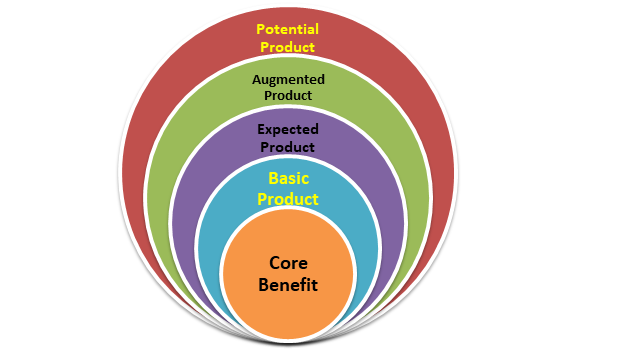
According to Philip Kotler, who is an economist and a marketing guru, a product is more than a tangible ‘thing’. A product meets the needs of a consumer and in addition to a tangible value this product also has an abstract value. For this reason Philip Kotler states that there are five product levels that can be identified and developed. In order to shape this abstract value, Philip Kotler uses five product levels in which a product is located or seen from the perception of the consumer. These 5 Product Levels indicate the value that consumers attach to a product. The customer will only be satisfied when the specified value is identical or higher than the expected value.

  • Need: A lack of a basic requirement.
  • Want: A specific requirement of products to satisfy a need.
  • Demand: A set of wants plus the desire and ability to pay for the product.

Customers will choose a product based on their perceived value of it. Satisfaction is the degree to which the actual use of a product matches the perceived value at the time of the purchase. A customer is satisfied only if the actual value is the same or exceeds the perceived value. Kotler attributed five levels to products:

The five(5) product levels are:

  1. Core Benefit

The fundamental need or want that consumers satisfy by consuming the product or service. For example, the need to process digital images.

  1. Generic/Basic Product

A version of the product containing only those attributes or characteristics absolutely necessary for it to function. For example, the need to process digital images could be satisfied by a generic, low-end, personal computer using free image processing software or a processing laboratory.

  1. Expected Product

The set of attributes or characteristics that buyers normally expect and agree to when they purchase a product. For example, the computer is specified to deliver fast image processing and has a high-resolution, accurate colour screen.

  1. Augmented Product

The inclusion of additional features, benefits, attributes or related services that serve to differentiate the product from its competitors. For example, the computer comes pre-loaded with a high-end image processing software for no extra cost or at a deeply discounted, incremental cost.

  1. Potential Product

This includes all the augmentations and transformations a product might undergo in the future. To ensure future customer loyalty, a business must aim to surprise and delight customers in the future by continuing to augment products. For example, the customer receives ongoing image processing software upgrades with new and useful features.

Added value of the Five Product Levels

Each level of the five product levels adds value for the customer. The more efforts production companies make at all levels, the more likely they are to stand a chance to be distinctive. At the Augmented Product level, the competition is observed in order to copy certain techniques, tricks and appearance of each other’s products. This makes it increasingly difficult for a consumer to define the distinctiveness of a product. To be able to tower over the competition, production companies focus on factors which consumers attach extra value to such as extreme packaging, surprising advertisements, customer-oriented service and affordable payment terms. This is not just about satisfying the customers and exceeding their expectations but also about surprising them.

What benefits does the model provide?

Kotler’s Five Product Level model provides businesses with a proven method for structuring their product portfolio to target various customer segments. This enables them to analyse product and customer profitability (sales and costs) in a structured way. By organizing products according to this model, a business’ sales processes can be aligned to its customer needs and help focus other operational processes around its customers – such as design and engineering, procurement, production planning, costing and pricing, logistics, and sales and marketing. Grouping products into product families that align with customer segments helps modelling and planning sales, as well as production and new product planning.

Social Product Branding Decision

Branding consists of a set of complex branding decisions. Major brand strategy decisions involve brand positioning, brand name selection, brand sponsorship and brand development.

Before going into the four branding decisions, also called brand strategy decisions, we should clarify what a brand actually is. A brand is a company’s promise to deliver a specific set of features, benefits, services and experiences consistently to buyers. However, a brand should rather be understood as a set of perceptions a consumer has about the products of a particular firm. Therefore, all branding decisions focus on the consumer.

We will take a close look at each of these four branding decisions.

  1. Brand Positioning

A brand must be positioned clearly in target customers’ minds. Brand positioning can be done at any of three levels:

  • On product attributes
  • On benefits
  • On beliefs and values.

At the lowest level, marketers can position a brand on product attributes. Marketing for a car brand may focus on attributes such as large engines, fancy colours and sportive design. However, attributes are generally the least desirable level for brand positioning. The reason is that competitors can easily copy these attributes, taking away the uniqueness of the brand. Also, customers are not interested in attributes as such. Rather, they are interested in what these attributes will do for them. That leads us to the next level: Benefits.

A brand can be better positioned on basis of a desirable benefit. The car brand could go beyond the technical product attributes and promote the resulting benefits for the customer: quick transportation, lifestyle and so further.

Yet, the strongest brands go beyond product attributes and benefits. They are positioned on beliefs and values. Successful brands engage customers on a deep, emotional level. Examples include brands such as Mini and Aston Martin. These brands rely less on products’ tangible attributes, but more on creating passion, surprise and excitement surrounding the brand. They have become “cool” brands.

Brand positioning lays the foundation for the three other branding decisions. Therefore, brand positioning should also involve establishing a mission for the brand and a vision of what the brand should be and do. The brand’s promise must be simple and honest.

  1. Brand Name Selection

When talking about branding decisions, the brand name decision may be the most obvious one. The name of the brand is maybe what you think of first when imagining a brand – it is the base of the brand. Therefore, the brand name selection belongs to the most important branding decisions. However, it is also quite a difficult task.

We have to start with a careful review of the product and its benefits, the target market and proposed marketing strategies. Having that in mind, we have to find a brand name matching these things. Naming a brand is part science, part art, and certainly a measure of instinct.

Although finding the right name for a brand can be a challenging task, there are some guidelines to make it easier. Desirable qualities for a brand name include:

  • It should suggest something about a product’s benefits and qualities. Think of the wadding polish “Nevr Dull”. The brand name indicates the benefit of using this product: the treated metal will never be dull.
  • It should be easy to pronounce, recognise, and remember. iPod and Nike are certainly better than “Troglodyte Homonculus” a clothing brand.
  • The brand name should be distinctive, so that consumers don’t confuse it with other brands. Rolex and Bugatti are good examples.
  • It should also be extendable. Think of Amazon.com, which began as an online bookseller but chose a name that would allow expansion into other categories. If Amazon.com had chosen a different name, such as books.com, it could not have extended its business that easily.
  • The brand name should translate easily into foreign languages. The Ford Pinto line had some struggles in Brazil, seeing as it translated into “tiny male genitals”. Or the Mitsubishi Pajero, which means in Spanish “man who plays with himself and enjoys it a bit too much”. More famous: Coca-Cola reads in Chinese as “female horse stuffed with wax”.
  • It should be capable of registration and legal protection. In other words, it must not infringe on existing brand names.

Worthy of note is the fact that brand name preferences are changing continuously. After a decade of choosing quirky names (such as Yahoo!, Google) or fictional names, today’s style is to build brands around names that carry real meaning. For instance, names such as Blackboard, a school software, make sense. However, with more and more brand names and trademark applications, available new names can be hard to find.

Choosing a brand name is not enough. It also needs to be protected. Many firms attempt to build a brand name that will eventually become identified with a product category. Examples for these names include Kleenex, Tip-ex and Jeep. However, their success can also quickly threaten the company’s rights to the name. Once a trademark becomes part of the normal language (called “genericization”), it is not protected anymore. For that reason many originally protected brand names, such as aspirin, Walkman (by Sony) and many other names are not protected anymore.

  1. Brand Sponsorship

Branding decisions go beyond deciding upon brand positioning and brand name. The third of our four branding decisions is the brand sponsorship. A manufacturer has four brand sponsorship options.

A product may be launched as a manufacturer’s brand. This is also called national brand. Examples include Kellogg selling its output under the own brand name (Kellog’s Frosties, for instance) or Sony (Sony Bravia HDTV).

The manufacturer could also sell to resellers who give the product a private brand. This is also called a store brand, a distributor brand or an own-label. Recent tougher economic times have created a real store-brand boom. As consumers become more price-conscious, they also become less brand-conscious, and are willing to choose private brands instead of established and often more expensive manufacturer’s brands.

Also, manufacturers can choose licensed brands. Instead of spending millions to create own brand names, some companies license names or symbols previously created by other manufacturers. This can also involve names of well-known celebrities or characters from popular movies and books. For a fee, they can provide an instant and proven brand name. For example, sellers of children’s products often attach character names to clothing, toys and so on. These licensed character names include Disney, Star Wars, Hello Kitty and many more.

Finally, two companies can join forces and co-brand a product. Co-branding is the practice of using the established brand names of two different companies on the same product. This can offer many advantages, such as the fact that the combined brands create broader consumer appeal and larger brand equity. For instance, Nestlé uses co-branding for its Nespresso coffee machines, which carry the brand names of well-known kitchen equipment manufacturers such as Krups, DeLonghi and Siemens.

  1. Brand Development

Branding decisions finally include brand development. For developing brands, a company has four choices: line extensions, brand extensions, multibrands or new brands.

Line extension refers to extending an existing brand name to new forms, sizes, colours, ingredients or flavours of an existing product category. This is a low-cost, low-risk way to introduce new products. However, there are the risks that the brand name becomes overextended and loses its specific meaning. This may confuse consumers. An example for line extension is when Coca-Cola introduces a new flavour, such as diet cola with vanilla, under the existing brand name.

Brand extension also assumes an existing brand name, but combines it with a new product category. Thus, an existing brand name is extended to a new product category. This gives the new product instant recognition and faster acceptance and can save substantial advertising costs for establishing a new brand. However, the risk that the extension may confuse the image of the main brand should be kept in mind. Also, if the extension fails, it may harm consumer attitudes toward other products carrying the same brand name. For this reason, a brand extension such as Heinz pet food cannot survive. But other brand extensions work well. For instance, Kellog’s has extended its Special K healthy breakfast cereal brand into a complete line of cereals plus a line of biscuits, snacks and nutrition bars.

Multibrands means marketing many different brands in a given product category. P&G (Procter & Gamble) and Unilever are the best examples for this. In the USA, P&G sells six brands of laundry detergent, five brands of shampoo and four brands of dishwashing detergent. Why? Multibranding offers a way to establish distinct features that appeal to different customer segments. Thereby, the company can capture a larger market share. However, each brand might obtain only a very small market share and none may be very profitable.

New brands are needed when the power of existing brand names is waning. Also, a new brand name is appropriate when the company enters a new product category for which none of its current brand names are appropriate.

As you might have recognised, these four branding decisions are all interrelated. In order to build strong brands, brand positioning, brand name, brand sponsorship and brand development have to be in line with each other.

Price: Monetary and Non Monetary Incentives for Desired Behaviour

Price

A value that will purchase a finite quantity, weight, or other measure of a good or service.

As the consideration given in exchange for transfer of ownership, price forms the essential basis of commercial transactions. It may be fixed by a contract, left to be determined by an agreed upon formula at a future date, or discovered or negotiated during the course of dealings between the parties involved.

Monetary and Non Monetary Incentives for Desired Behaviour

Money doesn’t grow on trees, but you’re thinking about extending a branch from your desk. It could “grow” from there, in the form of monetary and non-monetary incentives to your employees. As a small-business owner, you well know: No matter how driven an employee is, there’s nothing like an incentive to light the fire of motivation. Incentives can improve employee morale and bolster productivity, leading to improved customer service, efficiency, sales and profits.

If you’re new to the concept of incentives, what you may not know is that there’s a difference between monetary and non-monetary incentives. They obviously differ in form, but they also differ in how they’re perceived by employees. These differences are worth considering before you put a pair of hedge clippers next to your desk.

Monetary Incentives

If you want to get technical about it, as human resource professionals are prone to do, monetary incentives are designed to reward employees for outstanding job performance or longevity.

As its name implies, a monetary incentive has an explicit monetary value; an employee knows exactly what one is worth. In addition to cold, hard cash, monetary rewards can take the form of:

  • Bonuses
  • Commissions
  • Merit pay
  • Profit sharing
  • Stock options
  • Vacation time (beyond an employee’s normal paid time)

Non-Monetary Incentives

Non-monetary incentives are designed to recognize a special achievement or the completion of something that enhances an employee’s job performance or value to a company. Such a meritorious category might include the attainment of a sales goal, the culmination of a special research project or graduation from a training program that leads to a desirable certification.

A non-monetary incentive does not take the form of cold, hard cash, but this doesn’t mean an employee cannot discern its monetary value. Some traditional favorites among employers include:

  • Healthcare benefits
  • Life insurance
  • Promotion
  • Vehicle or vehicle allowance

Expand Upon Traditional Non-Monetary Incentives

If you’re considering using non-monetary incentives as a motivational tool, it’s fair to say that they’re limited only by your imagination, and maybe the needs or wants of your employees.

If you’re looking for ideas, employers are known to turn to non-cash incentives such as:

  • Charitable donations made in an employee’s name.* Concert tickets.
  • Gift cards.
  • Luxury gifts, such as designer clothing, watches and laptops.* Vacation packages, including airfare and accommodations.

Study Reveals Strong Preference

Despite the differences, there are no hard-and-fast rules governing the use of monetary and non-monetary incentives. In other words, who’s to say that you can’t write a bonus check to an employee who just finished an intensive training program? Or that you shouldn’t surprise an employee celebrating his 10th anniversary with your company by gifting him a weekend getaway package?

You’re the boss, so it’s up to you to decide how best to incentivize your employees. However, if you’re interested in knowing how other business owners are lining up on the topic, then you might cast your lot with non-cash incentives. Between 1996 and 2016, the number of businesses that rely on non-cash rewards increased from 26 percent to 84 percent, according to The Incentive Research Foundation.

How does the foundation explain such a dramatic increase? Two possible influences in the world of work may account for it:

CEOs play a more hands-on role in the day-to-day operation of businesses, putting them in the same realm as employees more frequently than in the past. This greater insight compels CEOs to reward employees more often.* Many employees’ roles have expanded well beyond their basic job description, and CEOs feel duty-bound to acknowledge employee contributions, beyond their usual paycheck.

Assess the Advantages of Monetary Incentives

Before you officially cast your vote, you may wish to assess the advantages and disadvantages of monetary and non-monetary incentives. Some of them may surprise you, especially if you think nothing “talks” more persuasively than money. Monetary incentives:

  • Are instantly recognizable and simple for employees to comprehend.
  • Hold universal appeal.
  • Are favored by employees who prefer to add them to their annual salary.
  • Do not require personalization in the way that a non-monetary incentive requires forethought.
  • Can solve a financial dilemma for a small-business owner who may want to give an employee a pay raise but cannot afford to do so.

Assess the Disadvantages of Monetary Incentives

You would be hard-pressed to find an employee who would say, “No thanks, boss; I don’t care much for money.” Remember that in this context, as an incentive, money might talk, alright. It just might speak a different language. It’s wise to consider that maybe – just maybe – the monetary benefits you hope to reap could backfire if:

  • Employees don’t see a clear and direct correlation between the benchmark and the incentive. These employees could undercut even the most lucrative incentive program unless they view it as worthwhile.
  • They create a sense of inequality. Since “top” employees often get monetary rewards, those who are left out may become a drag on employee morale and teamwork. They lead to a sense of entitlement among top employees, who may even turn up their noses to the non-monetary incentives you offer. They “supercharge” cut-throat, competitive employees to sabotage the work of their colleagues to attain the incentive.* They are unfairly distributed among a group. This is why many business owners get ahead of this approaching storm cloud and either establish individual incentives or distribute incentives to all team members.
  • You include them as an addendum to an employee’s paycheck. In this case, the incentive doesn’t stand out; it’s simply absorbed in an employee’s earnings and probably goes to pay the rent or mortgage and other monthly bills and is quickly forgotten.

Assess the Top Advantages of Non-Monetary Incentives

The businesses that The Incentive Research Foundation found are turning to non-monetary incentives may be on to something: Employees seem to ascribe a greater value to gifts, even if they can place a dollar value on them. As an employer, you may see little difference between, say, writing a $1,000 bonus check and bestowing a $1,000 laptop on a deserving employee.

But the employee? Multiple research studies show that employees show greater enthusiasm and appreciation for tangible things they can use (like a laptop), enjoy (like a vacation) or show off and brag about to others (like jewelry and clothing). And the more they can use or show off these incentives, the more likely they are to think of the employer in a favorable light.

If this still doesn’t compute to you, try relating non-monetary incentives to the burgeoning gift card industry. Give someone $50 in cash and they will surely appreciate it – before putting it promptly in their wallet and probably forgetting about it. But give them a $50 gift card and they will regard it for what it is: A gift, and something they can redeem for something pleasurable. Gift cards are stamped with a dollar amount, just like cash. But somehow, they signal greater thought and consideration on the part of the giver.

Assess the Other Advantages of Non-Monetary Incentives

Research also shows that the psychology of offering non-monetary incentives intensifies when employees are given a choice or are at least asked about their preferences. This is no small insight for any small-business owner who hopes to incentivize her staff.

In addition to being tangible items that hold bragging rights, non-monetary incentives:

  • Serve as a lasting reminder of an employee’s accomplishment.
  • Can serve as an in-house marketing tool, especially if you photograph the employee with the incentive and post it on your business website.
  • Can be used as a recruiting tool if you “advertise” the incentive in the same way.* Can be deducted as a business expense.

Assess the Disadvantages of Non-Monetary Incentives

It would be wrong to say that non-monetary incentives have no drawbacks. They exist, but they seem to be mostly self-inflicted by the business owner who neglects to:

  • Ensure that the incentives are appealing to employees. A weekend ski package or a Las Vegas getaway may be up your alley but not necessarily so for an employee who has never snapped on ski boots or who doesn’t like to gamble.
  • Do his homework when selecting employee incentives.

Like many business owners, you might need to experiment with monetary and non-monetary incentives, until you find the right offering for your employees. But compared to the other dilemmas you face, this task might be one of the most fun – with or without the hedge clippers.

error: Content is protected !!