Fundamental Concepts of VAR Approach

Value at risk (VAR or sometimes VaR) has been called the “new science of risk management,” but you don’t need to be a scientist to use VAR.

Here, in part 1 of this short series on the topic, we look at the idea behind VAR and the three basic methods of calculating it.

alue at risk (VaR) is a measure of the risk of loss for investments. It estimates how much a set of investments might lose (with a given probability), given normal market conditions, in a set time period such as a day. VaR is typically used by firms and regulators in the financial industry to gauge the amount of assets needed to cover possible losses.

For a given portfolio, time horizon, and probability p, the p VaR can be defined informally as the maximum possible loss during that time after we exclude all worse outcomes whose combined probability is at most p. This assumes mark-to-market pricing, and no trading in the portfolio.

For example, if a portfolio of stocks has a one-day 5% VaR of $1 million, that means that there is a 0.05 probability that the portfolio will fall in value by more than $1 million over a one-day period if there is no trading. Informally, a loss of $1 million or more on this portfolio is expected on 1 day out of 20 days (because of 5% probability).

More formally, p VaR is defined such that the probability of a loss greater than VaR is (at most) p while the probability of a loss less than VaR is (at least) 1−p. A loss which exceeds the VaR threshold is termed a “VaR breach”.

The Idea Behind VAR

The most popular and traditional measure of risk is volatility. The main problem with volatility, however, is that it does not care about the direction of an investment’s movement: stock can be volatile because it suddenly jumps higher. Of course, investors aren’t distressed by gains.

For investors, the risk is about the odds of losing money, and VAR is based on that common-sense fact. By assuming investors care about the odds of a really big loss, VAR answers the question, “What is my worst-case scenario?” or “How much could I lose in a really bad month?”
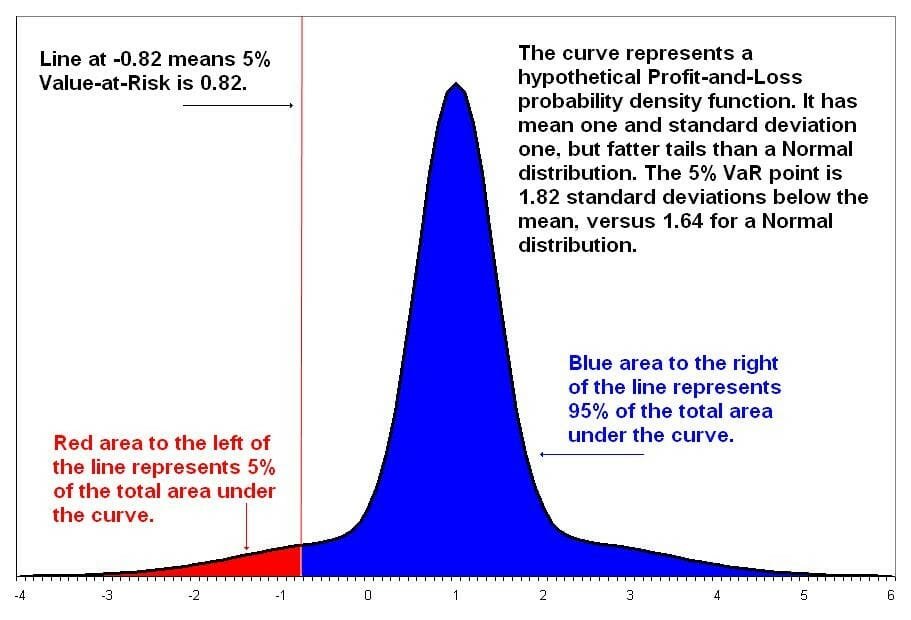
Now let’s get specific. A VAR statistic has three components: a time period, a confidence level and a loss amount (or loss percentage). Keep these three parts in mind as we give some examples of variations of the question that VAR answers:

  • What is the most I can – with a 95% or 99% level of confidence – expect to lose in dollars over the next month?
  • What is the maximum percentage I can – with 95% or 99% confidence – expect to lose over the next year?

You can see how the “VAR question” has three elements: a relatively high level of confidence (typically either 95% or 99%), a time period (a day, a month or a year) and an estimate of investment loss (expressed either in dollar or percentage terms).

Methods of Calculating VAR

Institutional investors use VAR to evaluate portfolio risk, but in this introduction, we will use it to evaluate the risk of a single index that trades like a stock: the Nasdaq 100 Index, which is traded through the Invesco QQQ Trust. The QQQ is a very popular index of the largest non-financial stocks that trade on the Nasdaq exchange.

There are three methods of calculating VAR: the historical method, the variance-covariance method, and the Monte Carlo simulation.

1. Historical Method

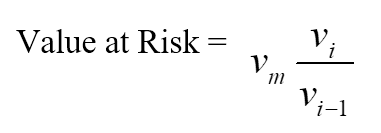
The historical method is the simplest method for calculating Value at Risk. Market data for the last 250 days is taken to calculate the percentage change for each risk factor on each day. Each percentage change is then calculated with current market values to present 250 scenarios for future value. For each of the scenarios, the portfolio is valued using full, non-linear pricing models. The third worst day selected is assumed to be 99% VaR.
Where:

  • vi is number of variables on day i
  • is the number of days from which historical data is taken

2. Parametric Method

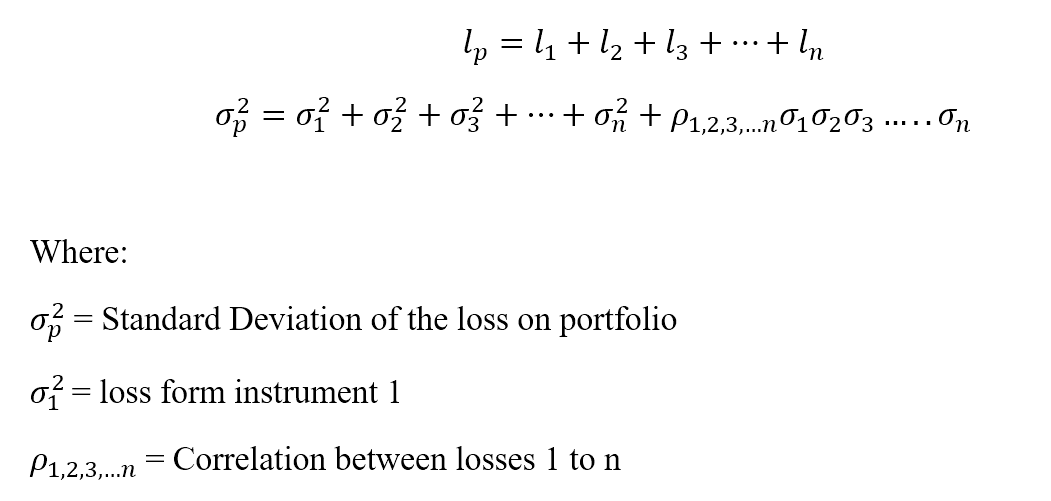
The parametric method is also known as the variance-covariance method. This method assumes a normal distribution in returns. Two factors are to be estimated – an expected return and a standard deviation. This method is best suited to risk measurement problems where the distributions are known and reliably estimated. The method is unreliable when the sample size is very small.

Let loss be ‘l’ for a portfolio ‘p’ with ‘n’ number of instruments.
  1. Monte Carlo Method

Under the Monte Carlo method, Value at Risk is calculated by randomly creating a number of scenarios for future rates using non-linear pricing models to estimate the change in value for each scenario, and then calculating the VaR according to the worst losses. This method is suitable for a great range of risk measurement problems, especially when dealing with complicated factors. It assumes that there is a known probability distribution for risk factors.

Advantages of Value at Risk (VaR)

  1. Easy to understand

Value at Risk is a single number that indicates the extent of risk in a given portfolio. Value at Risk is measured in either price units or as a percentage. This makes the interpretation and understanding of VaR relatively simple.

  1. Applicability

Value at Risk is applicable to all types of assets bonds, shares, derivatives, currencies, etc. Thus, VaR can be easily used by different banks and financial institutions to assess the profitability and risk of different investments, and allocate risk based on VaR.

  1. Universal

The Value at Risk figure is widely used, so it is an accepted standard in buying, selling, or recommending assets.

Limitations of Value at Risk

  1. Large portfolios

Calculation of Value at Risk for a portfolio not only requires one to calculate the risk and return of each asset but also the correlations between them. Thus, the greater the number or diversity of assets in a portfolio, the more difficult it is to calculate VaR.

  1. Difference in methods

Different approaches to calculating VaR can lead to different results for the same portfolio. 3. Assumptions

Calculation of VaR requires one to make some assumptions and use them as inputs. If the assumptions are not valid, then neither is the VaR figure.

Key Elements of Value at Risk

  • Specified amount of loss in value or percentage
  • Time period over which the risk is assessed
  • Confidence interval

Risk Management with Swaps

Swaps are used to manage risk in a couple ways. First, you can use swaps to ensure favorable cash flows, either through timing (as with the coupons on bonds) or through the types of assets being exchanged (as with foreign exchange swaps that ensure a corporation has the right type of currency). The exact nature of the risk being managed depends on the type of swap being used.

Four types of swaps are interest rate, currency, equity, and commodity swaps.

  • Interest rate swaps typically involve one side paying at a floating interest rate and the other paying at a fixed interest rate. In some cases both sides pay at a floating rate, but the floating rates are different.
  • Currency swaps are essentially interest rate swaps in which one set of payments is in one currency and the other is in another currency. The payments are in the form of interest payments; either set of payments can be fixed or floating, or both can be fixed or floating. With currency swaps, a source of uncertainty is the exchange rate so the payments can be fixed and still have uncertain value.
  • In equity swaps, at least one set of payments is determined by the course of a stock price or stock index.
  • In commodity swaps at least one set of payments is determined by the course of a commodity price, such as the price of oil or gold.

The easiest way to see how companies can use swaps to manage risks is to follow a simple example using interest-rate swaps, the most common form of swaps.

  1. Company A owns $1,000,000 in fixed rate bonds earning 5 percent annually, which is $50,000 in cash flows each year.
  2. Company A thinks interest rates will rise to 10 percent, which will yield $100,000 in annual cash flows ($50,000 more per year than their current bond holdings), but exchanging all $1,000,000 for bonds that will yield the higher rate would be too costly.
  3. Company A goes to a swap broker and exchanges not the bonds themselves but the company’s right to the future cash flows.

Company A agrees to give the swap broker the $50,000 in fixed rate annual cash flows, and in return, the swap broker gives the company the cash flows from variable rate bonds worth $1,000,000.

  1. Company A and the swap broker continue to exchange these cash flows over the life of the swap, which ends on a date determined at the time the contract is signed.

Revenue generation and swap derivatives

When pursuing opportunities to generate revenue through swaps, the process is no different, but the motivation behind the swap is to take advantage of differentials in the spot and anticipated future values related to the swap. To see how revenue generation works with swaps, consider the following example, which involves foreign exchange swaps, a simpler but less common form of swap (in the example, USD = U.S. dollar):

  1. Company A has USD 1,000 and believes that the Chinese Yuan (CNY) is set to increase in value compared to the USD.
  2. Company A gets in touch with Company B in China, which just happens to need USD for a short time to fund a capital investment in computers coming from the U.S.
  3. The two companies agree to swap currency at the current market exchange rate, which for this example, is USD 1 = CNY 1.

They swap USD 1,000 for CNY 1,000. The swap agreement states that they’ll exchange currencies back in one year at the forward rate (also USD 1 = CNY 1; it’s a very stable market in Example-World).

In the example, Company B needs the currency but doesn’t want to pay the transaction fees, while Company A is speculating on the change in exchange rate. If the CNY were to increase by 1 percent compared to the USD, then Company A would make a profit on the swap.

If the CNY were to decrease in value by 1 percent, then Company A would lose money on the swap. This potential for loss is why using derivatives to generate income is called speculating. (Did you know the term speculate means “to come by way of very loose interpretation” or “to guess”?)

Valuation of swap derivatives

The value of a swap isn’t very difficult to measure. Simply put, you start with the value of what you’re receiving plus any added value that results from changes in rates or returns and then subtract the value of what you’re giving away plus any increases in value associated with interest earned or changes in rates.

Of course, as with all known valuations, this is a hindsight calculation. When you’re estimating future value, the calculations involve the time value of money and the probabilities of event occurrences, both of which should be treated in the same manner as estimating the value of futures. Remember that a swap is nothing more than a combination of a spot rate exchange and a futures exchange in a single contract.

Fundamentals of Currency and Interest Rate Swaps

A currency swap is a “contract to exchange at an agreed future date principal amounts in two different currencies at a conversion rate agreed at the outset”.

During the term of the contract the parties exchange interest, on an agreed basis, calculated on the principal amounts.

A currency swap is a legal agreement between two parties to exchange the principal and interest rate obligations, or receipts, in different currencies.

The transaction involves two counter-parties who exchange specific amounts of two currencies at the outset, and repay them over time according to a predetermined rule that reflects both the interest payment and the amortisation of the principal amount.

A currency swap is an agreement to exchange fixed or floating rate payments in one currency for fixed or floating payments in a second currency plus an exchange of the principal currency amounts.

Currency swap allows a customer to re-denominate a loan from one currency to another.

The re-denomination from one currency to another currency is done to lower the borrowing cost for debt and to hedge exchange risk.

The concept behind is to match the difference between the spot and forward rate of any currency over a specified period of time.

Usually, banks with a global presence act as intermediaries in swap transactions, helping to being together the two parties. Sometimes, banks themselves may become counter-parties to the swap deal, and try to offset the risk they take by entering into an offsetting swap deal.

Alternatively, banks can hedge themselves by taking positions in the futures markets.

Types of Currency Swaps:

The following types of cross-currency swaps are generally used:

  1. Fixed to Fixed Currency Swap:

In this form of swap, it may involve exchanging fixed interest payments on a loan in one currency for fixed interest payments on an equivalent loan in another currency. It is not necessary that the actual principal be swapped. Sometime, an alternative currency can be exchanged at spot into desired currency, however the principal amounts are always re-exchanged at the maturity of the swap.

  1. Fixed to Floating Cross Currency Swap:

In this form of swap, fixed rate obligations in one currency are swapped for floating rate obligations in another currency. For example, US dollars at fixed rates can be swapped against sterling with LIBOR + floating rate.

Stages in Currency Swap:

The currency swaps involve an exchange of liabilities between currencies.

A currency swap can consist of three stages:

  1. A spot exchange of principal – this forms part of the swap agreement as a similar effect can be obtained by using the spot foreign exchange market.
  2. Continuing exchange of interest payments during the terms of the swap – this represents a series of forward foreign exchange contracts during the term of the swap contract. The contract is typically fixed at the same exchange rate as the spot rate used at the outset of the swap.
  3. Re-exchange of principal on maturity.

In a currency swap the principal sum is usually exchanged in one of the following manner:

(i) At the start

(ii) At a combination of start and end

(iii) At the end

(iv) Neither

Benefits of Currency Swaps:

  1. Currently swaps enable corporate to exploit their comparative advantage in raising funds in one currency to obtain savings in other currencies.
  2. Currency swaps permit corporate to switch their loans from a particular currency to another depending on their expectations of the future movement of the currency and interest rates.
  3. It offers flexibility to corporate seeking to hedge the risk associated with a particular currency.
  4. A company no longer has to live with a bad decision, if it has selected a wrong currency for its overseas funding operations, a currency swap can undo the damage.
  5. Currency swap can be used to lock into exchange rates for a longer period and it do not require monitoring and reviewing.
  6. The currency swap mode can be chosen to restructure the currency base of companies liabilities.
  7. Currency swaps are used to hedge exposure to currency risk on future receipts (asset swaps) and payments (liability swaps), and to raise funds at a lower cost.
  8. A high degree of liquidity in currency swap market ensures a steady supply of principals ready to assume the opposite side of a transaction.
  9. In a currency swap, the exchange rates at maturity is known at the outset.
  10. Early termination of swap contracts may be possible by agreement of the counter parties.
  11. Currency swaps can be entered into at any time during the life of the transaction, they are being used to hedge.

Interest Rate Swaps:

An interest rate swap is a simple agreement between two parties to exchange series of interest payments on an underlying loan.

There is no exchange of principal amount and an independent silent financial transaction takes place which does not affect the lender.

A fixed rate of interest is swapped for a floating rate of interest or vice versa.

An interest rate swap is a legal agreement between two parties to exchange their interest rate obligations or receipts.

Thus, in such a transaction, interest payment streams of differing characters are exchanged according to predetermined rules, and are based on an underlying notional principal amount.

Interest rate swaps can take different forms as they can be structured to meet each corporate’s specific requirements.

A ‘fixed-to-floating swap’ changes the profile of your foreign currency borrowings from fixed to floating rates, or vice versa. Ideally, to minimize the interest rate risk over the life-span of the loan, a corporate should move from a floating to a fixed rate term at the bottom of an interest rate cycle, and do the opposite at its crest.

A ‘coupon swap’, which is also known as an ‘interest-only swap’, is an agreement between two parties to exchange their interest rate obligations denominated in different currencies. For instance, if the interest rates on the US dollar are expected to rise, a company with dollar borrowings may wish to switch its interest payments to another currency whose interest rates are expected to be lower.

The interest swaps offers hedge against advance interest rate movements in future and also creation of new, low cost borrowing alternatives.

When a company borrow to advantage with one type of financing but really prefers another, its sources will engage in a swap with an interest rate swap, interest payment obligations are exchanged between two parties, but they are denominated in the same currency.

The most common swap is the floating/fixed rate exchange.

The popular form of interest rate swap is a ‘plain vanilla’ swap, in which fixed and floating interest payments are based on some notional principal amount.

Fixed Interest Rate vs. Floating Interest Rate

Interest rate swaps usually involve the exchange of one stream of future payments based on a fixed interest rate for a different set of future payments that are based on a floating interest rate. Thus, understanding the concepts of fixed-rate loans vs. floating rate loans is crucial to understanding interest rate swaps.

A fixed interest rate is an interest rate on a debt or other security that remains unchanged during the entire term of the contract, or until the maturity of the security. In contrast, floating interest rates fluctuate over time, with the changes in interest rate usually based on an underlying benchmark index. Floating interest rate bonds are frequently used in interest rate swaps, with the bond’s interest rate based on the London Interbank Offered Rate (LIBOR). Briefly, the LIBOR rate is an average interest rate that the leading banks participating in the London interbank market charge each other for short-term loans.

The LIBOR rate is a commonly used benchmark for determining other interest rates that lenders charge for various types of financing.

How Does an Interest Rate Swap Work?

Basically, interest rate swaps occur when two parties – one of which is receiving fixed-rate interest payments and the other of which is receiving floating-rate payments – mutually agree that they would prefer the other party’s loan arrangement over their own. The party being paid based on a floating rate decides that they would prefer to have a guaranteed fixed rate, while the party that is receiving fixed-rate payments believes that interest rates may rise, and to take advantage of that situation if it occurs – to earn higher interest payments – they would prefer to have a floating rate, one that will rise if and when there is a general uptrend in interest rates.

In an interest rate swap, the only things that actually get swapped are the interest payments. An interest rate swap, as previously noted, is a derivative contract. The parties do not take ownership of the other party’s debt. Instead, they merely make a contract to pay each other the difference in loan payments as specified in the contract. They do not exchange debt assets, nor pay the full amount of interest due on each interest payment date – only the difference due as a result of the swap contract.

A good interest rate swap contract clearly states the terms of the agreement, including the respective interest rates each party is to be paid by the other party, and the payment schedule (e.g., monthly, quarterly, or annually). In addition, the contract states both the start date and maturity date of the swap agreement, and that both parties are bound by the terms of the agreement until the maturity date.

Note that while both parties to an interest rate swap get what they want – one party gets the risk protection of a fixed rate, while the other gets the exposure to potential profit from a floating rate – ultimately, one party will reap a financial reward while the other sustains a financial loss. If interest rates rise during the term of the swap agreement, then the party receiving the floating rate will profit and the party receiving the fixed rate will incur a loss. Conversely, if interest rates decline, then the party getting paid the guaranteed fixed rate return will benefit, while the party receiving payments based on a floating rate will see the amount of the interest payments it receives go down.

Risks of Interest Rate Swaps

Interest rate swaps are an effective type of derivative that may be of benefit to both parties involved in using them, in a number of different ways. However, swap agreements also come with risks.

One notable risk is that of counterparty risk. Because the parties involved are typically large companies or financial institutions, counterparty risk is usually relatively low. But if it should happen that one of the two parties defaults and is unable to meet its obligations under the interest rate swap agreement, then it would be difficult for the other party to collect. It would have an enforceable contract, but following the legal process might well be a long and twisting road.

Just dealing with the unpredictable nature of floating interest rates also adds some inherent risk for both parties to the agreement.

Risk Management with Options

Many investors mistakenly believe that options are always riskier investments than stocks because they may not fully understand what options are exactly and how they work. Options, in fact, can be used to hedge positions and reduce risk, such as with a protective put. Options can also be used to bet on a stock going up or down, but with relatively less risk than owning or shorting the actual equivalent in the underlying stock. This latter use of options to minimize risk in making directional bets will be the focus of this article. Read on to learn how to calculate the potential risk of options positions and how the power of leverage can work in your favor.

Here are five ways to effectively manage risk as an option trader:

  • The first step in managing risk as an option trader is position sizing. When buying options the amount of capital you spend buying an option contract long is the most you can lose if your option expires worthless before expiration. The best way to avoid the risk of ruin when trading options is to never put on a position size greater than 1% to 2% of your total trading capital. If you have a $50,000 option trading account your maximum option trade should be $500.
  • When selling option contracts to open your risk can be theoretically unlimited unless you buy a farther out option as a hedge. Using fix loss option plays is important so you cap the amount of your losses if a strong trend moves against your short option. You should buy your hedge at the location of price you want to cap losses at.
  • If you sell a covered call your risk is in the stock. You can set a stop loss for your stock position where you will cut your losses short and buy to cover your short call.
  • If you sell a married put your risk is in the short stock. You can set a stop loss for your short stock position where you will cut your losses short and buy to cover your short stock and buy to close your short put option.
  • Do not put on option plays with open risk or undefined risk. It is very dangerous to expose yourself to uncapped and unlimited risk selling options short, the odds are that eventually you will be ruined on one outsized move. Always have an exit strategy when you sell option contracts. Option hedges are insurance that will pay for their self over the long term.
  • Options and Leverage

Let us first consider the concept of leverage, and how it applies to options. Leverage has two basic definitions applicable to options trading. The first defines leverage as the use of the same amount of money to capture a larger position. This is the definition that gets investors into the most trouble. A dollar invested in a stock, and the same dollar invested in an option does not equate to the same risk.

The second definition characterizes leverage as maintaining the same sized position but spending less money doing so. This is the definition of leverage that a consistently successful trader or investor incorporates into his or her frame of reference.

  • Options contracts can be used to minimize risk through hedging strategies that increase in value when the investments you are protecting fall.
  • Options can also be used to leverage directional plays with less potential loss than owning the outright stock position.
  • This is because long options can only lose a maximum of the premium paid for the option, but have potentially unlimited profit potential.

Fundamental concepts of Options and Hedging

Option

Options are financial instruments that are derivatives based on the value of underlying securities such as stocks. An options contract offers the buyer the opportunity to buy or sell depending on the type of contract they hold the underlying asset. Unlike futures, the holder is not required to buy or sell the asset if they choose not to.

  • Call options allow the holder to buy the asset at a stated price within a specific timeframe.
  • Put options allow the holder to sell the asset at a stated price within a specific timeframe.

Each option contract will have a specific expiration date by which the holder must exercise their option. The stated price on an option is known as the strike price. Options are typically bought and sold through online or retail brokers.

Options are a versatile financial product. These contracts involve a buyer and a seller, where the buyer pays an options premium for the rights granted by the contract. Each call option has a bullish buyer and a bearish seller, while put options have a bearish buyer and a bullish seller.

Options contracts usually represent 100 shares of the underlying security, and the buyer will pay a premium fee for each contract. For example, if an option has a premium of 35 cents per contract, buying one option would cost $35 ($0.35 x 100 = $35). The premium is partially based on the strike price—the price for buying or selling the security until the expiration date. Another factor in the premium price is the expiration date. Just like with that carton of milk in the refrigerator, the expiration date indicates the day the option contract must be used. The underlying asset will determine the use-by date. For stocks, it is usually the third Friday of the contract’s month.

Traders and investors will buy and sell options for several reasons. Options speculation allows a trader to hold a leveraged position in an asset at a lower cost than buying shares of the asset. Investors will use options to hedge or reduce the risk exposure of their portfolio. In some cases, the option holder can generate income when they buy call options or become an options writer. Options are also one of the most direct ways to invest in oil. For options traders, an option’s daily trading volume and open interest are the two key numbers to watch in order to make the most well-informed investment decisions.

American options can be exercised any time before the expiration date of the option, while European options can only be exercised on the expiration date or the exercise date. Exercising means utilizing the right to buy or sell the underlying security.

Hedging

The best way to understand hedging is to think of it as a form of insurance. When people decide to hedge, they are insuring themselves against a negative event’s impact to their finances. This doesn’t prevent all negative events from happening, but something does happen and you’re properly hedged, the impact of the event is reduced.

In practice, hedging occurs almost everywhere, and we see it every day. For example, if you buy homeowner’s insurance, you are hedging yourself against fires, break-ins, or other unforeseen disasters.

Portfolio managers, individual investors, and corporations use hedging techniques to reduce their exposure to various risks. In financial markets, however, hedging is not as simple as paying an insurance company a fee every year for coverage.

Hedging against investment risk means strategically using financial instruments or market strategies to offset the risk of any adverse price movements. Put another way, investors hedge one investment by making a trade in another.

Technically, to hedge you would trade make offsetting trades in securities with negative correlations. Of course, nothing in this world is free, so you still have to pay for this type of insurance in one form or another.

For instance, if you are long shares of XYZ corporation, you can buy a put option to protect you from large downside moves but the option will cost you since you have to pay its premium.

A reduction in risk, therefore, will always mean a reduction in potential profits. So, hedging, for the most part, is a technique not by which you will make money but by which you can reduce potential loss. If the investment you are hedging against makes money, you have typically reduced your potential profit, but if the investment loses money, your hedge, if successful, reduces that loss.

Disadvantages of Hedging

Every hedge has a cost, so before you decide to use hedging, you must ask yourself if the benefits received from it justify the expense. Remember, the goal of hedging isn’t to make money but to protect from losses. The cost of the hedge, whether it is the cost of an option or lost profits from being on the wrong side of a futures contract, cannot be avoided. This is the price you pay to avoid uncertainty.

While it’s tempting to compare hedging to insurance, insurance is far more precise. With insurance, you are completely compensated for your loss (usually minus a deductible). Hedging a portfolio isn’t a perfect science and things can go wrong. Although risk managers are always aiming for the perfect hedge, it is difficult to achieve in practice.

The majority of investors will never trade a derivative contract. In fact, most buy-and-hold investors ignore short-term fluctuation altogether. For these investors, there is little point in engaging in hedging because they let their investments grow with the overall market. So why learn about hedging?

Even if you never hedge for your own portfolio, you should understand how it works, because many big companies and investment funds will hedge in some form. Oil companies, for example, might hedge against the price of oil, while an international mutual fund might hedge against fluctuations in foreign exchange rates. An understanding of hedging will help you to comprehend and analyze these investments.

Index Future and Commodity Futures

Index Futures

Index futures are futures contracts where a trader can buy or sell a financial index today to be settled at a future date. Index futures are used to speculate on the direction of price movement for an index such as the S&P 500.

Investors and investment managers also use index futures to hedge their equity positions against losses.

Index futures, like all future contracts, give the trader or investor the power and the commitment to deliver the cash value based on an underlying index at a specified future date. Unless the contract is unwound before the expiration through an offsetting trade, the trader is obligated to deliver the cash value on the expiry.

An index tracks the price of an asset or group of assets. Index futures are derivatives meaning they are derived from an underlying asset the index. Traders use these products to exchange various instruments including equities, commodities, and currencies. For example, the S&P 500 index tracks the stock prices of 500 of the largest companies in the United States. An investor could buy or sell index futures on the S&P to speculate the appreciation or depreciation of the index.

Types of Index Futures

Some of the most popular index futures are based on equities. However, each product may use a different multiple for determining the price of the futures contract. As an example, the value of the S&P 500 futures contract is $250 times the S&P 500 index value. The E-mini S&P 500 futures contract has a value of 50 times the value of the index.

Index futures are also available for the Dow Jones Industrial Average (DJIA) and the Nasdaq 100 along with E-mini Dow (YM) and E-mini NASDAQ 100 (NQ) contracts. Index futures are available for foreign markets including the German, Frankfurt Exchange traded (DAX) which is similar to the Dow Jones the SMI index in Europe, and the Hang Seng Index (HSI) in Hong Kong.

Margin and Index Futures

Futures contracts don’t require the trader or investor to put up the entire value of the contract when entering a trade. Instead, they only required the buyer to maintain a fraction of the contract amount in their account, called the initial margin.

Prices of index futures can fluctuate significantly until the contract expires. Therefore, traders must have enough money in their account to cover a potential loss, which is called the maintenance margin. Maintenance margin sets the minimum amount of funds an account must have to satisfy any future claims.

Both the New York Stock Exchange (NYSE) and Financial Industry Regulatory Authority, Inc. (FINRA) require a minimum of 25% of the total trade value as the minimum account balance. However, some brokerages will demand greater than this 25% margin. Also, as the value of the trade climbs before expiration the broker can demand additional funds be deposited to top-off the value of the account known as a margin call.

It’s important to note that index futures contracts are legally binding agreements between the buyer and seller. Futures differ from an option in that a futures contract is considered an obligation, while an option is considered a right that the holder may or may not exercise.

Profits and Loss from Index Futures

An index futures contract states that the holder agrees to purchase an index at a particular price on a specified future date. Index futures typically settled quarterly, and there are several annual contracts as well.

Equity index futures are cash settled meaning there’s no delivery of the underlying asset at the end of the contract. If on expiry, the price of the index is higher than the agreed-upon price in the contract, the buyer has made a profit, and the seller future writer has suffered a loss. Should the opposite be true, the buyer suffers a loss, and the seller makes a profit.

For example, if the Dow were to close at 16,000 at the end of September, the holder who bought a September future contact one year earlier at 15,760 would have a profit.

Profits are determined by the difference between the entry and exit prices of the contract. As with any speculative trade, there are risks that the market could move against the position. As mentioned earlier, the trading account must keep funds or margin on hand and could have a margin call demand to offset any risk of further losses. Also, the investor or trader must understand that many factors can drive market index prices including macroeconomic conditions such as growth in the economy and corporate earnings or disappointments.

Index Futures for Hedging

Portfolio managers will often buy equity index futures as a hedge against potential losses. If the manager has positions in a large number of stocks, index futures can help hedge the risk of declining stock prices by selling equity index futures. Since many stocks tend to move in the same general direction, the portfolio manager could sell or short an index futures contract in case stocks prices decline. In the event of a market downturn, the stocks within the portfolio would fall in value, but the sold index futures contracts would gain in value offsetting the losses from the stocks.

The fund manager could hedge all of the downside risks of the portfolio, or only partially offset it. The downside of hedging is that hedging can reduce profits if the hedge isn’t required. For example, if in the above scenario, the portfolio manager shorts the index futures and the market rises, the index futures would decline in value. The losses from the hedge would offset gains in the portfolio as the stock market rises.

Commodity Futures

Commodities futures contracts are agreements to buy or sell a raw material at a specific date in the future at a particular price. The contract is for a set amount. It specifies when the seller will deliver the asset. It also sets the price. Some contracts allow a cash settlement instead of delivery.

The three main areas of commodities are food, energy, and metals. The most popular food futures are for meat, wheat, and sugar. Most energy futures are for oil and gasoline. Metals using futures include gold, silver, and copper.

Buyers of food, energy, and metal use futures contracts to fix the price of the commodity they are purchasing. That reduces their risk that prices will go up. Sellers of these commodities use futures to guarantee they will receive the agreed-upon price. They remove the risk of a price drop.

Prices of commodities change on a weekly or even daily basis. Contract prices change as well. That’s why the cost of meat, gasoline, and gold changes so often.

How They Work?

If the price of the underlying commodity goes up, the buyer of the futures contract makes money. He gets the product at the lower, agreed-upon price and can now sell it at today’s higher market price. If the price goes down, the futures seller makes money. He can buy the commodity at today’s lower market price and sell it to the futures buyer at the higher, agreed-upon price.

If commodities traders had to deliver the product, few people would do it. Instead, they can fulfill the contract by delivering proof that the product is in the warehouse. They can also pay the cash difference or provide another contract at the market price.

Commodities Exchanges

Future contracts are traded on a commodities futures exchange. These include the Chicago Mercantile Exchange, the Chicago Board of Trade, and the New York Mercantile Exchange. These are all now owned by the CME Group. The Commodities Futures Trading Commission regulates them. Buyers and sellers must register with the CFTC.

The role of the exchange is important in providing a safer trade.

The contracts go through the exchange’s clearing house. Technically, the clearinghouse buys and sells all contracts.

The exchanges make contracts easier to buy and sell by making them fungible. That means they are interchangeable. But they must be for the same commodity, quantity, and quality. They must also be for the same delivery month and location.

Fungibility allows the buyers to “offset” contracts. That’s when they buy and then subsequently sell the contracts. It allows them to pay off or extinguish the contract before the agreed-upon date. For that reason, futures contracts are derivatives.

Hedging Risks with Currency

Currency risk is the financial risk that arises from potential changes in the exchange rate of one currency in relation to another. And it’s not just those trading in the foreign exchange markets that are affected. Adverse currency movements can often crush the returns of a portfolio with heavy international exposure, or diminish the returns of an otherwise prosperous international business venture. Companies that conduct business across borders are exposed to currency risk when income earned abroad is converted into the money of the domestic country, and when payables are converted from the domestic currency to the foreign currency.

The currency swap market is one way to hedge that risk. Currency swaps not only hedge against risk exposure associated with exchange rate fluctuations, but they also ensure receipt of foreign monies and achieve better lending rates.

How Currency Swaps Work?

A currency swap is a financial instrument that involves the exchange of interest in one currency for the same in another currency.

Currency swaps comprise two notional principals that are exchanged at the beginning and end of the agreement. These notional principals are predetermined dollar amounts, or principal, on which the exchanged interest payments are based. However, this principal is never actually repaid: It’s strictly “notional” (which means theoretical). It’s only used as a basis on which to calculate the interest rate payments, which do change hands.

Currency Swaps Beneficial

Recall our first plain vanilla currency swap example using the U.S. company and the German company. There are several advantages to the swap arrangement for the U.S. company. First, the U.S. company is able to achieve a better lending rate by borrowing at 7% domestically as opposed to 8% in Europe. The more competitive domestic interest rate on the loan, and consequently the lower interest expense, is most likely the result of the U.S. company being better known in the U.S. than in Europe. It is worthwhile to realize that this swap structure essentially looks like the German company purchasing a euro-denominated bond from the U.S. company in the amount of €3 million.

The advantages of this currency swap also include assured receipt of the €3 million needed to fund the company’s investment project. Other instruments, such are forward contracts, can be used simultaneously to hedge exchange rate risk.

Investors benefit from hedging foreign exchange rate risk as well.

How Currency Hedging Helps Investors?

Using currency swaps as hedges is also applicable to investments in mutual funds and ETFs. If you have a portfolio heavily weighted towards United Kingdom stocks, for instance, you’re exposed to currency risk: The value of your holdings can decline due to changes in the exchange rate between the British pound and the U.S. dollar. You need to hedge your currency risk to benefit from owning your fund over the long term.

Many investors can reduce their risk exposure by using currency-hedged ETFs and mutual funds. A portfolio manager who must purchase foreign securities with a heavy dividend component for an equity fund could hedge against exchange rate volatility by entering into a currency swap in the same way as the U.S. company did in our examples. The only downside is that favorable currency movements will not have as beneficial an impact on the portfolio: The hedging strategy’s protection against volatility cuts both ways.

Currency Swaps and Forward Contracts

Companies that have exposure to foreign markets can often hedge their risk with currency swap forward contracts. Many funds and ETFs also hedge currency risk using forward contracts.

A currency forward contract, or currency forward, allows the purchaser to lock in the price they pay for a currency. In other words, the exchange rate is set in place for a specific period of time. These contracts can be purchased for every major currency.

The contract protects the value of the portfolio if exchange rates make the currency less valuable protecting a U.K.-oriented stock portfolio if the value of the pound declines relative to the dollar, for example. On the other hand, if the pound becomes more valuable, the forward contract isn’t needed, and the money to buy it was wasted.

So, there is a cost to buying forward contracts. Funds that use currency hedging believe that the cost of hedging will pay off over time. The fund’s objective is to reduce currency risk and accept the additional cost of buying a forward contract.

Currency Swaps and Mutual Funds

A hedged portfolio incurs more costs but can protect your investment in the event of a sharp decline in a currency’s value.

Consider two mutual funds that are made up entirely of Brazilian-based companies. One fund does not hedge currency risk. The other fund contains the exact same portfolio of stocks, but purchases forward contracts on the Brazilian currency, the real.

If the value of the real stays the same or increases compared to the dollar, the portfolio that is not hedged will outperform, since that portfolio is not paying for the forward contracts. However, if the Brazilian currency declines in value, the hedged portfolio performs better, since that fund has hedged against currency risk.

Important Features of Derivatives

Derivatives serve as financial contracts of a kind, in which their value depends on some underlying asset or a group of such assets. Some of the most commonly used derivatives are bonds, stocks, commodities, currencies, and indices. Since the value of the assets which control the derivative value fluctuates occasionally, the derivative to does not have a fixed value. Market conditions play an important role in deciding the value of a derivative. The basic guiding principle of derivative trading is that the buyer successfully predicts market changes to earn profits from their contracts. When the price of the asset on which the derivative depends falls, you will meet with a loss, whereas a surge in price, results in a profit. Therefore, trading in derivatives is about being able to predict the rise and fall of the asset and timing your exit and entry into the market subsequently.

Why invest in derivative contracts?

Earning profits is not the only reason investors flock towards derivative contracts. One of the biggest reasons investors prefer derivatives is because it gives them an Arbitrage advantage. This comes as a result of buying an asset at a low price and then selling it at a higher price in another market. This way, the buyer is protected by the difference in the value of the product in the different markets, and thereby, gets an added benefit from both markets. Furthermore, certain derivative contracts protect you from market volatility and help shield your assets against fall in stock prices. If that wasn’t enough, derivative contracts are also a great way to transfer risk and balance out your portfolio.

Important Features of Derivatives

Derivative can be defined as a contract or an agreement for exchange of payments, whose value is derived from the value of an underlying asset. In simple words the price of derivative depends on the price of other assets.

Here are some of the features of derivative markets:

  • Derivative are of three kinds future or forward contract, options and swaps and underlying assets can be foreign exchange, equity, commodities markets or financial bearing assets.
  • As all transactions in derivatives takes place in future specific dates it is easier to short sell then doing the same in cash markets because an individual can take of markets and take the position accordingly because one has more time in derivatives.
  • Since derivatives have standardized terms due to which it has low counterparty risk, also transactions costs are low in derivative market and hence they tend to be more liquid and one can take large positions in derivative markets quite easily.
  • When value of underlying assets change then value of derivatives also changes and hence one can construct portfolio which is needed by one and that too without having the underlying asset. So for example if one want to buy some stock and short the market then he can buy the future of a stock and at the same time short sell the market without having to buy or sell the underlying assets.

Characteristics of Derivatives

  1. Derivatives have the characteristic of Leverage or Gearing. With a small initial outlay of funds (a small percentage of the entire contract value) one can deal big volumes.
  2. Pricing and trading in derivatives are complex and a thor­ough understanding of the price behaviour and product structure of the underlying is an essential pre-requisite before one can venture into dealing in these products.
  3. Derivatives, by themselves, have no independent value. Their value is derived out of the underlying instruments.

Functions of Derivatives

  1. Derivatives shift the risk from the buyer of the derivative product to the seller and as such are very effective risk management tools.
  2. Derivatives improve the liquidity of the underlying instru­ment. Derivatives perform an important economic function viz. price discovery. They provide better avenues for raising money. They contribute substantially to increasing the depth of the markets.

Users of Derivatives

Hedgers, Traders and Speculators use derivatives for different purposes. Hedgers use derivatives to protect their assets/posi­tions from erosion in value due to market volatility. Traders look for enhancing their income by making a two-way price for other market participants. Speculators set their eyes on making quick money by taking advantage of the volatile price movements.

Hedging is a mechanism by which an investor seeks to protect his asset from erosion in value due to adverse market price move­ments. A Hedger is usually interested in streamlining his future cash flows. He is most concerned when the market prices are very volatile. He is not concerned with future positive potential of the value of underlying asset.

A speculator has, normally, no asset in his possession to protect. He is not concerned with stabilising his future cash flows. He is interested only in making quick money by taking advantage of the price movements in the market. He is quite happy with volatility. In fact, volatility is his daily bread and butter.

Arbitrageurs also form a segment of the financial markets. They make riskless profit by exploiting the price differentials in differ­ent markets. For example, if a company’s shares were trading at Rs. 3500 in Mumbai market and Rs.3498 in Delhi market, an arbitrageur will buy it in Delhi and sell it in Mumbai to make a riskless profit of Rs. 2 (transaction cost is ignored for the purpose of this example).

Successive such transactions will iron out the difference in prices and bring equilibrium in the market. How­ever, arbitraging is not a very safe way of making money as was proved in the case of Barings Bank where unscrupulous arbitraging between Osaka and Tokyo exchanges in Nikkei Stock index futures drove the Bank to bankruptcy.

Salient Points of Derivatives

  1. Financial Derivatives are products whose values are derived from the values of the underlying assets.
  2. Derivatives have the characteristics of high leverage and of being complex in their pricing and trading mechanism.
  3. Derivatives enable price discovery, improve the liquidity of the underlying asset, serve as effective hedge instruments and offer better ways of raising money.
  4. The main players in a financial market include hedgers, speculators, arbitrageurs and traders.
  5. Hedging can be done in two ways viz. fixing a price (the linear way) and taking an insurance (non-linear or asymmetric way).

There are a number of derivative contracts. Basically they are forwards, futures and options. Forwards are definitive purchases and/or sales of a currency or commodity for a future date. Forward contracts are contracted for a particular value and should be transacted on a given date.

Forwards are useful in avoiding liquidity risk, price variations and locking in avoiding a downside. Forward however has the limitation that the contract has to be performed in full and has attendant credit risk and market risk. Forwards are most useful in forex transactions where a spot transaction can be covered by a contrary move in the forward market.

Classification, Advantage and Disadvantage of Derivatives

There are hundreds or even thousands of types of contracts that are available in the market. This may make it seem like a difficult and confusing task to deal with derivatives. However, that is not the case. True, that there are hundreds of variations in the market. However, these variations can all be traced back to one of the four categories. These four categories are what we call the 4 basic types of derivative contracts. In this article, we will list down and explain those 4 types:

Type 1: Forward Contracts

Forward contracts are the simplest form of derivatives that are available today. Also, they are the oldest form of derivatives. A forward contract is nothing but an agreement to sell something at a future date. The price at which this transaction will take place is decided in the present.

However, a forward contract takes place between two counterparties. This means that the exchange is not an intermediary to these transactions. Hence, there is an increase chance of counterparty credit risk. Also, before the internet age, finding an interested counterparty was a difficult proposition. Another point that needs to be noticed is that if these contracts have to be reversed before their expiration, the terms may not be favorable since each party has one and only option i.e. to deal with the other party. The details of the forward contracts are privileged information for both the parties involved and they do not have any compulsion to release this information in the public domain.

Type 2: Futures Contracts

A futures contract is very similar to a forwards contract. The similarity lies in the fact that futures contracts also mandate the sale of commodity at a future data but at a price which is decided in the present.

However, futures contracts are listed on the exchange. This means that the exchange is an intermediary. Hence, these contracts are of standard nature and the agreement cannot be modified in any way. Exchange contracts come in a pre-decided format, pre-decided sizes and have pre-decided expirations. Also, since these contracts are traded on the exchange they have to follow a daily settlement procedure meaning that any gains or losses realized on this contract on a given day have to be settled on that very day. This is done to negate the counterparty credit risk.

An important point that needs to be mentioned is that in case of a futures contract, they buyer and seller do not enter into an agreement with one another. Rather both of them enter into an agreement with the exchange.

Type 3: Option Contracts

The third type of derivative i.e. option is markedly different from the first two types. In the first two types both the parties were bound by the contract to discharge a certain duty (buy or sell) at a certain date. The options contract, on the other hand is asymmetrical. An options contract, binds one party whereas it lets the other party decide at a later date i.e. at the expiration of the option. So, one party has the obligation to buy or sell at a later date whereas the other party can make a choice. Obviously the party that makes a choice has to pay a premium for the privilege.

There are two types of options i.e. call option and put option. Call option allows you the right but not the obligation to buy something at a later date at a given price whereas put option gives you the right but not the obligation to sell something at a later date at a given pre decided price. Any individual therefore has 4 options when they buy an options contract. They can be on the long side or the short side of either the put or call option. Like futures, options are also traded on the exchange.

Type 4: Swaps

Swaps are probably the most complicated derivatives in the market. Swaps enable the participants to exchange their streams of cash flows. For instance, at a later date, one party may switch an uncertain cash flow for a certain one. The most common example is swapping a fixed interest rate for a floating one. Participants may decide to swap the interest rates or the underlying currency as well.

Swaps enable companies to avoid foreign exchange risks amongst other risks. Swap contracts are usually not traded on the exchange. These are private contracts which are negotiated between two parties. Usually investment bankers act as middlemen to these contracts. Hence, they too carry a large amount of exchange rate risks.

So, these are the 4 basic types of derivatives. Modern derivative contracts include countless combinations of these 4 basic types and result in the creation of extremely complex contracts.

Advantages of Derivatives

Unsurprisingly, derivatives exert a significant impact on modern finance because they provide numerous advantages to the financial markets:

  1. Hedging risk exposure

Since the value of the derivatives is linked to the value of the underlying asset, the contracts are primarily used for hedging risks. For example, an investor may purchase a derivative contract whose value moves in the opposite direction to the value of an asset the investor owns. In this way, profits in the derivative contract may offset losses in the underlying asset.

  1. Underlying asset price determination

Derivates are frequently used to determine the price of the underlying asset. For example, the spot prices of the futures can serve as an approximation of a commodity price.

  1. Market efficiency

It is considered that derivatives increase the efficiency of financial markets. By using derivative contracts, one can replicate the payoff of the assets. Therefore, the prices of the underlying asset and the associated derivative tend to be in equilibrium to avoid arbitrage opportunities.

  1. Access to unavailable assets or markets

Derivatives can help organizations get access to otherwise unavailable assets or markets. By employing interest rate swaps, a company may obtain a more favorable interest rate relative to interest rates available from direct borrowing.

Disadvantages of Derivatives

Despite the benefits that derivatives bring to the financial markets, the financial instruments come with some significant drawbacks. The drawbacks resulted in disastrous consequences during the financial crisis of 2007-2008. The rapid devaluation of mortgage-backed securities and credit-default swaps led to the collapse of financial institutions and securities around the world.

  1. High risk

The high volatility of derivatives exposes them to potentially huge losses. The sophisticated design of the contracts makes the valuation extremely complicated or even impossible. Thus, they bear a high inherent risk.

  1. Speculative features

Derivatives are widely regarded as a tool of speculation. Due to the extremely risky nature of derivatives and their unpredictable behavior, unreasonable speculation may lead to huge losses.

  1. Counter-party risk

Although derivatives traded on the exchanges generally go through a thorough due diligence process, some of the contracts traded over-the-counter do not include a benchmark for due diligence. Thus, there is a possibility of counter-party default.

Features of Hedging, Forward, Future, Options and Swaps

Hedging

Hedging is a standard practice followed in the stock market by investors to safeguard themselves from the losses that might arise from market fluctuation. In a way, hedging is the insurance that helps the investor to lessen their losses, but it does not prevent the negative things happening in the course of life or business. Hedging is followed in all walks of life like opting for car insurance, life insurance, term insurance and so on.

The technique of hedging is also followed at an institutional level by portfolio and fund management companies to minimize their exposure to different types of risk and to decrease its negative impact.

In the stock market, the hedging technique is used in the following areas:

  • Commodities
  • Securities
  • Currencies
  • The interest rate
  • Weather

Hedging is also a technique that will help the investor to gain profits by trading different commodities, currencies or securities. Hedging is of three types namely:

  • Forward contract: The forward contract is a non-standardized agreement to buy specified assets at a determined price on a date agreed by two independent parties. The forward contract is drawn for various types of assets like commodities, currencies, etc.
  • Futures contract: The futures contract is a standardized agreement to buy specified assets at a specified price on a date agreed by two independent parties. The futures contract is drawn for various types of assets like commodities, currencies, etc.
  • Money Markets: Money markets cover many types of financial activities of currencies, money market operations for interest, calls on equities where short-term loans, borrowing, selling and lending happen with a maturity of one year or more.

Hedging strategies

When looking for investment options, hedging helps the investor to spread their risks and reduce them to a certain extent. As the market is unpredictable so are the hedging techniques. The hedging technique will have a constant modification as per the market situation and the investment type.

Some of the common strategies followed in hedging are as follows.

  • Asset allocation: While investing, the investor can hedge their risks by diversifying their portfolio into asset allocations that carry risk and assets that provide stable returns and balance their portfolio.
  • Structuring the portfolio: Another type of hedging is the technique of structuring. Here the investor will invest a portion of their portfolio in debt and some in derivatives. Debt gives stability and derivatives to protect the investor portfolio from risk.
  • Hedging by options: This technique involves call and puts options of assets. This helps the investor to safeguard their portfolio directly.

Benefits of hedging

  • The basic advantage of hedging is that it limits the losses of the investor.
  • Hedging protects the profits of the investor.
  • It increases the liquidity of the financial markets as hedging prompts the investor to trade across different markets of commodity, currencies and derivative markets.
  • The hedging offers flexible price mechanism as it requires very less margin outlay.

Hedging offers a scalable advantage to investors and traders to effectively trade in the market. As risk is an essential part of the trading cycle and its main motive is to gain profit. However, as the market remains unpredictable, hedging offers a safety net for investors and helps them to protect themselves from market uncertainty.

Forwards

Forwards and futures are very similar as they are contracts which give access to a commodity at a determined price and time somewhere in the future. A forward distinguish itself from a future that it is traded between two parties directly without using an exchange. The absence of the exchange results in negotiable terms on delivery, size and price of the contract. In contrary to futures, forwards are usually executed on maturity because they are mostly use as insurance against adverse price movement and actual delivery of the commodity takes place. Whereas futures are widely employed by speculators who hope to gain profit by selling the contracts at a higher price and futures are therefore closed prior to maturity.

Futures

Futures are exchange organized contracts which determine the size, delivery time and price of a commodity. Futures can easily be traded because they are standardized by an exchange. Per commodity traded there are different aspects specified in a futures contract. First of all is the quality of a commodity. For a commodity to be traded on the exchange, it must meet the set requirements. Second is the size of a single contract. The size determines the units of a commodity that is traded per contract. Thirdly is the delivery date, which determines on which date or in which month the commodity must be delivered. Thanks to the standardization of futures commodities can easily be traded and give manufacturers access to large amounts of raw materials. They can buy their materials on the exchange and don’t need to worry about the producer or take on contracts with multiple suppliers.

Options

Options are a form of derivatives, which gives holders the right, but not the obligation to buy or sell an underlying asset at a pre-determined price, somewhere in the future. When you take an option to buy an asset it is called a ‘call’ and when you obtain the right to sell an asset it is called a ‘put’. To determine whether it is profitable to exercise an option, the current market price (spot price) and the price in the option (strike price) need to be compared. By comparing both prices, a choice can be made to either exercise the option or let it expire. When exercising an option there are three positions on which the holder can find themselves. The first is in the money (ITM), where the strike price is more favorable than the spot price and thus it will be advantageous to exercise the option. The second is at the money (ATM) in which the strike and spot price are equal and so no advantage can be gained. The third is out the money (OTM), where the strike price is higher than the spot price. In this case it is better to let the option expire and buy the commodity at the current market price. There are two ways of settling an option between two parties. The first way is to physically deliver the underlying commodity. The other way is to cash settle the option. In this way the difference between the spot and strike price is paid to the holder of the option upon exercising of the option. An option has a few advantages over other derivatives. The most important advantage is that an option is not binding, in the way is does not obligate one to buy a commodity. It gives you the right to buy it and so when the price of the option is higher than the current market price you can just let the option expire and buy at the spot price. The only loss made, will be the premium which is the cost for maintaining the option. Another advantage is the usefulness of options as a hedging tool. Options offer the tools to successfully hedge price movements with a small investment risk.

Swaps

A swap is an agreement between two parties to exchange cash flows on a determined date or in many cases multiple dates. Typically, one party agrees to pay a fixed rate while the other party pays a floating rate. For example, when trading commodities the first party, an airline company relying of kerosene, agrees to pay a fixed price for a pre-determined quantity of this commodity. The other party, a bank, agrees to pay the sport price for the commodity. Hereby the airline company is insured of a price it will pay for its commodity. A rise in the price of the commodity is in this case paid by the bank. Should the price fall the difference will be paid to the bank.

error: Content is protected !!