Financial Planning and Working with Investors

We all have dreams, be it owning a car, a house, child attending a prestigious college or building a healthy retirement corpus. But we seldom pen down these goals and work towards a plan for achieving them. These can be termed as your life goals.

Financial Planning

Contrary to popular belief, financial planning is not just investing. It is a process. It allows you to manage your finances in such a way that you link it to your goals. Making a standalone investment in a life insurance product means nothing if you do not know the amount of cover you need, or whether the maturity proceeds are adequate, or whether you need a life cover.

The process of financial planning should help you answer three questions. Where you are today, that is, your current personal balance sheet, where do you want to be tomorrow, that is, finances linked to your goals, and what you must do to get there, that is, the asset allocation and investment strategy that will help you achieve your objectives.

Developing a financial plan needs a consideration of various factors. First, your objective or the purpose for which the investments are being made. The time period, too, is critical, since the longer the period of investment, the higher is the ability to absorb risks. Also, one of the most important factors that many of us did not account for earlier is inflation. The level of inflation can deplete your return from investment considerably. Today’s expense of Rs 10,000 would be Rs 43,000 in 30 years if the inflation rate stays at 5% per annum.

Mutual funds as a financial planning tool: Mutual funds have managed to constantly deliver financial planning solutions to investors by way of various products that they offer. Contrary to popular belief, mutual funds are not an asset class. They are vehicles that allow you to execute your financial plan.

In terms of the risk-return perspective, not only can you choose funds which are as safe as you want (such as liquid funds), you can also invest in funds that can be as risky as you want (such as sectoral funds). In between there are various types of funds that have different levels of risk. Not only are they cost efficient, they are tax efficient as well.

Investment tools such as systematic investment plans (SIPs) and systematic transfer plans (STPs) are ideal for salaried individuals who want to invest consistently and ride through market volatility. By rightly identifying the risk you are willing to take, your liquidity requirement and your return expectation, you can match a fund to suit your investment objective.

Remember to invest in products you understand, and more important, stick to funds that have an established record. Given below are excerpts from the interaction that investors had with the panelists.

How to Create a Financial Plan?

A good Financial plan differs from person to person according to their individual needs, goals and long-term plan. But the steps involved in a creating a sound personal financial plan are by and large similar for all. Let’s look at the steps involved in the creating a financial plan for yourself:

  1. Find out your Current Financial Situation

You should be well aware of your current financial status and net worth before setting out to reach your goals. A discussion with your financial advisor will help you understand your net worth and put a spotlight on your priorities. For example, after the analyzing your current financial situation, you discover that planning for the marriage is more important than planning for buying a car. You need to understand your cash flows, income levels, dependants, running loans, liabilities etc. This research will help you prioritise your goals and carve a plan accordingly.

  1. Time Frame and Budgeting

For a financial plan to work, it is of utmost importance that a clear timeline is defined. The timeline gives you a direction to reach your set goals. Moreover, the deadlines keep you alert and motivated to reach your goals in time. Along with this time frame, it is important to have a budget accompanying it. A budget gives you an idea about your expenses, spending, and savings that ultimately help you in reaching your goals.

  1. Set Goals- Short Term, Mid Term, and Long Term

You must have clear goals in order to make full use of your financial plan. The financial plan is the road that leads you to the targets that you have set. Your goals can be either short-term, mid-term or long-term.

Short-term goals are those goals that you set for the near future. These goals have specific time frames and an objective that you want to accomplish in say a year or two years’ time. There are a lot of short-term financial goals that can be set as per your wish list. For example, save for a family vacation, buy high-tech gadgets, etc. Mid-term goals are those goals that you wish to achieve in the next three to four years. It may include important goals like saving up for marriage or higher education, buy a fancy car, paying off previous debts (if any), or to start a business, etc. As you march on to complete your short-term goals, you can start ideating your mid-term goals and also plan on how you can achieve them.

Long term goals are the ones that might take you considerably more time to achieve than the previous two types of financial goals. Planning for long-term goals such as your children’s future, their education, your own retirement, etc. takes meticulous planning and organization. You can start by setting up short-term and mid-term goals, deliver them on time and then build on it to achieve your long-term goals.

  1. Assess your Risk

Investing plays a big role in your long-term wealth management. It’s never too late to start investing. Any investment comes with a risk factor attached to it. Investing Early gives you the ability to take bigger risks and thus an opportunity to generate higher returns. But before investing, one should assess their own risk-taking ability or do their Risk assessment to know their risk appetite. Risk profiling helps you understand how much risk can you take and then invest accordingly. Assessing risk involves many factors such as the ability to tolerate loss, intended holding period, knowledge of investments, current cash flows, dependants etc. Assessment of risk ensures that one stays within the zone defined by risk. This tries to ensure that in the long run, one does not see unexpected action or outcomes in the investment portfolio.

When an investor undergoes risk profiling, they have to answer a set of questions designed specifically for the purpose. The answers to those questions are recorded and used to calculate their risk appetite. These set of questions differ for different Mutual Fund Houses or distributors. The score of an investor after answering the questions determines their ability to take a risk. An investor can be a high-risk taker, mid-risk taker or can be a low-risk taker.

  1. Asset Allocation

You should decide the mix of your asset classes such as debt and equity depending upon the risk appetite that one has. The asset allocation can be aggressive (investing mainly in equity), moderate (more inclined toward Debt fund) or it can be conservative (less inclined towards equity). You need to match your risk profile or risk taking capacity with the asset allocation you seek to have in your investment portfolio.
Key terms of E- Commerce

E-commerce is big much bigger than you might think. According to a survey from Pew Research, 35 percent of Indian have made an online purchase, and those numbers are even higher among younger demographics.

Because of this, it should hardly be surprising that more and more entrepreneurs are looking to enter the B2C e-commerce world and are using dropshipping as their go-to method. Dropshipping is an extremely cost-effective method of starting your own online business that can yield big dividends, but it is still largely misunderstood by many would-be entrepreneurs.

By understanding a few key e-commerce terms, you can better comprehend how dropshipping works and learn what you need to do to turn your own dropshipping endeavors into a profitable business.

Without further ado, here are seven key e-commerce terms you need to know.

  1. Trading companies and wholesalers

Trading companies and wholesalers play a central role in dropshipping. Rather than ordering and storing your own inventory, the products you sell in your e-commerce store are made available through a third party manufacturer. You feature items in your store, but after the customer places an order, the trading company will fulfill the order. You essentially “buy” the item from the wholesaler, while keeping any profits from your price markups. While you need to be careful to only work with quality manufacturers, this partnership dramatically reduces overhead costs when compared with a more traditional business model.

  1. HTTPS

With digital data theft a constant threat, customers are understandably wary of submitting their credit card information to a new site. Because of this, it is essential that you update your e-commerce site to use HTTPS. This system uses either an SSL or TLS protocol connection to provide an extra layer of security for your site, encrypting traffic so that hackers won’t be able to steal any data that is communicated through your platform.

If you don’t offer an HTTPS connection, many potential buyers will avoid your site entirely but worse yet, you’ll put your own information and that of your customers at risk.

  1. PPC advertising

It’s one thing to set up a store; it’s quite another to actually get customers to come to it. For dropshipping businesses, one of the best ways to attract new customers is through pay-per-click (PPC) advertising. In a PPC campaign, you create advertisements through AdWords or another similar resource, developing engaging content with keywords that are related to your products or store.

Your completed ads will then appear when a web browser conducts a relevant online search in Google or another search engine but you’ll only pay when someone actually clicks on your ad. The quality of your ad and the amount you are willing to bid for an ad placement will affect where your content will show up in the search results. PPC is one of the most important tools in your dropshipping arsenal the more you do to master this digital advertising method, the more likely you are to achieve success.

  1. MAP pricing

While most of us understand the term MSRP, MAP pricing is a less commonly used term however, it is of extreme importance for dropshipping businesses. Because of dropshipping’s low overhead costs, many sellers adopt a strategy of offering deep discounts in an effort to boost sales. However, many manufacturers enforce a minimum advertised price (MAP) agreement. In a nutshell, this means that sellers must agree to not offer items below a certain price. Should you break the agreement, the manufacturer can revoke your selling privileges for their products.

  1. Cost Per Acquisition (CPA)

While your marketing efforts can help bring new customers to your store, it is essential that they do so in a cost-effective manner. Cost per acquisition (CPA) refers to how much money you needed to spend to acquire a customer. For example, if you were to evaluate the CPA for a PPC campaign, you would look at how much money you spent on the campaign, and then divide it by the number of conversions you achieved from your efforts.

It should come as no surprise that you should always be trying to lower your CPA, but you need to examine this crucial data point more closely than that. Your CPA should be evaluated alongside your other overhead costs and then compared to how much your average converted customer spends on your site. If your CPA is higher than your average customer spend, it’s time to rethink your marketing strategy otherwise, you’ll only lose money.

  1. Responsive design

People use their smartphones for social media and games, but they also use it for shopping. Currently, an estimated 34.5 percent of e-commerce sales come from mobile users, and that number is expected to continue to grow in the coming years, with mobile sales making up the majority of purchases by 2021. This means that responsive design is an absolute must for your e-commerce site.

Responsive website design accounts for the device someone is using to browse your site by adapting the presentation of images, menus and text so that a user can easily navigate the page. Responsive design makes it easy for someone visiting your site to fill out forms, browse items and make a purchase, regardless of whether they are using a desktop computer or a smartphone.

  1. Bounce rate

Another important term for understanding the effectiveness of your website is its bounce rate. The bounce rate refers to how many people click away from your site before clicking on any of your links or content. In other words, these people are taking a quick glance at your landing page, deciding they don’t like what they see and leaving before ever having the chance to become a paying customer.

While bounce rates for almost any website are relatively high, you should consistently examine your bounce rate and look for steps you can take to make your site more appealing to visitors. A retail commerce site that uses good targeting should aim to have a bounce rate between 20 percent and 40 percent any higher, and you likely have issues with either your marketing campaigns or the site content itself that need to be addressed.

Conclusion

Knowledge is power, and that is definitely the case with these e-commerce keywords. As you come to understand these important terms and leverage them in your day-to-day business activities, you’ll be able to lay the foundations for a successful e-commerce store and get more out of your dropshipping efforts.

Electronic Commerce & Banking

E-commerce has fundamentally changed the way that companies do business. In fact, some research notes that e-commerce sales alone will make up almost 14% of all retail sales transactions in 2019. It’s more important than ever to have good financial practices in place to grow the business and connect with customers safely, securely, and easily.

Banking practices have changed in some ways to keep up with customer expectations and technological demands set forth by e-commerce experiences.

Applications of E-Commerce in Banking

Here are some of the most important current applications of e-commerce in banking.

  1. Electronic billing

Electronic billing is one of the biggest benefits that e-commerce has brought to both consumers and businesses. Banks now offer the ability to automatically pay your bills through their website or on their app. Companies can send out electronic invoices to their customers and receive payment automatically instead of waiting for and cashing a physical check. The connection between the ability for banks to send and receive payment digitally and the rise of e-commerce as a primary driver of sales and revenue in many businesses is not a coincidence; it would be nearly impossible to effectively have one without the other.

  1. ID verification

Banks can and should take identification very seriously. The job of a credible financial institution is to ensure that the person spending is the person who should have access to the funds in the account. This has become harder the more technology has advanced. But technology has also helped drive innovation in the ability to confirm the identity and other credentials so that customers can conduct their e-commerce transaction more securely, without the possibility of data being stolen or leaked this identification process is not just a protection for the customer, but also for the retailer or vendor. It’s the responsibility of all stakeholders banks and e-commerce retailers alike to uphold ID verification and customer information security standards.

  1. Mobile payments

Mobile commerce, or m-commerce, is an important part of e-commerce. Mobile focused commerce has become a new normal for many people who are now able to buy everything from a dog sitter to a plane ticket from their phone. A smartphone has become another important e-commerce tool, however a digital wallet. Customers can now pay for many of their in-person purchases with a smartphone app, whether it’s a bank-backed credit card app or an app like Apple Pay which keeps payment options for customers’ various financial sources together in one place for easy payment. While mobile payments are more often used to describe in-person digital transactions, they are definitely born out of the application of e-commerce in banking endeavors.

  1. Digital-only banking

E-commerce has enabled app payments and transactions, leading the way for reeducation in physical brick and mortar banks. While many large banks with an e-commerce presence do still have in-person presences in certain communities, many banks have opened as online only operations, such as Ally. Mortgage brokers have joined the only online finance trend as well. Having users interact with their banking primarily through an app is in line with how consumers interact with many other parts of their daily lives, from paying for coffee to ordering groceries to set doctor’s appointments and more. Online-only banks can also offer a better banking experience by often being able to give customers a better interest rate on savings accounts or loans because of the money the bank itself was able to save by not having to pay overhead costs like rent, etc.

  1. B2B innovation

The e-commerce experience has changed the way B2B buyers anticipate buying and selling experiences to go. This has largely been due to the implication of e-commerce in banking in B2C spheres. E-commerce has enabled banks to offer faster account opening, digital invoice payment, and other conveniences that B2C buyers have long enjoyed. B2B buyers have experienced these features in their non-business life and are making demands in the marketplace that their B2B experience is more consistent and matches the rest of modern life. E-commerce and banking, then, have a responsibility to continue to elevate the customer experience.

  1. International commerce

E-commerce has made it easier for people to bank internationally or pay for goods and services from another country without having to work around banking regulations or exchange rates. Third-party vendors like PayPal work as a go-between for e-commerce retailers and financial organizations and banks.

E-commerce has created a lot of opportunities for banking and the applications of e-commerce in banking continue to grow, with both retailers and finance organizations working to create a better customer experience through technology that will help businesses from both industries grow revenue and strengthen their brand.

Electronic Payment Technology

An e-commerce payment system (or an electronic payment system) facilitates the acceptance of electronic payment for online transactions. Also known as a subcomponent of Electronic Data Interchange (EDI), e-commerce payment systems have become increasingly popular due to the widespread use of the internet-based shopping and banking.

Credit cards remain the most common forms of payment for e-commerce transactions. As of 2019, in India almost 65% of online retail transactions were made with this payment type. It is difficult for an online retailer to operate without supporting credit and debit cards due to their widespread use. Online merchants must comply with stringent rules stipulated by the credit and debit card issuers (e.g. Visa and MasterCard) in accordance with bank and financial regulation in the countries where the debit/credit service conducts business.

For the vast majority of payment systems accessible on the public Internet, baseline authentication data integrity, and confidentiality of the electronic information exchanged over the public network involves obtaining a certificate from an authorized certification authority (CA) who provides public-key infrastructure (PKI). Even with transport layer security (TLS) in place to safeguard the portion of the transaction conducted over public networks especially with payment systems the customer-facing website itself must be coded with great care, so as not to leak credentials and expose customers to subsequent identity theft.

Despite widespread use in North America, there are still many countries such as China and India that have some problems to overcome in regard to credit card security. Increased security measures include use of the card verification number (CVN) which detects fraud by comparing the verification number printed on the signature strip on the back of the card with the information on file with the cardholder’s issuing bank.

There are companies that specialize in financial transaction over the internet, such as Stripe for credit cards processing, Smartpay for direct online bank payments and PayPal for alternative payment methods at checkout. Many of the mediaries permit consumers to establish an account quickly, and to transfer funds between their on-line accounts and traditional bank accounts, typically via Automated Clearing House (ACH) transactions.

Electronic Payment Methods

One of the most popular payment forms online are credit and debit cards. Besides them, there are also alternative payment methods, such as bank transfers, electronic wallets, smart cards or bitcoin wallet (bitcoin is the most popular cryptocurrency).

E-payment methods could be classified into two areas, credit payment systems and cash payment systems.

  1. Credit Payment System

  • Credit Card: A form of the e-payment system which requires the use of the card issued by a financial institute to the cardholder for making payments online or through an electronic device, without the use of cash.
  • E-wallet: A form of prepaid account that stores user’s financial data, like debit and credit card information to make an online transaction easier.
  • Smart card: A plastic card with a microprocessor that can be loaded with funds to make transactions; also known as a chip card.
  1. Cash Payment System

  • Direct debit: A financial transaction in which the account holder instructs the bank to collect a specific amount of money from his account electronically to pay for goods or services.
  • E-check: A digital version of an old paper check. It’s an electronic transfer of money from a bank account, usually checking account, without the use of the paper check.
  • E-cash is a form of an electronic payment system, where a certain amount of money is stored on a client’s device and made accessible for online transactions.
  • Stored-value card: A card with a certain amount of money that can be used to perform the transaction in the issuer store. A typical example of stored-value cards are gift cards.

Pros and Cons of Using an E-payment System

E-payment systems are made to facilitate the acceptance of electronic payments for online transactions. With the growing popularity of online shopping, e-payment systems became a must for online consumers — to make shopping and banking more convenient. It comes with many benefits, such as:

  • Reaching more clients from all over the world, which results in more sales.
  • More effective and efficient transactions: It’s because transactions are made in seconds (with one-click), without wasting customer’s time. It comes with speed and simplicity.
  • Customers can pay for items on an e-commerce website at anytime and anywhere. They just need an internet connected device. As simple as that!
  • Lower transaction cost and decreased technology costs.
  • Expenses control for customers, as they can always check their virtual account where they can find the transaction history.
  • Today it’s easy to add payments to a website, so even a non-technical person may implement it in minutes and start processing online payments.
  • Payment gateways and payment providers offer highly effective security and anti-fraud tools to make transactions reliable.

Sounds great, so are there any drawbacks?

  • E-commerce fraud is growing at 30% per year. If you follow the security rules, there shouldn’t be such problems, but when a merchant chooses a payment system which is not highly secure, there is a risk of sensitive data breach which may cause identity theft.
  • The lack of anonymity: For most, it’s not a problem at all, but you need to remember that some of your personal data is stored in the database of the payment system.
  • The need for internet access: As you may guess, if the internet connection fails, it’s impossible to complete a transaction, get to your online account, etc.

E-commerce, as well as m-commerce, is getting bigger year after year, so having an e-payment system in your online store is a must. It’s simple, fast and convenient, so why not have one?

Still, one of the most popular payment methods are credit and debit card payments, but people also choose some alternatives or local payment methods. If you run an online business, find out what your target audience needs and provide the most convenient and relevant e-payment system.

On-Line Credit Card

A lot of things happen between the time you swipe your credit card and sign the credit card slip. Everything that happens behind the scenes makes it possible for you to make purchases with your credit card instead of having to go to the bank every time you want to spend money from your credit limit.

A few people/entities are involved in each credit card transaction:

  • The customer (you) who presents the credit card for payment.
  • The merchant sells you goods or services.
  • The merchant’s bank sends credit card transactions for approval.
  • The credit card payment network is a liaison between the merchant bank and the credit card issuer.
  • The credit card issuer approves and pays transactions.
  1. Swipe Your Credit Card for Approval

You present your card for payment by swiping your credit card through the payment terminal. The payment terminal communicates with the merchant bank to ask whether you can make the credit card purchase.

  1. Credit Card Authorization

The merchant bank contacts the appropriate credit card network (Visa, MasterCard, American Express, or Discover) to get authorization for the credit card purchase. Then, the payment network contacts the credit card issuer to make sure the credit card is valid and there’s enough available credit for the transaction.

American Express and Discover are the payment network and the credit card issuer, so they approve credit card transactions themselves. Visa and MasterCard, however, do not issue credit cards and must contact the credit card issuer.

The credit card issuer sends back an authorization code for the transaction. If your credit card is declined, you won’t get a reason at the point of sale, just a message that the card was declined. You’ll have to contact your card issuer directly to find out why your card was declined.

The store’s bank sends their communications electronically either through the phone line or through the internet. You may have been to a store or restaurant and heard the screeching and static from the credit card terminal communicating with the merchant bank. Now you know what’s going on.

  1. Credit Card Approval

The merchant bank sends the approval message for your credit card purchase, the receipt prints, you sign, and you can leave with your purchase.

When you sign the receipt and leave the store with your purchase, your credit card has only been authorized for the payment. The merchant hasn’t actually been paid and your credit card hasn’t been charged. If you check your credit card online right after you’ve made a purchase, the payment probably hasn’t shown up in your transaction list just yet. Some credit card issuers have more sophisticated reporting systems that will show authorized transactions and may even reduce your available credit by the amount of your recent purchase. It’s more likely that you won’t see the charge for a few days.

  1. Batch Processing

At the end of the day, the merchant prints a list of all the credit card transactions that have been made that day and sends them to their bank. The merchant’s bank then sends the transactions to the appropriate payment network for processing.

  1. The Credit Card Issuer Sends Payment

The credit card network lets each credit card issuer know what payments are due. The credit card issuer keeps a fee, the interchange fee, as part of its agreement with the merchant. Credit card issuers share the interchange fee with credit card networks. Since American Express and Discover are both the credit card network and the credit card issuer, they get to keep a higher percentage of the fee.

  1. The Merchant Gets Paid

The credit card network sends payment to the merchant bank who collects its own fee before depositing the credit card charges in the merchant’s account.

  1. The Credit Card Issuer Bills You

Each month, the credit card issuer sends a bill for the charges you made during the month. Then, you pay some or all the charges. If you choose to pay only a portion of the charges, you’ll pay interest on the amount that you don’t pay. The credit card issuer uses the money and interest you pay to pay merchants as new transactions are made.

Preparing the Master budget and Functions budgets

Master Budget:

The collection of a series of subsidiary or functional budgets into a total or master budget is the outcome of the budgeting process.

The master budget which covers a definite period of time, such as a year, represents the overall plan of operations which the management develops for the company. The master budget formally expresses the managerial policies & goals for a specified period which, with respect to functions & organizational responsibilities are broken down into details.

The master budget together with the subsidiary budgets on completion will be submitted for approval to the budget committee.

Constituent Elements of a Master Budget:

A master budget comprises a number of functional & financial budgets.

Functional Budget: Functional budget is related to a major function of the business. The usual functional budgets are:

  1. Sales Budget: The sales in terms of quantity & value which are analyzed by the product, by region, by month, by salesman & by distribution channels are shown by this budget.
  2. Selling Expenses Budget: The salaries & commission of salesmen’s, expenses & other related costs is included in this budget.
  3. Distribution Expenses Budget: Charges for transportation, charges for freight, warehousing, stock control, wages, expenses & related administrative costs is included in this budget.
  4. Marketing Budget: Marketing budget, apart from details regarding advertising, activities related to promotion, market research, customers service, public relations & so forth; also includes a summery relating to sales, selling expenses & marketing expenses budgets.
  5. Research & Development Budget: Materials, salaries, expenses, equipment & supplies & other costs which are related with design, development & technical research projects are included in research & development budget.
  6. Production Budget: Production budget aims to supply specified quality of finished goods so that the marketing demands can be met. Levels of finished goods stock is specified by the distribution budget & for providing detailed production requirements this can be related with the sales budget. Following from this, consideration of a series of subsidiary budgets becomes necessary:
  7. Raw Materials Budget: Appropriate attention to the desired levels of stock is paid by this budget.
  8. Labour Budget: This budget ensures that at the right time the required number of employees with suitable skills & of suitable grade will be made available by the plan.
  9. Manufacturing Overheads budget: Items such as consumable materials & waste disposal is covered by this budget.
  10. Purchasing Budget:While preparing this budget along with the answers to the questions regarding when, where & at what price to buy & how often to buy, consideration has to given to raw materials, consumable items, office supplies & equipments & the whole range of requirements of an organization.  
  11. Administration Expenses Budget: Such expenses as salaries & upkeep of office, salaries of management, stationery, telephones, depreciation, postage etc. are dealt with by this budget.
  12. Manpower Budget: An overall view of the need of the organization regarding manpower for all the areas of activity for a period of years-like manufacturing, administrative, sales, executive activities & so on, must be taken by the manpower budget. Training expenses budget & recruitment expenses budget can be formulated on the basis of the manpower budget & policies.

Prepare a materials purchase budget for the 3 months- January, February & March from the following information:

(a) Estimated sales of finished products:

January                                   12000 units
February                                 14000 units
March                                      16000 units
April                                         13200 units
May                                         16800 units

 (b) It is required as per stocking policy to maintain at the end of the month a sufficient quantity of finished goods so as to satisfy 25% of the estimated sales for the following month. 3000 units were in stock on 1st January.

(c) The standard requirement of per unit material as per the standard card of the product is:

Standard quantity: Material X            2 kg @ $ 2.50 per kg

                                    Material Y           4 Kg @ $ 1.50 per kg

Stoking policy required the maintenance at the end of each month, of a sufficient quantity of raw materials so that 50% of the production requirement of the following month can be met. The adherence of this policy is always required.

Solution:         
Production Budget
                                                            Jan                   Feb                  Mar                  April
                                                            Units                  Units               Units               Units
Estimated Sales                                  12000              14000              16000              13200
Desired Closing Inventory equal
to 25% of sales demand for
following month                                 3500                4000                3300               4200
                                                        15500               18000              19300              17400
Opening Inventory                          (3000)              (3500)              (4000)              (3300)
Budgeted Production (in units)         12500              14500              15300              14100

                                                    Material Usage Budget

                                                            Jan                   Feb                  Mar                  April

                                                              Kg                   Kg                   Kg                   Kg

Material X @ 2 Kg per unit                25000              29000              30600              28200
Material Y @ 4 Kg per unit                50000              58000              61200              56400

                                                Material Purchase Budget

                                                                        Jan                   Feb                  Mar
Material X:

Usage Quantities (Kg)                                    25000              29000              30600
Desired closing stock equal to 50% of
production requirements for following
month                                                              14500              15300              14100             
                                                                        39500              44300              44700 
Opening Inventory                                         (12500)          (14500)           (15300)
Purchase Quantities                                         27000             29800              29400
Price per Kg                                                      $ 2.50            $ 2.50              $ 2.50
Value of purchases                                        $ 67500       $74500         $ 73500

Material Y:

Usage Quantities (Kg)                                     50000              58000              61200
Desired closing stock equal to 50% of          
production requirements for following
month                                                              29000              30600              28200
                                                                        79000              88600              89400
Opening Inventory                                         (25000)           (29000)          (30600)
Purchase Quantities                                        54000              59600              58800
Price per Kg                                                    $1.50                 $1.50              $1.50
Value of purchases                                        $ 81000        $ 89400         $ 88200

Flexible Budgets

A flexible budget adjusts to changes in actual revenue levels. Actual revenues or other activity measures are entered into the flexible budget once an accounting period has been completed, and it generates a budget that is specific to the inputs. The budget is then compared to actual expenses for control purposes. The steps needed to construct a flexible budget are:

  1. Identify all fixed costs and segregate them in the budget model.
  2. Determine the extent to which all variable costs change as activity measures change.
  3. Create the budget model, where fixed costs are “hard coded” into the model, and variable costs are stated as a percentage of the relevant activity measures or as a cost per unit of activity measure.
  4. Enter actual activity measures into the model after an accounting period has been completed. This updates the variable costs in the flexible budget.
  5. Enter the resulting flexible budget for the completed period into the accounting system for comparison to actual expenses.

This approach varies from the more common static budget, which contains nothing but fixed amounts that do not vary with actual revenue levels. Budget versus actual reports under a flexible budget tend to yield variances that are much more relevant than those generated under a static budget, since both the budgeted and actual expenses are based on the same activity measure. This means that the variances will likely be smaller than under a static budget, and will also be highly actionable.

A flexible budget can be created that ranges in level of sophistication. Here are several variations on the concept:

  • Basic flexible budget. At its simplest, the flexible budget alters those expenses that vary directly with revenues. There is typically a percentage built into the model that is multiplied by actual revenues to arrive at what expenses should be at a stated revenue level. In the case of the cost of goods sold, a cost per unit may be used, rather than a percentage of sales.
  • Intermediate flexible budget. Some expenditures vary with other activity measures than revenue. For example, telephone expenses may vary with changes in headcount. If so, one can integrate these other activity measures into the flexible budget model.
  • Advanced flexible budget. Expenditures may only vary within certain ranges of revenue or other activities; outside of those ranges, a different proportion of expenditures may apply. A sophisticated flexible budget will change the proportions for these expenditures if the measurements they are based on exceed their target ranges.

In short, a flexible budget gives a company a tool for comparing actual to budgeted performance at many levels of activity.

Advantages of Flexible Budgeting

The flexible budget is an appealing concept. Here are several advantages:

  • Usage in variable cost environment. The flexible budget is especially useful in businesses where costs are closely aligned with the level of business activity, such as a retail environment where overhead can be segregated and treated as a fixed cost, while the cost of merchandise is directly linked to revenues.
  • Performance measurement. Since the flexible budget restructures itself based on activity levels, it is a good tool for evaluating the performance of managers the budget should closely align to expectations at any number of activity levels.
  • Budgeting efficiency. Flexible budgeting can be used to more easily update a budget for which revenue or other activity figures have not yet been finalized. Under this approach, managers give their approval for all fixed expenses, as well as variable expenses as a proportion of revenues or other activity measures. Then the budgeting staff completes the remainder of the budget, which flows through the formulas in the flexible budget and automatically alters expenditure levels.

These points make the flexible budget an appealing model for the advanced budget user. However, before deciding to switch to the flexible budget, consider the following countervailing issues.

Disadvantages of Flexible Budgeting

The flexible budget at first appears to be an excellent way to resolve many of the difficulties inherent in a static budget. However, there are also a number of serious issues with it, which we address in the following points:

  • Formulation. Though the flex budget is a good tool, it can be difficult to formulate and administer. One problem with its formulation is that many costs are not fully variable, instead having a fixed cost component that must be calculated and included in the budget formula. Also, a great deal of time can be spent developing cost formulas, which is more time than the typical budgeting staff has available in the midst of the budget process.
  • Closing delay. A flexible budget cannot be preloaded into the accounting software for comparison to the financial statements. Instead, the accountant must wait until a financial reporting period has been completed, then input revenue and other activity measures into the budget model, extract the results from the model, and load them into the accounting software. Only then is it possible to issue financial statements that contain budget versus actual information, which delays the issuance of financial statements.
  • Revenue comparison. In a flexible budget, there is no comparison of budgeted to actual revenues, since the two numbers are the same. The model is designed to match actual expenses to expected expenses, not to compare revenue levels. There is no way to highlight whether actual revenues are above or below expectations.
  • Applicability. Some companies have so few variable costs of any kind that there is little point in constructing a flexible budget. Instead, they have a massive amount of fixed overhead that does not vary in response to any type of activity. For example, consider a web store that downloads software to its customers; a certain amount of expenditure is required to maintain the store, and there is essentially no cost of goods sold, other than credit card fees. In this situation, there is no point in constructing a flexible budget, since it will not vary from a static budget.

A flexible budget can be created that ranges in level of sophistication. Here are several variations on the concept:

  • Basic flexible budget. At its simplest, the flexible budget alters those expenses that vary directly with revenues. There is typically a percentage built into the model that is multiplied by actual revenues to arrive at what expenses should be at a stated revenue level. In the case of the cost of goods sold, a cost per unit may be used, rather than a percentage of sales.
  • Intermediate flexible budget. Some expenditures vary with other activity measures than revenue. For example, telephone expenses may vary with changes in headcount. If so, one can integrate these other activity measures into the flexible budget model.
  • Advanced flexible budget. Expenditures may only vary within certain ranges of revenue or other activities; outside of those ranges, a different proportion of expenditures may apply. A sophisticated flexible budget will change the proportions for these expenditures if the measurements they are based on exceed their target ranges.

Variance analysis

Variance analysis is the quantitative investigation of the difference between actual and planned behavior. This analysis is used to maintain control over a business. For example, if you budget for sales to be Rs. 10,000 and actual sales are Rs. 8,000, variance analysis yields a difference of Rs. 2,000. Variance analysis is especially effective when you review the amount of a variance on a trend line, so that sudden changes in the variance level from month to month are more readily apparent. Variance analysis also involves the investigation of these differences, so that the outcome is a statement of the difference from expectations, and an interpretation of why the variance occurred. To continue with the example, a complete analysis of the sales variance would be:

“Sales during the month were Rs. 2,000 lower than the budget of Rs. 10,000. This variance was primarily caused by the loss of ABC customer at the end of the preceding month, which usually buys Rs. 1,800 per month from the company. We lost ABC customer because we had several instances of late deliveries to it over the past few months.”

This level of detailed variance analysis allows management to understand why fluctuations occur in its business, and what it can do to change the situation.

Here are the most commonly-derived variances used in variance analysis (they are linked to more complete descriptions, as well as examples):

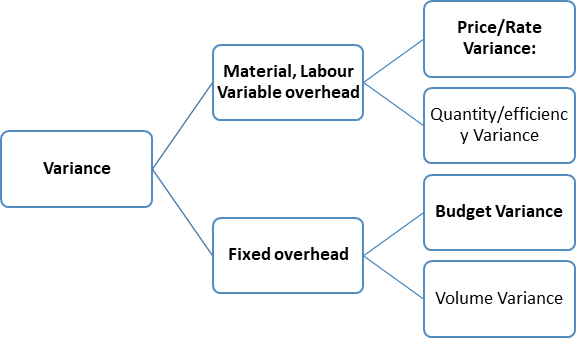
  • Purchase price variance. The actual price paid for materials used in the production process, minus the standard cost, multiplied by the number of units used.
  • Labor rate variance. The actual price paid for the direct labor used in the production process, minus its standard cost, multiplied by the number of units used.
  • Variable overhead spending variance. Subtract the standard variable overhead cost per unit from the actual cost incurred and multiply the remainder by the total unit quantity of output.
  • Fixed overhead spending variance. The total amount by which fixed overhead costs exceed their total standard cost for the reporting period.
  • Selling price variance. The actual selling price, minus the standard selling price, multiplied by the number of units sold.
  • Material yield variance. Subtract the total standard quantity of materials that are supposed to be used from the actual level of use and multiply the remainder by the standard price per unit.
  • Labor efficiency variance. Subtract the standard quantity of labor consumed from the actual amount and multiply the remainder by the standard labor rate per hour.
  • Variable overhead efficiency variance. Subtract the budgeted units of activity on which the variable overhead is charged from the actual units of activity, multiplied by the standard variable overhead cost per unit.

It is not necessary to track all of the preceding variances. In many organizations, it may be sufficient to review just one or two variances. For example, a services organization (such as a consulting business) might be solely concerned with the labor efficiency variance, while a manufacturing business in a highly competitive market might be mostly concerned with the purchase price variance. In other words, put most of the variance analysis effort into those variances that make the most difference to the company if the underlying issues can be rectified.

There are several problems with variance analysis that keep many companies from using it. They are:

  • Time delay. The accounting staff compiles the variances at the end of the month before issuing the results to the management team. In a fast-paced environment, management needs feedback much faster than once a month, and so tends to rely upon other measurements or warning flags that are generated on the spot (especially in the production area).
  • Variance source information. Many of the reasons for variances are not located in the accounting records, so the accounting staff has to sort through such information as bills of material, labor routings, and overtime records to determine the causes of problems. The extra work is only cost-effective when management can actively correct problems based on this information.
  • Standard setting. Variance analysis is essentially a comparison of actual results to an arbitrary standard that may have been derived from political bargaining. Consequently, the resulting variance may not yield any useful information.

Many companies prefer to use horizontal analysis, rather than variance analysis, to investigate and interpret their financial results. Under this approach, the results of multiple periods are listed side-by-side, so that trends can be easily discerned.

Introduction to Management Control Systems

Horngreen, Datar and Foster define management control system “as a means of gathering and using information to aid and coordinate the process of making planning and control decisions through- out the organisation and to guide the behaviour of its managers and employees. The goal of management control system is to improve the collective decisions within an organisation in an economically feasible way.”

Different managers perform different responsibilities in an organisation and therefore different kinds of information are needed by them to manage the activities in their respective areas. Management control system should be able to develop, gather and communicate information to management at different levels in the organisation. Also, management control system should aim to provide financial as well as non-financial information as needed by different managers.

Some examples of financial information are material costs, labour costs, net profit, investments made etc. Non-financial data are those which are not in monetary terms such as production units per worker, labour hours, machine hours, time taken to comply with the customer’s orders, absenteeism. Some information gathered under management control system may emerge from internal data maintained within the firm.

Some other information required by managers may be gathered from external sources such as information about competitors’ product. As stated earlier, different types of information are needed by persons working at different levels in the organisation. For example, top managers may require internal as well as external financial and non-financial data as their responsibilities relate to total organisation. However, a production manager would be more interested in internally generated financial and non-financial data.

Management Control Systems:

Broadly, management control system (MCS) refers to the design, installation and operation of management planning and control systems.

The term ‘management control systems’ emphasises on two distinct, but highly interrelated and sometimes indistinguishable, subdivisions of controls systems:

(i) Structure or organisation structure or relationships among the units in the organisation, more specifically the responsibility centres, the relationship among responsibility centres, performance measures and the information that flows among these responsibility centres.

(ii) Process or set of activities, or steps or decisions that are taken by an organisation or managers to establish purposes, allocate resources and achieve organisational purposes.

The process consists of interrelated phases of programming (programme selection), budgeting, execution, measurement and evaluation of actual performance.

The structure of a management control system indicates what the system “is” and process of a management control system indicates what the system “does.” The management control systems knits the organisation together so that each part, by exercising the autonomy given to it, fulfills a purpose that is consistent with and contributes to the fulfillment of the overall purpose of the organisation.

The control system should be designed to achieve unity of purpose through the use of the diverse talents of individuals in the organisation. The constant requirement of management control is the achievement of unity in diversity through coordination, in pursuit of short-term objectives and long-term goals.

Management Control System” Formal and Informal:

Management control system includes both formal control system and informal control system. A formal control system requires that an organisation should have clear-cut rules, procedures, guidelines, plans relating to different managerial aspects. Such things are needed to guide, direct, motivate the managers and other employees and coordinate their behaviour to achieve organisational goals.

In an organisation, many formal control systems may exist such as cost accounting system, management accounting system, production engineering systems, human resource system, quality maintenance system etc. Informal management control systems are always unwritten and implicit.

However, they contribute greatly in the implementation of business goals and strategies and help the organisation to attain high degree of motivation and goal congruence. Examples of informal management control systems are unwritten norms about good behaviour of managers and employees, loyalties, shared values, organisational culture and ethics, mutual commitments among managers and employees.

A major objective of management control is to encourage goal congruence, which means that as people work to achieve their own goals, they also work to achieve the goals of the company. People must have incentives to work toward the company’s goals. To accomplish that objective, managers must assign responsibilities and develop performance evaluation criteria that motivate employees to work toward the company’s goals.

A management control system is most effective when it establishes evaluation criteria that encourage goal-congruent behaviour and is implemented through a responsibility accounting system that employees trust to report their performance.

Characteristics of Management Control Systems:

Management control systems designed in an organisation should fulfill the following characteristics:

(i) Management control systems should be closely aligned to an organisation’s strategies and goals.

(ii) Management control systems should be designed to fit the organisation’s structure and the decision-making responsibility of individual managers.

(iii) Effective management control systems should motivate managers and employees to exert efforts toward attaining organisation goals through a variety of rewards tied to the achievement of those goals.

Factors Influencing Management Control Systems:

Factors influencing the design of Management Control Systems are as follows:

(i) Size and Spread of the Enterprise:

The size and spread of a large firm is bound to be different compared with that of a small firm. This would certainly determine the content and nature of the control system for each organisation.

(ii) Organisational Structure, Delegation and Decentralisation:

Statutes and conventions govern organisational structure, and the extent of decentralisation and delegation in all enterprises. For example, the management philosophy of the State Bank of India is bound to be different from that of the State Trading Corporation. Also, within an enterprise, the degree of decentralisation and delegation changes from one point of time to another to meet changed environmental challenges and the opportunities that these may present. All these influence management control systems practiced in organisations.

(iii) Nature of Operations and Divisibility:

Nature of operations and their divisibility affect management control systems. For example, in the oil industry, for instance, sub-units can not be formed on the basis of products. In many large trading companies, however, divisions can be created on the basis of products. Again, in the paper industry, the different stages in pulp making can not be subdivided for the purposes of management control, though pulp making as a whole can be regarded as a division.

(iv) Types of Responsibility Centres:

Different control systems are needed for the various responsibility centres or sub-systems within an organisation. Whether the performance of a responsibility centre should be measured in terms of expenses or profitability or return on investment depends on the type of responsibility centre. For example, a bank may apply different performance measures to measure performance of its different branches.

There are transactional differences between branches; some are deposit heavy or advance heavy, some are with or without safe deposit facilities or foreign exchange transaction. It is, therefore, not possible to have profit as the sole criteria for performance evaluation of all branches. Hence, control systems with different criteria of performance should be used for different sub-units.

(v) People and their Perceptions:

Perceptions of people in the organisation about the likely effects of the control system on their work life, job satisfaction, job security, promotion and general well-being could differ across organisations. These considerations will significantly influence the nature and content of the management control system needed in the organisation and must be duly considered while designing management control systems.

Optimal uses of Limited Resources

Limited resources are the essential inputs required for production or providing services. These include natural resources (land, water, minerals), human resources (labor, expertise), capital resources (machinery, buildings, technology), and financial resources (money, credit). Due to their scarcity, organizations face the challenge of deciding how to best allocate these resources to achieve their objectives.

In an economic context, limited resources exist because there is always more demand for them than the available supply. This creates the necessity for careful planning and decision-making, ensuring that resources are used efficiently, effectively, and in the right combination.

Principles of Optimal Resource Allocation

  • Maximizing Output

The primary objective of optimal resource use is to generate the highest possible output. Organizations should ensure that each resource—whether human, material, or financial—produces the maximum benefit. This involves careful production planning, workforce management, and adopting technologies that increase productivity.

Example: A manufacturing plant may use advanced machinery to improve the speed and quality of production, thus maximizing the output of each worker and minimizing waste.

  • Cost Efficiency

Organizations aim to minimize costs while maximizing output. This can be achieved by reducing wastage, eliminating inefficiencies, and utilizing resources in the most cost-effective manner.

Example: A company may implement lean manufacturing principles to minimize waste in its production processes, using fewer materials and labor to achieve the same output.

  • Prioritization of Resource Use

Limited resources must be allocated to areas that provide the greatest return. This involves identifying the most profitable and critical areas for investment or production. Prioritization ensures that resources are not wasted on less important tasks.

Example: A firm facing budget constraints may choose to allocate more resources to a high-margin product line rather than an unprofitable one, thereby ensuring a better return on investment.

  • Balancing Short-term and Long-term Goals

Organizations must balance immediate needs with long-term sustainability. Focusing only on short-term profits can lead to resource depletion and long-term negative consequences. Conversely, long-term sustainability may involve initial sacrifices in resource allocation.

Example: A company may invest in renewable energy technologies that require upfront capital investment but will result in long-term cost savings and environmental benefits.

  • Flexibility and Adaptability

Optimal use of resources requires the ability to adapt to changing circumstances. Economic conditions, technological advancements, and consumer preferences can alter the demand for resources. Flexible resource allocation allows organizations to respond quickly to new opportunities or challenges.

Example: During a period of economic downturn, a company may reduce spending on luxury products and shift resources toward basic essentials that consumers still demand.

Tools for Optimizing Resource Use

  • Cost-Benefit Analysis (CBA)

A cost-benefit analysis helps organizations weigh the potential benefits against the costs of utilizing a resource. It provides a quantitative framework for making resource allocation decisions, ensuring that the benefits derived from a resource exceed its associated costs.

Example: A company may conduct a CBA to determine whether investing in new technology will yield a higher return on investment compared to the cost of acquiring and maintaining the equipment.

  • Resource Allocation Models

Models like the Economic Order Quantity (EOQ) or Linear Programming help businesses determine the optimal allocation of resources under specific constraints, such as budget limits or production capacities.

Example: A company could use linear programming to determine the optimal mix of products to produce, ensuring that the use of raw materials and labor is maximized without exceeding resource constraints.

  • Budgeting and Forecasting

Budgeting is a crucial tool for planning the use of limited resources. Accurate forecasting and creating a budget allow organizations to anticipate resource needs and allocate funds appropriately.

Example: A manufacturing company may prepare an annual budget that allocates capital for new machinery, labor costs, and materials, ensuring that resources are allocated to areas that will generate the most value.

  • Supply Chain Optimization

Efficient supply chain management is vital for ensuring the timely availability of resources without overstocking or incurring unnecessary costs. Optimizing the supply chain ensures that materials and products are available when needed and at the lowest possible cost.

Example: A retailer may use a just-in-time inventory system to ensure that products are replenished precisely when needed, avoiding the cost of holding excessive inventory.

Challenges in Optimizing Limited Resources

  • Uncertainty and Risk

The future is often uncertain, making it difficult to predict resource requirements accurately. Changes in market conditions, consumer behavior, or external factors (e.g., economic downturns, geopolitical events) can disrupt resource plans.

Example: A company that relies heavily on imported raw materials may face supply chain disruptions due to trade restrictions, requiring quick adaptations in resource allocation.

  • Competing Priorities

Organizations often face competing demands for limited resources, making it difficult to decide how to allocate them. Balancing the needs of various departments, projects, and stakeholders can create conflicts.

Example: A firm may need to decide whether to invest in research and development for future products or focus on increasing the capacity of its existing product line.

  • Technological Constraints

Even with advanced technology, limitations in production capacity, human resources, or infrastructure may restrict the optimal use of resources.

Example: A company may have access to advanced machinery but face constraints in terms of skilled labor, limiting the amount of output that can be produced.

error: Content is protected !!