Brand Management University of Mumbai BMS 6th Sem Notes

Unit 1 Introduction to Brand Management {Book}
Meaning of Brand VIEW
Brand Management VIEW
Branding, Importance of Branding to Consumers, Firms VIEW VIEW
Brands v/s Product VIEW
Scope of Branding VIEW
Branding Challenges and Opportunities VIEW
Strategic Brand Management Process VIEW
Customer Based Brand Equity model (CBBE) VIEW
Sources of Brand Equity VIEW
Steps of Brand Building including Brand Building Blocks VIEW
Brand Positioning: Meaning, Importance, Basis VIEW VIEW


Unit 2 Planning and Implementing Brand Marketing Programs {Book}
Brand Element: Meaning, Criteria for choosing Brand Elements, Types of Brand Elements VIEW
Integrating Marketing Programs and Activities VIEW
Personalizing Marketing: Experiential Marketing, One to One Marketing VIEW
Permission Marketing VIEW
Product Strategy VIEW
Perceived Quality VIEW
Relationship Marketing VIEW VIEW
Pricing Strategy: VIEW VIEW
Setting Prices to Build Brand Equity VIEW
Channel Strategy: VIEW VIEW
Direct, Indirect Channel VIEW
Promotion Strategy VIEW VIEW
Developing Integrated Marketing Communication Programs VIEW VIEW
Leveraging Secondary Brand Associations to Build Brand Equity: Companies, Countries VIEW
Channel of Distribution VIEW VIEW
Co-branding, Characters VIEW
Events VIEW


Unit 3 Measuring and Interpreting Brand Performance {Book}
a) The Brand Value Chain VIEW
b) Measuring Sources of Brand Equity:
Qualitative Research Techniques: Projective Techniques: Completion, Comparison VIEW
Brand Personality VIEW VIEW
Values: The Big Five VIEW
Free Association VIEW
Quantitative Research Techniques:
Brand Awareness VIEW
Brand Recognition VIEW
Brand Recall VIEW
Brand Image VIEW VIEW
Brand Responses VIEW
c) Young and Rubicam’s Brand Asset Valuator VIEW
d) Measuring Outcomes of Brand Equity VIEW
Comparative Methods: Brand based Comparative Approaches, Marketing Based Comparative Approaches, Conjoint Analysis VIEW
Holistic Methods: Residual Approaches, Valuation Approaches VIEW
Historical Perspectives and Interbrand’s Brand Valuation Methodology VIEW


Unit 4 Growing and Sustaining Brand Equity {Book}
Designing and Implementing Branding Strategies VIEW
Brand Architecture: Meaning of Brand Architecture, The Brand-Product Matrix VIEW
Breadth of a Branding Strategy, Depth of a Branding Strategy VIEW
Brand Hierarchy: Meaning of Brand Hierarchy, Building equity at Different Hierarchy Levels VIEW
Cause Marketing to Build Brand Equity: Meaning of Cause Marketing, Advantages VIEW
Green Marketing VIEW
Brand extensions: Meaning, Advantages, Disadvantages VIEW
Brand extension and Brand equity VIEW
Managing Brands over Time: VIEW
Reinforcing Brand VIEW
Revitalizing Brand VIEW
Building global customer-based Brand equity VIEW


Retail Management University of Mumbai BMS 6th Sem Notes

Unit 1 Retail Management: An overview {Book}
a) Retail Management: Introduction and Meaning, Significance, Scope of Retail Management VIEW
Factors Influencing Retail Management VIEW
b) Retail Formats VIEW
Concept of Organized Retailing VIEW VIEW
Factors Responsible for the Growth of Organized Retail in India VIEW VIEW
Multichannel Retailing: Meaning and Types VIEW
E-tailing: Meaning, Advantages and Limitations VIEW
c) Emerging Trends in Retailing VIEW
Impact of Globalization on Retailing VIEW
IT in Retail: Importance, Advantages and Limitations VIEW
Applications of IT in Retail:
EDI VIEW
Bar Coding VIEW
RFID Tags, Electronic Surveillance VIEW
Electronic Shelf Labels VIEW
FDI in Retailing: Meaning, Need for FDI in Indian Retail Scenario VIEW
Franchising: Meaning, Types, Advantages and Limitations, Franchising in India VIEW
Green Retailing VIEW
Airport Retailing VIEW


Unit 2 Retail Consumer and Retail Strategy {Book}
a) Retail Consumer/Shopper: Meaning of Retail Shopper, Factors Influencing Retail Shoppers VIEW
Changing Profile of Retail Shoppers VIEW
Market Research as a Tool for Understanding Retail Markets and Shoppers VIEW
b) CRM in Retail: Meaning, Objectives VIEW
Customer Retention Approaches: Frequent Shopper Programme, Special Customer Services, Personalization, Community VIEW
c) Retail Strategy: Meaning, Steps in Developing Retail Strategy, Retail Value Chain VIEW
d) Store Location Selection: Meaning, Types of Retail Locations, Factors Influencing Store Location VIEW
e) HRM in Retail: Meaning, Significance, Functions VIEW
Organization Structure in Retail: Meaning, Factors Influencing Designing Organization Structure, Organization Structure for Small Stores/Single Stores/Independent Retailers and Retail Store Chain/Department Store VIEW


Unit 3 Merchandise Management and Pricing {Book}
a) Merchandise Management Concept, Types of Merchandise, Principles of Merchandising VIEW
Merchandise Planning Meaning and Process VIEW
Merchandise Category: Meaning, Importance, Components, Role of Category Captain VIEW
Merchandise Procurement/Sourcing: Meaning, Process, Sources for Merchandise VIEW
b) Buying Function Meaning VIEW
Buying Cycle VIEW
Factors Affecting Buying Functions VIEW
Functions of Buying for Different Types of Organizations VIEW
Young and Rubicam’s Brand Asset Valuator VIEW
Independent Store, Retail Chain, Non-store Retailer VIEW VIEW
c) Concept of Lifestyle Merchandising VIEW
d) Private Label: Meaning, Need and Importance, Private Labels in India VIEW
e) Retail Pricing, Meaning, Considerations in Setting Retail Pricing, VIEW
Pricing Strategies:
High/Low Pricing: Meaning, Benefits VIEW
Everyday Low Pricing Meaning, Benefits VIEW
Market Skimming, Market Penetration VIEW
Leader Pricing, Odd Pricing, Single Pricing VIEW
Multiple Pricing, Anchor Pricing VIEW
Variable Pricing and Price Discrimination Meaning VIEW
Types:
Individualized Variable Pricing/First Degree Price VIEW
Self-Selected Variable Pricing/ Second Degree Price Discrimination: Clearance and Promotional Markdowns, Coupons, Price Bundling, Multiple, Unit Pricing VIEW
Variable Pricing by Market Segment/ Third Degree Price Discrimination VIEW


Unit 4 Managing and Sustaining Retail {Book}
a) Retail Store Operations Meaning VIEW
Responsibilities of Store Manager VIEW
The 5 S’s of Retail Operations (Systems, Standards, Stock, Space, Staff) VIEW
b) Store Design and Layout:
Store Design: Meaning, Objectives, Principles VIEW
Elements of Exterior and Interior Store Design VIEW
Store Atmospherics and Aesthetics VIEW
Store Layout Meaning, Types; Grid, Racetrack, Free Form VIEW
Signage and Graphics Meaning, Significance, Concept of Digital Signage VIEW
Feature Areas: Meaning, Types; Windows, Entrances, Freestanding Displays, End Caps, Promotional Aisles, Walls, Dressing Rooms, Cash Wraps VIEW
c) Visual Merchandising and Display:
Visual Merchandising Meaning, Significance, Tools Used for Visual Merchandising VIEW
The Concept of Planogram VIEW
Display Meaning, Methods of Display, Errors in Creating Display VIEW


International Marketing University of Mumbai BMS 6th Sem Notes

Unit 1 Introduction to International Marketing & Trade {Book}
Meaning, Features of International Marketing, Need and Drivers of International Marketing VIEW
Process of International Marketing, Phases of International Marketing VIEW
Benefits of International Marketing VIEW
Challenges of International Marketing VIEW
Difference between Domestic and International Marketing VIEW
Different Orientations of International Marketing: EPRG Framework VIEW
Entering International Markets: VIEW
Exporting VIEW VIEW
Licensing VIEW
Franchising VIEW
Mergers and Acquisition VIEW
Joint Ventures VIEW
Strategic Alliance VIEW
Wholly Owned Subsidiaries VIEW
Contract Manufacturing VIEW
Turnkey Projects VIEW
Concept of Globalization VIEW VIEW
Introduction to International Trade: Concept of International Trade VIEW VIEW
Barriers to Trade: Tariff and Non-Tariff VIEW
Trading Blocs: SAARC, ASEAN, NAFTA VIEW
European Union VIEW
OPEC VIEW


Unit 2 International Marketing Environment and Marketing Research {Book}
a) International Marketing Environment VIEW
Economic Environment: International Economic Institution:
World Bank VIEW
IMF VIEW
IFC VIEW
International Economic Integration:
Free Trade Agreement VIEW
Customs Union VIEW VIEW
Common Market VIEW
Economic Union VIEW
Political Environment: Political System (Democracy, Authoritarianism, Communism), Political Risk, Political Instability, Political Intervention VIEW
Legal Environment: Legal Systems (Common Law, Civil Law, Theocratic Law), Legal Differences, Anti-Dumping Law and Import License VIEW
Cultural Environment: Concept, Elements of Culture (Language, Religion, Values and Attitude, Manners and Customs, Aesthetics and Education), HOFSTEDE’s Six Dimension of Culture, Cultural Values (Individualism v/s Collectivism) VIEW
b) Marketing Research: Introduction, Need for Conducting International Marketing Research, International Marketing Research Process, Scope of International Marketing Research, IT in Marketing Research VIEW


Unit 3 International Marketing Mix {Book}
International Product Decision VIEW
International Product Line Decisions VIEW
Product Standardization v/s Adaptation Argument VIEW
International Product Life Cycle VIEW
Role of Packaging and Labelling in International Markets VIEW
Branding Decisions in International Markets VIEW
International Market Segmentation and Targeting, Positioning VIEW
b) International Pricing Decision VIEW
Concept of International Pricing, Objectives of International Pricing, Factors Affecting International Pricing VIEW
International Pricing Methods: Cost Based, Demand Based, Competition Based, Value Pricing, Target Return Pricing and Going Rate Pricing VIEW
International Pricing Strategies: Skimming Pricing, Penetration Pricing, Predatory Pricing VIEW
International Pricing Issues: Gray Market, Counter Trade, Dumping, Transfer Pricing VIEW
c) International Distribution Decisions
Concept of International Distribution Channels, Types of International Distribution Channels VIEW
Factors Influencing Selection of International Distribution Channel VIEW
d) International Promotion Decisions:
Concept of International Promotion Decision VIEW VIEW
Planning International Promotional Campaigns: Steps: Determine the Target Audience, Determine Specific Campaigns VIEW
Determine Budget VIEW
Determine Message VIEW VIEW
Determine Campaign Approach VIEW VIEW
Determine Campaign Effectiveness VIEW VIEW
Standardization V/S Adaptation of International Promotional Strategies VIEW VIEW
International Promotional Tools/Elements VIEW


Unit 4 Developments in International Marketing {Book}
a) Introduction: Developing International Marketing Plan: VIEW
Preparing International Marketing Plan VIEW
Examining International Organisational Design VIEW
Controlling International Marketing Operations VIEW
Devising International Marketing Plan VIEW
b) International strategies:
Need for International Strategies, Types of International Strategies VIEW
c) International Marketing of Services:
Concept of International Service Marketing, Features of International Service Marketing, Need of International Service Marketing VIEW
Drivers of Global Service Marketing, Advantages and Disadvantages of Global Service Marketing, Service Culture VIEW


Media Planning & Management University of Mumbai BMS 6th Sem Notes

Unit 1 Overview of Media and Media Planning {Book}
Meaning of Media & Features of Media VIEW
Meaning of Media Planning, Scope of Media planning VIEW
Media Planning Elements VIEW
Role of Media in Business VIEW
Media Planning Process VIEW
Impact of Marketing Objectives on Media Planning, Factors Influencing Media Planning Decisions VIEW
Role and Importance of Media in Consumer Buying Decision VIEW
Role of Media Planner, Challenges of Media Planning VIEW
Organization Structure of Media Company VIEW
Regulatory Framework and Legal Aspects in Media Planning VIEW
Media Research Meaning, Role and Importance VIEW
Sources of Media Research: Audit Bureau of Circulation, Press Audits, National Readership Survey/IRS, Businessmen’s Readership Survey, TRP, VIEW
Sources of Media Research: National Television Study, ADMAR Satellite Cable Network Study, Reach and Coverage Study, CIB Listenership Survey VIEW


Unit 2 Media Mix and Media Strategy {Book}
Media Mix Meaning, Need for Media Mix VIEW
Identifying Audience for Mass Media VIEW
Factors Affecting Media Mix Decision VIEW
Types of Media Mix Decisions: Broad Media Classes, Media Vehicles, Media Units VIEW
Deciding Ideal Media Mix VIEW
Media Choices:
Print Meaning Factors Affecting Selection of Print Media Decisions, Types of Print Media, Advantages and Limitations VIEW
Television Media: Meaning, Factors Affecting Selection of Television Media Decisions, Advantages and Limitations VIEW
Radio Media: Meaning, Factors affecting Selection of Radio Media Decision, Advantages and Limitations VIEW
Out of Home (OOH): Meaning, Types of OOH, Factors Affecting OOH Planning Decision, Advantages and Limitations VIEW
Emerging Media:
Online, Mobile, Gaming, In flight, In Store, Interactive Media VIEW
Media Strategy:
Media Strategy: Meaning, Need for Media Strategy, Situation Analysis for Media Strategy and its Components VIEW
Steps in Formulating Media Strategies: Defining the Target Group, Market Prioritization, Media Weights, Media Mix, Media Scheduling VIEW


Unit 3 Media Budgeting, Buying & Scheduling {Book}
Media Budget Meaning VIEW VIEW
Factors to be considered while Framing a Budget: Advertising Task, Competitive Framework, Market Dominance, Market Coverage, Media Cost, Market Task, Pricing, Frequency of Purchase VIEW
Importance of Media Budget VIEW VIEW
Methods of Setting Media Budget: Status Quo, Inflation Adjusted, Advertising Sales, Case Rate & Advertising Margin Method, Share of Market VIEW
Methods of Setting Media Budget: Yardstick Method, Effective Frequency & Reach Method & Margin Analysis ROI Based Approach, Experimental Approach, Break Even Planning VIEW
Media Buying: Meaning, Role of Media Buyer, Objectives of Media Buying VIEW
Media Buying Process: Buying Brief, Environmental Analysis, Science and Art of Buying, Benchmarking Buying Plan Presentation Deal Management and Post Buy VIEW
Buying brief: Concept & Elements of Buying Brief, Art of Media Buying Negotiation in Media Buying, Plan Presentation and Client Feedback VIEW
Criteria in Media Buying VIEW
Media Scheduling Meaning, Importance VIEW
Factors Affecting Scheduling: Sales Pattern, Purchase Cycle, Product Availability, Competitive Activity, Marketing Task, Budget Constraints, Target Group VIEW
Scheduling Patterns; Continuity, Flighting, Pulsing VIEW
Scheduling Strategies for Creating Impact: Road Block, Day or Day part VIEW
Emphasis, Multiple Spotting, Teasers


Unit 4 Developments in International Marketing {Book}
a) Media Measurement: Basic Metrics: Reach, Cumulative/Frequency Reach, Discrete & Cumulative distribution, Average Opportunity to See (AOTS), Effective frequency/Reach VIEW
Television Metrics: Dairy v/s PeopIemeter, TRP/TVR, Program Reach & Time Spent, Stickiness Index, Ad Viewership VIEW
Radio Metrics: Arbitron Radio Rating VIEW
Print Metrics: Circulation, Average Issue Readership (AIR), Total or Claimed Reader, Sole or Solus reader VIEW
OOH Metrics: Traffic Audit Bureau (TAB) VIEW
Benchmarking Metrics: Share, Profile, and Selectivity Index VIEW
Plan Metrics: Gross Rating Points (GRP), Gross Impressions (GI), Share of Voice (SOV) VIEW
Evaluating Media Buys
Evaluating Television Media Buying: Dysfunctional Card Rate, Secondary and Effective Rate, Deal Composition, Cost Per Rating Point (CPRP), Reach Delivered by the Buy, Visibility Spots, Bonus Percentage, Upgrades and Spot Fixing, Sponsorships VIEW
Evaluating Print Media Buying: Discount on Rate Card, Negotiated Rate, Cost Per Thousand (CPT), Market Share Incentives, Readership v/s Circulation Track, Growth Incentives, Combination Rate Incentives, Full Page Discounts and Size Upgrades, Discount for Colour Ads, Date Flexibility Incentives, Positioning, Innovations VIEW
Evaluating Other Media Buys: Radio Buys, Outdoor Buys, Cinema Buys, Internet Buys, and Mobile Buys VIEW


HRM in Global Perspective University of Mumbai BMS 6th Sem Notes

Unit 1 International HRM: An Overview: {Book}
International HRM Meaning and Features VIEW
Objectives, Evolution of IHRM VIEW
Reasons for Emergency of IHRM VIEW
Significance of IHRM in International Business VIEW
International HRM Scope/Functions VIEW
Difference between International HRM and Domestic HRM VIEW VIEW
Approaches to IHRM: Ethnocentric, Polycentric, Geocentric and Regiocentric VIEW
Limitations to IHRM VIEW
Qualities of Global Managers VIEW
Organizational Dynamics and IHRM VIEW
Components of IHRM: Cross Cultural Management, Comparative HRM
Cross Cultural Management: Meaning, Features, Convergence of Cultures VIEW
Role of IHRM in Cross Culture Management VIEW
Problems of Cross-Cultural Issues in Organizations VIEW
Importance of Cultural Sensitivity to International Managers VIEW
Comparative HRM: Meaning, Importance, Difference between IHRM and Comparative HRM VIEW
Managing Diversity in Workforce VIEW VIEW
Dealing with Cultural Shock VIEW


Unit 2 Global HRM Functions {Book}
International Recruitment and Selection Meaning VIEW VIEW
Sources of International Labour Market, Global Staffing, Selection Criteria VIEW
Managing Global Diverse Workforce VIEW VIEW
International Compensation Meaning, Objectives, Components of International Compensation Program VIEW
Approaches to International Compensation VIEW
HRM Perspectives in Training and Development Meaning, Advantages VIEW
Cross Cultural Training, Issues in Cross Cultural Training VIEW
International Performance Management Meaning, Factors VIEW
Criterion used for Performance Appraisal of International Employees VIEW
Problems Faced in International Performance Management VIEW
Motivation System Meaning VIEW VIEW
Reward System Meaning VIEW VIEW
Benchmarking Global Practices VIEW
International Industrial Relations Meaning VIEW
Trade Union and International IR VIEW
Trade Union VIEW VIEW


Unit 3 Managing Expatriation and Repatriation {Book}
Concepts of PCNs (Parent-Country Nationals), TCNs (Third-Country Nationals) and HCNs (Host-Country Nationals) VIEW
Expatriation Meaning, Reasons for Expatriation, Factors in Selection of Expatriates VIEW
Advantages of Using Expatriates VIEW
Limitations of using Expatriates, Role of Family, Reasons for Expatriate Failure VIEW
The Role of Non-expatriates VIEW
Women and Expatriation VIEW
Requirements/Characteristics of Effective Expatriate Managers VIEW
Repatriation Meaning, Repatriation Process VIEW
Factors affecting Repatriation Process VIEW
Role of Repatriate, Challenges faced by Repatriates VIEW


Unit 4 International HRM Trends and Challenges {Book}
Emerging Trends in IHRM VIEW
Off Shoring Meaning, Importance, Off Shoring and HRM in India VIEW
International Business Ethics and IHRM:
Business Ethics VIEW VIEW
Global Values VIEW
International Corporate Code of Conduct VIEW VIEW
Criminalization of Bribery VIEW
Operationalizing Corporate Ethics of HR in Overall Corporate Ethics Programme VIEW
Managing International Projects and Teams Meaning VIEW
How Projects are Managed across the World VIEW
Challenges in Managing International Projects across the World VIEW
HR in MNCs; Industrial Relations in MNCs VIEW
Role of Technology on IHRM VIEW
IHRM and Virtual Organization Meaning and Features of Virtual Organization VIEW
Difference between Virtual Organization and Traditional Organization VIEW
Managing HR in Virtual Organization VIEW
Growth in Strategic Alliances; Impact on IHRM VIEW VIEW
Cross Border Mergers and Acquisitions VIEW
Knowledge Management and IHRM VIEW


Organisational Development University of Mumbai BMS 6th Sem Notes

Unit 1 Organisational Development: An Overview {Book}
Organisational Development Meaning, Features, Evolution, Components, Objectives VIEW
Organisational Development Principles, Process, Importance VIEW
Relevance of Organisational Development for Managers, OD-HRD Interface VIEW
Participation of Top Management in OD VIEW
OD Practitioner Meaning, Role of OD Practitioner, Competencies of an OD Practitioner VIEW
Emerging Trends in OD VIEW
OD in Global Setting VIEW


Unit 2 Organisational Diagnosis, Renewal and Change {Book}
Organisational Diagnosis: Meaning, Need, Phases VIEW
Levels of Organisational Diagnosis VIEW
Techniques of Organisational Diagnosis VIEW
Tools used in Organisational Diagnosis VIEW
Organizational Renewal, Re-energizing VIEW
OD and Business Process Re- Engineering (BPR) VIEW
OD and Leadership Development VIEW
Organisational Change Meaning VIEW
Organisational Life Cycle VIEW
Planned Change VIEW VIEW
Organizational Growth and its Implication for Change VIEW
Change Agents: Meaning, Features, Types, Role, Skills required VIEW


Unit 3 OD Interventions {Book}
a) Managing Expatriation and Repatriation VIEW
OD Interventions: Meaning, Features, Steps in OD Interventions VIEW
Factors Affecting Success of Interventions VIEW
Types of Interventions:
Human Resource Intervention VIEW
Structural Intervention VIEW
Strategic Interventions VIEW
Third-Party Peace-Making Intervention VIEW
**Team Intervention VIEW
**Interpersonal Intervention VIEW
Techniques of OD Intervention:
Traditional Intervention: Sensitive Training, Grid Training, Survey Feedback VIEW
Modern Intervention: Process Consultation, Third Party, Team Building, Transactional Analysis VIEW
Evaluation of OD Interventions: Process, Types, Methods, Importance VIEW


Unit 4 OD Effectiveness {Book}
Issues faced in OD: Issues Related to Client Relationship, Power Individual skills and Attributes as a Source of Power, Power and Influence Tactics, Politics and OD VIEW
Values in OD: Meaning, Professional Values, Value Conflict and Dilemma VIEW
Ethics in OD: Meaning, Factors Influencing Ethical Judgement VIEW
Ethical Guidelines for OD Professionals VIEW
Organisational Effectiveness Meaning, Effectiveness v/s Efficiency VIEW
Approaches of Organisational Effectiveness: Goal Approach, System Resource Approach, Strategic Constituency Approach, Internal Process Approach VIEW
Parameters for Judging Organisational Effectiveness VIEW
Ways to Enhance Organisational Effectiveness VIEW


Indian Ethos in Management University of Mumbai BMS 6th Sem Notes

Unit 1 Indian Ethos: An Overview {Book}
a) Indian Ethos
Meaning, Features, Need, Relevance, History, Principles practiced by Indian Companies VIEW
Requisites, Elements, Role of Indian Ethos in Managerial Practices VIEW
b) Management Lessons from Scriptures:
**Management Lessons from Bhagavad Gita VIEW
**Management Lessons from Quran Ramayana VIEW
Management Lessons from Vedas VIEW
Management Lessons from Mahabharata VIEW
Management Lessons from Bible VIEW
Management Lessons from Quran VIEW
Management Lessons from Kautilya’s Arthashastra VIEW
Indian Heritage in Business, Management, Production and Consumption VIEW
Ethics v/s Ethos VIEW
Indian Management v/s Western Management VIEW


Unit 2 Work Ethos and Values {Book}
a) Work Ethos: Meaning, Levels, Dimensions, Steps VIEW
Factors Responsible for Poor Work Ethos VIEW
b) Values:
Meaning, Features, Values for Indian Managers VIEW
Relevance of Value Based Management in Global Change VIEW
Impact of Values on Stakeholders: Employees, Customers, Government, Competitors and Society VIEW
Values for Managers VIEW
Trans-Cultural Human Values in Management and Management Education VIEW
Secular v/s Spiritual Values in Management VIEW
Importance of Value System in Work Culture VIEW


Unit 3 Stress Management {Book}
a) Stress Management Meaning VIEW
Types of Stress at Work VIEW VIEW
Causes of Stress VIEW VIEW
Consequences of Stress VIEW
b) Stress Management Techniques: VIEW
Meditation Meaning, Techniques, Advantages VIEW
Mental Health and its Importance in Management VIEW
Brain Storming, Brain Stilling VIEW
Yoga Meaning, Significance VIEW VIEW
c) Leadership Meaning VIEW
Contemporary Approaches to Leadership VIEW VIEW
Joint Hindu Family Business VIEW
Leadership Qualities of Karta VIEW
d) Motivation Meaning, Techniques VIEW VIEW
Indian Approach to Motivation VIEW


Unit 4 Indian Systems of Learning {Book}
a) Learning Meaning, Mechanisms VIEW VIEW
Gurukul System of Learning: Meaning, Features, Advantages, Disadvantages VIEW
Modern System of Learning Meanings, Features, Advantages, Disadvantages VIEW
Karma Meaning, Importance of Karma to Managers, Nishkama Karma VIEW
Laws of Karma The Great Law, Law of Creation, Law of Humility, Law of Growth, Law of Responsibility, Law of Connection VIEW
Corporate Karma Meaning, Methodology, Guidelines for good Corporate Karma VIEW
Self-Management Personal growth and Lessons from Ancient Indian Education System VIEW
Personality Development Meaning, Determinants VIEW
Indian Ethos and Personality Development VIEW


Role of Management Information System (MIS)

Simply MIS stand For Management Information System. For Simply Understanding Management Information System (MIS) we can divide in to three Word and Understand Part by part

  • Management: “Management is function to do the work at the Right time, by the right Person, For the Right Job.”
  • Information: “Information is the Collection of Organized data which plays a Vital Role for decision making.”
  • System: “System Consist for a set of elements which Provides a Framework to convert Unorganized (Data) into Organized Information.”

Role of Management Information System

Management information system (MIS) has become Very Necessary due to Emergence of high complexity in Business Organization. It is all to know that without information no Organization can take even one step properly regarding the decision making process. Because it is matter of fact that in an organization decision plays an essential role for the achievement of its objectives and we know that every decision is based upon information. If gathered information are irrelevant than decision will also incorrect and Organization may face big loss & lots of Difficulties in Surviving as well.

  1. Helps in Decision making

Management Information System (MIS) plays a significant Role in Decision making Process of any Organization. Because in Any organization decision is made on the basis of relevant Information and relevant information can only be Retrieving from the MIS.

  1. Helps in Coordination among the Department

Management information System is also help in establishing a sound Relationship among the every persons of department to department through proper exchanging of Information’s.

  1. Helps in Finding out Problems

As we know that MIS provides relevant information about the every aspect of activities. Hence, If any mistake is made by the management then Management Information Systems (MIS) Information helps in Finding out the Solution of that Problem.

  1. Helps in Comparison of Business Performance

MIS store all Past Data and information in its Database. That why management information system is very useful to compare Business organization Performance. With the help of Management information system (MIS) Organization can analyze his Performance means whatever they do last year or Previous Years and whatever business performance in this year and also measures organization Development and Growth.

Components

A Management Information System (MIS) comprises five key components – people, business processes, data, hardware, and software. These components work collaboratively to achieve the organization’s objectives and ensure smooth operations.

People:

Users of the information system, such as accountants, human resource managers, etc., record day-to-day business transactions. The ICT department supports these users, ensuring the system’s proper functioning.

Business Procedures:

Agreed-upon best practices that guide users and other components in working efficiently. These procedures are developed by various stakeholders, including users and consultants.

Data:

Recorded day-to-day business transactions, collected from various activities like deposits and withdrawals for a bank.

Hardware:

The physical equipment like computers, printers, and networking devices that provide computing power for data processing, as well as networking and printing capabilities. Hardware accelerates the transformation of data into valuable information.

Software:

Programs that run on the hardware. Software is divided into system software (e.g., operating systems like Windows, Mac OS, Ubuntu) and applications software (e.g., Payroll program, banking system, point of sale system) that facilitate specific business tasks.

In an MIS, these components form an interconnected ecosystem, with people using business procedures to interact with and record data. The hardware, along with the software, processes this data, transforming it into meaningful information accessible to users. The effective collaboration of all these components ensures the MIS serves its purpose, providing valuable insights for decision-making and supporting business operations.

Organizational Decision Making

Decision making can be defined as selecting between alternative courses of action. Management decision making concerns the choices faced by managers within their duties in the organization. Making decisions is an important aspect of planning. Decision making can also be classified into three categories based on the level at which they occur.

Strategic Decisions: These decisions establish the strategies and objectives of the organization. These types of decisions generally occur at the highest levels of organizational management.

Tactical Decisions: Tactical decisions concern the tactics used to accomplish the organizational objectives. Tactical decisions are primarily made by middle and front-line managers.

Operational Decisions: Operational decisions concern the methods for carrying out the organizations delivery of value to customers. Operational decisions are primarily made by middle and front-line managers.

Decisions can be categorized based on the capacity of those making the decision.

Personal Decisions: Personal decisions are those primarily affecting the individual though the decision may ultimately have an effect on the organization as a result of its effect on the individual. These types of decisions are not made within a professional capacity. These decisions are generally not delegated to others.

Organizational Decisions: An organizational decision is one that relates or affects the organization. It is generally made by a manager or employee within their official capacity. These decisions are often delegated to others.

Strategies:

Marginal Analysis

Marginal analysis helps organizations allocate resources to increase profitability and benefits and reduce costs. An example from indeed.com is if a company has the budget to hire an employee, a marginal analysis may show that hiring that person provides a net marginal benefit because the ability to produce more products outweighs the increase in labor costs.

SWOT Diagram

This tool helps a manager study a situation in four quadrants:

  • Strengths: Where does the organization excel compared to its competition? Consider the internal and external strengths.
  • Weaknesses: What could the organization improve?
  • Opportunities: How can the organization leverage its strengths to create new avenues for success.
  • Threats: Determine what obstacles prevent the organization from achieving its goals.

Decision Matrix

A decision matrix can provide clarity when dealing with different choices and variables. It is like a pros/cons list, but decision-makers can place a level of importance on each factor. According to Dashboards, to build a decision matrix:

  • List your decision alternatives as rows
  • List relevant factors as columns
  • Establish a consistent scale to assess the value of each combination of alternatives and factors
  • Determine how important each factor is in choosing a final decision and assign weights accordingly
  • Multiply your original ratings by the weighted rankings
  • Add up the factors under each decision alternative
  • The highest-scoring option wins

Pareto Analysis

The Pareto Principle helps identify changes that will be the most effective for an organization. It’s based on the principle that 20 percent of factors frequently contribute to 80 percent of the organization’s growth. For example, suppose 80 percent of an organization’s sales came from 20 percent of its customers. A business can use the Pareto Principle by identifying the characteristics of that 20 percent customer group and finding more like them. By identifying which small changes have the most significant impact, an organization can better prioritize its decisions and energies.

Steps:

Make long-term goals and use them to measure your decisions.

All too often, organizations find themselves endlessly running around in pursuit of short-term goals. Money that has been committed to a year-long project gets overrun or set off because flashy or short-term priorities arise and resources are redirected. As a result, you typically end up with an awful lot of confusion and a lack of overall progress.

To avoid this problem, nail down your high-priority, long-term goals from the outset. Then as your organization makes decisions, ask yourself whether what you’re doing aligns with those goals. This should be a constant process, returning again and again to check your organizational activity against your goals.

When you apply this method successfully, you will engage more reliably in short-term projects that support your long-term goals. Over time, this will push your organization forward.

Align your goals with your core values

Ideally, these should flow from your organization’s mission and core values. Your organization’s goals may evolve over time, but its values should be much less mutable.

Your organizational values confer a coherent sense of identity and continuity to your organization. They should be clearly understood and agreed upon by your decision-makers. As you evaluate your goals, make sure that they are aligned with your core values.

Assess (and reassess) spending

One way to evaluate your priorities as they are being realized today is to take a look at your spending. Often, you may think you’re prioritizing a particular goal or effort, while your budget tells a different story.

Make sure your organizational spending reflects your identified priorities. If not, you need to take a second look. And as with any such check-in, it’s essential to make this a regular assessment to continuously verify that you’re on track.

Understand the impacts of your decisions.

Some decisions may be discrete and routine, having neat boundaries and only significantly impacting the matter directly at hand. But more often, organizational decisions may have wide-ranging consequences, especially if they will touch on policy or processes.

As your organization considers varying possibilities, make sure to weight second and third-order effects. These consequences can provide crucial context for the decision at hand.

Remember your personnel.

Organizations tend to depend on the quality of their employees to succeed. If your decisions make it difficult for your employees to be productive in their work environment, it will damage your prospects for long-term success even if your decisions appear to advance a short-term goal.

Evaluate the effect your decisions will have on your employees’ ability to perform their jobs and factor this component into your decisions accordingly.

The most effective decision-making should lead to improved work toward your long-term goals, which should be driven by core values. You should constantly reevaluate your spending and assess likely consequences of your actions. If you follow these steps thoroughly, you will have assembled a framework for successful organizational decision-making.

Advantages of Decision Making

Increase People’s Participation

Decision making in the organisation is done by a group of peoples working in the organisation. It is not carried out by a single individual rather than by a group of people. Each people actively participates in decision making of the organisation. They are free to present their creative ideas without any boundations.

Also, none of them is individually criticized for any failure but the whole group is responsible to handle. This increases the participation level of different people in the organisation.

Gives More Information

Good decision-making process acquires enough information before taking any action. In decision making, there is a large number of peoples involved. It is undertaken by the whole group rather than by a single individual. Each person gives his perspective to handle a particular situation.

They all represent there facts and figures according to their skill. This generates enough information which can be used for better understanding of the situation. This helps managers in taking corrective decisions.

Provide More Alternatives

Companies are able to get different alternatives for a particular situation through group decision making. There are different people working as a group for proper decisions. Each person looks differently to a particular problem.

They give their own perspectives and ideas for it. This way there are different options available to choose. All the alternatives are properly analysed in light of handling situation. The best one is chosen to arrive at a better result.

Improves the Degree of Acceptance and Commitment

Companies always face the chances of conflict among its staff working in the organisation. Through group decision making each person gets equal right to share his views and ideas.

Here decisions are not imposed on the peoples but are created with their participation. It develops a sense of loyalty and belongingness among people towards the business. They easily accept the decisions taken and are committed to their roles.

Helps In Strengthening the Organisation

It helps in improving the strength of the organisation. Decision making provides a platform to each individual working in an organisation to equally represent their ideas. Everybody gets an equal right to take part in managing the organisation.

It develops a sense of cooperation and unity among individuals working there. They all come together and work towards the accomplishment of the company’s goals. This increases the overall productivity of the organisation and strengthens its overall structure.

Improves the Quality of Decisions

Decision making helps in taking quality decisions at the right time. There are different experts engaged by organisations in their decision-making group. These peoples have through knowledge and creative thinking.

They analyse each and every aspect of every alternative available to them for handling situations. Best among the different alternatives available is chosen. It enables in quality decision making which helps in easy attainment of objectives.

Limitations:

Consultation ambiguity: This can be a scenario where a group of employees all feel like they have a vote in a decision or when a manager asks for input but doesn’t consider a group’s views. It’s important for a manager to solicit feedback but to make sure that contributors understand it’s the manager’s final decision.

Avoiding discomfort: Sound management decision making requires leaders who do not confuse their need for comfort with making the best decision. Some of the most effective decisions involve a degree of discomfort for the manager.

Appearing indecisive: Sometimes, a systematic decision making process has a downside. Being too rigorous in evaluating every possible angle can draw out the process and open the risk of appearing indecisive. Keep stakeholders informed about the timeline for a decision.

Blind spots: People have particular perspectives and ways of thinking that can create blind spots, which may be important for an effective decision but cannot be readily apparent. It can be helpful to seek input from trusted colleagues to provide a different perspective.

Groupthink: This occurs when a group’s members want to minimize conflict and reach a comfortable decision at the expense of a critical evaluation of other ideas and viewpoints. It’s important to explore alternatives a group may not have considered.

Networking of Computers, Client Server LAN, Wide Area Network (WAN)

A computer network is a system in which multiple computers are connected to each other to share information and resources.

Characteristics of a Computer Network

  • Share resources from one computer to another.
  • Create files and store them in one computer, access those files from the other computer(s) connected over the network.
  • Connect a printer, scanner, or a fax machine to one computer within the network and let other computers of the network use the machines available over the network.

NODA

A node is any physical device within a network of other tools that’s able to send, receive, or forward information. A personal computer is the most common node. It’s called the computer node or internet node.

Modems, switches, hubs, bridges, servers, and printers are also nodes, as are other devices that connect over Wi-Fi or Ethernet. For example, a network connecting three computers and one printer, along with two more wireless devices, has six total nodes.

Nodes within a computer network must have some form of identification, like an IP address or MAC address, for other network devices to recognize it. A node without this information, or one that’s offline, no longer functions as a node.

In telecommunications networks, a node is either a redistribution point or a communication endpoint. The definition of a node depends on the network and protocol layer referred to. A physical network node is an electronic device that is attached to a network, and is capable of creating, receiving, or transmitting information over a communications channel. A passive distribution point such as a distribution frame or patch panel is consequently not a node.

Network nodes are the physical pieces that make up a network. They usually include any device that both receives and then communicates information. But they might receive and store the data, relay the information elsewhere, or create and send data instead.

For example, a computer node might back up files online or send an email, but it can also stream videos and download other files. A network printer can receive print requests from other devices on the network, while a scanner can send images back to the computer. A router determines which data goes to which devices that request file downloads within a system, but it can also send requests out to the public internet.

Client Server LAN

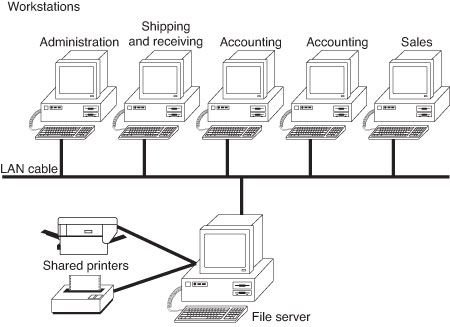
On a client/server network, every computer has a distinct role: that of either a client or a server. A server is designed to share its resources among the client computers on the network. Typically, servers are located in secured areas, such as locked closets or data centers (server rooms), because they hold an organization’s most valuable data and do not have to be accessed by operators on a continuous basis. The rest of the computers on the network function as clients.

The components of a client/server LAN.

Wide Area Network (WAN)

A wide area network (WAN) is a telecommunications network that extends over a large geographical area for the primary purpose of computer networking. Wide area networks are often established with leased telecommunication circuits.

Business, as well as education and government entities use wide area networks to relay data to staff, students, clients, buyers and suppliers from various locations across the world. In essence, this mode of telecommunication allows a business to effectively carry out its daily function regardless of location. The Internet may be considered a WAN.

Similar types of networks are personal area networks (PANs), local area networks (LANs), campus area networks (CANs), or metropolitan area networks (MANs) which are usually limited to a room, building, campus or specific metropolitan area, respectively.

error: Content is protected !!