Emotions

According to the book “Discovering Psychology” by Don Hockenbury and Sandra E. Hockenbury, an emotion is a complex psychological state that involves three distinct components: a subjective experience, a physiological response, and a behavioral or expressive response.

In addition to trying to define what emotions are, researchers have also tried to identify and classify the different types of emotions. The descriptions and insights have changed over time:

  • In 1972, psychologist Paul Eckman suggested that there are six basic emotions that are universal throughout human cultures: fear, disgust, anger, surprise, happiness, and sadness.
  • In 1999, he expanded this list to include a number of other basic emotions, including embarrassment, excitement, contempt, shame, pride, satisfaction, and amusement.2
  • In the 1980s, Robert Plutchik introduced another emotion classification system known as the “wheel of emotions.” This model demonstrated how different emotions can be combined or mixed together, much the way an artist mixes primary colors to create other colors.

Analysis of Emotions

(i) Fear

It is an emotion excited by the apprehension of a dan­gerous situation. McDougall holds that the emotion of fear is the affective aspect of instinct to escape. Fear is excited by a deafening noise, a blinding flash of lighting a sudden peal of thunder, etc. It arises from the perception of an object which caused pain or injury in the past.

The conditions which excite fear must be aggressive or obtrusive in their nature. A sudden and intense impression excites fear. A loud sound for which we are unprepared excited fear in us. Fear is expressed in quick palpitation of the heart, trembling, drooping of the limbs, running away etc. Extreme terror is expressed in immobility of the body.

(ii) Anger

It is an emotion excited by the thwarting of conation. It arises from obstruction of any instinctive or acquired tendency. McDougall holds that the emotion of anger is the affective aspect of the instinct of combat.

Any kind of opposition, or thwarting of an instinctive or acquired tendency, may cause anger. A cat becomes angry if you interfere with its kittens. A child becomes angry if you take away its toy. A. man becomes angry if you insult or abuse him.

The emotion of anger is the affective aspect of the instinct to fight to break down opposition. Anger and fear are characterized by opposite tendencies. In car, the bodily attitude is one of with­drawal, while in anger the body assumes an aggressive attitude.

Anger is expressed in a violent motor discharge. It is expressed in frowning, howling, grinding the teeth, closing the fists, kicking, striking, etc. Fear is expressed in trembling running away, etc.

(iii) Joy

It arises from the attainment of a cherished object. When the object of desire is attained, it gives rise to joy. It is ex­pressed in a general heightened tension of the entire body. Erect posture, throwing out the chest, brightness of the eyes, smiling face, shooting, laughing, jumping, etc., are the expressions of joy.

(iv) Sorrow

It arises from the loss of a cherished object. It is excited by the failure to fulfil our desires. When a person is deprived of his cherished objects, he feels sorrow. Joy is the emotion that results from success of an endeavour, while sorrow is the emotion that results from impending or actual failure.

The expressions of sorrow are the opposite of those of joy. Drooping posture, retracting the chest, general relaxation of the bodily tension, etc., are the expres­sions of sorrow. Deep grief has a prostrating effect.

(v) Love

The word ‘love’ is ambiguous. It is used in three senses. First, it means sexual emotion. It is the emotion arising from the sex instinct. McDougall calls it the emotion of lust. Secondly, it means tender emotion arising from the maternal instinct.

Thirdly, it means a sentiment or permanent emotional disposition which is manifested in tender emotion. Selfish love seeks to satisfy itself, regard­less of the welfare of the loved object. But, when it is excited, not merely by the presence of the loved object, but also by considerat­ions for the welfare of the object it true emotion of love.

Love contains two elements, viz., attachment and sympathy. Attachment consists in fondling or caressing. Sympathy consists in sharing or entering into the emotions of others. Sully regards attachment or selfish love as the egoistic element and sympathy, as the altruistic element, in love.

Bain holds that attachment is a tender emotion which is expressed in bodily contact of some sort-touching, caressing, embracing, etc. In fact, the natural outlet of love, in all its forms, is delight in the society of, or in the presence of, the loved object.

(vi) Hate

The word ‘hate’ is ambiguous. It is used in the sense of a sentiment and an emotion both. According to McDougall, hate is a compound emotion. It consist of anger, fear, and disgust. The object of hatred provokes us, frightens us, and repels us. A power­ful person who insults me excites anger in me. But anger cannot be expressed in fighting him. He is too powerful for me.

So he excites fear in me. This important anger mingled with fear is further com­plicated by disgust or loathing for the person. Hate is the opposite of love. It makes a person withdraw from the presence of the object of hate. While love is an expanding emotion, hate is a contracting emotion. It makes a person guard himself from others and withdraw from them. It is a defensive emotion.

Factors of Emotions

Every emotion has two sides bodily and mental. Mellone mentions the following factors in emotion:

(i) On the Mental Side

  • The perception, memory, imagination or thought, of a situation which affects the material, mental, social or higher interests of the individual
  • An affective quality tending towards pleasure or towards pain
  • A tendency to activity
  • A complication of organic sensations and muscular sensations.

(ii) On the Bodily Side

  • Diffused changes in the internal organs
  • Muscular movements

Theories of Emotions

  1. James-Lange Theory of Emotions

The common view is that an emotion arises from the percep­tion, memory, or imagination, of a situation, and is expressed in organic changes. Thus, according to the common view, first there is perception, ideation, or thought; of a situation; than an emotion arises out of it; and then the emotion is expressed in organic changes.

Thus, emotion is prior to organic expression. You perceive a tiger at large; it excites fear in your mind, the emotion of fear gives rise to trembling and running away.

William James propounds just an opposite view. According to him, the perception of an object produces directly in reflex way organic changes in the internal organs; and these are reported to the brain by the sensory nerves and produce organic sensations. These organic sensations together with the perception of the object are called an emotion.

At first, there is a cold or feeling-less percep­tion of a certain object, which is at once followed automatically by certain bodily or organic changes by a pre-organized mechanism, and then when these organic “reverberations” are reported back to the brain, the conscious correlates of these organic changes together with the original perception constitute an emotion.

Emotion, according to James, is a group of reflexly excited organic sensations clustered about the perception of an object. There is no element of feeling in an emotion. It is a mass of reflexly aroused organic sensations.

  1. Cannon’s Emergency Theory of Emotion

According to Cannon, the sympathetic system operates in a physical emergency to strengthen the organism for combat or any other unusual exertion. The perception of a complex situation quickens the action of the heart.

Accelerated heart action drives the blood more rapidly through the blood vessels, and thus washes away the products of fatigue more quickly. Further, the blood is diverted from the stomach and the intestines, so that the digestive processes are inhibited, and the skeletal muscles are better supplied with blood.

The liver discharges more sugar, which gives greater strength. The adrenal gland secretes adrenin, which stimulates the heart, increases blood-pressure, and tones up the fatigued muscles. Cannon tries to account for the changes in the internal organs, ductless glands and muscles accompanying emotions.

But a theory of the emotion derived from such nicely co­ordinated physiological activity appears to conflict with the fact that emotion is a diffuse and disruptive response. If an emotion were to emerge only in an ’emergency’, the individual would be thwarted very much in the normal course of his activity, since an emotion would occur only in a emergency.

An emergency is an unusual situation which calls for unusual exertion. It requires a new coordination involving complex bodily changes to meet the emergency. If greater physical strength, and endurance are required, the result may be successful.

But if a delicate coordination to obtain the desired end is required, the overwhelming responses produced by the activity of the autonomic nervous system may not achieve the end. The bodily changes produced by the autonomic nervous system may be effective in overcoming or escaping an assailant, but they are ineffective in mending a watch or plan­ning an experiment.

  1. McDougall’s Theory of Emotion

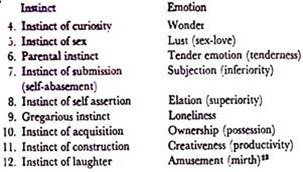
McDougall holds that emotions are functions of instincts. Primary emotions are conscious correlates of instincts. He says: “Each of the principal instincts conditions some one kind of emo­tional excitement whose quality is specific or peculiar to it”.

He gives the following pairs of instincts and emotions correlated to each other:
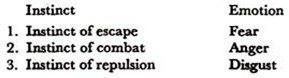
McDougall is right when he enunctates the principle that every emotive situation appeals to an instinctive tendency. But his list based on this principle is unscientific. For example, anger does not always arise from pugnacity; tender emotion may arise from other instincts than the parental.

McDougall mentions a number of instincts with less well-defined emotive reactions, e.g., the instinct of reproduction, the gregarious instinct, the instincts of acquisition and construction. Yet there are well-defined emotions of security, of self-expansion, of possession, etc., which have not been mentioned by McDougall.

His theory is very attractive, but it has not been worked out very satisfactorily. Some instincts (e.g., the instincts of walking, sitting, standing, running, etc.,) seem to have no specific emotions attached to them. Anger and fear resemble each other very closely as organic states, though they differ as impulses.

The really distinct emotions are much fewer than the instincts. So McDougall’s theory may be regarded as a working hypothesis. When we find an emotion, we find also a tendency to action that leads to some end-result.

But though emotion and instinct are closely connected with each other, we cannot hold that corresponding to every instinct there is an emotion and corresponding to every emotion there is an instinct. There are many instincts which are not accompanied by any specific emotions.

Further, the same emotion may include a variety of instinct in its system. The instinct of concealment and flight both operate in the emotion of fear. Again, the same expression may be connected with different emotions. Just as the same emotion may be organized in different sentiments, so the same instinct may be organized in different emotions.

The instinct of flight may operate in birds in fear as well as anger. Moreover, when the instinctive act evoked by a situation runs smoothly, the individual does not feel an emotion. But when the individual cannot effectively cope with the situation and his instinc­tive response is thwarted, he feels an emotion.

Therefore, an in­stinctive act is not always accompanied by an emotion. Hence McDougall’s theory may be regarded as a working hypothesis. It contains core of truth in it; it points out an intimate connection between instinct and emotion.

  1. Philips Bard’s Theory of Emotion

Cannon (1927), refuted the James-Lange theory of emotion by showing that experimental subjects experienced and reported emotions before all bodily sensations. Therefore, emotions were not preceded and constituted by bodily sensations.

Bard (1934) later removed the cortex and thalamus of some animals and left only the posterior part of the hypothalamus and found that they still showed rage. But when he removed the hypo­thalamus also, they failed to show the integrated rage pattern.

Thus he proved that the hypothalamus was necessary for the expression of rage. His experiments did not prove that either the thalamus or hypothalamus generated rage (or any other emotion) or did they prove that the cortex normally inhibited the thalamus.

Masserman showed that convincingly by some experiments. He stimulated the hypothalamus in some normal cats by means of bipolar electrodes and they showed the integrated rage pattern, e.g., hissing, spitting, and unsheathing of claws. But these expressions did not disturb their normal activity.

Both Bard and Masserman also obtained the flight reaction in fear in a similar way. Bard removed the cortex and thalamus in cats, who showed fight reaction in response to air-blast. Masserman stimulated the hypothalamus of intact cats and obtained flight reaction.

But fear pattern exhibited by them differed from that of normal animals. Instead of strenuous attempts at escape made by frightened animals, these cats had fits of aimless and hasty running.

  1. Emotion of the Ludicrous: Theory of Laughter

We should observe at the outset, that the ludicrous is not identical with the laughable. Laughter may arise from different sources. It may be excited by purely physical stimuli such as tickling. It is of the nature of a reflex action. Laughter may be excited by automatic imitation. You smile at a child and the child will smile at you. The people laugh in a crowd by automatic imitation.

They sometimes do not know the reason why they laugh. Laughter may arise from sympathetic reproduction .of the feelings of others. Emotions have a contagious effect. They spread from one person to another. When others faugh in exuberance of joy, we catch the contagion and laugh.

Laughter may arise from the consciousness of our own superiority over others. When we defeat our powerful adversary, we laugh in excess of elation. Laughter may be excited by the contemplation of the ludicrous.

Thus, the ludicrous is not identical with the laughable. Whatever is ludicrous is laughable, but whatever is laughable is not ludicrous. Laughter has many other causes hand ludicrous objects. The comic, emotion or the emotion of the ludicrous has the following characteristics.

It is an emotion of pure joy or elation unmixed with pain. It has a social significance. It is excited by incongruity in a situation, which is determined by a social standard of propriety or impropriety. It is a disinterested emotion devoid of a utilitarian motive.

Laughter is peculiar to the human species. Man is the only animal that laughs. He does not learn to laugh. He is provided by Nature with the complex mechanism of laughter. The impulse to laugh is instinctive.

Types of Emotions

McDougall classifies emotions into three types:

  • Primary emotions
  • Secondary or blended emotions
  • Derived emotions
  1. Primary emotions

Primary emotions are the elementary effective correlates of instincts. Fear, anger, disgust, tender emotion, distress, lust or sex-love, curiosity, amusement, etc., which arise from the instincts of escape, combat, repulsion, parental instinct, appeal, sex, curiosity, laughter, etc., are primary emotions. They do not presuppose other emotions.

  1. Secondary or blended emotions

Secondary or blended emotions are the combinations of two or more primary emotions. When two or more cooperating or conflic­ting instinctive impulses are evoked by a complex situation, a secondary or blended emotion is aroused.

It may not be a blend or coalescence of two or more primary emotions. It may arise from a complex situation which excites two or more cooperating or con­flicting instinctive tendencies which generally arouse two or more primary emotions.

It is the immediate response to a complex situation. McDougall avers that his treatment of the secondary emotions is not guilty of the errors of J.S. Mill’s “mental chemistry”. When a child approaches a snake and recedes from it out of fear and curiosity, he feels a blended emotion. Scorn is a blend of anger and disgust. Or, it is a blend of anger, disgust and positive self-feeling or elation.

It is a binary compound or a tertiary compound. Admiration is a compound of wonder and negative self-feeling or self-abasement. Awe is a compound of wonder, self-abasement and fear. Pity is a compound of tender emotion and sympathy pain or distress.

Reproach is a compound of tender feeling and anger. Hate is a blend of anger, fear and disgust. Jealousy, shame, revenge, gratitude, reverence etc., are blended emotions.

  1. Derived emotions

Derived emotions are the complex feelings, which are neither primary emotions nor blended motions but which are related to desires. They do not arise from the instinctive impulses. Confidence, hope, anxiety, despondency, despairs, regret, remorse, sorrow, etc., are derivative emotions.

Confidence, hope, anxiety, despondency and despair are the prospective emotions or desire. When a team of mountaineers start on a journey to reach a peak, they have confi­dence due to the anticipation of success. Their confidence arises from a strong desire for success.

When a member of the party falls seriously ill for a certain period, their confidence is reduced to hope. When they are hindered by a series of avalanches and landslides, their hope degenerates into anxiety. When farther on their journey they encounter freezing temperature, and shortage of food, and when some are crippled by frostbite, their anxiety is converted into des­pondency.

Later when their progress is thwarted by foul weather, heavy snowfall, and blizard, their despondency turns into despair. These derived emotions are called by Shand “the prospective emo­tions or desire” because they are related to desire that looks forward to the future.

Regret, remorse, and sorry are derived emotions which are called “the retrospective emotions of desire,” because they are related to desire which looks backward to the past. Regret arises from the frustration of a desire in the past, and is attended with pain.

Regret becomes remorse when the frustration of a desire in the past was due to one’s misjudgement or negligence of duty. It is attended with self-reproach. Sorrow is tender regret arising from the loss of a cherished object. It is a painful emotion of retrospective desire. Derived emotions may arise from prospective or retrospective aversion also.

Primary emotions are based on instincts excited by a situation. Derived emotions are not directly based on instincts, but they pre­suppose some desire or aversion which operates when a situation is apprehended. Primary emotions are comparatively simple and elementary, while derived emotions are complex and presuppose some mental development and operation of prospective or retros­pective desire or aversion.

Development of Emotions

Primary emotions are refined in three ways. First, they are refined by modifications of the motor response by which socially acceptable reactions are substituted for the primitive emotional expressions such as crying, kicking, scratching, biting, etc.

The emotional expressions of a cultured person are different from those of a child or a savage. Secondly, primary emotions are modified by new attachments on the side of the stimulus.

The primary emo­tion of fear is originally excited by the perception of a dangerous situation, e.g., the sight of a tiger at large. But later it is excited by the imagination or thought of a serious situation, e.g., the loss of a job, the imminent death of an earning member of a family, the fall of a Government, etc.

Thirdly, primary emotions are modified by a combination of one with another. Awe is a compound of wonder, fear and humility. Hate is a compound of anger, fear and disgust. Pity is a compound of grief and tenderness”.

The situations which excite specific emotions in older children and adults excite only general excitement in new born infants. Gradually distress, delight, fear, disgust, anger, affection and joy are differentiated from the general excitement in two years.

Maturation and learning both play important roles in the develop­ment of emotion. As the organism matures the infant exhibits such emotional responses as crying, weeping, smiling and laughing without earning them.

They appear almost at the same age in all children even when they are not allowed opportunities to imitate them from others. Facial expressions of deaf-blind children also confirm the influence of maturation in emotional development.

The stereotyped facial and gestural expressions which are peculiar to persons of a particular culture are learned from others. The clapping of hands is a sign of happiness in us, but of disappoint­ment in the Chinese. The raising of the eyebrows and the opening of the eyes widely are expression of surprise in us, but the sticking out of tongues, in them. These peculiar expressions show the in­fluence of learning and culture.

Emotions and their expressions are due to conditioning. A child of nine months exhibited fear reactions to a loud noise. When a rat was placed before him, he had no fear response. But when a rat was placed before him subsequently a number of times when a loud noise was produced on each occasion, the child showed fear reaction. Later when only a rat was placed before him, he exhibited fear reaction.

Thus his fear was conditioned by a substitute stimulus. Sometimes emotions are learned by imitation. If the parent is afraid of particular objects (e.g., darkness, lightning, snakes, etc.), the children get afraid of them. Obviously, their emotion is influenced by imitation.

Degrees of Emotional Responsiveness

Normal persons differ in their general emotional responsiveness. There are calm persons who are generally not perturbed, by emo­tions. There are excitable persons who are deeply stirred by emo­tions. These are two extremes. There are many degrees of emo­tionality between these two extremes.

  1. Emotional Excess

Some persons have an excess of emo­tionally. They are susceptible to all emotions. Their emotions are easily excited by slight stimuli. Joy, fear, anger, sorrow, and other emotions are easily and frequently aroused. They are usually intense. Joy becomes ecstasy, fear becomes terror, anger becomes violent rage, and sorrow becomes’ intense grief. Emotions are felt in their intensity.

  1. Emotionally Instability

Generally the persons who have an excess of emotionality have also emotional instability. They often shift abruptly from joy to sorrow, from love to hate; from self-confidence to diffidence. This is called emotional instability. It is generally accompanied by emotional sensitivity and excess of response.

But excessive emotionality and emotional instability do not invariably go together. Sometimes emotional instability is found along with nervous and mental instability.

  1. Unemotional Nature

The extremely unemotional individual is not dead to all emotions. But his emotions are not easily aroused. They are by no means unemotional. Unemotional persons do not experience difficulties in adapting themselves to the social environ­ment. But over-emotional persons cannot easily adapt themselves to it.

In the emotional person the sympathetic nervous system is readily excited and brings about visceral changes. Excessive sensi­tivity of the sympathetic systems is the cause of excessive emotionality and emotional instability.

Thinking Skills

The term “thinking skills” refers to the specific mental and cognitive processes that a person draws upon to think effectively. Basically, thinking skills are what we use in our heads to problem-solve, reason, infer and hypothesize.

Thinking skills are the mental activities you use to process information, make connections, make decisions, and create new ideas. You use your thinking skills when you try to make sense of experiences, solve problems, make decisions, ask questions, make plans, or organize information.

Types of Thinking Skills

The 4 types of thinking skills are:

  1. Convergent Analytical Thinking

Convergent thinking is the process of coming up with the best answer to a question using our memory, resources around us, or logic.

This thinking skill does not require significant creativity or lateral thinking strategies. Instead, it uses very straightforward thought processes. A convergent thinker simply needs to apply already established procedures and memory recall to reach the ‘correct’ answer.

Convergent thinking is very commonly used for standardized and multiple choice tests. These sorts of tests simply assess our knowledge and ability to apply knowledge to simple and logical situations.

The key elements required to be a skilled convergent thinker are: speed, accuracy and logic.

  1. Divergent Thinking

Divergent thinking is the exact opposite of convergent thinking. It involves coming up to solutions, paths forward or new ideas when there is no single correct answer. Questions like “should I study to become a doctor or a lawyer?” may not have a simple answer. You might be good at both, and both options might bring you happiness and a good life. So, which option should you choose?

To come up with solutions to questions without clear answers, you need to break down the possibilities and analyze each part. You might create a pros and cons list, a venn diagram or a table to lay out your options and consider each one in turn.

We often encourage divergent thinking from a very young age. For example, we encourage children to play or simply ‘be playful’ in order to discover how their world is complex and full of possibility.

  1. Critical Thinking

Critical thinking involves analyzing something in order to form a judgement about it. A critical thinker does not take the assumptions of a topic for granted. Instead, the thinkers ‘critiques’ what they are viewing using their available intellectual knowledge.

Critical thinkers can use three processes to develop critical insights on a topic: deduction, induction and abduction.

Deduction is the process of drawing conclusions based on the facts at hand. You have all the facts available to you to come to a clear and unambiguous conclusion about a topic. For example, a doctor does blood tests to determine if someone has a virus. The blood tests come back positive, so we can deduce that you definitely have that virus.

Induction is the process of drawing conclusions based on a generalization. You don’t have all the exact information at hand. However, you are aware of patterns, clues and a methodology that can help you induce the answer For example, you come to the doctor exhibiting a fever, sneezing and coughing. The doctor doesn’t do tests, but they induce that you probably have influenza because your symptoms are characteristic of someone with the flu.

Abduction involves coming to a conclusion that is the most likely or logical based on the small amount of knowledge that you have. You can’t be sure of the answer, but you can guess. For example, you may see that a cat is on the roof. The most logical answer is that the cat got up there by climbing a nearby tree and jumping from it to the roof, but you can’t be sure.

  1. Creative Thinking

Creative thinking involves thinking about a topic in unusual, unconventional and alternative ways to generate new ideas about an established topic. A creative thinker will try to address an issue from a perspective that hasn’t been used before.

While creative thinking may appear illogical, it is in fact a great driver of human development. Creative thinkers identify gaps in marketplaces or new, easier, faster and better ways of doing things. When a creative thinker comes up with a great new way of approaching an issue, their new method can become the new orthodoxy.

How to Improve your Thinking Skills?

To improve your thinking skills, you need to go beyond just maintaining your mind. You cannot just keep doing the same thing day-in, day-out and expect to get better.

Instead, you need to exercise new parts of your brain by studying regularly and keep creating new neural pathways in your mind. This emphasizes the importance of education.

You always need to be thinking about things that are new and difficult for you to understand.

The things that you learn need to be difficult. It’s through the difficulty and discomfort in thinking that you are improving your thinking. It’s just like going to the gym: no pain, no gain.

Some ways to improve your thinking include:

  • Taking college courses (or one of these alternatives) in topics that you find very difficult
  • Taking classes in an online school
  • Learning using new learning strategies that make you uncomfortable
  • Taking up new and diverse hobbies

The more you think, the better you will get at thinking. You’ll become faster, more creative and overall better at thinking if you practice and try out new strategies.

Tools to Help you Think Better

There are also some tools that we call cognitive tools that help you with your thinking skills. These tools don’t do the thinking for you, but they help you with your thinking.

Thinking tools can help you think better by:

  • Helping you structure your thoughts
  • Giving you a blueprint or scaffold for finding new angles to approach a topic
  • Providing prompts to move your thinking forward

Some tools that can help you think better include:

  1. A Brainstorming Mind Map

A brainstorming mind map can be made with a simple piece of paper. Simply write the topic at the top of the piece of paper and scrawl any and all key things you can think about down onto the paper.

During the brainstorming process, no ideas are bad ideas. You can critique and dismiss some of your ideas later on; but the brainstorming session can help get your mind moving.

  1. A Radar Chart

A radar (or spider) chart is very similar to a brainstorming mind map, but it also shows the links between concepts.

To create a spider chart, write the topic you’re thinking about in the middle of the piece of paper.

When you come up with a new idea, write it near the middle of the paper and draw a line from the topic in the center to the idea. If you come up with new ideas or sub-ideas based on that first key idea, you can write them down and draw a line from one idea to the other. Whenever you come up with related ideas, you should draw a line between them to show their relationship.

  1. A Process Chart

A process chart shows the sequence of steps from a question to its logical answer. Often in science and mathematics classes, you need to provide your process chart to your teacher to show how you came to your conclusions. You may hear your teacher tell you to “show your thinking”!

  1. A Spreadsheet

Even a simple spreadsheet using Excel or Google Sheets can help with your thinking. It will help you lay out ideas into an easy-to-read table to help you keep track of your thoughts, your processes and your different categories. Categorizing ideas into columns and rows can help you to identify new patterns in data.

  1. A Pros and Cons List

A simple pros and cons list can help you to get your ideas out of your brain and onto paper. Once it’s on paper, you can go through the list systematically and compare the pros and cons directly with one another. Once you’ve done this, you may have a better idea of what conclusions to come to.

  1. De Bono’s Six Thinking Hats

Another strategy for helping your thinking is to use De Bono’s Six Thinking Hats. These are six metaphorical ‘hats’ that you can put on. Each hat represents a different way to look at a topic. When you ‘put the hat on’, you have to think from the perspective of the hat.

The six hats are:

  • Red Hat: Think about your feelings, emotions and hunches about a topic
  • White Hat: Think about the information that’s available to you and what it can reveal about the topic
  • Yellow Hat: Think about the benefits and value in the situation you’re thinking about.
  • Black Hat: Think about the risks, difficulties and challenges that a situation you’re thinking about may cause.
  • Green Hat: Think about the alternatives and creative approaches you can apply to a topic.
  • Blue Hat: Think about the processes you can use and how to manage the situation logically.

Thinking Styles

“Thinking is more interesting than knowing, but less interesting than looking” :Johann Wolfgang von Goethe

You improve your communication with others when you can match their thinking style.

You can also avoid rubbing your boss the wrong way by paying close attention to how they approach the tasks of the day.

In Coping with Difficult Bosses, Robert Bramson identifies five thinking styles to categorize our modes of thinking and problem solving we use most frequently.

Five Thinking Styles

According to Bramson, the five thinking styles are:

  1. Synthesists

According to Bramson, “Synthesists are creative thinkers who perceives the world in terms of opposites.  When you say black, they think white, when you say long, they think short.”

To connect with Synthesists, Bramson suggests “listen appreciatively to their speculation and don’t confuse their arguing nature with resistance.”

  1. Idealists

According to Bramson, “Idealists believe in lofty goals and standards.”

To connect with Idealists, Bramson suggests “associate what you want to do with these goals of quality, service, and community good.”

  1. Pragmatic Thinkers

According to Bramson, “Pragmatic thinkers are flexible, resourceful folk who look for immediate payoff rather than for a grand plan that will change the world.”

To connect with Pragmatists, Bramson suggests “emphasize short-term objectives on which you can get started with resources at hand.”

  1. Analyst Thinkers

 According to Bramsom, “Analyst thinkers equate accuracy, thoroughness, and attention to detail with completeness.  They are likely to gather data, measure it, categorize it, and rationally and methodically calculate the right answer to any problem you come up with.

To connect to Analysts, Bramson suggests “provide a logical plan replete with back-up data and specifications.”

  1. Realist Thinkers

According to Bramson, “Realist thinkers are fast moving doers who know that reality is what their senses sight, sound, taste, smell, and touch tell them it is, and not that dry stuff that one finds in accounting ledgers, or the insipid pages of manual of operations.”

To connect with Realists, Bramson suggests focus on the challenge and your solution.

“If you communicate with Realist bosses as if they were Analysts, you will never get their attention. Rather than gobs of computer-printouts and other detailed information, Realists want a three-paragraph ‘Executive Summary’ which tells briefly what is wrong and how you propose to fix it. For rather complicated reasons, they will often take you at your word if they see you as a qualified expert. You become an expert in their eyes when they know that you’ve assembled a store of facts in which they are interested, and you have proposed a set of actions that they already believe are the best things to do.”

How to Use the Five Thinking Styles?

Take the time to place your boss or who you need to interact with into one or two of the five thinking-style categories. Keep in mind that while one or two styles predominates for most people, about fifteen percent use all five styles equally. Those who do, are seldom difficult bosses. Once you’ve identified their preferred categories, figure out how you can change your approach to better suit their style.

Here are my key take aways:

  • Seek first to understand, then to be understood. The more you understand somebody, the better you can adapt your style. I think the five thinking styles are a helpful framework in addition to understanding somebody’s learning style ( auditory, visual, or kinesthtic), their NLP meta-programs, their motivation (towards pleasure or away from pain), their values, their “rules”, their extraversion and introversion tendencies, their passive or aggressive tendencies, whether they are more “task-centered” or “people-centered”, their decision making style (consult-and-decide or build consensus), and their management styles (Autocratic, Paternalistic, Democratic, and Laissez-faire.)
  • Establish rapport. I think the heart of identifying the five thinking-styles revolves around establishing rapport. Rapport is the key to communication, influence, and trust.
  • Know the anti-patterns. It’s probably more important to know how to avoid rubbing somebody the wrong way, than getting the preferred or ideal communication style exactly right.
  • Wear different hats. I think you can use the Six-Thinking Hats concept to switch your hat based on who you are working with. Each hat you put on or take off can represent a different thinking style

A little insight can go a long way when it comes to connecting with people.

If you can bridge the gap between their thinking style and yours, you’ll have more rapport and get better results.

Thinking Hat

Six Thinking Hats was created by Edward de Bono, and published in his 1985 book of the same name.

It forces you to move outside your habitual thinking style, and to look at things from a number of different perspectives. This allows you to get a more rounded view of your situation.

You can often reach a successful solution or outcome from a rational, positive viewpoint, but it can also pay to consider a problem from other angles. For example, you can look at it from an emotional, intuitive, creative or risk management viewpoint. Not considering these perspectives could lead you to underestimate people’s resistance to your plans, fail to make creative leaps, or ignore the need for essential contingency plans.

You can use Six Thinking Hats in meetings or on your own. In meetings, it has the benefit of preventing any confrontation that may happen when people with different thinking styles discuss a problem, because every perspective is valid.

Each “Thinking Hat” is a different style of thinking. These are explained below:

  1. White Hat

With this thinking hat, you focus on the available data. Look at the information that you have, analyze past trends, and see what you can learn from it. Look for gaps in your knowledge, and try to either fill them or take account of them.

  1. Red Hat

“Wearing” the Red Hat, you look at problems using your intuition, gut reaction, and emotion. Also, think how others could react emotionally. Try to understand the responses of people who do not fully know your reasoning.

  1. Black Hat

Using Black Hat thinking, look at a decision’s potentially negative outcomes. Look at it cautiously and defensively. Try to see why it might not work. This is important because it highlights the weak points in a plan. It allows you to eliminate them, alter them, or prepare contingency plans to counter them.

Black Hat thinking helps to make your plans “tougher” and more resilient. It can also help you to spot fatal flaws and risks before you embark on a course of action. It’s one of the real benefits of this model, as many successful people get so used to thinking positively that they often cannot see problems in advance. This leaves them under-prepared for difficulties.

  1. Yellow Hat

This hat helps you to think positively. It is the optimistic viewpoint that helps you to see all the benefits of the decision and the value in it. Yellow Hat thinking helps you to keep going when everything looks gloomy and difficult.

  1. Green Hat

The Green Hat represents creativity. This is where you develop creative solutions to a problem. It is a freewheeling way of thinking, in which there is little criticism of ideas. (You can explore a range of creativity tools to help you.)

  1. Blue Hat

This hat represents process control. It’s the hat worn by people chairing meetings, for example. When facing difficulties because ideas are running dry, they may direct activity into Green Hat thinking. When contingency plans are needed, they will ask for Black Hat thinking.

A variant of this technique is to look at problems from the point of view of different professionals (for example, doctors, architects or sales directors) or different customers.

An Example of Six Hat Thinking

The directors of a property company are considering whether they should build a new office block. The economy is doing well, and the vacant office spaces in their city are being snapped up. As part of their decision-making process, they adopt the Six Thinking Hats technique.

Wearing the White Hat, they analyze the data that they have. They can see that the amount of available office space in their city is dwindling, and they calculate that, by the time a new office block would be completed, existing space will be in extremely short supply. They also note that the economic outlook is good, and steady growth is predicted to continue.

Thinking with a Red Hat, some of the directors say that the proposed building looks ugly and gloomy. They worry that people would find it an oppressive or uninspiring place to work.

When they think with the Black Hat, they wonder whether the economic forecast could be wrong. The economy may be about to experience a downturn, in which case the building could sit empty or only partially occupied for a long time. If the building is unattractive, then companies will choose to work in other, more attractive premises.

Wearing the positive Yellow Hat, however, the directors know that, if the economy holds up and their projections are correct, the company stands to make a healthy profit. If they are lucky, maybe they could sell the building before the next downturn, or rent to tenants on long-term leases that will last through any recession.

With Green Hat thinking, they consider whether they should redesign the building to make it more appealing. Perhaps they could build prestige offices that people would want to rent in any economic climate. Alternatively, maybe they should invest the money in the short term, then buy up property at a lower cost when the next downturn happens.

The chairman of the meeting wears the Blue Hat to keep the discussion moving and ideas flowing, encouraging the other directors to switch their thinking between the different perspectives.

Having examined their options from numerous viewpoints, the directors have a much more detailed picture of possible outcomes, and can make their decision accordingly.

Managerial Skills and Development

Managerial skills are the knowledge and ability of the individuals in a managerial position to fulfill some specific management activities or tasks. This knowledge and ability can be learned and practiced. However, they also can be acquired through practical implementation of required activities and tasks. Therefore, you can develop each skill through learning and practical experience as a manager.

There are many definitions of skills that talk about talent. Talent is something personal related to an individual and shows a natural gift from nature about something inside that talented person. All persons cannot be artists. Usually, artists are born with the gift of art, but despite their talent, they continue to develop their talent to improve their art skills.

When we talk about managerial skills, we talk about the skills of a manager to maintain high efficiency in the way how his or her employees complete their everyday working tasks. Because of that, managers will need skills that will help them to manage people and technology to ensure an effective and efficient realization of their working duties.

Three Types of Managerial Skills

Robert Katz identifies three types of skills that are essential for a successful management process:

  • Technical skills
  • Conceptual skills
  • Human or interpersonal management skills
  1. Technical Skills

As the name of these skills tells us, they give the manager’s knowledge and ability to use different techniques to achieve what they want to achieve. Technical skills are not related only for machines, production tools or other equipment, but also they are skills that will be required to increase sales, design different types of products and services, market the products and services, etc.

For example, let’s take an individual who works in the sales department and has highly developed sales skills achieved through education and experience in his department or the same departments in different organizations. Because of these skills that he possesses, this person can be a perfect solution to become a sales manager. This is the best solution because he has excellent technical skills related to the sales department.

On the other hand, the person who becomes sales manager will start to build his next type of required skills. It is because if his task until now was only to work with the customers as a sales representative, now he will need to work with employees in the sales department in addition to the work with customers.

Technical skills are most important for first-level managers. Whet it comes to the top managers, these skills are not something with high significance level. As we go through a hierarchy from the bottom to higher levels, the technical skills lose their importance.

  1. Conceptual Skills

Conceptual skills present knowledge or ability of a manager for more abstract thinking. That means he can easily see the whole through analysis and diagnosis of different states. In such a way they can predict the future of the business or department as a whole.

Why managers need these skills?

As a first, a company includes more business elements or functions as selling, marketing, finance, production, etc. All these business elements have different goals even completely opposed goals. Think about marketing and production as a business function and their specific goals. You’ll see the essential difference. The conceptual skills will help managers to look outside their department’s goals. So, they will make decisions that will satisfy overall business goals.

Conceptual skills are vital for top managers, less critical for mid-level managers, and not required for first-level managers. As we go from the bottom of the managerial hierarchy to the top, the importance of these skills will rise.

  1. Human or Interpersonal Managerial Skills

Human or interpersonal management skills present a manager’s knowledge and ability to work with people. One of the most critical management tasks is to work with people. Without people, there will not be a need for the existence of management and managers.

These skills will enable managers to become leaders and motivate employees for better accomplishments. Also, they will help them to make more effective use of human potential in the company. Simply, they are the essential skills for managers.

Interpersonal management skills are essential for all hierarchical levels in the company.

Learning, Characteristics, Nature, Types

Learning is the process of acquiring new knowledge, skills, behaviors, or attitudes through experience, instruction, or observation. It involves encoding information, consolidating it into memory, and using it to guide future behavior or thinking. Learning can occur through various mechanisms, including classical conditioning, operant conditioning, and observational learning. It is a fundamental aspect of human cognition and behavior, enabling individuals to adapt to their environment, solve problems, and achieve goals. Learning can be intentional or incidental, formal or informal, and it occurs throughout the lifespan, from infancy to old age. By learning from past experiences and acquiring new insights, individuals can enhance their understanding of the world, develop competencies, and facilitate personal growth and development.

Definition:

  1. John Dewey:

Education is not preparation for life; education is life itself.

  1. F. Skinner:

Learning is the change in behavior as a result of experience.

  1. Jean Piaget:

Learning is a transformative process, involving the adaptation of existing mental structures to accommodate new experiences.

  1. Lev Vygotsky:

Learning is a social process, with individuals acquiring knowledge and skills through interaction with others and cultural artifacts.

  1. Albert Bandura:

Learning is the acquisition of new behavior through observational learning and social modeling.

  1. National Research Council:

Learning involves the active construction of knowledge and understanding through inquiry, exploration, and problem-solving.

  1. American Psychological Association (APA):

Learning is the process of acquiring new knowledge, skills, or behaviors, either consciously or unconsciously, through experience, instruction, or observation, resulting in a relatively permanent change in behavior or mental processes.

  1. Merriam-Webster Dictionary:

Learning is the act or experience of one that learns.

Characteristics of Learning:

  • Active Engagement:

Learning involves active engagement on the part of the learner, who actively processes, manipulates, and interacts with the learning material or environment. Active engagement encourages deeper processing and understanding of the information, leading to more effective learning outcomes. Activities such as problem-solving, experimentation, and discussion promote active engagement and enhance learning effectiveness.

  • Relevance:

Learning is most effective when the content and activities are relevant and meaningful to the learner’s goals, interests, and experiences. When learners perceive the material as personally relevant or applicable to their lives, they are more motivated to engage with it and are more likely to retain the information. Making connections between new information and existing knowledge or real-world experiences enhances relevance and promotes deeper learning.

  • Feedback:

Feedback is an essential component of learning, providing learners with information about their performance, progress, and understanding. Effective feedback helps learners identify areas of strength and areas needing improvement, guiding their learning process and promoting skill development. Feedback can come from various sources, including teachers, peers, and self-assessment, and should be timely, specific, and actionable to be most beneficial.

  • Individual Differences:

Learning is influenced by individual differences in cognitive, emotional, and motivational factors. Learners vary in their cognitive abilities, learning styles, preferences, and prior knowledge, which can affect how they process and respond to learning experiences. Recognizing and accommodating individual differences, such as providing personalized instruction or offering multiple learning modalities, can enhance learning outcomes and promote inclusivity.

  • Constructivism:

Learning is often viewed through a constructivist lens, which emphasizes the active construction of knowledge and understanding by the learner. According to constructivist theory, learners actively engage in sense-making, interpretation, and reflection, constructing mental representations of concepts and ideas based on their experiences and interactions with the environment. Constructivist approaches to learning emphasize inquiry-based learning, problem-solving, and collaborative activities that encourage learners to construct their own knowledge.

  • Transfer:

Learning involves the transfer of knowledge, skills, or behaviors from one context to another, enabling learners to apply what they have learned in new and unfamiliar situations. Transferability is a key indicator of learning effectiveness, reflecting the extent to which learners can generalize and adapt their knowledge and skills to different contexts. Promoting transfer requires providing opportunities for learners to practice and apply their learning in diverse contexts, fostering flexibility and adaptability.

  • Metacognition:

Learning is enhanced by metacognitive processes, which involve awareness and regulation of one’s own thinking and learning strategies. Metacognitive skills enable learners to monitor their understanding, evaluate their progress, and adjust their learning strategies as needed. Encouraging metacognitive reflection, self-assessment, and goal-setting can empower learners to take ownership of their learning and become more effective and autonomous learners.

  • Social Interaction:

Learning is often situated within social contexts and influenced by social interactions with peers, teachers, and other members of the learning community. Social interaction provides opportunities for collaboration, communication, and shared meaning-making, enriching the learning experience and promoting cognitive and socio-emotional development. Collaborative learning activities, such as group discussions, cooperative projects, and peer feedback, foster social interaction and promote collective learning outcomes.

Nature of Learning:

  • Active Process:

Learning is an active process that involves the learner’s active engagement and participation in acquiring new information or skills. Rather than passively receiving knowledge, learners actively construct meaning, make connections, and apply what they have learned through exploration, experimentation, and problem-solving activities.

  • Constructive Process:

Learning is a constructive process whereby individuals actively construct mental representations of concepts and ideas based on their experiences and interactions with the environment. Through cognitive processes such as assimilation, accommodation, and schema development, learners organize and integrate new information into their existing knowledge structures, leading to deeper understanding and learning.

  • Social Process:

Learning is also a social process that occurs within social contexts and is influenced by interactions with others. Social interactions provide opportunities for collaboration, communication, and shared meaning-making, facilitating the exchange of ideas, perspectives, and knowledge. Peer learning, collaborative projects, and group discussions promote social interaction and enhance learning outcomes by fostering cooperation, collective problem-solving, and socio-emotional development.

  • Contextual Process:

Learning is situated within specific contexts that shape the nature and outcomes of learning experiences. Contextual factors, such as cultural norms, socio-economic background, and environmental conditions, influence how learning occurs and the meaning attributed to learning outcomes. Learning is contextualized within real-world settings, providing opportunities for authentic learning experiences and application of knowledge in relevant contexts.

  • Reflective Process:

Learning involves reflective processes whereby individuals monitor, evaluate, and regulate their own learning strategies and behaviors. Metacognitive skills enable learners to become aware of their learning processes, set goals, assess their progress, and adapt their strategies as needed. Metacognitive reflection promotes self-directed learning and empowers learners to take ownership of their learning journey.

  • Dynamic Process:

Learning is a dynamic and ongoing process that unfolds over time, with individuals continually acquiring, refining, and applying new knowledge and skills throughout their lives. Learning is not limited to specific timeframes or settings but occurs continuously through formal education, informal experiences, and lifelong learning pursuits. The dynamic nature of learning allows for adaptation, growth, and development in response to changing personal, social, and environmental demands.

  • Individualized Process:

Learning is an individualized process influenced by individual differences in cognitive abilities, learning styles, interests, and motivations. Each learner brings unique strengths, preferences, and prior knowledge to the learning process, shaping how they engage with learning activities and construct meaning from experiences. Personalized learning approaches that cater to individual needs, preferences, and goals enhance learning effectiveness and promote learner autonomy and engagement.

  • Cumulative Process:

Learning is a cumulative process whereby new knowledge, skills, or behaviors build upon existing foundations, forming interconnected networks of understanding and competence. Learning is scaffolded, with initial learning experiences laying the groundwork for more complex and advanced learning outcomes. Cumulative learning allows for the development of expertise and mastery over time, as individuals progress from novice to expert levels of proficiency in specific domains.

Types of Learners:

  • Visual Learners

Visual learners prefer to learn through images, charts, diagrams, and other visual aids. They retain information better when presented with graphical elements, such as infographics or mind maps. These learners benefit from color-coded notes, videos, and presentations. In the workplace or classroom, visual learners excel when concepts are explained using pictures, flowcharts, or graphs. Encouraging them to draw or outline ideas enhances their understanding. Since they rely heavily on sight, it’s crucial to minimize distractions and provide visually engaging material.

  • Auditory Learners

Auditory learners grasp information more effectively through listening. They prefer lectures, discussions, podcasts, and verbal instructions. These individuals benefit from reading aloud, group discussions, and audio recordings. Auditory learners often excel in environments where they can verbally articulate their thoughts and ideas. Providing opportunities for them to participate in interactive learning sessions or presentations enhances their retention. Encouraging note-taking during verbal explanations further improves understanding. These learners may struggle with silent reading or purely visual content without accompanying audio.

  • Kinesthetic Learners

Kinesthetic learners prefer a hands-on approach to learning. They understand concepts better through physical activity, experimentation, and real-world application. These learners benefit from role-playing, interactive workshops, and physical demonstrations. Kinesthetic learners often excel in environments that allow them to move, build, or manipulate objects while learning. Encouraging active participation through projects and experiments enhances their learning experience. Since they learn by doing, theoretical or lecture-based methods may not be as effective unless accompanied by practical activities.

  • Reading/Writing Learners

Reading/writing learners prefer to absorb information through written words. They excel when they can read texts, take detailed notes, and write essays or reports. These learners benefit from textbooks, articles, and written instructions. Encouraging them to summarize material in their own words helps reinforce learning. Reading/writing learners often prefer structured environments with clear written documentation. They may struggle with purely auditory or visual content unless they can supplement it with written material. Providing ample reading resources and opportunities for written reflection enhances their comprehension.

Theories of Learning

Learning is the process of acquiring new knowledge, skills, or behaviors through experiences, instruction, or observation. It involves the encoding, processing, and retention of information, leading to changes in behavior or understanding.

Theories of learning is crucial for comprehending the diverse ways in which individuals acquire new knowledge, skills, and behaviors.

Behaviorism:

Behaviorism, pioneered by psychologists such as Ivan Pavlov, John B. Watson, and B.F. Skinner, posits that learning is the result of observable changes in behavior due to experiences with the environment. Central to behaviorism is the concept of conditioning, which involves the association between stimuli and responses.

  • Classical Conditioning:

In classical conditioning, a neutral stimulus becomes associated with a meaningful stimulus, eliciting a response similar to the original stimulus. Pavlov’s famous experiments with dogs demonstrated this process, where the ringing of a bell (neutral stimulus) became associated with food (meaningful stimulus), leading to the dogs salivating (response) upon hearing the bell alone.

  • Operant Conditioning:

Operant conditioning, proposed by B.F. Skinner, emphasizes the role of reinforcement and punishment in shaping behavior. Behaviors that are reinforced (rewarded) are more likely to be repeated, while behaviors that are punished are less likely to occur in the future. Skinner’s Skinner Box experiments demonstrated how animals learn to perform specific behaviors (such as pressing a lever) in response to reinforcement (such as food or water).

Cognitive Theory:

Cognitive theories of learning, influenced by the work of Jean Piaget and Lev Vygotsky, focus on internal mental processes and the role of cognitive structures in learning and development. These theories emphasize the active construction of knowledge by the learner and the importance of cognitive processes such as perception, memory, and problem-solving.

  • Piaget’s Constructivism:

Piaget proposed a constructivist theory of learning, suggesting that children actively construct their understanding of the world through interactions with the environment. He identified four stages of cognitive development (sensorimotor, preoperational, concrete operational, and formal operational), each characterized by distinct ways of thinking and understanding. Piaget emphasized the role of assimilation (interpreting new information in terms of existing schemas) and accommodation (adapting existing schemas to incorporate new information) in cognitive development.

  • Vygotsky’s Sociocultural Theory:

Vygotsky’s sociocultural theory emphasizes the role of social interactions and cultural contexts in cognitive development and learning. According to Vygotsky, learning occurs through social interactions with more knowledgeable others (such as parents, teachers, or peers) who provide guidance, support, and scaffolding to facilitate learning. The zone of proximal development (ZPD) represents the difference between what a learner can do independently and what they can achieve with assistance, highlighting the importance of collaborative learning and guided participation in cognitive development.

Social Learning Theory:

Social learning theory, proposed by Albert Bandura, expands on behaviorism by emphasizing the role of observational learning and social modeling in learning and behavior. According to social learning theory, individuals learn by observing and imitating the behaviors of others, particularly models who are perceived as competent, attractive, or similar to themselves.

  • Observational Learning:

Bandura’s Bobo doll experiments demonstrated that children learn aggressive behaviors by observing adults’ aggressive actions towards a Bobo doll. Observational learning involves four key processes: attention (noticing the model’s behavior), retention (remembering the observed behavior), reproduction (imitating the behavior), and motivation (being reinforced or punished for the behavior).

  • Vicarious Reinforcement and Punishment:

Social learning theory also emphasizes the role of vicarious reinforcement (observing others being rewarded) and vicarious punishment (observing others being punished) in shaping behavior. Individuals are more likely to imitate behaviors that result in positive outcomes for others and less likely to imitate behaviors that lead to negative consequences.

Constructivism:

Constructivism, as a learning theory, emphasizes the active construction of knowledge by learners through meaningful interactions with the environment. Rather than passively receiving information, learners actively engage in sense-making, inquiry, and problem-solving activities to construct their understanding of concepts and phenomena.

  • Social Constructivism:

Social constructivism, influenced by the work of Vygotsky, emphasizes the role of social interactions and collaborative learning environments in knowledge construction. Learning is viewed as a social process that occurs through dialogue, negotiation, and shared meaning-making within communities of learners. Collaborative learning activities, such as group discussions, problem-solving tasks, and cooperative projects, promote social interaction and facilitate the construction of knowledge.

Connectivism:

Connectivism is a learning theory that emerged in the digital age, emphasizing the role of technology and networked learning environments in knowledge acquisition and dissemination. According to connectivism, learning is distributed across networks of people, resources, and technologies, and knowledge is continuously evolving in response to changing information landscapes.

  • Networked Learning:

Connectivism views learning as a process of network formation, whereby learners connect with diverse sources of information, expertise, and perspectives to construct knowledge. Digital technologies such as the internet, social media, and online communities enable learners to access, share, and contribute to information networks, fostering collaborative learning and knowledge creation.

  • Principles of Connectivism:

Connectivism is guided by several key principles, including autonomy (learners control their learning process), diversity (engaging with diverse perspectives and resources), openness (sharing and contributing to knowledge networks), and connectedness (forming meaningful connections with others). These principles reflect the interconnected and dynamic nature of learning in the digital age.

Experiential Learning:

Experiential learning theories, such as those proposed by David Kolb and Carl Rogers, emphasize the role of direct experience and reflection in learning. Experiential learning involves active engagement in real-world experiences, followed by reflection and conceptualization of the experience to derive meaning and insight.

  • Kolb’s Experiential Learning Cycle:

Kolb proposed a four-stage experiential learning cycle, consisting of concrete experience (engaging in a real-world experience), reflective observation (reflecting on the experience from different perspectives), abstract conceptualization (making sense of the experience and forming generalizations), and active experimentation (testing new ideas or behaviors in future experiences). This cyclical process promotes continuous learning and skill development.

Humanistic Theory:

Humanistic theories of learning, influenced by the work of Carl Rogers and Abraham Maslow, emphasize the role of personal growth, self-actualization, and intrinsic motivation in learning. Humanistic approaches to learning prioritize learners’ autonomy, self-direction, and holistic development.

  • Self-Directed Learning:

Humanistic theories emphasize the importance of self-directed learning, where individuals take ownership of their learning process and pursue knowledge and skills based on their interests, goals, and values. Self-directed learners are motivated by intrinsic factors such as curiosity, autonomy, and personal fulfillment, rather than external rewards or incentives.

  • Experiential Learning:

Humanistic approaches to learning often incorporate experiential learning methods, such as experiential workshops, group discussions, and reflective exercises, that promote self-awareness, personal growth, and interpersonal skills. Learning environments that are supportive, nonjudgmental, and learner-centered facilitate the development of self-actualization and holistic well-being.

Multiple Intelligences:

Multiple intelligences theory, proposed by Howard Gardner, challenges the traditional notion of intelligence as a single, unitary trait and instead identifies multiple forms of intelligence that individuals possess to varying degrees. According to Gardner, each person has unique combinations of intelligences that influence how they learn and engage with the world.

  • Types of Intelligences:

Gardner identified eight intelligences: linguistic intelligence (verbal-linguistic abilities), logical-mathematical intelligence (analytical and problem-solving skills), spatial intelligence (visual-spatial abilities), bodily-kinesthetic intelligence (physical coordination and movement), musical intelligence (musical aptitude and sensitivity), interpersonal intelligence (understanding others’ emotions and motivations), intrapersonal intelligence (self-awareness and self-regulation), and naturalistic intelligence (ability to recognize and classify patterns in nature). Recognizing and valuing diverse intelligences can inform instructional practices and accommodate learners’ individual strengths and preferences.

Intelligence Meaning and Types

One of the most important single variables, which affect schooling, is intelligence. Intelligence is the ability to acquire and apply knowledge. Success in school and colleges and in one’s own profession, social adjustment, possession of general information etc. are all associated with the concept of “intelligence”. The word intelligence is derived from the Latin verb ‘intellegere’ which means understanding.

According to Alfred Binet intelligence is the ability for judgement or common sense. Thorndike defines intelligence as “one’s capacity to deal effectively with situations”. For Jean Piaget, ‘intelligence is the ability to adapt to one’s surroundings’. In the words of Cyril Burt, “Intelligence is the capacity of flexible adjustment.”

According to David Wechsler (1977): ‘The global capacity to think rationally, act purposefully, and deal effectively with the environment.’

Intelligence is defined as mental capability that involves the ability to reason, to plan, to solve problems, to think abstractly, to comprehend complex ideas, to learn quickly and to learn from experience. It is not merely book learning, a narrow academic skill, or test-taking smartness.

In simple words, intelligence is nothing but thinking skills and the ability to adapt to and to learn from life’s everyday experiences.

Nature and Characteristics of Intelligence

Intelligence is not acquired after sustained labour. It is a gift from nature. Intelligence is not memory. An intelligent person may have poor memory. Intelligence is not a skill which a worker acquires after planned practice. Intelligence is not a guarantee of a good behaviour of the individual.

To understand the nature of intelligence we need to know the classification intelligence as given by E.L. Thorndike and Garret:

  1. Concrete Intelligence

It is the ability of an individual to comprehend actual situations and to react to them adequately. The concrete intelligence is evident from various activities of daily life. This type of intelligence is applicable when the individual is handling concrete objects or medicines. Engineers, mechanics and architects have this type of intelligence.

  1. Abstract Intelligence

It is the ability to respond to words, numbers and symbols. Abstract intelligence is required in the ordinary academic subjects in the school. This is acquired after an intensive study of books and literature. Good teachers, lawyers, doctors, philosophers etc. have this type of intelligence.

  1. Social Intelligence

It means the ability of an individual to react to social situations of daily life. Adequate adjustment in social situations is the index of social intelligence. Persons having this type of intelligence know the art of winning friends and influencing them. Leaders, ministers, members of diplomatic sources and social workers have it.

Thus we see the nature of intelligence as the ability for adjustment to environment, ability to perceive relationship between various objects and methods, ability to solve problems, ability to think independently, ability to learn maximum in minimum period of time, ability to benefit from one’s own experience and the experience of others.

Therefore, intelligence is an inborn ability of an individual, the distribution of intelligence is not equal among all human beings. There is wide individual difference that exists among individuals with regard to intelligence.

Characteristics of Intelligence

The main features of Intelligence are the following:

  • Intelligence is an innate natural endowment of the child.
  • It helps the child in maximum learning in minimum period of time.
  • The child is able to foresee the future and plan accordingly.
  • The child is able to take advantage of his previous experiences.
  • The child faces the future with compliance.
  • He develops a sense of discrimination between right or wrong.
  • The developmental period of intelligence is from birth to adolescence.
  • There is a minor difference in the development of intelligence between boys and girls.
  • There are individual differences with regard to the intelligence between boys and girls.
  • Intelligence is mostly determined by heredity but a suitable environment necessary to improve it.

Types of Intelligence

  1. Naturalist Intelligence

Naturalist intelligence designates the human ability to discriminate among living things (plants, animals) as well as sensitivity to other features of the natural world (clouds, rock configurations). This ability was clearly of value in our evolutionary past as hunters, gatherers, and farmers; it continues to be central in such roles as botanist or chef. It is also speculated that much of our consumer society exploits the naturalist intelligences, which can be mobilized in the discrimination among cars, sneakers, kinds of makeup, and the like.

  1. Musical Intelligence

Musical intelligence is the capacity to discern pitch, rhythm, timbre, and tone. This intelligence enables us to recognize, create, reproduce, and reflect on music, as demonstrated by composers, conductors, musicians, vocalist, and sensitive listeners. Interestingly, there is often an affective connection between music and the emotions; and mathematical and musical intelligences may share common thinking processes. Young adults with this kind of intelligence are usually singing or drumming to themselves. They are usually quite aware of sounds others may miss.

  1. Logical-Mathematical Intelligence

Logical-mathematical intelligence is the ability to calculate, quantify, consider propositions and hypotheses, and carry out complete mathematical operations. It enables us to perceive relationships and connections and to use abstract, symbolic thought; sequential reasoning skills; and inductive and deductive thinking patterns. Logical intelligence is usually well developed in mathematicians, scientists, and detectives. Young adults with lots of logical intelligence are interested in patterns, categories, and relationships. They are drawn to arithmetic problems, strategy games and experiments.

  1. Existential Intelligence

Sensitivity and capacity to tackle deep questions about human existence, such as the meaning of life, why we die, and how did we get here.

  1. Interpersonal Intelligence

Interpersonal intelligence is the ability to understand and interact effectively with others. It involves effective verbal and nonverbal communication, the ability to note distinctions among others, sensitivity to the moods and temperaments of others, and the ability to entertain multiple perspectives. Teachers, social workers, actors, and politicians all exhibit interpersonal intelligence. Young adults with this kind of intelligence are leaders among their peers, are good at communicating, and seem to understand others’ feelings and motives.

  1. Bodily-Kinesthetic Intelligence

Bodily kinesthetic intelligence is the capacity to manipulate objects and use a variety of physical skills. This intelligence also involves a sense of timing and the perfection of skills through mind–body union. Athletes, dancers, surgeons, and crafts people exhibit well-developed bodily kinesthetic intelligence.

  1. Linguistic Intelligence

Linguistic intelligence is the ability to think in words and to use language to express and appreciate complex meanings. Linguistic intelligence allows us to understand the order and meaning of words and to apply meta-linguistic skills to reflect on our use of language. Linguistic intelligence is the most widely shared human competence and is evident in poets, novelists, journalists, and effective public speakers. Young adults with this kind of intelligence enjoy writing, reading, telling stories or doing crossword puzzles.

  1. Intra-personal Intelligence

Intra-personal intelligence is the capacity to understand oneself and one’s thoughts and feelings, and to use such knowledge in planning and directioning one’s life. Intra-personal intelligence involves not only an appreciation of the self, but also of the human condition. It is evident in psychologist, spiritual leaders, and philosophers. These young adults may be shy. They are very aware of their own feelings and are self-motivated.

  1. Spatial Intelligence

Spatial intelligence is the ability to think in three dimensions. Core capacities include mental imagery, spatial reasoning, image manipulation, graphic and artistic skills, and an active imagination. Sailors, pilots, sculptors, painters, and architects all exhibit spatial intelligence. Young adults with this kind of intelligence may be fascinated with mazes or jigsaw puzzles, or spend free time drawing or daydreaming.

Perception Meaning and Features

“Perception is the process through which the information from outside environment is selected, received, organized and interpreted to make it meaningful to you. This input of meaningful information results in decisions and actions.”

A few definitions of perception as given by different authors are as explained below:

“Perception may be defined as a process by which individuals organize and interpret their sensory impressions in order to give meaning to their environment.”

According to Joseph Reitz, “Perception includes all those processes by which an individual receives information about his environment seeing, hearing, feeling, tasting and smelling. The study of these perpetual processes shows that their functioning is affected by three classes of variables—the objects or events being perceived, the environment in which perception occurs and the individual doing the perceiving.”

In simple words we can say that perception is the act of seeing what is there to be seen. But what is seen is influenced by the perceiver, the object and its environment. The meaning of perception emphasises all these three points.

Features of Perception

(i) Perception is very important in understanding the human behaviour, because every person perceives the world and approaches the life problems differently- Whatever we see or feel is not necessarily the same as it really is. It is because what we hear is not what is really said, but what we perceive as being said. When we buy something, it is not because it is the best, but because we take it to be the best. Thus, it is because of perception, we can find out why one individual finds a job satisfying while another one may not be satisfied with it.

(ii) If people behave on the basis of their perception, we can predict their behaviour in the changed circumstances by understanding their present perception of the environment. One person may be viewing the facts in one way which may be different from the facts as seen by another viewer.

(iii) With the help of perception, the needs of various people can be determined, because people’s perception is influenced by their needs. Like the mirrors at an amusement park, they distort the world in relation to their tensions.

(iv) Perception is very important for the manager who wants to avoid making errors when dealing with people and events in the work setting. This problem is made more complicated by the fact that different people perceive the same situation differently. In order to deal with the subordinates effectively, the managers must understand their perceptions properly.

Thus, for understanding the human behaviour, it is very important to understand their perception, that is, how they perceive the different situations. People’s behaviour is based on their perceptions of what reality is, not on reality itself. The world as it is perceived is the world that is important for understanding the human behaviour.

Factor Influencing Individual Perception

Perception is the process by which individuals interpret and make sense of sensory information from their environment. It involves selecting, organizing, and interpreting stimuli to form meaningful experiences. Perception is subjective, influenced by factors like past experiences, emotions, expectations, and cultural background. Each person’s unique perceptions shape their understanding and reactions to the world, affecting decisions, behaviors, and interactions. The concept highlights how people perceive reality differently, even when exposed to the same situation or information.

Factor Influencing Individual Perception

  • Past Experiences:

Past experiences shape perception by providing a framework for interpreting new information. Positive or negative encounters with certain situations, people, or events can influence how we perceive similar situations in the future. For instance, a person who has been repeatedly disappointed by a particular brand may perceive future interactions with that brand negatively.

  • Cultural Background:

Culture plays a crucial role in shaping perception by influencing values, norms, and behaviors. Cultural differences affect how individuals interpret social cues, customs, and communication styles, leading to diverse perceptions. For example, people from collectivist cultures may emphasize group harmony over individual achievement, influencing their perception of success.

  • Expectations:

Our expectations shape how we perceive situations. When we expect a particular outcome, we are more likely to interpret events in a way that confirms those expectations, a phenomenon known as the expectancy effect. For example, expecting a product to be of high quality may lead to a more favorable perception, even if it doesn’t meet objective standards.

  • Emotions:

Emotions strongly influence perception. A person in a good mood may perceive a neutral situation as more positive, while someone feeling anxious or angry may interpret the same situation negatively. For instance, someone feeling stressed may perceive a colleague’s neutral comment as a criticism, skewing their perception of the interaction.

  • Motivation:

Motivation drives the focus of perception. People tend to perceive objects or events that align with their personal goals and desires more clearly. For example, a hungry person may be more attuned to food-related cues in their environment, while someone focused on career success may notice job-related opportunities more easily.

  • Social Factors:

Social influences, such as the presence of others, group norms, and social roles, impact perception. People tend to conform to social expectations, which can alter how they perceive behaviors and situations. For example, peer pressure in a group may lead an individual to perceive a behavior as acceptable, even if they personally disagree.

  • Physical Factors:

Physical factors, such as lighting, temperature, and surroundings, can influence perception. A dimly lit room may make people feel more relaxed, while a brightly lit environment may make them more alert. Similarly, extreme heat or cold can influence mood and, in turn, perception, altering how we interpret interactions or events.

  • Perceptual Set:

Perceptual set is a mental predisposition to perceive something in a particular way based on previous experiences, expectations, or cultural influences. This cognitive bias can cause individuals to overlook information that contradicts their beliefs or to interpret ambiguous stimuli in ways that align with their preconceived notions.

  • Attitude:

A person’s attitude—whether positive, negative, or neutral—affects how they perceive people and situations. A positive attitude may lead to more favorable perceptions, while a negative attitude can result in biased or distorted views. For instance, someone with a positive attitude toward a colleague may perceive their actions more kindly than someone with a negative attitude.

  • Selective Perception:

Selective perception refers to the tendency to notice and interpret information that confirms one’s preexisting beliefs, while disregarding information that contradicts them. People often focus on specific aspects of a situation that align with their attitudes or interests, leading to a skewed or biased perception of reality.

  • Age:

Age influences perception, as older individuals may interpret events and information differently than younger ones due to differences in life experience, cognitive processing, and social roles. Older adults may focus more on past experiences, while younger people might be more adaptable to new information or technologies, affecting their perception of various situations.

  • Context:

The context in which an event or object is perceived significantly affects how it is interpreted. People’s perceptions can change based on the surrounding circumstances, such as the environment, time, or social setting. For instance, a joke that may seem funny in a casual setting could be perceived as inappropriate in a formal context, altering the interpretation.

error: Content is protected !!