Individual Behaviour: Concept of a Man

Individual behavior can be defined as a mix of responses to external and internal stimuli. It is the way a person reacts in different situations and the way someone expresses different emotions like anger, happiness, love, etc.

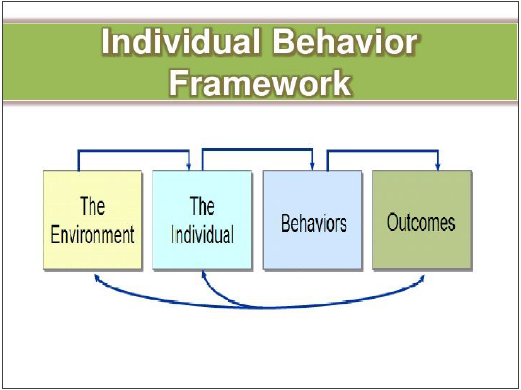
To get a brief idea about the individual behavior let us learn about the individual behavior framework and other key elements related to it.

Individual Behavior Framework

On the basis of these elements, psychologist Kurt Lewin stated the Field theory and outlined the behavior framework. This psychological theory studies the patterns of interaction between an individual and the environment. The theory is expressed using the formula

B = F(P,E)

where, B – Behavior, F – Behavior Function, P – Person, and E – Environment around the person.

Say for example, a well payed person who loses his job in recession may behave differently when unemployed.

Causes of Individual Behavior

Certain individual characteristics are responsible for the way a person behaves in daily life situations as well as reacts to any emergency situations. These characteristics are categorized as −

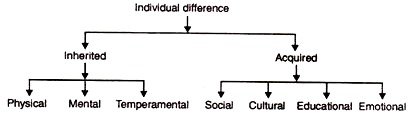
  • Inherited characteristics
  • Learned characteristics
  1. Inherited Characteristics

The features individuals acquire from their parents or from our forefathers are the inherited characteristics. In other words, the gifted features an individual possesses by birth is considered as inherited characteristics.

Following features are considered as inherited characteristics:

  • Color of a person’s eye
  • Religion/Race of a person
  • Shape of the nose
  • Shape of earlobes
  1. Learned Characteristics

Nobody learns everything by birth. First our school is our home, then our society followed by our educational institutions. The characteristics an individual acquires by observing, practicing and learning from others and the surroundings is known as learned characteristics.

It consists of the following features:

  • Perception: Result of different senses like feeling, hearing etc.
  • Values: Influences perception of a situation, decision making process.
  • Personality: Patterns of thinking, feeling, understanding and behaving.
  • Attitude: Positive or negative attitude like expressing one’s thought.

From Latin “Humanitas”, the concept of Man means human nature, general culture of the mind. It is also “men” in general, the human race taken as a unit. Most philosophers defined as any human being endowed with reason. What man is the ultimate metaphysical question.

Definitions of man by the Philosophers

Simone de Beauvoir:

“Humanity is a discontinuous series of free men permanently isolate their subjectivity. ”

Husserl (phenomenology):

“Each figure is spiritual in nature in the space of world history. This trial shows humanity as a single life kissing men and peoples and linked only by spiritual traits: it envelops a multitude of types of humanity and culture, but by imperceptible transitions, melt into each other. ”

Nietzsche (see Nietzsche Philosophy Summary):

“Mankind! He was never between all the old, old one more horrible (except perhaps the truth is a problem with the use of philosophers?”

“Man is a rope stretched between the animal and the Superman, a rope over an abyss”

Merleau-Ponty:

“Man is a historical idea and not a natural kind”

Sartre (Existentialism is a humanism):

“Man is nothing else than his plan, it exists only insofar as it is realized, so it is nothing but the whole ”

Heidegger (Being and Time)L

“Man is a creature of the distant”

Pascal:

“Man is a reed, the weakest of nature, but it is a thinking reed. It is not necessary that the entire universe arm itself to crush: a vapor, a drop of water suffices to kill him. But when the universe to crush him, man would still be nobler than what kills him, because he knows that he dies and the advantage that the universe has over him The universe knows nothing “

Individual Differences and Factors affecting Individual Differences

Dissimilarity is principle of nature. No two persons are alike. All the individuals differ from each other in many a respects. Children born of the same parents and even the-twins are not alike. This differential psychology is linked with the study of individual differences. Wundt, Cattel, Kraepelin, Jastrow and Ebbing Haus are the exponents of differential psychology.

This change is seen in physical forms like in height, weight, colour, complexion strength etc., difference in intelligence, achievement, interest, attitude, aptitude, learning habits, motor abilities, skill. Each man has an intellectual capacity through which he gains experience and learning.

Every person has the emotions of love, anger, fear and feelings of pleasure and pain. Every man has the need of independence, success and need for acceptance.

Broadly individual difference may be classified into two categories such as inherited traits and acquired traits:

Factors affecting Individual Differences

There are various causes which are responsible in bringing individual differences.

They are narrated below:

  1. Heredity

Some heretical traits bring a change from one individual to other. An individual’s height, size, shape and color of hair, shape of face, nose, hands and legs so to say the entire structure of the body is determined by his heretical qualities. Intellectual differences are also to a great extent influenced by hereditary factor.

  1. Environment

Environment brings individual differences in behaviour, activities, attitude, and style of life characteristics. Personality etc. Environment does not refer only physical surroundings but also it refers the different types of people, society, their culture, customs, traditions, social heritage, ideas and ideals.

  1. Race and Nationality

Race and Nationality is one cause of individual difference. Indians are very peace loving, Chinese are cruel; Americans are very frank due to race and nationality.

  1. Sex

Due to sex variation one individual differs from other. Men are strong in mental power. On the other hand women on the average show small superiority over men in memory, language and aesthetic sense. Women excel the men in shouldering social responsibilities and have a better control over their emotions.

  1. Age

Age is another factor which is responsible in bringing individual differences. Learning ability and adjustment capacity naturally grow with age. When one grows in age can acquire better control over our emotions and better social responsibilities. When a child grows then this maturity and development goes side by side.

  1. Education

Education is one major factor which brings individual differences. There is a wide gap in the behaviors of educated and uneducated persons. All traits of human beings like social, emotional and intellectual are controlled and modifies through proper education.

This education brings a change in our attitude, behaviour, appreciations, Personality. It is seen that uneducated persons are guided by their instinct and emotions where as the educated persons are guided by their reasoning power.

Educational Implications of Individual Differences

Educational implications of Individual differences are listed below:

(i) Aims of education, curriculum, method of teaching should be linked with individual differences considering the different abilities and traits individual.

(ii) Curriculum should be designed as per the interest, abilities and needs of different students.

(iii) The teacher has to adopt different types of methods of teaching considering individual difference related to interest, need, etc.

(iv) Some co-curricular activities such as Drama, music, literary activities (Essay & Debate Competition) should be assigned to children according to their interest.

(v) Teacher uses certain specific teaching aids which will attract the children towards teaching considering their interest and need.

(vi) Various methods such as playing method, project method, Montessori method, story telling methods are to be used considering/discovering how different children respond to a task or a problem.

(vii) The division of pupils into classes should not be based only on the mental age or chronological age of children but the physical, social and emotional maturity should be given due consideration.

(viii) In case of vocational guidance the counselor is to plan the guidance technique keeping in view the needs and requirements of the students.

Influence of Environment

Since the earliest times, humans have needed to be sensitive to their surroundings to survive, which means that we have an innate awareness of our environment and seek out environments with certain qualities.

First of all, humans have a strong need for safety and security and look for those attributes in their environment. We also look for physical comfort, such as an environment with the right temperature. In addition, we seek an environment that is psychologically comfortable: for example, environments that are familiar, but offer the right amount of stimulus.

Retailers and the hospitality industry know this very well and try to provide an atmosphere that creates a positive customer experience and offers three important attributes: comfort, safety, and entertainment. These attributes are equally important in healthcare as well.

How the environment can impact you?

Below are just a few examples of how the environment can impact you.

  1. The environment can facilitate or discourage interactions among people (and the subsequent benefits of social support). For example, an inviting space with comfortable chairs and privacy can encourage a family to stay and visit with a patient.
  2. The environment can influence peoples’ behavior and motivation to act. For example, a dingy corridor filled with extra hospital equipment will invite staff to leave another item in the hall, whereas a clean corridor and adequate storage will encourage staff to take the time to put the item away.
  3. The environment can influence mood. For example, the results of several research studies reveal that rooms with bright light, both natural and artificial, can improve health outcomes such as depression, agitation, and sleep.

What about stress?

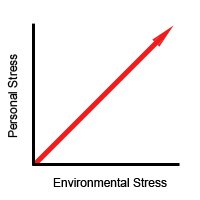
Perhaps most importantly for health, the environment can create or reduce stress, which in turn impacts our bodies in multiple ways. This is because our brain and our nervous, endocrine, and immune systems are constantly interacting. As neuroscientist Candice Pert puts it, “What you are thinking at any moment is changing your biochemistry.”

Thus, the stress of a noisy, confusing hospital room might result in a patient not only feeling worried, sad, or helpless, but experiencing higher blood pressure, heart rate, and muscle tension. In addition, hormones released in response to the emotional stress could suppress the patient’s immune system, causing his wounds to heal more slowly.

Stress is an important medical consideration, and creating an environment that reduces stress is a key piece of improving health outcomes.

Personality: Determinants of Personality

The term ‘personality’ is derived from the Latin word ‘persona’ which means a mask. According to K. Young, “Personality is a …. patterned body of habits, traits, attitudes and ideas of an individual, as these are organised externally into roles and statuses, and as they relate internally to motivation, goals, and various aspects of selfhood.” G. W. Allport defined it as “a person’s pattern of habits, attitudes, and traits which determine his adjustment to his environment.”

According to Robert E. Park and Earnest W. Burgess, personality is “the sum and organization of those traits which determine the role of the individual in the group.” Herbert A. Bloch defined it as “the characteristic organization of the individual’s habits, attitudes, values, emotional characteristics……. which imparts consistency to the behaviour of the individual.” According to Arnold W. Green, “personality is the sum of a person’s values (the objects of his striving, such as ideas, prestige, power and sex) plus his non- physical traits (his habitual ways of acting and reacting).” According to Linton, personality embraces the total “organized aggregate of psychological processes and status pertaining to the individual.”

According to Anderson and Parker, “Personality is the totality of habits, attitudes, and traits that result from socialization and characterizes us in our relationships with others.” According to N.L. Munn, “Personality may be defined as the most characteristic integration of an individual’s structure modes of behaviour, interests, attitudes, capacities, abilities and aptitudes.” According to Morton Prince, “Personality is the sum total of all the biological innate dispositions, impulses tendencies and instincts of the individual, and the acquired disposition and tendencies acquired by experience.” According to Young, “Personality is the totality of behaviour of an individual with a given tendency system interacting with a sequence of situations.”

Lawrence A. Pewin has given a working definition of personality in these words, “Personality represents those structural and dynamic properties of an individual or individuals as they reflect themselves in characteristic responses to situations.”

Personality Determinants

Personality is not determined by a single factor, but by an accumulation of many factors. Some of those factors are psychological, while others are physical, biological, and hereditary. I have compiled some of the most influential factors when it comes to determinants of personality.

  1. Heredity

Heredity refers to those factors that were determined at conception.

Physical stature, facial attractiveness, sex, temperament, muscle composition and reflexes, energy level, and biological rhythms are characteristics that are considered to be inherent from one’s parents. The heredity approach argues that the ultimate explanation of an individual’s personality is the molecular structure of the genes, located in the chromosomes.

Research on animals has showed that both physical and psychological characteristics can be transmitted through heredity. But research on human beings is in adequate to support this view point. However, psychologists and geneticists have accepted the fact that heredity plays an important role in one’s personality.

  1. Brain

The second biological approach is to concentrate on the role that the brain plays in personality. Though researchers make some promising inroads, the psychologists are unable to prove empirically the contribution of human brain in influencing personality. The most recent and exciting possibilities come from the work done with electrical stimulation of the brain (ESB) and split-brain psychology.

Preliminary results from the electrical stimulation of the brain (ESB) research give indication that better understanding of human personality and behaviour might come from the study of the brain. Work with ESB on human subjects is just beginning.

There seem to be definite pleasurable and painful areas in the human brain. This being true, it may be possible physically to manipulate personality through ESB.

  1. Biofeedback

Until recently, physiologists and psychologists felt that certain biological functions such as brainwave patterns, gastric secretions, and fluctuations in blood pressure and skin temperature were beyond conscious control. Now some scientists believe that these involuntary functions can be consciously controlled through biofeedback. In BFT the individual learns the internal rhythm of a particular body process through electronic signals feedback from equipment that is wired to the body area. From this biofeedback the person can learn to control the body processing question. More research is needed on biofeedback before any definitive conclusions can be drawn. But its potential impact could be extremely interesting for the future.

  1. Physical features

A vital ingredient of the personality, an individual’s external appearance, is biologically determined. The fact that a person is tall or short, fat or skinny, black or white will influence the person’s effect on others and this in turn, will affect the self-concept. Practically all would agree that physical characteristics have at least some influence on the personality. According to Paul H Mussen “a child’s physical characteristics may be related to his approach to the social environment, to the expectancies of others, and to their reactions to him. These, inturn, may have impacts on personality development”.

Personality Traits Theory

Among the best-known essential trait approaches are:

  1. Murray (20 + ‘needs’)
  2. Cattell (16 traits): 16 Personality Factors questionnaire
  3. Eysenck (3 traits): Eysenck Personality Questionnaire (EPQ)—extra- version, neuroticism, and psychotocism
  4. Costa and McCrae (5 traits): NEO—neuroticism, extraversion, open­ness to experience, agreeableness, and conscientiousness

Needs as personality—Henry murray

Henry Murray (1893-1988) was active in developing a theory of motivation from the 1930s to the 1960s. He believed that a need is a potentiality or readiness to respond in a certain way under certain given circumstances. It is a noun which stands for the fact that a certain trend is apt to recur. (Murray et al. 1938) A major assumption of Murray’s theory was that behaviour is driven by an internal state of disequilibrium. In other words, we lack something and this drives us, or we are dissatisfied and we desire for something.

Murray classified needs as follows:

Primary needs (biological needs) are food, water, air, sex, and avoidance of pain

Secondary needs (either derived from our biological needs or inherent in our psychological nature) are:

  • Achievement, recognition, acquisition
  • Dominance, aggression, autonomy
  • Affiliation, rejection
  • Nurturance, play, cognizance (asking questions of others)

Murray believed that stronger needs are expressed more often over time and lead to more intense behaviour. Murray’s main contribution was that he understood personality as being driven by the secondary needs: achievement, dominance, affiliation, and nurturance. The extent to which each of these needs was felt by an individual shaped his/her personality and behaviour. Since the 1960s and the 1970s, the main needs studies have examined achievement, power, affiliation, and intimacy.

For example, the need for achievement (or achievement motivation) was studied extensively by David McLelland in the 1970s, and is the single most- researched need. Achievement motivation refers to the desire to do things well and overcome obstacles to do things better. People possessing high achievement motivation tend to choose more difficult tasks than people with low achievement motivation. This is because they want to find out more about their ability to achieve.

The need for power was studied intensely by David Winter in the 1970s. The need for power is the desire to have dominance, impact on others, prestige, position, and influence over others. Those who have the need for power are often concerned about controlling the image of themselves portrayed to others. If the need for power can be combined with taking on responsibility, then ‘acceptable’ displays of power can be experienced.

The need for affiliation has been studied by McAdam in the 1980s. The need for affiliation refers to the desire to spend time with other people. It can be more useful to look at subcomponents such as social comparison, emotional support, positive stimulation, and attention from others.

The need for intimacy is the desire to experience warm, close, and communicative exchanges with another person. Ultimately, it is the desire to merge oneself with another. The need for intimacy correlates (medium correlation) with the need for affiliation, but focuses more on one-to-one interactions, particularly self-disclosure and listening.

Murray’s needs theory is sometimes studied as a part of the trait perspective, as ‘needs’ are seen as akin to traits. But probably, you will see the needs’ theory studied more often within the psychoanalytic perspective because it is seen as a Drive theory of personality. We will return to this when we look at the Thematic Apperception Test (TAT) in the psychoanalytic section of the course. The TAT was derived from Murray’s needs theory.

CATTELL’S 16 PERSONALITY FACTORS

Cattell (1905) viewed language as a useful source of information about personality. A quality described by many words, he figured, was likely to be a more important part of personality. Cattell used this lexical criterion in determining his original list of trait names.

Cattell narrowed Allport and Odbert’s (1936) listing of over 17,000 words down to 4,500 words and then narrowed these down further to 171 trait names. Cattell then collected self-ratings on these words and conducted a factor analysis. He used both observer and behavioural data.

The result was his 16 personality factors (16 PF):

  1. Reserved vs. warm
  2. Concrete reasoning vs. abstract reasoning
  3. Reactive vs. emotionally stable
  4. Deferential vs. dominant
  5. Serious vs. lively
  6. Expedient vs. rule-conscious
  7. Shy vs. socially bold
  8. Utilitarian vs. sensitive
  9. Trusting vs. vigilant
  10. Practical vs. imaginative
  11. Forthright vs. private
  12. Self-assured vs. apprehensive
  13. Traditional vs. open-to-change
  14. Group-oriented vs. self-reliant
  15. Tolerates disorder vs. perfectionist
  16. Relaxed vs. tense

SUPER TRAITS—HANS EYSENCK

Hans Eysenck (1916-97) believed initially that all people could be described in terms of two super traits, which he believed had a biological basis:

  1. Introversion-extraversion (continuum of sociability, dominance, liveli­ness, etc.)
  2. Emotionality-stability (neuroticism) (continuum of upset and distress)
  3. Psychoticism (added later, less researched), a predisposition towards becoming either psychotic or sociopathic (psychologically unattached to other people); also, a tendency to be hostile, manipulative, and impulsive

Eysenck designed the Eysenck Personality Questionnaire (EPQ). A second-order factor analysis of Cattell’s 16 PF shows two factors— introversion/extraversion and anxiety. So, the underlying factors of Cattell’s scales are very similar to those of Eysenck.

An example of the research supporting the super traits was a 1968 study by Giese and Schmidt with a group of college students over the age of nineteen (reported by Eysenck 1973), in which extraversion strongly predicted the age of first experiencing sexual intercourse.

There are many studies on primary personality traits, but an effective measurement of personality traits for identification and classification is widely done using the Myers-Briggs Type Indicator (MBTI) and the Big-Five Model. MBTI is essentially a 100-question personality test to understand from people their feelings and actions in a given situation.

The responses are then classified into four major types, such as extroverted vs introverted, sensing vs intuitive, thinking vs feeling, and judging vs perceiving. These were then combined into 16 personality types—ESTJ, INFP, ESFP, INTJ, ESFJ, INTP, ENFP, ISTJ, ESTP, INFJ, ENFJ, ISTP, ENTJ, ISFP, ENTP, and ISIJ. Attributes of some of the types are as follows.

(i) ESTJ

The ESTJ personality types prefer dealing with facts and the present, and make decisions using logic. They are organized on a logical basis, and are therefore practical. They like to solve problems in a businesslike and impersonal manner. They take care of details before considering any strategies.

(ii) INFP

People with this personality type are more focused on their inner world and therefore they are driven by thoughts and emotions. They give more importance to personal values, are flexible and open to new insights, and are adaptable. They take fancy to new ideas and sometimes make very creative contributions. They like to grow and feel that others should grow too. They undertake work that has a meaningful purpose.

(iii) ESFP

People with this personality type derive their energy from the outside world of actions and spoken words. They prefer dealing with facts, enjoy friendship, and are often impulsive. They tend to take part in fire fighting and troubleshooting and come out with practical solutions to problems involving people.

(iv) INTJ

People with this type of personality derive their energy from the inner world and more from their emotions. They deal with patterns and possibilities for the future, making impersonal decisions. They are strategists, capable of identifying long-term goals and achieving them. However, they are also a bit sceptical and critical, both about themselves and others. They have a keen sense of deficiencies in quality and competence.

(v) ESFJ

The ESFJ types take their energy from the outer world of actions and spoken words. They deal with facts and people and make decisions on the basis of personal values. They are very warm and seek to maintain harmonious relationships with colleagues and friends. They have a strong sense of duty and loyalty.

(vi) INTP

The INTP types take their energy from the inner world of thoughts and emotions. They make decisions on the basis of logic. Their life is flexible and they follow new insights and possibilities. They are quiet, detached, and adaptable only when there is a clear principle. They are not interested in routine and they will often experiment or change things to see if they can be improved. They operate best when solving complex problems that require the application of intellect.

It is important to mention here that the MBTI questionnaire cannot be printed here for the obvious lack of copyright. But interested researchers can obtain this from available web sites to assess the personality types of employees.

THE BIG-FIVE MODEL

Despite the wide popularity of MBTI, its results are not always fool proof. Many researchers recommend its use only for self-awareness.

The Big-Five Model, in contrast, has a strong application support and often researchers feel that it is a better alternative.

The Big-Five personality factors are:

  1. Extroversion
  2. Conscientiousness
  3. Openness to stability
  4. Agreeableness
  5. Emotional stability

A strong consensus has emerged since the mid-1980s about the number and nature of personality traits. Five superordinate factors have emerged, often referred to as the ‘Big Five’ or the 5-factor model. The presence of these five factors is well supported by a wide variety of research.

In 1949, Fiske published early evidence supporting the 5-factor model. During the 1980s and 1990s a vast array of research was combined to support the 5-factor model. Not everyone, however, agrees to the nomenclature of the five super-traits.

The 5-factor model is commonly measured by the NEO by Costa and McCrae (1992).

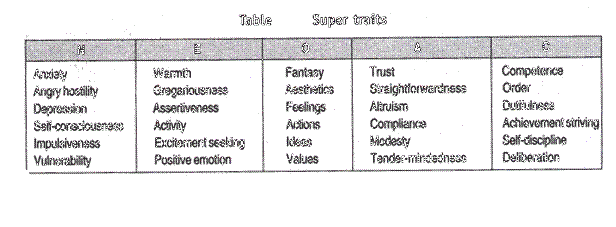
The Big Five, according to the NEO are neuroticism, extra- version, openness to experience, agreeableness, and conscientiousness (remember OCEAN, or NEOAC):

  1. Neuroticism (emotional stability)
  2. Extraversion (introversion)
  3. Openness to experience (closeness to experiences)
  4. Agreeableness (disagreeableness)
  5. Conscientiousness (lack of conscientiousness)

Each super-trait is measured by 6 facets (or subordinate traits). These are displayed in Table 1.
Type A and Type B Personalities

Type A and Type B personality hypothesis describes two contrasting personality types. In this hypothesis, personalities that are more competitive, highly organized, ambitious, impatient, highly aware of time management and/or aggressive are labeled Type A, while more relaxed, less ‘neurotic’, ‘frantic’, ‘explainable’, personalities are labeled Type B.

The two cardiologists who developed this theory came to believe that Type A personalities had a greater chance of developing coronary heart disease. Following the results of further studies and considerable controversy about the role of the tobacco industry funding of early research in this area, some reject, either partially or completely, the link between Type A personality and coronary disease. Nevertheless, this research had a significant effect on the development of the health psychology field, in which psychologists look at how an individual’s mental state affects physical health.

Type A

The hypothesis describes Type A individuals as outgoing, ambitious, rigidly organized, highly status-conscious, impatient, anxious, proactive, and concerned with time management. People with Type A personalities are often high-achieving “workaholics”. They push themselves with deadlines, and hate both delays and ambivalence. People with Type A personalities experience more job-related stress and less job satisfaction. Interestingly, those with Type A personalities do not always outperform those with Type B personalities. Depending on the task and the individual’s sense of time urgency and control, it can lead to poor results when there are complex decisions to be made.  However, research has shown that Type A individuals are in general associated with higher performance and productivity (Barling & Charbonneau, 1992; Bermudez, Perez-Garcia, & Sanchez-Elvira, 1990; Glass, 1977). Moreover, Type A students tend to earn higher grades than Type B students (Waldron et al., 1980), and Type A faculty members were shown to be more productive than their Type B behavior counterparts (Taylor, Locke, Lee, & Gist, 1984).

In his 1996 book dealing with extreme Type A behavior, Type A Behavior: Its Diagnosis and Treatment, Friedman suggests that dangerous Type A behavior is expressed through three major symptoms:

  • Free-floating hostility, which can be triggered by even minor incidents
  • Time urgency and impatience, which causes irritation and exasperation usually described as being “short-fused”
  • A competitive drive, which causes stress and an achievement-driven mentality. The first of these symptoms is believed to be covert and therefore less observable, while the other two are more overt.

Type A people were said to be hasty, impatient, impulsive, hyperalert, potentially hostile, and angry. Research has also shown that Type A personalities deal with reality and have certain defenses when it comes to dealing with problems.

Janet Spence’s research has shown that the Type A archetype can be broken down into two factors assessed using a modified Jenkins activity survey with 7 questions assessing AS and 5 items assessing II. The two factors are Achievement Striving (AS) and Impatience Irritability (II). AS is a desirable factor which is characterized by being hard working, active, and taking work seriously. II is undesirable and is characterized by impatience, irritability, and anger. Subsequent work by Day and Jreige has further clarified the independence of these two subtypes of type A personality. Additionally they further defined the interactions between AS and II subtypes and psychosocial outcomes.  AS was more strongly linked to job satisfaction while II was linked to self report of satisfaction and life satisfaction.  Associations were demonstrated between AS and II subtypes moderating the impact of job stressors (job control, role overload and role ambiguity) on outcomes of job satisfaction, life satisfaction and perceived stress.

There are two main methods to assessing Type A behaviour. The first being the SI and the second being the Jenkins Activity Survey (JAS) The SI assessment involves an interviewer measuring a persons emotional, nonverbal and verbal responses (your expressive style). The JAS involves a self questionnaire with three main categories: Speed and Impatience, Job Involvement, and Hard-Driving Competitiveness.

Type B

Type B is a behavior pattern that is lacking in Type A behaviors. A-B personality is a continuum where one either leans to be more Type A or Non Type A (Type B).

The hypothesis describes Type B individuals as a contrast to those of Type A. Type B personality, by definition, are noted to live at lower stress levels. They typically work steadily, and may enjoy achievement, although they have a greater tendency to disregard physical or mental stress when they do not achieve. When faced with competition, they may focus less on winning or losing than their Type A counterparts, and more on enjoying the game regardless of winning or losing. Unlike the Type A personality’s rhythm of multi-tasked careers, Type B individuals are sometimes attracted to careers of creativity: writer, counselor, therapist, actor or actress. Their personal character may enjoy exploring ideas and concepts.

Type B personality types are more tolerant than individuals in the Type A category. This can be evident through their relationship style that members of upper management prefer. Type B individuals can “…see things from a global perspective, encourage teamwork, and exercise patience in decision making…”

Interactions between Type A and Type B

Type A individuals’ proclivity for competition and aggression is illustrated in their interactions with other Type As and with Type Bs. When playing a modified Prisoner’s Dilemma game, Type A individuals elicited more competitiveness and angry feelings from both Type A and Type B opponents than did the Type B individuals. Type A individuals punished their Type A counterparts more than their Type B counterparts, and more than Type Bs punished other Type Bs. Rivalry between Type A individuals was shown by more aggressive behavior in their interactions, including initial antisocial responses, refusal to cooperate, verbal threats, and behavioral challenges.

Johari Window, Model, Features

Johari Window is a psychological model that represents self-awareness and interpersonal relationships. It consists of four quadrants that depict aspects of oneself: Open Area (known to self and others), Blind Spot (unknown to self but known to others), Hidden Area (known to self but hidden from others), and Unknown Area (unknown to both self and others). The model illustrates how communication, feedback, and disclosure can expand the Open Area, enhancing self-understanding and relationships. Through mutual sharing and feedback, individuals can reduce the Hidden and Blind Spot areas, fostering personal growth, trust, and effective collaboration in both personal and professional settings.

Johari Window Model Description:

The Johari Window is a framework used to enhance understanding of interpersonal communication and relationships. Developed by psychologists Joseph Luft and Harrington Ingham in 1955, it visualizes the aspects of oneself that are known or unknown to oneself and others.

topic 7.png

The model consists of four quadrants:

  • Open Area:

Known to both oneself and others, including traits, feelings, and behaviors openly shared.

  • Blind Spot:

Known to others but unknown to oneself, highlighting aspects where feedback and self-awareness can reduce misunderstanding.

  • Hidden Area:

Known to oneself but not shared openly with others, representing personal feelings, fears, or experiences kept private.

  • Unknown Area:

Neither known to oneself nor to others, holding unrealized potential, talents, or aspects awaiting discovery.

Johari Window Model Functions:

  • Self-awareness:

It promotes introspection and awareness of one’s own behaviors, feelings, and motivations by highlighting blind spots and hidden aspects.

  • Feedback:

Facilitates giving and receiving constructive feedback, helping individuals understand how others perceive them and reducing blind spots.

  • Relationship Building:

Enhances communication and trust by expanding the open area through mutual disclosure and sharing.

  • Conflict Resolution:

Provides a framework for resolving misunderstandings and conflicts by increasing awareness of differing perspectives and motivations.

  • Personal Growth:

Encourages personal growth and development by expanding the known areas and integrating feedback to improve self-understanding.

  • Team Development:

Used in organizational settings to foster teamwork, collaboration, and effective communication among team members.

Attitude Meaning, Nature, Types, Components

Attitude is a psychological construct that reflects an individual’s feelings, beliefs, and predispositions toward a person, object, idea, or situation. It influences how one perceives and interacts with their environment, shaping behavior and decision-making. Attitudes are composed of three components: cognitive (beliefs and thoughts), affective (emotions and feelings), and behavioral (actions or intentions). They can be positive, negative, or neutral and are formed through experiences, social influences, and education.

Nature of Attitude:

1. Learned Behavior

Attitudes are not innate but are acquired over time through experiences, education, and interactions.

  • They develop as individuals observe and interpret events in their environment.
  • For instance, a positive experience with teamwork may foster a favorable attitude toward collaboration.

2. Influenced by Social Context

Attitudes are shaped by cultural norms, peer groups, family, and societal values.

  • Socialization plays a critical role in forming attitudes, especially during childhood and adolescence.
  • Media, education, and social institutions further reinforce or challenge these attitudes.

3. Composed of Three Components

Attitudes consist of three interrelated components:

  • Cognitive Component: Beliefs and thoughts about the subject (e.g., “I believe exercise is beneficial”).
  • Affective Component: Emotional reactions (e.g., “I enjoy exercising”).
  • Behavioral Component: Action tendencies or intentions (e.g., “I go to the gym regularly”).

This tri-component model explains how attitudes influence thoughts, feelings, and actions.

4. Dynamic and Flexible

While attitudes can be stable, they are not rigid.

  • They may evolve over time due to new information, experiences, or changes in circumstances.
  • For example, a negative attitude toward technology can shift to positive after learning its benefits.

5. Vary in Intensity and Direction

Attitudes can range from strongly positive to strongly negative, with varying levels of intensity.

  • A person may feel strongly about environmental conservation, displaying active advocacy.
  • Conversely, a neutral or weak attitude may result in indifference.

6. Predict Behavior but Not Always Precisely

Attitudes often guide behavior, but external factors, such as situational constraints or social pressures, can influence actions.

  • For example, someone with a positive attitude toward sustainability might still use non-recyclable products if alternatives are unavailable.

Types of Attitude:

1. Positive Attitude

Positive attitude reflects optimism, hope, and confidence. Individuals with this mindset tend to see opportunities in challenges and maintain a constructive approach to life. They are enthusiastic, motivated, and resilient, making them effective in team environments and problem-solving scenarios. For example, a person with a positive attitude might view a setback as a learning experience rather than a failure.

2. Negative Attitude

Negative attitude is characterized by pessimism, doubt, and resistance to change. Such individuals often focus on problems rather than solutions, leading to reduced productivity and morale. They may resist new ideas or reject feedback, creating friction in personal and professional relationships. This attitude can stem from past failures, low self-esteem, or external influences like a toxic environment.

3. Neutral Attitude

Neutral attitude represents indifference or lack of strong feelings toward a person, object, or situation. Individuals with a neutral attitude neither support nor oppose an idea, often choosing to remain passive. This type of attitude may arise from insufficient knowledge or personal disinterest. While it minimizes conflict, it can also hinder decision-making and active participation.

4. Stereotyped Attitude

Stereotyped attitudes are preconceived notions or beliefs about a group of people, based on characteristics like race, gender, religion, or profession. These attitudes are often formed without direct experience and can lead to biases and discrimination. For instance, believing that a certain gender is better suited for leadership roles reflects a stereotyped attitude. Such attitudes can perpetuate social inequalities and hinder diversity.

5. Ego-Defensive Attitude

An ego-defensive attitude is adopted to protect one’s self-esteem or justify actions. Individuals with this attitude may deny facts or blame others to avoid accountability. For instance, an employee who misses deadlines might develop a negative attitude toward the manager to justify their own shortcomings. This type of attitude, while self-protective, can create conflicts and hinder personal growth.

6. Value-Expressive Attitude

A value-expressive attitude reflects an individual’s core beliefs, values, or principles. It helps individuals express their identity and align with causes they feel strongly about. For example, someone passionate about environmental conservation may actively support eco-friendly initiatives. This attitude is deeply rooted and often serves as a foundation for long-term behavior.

7. Social Attitude

Social attitudes are shaped by societal norms, traditions, and peer influences. These attitudes determine how individuals interact with others in a community setting. For example, a person might adopt a socially positive attitude to conform to group expectations, even if it conflicts with personal beliefs.

Components of Attitudes:

  1. Informational or Cognitive Component

The informational component consists of beliefs, values, ideas and other information a person has about the object. It makes no difference whether or not this information is empirically correct or real. For example, a person seeking a job may learn from his own sources and other employees working in the company that in a particular company the promotion chances are very favourable. In reality, it may or may not be correct. Yet the information that person is using is the key to his attitude about that job and about that company.

  1. Emotional or Affective Component

Informational component sets the stage for the more critical part of an attitude, its affective component. The emotional components involve the person’s feeling or affect-positive, neutral or negative-about an object. This component can be explained by this statement.” I like this job because the future prospects in this company are very good”.

  1. Behavioural Component

Behavioural component consists of the tendency of a person to behave in a particular manner towards an object. For example, the concerned individual in the above case may decide to take up the job because of good future prospects. Out of the three components of attitudes, only the behavioural component can be directly observed. One cannot see another person’s beliefs (the informational component) and his feelings (the emotional component). These two components can only be inferred. But still understanding these two components is essential in the study of organizational behaviour or the behavioural component of attitudes.

The components are illustrated in the following table:

ABC Model of Attitude

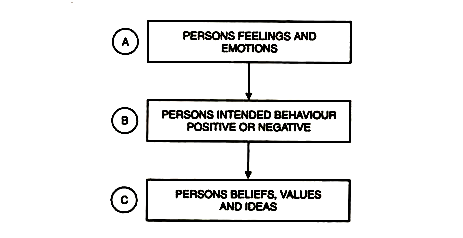
All the three components of attitude explained above constitute, what is OF called the ABC model. Here, in the ABC model, the alphabet A stands for Affective component, B for Behavioural and C for the cognitive component. The importance of this model is that to have a proper and thorough understanding of the concept of attitude, all the three components mentioned above must be properly assessed. It is only the behavioural component which can be directly observed, the other two components: affective and cognitive can however only be inferred.

Functions of Attitudes

According to California Management Review, 1995, an analysis, based on extensive review of surveys of employers concluded that “the most important consideration in hiring and biggest deficit among new work force entrants are the attitudes concerning work that they bring with them to their new jobs. ” Attitudes can help in predicting human behaviour at work. An understanding of attitudes is also important because attitudes help people adapt to their work environment.

Four Important Functions of Attitudes (According to D. Katz)

  1. The Adjustment Function

Attitudes often help people adjust to their work environment. When employees are well treated they are likely to develop a positive attitude towards the management and the organization, otherwise they are likely to develop a negative attitude towards management and the organization. These attitudes help employees adjust to their environment and are a basis for future behaviour.

For example, if employees who are well treated are asked about management or the organization they are likely to say good things. These employees are very loyal to the management also. On the other hand, if the employees are berated or they are given minimum salary increases or they have less job satisfaction, the reverse may be true.

  1. The Ego Defensive Function

Along with the adjustment function, attitudes also help them defend their self images. People often form and maintain certain attitudes to protect their own self images. For example, workers may feel threatened by the employment or advancement of minority or female workers in their organisation. These threatened workers may develop prejudices against the new workers.

They may develop an attitude that such newcomers are less qualified and they might mistreat these workers. This attitude helps the workers protect the ego and is known as an ego defensive attitude. This ego defensive attitude is used by the employees in coping with a feeling of guilt or threat. Unless this feeling is removed, this kind of attitude will Remain unchanged.

  1. The Value Expressive Function

Attitudes provide people with a basis for expressing their values. Our value expressive attitudes are closely related to our self concept. A person, whose value system is centralized on freedom, will have a positive attitude towards decentralization of authority in the organization, flexible work schedules etc. Another person who is very ambitious will have a positive attitude towards a job which will offer bright future prospects and chances of promotion.

A manager who believes strongly in work ethics will tend to voice attitudes toward specific individuals or work practices as a means of reflecting this value. For example, a supervisor who wants a subordinate to work harder might put it this way “You’ve got to work harder. That has been the tradition of the family since it was founded. It helped get us where we are today and everyone is expected to subscribe to this ethic”. Thus, the attitudes serve as a basis for expressing one’s central value.

  1. The Knowledge Function

Attitudes are often substituted for knowledge. Attitudes help supply standards and frames of reference that allow people to organize and explain the world around them. Regardless of how accurate a person’s view of reality is attitudes towards people, events and objects help the individual make sense out of what is going on. Stereotyping is an example. In the absence of knowledge about a person, we may use a stereotyped attitude for judging the person.

Why should managers know about these attitude functions? Such a knowledge can help the managers in two ways firstly, he will understand and predict how a certain person is likely to behave. Secondly, it can help the management in changing the attitudes of another person. They can do this by changing the conditions that sustain the attitude.

Way of Changing Attitude

If you truly want to be successful, your number one task should be to create and maintain a positive attitude. When you’ve got an attitude of optimism, expectancy and enthusiasm, opportunities grow, and problems shrink.

If you’re a leader, a positive attitude draws people to your side and encourages them to do their best work. A leader with a negative attitude, however, can only compel others to take action through fear.

More importantly, what would be point of being successful if you’re always feeling lousy?  With that in mind, here’s how to ensure your attitude stays upbeat:

  1. Always act with a purpose

Before you take any action, decide how it will serve your greater goals.  If the connection is weak or non-existent, take that action off your to-do list. Aimless activity wastes time and energy.

  1. Stretch yourself past your limits every day

Doing the same-old, same-old is depressing, even if your same-old has been successful in the past. Success is like athletics; if you don’t stretch yourself every day, you gradually become slow and brittle.

  1. Take action without expecting results

While you naturally must make decisions and take action based upon the results you’d like to achieve, it’s a big mistake to expect those results and then be disappointed when you don’t get them.  Take your best shot but don’t obsess about the target.

  1. Use setbacks to improve your skills

Rather than feeling bad if you fail or get rejected, look back at your actions and see what you can do (if anything) to improve your performances.  Remember: the results you receive are the signposts for the results you want to achieve.

  1. Seek out those who share your positive attitude

It’s a scientific fact your brain automatically imitates the behaviors of the people around you.  (It’s because of something called a mirror neuron).  Therefore, you should surround yourself with positive thinkers and shun those who are excessively negative.

  1. Don’t take yourself so seriously

If you want to be happier and make those around you feel more comfortable, cultivate the ability to laugh at yourself.  If you don’t (or can’t) laugh at yourself, I guarantee you that the people you work with are laughing behind your back!

  1. Forgive the limitations of others

High standards are important, but humans are, well, human. It’s crazy to make yourself miserable because other people can’t do a job as well as you think you could, or when people don’t share your vision with the same passion that you feel.

  1. Say “thank you” more frequently

Achieving an “attitude of gratitude” requires more than simply being aware of what’s wonderful in your life.  You must, and should, thank other people for their gifts to you, even if that gift is something as simple as a smile.

error: Content is protected !!