Effects of Perceptual Error in Managerial Decision Making at Work Place

Perceptual errors occur when individuals misinterpret information, people, or situations due to biases, limited information, or faulty judgment. In organizations, such errors can affect decision-making, teamwork, and evaluations. Common perceptual errors include stereotyping (judging someone based on group characteristics), halo effect (forming an overall impression from one trait), selective perception (focusing only on information that supports existing views), projection (attributing one’s own feelings to others), and contrast effect (evaluating someone in comparison with others rather than on merit). These errors can lead to unfair appraisals, poor communication, and conflicts in the workplace. Managers must be aware of perceptual biases to make objective decisions, promote fairness, and build stronger organizational relationships.

Types of Perceptual Errors:

  • Stereotyping

Stereotyping occurs when individuals judge others based on their membership in a particular group rather than personal characteristics. For example, assuming older employees resist technology or that young employees lack maturity. Such generalizations ignore individuality and lead to biased judgments. In organizations, stereotyping can negatively influence recruitment, promotions, and performance evaluations, resulting in discrimination and reduced morale. While it simplifies information processing, it distorts reality and creates unfair treatment. Managers must avoid relying on stereotypes and instead assess employees on actual performance and capabilities. Promoting diversity awareness and unbiased evaluation helps reduce stereotyping in the workplace.

  • Halo Effect

The halo effect happens when one positive trait of a person influences the overall perception of them. For example, if an employee is punctual, a manager might assume they are also hardworking, reliable, and productive, even without evidence. This bias often leads to inaccurate appraisals and overlooks weaknesses. Similarly, the reverse—called the “horn effect”—occurs when one negative trait dominates judgment. The halo effect affects promotions, rewards, and recognition by exaggerating certain qualities. In organizations, it reduces objectivity in evaluations. Managers must use structured performance criteria to ensure fairness and minimize the influence of single traits on overall judgment.

  • Selective Perception

Selective perception occurs when individuals interpret information based on their existing beliefs, values, or attitudes, ignoring information that contradicts them. For example, a manager who believes a specific employee is lazy may notice only mistakes while overlooking achievements. This error leads to biased decision-making and unfair evaluations. In organizations, selective perception can create misunderstandings, reinforce stereotypes, and prevent innovation. It causes individuals to see what they expect rather than what actually exists. Managers should encourage open communication, objective evidence-based decisions, and multiple perspectives to reduce selective perception and ensure fair treatment of employees and situations.

  • Projection

Projection refers to attributing one’s own feelings, motives, or attitudes to others. For example, a manager who values ambition may assume all employees are equally driven, or an insecure leader may think others doubt their capabilities. This error distorts reality and results in misjudgments about others’ behaviour and intentions. In organizations, projection can create unrealistic expectations, miscommunication, and conflicts. Employees may feel misunderstood or pressured to meet assumptions they do not hold. To overcome projection, managers must recognize personal biases, practice empathy, and evaluate employees based on actual behaviour rather than projecting their own thoughts and feelings.

  • Contrast Effect

The contrast effect occurs when individuals are evaluated by comparison with others rather than on their own merits. For example, a moderately performing employee may seem outstanding if compared to poor performers, but below average if compared to exceptional ones. This error skews performance evaluations, recruitment decisions, and promotions. It unfairly rewards or penalizes employees based on context instead of actual ability. In organizations, the contrast effect leads to inconsistency and dissatisfaction among employees. To minimize it, managers should use absolute standards and clear criteria for evaluation rather than relying on comparisons between individuals.

Effects of Perceptual Error in Managerial Decision Making at Work Place:

  • Biased Recruitment and Selection

Perceptual errors often lead to biased hiring decisions. For example, stereotyping may cause managers to prefer candidates from certain backgrounds, while the halo effect may result in overvaluing one positive trait, such as communication skills, over overall competency. Such errors can result in overlooking more qualified applicants, reducing workforce diversity, and lowering organizational efficiency. Poor hiring choices increase training costs, turnover, and dissatisfaction. To avoid this, managers must use structured interviews, standardized assessment tools, and multiple evaluators to ensure fairness and objectivity during recruitment and selection processes.

  • Inaccurate Performance Appraisal

Perceptual errors strongly affect performance evaluations. Managers may rely on selective perception, noticing only behaviours that confirm their beliefs, or the contrast effect, judging employees against one another rather than actual standards. This leads to unfair ratings, where hardworking employees may be undervalued while others are overrated. Such biased appraisals reduce employee motivation, trust, and morale, causing dissatisfaction and disengagement. In the long run, they undermine organizational justice and performance. Managers must rely on measurable performance indicators, consistent criteria, and multi-source feedback (such as 360-degree appraisals) to reduce errors and maintain fairness in evaluation processes.

  • Poor Communication and Misunderstanding

Perceptual errors can distort workplace communication. For instance, projection may cause managers to assume employees share the same goals or motivations, leading to unrealistic expectations. Similarly, selective perception may result in ignoring valuable employee input that contradicts managerial views. These distortions cause misunderstandings, misinterpretation of instructions, and reduced collaboration. Employees may feel unheard or misjudged, lowering trust and openness in communication. Such errors hinder teamwork and effective decision-making, reducing organizational performance. Managers can avoid this by practicing active listening, clarifying assumptions, and encouraging feedback to ensure messages are interpreted correctly and all perspectives are considered.

  • Conflict and Employee Dissatisfaction

Perceptual errors contribute to workplace conflict and dissatisfaction. For example, stereotyping may foster discrimination, while the halo or horn effect may lead to perceptions of favoritism in appraisals or promotions. These errors create resentment, reduce morale, and weaken trust in management. Employees who feel unfairly treated may disengage, resist cooperation, or even leave the organization. Conflicts arising from misjudgments also consume managerial time and resources. To minimize these effects, managers must ensure transparency, adopt fair evaluation systems, and implement diversity and inclusion initiatives. This builds trust, reduces conflict, and fosters a healthier work environment.
Group Behaviour

Individuals form groups. They live in groups. They move in groups. They work in groups. Groups are important. They influence work and work behaviour. They cannot be ignored. They exert significant influence on the organization. They are inseparable from organization. They are useful for the organization. They form foundation of human resources. The study of group behaviour is important. Individual and group behaviour differs from each other. Group behaviour affects productivity.

The importance of group behaviour has been realized from time to time. Elton Mayo and his associates way back in 1920 conducted the famous Hawthorne experiments and came to know that the group behaviour have major impact on productivity.

Human resources comprise individuals and individuals move in groups. Every manager must possess the knowledge of group behaviour along with individual behaviour. He must understand group psychology. He should understand individual behaviour in the context of group behaviour. Individual behaviour is influenced by the group behaviour.

An individual’s work, job satisfaction and effective performance is influenced by the group in which he moves. At lower level of the organization it is the small groups of employees work as a team. They have the responsibility to finish a task assigned to them within a stipulated period of time.

If they come across a problem they tackle it by themselves. They get guidance from senior fellow workers in solving the problem and accomplishing it. It is needless to say that groups are important in employee’s life. They spend increasing proportion of time with the group at workplace.

M.E. Shaw defined a group “as two or more people who interact and influence one another.” Viewers in a theatre, passengers in a train are not a group unless they interact for long and exert some influence on each other. Such people’s gatherings are referred to as collection.

They interact at a very low level nor they get influenced with each other but enjoy being in collection. The collection of people may get-converted into a group temporarily if they are caught up in a dangerous situation like fire, robbery etc. They will come over a problem fighting as a group unitedly.

Reasons for Group

Man is a social animal and he lives in groups, he moves in groups. So, group is inherent to human beings.

Following are the few reasons why group is essential:

  1. Management of modern organizations is making concerted efforts to introduce industrial democracy at workplace. They are using task force, project teams, work committees where workers get due representation. They participate very often in decision-making. This takes place in groups.
  2. The tasks in modern industries are becoming more complex, tedious and monotonous. To change these conditions and make the environment at workplace more lively, work committees and work groups and teams are formed to monitor the work and change.
  3. To make participative management more effective and relieve executives of petty responsibilities employees are given these responsibilities to carry on successfully and effectively. Group of employees are also given joint responsibility to carry on the work.
  4. Groups of all kinds and types are used by inviting their cooperation in all matters related to production as well as with human relations to make the organization effective.
  5. There are several works which an individual cannot perform. To complete such tasks, group efforts are required for its completion, e.g. building of a ship, making of a movie, construction of a fly-over, a complex etc.

All these require coordinated and unified efforts of many individuals i.e. groups. A group can do the work which cannot be performed by an individual or beyond his capabilities.

  1. A group can make better judgment as compared to an individual.
  2. While accomplishing tasks group can use creative instinct and innovative ideas than a single individual.
  3. When group is working, all the benefits of division of labour accrue.
  4. Individuals in a group communicate with each other and discuss work performance and suggestions to make it better and excellent.
  5. Group efforts substantially affect individual, his attitude and behaviour.
  6. Group has the ability to satisfy the needs of its members. In a group an individual member feels secured and he can directly get technical and work related assistance. They also get special support when they are emotionally depressed.

Types of Groups

Groups can be classified in many different ways on various bases.

Following are the basic groups

  1. Formal Groups

Formal groups are created as part of organization structure to accomplish organizational tasks. A work group in a plant is the example of formal group. They are bound by hierarchical authority in the organization. They have to follow rules, regulation and policy of the organization. These groups are required by the system. The organization provides a system of rules and regulation for attaining organizational objectives.

According to A.L. Stencombe, “a formal group is said to be any social arrangement in which the activities of some persons are planned by others to achieve a common purpose”.

Formal groups help in achieving goals without any difficulty. They facilitate coordination of activities and help in forming logical relationship among people and positions. They create group unity. Leonard R Sayles has subdivided formal group into command group and task group.

(a) Command Group: Command group consists of subordinates who are directly responsible to a supervisor. Command groups are structured by the organisation. The subordinates working in enforcement department of a town planning authority are reporting to and directly responsible to the enforcement officer. This group is responsible for removal of encroachment on public land. There is a specific department established for the purpose and is busy throughout with its activities.

(b) Task Group: Task group is formed to complete a project. This type of group is also known as task force. The job of the group is to complete the task within allotted time period. If one task is completed they are allotted new task to work with. Project teams, quality circles, audit teams are the examples of task group.

  1. Informal Groups

Informal groups exist within the formal organizations and arise because of individuals’ social needs and desire to develop and maintain relations with people. Working at a plant or office leads to formation of informal groups. They work together and this leads to their interaction. Through interaction groups are formed. These groups are spontaneous and emotional. Keith Davis has defined informal group as, “the network of persons and social relations which is not established or required for formal organization.”

These are the groups formed by the employees themselves at the workplace while working together. The organization has not taken any active interest in their formation. According to M. Dalton, “informal groups are cliques.” Cliques are a group of people of different organization levels coming together with a common interest. Cliques are horizontal, vertical, and random. Horizontal Cliques comprise people from the same rank and work area. Vertical Cliques consist of people of different organization levels. Random Cliques are made up of employees from both horizontal and vertical lines coming together with a common interest.

Informal groups are very effective and powerful. Some managers view them harmful and disruptive to the interest of the organization. They suspect their integrity and consider as a virtual threat. Some managers seek their help in getting the task completed quickly. They do not consider them as threat. The strength of these informal groups can be utilized for accomplishment of organisational objectives.

Informal groups are of following types:

(a) Interest Group: A group of employees coming together for attaining a common purpose. Employees coming together for payment of bonus increase in salary, medical benefits and other facilities are the examples of interest group. The people with common interest come together.

(b) Membership Group: A group of persons belonging to the same profession knowing each other e.g. teachers of the same faculty in the university.

(c) Friendship Group: A group outside the plant or office, having similar views, tastes, opinions, belonging to same age group. They form clubs and associations based on the friendship.

(d) Reference Group: It is a primary group where people shape their ideas, beliefs, values etc. They want support from the group. Family is an important reference group. A team of players playing a game is a reference group.

Again according to purposes groups can be classified into the following:

Vocational Groups

Association of the same vocation e.g.: Class I officers association, teachers association etc.

Instructional Groups

The people who have enrolled themselves for the same course e.g. students doing M. Tech in the same subject

Government Group

Association formed for the governing e.g. municipal council, management board.

Religious Group

People belonging to same religion coming together and forming a group.

Recreational Group

Group formed with a purpose of recreation e.g. football club, cricket club etc…

Group Dynamics, Meaning, Nature and Types of Groups

Group dynamics refers to the study of the behaviors, interactions, and processes that occur within a group of people. It examines how individuals influence each other, how roles and norms develop, and how group cohesion and conflict arise. Group dynamics includes both formal and informal groups, where members collaborate to achieve common goals or face challenges. It plays a critical role in enhancing group effectiveness, managing conflicts, and improving overall group performance in diverse settings like workplaces, classrooms, and social environments.

Nature of Group Dynamics:

  • Interdependence

In a group, members are interdependent, meaning their actions and decisions affect each other. This mutual reliance is essential for achieving common objectives. Each member’s success and failure influence the group’s overall performance. For example, in a work team, one member’s contribution can either enhance or hinder the collective result, making cooperation vital.

  • Shared Goals

Groups form to achieve specific shared goals that individual members cannot achieve alone. These goals can range from solving problems, completing projects, or reaching organizational targets. A shared sense of purpose unites group members and provides direction, fostering collaboration. For example, a project team working towards delivering a product within a set timeframe is united by this common objective.

  • Role Structure

Every group develops a structure of roles and responsibilities. Each member typically assumes a role that contributes to the group’s functioning. Roles can be formal, as in leadership or specialist positions, or informal, like the role of the motivator or peacemaker. Role clarity helps manage expectations, reduces conflicts, and ensures that tasks are completed effectively.

  • Norms and Standards

Groups create norms and standards—unwritten rules and behaviors that guide how members interact. Norms develop to regulate group activities, establish acceptable behavior, and maintain group cohesion. For example, a group might develop a norm where members listen attentively during meetings, fostering respect and collaboration. These norms can be positive or negative, influencing the group’s overall productivity and cohesion.

  • Communication

Effective communication is a cornerstone of group dynamics. How information flows within a group affects decision-making, problem-solving, and conflict resolution. Open communication promotes transparency, trust, and cooperation, while poor communication can lead to misunderstandings, conflicts, and inefficiency. Communication can be verbal, non-verbal, or through digital means, all of which play a role in shaping the group’s success.

  • Cohesion

Group cohesion refers to the level of attraction and unity that members feel toward each other and the group as a whole. High cohesion leads to stronger relationships, better collaboration, and increased motivation to achieve group goals. However, excessive cohesion can sometimes result in groupthink, where the desire for harmony suppresses dissent and critical thinking.

  • Conflict

Conflict is a natural part of group dynamics and can arise due to differences in opinions, goals, values, or personalities. While conflict can have negative effects, it can also drive creativity, innovation, and problem-solving when managed effectively. Constructive conflict resolution techniques, such as negotiation and compromise, can lead to improved decision-making and group development.

  • Leadership

Leadership plays a critical role in shaping group dynamics by providing direction, making decisions, and motivating members. Leaders influence the group’s culture, setting the tone for behavior, communication, and goal achievement. Leadership can be formal (e.g., a designated team leader) or informal (e.g., a member who naturally assumes a guiding role), and different leadership styles can significantly affect group dynamics and outcomes.

Types of Group Dynamics:

  • Primary Group

Primary groups are small, close-knit groups where members interact frequently and share strong emotional bonds. These groups include families, close friends, and other intimate social groups. The dynamics within these groups are influenced by deep personal relationships, trust, and mutual care. The focus is on personal connections rather than achieving specific tasks.

  • Secondary Group

Secondary groups are larger, more impersonal, and goal-oriented. They form around specific tasks or objectives, such as work teams, committees, or professional associations. While relationships are less personal than in primary groups, members collaborate to achieve common goals. Group dynamics in secondary groups are largely shaped by roles, norms, and productivity expectations.

  • Formal Group

Formal groups are structured with clearly defined roles, responsibilities, and hierarchies. These groups exist to achieve specific organizational objectives and often follow strict guidelines or policies. Examples include work teams, task forces, and committees. The dynamics in formal groups revolve around role fulfillment, leadership styles, decision-making processes, and adherence to organizational goals.

  • Informal Group

Informal groups are less structured and do not have officially defined roles or responsibilities. They form based on shared interests, friendships, or common goals, often within a larger formal organization. These groups have more flexible dynamics, with members naturally assuming roles based on personality, expertise, or group needs. The dynamics in informal groups are more fluid, with interactions occurring spontaneously.

  • Task-Oriented Group

Task-oriented groups are focused on achieving specific objectives or completing tasks. Members in these groups collaborate to solve problems, make decisions, or complete projects. The dynamics of task-oriented groups are heavily influenced by goal-setting, time management, resource allocation, and communication. Task-oriented groups may include project teams, brainstorming sessions, and problem-solving groups.

  • Social Group

Social groups are formed primarily for companionship and social interaction rather than for specific tasks or goals. These groups are centered around shared activities, interests, or social bonds, such as hobby groups, sports teams, or clubs. Social group dynamics are influenced by factors such as group cohesion, mutual support, and communication patterns. These groups help fulfill social needs and strengthen relationships.

  • Leadership and Authority

This type of group dynamic is centered around the influence and power exerted by leaders within the group. The leader’s style—whether autocratic, democratic, or laissez-faire—can significantly shape how group members interact, make decisions, and perform tasks. The presence of authority and hierarchy impacts communication, trust, and collaboration within the group.

  • Problem-Solving Group

Problem-solving groups are designed to identify, analyze, and resolve specific issues. These groups typically emerge in response to challenges, crises, or complex situations requiring diverse input. Dynamics in problem-solving groups revolve around critical thinking, collaboration, information sharing, and the integration of different perspectives. Effective problem-solving group dynamics encourage creativity, conflict resolution, and decision-making.

  • Virtual Group

Virtual groups interact and collaborate primarily through digital platforms rather than face-to-face meetings. With the rise of remote work and online communication tools, virtual groups have become increasingly common. The dynamics of virtual groups are shaped by technology, geographical dispersion, and communication barriers. These groups require effective use of online communication tools, clear guidelines, and trust-building to overcome challenges such as time zone differences and lack of physical presence.

  • Cohesive Group

Cohesive groups are characterized by strong unity, trust, and a high level of interaction among members. The dynamics in these groups are driven by mutual respect, shared values, and a strong sense of belonging. These groups tend to be highly productive and effective, as members are motivated to work together and support one another. However, excessive cohesion can sometimes lead to groupthink, where critical thinking is suppressed in favor of group harmony.

Group Behaviour Model (Roles, Norms, Status, Process and Structures)

Group structure is defined as the layout of a group. It is a combination of group roles, norms, conformity, workplace behavior, status, reference groups, status, social loafing, cohorts, group demography and cohesiveness.

  • Group Roles: The different roles a person plays as a part of the group.
  • Norms: The typical standard set by the group collaboratively that every member has to follow.
  • Conformity: The decisions or stand taken by majority in the group.
  • Workplace behavior: The ethics that one needs to follow while working with an organization.
  • Status: The designation of members in the group.
  • Social Loafing: The phenomena where group members put less effort towards achieving a goal than they would have while working alone.
  • Cohorts: Sharing common behavior in the group.
  • Reference Groups: Other groups to which a group is compared to.
  • Group Demography: Extent of sharing same behavior.
  • Cohesiveness: Extent of belongingness towards each other in the group.

Roles

Roles are a set of expected behavior patterns associated to someone occupying a given position in a social unit. There are three broad types of roles people play in small groups:

  • Task roles
  • Building and maintenance roles
  • Self-centered roles

(a) Task Roles

Task roles are roles that focus on completing group’s goal. The different task roles of a group are stated below:

  • Coordinator: Links statements made by one group member to another. Example − “Gita’s comment relate well to what Ram was saying.”
  • Energizer: Provokes group to take action. Example − “How many of you are willing to bring in a video on dispute for the next session?”
  • Elaborator: Extends upon another’s ideas. Example − “I think what Niki and Anni are suggesting is that we first explain nonverbally before we turn to verbal communication.”
  • Evaluator-critic: Evaluates the group’s work against higher standards. Example − “This is okay, but I think Shree needs to give more feedback.”
  • Information-giver: Gives helpful information. Example − “Rohit has some books about conflict we could use.”
  • Information-seeker: Questions for clarification. Example − “Richa or Trishala, could you please tell me what you said about disconfirming responses?”
  • Recorder: Keeps notes regarding the meeting. Example − “Last session we did not get to A-P’s presentation. Rahul and Rohit had just finished theirs.”
  • Procedural Technician: Takes accountability for tasks. Example − “I checked out the VCR for Nigaar and Neha’s presentations.”

(b) Group-Building / Maintenance Roles

It focuses on building interpersonal relationships and maintaining harmony. The various maintenance roles in a group are:

  • Encourager: Gives positive feedback. Example − “I think what Shyam was saying was totally right.”
  • Follower: Obtains ideas of others in the group. Example − “Let’s follow Adi’s plan—he had the right idea.”
  • Compromiser: Attempts to reach a solution acceptable by everyone. Example − “Pratik, Sid, and Nimmi have offered three great solutions. Why don’t we integrate them?”
  • Gatekeeper: Assists participation from everyone in the group. Example − “I don’t think we’ve heard from Madhuri yet.”
  • Harmonizer: Limits conflict and tension. Example − “After that test, we deserve a free meal!”
  • Observer: Examines group progress. Example − “I think we’ve learned a lot so far. Monica and Mona gave us great information.”

(c) Self-centered Roles

These roles aim to impede or disrupt the group from reaching its goals. The various self-centered roles in a group are as follows:

  • Aggressor: Acts aggressively towards other group members and their ideas. Example − “Playing desert survival is the greatest idea I’ve ever heard.”
  • Dominator: Dominates group speaking time. Example − Interrupting—“I’m going to tell you seven reasons why this is a great idea.”
  • Blocker: Refuses to collaborate with other’s ideas. Example − “I refuse to play Family Swap.”
  • Help-Seeker: Acts helpless to neglect work. Example − “I don’t think I can put together a summary. Why don’t you do it for me?”
  • Loafer: Refrains from work. Example − “Why don’t we just go have coffee instead of finishing this project?”
  • Special Interest Advocate: Presents own viewpoint and requirements. Example − “I can’t meet today. I need to sleep early and call my mom.”
  • Self-confessor: Talks about the topics important to self and not the group. Example − “I really like tea. Yesterday I went to CCD. Their coffee is better than what you get elsewhere . . .”

Norms

Norms are the acceptable standards of behavior within a group that are shared by the group members. Every group develops its own customs, values, habits and expectations for how things need to be done.

These patterns and expectations, or group norms as they’re called sometimes, direct the ways team members interact with each other.

Norms can help or block a group in achieving its goals.

Types of Norms

There are four different types of norms that exist in a group:

  • Performance norms
  • Appearance Norms
  • Social arrangement norms
  • Resource allocation norms

(a) Performance Norms

These are centered on how hard a person should work in a given group. They are informal clues that help a person understand how hard they should work and what type of output they should give.

For example: Team leader puts various posters in the firm to motivate employees to work efficiently and give their best performance.

(b) Appearance Norms

Appearance norms updates or guides us as to how we should look or what our physical appearance should be, like what fashion we should wear or how we should style our hair or any number of areas related to how we should look.

For example: There is a formal dress code we need to follow while working in a organization, we cannot wear a wedding gown to a board meeting.

(c) Social Arrangement Norms

This norm is basically centered on how we should behave in social settings. Again here, there are clues we need to pick up on when we are out with friends or at social events that help us fit in and get a closer connection to the group.

For Example: We cannot take our official work to a friend’s birthday party just for the sake of completing it.

(d) Resource Allocation Norms

This norm focusses on the allocation of resources in a business surrounding. This may include raw materials as well as working overtime or any other resource found or needed within an organization.

For Example: If the client needs the project by tomorrow then anyhow it has to be completed by using available resources or doing over time.

Conformity

Conformity can be stated as “accommodating to group pressures”. It is also called as the majority influence or we can say the group pressure.

It is widely used to indicate an agreement to the majority position, brought about either by a desire to fit-in or be liked or because of a desire to be correct, or simply to conform to a social role.

Types of Social Conformity

Three types of conformity can be identified:

  • Normative Conformity
  • Informational Conformity
  • Ingratiational Conformity

(a) Normative Conformity

Yielding to group pressure because an individual wants to fit in with the group. Conforming usually takes place because the individual is scared of being rejected or neglected by the group.

This type of conformity usually includes compliance like where a person publicly accepts the views of a group but privately rejects them.

(b) Informational Conformity

This usually happens when a person lacks knowledge and looks to the group for guidance. Or when a person is not clear about a situation and socially compares one’s behavior with the group.

This type of conformity includes internalization like where a person accepts the views of the groups and adopts them as an individual.

(c) Ingratiational Conformity

Where a person conforms to gain a favor or acceptance from other people. It is relative to normative influence but is encouraged by the need for social rewards rather than the threat of being rejected.

In other words, group pressure is not always the reason to conform.

Harvard psychologist, Herbert Kelman, identified three different types of conformity:

  • Compliance: Socially changing behavior in order to fit in with the group while disagreeing privately. In simple words, conforming to the mass, in spite of not really agreeing with them.
  • Internalization: Socially changing behavior to fit in with the group and also agreeing with them privately.
  • Identification: Agreeing to the expectations of a social role. It is similar to compliance, but there is no change in private opinion.

Reference groups

It is a group to which a person or another group is compared. Reference groups are used in order to examine and determine the nature of a person or other group’s features and sociological attributes.

It is the group to which a person relates or aspires to link himself or herself psychologically. It becomes the individual’s frame of reference and source to derive his or her experiences, perceptions, needs, and ideas of self.

These groups act as a benchmark and contrast needed for comparison and evaluation of group and personal characteristics.

Status

Status is a socially defined position or rank given to groups or group members by others. A group structure status includes group norms, culture, status equity. All these factors when combined presents the status of members of the group.

Social loafing

It is the phenomenon of people exerting less effort to achieve a goal when they work as a group than when they work alone.

This is one of the main reasons why groups are sometimes less productive than the combined performance of their members working as individuals, but should be recognized from the accidental coordination problems that groups sometimes experience.

Many of the causes of social loafing arise from an individual feeling that his or her effort will not matter to the group.

Cohorts & group demography

Individuals who, as a part of a group, share a common attribute are known as cohorts. Group demography is the level to which a member of a group can share a common demographic attribute with his fellow team members. Group demography is a successful ploy in increasing the efficiency of a team in the long run.

For Example: Age, sex, religion, region, length of the service in the organization and the impact of this attribute on turnover.

Cohesiveness

Extent to which group members are attracted towards each other, and are encouraged to stay in the group. Group cohesion is the aggregate of all the factors causing members of a group to stay in the group or be attracted to the group. Group cohesion acts as the social glue that binds a group together. Some people think that work teams illustrating strong group cohesion will function and perform better in achieving work goals.

Group cohesion is not attributed to one single factor, but is the interaction of more than one factor. While group cohesion may have an impact on group performance, group performance may create or increase group cohesion. Thus, group cohesion can actually have a negative impact on group task performance.

The most influential factor that creates a positive relationship between group cohesion and group performance is the group members’ commitment towards the organization’s performance goals and norms.

Team Effectiveness: Meaning and Nature

Team effectiveness (also referred to as group effectiveness) is the capacity a team has to accomplish the goals or objectives administered by an authorized personnel or the organization. A team is a collection of individuals who are interdependent in their tasks, share responsibility for outcomes, and view themselves as a unit embedded in an institutional or organizational system which operates within the established boundaries of that system. Teams and groups have established a synonymous relationship within the confines of processes and research relating to their effectiveness (i.e. group cohesiveness, teamwork) while still maintaining their independence as two separate units, as groups and their members are independent of each other’s role, skill, knowledge or purpose versus teams and their members, who are interdependent upon each other’s role, skill, knowledge and purpose.

The evaluation of how effective a team is, is achieved with the aid of a variety of components derived from research and theories that help in creating a description of the multifaceted nature of team effectiveness. According to Hackman (1987), team effectiveness can be defined in terms of three criteria:

  • Output: The final outputs produced by the team must meet or exceed the standards set by key constituents within the organization
  • Social Processes: The internal social processes operating as the team interacts should enhance, or at least maintain, the group’s ability to work together in the future
  • Learning: The experience of working in the team environment should act to satisfy rather than aggravate the personal needs of team members

Nature of Effective Teams

Rensis Likert and Douglas McGregor, were among the early writers who directed attention to the importance of team functioning. They identified some of the nature of well functioning effective teams.

McGregor’s lists of nature are as follows:

  1. The atmosphere tends to be relaxed, comfortable and informal.
  2. The team task is well understood and accepted by the members.
  3. The members listen well to each other and there is a lot of task relevant discussion in which most members participate.
  4. People express both their feelings and ideas.
  5. Conflicts and disagreements are present but are centered around ideas and methods, not around personalities and people.
  6. The group is self conscious about its own operations.
  7. Decisions are usually based on consensus, not on majority votes.

When actions are decided upon, clear assignments are made and accepted by the members.

When all these nature are there, it means that the team is successfully accomplishing its mission and simultaneously satisfying the personal and interpersonal needs of the members.

In the later stages, a number of writers and researchers have built their work on the basis of the work of McGregor, Likert and others.

Glenn Parker developed a similar list of the nature of effective teams, following as its features:

  1. Clear purpose (defined and accepted vision, mission, goal or task and an action plan.)
  2. Informality (informal, comfortable and relaxed.)
  3. Participation (discussion and every one encouraged to participate.)
  4. Listening (members use effective listening techniques such as questioning, paraphrasing and summarizing.)
  5. Civilized disagreement (team is comfortable with disagreement, does not avoid, smooth over or suppress conflict.)
  6. Consensus decision making (substantial agreement through thorough discussion, avoidance of voting.)
  7. Open communication (feelings are legitimate, few hidden agendas.)
  8. Clear roles and work assignments (clear expectations and work evenly divided.)
  9. Shared leadership (While there is a formal leader everyone shares in effective leadership behaviour.)
  10. External relations (the team pays attention to developing outside relationships, resources, credibility etc.)
  11. Style diversity (team has broad spectrum of group process and task skills.)
  12. Self assessment (the team periodically stops to examine how well it is functioning.)

All the above nature contribute in making an effective team. We can further distinguish between effective teams and high performance teams. High performance teams have the same nature but to a higher degree. Katzenbach and Smith say that strong personal commitment to each other, commitment to the organizational growth and success, distinguishes high performance teams from effective teams.

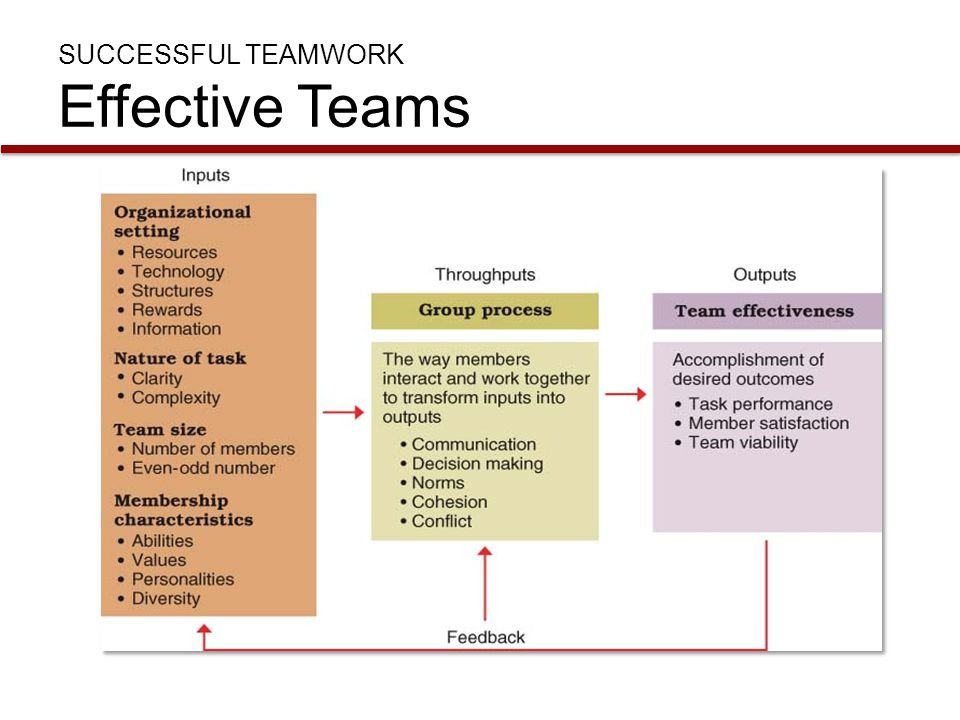
Getting a good start by addressing each of the Inputs is very critical to team success. This is very similar to the open systems view of organizations.

Types of Team

Team is a group of individuals who work together towards a common goal or objective. Team members bring their unique skills, knowledge, and expertise to collaborate, share responsibilities, and contribute to the success of the group. Effective teams rely on communication, trust, and coordination, ensuring that each member’s strengths are leveraged. Teams can be found in various settings, such as workplaces, sports, or community projects. The success of a team is often measured by its ability to achieve its objectives, maintain positive dynamics, and adapt to challenges efficiently.

  • Functional Teams

Functional teams consist of members from the same department or area of expertise. They work on tasks related to their specific function, such as marketing, finance, or human resources. These teams focus on specialized goals and operate within a structured hierarchy. Functional teams are effective for achieving specific, departmental objectives, promoting expertise, and improving efficiency within their area. However, they may face limitations in collaboration across different functions, often leading to silos within an organization.

  • Cross-functional Teams

Cross-functional teams bring together members from different departments or areas of expertise to work on a common project or goal. These teams are designed to solve complex problems that require diverse skills and perspectives. Cross-functional teams encourage collaboration, innovation, and knowledge sharing. They are effective in tackling company-wide challenges or projects but may face difficulties in coordination due to differing priorities, departmental goals, and communication styles.

  • Self-managed Teams

Self-managed teams operate with a high degree of autonomy, with little or no supervision. Members are responsible for setting goals, making decisions, and managing their tasks. These teams are typically empowered to manage their processes, solve problems, and make operational decisions. Self-managed teams promote accountability, innovation, and motivation. However, they require a high level of trust, clear goals, and strong leadership to be successful, as there is less external guidance or direction.

  • Virtual Teams

Virtual teams are composed of members who work remotely and communicate primarily through digital means such as video calls, emails, or collaboration software. These teams may be dispersed geographically, making face-to-face interaction impossible. Virtual teams rely heavily on technology and require strong communication skills and a clear structure to be effective. While they offer flexibility and the ability to tap into global talent, they can face challenges such as miscommunication, time zone differences, and a lack of personal connections.

  • Project Teams

Project teams are formed for the specific purpose of completing a project within a defined timeframe. These teams are typically temporary, disbanding once the project is completed. Members bring expertise from various fields to achieve project objectives. Project teams are often used in industries like construction, software development, and event planning. They offer flexibility and focus but can face challenges in terms of coordination and goal alignment, especially if team members are pulled from other areas with competing priorities.

  • Advisory Teams

Advisory teams are formed to provide expert advice and recommendations on specific topics or issues. They typically do not engage in day-to-day decision-making or implementation but offer valuable insights based on their expertise. Advisory teams are common in fields like research, legal matters, or strategy development. Their role is to guide leadership or project teams with informed recommendations. While advisory teams may not be directly responsible for execution, their advice can significantly influence decision-making and organizational strategy.

  • Problem-solving Teams

Problem-solving teams are created to address specific challenges or issues within an organization. These teams are typically short-term and are formed to identify solutions, make recommendations, and address operational inefficiencies or obstacles. Members of problem-solving teams use their expertise to analyze the situation, suggest solutions, and implement changes. These teams focus on improving processes, resolving conflicts, or addressing specific issues. Effective problem-solving teams rely on strong communication, creativity, and collaboration to generate effective solutions.

  • Task Forces

Task forces are temporary teams formed to address specific, urgent issues or to tackle critical tasks. They often work under tight deadlines to achieve a specific outcome and are disbanded once the objective is accomplished. Task forces are often composed of experts or individuals with specialized skills related to the issue at hand. Their primary goal is to resolve a specific problem, improve an urgent process, or manage a crisis. Task forces are highly focused but can sometimes experience challenges related to resource allocation and time management.

Way of Forming an Effective Team

One of the things that leaders are often pondering is the performance and relationships of their team. Performance indicators show that effective teams will almost always outperform people working individually, particularly in high-pressure situations or when multiple skillsets are needed.

This shouldn’t come as much of a surprise, as most organizations are recognizing the importance of team building and are trying to foster it in the workplace. However, building effective teams requires more than an abstract commitment to teamwork; it requires input from managers to foster it.

Without team building skills, a manager risks limiting the productivity of their employees to what each member can do on their own, whereas if you foster team building you can unite your team around a common goal, which will raise productivity as a result.

So here are five steps to building a productive and effective team this year:

Step 1: Establish leadership

If your employees trust your judgement, they will work effectively even when you’re not around. Before you can start team building, you need to develop the right kind of leadership skills. This doesn’t mean asserting authority, instead try to foster trust through honesty and transparency.  Especially in larger organizations, managers can’t be everywhere at once, but if your employees trust your judgements they will work effectively even when you’re not around.

Step 2: Establish relationships with each of your employees

Try to learn more about each member of your team, their skill sets, how they are motivated and their likes and dislikes. This knowledge is invaluable to leaders, as it allows them to match each employee’s expertise and competencies to specific problems, which will help increase their productivity and job satisfaction.

As well as this, try to include your employees in the decision making process where possible. Instead of delegating tasks, give your team’s open-ended projects and allow them to determine the best solution. This will encourage them to cooperate and develop problem solving skills.

Step 3: Build relationships between your employees

As your team starts to cooperate more, examine the way they work together and take steps to improve communication, cooperation and trust amongst the team. If there are any conflicts, try to resolve them amicably. Listen to both sides of the argument and act as a mediator. One way to do this is to brainstorm solutions, which helps to empower your employees and may lead to new solutions to the problem.

Step 4: Foster teamwork

Once you have established relations with and between your employees, it’s time to help them work together effectively. Encourage your team to share information, both amongst themselves and within the wider organisation.  Also, try to communicate more with your team. This goes beyond simply holding meetings, and includes things like being open to suggestions and concerns, asking about each team member’s work and offering assistance where necessary, and doing everything you can to communicate clearly and honestly with your team.

Step 5: Set ground rules for the team

Finally, you can begin officially establishing your team through creating team values and goals, as well as evaluating team performance alongside individual performance. Be sure to include your team in this process, so they know what’s required and agree with it.

Team building is one of the most important responsibilities a manager has. It isn’t something that can be achieved in a short time and then forgotten. It is an ongoing organic process that you a will have to facilitate and guide. As this process unfolds, however, your team members will begin to trust and support one another and share their skill sets and effort in order to more effectively complete your organization’s goals.

Setting Goals

If you want to succeed, you need to set goals. Without goals you lack focus and direction. Goal setting not only allows you to take control of your life’s direction; it also provides you a benchmark for determining whether you are actually succeeding. Think about it: having a million dollars in the bank is only proof of success if one of your goals is to amass riches. If your goal is to practice acts of charity, then keeping the money for yourself is suddenly contrary to how you would define success.

To accomplish your goals, however, you need to know how to set them. You can’t simply say, “I want” and expect it to happen. Goal setting is a process that starts with careful consideration of what you want to achieve, and ends with a lot of hard work to actually do it. In between, there are some very well-defined steps that transcend the specifics of each goal. Knowing these steps will allow you to formulate goals that you can accomplish.

Here are our five golden rules of goal setting

The Five Golden Rules

  1. Set Goals That Motivate You

When you set goals for yourself, it is important that they motivate you: this means making sure that they are important to you, and that there is value in achieving them. If you have little interest in the outcome, or they are irrelevant given the larger picture, then the chances of you putting in the work to make them happen are slim. Motivation is key to achieving goals.

Set goals that relate to the high priorities in your life. Without this type of focus, you can end up with far too many goals, leaving you too little time to devote to each one. Goal achievement requires commitment, so to maximize the likelihood of success, you need to feel a sense of urgency and have an “I must do this” attitude. When you don’t have this, you risk putting off what you need to do to make the goal a reality. This in turn leaves you feeling disappointed and frustrated with yourself, both of which are de-motivating. And you can end up in a very destructive “I can’t do anything or be successful at anything” frame of mind.

  1. Set SMART Goals

You have probably heard of SMART goals already. But do you always apply the rule? The simple fact is that for goals to be powerful, they should be designed to be SMART. There are many variations of what SMART stands for, but the essence is this – goals should be:

  • Set Specific Goals: Your goal must be clear and well defined. Vague or generalized goals are unhelpful because they don’t provide sufficient direction. Remember, you need goals to show you the way. Make it as easy as you can to get where you want to go by defining precisely where you want to end up.
  • Set Measurable Goals: Include precise amounts, dates, and so on in your goals so you can measure your degree of success. If your goal is simply defined as “To reduce expenses” how will you know when you have been successful? In one month’s time if you have a 1 percent reduction or in two years’ time when you have a 10 percent reduction? Without a way to measure your success you miss out on the celebration that comes with knowing you have actually achieved something.
  • Set Attainable Goals: Make sure that it’s possible to achieve the goals you set. If you set a goal that you have no hope of achieving, you will only demoralize yourself and erode your confidence. However, resist the urge to set goals that are too easy. Accomplishing a goal that you didn’t have to work hard for can be anticlimactic at best, and can also make you fear setting future goals that carry a risk of non-achievement. By setting realistic yet challenging goals, you hit the balance you need. These are the types of goals that require you to “raise the bar” and they bring the greatest personal satisfaction.
  • Set Relevant Goals: Goals should be relevant to the direction you want your life and career to take. By keeping goals aligned with this, you’ll develop the focus you need to get ahead and do what you want. Set widely scattered and inconsistent goals, and you’ll fritter your time – and your life – away.
  • Set Time-Bound Goals: Your goals must have a deadline. Again, this means that you know when you can celebrate success. When you are working on a deadline, your sense of urgency increases and achievement will come that much quicker.
  1. Set Goals in Writing

The physical act of writing down a goal makes it real and tangible. You have no excuse for forgetting about it. As you write, use the word “will” instead of “would like to” or “might.” For example, “I will reduce my operating expenses by 10 percent this year,” not “I would like to reduce my operating expenses by 10 percent this year.” The first goal statement has power and you can “see” yourself reducing expenses, the second lacks passion and gives you an excuse if you get sidetracked.

Post your goals in visible places to remind yourself every day of what it is you intend to do. Put them on your walls, desk, computer monitor, bathroom mirror or refrigerator as a constant reminder.

  1. Make an Action Plan

This step is often missed in the process of goal setting. You get so focused on the outcome that you forget to plan all of the steps that are needed along the way. By writing out the individual steps, and then crossing each one off as you complete it, you’ll realize that you are making progress towards your ultimate goal. This is especially important if your goal is big and demanding, or long-term. Read our article on Action Plans  for more on how to do this.

  1. Stick With It!

Remember, goal setting is an ongoing activity, not just a means to an end. Build in reminders to keep yourself on track, and make regular time-slots available to review your goals. Your end destination may remain quite similar over the long term, but the action plan you set for yourself along the way can change significantly. Make sure the relevance, value, and necessity remain high.

Power and Politics, Manifestations, Impacts, Managing

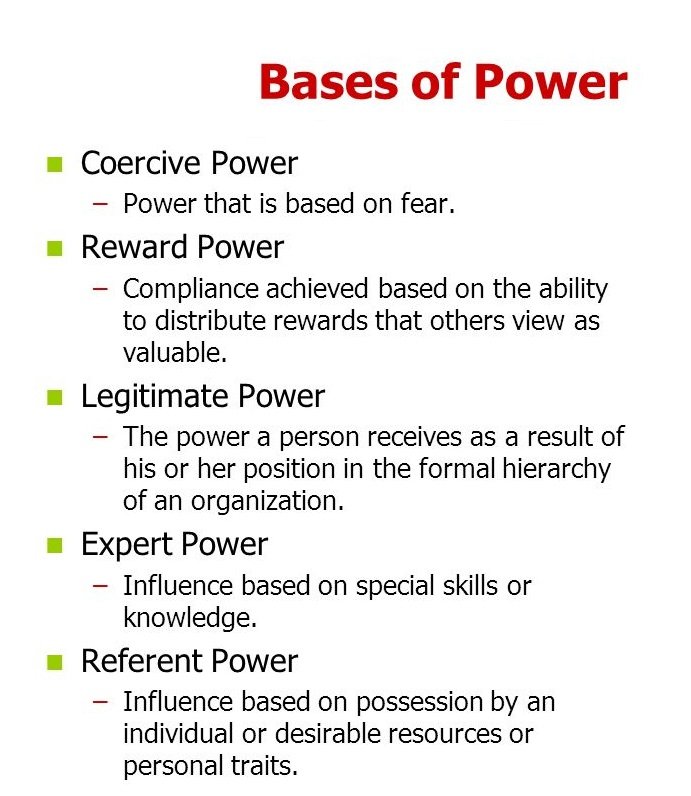
Power refers to the ability of an individual or group to influence or control the behavior of others, either overtly or covertly. Power can manifest in various forms, including legitimate authority derived from one’s position in the organizational hierarchy, expert power stemming from specialized knowledge or skills, referent power based on charisma or personal qualities, reward power through the ability to provide incentives, and coercive power exerted through the threat of punishment.

Politics, on the other hand, encompasses the informal processes through which power is distributed and exercised within an organization. It involves the pursuit and use of power and influence to achieve personal or group goals, often through tactics such as coalition-building, manipulation, or negotiation. While power is often associated with formal authority structures, politics operates within both formal and informal channels, reflecting the complex social dynamics at play in organizations.

Manifestations of Power and Politics:

Power dynamics can manifest in various ways within organizations:

  • Decision-Making:

Power influences who participates in decision-making processes, whose interests are prioritized, and the outcomes of decisions. Those with greater power may exert disproportionate influence over strategic choices and resource allocation, shaping the direction and priorities of the organization.

  • Resource Allocation:

Power plays a role in determining access to and distribution of resources such as funding, staffing, and information. Individuals or groups with more power may control critical resources, using them to further their own agendas or consolidate their influence within the organization.

  • Conflict Resolution:

Power imbalances can affect how conflicts are addressed and resolved within organizations. Those with greater power may have more leverage in negotiations and may be able to impose their preferred solutions, potentially exacerbating tensions and undermining cooperation.

  • Organizational Culture:

Power dynamics shape the norms, values, and behaviors that characterize organizational culture. Cultures that emphasize hierarchy and centralized control may reinforce existing power structures, while those that promote collaboration and empowerment may facilitate more equitable distribution of power.

Impacts of Power and Politics:

The interplay between power and politics can have significant impacts on organizational effectiveness, employee morale, and overall performance:

  • Erosion of Trust:

Excessive politicking and power struggles can erode trust among employees and undermine cooperation and collaboration. When individuals perceive that power is wielded unfairly or manipulatively, they may become disengaged or cynical, impairing organizational cohesion and effectiveness.

  • Decision-Making Biases:

Power dynamics can introduce biases into decision-making processes, as those with more power may prioritize their own interests or perspectives over those of others. This can lead to suboptimal decisions that overlook valuable insights or alternative viewpoints, hindering innovation and adaptability.

  • Resistance to Change:

Power struggles can impede organizational change efforts by creating resistance among those who perceive change as a threat to their power or status. This resistance can manifest in various forms, including passive-aggressive behavior, sabotage, or outright defiance, slowing the pace of change and undermining its success.

  • Inequitable Outcomes:

Unequal distribution of power can result in inequitable outcomes for different individuals or groups within the organization. Marginalized employees may face barriers to advancement or experience discrimination, perpetuating systemic inequalities and hindering diversity and inclusion efforts.

Managing Power and Politics

While power and politics are inherent aspects of organizational life, effective management strategies can help mitigate their negative effects and promote a more inclusive and equitable workplace:

  • Transparent Communication:

Open and transparent communication can help build trust and reduce uncertainty, mitigating the perception of hidden agendas or manipulation. Leaders should strive to communicate openly about decision-making processes, organizational goals, and the rationale behind strategic choices.

  • Fair and Consistent Policies:

Implementing fair and consistent policies and procedures can help minimize perceptions of favoritism or bias, fostering a sense of equity and fairness among employees. Leaders should ensure that performance evaluations, promotions, and resource allocation decisions are based on objective criteria and merit.

  • Empowerment and Inclusivity:

Empowering employees and fostering inclusivity can help redistribute power more equitably within the organization. Leaders should create opportunities for employees to participate in decision-making processes, solicit feedback, and contribute their ideas and perspectives.

  • Conflict Resolution Mechanisms:

Establishing effective conflict resolution mechanisms can help address power struggles and disputes in a constructive manner. Mediation, arbitration, or facilitated dialogue can provide a forum for parties to express their concerns, explore solutions, and reach mutually acceptable resolutions.

  • Ethical Leadership:

Ethical leadership is essential for promoting integrity, accountability, and trust within organizations. Leaders should lead by example, adhering to high ethical standards and modeling behaviors that reflect fairness, honesty, and respect for others.

Bases of power in an Organization

Organizations are made up of individuals that exercise greater or lesser degrees of power. Sometimes, authority stems from a person’s title in the organization, or from specialized knowledge and expertise. Others may exercise power through interpersonal relationships or the force of their personality. And still others gain influence through an ability to grant access to important resources.

Legitimate or Positional Power

Legitimate power is also known as positional power. It’s derived from the position a person holds in an organization’s hierarchy. Job descriptions, for example, require junior workers to report to managers and give managers the power to assign duties to their juniors.

For positional power to be exercised effectively, the person wielding it must be deemed to have earned it legitimately. An example of legitimate power is that held by a company’s CEO.

Expert Power Derived from Possessing Knowledge

Knowledge is power. Expert power is derived from possessing knowledge or expertise in a particular area. Such people are highly valued by organizations for their problem solving skills. People who have expert power perform critical tasks and are therefore deemed indispensable.

The opinions, ideas and decisions of people with expert power are held in high regard by other employees and hence greatly influence their actions. Possession of expert power is normally a stepping stone to other sources of power such as legitimate power. For example, a person who holds expert power can be promoted to senior management, thereby giving him legitimate power.

Referent Power Derived from Interpersonal Relationships

Referent power is derived from the interpersonal relationships that a person cultivates with other people in the organization. People possess reference power when others respect and like them. Referent power arises from charisma, as the charismatic person influences others via the admiration, respect and trust others have for her.

Referent power is also derived from personal connections that a person has with key people in the organization’s hierarchy, such as the CEO. It’s the perception of the personal relationships that she has that generates her power over others.

Coercive Power Derived from Ability to Influence Others

Coercive power is derived from a person’s ability to influence others via threats, punishments or sanctions. A junior staff member may work late to meet a deadline to avoid disciplinary action from his boss. Coercive power is, therefore, a person’s ability to punish, fire or reprimand another employee. Coercive power helps control the behavior of employees by ensuring that they adhere to the organization’s policies and norms.

Reward Power and Ability to Influence Allocation of Incentives

Reward power arises from the ability of a person to influence the allocation of incentives in an organization. These incentives include salary increments, positive appraisals and promotions. In an organization, people who wield reward power tend to influence the actions of other employees.

Reward power, if used well, greatly motivates employees. But if it’s applied through favoritism, reward power can greatly demoralize employees and diminish their output.

error: Content is protected !!