Capital Structure, Meaning, Definitions, Objectives, Types, Importance and Theories

Capital Structure refers to the mix of debt and equity a company uses to finance its operations and growth. It represents the proportion of various sources of capital, such as long-term debt, preferred equity, and common equity, in the total financing of the firm. The structure affects a company’s risk profile, cost of capital, and financial stability. An optimal capital structure balances the benefits and risks associated with debt and equity to maximize shareholder value while maintaining financial flexibility. Factors influencing capital structure include business risk, market conditions, tax considerations, and the cost of raising funds.

Asset’s Structure = Fixed Assets + Current Assets

Meaning of Capital Structure

Capital structure refers to the proportion of debt and equity in a company’s total financing. It represents the mix of long-term funds used to finance assets and operations. Equity includes share capital, retained earnings, and reserves, while debt includes loans, debentures, and bonds. The main objective of capital structure planning is to maximize the value of the firm and minimize the cost of capital while maintaining an appropriate balance between risk and return.

A well-planned capital structure ensures financial stability, flexibility in raising funds, and an optimal balance between ownership control and financial risk. It plays a key role in long-term growth, profitability, and shareholders’ wealth maximization.

Definitions of Capital Structure

1. Weston & Brigham

“Capital structure refers to the composition of a firm’s long-term sources of funds, including debt and equity, and their proportions in total financing.”

2. Solomon Ezra

“Capital structure is the combination of debt and equity maintained by a firm to finance its assets in order to maximize shareholders’ wealth.”

3. James C. Van Horne

“Capital structure is the permanent financing of a firm represented by long-term debt, preferred stock, and net worth.”

4. Gitman

“Capital structure is the mix of debt and equity that a firm uses to finance its operations and growth.”

Objectives of Capital Structure

  • Maximizing Shareholders’ Wealth

The primary objective of capital structure is to maximize shareholders’ wealth by selecting an optimal mix of debt and equity. Proper planning ensures returns on investment exceed the cost of capital. By increasing net earnings and market value of shares, the firm creates long-term value for investors. Decisions that support wealth maximization also attract investors and maintain confidence in the company’s financial management.

  • Minimizing Cost of Capital

Capital structure aims to reduce the overall cost of raising funds. By using a combination of cheaper debt and equity, the Weighted Average Cost of Capital (WACC) can be minimized. Lower financing costs enhance profitability and ensure more funds are available for reinvestment. Minimizing cost of capital improves the feasibility of investment projects and strengthens the financial position of the company.

  • Maintaining Financial Flexibility

An effective capital structure provides financial flexibility, enabling the firm to raise funds in future without stress. Flexibility allows firms to respond to growth opportunities, market changes, or unexpected expenses. A balanced debt-equity mix ensures that the company can borrow further if needed, without excessive financial strain. Financially flexible firms can maintain operations and strategic investments under varying economic conditions.

  • Ensuring Solvency and Stability

Capital structure objectives include maintaining solvency and financial stability. Excessive debt may lead to default, while excessive equity can increase cost. By balancing these sources, firms maintain a stable capital base, ensuring obligations are met without risking bankruptcy. Stability also boosts investor confidence, enhances credit ratings, and provides a secure financial environment for operational and strategic activities.

  • Supporting Growth and Expansion

A well-planned capital structure ensures funds are available for expansion, modernization, and diversification. By providing a reliable source of long-term financing, it supports strategic business growth. The right mix of debt and equity allows investment in profitable projects while maintaining financial balance. Proper capital structure planning encourages sustainable growth and strengthens the firm’s competitive position.

  • Optimizing Risk and Return

Capital structure balances financial risk and expected returns. Debt increases risk due to fixed obligations but can enhance returns through leverage. Equity reduces risk but is more expensive. The objective is to optimize this trade-off so that the company achieves acceptable risk levels while maximizing profitability. Effective capital structure management ensures that financial risk does not outweigh expected returns.

  • Facilitating Dividend Policy

Capital structure influences dividend decisions because retained earnings form part of equity financing. A sound capital structure ensures adequate funds are available for dividend distribution without compromising financial obligations. Firms can maintain a consistent dividend policy that satisfies shareholders while supporting growth projects. This promotes investor confidence and strengthens market reputation.

  • Enhancing Market Reputation

Maintaining an optimal capital structure improves the firm’s credibility in financial markets. Companies with a stable and balanced capital structure are perceived as less risky by investors and lenders. This facilitates easier access to funds in the future at lower costs. Market reputation also enhances shareholder trust, increases stock value, and ensures long-term financial sustainability.

Types of Capital Structure

1. Equity Capital Structure

Equity capital structure consists entirely of funds raised through equity shares and retained earnings. It does not include debt or preference shares. This structure carries no fixed obligations, making it less risky for the firm but more expensive due to higher expected returns by shareholders. Companies with stable profits and a focus on ownership control may prefer equity capital. It is ideal for firms seeking long-term growth without incurring financial risk from debt.

2. Debt Capital Structure

Debt capital structure relies primarily on borrowed funds, such as debentures, long-term loans, and bonds. Interest on debt is a fixed cost and tax-deductible, making it cheaper than equity. However, high reliance on debt increases financial risk due to mandatory interest and principal payments. Companies with stable cash flows may adopt this structure to leverage profits, but excessive debt can lead to insolvency.

3. Preference Share Capital Structure

Preference share capital structure uses preference shares as the main financing source. Preference shareholders receive fixed dividends before equity holders. This structure balances the advantages of debt and equity: it provides fixed income without transferring ownership control. While safer for shareholders than equity, it is costlier than debt. Firms may use preference shares to maintain a moderate risk-return profile while preserving control over the company.

4. Debt-Equity Mix (Balanced Capital Structure)

A balanced capital structure combines debt and equity in optimal proportions. It aims to minimize the cost of capital while controlling financial risk. This structure uses the benefits of debt tax shields and equity flexibility. Most established firms adopt this mix to maintain stability, flexibility, and shareholder confidence. It is considered ideal for maximizing firm value and supporting sustainable growth through an appropriate leverage level.

5. Leveraged Capital Structure (High Debt)

Leveraged capital structure contains a high proportion of debt compared to equity. It is used to maximize returns through financial leverage. While potentially increasing profitability, this structure carries significant financial risk due to fixed interest obligations. Only firms with predictable cash flows, low business risk, and strong credit ratings can safely adopt a highly leveraged structure. Mismanagement can lead to solvency issues.

6. Unleveraged Capital Structure (Equity-Only)

An unleveraged capital structure relies entirely on equity financing, with no debt. It eliminates financial risk and ensures stability, as there are no mandatory interest or repayment obligations. While safer, it is more expensive due to higher expected returns by equity shareholders. Startups or risk-averse firms often adopt this structure to maintain control and reduce the risk of insolvency during initial operations.

7. Hybrid Capital Structure

Hybrid capital structure uses a combination of debt, equity, and preference shares or convertible instruments. This structure provides flexibility, balancing risk, cost, and control. It allows firms to optimize financing based on current market conditions and project needs. Hybrid structures are common in large corporations seeking long-term growth while maintaining stability and reducing reliance on any single source of finance.

8. Permanent or Fixed Capital Structure

Permanent capital structure refers to a long-term, stable financing arrangement where a fixed proportion of capital comes from permanent sources such as equity, retained earnings, and long-term debt. This structure supports strategic planning, financial stability, and predictable funding for ongoing operations. It avoids frequent changes in capital mix, ensuring consistent returns, investor confidence, and ease in raising additional funds when needed.

Importance of Capital Structure:

  • Cost of Capital

Capital structure directly influences the cost of capital for a company. A well-balanced mix of debt and equity minimizes the overall cost of capital, ensuring that funds are acquired at the lowest possible rate. This helps companies to maximize profits and shareholder value. The lower the cost of capital, the higher the return on investment (ROI).

  • Financial Flexibility

A good capital structure provides financial flexibility. It allows a company to raise funds easily in case of future financial needs. Companies with an optimal balance of debt and equity have better access to capital markets for future funding, enabling them to take advantage of new opportunities or manage unforeseen financial challenges.

  • Risk Management

Capital structure affects the level of risk a company is exposed to. A higher proportion of debt increases the financial risk because of the fixed interest payments that must be made regardless of the company’s performance. On the other hand, equity financing reduces financial risk but may dilute ownership. Therefore, finding the right balance is crucial to managing risk effectively.

  • Control and Ownership

The way a company structures its capital impacts control and ownership. Debt financing does not dilute the ownership, as debt holders do not get voting rights in the company. In contrast, issuing more equity results in sharing control, which may lead to reduced decision-making power for the original owners or shareholders. Therefore, the capital structure influences how control is distributed among stakeholders.

  • Impact on Profitability

A well-structured capital mix can enhance profitability by lowering the cost of funds. Debt financing, with its tax-deductible interest, can lead to greater profitability. However, excessive debt may lead to financial distress, undermining profitability. Hence, maintaining an appropriate debt-equity ratio is important for sustaining healthy profits.

  • Market Perception

Capital structure impacts how investors and the market perceive a company. A company with a high level of debt may be viewed as more risky, leading to higher interest rates on new debt issuance and potential declines in stock price. Conversely, a company with too much equity may be seen as inefficient in utilizing capital. Thus, an optimal capital structure enhances the company’s market image and investor confidence.

  • Tax Benefits

One of the significant advantages of using debt in capital structure is the tax-deductible nature of interest payments. This helps reduce a company’s overall tax liability, as interest expenses on debt are deductible from taxable income. This advantage makes debt an attractive option for companies aiming to lower their tax burden.

  • Growth and Expansion

Capital structure plays a crucial role in a company’s ability to grow and expand. Companies with an optimal capital structure can fund large-scale projects or acquisitions through debt without diluting ownership too much. Moreover, a well-managed capital structure can signal financial stability to investors, making it easier to secure funding for future growth initiatives.

Theories of Capital Structure:

1. Net Income (NI) Approach

The Net Income Approach suggests that a company can increase its value by using debt financing because debt is cheaper than equity. The theory asserts that the overall cost of capital decreases as the proportion of debt increases, leading to higher firm value and profitability. According to this approach, companies should maximize the use of debt to reduce their cost of capital and improve shareholders’ wealth. The underlying assumption is that debt does not increase the company’s risk and that the company’s earnings are sufficient to meet the debt obligations.

2. Net Operating Income (NOI) Approach

The Net Operating Income Approach, in contrast to the NI approach, argues that the capital structure has no impact on the overall cost of capital or the value of the firm. According to this theory, changes in the debt-equity ratio do not affect the overall risk of the company. The firm’s value is determined by its operating income (EBIT) and its business risk, rather than its financial structure. The theory suggests that the cost of debt and equity rises proportionally as debt increases, leaving the firm’s total value unchanged.

3. Traditional Approach

The Traditional Approach is a compromise between the NI and NOI approaches. It recognizes that an optimal capital structure exists where the cost of capital is minimized, and the firm’s value is maximized. The theory suggests that moderate levels of debt can reduce the company’s cost of capital by taking advantage of the tax shield on debt. However, beyond a certain point, increasing debt increases the firm’s financial risk, which in turn raises the cost of both debt and equity. The balance between debt and equity at this optimal point minimizes the overall cost of capital.

4. Modigliani-Miller (M&M) Proposition I

Modigliani and Miller’s Proposition I states that in a perfect capital market (no taxes, no bankruptcy costs, and no agency costs), the capital structure of a firm does not affect its overall value. In other words, whether a firm is financed by debt or equity, its total value remains unchanged. The theory assumes that investors can create their own leverage by borrowing or lending on their own, thus making the firm’s financing decisions irrelevant in determining its value.

5. Modigliani-Miller Proposition II (with Taxes)

Modigliani and Miller’s Proposition II builds on their first proposition by introducing the concept of taxes. According to this theory, the value of a firm increases as it uses more debt because interest payments on debt are tax-deductible. This creates a tax shield, lowering the company’s effective cost of debt and increasing its total value. Thus, M&M Proposition II suggests that the firm should increase its debt financing to maximize its value, as long as the firm is operating in a tax environment.

6. Pecking Order Theory

The Pecking Order Theory, proposed by Myers and Majluf, argues that companies prioritize their sources of financing according to the principle of least effort, or least resistance. Firms prefer internal financing (retained earnings) over debt, and debt over equity. The rationale is that issuing new equity can signal a company’s weakness to the market, potentially leading to a decrease in stock price. Therefore, firms first use internal funds, then debt, and only issue equity when all other sources are exhausted.

7. Market Timing Theory

Market Timing Theory suggests that firms make capital structure decisions based on market conditions. According to this theory, firms issue equity when their stock prices are high and issue debt when interest rates are low. Essentially, companies “time” the market to take advantage of favorable conditions. This approach assumes that managers can accurately predict market trends and act in the best interests of the company and its shareholders, though such predictions are difficult to make consistently.

8. Agency Theory

Agency Theory focuses on the relationship between the company’s management and its shareholders, as well as the conflict of interest that can arise between the two parties. According to this theory, debt can serve as a monitoring tool to reduce the agency cost of equity. When a company takes on more debt, management is under greater pressure to perform well and meet its obligations, which can align their interests with those of shareholders. However, excessive debt may lead to a situation where managers focus too much on short-term profitability at the expense of long-term shareholder value.

Key differences between Profit Maximization and Wealth Maximization

Profit Maximization

Profit Maximization is a fundamental objective of financial management, focusing on increasing a firm’s earnings in the short or long term. It involves making decisions and strategies aimed at maximizing the financial surplus generated by the business. This concept is traditionally viewed as the primary goal of any enterprise, as it ensures the firm’s survival, growth, and ability to reward stakeholders.

Features of Profit Maximization

  1. Short-Term Focus: It primarily emphasizes achieving higher profits in the immediate future.
  2. Decision-Making Goal: All business decisions, such as pricing, cost control, and investment allocation, are directed toward maximizing returns.
  3. Simple and Clear Objective: It provides a straightforward criterion for measuring business success.

Importance of Profit Maximization

  1. Survival and Growth: Profits provide the capital necessary for sustaining operations, expanding activities, and exploring new markets.
  2. Reward to Stakeholders: Higher profits enable better returns for shareholders and adequate compensation for employees.
  3. Business Valuation: Profitability boosts the market value of the firm, attracting investors and enhancing creditworthiness.
  4. Economic Development: Increased profits lead to higher tax contributions, investments, and employment opportunities, contributing to overall economic progress.

Limitations of Profit Maximization

  1. Neglects Long-Term Goals: A focus solely on profits may lead to short-term strategies that could harm the firm’s sustainability.
  2. Ignores Risk and Uncertainty: It does not consider risks associated with financial decisions or the uncertainty of future returns.
  3. Lack of Social Responsibility: Profit maximization may lead to unethical practices, such as exploiting labor or harming the environment, to achieve financial gains.
  4. No Consideration for Stakeholders’ Interests: It prioritizes profits over the well-being of employees, customers, and society at large.
  5. Limited Measurement of Success: Solely focusing on profits may overlook other critical aspects, such as customer satisfaction, innovation, and brand value.

Wealth Maximization:

Wealth Maximization is a modern financial management objective that focuses on increasing the net worth and long-term value of a firm for its shareholders. Unlike profit maximization, which prioritizes short-term earnings, wealth maximization emphasizes sustainable growth by considering risk, time value of money, and broader stakeholder interests. It aligns closely with the goals of value creation and financial stability.

Concepts of Wealth Maximization:

  1. Shareholder Value: Wealth maximization is centered around increasing the wealth of shareholders by enhancing the market value of shares.
  2. Long-Term Focus: This approach prioritizes the firm’s long-term success over immediate profits.
  3. Time Value of Money: It incorporates the concept that the value of money today is different from its value in the future due to inflation and opportunity cost.
  4. Risk and Return: Wealth maximization considers the trade-off between risk and expected returns, ensuring optimal financial decisions.

Importance of Wealth Maximization:

  1. Sustainable Growth: By focusing on long-term objectives, wealth maximization ensures sustained profitability and business growth.
  2. Stakeholder Benefits: It creates value not only for shareholders but also for employees, customers, and society through better products, innovation, and responsible practices.
  3. Risk Management: The approach evaluates potential risks in financial decisions, promoting prudent strategies that safeguard the firm’s future.
  4. Economic Contribution: Wealth maximization contributes to economic development by driving investments, generating employment, and increasing tax revenues.

Advantages of Wealth Maximization

  1. Comprehensive Goal: It encompasses profitability, risk management, and sustainability, offering a holistic view of financial success.
  2. Improved Market Reputation: A focus on value creation enhances the firm’s reputation, attracting investors, customers, and talented employees.
  3. Better Financial Decisions: By incorporating risk and time value, wealth maximization ensures well-informed and strategic decisions.
  4. Alignment with Stakeholder Interests: It balances the interests of shareholders, customers, employees, and society, fostering trust and goodwill.

Limitations of Wealth Maximization

  1. Market Fluctuations: Shareholder wealth depends on market conditions, which can be influenced by external factors beyond the firm’s control.
  2. Complexity in Measurement: Determining true wealth creation involves assessing market value, risk-adjusted returns, and intangible factors, making it complex.
  3. Potential for Short-Termism: Despite its long-term focus, pressure from shareholders or management may lead to short-term strategies to boost share prices temporarily.
  4. Neglect of Non-Financial Goals: Although comprehensive, wealth maximization may overlook certain ethical or social responsibilities if not balanced properly.

Key difference between Profit Maximization and Wealth Maximization

Basis of Comparison Profit Maximization Wealth Maximization
Definition Focus on maximizing short-term profit Focus on maximizing long-term wealth
Objective Immediate returns Sustainable growth
Time Horizon Short-term Long-term
Scope Limited Broader
Risk Consideration Ignores risk Considers risk
Decision Basis Accounting profit Cash flows
Focus Revenue and costs Shareholder value
Sustainability Less sustainable More sustainable
Stakeholder Focus Shareholders only Shareholders and other stakeholders
Uncertainty Management Overlooks uncertainty Includes uncertainty
Market Value Impact Minimal impact Enhances market value
Ethics and Responsibility Secondary Integral
Measurement Accounting standards Market valuation
Objective Clarity Ambiguous Clear
Strategic Alignment Operational Strategic

Theories of Dividend decisions

Dividend decisions refer to the strategic choices a company makes regarding the distribution of its profits to shareholders in the form of dividends or retaining them for reinvestment in the business. These decisions play a crucial role in financial management as they influence shareholder satisfaction, market perception, and the company’s growth potential. A balanced dividend policy ensures that adequate returns are provided to shareholders while retaining enough earnings for business expansion and stability. Factors such as profitability, cash flow, growth opportunities, and market expectations significantly impact these decisions, highlighting their importance in achieving long-term corporate objectives.

Some of the major different theories of dividend in financial management are as follows: 

1. Walter’s model

2. Gordon’s model

3. Modigliani and Miller’s hypothesis.

1. Walter’s model:

Professor James E. Walter argues that the choice of dividend policies almost always affects the value of the enterprise. His model shows clearly the importance of the relationship between the firm’s internal rate of return (r) and its cost of capital (k) in determining the dividend policy that will maximise the wealth of shareholders.

Walter’s Model Assumptions:

  1. The firm finances all investment through retained earnings; that is debt or new equity is not issued;
  2. The firm’s internal rate of return (r), and its cost of capital (k) are constant;
  3. All earnings are either distributed as dividend or reinvested internally immediately.
  4. Beginning earnings and dividends never change. The values of the earnings pershare (E), and the divided per share (D) may be changed in the model to determine results, but any given values of E and D are assumed to remain constant forever in determining a given value.
  5. The firm has a very long or infinite life.

Walter’s formula to determine the market price per share (P) is as follows:

P = D/K +r(E-D)/K/K

The above equation clearly reveals that the market price per share is the sum of the present value of two sources of income:

i) The present value of an infinite stream of constant dividends, (D/K) and

ii) The present value of the infinite stream of stream gains.

[r (E-D)/K/K]

Criticism:

  1. Walter’s model of share valuation mixes dividend policy with investment policy of the firm. The model assumes that the investment opportunities of the firm are financed by retained earnings only and no external financing debt or equity is used for the purpose when such a situation exists either the firm’s investment or its dividend policy or both will be sub-optimum. The wealth of the owners will maximise only when this optimum investment in made.
  2. Walter’s model is based on the assumption that r is constant. In fact decreases as more investment occurs. This reflects the assumption that the most profitable investments are made first and then the poorer investments are made.

The firm should step at a point where r = k. This is clearly an erroneous policy and fall to optimise the wealth of the owners.

  1. A firm’s cost of capital or discount rate, K, does not remain constant; it changes directly with the firm’s risk. Thus, the present value of the firm’s income moves inversely with the cost of capital. By assuming that the discount rate, K is constant, Walter’s model abstracts from the effect of risk on the value of the firm.

2. Gordon’s Model:

One very popular model explicitly relating the market value of the firm to dividend policy is developed by Myron Gordon.

Assumptions:

Gordon’s model is based on the following assumptions.

  1. The firm is an all Equity firm
  2. No external financing is available
  3. The internal rate of return (r) of the firm is constant.
  4. The appropriate discount rate (K) of the firm remains constant.
  5. The firm and its stream of earnings are perpetual
  6. The corporate taxes do not exist.
  7. The retention ratio (b), once decided upon, is constant. Thus, the growth rate (g) = br is constant forever.
  8. K > br = g if this condition is not fulfilled, we cannot get a meaningful value for the share.

According to Gordon’s dividend capitalisation model, the market value of a share (Pq) is equal to the present value of an infinite stream of dividends to be received by the share. Thus:

6.1.jpg

The above equation explicitly shows the relationship of current earnings (E,), dividend policy, (b), internal profitability (r) and the all-equity firm’s cost of capital (k), in the determination of the value of the share (P0).

3. Modigliani and Miller’s hypothesis:

According to Modigliani and Miller (M-M), dividend policy of a firm is irrelevant as it does not affect the wealth of the shareholders. They argue that the value of the firm depends on the firm’s earnings which result from its investment policy.

Thus, when investment decision of the firm is given, dividend decision the split of earnings between dividends and retained earnings is of no significance in determining the value of the firm. M – M’s hypothesis of irrelevance is based on the following assumptions.

  1. The firm operates in perfect capital market
  2. Taxes do not exist
  3. The firm has a fixed investment policy
  4. Risk of uncertainty does not exist. That is, investors are able to forecast future prices and dividends with certainty and one discount rate is appropriate for all securities and all time periods. Thus, r = K = Kt for all t.

Under M – M assumptions, r will be equal to the discount rate and identical for all shares. As a result, the price of each share must adjust so that the rate of return, which is composed of the rate of dividends and capital gains, on every share will be equal to the discount rate and be identical for all shares.

Thus, the rate of return for a share held for one year may be calculated as follows:

6.2.jpg

Where P^ is the market or purchase price per share at time 0, P, is the market price per share at time 1 and D is dividend per share at time 1. As hypothesised by M – M, r should be equal for all shares. If it is not so, the low-return yielding shares will be sold by investors who will purchase the high-return yielding shares.

This process will tend to reduce the price of the low-return shares and to increase the prices of the high-return shares. This switching will continue until the differentials in rates of return are eliminated. This discount rate will also be equal for all firms under the M-M assumption since there are no risk differences.

From the above M-M fundamental principle we can derive their valuation model as follows:

6.3.jpg

Multiplying both sides of equation by the number of shares outstanding (n), we obtain the value of the firm if no new financing exists.

6.4.jpg

If the firm sells m number of new shares at time 1 at a price of P^, the value of the firm at time 0 will be

6.5

The above equation of M – M valuation allows for the issuance of new shares, unlike Walter’s and Gordon’s models. Consequently, a firm can pay dividends and raise funds to undertake the optimum investment policy. Thus, dividend and investment policies are not confounded in M – M model, like waiter’s and Gordon’s models.

Criticism:

Because of the unrealistic nature of the assumption, M-M’s hypothesis lacks practical relevance in the real world situation. Thus, it is being criticised on the following grounds.

  1. The assumption that taxes do not exist is far from reality.
  2. M-M argue that the internal and external financing are equivalent. This cannot be true if the costs of floating new issues exist.
  3. According to M-M’s hypothesis the wealth of a shareholder will be same whether the firm pays dividends or not. But, because of the transactions costs and inconvenience associated with the sale of shares to realise capital gains, shareholders prefer dividends to capital gains.
  4. Even under the condition of certainty it is not correct to assume that the discount rate (k) should be same whether firm uses the external or internal financing.

If investors have desire to diversify their port folios, the discount rate for external and internal financing will be different.

  1. M-M argues that, even if the assumption of perfect certainty is dropped and uncertainty is considered, dividend policy continues to be irrelevant. But according to number of writers, dividends are relevant under conditions of uncertainty.

Time Value of Money: Compounding, Discounting

Time Value of Money (TVM) is a financial principle that recognizes the value of money changes over time due to its earning potential. A sum of money today is worth more than the same amount in the future because it can be invested to earn interest or generate returns. TVM forms the foundation of various financial decisions, including investment appraisals, loan calculations, and savings growth. It relies on concepts like present value (PV), future value (FV), discounting, and compounding to quantify the impact of time on money’s worth, ensuring sound financial planning and resource allocation.

Need of Time Value of Money (TVM):

  • Investment Decision-Making

TVM is critical for evaluating investment opportunities by comparing the present value of future returns. Investors need to determine if the returns from an investment justify the risk and time involved. Concepts like Net Present Value (NPV) and Internal Rate of Return (IRR) are used to assess the profitability of projects based on future cash flows.

  • Loan and Mortgage Calculations

When obtaining loans or mortgages, TVM helps calculate the equated monthly installments (EMIs), interest, and principal repayments over time. Financial institutions use TVM principles to structure loan terms and interest rates that balance affordability and profitability.

  • Retirement Planning

Planning for retirement requires estimating how much to save today to meet future financial needs. TVM helps in calculating the future value of current savings and determining the present value of future retirement expenses, ensuring adequate funds are available during retirement.

  • Inflation Adjustment

Inflation erodes the purchasing power of money over time. TVM accounts for inflation by discounting future cash flows to reflect their real value. This adjustment ensures accurate financial planning and investment decisions that consider the changing economic environment.

  • Business Valuation

TVM is essential for valuing businesses and their assets. Future cash flows generated by a business are discounted to determine their present value, providing insights into the company’s worth. This is crucial for mergers, acquisitions, and investor decision-making.

  • Capital Budgeting

Organizations use TVM to assess the feasibility of long-term projects. By discounting future costs and benefits, companies can prioritize projects that offer the highest returns relative to their initial investment, ensuring efficient allocation of resources.

  • Savings and Wealth Accumulation

TVM aids individuals in understanding the growth potential of their savings through compounding. By starting to save or invest early, individuals can take advantage of compound interest to maximize wealth accumulation over time.

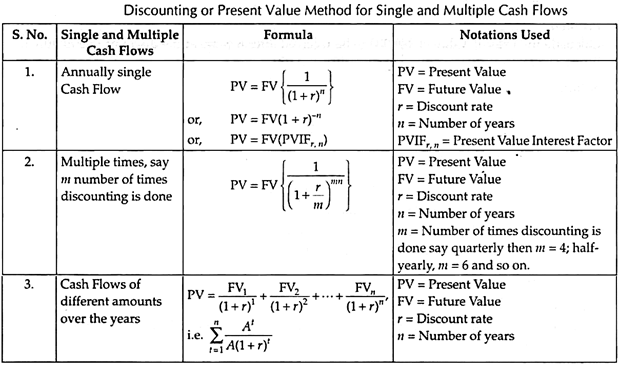
Discounting or Present Value Method

The current value of an expected amount of money to be received at a future date is known as Present Value. If we expect a certain sum of money after some years at a specific interest rate, then by discounting the Future Value we can calculate the amount to be invested today, i.e., the current or Present Value.

Hence, Discounting Technique is the method that converts Future Value into Present Value. The amount calculated by Discounting Technique is the Present Value and the rate of interest is the discount rate.

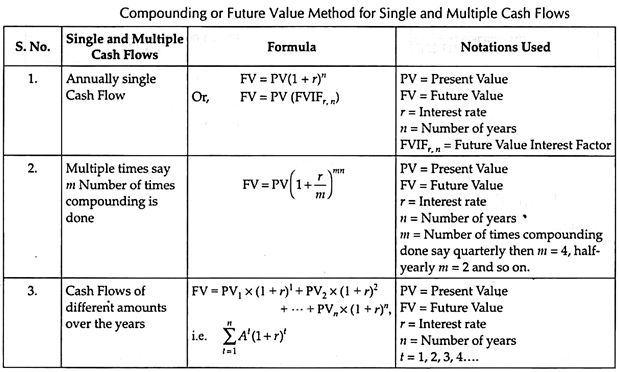
Compounding or Future Value Method

Compounding is just the opposite of discounting. The process of converting Present Value into Future Value is known as compounding.

Future Value of a sum of money is the expected value of that sum of money invested after n number of years at a specific compound rate of interest.

Key differences between Compounding and Discounting:

Basis of Comparison Compounding Discounting
Definition Future value (FV) Present value (PV)
Focus Value growth Value reduction
Process Adding interest Removing interest
Direction Present to future Future to present
Use Investment growth Valuation analysis
Formula FV = PV × (1 + r)^n PV = FV ÷ (1 + r)^n
Objective Maximize returns Evaluate worth today
Application Savings, investments Loan, cash flow eval
Time Horizon Future-oriented Current-oriented
Example Bank deposits Bond valuation

Meaning of Risk, Risk Vs Uncertainty

Risk, in the context of finance and investment, refers to the uncertainty regarding the financial returns or outcomes of an investment, and the potential for an investor to experience losses or gains different from what was initially expected. It is a fundamental concept that underpins nearly all financial decisions and strategies. The essence of risk is the variability of returns, which can be influenced by a myriad of factors, including economic changes, market volatility, political instability, and specific events affecting individual companies or industries.

Dimensions and Types of Risk:

  • Market Risk (Systematic Risk):

This type of risk affects all investments to some degree because it is linked to factors that impact the entire market, such as economic recessions, interest rate changes, political turmoil, and natural disasters. Market risk is inherent and cannot be eliminated through diversification.

  • Credit Risk (Default Risk):

Credit risk arises when there is a possibility that a borrower will default on their debt obligations, leading to losses for the lender. It is a significant consideration in bond investing and lending activities.

  • Liquidity Risk:

Liquidity risk refers to the potential difficulty in buying or selling an asset without causing a significant movement in its price. Investments in thinly traded or illiquid markets are particularly susceptible to this risk.

  • Operational Risk:

This risk stems from internal processes, people, and systems, or from external events that could disrupt a company’s operations. It includes risks from business operations, fraud, legal risks, and environmental risks.

  • Country and Political Risk:

Investments across different countries are subject to risks from political instability, changes in government policy, taxation laws, and currency fluctuations.

  • Interest Rate Risk:

This is the risk that changes in interest rates will affect the value of fixed-income securities. Generally, as interest rates rise, the value of fixed-income securities falls, and vice versa.

Risk is quantified and managed through various statistical measures and techniques, such as standard deviation, beta, value at risk (VaR), and stress testing. These measures help investors and managers understand the volatility of investments and the potential for losses.

Understanding and managing risk is crucial for achieving investment objectives. While risk cannot be completely avoided, it can be managed and mitigated through strategies such as diversification, asset allocation, and hedging. Diversification, for instance, involves spreading investments across various asset classes and securities to reduce the impact of any single investment’s poor performance on the overall portfolio.

Investors’ attitudes towards risk, known as risk tolerance, vary widely. Some are risk-averse, preferring investments with lower returns but less variability in returns. Others are more risk-tolerant, willing to accept higher volatility for the chance of higher returns. Identifying one’s risk tolerance is a critical step in developing an investment strategy that aligns with one’s financial goals and comfort level with uncertainty.

Uncertainty

Uncertainty refers to situations where the outcomes, probabilities, or implications of events are unknown or cannot be precisely quantified. It permeates various aspects of life and decision-making, especially prominent in economics, finance, and strategic planning. In these contexts, uncertainty arises due to incomplete information about the future, unpredictability of external factors, or complexity in underlying systems. Unlike risk, which can often be measured or assigned probabilities based on historical data or models, uncertainty defies precise calculation, making it challenging for individuals and organizations to make informed decisions.

In financial markets, uncertainty can stem from volatile economic conditions, political instability, or unforeseen global events, leading to erratic market behaviors. For businesses, strategic uncertainty might arise from unpredictable consumer preferences, technological innovation, or regulatory changes. The presence of uncertainty requires flexibility, robust contingency planning, and sometimes, a tolerance for making decisions without clear outcomes. Coping strategies include diversification, scenario planning, and maintaining liquidity. Understanding that uncertainty is an inherent part of decision-making processes is crucial, as it encourages the development of adaptive strategies and resilience in the face of the unknown.

Risk Vs. Uncertainty

Aspect Risk Uncertainty
Nature Quantifiable Not quantifiable
Probability Measurable Not measurable
Information Available Insufficient or unavailable
Decision-making Based on probabilities Often based on judgment
Predictability Higher Lower
Management Possible through diversification Requires contingency planning
Outcome Potential for estimation Outcomes unknown
Economic Models Often applicable Less applicable
Financial Tools Risk assessment tools available Limited tools for measurement
Investment Strategy Can be optimized More reliant on flexibility
Impact on planning Can be incorporated into plans Plans must allow for adjustments
Example Market risk, credit risk Political instability, technological innovation

Financial System and Economic Development

The financial system is crucial to the economic development of a country as it facilitates the efficient allocation of resources, mobilizes savings, enables investments, and supports the creation of wealth. It consists of financial institutions, markets, instruments, and regulatory frameworks that together create an environment conducive to economic growth.

Role of Financial Institutions

Financial institutions, which include banks, insurance companies, pension funds, and other non-banking financial companies, play a pivotal role in economic development. They act as intermediaries between savers and borrowers, channeling funds from those with surplus capital to those in need of capital for productive use. Banks, for instance, accept deposits and extend credit to businesses and consumers, facilitating investment in new ventures and supporting existing businesses in expansion efforts. These activities are fundamental to job creation, wealth generation, and the overall growth of the economy.

Financial Markets and Their Impact

Financial markets, encompassing the stock market, bond market, and derivative market, provide a platform for buying and selling financial assets efficiently. These markets ensure that capital is allocated to its most productive uses by enabling price discovery through the mechanisms of demand and supply. Efficient financial markets stimulate economic growth by providing individuals and corporations with access to capital. For example, the equity market enables companies to raise capital by issuing stocks, while government and corporate bonds in the bond market fund various activities without directly taxing citizens and businesses.

The liquidity provided by financial markets also helps in risk management. Derivatives markets allow businesses to hedge against risks associated with currency fluctuations, interest rates, and other economic variables. This risk mitigation is crucial for stable business planning and investment.

Mobilization of Savings

One of the fundamental aspects of a financial system is its ability to mobilize savings. Financial institutions offer various savings instruments that attract idle funds from individuals and institutions. These savings are then directed towards investment opportunities. Mobilization not only pools financial resources but also facilitates their distribution across the economy, ensuring that these resources are available for productive investment rather than remaining idle.

Investment Facilitation

The efficient facilitation of investment is a direct function of a robust financial system. By providing information, managing risks, and allocating resources efficiently, financial systems lower the cost of capital and reduce the barriers to investment. This environment encourages both domestic and foreign investments, driving economic growth. Moreover, by offering a variety of investment products, financial systems enable diversification, which reduces the risk of investment portfolios and stabilizes the economy.

Technological Advancements and Financial Innovation

Technological advancements have significantly influenced the effectiveness of financial systems. Financial technology (fintech) innovations such as digital banking, mobile money, and blockchain technology have revolutionized traditional financial services, making them more accessible, faster, and cheaper. For instance, mobile money services have dramatically increased financial inclusion in developing countries by providing financial services to people without access to traditional banking facilities.

Additionally, fintech innovations contribute to better financial data management and fraud prevention systems, enhancing the overall health of the financial system. The increased efficiency and security provided by these technological tools support economic growth by building trust and encouraging wider participation in the financial system.

Regulatory Framework and Stability

A sound regulatory framework is essential for maintaining the stability and integrity of the financial system. Regulatory bodies ensure that financial institutions operate in a safe and sound manner, adhering to policies that mitigate risks such as excessive leverage, liquidity crises, and insolvencies. For example, central banks monitor monetary policy and interest rates to control inflation and stabilize the currency, which are vital for economic growth.

Effective regulation also fosters consumer confidence in the financial system, encouraging more active participation in financial activities. It protects investors and consumers from potential losses due to fraudulent activities or unfair practices, further enhancing the system’s stability.

Financial Inclusion

Financial inclusion is a critical aspect that underscores the link between financial systems and economic development. An inclusive financial system ensures that financial services are accessible to all segments of society, including the underprivileged and those living in remote areas. This inclusion supports poverty reduction and wealth equality by providing everyone with opportunities for economic participation and risk mitigation.

Challenges and Recommendations

Despite the significant role of the financial system in economic development, there are challenges that must be addressed to harness its full potential. These include financial crises, which can lead to severe economic downturns, and disparities in financial inclusion. Regulatory challenges also persist, as too stringent regulations might stifle innovation, whereas lax regulations could lead to instability.

To optimize the financial system’s role in economic development, continuous regulatory improvements are necessary to balance stability with innovation. There should also be a concerted effort to enhance financial literacy, which will enable more people to participate effectively in the financial system. Furthermore, leveraging technology to extend financial services, especially in underserved regions, will promote greater financial inclusion and, by extension, economic development.

Financial Decision Making-1 Osmania University B.com 5th Semester Notes

Unit 1 Financial Statement Analysis {Book}
Basic Financial Statement Analysis VIEW
Common size financial statements VIEW
Common base year financial statements VIEW
Financial Ratios: VIEW
Liquidity Ratio VIEW
Leverage Ratio VIEW
Activity Ratio VIEW
Profitability Ratios VIEW
Solvency Ratio VIEW
Market Profitability analysis VIEW
Income measurement analysis VIEW
Revenue analysis VIEW
Cost of sales analysis VIEW
Expense analysis VIEW
Variation analysis VIEW VIEW
Special issues:
Impact of foreign operations VIEW VIEW
Effects of changing prices and inflation VIEW VIEW
Off-balance sheet financing VIEW
Impact of changes in accounting treatment VIEW
Accounting and Economic concepts of value and income VIEW
Earnings quality VIEW


Unit 2 Financial Management {Book}
Risk & Return VIEW VIEW VIEW
Calculating return VIEW
Types of risk VIEW
Relationship between Risk and Return VIEW VIEW
Long-term Financial Management: VIEW
Term structure of interest rates VIEW
Types of financial instruments VIEW VIEW
Cost of capital VIEW VIEW
Valuation of financial instruments VIEW


Unit 3 Raising Capital {Book}
Raising Capital VIEW VIEW
Financial markets VIEW VIEW VIEW
Financial markets regulation VIEW
Market efficiency VIEW
Financial institutions VIEW VIEW
Initial and secondary public offerings VIEW VIEW
Secondary public offerings VIEW
Dividend policy VIEW VIEW VIEW
share repurchases VIEW
Lease financing VIEW VIEW


Unit 4 Working Capital Management {Book}
Managing working capital VIEW VIEW
Cash Management VIEW VIEW
Marketable Securities management VIEW
Accounts Receivable Management VIEW VIEW
Inventory management VIEW VIEW VIEW
Short-term Credit: VIEW
Types of short-term credit VIEW
Short-term credit management VIEW


Unit 5 Corporate Restructuring and International Finance {Book}
Corporate Restructuring VIEW
Mergers and acquisitions VIEW
Bankruptcy VIEW VIEW
Other forms of restructuring VIEW
International Finance VIEW
Fixed, flexible, and floating exchange rates VIEW VIEW
Managing transaction exposure VIEW
Financing international trade VIEW
Tax implications of transfer pricing VIEW


Factors affecting Investment Decisions in Portfolio Management

Age

Age is a decisive factor as it will define your financial priorities and what are your goals. This will further define the characteristics of the kind of assets you will purchase. For a younger person, assets which can give long-term returns will be preferable as he has that many years left, whereas, for an older person, assets with income features will be most helpful. Most assets such as equities and bonds can be defined as per the age requirement in the form of mutual funds.

Risk tolerance

This is a very important factor as it will determine if and how much you can invest in risk assets. Most assets which give high returns are also highly risks. This creates a need to assess how much of a loss can you bear on an asset. If your capital gets wiped out it should not affect your financial stability and wealth status. That is how you will get started on understanding your risk appetite.

  • Usually, it is found that older people, lower income group people will have lower risk appetite as the earning power is less,
  • There can be exceptions to the above rule when the person has savings earmarked for investment or inheritance allows the person to invest in more risky assets
  • People with a longer working age left should look at equities as it will give a long-term benefit of accumulation and the number of economic cycles will give more benefit of capital appreciation

Time horizon

This aspect is related to fulfilling of specific financial goals and how much time is left for their fulfillment. If a goal has to say 3 years left to arrive, it makes sense to put the capital in bonds or income funds to ensure the capital safety. 3 years might be a short period to earn a substantial return from the equity market. But one might be able to find a diversified mutual fund which can not only sustain the capital in a good market but also give good returns.

The time horizon starts when the investment portfolio is implemented and ends when the investor will need to take the money out. The length of time you will be investing is important because it can directly affect your ability to reduce risk. Longer time horizons allow you to take on greater risks Þ with a greater total return potential Þ because some of that risk can be reduced by investing across different market environments. If the time horizon is short, the investor has greater liquidity needs Þ some attractive opportunities of earning higher return has to be sacrificed and the result is reduced in return. Time horizons tend to vary over the life-cycle. Younger investors who are only accumulating savings for retirement have long time horizons, and no real liquidity needs except for short-term emergencies. However, younger investors who are also saving for a specific event, such as the purchase of a house or a child’s education, may have greater liquidity needs. Similarly, investors who are planning to retire, and those who are in retirement and living on their investment income, have greater liquidity needs.

Return Needs

This refers to whether the investor needs to emphasize growth or income. Younger investors who are accumulating savings will want returns that tend to emphasize growth and higher total returns, which primarily are provided by equity shares. Retirees who depend on their investment portfolio for part of their annual income will want consistent annual payouts, such as those from bonds and dividend-paying stocks. Of course, many individuals may want a blending of the two Þ some current income, but also some growth.

Criteria for Investment, Objectives, Types

Criteria for investment refer to the set of guidelines or principles that investors use to evaluate and select securities or assets for their portfolios. These criteria are crucial for making informed decisions that align with an investor’s financial goals, risk tolerance, and investment horizon. Common criteria include the expected return on investment, which measures the potential income or profit from an investment relative to its cost. Risk assessment is another vital criterion, involving the evaluation of the uncertainty in the investment’s returns, including the possibility of losing some or all of the original investment. Diversification is considered to ensure a well-balanced portfolio that can mitigate risks by spreading investments across various asset classes or sectors. Liquidity, or the ease with which an investment can be converted into cash without significantly affecting its price, is also a key consideration. Lastly, the investment’s time horizon, or the expected duration until the investment goal is realized, influences the selection of suitable investments.

Objectives of Investment Criteria:

  • Maximizing Returns:

One of the primary objectives is to identify investments that offer the best potential for high returns, given the investor’s risk appetite. This involves evaluating expected income, capital gains, and total return prospects of various assets.

  • Risk Management:

Criteria for investment help in assessing and managing the risks associated with different investment options. By understanding the risk-reward ratio, investors aim to select investments that match their risk tolerance levels, ensuring they are comfortable with the potential outcomes.

  • Portfolio Diversification:

A critical objective is to achieve a diversified portfolio that can withstand market volatility. By spreading investments across different asset classes, sectors, or geographies, investors can reduce the impact of a poor performance in any single investment.

  • Liquidity Considerations:

Ensuring investments meet liquidity requirements is vital. This means selecting assets that can be easily converted into cash without significant losses, especially important for investors who may need to access their funds within a short timeframe.

  • Alignment with Financial Goals:

Investment criteria aim to align selections with the investor’s specific financial objectives, whether for retirement, purchasing a home, funding education, or other goals. This involves choosing investments with appropriate maturity, yield, and risk characteristics to meet these goals.

  • Tax Efficiency:

Another objective is to consider the tax implications of investments. Criteria might include seeking tax-advantaged investments or strategies to minimize the tax burden, thereby enhancing overall returns.

Types of Investment Criteria:

  • Financial Return:

This type involves criteria focused on the financial performance of the investment, including return on investment (ROI), net present value (NPV), internal rate of return (IRR), and payback period. These criteria help investors evaluate the profitability and efficiency of their investments.

  • Risk Assessment:

These criteria involve the analysis of the potential risk associated with an investment. This includes understanding the volatility of returns, credit risk, market risk, and liquidity risk. Investors use risk assessment criteria to match investments with their risk tolerance levels.

  • Market Conditions:

This type focuses on evaluating investments based on current and anticipated market conditions. Criteria might include market trends, economic indicators, sector performance, and geopolitical factors. This helps investors to align their investments with broader market dynamics.

  • Tax Implications:

Investment criteria can also consider the tax implications of investments. This includes understanding the tax treatment of investment income, capital gains, and any available tax advantages or implications for specific investment vehicles.

  • Social and Ethical Considerations:

These criteria involve evaluating investments based on ethical, social, and governance (ESG) factors. Investors who prioritize sustainability and ethical considerations might focus on companies with strong ESG practices.

  • Liquidity Needs:

Liquidity criteria focus on how easily an investment can be converted into cash. This is crucial for investors who may need to access their funds within a certain timeframe without incurring significant losses.

  • Diversification:

This type of criterion emphasizes the importance of spreading investments across various asset classes, industries, or geographies to mitigate risk. Diversification helps in reducing the impact of poor performance in any single investment on the overall portfolio.

  • Time Horizon:

Investment criteria can also be based on the investor’s time horizon, which is the expected time frame for holding an investment. Short-term investors may prioritize liquidity and lower-risk investments, while long-term investors might focus on growth potential and compounding returns.

Capital Turnover Criterion

Capital Turnover is a measure of how efficiently a business uses its capital to generate revenue. It’s calculated by dividing the total sales or revenue of a company by its average total shareholders’ equity or total assets, depending on the specific focus. A higher capital turnover ratio indicates that a company is efficiently using its capital to generate sales.

The primary objective of focusing on capital turnover is to assess the efficiency with which a company is utilizing its capital to generate revenue. Investors and managers aim to maximize capital turnover, indicating that minimal capital is needed to generate higher sales volumes, which can be a sign of operational efficiency and potentially higher profitability.

Capital Intensity Criterion

Capital Intensity, on the other hand, refers to the amount of fixed or total assets required to generate a specific level of sales or revenue. It is essentially the inverse of the capital turnover ratio and can be calculated by dividing the total assets by total sales. A higher capital intensity indicates that a company needs more assets to generate sales, which can signify a heavy investment in physical or fixed assets relative to its revenue.

The objective of assessing capital intensity is to understand the extent of investment in assets needed to maintain or grow the business. It provides insight into the business model’s scalability and the potential barriers to entry for new competitors. A company with high capital intensity might face higher fixed costs, potentially affecting its flexibility and profitability.

Implications

  • For Investors:

Understanding these metrics helps investors evaluate a company’s operational efficiency and potential return on investment. Companies with high capital turnover might be seen as more efficient, potentially offering higher returns on invested capital.

  • For Management:

For the management team, these metrics can guide strategic decisions regarding capital investments, cost management, and operational improvements. Balancing capital turnover and intensity is crucial for sustaining growth and competitive advantage.

Time Series Criterion

Time Series Criterion is a method used in security analysis and portfolio management to evaluate investments based on historical data patterns over a period of time. It involves analyzing the performance of securities or assets by observing their behavior and trends over consecutive time intervals, such as days, weeks, months, or years.

The primary objective of the Time Series Criterion is to identify patterns, trends, and relationships in historical data that can help investors make informed decisions about future performance. By examining past price movements, trading volumes, and other relevant metrics, investors seek to predict future price movements and assess the risk-return profile of potential investments.

Components:

  1. Historical Data:

Time series analysis relies on historical data of the security or asset being analyzed. This data typically includes price data, trading volumes, and other relevant financial metrics recorded at regular intervals over a specified time period.

  1. Data Analysis Techniques:

Various statistical and analytical techniques are employed to analyze the historical data and identify patterns or trends. This may include methods such as moving averages, trend analysis, volatility analysis, and autocorrelation analysis.

  1. Pattern Recognition:

The Time Series Criterion involves identifying recurring patterns or trends in the historical data, such as upward or downward trends, cyclical patterns, or seasonal variations. By recognizing these patterns, investors aim to predict future price movements and make informed investment decisions.

  1. Forecasting:

Based on the analysis of historical data patterns, investors may attempt to forecast future price movements or returns for the security or asset being evaluated. This forecasting can help investors assess the potential risk and return of an investment and adjust their investment strategies accordingly.

Implications:

  • Risk Management:

Time series analysis can help investors identify and assess risks associated with investments by examining historical volatility and price movements. Understanding past patterns can provide insights into potential future risks and uncertainties.

  • Portfolio Optimization:

By incorporating time series analysis into portfolio management strategies, investors can optimize their portfolios by selecting assets with favorable historical performance characteristics and diversifying across different assets and asset classes.

  • Trading Strategies:

Time series analysis is often used in the development of trading strategies, such as trend-following or momentum-based strategies, which capitalize on identified patterns and trends in historical data to generate trading signals.

Factors Influencing Selection of Investment Alternatives

Investment alternatives refer to the various financial vehicles and assets that individuals and institutions can allocate their funds to with the aim of generating returns or preserving capital. These alternatives encompass a broad spectrum of options, including traditional investments like stocks, bonds, and real estate, as well as more sophisticated or non-traditional assets such as private equity, hedge funds, commodities, and digital currencies like cryptocurrencies. The choice among these alternatives depends on factors like the investor’s financial goals, risk tolerance, investment horizon, and market conditions. Diversifying across different investment alternatives can help investors manage risk and achieve a balanced investment portfolio.

Selection of investment alternatives is influenced by a multitude of factors, each significant in guiding investors toward making decisions that align with their financial goals, risk tolerance, and market outlook. Understanding these factors is crucial for constructing a well-balanced and effective investment portfolio.

  • Investment Objectives

The primary factor influencing investment choice is the investor’s objectives, which include capital appreciation, income generation, safety of capital, and tax considerations. Investors seeking steady income might prefer bonds or dividend-paying stocks, whereas those aiming for long-term growth may lean towards equities or real estate investments.

  • Risk Tolerance

Risk tolerance is the degree of variability in investment returns that an investor is willing to withstand. This varies greatly among individuals and influences the choice of investment. Risk-averse investors might favor bonds or fixed deposits, while risk-takers might opt for stocks, commodities, or cryptocurrencies.

  • Time Horizon

The investment time horizon refers to the expected period an investment will be held before the capital is needed again. Long-term investors might be more inclined to invest in equities or real estate, given their potential for higher returns over time, despite short-term volatility. Short-term investors might prefer more liquid and less volatile investments, like money market funds or short-term bonds.

  • Liquidity Needs

Liquidity refers to how quickly and easily an investment can be converted into cash without significant loss in value. Investors with higher liquidity needs might prefer investments that can be easily sold or redeemed, such as stocks or ETFs, over less liquid options like real estate or certain private investments.

  • Market Conditions

Economic indicators, market trends, and financial market conditions play a significant role in investment selection. For example, in a bullish stock market, investors might favor equities, while in a bear market or during economic downturns, the preference might shift towards bonds or other safer assets.

  • Tax Considerations

The tax implications of investments can significantly affect net returns. Different investment vehicles have different tax treatments regarding capital gains, dividends, and interest income. Investors need to consider how their investment choices align with their tax planning strategies.

  • Diversification Needs

Diversification is a strategy used to reduce risk by allocating investments among various financial instruments, industries, and other categories. An investor’s desire to diversify their portfolio will influence their choice of investments, encouraging a mix of asset classes to spread risk.

  • Financial Situation and Capital Availability

The investor’s financial situation, including available capital and existing financial obligations, will influence investment choices. Those with limited capital might prefer direct stock purchases, ETFs, or mutual funds, which allow investment with smaller outlays, over real estate or private equity, which require significant capital.

  • Knowledge and Experience

An investor’s familiarity with different investment vehicles and their confidence in understanding market movements can greatly influence their choices. Experienced investors might explore options like options trading, foreign exchange, or alternative investments, while beginners might stick to more straightforward options like mutual funds or index funds.

  • Economic and Political Climate

Global and local economic indicators, political stability, interest rates, inflation, and monetary policies can influence investment decisions. For instance, in times of political instability or high inflation, investors might gravitate towards safer, more conservative investments like gold or government bonds.

Major factors influencing investments by firms:

  • Financial Objectives

Firms prioritize investments that align with their financial objectives, such as revenue growth, profitability improvement, and value maximization for shareholders. Investments are evaluated based on their potential to contribute to these goals.

  • Market Conditions

Economic and market conditions play a significant role in investment decisions. Factors such as market demand, competition, and overall economic health influence the attractiveness of investment opportunities.

  • Capital Availability

The availability of capital, both internally generated funds and external financing options, is a critical factor. Firms with access to substantial capital can pursue more, and often larger, investment opportunities.

  • Risk Tolerance

The level of risk a firm is willing to undertake influences its investment choices. Companies may shy away from high-risk projects unless the potential returns justify the risks involved.

  • Regulatory Environment

Regulations and legal considerations can impact the feasibility and attractiveness of investment opportunities. Compliance costs and potential regulatory changes are significant considerations.

  • Technological Advancements

Technological trends and advancements can create new investment opportunities or render existing operations obsolete. Firms must consider how technological changes affect their industry and investment strategy.

  • Interest Rates

The cost of borrowing is a key consideration for firms looking at external financing for their investments. Lower interest rates make debt financing more attractive, potentially influencing the timing and scale of investments.

  • Taxation Policies

Tax incentives for certain types of investments or sectors can make those options more attractive. Conversely, high tax burdens can deter investment in specific areas.

  • Strategic Fit

Investments must align with the firm’s strategic goals, competencies, and long-term vision. Investments that are a good strategic fit are more likely to receive approval and funding.

  • Time Horizon

The expected time frame for seeing returns on an investment influences decision-making. Projects with quicker paybacks may be preferred in uncertain markets, while long-term investments might be prioritized for strategic growth areas.

  • Global Events

Events such as geopolitical tensions, pandemics, and international trade agreements can influence investment decisions by affecting global markets, supply chains, and consumer behavior.

  • Sustainability and Corporate Social Responsibility (CSR)

Increasingly, firms consider the environmental and social impact of their investments. Sustainable practices and positive social contributions can enhance a firm’s reputation and align with investor values.

error: Content is protected !!