Over Capitalization Meaning, Causes, Consequences, Remedies

Over Capitalization occurs when a company has more capital (both debt and equity) than it can effectively utilize to generate earnings or value. This leads to a lower rate of return on capital, making the business inefficient. The excess capital can manifest in a higher-than-necessary stock issuance, borrowing at uncompetitive rates, or inflating the company’s capital base, resulting in an inflated value of the business that does not reflect its true earning potential.

In such cases, the company may face several financial issues, including a reduced ability to meet debt obligations, stagnant stock prices, and the inability to use resources effectively to generate profits. Over capitalization may result from poor planning, overoptimistic growth expectations, or mismanagement.

Causes of Over Capitalization:

  • Issuance of Excessive Equity Shares:

One of the primary causes of over capitalization is the issuance of too many shares relative to the company’s earning potential. When a firm issues more shares to raise capital, it increases the total capital in circulation, which may not align with its profitability. If the company cannot generate enough profits to sustain the high number of shares, over capitalization results.

  • Excessive Debt Financing:

Relying heavily on debt can lead to over capitalization if a company borrows more than it can reasonably repay from its earnings. This increases the financial obligations, and if earnings do not match the debt levels, it can lead to difficulties in servicing the debt, thus overloading the company’s capital base.

  • Inflated Asset Valuation:

Sometimes, companies overestimate the value of their assets when raising capital. When the valuation of assets is inflated, the company may raise more funds than needed, resulting in an excessive capital base. This is often seen in the case of mergers or acquisitions where the value of acquired assets is overstated.

  • Overestimation of Earnings Potential:

Over capitalization can also result from overly optimistic forecasts regarding the company’s earnings. If a business expects rapid growth or higher profitability than what is achievable, it may raise excessive funds to support this expected growth. When the expected returns do not materialize, over capitalization occurs.

  • Lack of Proper Financial Planning:

Poor financial planning, or a lack of financial discipline, often leads to over capitalization. Companies may fail to assess their actual capital needs thoroughly, raising more capital than they can utilize effectively. This may stem from management’s inability to forecast capital requirements accurately.

  • Unrealistic Expansion Plans:

Companies planning to expand aggressively may raise more capital than required in anticipation of higher returns from expansion. If the expansion does not meet projections or fails to generate the expected growth, the business becomes overcapitalized with surplus capital that cannot be deployed effectively.

  • Mismanagement of Funds:

In some cases, mismanagement or poor allocation of funds may lead to over capitalization. Companies may take on excessive capital without a clear strategy for how to deploy it, resulting in an unproductive capital base.

Consequences of Over Capitalization

  • Low Rate of Return on Capital:

The most significant consequence of over capitalization is a low or insufficient rate of return on capital. When a company has more capital than it can utilize effectively, the returns generated from this capital will be less than what the investors expect, leading to a decrease in profitability.

  • Decline in Earnings Per Share (EPS):

Over capitalization can lead to a fall in earnings per share (EPS) due to the larger number of shares in circulation. As the company struggles to generate enough profits, the earnings are diluted across a greater number of shares, decreasing the value for existing shareholders.

  • Reduced Dividends:

Companies that are overcapitalized may have to reduce or even eliminate dividend payouts to shareholders. This is because excessive capital results in a lower return on investment, which diminishes the company’s ability to distribute profits in the form of dividends.

  • Decreased Market Value of Shares:

The market often recognizes when a company is overcapitalized. Excess capital relative to earnings potential leads to the perception that the business is inefficient. This results in a decline in the market value of shares, as investors realize that the company cannot generate enough profits to justify its capital structure.

  • Difficulty in Servicing Debt:

In the case of debt over capitalization, the company may find it challenging to service its debt obligations. Excessive debt burdens may lead to an inability to meet interest payments or repay principal amounts, which can result in liquidity issues and even bankruptcy.

  • Inefficiency in Capital Deployment:

With an excessive amount of capital, companies may struggle to deploy funds effectively in growth or operational improvements. This inefficient allocation of resources leads to missed opportunities for profitability and expansion, exacerbating the over capitalization issue.

  • Loss of Confidence Among Stakeholders:

Over capitalization often results in a lack of confidence from investors, lenders, and other stakeholders. The company’s inability to generate adequate returns on the capital invested can cause a decline in investor trust, leading to a reduction in share prices, difficulty in raising additional funds, and overall poor business performance.

Remedies for Over Capitalization

  • Reduction in Share Capital:

One of the most common remedies for over capitalization is the reduction of share capital. Companies may reduce the number of shares in circulation through a share buyback or consolidation of shares (also known as a stock split). By doing so, the company reduces the excess capital and improves the EPS, thereby increasing shareholder value.

  • Debt Restructuring:

Over capitalized companies with excessive debt may need to restructure their debt. This could involve renegotiating the terms of the debt to extend repayment periods, reduce interest rates, or convert some of the debt into equity. This can help reduce the financial burden and improve the company’s liquidity.

  • Issuance of Bonus Shares:

Issuing bonus shares can help address over capitalization by redistributing the excess capital into shareholder equity, which can lead to a more balanced capital structure. Bonus shares allow the company to give back capital to its shareholders in the form of additional shares, rather than keeping excessive capital on the books.

  • Improved Earnings and Operational Efficiency:

Companies should focus on improving their operational efficiency and earnings to match the capital invested. Streamlining operations, reducing waste, and focusing on profitable growth can help increase the returns on the capital base, addressing the issue of over capitalization.

  • Return of Excess Capital to Shareholders:

If a company finds that it has excess capital that it cannot efficiently utilize, it may consider returning it to shareholders through dividends or capital reduction programs. This will help align the capital base with the company’s true earnings potential and improve financial performance.

  • Review of Capital Structure:

Companies should periodically review their capital structure to ensure it aligns with their operational needs. A more balanced mix of equity and debt, without overreliance on either, can help optimize the cost of capital and financial stability, preventing over capitalization.

  • Strategic Expansion and Investment:

A company facing over capitalization should evaluate its expansion plans and investments carefully. Investments should be made in areas that offer a clear path to generating substantial returns. By focusing on high-return projects, companies can utilize their capital efficiently and avoid excess capital accumulation.

Under Capitalization Meaning, Causes, Consequences, Remedies

Under Capitalization occurs when a company’s capital base (both equity and debt) is inadequate relative to its operations, expansion needs, or potential earnings. When a firm is undercapitalized, it lacks the necessary funds to support its business activities, maintain operations, and pursue growth opportunities. As a result, it may rely heavily on external debt or short-term financing, often leading to financial instability.

A business that is undercapitalized may not be able to meet its financial obligations such as paying suppliers, paying employee wages, servicing debts, or investing in needed assets. It can also be unable to seize profitable investment opportunities or compete effectively with better-capitalized competitors. In the long run, under capitalization can result in a decline in market share, profitability, and overall business performance.

Causes of Under Capitalization:

  • Inadequate Equity Investment:

The primary cause of under capitalization is insufficient equity investment by the owners or shareholders. If a company relies too heavily on debt and does not have enough equity capital, it can result in under capitalization. Equity provides a financial cushion to absorb losses and support operations in case of unforeseen events, while debt brings in fixed obligations.

  • Over-reliance on Short-Term Debt:

Companies that rely on short-term debt to meet their operational requirements are at risk of under capitalization. Short-term debt does not provide long-term stability and can lead to liquidity crises when it is due for repayment. Over-reliance on such debt may cause companies to run out of cash, especially if they are unable to generate sufficient profits.

  • Low Retained Earnings:

When companies do not reinvest their profits into the business or have low retained earnings, it limits their ability to build up their equity base. As a result, they may become undercapitalized and find it difficult to raise capital to meet their future needs. Insufficient reinvestment in the business limits growth and deprives the company of the funds required to cover operational expenses.

  • Inefficient Capital Structure:

An inefficient capital structure, with too much short-term debt and too little long-term equity, can cause under capitalization. Companies that rely on borrowed funds to finance their operations may be unable to generate enough returns to cover their interest expenses and repay debt, leading to under capitalization. A well-balanced mix of equity and long-term debt is essential for avoiding this issue.

  • External Economic Factors:

Under capitalization can also result from external economic factors such as inflation, market downturns, or changes in government policies. For example, during an economic recession, a company may experience a decline in revenues, which makes it difficult to raise adequate capital. Similarly, regulatory changes may limit a company’s access to financing or increase the cost of capital.

  • Lack of Planning and Forecasting:

Companies that fail to plan and forecast their capital requirements accurately are prone to under capitalization. Inaccurate assessments of capital needs may lead businesses to raise insufficient funds, which hampers their ability to expand, operate smoothly, or meet future financial obligations.

  • Unrealistic Valuation and Market Perception:

A company’s inability to properly value itself or its growth prospects can contribute to under capitalization. For instance, if a business overestimates its future cash flows or undervalues its current market position, it may struggle to attract the necessary investment. The market perception of a company’s worth can also influence its ability to raise capital.

Consequences of Under Capitalization

  • Liquidity Problems:

The most immediate consequence of under capitalization is liquidity problems. When a company does not have enough capital to support its operations, it may struggle to pay its creditors, employees, or suppliers. This creates a vicious cycle of financial instability, as the company may resort to borrowing at high-interest rates, leading to further financial strain.

  • Inability to Seize Growth Opportunities:

Under capitalized firms are often unable to take advantage of profitable growth opportunities. Without the necessary funds to invest in new projects, research and development, or acquisitions, they miss out on potential market share and long-term profitability. This inability to grow at the same rate as competitors can lead to stagnation and, eventually, business failure.

  • Higher Operational Costs:

Due to an insufficient capital base, under capitalized companies may be forced to borrow money at higher interest rates. These higher costs of borrowing increase the firm’s operational expenses, reducing profitability. The need for short-term debt may also lead to additional administrative and financing costs, further eroding the company’s financial position.

  • Reduced Market Confidence:

When investors and creditors recognize that a company is undercapitalized, it diminishes their confidence in the company’s ability to manage financial risks. As a result, stock prices may fall, and the firm’s creditworthiness may be downgraded, making it harder to raise capital in the future. Low investor confidence also results in lower valuations of the company’s assets and equity.

  • Inability to Meet Financial Obligations:

A business that is undercapitalized may find it challenging to meet its financial obligations such as paying interest on debt, dividends to shareholders, or salaries to employees. The inability to meet these obligations could lead to a loss of goodwill, a decline in customer trust, and eventually the company’s inability to remain in business.

  • Competitive Disadvantage:

Companies with inadequate capital struggle to compete with well-capitalized firms that have the resources to fund research and development, marketing, and expansion activities. Under capitalization limits the company’s ability to innovate and stay competitive in the marketplace, putting it at a significant disadvantage.

  • Bankruptcy or Liquidation:

If under capitalization persists over time and financial problems worsen, the business may face bankruptcy or forced liquidation. Undercapitalized firms are more vulnerable to financial distress during periods of economic downturns, competitive pressures, or operational challenges. They may be unable to pay off their debts and, as a result, may be forced to close down their operations.

Remedies for Under Capitalization

  • Raising Additional Capital:

The most direct remedy for under capitalization is raising additional capital. Companies can do this by issuing more shares (equity financing) or raising long-term debt. Equity financing helps increase the capital base without the pressure of fixed interest payments, while long-term debt can provide the funds needed to stabilize operations. A balanced mix of both equity and debt is ideal for financing the company’s growth.

  • Restructuring Debt:

Companies facing under capitalization may benefit from debt restructuring, which involves renegotiating the terms of existing debt to lower interest rates, extend repayment periods, or even convert some debt into equity. This reduces the pressure of fixed financial obligations and allows the company to focus on long-term growth.

  • Increase Retained Earnings:

To address under capitalization in the long term, companies should increase their retained earnings by reinvesting profits back into the business rather than distributing them as dividends. By retaining more of their profits, companies can gradually build a stronger equity base and reduce reliance on external financing.

  • Cutting Operational Costs:

If a company is undercapitalized, it can improve its financial position by cutting unnecessary operational costs. Cost control measures, such as improving operational efficiency, reducing waste, and automating processes, can free up funds that can be reinvested into the business to improve profitability.

  • Strategic Partnerships and Joint Ventures:

Entering into strategic partnerships or joint ventures with other firms can help undercapitalized companies raise capital and access new markets. By pooling resources with a partner, a company can reduce the financial burden of expansion and increase its capital base.

  • Equity Financing through Private Placements:

Companies that are not publicly traded can raise capital through private placements by offering equity to a select group of investors. This can provide the necessary funds without the need for a public offering, allowing the business to grow and improve its financial position.

  • Improve Financial Planning and Forecasting:

To avoid under capitalization, companies should focus on improving their financial planning and forecasting. This includes accurately estimating capital needs, anticipating future cash flows, and maintaining a balanced capital structure. By ensuring they have the right amount of capital at the right time, businesses can avoid under capitalization and its negative consequences.

Capital Structure, Meaning, Definitions, Objectives, Types, Importance and Theories

Capital Structure refers to the mix of debt and equity a company uses to finance its operations and growth. It represents the proportion of various sources of capital, such as long-term debt, preferred equity, and common equity, in the total financing of the firm. The structure affects a company’s risk profile, cost of capital, and financial stability. An optimal capital structure balances the benefits and risks associated with debt and equity to maximize shareholder value while maintaining financial flexibility. Factors influencing capital structure include business risk, market conditions, tax considerations, and the cost of raising funds.

Asset’s Structure = Fixed Assets + Current Assets

Meaning of Capital Structure

Capital structure refers to the proportion of debt and equity in a company’s total financing. It represents the mix of long-term funds used to finance assets and operations. Equity includes share capital, retained earnings, and reserves, while debt includes loans, debentures, and bonds. The main objective of capital structure planning is to maximize the value of the firm and minimize the cost of capital while maintaining an appropriate balance between risk and return.

A well-planned capital structure ensures financial stability, flexibility in raising funds, and an optimal balance between ownership control and financial risk. It plays a key role in long-term growth, profitability, and shareholders’ wealth maximization.

Definitions of Capital Structure

1. Weston & Brigham

“Capital structure refers to the composition of a firm’s long-term sources of funds, including debt and equity, and their proportions in total financing.”

2. Solomon Ezra

“Capital structure is the combination of debt and equity maintained by a firm to finance its assets in order to maximize shareholders’ wealth.”

3. James C. Van Horne

“Capital structure is the permanent financing of a firm represented by long-term debt, preferred stock, and net worth.”

4. Gitman

“Capital structure is the mix of debt and equity that a firm uses to finance its operations and growth.”

Objectives of Capital Structure

  • Maximizing Shareholders’ Wealth

The primary objective of capital structure is to maximize shareholders’ wealth by selecting an optimal mix of debt and equity. Proper planning ensures returns on investment exceed the cost of capital. By increasing net earnings and market value of shares, the firm creates long-term value for investors. Decisions that support wealth maximization also attract investors and maintain confidence in the company’s financial management.

  • Minimizing Cost of Capital

Capital structure aims to reduce the overall cost of raising funds. By using a combination of cheaper debt and equity, the Weighted Average Cost of Capital (WACC) can be minimized. Lower financing costs enhance profitability and ensure more funds are available for reinvestment. Minimizing cost of capital improves the feasibility of investment projects and strengthens the financial position of the company.

  • Maintaining Financial Flexibility

An effective capital structure provides financial flexibility, enabling the firm to raise funds in future without stress. Flexibility allows firms to respond to growth opportunities, market changes, or unexpected expenses. A balanced debt-equity mix ensures that the company can borrow further if needed, without excessive financial strain. Financially flexible firms can maintain operations and strategic investments under varying economic conditions.

  • Ensuring Solvency and Stability

Capital structure objectives include maintaining solvency and financial stability. Excessive debt may lead to default, while excessive equity can increase cost. By balancing these sources, firms maintain a stable capital base, ensuring obligations are met without risking bankruptcy. Stability also boosts investor confidence, enhances credit ratings, and provides a secure financial environment for operational and strategic activities.

  • Supporting Growth and Expansion

A well-planned capital structure ensures funds are available for expansion, modernization, and diversification. By providing a reliable source of long-term financing, it supports strategic business growth. The right mix of debt and equity allows investment in profitable projects while maintaining financial balance. Proper capital structure planning encourages sustainable growth and strengthens the firm’s competitive position.

  • Optimizing Risk and Return

Capital structure balances financial risk and expected returns. Debt increases risk due to fixed obligations but can enhance returns through leverage. Equity reduces risk but is more expensive. The objective is to optimize this trade-off so that the company achieves acceptable risk levels while maximizing profitability. Effective capital structure management ensures that financial risk does not outweigh expected returns.

  • Facilitating Dividend Policy

Capital structure influences dividend decisions because retained earnings form part of equity financing. A sound capital structure ensures adequate funds are available for dividend distribution without compromising financial obligations. Firms can maintain a consistent dividend policy that satisfies shareholders while supporting growth projects. This promotes investor confidence and strengthens market reputation.

  • Enhancing Market Reputation

Maintaining an optimal capital structure improves the firm’s credibility in financial markets. Companies with a stable and balanced capital structure are perceived as less risky by investors and lenders. This facilitates easier access to funds in the future at lower costs. Market reputation also enhances shareholder trust, increases stock value, and ensures long-term financial sustainability.

Types of Capital Structure

1. Equity Capital Structure

Equity capital structure consists entirely of funds raised through equity shares and retained earnings. It does not include debt or preference shares. This structure carries no fixed obligations, making it less risky for the firm but more expensive due to higher expected returns by shareholders. Companies with stable profits and a focus on ownership control may prefer equity capital. It is ideal for firms seeking long-term growth without incurring financial risk from debt.

2. Debt Capital Structure

Debt capital structure relies primarily on borrowed funds, such as debentures, long-term loans, and bonds. Interest on debt is a fixed cost and tax-deductible, making it cheaper than equity. However, high reliance on debt increases financial risk due to mandatory interest and principal payments. Companies with stable cash flows may adopt this structure to leverage profits, but excessive debt can lead to insolvency.

3. Preference Share Capital Structure

Preference share capital structure uses preference shares as the main financing source. Preference shareholders receive fixed dividends before equity holders. This structure balances the advantages of debt and equity: it provides fixed income without transferring ownership control. While safer for shareholders than equity, it is costlier than debt. Firms may use preference shares to maintain a moderate risk-return profile while preserving control over the company.

4. Debt-Equity Mix (Balanced Capital Structure)

A balanced capital structure combines debt and equity in optimal proportions. It aims to minimize the cost of capital while controlling financial risk. This structure uses the benefits of debt tax shields and equity flexibility. Most established firms adopt this mix to maintain stability, flexibility, and shareholder confidence. It is considered ideal for maximizing firm value and supporting sustainable growth through an appropriate leverage level.

5. Leveraged Capital Structure (High Debt)

Leveraged capital structure contains a high proportion of debt compared to equity. It is used to maximize returns through financial leverage. While potentially increasing profitability, this structure carries significant financial risk due to fixed interest obligations. Only firms with predictable cash flows, low business risk, and strong credit ratings can safely adopt a highly leveraged structure. Mismanagement can lead to solvency issues.

6. Unleveraged Capital Structure (Equity-Only)

An unleveraged capital structure relies entirely on equity financing, with no debt. It eliminates financial risk and ensures stability, as there are no mandatory interest or repayment obligations. While safer, it is more expensive due to higher expected returns by equity shareholders. Startups or risk-averse firms often adopt this structure to maintain control and reduce the risk of insolvency during initial operations.

7. Hybrid Capital Structure

Hybrid capital structure uses a combination of debt, equity, and preference shares or convertible instruments. This structure provides flexibility, balancing risk, cost, and control. It allows firms to optimize financing based on current market conditions and project needs. Hybrid structures are common in large corporations seeking long-term growth while maintaining stability and reducing reliance on any single source of finance.

8. Permanent or Fixed Capital Structure

Permanent capital structure refers to a long-term, stable financing arrangement where a fixed proportion of capital comes from permanent sources such as equity, retained earnings, and long-term debt. This structure supports strategic planning, financial stability, and predictable funding for ongoing operations. It avoids frequent changes in capital mix, ensuring consistent returns, investor confidence, and ease in raising additional funds when needed.

Importance of Capital Structure:

  • Cost of Capital

Capital structure directly influences the cost of capital for a company. A well-balanced mix of debt and equity minimizes the overall cost of capital, ensuring that funds are acquired at the lowest possible rate. This helps companies to maximize profits and shareholder value. The lower the cost of capital, the higher the return on investment (ROI).

  • Financial Flexibility

A good capital structure provides financial flexibility. It allows a company to raise funds easily in case of future financial needs. Companies with an optimal balance of debt and equity have better access to capital markets for future funding, enabling them to take advantage of new opportunities or manage unforeseen financial challenges.

  • Risk Management

Capital structure affects the level of risk a company is exposed to. A higher proportion of debt increases the financial risk because of the fixed interest payments that must be made regardless of the company’s performance. On the other hand, equity financing reduces financial risk but may dilute ownership. Therefore, finding the right balance is crucial to managing risk effectively.

  • Control and Ownership

The way a company structures its capital impacts control and ownership. Debt financing does not dilute the ownership, as debt holders do not get voting rights in the company. In contrast, issuing more equity results in sharing control, which may lead to reduced decision-making power for the original owners or shareholders. Therefore, the capital structure influences how control is distributed among stakeholders.

  • Impact on Profitability

A well-structured capital mix can enhance profitability by lowering the cost of funds. Debt financing, with its tax-deductible interest, can lead to greater profitability. However, excessive debt may lead to financial distress, undermining profitability. Hence, maintaining an appropriate debt-equity ratio is important for sustaining healthy profits.

  • Market Perception

Capital structure impacts how investors and the market perceive a company. A company with a high level of debt may be viewed as more risky, leading to higher interest rates on new debt issuance and potential declines in stock price. Conversely, a company with too much equity may be seen as inefficient in utilizing capital. Thus, an optimal capital structure enhances the company’s market image and investor confidence.

  • Tax Benefits

One of the significant advantages of using debt in capital structure is the tax-deductible nature of interest payments. This helps reduce a company’s overall tax liability, as interest expenses on debt are deductible from taxable income. This advantage makes debt an attractive option for companies aiming to lower their tax burden.

  • Growth and Expansion

Capital structure plays a crucial role in a company’s ability to grow and expand. Companies with an optimal capital structure can fund large-scale projects or acquisitions through debt without diluting ownership too much. Moreover, a well-managed capital structure can signal financial stability to investors, making it easier to secure funding for future growth initiatives.

Theories of Capital Structure:

1. Net Income (NI) Approach

The Net Income Approach suggests that a company can increase its value by using debt financing because debt is cheaper than equity. The theory asserts that the overall cost of capital decreases as the proportion of debt increases, leading to higher firm value and profitability. According to this approach, companies should maximize the use of debt to reduce their cost of capital and improve shareholders’ wealth. The underlying assumption is that debt does not increase the company’s risk and that the company’s earnings are sufficient to meet the debt obligations.

2. Net Operating Income (NOI) Approach

The Net Operating Income Approach, in contrast to the NI approach, argues that the capital structure has no impact on the overall cost of capital or the value of the firm. According to this theory, changes in the debt-equity ratio do not affect the overall risk of the company. The firm’s value is determined by its operating income (EBIT) and its business risk, rather than its financial structure. The theory suggests that the cost of debt and equity rises proportionally as debt increases, leaving the firm’s total value unchanged.

3. Traditional Approach

The Traditional Approach is a compromise between the NI and NOI approaches. It recognizes that an optimal capital structure exists where the cost of capital is minimized, and the firm’s value is maximized. The theory suggests that moderate levels of debt can reduce the company’s cost of capital by taking advantage of the tax shield on debt. However, beyond a certain point, increasing debt increases the firm’s financial risk, which in turn raises the cost of both debt and equity. The balance between debt and equity at this optimal point minimizes the overall cost of capital.

4. Modigliani-Miller (M&M) Proposition I

Modigliani and Miller’s Proposition I states that in a perfect capital market (no taxes, no bankruptcy costs, and no agency costs), the capital structure of a firm does not affect its overall value. In other words, whether a firm is financed by debt or equity, its total value remains unchanged. The theory assumes that investors can create their own leverage by borrowing or lending on their own, thus making the firm’s financing decisions irrelevant in determining its value.

5. Modigliani-Miller Proposition II (with Taxes)

Modigliani and Miller’s Proposition II builds on their first proposition by introducing the concept of taxes. According to this theory, the value of a firm increases as it uses more debt because interest payments on debt are tax-deductible. This creates a tax shield, lowering the company’s effective cost of debt and increasing its total value. Thus, M&M Proposition II suggests that the firm should increase its debt financing to maximize its value, as long as the firm is operating in a tax environment.

6. Pecking Order Theory

The Pecking Order Theory, proposed by Myers and Majluf, argues that companies prioritize their sources of financing according to the principle of least effort, or least resistance. Firms prefer internal financing (retained earnings) over debt, and debt over equity. The rationale is that issuing new equity can signal a company’s weakness to the market, potentially leading to a decrease in stock price. Therefore, firms first use internal funds, then debt, and only issue equity when all other sources are exhausted.

7. Market Timing Theory

Market Timing Theory suggests that firms make capital structure decisions based on market conditions. According to this theory, firms issue equity when their stock prices are high and issue debt when interest rates are low. Essentially, companies “time” the market to take advantage of favorable conditions. This approach assumes that managers can accurately predict market trends and act in the best interests of the company and its shareholders, though such predictions are difficult to make consistently.

8. Agency Theory

Agency Theory focuses on the relationship between the company’s management and its shareholders, as well as the conflict of interest that can arise between the two parties. According to this theory, debt can serve as a monitoring tool to reduce the agency cost of equity. When a company takes on more debt, management is under greater pressure to perform well and meet its obligations, which can align their interests with those of shareholders. However, excessive debt may lead to a situation where managers focus too much on short-term profitability at the expense of long-term shareholder value.

Key differences between Profit Maximization and Wealth Maximization

Profit Maximization

Profit Maximization is a fundamental objective of financial management, focusing on increasing a firm’s earnings in the short or long term. It involves making decisions and strategies aimed at maximizing the financial surplus generated by the business. This concept is traditionally viewed as the primary goal of any enterprise, as it ensures the firm’s survival, growth, and ability to reward stakeholders.

Features of Profit Maximization

  1. Short-Term Focus: It primarily emphasizes achieving higher profits in the immediate future.
  2. Decision-Making Goal: All business decisions, such as pricing, cost control, and investment allocation, are directed toward maximizing returns.
  3. Simple and Clear Objective: It provides a straightforward criterion for measuring business success.

Importance of Profit Maximization

  1. Survival and Growth: Profits provide the capital necessary for sustaining operations, expanding activities, and exploring new markets.
  2. Reward to Stakeholders: Higher profits enable better returns for shareholders and adequate compensation for employees.
  3. Business Valuation: Profitability boosts the market value of the firm, attracting investors and enhancing creditworthiness.
  4. Economic Development: Increased profits lead to higher tax contributions, investments, and employment opportunities, contributing to overall economic progress.

Limitations of Profit Maximization

  1. Neglects Long-Term Goals: A focus solely on profits may lead to short-term strategies that could harm the firm’s sustainability.
  2. Ignores Risk and Uncertainty: It does not consider risks associated with financial decisions or the uncertainty of future returns.
  3. Lack of Social Responsibility: Profit maximization may lead to unethical practices, such as exploiting labor or harming the environment, to achieve financial gains.
  4. No Consideration for Stakeholders’ Interests: It prioritizes profits over the well-being of employees, customers, and society at large.
  5. Limited Measurement of Success: Solely focusing on profits may overlook other critical aspects, such as customer satisfaction, innovation, and brand value.

Wealth Maximization:

Wealth Maximization is a modern financial management objective that focuses on increasing the net worth and long-term value of a firm for its shareholders. Unlike profit maximization, which prioritizes short-term earnings, wealth maximization emphasizes sustainable growth by considering risk, time value of money, and broader stakeholder interests. It aligns closely with the goals of value creation and financial stability.

Concepts of Wealth Maximization:

  1. Shareholder Value: Wealth maximization is centered around increasing the wealth of shareholders by enhancing the market value of shares.
  2. Long-Term Focus: This approach prioritizes the firm’s long-term success over immediate profits.
  3. Time Value of Money: It incorporates the concept that the value of money today is different from its value in the future due to inflation and opportunity cost.
  4. Risk and Return: Wealth maximization considers the trade-off between risk and expected returns, ensuring optimal financial decisions.

Importance of Wealth Maximization:

  1. Sustainable Growth: By focusing on long-term objectives, wealth maximization ensures sustained profitability and business growth.
  2. Stakeholder Benefits: It creates value not only for shareholders but also for employees, customers, and society through better products, innovation, and responsible practices.
  3. Risk Management: The approach evaluates potential risks in financial decisions, promoting prudent strategies that safeguard the firm’s future.
  4. Economic Contribution: Wealth maximization contributes to economic development by driving investments, generating employment, and increasing tax revenues.

Advantages of Wealth Maximization

  1. Comprehensive Goal: It encompasses profitability, risk management, and sustainability, offering a holistic view of financial success.
  2. Improved Market Reputation: A focus on value creation enhances the firm’s reputation, attracting investors, customers, and talented employees.
  3. Better Financial Decisions: By incorporating risk and time value, wealth maximization ensures well-informed and strategic decisions.
  4. Alignment with Stakeholder Interests: It balances the interests of shareholders, customers, employees, and society, fostering trust and goodwill.

Limitations of Wealth Maximization

  1. Market Fluctuations: Shareholder wealth depends on market conditions, which can be influenced by external factors beyond the firm’s control.
  2. Complexity in Measurement: Determining true wealth creation involves assessing market value, risk-adjusted returns, and intangible factors, making it complex.
  3. Potential for Short-Termism: Despite its long-term focus, pressure from shareholders or management may lead to short-term strategies to boost share prices temporarily.
  4. Neglect of Non-Financial Goals: Although comprehensive, wealth maximization may overlook certain ethical or social responsibilities if not balanced properly.

Key difference between Profit Maximization and Wealth Maximization

Basis of Comparison Profit Maximization Wealth Maximization
Definition Focus on maximizing short-term profit Focus on maximizing long-term wealth
Objective Immediate returns Sustainable growth
Time Horizon Short-term Long-term
Scope Limited Broader
Risk Consideration Ignores risk Considers risk
Decision Basis Accounting profit Cash flows
Focus Revenue and costs Shareholder value
Sustainability Less sustainable More sustainable
Stakeholder Focus Shareholders only Shareholders and other stakeholders
Uncertainty Management Overlooks uncertainty Includes uncertainty
Market Value Impact Minimal impact Enhances market value
Ethics and Responsibility Secondary Integral
Measurement Accounting standards Market valuation
Objective Clarity Ambiguous Clear
Strategic Alignment Operational Strategic

Theories of Dividend decisions

Dividend decisions refer to the strategic choices a company makes regarding the distribution of its profits to shareholders in the form of dividends or retaining them for reinvestment in the business. These decisions play a crucial role in financial management as they influence shareholder satisfaction, market perception, and the company’s growth potential. A balanced dividend policy ensures that adequate returns are provided to shareholders while retaining enough earnings for business expansion and stability. Factors such as profitability, cash flow, growth opportunities, and market expectations significantly impact these decisions, highlighting their importance in achieving long-term corporate objectives.

Some of the major different theories of dividend in financial management are as follows: 

1. Walter’s model

2. Gordon’s model

3. Modigliani and Miller’s hypothesis.

1. Walter’s model:

Professor James E. Walter argues that the choice of dividend policies almost always affects the value of the enterprise. His model shows clearly the importance of the relationship between the firm’s internal rate of return (r) and its cost of capital (k) in determining the dividend policy that will maximise the wealth of shareholders.

Walter’s Model Assumptions:

  1. The firm finances all investment through retained earnings; that is debt or new equity is not issued;
  2. The firm’s internal rate of return (r), and its cost of capital (k) are constant;
  3. All earnings are either distributed as dividend or reinvested internally immediately.
  4. Beginning earnings and dividends never change. The values of the earnings pershare (E), and the divided per share (D) may be changed in the model to determine results, but any given values of E and D are assumed to remain constant forever in determining a given value.
  5. The firm has a very long or infinite life.

Walter’s formula to determine the market price per share (P) is as follows:

P = D/K +r(E-D)/K/K

The above equation clearly reveals that the market price per share is the sum of the present value of two sources of income:

i) The present value of an infinite stream of constant dividends, (D/K) and

ii) The present value of the infinite stream of stream gains.

[r (E-D)/K/K]

Criticism:

  1. Walter’s model of share valuation mixes dividend policy with investment policy of the firm. The model assumes that the investment opportunities of the firm are financed by retained earnings only and no external financing debt or equity is used for the purpose when such a situation exists either the firm’s investment or its dividend policy or both will be sub-optimum. The wealth of the owners will maximise only when this optimum investment in made.
  2. Walter’s model is based on the assumption that r is constant. In fact decreases as more investment occurs. This reflects the assumption that the most profitable investments are made first and then the poorer investments are made.

The firm should step at a point where r = k. This is clearly an erroneous policy and fall to optimise the wealth of the owners.

  1. A firm’s cost of capital or discount rate, K, does not remain constant; it changes directly with the firm’s risk. Thus, the present value of the firm’s income moves inversely with the cost of capital. By assuming that the discount rate, K is constant, Walter’s model abstracts from the effect of risk on the value of the firm.

2. Gordon’s Model:

One very popular model explicitly relating the market value of the firm to dividend policy is developed by Myron Gordon.

Assumptions:

Gordon’s model is based on the following assumptions.

  1. The firm is an all Equity firm
  2. No external financing is available
  3. The internal rate of return (r) of the firm is constant.
  4. The appropriate discount rate (K) of the firm remains constant.
  5. The firm and its stream of earnings are perpetual
  6. The corporate taxes do not exist.
  7. The retention ratio (b), once decided upon, is constant. Thus, the growth rate (g) = br is constant forever.
  8. K > br = g if this condition is not fulfilled, we cannot get a meaningful value for the share.

According to Gordon’s dividend capitalisation model, the market value of a share (Pq) is equal to the present value of an infinite stream of dividends to be received by the share. Thus:

6.1.jpg

The above equation explicitly shows the relationship of current earnings (E,), dividend policy, (b), internal profitability (r) and the all-equity firm’s cost of capital (k), in the determination of the value of the share (P0).

3. Modigliani and Miller’s hypothesis:

According to Modigliani and Miller (M-M), dividend policy of a firm is irrelevant as it does not affect the wealth of the shareholders. They argue that the value of the firm depends on the firm’s earnings which result from its investment policy.

Thus, when investment decision of the firm is given, dividend decision the split of earnings between dividends and retained earnings is of no significance in determining the value of the firm. M – M’s hypothesis of irrelevance is based on the following assumptions.

  1. The firm operates in perfect capital market
  2. Taxes do not exist
  3. The firm has a fixed investment policy
  4. Risk of uncertainty does not exist. That is, investors are able to forecast future prices and dividends with certainty and one discount rate is appropriate for all securities and all time periods. Thus, r = K = Kt for all t.

Under M – M assumptions, r will be equal to the discount rate and identical for all shares. As a result, the price of each share must adjust so that the rate of return, which is composed of the rate of dividends and capital gains, on every share will be equal to the discount rate and be identical for all shares.

Thus, the rate of return for a share held for one year may be calculated as follows:

6.2.jpg

Where P^ is the market or purchase price per share at time 0, P, is the market price per share at time 1 and D is dividend per share at time 1. As hypothesised by M – M, r should be equal for all shares. If it is not so, the low-return yielding shares will be sold by investors who will purchase the high-return yielding shares.

This process will tend to reduce the price of the low-return shares and to increase the prices of the high-return shares. This switching will continue until the differentials in rates of return are eliminated. This discount rate will also be equal for all firms under the M-M assumption since there are no risk differences.

From the above M-M fundamental principle we can derive their valuation model as follows:

6.3.jpg

Multiplying both sides of equation by the number of shares outstanding (n), we obtain the value of the firm if no new financing exists.

6.4.jpg

If the firm sells m number of new shares at time 1 at a price of P^, the value of the firm at time 0 will be

6.5

The above equation of M – M valuation allows for the issuance of new shares, unlike Walter’s and Gordon’s models. Consequently, a firm can pay dividends and raise funds to undertake the optimum investment policy. Thus, dividend and investment policies are not confounded in M – M model, like waiter’s and Gordon’s models.

Criticism:

Because of the unrealistic nature of the assumption, M-M’s hypothesis lacks practical relevance in the real world situation. Thus, it is being criticised on the following grounds.

  1. The assumption that taxes do not exist is far from reality.
  2. M-M argue that the internal and external financing are equivalent. This cannot be true if the costs of floating new issues exist.
  3. According to M-M’s hypothesis the wealth of a shareholder will be same whether the firm pays dividends or not. But, because of the transactions costs and inconvenience associated with the sale of shares to realise capital gains, shareholders prefer dividends to capital gains.
  4. Even under the condition of certainty it is not correct to assume that the discount rate (k) should be same whether firm uses the external or internal financing.

If investors have desire to diversify their port folios, the discount rate for external and internal financing will be different.

  1. M-M argues that, even if the assumption of perfect certainty is dropped and uncertainty is considered, dividend policy continues to be irrelevant. But according to number of writers, dividends are relevant under conditions of uncertainty.

Time Value of Money: Compounding, Discounting

Time Value of Money (TVM) is a financial principle that recognizes the value of money changes over time due to its earning potential. A sum of money today is worth more than the same amount in the future because it can be invested to earn interest or generate returns. TVM forms the foundation of various financial decisions, including investment appraisals, loan calculations, and savings growth. It relies on concepts like present value (PV), future value (FV), discounting, and compounding to quantify the impact of time on money’s worth, ensuring sound financial planning and resource allocation.

Need of Time Value of Money (TVM):

  • Investment Decision-Making

TVM is critical for evaluating investment opportunities by comparing the present value of future returns. Investors need to determine if the returns from an investment justify the risk and time involved. Concepts like Net Present Value (NPV) and Internal Rate of Return (IRR) are used to assess the profitability of projects based on future cash flows.

  • Loan and Mortgage Calculations

When obtaining loans or mortgages, TVM helps calculate the equated monthly installments (EMIs), interest, and principal repayments over time. Financial institutions use TVM principles to structure loan terms and interest rates that balance affordability and profitability.

  • Retirement Planning

Planning for retirement requires estimating how much to save today to meet future financial needs. TVM helps in calculating the future value of current savings and determining the present value of future retirement expenses, ensuring adequate funds are available during retirement.

  • Inflation Adjustment

Inflation erodes the purchasing power of money over time. TVM accounts for inflation by discounting future cash flows to reflect their real value. This adjustment ensures accurate financial planning and investment decisions that consider the changing economic environment.

  • Business Valuation

TVM is essential for valuing businesses and their assets. Future cash flows generated by a business are discounted to determine their present value, providing insights into the company’s worth. This is crucial for mergers, acquisitions, and investor decision-making.

  • Capital Budgeting

Organizations use TVM to assess the feasibility of long-term projects. By discounting future costs and benefits, companies can prioritize projects that offer the highest returns relative to their initial investment, ensuring efficient allocation of resources.

  • Savings and Wealth Accumulation

TVM aids individuals in understanding the growth potential of their savings through compounding. By starting to save or invest early, individuals can take advantage of compound interest to maximize wealth accumulation over time.

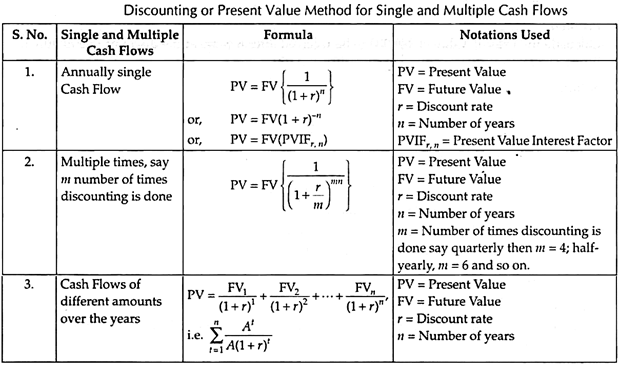
Discounting or Present Value Method

The current value of an expected amount of money to be received at a future date is known as Present Value. If we expect a certain sum of money after some years at a specific interest rate, then by discounting the Future Value we can calculate the amount to be invested today, i.e., the current or Present Value.

Hence, Discounting Technique is the method that converts Future Value into Present Value. The amount calculated by Discounting Technique is the Present Value and the rate of interest is the discount rate.

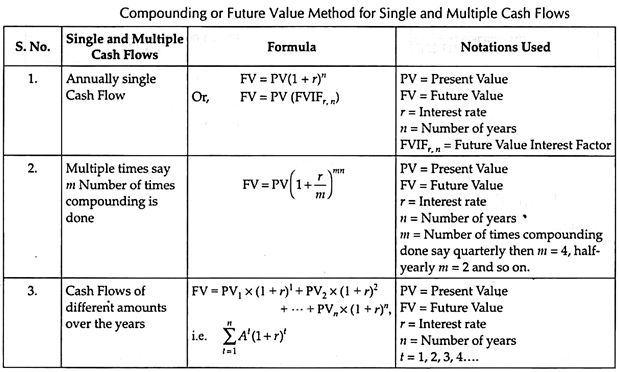
Compounding or Future Value Method

Compounding is just the opposite of discounting. The process of converting Present Value into Future Value is known as compounding.

Future Value of a sum of money is the expected value of that sum of money invested after n number of years at a specific compound rate of interest.

Key differences between Compounding and Discounting:

Basis of Comparison Compounding Discounting
Definition Future value (FV) Present value (PV)
Focus Value growth Value reduction
Process Adding interest Removing interest
Direction Present to future Future to present
Use Investment growth Valuation analysis
Formula FV = PV × (1 + r)^n PV = FV ÷ (1 + r)^n
Objective Maximize returns Evaluate worth today
Application Savings, investments Loan, cash flow eval
Time Horizon Future-oriented Current-oriented
Example Bank deposits Bond valuation

Financial Decision Making-1 Osmania University B.com 5th Semester Notes

Unit 1 Financial Statement Analysis {Book}
Basic Financial Statement Analysis VIEW
Common size financial statements VIEW
Common base year financial statements VIEW
Financial Ratios: VIEW
Liquidity Ratio VIEW
Leverage Ratio VIEW
Activity Ratio VIEW
Profitability Ratios VIEW
Solvency Ratio VIEW
Market Profitability analysis VIEW
Income measurement analysis VIEW
Revenue analysis VIEW
Cost of sales analysis VIEW
Expense analysis VIEW
Variation analysis VIEW VIEW
Special issues:
Impact of foreign operations VIEW VIEW
Effects of changing prices and inflation VIEW VIEW
Off-balance sheet financing VIEW
Impact of changes in accounting treatment VIEW
Accounting and Economic concepts of value and income VIEW
Earnings quality VIEW


Unit 2 Financial Management {Book}
Risk & Return VIEW VIEW VIEW
Calculating return VIEW
Types of risk VIEW
Relationship between Risk and Return VIEW VIEW
Long-term Financial Management: VIEW
Term structure of interest rates VIEW
Types of financial instruments VIEW VIEW
Cost of capital VIEW VIEW
Valuation of financial instruments VIEW


Unit 3 Raising Capital {Book}
Raising Capital VIEW VIEW
Financial markets VIEW VIEW VIEW
Financial markets regulation VIEW
Market efficiency VIEW
Financial institutions VIEW VIEW
Initial and secondary public offerings VIEW VIEW
Secondary public offerings VIEW
Dividend policy VIEW VIEW VIEW
share repurchases VIEW
Lease financing VIEW VIEW


Unit 4 Working Capital Management {Book}
Managing working capital VIEW VIEW
Cash Management VIEW VIEW
Marketable Securities management VIEW
Accounts Receivable Management VIEW VIEW
Inventory management VIEW VIEW VIEW
Short-term Credit: VIEW
Types of short-term credit VIEW
Short-term credit management VIEW


Unit 5 Corporate Restructuring and International Finance {Book}
Corporate Restructuring VIEW
Mergers and acquisitions VIEW
Bankruptcy VIEW VIEW
Other forms of restructuring VIEW
International Finance VIEW
Fixed, flexible, and floating exchange rates VIEW VIEW
Managing transaction exposure VIEW
Financing international trade VIEW
Tax implications of transfer pricing VIEW


Factors affecting Investment Decisions in Portfolio Management

Age

Age is a decisive factor as it will define your financial priorities and what are your goals. This will further define the characteristics of the kind of assets you will purchase. For a younger person, assets which can give long-term returns will be preferable as he has that many years left, whereas, for an older person, assets with income features will be most helpful. Most assets such as equities and bonds can be defined as per the age requirement in the form of mutual funds.

Risk tolerance

This is a very important factor as it will determine if and how much you can invest in risk assets. Most assets which give high returns are also highly risks. This creates a need to assess how much of a loss can you bear on an asset. If your capital gets wiped out it should not affect your financial stability and wealth status. That is how you will get started on understanding your risk appetite.

  • Usually, it is found that older people, lower income group people will have lower risk appetite as the earning power is less,
  • There can be exceptions to the above rule when the person has savings earmarked for investment or inheritance allows the person to invest in more risky assets
  • People with a longer working age left should look at equities as it will give a long-term benefit of accumulation and the number of economic cycles will give more benefit of capital appreciation

Time horizon

This aspect is related to fulfilling of specific financial goals and how much time is left for their fulfillment. If a goal has to say 3 years left to arrive, it makes sense to put the capital in bonds or income funds to ensure the capital safety. 3 years might be a short period to earn a substantial return from the equity market. But one might be able to find a diversified mutual fund which can not only sustain the capital in a good market but also give good returns.

The time horizon starts when the investment portfolio is implemented and ends when the investor will need to take the money out. The length of time you will be investing is important because it can directly affect your ability to reduce risk. Longer time horizons allow you to take on greater risks Þ with a greater total return potential Þ because some of that risk can be reduced by investing across different market environments. If the time horizon is short, the investor has greater liquidity needs Þ some attractive opportunities of earning higher return has to be sacrificed and the result is reduced in return. Time horizons tend to vary over the life-cycle. Younger investors who are only accumulating savings for retirement have long time horizons, and no real liquidity needs except for short-term emergencies. However, younger investors who are also saving for a specific event, such as the purchase of a house or a child’s education, may have greater liquidity needs. Similarly, investors who are planning to retire, and those who are in retirement and living on their investment income, have greater liquidity needs.

Return Needs

This refers to whether the investor needs to emphasize growth or income. Younger investors who are accumulating savings will want returns that tend to emphasize growth and higher total returns, which primarily are provided by equity shares. Retirees who depend on their investment portfolio for part of their annual income will want consistent annual payouts, such as those from bonds and dividend-paying stocks. Of course, many individuals may want a blending of the two Þ some current income, but also some growth.

Significance of Adequate Working Capital

Working capital refers to the difference between current assets and current liabilities. Adequate working capital is essential for ensuring smooth day-to-day business operations without financial strain. It provides liquidity, stability, and confidence to manage short-term obligations and unexpected expenses. A sound working capital position not only strengthens solvency but also improves profitability, goodwill, and growth prospects. Thus, maintaining adequate working capital is vital for the overall financial health of an enterprise.

Significance of Adequate Working Capital:

  • Ensures Smooth Business Operations

Adequate working capital guarantees uninterrupted business activities by ensuring timely availability of funds for raw material purchases, wage payments, and meeting short-term liabilities. It reduces the chances of delays in production or service delivery and enhances efficiency in day-to-day functioning. A business with sufficient liquidity can handle routine expenses smoothly, thereby maintaining continuous production cycles and steady sales. Without adequate working capital, operations may be disrupted, leading to inefficiency, customer dissatisfaction, and loss of revenue opportunities.

  • Maintains Solvency and Liquidity

A sound working capital position enhances the solvency of a firm by enabling it to meet short-term obligations like creditors’ payments, bills, and loans on time. Adequate working capital prevents insolvency risks and builds trust among lenders, suppliers, and stakeholders. It ensures that current liabilities are covered by current assets, thereby maintaining liquidity and financial stability. Firms with strong liquidity positions can avoid borrowing under unfavorable terms. Thus, adequate working capital serves as a financial cushion, safeguarding the enterprise against unexpected obligations or market fluctuations.

  • Improves Creditworthiness

A company with adequate working capital enjoys better creditworthiness in the market. Suppliers and financial institutions gain confidence in its ability to repay debts promptly, making it easier to obtain trade credit and bank loans on favorable terms. Strong creditworthiness also enhances bargaining power in negotiations. This financial credibility improves the firm’s reputation and relationships with stakeholders. In contrast, inadequate working capital damages credit ratings, making borrowing costly or impossible. Therefore, maintaining adequate working capital strengthens a firm’s financial image and facilitates smooth external financing opportunities when required.

  • Enhances Profitability

Adequate working capital helps in boosting profitability by ensuring the timely procurement of raw materials at favorable prices, avoiding production delays, and taking advantage of cash discounts offered by suppliers. With sufficient liquidity, the firm can maintain smooth sales and service delivery, leading to higher revenue. Additionally, optimal working capital prevents excessive borrowing, thereby reducing interest costs. Firms with a healthy working capital position can also invest surplus funds in short-term profitable avenues, further enhancing profitability. Thus, effective working capital management significantly contributes to improving the bottom line.

  • Builds Goodwill and Reputation

A company that maintains adequate working capital is more likely to build goodwill and a strong reputation in the market. Regular and timely payments to suppliers, employees, and creditors create trust and confidence among stakeholders. Customers are also assured of timely deliveries and uninterrupted services, enhancing satisfaction and loyalty. Goodwill leads to stronger long-term relationships with business partners and helps attract new investors. On the contrary, poor working capital management may damage credibility, cause delays, and harm the firm’s standing in the marketplace.

  • Supports Expansion and Growth

Adequate working capital provides the necessary financial strength for expansion and growth. A company with sufficient funds can easily finance research and development, product diversification, and market expansion without relying excessively on external borrowing. Strong liquidity supports higher production levels, larger inventories, and extended credit facilities to customers, which in turn lead to increased sales and profitability. It also enables businesses to seize sudden growth opportunities. Without adequate working capital, firms may miss such opportunities and restrict their ability to expand competitively in domestic or global markets.

  • Enables Timely Payments

Maintaining adequate working capital ensures that a firm can make timely payments to creditors, employees, and other stakeholders. Prompt payments improve business relationships, reduce the risk of penalties, and strengthen supplier confidence. Timeliness also allows firms to avail early payment discounts from suppliers, thereby reducing costs. Employees who are paid on time remain motivated, enhancing productivity. Conversely, delayed payments due to inadequate working capital may result in strained relationships, loss of trust, or even legal complications. Thus, adequate working capital supports credibility through financial discipline.

  • Provides Financial Stability

Adequate working capital contributes significantly to the financial stability of a firm. With sufficient liquidity, a business can withstand short-term financial crises, unforeseen market fluctuations, or sudden expenses without difficulty. It acts as a financial buffer, reducing dependence on emergency borrowings. Stability also improves investor confidence and attracts long-term funding. A stable financial position allows firms to focus on growth strategies rather than firefighting liquidity issues. Inadequate working capital, however, makes businesses vulnerable to insolvency and weakens their ability to handle economic downturns effectively.

  • Facilitates Efficient Utilization of Resources

When working capital is maintained at an adequate level, businesses can utilize their resources more efficiently. Funds are neither locked in excessive current assets nor are operations constrained by insufficient liquidity. Adequate working capital enables firms to strike a balance between liquidity and profitability. It allows for smooth cash flow management, timely procurement of inputs, and uninterrupted production cycles. Efficient use of resources ensures better returns on investment and minimizes wastage. Therefore, proper working capital management ensures both financial discipline and resource optimization for higher efficiency.

  • Helps in Dealing with Contingencies

Adequate working capital equips a business to handle unforeseen contingencies such as sudden market downturns, strikes, natural disasters, or unexpected expenses. It provides financial resilience to absorb shocks without disrupting operations. Having a liquidity buffer ensures that the business does not need to depend heavily on emergency loans, which often come at higher costs. This readiness for uncertainties enhances confidence among managers, employees, and investors. Therefore, adequate working capital acts as a safeguard against business risks, ensuring continuity, stability, and the long-term survival of the enterprise.

Determinants of Working Capital

Working Capital requirements represent the funds a business needs to finance its day-to-day operations, calculated as current assets minus current liabilities. This critical lifeline ensures a company can meet short-term obligations and sustain smooth operational flow. However, the precise amount needed is not static; it fluctuates based on a variety of internal and external business factors. Understanding the determinants of these requirements is essential for effective financial management, preventing both wasteful idle resources and dangerous liquidity shortfalls.

  • Nature and Size of Business

A company’s industry and scale are primary determinants. Trading firms and retailers require substantial working capital due to high inventory and sales volumes, while utility companies or software firms need less due to steady cash flows and low inventory. Larger companies typically need more working capital to support extensive operations, but they may also benefit from economies of scale. Essentially, the business model dictates the operational cycle’s length and intensity, directly influencing the investment needed in current assets like stock and receivables.

  • Production Cycle

The production cycle is the total time taken to convert raw materials into finished goods. A longer cycle means raw materials and work-in-progress inventory are tied up for extended periods, increasing the funds required. Conversely, a shorter cycle accelerates the transformation of materials into sellable products, freeing up cash quicker. Industries with complex manufacturing processes (e.g., aircraft, machinery) have high working capital needs, while those with rapid production (e.g., bakeries, printing) require less.

  • Business Cycle Fluctuations

Economic conditions significantly impact working capital needs. During a boom, companies expand operations, build more inventory, and extend more credit sales, increasing requirements. During a recession, demand falls, leading to inventory accumulation and slower collections, which also unexpectedly increases the need for funds to cover fixed costs. Thus, requirements are dynamic, and companies must plan for both expansionary and contractionary phases to maintain liquidity.

  • Scale of Operations

This refers directly to a company’s sales volume. A larger scale of operation generally necessitates a larger investment in raw materials, work-in-progress, finished goods, and accounts receivable to support that higher level of sales. While some assets may not increase proportionally, the overall correlation is positive. Therefore, a growing company must proactively plan for increased working capital needs to avoid stifling its growth due to a lack of operational funding.

  • Credit Policy

A company’s terms of sale—both given to customers (receivables) and received from suppliers (payables)—are a crucial lever. A liberal credit policy to customers boosts sales but locks funds in receivables, increasing working capital needs. Conversely, a tight policy reduces this need but may impact sales. Meanwhile, leveraging credit from suppliers (delaying payables) is a source of financing that reduces the net working capital requirement. The balance between trade credit extended and received is a key management decision.

  • Operating Efficiency

This measures how quickly a company cycles its cash. High efficiency is achieved through a shorter cash conversion cycle: swiftly collecting receivables, rapidly turning over inventory, and optimally delaying payables. This efficiency reduces the time money is tied up, thereby lowering the permanent working capital requirement. Inefficient operations with slow collections and high inventory days significantly increase the amount of capital needed to fund the operating cycle.

  • Seasonality of Demand

Many businesses face predictable seasonal peaks (e.g., winter apparel, holiday decor, air conditioners). This necessitates building large inventories before the peak season, creating a temporary surge in working capital requirements. Special arrangements for short-term financing are often needed to cover this period. After the season, as sales are made and cash is collected, the need subsides. Planning for these cyclical spikes is vital for uninterrupted operation.

  • Growth Prospects

A rapidly growing company faces increasing working capital needs. Expansion typically requires more inventory to support higher sales and larger accounts receivable due to a growing customer base. This investment often precedes the actual cash inflow from the increased sales, creating a funding gap. Therefore, growth must be carefully managed and financed; otherwise, a company can ironically face a liquidity crisis (overtrading) precisely when it is growing most rapidly.

error: Content is protected !!