Span of Management Meaning, Components, Factors, Limitations

Span of Management, also known as Span of Control, refers to the number of subordinates that a manager can effectively supervise and control. It determines the number of direct reports under a single manager and influences the organization’s structure. A narrow span of management results in more levels of hierarchy, leading to close supervision but slower communication. A wide span involves fewer levels and more subordinates under one manager, promoting autonomy but requiring strong leadership skills. The ideal span depends on factors like the complexity of tasks, skills of employees, and the management style employed.

Components of Span of Management:

  1. Nature of Work

The complexity and nature of the tasks performed by subordinates greatly affect the span of management. Simple, repetitive tasks typically allow for a wider span, as they require less supervision. Conversely, complex tasks requiring specialized skills may necessitate a narrower span to ensure effective oversight.

  1. Managerial Skills

The skills and experience of the manager play a crucial role in determining the effective span of control. A highly skilled and experienced manager may handle a wider span because they can effectively delegate, communicate, and motivate their team. In contrast, a less experienced manager may need a narrower span to maintain control.

  1. Employee Competence

The competence and skill level of subordinates also influence the span of management. If employees are highly skilled and experienced, a manager can supervise more of them effectively. However, if employees require more guidance and training, a narrower span may be necessary to provide adequate support.

  1. Geographic Dispersion

The physical location of employees can impact the span of management. If subordinates are geographically dispersed, it may be challenging for a manager to maintain effective communication and control over a wide span. This scenario may necessitate a narrower span to ensure effective supervision.

  1. Communication Systems

Effective communication is vital for managing a wider span. If an organization has strong communication systems and tools in place, a manager can oversee more employees. Poor communication can hinder a manager’s ability to supervise effectively, leading to a preference for a narrower span.

  1. Organizational Structure

The overall structure of the organization influences the span of management. Flat organizations with fewer hierarchical levels may encourage wider spans, while tall organizations with multiple levels of management may have narrower spans. The organizational culture also impacts how spans are perceived and implemented.

  1. Nature of Relationships

The interpersonal dynamics between managers and employees can affect the span of control. A strong rapport and trust between a manager and their subordinates may enable a wider span, as employees feel more empowered and capable. In contrast, strained relationships may necessitate closer supervision, resulting in a narrower span.

  1. Time Constraints

Time constraints faced by managers can also dictate the span of control. If managers are required to make quick decisions or oversee time-sensitive tasks, a narrower span may be necessary to ensure close oversight and timely action.

  1. Technological Tools

The availability and use of technology can impact the span of management. Tools that facilitate communication, task management, and monitoring can enable managers to effectively oversee a larger number of subordinates. Conversely, a lack of technological support may limit the span.

Factors Affecting Span of Management:

  1. Complexity of Tasks

The complexity and nature of the tasks being performed play a significant role in determining the span of management. Simple, routine tasks that require less supervision can be managed by a larger number of subordinates. Conversely, complex tasks that require specialized skills or significant oversight may necessitate a narrower span to ensure effective supervision and guidance.

  1. Managerial Skills and Experience

The skills and experience of the manager significantly influence the span of control. An experienced manager with strong leadership, communication, and delegation skills can effectively supervise a larger team. In contrast, a less experienced manager may struggle to manage many subordinates, resulting in the need for a narrower span of control.

  1. Employee Competence

The competence and skill level of employees also impact the span of management. If employees are highly skilled and capable of performing their tasks independently, a manager can oversee more subordinates effectively. However, if employees require more guidance, training, or supervision, a narrower span may be necessary to provide adequate support and development.

  1. Geographic Dispersion

The physical location of employees affects how effectively a manager can supervise them. When employees are located in different geographical areas, managing a wider span can be challenging due to communication barriers and the inability to provide immediate supervision. In such cases, a narrower span may be more effective to ensure close monitoring and support.

  1. Organizational Structure

The overall structure of the organization significantly influences the span of management. In flat organizations with fewer hierarchical levels, managers may oversee a larger number of employees due to reduced layers of management. Conversely, tall organizations with multiple management levels may require a narrower span to maintain effective supervision and communication.

  1. Technology and Communication Tools

The availability of technology and communication tools can enhance a manager’s ability to oversee a larger team. Effective communication systems, task management software, and monitoring tools enable managers to manage multiple subordinates more efficiently. Without such technological support, a narrower span may be necessary to ensure effective management.

  1. Time Constraints

Time pressures faced by managers can dictate the span of control. When managers need to make quick decisions or handle urgent tasks, they may require a narrower span to ensure close oversight and prompt action. Time constraints can limit the ability to supervise a large team effectively.

  1. Interpersonal Relationships

The dynamics of relationships between managers and subordinates also impact the span of management. A strong rapport and trust can enable a manager to supervise more employees effectively, as employees feel empowered and supported. Conversely, strained relationships or a lack of trust may require closer supervision, leading to a narrower span.

Limitations Span of Management:

  1. Reduced Supervision

A wider span of management can lead to reduced supervision of employees. When a manager oversees too many subordinates, they may not have enough time to provide individual attention or guidance. This can result in a lack of support for employees, leading to decreased motivation and performance.

  1. Increased Workload

Managers with a large span of control often face an increased workload. With more subordinates to supervise, managers may find it challenging to manage their time effectively. This can lead to burnout and stress, affecting the manager’s performance and decision-making abilities.

  1. Communication Challenges

Effective communication becomes more challenging as the span of management increases. Managers may struggle to relay information effectively to a larger number of employees, which can lead to misunderstandings and miscommunication. This can hinder teamwork and collaboration, ultimately affecting overall organizational performance.

  1. Limited Feedback

With a wider span of control, managers may find it difficult to provide and receive feedback. Individual feedback is essential for employee development, but when a manager oversees many subordinates, it becomes harder to give personalized guidance. This can hinder employees’ growth and limit their potential.

  1. Less Cohesion

A larger span of management can reduce the cohesion within teams. When employees feel disconnected from their manager due to the sheer number of subordinates, it may create an environment where teamwork and collaboration suffer. This lack of cohesion can negatively impact morale and productivity.

  1. Difficulty in Delegation

Managers may encounter difficulties in effectively delegating tasks when they oversee too many employees. With numerous tasks to manage, it can be challenging to identify which subordinates are best suited for specific responsibilities. This can result in inefficiencies and reduced effectiveness in task completion.

  1. Limited Employee Development

A wider span of management may limit opportunities for employee development. Managers may not have enough time to mentor or coach employees, hindering their professional growth. This lack of development can lead to employee dissatisfaction and high turnover rates.

  1. Potential for Conflict

When a manager supervises a large number of employees, the likelihood of conflicts arising may increase. With more personalities and opinions to manage, conflicts can become more frequent and harder to resolve. This can lead to a toxic work environment if not handled properly.

  1. Reduced Control Over Quality

A broader span of control can result in diminished quality control. With a manager overseeing too many employees, it may become difficult to ensure that all work meets the required standards. This can lead to inconsistencies in output and a decline in overall quality.

FW Taylor’s Scientific Management

Frederick Winslow Taylor, widely known as the “father of scientific management,” was a pivotal figure in the development of modern management practices. His groundbreaking approach to improving industrial efficiency, known as Scientific Management, had a profound and lasting impact on how businesses are structured and managed. Taylor’s work revolutionized the way organizations think about labor, productivity, and the role of management in optimizing human and material resources.

Background of Frederick Taylor

Born in 1856 in Philadelphia, Pennsylvania, Frederick Taylor began his career as a machinist and rose through the ranks to become an engineer. His practical experience working in factories gave him firsthand insight into the inefficiencies of traditional management practices. Observing the lack of standardization, poor labor practices, and inefficiencies in production, Taylor became determined to develop a system that would improve both productivity and worker satisfaction.

In the early 20th century, Taylor formalized his ideas into a comprehensive theory known as Scientific Management, which he detailed in his seminal work, The Principles of Scientific Management (1911). His principles aimed to replace the informal, ad-hoc methods of managing work with a systematic, data-driven approach to labor management.

Key Principles of Scientific Management:

Taylor’s approach to management was based on four core principles designed to improve efficiency, standardize work processes, and increase productivity:

  1. Developing a Science for Each Element of Work

The first principle of scientific management involves breaking down each job into its smallest components and studying these tasks to develop a science for each element of work. Taylor argued that work should not rely on arbitrary rules-of-thumb or personal discretion but should instead be based on precise, scientific methods.

Through time-and-motion studies, Taylor analyzed the best way to perform a task, determining the optimal tools, techniques, and steps required. By applying scientific methods to work processes, management could establish the “one best way” to perform each job. This principle laid the groundwork for standardization in industries, leading to greater consistency and efficiency.

  1. Selection and Training of Workers

The second principle focuses on the careful selection and systematic training of workers. Taylor argued that the success of scientific management depended on hiring workers whose skills and physical abilities matched the requirements of the job. In contrast to traditional methods, where workers learned their tasks through trial and error, Taylor advocated for a more scientific approach to workforce development.

Once selected, workers were trained in the most efficient methods of performing their tasks, ensuring that they understood the scientifically determined processes. Taylor believed that proper training would not only increase productivity but also improve job satisfaction, as workers would know exactly what was expected of them and how to achieve optimal results.

  1. Cooperation Between Management and Workers

Taylor emphasized the importance of collaboration between management and workers. Traditionally, there had been an adversarial relationship between the two groups, with management focused on maximizing profits and workers on minimizing effort. Taylor argued that scientific management would foster cooperation by aligning the interests of both parties.

Management’s role was to plan and design work scientifically, while workers were responsible for executing the tasks according to the prescribed methods. Taylor believed that this division of labor would lead to mutual benefits: management would achieve higher productivity and workers would be rewarded with fair wages tied to their increased output. He also advocated for incentive-based pay systems that rewarded workers for exceeding production targets.

  1. Division of Work and Responsibility

The fourth principle of scientific management calls for a clear division of labor and responsibility between management and workers. Traditionally, workers had a great deal of autonomy in deciding how to perform their tasks, which led to inconsistencies and inefficiencies.

Taylor argued that management should take responsibility for designing and planning work, while workers should focus solely on executing tasks. This division of responsibility ensured that workers could concentrate on their tasks without the burden of decision-making, while management focused on optimizing the work process. This system of control led to the emergence of specialized managerial roles, which became a hallmark of modern organizations.

Advantages of Scientific Management:

Taylor’s system brought about significant benefits, both in terms of productivity and organizational structure. Here are some key advantages:

  1. Increased Efficiency:

By developing scientific methods for performing tasks, Taylor’s approach significantly improved productivity. Standardized processes reduced waste, minimized downtime, and streamlined operations, leading to higher output levels.

  1. Labor Specialization:

The division of labor allowed workers to specialize in specific tasks, increasing their skill levels and contributing to greater efficiency. This specialization also laid the foundation for modern assembly line production.

  1. Incentive-Based Compensation:

Taylor introduced a compensation system based on performance, where workers were rewarded with higher wages for exceeding production targets. This incentivized workers to be more productive, resulting in higher overall output.

  1. Management Structure:

Scientific management introduced a clear distinction between the roles of managers and workers. This structured approach to management provided a framework for planning, controlling, and monitoring work processes, which is still used in modern organizations.

Criticisms of Scientific Management

While scientific management brought about notable improvements in industrial efficiency, it also faced significant criticism, particularly concerning its impact on workers:

  • Dehumanization of Labor:

Critics argued that Taylor’s approach reduced workers to mere cogs in a machine, stripping them of creativity, autonomy, and job satisfaction. The focus on efficiency and productivity often led to monotonous and repetitive work, which many believed dehumanized the workforce.

  • Overemphasis on Control:

Taylor’s strict division of labor and responsibility placed most decision-making power in the hands of management, leaving workers with little control over their work. This created a rigid hierarchy that some viewed as overly authoritarian.

  • Neglect of Social and Psychological Factors:

Taylor’s model focused primarily on the technical and mechanical aspects of work, largely ignoring the social and psychological needs of workers. Later studies, such as Elton Mayo’s Hawthorne Experiments, highlighted the importance of human relations, motivation, and job satisfaction, which were not adequately addressed by Taylor’s system.

  • Worker Exploitation:

Some critics claimed that the incentive-based pay system could lead to worker exploitation, with managers pushing workers to the limit to maximize output without regard for their well-being. This resulted in a negative perception of scientific management among labor unions and workers.

Legacy and Impact on Modern Management:

Despite its criticisms, Taylor’s scientific management had a profound and lasting influence on modern management practices. Many of the principles he introduced, such as time-and-motion studies, standardization, and the clear division of labor, continue to shape organizational structures today. Concepts like productivity measurement, performance-based pay, and efficiency optimization can trace their roots back to Taylor’s work.

Taylor’s ideas also paved the way for the development of later management theories, including Fayol’s Administrative Theory, Weber’s Bureaucracy, and Operations Management. Although management thought has evolved to incorporate more human-centered approaches, Taylor’s contributions remain a foundational element of management theory.

Henry Fayol’s 14 Principles of Management

Henri Fayol, a French mining engineer and management theorist, is renowned for his development of the 14 Principles of Management. These principles form a significant part of his administrative theory, which aimed to establish a comprehensive framework for effective management in organizations. In his 1916 book General and Industrial Management, Fayol argued that managerial practices are universal and can be applied to all types of organizations.

Fayol’s principles provide a foundation for modern management, emphasizing the role of planning, organizing, leading, and controlling within an organization.

  1. Division of Work

The principle of division of work emphasizes specialization and efficiency. Fayol argued that by dividing tasks into smaller, more manageable units, workers can develop expertise in a specific area, leading to increased productivity and better performance. Specialization allows employees to perform tasks more efficiently, reducing time and effort, while also improving accuracy and skill development.

For example, in a manufacturing environment, workers who specialize in specific production processes, such as assembly or quality control, can complete their tasks more effectively than generalists who perform a variety of roles.

  1. Authority and Responsibility

According to Fayol, authority and responsibility go hand in hand. Authority is the right to give orders and expect obedience, while responsibility refers to being accountable for fulfilling assigned duties. Fayol argued that managers must have the authority to issue commands but must also bear the responsibility for ensuring that their directives are carried out effectively.

Effective management requires a balance between authority and accountability to maintain discipline and achieve organizational goals.

  1. Discipline

Discipline is essential for the smooth functioning of an organization. Fayol believed that discipline involves obedience, respect for authority, and adherence to established rules and regulations. Clear and fair policies, consistent enforcement, and mutual respect between employees and management help maintain discipline.

Organizations with strong disciplinary systems tend to have more engaged employees and efficient operations.

  1. Unity of Command

The principle of unity of command states that each employee should report to only one superior. Fayol argued that if an employee receives orders from multiple sources, it leads to confusion, conflict, and inefficiency. This principle ensures that communication is clear and that employees understand their specific responsibilities.

By maintaining a clear chain of command, organizations can avoid contradictory instructions and reduce the likelihood of misunderstandings.

  1. Unity of Direction

Unity of direction emphasizes that all members of the organization should be aligned toward the same objectives, with a common plan for achieving them. This principle ensures that everyone in the organization works together toward shared goals, avoiding fragmentation and inefficiency.

For example, in a marketing department, all team members should work toward increasing brand awareness, rather than pursuing individual or conflicting objectives.

  1. Subordination of Individual Interests to General Interest

Fayol believed that the interests of the organization should take precedence over the interests of individual employees. While individual goals and aspirations are important, the collective success of the organization must be prioritized. Fayol stressed that managers must align individual interests with organizational goals to ensure that personal ambitions do not interfere with the company’s success.

This principle fosters a sense of collective responsibility and encourages employees to work for the greater good of the organization.

  1. Remuneration

Remuneration refers to fair compensation for employees’ efforts. Fayol argued that wages should be equitable and based on factors such as skill, effort, responsibility, and performance. Fair remuneration serves as a motivator for employees and contributes to job satisfaction and organizational loyalty.

Fayol also believed in offering both financial and non-financial rewards to motivate employees.

  1. Centralization

Centralization refers to the degree to which decision-making authority is concentrated at the top levels of management. Fayol recognized that the optimal level of centralization varies depending on the organization’s size, nature, and circumstances. In highly centralized organizations, top management retains most decision-making authority, while decentralized organizations delegate authority to lower-level managers.

The key is to strike the right balance between centralization and decentralization to ensure that decisions are made efficiently while maintaining overall organizational control.

  1. Scalar Chain

The scalar chain refers to the hierarchy or chain of command within an organization. Fayol argued that a well-defined hierarchy ensures that authority flows from the top levels of management to the bottom, and that communication follows a clear path. This structure provides a framework for decision-making and accountability.

Fayol also advocated for “gangplank” communication, allowing for direct communication between employees at the same level to avoid delays caused by following the scalar chain rigidly.

  1. Order

Order refers to the organization and arrangement of resources, including people and materials, in the workplace. Fayol believed that every resource should have a specific place and function, ensuring that everything is in its proper position. This principle promotes efficiency by reducing confusion and delays in operations.

In a well-ordered organization, the right person is in the right job, and materials are placed where they are easily accessible when needed.

  1. Equity

Equity involves treating employees fairly and with respect. Fayol believed that fairness should govern all managerial actions, as employees are more motivated and loyal when they feel valued and respected. Equity encourages a harmonious workplace, where employees are treated justly in terms of pay, opportunities, and recognition.

Managers must strive to create an atmosphere of kindness and justice, ensuring that all employees are treated equally regardless of rank or position.

  1. Stability of Tenure of Personnel

Fayol emphasized the importance of retaining employees for a stable workforce. High employee turnover can be disruptive and costly for organizations, as it requires time and resources to train new workers. By promoting stability in the workforce, organizations can benefit from employees’ accumulated skills and experience.

Long-term employment contributes to improved productivity, as employees become more proficient in their roles over time.

  1. Initiative

Fayol believed that managers should encourage employees to take initiative and contribute their ideas to the organization. When employees are allowed to express their creativity and take initiative, they feel more engaged and motivated. This principle fosters innovation, as employees are more likely to suggest improvements to processes and products.

Managers should create an environment where employees feel empowered to propose new ideas and take ownership of their work.

  1. Esprit de Corps

Esprit de corps refers to promoting team spirit and unity within the organization. Fayol argued that a strong sense of camaraderie and mutual respect among employees leads to higher morale and greater productivity. Managers should focus on building a sense of community within teams and fostering a positive work culture.

By encouraging teamwork and open communication, managers can create a cohesive and motivated workforce that works together toward shared goals.

Key differences between Management and Administration

Management refers to the process of planning, organizing, leading, and controlling resources—such as people, finances, and materials—to achieve specific goals efficiently and effectively. It involves setting objectives, developing strategies, coordinating tasks, and making informed decisions to guide an organization or group toward success. Management also entails motivating employees, resolving conflicts, and ensuring that resources are used optimally. It plays a critical role in both day-to-day operations and long-term strategic planning, aiming to balance productivity with innovation and adaptability in a constantly changing environment.

Characteristics of Management:

  1. Goal-Oriented Process

Management is primarily a goal-oriented activity. It is focused on achieving specific organizational objectives, whether they are financial, operational, or related to employee welfare. Managers set clear, measurable goals and work systematically to achieve them. Without defined goals, management lacks direction and purpose. The entire process of planning, organizing, leading, and controlling revolves around achieving these objectives efficiently and effectively.

  1. Pervasive Function

Management is a universal function present in every type of organization—business, government, education, and non-profit institutions. Regardless of the size or nature of the organization, management is necessary to ensure that resources are used efficiently and objectives are met. It exists at all levels of the organization, from top-level strategic decision-making to operational management at the ground level. This pervasive nature makes management a critical function in every organization, regardless of industry or purpose.

  1. Multidimensional

Management is multidimensional in nature, involving the management of work, people, and operations. First, it includes managing the work or tasks that need to be accomplished. Second, it involves managing people, which requires interpersonal skills, communication, and leadership to guide and motivate employees. Lastly, it covers managing operations, which includes processes, technology, and the physical resources required to produce goods or services. These dimensions are interconnected and require managers to be versatile and skilled in multiple areas.

  1. Continuous Process

Management is not a one-time activity but an ongoing process. Managers continuously plan, execute, and evaluate strategies and operations to ensure that the organization stays on course to achieve its goals. As internal and external environments change, managers need to revisit and adjust their plans to accommodate new challenges and opportunities. This dynamic nature makes management a continuous process, requiring ongoing attention and adaptation.

  1. Dynamic Function

Management is dynamic because it must adapt to the ever-changing business environment. Economic conditions, technological advancements, customer preferences, and legal requirements are always evolving. As a result, management practices need to be flexible and adaptable to respond effectively to these changes. A static management approach would fail in a competitive and volatile environment, so managers must continuously innovate and adjust strategies to stay relevant and successful.

  1. Group Activity

Management is inherently a group activity. It involves coordinating and guiding people to work together towards a common goal. Effective management ensures that the collective efforts of individuals are aligned with organizational objectives. This requires fostering collaboration, communication, and teamwork among employees, as well as aligning individual goals with the organization’s mission. Management also ensures that the roles and responsibilities of each team member are clearly defined to avoid confusion and promote accountability.

  1. Intangible Force

Although management produces tangible results, the process itself is intangible. It cannot be physically seen, but its presence is felt through the smooth operation of the organization. The quality of management is reflected in organizational success, employee morale, and the achievement of objectives. A well-managed organization will have a positive work environment, efficient operations, and satisfied stakeholders, even though management as a process remains unseen.

  1. Decision-Making Process

Management heavily relies on decision-making. Managers are constantly required to make decisions, whether they are related to resource allocation, employee management, strategy implementation, or customer relations. Effective decision-making involves analyzing data, assessing risks, weighing alternatives, and choosing the best course of action. Decisions impact every aspect of the organization, making it crucial for managers to be skilled in making informed and timely decisions that contribute to organizational success.

  1. Interdisciplinary Nature

Management draws knowledge and concepts from various disciplines such as economics, psychology, sociology, finance, and information technology. A manager needs to be familiar with these fields to handle the diverse range of challenges faced by modern organizations. For example, understanding human behavior helps in managing employees, while knowledge of finance is essential for resource allocation and budgeting. This interdisciplinary nature makes management a broad and versatile field that incorporates multiple areas of expertise.

Administration

Administration refers to the process of formulating policies, setting objectives, and overseeing the overall governance of an organization or institution. It involves high-level decision-making, focusing on strategic planning, resource allocation, and the establishment of guidelines to ensure smooth functioning. Unlike management, which deals with the execution of plans, administration is concerned with defining the framework within which management operates. Administrators are responsible for setting organizational goals, maintaining control over operations, and ensuring that the organization adheres to legal, ethical, and policy-based standards while achieving long-term objectives.

Characteristics of Administration:

  1. Policy-Making Function

Administration primarily deals with the formulation of policies and plans for the organization. Administrators set the overall direction by deciding the goals and guidelines that govern how the organization will operate. These policies provide a framework for the management team to execute day-to-day tasks. Thus, the core function of administration is to establish a long-term vision and develop the rules and procedures to achieve it.

  1. Top-Level Activity

Administration is a top-level activity, typically carried out by the highest-ranking executives or board of directors. This level of responsibility involves overseeing the entire organization and making decisions that affect its overall direction. While management focuses on operational tasks, administration focuses on strategic planning and ensuring that the organization moves in the right direction to meet its goals.

  1. Strategic in Nature

Administration is strategic, focusing on the long-term growth, development, and sustainability of the organization. It involves decisions related to overall organizational policies, resource allocation, and the external environment. Administrators consider factors like market trends, governmental policies, and economic conditions to set a strategic course for the future. This strategic nature distinguishes administration from management, which is more tactical and operational.

  1. Goal Setting

One of the core responsibilities of administration is to set the organization’s objectives. Administrators determine what the organization aims to achieve in the long run, such as financial goals, market expansion, or social impact. Once these goals are established, they guide the organization’s operations and serve as benchmarks for success. The clear definition of goals ensures that all activities align with the overall mission of the organization.

  1. Coordination of Resources

Administration involves the coordination of all resources—human, financial, and material—to achieve organizational objectives. Administrators ensure that resources are allocated efficiently across departments and projects to meet strategic goals. This requires balancing priorities, managing budgets, and ensuring that the right resources are available at the right time.

  1. Decision-Making

A critical characteristic of administration is decision-making, particularly at the strategic level. Administrators make high-level decisions that shape the future of the organization, such as mergers, acquisitions, new market entry, or changes in organizational structure. These decisions are based on an analysis of internal capabilities and external factors like competition and regulatory requirements. Effective decision-making in administration ensures the long-term success of the organization.

  1. Bureaucratic Framework

Administration typically operates within a bureaucratic framework, meaning it is characterized by formal rules, hierarchies, and structured procedures. This framework ensures that policies are implemented consistently throughout the organization. A clear chain of command and defined roles make it easier to enforce policies, maintain accountability, and ensure that administrative functions are carried out systematically.

  1. Control and Regulation

Administration is responsible for maintaining control over organizational processes by ensuring adherence to policies and standards. It sets up monitoring and evaluation systems to assess performance, ensure compliance, and implement corrective measures when necessary. The control function of administration ensures that all departments and activities align with the organization’s strategic goals and regulatory requirements.

  1. Interdisciplinary Approach

Like management, administration draws from various disciplines such as economics, law, political science, and sociology. This interdisciplinary approach is necessary because administrators deal with complex and diverse issues that require knowledge from multiple fields. For instance, understanding legal frameworks helps administrators comply with regulatory policies, while knowledge of economics aids in budgeting and resource allocation.

Key differences between Management and Administration

Basis of Comparison Management Administration
Focus Execution Policy-making
Nature Doing Thinking
Scope Operational Strategic
Decision-making Middle & lower levels Top-level
Objective Profit maximization Welfare
Function Active Passive
Control Internal (employees) External (owners)
Approach Result-oriented Process-oriented
Authority Limited Broad
Discipline Practical Theoretical
Skills Technical Conceptual
Influence Direct Indirect
Responsibility Middle/lower level Top level
Flexibility More Less
Focus Area Business activities Organizational goals

Management as a Science, as an Art and as a Profession

Management is a multidimensional field that incorporates principles from both science and art, while also evolving into a recognized profession. This classification reflects its systematic, creative, and increasingly specialized nature.

Management as a Science:

Science is characterized by systematic knowledge, organized principles, and a cause-and-effect relationship. It involves the use of logical, rational approaches to problem-solving and decision-making. For management to be considered a science, it must meet certain criteria: it should be based on universally accepted principles, derived from empirical evidence, and capable of being tested under various conditions.

  1. Systematic Body of Knowledge

Management, as a science, is built on a systematic body of knowledge that includes established theories, models, and principles. These principles guide managers in decision-making and organizational operations. Concepts such as Frederick Taylor’s scientific management, Henry Fayol’s administrative theory, and Max Weber’s bureaucratic management reflect the application of scientific principles to manage people, resources, and processes efficiently. These principles have been tested in various organizations and situations, yielding predictable outcomes, much like scientific experiments.

  1. Universal Principles

Management is based on universally accepted principles such as division of labor, authority and responsibility, and unity of command. These principles, when applied correctly, tend to produce similar results regardless of the industry or geographical location. For instance, the principle of specialization (division of labor) has been shown to improve productivity in factories, service industries, and even in high-level corporate settings.

  1. Empirical and Evidence-Based

Like science, management relies on observation and experimentation. Management theories are derived from real-world experiences and research. For example, scientific management evolved from studies on productivity in the industrial era. Similarly, the contingency theory of management arose from empirical studies showing that no one-size-fits-all approach works for every organization. Managers rely on data and analytics to make informed decisions, indicating that management has a strong scientific foundation.

Limitations as a Science

While management has many scientific aspects, it is not a pure science like physics or chemistry, where outcomes are certain. In management, human behavior is unpredictable, and organizations operate in dynamic environments. Therefore, while management uses scientific methods, the presence of variables such as emotions, culture, and leadership styles can lead to different outcomes, reducing its precision compared to the natural sciences.

Management as an Art:

Art is the expression of creativity, intuition, and subjective judgment. It focuses on achieving desired results through personal skills, insights, and expertise. Management, as an art, requires a creative and personalized approach to dealing with people and situations. Successful managers often rely on their experience, judgment, and intuition to navigate complex environments.

  1. Personal Skills and Creativity

Management, as an art, requires personal expertise, creativity, and innovation. Managers must adapt general principles to specific situations, crafting strategies tailored to their organization’s unique needs. This is where creativity comes into play. For instance, while the principle of motivation may be universal, how a manager motivates a sales team versus a research team may differ significantly. Leadership styles, communication techniques, and conflict resolution strategies all require an element of art in their execution. Effective managers blend the science of management with personal style, emotional intelligence, and people skills.

  1. Judgement and Intuition

In art, individuals apply their judgment and intuition, which cannot be replicated or standardized. Similarly, managers often rely on their gut feeling or intuition when making decisions, especially when facing uncertainty. For example, when a manager decides to enter a new market or hire a particular candidate, scientific principles might guide their thinking, but ultimately, the decision may hinge on the manager’s personal judgment or intuition.

  1. Flexibility and Adaptation

Management is not a rigid practice. Managers must be flexible and adaptive, tailoring their approach to fit the changing dynamics of the business environment. In art, creativity lies in interpreting and expressing in varied ways. Likewise, in management, a successful manager must innovate and adapt strategies to suit the specific context, whether it’s handling a crisis, managing a diverse workforce, or steering through market disruptions.

Limitations as an Art:

The artistry in management comes from personal experience and innate skills, but it also means that results may vary greatly. Not every manager will apply the same principles with the same level of success. Hence, management as an art lacks the replicability and consistency of a science. Furthermore, reliance on intuition and creativity alone can sometimes lead to unsystematic or inconsistent decisions.

Management as a Profession:

Profession is defined by specialized knowledge, formal education, a code of ethics, and social recognition. As management has developed over time, it has increasingly taken on the characteristics of a profession.

  1. Specialized Knowledge

Management has become a formal discipline with its own body of knowledge, methods, and tools. This knowledge is imparted through formal education and specialized training programs, such as MBA (Master of Business Administration) degrees, which aim to develop managerial skills in areas like finance, marketing, human resources, and operations.

  1. Formal Training and Qualification

Management is now recognized as a field that requires formal training and education. Business schools, universities, and professional associations offer programs designed to equip aspiring managers with the skills needed to succeed. The rise of certifications like Project Management Professional (PMP) or Chartered Manager (CMgr) demonstrates the growing demand for professional qualifications in management.

  1. Code of Ethics

Many professional management bodies, such as the American Management Association (AMA) or the Institute of Management Consultants (IMC), require their members to adhere to a code of ethics. Ethical behavior is increasingly becoming a cornerstone of managerial practice. Managers are expected to demonstrate responsibility, fairness, and transparency in their decision-making, ensuring accountability to both their organization and society.

  1. Social Recognition

Over time, management has gained recognition as a profession with an important social role. Managers play a critical part in shaping organizations, economies, and even societal progress. The demand for skilled and ethical managers in every sector underscores management’s professional status.

Limitations as a Profession:

While management has many characteristics of a profession, it is still evolving. Unlike professions such as medicine or law, there is no strict licensing requirement for managers. Although formal education is highly valued, it is not mandatory, and many successful managers thrive based on experience and innate skills rather than formal qualifications. Additionally, management lacks a single unified professional body that governs all aspects of the field.

Fundamentals of Management and Life Skills

Unit 1 Management {Book}

Introduction, Meaning, Definitions, Characteristics, Importance and Scope of Management VIEW
Management as a Science, as an Art and as a Profession VIEW
Meaning and Definitions of Administration VIEW
Differences between Management and Administration VIEW
Unit 2 Principles and Functions of Management {Book}
Principles of Management VIEW
Management Nature and Importance VIEW
FW Taylor’s Scientific Management VIEW
Henry Fayol’s 14 Principles of Management VIEW
Management of objectives (MBO): Meaning, Definitions, Need, Benefits and Limitations VIEW
Management of Exception (MBE): Meaning, Definitions, Need, Benefits and Limitations VIEW
Management functions: Meaning, Definitions, Characteristics VIEW
Benefits & Limitations of Planning VIEW
Benefits & Limitations of Organizing VIEW
Benefits & Limitations of Staffing VIEW
Benefits & Limitations of Directing VIEW
Benefits & Limitations of Co-ordinating VIEW
Benefits & Limitations of Reporting VIEW
Benefits & Limitations of Controlling VIEW
Unit 3 Leadership and Motivation {Book}
Leadership Meaning, Definition, Characteristics VIEW
Role and Qualities of a Good Leader VIEW
Leadership Styles: Autocratic, Democratic, Free-rein, New age leadership styles-servant leadership, Level-5 leadership, Transformation leadership, Transactional leadership, Negotiation leadership, Moral leadership, Women leadership and Global business leadership style VIEW
Motivation Nature, importance VIEW
Theories of Motivation:
Maslow’s Need Hierarchy Theory VIEW
McGregor’s Theory X and Theory Y VIEW
Herzberg’s Two Factory Theory VIEW
Unit 4 Communication Skills {Book}
Meaning and Definitions of Communication VIEW VIEW
Types of Communication: Formal Communication & Informal Communication VIEW VIEW
Modes of Communication:
Verbal Communication VIEW
Non-Verbal Communication (Body Language, Gestures and Facial Expressions) VIEW
Etiquette and mannerism in Personal and Business meetings VIEW
E-communication: Video and virtual Conferencing VIEW
Written Communication VIEW
Email Writing VIEW
Characteristics Effective Communication VIEW
Importance of Effective Communication VIEW
Barriers to Effective Communication and Measures to Overcome Barriers VIEW
Measures to Overcome Barriers to Effective Communication VIEW
Effective Communication Skills: Active Listening, Speaking, Observing, Empathizing VIEW VIEW
Tips for Improving Communication Skills VIEW
Unit 5 Life Skills, Personality and Attitude {Book}
Life Skills Meaning, Definitions VIEW
Elements of life skills: Behavior, Attitude, Mannerism, Manners, Etiquette, Ethos, Morality, Determination commitment, Courageousness, Perseverance VIEW
Personality-Meaning, Definition, Characteristics VIEW
Personality Determinants VIEW
Personality Types VIEW
Sources of Personality VIEW
Difference between Trait and Personality VIEW VIEW
Attitude: Meaning, Definition, Components VIEW
Characteristics/Functions of Attitude VIEW
Factors influencing attitude VIEW
Types of Attitude VIEW

Methods of Supervision and Control of Sales Force

Control

The last but not the least significant phase is control of sales force operations. In any sphere of activity, supervision and control of salesmen is essential with a view to achieve the maximum success. The sales operations are to be materialized as per plans laid down, followed by scientific control of efforts and resources. A plan is necessary when you construct a building. In the same way, in business also a chalked out plan is a sine-qua-non and the plan to be under a successful control is essential.

What is control? It simply means a check, a means of controlling or testing. Control involves such functions as checking, verifying, standard selling, and directing or guiding. One may say, “Control means watching results and translating them into positive action.” Control is a process to establish the standard of performance measuring the work done. Through control salesman’s performance can be appraised.

All the organisations must have the operation of control, as a tool, for their progress and successful working. It is an act of checking or verifying the performance as per the plans. “Control consists in verifying whether everything occurs in conformity with the plans adopted, the instructions issued and the principles established. Its objective is to point out weaknesses and errors in order to rectify them and prevent their recurrence. It operates on every thing-things, people and actions.”

Is Control Necessary?

The manager exercises the control over the activities of salesmen through supervision. The planned sales operations are to be carried out systematically in order to get success over the aimed result.

Salesmen are human beings; the need for supervision arises because of:

  • Salesmen may be working independently and may be at a longer distance from the sales manager. There may arise a problem of co-ordination, of salesmen’s effort with the other sales efforts i.e., publicity, sales promotions etc. To ensure co-ordination, control is a must.
  • The sales effected by each salesman should be known to the sales manager, who compares the actuals with the targets, to find negative variation, which should be rectified by corrective actions. There may be mistakes in the approach of a salesman, laziness in activities etc.,. These must be traced out and the salesman guided in order to channelize his efforts into desired path.
  • Efforts of the salesman have to be directed to maximize profits to firm in the light of progressive ideas and techniques to ensure the proper utilization of men and materials.
  • “Of all the assets customers are the most valuable.” To build a sound public relation, complaints of different types of customers are to be redressed. Thereby, it is possible to build a good image in the minds of the public. The salesman is guided by the sales manager, who tries to satisfy the customers through salesmen.

Prerequisites of Control

  • The sales manager should know what exactly he expects a salesman to do. (through fixing the sales quota).
  • Salesman should be given an idea of what he is expected to do. (through training).
  • Sales manager should know that the salesman is doing exactly what he is expected to do. (through reports).
  • Salesman should be made to know that the sales manager knows what he does, (through personal talk and reports).
  • Salesman should know that the sales manager appreciates what he does, (through reports).

Elements Involved in Control

The following steps are involved in the process of control:

  1. Analysis of Performance

All controls involve the setting of a standard and the measurement of performance against their standard. The performances are analysed and compared with reference to the objectives, budgets and standards. This will reveal the variances between the performance and the standard.

  1. Analysis of Variance

After finding out the variance, the first question is whether this variance is significant. If the variance is significant, the next question is usually, “What went wrong with the performance?” and possibly a better question will be “What is wrong with the standard?” Effective sales control should reveal poor execution of sales policies or indicate when sales policies need changing.

Sales Control may not, however, disclose the reasons for poor execution. For instance, poor execution may be due to ignorance of sales policies, inability to perform the tasks, resentment, discontent etc. The significant variances are considered carefully to enable the authority to take corrective steps.

  1. Measures to Deal with Unfavorable Variance

The function of control is to identify the weakness and errors in the sales efforts. Reasons and causes are found out and their remedial measures are formulated in order to correct the weakness and errors in a speedy manner. These enable the sales manager to guide the individual salesman when necessary. All these are done in order to improve the sales programme performance.

Methods of Control

Control is essential in order to secure optimum performance from salesmen. Sales managers effect controls, by common methods, through personal contacts, correspondence and report.

  1. Personal Contact

Personal contacts are more effective than other methods. Sales manager himself or through branch managers or field supervisors, exercises controls over the salesmen. Salesmen can be assisted and inspired, and corrective steps can be taken.

  1. Correspondence

This method is commonly accepted and is economical. Through correspondence, instructions are passed on to the salesmen and replies received from the salesmen. The salesmen are supervised or controlled through letters.

  1. Report

They are not in the form of letters. Printed report forms are used by the salesmen to make reports to the sales manager. In certain cases, the report may be oral.

Bases of Control

The control of salesman is based on:

  • Reports and Records
  • Sales Territories and Sales Quotas
  • Determination of salesman’s authority
  • Field Supervision and
  • Remuneration Plans.

Importance of Supervision and Control in a Sales Organization

In an organization, the success of planning largely depends on the efficient supervision and control of the sales force. It is an important aspect of the management of the sales force.

In fact, the activities of the salesmen have to be supervised and controlled to ensure that the job is done properly and efforts are being made towards the achievement of the sales objectives. Supervision and control of salesmen is essential for the sales organization to achieve maximum success.

An organization may have a talented and efficient sales force with adequate training and the compensation plan may be attractive, but unless the activities of the sales force are properly supervised and controlled, it is hardly possible for the organization to achieve the sales targets.

Therefore, an effective method of supervision, direction and control of the sales force is extremely important in order to secure the most productive and economical performance from them. The establishment of sales territories and sales quotas are the specific control devices by which the sales manager exercises control on the salesmen.

Control is the process of trying to achieve conformity between goals and actions. Controlling is an act of checking and verifying an act to know whether everything is taking place in accordance with the predetermined plan. In other words, control covers the direction and guidance towards securing desired objectives.

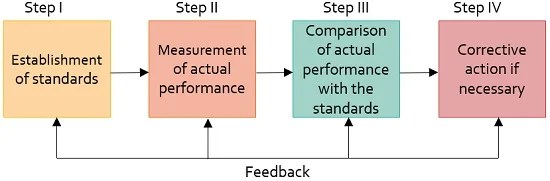
To M.C. Niles, ‘controlling is maintaining of a balance in activities directed towards a goal or a set of goals.’ Therefore, control consists of the steps taken to ensure that the performance of the organisation conforms to the plans. The process of control consists of a few steps, namely

  • Establishing standards or measures for performance,
  • Measuring and recording of actual performance
  • Comparing actual with the planned measures to find out the deviations
  • Taking corrective measures, if needed. Thus, control is one of the important ingredients for the success of the sales department.

Reports and Records

Report

Every sales manager needs accurate and up-to-date information, on the basis of which he formulates policies for future business. Formulation of policies may not be practical in the absence of information. For the growing needs of the organization, expanding the professions, widening activities of the business etc., it has become essential to look for the information.

A report is a presentation of facts on the basis of activities. Salesmen’s reports-daily, weekly, monthly, provide valuable information relating to the salesmen’s activities for a sales organization. Salesmen, who are the primary source of information, being the eyes and ears of the selling firms, are asked to send reports periodically.

Advantages of Reports

  • Salesman’s report is a good guide and indicator for building future plan-a barometer.
  • Competitors’ attitude can be known.
  • Sales manager does not waste time in formulating the policies for future, because of the brevity in reports.
  • Salesmen takes little time in writing the reports.
  • The report is a good form of control as it reveals the weakness and strong points of the salesmen.
  • The changes in demand and attitude of the consumers can be known.
  • It is a tool by which the activities of the salesmen can be sharpened.
  • Sales manager is able to divert his attention to the situation warranted on the basis of importance.
  • Salesman himself develops the habit of self-activity analysis.
  • The two-way communication assures employee morale.

Sales Territories and Sales Quotas

Sales manager must try to know the sales field well in advance, before the production starts. He must know the area of demand for the products and for this he should know the habits and economic position of the customers; and the type of demand and quality of products usually in demand. In short, a detailed study of consumers is important. The sources of information are year books, census reports, publications, professional organisations etc.

Sales Territory

Almost all the firms divide their markets, after the sales field is located into different territories. Sales territory is a particular grouping of customers and prospects assigned to a salesman. A sales territory is a geographical area which contains present and potential customers, who can be served effectively and economically by a single salesman.

Its aim is to facilitate management’s task in matching sales efforts with the sales opportunities. An efficient salesman can successfully discharge his duties and responsibilities if the territory allotted to him is of workable and suitable size. A good sales planning is based on sales territory, rather than taking the whole market area.

That is, the market of a firm’s product is divided into small segments or territories or areas, so that each territory can be allotted to each salesman.

When allotting perfect sales territories, which have been planned carefully, the following objectives are aimed for the reasons thereof:

  • Sales effort can be fruited more effectively in the assigned territory.
  • It is possible to have increased market coverage, not losing the orders to competitors. He meets the competition wisely as it is pre-planned, because he knows the local condition.
  • It prevents the duplication or overlapping sales efforts.
  • Headquarters of each sales territory can be located in a place, where greater number of customers are located.
  • Work load for each salesman can equitably be distributed, in terms of sales volume.

Sales Quota

Apart from the allocation of sales territories, salesmen are further controlled by fixing sales quota. Almost all the companies use quota system of defining and evaluating the task expected of the salesmen. Sales quota may be defined as the estimated volume of sales that a company expects to secure within a definite period of time.

Quota is the amount of business, in terms of value or in terms of units of sales, which is fixed for every salesman. It may be fixed for a geographical area to be achieved within a definite period of time, a month or a year. Shorter the period, the better it is. It is a target or a standard of performance that the salesman has to attain. The quota is fixed on the basis of sales forecast. For an effective control, smaller area and shorter period are preferred.

A sales quota, to be effective, practical and successful, should satisfy the following:

  • Sales quota must be attainable and fair.
  • It must be scientifically calculated. It should not be too small or too big.
  • It must provide definite incentive to salesman.
  • It must be flexible.
  • It must be simple and must be fixed in consultation with the salesman.

Sales quota brings the following benefits

  • The sales quota can be used as yardstick to assess the performance of the salesmen.
  • It is a measuring rod with which the sales operations are directed and controlled to more profitable channels.
  • It is possible and easier to locate strong markets and weak markets.
  • It is a device to adopt more effective compensation plans.
  • It fixes the responsibility on each salesman and so they work hard to attain the goal. The salesmen never allow the sales to fall below the quota.
  • It facilitates sales contests and is a base.

Weaknesses

  • In many cases the sales quota is fixed arbitrarily.
  • If situations are changed, the quota fixed may become ineffective.
  • If the quota is too small, the salesman will relax and if the quota fixed is too large or unattainable, the salesman loses initiative.
  • It is difficult to set an accurate quota.

Bases Necessary for Fixing Quota:

  • Purchasing power of the prospects.
  • Past sales figures compared by analysis.
  • Demand trend for the products.
  • Position and degree of competition prevailing.

At the end of the quota period, it is a must to measure the effectiveness of quota by comparing the performance of salesman, in relation to the quota. To keep salesmen’s effort on the right path, quotas can be used as a control mechanism. Departure of sales activities from the projected quota is a main problem to the sales management. If sales volume is not satisfactory, the fault may lie with quota plans. Quota, as a diagnostic aid, cautions the authority to take corrective steps and especially, when the sales volume takes a negative departure from the past sales.

In all fairness, quota should be aimed at equitable distribution. It should be equal for all salesmen. Should all the salesmen have the same quotas? The answer depends upon the territories, which are not the same in respect of competition, extent, customers etc. the ability of the salesman is also different. The ‘better’ salesman with ‘better’ territory exceeds the quota and ‘poor’ salesman with ‘poor’ territory fails to achieve even the quota. By considering all these, fairness of the quote decision takes place.

Types of Quotas

  • Sales volume, in value or units by product line, consumer type etc.
  • Salesmen activity, such as calls, new accounts, demonstrations, display arranged etc.
  • Expenses quota, either in value or percentage of sales obtained.
  • Gross Margin from sales obtained etc.

Quota can be used as a management tool, if it is set scientifically.

Salesmen’s Authority

If the sales manager goes for doing all the works of a firm, it is very difficult to conduct the business Moreover, he lacks time. Therefore, the job is divided and entrusted to the salesmen. When the authority is passed on to the salesmen, there is transfer of power to the salesmen i.e., delegation of power. Delegation is the required authority to the salesmen to discharge their assigned job.

When one is delegated the authority, it means permission is given to do the duties. When authority is conferred on salesmen, they know their responsibilities. Customers may not be willing to deal with a salesman having no authority.

There are no hard and fast rules as to how much authority be given to a salesman. In modern time, the degree of authority is reduced. The authority and freedom of salesmen varies from firm to firm. To what extent the authority is given to a salesman depends upon the size and nature of the firm.

Since the salesmen are representing the firm and deal with customers, who have no direct contact with the firm, the salesmen’s authority be well-defined. Generally, catalogue, price lists advertisements etc., reveal the prices, guarantees, quality and other details of the products. And the salesmen are being relieved of these botherations.

However, salesmen may be conferred with certain measure of authority in dealing with the matters, such as special concessions, discount rates, granting credit, settlement of claims, settlement of damages, defective, unsalable items etc. But it is important that salesmen are watched in their acts which must be in accordance with the instructions by the sales manager and their activities are subject to the approval of the sales manager.

Field Supervision

Performance of a function or service by an individual is called duty; activities that an individual is required to perform are a duty on him. Authority is a right or power required to perform a job on the basis of duty assigned to one. An authorized person is empowered to do the assigned job Responsibility must always be followed by corresponding authority or power. Authority and responsibility move in opposite directions.

Authority always moves from the top downward, whereas responsibility moves upwards. Authority is derived from sales manager to whom the salesmen are responsible for proper performance of their activities. The individual responsibility and freedom of the sales personnel vary from firm to firm. A good degree of control is essential over the activities of the salesmen.

Generally the sales manager or any senior sales personnel or field supervisor; are appointed to check the activities of the salesmen so as to:

  • Know whether the salesman is doing his job in best way
  • Find out deficiencies if any
  • Make suggestions for further improvement
  • Check the procedure of orders taking
  • Evaluate the performance of salesman
  • Provide spot motivation to salesman
  • Secure maximum coverage of the market

Control aims at appraisal of salesman’s performance. It must be done periodically and on continuing basis as to determine the compliance of policies and attainment of targeted quota in respect of job. Supervision and control are different. Supervision aims at direction for working and control includes supervision and evaluation of past performance.

Routing and Scheduling

Time must be used wisely while a salesman travels in his respective territorial area. Salesman will be encouraged to get maximum sales by reducing the wastage of time. Routing and scheduling is one of the techniques of controlling a salesman’s day to day activities. A planned routing of the salesman will facilitate easy communication, maximum territorial coverage and thereby reduce the waste time.

Management has a closer control. A clear tour plan is there and reveals route, location of customers, transport facilities, maps etc. The planned routes and schedules are to be followed by the salesman. The reports sent by the salesman can be compared with the planned routes and schedules and this reveals the deviations.

Strategic Decision Making

Strategic decision-making is the process of charting a course based on long-term goals and a longer term vision. By clarifying your company’s big picture aims, you’ll have the opportunity to align your shorter term plans with this deeper, broader mission giving your operations clarity and consistency.

Strategic decision making involves the following 3 things:

  • The long term way forward for the company
  • Selection of proper markets for the company
  • The products and tactics needed to succeed in the targeted market.

Features of Strategic Decision Making

  1. Strategy is at many times at tangent with Marketing Decisions

Where marketing decisions are short term, strategic decision making might consider a long term initiative, such as launching a very new and innovative product, or changing the existing product lines radically. Technology or innovation is at the crux of strategic decision making.

The reason that marketing decisions and strategy decisions are difference is because marketing is focused on retaining the existing customer base with the existing technologies. But the customer base is sure to get tired soon of the existing products and the innovators and adopters will keep searching for new products in the market. And hence, through strategic decisions, the firm has to stay in a place of continuous development.

  1. There is immense risk involved while taking strategic decisions

Naturally, when you are implementing plans which will show positive or negative results only after 4-5 years, the risk in strategic decision making is huge. Think about the time and energy, not to say natural resources wasted to implement a plan which failed after 4-5 years.

Yet, even after the risk involved, companies have to implement risky strategic decisions from time to time just because the directors thought a unique product had demand in the market, or that another product is required in the market. Strategic decisions involve necessary risk and success is not guaranteed.

  1. Strategic decisions involve a lot of Ifs and Buts

Think of a mind map and the number of branches and nodes that can form the complete mind map. When a brain starts thinking, the central thought might have further branches, and these branches will have even more nodes (or sub branches if you want to call them)

Similar to the mind map, a business can face many problems in the course of its run. A competitor can crop up, the market can become penetrative, the external environment can change, and many other unforeseen situations can happen. The strategic decision making has to consider all these alternatives, whether positive or negative. And the plan has to also include the action that the firm will take, if any of the above business problems or factors come into play.

  1. Strategy implementation timelines

Whenever we make a schedule in our personal lives, we always start things when we have enough time in our hand. For example you will plan a holiday, when office work is not hectic. You will not plan it when there is a product launch nearby. Similarly, when in business, timelines are very important.

If a product is to be launched, the launch date is decided at least a year back, the sales phase has to be implemented at least 2 months before the actual launch so that you have sellers in place when the product is launch. Moreover, the service network is also to be planned before the launch, so that service issues are sorted out when there are problems after the product launch. If these concepts are not implemented, the marketing strategy and hence the product can fail miserably.

  1. Preparing for the competition’s response

Whenever you change the market equilibrium, the competitors, whose businesses you have directly challenged, are sure to respond. When they respond, the market changes and you have to change your strategy accordingly.

In general there are 2 ways that a company directly affects the competition and the market.

  • The company creates a completely new operating norm in the market itself.
  • It raises customer expectations and thereby changes the market equilibrium.

Most strategic decisions will call for radical changes in the way the company operates in the existing market. Accordingly, the perception of competitors and customers will change for the company. The company has to in turn be prepared for the response of competitors in such a case.

Implementation of strategic decisions While implementing strategic decisions, you need to have eyes at the front as well as the back of your head. You need to look at what was decided at the start, as due to short term pressure, it is very much possible to deviate from the path which was already set.

Dealing with Risk and Uncertainty in Decision Making

Decision-making under Certainty

A condition of certainty exists when the decision-maker knows with reasonable certainty what the alternatives are, what conditions are associated with each alternative, and the outcome of each alternative. Under conditions of certainty, accurate, measurable, and reliable information on which to base decisions is available.

The cause and effect relationships are known and the future is highly predictable under conditions of certainty. Such conditions exist in case of routine and repetitive decisions concerning the day-to-day operations of the business.

Decision-making under Risk

When a manager lacks perfect information or whenever an information asymmetry exists, risk arises. Under a state of risk, the decision maker has incomplete information about available alternatives but has a good idea of the probability of outcomes for each alternative.

While making decisions under a state of risk, managers must determine the probability associated with each alternative on the basis of the available information and his experience.

Decision-making under Uncertainty

Most significant decisions made in today’s complex environment are formulated under a state of uncertainty. Conditions of uncertainty exist when the future environment is unpredictable and everything is in a state of flux. The decision-maker is not aware of all available alternatives, the risks associated with each, and the consequences of each alternative or their probabilities.

The manager does not possess complete information about the alternatives and whatever information is available, may not be completely reliable. In the face of such uncertainty, managers need to make certain assumptions about the situation in order to provide a reasonable framework for decision-making. They have to depend upon their judgment and experience for making decisions.

Modern Approaches to Decision-making under Uncertainty

There are several modern techniques to improve the quality of decision-making under conditions of uncertainty.

The most important among these are:

  • Risk analysis
  • Decision trees
  • Preference theory

Risk Analysis

Managers who follow this approach analyze the size and nature of the risk involved in choosing a particular course of action.

For instance, while launching a new product, a manager has to carefully analyze each of the following variables the cost of launching the product, its production cost, the capital investment required, the price that can be set for the product, the potential market size and what percent of the total market it will represent.

Risk analysis involves quantitative and qualitative risk assessment, risk management and risk communication and provides managers with a better understanding of the risk and the benefits associated with a proposed course of action. The decision represents a trade-off between the risks and the benefits associated with a particular course of action under conditions of uncertainty.

Decision Trees

These are considered to be one of the best ways to analyze a decision. A decision-tree approach involves a graphic representation of alternative courses of action and the possible outcomes and risks associated with each action.

By means of a “tree” diagram depicting the decision points, chance events and probabilities involved in various courses of action, this technique of decision-making allows the decision-maker to trace the optimum path or course of action.

Preference or Utility Theory

This is another approach to decision-making under conditions of uncertainty. This approach is based on the notion that individual attitudes towards risk vary. Some individuals are willing to take only smaller risks (“risk averters”), while others are willing to take greater risks (“gamblers”). Statistical probabilities associated with the various courses of action are based on the assumption that decision-makers will follow them.

3For instance, if there were a 60 percent chance of a decision being right, it might seem reasonable that a person would take the risk. This may not be necessarily true as the individual might not wish to take the risk, since the chances of the decision being wrong are 40 percent. The attitudes towards risk vary with events, with people and positions.

Top-level managers usually take the largest amount of risk. However, the same managers who make a decision that risks millions of rupees of the company in a given program with a 75 percent chance of success are not likely to do the same with their own money.

Moreover, a manager willing to take a 75 percent risk in one situation may not be willing to do so in another. Similarly, a top executive might launch an advertising campaign having a 70 percent chance of success but might decide against investing in plant and machinery unless it involves a higher probability of success.

Though personal attitudes towards risk vary, two things are certain.

Firstly, attitudes towards risk vary with situations, i.e. some people are risk averters in some situations and gamblers in others.

Secondly, some people have a high aversion to risk, while others have a low aversion.

Most managers prefer to be risk averters to a certain extent, and may thus also forego opportunities. When the stakes are high, most managers tend to be risk averters; when the stakes are small, they tend to be gamblers.

Manpower Planning, Process, Reason, Challenges

Manpower Planning, also known as human resource planning, is the process of forecasting an organization’s future human resource needs and ensuring that the right number of qualified individuals are available to meet those needs. It involves analyzing current workforce capabilities, predicting future staffing requirements based on organizational goals and strategies, and developing plans to recruit, train, and retain employees. Effective manpower planning helps organizations optimize their human resources, minimize costs, improve productivity, and ensure that they can adapt to changing business conditions while achieving strategic objectives.

Process of Manpower Planning:

Process of manpower planning involves several steps that help organizations ensure they have the right number of employees with the necessary skills to meet their goals.

  1. Assess Organizational Objectives

  • Understand the organization’s short-term and long-term goals.
  • Align manpower planning with strategic objectives to ensure that the workforce supports business needs.
  1. Analyze Current Workforce

  • Conduct a thorough evaluation of the existing workforce to determine the number of employees, their skills, experience, and qualifications.
  • Identify strengths, weaknesses, and gaps in the current workforce.
  1. Forecast Future Manpower Needs

  • Project future staffing requirements based on factors such as business growth, upcoming projects, market trends, and technological changes.
  • Use quantitative methods (statistical analysis) and qualitative methods (expert opinions) for forecasting.
  1. Identify Gaps in Workforce

  • Compare the current workforce against the projected needs to identify gaps.
  • Determine the quantity and type of personnel required to meet future demands.
  1. Develop Recruitment Plans

  • Create strategies for recruiting new employees to fill identified gaps.
  • Consider various recruitment sources such as job postings, employee referrals, recruitment agencies, and online platforms.
  1. Implement Training and Development Programs

  • Identify skills development needs and create training programs to enhance the existing workforce’s capabilities.
  • Ensure employees are equipped with the skills required for future roles.
  1. Evaluate and Adjust Staffing Levels

  • Monitor the implementation of the staffing plan and assess its effectiveness.
  • Adjust the workforce levels and recruitment plans based on changing business conditions and feedback from management.
  1. Review and Revise Manpower Plan

  • Continuously evaluate the manpower planning process to ensure it remains aligned with the organization’s objectives and responds to internal and external changes.
  • Revise the manpower plan as needed to adapt to new business challenges or opportunities.

Reason of Manpower Planning:

  • Optimal Utilization of Resources:

Manpower planning ensures that an organization effectively utilizes its human resources, preventing both understaffing and overstaffing, which can lead to inefficiencies and increased costs.

  • Future Workforce Needs:

It helps organizations anticipate future staffing requirements based on business growth, projects, and changes in the industry, ensuring they have the right talent available when needed.

  • Skill Development and Training:

Through manpower planning, organizations can identify skill gaps within their workforce and implement training programs to develop the necessary competencies, enhancing overall productivity.

  • Employee Retention:

Effective manpower planning contributes to higher employee satisfaction by aligning individual career goals with organizational objectives, leading to improved retention rates.

  • Cost Management:

By accurately forecasting staffing needs, organizations can manage labor costs more effectively, reducing unnecessary expenses related to recruitment and training.

  • Adaptability to Change:

In a dynamic business environment, manpower planning enables organizations to quickly adapt to changes in market demand or operational needs by ensuring a flexible and capable workforce.

  • Strategic Decision-Making:

It provides essential data and insights for strategic decision-making, allowing management to align workforce capabilities with business goals and objectives.

  • Succession Planning:

Manpower planning facilitates the identification of potential leaders within the organization, ensuring a smooth transition in key positions and maintaining business continuity.

Challenges of Manpower Planning:

  1. Dynamic Business Environment

The rapid changes in the business landscape, including technological advancements, market fluctuations, and evolving consumer preferences, make it difficult to predict future manpower needs accurately. Organizations must remain agile and adaptable to respond to these changes effectively.

  1. Skill Shortages

Many industries face a shortage of skilled labor, making it challenging to find qualified candidates to fill key positions. As job requirements become more specialized, organizations may struggle to identify individuals with the necessary skills and experience, leading to potential gaps in the workforce.

  1. Inaccurate Forecasting

Forecasting future manpower needs relies on various assumptions and data analysis, which may not always be accurate. Poor forecasting can lead to overstaffing or understaffing, both of which can have negative consequences for organizational performance and employee morale.

  1. Employee Turnover

High employee turnover can disrupt manpower planning efforts. Frequent departures can create instability within teams and require ongoing recruitment and training efforts, complicating the planning process. Organizations need strategies to retain talent and minimize turnover to ensure a stable workforce.

  1. Resistance to Change

Employees may resist changes associated with manpower planning, such as new roles, restructuring, or shifts in organizational culture. Overcoming this resistance requires effective communication and change management strategies to foster acceptance and cooperation among staff.

  1. Integration with Other HR Functions

Manpower planning must be integrated with other human resource functions, such as recruitment, training, and performance management. Lack of coordination can lead to inefficiencies, misalignment, and missed opportunities for optimizing workforce capabilities.

  1. Compliance and Regulations

Organizations must navigate various labor laws and regulations that impact manpower planning, such as equal employment opportunity laws, health and safety regulations, and union agreements. Compliance with these regulations adds complexity to the planning process and can limit flexibility.

  1. Technological Integration

The integration of technology into manpower planning processes can be both a challenge and an opportunity. While technology can enhance data analysis and forecasting capabilities, organizations may face challenges in adopting new systems, training staff, and ensuring data accuracy and security.

error: Content is protected !!