Purpose of related party disclosures

IAS 24 Related Party Disclosures requires disclosures about transactions and outstanding balances with an entity’s related parties. The standard defines various classes of entities and people as related parties and sets out the disclosures required in respect of those parties, including the compensation of key management personnel.

Disclosures to be made

  • Relationships between parent and subsidiaries should be disclosed irrespective of whether there have been any transactions or not. If the entity’s parent or the ultimate controlling party does not produce consolidated financial statements, then the next senior parent must be named in the consolidated financial statements for public use.
  • An entity must report the compensation to the key management personnel in total and each of the categories such as short term employee benefits, post-employment benefits, termination benefits, share-based payment, and other long-term benefits.
  • If key management services are obtained from another entity, then only the amounts incurred for the provision of such services shall be disclosed.
  • If the entity has transactions with the related party during the financial year, then it shall disclose the nature of such transactions, and also all the details such as amount, outstanding balances including commitments, provision for doubtful debts, and the expense recognised in respect of bad and doubtful debts.
  • The above disclosures will be made separately in respect of a parent, subsidiaries, associate, entities with joint control or significant influence over the other entity, joint ventures in which the entity is the venturer, and key management personnel of the entity or parent and other related parties.

In general, any related party transaction should be disclosed that would impact the decision making of the users of a company’s financial statements. This involves the disclosures noted below. Depending on the transactions, it may be acceptable to aggregate some related party information by type of transaction. Also, it may be necessary to disclose the name of a related party, if doing so is required to understand the relationship.

General Disclosures

Disclose all material related party transactions, including the nature of the relationship, the nature of the transactions, the dollar amounts of the transactions, the amounts due to or from related parties and the settlement terms (including tax-related balances), and the method by which any current and deferred tax expense is allocated to the members of a group. Do not include compensation arrangements, expense allowances, or any transactions that are eliminated in the consolidation of financial statements.

Control Relationship Disclosures

Disclose the nature of any control relationship where the company and other entities are under common ownership or management control, and this control could yield results different from what would be the case if the other entities were not under similar control, even if there are no transactions between the businesses.

Receivable Disclosures

Separately disclose any receivables from officers, employees, or affiliated entities.

When disclosing related party information, do not state or imply that the transactions were on an arm’s-length basis, unless you can substantiate the claim.

Preparation of Final accounts of General insurance

The financial statements of general insurance companies must be in conformity with the regulations of IRDA, Schedule B.

It has three parts: viz:

(a) Revenue Account;

(b) Profit and Loss Account, and

(c) Balance Sheet.

Revenue Account (Form B-RA):

The Revenue Account of general insurance companies must be prepared in conformity with the regulations of IRDA, Regulations 2002, as per the requirements of Schedule B. It has already been stated above that separate Revenue Account is to be prepared for each individual unit i.e. for Marine, Fire, and Accident.

These individual revenue accounts will highlight the result of operation of each individual unit for a particular accounting period. It also reveals the incomes and expenditures of each individual unit. Like Revenue Account of a life insurance company, Revenue Account is prepared under Mercantile System of Accounting.

Items appearing in Revenue Account:

Premiums:

It has already been stated above that general insurance policies are issued for a short period, say, for a year. As a result, many of them may be unexpired at the end of the year. Therefore, the entire premium so received cannot be treated as an income for the current year only. A portion of that amount should be carried forward to the next year in order to cover the unexpired risks. This is what is known as Reserve for Unexpired Risks.

As per Schedule IIB of the IRDA the Reserve for Unexpired Risks should be provided for out of net premium so received as:

(a) 50% for Fire Insurance business;

(b) 50% for Miscellaneous Insurance business;

(c) 50% for Marine Insurance business other than Marine Hull business, and

(d) 100% for Marine Hull business.

In addition to the above, if any company wants to maintain more than this level, it can do so. The same is known as Additional Reserve.

Claims Incurred (Net):

It is the first item that appears in the expenditure side of the Revenue Account of an insurance company. Claims mean the amount which is payable by the insurer, to the insured for the loss suffered by the latter against which the insurance was made.

Claims can be divided into:

(a) Claims intimated but not yet accepted and paid;

(b) Claims intimated, accepted but not paid;

(c) Claims intimated, accepted and paid; and

(d) Claims rejected. But if there is only ‘Claims intimated’ the same is to be treated like (b). That is why, in order to find out the outstanding claims, claims that have been intimated (whether paid or unpaid) should be considered.

At the end of the year the entry for the purpose will be:

Claims A/c             Dr.

To Claims Intimated Accepted but Not Paid A/c

Claims Intimated but Not Accepted and Not Paid A/c

A reverse entry should be passed at the beginning of the next year for which there will be no effect in Claims Account. But, if any claim is rejected subsequently, the amount is to be transferred to Profit and Loss Account and Claims Account must be credited for the purpose.

Commissions:

Insurance Regulatory and Development Authority Act, 1999, regulates the amount of commission which is payable on policies to the agents.

Operating Expenses:

Operating expenses will come under Schedule 4 of the Act. All revenue expenses other than the commission and claims will appear under this head.

Some of the operating expenses are:

Training Expenses; Rent, Rates and Taxes; Repairs; Printing and Stationery; Legal and Professional Expenses; Advertisement and Publicity, Interest on Bank Charges, etc.

Profit and Loss Account (Form B-Pl):

In order to find out the overall performance or results of the operating of general insurance business Profit and Loss Account of the General Insurance Companies is prepared. It also takes into account the income from investment by way of interest, dividend, Rent Profit/Loss on sale of investments. Provision for Taxations and Provision for Doubtful Debts, if any, should also be provided for.

Similarly, other expenses related to insurance business and bad debts written-off also will be adjusted to this account. However, appropriation section of Profit and Loss Account will contain payment of interim dividend; proposed dividend; transfer to any reserve i.e. appropriation items.

Balance Sheet (Form B-Bs):

The Balance Sheet of a general insurance company as per IRDA format is divided into two parts, viz. Source of Funds and Application of Funds. It is prepared in vertical form.

Sources of Funds:

It consists of:

(i) Share Capital (Schedule 5):

Various classes of Share Capital viz. Authorized Capital, Issued, Subscribed, Called-up and Paid up capital are separately shown.

(ii) Reserves & Surplus- (Schedule 6):

All kinds of reserves will appear under this head, viz. Securities Premium, Balance of Profit and Loss Account, General Reserve, Capital Redemption Reserve, Capital Reserve, etc.

(iii) Borrowings (Schedule 7):

Long term borrowings viz. Bonds, Debentures, Bank Loans, taken from various financial institutes will appear under this head.

Applications of Funds:

It consists of:

(i) Investments — (Schedule 8):

All kinds of investments, whether long-term or short-term, will appear under this schedule.

(ii) Loans— (Schedule 9):

Different kinds of loans clearly specified, viz. (a) Security-wise, Borrower-wise, performance-wise, and maturity-wise classification.

(iii) Fixed Assets (Schedule 10):

All fixed assets viz. Goodwill, Intangibles, Land and Building, Freehold/Leasehold Property, Furniture & Fixture, etc. will appear in this schedule.

(iv) Current Assets:

This section has two parts:

(a) Cash and Bank Balances (Schedule 11):

All cash and bank balances lying at Deposit Account and Current Account, Money-at-call and short notice etc. will appear in the Schedule.

(b) Advances and Other Assets (Schedule 12):

All advances (short-term) and other assets, if any, will appear in this Schedule.

(v) Current Liabilities (Schedule 14):

All current liabilities viz., Agents’ balances, Premium Received in Advance, Sundry Creditors, Claims Outstanding etc.

(vi) Provisions— (Schedule 15):

All kinds of provisions viz., Reserve for Unexpired Risk; Provision for Taxation, Proposed Dividend, Others.

New Format for Financial Statement:

According to Insurance Regulatory and Development Authority (Preparation of Financial Statements and Auditors’ Report of Insurance Companies) Regulations, 2002, every general insurance company must prepare as per Schedule B of the Regulations the following three statements for preparation and presentation of financial statements:

For General Insurance:

Revenue Account— Form B-RA

Profit and Loss Account — Form B-PL

Balance Sheet — Form B-BS

Thus, in short, every general insurance company is required to prepare a Revenue Account (Form B-RA); Profit and Loss Account (Form B-PL) and Balance Sheet (Form B-BS).

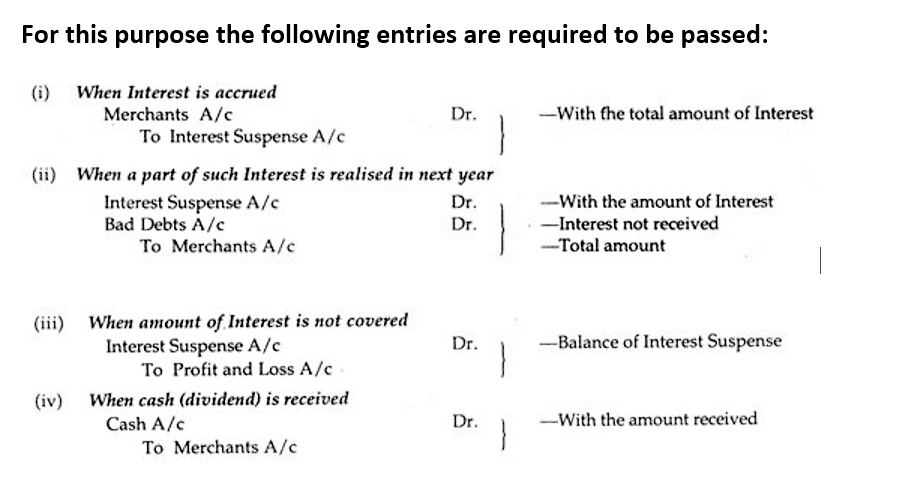
Interest on doubtful debts

(a) Interest Suspense Method:

From the standpoint of conservatism, interest on doubtful loans should be transferred to Interest Suspense Account and, at the same time, when the interest is realized (either in part or whole) the same is credited.


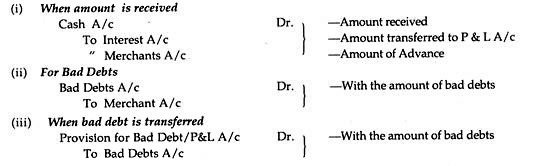
(b) Cash Basis Method:

No separate entry is required for Interest on doubtful loans. Since interest on such loans comes under Non-performing Assets, as such, such interest should not be recognized from conservatism point of view cash basis method is the best one.

The entries are:

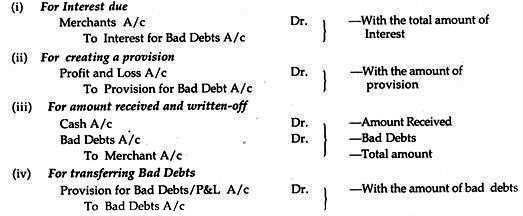
(c) Accrual Basis Method:

Under this method, the whole amount of interest is to be credited and, at the same time, a provision should also be made for such interest to Bad and Doubtful Debts Account.

The entries under this method are:

Relationship between Provisions and Contingent liability

Provision

A provision is a decrease in asset value and should be recognized when a present obligation arises due to a past event. The timing as to when the said obligation arises and the amount is often uncertain. Commonly recorded provisions are, provision for bad debts (debts that cannot be recovered due to insolvency of the debtors) and provision for doubtful debts (debts that are unlikely to be collected due to possible disputes with debtors, issues with payments days etc.) where the organization makes an allowance for the inability to collect funds from their debtors due to nonpayment. Provisions are reviewed at the financial year end to recognize the movements from the last financial year’s provision amount and the over provision or under provision will be charged to the income statement. The usual provision amount for a provision will be decided based on company policy.

Basic accounting treatment for recognizing a provision is,

Expense A\C                              Dr

Provision A\C                            Cr

Contingent Liability

For a contingent liability to be recognized there should be a reasonable estimate of a probable future cash outflow based on a future event. For instance, if there is a pending lawsuit against the organization, a possible cash payment may have to be made in the future in case the organization loses the lawsuit. Either winning or losing the lawsuit is not known at present thus the occurrence of the payment is not guaranteed. The recording of the contingent liability depends on the probability of the occurrence of the event that gives rise to such liability. If a reasonable estimate cannot be made regarding the amount, the contingent liability may not be recorded in the financial statements. Basic accounting treatment for recognizing a contingent liability is,

Cash   A\C                                       Dr

Accrued Liability A\C                   Cr

Contingent Liabilities

Provisions

Recorded at present to account for future possible outflows events. Accounting for the present, due to past events.
Occurrence is conditional or not certain. Occurrence is certain.
Reasonable estimation is made for the future amount to be paid. Amount is not largely certain.
Recorded in Statement of financial position: increase in company’s liabilities. Recorded in Statement of financial position: decrease in company’s assets.
Not recorded in the income statement. Recorded in income statements.

Advanced Financial Accounting Bangalore University B.com 2nd Semester NEP Notes

Unit 1 Insurance Claims for Loss of Stock and Loss of Profit
Meaning of fire claim, Features and Principles of Fire Insurance VIEW
Concept of Loss of Stock: Loss of Profit and Average Clause VIEW
Computation of Claim for loss of stock (including Over valuation and Under Valuation of Stock VIEW
Abnormal Items VIEW
Application of Average Clause VIEW
Unit 2 Departmental Accounts
Departmental Accounts Meaning, Advantages, Disadvantages VIEW
Method of Departmental accounting VIEW
Basis of allocation of common expenditure among various departments. VIEW
Types of departments & Inter-department transfers at cost price and invoice price (Theory and proforma journal entries) VIEW
Preparation Departmental Trading and Profit and Loss Account including inter departmental transfers at Cost Price only. VIEW
VIEW
Unit 3 Conversion of Single Entry into Double Entry
Meaning, Features Types of Single Entry System VIEW
Merits, Demerits of Single Entry System VIEW
Differences between Single Entry System and Double Entry System VIEW
Need and Methods of conversion of Single Entry into Double entry VIEW
Problems on Conversion of Single Entry into Double Entry (Simple Problems only)
Unit 4 Royalty Accounts
Royalty and Royalty agreement, Introduction, Meaning, Definition, Types of Royalty VIEW
Differences between Rent and Royalty VIEW
Terms used in Royalty, Lessor, Lessee, Short Workings, Irrecoverable Short Workings, Recoupment of Short Workings, Surplus Royalty VIEW
Methods of Recoupment of Short Workings: Fixed and Floating methods VIEW
Preparation of Royalty Analysis Table (Excluding Government Subsidy) VIEW
Journal Entries and Ledger Accounts in the books of Lessee only:

i) When Minimum Rent Account is opened

ii) When Minimum Rent Account is not opened.

Note: Problems including Strikes and Lockouts, but excluding sub-lease.

VIEW
VIEW
Unit 5 Average Due Date and Account Current
Average Due Date: Meaning, Concept, Uses VIEW
Calculation of Average Due Date:

i) Where amount is lent in one installment

ii) Where amount is lent in various installments

iii) Taking Grace Days into account

iv) Calculation of Due Date few months after date / Sight

VIEW
Account Current Meaning, Need and Situation leading to Account Current Preparation VIEW
Account Current with the help of:

i) Interest table.

ii) By Means of Product.

VIEW

Financial & Management Accounting-II LU BBA 2nd Semester NEP Notes

Unit 1 [Book]
Accounting for Assets VIEW
Valuation of inventories VIEW VIEW VIEW
Depreciation VIEW VIEW VIEW
Methods of Depreciation: WDV VIEW
SLM Method VIEW
Bank Reconciliation Statement VIEW VIEW
Introduction to Corporate Accounting VIEW
Preparation of financial Statements of a company VIEW VIEW


Unit 2 [Book]
Analysis of Financial Statements Meaning VIEW
Financial Statements Types and Techniques VIEW
Trend analysis VIEW
Ratio Analysis VIEW VIEW
Statement of Cash Flow VIEW VIEW
Indirect method VIEW


Unit 3 [Book]
Introduction to Management Accounting VIEW
Objectives of Management Accounting VIEW
**Tools & Techniques of Management Accounting VIEW
Difference between Cost and Management accounting VIEW
Relevant costing: VIEW
Special order VIEW
Addition, Deletion of product and services VIEW
Optimal uses of limited resources VIEW
Pricing decisions VIEW
Make or Buy decisions VIEW VIEW


Unit 4 [Book]
Budgets and Budgetary Control VIEW VIEW
Preparing flexible budgets VIEW VIEW
Standard Costing VIEW
Material Variance Analysis VIEW
Labour Variance Analysis VIEW
**Overhead Variance Analysis VIEW
**Cost Variance Analysis VIEW
Introduction to Responsibility accounting VIEW
Meaning and types of Responsibility centres VIEW

Kinds of Accounts, Rules

In accounting, “Accounts” refer to the individual records that track financial transactions related to specific assets, liabilities, equity, income, or expenses. Each account is part of the general ledger, where debits and credits are recorded to monitor the financial status of a business. Accounts help in organizing financial data for reporting, analysis, and decision-making purposes.

Accounts Types

There are several types of accounting that range from auditing to the preparation of tax returns. Accountants tend to specialize in one of these fields, which leads to the different career tracks noted below:

  • Public Accounting.

This field investigates the financial statements and supporting accounting systems of client companies, to provide assurance that the financial statements assembled by clients fairly present their financial results and financial position. This field requires excellent knowledge of the relevant accounting framework, as well as an inquiring personality that can delve into client systems as needed. The career track here is to progress through various audit staff positions to become an audit partner.

  • Financial Accounting.

This field is concerned with the aggregation of financial information into external reports. Financial accounting requires detailed knowledge of the accounting framework used by the reader of a company’s financial statements, such as Generally Accepted Accounting Principles (GAAP) or International Financial Reporting Standards (IFRS). Or, if a company is publicly-held, it requires a knowledge of the standards issued by the government entity responsible for public company reporting in a specific country (such as the Securities and Exchange Commission in the United States). There are several career tracks involved in financial accounting. There is a specialty in external reporting, which usually involves a detailed knowledge of accounting standards. There is also the controller track, which requires a combined knowledge of financial and management accounting.

  • Government Accounting.

This field uses a unique accounting framework to create and manage funds, from which cash is disbursed to pay for a number of expenditures related to the provision of services by a government entity. Government accounting requires such a different skill set that accountant tend to specialize within this area for their entire careers.

  • Management Accounting.

This field is concerned with the process of accumulating accounting information for internal operational reporting. It includes such areas as cost accounting and target costing. A career track in this area can eventually lead to the controller position, or can diverge into a number of specialty positions, such as cost accountant, billing clerk, payables clerk, and payroll clerk.

  • Forensic Accounting.

This field involves the reconstruction of financial information when a complete set of financial records is not available. This skill set can be used to reconstruct the records of a destroyed business, to reconstruct fraudulent records, to convert cash-basis accounting records to the accrual basis, and so forth. This career tends to attract auditors. It is usually a consulting position, since few businesses require the services of a full-time forensic accountant. Those in this field are more likely to be involved in the insurance industry, legal support, or within a specialty practice of an audit firm.

  • Tax Accounting.

This field is concerned with the proper compliance with tax regulations, tax filings, and tax planning to reduce a company’s tax burden in the future. There are multiple tax specialties, tracking toward the tax manager position.

  • Internal Auditing.

This field is concerned with the examination of a company’s systems and transactions to spot control weaknesses, fraud, waste, and mismanagement, and the reporting of these findings to management. The career track progresses from various internal auditor positions to the manager of internal audit. There are specialties available, such as the information systems auditor and the environmental auditor.

Accounting Rules

The system of debit and credit is right at the foundation of double entry system of book keeping. It is very useful, however at the same time it is very difficult to use in reality. Understanding the system of debits and credits may require a sophisticated employee. However, no company can afford such ruinous waste of cash for record keeping. It is generally done by clerical staff and people who work at the store. Therefore, golden rules of accounting were devised.

Golden rules convert complex bookkeeping rules into a set of principles which can be easily studied and applied.

  • Debit The Receiver, Credit the Giver

This principle is used in the case of personal accounts. When a person gives something to the organization, it becomes an inflow and therefore the person must be credit in the books of accounts. The converse of this is also true, which is why the receiver needs to be debited.

  • Debit What Comes In, Credit What Goes Out

This principle is applied in case of real accounts. Real accounts involve machinery, land and building etc. They have a debit balance by default. Thus, when you debit what comes in, you are adding to the existing account balance. This is exactly what needs to be done. Similarly, when you credit what goes out, you are reducing the account balance when a tangible asset goes out of the organization.

  • Debit All Expenses and Losses, Credit All Incomes and Gains

This rule is applied when the account in question is a nominal account. The capital of the company is a liability. Therefore, it has a default credit balance. When you credit all incomes and gains, you increase the capital and by debiting expenses and losses, you decrease the capital. This is exactly what needs to be done for the system to stay in balance.

Transaction Analysis, Significance, Components, Steps

Transaction analysis is the process of examining and interpreting a business transaction to determine its impact on the accounting equation: Assets = Liabilities + Equity. It is the first step in the accounting cycle and helps ensure that each transaction is recorded accurately in the books. Every transaction affects at least two accounts and maintains the balance of the equation through Double-entry Accounting. For example, purchasing goods for cash decreases cash (asset) and increases inventory (asset), keeping the equation in balance. Transaction analysis involves identifying the accounts involved, classifying them (asset, liability, equity, income, or expense), determining the amount, and deciding whether to debit or credit each account. This ensures precise financial reporting and bookkeeping accuracy.

Significance of Transaction Analysis:

  • Accurate Financial Reporting:

Transaction analysis helps ensure that all financial transactions are accurately recorded, providing a true representation of a company’s financial position. This accuracy is essential for internal management and external stakeholders.

  • Informed Decision-Making:

Understanding the effects of transactions on financial statements allows management to make informed decisions. By analyzing past transactions, businesses can identify trends, assess performance, and strategize for the future.

  • Compliance:

Transaction analysis ensures that organizations comply with accounting principles and regulations, such as Generally Accepted Accounting Principles (GAAP) or International Financial Reporting Standards (IFRS). Adherence to these standards is critical for maintaining transparency and credibility.

  • Fraud Detection:

A thorough analysis of transactions can help identify irregularities and potential fraud. By scrutinizing transactions, accountants can detect discrepancies that may indicate fraudulent activities.

Components of Transaction Analysis:

Transaction analysis involves several key components that work together to assess the financial implications of a transaction. These components are:

  • Accounts:

Accounts are the individual records in which financial transactions are recorded. Each account represents a specific category, such as assets, liabilities, equity, revenue, or expenses.

  • Debits and Credits:

The double-entry accounting system relies on the concepts of debits and credits. Each transaction affects at least two accounts, with one account being debited and another being credited. This ensures that the accounting equation (Assets = Liabilities + Equity) remains balanced.

  • Accounting Equation:

The accounting equation serves as the foundation for transaction analysis. It states that a company’s assets must equal the sum of its liabilities and equity. Understanding this equation is crucial for determining how transactions affect the financial position of a business.

Steps in Transaction Analysis:

Transaction analysis typically involves a systematic approach to assess the financial impact of a transaction.

Step 1: Identify the Transaction

The first step in transaction analysis is to identify the transaction that needs to be analyzed. This could be any financial activity, such as a sale, purchase, payment, or receipt. For instance, if a company sells goods to a customer for cash, this transaction must be recorded.

Step 2: Determine the Accounts Affected

Once the transaction is identified, the next step is to determine which accounts will be affected. In our example of a cash sale, the accounts involved would be “Cash” (an asset) and “Sales Revenue” (a revenue account). It’s essential to consider the nature of each account to understand how the transaction will impact the financial statements.

Step 3: Analyze the Impact on Each Account

After identifying the affected accounts, the next step is to analyze how the transaction impacts each account. This involves deciding whether the accounts will be debited or credited.

For the cash sale example:

  • Cash Account: This account will be increased (debited) by the amount received from the customer.
  • Sales Revenue Account: This account will be increased (credited) to reflect the revenue earned from the sale.

Step 4: Record the Transaction

Once the impact on each account is determined, the transaction can be recorded in the accounting system using journal entries. The journal entry for the cash sale would look like this:

Date Account Debit Credit
YYYY-MM-DD Cash $1,000
Sales Revenue $1,000

This entry reflects that cash is increasing by $1,000 and sales revenue is also increasing by the same amount.

Step 5: Post to the Ledger

After recording the transaction in the journal, it must be posted to the general ledger. The ledger is a collection of all accounts, where the cumulative effect of transactions is maintained. In our example, the cash and sales revenue accounts in the ledger will now reflect the increase.

Step 6: Prepare Financial Statements

Transaction analysis culminates in the preparation of financial statements, which summarize the financial position and performance of the business. The recorded transactions will impact the balance sheet and income statement.

  • Balance sheet will show an increase in cash under assets.
  • Income statement will reflect the increase in sales revenue, contributing to the company’s net income.

Provision for Doubtful Debts

Provision for Doubtful Debts refers to a fund or reserve that a business sets aside from its earnings to cover potential future bad debts. In many businesses, customers purchase goods or services on credit, leading to accounts receivable. However, not all customers may fulfill their obligation to pay, and some of these debts may turn into bad debts.

To prepare for such losses, companies create a provision based on historical data, the financial condition of debtors, or market trends. This provision does not directly write off any specific debt but sets aside an estimated amount that may become uncollectible. This approach ensures that the reported value of accounts receivable reflects a more accurate figure, reducing the risk of overstating a company’s assets.

Importance of Provision for Doubtful Debts:

  • Accurate Financial Reporting:

By creating a provision for doubtful debts, businesses ensure that their financial statements show a realistic picture of their financial health. Without this provision, accounts receivable could be overstated, misleading stakeholders about the company’s actual liquidity and solvency.

  • Risk Mitigation:

It helps businesses anticipate potential losses and prepare for them in advance, ensuring that they are not caught off-guard if debts become uncollectible. This aligns with the conservative approach in accounting, which encourages businesses to prepare for foreseeable risks.

  • Compliance with Accounting Standards:

In accordance with accounting principles such as the prudence principle and matching principle, the creation of this provision allows businesses to match potential future bad debt expenses with the revenues generated during the same accounting period.

  • Improved Decision-Making:

Business leaders can make more informed decisions about credit policies, risk management, and liquidity when they have a realistic estimate of potential bad debts.

  • Investor Confidence:

Investors and creditors prefer to see financial statements that adhere to conservative accounting practices, as it reduces the likelihood of sudden financial surprises due to bad debts.

Methods for Estimating Provision for Doubtful Debts:

The provision for doubtful debts can be estimated using the following methods:

  1. Percentage of Sales Method:

A certain percentage of total credit sales is set aside as a provision. The percentage is usually based on historical data or industry standards regarding bad debts.

  1. Aging of Accounts Receivable Method:

This method involves classifying debts according to their age (how long they have been outstanding) and applying different percentages of uncollectibility to each age category. Older debts are usually more likely to be written off, so they are allocated a higher provision.

  1. Historical Data:

Businesses often review their past experiences with bad debts to estimate the provision required for the future.

Accounting Treatment for Provision for Doubtful Debts:

The creation of the provision for doubtful debts involves recording an expense in the profit and loss account and creating a liability or reducing the receivables balance on the balance sheet. Here’s the accounting treatment:

  1. At the Time of Creating Provision:

When a company determines the estimated amount for provision, the following journal entry is passed:

Bad Debts Expense A/c   Dr.

    To Provision for Doubtful Debts A/c

  • Bad Debts Expense is debited, increasing the expenses in the profit and loss account.
  • Provision for Doubtful Debts is credited, creating a liability on the balance sheet or reducing the value of accounts receivable.
  1. At the Time of Writing Off Bad Debts:

If any debt is confirmed to be uncollectible, the following entry is made to write off the debt:

Provision for Doubtful Debts A/c   Dr.

    To Debtors A/c

This entry reduces the debtor’s balance and uses the provision previously created. The loss does not affect the current year’s profit and loss account because it was already accounted for when the provision was created.

  1. Adjusting Provision in Subsequent Years:

At the end of every financial year, the provision for doubtful debts is re-evaluated. If the provision needs to be increased or decreased, the following journal entries are passed:

  • Increase in Provision: If the provision is found to be inadequate, an additional provision is created:

Bad Debts Expense A/c   Dr.

    To Provision for Doubtful Debts A/c

  • Decrease in Provision: If the provision is too high, the excess amount is written back:

Provision for Doubtful Debts A/c   Dr.

    To Bad Debts Expense A/c

Example of Provision for Doubtful Debts

Let’s say a company has the following data:

  • Accounts receivable: $100,000
  • Estimated 5% of the receivables will become bad debts based on past experiences.

The provision for doubtful debts would be calculated as:

Provision for Doubtful Debts = 5% of $100,000 = $5,000

The journal entry to record the provision would be:

Bad Debts Expense A/c   Dr.  $5,000

    To Provision for Doubtful Debts A/c   $5,000

If in the next year, an actual bad debt of $2,000 is identified, the following entry would be made to write off the debt:

Provision for Doubtful Debts A/c   Dr.  $2,000

    To Debtors A/c   $2,000

In this case, the bad debt is written off without affecting the current year’s profit and loss account because the expense was already recognized when the provision was created.

Fundamentals of Accountancy Bangalore University BBA 1st Semester NEP Notes

Unit 1 Introduction to Accountancy {Book}
Introduction, Meaning and Definition of Accounting VIEW
Objectives of Accounting VIEW
Functions of Accounting VIEW
Users of Accounting Information VIEW
Advantages & Limitations of Accounting VIEW
Accounting Cycle VIEW
Accounting Principles VIEW VIEW
Accounting Concepts and Accounting Conventions VIEW
Accounting Standards objectives VIEW
Significance of accounting standards VIEW
List of Indian Accounting Standards VIEW


Unit 2 Accounting Process {Book}
Process of Accounting VIEW
Double entry system VIEW VIEW
Kinds of Accounts, Rules VIEW
Transaction Analysis VIEW
Journal VIEW VIEW
Ledger VIEW
Balancing of Accounts VIEW
Trial Balance VIEW VIEW
Problems on Journal VIEW VIEW VIEW
Ledger Posting VIEW
Preparation of Trial Balance VIEW


Unit 3 Subsidiary Books {Book}
Subsidiary Books Meaning, Significance VIEW
Types of Subsidiary Books: Purchases Book, Sales Book (With Tax Rate), Purchase Returns Book, Sales Return Book VIEW
Bills Receivable Book, Bills Payable Book VIEW
Types of Cash Book: Simple Cash Book, Double Column Cash Book, Three Column Cash Book VIEW
Petty Cash Book (Problems only on Three Column Cash Book and Petty Cash Book) VIEW


Unit 4 Final Accounts of Proprietary Concern {Book} VIEW
Preparation of Statement of Profit and Loss of a proprietary concern with special adjustments like Depreciation VIEW
Preparation of Statement of Balance Sheet of a proprietary

concern with special adjustments like Depreciation

VIEW VIEW
*Closing entries VIEW
Outstanding Expenses VIEW
Prepaid and Received in Advance of Incomes VIEW
Provision for Doubtful Debts VIEW
Drawings and Interest on Capital VIEW


Unit 5 Experiential Learning {Book}
Creation of Subsidiary Books in Spreadsheet: Purchases Book, Sales Book (With Tax Rate), Purchase Returns Book, Sales Return Book, VIEW
Bills Receivable Book, Bills Payable Book VIEW
Types of Cash Book: Simple Cash Book, Double Column Cash Book, Three Column Cash Book VIEW
Petty Cash Book VIEW
Preparation of Statement of P/L VIEW
Balance Sheet in Spreadsheet VIEW


error: Content is protected !!