Efforts put for rural Development by Government

Rural Development is a process of developing and utilizing natural and human resources, technologies, infrastructural facilities, institutions and organizations, government policies and programmes to encourage and speed up economic growth in rural areas, to create jobs and to improve the quality of rural life towards self-sustenance. Ultimate objective of rural development is improving the quality of life of rural poor and the rural weak.

The present strategy of rural development mainly focuses on poverty alleviation, better livelihood opportunities, provision of basic amenities and infrastructure facilities through innovative programmes of wage and self-employment. The above goals will be achieved by various programme support being implemented creating partnership with communities, non-governmental organizations, community based organizations, institutions and industrial establishments, while the Department of Rural Development will provide logistic support both on technical and administrative side for programme implementation. Other aspects that will ultimately lead to transformation of rural life are also being emphasized simultaneously.

The Government’s policy and programmes have laid emphasis on poverty alleviation, generation of employment and income opportunities and provision of infrastructure and basic facilities to meet the needs of rural poor. For realizing these objectives, self-employment and wage employment programmes continued to pervade in one form or other.

As a measure to strengthen the grass root level democracy, the Government is constantly endeavoring to empower Panchayat Raj Institutions in terms of functions, powers and finance. Gram sabha, NGOs, Self-Help Groups and PRIs have been accorded adequate role to make participatory democracy meaningful and effective.

The prime goal of rural development is to improve the quality of life of the rural people by alleviating poverty through the instrument of self-employment and wage employment programmes, by providing community infrastructure facilities such as drinking water, electricity, road connectivity, health facilities, rural housing and education and promoting decentralization of powers to strengthen the Panchayat Raj institutions.

The Department of Rural Development and Panchayat Raj is responsible for the implementation of various rural welfare schemes and also assists Panchayat Raj Institutions to discharge their duties and functions as effective Local Self-Government entities.

Some Policies

National Food Security Scheme:

On the pattern of MNREGS, the central government is trying hard to bring a bill in the monsoon session (2013) to provide guarantee for food to the poor people, although it has already issued an ordinance in this regard.

National Rural Livelihood Mission:

It is meant to eradicate poverty by 2014-15.

National Rural Health Mission:

It was launched to make basic health care facilities accessible to the rural people.

Rajiv Awas Yojana (RAY):

This programme was announced in June 2009 with an objective to make the country slum-free.

Jawaharlal Nehru National Urban Renewal Mission (JNNURM):

It was launched on 3rd December, 2005. The main objective of this scheme was fast track development of cities across the country. It was focused especially on developing efficient urban infrastructure service delivery mechanism, community participation and accountability of urban local bodies and other agencies towards citizen.

Indira Awas Yojana:

It is one of the six components of Bharat Nirman Yojana. It was introduced in 1985-86. It aims to help built or upgrade the households of people living under BPL.

Bharat Nirman Yojana:

It was launched in 2005 for building infra­structure and basic amenities in rural areas. It comprises of six components rural housing, irrigation, drinking water, rural roads, electrification and rural telephony.

Pradhan Mantri Adarsh Gram Sadak Yojana (PMAGSY):

It focuses on integrated development of 100 villages with a 50 per cent population of SCs.

Mahatma Gandhi National Rural Employment Guarantee Scheme (MNREGS):

After independence, for the development of rural society, particularly to develop the socio-economic life of the rural poor, many schemes and programmes were launched from time to time but unfortunately the fruits of these programmes reached to a very low proportion of these people.

It was estimated about 70 per cent of rural population was still deprived of the basic necessities of life. For the purpose of extending the benefits to rural people, a new scheme was launched and legislation was enacted under the name ‘National Rural Employment Guarantee Act’ (NREGA).

Antyodaya Yojana:

The Hindi word ‘antyodaya’ is a combination of two words ant meaning end or bottom level and udaya meaning development. Thus, as a whole, it implies the development or welfare of a person standing at the end of the queue (lowest level), that is, the poorest of the poor.

This programme was initiated by the Government of Rajasthan on 2nd October, 1977 for special assistance to persons living below the poverty line (BPL). It was later on picked up by the then Janata government at the centre in 1978. The idea was to select five of the poorest families from each village every year and help them in their economic betterment.

20-Point Programme:

This has been a major programme of rural development encompassing various aspects of rural people. This programme is associated with former Prime Minister Indira Gandhi, who introduced it in July 1975 for reducing poverty and economic exploitation and for the uplift of weaker sections of society. She gave the slogan ‘Garibi Hatao’ during parliamentary elections.

The important goals of this programme were:

  1. Welfare of the rural masses.
  2. Increase in rural employment.
  3. Minimum wages to landless labourers.
  4. Uplift of the SC and ST people.
  5. Growth of housing facilities.
  6. New programmes of family planning.
  7. Extension of primary health facilities.
  8. Making primary education more effective.
  9. Welfare of women and children.
  10. Some other programmes drinking water facilities, public distribution system, increasing power production, etc.

Pradhan Mantri Awas Yojana

Pradhan Mantri Awas Yojana – Urban (PMAY-U), a flagship Mission of Government of India being implemented by Ministry of Housing and Urban Affairs (MoHUA), was launched on 25th June 2015. The Mission addresses urban housing shortage among the EWS/LIG and MIG categories including the slum dwellers by ensuring a pucca house to all eligible urban households by the year 2022, when Nation completes 75 years of its Independence.
Emerging Profile of Rural Markets in India

The rural market has been growing steadily over the past few years and is now even bigger than the urban market. About 70 per cent of India’s population lives in villages. More than 800 million people live in villages of India. ‘Go rural’ is the marketer’s new slogan. Indian marketers as well as multina­tionals, such as Colgate-Palmolive, Godrej and Hindustan Lever have focused on rural markets.

Thus, looking at the opportunities, which rural markets offer to the marketers, it can be said that the future is very promising for those who can understand the dynamics of rural markets and exploit them to their best advantage.

About 68.84% of the consumers live in rural areas and more than half of the national income is generated from rural areas. Of the 121 crore Indians, 83.3 crore live in rural areas while 37.7 crore stay in urban areas, Our nation is distributed approximately in 6,30,000 villages which can be sorted in different parameters such as literary levels, accessibility, income level, penetration, distance from nearest town etc. It is only natural that rural India occupies an important position in the marketing strategies both in the narrower and broader spectrum.

Rural marketing in Indian economy can be classified under two broad categories. These are (a) the markets for consumer goods that comprise of both durable and non-durable goods, and (b) the markets for agricultural inputs that include fertilizers, pesticides, seeds, and so on. The concept of rural marketing in India is often been found to form ambiguity in the minds of people who think rural marketing is all about agricultural marketing. However, rural marketing determines the carrying out of business activities bringing in the flow of goods from urban sectors to the rural regions of the country as well as the marketing of various products manufactured by the non-agricultural workers from rural to urban areas.

Trends

Brand conscious: The rural market in India is not separate entity in itself and it is highly influenced by the sociological and behavioural factors operating in the country. Spending on FMCG products especially in the rural areas is showing an increasing tendency.

Better credit facilities through banks: With co-operative banks taking the lead in the rural areas, every village has access to short, medium, long-term loans from these banks. The credit facilities extended by public sector banks through Kisan Credit Cards help the farmers to but seeds, fertilizers and every consumer goods on instalments.

IT penetration in rural India: Today’s rural children and youth will grow up in an environment where they have ‘information access’ to education opportunities, exam results, career counselling, job opportunities, government schemes and services, health and legal advice and services, worldwide news and information, land records, mandi prices, weather forecasts, bank loans, livelihood options. If television could change the language of brand communication in rural India, affordable Web connectivity through various types of communication hubs will surely impact the currency of information exchange.

Media: Mass Media has created increased demand for goods and services in rural areas. Smart marketers are employing the right mix of conventional and non-conventional media to create increased demand for products. The role cable television has been noteworthy in bringing about the change in rural people‟s mindset and influencing their lifestyles.

Government Incentives and polices: The government‟s stress on self-sufficiency resulted in various schemes like Operation Flood (White Revolution), Blue Revolution, Yellow Revolution, etc. resulted in the production of 15 million tons of milk per annum. The Indian Government launched a number of schemes like IRDP (Integrated Rural Development Programme) and REP (Rural Electrification Programme) in the 1970‟s, which gave a boost to the agrarian economy. This resulted in changes in people‟s habits and social life. REP gave impetus to the development of consumer durable industry.

Increased purchasing power: Rural purchasing power has grown faster than urban in the recent years. Rural Indian economy is highly supported by increasing disposable income, Government initiatives and schemes and favourable demographics. As a result, the rural segment of the Indian economy is growing at a pace of 8-10% per annum. Government spending in rural India has tripled over the last four years and is now translating into higher consumer spending. Therefore, rural consumers are consuming more premium and convenience oriented categories that are typical of their urban counterparts. “Policy measures like the waiver of agricultural loans around US$ 13.9 billion and the National Rural Employment Guarantee Scheme, which guarantees 100 days of employment to one member of every rural household (NREGS), the Bharat Nirman program with an outlay of US$ 34.84 billion for improving rural infrastructure etc helped the rural economy.

Increased level of education and employability of rural youth: Villagers realized their children education is the first priority. Most of the rural youth especially teenagers are well aware of products due to their school education and media exposure. Significant progress on literacy levels 90% of the villages have a primary school within a 1 km walk. Private school enrolment in rural India has enhanced by 5.5% points over past six years. The literacy rate has also gone up by 68.91% in rural India. This enhanced the employability of rural youth they are not sitting idle in villages they are motivated to go to nearby towns to find the jobs.

Smart phones penetrating into rural India: 320 million are rural mobile phone users i.e. roughly 38 per cent of the rural population, which includes children and senior citizens. The actual benefit of technology positively impacting rural economy will be seen when data communication is used effectively. Since the mobile phone and associated wireless technologies can be used to tackle one of the problems, namely, literacy, it would certainly have a cascading effect on the economic development. The telecom service providers concentrate on subscriber acquisition in the rural market, primarily for voice services, which has become commoditised due to intense competition in the sector, it is not the end. The low and ever-dwindling ARPU (Average Revenue per User, currently at around Rs 200 a month) can be offset by using mobile services not just for communication, but to more basic aspects of life such as education and healthcare.

Green revolution: The vision of Dr. Swami Nathan, the father of the green revolution to achieve self-sufficiency in food grain production in 1995, gave a major breakthrough in food grain production by the use of scientific methods in agriculture. At present, Rural India generates 299 million tons annually.The substantial attention accorded to agriculture during the successive five-year plans has helped in improving agricultural productivity. Adoption of new agronomic practices, selected mechanisation, multiple cropping, inclusion of cash crops and development of allied activities like dairy, fisheries and other commercial activities have helped in increasing disposable income of rural consumers.

Large population: The Indian rural market with its vast size and demand offers great opportunity to marketers. Our national is classified in around 450 districts & approx. 6, 30,000 villages. Indian rural market is huge in size because rural population accounts for almost 70% of Indian population as the recent Census 2011, 833 million live in rural India, 33% of rural population includes youth, number of households increased from 25 to 33 crore. The rural market is currently worth approximately USD$ 10 billion in consumer spending in the FMCG market annually. Food categories are currently driving the bulk of the additional USD$ 90 billion into the marketplace by 2025.

Constraints in Rural Marketing and Strategies to overcome

Delivering to the rural markets is a real challenge to many marketers. In fact, the whole dynamics of rural markets are so unique that one has to look at beyond traditional marketing mix with advanced mix containing the 4A‟s instead of the traditional 4P‟s of marketing:

  • Acceptability develop what the consumer wants,
  • Affordability, make an affordable product,
  • Availability, product made available at villages
  • Awareness; Don’t promote the brand, demonstrate the product.

Most of the marketers look at rural market as an extension of existing urban market hence they simply dump their existing product which is outdated in urban market into rural market. Hence marketers fail to penetrate into rural market in big way. Though rural consumers attracted towards urban life styles their dynamics are differ from urban consumers. Similarly, rural marketing strategies are also significantly different from the marketing strategies aimed at an urban consumer.

Common constraints

Hierarchy of Market:

Rural consumers have identified market places for different items of their requirements. Thus depending upon the purchase habit of rural people, the distribution network of different commodities has to be different.

Non-Availability of Dealers:

It is not possible to have direct outlets in each rural market; firms need to have service of dealers, which is not easily available.

Many Languages and Dialects:

The number of language and dialects vary widely from state to state, region to region and even from district to district. Though the recognized languages are only 16 the number of dialects is around 850.

Vastness and Uneven Growth:

India has about 5 lakhs villages, which are scattered over a wide range of geographical area, and also they are not uniform in size.

Warehousing Problems:

Central Warehousing Corporation and State Warehousing Corporation do not extend their services to the rural parts. The warehouses at mandi level are managed by co-operative societies who provide services to members only.

Communication Problems:

Communication infrastructure consisting of posts, telegraphs and telephones are inadequate.

Transport Problem:

Transportation infrastructure is very poor in rural India. Though India has the fourth largest railway system in the world, many villages remain outside the railway network. Many villages have only kaccha roads while many of rural interiors are totally unconnected by the roads. Because of this the physical distribution is difficult in rural areas.

Underdeveloped Societies and Populace: Majority of Indian rural societies are still underdeveloped they follow old customs, traditions and beliefs. The modern science and technology have made a less impact on their lives, the people in the rural areas are rigid and not ready to adopt the change in any spears. This is a major reason why scientific innovations are not entering the rural segments and they are not getting the expected outcomes.

Uneven Distribution of Villages: India is a vast country approximately raning form 3214 Km from North to South and 2933 Km from East to West. Rural market consist of 638365 villages as per 2011 censes, some villages are large and some of them are small and remote. Further, each village will have different culture, agricultural pattern followed by different climatic and geographical conditions. In this scenario it is difficult to frame a single policy of development of all rural areas ignoring their economic, geographical, cultural, and political backgrounds.

Poor Planning and Market Research: The concept of planning was almost absent in the rural markets, due to lack of marketing information facilities. Rural producers fail to produce to the goods as per the demand because of the above reason. Further, they will not search for markets, customers and consumers for their products and services. Due to which in spite of the quality and low price of rural products they were not able to market them and initiate marketing activities in the rural areas.

Solutions

  1. The rural populace should be developed in all aspect’s strategies must be designed by the central government, respective state governments, local bodies and NGOs for the upliftment of the same.
  2. Adequate infrastructural facilities like roads, bridges, ware houses, marketing yards, information centres etc., must be provided by in association with public and private partnership.
  3. Communication networks like postal, telegraph, telecommunication, television, cinema, etc., need to be strengthened in the rural India. It can be done with the help of the technology and customized services designed to satisfied the communication requirements of rural masses
  4. Banking and financial system need to be redesigned and reinforced as per the requirements of the rural societies. Private banking system, co-operative credit societies and other financial institutions should extend their operations to the rural areas and should provide all possible services
  5. A program should be initiated to connect all rural areas with the highways, urban and semi urban centers throughout the country. A broad understanding must be developed on cultural patterns, climatic and geographical conditions pattern of living traditions, customs, values, and beliefs of the peoples with the help of research centers in that respective areas.
  6. Training Programs must be designed to impart the knowledge in vocational and non-agricultural sectors to the rural people so that the dependency on agriculture can be reduced and the rural entrepreneurial activity and industries can be strengthened. This measure will definitely increase the average and per capita income of the rural house holds
  7. Both central and state governments should provide a platform through which rural entrepreneurs can join together in a given area to comeback the problems of low production this would include standardizing their products, common marketing and sharing of revenues in proportion to the contribution by each member.
  8. Interventions by government agencies are needed to do the market research and disseminate the findings to the rural marketers at an earliest so that they can be benefited with the competitive advantage. Further accurate market planning form the main ingredient in an effective marketing plan. Hence marketing palming must be done on scientific and statistical basis
  9. Rural entrepreneurs should be trained in the areas and usage of computer and information technology. Customer data base must be maintained to build healthy business relations with the help of electronic and social media.
  10. Local business clients, markets, customers and consumers must be identified. This will reduce the cost of logistics, transportation and price of the products.

Systematic approach to change, Client & Consultant relationship

Systematic approach to change

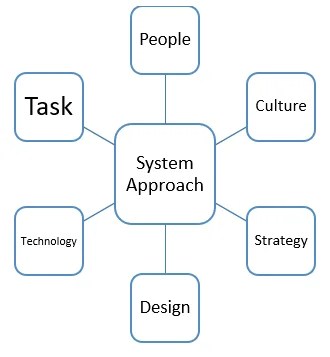
The Systems Model of Change or Organization-Wide Change lays more emphasis on the fact that a change must be implemented organization-wide instead of implementing it in piecemeal.

This model provides a whole new dimension to the concept of organizational change and describes the role played by six interconnected or interdependent variables like people, task, strategy, culture, technology and design. All these 6 variables are the key focus of planned change. The model has been represented in the diagram below:

  1. People: This variable involves the individuals who work in an organization. This would take into consideration the individual differences in the form of personalities, goals, perceptions, attitudes, attributions and their needs/motives.
  2. Task: The task is related to the nature of work which an individual handles in an organization. The nature of the job may be simple or complex, repetitive or novel, unique or standardized.
  3. Design: This variable refers to the organizational structure itself and also the system of communication, authority and control, the delegation of responsibilities and accountabilities.
  4. Strategy: The organizational strategy is the road map of action for realizing the future goals both short term and long term in nature. Strategic Planning involves identification of existing resources, a careful assessment of internal strengths and weaknesses, identifying the opportunities in the environment and threats as well for a competitive advantage.
  5. Technology: It takes into consideration the advancements in the technology in the field of IT, automation, new methods and techniques for enhancing productivity, the introduction of new processes and best practices for remaining ahead in the competition.
  6. Culture: It takes into consideration the shared beliefs, practices, values, norms and expectations of the members of the organization.

Steps to follow:

  • Dedicate time for planning

This may sound silly but you need to actually plan for planning. Always think of things, needs to plan for and to-do lists I need to write but not until recently did I realize that I was leaving the actual planning to the last minute. That’s because one wasn’t dedicating enough time to just sit and plan things out. Set up a recurring event in your calendar to just sit there and put your plans in writing.

  • Batch your time

I’ve tried so many “productivity hacks” and I find this one to be the most useful. It might not work for everyone but it’s worth the shot. Batching your time basically means that you divide your day into time blocks dedicated to only one task or multiple tasks of the same nature. This ensures that you don’t get distracted with doing other tasks and minimizes your tendency to multitask. It also allows you to enter the flow state of diving deep into one task.

  • Create checklists

Make checklists of things you need to get done and keep looking at those checklists. Many of us are guilty of writing down a to-do list, feeling good about it, and then never looking at it again. Put the checklist somewhere accessible like your notes on your phone so that you can pull it out easily. Track your progress and check off things that you’ve completed. Once you finish a checklist you’ll feel so good about yourself, trust me!

  • Prepare for the unexpected

No matter how hard you plan or how much you think you’ve thought ahead, always mentally prepare yourself for things to go wrong. There’s a saying that says “you plan and the universe laughs”, which is so true. That doesn’t mean that you shouldn’t plan, but just make sure you have back-ups and prepare for some crisis management.

Client & Consultant relationship

Consultants are expected to maintain professional and ethical standards when dealing with their clients. This can take the form of maintaining arm’s length relationships, not intervening in the internal affairs and politics of the client’s organizations, keeping confidential information away from interested parties looking for insider knowledge, and reporting any violations in the conduct (financial, operational, and behavioral) by the client’s organization to the regulators. This is the code of conduct that is usually prescribed for consulting firms whenever they take on work from client organizations.

Realities of Consultant-Client Relations

However, this is rarely followed in practice as evidenced by the large numbers of corporate scandals that have emerged in the last decade or so where the consultant was found to be aiding and even abetting the malfeasance conducted by the client. For instance, the Enron scandal manifested itself because the consulting firm was in cahoots with the client in cooking the books. Indeed, in this case, it was found that the consulting firm’s partners went beyond collaboration and were indeed one of the culprits.

Some Examples from the Corporate World

Similarly, the Satyam scandal in India was also found to be a case where the consultants (or some of them) knew about the goings-on in the company and were in breach of the code of conduct and even legal aspects since they did not report the matter to the regulators. However, the saving grace in this case was that when the malfeasance became too big and too hot to handle, it was the new consulting firm that had been roped in for another purpose that blew the whistle on the scam.

Consultants have to Walk a Thin Line between Professional and Personal Obligations

These examples indicate that the consultants have to walk a thin line between fulfilling professional obligations and reporting unethical behavior. Since the client is the one who pays them, it is often the case that the consultants are reluctant to report malfeasance to the regulators. Further, considering the extremely competitive nature of the market wherein there are several consulting firms competing for the same client, money talks and hence, consultants are often found to go along with the client. There are no easy answers when one considers all the aspects and it would be indeed a brave and conscientious consultant who would be the whistleblower.

Some Solutions Which Were Proposed

Having said that, there are some solutions that have emerged in recent years about the course of action to be taken by the consulting firms. For instance, after the Enron scandal, the SEC (Securities and Exchange Commission) and other regulators ensured that new rules separating consulting and investment banking so that the same consulting firm which was also advising the client in financial matters would now be two different firms. While this was intended to reduce the conflict of interest since it was thought that when consultants and investment bankers represent two firms they would automatically be in a position to wink at malfeasance, it is debatable as to how far this law succeeded given the Global Economic Crisis of 2008 wherein several case of malfeasance came to light.

Conflict of Interest is at the Heart of the Problem

Of course, as some experts have mentioned, the real issue here is of conflict of interest. How far would a consultant go in reporting unethical behavior to the regulators which is expected from him or her when such case involve the very clients who are giving them business. Further, the fact that many consultants often are embroiled in the internal politics of the client wherein they take sides in corporate and boardroom battles. This indicates the tricky nature of the problem of consultant client relations wherein the temptation to use confidential and insider information to one’s advantage is motivated by greed and power.

Classic skills of Leaders

Don’t waste energy in that which you cannot change: Aristophanes

In his “Peace”, Aristophanes wrote: “You will never get the crab to walk straight.” Indeed, there are things we cannot change. Successful (and productive) leadership takes a flexible approach and does not waste time on things that cannot be changed.

Character marks destiny: Heraclitus

Our character determines the course of our lives. That’s why, as Heraclitus said, it is so important to know ourselves and although we cannot control everything around us, we are ultimately responsible for our own misfortunes or fortunes. Leadership must work persistently on what you want to achieve.

Do not underestimate the power of personal integrity: Sophocles

In the play “Philoctetes” by Sophocles, one of the main characters argues that the end “justifies the means” and another one, Neoptolemus, refutes that theory by ensuring that he prefers to “fail with honor than win by cheating.” A good leader can never rationalize the wrong behavior.

Set your goals: Seneca

The philosopher Seneca would say that “there is never favorable wind for he who knows not where he is going.” From this quote, and from many others by Seneca offered during the course-game Triskelion on time management and personal productivity, we can learn a great lesson: set your goals so you always know what direction to take, and succeed.

Always seek the truth: Antisthenes

Antisthenes said that only our enemies, or else those friends who love us very much, will be able to tell us the truth. The basis for effective leadership is honesty, but not everyone is willing to “sing the truth”. Therefore, leaders must be willing to surround themselves with people who are able to offer an honest assessment about them. So, Seneca said: “I’d rather annoy with the truth than please with adulation.”

Competitiveness + Creativity: Hesiod

Competitiveness coming from selfishness (we should perhaps speak of “envy”) is a destructive quality. But that competitiveness which fosters creativity and inventiveness is not only constructive but also enhances the development and excellence of leadership.

Discover people: Pythagoras

Delegating power to the people, you will discover their innate qualities. By giving power, you can learn if a person has the disposition to become a leader or not. Discovering hidden leaders is a strategy to take your leadership to success.

Protect your values: Aristotle

Aristotle wrote about the “magnanimous” man, the one who lives according to a strict code of honor, stricter than that which the average person has. A leader must also protect and live according to their values, and apply them to the vision of their project or company, so that living according to them is their top priority. Make your decisions based on your principles.

Be a team: Plato

From Plato, we can extract the second golden rule: encourage team culture over the individual. Good leaders will always try to get their people involved in the same project, fostering a culture of collaboration so as to achieve a common goal. According to Plato, the benefits of working together outweigh the “evil of discord”.

Know Yourself: Thales of Miletus

That’s the hardest task, but also the most crucial. Getting to know oneself means knowing what our best hidden motivations are, and taking the decision of committing to that which we want to achieve.

Coaching & Mentoring

Coaching and mentoring serve as learning tools in the workplace that can lead to empowering your employees. The employees who are coached and mentored often receive the greatest benefit, but the coach or mentor also benefits and may feel a sense of empowerment from the relationship. Understanding the dynamics and outcomes of this type of workplace learning strategy helps you evaluate the need for a coaching program in your small business.

Coaching

Coaching at work is designed to help employees learn or enhance specific skills. It focuses on one individual over a defined period of time, helping them to develop effectively. It can be used to:

  • Teach new skills in a focused way
  • improve performance in a particular area of work
  • build ‘soft’ skills like confidence, interpersonal relationships or planning

The objective of coaching at work is to help an employee make a distinct improvement in an agreed area. That improvement might be measurable through KPIs, or it might be a softer target. To achieve it, the employee receives support and constructive feedback from a designated coach.

Coaching is a powerful tool for employees, but your company will also reap the benefits of a specially trained workforce.

The great benefit of coaching is that you are likely to see quick, positive results as an outcome. This is because coaching is participative and people tend to learn and adopt new habits more easily when they are actively engaged in the learning process.

Mentoring

Mentoring involves the use of the same models and skills of questioning, listening, clarifying and reframing associated with coaching.

Traditionally, mentoring in the workplace is usually where a more experienced colleague uses his or her greater knowledge and understanding of the workplace in order to support the development of a less experienced member of staff.

Deciding if coaching is the right approach

How do you know if coaching will work for your company? In truth, it can depend on the context and the people concerned.

Some employees will respond enthusiastically, especially to the right coach, and will come on leaps and bounds. For example, you could use a professional coach to:

  • Bring out the full potential of a gifted employee
  • help technical experts improve interpersonal skills
  • train managers to handle conflict situations

Although coaching at work is normally very effective, it doesn’t suit every situation or every personality. Other options to consider might be external training, mentoring or online learning.

Importance

Coach or Mentor Empowerment

The experienced employee who serves as the coach or mentor is able to show his knowledge and skill in the industry. This added challenge can boost his confidence and give him a sense of empowerment in his own work. In some cases, the employee the mentors push him to learn new skills in the industry. The collaboration between coach and mentor can lead to new ideas and achievements to aid them both in succeeding.

Independence

A mentor provides support for a new employee, but the ultimate goal is to empower the employee to work independently with the skills she has learned. The ability to work successfully on her own brings a sense of empowerment as she gains independence in the workplace. While employees feel confident to work independently, the mentoring program creates a sense of teamwork and often boosts morale for your employees. This positive work environment continues to empower employees in their work.

Goal Setting

Coaching and mentoring often includes goal setting for the employee. The mentor helps the new employee set specific goals related to the job. The two work together to create a plan to reach those goals. Mentors can customize objectives and support that that employee needs for his particular role. The mentor is also available as a resource if the new employee needs support along the way to be successful. Having a set of challenging goals is motivating and empowers the employee to work beyond the minimum requirements.

Hands-On Learning

Coaching and mentoring gives new employees a hands-on training program to learn job expectations. Instead of throwing a new employee right into the position, he gets a support system and an interactive learning situation that may engender more on-the-job confidence. Mentored employees may often feel a greater sense of understanding of what is required of them in their jobs because they get one-on-one job training, support and the advice of an experienced employee. When an employee receives this kind of personalized training, he may feel empowered to fully perform his job duties.

Manifestations of resistance

There are several ways which are reflected through the behaviour of the people to express resistance to change. Occasionally, such hostile behaviour may create lot of problems for the organisation. Aggression or exhibiting ill will are the immediate reaction of an employee towards change. It also be expressed through anger expressed with the subordinates or superiors. An individual may lose interest in the work is another sign.

Complaints and gossip

Another major sign of resistance of implemented changes in an organization is increased complaints and gossip. The employees might not complain directly to you as a manager. They will air their complaints among themselves because they feel you are part of those planning and implementing the change. This leads to the emergence of a grapeview within the organization. These complaints can not only be disruptive but also cause lower productivity.

On the other hand, gossip is a natural reaction of voicing dissatisfaction, but if the manager fails to initiate an open discussion regarding the change and allows the gossip to worsen due to lack of attention, it might lead to huge problems in the company, which might take time to be resolved.

Resistance to change is expressed by different signs, which the manager should be keen to note after implementing changes. However, resistance signs should give you the best time to act and address every issue leading to resistance.

Decision Paralysis

The resistance of change by the employees in an organization makes manager paralyzed in decision making. Not only the manager, the employee also thinks a lot before making certain decisions because of different thought processes involved.

Since your task as a manager is to ensure things are implemented and running smoothly, you cease to be a manager when you cannot make new things happen and can’t make your employees adopt to changes. As a result, the stress and pressure builds up, affecting the team entirely.

Low morale

Low morale is a classic sign of change resistance which you will note as a manager, after the introduction of new changes. If your employees have always had a high morale in their assigned duties, the morale noticeably declines, they become more distant and appear lethargic, new changes might be the main cause.

The low morale makes the employees to lose motivation in undertaking new responsibilities and projects, as they feel uncomfortable. Low morale has a negative impact to the productivity of the organization, which is low productivity.

Lack of adoption to new process

Change Resistance is most commonly observed when employees take longer to adopt to the new changes or even avoid the changes completely.

The resistance to change sign is manifested after the introduction of new procedures in the organization aimed at enhancing their productivity and delivery of services, but resistant employeess continue doing things the same way.

Poor communication

In cases where employees had excellent communication within themselves before change, but changes have resulted to breakdown in communication, it is an indicator of change resistance. In this case, not all employees might be resisting the change, but some avoid accepting the reality that new procedures have been introduced and they do not follow them.

Alternatively, there might be more gossip happening then actual communication. Resistance through breakdown in communication comes differently, by some employees piling up the emails, slowing down the productivity reports and ignoring updates and request of information.

Reduction in productivity

The greatest indicator of resistance by your employees is a reduction in productivity. If what the employees are producing is low or declines with the introduction of change, yet they all remain busy while at work, they are resisting the change.

Even if the changes were meant to increase the productivity, the employees might procrastinate in adopting the new means of carrying the business activities, if they are not certain with the means, or if they are feeling exploited.

In other instances, the employees miss deadlines, and they might blame the change in processes which becomes an excuse for them. This happens mostly when the employees are forced to sign acceptance forms by the managers, as they feel forced to accept the change.

Absenteeism

If, before the change, the employees used to arrive on time at work without failure but all of a sudden after the introduction of changes they start being late, then this is a sign of resistance to change. Many employees come on time and even stay till late because they want to actively contribute to work. But if they don’t like the work or the changes that have taken place, they might come late and want to leave early. This is definitely a sign of resistance to change.

Avoidance of new assignments

In most cases, employees welcome new assignments. This happens specially if the assignments help them experience new challenges, explore new opportunities and make new accomplishments. These new opportunities also help them increase their pay and promotions.

The change resistance sign is your employees avoiding new assignments, as they prefer remaining in the comfort zone of their previous assignments, rather than exploring new assignments where they only see the wrongs and not the rights.

Role analysis technique

The role analysis technique intervention is designed to clarify role expectations and obligations of team members to improve team effectiveness. In an organisation, individuals fill different specialised roles in which they manifest certain behaviours. This division of labour and function facilitates organisational performance. Often, however, the role incumbent may not have a clear idea of the behaviour expected of him by others and, equally often, what others can do to help the incumbent fulfill the role is not understood. Iswar Dayal and John M. Thomas developed a technique for clarifying the roles of top management of a new organisation in India. This technique is particularly applicable for new teams.

The steps involved in this technique are as explained below:

(i) Analysis of Focal Role:

The focal role individual initiates the analysis of focal role in the first step. The important points to be discussed are the role, its place in the organisation the purpose of its existence, its place in achieving the overall organisational goals, specific duties of the office etc. The specific duties and behaviours related to that role are listed on a chalk board and discussed by the whole team. Till the role incumbent and the entire team, satisfactorily define the role completely, additions and deletions will be made from the roles and behaviours.

(ii) Focal Role Incumbent’s Expectations of Others

In the second step, the focal role incumbent’s expectations of the others are examined. The incumbent makes a list of his or her expectations of the other roles in the group that affect the incumbent’s role performance. The entire group then discusses these expectations, modifies these, makes any additions or deletions and finally agree’ upon the list.

(iii) Others Expectations and Desired Behaviour of the Focal Role:

In the third step, the members of the group describe what they want from and expect from the incumbent in the focal role. Again, these expectations are discussed, modified and agreed upon by the group and the focal role person.

(iv) Preparation of the Role Profile:

After the conclusion of the third step, the focal person will assume the responsibility of making a written summary of the role as it has been defined. This summary is called the role profile and is based on the results of the discussion in the above steps. Role profile provides a comprehensive understanding of each individual’s role in the team.

(v) Review of the Role Profile:

The written role profile prepared hi the previous step is briefly reviewed in the following meeting of the team. Till one role profile is reviewed, no other focal role is to be analyzed. After the review, the accepted role profile constitutes the role activities for the focal role person.

Role analysis technique is a very effective method of team building. Role analysis and definition by the entire group not only clarifies who is to do what but also ensures commitment to the role once it has been clarified. In reality, we have often heard people complaining “Why those other people are not doing what they are supposed to do?” Whereas in reality all the incumbents are performing as they think they are supposed to. RAT examines the mutual demands, expectations and obligations of interdependent team members, which have never been examined earlier.

Six Box Model

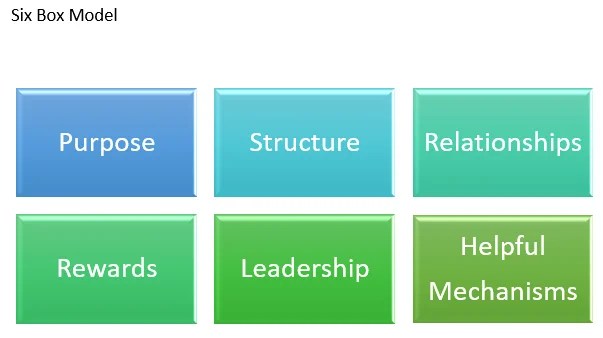
Weisbord presents a six-box model for understanding organizations:

  • Purposes: The organization members are clear about the organization’s mission and purpose and goal agreements, whether people support the organization’s purpose. This aspect of the model harps on the fact that the management and all the key members of the team agree and support the overall values, goals, aims, and mission of the organization.
  • Structure: How is the organization’s work divided up? The question is whether there is an adequate fit between the purpose and the internal structure. This aspect of the model focuses on the fact that if there is a proper and deemed fit between the internal structure and overall purposes of the organization.
  • Relationship: Between individuals, between units or departments that perform different tasks, and between the people and requirements of their jobs. This aspect of the model makes the management understand what kind of relations exists between the various individuals of the company, between the departments, and more importantly between the individuals and nature of their work. It also focuses on the facets of conflicts if any, the kind of interdependencies, and the nature and quality of relations.
  • Rewards: The consultant should diagnose the similarities between what the organization formally rewarded or punished members for. This aspect of the model harps on the fact that what kind of rewards do the organizations gives to its employees, for what kind of attributes the employees are rewarded and punished for and what steps does the organization takes to fit in the business environment.
  • Leadership: Is to watch for blips among the other boxes and maintain balance among them. This aspect of the model focuses on the style of the leadership followed in the organization, the leadership programs defined by the leaders of the organization, and are they well aligned with the nature, core values, and objectives of the organization.
  • Helpful mechanism: What must the organization attend to in order to survive and thrive procedures such as planning, control, budgeting, and other information systems. This aspect of the model focuses on if the various mechanisms of the organization help in accomplishing the objectives or works as an obstacle in the path of their attainment.

T-group, Job expectation Technique

A T-group or training group (sometimes also referred to as sensitivity-training group, human relations training group or encounter group) is a form of group training where participants (typically between eight and fifteen people) learn about themselves (and about small group processes in general) through their interaction with each other. They use feedback, problem solving, and role play to gain insights into themselves, others, and groups.

Experimental studies have been undertaken with the aim of determining what effects, if any, participating in a T-group has on the participants. For example, a 1975 article by Nancy E. Adler and Daniel Goleman concluded that “Students who had participated in a T-group showed significantly more change toward their selected goal than those who had not.” Carl Rogers described sensitivity groups as “…the most significant social invention of the century”.

The concept of encounter as “a meeting of two, eye to eye, face to face,” was articulated by J.L. Moreno in Vienna in 1914–15, in his “Einladung zu einer Begegnung” (“Invitation to an Encounter”), maturing into his psychodrama therapy. It was pioneered in the mid-1940s by Moreno’s protege Kurt Lewin and his colleagues as a method of learning about human behavior in what became the National Training Laboratories (also known as the NTL Institute) that was created by the Office of Naval Research and the National Education Association in Bethel, Maine, in 1947. First conceived as a research technique with a goal to change the standards, attitudes and behavior of individuals, the T-group evolved into educational and treatment schemes for non-psychiatric patient people.

A T-group meeting does not have an explicit agenda, structure, or expressed goal. Under the guidance of a facilitator, the participants are encouraged to share emotional reactions (for example, anger, fear, warmth, or envy) that arise in response to their fellow participants’ actions and statements. The emphasis is on sharing emotions, as opposed to judgments or conclusions. In this way, T-group participants can learn how their words and actions trigger emotional responses in the people they communicate with.

There are a number of group types.

Task groups focus on the here and now, involving learning through doing, activity and processing; and involves daily living skills and work skills.

Evaluative groups focus on evaluating the skills, behaviors, needs, and functions of a group and is the first step in a group process.

Topical discussion groups focus on a common topic that can be shared by all the members to encourage involvement.

Developmental groups encourage the members to develop sequentially organized social interaction skills with the other members.

  • Parallel groups are made up of clients doing individual tasks side by side.
  • Project groups emphasize task accomplishment. Some interaction may be built in, such as shared materials and tools and sharing the work.
  • Egocentric cooperative groups require the members to select and implement the task. Tasks are longer term and socialization is required.
  • Cooperative groups require the therapist only as an advisor. Members are encouraged to identify and gratify each other’s social and emotional needs in conjunction with task accomplishment. The task in a cooperative group may be secondary to social aspects.
  • Mature groups involve the therapist as a co-equal member. The group members take on all leadership roles in order to balance task accomplishment with need satisfaction of the members.

Self-help groups are supportive and educational, and focus on personal growth around a single major life disrupting problem (for example, Alcoholics Anonymous).

Support groups focus on helping others in a crisis and continue to do so until the crisis is gone and is usually before the self-help group.

Advocacy groups focus on changing others or changing the system, rather than changing one’s self: “getting one from point A to point B”.

Psychotherapy groups focus on helping individuals in the present that have past conflicts which affect their behavior.

Controversial

This type of training is controversial as the behaviors it encourages are often self-disclosure and openness, which many people believe some organizations ultimately punish. The feedback used in this type of training can be highly personal, hence it must be given by highly trained observers (trainers).[citation needed]. In the NTL-tradition, the T-group is always embedded in a Human Interaction Laboratory, with reflection time and theory sessions. In these sessions, the participants have the opportunity to make sense of what’s happening in the T-group.

Job expectation Technique

Behaviors in the workplace:

  • Display a positive and respectful attitude.
  • Work with honesty and integrity.
  • Represent the organization in a responsible manner.
  • Perform their jobs to a reasonable, acceptable standard.
  • Maintain good attendance.
  • Conduct themselves in a professional manner, even when off duty.
  • Follow set policies and procedures when dealing with problems or issues.

Team member should be accountable for:

  • Respect each other, and be courteous and sensitive to everyone’s needs and concerns.
  • Be accountable for your work.
  • Be flexible about job and task assignments.
  • Be willing to help each other instead of displaying an “it’s not my job” attitude.
  • Ask for help when needed.
  • Work safely together.
  • Be open to constructive feedback without being defensive or negative.
  • Be self-motivated and reliable.
  • Share ideas for improvement.
  • Be cheerful, positive and encouraging to other team members.

Since an employee’s position affects their performance expectations, Wee created this table to illustrate the performance expectations for different job levels:

Position level of employee Performance expectations
Senior-level manager or executive Focus on departmental performances
Manager or supervisory position Focus on unit and functional results of the work team
Professional or technical position Focus on project-related performances
Individual contributor Focus on assigned tasks and contributions to the work team
Major project member or departmental initiator Focus on the major projects/departmental initiatives specifically

To improve the chances of employees meeting or exceeding your expectations, follow these steps when you plan and set them.

  1. Determine what your expectations are.

Before you can have a conversation with your staff members, you need to have a conversation with yourself and write down what your realistic expectations are. For example, you may expect staff members to do the following:

  • Complete projects within the given timeframe.
  • Have a positive attitude.
  • Take initiative on starting new projects and coming up with new ideas that can benefit the company.
  • Come to work on time.
  • Follow the dress code.
  • Remain professional at all times when communicating with clients and other staff members.
  • Follow up with clients within two business days.
  • Respect each other.
  1. Minimize confusion by making expectations clear.

Clear communication from leaders is imperative for success. If staff members don’t fully understand what you expect from them, it’ll be difficult for them to meet your expectations. You can do these things to make them clear:

  • Lay out exactly what your expectations are in paperwork for new hires.
  • Provide existing employees with a digital or print guide as an amendment to your employee handbook or their job responsibilities.
  • Don’t just hand staff members your expectations guide meet with them to discuss what they are.
  • Address any questions employees have about your expectations.
  • Ensure they understand what your expectations are.
  1. Let staff members know why your expectations are important.

When employees understand why expectations are important, it can help them see the bigger picture and feel like their role in the company matters.

  • Don’t just tell staff members what your expectations are – communicate why they are important.
  • Help staff members see how the company as a whole can benefit when they meet or exceed your expectations.
  • Beyond communicating the importance of your expectations, break down the “why” in as much detail as possible to minimize confusion.
  1. Provide examples of why expectations are important.

Offer concrete examples as to why you’ve set certain expectations, and explain to your team how these expectations connect to the big-picture goals of the company.

  • Being on time for work ensures operations run smoothly.
  • Adhering to the dress code casts the company in a professional light among customers.
  • Displaying a positive attitude at work helps employees deal with stress and keeps morale up.
  1. Get an agreement and commitment.

Formalize the expectations by requiring employees to sign off on them. When employees sign off on your expectations, it makes them feel more serious. In the event they don’t meet your expectations, you will have the documentation to hold them accountable and make a case as to how they have fallen short of the agreement.

error: Content is protected !!