Theories of Dividend decisions

Dividend decisions refer to the strategic choices a company makes regarding the distribution of its profits to shareholders in the form of dividends or retaining them for reinvestment in the business. These decisions play a crucial role in financial management as they influence shareholder satisfaction, market perception, and the company’s growth potential. A balanced dividend policy ensures that adequate returns are provided to shareholders while retaining enough earnings for business expansion and stability. Factors such as profitability, cash flow, growth opportunities, and market expectations significantly impact these decisions, highlighting their importance in achieving long-term corporate objectives.

Some of the major different theories of dividend in financial management are as follows: 

1. Walter’s model

2. Gordon’s model

3. Modigliani and Miller’s hypothesis.

1. Walter’s model:

Professor James E. Walter argues that the choice of dividend policies almost always affects the value of the enterprise. His model shows clearly the importance of the relationship between the firm’s internal rate of return (r) and its cost of capital (k) in determining the dividend policy that will maximise the wealth of shareholders.

Walter’s Model Assumptions:

  1. The firm finances all investment through retained earnings; that is debt or new equity is not issued;
  2. The firm’s internal rate of return (r), and its cost of capital (k) are constant;
  3. All earnings are either distributed as dividend or reinvested internally immediately.
  4. Beginning earnings and dividends never change. The values of the earnings pershare (E), and the divided per share (D) may be changed in the model to determine results, but any given values of E and D are assumed to remain constant forever in determining a given value.
  5. The firm has a very long or infinite life.

Walter’s formula to determine the market price per share (P) is as follows:

P = D/K +r(E-D)/K/K

The above equation clearly reveals that the market price per share is the sum of the present value of two sources of income:

i) The present value of an infinite stream of constant dividends, (D/K) and

ii) The present value of the infinite stream of stream gains.

[r (E-D)/K/K]

Criticism:

  1. Walter’s model of share valuation mixes dividend policy with investment policy of the firm. The model assumes that the investment opportunities of the firm are financed by retained earnings only and no external financing debt or equity is used for the purpose when such a situation exists either the firm’s investment or its dividend policy or both will be sub-optimum. The wealth of the owners will maximise only when this optimum investment in made.
  2. Walter’s model is based on the assumption that r is constant. In fact decreases as more investment occurs. This reflects the assumption that the most profitable investments are made first and then the poorer investments are made.

The firm should step at a point where r = k. This is clearly an erroneous policy and fall to optimise the wealth of the owners.

  1. A firm’s cost of capital or discount rate, K, does not remain constant; it changes directly with the firm’s risk. Thus, the present value of the firm’s income moves inversely with the cost of capital. By assuming that the discount rate, K is constant, Walter’s model abstracts from the effect of risk on the value of the firm.

2. Gordon’s Model:

One very popular model explicitly relating the market value of the firm to dividend policy is developed by Myron Gordon.

Assumptions:

Gordon’s model is based on the following assumptions.

  1. The firm is an all Equity firm
  2. No external financing is available
  3. The internal rate of return (r) of the firm is constant.
  4. The appropriate discount rate (K) of the firm remains constant.
  5. The firm and its stream of earnings are perpetual
  6. The corporate taxes do not exist.
  7. The retention ratio (b), once decided upon, is constant. Thus, the growth rate (g) = br is constant forever.
  8. K > br = g if this condition is not fulfilled, we cannot get a meaningful value for the share.

According to Gordon’s dividend capitalisation model, the market value of a share (Pq) is equal to the present value of an infinite stream of dividends to be received by the share. Thus:

6.1.jpg

The above equation explicitly shows the relationship of current earnings (E,), dividend policy, (b), internal profitability (r) and the all-equity firm’s cost of capital (k), in the determination of the value of the share (P0).

3. Modigliani and Miller’s hypothesis:

According to Modigliani and Miller (M-M), dividend policy of a firm is irrelevant as it does not affect the wealth of the shareholders. They argue that the value of the firm depends on the firm’s earnings which result from its investment policy.

Thus, when investment decision of the firm is given, dividend decision the split of earnings between dividends and retained earnings is of no significance in determining the value of the firm. M – M’s hypothesis of irrelevance is based on the following assumptions.

  1. The firm operates in perfect capital market
  2. Taxes do not exist
  3. The firm has a fixed investment policy
  4. Risk of uncertainty does not exist. That is, investors are able to forecast future prices and dividends with certainty and one discount rate is appropriate for all securities and all time periods. Thus, r = K = Kt for all t.

Under M – M assumptions, r will be equal to the discount rate and identical for all shares. As a result, the price of each share must adjust so that the rate of return, which is composed of the rate of dividends and capital gains, on every share will be equal to the discount rate and be identical for all shares.

Thus, the rate of return for a share held for one year may be calculated as follows:

6.2.jpg

Where P^ is the market or purchase price per share at time 0, P, is the market price per share at time 1 and D is dividend per share at time 1. As hypothesised by M – M, r should be equal for all shares. If it is not so, the low-return yielding shares will be sold by investors who will purchase the high-return yielding shares.

This process will tend to reduce the price of the low-return shares and to increase the prices of the high-return shares. This switching will continue until the differentials in rates of return are eliminated. This discount rate will also be equal for all firms under the M-M assumption since there are no risk differences.

From the above M-M fundamental principle we can derive their valuation model as follows:

6.3.jpg

Multiplying both sides of equation by the number of shares outstanding (n), we obtain the value of the firm if no new financing exists.

6.4.jpg

If the firm sells m number of new shares at time 1 at a price of P^, the value of the firm at time 0 will be

6.5

The above equation of M – M valuation allows for the issuance of new shares, unlike Walter’s and Gordon’s models. Consequently, a firm can pay dividends and raise funds to undertake the optimum investment policy. Thus, dividend and investment policies are not confounded in M – M model, like waiter’s and Gordon’s models.

Criticism:

Because of the unrealistic nature of the assumption, M-M’s hypothesis lacks practical relevance in the real world situation. Thus, it is being criticised on the following grounds.

  1. The assumption that taxes do not exist is far from reality.
  2. M-M argue that the internal and external financing are equivalent. This cannot be true if the costs of floating new issues exist.
  3. According to M-M’s hypothesis the wealth of a shareholder will be same whether the firm pays dividends or not. But, because of the transactions costs and inconvenience associated with the sale of shares to realise capital gains, shareholders prefer dividends to capital gains.
  4. Even under the condition of certainty it is not correct to assume that the discount rate (k) should be same whether firm uses the external or internal financing.

If investors have desire to diversify their port folios, the discount rate for external and internal financing will be different.

  1. M-M argues that, even if the assumption of perfect certainty is dropped and uncertainty is considered, dividend policy continues to be irrelevant. But according to number of writers, dividends are relevant under conditions of uncertainty.
Memorandum Reconciliation Account

Memorandum Reconciliation Statement is a statement prepared to reconcile the difference between the profit or loss as per cost accounts and financial accounts. It is called a “memorandum” because it is not a part of the double-entry system; it is an informal statement prepared only for internal use. The statement starts with the profit as per one set of accounts (usually cost accounts) and adjusts for items causing the difference — such as over- or under-absorbed overheads, stock valuation differences, or items recorded only in one set of books — to arrive at the corresponding profit in the other.

Preparation of Memorandum Reconciliation Statement:

1. Understand the Purpose and Basis

Before preparing a Memorandum Reconciliation Statement, it is important to understand its purpose: to find the reasons for the difference between the profits as per cost accounts and financial accounts. One must decide the starting point, either profit as per cost accounts or profit as per financial accounts. This starting figure is adjusted by adding or deducting various items responsible for the differences. The main objective is not to pass accounting entries but to create clarity between the two sets of profits for internal analysis and managerial understanding.

2. Identify Items Causing Differences

The next step is identifying all items that lead to differences between cost and financial profits. These include:

  • Purely financial items (e.g., interest, donations, fines)

  • Notional items (e.g., imputed rent or interest on owned funds)

  • Over- or under-absorption of overheads

  • Stock valuation differences

  • Treatment of abnormal gains or losses Each item should be clearly classified whether it increases or decreases the profit. A careful study of both financial and cost records is necessary at this stage to avoid missing any adjustments during reconciliation.

3. Decide Adjustment Direction

After listing the items, the preparer must decide whether each item should be added or deducted. For example:

  • Add items like under-absorbed overheads, incomes appearing only in financial accounts.

  • Deduct items like over-absorbed overheads, expenses recorded only in financial accounts. Remember, if starting from cost profit, and a particular item reduces financial profit, it must be deducted; if it increases financial profit, it must be added. This logical flow is important for arriving at an accurate final profit figure and maintaining consistency throughout the statement.

4. Format of Memorandum Reconciliation Statement

The statement is typically formatted in a simple, logical manner. It starts with:

  • Profit as per cost accounts (or financial accounts)

  • Add: Items that increase financial profit compared to cost profit

  • Less: Items that decrease financial profit compared to cost profit

  • Result: Profit as per financial accounts (or cost accounts) The presentation should be clean and easy to follow, showing all adjustments separately. A clear and simple format helps ensure no adjustment is missed and makes verification easy for internal auditors and managers.

5. Treatment of Stock Valuations and Overheads

Special attention must be given to stock valuation differences and overheads:

  • If closing stock is higher in financial accounts than cost accounts, add the difference.

  • If closing stock is lower, deduct the difference.

  • Over-absorbed overheads (more charged in cost accounts) should be deducted.

  • Under-absorbed overheads (less charged in cost accounts) should be added. Correct treatment of these two areas is critical because they often cause major profit differences. Careful checking ensures that the reconciliation statement is accurate and matches with accounting records.

6. Finalization and Verification

Once all adjustments are made, the final figure should match the profit as per the other set of accounts. It is important to verify all calculations thoroughly to ensure no item is wrongly added or omitted. The Memorandum Reconciliation Statement should be reviewed by the accounts team or auditors if necessary. Though it is an informal statement, its accuracy plays a major role in building trust in internal reporting. Regular reconciliation also improves the efficiency and reliability of the company’s accounting system over time.

Incentive Systems (Hasley Plan, Rowan Plan, Taylor’s & Merrick Differential Piece rate System)

Incentive System is a structured approach to rewarding employees for their performance, productivity, or achievements beyond basic wages or salaries. It aims to motivate workers, enhance efficiency, and drive organizational goals. Incentives can be monetary, such as bonuses, commissions, or profit-sharing, or non-monetary, including recognition, promotions, or additional leave. Effective incentive systems align employee efforts with business objectives, fostering a culture of commitment and high performance. They also help reduce absenteeism, increase job satisfaction, and retain talent, making them a crucial element of modern workforce management.

Halsey Premium Plan

This plan known after F.A. Halsey is also called the Weir Premium Plan because it was first introduced in the Weir Engineering Works in England. Under this plan, a standard time is fixed (on the basis of past performance records and not on the basis of elaborate time study) for the completion of a job. A worker who completes his job in less than the standard time is paid at this hourly rate for the time actual spent on the job plus a bonus for the time saved.

Feature of Halsey Premium Plan

(i) Standard time of production is determined well in advance.

(ii) The workers, who complete their work in less than standard time, are paid the wages according to the standard rate. They are paid a bonus also on the basis of time saved by him.

(iii) Standard rate of wages is also determined.

(iv) The workers, who complete their work within standard time, are paid the wages at the standard rate.

(v) The rate of bonus may be 33-1/3 or 50%.

Rowan Premium Plan

This plan was introduced by James Rowan. Under this method, the standard time and the standard rate of wage Payment are determined in the same manner as Halsey Plan. The workers, who complete their work within standard time, are paid the wages at standard rate. The workers, who complete their work in less time than the standard, are paid wages at the standard rate plus some bonus. This bonus is calculated in proportion of time saved.

Features of this plan

  • Standard time of work is decided.
  • The workers, who complete their work in more time than standard, are also paid the wages according to standard rate. Thus, in this system also there is no provision of punishment for late completion of the work.
  • Standard rate of wage is decided.
  • The workers, who complete their work within standard time, are paid the wages according to standard time.
  • The workers, who complete their work before standard time, are paid wages according to standard rate plus some bonus.
  • Bonus is calculated in the ratio of time saved with standard time.

Merits of Rowan Premium Plan are as under

  • It checks over-speeding because the workers cannot get bonus more than 25% of the standard time.
  • This method of incentive wage plan is based upon scientific calculations.
  • The workers get higher bonus under this system.

Taylor Differential Piece Rate System

This system was introduced by Mr. F.W. Taylor. Under this system, standard time for every work is determined on the basis of time and motion study. Two rates of wages are determined-as High rate and Low rate. The workers, who complete their work within standard time or before standard time, are paid wages according to the high rate. The workers, who complete their work in more time than standard time, are paid the wage according to lower rate.

Basic Features of Differential Rate System

  • The workers, who complete their work in more time than the standard time, are paid the wages at lower rate.
  • Two rates of wages are determined i.e., Higher rate and Lower rate.
  • Standard time of the work is determined.
  • The workers, who complete their work within standard time or before standard time, are paid the wages at high rate.

Important merits of Taylor Differential Piece Rate System

  • This system helps in reducing the cost of production per unit.
  • This system is based upon scientific calculations, proper work and job standardisation.
  • Most important merits of this system are that it rewards an efficient worker and penalises the inefficient worker.
  • This system helps in eliminating the workers who are quite inefficient, because in the course of time, they will try to get the work elsewhere.
  • This system is very easy to understand and to calculate.

Demerits of Taylor Differential Piece Rate System

  • If the standard work of a worker is less than his normal capacity it causes great dissatisfaction among the workers.
  • The greatest demerit of this system is that it does not guarantee minimum wages. Therefore, it is opposed by the labour unions.
  • This system classifies the workers into two categories; efficient and inefficient.
  • This system helps in eliminating the workers who are quite inefficient, because in the course of time, they will try to get the work elsewhere.
  • This system is very easy to understand and to calculate.

Merrick Differential Piece Rate System

Merrick Differential Piece Rate System is an improved form of Taylor’s Differential Piece Rate System. It was introduced to reduce the harshness of Taylor’s method and to provide a more balanced incentive scheme. Under this system, three different piece rates are fixed based on the level of efficiency achieved by the worker.

If a worker’s efficiency is below 83%, wages are paid at the normal piece rate. When efficiency is between 83% and 100%, the worker is paid at a higher piece rate, usually 110% of the normal rate. If efficiency exceeds 100%, the worker receives an even higher rate, generally 120% of the normal piece rate.

This system encourages workers to improve efficiency gradually by offering increasing rewards for better performance. It ensures fair wages for average workers while providing strong incentives for efficient workers. The Merrick system promotes productivity, maintains quality standards, and improves employee morale, making it an effective incentive scheme in cost accounting.

Features of Merrick Differential Piece Rate System

  • Three Different Piece Rates

The most important feature of the Merrick system is the use of three different piece rates. Workers below 83% efficiency receive the normal piece rate, workers between 83% and 100% efficiency receive a higher rate, and workers above 100% efficiency receive the highest rate. This tiered structure encourages gradual improvement.

  • Efficiency-Based Classification

Workers are classified based on efficiency levels measured against standard performance. This ensures objectivity in wage payment and links remuneration directly to productivity. Employees clearly understand the standards they must achieve to earn higher wages.

  • Guaranteed Minimum Wages

Even workers with low efficiency are paid at the normal piece rate, ensuring minimum wage security. This reduces dissatisfaction and anxiety among slow or new workers and promotes stability in earnings.

  • Progressive Incentive Structure

Unlike Taylor’s system, where incentives increase sharply, the Merrick system provides progressive incentives. Workers move gradually from one efficiency level to another, making the system fairer and more motivating.

  • Encouragement of Productivity

The system strongly encourages workers to improve efficiency by offering higher rewards for better performance. As efficiency increases, wages also increase, motivating employees to maximize output.

  • Reduced Harshness Compared to Taylor’s System

Merrick’s system removes the punishment element present in Taylor’s method. Inefficient workers are not penalized severely, making the system more acceptable to workers and trade unions.

  • Standard Time and Rate Fixation

The system requires proper fixation of standard time and piece rates using time and motion studies. Accurate standards ensure fairness and reliability in wage calculation.

  • Applicability to Repetitive Work

The Merrick system is most suitable for repetitive and standardized manufacturing operations where output and efficiency can be measured easily.

Advantages of Merrick Differential Piece Rate System

  • Encourages Gradual Efficiency Improvement

The system motivates workers to improve productivity step by step rather than forcing sudden increases in output. This results in sustainable efficiency growth and reduced work pressure.

  • Fair Treatment of Workers

By offering normal wages even to low-efficiency workers, the system ensures fairness and avoids exploitation. Average workers feel secure and motivated to improve performance.

  • Higher Employee Morale

Progressive rewards improve employee morale and job satisfaction. Workers feel recognized and rewarded for their efforts, leading to better cooperation and commitment.

  • Increased Productivity

The incentive-based structure encourages workers to increase output. Higher efficiency leads to higher earnings, benefiting both employees and employers.

  • Better Cost Control

As productivity increases, labor cost per unit decreases. This helps management control production costs and improve profitability.

  • Reduced Labor Turnover

Fair wages and income security reduce dissatisfaction and labor turnover. Retaining experienced workers saves recruitment and training costs.

  • Improved Industrial Relations

The system is more acceptable to trade unions due to its humane approach. This helps maintain industrial peace and reduces wage-related disputes.

  • Balanced Focus on Quantity and Quality

Since incentives increase gradually, workers are less likely to sacrifice quality for speed. This helps maintain product standards and reduces defects.

Limitations of Merrick Differential Piece Rate System

  • Difficulty in Fixing Standards

Accurate fixation of standard time and piece rates requires detailed time and motion studies, which can be costly and time-consuming.

  • Dependence on Accurate Measurement

The system depends heavily on accurate measurement of output and efficiency. Errors in measurement can lead to dissatisfaction and disputes.

  • Limited Applicability

The Merrick system is not suitable for non-repetitive, creative, or supervisory jobs where output cannot be measured easily.

  • External Factors Affect Efficiency

Machine breakdowns, power failures, or material shortages may affect worker efficiency beyond their control, leading to unfair wage outcomes.

  • Administrative Complexity

Compared to simple time rate systems, the Merrick system involves more calculations and record-keeping, increasing administrative workload.

  • Possibility of Reduced Teamwork

Since rewards are based on individual efficiency, workers may focus on personal output rather than teamwork, affecting cooperation.

  • Health and Fatigue Issues

Continuous efforts to improve efficiency may lead to fatigue and health issues if not properly managed.

  • Resistance from Some Workers

Some workers may resist efficiency standards due to fear of increased work pressure or unrealistic targets, requiring proper communication and training.

Labour Cost Control, Meaning, Objectives, Technique, Factors and Importance

Labour Cost Control refers to the systematic process of monitoring, analyzing, and managing workforce expenses to enhance productivity and reduce unnecessary costs. It involves techniques like workforce planning, standard costing, performance evaluation, and incentive schemes to optimize efficiency. Proper labour cost control helps businesses reduce wastage, improve employee performance, and maintain profitability. It includes measures like reducing idle time, controlling overtime, and implementing training programs to enhance worker skills. Effective labour cost control ensures that the company balances labour expenses with output, leading to higher productivity, cost efficiency, and competitive advantage in the industry.

Objectives of Labour Cost Control

  • To Ensure Optimum Utilisation of Labour

One of the primary objectives of labour cost control is to ensure the best possible use of available labour resources. Proper planning, scheduling, and supervision help in avoiding under-utilisation or over-utilisation of workers. Optimum utilisation reduces idle time, increases output per worker, and lowers labour cost per unit. This objective ensures that employees are assigned work according to their skills and capacity.

  • To Reduce Cost of Production

Labour cost forms a significant portion of total production cost. Effective labour cost control aims to minimise unnecessary labour expenses such as idle time wages, overtime premiums, and inefficiencies. By improving productivity and eliminating wastage of labour time, the overall cost of production can be reduced. Lower production cost helps the firm remain competitive and earn higher profits.

  • To Improve Labour Efficiency and Productivity

Another important objective is to increase labour efficiency and productivity. Through proper training, performance standards, incentive wage systems, and motivation, workers are encouraged to perform better. Higher productivity means more output with the same or lower labour cost. Efficient labour contributes to improved quality, timely completion of work, and better utilisation of machines and materials.

  • To Control Idle Time and Overtime

Labour cost control seeks to minimise idle time and unnecessary overtime, as both increase labour cost without proportionate output. Idle time arises due to machine breakdowns, material shortages, or poor supervision, while overtime leads to higher wage payments. Proper production planning, maintenance, and supervision help control these issues, ensuring economical use of labour hours.

  • To Establish a Fair Wage System

Ensuring fair and equitable wages is a key objective of labour cost control. Through job evaluation and merit rating, wages are fixed according to the nature of work and worker efficiency. Fair wages improve employee satisfaction, reduce labour turnover, and promote industrial harmony. This helps in maintaining a motivated workforce while keeping labour cost within reasonable limits.

  • To Prevent Fraud and Labour Cost Manipulation

Labour cost control aims to prevent frauds and malpractices such as fake attendance, buddy punching, inflated wage payments, and incorrect job time recording. Proper time keeping and time booking systems ensure accurate wage calculation. This objective protects the organisation from financial losses and ensures transparency and accuracy in labour cost records.

  • To Assist in Accurate Costing and Pricing

Proper control of labour cost helps in accurate determination of product cost, which is essential for pricing decisions. When labour cost is correctly recorded and allocated, management can fix selling prices scientifically. Accurate costing also helps in preparing tenders, quotations, budgets, and profitability analysis, thereby supporting effective managerial decision-making.

  • To Maintain Industrial Peace and Stability

Effective labour cost control helps maintain healthy relations between management and workers. Fair wages, incentive schemes, proper working conditions, and timely payments reduce labour disputes and strikes. Industrial peace leads to uninterrupted production, higher morale, and long-term organisational stability, which ultimately contributes to cost efficiency and profitability.

Techniques of Labour Cost Control:

  • Time and Motion Study

Time and Motion study analyzes the time required for each task and the movements involved in performing it. This technique helps in identifying inefficiencies, eliminating unnecessary movements, and streamlining work processes. By setting standard time limits for tasks, businesses can reduce idle time, enhance productivity, and optimize labour utilization. It ensures that employees work at an optimal pace without excessive fatigue or wastage of time. This method is widely used in manufacturing industries to improve efficiency and control labour costs effectively.

  • Labour Budgeting

Labour budgeting involves estimating workforce expenses in advance to ensure financial discipline. It includes forecasting salaries, wages, overtime, and incentives based on projected production levels. This technique helps businesses allocate resources efficiently and prevent unnecessary labour costs. By analyzing past data and expected workload, companies can create a labour budget that balances cost-effectiveness with operational efficiency. Regular monitoring and adjustments in the budget ensure that businesses stay within financial limits, thereby improving cost control and profitability.

  • Standard Costing

Standard costing involves pre-determining the expected labour costs for specific operations. Businesses set cost standards based on historical data, industry benchmarks, and efficiency expectations. These standard costs serve as a comparison tool against actual labour expenses. Any variances between standard and actual costs are analyzed to identify inefficiencies and take corrective actions. By maintaining consistent performance tracking, businesses can minimize labour cost fluctuations and ensure that workers operate within optimal productivity levels, ultimately leading to better cost control and profitability.

  • Incentive Schemes

Incentive schemes help motivate employees to perform efficiently by offering monetary or non-monetary rewards for achieving performance targets. These include piece-rate wages, bonuses, profit-sharing, and skill-based incentives. By linking pay to productivity, businesses encourage employees to reduce idle time, minimize errors, and increase efficiency. Effective incentive programs enhance motivation, improve job satisfaction, and optimize labour costs by ensuring that workers are paid based on actual performance rather than fixed wages. This technique leads to higher productivity and reduced labour costs.

  • Job Evaluation

Job evaluation is the process of analyzing and ranking jobs based on their complexity, responsibilities, and required skills. It helps in determining fair wages for different job roles, preventing overpayment or underpayment of employees. A well-structured job evaluation system ensures that businesses assign wages proportionate to job responsibilities, reducing labour cost inefficiencies. This technique also helps in workforce restructuring and job redesign, ensuring that tasks are fairly distributed among employees, leading to improved efficiency and optimized labour costs.

  • Work Measurement

Work measurement involves setting standard performance benchmarks for different jobs based on industry standards and past performance data. Techniques such as time study, work sampling, and predetermined motion time systems (PMTS) help in determining the ideal time required for tasks. By identifying and eliminating bottlenecks, delays, and inefficiencies, businesses can reduce unnecessary labour expenses. Work measurement ensures that employees perform at optimal efficiency, leading to controlled labour costs and higher productivity with minimal workforce wastage.

  • Control Over Overtime

Excessive overtime increases labour costs significantly and may lead to worker fatigue, reducing overall efficiency. Implementing strict policies on overtime approval, workload distribution, and shift planning helps in controlling these extra costs. Businesses should analyze workload requirements and adjust shifts accordingly to prevent unnecessary overtime. Encouraging multi-skilled workers and better task scheduling ensures that work is completed within regular working hours. By reducing overtime dependency, businesses can save costs, maintain worker efficiency, and optimize overall labour expenses.

  • Training and Development

Training and development programs enhance employee skills, efficiency, and productivity, leading to cost savings in the long run. Well-trained workers make fewer mistakes, require less supervision, and complete tasks faster, reducing overall labour costs. Continuous training in technology, work methods, and safety measures ensures that employees perform at peak efficiency. This technique helps in reducing turnover rates and recruitment costs, as skilled employees contribute to higher quality output and lower wastage, making businesses more cost-effective.

Factor affecting Labour Cost Control

  • Production Planning

The production is to be planned in a way as to have the maximum and rational utilization of labour. The product and process engineering, programming, routing and direction constitute the production planning.

  • Setting up of Standards

Standards are set up with the help of work study, time study and motion study, for production operations. The standard cost of labour so set is compared to the actual labour cost and the reasons for variations, if any, are studied minutely.

  • Use of Labour Budgets

Labour budget is prepared on the basis of production budget. The number and type of workers needed for the production are provided for along with the cost of labour in the labour budget. This budget is a plan for labour cost and is prepared on the basis of the past data considering the future prospects.

  • Study of the Effectiveness of Wage-Policy

The point for study and control of cost is how far the remuneration paid on the basis of incentive plan matches with increased production.

  • Labour Performance Reports

The labour utilization and labour efficiency reports received periodically from the departments are helpful in the managerial control on labour and exercise labour cost control.

Importance of Labour Cost Control

  • Improves Profitability

Labour costs form a significant portion of total business expenses. Effective control over wages, overtime, and incentives helps in minimizing unnecessary costs, directly increasing profitability. When businesses reduce idle time and inefficiencies, they maximize output without increasing expenses. Proper workforce management, along with performance-based pay structures, ensures that labour costs align with productivity levels. By setting labour budgets and monitoring expenses, companies can avoid overpayment and unnecessary hiring, leading to improved financial performance and sustainable profit growth.

  • Enhances Productivity

Labour cost control promotes higher efficiency and productivity by optimizing the workforce. Strategies such as skill-based job allocation, training programs, and incentive schemes encourage employees to perform efficiently and effectively. Businesses can implement work measurement techniques to ensure that tasks are completed in the least amount of time, reducing labour idle time and inefficiencies. Moreover, by monitoring employee performance and implementing reward-based systems, companies can boost motivation and job satisfaction, leading to higher productivity and better-quality output.

  • Reduces Wastage and Idle Time

Uncontrolled labour costs often lead to wastage of time, resources, and manpower. Implementing a proper labour cost control system helps businesses identify and minimize idle time, overstaffing, and inefficient work processes. By analyzing work schedules, shift planning, and job distribution, companies can ensure that employees are utilized effectively and productively. Reducing non-productive hours and unnecessary labour expenses prevents financial losses and optimizes production. Proper tracking of attendance and performance helps in reducing absenteeism and maximizing work efficiency.

  • Helps in Cost Reduction

Labour cost control directly contributes to overall cost reduction by eliminating unnecessary expenses. By managing overtime, implementing proper wage structures, and adopting automation, businesses can reduce labour-related costs without compromising productivity. Cost-saving strategies such as multi-skilling employees, outsourcing non-core tasks, and using technology for routine tasks help in controlling excess labour costs. Efficient workforce management ensures that businesses operate within their budget constraints, enabling them to offer competitive prices and maintain financial stability.

  • Ensures Efficient Manpower Utilization

Proper labour cost control ensures that businesses utilize manpower efficiently. By analyzing workforce needs, job roles, and skill levels, companies can assign the right employees to the right tasks, preventing underutilization or overburdening. A well-managed labour force improves workflow, reduces duplication of effort, and ensures smooth operations. Additionally, using labour efficiency metricsā and workforce analytics helps businesses identify performance gaps and take corrective actions to optimize workforce utilization, leading to better productivity and cost savings.

  • Facilitates Better Pricing Decisions

Labour costs directly affect product pricing and profitability. If labour expenses are high, the cost of production increases, leading to higher product prices. By controlling labour costs, businesses can keep their production expenses within limits, enabling them to offer competitive pricing in the market. Accurate cost estimation through labour cost analysis helps businesses set profitable price points while maintaining affordability for customers. This ensures that products remain cost-effective and competitive, contributing to market success and long-term business growth.

  • Improves Financial Planning and Stability

A well-controlled labour cost system contributes to better financial planning and long-term stability. By forecasting labour expenses, analyzing cost trends, and setting labour budgets, companies can ensure stable financial health. Labour cost control enables businesses to allocate resources effectively, reduce financial risks, and improve cash flow management. Companies that maintain a balanced labour cost structure can handle economic fluctuations better, ensuring sustainability and business growth even during financial downturns. Proper planning helps avoid unexpected labour expenses that may affect overall financial stability.

Preparation of Cost Sheet Tenders and Quotations

Cost Sheet is a structured statement that presents a detailed breakdown of costs incurred in the production of goods or services. It helps businesses in cost control, price determination, and decision-making. The preparation of tenders and quotations also relies on the cost sheet, ensuring accurate pricing for competitive bidding and profitability.

Preparation of Cost Sheet:

The cost sheet systematically classifies costs into different components, helping businesses assess production costs and set selling prices. It generally includes the following elements:

Format of a Cost Sheet

Particulars Amount (₹)
1. Prime Cost:
– Direct Material Cost XX
– Direct Labor (Wages) XX
– Direct Expenses XX
Prime Cost Total XX
2. Factory Cost (Works Cost):
– Prime Cost XX
– Factory Overheads XX
Factory Cost Total XX
3. Cost of Production:
– Factory Cost XX
– Office & Administrative Overheads XX
Cost of Production Total XX
4. Total Cost (Cost of Sales):
– Cost of Production XX
– Selling & Distribution Overheads XX
Total Cost (Total Expenses Incurred) XX
5. Selling Price:
– Total Cost XX
– Profit XX
Final Selling Price XX

The cost sheet assists in cost control, financial analysis, and price setting.

Preparation of Tenders and Quotations:

Tenders and quotations are prepared using cost sheet data to determine the best possible price while ensuring profitability.

  • Tender: A formal offer submitted by a business in response to an invitation for bids. It includes pricing and terms of service.

  • Quotation: A fixed price proposal for goods or services, often given to potential buyers before an agreement is finalized.

Both require accurate cost calculations to avoid losses while remaining competitive.

Steps in Preparing Tenders and Quotations:

Step 1: Collect Costing Data

  • Gather all direct and indirect costs related to the product or service.

  • Ensure accuracy in cost estimation to avoid underpricing or overpricing.

Step 2: Determine Prime Cost

  • Calculate direct material costs, direct labor costs, and direct expenses.

  • This forms the base cost of production.

Step 3: Add Factory Overheads

  • Include factory rent, depreciation, indirect wages, and other overheads.

  • This results in the factory cost.

Step 4: Include Administrative and Selling Costs

  • Add administrative overheads like salaries, office rent, and utilities.

  • Consider selling and distribution expenses like advertising, commissions, and transportation.

Step 5: Compute the Total Cost

  • Summing up all costs gives the total cost or cost of sales.

Step 6: Add Profit Margin

  • Decide on a reasonable profit percentage based on market conditions and business strategy.

  • This ensures the final price covers costs while yielding a profit.

Step 7: Determine Tender/Quotation Price

  • The final price is calculated using the formula:

Tender/Quotation Price = Total Cost + Profit Margin

  • Adjustments may be made for market competition or negotiation flexibility.

Key Considerations in Preparing Tenders and Quotations:

  1. Market Competition: Pricing should be competitive to win bids.

  2. Customer Requirements: Consider specific customer demands and expectations.

  3. Profitability: Ensure a reasonable profit margin while remaining cost-effective.

  4. Cost Accuracy: Use precise cost calculations to avoid underquoting or overquoting.

  5. Flexibility in Pricing: Include provisions for price adjustments due to inflation or market changes.

  6. Terms and Conditions: Clearly outline payment terms, delivery schedules, and quality standards.

Material Control, Objectives, Advantages, Challenges

Material Control refers to the systematic management of materials to ensure their availability in the right quantity, quality, and at the right time while minimizing costs and wastage. It involves planning, purchasing, storing, and issuing materials efficiently to maintain an uninterrupted production process. Proper material control helps prevent excess inventory, stock shortages, and unnecessary holding costs. Techniques such as Just-in-Time (JIT), Economic Order Quantity (EOQ), and ABC Analysis are used to optimize material usage. Effective material control improves cost efficiency, enhances productivity, and ensures the smooth functioning of business operations.

Objectives of Materials Control:

  • Avoiding Material Shortages

One of the primary objectives of material control is to prevent shortages that can disrupt production. Proper planning ensures that materials are available when needed, avoiding delays and production stoppages. Techniques like Just-in-Time (JIT) and Economic Order Quantity (EOQ) help maintain an optimal stock level. Ensuring a continuous flow of materials enhances productivity, meets customer demand on time, and prevents financial losses due to downtime.

  • Reducing Wastage and Pilferage

Material control aims to minimize wastage, spoilage, and pilferage, which can lead to unnecessary cost increases. Proper storage, handling, and monitoring of inventory prevent damage and theft. Regular stock audits, security measures, and employee accountability reduce misuse. By implementing techniques like ABC Analysis and Perpetual Inventory System, businesses can track materials effectively, ensuring efficient utilization and cost savings.

  • Cost Reduction and Budget Control

Effective material control helps in reducing procurement, storage, and handling costs. By purchasing materials in the right quantity at competitive prices, businesses can avoid excessive inventory costs. Material control also ensures that budgeted limits are adhered to, preventing overspending. Methods like Standard Costing and EOQ help in maintaining financial discipline, improving profit margins, and ensuring efficient allocation of resources.

  • Maintaining Quality Standards

Ensuring high-quality materials is essential for producing superior products. Material control focuses on sourcing raw materials from reliable suppliers and conducting quality checks before usage. Defective or substandard materials can impact product quality, leading to customer dissatisfaction and losses. A strong material control system includes proper inspection procedures, supplier evaluation, and adherence to quality standards, ensuring consistency and reliability in production.

  • Improving Inventory Management

Proper material control helps maintain an optimal inventory level, preventing both overstocking and understocking. Overstocking ties up capital and increases storage costs, while understocking leads to production delays. Efficient inventory management systems like Material Requirement Planning (MRP) and FIFO (First-In, First-Out) help businesses track inventory movement, optimize storage, and streamline procurement processes for better resource utilization.

  • Enhancing Profitability and Efficiency

By optimizing material usage, reducing waste, and controlling costs, material control directly contributes to business profitability. Efficient material handling improves workflow, reduces lead times, and enhances production efficiency. A well-managed material control system ensures better decision-making, improved financial performance, and sustained growth for the organization.

Advantages of Material Control:

  • Reduction in Wastage and Losses

A well-implemented material control system minimizes wastage, spoilage, and losses due to improper handling or theft. By tracking inventory movement and using techniques like Just-in-Time (JIT) and First-In, First-Out (FIFO), businesses can reduce excess stock and prevent material obsolescence. Proper storage and handling protocols ensure materials remain in good condition, lowering financial losses. Regular audits, security measures, and employee accountability further help in preventing pilferage and material misuse, leading to efficient utilization of resources.

  • Cost Reduction and Profit Maximization

Material control helps businesses lower production costs by ensuring that materials are purchased, stored, and used efficiently. By maintaining optimal stock levels, companies avoid unnecessary storage costs, reduce capital tied up in inventory, and prevent emergency purchases at higher prices. Techniques like Economic Order Quantity (EOQ) and vendor negotiations ensure cost-effective procurement. Effective material control directly impacts profit margins by reducing unnecessary expenses and optimizing material usage, leading to better financial performance and competitive pricing.

  • Continuous and Uninterrupted Production

A well-planned material control system ensures that production processes are not disrupted due to material shortages. Proper inventory management techniques like Material Requirement Planning (MRP) help in forecasting demand and scheduling timely purchases. This prevents delays in manufacturing, reduces downtime, and enhances overall productivity. By ensuring a smooth flow of materials, businesses can meet customer orders on time, maintain consistent quality, and avoid production bottlenecks, ultimately improving customer satisfaction and market reputation.

  • Improved Inventory Management

Material control helps in maintaining an accurate record of stock levels, ensuring that materials are neither overstocked nor understocked. Overstocking leads to increased storage costs, while understocking can halt production. Advanced inventory tracking methods like barcode scanning, ERP (Enterprise Resource Planning) software, and automated inventory management systems help businesses monitor inventory in real time. By optimizing stock levels, businesses reduce holding costs and make better purchasing decisions, ensuring smooth operations and efficient resource utilization.

  • Quality Control and Standardization

Material control ensures that only high-quality raw materials are used in production, leading to superior finished goods. Proper inspection, supplier evaluation, and quality checks help in maintaining consistency in product standards. Using defective or substandard materials can result in increased rejections, customer dissatisfaction, and financial losses. A strict material control system ensures that materials are sourced from reliable suppliers, undergo quality inspections, and meet production standards, enhancing overall brand reputation and customer trust.

  • Efficient Financial Planning and Budgeting

A proper material control system assists in accurate financial planning and budgeting by keeping track of material costs, stock levels, and procurement expenses. Businesses can forecast their material requirements more effectively, plan purchases in advance, and allocate budgets efficiently. This helps in avoiding overspending, reducing financial risks, and improving overall cost management. By ensuring transparency in material usage, businesses can make data-driven financial decisions, improving operational efficiency and achieving long-term financial stability.

Challenges of Material Control:

  • Inaccurate Demand Forecasting

One of the biggest challenges in material control is predicting demand accurately. Fluctuations in customer preferences, seasonal demand variations, and economic conditions can lead to overstocking or stock shortages. Inaccurate forecasting results in excess inventory costs or production delays. Businesses need advanced forecasting techniques, historical data analysis, and market trend evaluation to make accurate demand predictions and maintain optimal inventory levels.

  • Overstocking and Understocking Issues

Maintaining the right balance of materials is difficult. Overstocking leads to higher storage costs, material deterioration, and tied-up capital, while understocking results in production delays and missed sales opportunities. Both situations negatively impact business operations and profitability. Effective inventory management strategies like Just-in-Time (JIT), Economic Order Quantity (EOQ), and ABC Analysis help maintain the right inventory levels and reduce material-related risks.

  • Material Wastage and Pilferage

Material wastage due to improper handling, poor storage, or inefficient processes increases costs. Pilferage (theft of materials) is another major concern, especially in large warehouses. Lack of proper security, monitoring, and tracking mechanisms can lead to financial losses. Implementing strict storage protocols, employee accountability, and technological solutions like barcode scanning and surveillance systems can help reduce wastage and pilferage.

  • Supplier Reliability and Lead Time Issues

Material control heavily depends on suppliers delivering the required materials on time. Delays in raw material supply can disrupt production schedules, leading to inefficiencies. Poor supplier quality or inconsistent deliveries can impact product quality and customer satisfaction. To overcome this, businesses must establish strong supplier relationships, evaluate supplier performance regularly, and maintain backup suppliers to ensure a smooth supply chain.

  • Storage and Handling Challenges

Proper material storage is essential for preventing spoilage, damage, or deterioration. Certain materials, such as perishable goods or fragile items, require specific storage conditions like temperature control or secure packaging. Inefficient handling practices can lead to breakage and increased costs. Businesses need optimized warehouse management, trained personnel, and automated inventory tracking to ensure efficient material handling and storage.

  • Rising Material Costs

Fluctuations in material prices due to inflation, geopolitical issues, or supply chain disruptions can impact material control. Rising costs affect budgeting and profit margins. Businesses must adopt cost-saving procurement strategies, bulk purchasing when feasible, and negotiate long-term contracts with suppliers to mitigate the effects of price volatility. Monitoring market trends also helps in making cost-effective purchasing decisions.

  • Integration of Technology and Automation

Many businesses still rely on manual processes for material control, leading to errors, inefficiencies, and delays. Implementing automated inventory management systems, ERP (Enterprise Resource Planning) software, and AI-driven forecasting tools can improve accuracy and efficiency. However, adopting these technologies requires investment, employee training, and overcoming resistance to change. Businesses must balance the cost of technology implementation with its long-term benefits.

Simple Average Price Method, Formula, Features, Advantages, Challenges

The Simple Average Price Method is a material pricing technique used in cost accounting to issue materials from stores. Under this method, the issue price of materials is calculated by taking the average of different purchase prices of materials available, without considering the quantity purchased at each price. For example, if a company buys the same material at ₹10, ₹12, and ₹14 per unit, the issue price will be the simple average i.e., (10+12+14) ÷ 3 = ₹12 per unit. This method is simple to apply and avoids wide fluctuations in issue prices. However, it may not reflect the actual cost of materials consumed since quantities are ignored, making it less accurate in cases of large price variations.

Simple Average Price Method Formula:

Explanation:

  • This formula calculates the average of the purchase prices of materials, ignoring the quantities purchased.

  • Each purchase price is given equal weight, regardless of whether the quantity bought is large or small.

  • The derived average price is then used as the issue price for materials consumed in production.

Features of Simple Average Method:

  • Equal Weightage to Prices

In the Simple Average Method, each purchase price is given equal importance irrespective of the quantity bought. For instance, whether 100 units are purchased at ₹10 or 10 units at ₹12, both prices are treated equally. This ensures an uncomplicated approach to pricing but ignores purchase volumes. As a result, the issue price may not represent the true weighted cost, yet the method remains convenient and widely applicable in businesses with minimal price fluctuations.

  • Ease of Calculation

The method is straightforward and easy to apply since it involves adding the prices of all purchase lots and dividing by the number of lots. No advanced calculations or complex records are required, making it time-saving for accountants. This feature is particularly useful for small businesses or firms dealing with limited purchase variations. Its simplicity reduces clerical workload, though it may sometimes compromise accuracy if the quantities purchased vary significantly across different lots.

  • Stability in issue Prices

The Simple Average Method helps in maintaining some degree of stability in the issue prices of materials. Since the average of purchase prices is considered, sudden fluctuations in market prices are smoothed out to some extent. This prevents large variations in material cost allocation to production. However, when there is a wide range of price differences, the averaging may not provide a realistic cost, leading to under- or overvaluation in certain situations.

Advantages of Simple Average Method:

  • Simplicity and Easy Calculation

The biggest advantage of the Simple Average Method is its simplicity. The method requires only the addition of different purchase prices and dividing by the number of price quotations, without considering the quantity purchased. This makes it very easy to understand and apply, even for small organizations with limited accounting staff. It avoids complex computations like weighted averages or perpetual inventory tracking. As a result, businesses with low transaction volumes or stable purchase patterns can save time, reduce clerical effort, and maintain smooth material costing procedures without investing in advanced systems or specialized cost accountants.

  • Avoids Extreme Price Influence

The Simple Average Method helps avoid the influence of extreme price fluctuations by averaging the prices equally. Unlike methods such as FIFO or LIFO, where the latest or earliest prices directly affect material cost, this method balances the issue price between high and low purchase costs. This ensures that neither unusually high nor unusually low prices dominate cost allocation. For organizations experiencing occasional market price spikes or discounts, the method provides a fair compromise. Thus, it stabilizes material issue pricing, making production cost estimation more consistent and preventing sudden distortions in profitability due to irregular purchase prices.

  • Useful for Stable Price Situations

This method is particularly beneficial in industries or situations where material prices do not fluctuate drastically and purchases are made in relatively small, frequent lots. In such cases, the average price closely reflects actual costs, ensuring that inventory valuation and cost allocation remain realistic. For example, if raw material prices vary only slightly, the Simple Average Method provides results almost identical to weighted averages. Therefore, it saves effort while still maintaining reasonable accuracy. It is a practical method for businesses operating in stable markets, offering efficiency without compromising much on cost control effectiveness.

Challenges of Simple Average Method:

  • Ignores Quantity Purchased

A major challenge is that the method does not consider the quantity of materials purchased at different prices. For example, if 1,000 units are purchased at ₹10 and 50 units at ₹15, both prices are treated equally when calculating the average. This leads to an issue price that does not reflect the actual weighted cost. As a result, material costs may be understated or overstated, affecting the accuracy of production costing and profitability analysis in organizations with frequent bulk purchases.

  • Unrealistic Issue Price

Since equal importance is given to all purchase prices, the calculated average may not represent the true economic cost of materials. In cases where purchase prices fluctuate significantly, the issue price may turn out either higher or lower than the actual purchase cost. This could distort cost of goods sold and inventory valuation. Therefore, businesses with volatile market conditions find it difficult to rely on this method, as it can mislead management decision-making and financial performance measurement.

  • Not Suitable for Frequent Price Changes

When material prices change frequently, the Simple Average Method becomes less effective. Averaging prices without considering purchase volumes fails to account for market volatility. For instance, if frequent small purchases are made at higher rates, they may disproportionately affect the average issue price. This causes discrepancies in cost allocation, leading to inaccurate budgetary control and variance analysis. In dynamic industries where price changes are common, the method provides unreliable results and is unsuitable for accurate cost accounting.

Time Value of Money: Compounding, Discounting

Time Value of Money (TVM) is a financial principle that recognizes the value of money changes over time due to its earning potential. A sum of money today is worth more than the same amount in the future because it can be invested to earn interest or generate returns. TVM forms the foundation of various financial decisions, including investment appraisals, loan calculations, and savings growth. It relies on concepts like present value (PV), future value (FV), discounting, and compounding to quantify the impact of time on money’s worth, ensuring sound financial planning and resource allocation.

Need of Time Value of Money (TVM):

  • Investment Decision-Making

TVM is critical for evaluating investment opportunities by comparing the present value of future returns. Investors need to determine if the returns from an investment justify the risk and time involved. Concepts like Net Present Value (NPV) and Internal Rate of Return (IRR) are used to assess the profitability of projects based on future cash flows.

  • Loan and Mortgage Calculations

When obtaining loans or mortgages, TVM helps calculate the equated monthly installments (EMIs), interest, and principal repayments over time. Financial institutions use TVM principles to structure loan terms and interest rates that balance affordability and profitability.

  • Retirement Planning

Planning for retirement requires estimating how much to save today to meet future financial needs. TVM helps in calculating the future value of current savings and determining the present value of future retirement expenses, ensuring adequate funds are available during retirement.

  • Inflation Adjustment

Inflation erodes the purchasing power of money over time. TVM accounts for inflation by discounting future cash flows to reflect their real value. This adjustment ensures accurate financial planning and investment decisions that consider the changing economic environment.

  • Business Valuation

TVM is essential for valuing businesses and their assets. Future cash flows generated by a business are discounted to determine their present value, providing insights into the company’s worth. This is crucial for mergers, acquisitions, and investor decision-making.

  • Capital Budgeting

Organizations use TVM to assess the feasibility of long-term projects. By discounting future costs and benefits, companies can prioritize projects that offer the highest returns relative to their initial investment, ensuring efficient allocation of resources.

  • Savings and Wealth Accumulation

TVM aids individuals in understanding the growth potential of their savings through compounding. By starting to save or invest early, individuals can take advantage of compound interest to maximize wealth accumulation over time.

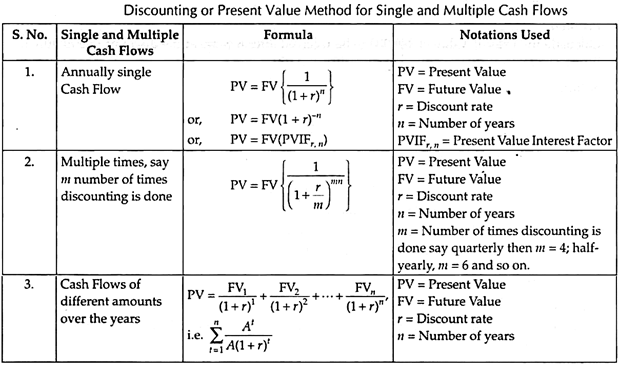
Discounting or Present Value Method

The current value of an expected amount of money to be received at a future date is known as Present Value. If we expect a certain sum of money after some years at a specific interest rate, then by discounting the Future Value we can calculate the amount to be invested today, i.e., the current or Present Value.

Hence, Discounting Technique is the method that converts Future Value into Present Value. The amount calculated by Discounting Technique is the Present Value and the rate of interest is the discount rate.

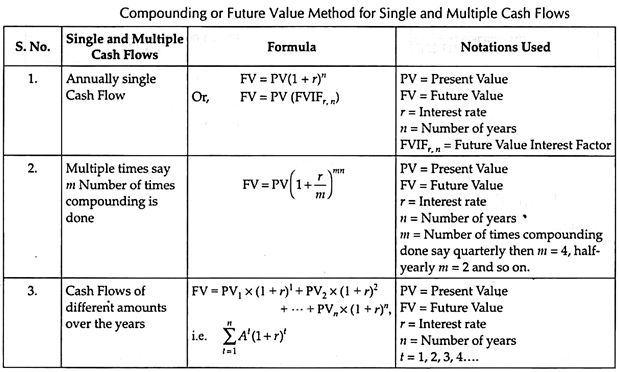
Compounding or Future Value Method

Compounding is just the opposite of discounting. The process of converting Present Value into Future Value is known as compounding.

Future Value of a sum of money is the expected value of that sum of money invested after n number of years at a specific compound rate of interest.

Key differences between Compounding and Discounting:

Basis of Comparison Compounding Discounting
Definition Future value (FV) Present value (PV)
Focus Value growth Value reduction
Process Adding interest Removing interest
Direction Present to future Future to present
Use Investment growth Valuation analysis
Formula FV = PV × (1 + r)^n PV = FV ÷ (1 + r)^n
Objective Maximize returns Evaluate worth today
Application Savings, investments Loan, cash flow eval
Time Horizon Future-oriented Current-oriented
Example Bank deposits Bond valuation

Activity Based Costing, Significance, Features, Stages, Application

ABC, or Activity-Based Costing, is a costing methodology that focuses on identifying and assigning costs to specific activities that consume resources within an organization. It provides a more accurate and detailed understanding of cost drivers and cost behavior, allowing for better cost allocation and decision-making.

ABC departs from traditional costing methods that rely heavily on volume-based allocation, such as direct labor hours or machine hours. Instead, ABC identifies activities performed within an organization and allocates costs to those activities based on their consumption of resources. It recognizes that activities drive costs and that products or services consume activities in varying degrees.

Significance of ABC:

  • Cost Accuracy:

ABC provides a more accurate picture of the true costs of products, services, or processes by tracing costs to specific activities. It helps in identifying and allocating both direct and indirect costs more effectively, leading to more accurate product/service pricing and profitability analysis.

  • Cost Control and Optimization:

ABC helps identify and control costs associated with activities. By focusing on cost drivers, organizations can identify and eliminate non-value-added activities or find ways to optimize resource utilization, thereby reducing overall costs.

  • Decision-Making:

ABC provides valuable insights for decision-making by providing a clearer understanding of the cost implications of different activities. It helps prioritize activities, evaluate process improvements, make informed product mix decisions, and identify areas for cost reduction or process optimization.

  • Performance Measurement:

ABC enables performance measurement at the activity level, allowing organizations to assess the efficiency and effectiveness of activities and identify opportunities for improvement. It provides a basis for setting performance targets and evaluating performance against those targets.

  • Enhanced Cost Transparency:

ABC improves cost transparency by breaking down costs into meaningful activities. It enables managers to better understand the cost structure and drivers, facilitating communication and collaboration across different functions and departments.

Features of ABC:

  • Activity Identification:

ABC involves identifying and documenting activities performed within the organization. Activities are specific tasks or processes that consume resources and contribute to the production or delivery of products/services.

  • Cost Driver Identification:

ABC identifies cost drivers, which are the factors that influence the consumption of activities and, consequently, the costs incurred. Cost drivers can be volume-based (such as machine hours), transaction-based (such as the number of orders processed), or duration-based (such as the time spent on a specific activity).

  • Resource Consumption Analysis:

ABC analyzes the resources consumed by each activity. It involves identifying the types and quantities of resources, both direct and indirect, used by activities to accurately allocate costs.

  • Cost Allocation:

ABC allocates costs to activities based on their consumption of resources. It assigns indirect costs to activities using suitable cost drivers, resulting in more accurate cost allocation.

  • Cost Assignment to Products/Services:

Once costs are assigned to activities, ABC assigns those costs to products, services, or customers based on the activity consumption associated with each. This provides a more precise understanding of the costs incurred by different products or services.

  • Continuous Improvement:

ABC supports continuous improvement efforts by identifying areas for process optimization, cost reduction, or value-added enhancements. It provides insights into the efficiency and effectiveness of activities, allowing organizations to focus on high-value activities and eliminate or streamline non-value-added activities.

Stages and Flow of Costs in ABC

the flow of costs involves several stages as costs are traced from resource consumption to activities, and finally to products, services, or customers.

  • Identify Activities:

The first stage in ABC is to identify the activities performed within the organization that contribute to the production or delivery of products/services. Activities are specific tasks or processes that consume resources. Examples may include machine setups, order processing, quality inspections, or customer support.

  • Identify Cost Drivers:

Once activities are identified, the next step is to determine the appropriate cost drivers for each activity. Cost drivers are the factors that influence the consumption of activities and, consequently, the costs incurred. Cost drivers can be volume-based, transaction-based, or duration-based, depending on the nature of the activity.

  • Assign Resources to Activities:

In this stage, the resources consumed by each activity are identified and assigned. Resources can be direct or indirect and may include labor, materials, equipment, facilities, or overhead costs. The goal is to accurately allocate the resources used by each activity.

  • Calculate Activity Costs:

Once the resources are assigned to activities, the costs associated with each activity are calculated. This involves determining the cost per unit of resource consumed by an activity. For example, if an activity consumes 10 labor hours and the labor rate is $20 per hour, the activity cost would be $200.

  • Trace Costs to Products/Services:

In this stage, the costs calculated for each activity are traced to the products, services, or customers that consume those activities. This is done by identifying the specific activities required to produce or deliver a particular product or service and allocating the costs of those activities accordingly. This provides a more accurate understanding of the costs incurred by each product or service.

  • Calculate Product/Service Costs:

Once the costs are traced to the products/services, the total cost for each product or service is calculated. This includes the direct costs associated with the resources consumed by the activities directly linked to the product/service, as well as the indirect costs allocated to those activities.

  • Cost Analysis and Decision Making:

The final stage involves analyzing the costs and using the information to make informed decisions. Managers can evaluate the profitability of different products/services, identify cost-saving opportunities, prioritize activities for improvement, and make pricing decisions based on the accurate cost information provided by ABC.

Throughout these stages, the flow of costs in ABC ensures that costs are assigned based on the actual consumption of resources by activities and that they are accurately allocated to the products, services, or customers that benefit from those activities. This provides organizations with a more precise understanding of their cost structure and enables better cost management and decision-making.

Application of ABC in a Manufacturing Organization:

  • Product Costing:

ABC can help in accurately determining the cost of individual products by tracing costs to specific activities involved in their production. It allows for a more precise allocation of indirect costs based on the activities consumed by each product. This information can help in pricing decisions, product profitability analysis, and identifying cost reduction opportunities.

  • Process Analysis:

ABC can be used to analyze the costs associated with different manufacturing processes or stages. By identifying the activities and their respective costs at each stage, organizations can pinpoint inefficiencies, bottlenecks, and areas for process improvement. This information can aid in optimizing resource allocation, reducing cycle times, and enhancing overall process efficiency.

  • Inventory Management:

ABC can provide insights into the costs associated with inventory holding and handling. By allocating costs based on the activities involved in storing, managing, and moving inventory, organizations can identify the true costs of carrying inventory. This can help in optimizing inventory levels, identifying slow-moving or obsolete items, and reducing carrying costs.

  • Supply Chain Management:

ABC can be applied to analyze costs throughout the supply chain, from procurement to distribution. By tracing costs to activities related to supplier management, order processing, transportation, and warehousing, organizations can identify cost drivers and areas for cost reduction. This can lead to more informed decisions regarding supplier selection, order quantity optimization, and logistics management.

Application of ABC in the Service Industry:

ABC is particularly relevant in the service industry, where the cost structure is often complex and indirect costs play a significant role.

  • Service Costing:

ABC helps in accurately determining the cost of delivering various services. By identifying and allocating costs to activities specific to each service, organizations can understand the true cost drivers and allocate costs more accurately. This information is valuable for service pricing, profitability analysis, and identifying areas for cost reduction or efficiency improvement.

  • Customer Profitability Analysis:

ABC allows organizations to analyze the profitability of individual customers or customer segments. By tracing costs to activities consumed by each customer, organizations can identify high-profit customers, low-profit customers, or even unprofitable customers. This information can guide customer retention strategies, pricing decisions, and resource allocation to maximize profitability.

  • Service Process Optimization:

ABC helps in analyzing and optimizing service processes. By identifying activities, their costs, and their resource consumption, organizations can streamline processes, eliminate non-value-added activities, and enhance overall process efficiency. This can result in improved service delivery, reduced costs, and enhanced customer satisfaction.

  • Resource Allocation:

ABC provides insights into resource utilization for different services. By identifying the activities and the resources consumed, organizations can optimize resource allocation, match resource capacity to demand, and avoid underutilization or overutilization of resources. This can lead to cost savings and improved operational efficiency.

Financial Decision Making-1 Osmania University B.com 5th Semester Notes

Unit 1 Financial Statement Analysis {Book}
Basic Financial Statement Analysis VIEW
Common size financial statements VIEW
Common base year financial statements VIEW
Financial Ratios: VIEW
Liquidity Ratio VIEW
Leverage Ratio VIEW
Activity Ratio VIEW
Profitability Ratios VIEW
Solvency Ratio VIEW
Market Profitability analysis VIEW
Income measurement analysis VIEW
Revenue analysis VIEW
Cost of sales analysis VIEW
Expense analysis VIEW
Variation analysis VIEW VIEW
Special issues:
Impact of foreign operations VIEW VIEW
Effects of changing prices and inflation VIEW VIEW
Off-balance sheet financing VIEW
Impact of changes in accounting treatment VIEW
Accounting and Economic concepts of value and income VIEW
Earnings quality VIEW


Unit 2 Financial Management {Book}
Risk & Return VIEW VIEW VIEW
Calculating return VIEW
Types of risk VIEW
Relationship between Risk and Return VIEW VIEW
Long-term Financial Management: VIEW
Term structure of interest rates VIEW
Types of financial instruments VIEW VIEW
Cost of capital VIEW VIEW
Valuation of financial instruments VIEW


Unit 3 Raising Capital {Book}
Raising Capital VIEW VIEW
Financial markets VIEW VIEW VIEW
Financial markets regulation VIEW
Market efficiency VIEW
Financial institutions VIEW VIEW
Initial and secondary public offerings VIEW VIEW
Secondary public offerings VIEW
Dividend policy VIEW VIEW VIEW
share repurchases VIEW
Lease financing VIEW VIEW


Unit 4 Working Capital Management {Book}
Managing working capital VIEW VIEW
Cash Management VIEW VIEW
Marketable Securities management VIEW
Accounts Receivable Management VIEW VIEW
Inventory management VIEW VIEW VIEW
Short-term Credit: VIEW
Types of short-term credit VIEW
Short-term credit management VIEW


Unit 5 Corporate Restructuring and International Finance {Book}
Corporate Restructuring VIEW
Mergers and acquisitions VIEW
Bankruptcy VIEW VIEW
Other forms of restructuring VIEW
International Finance VIEW
Fixed, flexible, and floating exchange rates VIEW VIEW
Managing transaction exposure VIEW
Financing international trade VIEW
Tax implications of transfer pricing VIEW


error: Content is protected !!