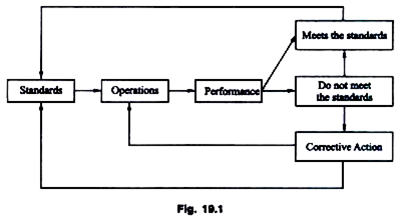
Philip Kotler considers four types of marketing control:
- Annual Plan control
- Profitability control
- Efficiency Control
- Strategic Control
Annual Plan Control:
In this method, annul plans are prepared for various activities. Each plan includes setting objectives (expected results or standards), allocating resources, defining time limit, and formulating rules, policies and procedures. Annual plan control relates to sales. Periodically (mostly annually) the actual results are measured and compared with standards to judge whether annual plans are being (or have been) achieved.
Depending on the degree of difference between the planned and the actual results, causes are detected and suitable corrective actions are undertaken. Thus, it contains checking ongoing performance against annual plan and taking corrective action. Figure 1 shows five measures of annual plan control.
Measures (Evaluation Tools) of Annual Plan Control:
Following five measures are used in annual plan control:
- Analysis of Different Sales:
Analysis of different sales contains measuring and evaluating different sales (total sales, territory- wise sales, distribution channel-wise, product-wise sales, customer-wise sales, etc.) with annual sales goals. Targets are set for different types of sales and actual sales of different categories are compared to find out how far company can achieve its sales goals.
- Analysis of Market Share:
Here, market share is used as base for measuring, comparing, and correcting results. Market share is a proportion of company’s sales in the total sales of the industry. It helps to know how well the company is performing relative to its close competitors. Thus, the performance is assessed against expected market share and competitors’ market share.
It involves considering three types of market shares:
- Overall market share
- Served market share
- Relative market share
- Analysis of Market Expenses-to-Sales:
This type of control checks marketing expenses. It ensures that the firm is not overspending to achieve its annual sales goals. Different marketing expenses are watched in relations to sales.
Normally, company considers five components to calculate expenses-to-sales ratios and compares them with standard ratios to find out how far expenses are under control, such as:
- Sales force-to-sales ratio
- Advertising-to- sales ratio
- Sales promotion-to-sales ratio
- Marketing research-to-sales ratio
- Sales administration-to-sales ratio
Marketing managers needs to monitor these expenses in relation to sales. If the expenses fall beyond permissible limits, it should be taken as a serious concern and needed steps are taken to keep them under control.
- Financial Analysis:
Financial control consists of evaluating sales and sales-to-expense ratios in relation to overall financial framework. It means net profits, net sales, assets, and expenses are studied to find out rate return on total assets, and rate of return on net worth.
Financial analysis determines firm’s capacity of earnings, profits, or income. Attempts are made to find out factors influencing firm’s rate of return on net worth. Here, various ratios are calculated such as profit margin ratio (net profits + net sales), asset turnover ratio (net sales + total assets), and return on assets ratio (net profits + total assets), financial leverage (total assets + net worth) and return on net worth (net profits – net worth). Profit margin can be improved either by cutting expenses and/or increasing sales.
- Analysis of Customer and Stakeholder Attitudes:
The measures of annual plan control discussed in former part are financial and quantitative in nature. Qualitative measures are more critical because they give early warning about what is going to happen on sales as well as profits.
Manager can initiate precautionary actions to minimize adverse impacts of forces on the future outcomes. Under this tool, customers’ attitudes are tracked to project the way they will react to the company’s offers. Alert company prefers to set up a system to monitor attitudes of customers, dealers, and other participants.
Base on their attitudes, preference and satisfaction, management can take early actions. This tool is preventive in nature as adverse impact on the future results can be prevented by advanced steps. Market- based preference scorecard analysis is used to measure (score) attitudes of customers and other participants. Such analysis reflects actual company’s performance and provides early warnings.
Measuring Customers’ Attitudes:
Here, a firm tries to measure attitudes of customers by using various methods like, complaints and suggestions, customer panels, customer survey, etc. It provides details about new customers created, existing customers lost, dissatisfied customers, relative product quality, relative service quality, target market awareness, target market preference, and other valuable information.
Measuring Stakeholders’ Attitudes:
It consists of measuring or recording stakeholders’ attitudes. It shows the pattern of stakeholders’ preference, attitudes, and overall response toward company and its offers. Stakeholders include suppliers, dealers, employees, stockholders, service providers, etc. They have critical interest and impact on company’s performance.
Without their cooperation and contribution, a company cannot realize its goals. When one or more of these stakeholders register dissatisfaction, management must take suitable actions. Methods used to track attitudes of customers can also be used for measuring attitudes of stakeholders.
Profitability Control:
In this method, the base of exercising control over marketing activities is the profitability. Certain profitability (and expenses) related standards are set and compared with actual profitability results to find out how far company is achieving profits. Profitability control calls for measuring profitability of various products, channels, territories, customer groups, order size, etc. It provides necessary information to management to determine whether products, channels, or territories should be expanded, reduced, or eliminated.
Process of Marketing-Profitability Analysis:
Systematic and logical process is used for analysis of profitability.
It involves:
- Identifying Functional Expenses:
It consists of determining expenses to be incurred for the marketing activities like salaries, rents, advertising, selling and distribution, packing and delivery, billing and collection, etc.
- Assigning Function Expenses to Marketing Entities:
Simply, expenses of particular head (for example, salary or advertising) are associated with different entities like products, channels, territories or customers groups.
- Preparing Profits and Loss statement:
A profit and loss statement is prepared for each type of products, channels, territories, etc., to evaluate their relative performance. Based on relative performance in form of profitability, management can decide on products, channels or territories to be expanded, reduced or eliminated.
For example, a firm has five products, like A, B, C, D, and E. If profit and loss statement shows that:
(1) Product C is more profitable, and therefore, it must be expanded;
(2) Product B is poor, and, therefore, it must be reduced;
(3) Product D is making loss, and therefore, it must be eliminated, and
(4) Product A and product E are satisfactory, and therefore they must be maintained. In the same way, it can be applied to different territories and segments.
Table 1 shows how to prepare profit and loss statement for different products.
- Taking Action:
On the basis of the profit and loss statement, necessary actions can be directed.
Actions include one or more of followings:
- Expanding product(s)
- Reducing product(s)
- Eliminating product(s)
- Reducing any of the expenses
- Increasing sales, etc.
Efficiency Control:
This control, particularly, concerns with measuring spending efficiency. While profitability control reveals the relative (in relation to different entities like products, territories, channels, etc.) profits a company is earning, the efficiency control shows the ways to improve efficiency of various marketing entities like sales force, advertising, distribution, sales promotion, and so forth.
Sometimes, a post of marketing controller is created to work out a detailed programme to measure and improve efficiency of expense-centered marketing activities. Here also, in order to evaluate efficiency level of different marketing activities, the efficiency standards (of ideal performance) are set and are compared with actual performance.
Efficiency control can improve efficiency of marketing department in two ways – one is, improving ability of various marketing activities to contribute more in reaching the goals, and the second is, reducing expenses or wastage.
Types of Efficiency Control:
Figure 2 shows major types of efficiency control. Main types of efficiency control involve controlling sales force efficiency, advertising efficiency, sales promotion efficiency, distribution efficiency, and marketing research efficiency.
- Sales Force Efficiency Control:
To measure efficiency of sale force (salesmen), certain key indicators/criteria are developed. A manager has to make a lot of calculations and paperwork.
Common criteria used to measure and evaluate the sales force efficiency include:
- Average number of sales calls per salesman in a day
- Average sales calls time spared per contact
iii. Average revenue generated per call
- Average costs incurred per call
- Entertainment cost per calls
- Percentage of orders per specific number of calls, i.e., how many orders have been received from 100 calls made
- Number of new customers created during specific period
- Number of customers lost in a given period
- Contribution of salesmen in total sales, revenue, and profits
- Sales force costs as percentage of total sales.
Questionnaire, discussion, inspection, observation, salesman’s report, etc., methods are used for the purpose. However, most companies use salesman’s report. A unique computer-based programme or software can also be developed for speedy and accurate measurement of sales forces efficiency on a regular basis. Simply, actual performance of sales force is compared with these criteria to find out deviation, and, accordingly, necessary actions are taken.
This measurement of sales force efficiency can provide satisfactory answers of following questions:
- What is role/contribution of sales force in selling efforts?
- Who are the most efficient, less efficient and inefficient sales people?
- Which are reasons responsible for poor efficiency of sales force?
- What can/should be done to improve efficiency?
- Advertising Efficiency Control:
Advertising is the most expensive among all the promotional tools. Major part of promotion budget is consumed by advertising alone. So, it is extremely necessary to find out efficiency level of advertising efforts. A company sets advertising goals (standards) and compared actual contribution of advertising to decide how far advertising has been capable to fulfill firm’s expectations. Advertising efficiency control mainly involves measuring cost efficiency or contribution efficiency.
Practically, it is difficult to measure the exact contribution of advertising efforts/costs. Systematic tools can be developed to measure impact of advertising qualitatively – in forms of increasing awareness, changing attitudes, and creating brand loyalty – and quantitatively – in forms of impact on sales and profits. Survey of dealers and customers can be made to collect needed data.
Common criteria used for measuring advertising efficiently include:
- Advertising cost per thousand target customers reached by a specific media vehicle, for example, television medium.
- Percentage of audience who read, noted, or saw message from print media.
- Customer opinion on advertising contents and effectiveness.
- Measurement of pre-post (before-after) advertising impact on attitudes of people toward the product.
- Number of inquiries generated by advertising.
- Cost per inquiry.
- Impact of advertising on personal selling, sales promotion, public relations, publicity, and distribution.
- Need and performance of advertising agency, etc.
Manager can compared efficiency of advertising programme with internal as well as external standards to judge comparative efficiency. He must find out causes leading to inefficiency.
One or more of following actions are initiated:
- To changes advertising objectives and policies.
- To change advertising message.
- To change advertising media.
- To change media scheduling and frequencies.
- To change and/or train the staff.
- To change advertising agency.
- To change advertising budget, etc.
- Sales Promotion Efficiency Control:
This control is exercised by sale manager. Sometimes, sales promotion manager is also appointed to deal with the issue. Sales promotion efficiency measures the impact of sales promotion efforts on sales, profits, competitiveness, and consumer satisfaction. Such efforts include offering a wide range of short-term incentives to stimulate buyer interest and consumer trial. Sales promotion is, no doubt, costly, but it seems essential. Here, manager tries to measure costs and impact of each of sales promotion tools. Normally, sales promotion tools are applied at three levels – customer level, dealer level, and sale force level.
Common criteria used for measuring sales promotion efficiency include:
- Percentage of total sales promotion expenses to sales.
- Costs of display, sample, coupons, and other tools per unit selling price.
- Number of inquires generated due to display, demonstration, other such incentives.
- Joint and individual impact of various tools on dealer interest, consumer purchase, and competitiveness.
Analysis of costs and contribution of sales promotion tools helps in selecting the most cost- effective sales promotion tools to use. A firm can reduce unnecessary costs and/or can improve contribution of each of the tools of sales promotion. It helps design suitable sales promotion strategies in term of costs, level of sales promotion, timing, and types of techniques at each of the levels.
- Distribution Efficiency Control:
In an average, distribution costs account for 20 to 30 per cent of selling price. By a suitable distribution network, company can improve its profitability on one end and consumer satisfaction on the other end. Therefore, it is necessary to review or assess the entire distribution system periodically. Distribution efficiency control measures how far company’s distribution system is efficient to achieve marketing goals.
Common criteria used for the purpose include:
- Percentage of total distribution costs per unit price.
- Percentage of physical distribution (warehousing, inventory, ordering, transportation, communication, insurance, etc.) costs per unit price.
- Percentage of channel members’ (wholesalers, retailers, agents, etc.) costs per unit price.
- Costs and contribution of direct v/s indirect channels.
- Potentials of using online marketing, network marketing, and by retailing chains.
- Assessing costs of marketing channels in relation to services they offer to the company as well consumers.
Distribution efficiency gives valuable information to select the most cost-effective distribution option and sub-options. Company can minimize distribution costs and/or improve profits and competitiveness. In the same way, it can increase consumer satisfaction, too.
- Marketing Research Efficiency Control:
Marketing research is process of gathering, analyzing, and interpreting data relating to any marketing problem. Due to dynamic nature of marketing environment, a company needs data on various relevant variables time to time. Marketing research is an expensive option. It is imperative for a firm to know how far marketing research efforts and costs are instrumental in achieving marketing goals. It provides necessary details to improve research policies and practices.
Common criteria used to measure marketing research efficiency include:
- Annual budget of marketing research department.
- Costs of research projects conducted in a year.
- Effectiveness of tools and methods used for collecting and analyzing data.
- Usefulness of findings of marketing research in decision-making.
- Relative advantages of company’s research department v/s professional research firms, etc.
Strategic Control:
Strategic control implies a critical review of overall marketing effectiveness in relation to broad and long-term objectives and firm’s response to marketing environment. It deals with assessing firm’s ability to define and achieve marketing goals, and response pattern to environment. Normally, strategic control verifies company’s long-term performance with reference to the close competitors. Here, entire marketing system is reviewed to judge firm’s overall strengths and weaknesses. It answers the question: How far is the firm capable to exploit emerging marketing opportunities and face challenges and threats?
Methods or Tools:
As shown in Figure 3, four tools are used for strategic control – the marketing effectiveness review, the marketing audit, the marketing excellence review, and the ethical and social responsibility review. Let’s discuss each of them.
- The Marketing Effectiveness Review:
It involves a review of overall marketing performance. It helps finding effectiveness of several business plans in term of sales growth, market share, and profitability. Attempts are made to detect causes for good-performing marketing department and poor-performing department.
Common criteria:
Some criteria are used to review marketing effectiveness.
They include:
- Company’s Customer Philosophy:
It shows company’s approach toward customers.
- Integrated Marketing Efforts:
It shows the way company integrates efforts of all divisions and departments for achieving marketing goals.
iii. Marketing Information:
It studies company’s policies and practices to collect, use, and disseminate critical information on a regular basis.
- Company’s Strategic Orientation:
It shows company’s broad and long-term plans for survival and growth. It also indicates firm’s long-term plans for profits, sales, and expansion.
- Operational Efficiency:
It shows how efficiently a company managing its current operations.
- Public Relations Practices:
It shows company’s policies and practices to establish, maintain, and improve relations with various publics, which have direct interest in the company’s operations, and whose cooperation seems critical in achieving marketing goals.
Here, we have considered only six criteria. As per need, more criteria can be developed and used for the purpose.
A special instrument can be developed by using these criteria to measure marketing effectiveness. The instrument (a type of questionnaire or form with questions and certain number of options or intensity in each of the questions) is filled by managers of marketing and various other departments.
On the basis of this instrument, controller can calculate score of each managers of each of the departments. Level of scores received by manager or department clearly indicates the effectiveness of particular manager and/or department. Accordingly, each department is awarded class like excellent, very good, good, fair, or poor. Necessary actions can be taken on the basis of performance.
- The Marketing Audit:
Another alternative tool for critical review of overall marketing performance is the marketing audit. Audit means to examine systematically. It is systematic examination/investigation of all critical aspects of marketing department.
Philip Kotler defines: “A marketing audit is a comprehensive, systematic, independent, and periodical examination of a company’s marketing environment, objectives, strategies, and activities with a view to determine problem areas and opportunities, and recommending a plan of action to improve the company’s marketing performance.”
Key characteristics of marketing audit have been discussed below:
- Comprehensive:
The marketing audit covers all the major marketing activities of a business unit.
- Systematic:
It is a systematic examination of all marketing operations. It is a well-planned and orderly task. All aspects are audited minutely. It indicates corrective actions to improve firm’s marketing performance.
iii. Independent:
Marketing audit is conducted objectively (bias-free) or neutrally. It includes self-audit, internal, or external audit. However, the external audit is considered as the best one.
- Periodical:
The marketing audit should be conducted regularly to detect problems and avoid crisis.
- Purposive:
Its purpose is to find out marketing problem areas and opportunities. It recommends actions to improve company’s marketing performance.
Key Issues or Decisions of Marketing Audit:
A detailed plan is prepared to conduct marketing audit.
The main decisions/issues of marketing audit include:
- Deciding on marketing audit objectives (why).
- Deciding on marketing audit responsibility (who).
iii. Deciding on data to be collected (what).
- Deciding on respondents (whom).
- Deciding on time (when and how long).
- Deciding on areas of marketing audit (Where).
vii. Deciding on intensity of examination (How much).
viii. Deciding on methods and tools (how)
- Deciding on audit report format
- Deciding on actions to be taken on the basis of report.
Components of Marketing Audit:
The marketing audit examines six major components of company’s marketing operations, such as:
- Marketing Environment Audit:
It examines impacts of micro and macro factors of marketing environment. Macro marketing environment consists of demographic, economic, environmental (ecological), technological, political and cultural factors. Micro marketing environment includes market segments, customers, competitors, dealers, suppliers, facilitators, and general public’s.
- Marketing Strategy Audit:
It examines company’s business mission, marketing goals and objectives, resources capacity, and marketing strategies.
- Marketing Organisation Audit:
It examines suitability of marketing organisation (structures) to implement marketing operations effectively. It includes level, relations, authority- responsibility, communication, facilities, organisation manual, etc.
- Marketing System Audit:
It examines major systems like marketing information and research system, marketing planning system, marketing control system, new product development system, etc.
- Marketing Productivity Audit:
It examines company’s profitability for different products, territories, and channels. It also examines cost-effectiveness for various operations.
- Marketing Function Audit:
It examines marketing mix elements such as product, price, promotion (advertising, sales promotion, personal selling-sales force, publicity, and public relations), and distribution. For each of the components, appropriate auditing questions are designed to examine how effectively the company is performing. All relevant respondents like customers, suppliers, managers, dealers, etc., are interviewed using these questions.
Finally, the auditor prepares marketing audit report. The audit report contains individual and joint evaluation of main audit components (marketing areas). It detects strengths and weakness, and recommends actions for improving marketing performance.
- The Marketing Excellence Review:
This is more or less similar to market effectiveness review. But, here, some excellently performing business units are taken as the base for evaluating firm’s performance. Here, performance is reviewed relatively.
The marketing excellence review is used to judge how excellently the company is performing with reference to high performing business units. A special instrument with adequate number of criteria and appropriate scaling can be developed to judge poor, good or excellent performance.
Criteria used for the purpose include:
- Market/customer orientation
- Market segmentation
- Product quality
- Quality of services
- Approach toward competition
- Integration and alliance
- Approach toward dealers
- Dealing with other stakeholders
- Social responsibility and national services, etc.
Depending on result of the marketing excellent review, necessary actions are taken. Company’s actions mainly include undertaking all possible steps to reach the level of excellently performing business units.
- The Ethical and Social Responsibility Review:
This review/verification decides whether firm’s marketing policies and practices are ethically and socially true. Ethics are moral principles, norms, or standards of right or wrong. Every business unit has social responsibilities toward a number of stakeholders.
In same way, marketing practices should be ethical with reference to moral norms, standards, and values. Company’s products, policies, and practices should not have adverse impact on customers, other stakeholders, and larger interest of society. Thus, here company tries to assess its ethical and social responsibility. As per need, necessary actions are taken.
Criteria used to review social and ethical responsibility include:
- Clear definitions of illegal, immoral, and antisocial activities.
- Company’s active efforts to practice, promote, and disseminate moral principles and to hold its employees fully responsible to observe them in practice.
- Company’s direct contribution for social welfare of people.
- Fulfilment of social responsibility toward various parties.
- The adherence to all laws and regulations in force.
- Use of business ethics in areas of product, price, promotion and distribution.
On the basis of ethical and social review, company can evaluate its performance in this regard and, if necessary, appropriate actions are taken.
 by
by