Security Trading corp. of India

The Security Printing & Minting Corporation of India Ltd. (SPMCIL) is a Mini-Ratna Central Public Sector Enterprise (CPSE). It is a wholly owned by Government of India Schedule “A” Company of the Government of India and was incorporated on 13 January 2006 with its registered office at New Delhi. The Corporation is engaged in the manufacture / production of Currency and Bank Notes, Security Paper, Non-judicial Stamp Papers, Postal Stamps & Stationery, Travel Documents viz., Passport and Visa, Security Certificates, Cheques, Bonds, Warrants, Special Certificates with Security Features, Security Inks, Circulation & Commemorative Coins, Medallions, Refining of Gold, Silver and Assay of Precious Metals, etc.

The company was formed in 2006 as the result of corporatisation of security presses and mints functioning under the Indian Ministry of Finance. It contains nine units, four mints, four presses and a paper mill.

Organisation structure

SPMCIL organisational sturcute

Corporate Structure of SPMCIL

SPMCIL is headed by a board of directors, presided by the chairman and managing director. The other board members include three functional directors who head the departments of technology, finance and human resource. Apart from the four functional directors, two independent directors are nominated by the Ministry of Finance and one by the Ministry of External Affairs. The board also commissions a Chief Vigilance Officer (CVO) who heads the organisation’s internal vigilance department. His functional responsibilities include managing production planning, maintenance, technology, R&D, logistics, procurement and marketing. Every individual unit is headed by a Chief General Manager who functions under the control and directions of the head office.

Finance Department

The finance department handles accounts, taxation, internal audits, costing, budgeting, capital investments corporate finance, co-ordination with auditors, systems and co-ordination, company secretariat etc.

Human Resource

The human resource department handles administration, establishment, legal matters, training, personnel and industry relations.

Units

According to the information made available, SPMCIL broadly operates through four production verticals i.e. currency printing presses, security printing presses, security paper mill and India Government mints.

Currency Printing Presses

SPMCIL consists of two currency printing presses: The Currency Note Press (CNP) in Nashik and the Bank Note Press (BNP) in Dewas. The two units are engaged in production of bank notes for India as well as a few foreign countries including Iraq, Nepal, Sri Lanka, Myanmar and Bhutan. More than 40% of Currency Notes circulated in India are printed by the two units. These units are equipped with designing, engraving, complete Pre-printing and Offset facilities, Intaglio Printing machines, Numbering & Finishing machines etc.

The CNP was established in 1928 as the first printing press for bank notes in India. They are currently responsible for the printing of the new 500 rupee notes following the demonetisation of the old 500 rupee and 1000 rupee note. Currency is also printed by the two presses of Bharatiya Reserve Bank Note Mudran Private Limited, a wholly owned subsidiary of Reserve Bank of India. They are currently responsible for the printing of the new 2000 rupee notes, and speculations suggest that the printing of the 500 rupee notes will also shift to these presses for better speed and fewer errors. BNP also has an ink factory that produces ink for security printing.

Security Printing Presses

There are two Security printing presses of SPMCIL, namely the India Security Press (ISP) at Nashik and Security Printing Press (SPP) at Hyderabad. These presses print the 100% requirement of passports and other travel documents, non-judicial stamp papers, cheques, bonds, warrants, postal stamps and postal stationery and other security products. The Security Printing Presses have the capability of incorporating security features like chemically reactive elements, various Guilloche patterns, micro lettering, designs with UV inks, bi-fluorescent inks, optical variable inks, micro perforation, adhesive/glue, embossing, die-cutting and personalization, etc.

Mints

SPMCIL comprises four units of India Government Mint located in the cities of Mumbai, Kolkata, Hyderabad and Noida.[9] These mints produce circulation coins, commemorative coins, medallions and bullion, as required by the Government of India.

Paper mill

Security Paper Mill was established in 1968 at Hoshangabad, Madhya Pradesh. It produces papers for banknotes and non–judicial stamps and further prints with new enhanced unit.

Types of Bonds

1. Serial Bonds:

Serial bonds are issued by an organization with different maturity dates. This is done to enable the company to retire the bonds in instalments rather than all together. It is less likely to disturb the cash position of the firm than if all the bonds were retired together.

From the point of view of the bondholder, this gives him a chance to select a bond of the maturity date which would suit his portfolio. He may select a short-term maturity bond if it meets his need or take a bond with a long-term maturity if he already has too many shorter-term investments.

Serial bonds usually do not have the call feature and the company retires the debt when it becomes payable on the maturity date. Such bonds are useful to those companies that wish to retire their bonds in series. Serial bonds, resemble sinking fund bonds and have an effect on the yields of bonds. Bonds with shorter-term maturity have lower yields compared to those of long- term maturities.

2. Sinking Fund Bonds:

Sometimes, an organization plans the issue of its bonds in such a way that there is no burden on the company at the time of retiring bonds. This has the advantage of using the funds are well as retiring them without any excessive liquidity problems.

The company sets apart an amount annually for retirement of bonds. The annual installment is usually fixed and put in a sinking fund through the trustees. The trustee uses his discretion in investing these funds. He may use the fund to call the bonds every year or purchase bonds from them at a discount. Sinking fund bonds are commonly used as a measure of industrial financing.

3. Registered Bonds:

Registered bonds offer an additional security by a safety value, attached to them. A registered bond protects the owner from loss of principal. The bondholder’s bond numbers, name address and type of bond are entered in the register of the issuing company. The bondholder has to comply with the firm’s formalities at the time of transfer of bonds.

While receiving interest, registered bondholders usually get their payment by cheque. The main advantage of registering a bond is that if the bond is misplaced or lost, the bondholder does not suffer a loss unlike the unregistered bonds. However, registered bonds do not offer security of principal at maturity.

4. Debenture Bonds:

Debentures in the USA are considered to be slightly different from bonds. Debenture bonds are issued by those companies who have an excellent credit rating but do not have security in the form of assets to pledge to the bondholders. The debenture holders are creditors of the firm and receive the full rate of interest whether the company makes a profit or not.

In India, debentures can be issued with the specific permission of the Controller of Capital Issues. Bearer debentures are not considered legal and permissible documents in India. Convertible debentures have become popular in recent years.

Convertible debentures have lower rates of interest but the convertible clause makes it an attractive investment. While permission has to be sought for the convertibility clause, it is not necessary if they are solely offered to financial institutions. Debentures can be of different kinds. They may be registered, convertible, mortgage, guaranteed and may also combine more than one feature in one issue.

5. Mortgage Bonds:

A mortgage bond is a promise by the bond issuing authority to pledge real property as additional security. If the company does not pay its bondholders the interest or the principal, when it falls due, the bondholders have the right to sell the security and get back their dues.

The value of mortgage bonds depends on the quality of property mortgages and the kind of charge on property. A first charge is the most suitable and highly secure form of investment, since its claims will be on priority of the asset.

A specific claim on a particular property is also an important consideration compared to a general charge. A second and third charge on security of property is considered to be a weak form of security, and is less sound than a first charge. Sometimes, however, second or third charges prove useful when the quality of the property with a first charge is poor.

This means that a property which is of high value and immediately saleable because of its strategic placement should be considered very valuable even if it offers a second and third charge.

Another property offering no saleable features but giving a first charge may be worthless to the bondholders. The quality of the mortgage is, therefore, an important consideration to the mortgage bondholders. Mortgage bonds may be open end, close end and limited open end.

An open end mortgage bond permits the bond issuing company to issue additional bonds if earnings and asset coverage make it permissible to do so. In close end mortgage bonds, the company can make only one issue of bonds and while those bonds exist, new bonds cannot be issued.

If additional bonds are issued they get the ranking of junior bonds and the prior issue gets the first priority in receiving payments. The limited open end bonds permit the organization to issue specified number of fresh bonds series distributed over a number of years.

6. Collateral Trust Bonds:

A collateral trust bond is issued generally when two companies exist and are in the relationship of parent and subsidiary. The collateral that is provided in these bonds is the personal property of the company which issues the bonds. A typical example of such bonds is when a parent company requires funds, it issues collateral bonds by pledging securities of its own subsidiary company.

The collaterals are generally in the form of intangible securities like shares or bonds. These bonds have a priority charge on the shares or bonds which are used as collaterals. The quality of the collateral bonds is determined by the assets and earning position of both the parent as well as the subsidiary company.

7. Equipment Trust Bonds:

In the USA, a typical example of Equipment Trust Bonds is the issue of bonds with equipment like machinery as security. The property papers are submitted to trustees. These bonds are retired serially.

The usual method of using these bonds was to issue 20% equity and 80% bonds. The equity issue is like a reverse to protect the lender in cases where the value of the asset falls in the market. The trustee also has the right to sell the equipment and pay the bondholders in case of default.

8. Supplemental Credit Bonds:

When additional pledge is guaranteed to the bondholders their bonds are categorized as supplemental by an additional non-specific guarantee. Such bonds are classified as: Guaranteed Bonds, Joint Bonds and Assumed Bonds.

9. Guaranteed Bonds:

Guaranteed Bonds are issued as bonds secured by the issuing company and they are guaranteed by another company. Sometimes, a company takes assets through a lease. The leasing company guarantees the bonds of the bond issuing company regarding interest and principal amount due on bonds.

10. Joint Bonds:

Joint bonds are guaranteed bonds secured jointly by two or more companies. These bonds are issued when two or more companies are in need of finance and decide to raise the funds together through bonds. It serves the purpose of the company as well as the investor.

The company raises funds at reduced cost. Since funds are raised jointly, dual operations of advertising and the formalities of capital issues control are avoided. The investor is in a favourable position as he has security by pledge of two organizations.

11. Assumed Bonds:

These bonds are the result of a decision between two companies to amalgamate or merge together. For example, Company-X decides to merge into Company-Y. X’s issue of bonds prior to merger then becomes the obligation of Company-Y when merger is effected.

These are called assumed bonds as Company-Y did not originally issue them but as a result of merger the debt was passed on to them. The bondholder receives an additional pledge from Company-Y. He is more secured as his bonds due to merger get the safety of both Companies X and Y.

12. Income Bonds:

Such bonds offer interest to the bondholders only when the firm earns a profit. If profit is not declared in a particular year, interest on bonds is cumulated for a future period when the company can sufficiently earn and make a profit.

Income bonds are frequently issued in case of reorganization of companies. When income bonds arise out of reorganization they are called adjustment bonds. They are also used to recapitalize the firm and take the benefit of deduction of tax by changing preference shares with income bonds.

13. Bonds with Warrants:

Bonds with warrants are also called Warrant Bonds. Each bond has one warrant attached to it and it gives the right to the bondholder to pay a subscription price and exchange the bonds for equity shares. This right is given, for a limited period of time. Usually, a time period is put up in a legal document with the trustee.

Warrant bonds may be detachable or non-detachable. Detachable warrants are used by the investor (a) to sell the warrant during price increase in the market, and (b) to buy stock at an option price and to be sold at market value. A non-detachable bond is slightly more complicated. It has to be sent to the company’s trustee at the time of exercising an option. The warrant is detached by the trustee and sent to the investor.

Warrant bonds like convertible bonds offer a chance to the investor to share in the growth of the company, but convertible bonds are more popular than warrant bonds.

In India, convertible debenture bonds are also relatively new and not as popular as equity issues. The warrant bond gives the right to its holder to sell a warrant if the price increases in the market and retain the bond. If the price does not increase, the bondholder may retain the bond with a warrant.

14. Foreign Bonds:

Bonds raised in India by foreign companies but for Indian investor will he called a ‘foreign bond’. A foreign bond, for example, an American Bond or Japanese Bond in India may be very attractive to investors because (a) the dollar yield is much higher than the rupee, (b) deposits in dollars are considered a good investment, and (c) risk on the portfolio is diversified.

Having described the different kinds of bonds, let us find out the objective of issuing such bonds as well as evaluate bonds as an investment.

Balance sheet valuation

Debt investments and equity investments recorded using the cost method are classified as trading securities, available‐for‐sale securities, or, in the case of debt investments, held‐to‐maturity securities. The classification is based on the intent of the company as to the length of time it will hold each investment. A debt investment classified as held‐to‐maturity means the business has the intent and ability to hold the bond until it matures. The balance sheet classification of these investments as short‐term (current) or long‐term is based on their maturity dates.

Debt and equity investments classified as trading securities are those which were bought for the purpose of selling them within a short time of their purchase. These investments are considered short‐term assets and are revalued at each balance sheet date to their current fair market value. Any gains or losses due to changes in fair market value during the period are reported as gains or losses on the income statement because, by definition, a trading security will be sold in the near future at its market value. In recording the gains and losses on trading securities, a valuation account is used to hold the adjustment for the gains and losses so when each investment is sold, the actual gain or loss can be determined. The valuation account is used to adjust the value in the trading securities account reported on the balance sheet.

Debt and equity investments that are not classified as trading securities or held‐to‐maturity securities are called available‐for‐sale securities. Whereas trading securities are short‐term, available‐for‐sale securities may be classified as either short‐term or long‐term assets based on management’s intention of when to sell the securities. Available‐for‐sale securities are also valued at fair market value. Any resulting gain or loss is recorded to an unrealized gain and loss account that is reported as a separate line item in the stockholders’ equity section of the balance sheet. The gains and losses for available‐for‐sale securities are not reported on the income statement until the securities are sold. Unlike trading securities that will be sold in the near future, there is a longer time before available‐for‐sale securities will be sold, and therefore, greater potential exists for changes in the fair market value.

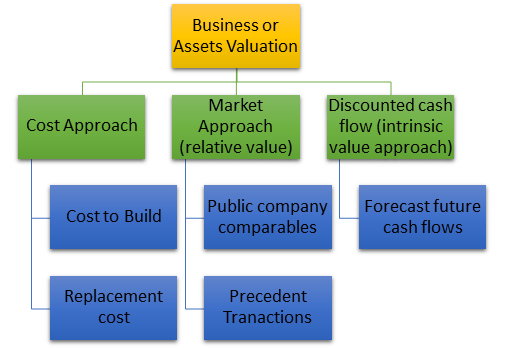
When valuing a company as a going concern, there are three main valuation methods used by industry practitioners:

(1) DCF analysis

(2) comparable company analysis,

(3) precedent transactions.

These are the most common methods of valuation used in investment banking, equity research, private equity, corporate development, mergers & acquisitions (M&A), leveraged buyouts (LBO), and most areas of finance.

As shown in the diagram above, when valuing a business or asset, there are three broad categories that each contain their own methods. The Cost Approach looks at what it costs to build something and this method is not frequently used by finance professionals to value a company as a going concern. Next is the Market Approach, this is a form of relative valuation and frequently used in the industry. It includes Comparable Analysis Precedent Transactions.  Finally, the discounted cash flow (DCF) approach is a form of intrinsic valuation and is the most detailed and thorough approach to valuation modeling.

Method 1: Comparable Analysis (“Comps”)

Comparable company analysis (also called “trading multiples” or “peer group analysis” or “equity comps” or “public market multiples”) is a relative valuation method in which you compare the current value of a business to other similar businesses by looking at trading multiples like P/E, EV/EBITDA, or other ratios. Multiples of EBITDA are the most common valuation method.

The “comps” valuation method provides an observable value for the business, based on what companies are currently worth. Comps are the most widely used approach, as they are easy to calculate and always current.

Method 2: Precedent Transactions

Precedent transactions analysis is another form of relative valuation where you compare the company in question to other businesses that have recently been sold or acquired in the same industry. These transaction values include the take-over premium included in the price for which they were acquired.

These values represent the en bloc value of a business. They are useful for M&A transactions, but can easily become stale-dated and no longer reflective of the current market as time passes. They are less commonly used than Comps or market trading multiples.

Method 3: DCF Analysis

Discounted Cash Flow (DCF) analysis is an intrinsic value approach where an analyst forecasts the business’ unlevered free cash flow into the future and discounts it back to today at the firm’s Weighted Average Cost of Captial (WACC).

A DCF analysis is performed by building a financial model in Excel and requires an extensive amount of detail and analysis.  It is the most detailed of the three approaches, requires the most assumptions, and often produces the highest value. However, the effort required for preparing a DCF model will also often result in the most accurate valuation. A DCF model allows the analyst to forecast value based on different scenarios, and even perform a sensitivity analysis.

For larger businesses, the DCF value is commonly a sum-of-the-parts analysis, where different business units are modeled individually and added together.

Determinants of interest rate risk

The inverse relationship between the interest rate and bond prices can be explained by opportunity risk. By purchasing bonds, an investor assumes that if the interest rate increases, he or she will give up the opportunity of purchasing the bonds with more attractive returns. Whenever the interest rate increases, the demand for existing bonds with lower returns declines as new investment opportunities arise (e.g., new bonds with higher return rates are issued).

Although the prices of all bonds are affected by interest rate fluctuations, the magnitude of the change varies among bonds. Different bonds show different price sensitivities to interest rate fluctuations. Thus, it is imperative to evaluate a bond’s duration while assessing the interest rate risk.

Generally, bonds with a shorter time to maturity carry a smaller interest rate risk compared to bonds with longer maturities. Long-term bonds imply a higher probability of interest rate changes. Therefore, they carry a higher interest rate risk.

How to Mitigate Interest Rate Risk?

Similar to other types of risks, the interest rate risk can be mitigated. The most common tools for interest rate mitigation include:

  1. Diversification

If a bondholder is afraid of interest rate risk that can negatively affect the value of his portfolio, he can diversify his existing portfolio by adding securities whose value is less prone to the interest rate fluctuations (e.g., equity). If the investor has a “bonds only” portfolio, he can diversify the portfolio by including a mix of short-term and long-term bonds.

  1. Hedging

The interest rate risk can also be mitigated through various hedging strategies. These strategies generally include the purchase of different types of derivatives. The most common examples include interest rate swaps, options, futures, and forward rate agreements (FRAs).

Types of Interest Rate Risks

There are quite a few types of interest rate risks, which must be noted by every investor, be it an individual or a firm. These are explained below in detail.

  • Price risk

The risk of change in the price of an investment bond or certificate is known as its price risk. This leads to unforeseen loss or gains while selling security in the future.

  • Reinvestment risk

The risk of change in their interest rate might lead to the selling of the securities. In turn, this can lead to a loss of opportunity to re-invest in the current interest rate. Known as reinvestment risk, these types of interest rate risk can be further divided into 2 categories.

Name Definition
Duration risk Risk due to the probability of unwillingness to extend an investment beyond its maturity period.
Basis risk Risk of being subjected to a negative downturn in the market.

Factors Impacting Interest Rate Risks of a Firm

There are many factors, which directly impact the interest rate risk associated with a company. These factors are discussed below in detail.

  • Credit risk associated with a company: A company’s debt to equity ratio is one of the primary determinants of credit risk. A rise in interest rates leads to more expense for a company since they have to pay more interest to its investors. As a result, the credit risk of an institution increases.
  • Length of loan terms: Length of loan terms, both as a borrower as well as a lender, are major determinants of the interest rate risks of an institution. Companies and ventures charging a fixed interest on its receivable accounts might have baselines dropping down if they need to refinance themselves. This, in turn, increases the risk involved with the shift in interest rates.
  • Market fluctuation: Market fluctuation and inflation can immensely impact the risk related to interest rates since refinancing, or other such necessities can become more difficult during such times. Such circumstances often lead to a situation where outgoing cash flow crosses the incoming cash flow, making it more difficult for the institution to function.
  • Foreign exchange rates: Any company which has a foreign debt is also affected by a change in foreign exchange rates. The associated interest rate risks increase with fall in the price of the prevalent currency, while the inverse happens in case there is a rise in the price of the currency.

Manage Interest Rate Risks

It is important to learn how to manage interest rate risk since it can potentially make an institution dysfunctional and ultimately bankrupt. The few methods which can be employed to manage the interest rate and in turn associated risks are discussed below.

  • Diversification: Among the different options that can be employed by an institution to manage the interest rate risk associated with them, one of the most effective options is to diversify their financial investments. For investors who invest in both equity and fixed investment options, this is the best method to manage the risks associated with interest rates.
  • Safer investments: The safest option for investors who are trying to reduce the risks associated with interest rates is to invest in bonds and certificates, which have short maturity tenure. Securities with short maturity tenure are less susceptible to the fluctuations in interest rate. This method for interest rate management reduces the chance of being subjected to interest rate fluctuations since they have low maturity tenure.
  • Hedging: Hedging is an option, which can be used successfully to reduce the risks related to interest rates. Generally referring to the purchase of various types of derivatives which are available, there are many ways of hedging. A few of the hedging strategies are illustrated in the table below.
Strategy Definition
1. Forwards The simplest of strategies to combat interest rate risks, this option is the fundamental one on which many other strategies have been formulated. The basic idea behind this management method is to make a specific trade or exchange agreement under the given circumstances though the exchange is to be scheduled for a future date.
2. Forward Rate Agreements As suggested by the name, forward rate agreements are a type of forwarding where the interest rate which is applicable decides the gain or loss. In these types of agreements for interest rate management, one of the involved parties offer fixed interest rates in exchange for floating interest rates which are equal to reference rates.
3. Swaps Much like the name and what it suggests, this method which is often used to manage risks related to interest rates is quite similar to Forwarding rate agreements. Here, the 2 parties involved in an agreement swap the interest rates.
4. Futures Very similar to forwarding contracts, this method of managing interest rate risk involves an intermediary. Typically, the default is lessened in this method. Additionally, the liquidity risk involved in these agreements is much lesser than those of forwards.
  • Selling long-term bonds: A common method which is often used is that of selling the long-term bonds. This effectively clears up the investment funds for re-investment in bonds with higher returns, thus allowing investors to manage the interest rate risk better. It is advisable to re-invest in securities which have shorter maturity tenure since these carry lesser risks related to interest rates.
  • Purchasing floating-rate bonds: Floating rate bonds, as suggested by its name, have a rate of interest, which is directly related to market fluctuations. It is advisable to invest in these securities since being related to the market fluctuations, the return on these investments go up and down too. These should also be bought in a healthy mix of long-term and short-term investments. While this cannot always be used to calculate the exact return, it is helpful in reducing the interest rate risk involved.

It is important for investors to note the above risk management options since risks related to interest rates can greatly affect a company or an investor. Evident from the interest rate risk example mentioned above in this article, managing the risk is necessary to prevent the devaluation of any investment security.

Determinants of the Value of Bonds

Bonds are fixed-income securities that represent a loan from an investor to a borrower, typically a corporation or government. When purchasing a bond, the investor lends money in exchange for periodic interest payments and the return of the bond’s face value at maturity. Bonds are used to finance various projects and operations, providing a predictable income stream for investors.

Valuation of Bonds

The method for valuation of bonds involves three steps as follows:

Step 1: Estimate the expected cash flows

Step 2: Determine the appropriate interest rate that should be used to discount the cash flows.

& Step 3: Calculate the present value of the expected cash flows (step-1) using appropriate interest rate (step- 2) i.e. discounting the expected cash flows

Step 1: Estimating cash flows

Cash flow is the cash that is estimated to be received in future from investment in a bond. There are only two types of cash flows that can be received from investment in bonds i.e. coupon payments and principal payment at maturity.

The usual cash flow cycle of the bond is coupon payments are received at regular intervals as per the bond agreement, and final coupon plus principle payment is received at the maturity. There are some instances when bonds don’t follow these regular patterns. Unusual patterns maybe a result of the different type of bond such as zero-coupon bonds, in which there are no coupon payments. Considering such factors, it is important for an analyst to estimate accurate cash flow for the purpose of bond valuation.

Step 2: Determine the appropriate interest rate to discount the cash flows

Once the cash flow for the bond is estimated, the next step is to determine the appropriate interest rate to discount cash flows. The minimum interest rate that an investor should require is the interest available in the marketplace for default-free cash flow. Default-free cash flows are cash flows from debt security which are completely safe and has zero chances default. Such securities are usually issued by the central bank of a country, for example, in the USA it is bonds by U.S. Treasury Security.

Consider a situation where an investor wants to invest in bonds. If he is considering to invest corporate bonds, he is expecting to earn higher return from these corporate bonds compared to rate of returns of U.S. Treasury Security bonds. This is because chances are that a corporate bond might default, whereas the U.S. Security Treasury bond is never going to default. As he is taking a higher risk by investing in corporate bonds, he expects a higher return.

One may use single interest rate or multiple interest rates for valuation.

Step 3: Discounting the expected cash flows

Now that we already have values of expected future cash flows and interest rate used to discount the cash flow, it is time to find the present value of cash flows. Present Value of a cash flow is the amount of money that must be invested today to generate a specific future value. The present value of a cash flow is more commonly known as discounted value.

The present value of a cash flow depends on two determinants:

  • When a cash flow will be received i.e. timing of a cash flow &;
  • The required interest rate, more widely known as Discount Rate (rate as per Step-2)

First, we calculate the present value of each expected cash flow. Then we add all the individual present values and the resultant sum is the value of the bond.

The formula to find the present value of one cash flow is:

Present value formula for Bond Valuation

Present Value n = Expected cash flow in the period n/ (1+i) n

Here,

i = rate of return/discount rate on bond
n = expected time to receive the cash flow

By this formula, we will get the present value of each individual cash flow t years from now. The next step is to add all individual cash flows.

Bond Value = Present Value 1 + Present Value 2 + ……. + Present Value n

Dividend discount Model (Zero growth, Constant growth, Multiple growth)

The Dividend Discount Model (DDM) is a quantitative method of valuing a company’s stock price based on the assumption that the current fair price of a stock equals the sum of all company’s future dividends discounted back to their present value.

The dividend discount model was developed under the assumption that the intrinsic value of a stock reflects the present value of all future cash flows generated by a security. At the same time, dividends are essentially the positive cash flows generated by a company and distributed to the shareholders.

Generally, the dividend discount model provides an easy way to calculate a fair stock price from a mathematical perspective with minimum input variables required. However, the model relies on several assumptions that cannot be easily forecasted.

Depending on the variation of the dividend discount model, an analyst requires forecasting future dividend payments, the growth of dividend payments, and the cost of equity capital. Forecasting all the variables precisely is almost impossible. Thus, in many cases, the theoretical fair stock price is far from reality.

  1. Gordon Growth Model (Costant)

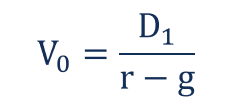
The Gordon Growth Model (GGM) is one of the most commonly used variations of the dividend discount model. The model is called after American economist Myron J. Gordon, who proposed the variation.

The GGM is based on the assumptions that the stream of future dividends will grow at some constant rate in future for an infinite time. Mathematically, the model is expressed in the following way:

Where:

  • V– the current fair value of a stock
  • D– the dividend payment in one period from now
  • r – the estimated cost of equity capital (usually calculated using CAPM)
  • g – the constant growth rate of the company’s dividends for an infinite time
  1. One-period Dividend Discount Model

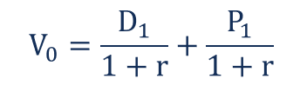
The one-period discount dividend model is used much less frequently than the Gordon Growth model. The former is applied when an investor wants to determine the intrinsic price of a stock that he or she will sell in one period from now. The one-period dividend discount model uses the following equation:

Where:

  • V– the current fair value of a stock
  • D– the dividend payment in one period from now
  • P– the stock price in one period from now
  • r – the estimated cost of equity capital
  1. Multi-period Dividend Discount Model

The multi-period dividend discount model is an extension of the one-period dividend discount model wherein an investor expects to hold a stock for the multiple periods. The main challenge of the multi-period model variation is that forecasting dividend payments for different periods is required. The model’s mathematical formula is below:

Interest rate risk

Interest rate risk is the potential for investment losses that result from a change in interest rates. If interest rates rise, for instance, the value of a bond or other fixed-income investment will decline. The change in a bond’s price given a change in interest rates is known as its duration.

Interest rate risk can be reduced by holding bonds of different durations, and investors may also allay interest rate risk by hedging fixed-income investments with interest rate swaps, options, or other interest rate derivatives.

  • Interest rate risk is the potential that a change in overall interest rates will reduce the value of a bond or other fixed-rate investment:
  • As interest rates rise bond prices fall, and vice versa. This means that the market price of existing bonds drops to offset the more attractive rates of new bond issues.
  • Interest rate risk is measured by a fixed income security’s duration, with longer-term bonds having a greater price sensitivity to rate changes.
  • Interest rate risk can be reduced through diversification of bond maturities or hedged using interest rate derivatives.

Interest rate changes can affect many investments, but it impacts the value of bonds and other fixed-income securities most directly. Bondholders, therefore, carefully monitor interest rates and make decisions based on how interest rates are perceived to change over time.

For fixed-income securities, as interest rates rise security prices fall (and vice versa). This is because when interest rates increase, the opportunity cost of holding those bonds increases that is, the cost of missing out on an even better investment is greater. The rates earned on bonds therefore have less appeal as rates rise, so if a bond paying a fixed rate of 5% is trading at its par value of $1,000 when prevailing interest rates are also at 5%, it becomes far less attractive to earn that same 5% when rates elsewhere start to rise to say 6% or 7%. In order to compensate for this economic disadvantage in the market, the value of these bonds must fall – because who will want to own a 5% interest rate when they can get 7% with some different bond.

Therefore, for bonds that have a fixed rate, when interest rates rise to a point above that fixed level, investors switch to investments that reflect the higher interest rate. Securities that were issued before the interest rate change can compete with new issues only by dropping their prices.

Interest rate risk can be managed through hedging or diversification strategies that reduce a portfolio’s effective duration or negate the effect of rate changes.

Price earning Model

The Price Earnings Ratio (P/E Ratio) is the relationship between a company’s stock price and earnings per share (EPS). It is a popular ratio that gives investors a better sense of the value of the company. The P/E ratio shows the expectations of the market and is the price you must pay per unit of current earnings (or future earnings, as the case may be).

Earnings are important when valuing a company’s stock because investors want to know how profitable a company is and how profitable it will be in the future. Furthermore, if the company doesn’t grow and the current level of earnings remains constant, the P/E can be interpreted as the number of years it will take for the company to pay back the amount paid for each share.

P/E Ratio in Use

Looking at the P/E of a stock tells you very little about it if it’s not compared to the company’s historical P/E or the competitor’s P/E from the same industry. It’s not easy to conclude whether a stock with a P/E of 10x is a bargain, or a P/E of 50x is expensive without performing any comparisons.

The beauty of the P/E ratio is that it standardizes stocks of different prices and earnings levels.

The P/E is also called earnings multiple. There are two types of P/E: trailing and forward. The former is based on previous periods of earnings per share, while a leading or forward P/E ratio is when EPS calculations are based on future estimates, which predicted numbers (often provided by management or equity research analysts).

Price Earnings Ratio Formula

P/E = Stock Price Per Share / Earnings Per Share

or

P/E = Market Capitalization / Total Net Earnings

or

Justified P/E = Dividend Payout Ratio / R – G

where;

R = Required Rate of Return

G = Sustainable Growth Rate

Why Use the Price Earnings Ratio?

Investors want to buy financially sound companies that offer a good return on investment (ROI). Among the many ratios, the P/E is part of the research process for selecting stocks, because we can figure out whether we are paying a fair price. Similar companies within the same industry are grouped together for comparison, regardless of the varying stock prices.  Moreover, it’s quick and easy to use when we’re trying to value a company using earnings. When a high or a low P/E is found, we can quickly assess what kind of stock or company we are dealing with.

High P/E

Companies with a high Price Earnings Ratio are often considered to be growth stocks. This indicates a positive future performance, and investors have higher expectations for future earnings growth and are willing to pay more for them. The downside to this is that growth stocks are often higher in volatility and this puts a lot of pressure on companies to do more to justify their higher valuation. For this reason, investing in growth stocks will more likely be seen as a risky investment. Stocks with high P/E ratios can also be considered overvalued.

Low P/E

Companies with a low Price Earnings Ratio are often considered to be value stocks. It means they are undervalued because their stock price trade lower relative to its fundamentals. This mispricing will be a great bargain and will prompt investors to buy the stock before the market corrects it. And when it does, investors make a profit as a result of a higher stock price. Examples of low P/E stocks can be found in mature industries that pay a steady rate of dividends.

Yield to Maturity

Yield to maturity (YTM) is the total return anticipated on a bond if the bond is held until it matures. Yield to maturity is considered a long-term bond yield but it is expressed as an annual rate. In other words, it is the internal rate of return (IRR) of an investment in a bond if the investor holds the bond until maturity, with all payments made as scheduled and reinvested at the same rate.

Because yield to maturity is the interest rate an investor would earn by reinvesting every coupon payment from the bond at a constant interest rate until the bond’s maturity date, the present value of all the future cash flows equals the bond’s market price. An investor knows the current bond price, its coupon payments and its maturity value, but the discount rate cannot be calculated directly. However, there is a trial-and-error method for finding YTM with the following present value formula:

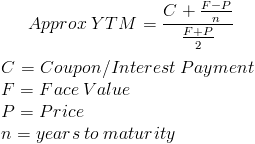
Alternative formula for finding YTM

Each one of the future cash flows of the bond is known and because the bond’s current price is also known, a trial-and-error process can be applied to the YTM variable in the equation until the present value of the stream of payments equals the bond’s price.

Solving the equation by hand requires an understanding of the relationship between a bond’s price and its yield, as well as of the different types of bond pricings. Bonds can be priced at a discount, at par or at a premium. When the bond is priced at par, the bond’s interest rate is equal to its coupon rate. A bond priced above par, called a premium bond, has a coupon rate higher than the realized interest rate and a bond priced below par, called a discount bond, has a coupon rate lower than the realized interest rate. If an investor were calculating YTM on a bond priced below par, he or she would solve the equation by plugging in various annual interest rates that were higher than the coupon rate until finding a bond price close to the price of the bond in question.

Calculations of yield to maturity (YTM) assume that all coupon payments are reinvested at the same rate as the bond’s current yield and take into account the bond’s current market price, par value, coupon interest rate and term to maturity. The YTM is merely a snapshot of the return on a bond because coupon payments cannot always be reinvested at the same interest rate. As interest rates rise, the YTM will increase; as interest rates fall, the YTM will decrease.

Reinsurance, Importance, Reasons, Types, Challenges, Products

Reinsurance is fundamentally “insurance for insurance companies.” It is a risk management tool where an insurer (the cedant) transfers a portion of its risk portfolio to another party (the reinsurer) to reduce the likelihood of paying a large obligation resulting from an insurance claim.

This process enhances the primary insurer’s financial stability by protecting against catastrophic losses, stabilizing underwriting results, and increasing underwriting capacity—allowing them to issue larger policies than their own capital would permit. Reinsurance can be structured in two primary ways: Treaty (automatic cover for a class of business) and Facultative (negotiated for a single, specific risk). It is a global industry essential for spreading risk across borders, ensuring that the insurance market remains solvent and resilient, especially after major disasters.

Importance of Reinsurance:

  • Risk Transfer and Management

Reinsurance plays a crucial role in transferring risk from primary insurers to reinsurers, allowing insurers to manage exposure to large or catastrophic losses. By sharing risks, primary insurers can undertake higher-value policies and expand coverage without threatening their solvency. This risk-sharing mechanism ensures financial stability, protects policyholders, and enhances insurer confidence. Reinsurance also enables better portfolio diversification, reducing the impact of unexpected claims. In India and globally, effective reinsurance arrangements help insurers maintain solvency, manage volatility, and provide comprehensive protection to clients, ensuring a resilient and robust insurance sector.

  • Capital Relief and Solvency Support

Reinsurance provides capital relief, allowing insurers to maintain adequate solvency margins while underwriting more policies. By transferring part of the risk, insurers can reduce the amount of capital required to cover potential losses. This enhances financial flexibility, supports growth, and enables compliance with regulatory capital requirements. In India, reinsurers help insurers optimize capital allocation, manage reserves, and meet IRDAI solvency norms. By reducing financial strain, reinsurance allows companies to focus on expanding business, innovating products, and improving services, ensuring both stability and profitability in a competitive insurance market.

  • Protection Against Catastrophic Losses

Reinsurance is essential for protecting insurers from large-scale or catastrophic losses, such as natural disasters, pandemics, or industrial accidents. By sharing the financial burden with reinsurers, insurance companies can safeguard solvency and ensure uninterrupted claims settlement. Reinsurance allows for excess-of-loss coverage, mitigating the impact of extreme events that could otherwise threaten an insurer’s existence. It enables insurers to underwrite high-risk policies confidently, knowing that major losses will be partially absorbed by the reinsurer. This protection maintains policyholder trust, market stability, and overall resilience of the insurance sector in the face of unpredictable and severe risks.

  • Encouragement of Business Growth

Reinsurance supports business expansion and market development by enabling insurers to underwrite larger or more diverse policies without exceeding retention limits. It provides the financial backing and security needed to explore new markets, launch innovative products, and cater to high-value clients. In India, reinsurance facilitates rural insurance, microinsurance, and specialized commercial coverage, encouraging insurers to reach underserved areas. By reducing risk exposure, insurers can focus on profitability, customer acquisition, and long-term growth. Reinsurance thus acts as a catalyst for business development, promoting a healthy, competitive, and dynamic insurance industry.

  • Expertise and Technical Support

Reinsurers bring technical expertise, actuarial analysis, and industry knowledge to primary insurers. They assist in risk assessment, pricing, portfolio management, and claim handling, enhancing the efficiency and accuracy of insurance operations. This support is particularly valuable for emerging or complex risks, such as cyber threats, climate-related hazards, and large commercial projects. Reinsurers provide guidance on product design, risk mitigation, and regulatory compliance, strengthening the insurer’s decision-making capabilities. By leveraging reinsurers’ experience, primary insurers can improve underwriting quality, minimize losses, and deliver better services, making expertise transfer a key component of reinsurance importance.

Reasons of Reinsurance:

  • Risk Transfer and Catastrophe Protection

The fundamental reason for reinsurance is to transfer risk and protect the primary insurer from financial ruin due to a catastrophic event or an accumulation of large losses from a single event (e.g., a hurricane, earthquake, or major industrial fire). No single insurer has the capital to comfortably absorb such immense losses alone. Reinsurance allows the cedant to share these extreme risks with a global network of reinsurers, ensuring that a single disaster does not threaten its solvency or ability to pay all its policyholders’ claims, thereby maintaining market stability.

  • Capital Management and Solvency

Reinsurance is a crucial tool for capital management. By ceding risk, an insurer reduces the amount of capital it is required to hold in reserve as mandated by regulators (like IRDAI) to ensure solvency. This process, known as capital relief, frees up significant funds that can be redeployed for other profitable purposes, such as writing new business, investing, or expanding operations. It directly improves the company’s key financial ratios and ensures compliance with stringent regulatory capital requirements, making its balance sheet stronger and more efficient.

  • Underwriting Capacity Expansion

Reinsurance enables an insurance company to expand its underwriting capacity. This means it can accept risks—especially large, single risks that exceed its normal retention limit—that would otherwise be too sizeable or hazardous to insure on its own. For example, a mid-sized insurer can underwrite a large industrial project or a jumbo jet by ceding a substantial portion of the risk to reinsurers. This allows the insurer to compete for larger clients, diversify its book of business, and increase premium income without exposing itself to an unacceptable level of risk.

  • Stabilizing Underwriting Results

Insurance results can be volatile, with profitable years followed by years of heavy losses. Reinsurance helps smooth out this volatility and stabilize underwriting results over time. By protecting against severe losses, reinsurance reduces the likelihood of extreme financial fluctuations. This creates more predictable earnings, which is highly valued by investors, rating agencies, and management. This stability also provides the insurer with the confidence to underwrite cyclical or more volatile lines of business, knowing that its financial performance will be shielded from the worst-case scenarios.

Types of Reinsurance:

  • Facultative Reinsurance

Facultative reinsurance is arranged for individual risks or specific policies. The ceding company (primary insurer) negotiates terms with the reinsurer for each risk separately. It provides flexibility, allowing the insurer to transfer high-value or unusual risks that exceed its retention capacity. Both parties evaluate the risk individually, and the reinsurer can accept or reject coverage. Facultative reinsurance is typically used for large commercial, industrial, or specialized risks, where standard treaty arrangements may not be sufficient. This type of reinsurance ensures adequate coverage for exceptional cases, enhances the insurer’s capacity, and reduces the potential financial impact of catastrophic losses.

  • Treaty Reinsurance

Treaty reinsurance is a pre-agreed arrangement where the reinsurer automatically covers a portfolio or class of risks of the ceding company. Unlike facultative reinsurance, individual policies are not negotiated separately. Treaties can be proportional (sharing premiums and losses) or non-proportional (coverage after a loss threshold). This type of reinsurance provides stability, predictability, and continuous risk transfer for the insurer, allowing them to underwrite large volumes of policies without exceeding retention limits. Treaty reinsurance simplifies administration, reduces underwriting burden, and protects insurers from accumulated or catastrophic losses. It is widely used for standard risks like motor, property, and health insurance portfolios.

  • Proportional Reinsurance

Proportional reinsurance involves sharing both premiums and losses between the ceding company and the reinsurer in a pre-determined ratio. It can take the form of quota share (fixed percentage of each policy) or surplus share (only amounts above the insurer’s retention). This type of reinsurance ensures that both parties share risk fairly and proportionally, reducing the insurer’s exposure while allowing the reinsurer to earn a corresponding share of the premium. Proportional reinsurance is widely used to expand underwriting capacity, stabilize financial results, and maintain solvency margins. It encourages careful underwriting and ensures that large claims are shared responsibly between insurers and reinsurers.

  • Non-Proportional Reinsurance

Non-proportional reinsurance provides coverage only when losses exceed a specified threshold, known as the retention limit. Common forms include excess of loss reinsurance, stop-loss reinsurance, and catastrophe covers. The reinsurer pays for the portion of the loss above the retention, protecting the ceding company from large, unexpected claims. Non-proportional reinsurance is ideal for catastrophic risks, high-value properties, or portfolios with volatile claims patterns. It reduces the financial impact of major losses, stabilizes profits, and allows insurers to underwrite policies with higher exposure. Unlike proportional reinsurance, the premium is calculated based on risk exposure, potential severity, and historical loss data, not merely a fixed percentage.

Challenges of Reinsurance:

  • Risk Assessment and Pricing

One major challenge in reinsurance is accurately assessing risks and determining premiums. Reinsurers must evaluate complex, large-scale, or catastrophic risks, often with limited historical data. Incorrect risk assessment can lead to underpricing, resulting in financial losses, or overpricing, making the product unattractive to primary insurers. Emerging risks like cyber threats, climate change, and pandemics further complicate pricing. Reinsurers rely on advanced modeling, actuarial analysis, and industry expertise, but uncertainties remain. Maintaining a balance between competitive premiums and adequate risk coverage is a continuous challenge in the dynamic insurance environment.

  • Regulatory and Compliance issues

Reinsurance companies face strict regulatory requirements in multiple jurisdictions. Differences in capital adequacy norms, reporting standards, and solvency regulations create compliance complexities. Cross-border reinsurance adds challenges related to taxation, foreign exchange, and legal frameworks. Non-compliance can lead to penalties, license revocation, or reputational damage. In India, reinsurers must adhere to IRDAI guidelines, including solvency margins and reporting obligations. Managing compliance while remaining competitive in pricing and risk acceptance is challenging. Constantly evolving regulations require reinsurers to update policies, maintain accurate records, and implement robust internal controls, adding operational and administrative burdens.

  • Catastrophic and Accumulation Risk

Reinsurers face challenges in managing catastrophic events, such as earthquakes, floods, or pandemics, which can result in massive simultaneous claims. Accumulation risk occurs when multiple policies or portfolios are exposed to the same event, increasing potential losses. Estimating the frequency and severity of such events is difficult, requiring sophisticated risk modeling and historical data analysis. Failure to manage these risks can threaten financial solvency and stability. Reinsurers often use diversification, catastrophe bonds, and excess-of-loss covers to mitigate exposure, but extreme or unprecedented events remain a significant challenge in the reinsurance industry.

  • Counterparty and Credit Risk

Reinsurance involves interdependence between primary insurers and reinsurers, making counterparty risk critical. If a reinsurer fails to honor claims due to financial instability or insolvency, the ceding company bears the loss, disrupting operations and finances. Similarly, primary insurers must meet obligations for accurate reporting, timely premiums, and transparency. Credit risk arises when reinsurers are exposed to delayed payments, disputes, or defaults. Managing these risks requires careful selection of partners, credit monitoring, and contractual safeguards. Strong financial evaluation and regulatory compliance are essential to minimize exposure to counterparty risk and ensure smooth claim settlement.

  • Technological and Data Challenges

Modern reinsurance relies heavily on data analytics, risk modeling, and digital platforms. Challenges arise from inaccurate, incomplete, or inconsistent data, which can affect risk evaluation, pricing, and claim settlement. Emerging risks like cyberattacks and digital fraud require sophisticated technological infrastructure for monitoring and mitigation. Implementing advanced analytics, AI, and predictive models involves high costs, skilled personnel, and system integration, which can be challenging for smaller reinsurers. Maintaining data security, privacy compliance, and real-time reporting is essential. Technology gaps or errors can lead to financial loss, operational inefficiency, and reputational damage, making technological management a critical challenge.

Reinsurance Products in India:

  • Treaty Reinsurance

Treaty reinsurance is a pre-arranged agreement between a primary insurer and a reinsurer covering a portfolio or class of policies. It provides automatic coverage for all risks falling under the treaty, eliminating the need to negotiate each policy individually. Treaty reinsurance can be proportional (sharing premiums and losses) or non-proportional (coverage beyond a retention limit). In India, treaty reinsurance ensures risk diversification, financial stability, and solvency compliance. It allows insurers to underwrite large volumes of policies confidently, manage catastrophic exposure, and maintain consistent protection across standard and recurring risks, supporting overall business growth.

  • Facultative Reinsurance

Facultative reinsurance covers specific individual risks or policies rather than an entire portfolio. Each risk is evaluated separately, and the reinsurer can accept or reject coverage. This type of reinsurance is suitable for high-value, unusual, or complex risks, like industrial projects, large commercial properties, or specialized assets. Facultative reinsurance provides flexibility and customized solutions for individual exposures. In India, it helps insurers expand underwriting capacity and manage risk selectively. By sharing responsibility for exceptional or high-risk policies, facultative reinsurance reduces financial strain, enhances solvency, and ensures protection against catastrophic or unpredictable losses.

  • Proportional Reinsurance

Proportional reinsurance involves sharing both premiums and claims between the ceding insurer and the reinsurer in a predetermined ratio. Common forms include quota share, where a fixed percentage of every policy is transferred, and surplus share, covering amounts above the insurer’s retention. This product ensures equitable risk distribution, stabilizes financial results, and increases underwriting capacity. In India, proportional reinsurance is widely used in motor, health, and property insurance portfolios. It allows insurers to underwrite more policies confidently, maintain solvency, and balance claims exposure. Proportional reinsurance strengthens insurer-reinsurer collaboration and supports sustainable growth in the insurance sector.

  • Non-Proportional Reinsurance

Non-proportional reinsurance provides coverage only when losses exceed a specified threshold. It includes excess-of-loss, stop-loss, and catastrophe covers. The reinsurer pays for claims above the insurer’s retention limit, protecting against large, unpredictable, or catastrophic losses. This product is crucial for disaster-prone regions, high-value assets, and volatile risk portfolios. In India, non-proportional reinsurance helps insurers manage solvency, reduce risk concentration, and stabilize profits. By mitigating financial impact from extreme events, it ensures policyholder protection and insurer confidence, enabling sustainable operations and fostering growth in challenging insurance markets.

  • Catastrophe Reinsurance

Catastrophe reinsurance covers extreme events such as earthquakes, floods, cyclones, or pandemics that could result in massive simultaneous claims. It is often structured as excess-of-loss or parametric reinsurance, triggered when losses exceed a defined threshold. In India, catastrophe reinsurance protects insurers from natural disasters and regional calamities, ensuring financial stability and uninterrupted claim settlement. It helps insurers expand coverage in high-risk areas and maintain solvency during catastrophic events. By pooling and transferring extreme risks to reinsurers, catastrophe reinsurance enhances resilience, reduces volatility, and supports sustainable insurance operations in a disaster-prone economy.

  • Retrocession

Retrocession is a form of reinsurance where a reinsurer transfers part of its risk to another reinsurer. This helps distribute large or concentrated exposures, manage solvency, and reduce financial strain. Retrocession ensures that no single reinsurer bears excessive loss, maintaining stability in the insurance chain. In India, retrocession is used for high-value, catastrophic, or complex portfolios, particularly in life, health, and general insurance. It promotes risk diversification, operational continuity, and capital efficiency. By spreading risks across multiple reinsurers, retrocession strengthens the resilience of both primary insurers and reinsurers, ensuring reliable protection for policyholders.

error: Content is protected !!