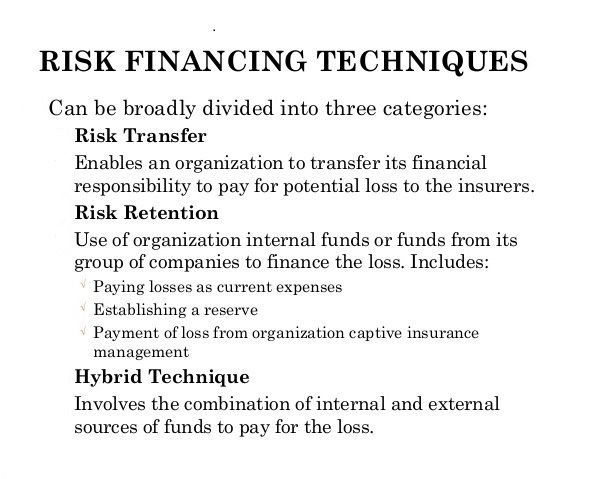
Risk Retention

Risk retention is a company’s decision to take responsibility for a particular risk it faces, as opposed to transferring the risk over to an insurance company. Companies often retain risks when they believe that the cost of doing so is less then the cost of fully or partially insuring against it.

If a company retains a certain risk, it will have to pay for losses from that risk out of its own reserve funds. For this reason, it is important for companies to make sure that they can properly afford to pay for potential losses before they make the decision to retain particular risks. Companies may retain risks if the premiums for insuring against it are particularly high.

A risk retention group (RRG) is an alternative risk transfer entity created by the federal Liability Risk Retention Act (LRRA). RRGs must form as liability insurance companies under the laws of at least one state its charter state or domicile. The policyholders of the RRG are also its owners and membership must be limited to organizations or persons engaged in similar businesses or activities, thus being exposed to the same types of liability. Most RRGs are regulated as captive insurance companies. However, RRGs domiciled in states without captive law are regulated as traditional insurance companies.

A risk retention group is a corporation or limited liability association formed under the laws of any state for the primary purpose of assuming liability exposures on behalf of its members. Members of the group must be engaged in similar activities or related with respect to liability exposures by virtue of any related or common business exposure, trade, product, service, or premise. Members must have an ownership interest in the group and only members may benefit from the group. Risk retention groups only apply to liability loss exposures.

RRGs provide their members with the following benefits:

  • Program control
  • Long-term rate stability
  • Customized Loss control and risk management practices
  • Dividends for good loss experience
  • Access to reinsurance markets
  • Stable source of liability coverage at affordable rates
  • Multi-state operations

Advantage of Risk Retention

  • Avoidance of multiple state filing and licensing requirements
  • Member control over risk and litigation management issues
  • Establishment of stable market for coverage and rates
  • Elimination of market residuals
  • Exemption from countersignature laws for agents and brokers
  • No expense for fronting fees
  • Unbundling of services

Disadvantage Risk Retention

  • Risks are limited to liability insurance
  • Not permitted to write risks outside its homogenous group
  • No guaranty fund coverage for members
  • May not be able to comply with proof of financial responsibility laws
  • Can be without a financial rating from a rating agency

Transfer of Risks

A transfer of risk is a business agreement in which one party pays another to take responsibility for mitigating specific losses that may or may not occur. This is the underlying tenet of the insurance industry.

Risks may be transferred between individuals, from individuals to insurance companies, or from insurers to reinsurers. When homeowners purchase property insurance, they are paying an insurance company to assume various specific risks associated with homeownership.

When purchasing insurance, the insurer agrees to indemnify, or compensate, the policyholder up to a certain amount for a specified loss or losses in exchange for payment.

Insurance companies collect premiums from thousands or millions of customers every year. That provides a pool of cash that is available to cover the costs of damage or destruction to the properties of some small percentage of its customers. The premiums also cover administrative and operating expenses, and provide the company’s profits.

Life insurance works the same way. Insurers rely on actuarial statistics and other information to project the number of death claims it can expect to pay out per year. Because this number is relatively small, the company sets its premiums at a level that will exceed those death benefits.

Working

Risk transfer is a common risk management technique where the potential of an adverse outcome faced by an individual or entity is shifted to a third party. To compensate the third party for bearing the risk, the individual or entity will generally provide the third party with periodic payments.

The most common example of risk transfer is insurance. When an individual or entity purchases insurance, they are insuring against financial risks. For example, an individual who purchases car insurance is acquiring financial protection against physical damage or bodily harm that can result from traffic incidents.

As such, the individual is shifting the risk of having to incur significant financial losses in a traffic incident to an insurance company. In exchange for bearing such risks, the insurance company will typically require periodic payments from the individual.

Reinsurance companies accept transfers of risk from insurance companies.

The insurance industry exists because few individuals or companies have the financial resources necessary to bear the risks of the loss on their own. So, they transfer the risks.

Risk Transfer to Reinsurance Companies

Some risks are too big for insurance companies to bear alone. That’s where reinsurance comes in.

When insurance companies don’t want to assume too much risk, they transfer the excess risk to reinsurance companies. For example, an insurance company may routinely write policies that limit its maximum liability to $10 million. But it may take on policies that require higher maximum amounts and then transfer the remainder of the risk in excess of $10 million to a reinsurer. This subcontract comes into play only if a major loss occurs.

Property Insurance Risk Transfer

Purchasing a home is the most significant expense most individuals make. To protect their investment, most homeowners buy homeowners insurance. With homeowners insurance, some of the risks associated with homeownership are transferred from the homeowner to the insurer.

Insurance companies typically assess their own business risks in order to determine whether a customer is acceptable, and at what premium. Underwriting insurance for a customer with a poor credit profile and several dogs is riskier than insuring someone with a perfect credit profile and no pets. The policy for the first applicant will command a higher premium because of the higher risk being transferred from the applicant to the insurer.

  • A transfer of risk shifts responsibility for losses from one party to another in return for payment.
  • The basic business model of the insurance industry is the acceptance and management of risk.
  • This system works because some risks are beyond the resources of most individuals and businesses.

Methods of Risk Transfer

There are two common methods of transferring risk:

  1. Insurance policy

As outlined above, purchasing insurance is a common method of transferring risk. When an individual or entity is purchasing insurance, they are shifting financial risks to the insurance company. Insurance companies typically charge a fee an insurance premium for accepting such risks.

  1. Indemnification clause in contracts

Contracts can also be used to help an individual or entity transfer risk. Contracts can include an indemnification clause  a clause that ensures potential losses will be compensated by the opposing party. In simplest terms, an indemnification clause is a clause in which the parties involved in the contract commit to compensating each other for any harm, liability, or loss arising out of the contract.

For example, consider a client that signs a contract with an indemnification clause. The indemnification clause states that the contract writer will indemnify the client against copyright claims. As such, if the client receives a copyright claim, the contract writer would

  • Be obliged to cover the costs related to defending against the copyright claim.
  • Be responsible for copyright claim damages if the client is found liable for copyright infringement.

Risk Financing

Risk financing is the determination of how an organization will pay for loss events in the most effective and least costly way possible. Risk financing involves the identification of risks, determining how to finance the risk, and monitoring the effectiveness of the financing technique that is chosen.

Risk financing is designed to help a business align its desire to take on new risks to grow, with its ability to pay for those risks. Businesses must weigh the potential costs of their actions and whether the action will help the business reach its objectives. The business will examine its priorities to determine whether it is taking on the appropriate amount of risk to achieve its objectives. It’ll also examine whether it is taking the right types of risks and whether the costs of these risks are being accounted for financially.

Companies have a variety of options when it comes to protecting themselves from risk. Commercial insurance policies, captive insurance, self-insurance, and other alternative risk transfer schemes are available, though the effectiveness of each depends on the size of the organization, the organization’s financial situation, the risks that the organization faces and the organization’s overall objectives. Risk financing seeks to choose the option that is the least costly, but it also must ensure the organization has the financial resources available to continue its objectives after a loss event occurs.

The process for determining risk financing typically involves a company forecasting the losses that they expect to experience over a period of time and then determining the net present value of the costs associated with the different risk financing alternatives available to them. Each option is likely to have different costs, depending on the risks that need coverage, the loss development index that is most applicable to the company, the cost of maintaining a staff to monitor the program and any consulting, legal, or external experts that are needed.

Risk Financing as an Indicator of Financial Health

How a company manages situations that call for risk financing is a good indicator of that organization’s competitiveness and potential for long term success. That’s because risk financing depends on the aptitude of business leaders to identify and monitor key metrics that provide insight into its financial health. One of the most widely accepted of those key metrics is Cost of Risk (COR), a quantitative measure of the total direct and indirect expenditures dedicated to mitigating the risk exposures. While typically interpreted to capture only those costs arising out of insurance activities (i.e. retained losses, risk control costs, insurance premiums, and dept administration expenses), true COR captures expenditures (risk spend) from external risk transfer, retained/self-insured losses, external consultancy fees, internal program administration, collateral costs and missed opportunity costs.

Loss Prevention and its Importance

While controlling and preventing losses is not always easy, it is the best course of action. Our advice on preventing and controlling risk is designed to assist clients to protect the property under their care, as well as the safety and health of persons who use their premises.

No matter how careful we are, losses cannot be totally eliminated. Understanding hazards and taking proper safety measures will help keep losses to a minimum, as will a detailed Risk Management Program.

Insurance is a form of risk management where you undertake to transfer part of the financial risk to another party in the event of an accident or loss. You must not rely on insurance entirely, as there are costs that cannot be claimed against an insurance policy, such as excess on a claim or the cost of labour in finding a repairer. Avoiding a claim by reducing its potential should be your first course of action.

Loss Prevention

Loss Prevention and Control is primarily concerned with preloss consideration, not post loss ‘patching up’. Loss Prevention and Control is as the name states, identification and evaluation of risks before they become losses.

It is necessary to carry out the ongoing role of risk identification and evaluation to protect and prevent personal injury and suffering before the damage or injury occurs. Investigation should be undertaken into your State’s Work Health & Safety Act requirements to ensure the environment for which they are responsible is not in breach of this Act.

A holistic risk valuation approach requires objective and accurate estimations of the maximum possible loss (MPL) and the normal loss expectancy (NLE), which both rely on quantitative analysis. However, novel approaches to risk also emphasize the importance of risk prevention to benefit insurance companies’ valuations. To support this methodology, a structured framework, based on both quantitative analysis and loss prevention, can provide a flawless tool for risk evaluation. This structured framework supports the insurance company, not only in the underwriting process of new clients by evaluating their risk profiles, but also in the optimization of their existing portfolios by prioritizing the areas of investment in the current business.

Insurance companies sometimes cannot afford or do not want to invest in the development of both structured loss prevention services and an objective tools. A quantitative framework approach would allow these companies to rely on effective risk evaluation processes. In addition to this, the tool targets insurance companies that lack effective and accurate valuation models and want to invest in upgrading their existing tools to exploit their maximum potential value.

In complex and embedded situations, in which market resilience, lack of information and an increasing number of specialty industries are the main threats, a quantitative framework is key to gaining the necessary knowledge to face risk evaluation. In fact, the framework gives insurance companies and first-hand users a homogeneous, 360-degree understanding of the situation, which is concise and objective at the same time, to make data-driven decisions. The benefits of the tool are many: access to a wide range of information, in order to develop cost-benefit-based decision-making, knowledge acquisition, intergenerational transmission and maintenance.

A loss prevention framework allows insurance companies to measure and mitigate risks.

Risk profiling has traditionally been carried out by insurance companies’ experts, who counted on their personal experience to define strengths and criticalities of each site through desk analysis and site visits. However, this method is highly subjective and, therefore, it is not appropriate to compare different sites, especially if different experts carried out the analyses.

To overcome this problem, cooperation between insurance companies and their clients can prevent avoidable economic losses and reduce clients’ risk exposure, which, in turn, benefits all shareholders insurance companies, their clients and society. In fact, a better understanding of a client’s risk exposure can help all involved parties:

  • Insurance companies make data-informed decisions and define more adequate policies; they limit their own risk exposure and can, in turn, offer more competitive products than other companies that cannot assess risks as accurately.
  • Clients are incentivized to improve internal risk management, in which improvements and good practices are acknowledged and reflected in the insurance premiums.
  • Society and stakeholders as a whole are less exposed to risks; over time, businesses become more economically, socially and environmentally sustainable.

Risk Control

When it comes to risk control the first step is definitely the assessment of assets of the company.  The company/firm then chalks out the best methods to control the losses. They do accept the task but the aim is to minimize it as much as possible.

Since it’s very difficult to avoid it, loss prevention is the best solution. In case of a threat the loss prevention strategies help to accommodate the risk effectively and minimize the damage as much as possible. One of the strategies for risk control is Insurance, a third party is appointed to balance the losses under a contract.

They separate the assets strategically so that the risk is spread evenly and a threat can only affect one business location at a time because if all the assets are merged in the same place it can increase the percentage of the risk.

That’s not all risk control also involves duplication which is a backup plan, created through technology.  A company cannot afford a system failure hindering its operations, therefore a backup server is always kept ready.

Apart from that the resources are managed efficiently and put in diverse lines of business, offering a variety of products and services, so a loss in one line cannot harm the entire firm and its bottom line.

Examples of Risk Control Actions

Regular inspections are done to reduce infrastructure risks. Equipment failure can be a huge risk to a firm, maintenance of equipment used in production is an example of risk control. The clients are provided due diligence for credit risks by carefully validating credit applications.

Another example of risk control is a validation of the system wherein human error is reduced in financial trading. Although, machines are also designed to shut down automatically when there are errors in order to reduce safety risks.

Policies are also implemented which involve wearing safety gear to reduce safety risks at work sites. There is always scope for change which is controlled by reviewing and approving changes to a project.

Overall the risk of any failure is managed by escalating issues and making the decisions required to clear them.

How does risk control help a firm?

Risk control is an important discipline for business in recent times. It helps in encouraging regulation and provides relief at the time of crisis. It helps predict all the risks that are most likely to happen to a firm and encourages preplanning to keep them in control and be aware of forthcoming issues; it basically helps to be one step ahead.

Identifying the impact of business and projects, focusing on ideas discussed and then dealing with points that are finalized with more relative solutions, is necessary.  Risk control takes all views into account and helps to tackles issues easily.

Risks are treated by implementing already discussed plans and there is an internal agreement to put forth those actions so it helps to prevent conflict of interests. With all the planning and foreseeing that happens the risks that are to be handled are to the minimum which assists in speeding up data to change policies within the mapped business functions.

There is always increased awareness of the scheduled terms of risks and successful analysis and exercise of control over them.  One can learn through the process and treat the risks better and improve performance gradually. It helps to save cost and time for the firm which results in better productivity.

New opportunities arise with unraveling issues and benefit in preparation for future endeavors along with the vast knowledge that is gained through experience coming from a greater insight of real balance sheets that supports the culture of risk management.

The firm even earns competitive advantages and there continued stable earnings.

What damages are caused by the process of risk control?

Risk control does take over the time needed for compensating on projects. It involves complex calculations in terms of management of risks. And the entire process is really difficult to predict.  In case of improper control of risks, the pay of the firm is diverted to the payment of losses and recovery from the incurred losses. A lot of risk control depends on external entities and external data, so the information is not always under internal control.

Risk control takes a lot of time to implement, it’s a long process to gather information then devise strategies and mitigating the risks. It is quite futuristic and may or may not always turn as planned, it’s subjective. The potential threats need to managed effectively so that they disappear, which can reduce the level of risk and even increase the control over it.

Though all processes have their limitations and benefits, risk control becomes the major case when the firm has targeted results apart from potential threats, damages, and vulnerabilities.

What is the Importance of Risk Control?

Risk control measures are very crucial for the prevention of accident or injury to an organization.  They provide a sort of safety net by identifying, controlling and reducing the risks present in an organization.

They provide a number of benefits to a firm, like identifying at-risk employees, and knowing what factors they are exposed to. Awareness of factors that cannot be eliminated and some factors that can be eliminated completely helps to know what to watch out for and gain knowledge of mitigation methods.

These processes are very important for the reassessment of risks time and again and check the efficiency of the methods applied to control them and decide whether they should be re-evaluated. It really does reduce the accidents and injuries caused by an organization.

These planning measures also help take care of legal obligations which require identification of risks and apply safety measures accordingly. There are a number of measures that work together in order to prevent a company from losses, elimination of risks is most preferred but it cannot work in all cases, thus there is risk substitutions and risk isolation which are implemented.

These work as a tool to keep the company in maximum profitable situations and always be covered up against the losses. Thus, risk control is an important procedure to keep the firm running healthily, attain the goals and profits that it aims for and make sure that losses incurred at kept at bay and do not cause a lot of collateral damage to the assets of an organization.

Risk Analysis

Risk analysis is the process of assessing the likelihood of an adverse event occurring within the corporate, government, or environmental sector. Risk analysis is the study of the underlying uncertainty of a given course of action and refers to the uncertainty of forecasted cash flow streams, the variance of portfolio or stock returns, the probability of a project’s success or failure, and possible future economic states. Risk analysts often work in tandem with forecasting professionals to minimize future negative unforeseen effects.

A risk analyst starts by identifying what could go wrong. The negative events that could occur are then weighed against a probability metric to measure the likelihood of the event occurring. Finally, risk analysis attempts to estimate the extent of the impact that will be made if the event happens.

Quantitative Risk Analysis

Risk analysis can be quantitative or qualitative. Under quantitative risk analysis, a risk model is built using simulation or deterministic statistics to assign numerical values to risk. Inputs that are mostly assumptions and random variables are fed into a risk model.

For any given range of input, the model generates a range of output or outcome. The model is analyzed using graphs, scenario analysis, and/or sensitivity analysis by risk managers to make decisions to mitigate and deal with the risks.

A Monte Carlo simulation can be used to generate a range of possible outcomes of a decision made or action taken. The simulation is a quantitative technique that calculates results for the random input variables repeatedly, using a different set of input values each time. The resulting outcome from each input is recorded, and the final result of the model is a probability distribution of all possible outcomes. The outcomes can be summarized on a distribution graph showing some measures of central tendency such as the mean and median, and assessing the variability of the data through standard deviation and variance.

The outcomes can also be assessed using risk management tools such as scenario analysis and sensitivity tables. A scenario analysis shows the best, middle, and worst outcome of any event. Separating the different outcomes from best to worst provides a reasonable spread of insight for a risk manager.

For example, an American Company that operates on a global scale might want to know how its bottom line would fare if the exchange rate of select countries strengthens. A sensitivity table shows how outcomes vary when one or more random variables or assumptions are changed. A portfolio manager might use a sensitivity table to assess how changes to the different values of each security in a portfolio will impact the variance of the portfolio. Other types of risk management tools include decision trees and break-even analysis.

Qualitative Risk Analysis

Qualitative risk analysis is an analytical method that does not identify and evaluate risks with numerical and quantitative ratings. Qualitative analysis involves a written definition of the uncertainties, an evaluation of the extent of the impact (if the risk ensues), and countermeasure plans in the case of a negative event occurring.

Examples of qualitative risk tools include SWOT Analysis, Cause and Effect diagrams, Decision Matrix, Game Theory, etc. A firm that wants to measure the impact of a security breach on its servers may use a qualitative risk technique to help prepare it for any lost income that may occur from a data breach.

 While most investors are concerned about downside risk, mathematically, the risk is the variance both to the downside and the upside.

Almost all sorts of large businesses require a minimum sort of risk analysis. For example, commercial banks need to properly hedge foreign exchange exposure of overseas loans while large department stores must factor in the possibility of reduced revenues due to a global recession. It is important to know that risk analysis allows professionals to identify and mitigate risks, but not avoid them completely.

Example of Risk Analysis: Value at Risk (VaR)

Value at risk (VaR) is a statistic that measures and quantifies the level of financial risk within a firm, portfolio, or position over a specific time frame. This metric is most commonly used by investment and commercial banks to determine the extent and occurrence ratio of potential losses in their institutional portfolios. Risk managers use VaR to measure and control the level of risk exposure. One can apply VaR calculations to specific positions or whole portfolios or to measure firm-wide risk exposure.

VaR is calculated by shifting historical returns from worst to best with the assumption that returns will be repeated, especially where it concerns risk. As a historical example, let’s look at the Nasdaq 100 ETF, which trades under the symbol QQQ (sometimes called the “cubes”) and which started trading in March of 1999. If we calculate each daily return, we produce a rich data set of more than 1,400 points. The worst are generally visualized on the left, while the best returns are placed on the right.

For more than 250 days, the daily return for the ETF was calculated between 0% and 1%. In January 2000, the ETF returned 12.4%. But there are points at which the ETF resulted in losses as well. At its worst, the ETF ran daily losses of 4% to 8%. This period is referred to as the ETF’s worst 5%. Based on these historic returns, we can assume with 95% certainty that the ETF’s largest losses won’t go beyond 4%. So if we invest $100, we can say with 95% certainty that our losses won’t go beyond $4.

One important thing to keep in mind. VaR doesn’t provide analysts with absolute certainty. Instead, it’s an estimate based on probabilities. The probability gets higher if you consider the higher returns, and only consider the worst 1% of the returns. The Nasdaq 100 ETF’s losses of 7% to 8% represent the worst 1% of its performance. We can thus assume with 99% certainty that our worst return won’t lose us $7 on our investment. We can also say with 99% certainty that a $100 investment will only lose us a maximum of $7.

Limitations of Risk Analysis

Risk is a probabilistic measure and so can never tell you for sure what your precise risk exposure is at a given time, only what the distribution of possible losses are likely to be if and when they occur. There are also no standard methods for calculating and analyzing risk, and even VaR can have several different ways of approaching the task. Risk is often assumed to occur using normal distribution probabilities, which in reality rarely occur and cannot account for extreme or “black swan” events.

The financial crisis of 2008 that exposed these problems as relatively benign VaR calculations understated the potential occurrence of risk events posed by portfolios of subprime mortgages. Risk magnitude was also underestimated, which resulted in extreme leverage ratios within subprime portfolios. As a result, the underestimations of occurrence and risk magnitude left institutions unable to cover billions of dollars in losses as subprime mortgage values collapsed.

Identification and Evaluation of Risk

Risk identification is the process of identifying and assessing threats to an organization, its operations and its workforce. For example, risk identification may include assessing IT security threats such as malware and ransomware, accidents, natural disasters and other potentially harmful events that could disrupt business operations. Companies that develop robust risk management plans are likely to find they’re able to minimize the impact of threats, when and if they should occur.

Risk Identification Process Steps

There are five core steps within the risk identification and management process. These steps include risk identification, risk analysis, risk evaluation, risk treatment and risk monitoring.

  1. Risk Identification

The purpose of risk identification is to reveal the what, where, when, why and how something could affect a company’s ability to operate. For example, a business located in central California might include “possibility of wildfire” as an event that could disrupt business operations.

  1. Risk Analysis

This step involves establishing the probability that a risk event might occur and the potential outcome of each event. Using the California wildfire example, safety managers might assess how much rainfall has occurred in the past 12 months and the extent of damage the company could face should a fire occur.

  1. Risk Evaluation

Risk evaluation compares the magnitude of each risk and ranks them according to prominence and consequence. For example, the effects of a possible wildfire may be weighed against the effects of a possible mudslide. Whichever event is determined to have a higher probability of happening and causing damage, would rank higher.

  1. Risk Treatment

Risk treatment is also referred to as Risk Response Planning. In this step, risk mitigation strategies, preventative care and contingency plans are created based on the assessed value of each risk. Using the wildfire example, risk managers may choose to house additional network servers offsite, so business operations could still resume if an onsite server is damaged. The risk manager may also develop evacuation plans for employees.

  1. Risk Monitoring

Risk management is a non-stop process that adapts and changes over time. Repeating and continually monitoring the processes can help assure maximum coverage of known and unknown risks.

Evaluation of Risk

Risk evaluation is defined by the Business Dictionary as: “Determination of risk management priorities through establishment of qualitative and/or quantitative relationships between benefits and associated risks.”

So how does that relate to managed service providers or IT administrators?

Anyone responsible for a company’s data, server, network or software must perform a risk evaluation. A risk evaluation can help determine if those assets are at risk for a cyber attack, virus, data loss through natural disaster or any other threat.

The benefit of a risk evaluation is simple it provides IT professionals with knowledge of where and how their business and reputation are at risk.

Performing a Risk Evaluation

A risk evaluation can be performed in five simple steps.

  1. Identify and prioritize assets

Consider all the different types of data, software applications, servers and other assets that are managed. Determine which of these is the most sensitive or would be the most damaging to the company if compromised.

  1. Locate assets

Find and list the source of those assets. Be it desktop office computers, mobile devices, internal servers or anything else, you’ll want to trace each asset back to its source.

  1. Classify assets

Categorize each asset as either public information, sensitive internal information, non-sensitive internal information, compartmentalized internal information and regulated information.

  1. Perform a threat modeling exercise

Identify and rate all the threats faced by your top-rated assets. Microsoft’s STRIDE method is a popular one.

  1. Finalize data and make a plan

Once you have your evaluation, it’s time to start tackling those risks, beginning with the most critical.

Process of Risk Management

The risk management process is a framework for the actions that need to be taken. There are five basic steps that are taken to manage risk; these steps are referred to as the risk management process. It begins with identifying risks, goes on to analyze risks, then the risk is prioritized, a solution is implemented, and finally, the risk is monitored. In manual systems, each step involves a lot of documentation and administration.

Now let’s look at how these steps are carried out in a more digital environment.

Step 1: Identify the Risk

The first step is to identify the risks that the business is exposed to in its operating environment. There are many different types of risks – legal risks, environmental risks, market risks, regulatory risks, and much more. It is important to identify as many of these risk factors as possible. In a manual environment, these risks are noted down manually.

If the organization has a risk management solution employed all this information is inserted directly into the system. The advantage of this approach is that these risks are now visible to every stakeholder in the organization with access to the system. Instead of this vital information being locked away in a report which has to be requested via email, anyone who wants to see which risks have been identified can access the information in the risk management system.

Step 2: Analyze the risk

Once a risk has been identified it needs to be analyzed. The scope of the risk must be determined. It is also important to understand the link between the risk and different factors within the organization. To determine the severity and seriousness of the risk it is necessary to see how many business functions the risk affects. There are risks that can bring the whole business to a standstill if actualized, while there are risks that will only be minor inconveniences in analyzed. In a manual risk management environment, this analysis must be done manually.

When a risk management solution is implemented one of the most important basic steps is to map risks to different documents, policies, procedures, and business processes. This means that the system will already have a mapped risk framework that will evaluate risks and let you know the far-reaching effects of each risk.

Step 3: Evaluate or Rank the Risk

Risks need to be ranked and prioritized. Most risk management solutions have different categories of risks, depending on the severity of the risk. A risk that may cause some inconvenience is rated lowly, risks that can result in catastrophic loss are rated the highest. It is important to rank risks because it allows the organization to gain a holistic view of the risk exposure of the whole organization. The business may be vulnerable to several low-level risks, but it may not require upper management intervention. On the other hand, just one of the highest-rated risks is enough to require immediate intervention.

Step 4: Treat the Risk

Every risk needs to be eliminated or contained as much as possible. This is done by connecting with the experts of the field to which the risk belongs to. In a manual environment, this entails contacting each and every stakeholder and then setting up meetings so everyone can talk and discuss the issues. The problem is that the discussion is broken into many different email threads, across different documents and spreadsheets, and many different phone calls.

In a risk management solution, all the relevant stakeholders can be sent notifications from within the system. The discussion regarding the risk and its possible solution can take place from within the system. Upper management can also keep a close eye on the solutions being suggested and the progress being made from within the system. Instead of everyone contacting each other to get updates, everyone can get updates directly from within the risk management solution.

Step 5: Monitor and Review the risk

Not all risks can be eliminated some risks are always present. Market risks and environmental risks are just two examples of risks that always need to be monitored. Under manual systems monitoring happens through diligent employees. These professionals must make sure that they keep a close watch on all risk factors. Under a digital environment, the risk management system monitors the entire risk framework of the organization. If any factor or risk changes, it is immediately visible to everyone. Computers are also much better at continuously monitoring risks than people. Monitoring risks also allows your business to ensure continuity.

Classification of Risks

Risk can be referred to like the chances of having an unexpected or negative outcome. Any action or activity that leads to loss of any type can be termed as risk. There are different types of risks that a firm might face and needs to overcome. Widely, risks can be classified into three types: Business Risk, Non-Business Risk, and Financial Risk.

  1. Business Risk

These types of risks are taken by business enterprises themselves in order to maximize shareholder value and profits. As for example, Companies undertake high-cost risks in marketing to launch a new product in order to gain higher sales.

  1. Non- Business Risk

These types of risks are not under the control of firms. Risks that arise out of political and economic imbalances can be termed as non-business risk.

  1. Financial Risk

Financial Risk as the term suggests is the risk that involves financial loss to firms. Financial risk generally arises due to instability and losses in the financial market caused by movements in stock prices, currencies, interest rates and more.

Types of Financial Risks

Financial risk is one of the high-priority risk types for every business. Financial risk is caused due to market movements and market movements can include a host of factors. Based on this, financial risk can be classified into various types such as Market Risk, Credit Risk, Liquidity Risk, Operational Risk, and Legal Risk.

  1. Market Risk

This type of risk arises due to the movement in prices of financial instrument. Market risk can be classified as Directional Risk and Non-Directional Risk. Directional risk is caused due to movement in stock price, interest rates and more. Non-Directional risk, on the other hand, can be volatility risks.

  1. Credit Risk

This type of risk arises when one fails to fulfill their obligations towards their counterparties. Credit risk can be classified into Sovereign Risk and Settlement Risk. Sovereign risk usually arises due to difficult foreign exchange policies. Settlement risk, on the other hand, arises when one party makes the payment while the other party fails to fulfill the obligations.

  1. Liquidity Risk

This type of risk arises out of an inability to execute transactions. Liquidity risk can be classified into Asset Liquidity Risk and Funding Liquidity Risk. Asset Liquidity risk arises either due to insufficient buyers or insufficient sellers against sell orders and buys orders respectively.

  1. Operational Risk

This type of risk arises out of operational failures such as mismanagement or technical failures. Operational risk can be classified into Fraud Risk and Model Risk. Fraud risk arises due to the lack of controls and Model risk arises due to incorrect model application.

  1. Legal Risk

This type of financial risk arises out of legal constraints such as lawsuits. Whenever a company needs to face financial losses out of legal proceedings, it is a legal risk.

Basic Concept of Risk

Financial Risk is one of the major concerns of every business across fields and geographies. This is the reason behind the Financial Risk Manager FRM Exam gaining huge recognition among financial experts across the globe. FRM is the top most credential offered to risk management professionals worldwide. Financial Risk again is the base concept of FRM Level 1 exam. Before understanding the techniques to control risk and perform risk management, it is very important to realize what risk is and what the types of risks are.

Risk is defines as an event having averse impact on profitability and/or reputation due to several distinct source of uncertainty.It is necessary that the managerial process captures both the uncertainty and potential adverse impact on profitability and/or reputation.

Risk is a part of any business’s lexicon, and understanding and subsequently managing it is the most important concern. In banking as well, risk is inherent in the business. Given the impor­tance of risk management, it is no wonder that it is today receiving scrutiny from the world’s top banking regulators.

Bank of Interna­tional Settlements (BIS), the Federal Reserve in the United States, Bundesbank in Germany, and Reserve Bank of India have indi­cated their concern at the risk-taking activities of banks.

These regulatory bodies have expressed concern since not only the environment has become a lot riskier with exchange rates and interest rates being extremely volatile, but a large amount of bank capital has been spread internationally seeking returns.

Banks’ exposure to Asian and Latin American countries’ corporates is extremely high in comparison to earlier years. As currencies and corporates reel under pressure (the South Asian crisis being an example), the regulators are understandably concerned about the banks’ ability to withstand these pressures.

Add to that mix, well publicized bank collapses (Barings) as well as losses incurred on account of faulty option pricing models (NatWest Markets) it is no wonder that there has been a slew of regulations covering capital and reporting requirements

Organizations and institutions like banks put tangible assets (such as funds, technology, processes, and people) and intangible assets such as reputation, brand and information) at risk to achieve their objectives.

Whether the organization is for-profit, or not-for- y profit the task of management is to manage these risks in the uncertain environment. Organizational management has thus become synonymous with risk management.

The Concept of Risk

The Oxford Dictionary of Word Origin states the following on risk: “We know well enough what the immediate source of word risk was. The English borrowed French risque in the 17th century. That in turn came from Italian rischo, which was based on the Latin verb rischare meaning ‘to run into danger’.

Beyond that, we get into uncertain territory. According to one theory it was a nautical term, referring to ships that ran the risk of sailing too close to dangerous rocky coasts. Evidence that supports this idea includes Greek rhiza meaning a cliff and the Latin verb resecare meaning ‘to cut of short’ (a rocky cliff being land that has been ‘cut off short’), both of which have been claimed as the source of rischare.

Risk taking comes naturally to banks. Banks engage themselves in the process of financial intermediation by taking risks to earn more than what they pay to the depositors. Risk is an event or injury that can cause damage to an institution’s income and/or reputation. It is like energy that cannot be created or destroyed but can only be passed on or managed.

There is a direct relation­ship between risk and reward and the quest for profit maximiza­tion has given rise to accelerated risk taking for enhanced re­wards. Whatever be the type of risk, the impact is primarily financial. Ultimately risk manifests in the form of loss of income and reputation.

Each bank as well as every banker needs to understand and appreciate that risk is unavoidable. The existence and quantum of risk associated with each transaction cannot be ascertained with certainty.

Whatever models have been developed for risk man­agement, are primarily on the basis of observed occurrences of the past, which may or may not be repeated in future. Risk is inherent to business. Since it cannot be eliminated, it has to be managed.

Characteristics of Risk

Banking is intermediation for funds. Intermediation involves risk. In order to make profits and earn a spread banker takes a position in the investment market or in loan business. Evidently it is risk that leads to some profits. As said earlier there is a close relation­ship between risk and reward. There are many reasons for busi­ness firms/companies to take risks primary need being profit motivation. Risks are of different types, but have certain common characteristics.

Financial Risk has to be differentiated from loss. Normally, the risks involved in business are fairly known. The risk is probabilistic and generic. Risks in financial markets are events that are likely to happen. The uncertainty is more in respect of time of risk and its impact.

There is nothing that can be completely failing or succeed­ing hundred percent. There is always a chance element reflected in probability. The risk is generic. For example one can make a statement that “the possibilities of chemical units in a particular industrial area succeeding are minimal”. No one can state with certainty that a particular chemical unit would succeed or fail.

Risks are ascertainable, although not always quantifiable. Risk has a direct relationship with return, i.e., higher the risk higher the return and vice versa. Precisely because of this, risks are needed for the conduct of business. The types of risks discussed below are interrelated; they are collectively exhaustive but not mutually exclusive.

The Changing Forms of Risk

Risk is associated with every business activity. It is more promi­nent and pronounced in respect of financial sector in general and banks in particular. In a repressed financial system risk is not apparent. Risk management in such a situation may not be well organized. With globalization, the unorganized efforts towards risk management have now been substituted by systematic and formal policy endeavours.

New concepts like ‘anticipate/prevent/ monitor mitigate’ have substituted the earlier ethos of ‘inspect/ detect/react’. The emphasis is now more on processes and not on people alone. The changed scenario for risk management has thrown up many challenges for banks. In this background it would be interesting to understand various types of risk in a banking environment.

error: Content is protected !!