Networking of Computers, Client Server LAN, Wide Area Network (WAN)

A computer network is a system in which multiple computers are connected to each other to share information and resources.

Characteristics of a Computer Network

  • Share resources from one computer to another.
  • Create files and store them in one computer, access those files from the other computer(s) connected over the network.
  • Connect a printer, scanner, or a fax machine to one computer within the network and let other computers of the network use the machines available over the network.

NODA

A node is any physical device within a network of other tools that’s able to send, receive, or forward information. A personal computer is the most common node. It’s called the computer node or internet node.

Modems, switches, hubs, bridges, servers, and printers are also nodes, as are other devices that connect over Wi-Fi or Ethernet. For example, a network connecting three computers and one printer, along with two more wireless devices, has six total nodes.

Nodes within a computer network must have some form of identification, like an IP address or MAC address, for other network devices to recognize it. A node without this information, or one that’s offline, no longer functions as a node.

In telecommunications networks, a node is either a redistribution point or a communication endpoint. The definition of a node depends on the network and protocol layer referred to. A physical network node is an electronic device that is attached to a network, and is capable of creating, receiving, or transmitting information over a communications channel. A passive distribution point such as a distribution frame or patch panel is consequently not a node.

Network nodes are the physical pieces that make up a network. They usually include any device that both receives and then communicates information. But they might receive and store the data, relay the information elsewhere, or create and send data instead.

For example, a computer node might back up files online or send an email, but it can also stream videos and download other files. A network printer can receive print requests from other devices on the network, while a scanner can send images back to the computer. A router determines which data goes to which devices that request file downloads within a system, but it can also send requests out to the public internet.

Client Server LAN

On a client/server network, every computer has a distinct role: that of either a client or a server. A server is designed to share its resources among the client computers on the network. Typically, servers are located in secured areas, such as locked closets or data centers (server rooms), because they hold an organization’s most valuable data and do not have to be accessed by operators on a continuous basis. The rest of the computers on the network function as clients.

The components of a client/server LAN.

Wide Area Network (WAN)

A wide area network (WAN) is a telecommunications network that extends over a large geographical area for the primary purpose of computer networking. Wide area networks are often established with leased telecommunication circuits.

Business, as well as education and government entities use wide area networks to relay data to staff, students, clients, buyers and suppliers from various locations across the world. In essence, this mode of telecommunication allows a business to effectively carry out its daily function regardless of location. The Internet may be considered a WAN.

Similar types of networks are personal area networks (PANs), local area networks (LANs), campus area networks (CANs), or metropolitan area networks (MANs) which are usually limited to a room, building, campus or specific metropolitan area, respectively.

Theory of interest

1. Productivity Theory:

According to productivity theory, interest can be defined as a reward for availing the services of capital for the production purpose.

Labor that is having good amount of capital produces more as compared to the labor who is not assisted by good amount of capital.

For example, farmer having tractor to plough the field produces more as compared to the farmer who does not have it. Thus, interest is the payment for the productivity of capital.

However, the productivity theory is criticized on the following grounds:

  1. Focuses only on the causes for what the interest is paid, not on the determination of interest rates.
  2. Assumes that interest is paid due to the productivity of capital. In such a case, pure interest should vary as per the productivity of the capital. However, pure interest is the same in money market during the same period of time.
  3. Lays emphasis on the demand of interest, but ignores the supply side of capital.
  4. Fails to explain how the interest is paid for the loan borrowed for consumption purposes.

2. Abstinence or Waiting Theory:

The abstinence theory was propounded by Senior. According to him, interest is a reward for abstinence. When an individual saves money out of his/her income and lends it to other individual, he/she makes sacrifice. The term sacrifice implies that the individual refrains from consuming his/her whole income that he/she could spent easily. Senior advocated that abstaining from consumption is unpleasant. Therefore, the lender must be rewarded for this. Thus, as per Senior, interest can be regarded as the reward for refraining from the use of capital.

Abstinence theory was also criticized by a number of economists. According to the theory, an individual feels unpleasant when they save as it reduces his/her consumption. However, rich people do not feel unpleasant while saving because they are able to meet their requirements.

Therefore, Marshall has replaced the term abstinence with waiting and described saving in terms of waiting. He states that saving is done by transferring the present requirement to the future and the person needs to wait for meeting those requirements. However, people do not want to wait rather they are motivated to save money by providing a certain amount of interest.

3. Austrian or Agio Theory:

Austrian theory is also termed as psychological theory of interest. This theory was advocated by John Rae and Bohm Bawerk in an Austrian school. According to Austrian theory, interest came into existence because present goods are preferred over future goods. Therefore, the present goods have premium with them in the form of interest. In other words, present satisfaction is of greater concern as compared to future satisfaction.

Therefore, future satisfaction has certain type of discount if compared with present satisfaction. The interest is the discounted amount that is required to be paid for motivating people to invest or transfer their present requirements to future. For example, an individual has to make a choice between two options.

He/she can either have Rs. 500 now or the same amount after a year. In such a case, he/she would prefer to have Rs. 500 in present. However, in case, the individual has a choice of getting Rs. 500 in present and Rs. 600 after one year.

In such a case, he/she would be more inclined toward getting Rs. 600 after a year. Thus, the extra payment of Rs. 100 would compensate the sacrifice involved in delaying his/her present satisfaction. The extra payment of Rs. 100 in the given case is considered as interest.

Agio theory’ has been criticized by various economists on the following grounds:

  1. Lays too much emphasis on the supply aspect and ignores the demand aspect
  2. Does not focus on the determination of rate of interest

4. Classical or Real Theory:

Classical theory helps in the determination of rate of interest with the help of demand and supply forces. Demand refers to the demand of investment and supply refers to the supply of savings. According to this theory, rate of interest refers to the amount paid for saving.

Therefore, the rate of interest can be determined with the help of demand for saving money to be invested in the capital goods and the supply of savings. Let us understand the concept of demand of investment. Capital goods are used for the production of consumer goods and provide returns continuously for many years.

However, a certain degree of uncertainty is associated with capital goods due to their future use. In addition, operation and maintenance costs are involved in using capital goods. This makes organizations to calculate the net expected return on the marginal cost that is represented as the percentage of cost of capital good.

In case, an organization has similar type of capital goods, then the increase in one more capital good would not yield them high revenue. The increase in the rate of interest would result in the fall of demand of capital goods.

Figure-18 shows the demand for capital investment:

4.1

In Figure-18, MRP represents the marginal revenue productivity curve. When the demand of capital is OM, then the rate of interest is Or. The net rate of return becomes equal to the current rate of interest (Or) at the OM demand of capital.

In case, the rate of interest decreases to Or’, then the demand of capital increases to OM’. The net rate of return is equal to Or’ when the amount of capital demanded is OM’. The demand for capital goods increases with a decrease in the rate of interest.

On the other hand, the supply of capital increases by the amount saved by an individual and the saving is done by transferring the present requirement to the future requirement. The rate of interest would increase with the increase in the amount of saving by an individual.

The rate of interest can be determined with the help of demand of investment and supply of savings. It would be the point of equilibrium where demand and supply intersects each other or get equal.

Figure-19 shows the determination of rate of interest with the help of demand and supply curves:

4.2

In Figure-19, SS is the supply curve of saving and II is the demand curve of investment that intersect each other at Or rate of interest with quantity of saving and investment is OM. OM represents the amount that is lent, borrowed and used for investment. The rate of interest can be changed by changing the demand and supply of savings and investment.

The classical theory is criticized by Keynes due to various reasons, which are as follows:

  1. Assumes the full employment of resources, which is not true in reality. This is because if one resource is reduced from one production process, then it would be utilized for other production process. On the contrary, if resources are available in abundant, then there is no need to save them.
  2. Assumes that investment can be increased only when individuals reduce their consumption. This is because if the consumption is less, then the saving would increase, which would lead to the increase in investment. However, if the demand of capital goods decreases, then the incentive to produce capital goods would also decrease. This would result in the decrease of investment.
  3. Assumes that there is no change in the income level of an individual. Thus, according to classical theory, saving and investment become equal due to change in rate of interest. However, according to Keynes theory, savings and investment become equal because of changes occur in the income level of an individual.

5. Loanable Fund Theory:

Loanable fund theory agrees with the view that time preference plays an important role in determining the occurrence of interest. This theory is also termed as neo-classical theory of interest. According to neo-classical economists, interest is the amount paid for loanable funds. It focuses on the determination of rate of interest with the help of demand and supply of loanable funds in the credit market. Let us understand the concept of supply of loanable funds.

The supply of loanable funds depends on the following factors:

  1. Savings:

Act as one of the sources of loanable funds. The loanable funds in the form of saving are classified as ex-ante saving and Robertsonian sense. Ex-ante saving refers to the saving that an individual plans according to his/her expected income and expenditure in the starting of a year or financial year or for a month.

On the other hand, Robertsonian sense refers to the saving that is produced by taking the difference of previous period income and present period consumption. In both the types of savings, the savings are different at different rate of interest. Savings are dependent on the income level that vanes with the rate of interest. The increase in the rate of interest would result in the increase of the level of saving and vice versa.

In the context of organizations, the amount left after distributing the profit in the form of dividends is termed as the saving of an organization. The savings of an organization depends on the rate of interest prevailing in the market. Increased rate of interest would encourage organizations to increase savings instead of borrowing money from loan market.

2. Dishoarding:

Involves reduction in the money stock of an organization. Therefore, in the previous money stock, the liquidity of money is high that can be utilized in the present time as loanable funds. The higher the rate of interest, the more would be the money dishoarded and vice versa.

3. Credit by bank:

Refers to the loan provided by bank to the organizations. Banks can increase or decrease the money lend to an organization on the basis of certain criteria. The supply of loanable funds increases with the increase in the money created by banks. The supply curve is interest elastic for loanable funds. The higher the rate of interest, the more the bank would lend money and vice versa.

4. Disinvestment:

Refers to the situation when the existing capital goods of an organization are reduced or the stock of the organization is less than the previous stock. In such a condition, the fund that is used for the replacement purposes are used as loanable funds.

According to Bober, ”Disinvestment is encouraged by the somewhat by a high rate of interest on loanable funds. When the rate is high, some of the current capital may not produce a marginal revenue product to match this rate of interest. The firm may decide to let this capital run down and to put the depreciation finds in the ban market”

After determining the factors that influence the supply of loanable funds, let us study the demand for loanable funds. The demand for loanable funds depends on investment, consumption, and hoarding of income. Organizations require loanable funds to a greater extent for expanding the stock of capital goods, such as machines and buildings.

The demand for loanable funds depends on the extent to which organizations require loanable funds. Interest is the price at which the loanable funds can be bought. Organizations require loanable funds at which the net rate of return on capital goods is equal to the rate of interest.

The higher rate of interest demotivates organizations to buy capital goods or expand their stock of capital goods. Therefore, the demand of loanable funds is interest elastic for organizations; therefore, the demand curve would slope downwards.

Another major constituent of demand for loanable funds is the requirement of funds b) individuals for consumption. Generally, individuals require loanable fund when they desire to purchase something out of their budget or the consumer goods that they cannot afford from their present income. The lower the rate of interest, the higher would be the demand for loanable goods. Therefore, the demand for loanable funds is interest elastic for individuals; thus the demand curve slopes downward.

Along with organizations and individuals, there are some people who require loanable goods for hoarding purposes. Hoarding refers to the holding of some part of income by the individuals for future use. In hoarding, the supplier and buyer of loanable funds is the same person.

A person may want to hold funds when the rate of interest is low. On the contrary, he/she may use his/her funds by investing in new projects, when the rate of interest is high. Therefore, the demand of loanable funds is interest elastic for hoarding purpose; thus, the demand curve slopes downward.

Figure-20 shows the interaction between the demand and supply curve of loanable funds to reach at equilibrium position:

4.3

In Figure-20, DH represents dishoarding curve, BM is bank credit curve, S represents saving curve, and DI is disinvestment curve. LS represent the supply of loanable funds, which is produced by summing up the DH, BM, S, and DI curve. Similarly, H represents hoarding, C is consumption, and I is investment, which together form LD.

In Figure-20, LD is the demand for loanable funds. The point at which the demand and supply curve of loanable funds intersect each other is termed as equilibrium point (E). At point E, the rate of interest is OR with ON loanable funds. Therefore, OR would be the equilibrium rate of interest in the credit market.

Law of Demand

Demand theory is a principle relating to the relationship between consumer demand for goods and services and their prices. Demand theory forms the basis for the demand curve, which relates consumer desire to the amount of goods available. As more of a good or service is available, demand drops and so does the equilibrium price.

Demand is the quantity of a good or service that consumers are willing and able to buy at a given price in a given time period. People demand goods and services in an economy to satisfy their wants, such as food, healthcare, clothing, entertainment, shelter, etc. The demand for a product at a certain price reflects the satisfaction that an individual expects from consuming the product. This level of satisfaction is referred to as utility and it differs from consumer to consumer. The demand for a good or service depends on two factors:

  • Its utility to satisfy a want or need.
  • The consumer’s ability to pay for the good or service. In effect, real demand is when the readiness to satisfy a want is backed up by the individual’s ability and willingness to pay.

Built into demand are factors such as consumer preferences, tastes, choices, etc. Evaluating demand in an economy is, therefore, one of the most important decision-making variables that a business must analyze if it is to survive and grow in a competitive market. The market system is governed by the laws of supply and demand, which determine the prices of goods and services. When supply equals demand, prices are said to be in a state of equilibrium. When demand is higher than supply, prices increase to reflect scarcity. Conversely, when demand is lower than supply, prices fall due to the surplus.

The law of demand introduces an inverse relationship between price and demand for a good or service. It simply states that as the price of a commodity increases, demand decreases, provided other factors remain constant. Also, as the price decreases, demand increases. This relationship can be illustrated graphically using a tool known as the demand curve.

The demand curve has a negative slope as it charts downward from left to right to reflect the inverse relationship between the price of an item and the quantity demanded over a period of time. An expansion or contraction of demand occurs as a result of the income effect or substitution effect. When the price of a commodity falls, an individual can get the same level of satisfaction for less expenditure, provided it’s a normal good. In this case, the consumer can purchase more of the goods on a given budget. This is the income effect. The substitution effect is observed when consumers switch from more costly goods to substitutes that have fallen in price. As more people buy the good with the lower price, demand increases.

Sometimes, consumers buy more or less of a good or service due to factors other than price. This is referred to as a change in demand. A change in demand refers to a shift in the demand curve to the right or left following a change in consumers’ preferences, taste, income, etc. For example, a consumer who receives an income raise at work will have more disposable income to spend on goods in the markets, regardless of whether prices fall, leading to a shift to the right of the demand curve.

The law of demand is violated when dealing with Giffen or inferior goods. Giffen goods are inferior goods that people consume more of as prices rise, and vice versa. Since a Giffen good does not have easily available substitutes, the income effect dominates the substitution effect.

Demand theory is one of the core theories of microeconomics. It aims to answer basic questions about how badly people want things, and how demand is impacted by income levels and satisfaction (utility). Based on the perceived utility of goods and services by consumers, companies adjust the supply available and the prices charged.

Law of Demand

The law of demand is one of the most fundamental concepts in economics. It works with the law of supply to explain how market economies allocate resources and determine the prices of goods and services that we observe in everyday transactions. The law of demand states that quantity purchased varies inversely with price. In other words, the higher the price, the lower the quantity demanded. This occurs because of diminishing marginal utility. That is, consumers use the first units of an economic good they purchase to serve their most urgent needs first, and use each additional unit of the good to serve successively lower valued ends.

  • The law of demand is a fundamental principle of economics which states that at a higher price consumers will demand a lower quantity of a good.
  • Demand is derived from the law of diminishing marginal utility, the fact that consumers use economic goods to satisfy their most urgent needs first.
  • A market demand curve expresses the sum of quantity demanded at each price across all consumers in the market.
  • Changes in price can be reflected in movement along a demand curve, but do not by themselves increase or decrease demand.
  • The shape and magnitude of demand shifts in response to changes in consumer preferences, incomes, or related economic goods, NOT to changes in price.

Understanding the Law of Demand

Economics involves the study of how people use limited means to satisfy unlimited wants. The law of demand focuses on those unlimited wants. Naturally, people prioritize more urgent wants and needs over less urgent ones in their economic behavior, and this carries over into how people choose among the limited means available to them. For any economic good, the first unit of that good that a consumer gets their hands on will tend to be put to use to satisfy the most urgent need the consumer has that that good can satisfy.

For example, consider a castaway on a desert island who obtains a six pack of bottled, fresh water washed up on shore. The first bottle will be used to satisfy the castaway’s most urgently felt need, most likely drinking water to avoid dying of thirst. The second bottle might be used for bathing to stave off disease, an urgent but less immediate need. The third bottle could be used for a less urgent need such as boiling some fish to have a hot meal, and on down to the last bottle, which the castaway uses for a relatively low priority like watering a small potted plant to keep him company on the island.

In our example, because each additional bottle of water is used for a successively less highly valued want or need by our castaway, we can say that the castaway values each additional bottle less than the one before. Similarly, when consumers purchase goods on the market each additional unit of any given good or service that they buy will be put to a less valued use than the one before, so we can say that they value each additional unit less and less. Because they value each additional unit of the good less, they are willing to pay less for it. So the more units of a good consumers buy, the less they are willing to pay in terms of the price.

By adding up all the units of a good that consumers are willing to buy at any given price we can describe a market demand curve, which is always downward-sloping, like the one shown in the chart below. Each point on the curve (A, B, C) reflects the quantity demanded (Q) at a given price (P). At point A, for example, the quantity demanded is low (Q1) and the price is high (P1). At higher prices, consumers demand less of the good, and at lower prices, they demand more.

Factors Affecting Demand

The shape and position of the demand curve can be impacted by several factors. Rising incomes tend to increase demand for normal economic goods, as people are willing to spend more. The availability of close substitute products that compete with a given economic good will tend to reduce demand for that good, since they can satisfy the same kinds of consumer wants and needs. Conversely, the availability of closely complementary goods will tend to increase demand for an economic good, because the use of two goods together can be even more valuable to consumers than using them separately, like peanut butter and jelly. Other factors such as future expectations, changes in background environmental conditions, or change in the actual or perceived quality of a good can change the demand curve, because they alter the pattern of consumer preferences for how the good can be used and how urgently it is needed.

Demand theory objectives

  • Forecasting sales
  • Ma­nipulating demand
  • Appraising salesmen’s performance for setting their sales quotas
  • Watching the trend of the company’s competi­tive position.

Of these the first two are most im­portant and the last two are ancillary to the main economic problem of planning for profit.

1. Forecasting Demand

Forecasting refers to predicting the future level of sales on the basis of current and past trends. This is perhaps the most important use of demand stud­ies. True, sales forecast is the foundation for plan­ning all phases of the company’s operations. There­fore, purchasing and capital budget (expenditure) programmes are all based on the sales forecast.

2. Manipulating Demand

Sales forecasting is most passive. Very few com­panies take full advantage of it as a technique for formulating business plans and policies. However, “management must recognize the degree to which sales are a result only of the external economic environment but also of the action of the company itself.

Sales volumes do differ, “depending upon how much money is spent on advertising, what price policy is adopted, what product improve­ments are made, how accurately salesmen and sales efforts are matched with potential sales in the various territories, and so forth”.

Often advertising is intended to change consumer tastes in a manner favourable to the advertiser’s product. The efforts of so-called ‘hidden persuaders’ are directed to ma­nipulate people’s ‘true’ wants. Thus sales forecasts should be used for estimating the consequences of other plans for adjusting prices, promotion and/or products.

Importance of Demand Analysis

  • Business Forecasting

Demand analysis is vital for forecasting future sales. It helps businesses estimate the quantity of a product that consumers will likely purchase over a specific period. Accurate forecasts enable companies to plan production schedules, manage inventory, allocate resources efficiently, and avoid underproduction or overproduction. This proactive planning improves operational efficiency and reduces costs. Demand forecasting also helps firms adapt to seasonal changes, market trends, and economic fluctuations, ensuring they remain responsive to consumer needs and market conditions.

  • Pricing Policy Formulation

Understanding demand is essential for determining the most effective pricing strategy. Through demand analysis, firms can identify how sensitive consumers are to price changes (price elasticity of demand). If demand is inelastic, companies may raise prices without a significant drop in sales. If it is elastic, firms must remain competitive with pricing. Analyzing demand patterns helps in setting optimal prices that balance profitability with consumer satisfaction, ensuring maximum revenue without alienating potential buyers.

  • Efficient Resource Allocation

Demand analysis aids in the optimal allocation of limited resources. By knowing which products or services are in high demand, businesses can prioritize investments, labor, and raw materials accordingly. This ensures resources are not wasted on low-demand items. For example, if demand analysis shows growing interest in electric vehicles, manufacturers may divert resources from traditional models to electric production, leading to better financial returns and strategic growth.

  • Marketing and Sales Strategy Development

An effective marketing plan depends on a deep understanding of consumer demand. Demand analysis reveals who the buyers are, what they need, and how much they are willing to spend. Businesses can tailor promotions, distribution channels, and product features to match demand patterns. Targeted campaigns and personalized customer engagement strategies become more effective when rooted in accurate demand insights, leading to higher conversion rates and customer loyalty.

  • Product Planning and Development

Demand analysis supports product innovation and development decisions. It helps firms identify unmet needs and emerging trends in the market. By studying demand data, companies can decide whether to introduce new products, discontinue existing ones, or modify features to meet changing customer preferences. This reduces the risk of product failure and increases the chances of launching offerings that are relevant, timely, and well-received by consumers.

  • Investment Decision-Making

Before investing in new plants, equipment, or market expansion, companies need to assess whether future demand justifies such expenditure. Demand analysis provides the necessary insights to evaluate potential returns on investment. For example, if demand is expected to grow significantly in a region, it may warrant establishing a new facility there. This minimizes financial risk and aligns investment decisions with long-term market opportunities and consumer behavior.

  • Helps Government and Policy Makers

Governments and policy makers use demand analysis to make informed decisions about infrastructure, subsidies, taxes, and social welfare programs. By understanding what goods and services are in high demand, governments can align public spending with citizen needs. Demand insights also aid in controlling inflation, managing subsidies, and framing import-export policies. For instance, demand data for housing or healthcare helps governments prioritize urban development and public service improvements.

  • Risk Management and Contingency Planning

Demand analysis helps businesses identify potential risks associated with market fluctuations. By studying demand trends, companies can anticipate downturns, supply disruptions, or changing customer preferences. This allows them to develop contingency plans, diversify offerings, or explore new markets in advance. For example, if a drop in demand for fossil fuels is predicted, energy firms can pivot toward renewables. Thus, demand analysis minimizes uncertainty and enhances long-term sustainability.

WTO Structure, Functions and Roles in the Current International Business Scenario

The establishment of the World Trade Organization (WTO) as the successor to ,the GATT on 1 January 1995 under the Marrakesh Agreement places the global trading system on a firm constitutional footing with the evolution of international economic legislation resulted through the Uruguay Round of GATT negotiations.

A remarkable feature of the Uruguay Round was that it paved the way for further liberalization of international trade with the fundamental shift from the negotiation approach to the institutional framework envisaged through transition from GATT to WTO Agreement.

The GATT 1947 and the WTO co-existed for the transitional period of one year in 1994. In January 1995, however, the WTO completely replaced the GATT. The membership of the WTO increased from 77 in 1995 to 127 by the end of 1996.

Structure of the World Trade Organization (WTO)

The organizational structure of the WTO is outlined in the Chart 1.

The Ministerial Conference (MC) is at the top of the structural organization of the WTO. It is the supreme governing body which takes ultimate decisions on all matters. It is constituted by representatives of (usually, Ministers of Trade) all the member countries.

The General Council (GC) is composed of the representatives of all the members. It is the real engine of the WTO which acts on behalf of the MC. It also acts as the Dispute Settlement Body as well as the Trade Policy Review Body.

There are three councils, viz.: the Council for Trade in Services and the Council for Trade-Related Aspects of Intellectual Property Rights (TRIPS) operating under the GC. These councils with their subsidiary bodies carry out their specific responsibilities

Further, there are three committees, viz., the Committee on Trade and Development (CTD), the Committee on Balance of Payments Restrictions (CBOPR), and the Committee on Budget, Finance and Administration (CF A) which execute the functions assigned to them by e WTO Agreement and the GC.

The administration of the WTO is conducted by the Secretariat which is headed by the Director General (DG) appointed by the MC for the tenure of four years. He is assisted by the four Deputy Directors from different member countries. The annual budget estimates and financial statement of the WTO are presented by the DG to the CBFA for review and recommendations for the final approval by the GC.

Functions of the World Trade Organization (WTO)

The WTO consisting a multi-faced normative framework: comprising institutional substantive and implementation aspects.

The major functions of the WTO are as follows:

  1. To lay-down a substantive code of conduct aiming at reducing trade barriers including tariffs and eliminating discrimination in international trade relations.
  2. To provide the institutional framework for the administration of the substantive code which encompasses a spectrum of norms governing the conduct of member countries in the arena of global trade.
  3. To provide an integrated structure of the administration, thus, to facilitate the implementation, administration and fulfillment of the objectives of the WTO Agreement and other Multilateral Trade Agreements.
  4. To ensure the implementation of the substantive code.
  5. To act as a forum for the negotiation of further trade liberalization.
  6. To cooperate with the IMF and WB and its associates for establishing a coherence in trade policy-making.
  7. To settle the trade-related disputes.

Features of the WTO

The distinctive features of the WTO are:

(i) It is a legal entity

(ii) World Bank (WB) it is not an agent of the United Nations.

(iii) Unlike the IMF and the World Bank, there is no weighted voting, but all the WTO members have equal rights.

(iv) Unlike the GATT, the agreements under the WTO are permanent and binding to the member countries.

(v) Unlike the GATT, the WTO dispute settlement system is based not on dilatory but automatic mechanism. It is also quicker and binding on the members. As such, the WTO is a powerful body.

(vi) Unlike the GATT, the WTOs approach is rule- based and time-bound.

(vii) Unlike the GATT, the WTOs have a wider coverage. It covers trade in goods as well as services.

(viii) Unlike the GATT, the WTOs have a focus on trade-related aspects of intellectual property rights and several other issues of agreements.

(ix) Above all, the WTO is a huge organizational body with a large secretariat.

Objectives of the WTO

The purposes and objectives of the WTO are spelled out in the preamble to the Marrakesh Agreement.

In a nutshell, these are:

  1. To ensure the reduction of tariffs and other barriers to trade.
  2. To eliminate discriminatory treatment in international trade relations.
  3. To facilitate higher standards of living, full employment, a growing volume of real income and effective demand, and an increase in production and trade in goods and services of the member nations.
  4. To make positive effect, which ensures developing countries, especially the least developed secure a level of share in the growth of international trade that reflects the needs of their economic development.
  5. To facilitate the optimal use of the world’s resources for sustainable development.
  6. To promote an integrated, more viable and durable trading system incorporating all the resolutions of the Uruguay Round’s multilateral trade negotiations.

Above all, to ensure that linkages trade policies, environmental policies with sustainable growth and development are taken care of by the member countries in evolving a new economic order.

Consumer’s Surplus

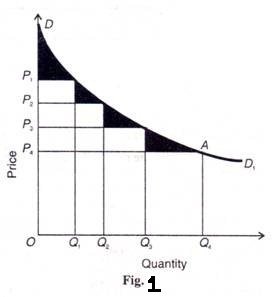
Consumer Surplus is the difference between the price that consumers pay and the price that they are willing to pay. On a supply and demand curve, it is the area between the equilibrium price and the demand curve

For example, if you would pay 76p for a cup of tea, but can buy it for 50p; your consumer surplus is 26p

Diagram of Consumer Surplus

Producer Surplus

  • This is the difference between the price a firm receives and the price it would be willing to sell it at.
  • Therefore it is the difference between the supply curve and the market price.

Consumer Surplus and Marginal Utility

The demand curve is derived from our marginal utility. If the marginal utility of a good is greater than the price, then that is our consumer surplus.

  1. Firms can reduce consumer surplus if they have market power. This enables them to raise prices above the competitive equilibrium.
  2. In a monopoly, a firm will maximise profits by reducing consumer surplus.
  3. Another way to reduce consumer surplus is to engage in price discrimination. Charging different prices to different groups of consumers. Those with inelastic demand will see their consumer surplus reduced. More on Price discrimination. To completely eliminate consumer surplus, a firm would need to engage in first-degree price discrimination this means charging the consumer the highest price they are willing to pay.
  4. To gain market power, a firm could advertise to create brand loyalty, this will make demand more inelastic

Significance of consumer surplus

  • In competitive markets, firms have to keep prices relatively low, enabling consumers to gain consumer surplus. If markets were not competitive, the consumer surplus would be less and there would be greater inequality.
  • A lower consumer surplus leads to higher producer surplus and greater inequality.
  • Consumer surplus enables consumers to purchase a wider choice of goods.

Cooperatives Company, Features, Types, Advantages and Disadvantages

Co-operative Organization is an association of persons, usually of limited means, who have vol­untarily joined together to achieve a common eco­nomic end through the formation of a democrati­cally controlled organization, making equitable dis­tributions to the capital required, and accepting a fair share of risk and benefits of the undertaking.

The word ‘co-operation’ stands for the idea of living together and working together. Cooperation is a form of business organization the only sys­tem of voluntary organization suitable for poorer people. It is an organization wherein persons vol­untarily associate together as human beings on a basis of equality, for the promotion of economic in­terests of themselves.

Characteristics/Features of Cooperative Organization:

  1. Voluntary Association

A cooperative so­ciety is a voluntary association of persons and not of capital. Any person can join a cooperative soci­ety of his free will and can leave it at any time. When he leaves, he can withdraw his capital from the so­ciety. He cannot transfer his share to another person.

The voluntary character of the cooperative as­sociation has two implications:

(i) None will be denied the right to become a member and

(ii) The cooperative society will not compete anybody to become a member.

  1. Spirit of Cooperation

The spirit of coop­eration works under the motto, ‘each for all and all for each.’ This means that every member of a co­operative organization shall work in the general interest of the organization as a whole and not for his self-interest. Under cooperation, service is of supreme importance and self-interest is of second­ary importance.

  1. Democratic Management

An individual member is considered not as a capitalist but as a human being and under cooperation, economic equality is fully ensured by a general rule—one man one vote. Whether one contributes 50 rupees or 100 rupees as share capital, all enjoy equal rights and equal duties. A person having only one share can even become the president of cooperative society.

  1. Capital

Capital of a cooperative society is raised from members through share capital. Coop­eratives are formed by relatively poorer sections of society; share capital is usually very limited. Since it is a part of govt. policy to encourage coopera­tives, a cooperative society can increase its capital by taking loans from the State and Central Coop­erative Banks.

  1. Fixed Return on Capital

In a cooperative organization, we do not have the dividend hunting element. In a consumers’ cooperative store, return on capital is fixed and it is usually not more than 12 p.c. per annum. The surplus profits are distrib­uted in the form of bonus but it is directly connected with the amount of purchases by the member in one year.

  1. Cash Sale

In a cooperative organization “cash and carry system” is a universal feature. In the absence of adequate capital, grant of credit is not possible. Cash sales also avoided risk of loss due to bad debts and it could also encourage the habit of thrift among the members.

  1. Moral Emphasis

A cooperative organization generally originates in the poorer section of population; hence more emphasis is laid on the de­velopment of moral character of the individual member. The absence of capital is compensated by honesty, integrity and loyalty. Under cooperation, honesty is regarded as the best security. Thus co­operation prepares a band of honest and selfless workers for the good of humanity.

  1. Corporate Status

A cooperative associa­tion has to be registered under the separate legisla­tion—Cooperative Societies Act. Every society must have at least 10 members. Registration is desirable. It gives a separate legal status to all cooperative organizations just like a company. It also gives ex­emptions and privileges under the Act.

Types of Cooperatives Company:

  1. Cooperative Credit Societies

Cooperative Credit Societies are voluntary associations of peo­ple with moderate means formed with the object of extending short-term financial accommodation to them and developing the habit of thrift among them.

Germany is the birth place of credit coopera­tion. Credit cooperation was born in the middle of the 19th century. Rural credit cooperative societies were started in the villages to solve the problem of agricultural finance.

The village societies were fed­erated into central cooperative banks and central cooperative banks federated into the apex of state cooperative banks. Thus rural cooperative finance has a federal structure like a pyramid. The primary society is the base. The central bank in the middle and the apex bank in the top of the structure. The members of the primary society are villagers.

In the similar manner urban cooperative credit societies were started in India. These urban coop­erative banks look after the financial needs of arti­sans and labour population of the towns. These urban cooperative banks are based on limited li­ability while the village cooperative societies are based on unlimited liability.

National Bank for Agriculture and Rural De­velopment (NABARD) has been established with an Authorised Capital of Rs. 500 crores. It will act as an Apex Agricultural Bank for disbursement of agricultural credit and for implementation of the programme of integrated rural development. It is jointly owned by the Central Govt. and the Reserve Bank of India.

  1. Consumers’ Cooperative Societies

28 Rochedale Pioneers in Manchester in UK laid the foundation for the Consumers’ Cooperative Move­ment in 1844 and paved the way for a peaceful revo­lution. The Rochedale Pioneers who were mainly weavers, set an example by collective purchasing and distribution of consumer goods at bazar rates and for cash price and by declaration of bonus at the end of the year on the purchase made.

Their example has brought a revolution in the purchase and sale of consumer goods by eliminating profit motive and introducing in its place service motive. In India, consumers’ cooperatives have re­ceived impetus from the govt, attempts to check rise in prices of consumer goods.

  1. Producers’ Cooperatives

It is said that the birth of Producers’ Cooperatives took place in France in the middle of 19th century. But it did not make satisfactory progress.

Producers’ Cooperatives, also known as indus­trial cooperatives, are voluntary associations of small producers formed with the object of elimi­nating the capitalist class from the system of in­dustrial production. These societies produce goods for meeting the requirements of consumers. Some­times their production may be sold to outsiders at a profit.

There are two types of producers’ cooperatives. In the first type, producer-members produce indi­vidually and not as employees of the society. The society supplies raw materials, chemicals, tools and equipment’s to the members. The members are sup­posed to sell their individual products to the soci­ety.

In the second type of such societies, the member-producers are treated as employees of the soci­ety and are paid wages for their work.

  1. Housing Cooperatives

Housing coopera­tives are formed by persons who are interested in making houses of their own. Such societies are formed mostly in urban areas. Through these soci­eties persons who want to have their own houses secure financial assistance.

  1. Cooperative Farming Societies

The coop­erative farming societies are basically agricultural cooperatives formed for the purpose of achieving the benefits of large scale farming and maximizing agricultural output. Such societies are encouraged in India to overcome the difficulties of subdivision and fragmentation of holdings in the country.

Advantages of Cooperatives Company:

  • Economical Operations:

The operation of a cooperative society is quite economical due to elimination of middlemen and the voluntary services provided by its members.

  • Open Membership:

Membership in a cooperative organisation is open to all people having a common interest. A person can become a member at any time he likes and can leave the society at any time by returning his shares, without affecting its continuity.

  • Easy to Form:

A cooperative society is a voluntary association and may be formed with a minimum of ten adult members. Its registration is very simple and can be done without much legal formalities.

  • Democratic Management:

A cooperative society is managed in a democratic manner. It is based on the principle of ‘one man one vote’. All members have equal rights and can have a voice in its management.

  • Limited Liability:

The liability of the members of a co-operative society is limited to the extent of capital contributed by them. They do not have to bear personal liability for the debts of the society.

  • Government Patronage:

Government gives all kinds of help to co-operatives, such as loans at lower rates of interest and relief in taxation.

  • Low Management Cost:

Some of the expenses of the management are saved by the voluntary services rendered by the members. They take active interest in the working of the society. So, the society is not required to spend large amount on managerial personnel.

  • Stability:

A co-operative society has a separate legal existence. It is not affected by the death, insolvency, lunacy or permanent incapacity of any of its members. It has a fairly stable life and continues to exist for a long period.

  • Mutual Co-Operation:

Cooperative societies promote the spirit of mutual understanding, self-help and self-government. They save weaker sections of the society from exploitation by the rich. The underlying principle of co-operation is “self-help through mutual help.”

  • Economic Advantages:

Cooperative societies provide loans for productive purposes and financial assistance to farmers and other lower income earning people.

  • Other Benefits:

Cooperative societies are exempted from paying registration fees and stamp duties in some states. These societies have priority over other creditors in realising its dues from the debtors and their shares cannot be decreed for the realisation of debts.

  • No Speculation:

The share is always open to new members. The shares of co­operative society are not sold at the rates higher than their par values. Hence, it is free from evils of speculation in share values.

Disadvantages of Cooperatives Company:

  • Over reliance on Government funds

Co-operative societies are not able to raise their own resources. Their sources of financing are limited and they depend on government funds. The funding and the amount of funds that would be released by the government are uncertain. Therefore, co-operatives are not able to plan their activities in the right manner.

  • Limited funds

Co-operative societies have limited membership and are promoted by the weaker sections. The membership fees collected is low. Therefore, the funds available with the co-operatives are limited. The principle of one-man one-vote and limited dividends also reduce the enthusiasm of members. They cannot expand their activities beyond a particular level because of the limited financial resources.

  • Benefit to Rural rich

Co-operatives have benefited the rural rich and not the rural poor. The rich people elect themselves to the managing committee and manage the affairs of the co-operatives for their own benefit.

The agricultural produce of the small farmers is just sufficient to fulfill the needs of their family. They do not have any surplus to market. The rich farmers with vast tracts of land, produce in surplus quantities and the services of co-operatives such as processing, grading, correct weighment and fair prices actually benefit them.

  • Imposed by Government

In the Western countries, co-operative societies were voluntarily started by the weaker sections. The objective is to improve their economic status and protect themselves from exploitation by businessmen. But in India, the co-operative movement was initiated and established by the government. Wide participation of people is lacking. Therefore, the benefit of the co-operatives has still not reached many poorer sections.

  • Lack of Managerial skills

Co-operative societies are managed by the managing committee elected by its members. The members of the managing committee may not have the required qualification, skill or experience. Since it has limited financial resources, its ability to compensate its employees is also limited. Therefore, it cannot employ the best talent.

  • Inadequate Rural Credit

Co-operative societies give loans only for productive purposes and not for personal or family expenses. Therefore, the rural poor continue to depend on the money lenders for meeting expenses of marriage, medical care, social commitments etc. Co-operatives have not been successful in freeing the rural poor from the clutches of the money lenders.

  • Government regulation

Co-operative societies are subject to excessive government regulation which affects their autonomy and flexibility. Adhering to various regulations takes up much of the management’s time and effort.

  • Misuse of funds

If the members of the managing committee are corrupt, they can swindle the funds of the co-operative society. Many cooperative societies have faced financial troubles and closed down because of corruption and misuse of funds.

  • Inefficiencies leading to losses

Co-operative societies operate with limited financial resources. Therefore, they cannot recruit the best talent, acquire latest technology or adopt modern management practices. They operate in the traditional mold which may not be suitable in the modern business environment and therefore suffer losses.

  • Lack of Secrecy

Maintenance of business secrets is the key for the competitiveness of any business organization. But business secrets cannot be maintained in cooperatives because all members are aware of the activities of the enterprise. Further, reports and accounts have to be submitted to the Registrar of Co-operative Societies. Therefore, information relating to activities, revenues, members etc becomes public knowledge.

  • Conflicts among members

Cooperative societies are based on the principles of co-operation and therefore harmony among members is important. But in practice, there might be internal politics, differences of opinions, quarrels etc. among members which may lead to disputes. Such disputes affect the functioning of the co-operative societies.

  • Limited scope

Co-operative societies cannot be introduced in all industries. Their scope is limited to only certain areas of enterprise. Since the funds available are limited they cannot undertake large scale operations and is not suitable in industries requiring large investments.

  • Lack of Accountability

Since the management is taken care of by the managing committee, no individual can be made accountable for in efficient performance. There is a tendency to shift responsibility among the members of the managing committee.

  • Lack of Motivation

Members lack motivation to put in their whole hearted efforts for the success of the enterprise. It is because there is very little link between effort and reward. Co-operative societies distribute their surplus equitably to all members and not based on the efforts of members. Further there are legal restrictions regarding dividend and bonus that can be distributed to members.

  • Low public confidence

Public confidence in the co-operative societies is low. The reason is, in many of the co-operatives there is political interference and domination. The members of the ruling party dictate terms and therefore the purpose for which cooperatives are formed is lost.

Strengths, Weakness, Opportunities, Threats (SWOT Analysis)

SWOT Analysis is a strategic planning tool used to identify an organization’s internal strengths and weaknesses, as well as external opportunities and threats. It involves assessing factors within the organization’s control, such as resources, capabilities, and processes, to determine competitive advantages and areas needing improvement. Additionally, SWOT analysis evaluates external factors like market trends, competitor actions, and regulatory changes to uncover potential avenues for growth and challenges to address. By synthesizing this information, organizations can develop strategies to capitalize on strengths, mitigate weaknesses, exploit opportunities, and defend against threats, ultimately enhancing their competitive position and guiding decision-making processes.

Elements of a SWOT analysis

1. Strengths:

Internal attributes and resources that give the organization a competitive advantage. These can include factors such as strong brand reputation, skilled workforce, proprietary technology, efficient processes, and financial stability.

2. Weaknesses:

Internal factors that place the organization at a disadvantage compared to competitors. Weaknesses may include areas such as limited resources, outdated technology, poor brand perception, inefficient processes, and lack of expertise or talent.

3. Opportunities:

External factors or trends in the business environment that the organization could exploit to its advantage. Opportunities may arise from market growth, emerging trends, technological advancements, changes in consumer preferences, or regulatory changes.

4. Threats:

External factors that could negatively impact the organization’s performance or pose risks to its success. Threats may come from factors such as intense competition, economic downturns, changing regulatory landscapes, disruptive technologies, or shifts in consumer behavior.

Factors affecting SWOT Analysis:

  • Scope and Objectives:

Clearly defining the scope and objectives of the analysis ensures that relevant factors are considered and that the analysis remains focused on its intended purpose.

  • Data Quality:

The accuracy and reliability of the data used in the analysis directly impact the validity of the findings. Using up-to-date, accurate, and comprehensive data sources is essential.

  • Perspective and Bias:

Different stakeholders may have varying perspectives and biases that influence their perception of the organization’s strengths, weaknesses, opportunities, and threats. It’s crucial to consider multiple viewpoints to ensure a balanced analysis.

  • Expertise and Knowledge:

The expertise and knowledge of the individuals conducting the analysis can affect the depth and insightfulness of the findings. Involving individuals with diverse backgrounds and expertise can enhance the quality of the analysis.

  • External Environment:

Changes in the external business environment, such as market trends, competitor actions, regulatory changes, economic conditions, and technological advancements, can impact the validity of the analysis. Regularly updating the analysis to reflect changes in the external environment is essential.

  • Internal Dynamics:

Internal factors such as organizational culture, leadership, resource allocation, and decision-making processes can influence the identification of strengths, weaknesses, opportunities, and threats. Understanding internal dynamics is crucial for conducting a realistic SWOT analysis.

  • Interrelationships:

Recognizing the interrelationships between different elements of the SWOT analysis is important for understanding how they interact and influence each other. For example, addressing a weakness may create opportunities, or exploiting an opportunity may mitigate a threat.

  • Time Constraints:

Time constraints can limit the depth and thoroughness of the analysis. It’s essential to allocate sufficient time and resources to conduct a comprehensive SWOT analysis effectively.

Benefits of SWOT Analysis:

  • Strategic Planning:

SWOT analysis provides a structured framework for organizations to assess their internal strengths and weaknesses, as well as external opportunities and threats. This information is invaluable for strategic planning, helping organizations align their resources and capabilities with their goals and objectives.

  • Improved Decision Making:

By identifying key factors influencing the organization’s performance and competitive position, SWOT analysis enables informed decision making. It helps organizations prioritize initiatives, allocate resources effectively, and capitalize on opportunities while mitigating potential risks.

  • Enhanced Competitive Positioning:

Understanding the organization’s strengths and weaknesses relative to competitors, as well as market opportunities and threats, enables organizations to develop strategies to enhance their competitive positioning. SWOT analysis helps organizations identify unique selling points, differentiate themselves in the market, and capitalize on competitive advantages.

  • Risk Management:

By identifying potential threats and weaknesses, SWOT analysis helps organizations anticipate risks and develop strategies to mitigate them. It enables proactive risk management, reducing the likelihood of negative impacts on the organization’s performance and reputation.

  • Facilitates Change Management:

SWOT analysis provides valuable insights into the internal and external factors affecting the organization, making it a useful tool for change management initiatives. It helps organizations anticipate resistance to change, identify areas requiring improvement, and develop strategies to overcome barriers to change.

  • Enhanced Communication and Alignment:

SWOT analysis fosters communication and alignment within the organization by providing a common understanding of the organization’s strengths, weaknesses, opportunities, and threats. It facilitates collaboration among stakeholders, promotes transparency in decision making, and ensures that everyone is working towards common goals and objectives.

Theories of International Trade

International trade allows countries to expand their markets for both goods and services that otherwise may not have been available domestically. As a result of international trade, the market contains greater competition, and therefore more competitive prices, which brings a cheaper product home to the consumer.

International trade gives rise to a world economy, in which supply and demand, and therefore prices, both affect and are affected by global events. Political change in Asia, for example, could result in an increase in the cost of labor, thereby increasing the manufacturing costs for an American sneaker company based in Malaysia, which would then result in an increase in the price charged at your local mall. A decrease in the cost of labor, on the other hand, would likely result in you having to pay less for your new shoes.

A product that is sold to the global market is called an export, and a product that is bought from the global market is an import. Imports and exports are accounted for in a country’s current account in the balance of payments.

Theories of International Trade

Classical Country- Based Theories

Modern Firm-Based Theories

Mercantilism Country Similarity
Absolute Advantages Product lifecycles
Comparative Advantage Global Strategic Rivalry
Heckscher-Ohlin Porter’s National Competitive Advantages

Mercantilism

According to Wild, 2000, the trade theory that state that nations ought to accumulate money wealth, typically within the style of gold, by encouraging exports and discouraging imports is termed mercantilism. In line with this theory different measures of countries’ well being, like living standards or human development, area unit tangential mainly Great britain, France, Holland, Portuguese Republic and Spain used mercantilism throughout the 1500s to the late 1700s.

Mercantilistic countries experienced the alleged game, that meant that world wealth was restricted which countries solely may increase their share at expense of their neighbours. The economic development was prevented once the mercantilistic countries paid the colonies very little for export and charged them high value for import. The most downside with mercantilism is that every one country engaged in export however was restricted from import, another hindrance from growth of international trade.

Absolute Advantage

The Scottish social scientist Smith developed the trade theory of absolute advantage in 1776. A rustic that has associate absolute advantage produces larger output of a decent or service than different countries mistreatment an equivalent quantity of resources. Smith declared that tariffs and quotas mustn’t limit international trade it ought to be allowed to flow in step with economic process. Contrary to mercantilism Smith argued that a rustic ought to focus on production of products within which it holds associate absolute advantage. No country then ought to turn out all the products it consumed. The speculation of absolute advantage destroys the mercantilistic concept that international trade could be a game. In step with absolutely the advantage theory, international trade could be a positive-sum game, as a result of there are gains for each countries to associate exchange. In contrast to mercantilism this theory measures the nation’s wealth by the living standards of its folks and not by gold and silver.

There’s a possible drawback with absolute advantage. If there’s one country that doesn’t have associate absolute advantage within the production of any product, can there still be profit to trade, and can trade even occur. The solution is also found within the extension of absolute advantage, the speculation of comparative advantage.

Comparative Advantage

The most basic idea within the whole of international trade theory is that the principle of comparative advantage, first introduced by economist David Ricardo in 1817. It remains a serious influence on a lot of international foreign policy and is thus necessary in understanding the fashionable international economy. The principle of comparative advantage states that a rustic ought to specialize in manufacturing and exportation those merchandise during which is includes a comparative, or relative price, advantage compared with different countries and will import those merchandise during which it’s a comparative disadvantage. Out of such specialization, it’s argued, can accrue larger profit for all.

During this theory there square measure many assumptions that limit the real-world application. The idea that countries square measure driven solely by the maximization of production and consumption and not by problems out of concern for employees or customers may be a mistake.

Heckscher-Ohlin theory

In the early decade a world trade theory referred to as issue proportions theory emerged by two Swedish economists, Eli Heckscher and Bertil Ohlin. This theory is additionally referred to as the Heckscher-Ohlin theory. The Heckscher-Ohlin theory stress that countries ought to turn out and export merchandise that need resources that area unit well endowed and import merchandise that need resources in brief provide. This theory differs from the theories of comparative advantage and absolute advantage since these theory focuses on the production of the assembly method for a selected smart. On the contrary, the Heckscher-Ohlin theory states that a rustic ought to specialize production and export victimization the factors that area unit most well endowed, and so the most cost effective. Not turn out, as earlier theories declared, the products it produces most expeditiously.

The Heckscher-Ohlin theory is most well-liked to the Ricardo theory by several economists, as a result of it makes fewer simplifying assumptions. In 1953, economic expert revealed a study, wherever he tested the validity of the Heckscher-Ohlin theory. The study showed that the U.S was additional well endowed in capital compared to alternative countries, thus the U.S would export capital- intensive merchandise and import labor-intensive merchandise. Wassily Leontief observed that the U.S’s export was less capital intensive than import.

Modern or Firm-Based Trade Theories

In contrast to classical, country-based trade theories, the category of modern, firm-based theories emerged after World War II and was developed in large part by business school professors, not economists. The firm-based theories evolved with the growth of the multinational company (MNC). The country-based theories couldn’t adequately address the expansion of either MNCs or intraindustry trade, which refers to trade between two countries of goods produced in the same industry. For example, Japan exports Toyota vehicles to Germany and imports Mercedes-Benz automobiles from Germany.

Unlike the country-based theories, firm-based theories incorporate other product and service factors, including brand and customer loyalty, technology, and quality, into the understanding of trade flows.

(i) Country Similarity Theory

Swedish economist Steffan Linder developed the country similarity theory in 1961, as he tried to explain the concept of intraindustry trade. Linder’s theory proposed that consumers in countries that are in the same or similar stage of development would have similar preferences. In this firm-based theory, Linder suggested that companies first produce for domestic consumption. When they explore exporting, the companies often find that markets that look similar to their domestic one, in terms of customer preferences, offer the most potential for success. Linder’s country similarity theory then states that most trade in manufactured goods will be between countries with similar per capita incomes, and intraindustry trade will be common. This theory is often most useful in understanding trade in goods where brand names and product reputations are important factors in the buyers’ decision-making and purchasing processes.

(ii) Product Life Cycle Theory

Raymond Vernon, a Harvard Business School professor, developed the product life cycle theory in the 1960s. The theory, originating in the field of marketing, stated that a product life cycle has three distinct stages: (1) new product, (2) maturing product, and (3) standardized product. The theory assumed that production of the new product will occur completely in the home country of its innovation. In the 1960s this was a useful theory to explain the manufacturing success of the United States. US manufacturing was the globally dominant producer in many industries after World War II.

It has also been used to describe how the personal computer (PC) went through its product cycle. The PC was a new product in the 1970s and developed into a mature product during the 1980s and 1990s. Today, the PC is in the standardized product stage, and the majority of manufacturing and production process is done in low-cost countries in Asia and Mexico.

The product life cycle theory has been less able to explain current trade patterns where innovation and manufacturing occur around the world. For example, global companies even conduct research and development in developing markets where highly skilled labor and facilities are usually cheaper. Even though research and development is typically associated with the first or new product stage and therefore completed in the home country, these developing or emerging-market countries, such as India and China, offer both highly skilled labor and new research facilities at a substantial cost advantage for global firms.

(iii) Global Strategic Rivalry Theory

Global strategic rivalry theory emerged in the 1980s and was based on the work of economists Paul Krugman and Kelvin Lancaster. Their theory focused on MNCs and their efforts to gain a competitive advantage against other global firms in their industry. Firms will encounter global competition in their industries and in order to prosper, they must develop competitive advantages. The critical ways that firms can obtain a sustainable competitive advantage are called the barriers to entry for that industry. The barriers to entry refer to the obstacles a new firm may face when trying to enter into an industry or new market. The barriers to entry that corporations may seek to optimize include:

  • Research and development,
  • The ownership of intellectual property rights,
  • Economies of scale,
  • Unique business processes or methods as well as extensive experience in the industry, and
  • The control of resources or favorable access to raw materials.

(iv) Porter’s National Competitive Advantage Theory

In the continuing evolution of international trade theories, Michael Porter of Harvard Business School developed a new model to explain national competitive advantage in 1990. Porter’s theory stated that a nation’s competitiveness in an industry depends on the capacity of the industry to innovate and upgrade. His theory focused on explaining why some nations are more competitive in certain industries. To explain his theory, Porter identified four determinants that he linked together. The four determinants are, local market resources and capabilities, local market demand conditions, local suppliers and complementary industries, and local firm characteristics.

  • Local market resources and capabilities (factor conditions). Porter recognized the value of the factor proportions theory, which considers a nation’s resources (e.g., natural resources and available labor) as key factors in determining what products a country will import or export. Porter added to these basic factors a new list of advanced factors, which he defined as skilled labor, investments in education, technology, and infrastructure. He perceived these advanced factors as providing a country with a sustainable competitive advantage.
  • Local market demand conditions. Porter believed that a sophisticated home market is critical to ensuring ongoing innovation, thereby creating a sustainable competitive advantage. Companies whose domestic markets are sophisticated, trendsetting, and demanding forces continuous innovation and the development of new products and technologies. Many sources credit the demanding US consumer with forcing US software companies to continuously innovate, thus creating a sustainable competitive advantage in software products and services.
  • Local suppliers and complementary industries. To remain competitive, large global firms benefit from having strong, efficient supporting and related industries to provide the inputs required by the industry. Certain industries cluster geographically, which provides efficiencies and productivity.
  • Local firm characteristics. Local firm characteristics include firm strategy, industry structure, and industry rivalry. Local strategy affects a firm’s competitiveness. A healthy level of rivalry between local firms will spur innovation and competitiveness.

In addition to the four determinants of the diamond, Porter also noted that government and chance play a part in the national competitiveness of industries. Governments can, by their actions and policies, increase the competitiveness of firms and occasionally entire industries.

Porter’s theory, along with the other modern, firm-based theories, offers an interesting interpretation of international trade trends. Nevertheless, they remain relatively new and minimally tested theories.

EXIM Bank, ECGC and other Institutions in Financing of Foreign Trade

Once our economy opened up post liberalization and globalization, the import and export industry became a huge sector in our economy. Even today India is one of the largest exporters of agricultural goods. So to provide financial support to importers and exporters the government set up the EXIM Bank.

EXPORT AND IMPORT BANK OF INDIA (EXIM)

The Export and Import Bank of India, popularly known as the EXIM Bank was set up in 1982. It is the principal financial institution in India for foreign and international trade. It was previously a branch of the IDBI, but as the foreign trade sector grew, it was made into an independent body.

The main function of the Export and Import Bank of India is to provide financial and other assistance to importers and exporters of the country. And it oversees and coordinates the working of other institutions that work in the import-export sector. The ultimate aim is to promote foreign trade activities in the country.

The management of the EXIM bank is done by a board, headed by the Managing Director. There are 17 other Directors on the board. The whole paid-up capital of the bank (100 crores currently) is subscribed by the Central Government exclusively.

Functions of the EXIM Bank

Let us take a look at some of the main functions of Export and Import Bank of India bank:

  1. Finances import and export of goods and services from India.
  2. It also finances the import and export of goods and services from countries other than India.
  3. It finances the import or export of machines and machinery on lease or hires purchase basis as well.
  4. Provides refinancing services to banks and other financial institutes for their financing of foreign trade.
  5. EXIM bank will also provide financial assistance to businesses joining a joint venture in a foreign country.
  6. The bank also provides technical and other assistance to importers and exporters. Depending n the country of origin there are a lot of processes and procedures involved in the import-export of goods. The EXIM bank will provide guidance and assistance in administrative matters as well.
  7. Undertakes functions of a merchant bank for the importer or exporter in transactions of foreign trade.
  8. Will also underwrite shares/debentures/stocks/bonds of companies engaged in foreign trade.
  9. Will offer short-term loans or lines of credit to foreign banks and governments.
  10. EXIM bank can also provide business advisory services and expert knowledge to Indian exporters in respect of multi-funded projects in foreign countries

Importance of the EXIM Bank

Other than providing financial assistance, the Export and Import Bank of India bank is always looking for ways to promote the foreign trade sector in India. In the early 1990s, EXIM introduced a program in India known as the Clusters of Excellence.

The aim was to improve the quality standards of our imports and exports. It also has a tie-up with the European Bank for Reconstruction and Development. It has agreed to co-finance programs with them in eastern Europe.

In order to promote exports EXIM bank also has schemes such as production equipment finance program, export marketing finance, vendor development finance, etc.

ECGC (Export Credit Guarantee Corporation of India)

The ECGC Limited (Formerly Export Credit Guarantee Corporation of India Ltd) is a company wholly owned by the Government of India based in Mumbai, Maharashtra. It provides export credit insurance support to Indian exporters and is controlled by the Ministry of Commerce. Government of India had initially set up Export Risks Insurance Corporation (ERIC) in July 1957. It was transformed into Export Credit and Guarantee Corporation Limited (ECGC) in 1964 and to Export Credit Guarantee Corporation of India in 1983.

Functions of ECGC

  • Provides a range of credit risk insurance covers to exporters against loss in export of goods and services as well.
  • Offers guarantees to banks and financial institutions to enable exporters to obtain better facilities from them.
  • Provides Overseas Investment Insurance to Indian companies investing in joint ventures abroad in the form of equity or loan and advances.

Facilities by ECGC

  • Offers insurance protection to exporters against payment risks
  • Provides guidance in export-related activities
  • Makes available information on different countries with its own credit ratings
  • Makes it easy to obtain export finance from banks/financial institutions
  • Assists exporters in recovering bad debt
  • Provides information on credit-worthiness of overseas buyers

Institutions in Financing of Foreign Trade

Business activities are conducted on a global level and even between nations. There is an emergence of global markets. To keep the trade fair and manage trade-related issues on a global level, various International Institutions and Trade Agreements were established.

International Trade Associations

The nations were influenced financially because of World War 1 and World War 2. The reconstruction couldn’t happen as there was an interruption in the financial system furthermore there was a shortage of resources. At this crossroads, the prominent economist J. M. Keynes with Bretton Woods establish an association with 44 countries to meet this and to reestablish commonship on the planet.

This gathering brought forth the International Monetary Fund (IMF) International bank Of Reconstruction and Development (IBRD) and the International Trade Organization (ITO). These three associations were considered as three columns for the improvement of the global economy.

World Bank

The International Bank of Reconstruction and Development (IBRD) is usually known as the World Bank. The fundamental point of IBRD is to remake the war influenced the economies of Europe and help the improvement of underdeveloped economies of the world. The World Bank after 1950 focused more on financially unstable nations and invested heavily into social segments like health and education of such immature nations.

Currently, the World Bank includes five universal bodies responsible for offering fund to various countries. These bodies and its partners are headquartered in Washington DC taking into account diverse financial requirements and necessities.

As specified before, the World Bank has been allocated the undertaking of financial development and expanding the extent of the international business. Amid its underlying years of foundation, it gave more significance on creating facilitates like transportation, health, energy and others.

This has profited the underdeveloped nations too, without doubt, however, because of poor regulatory structure, the absence of institutional system and absence of accessibility of skilled labour in these nations has prompted disappointment. World Bank and its Affiliates Institutions:

  • International Bank for Reconstruction and Development (IBRD) 1945
  • International Financial Corporation (IFC) 1956
  • Multilateral Investment Guarantee Agency (MIGA) 1988
  • International Development Association (IDA) 1960
  • International Centre for Settlement of Investment Disputes (ICSID) 1966

The World Bank is no longer limited to simply offering money related help for infrastructure development, agriculture, industry, health and sanitation. It is somewhat significantly engaged with regions like reducing rural poverty, increasing income of the rural poor, offering specialized help, and beginning research schemes.

International Development Association (IDA)

International Development Association (IDA) was set up in 1960 as a partner of the World Bank. IDA was set up essentially to offer fund to the less developed countries on a soft loan basis. It is because of its intention of providing soft loans that it is called the Soft Loan Window of the IBRD. The objectives of IDA are as follows,

  • To help the underdeveloped countries by giving loans in simple terms.
  • Help at the end of poverty in the poorest nations
  • Give macroeconomics services such as, for example, those relating to health, nutrition, education, human resource advancement and control of the population.
  • To offer loans at marked down interests in order to energize economic development, the increment in manufacturing limit and good expectations for standard of living in the underdeveloped nations.

International Finance Corporation (IFC)

Established in July 1956, IFC was aimed to assist in terms of finance to the private sector of developing nations. IFC is also an associate of the World Bank, but it has its own separate legal entity, functions and funds. All the members of the World Bank are entitled to become members of IFC.

Multinational Investment Guarantee Agency (MIGA)

Established in April 1988, The Multinational Investment Guarantee Agency’s aim was to support the task of the World Bank and IFC. Some objectives of the MIGA are:-

  • Advance the stream of direct foreign investment into less developed member countries.
  • Give protection cover to fund supplier against political risks.
  • Guarantee extension of current investment, privatization and economic reconstruction.
  • Provide assurance against noncommercial perils, for example, dangers engaged in currency transfer, war and domestic clashes, and infringement of agreement.

Recent World Trade Scenario of Trading

The global economy has been on a subdued growth path since the advent of ‘Financial Crisis’ of 2008, and has now started to show signs of global recovery. In October 2017, the IMF projected world GDP growth to pick up from 3.2% in 2016 to 3.6% in 2017, and further to 3.7% in 2018. Economic activity has also picked up in developed market economies such as the US, UK, and Europe. There is a rise in global demand, which is expected to remain buoyant. The developing and emerging market economies have seen mixed economic performance. The pickup in momentum of global demand has been led by investment demand. More specifically, production of both consumer durables and capital goods have rebounded since the second half of 2016. Some factors that have contributed to these developments include global recovery in investments, led by infrastructure and real estate investment in China; firming global commodity prices; and end of an inventory cycle in US.

On the back of this global recovery, the world is witnessing a pickup in global trade. The Asian Development Bank, in its recent update1, noted that most of the emerging economies (excluding China) are witnessing a rebound in manufacturing exports, “particularly in electronics, where foreign direct investment has been strengthening”. The economies of south-east Asia are also gaining from increased activity along cross-border manufacturing supply chains. The World Trade Organization (WTO), has recently in its September 2017 press release upgraded the growth forecast for global trade in the year 2017, from 2.4% to 3.6%. Particularly, in the first half of 2017, world trade rose by a robust 4.2% (year on year), driven by exports of developing economies which grew by 5.9 percent as compared to a growth of 3.1 percent witnessed in exports of developed economies. Imports by developed and developing economies also increased by 2.1% and 6.9%, respectively. Moreover, the ratio of trade growth to world GDP growth is also set to recover and reach around 1.3, which will be at a highest level in last 5 years.

This pickup in global growth which has boosted demand for imports, spurred intra-Asia-trade as demand was transmitted through global value chains. In this current scenario, even though India is witnessing a mild rebound in its exports, there are concerns that merchandise exports in Asia’s second largest economy are lagging behind other major Asian economies. Today global attention is riveted on emerging and developing economies and especially Asia, driven by the continent’s growing appetite for industrial investment, burgeoning infrastructural requirements and its quest for expanding trade.

Indian economy and its trade scenario

India’s growth story, especially since the start of the 21st century has been remarkable. The Indian economy has come a long way since its economic liberalisation, and is amongst the fastest growing major economies of the world today. While India witnessed a relatively moderate growth during the period 2011-12 to 2013-14, on account of the global economic slowdown, the economy recorded a robust growth averaging 7.5 percent during the period 2014-15 to 2016-17, much above the growth rate of other emerging and developing economies. In the last one year, it has seen major economic policy developments with the introduction of Goods and Services Tax (GST) and demonetization of higher currency notes.

Even though the GDP growth in the first quarter of current fiscal has fallen down to a low of 5.7%, its lowest since March 2014, it is widely believed that the economy has bottomed out and it can only rise from here. According to the IMF, India is expected to grow at 7.2% in this fiscal year, aided by higher government spending and a pickup in the service sector performance.

Fueling India’s growth through international trade

In recent years, India’s robust growth has been driven by the dynamic private sector. An encouraging phenomenon that has been witnessed has been the emergence of a large number of investment driven small and medium enterprises with immense potential for growth. A large number of such enterprises have also endeavoured to expand their business operations overseas. The Indian economy is more globalized than we could imagine. As a result, India’s foreign trade has seen a multi-fold increase, since liberalization of the economy.

Accordingly, there have been significant structural shifts not only in the product basket, but also in the geographical composition of India’s foreign trade. The opening up of Indian economy led to a massive increase in the foreign trade, which aided in sustained GDP growth over last two decades. During the last 25 years Indian exports have increased by 17 times and imports by 19 times. India’s share in global merchandise exports has risen from 0.6 percent in early 1990s to 1.7 percent in 2016, and similarly the share of imports has risen from 0.6 percent to 2.4 percent during the same period. India’s trade to GDP ratio, a measure of an economy’s openness and integration into the global economy, has witnessed a phenomenal increase over the last few decades. Foreign trade which constituted around 13-15 percent of India’s GDP in the early nineties, peaked at 55 percent in 2012- 13 and today accounts for around 40 percent in 2016-17. India also, ranked as the 20th largest exporter and 14th largest importer in the world in 2016.

Concomitantly, India’s engagement with Global Value Chains (GVCs), which have become dominant feature of world trade, has increased significantly since 1990s. In manufacturing sector, especially for electrical and optical equipment, India is more integrated with the south east Asian region, while for services the integration in GVCs is with western countries like the US and UK. According to an OECD estimate, developing economies with fastest growing GVC participation have experienced a GDP per capita growth rate percent above average.

India has set an ambitious target of achieving exports worth US $ 900 billion by 2020, while accounting for a share of 3.5 percent of global exports4. In the current global macroeconomic scenario, while it seems like a challenging task, concerted efforts would need to be made for India to be able to achieve its trade target and realign its foreign trade policy with the new global trading system.

While the global economic scenario is crucial, the domestic factors are no less important, when it comes to trade. India’s overall trade policy faces certain challenges viz. inadequate export diversification in terms of products and geographical distribution; insignificant involvement of a majority of states in exports; rationalisation of the tariff regime and export promotion schemes; and factor market reforms which are critically linked with export performance. These challenges not only affect the productivity and competitiveness of domestic firms but also restrict them from participating in global production networks.

(i) Integrating into and moving up the value chain

Most manufactured products, often high technology manufactured products, that are part of GVCs are infrastructure critical products whose parts are manufactured in several countries. A robust transport and connectivity network supported by fast entry/exit through port/customs is a precondition to making such products as delay may disrupt the entire value chain. There is a need for India to focus on expanding production capacity along with value addition, and moving up the value chain,while creating an enabling environment to account for a sizeable share in major leading global exports. This gain seven more significance given that India’s labour force is projected to swell by about 110 mn by 2020. The biggest challenge is to employ the surplus labour coming out of agriculture into industry and services.

(ii) Upscaling Manufacturing

The Make in India initiative is an important initiative of the Government of India, which envisages to promote India as a manufacturing hub and investment destination. There is need for highlighting the potential and stimulating the manufacturing sector through supporting mechanisms and conducive policy measures, including support for R&D, technology orientation and investment incentives. A Higher expenditure on R&D generally correlates with increase in high-technology exports, and increased local value addition. R&D expenditure as a percentage share of GDP in India has remained extremely low at less than1 percent, much lower even in comparison to other developing economies. Also, while we lay emphasis on the manufacturing sector and thereby on manufactured exports, it is also important to ensure an enabling environment and improving our competitiveness by investing in infrastructure such as better connectivity through roads and ports, coal availability, labour reforms and flexibility in factor markets.

(iii) Aligning India’s Export Capability in-Line with Global Import Demand

With regard to India’s exports, while merchandise exports have more than doubled over the period 2006-07 to 2016-17 from US$ 126 billion to more than US$276 billion, there remains huge potential for exports of select products to select countries in line with India’s export capability and import demand. There is need for identifying and aligning India’s export capability vis-à-vis global import demand. Such in-depth analysis has been the focus of research studies in Exim Bank. Comparative analyses of global trends in trade, undertaken in such studies have yielded interesting results.

To Conclude

All in all, a pick-up in global growth is expected to contribute to the revival of international trade, but the downside risks such as the possible adoption of protectionist trade policies by especially developed market economies, around the world weigh on the recovery of trade. As a result, there is an increasing need for India and other emerging market economies, relying on export led economic growth, to take a proactive stand for globalization and international trade.

There is a need to shift our focus from exporting what we can (or supply based), to items that are globally demanded. A demand-based export basket diversification approach could give a big push to exports. While India has made remarkable progress in the recent past, it facesan even more challenging global environment today. Itis certainly a daunting, yet possible, task to ensure that India repositions itself as an important driver of global economic growth.

error: Content is protected !!