Company Liquidation Meaning, Modes

According to the Companies Act, 2013, a meeting refers to a formal gathering of members, directors, or shareholders of a company, held to discuss, deliberate, and make decisions on specific matters related to the business of the company. The meeting must follow proper procedures, including notice, quorum, agenda, and other requisites to be legally valid. Meetings can include Board meetings, General meetings, Annual General Meetings (AGM), Extraordinary General Meetings (EGM), and committee meetings, each with distinct purposes and legal requirements.

Nature of Liquidation:

  • Formal Process:

Liquidation is a formal legal procedure governed by the Companies Act, 2013. It must be conducted following specific rules and regulations, ensuring that all stakeholders are treated fairly. It can be voluntary (initiated by shareholders) or compulsory (ordered by a court).

  • Cessation of Business:

Once liquidation starts, the company ceases its business operations, except for those necessary to complete the liquidation process. The company no longer carries out its primary business activities but focuses on settling liabilities and distributing assets.

  • Appointment of Liquidator:

Liquidator is appointed to oversee the process, manage the company’s assets, and ensure debts are paid off. The liquidator acts in the interest of creditors and shareholders, ensuring the orderly liquidation of the company.

  • Sale of Assets:

The company’s assets are sold or realized to generate cash, which is used to repay creditors. The liquidator handles the sale and distribution of assets, making sure the proceeds are maximized for the benefit of creditors and other stakeholders.

  • Priority of Payments:

In liquidation, creditors have priority over shareholders. Secured creditors are paid first, followed by unsecured creditors. Shareholders receive any remaining balance after all debts and liabilities have been settled, often receiving little or nothing.

  • Insolvency:

Liquidation is often the result of insolvency, where the company cannot meet its financial obligations. It provides a legal remedy for creditors to recover dues from the company’s assets.

  • Dissolution of Company:

The final step in liquidation is the dissolution of the company, meaning it ceases to exist as a legal entity. After the liquidation process is completed and all obligations are settled, the company is officially struck off the register of companies.

  • Distribution to Shareholders:

If any surplus remains after paying creditors, it is distributed among shareholders in accordance with their shareholding rights. Typically, preference shareholders are paid before equity shareholders.

Causes of Liquidation:

  • Insolvency:

One of the most common causes of liquidation is insolvency, where a company is unable to pay its debts as they fall due. When liabilities exceed assets and the company cannot meet its financial obligations, it may be forced into liquidation to repay creditors through asset sales.

  • Lack of Profitability:

Company that continually operates at a loss may not be able to sustain its business operations in the long term. If the company fails to generate enough profit to cover its expenses, it may opt for voluntary liquidation to avoid further financial decline.

  • Statutory Requirements:

The Companies Act, 2013, allows creditors or shareholders to petition for liquidation when specific statutory conditions are met, such as non-compliance with filing requirements, failure to hold meetings, or significant operational issues.

  • Court Order:

Compulsory liquidation may be initiated by a court order due to a petition filed by creditors, shareholders, or regulatory authorities. A court may order liquidation if the company has engaged in fraudulent activities, mismanagement, or violations of the law.

  • Creditors’ Pressure:

In cases where the company owes large sums of money to creditors and fails to meet repayment deadlines, creditors may push for liquidation to recover their dues. Creditors may initiate winding-up proceedings to force the company to sell off its assets and settle outstanding debts.

  • Voluntary Decision by Shareholders:

In some cases, shareholders may choose to voluntarily liquidate the company even when it is solvent. This may happen due to changes in market conditions, business restructuring, or a decision to exit the market while assets still hold value.

  • Mergers and Acquisitions:

If a company is acquired by another entity or merges with another firm, the original company may be liquidated to allow the new entity to take over its operations, assets, and liabilities. In such cases, the liquidation is a strategic decision rather than a financial necessity.

  • Operational Mismanagement:

Poor management practices, such as inefficiencies, lack of strategic planning, or fraud, can lead to the company’s failure. Over time, these factors can erode a company’s financial health, making liquidation the only viable option to pay off debts and close the business.

Types of Liquidation:

Liquidation is the process by which a company’s assets are sold off to pay its debts, and the company is ultimately dissolved. There are different types of liquidation based on the circumstances and the parties initiating the process. The two main types of liquidation are Voluntary liquidation and Compulsory liquidation.

  1. Voluntary Liquidation

Voluntary liquidation occurs when the company’s directors or shareholders decide to wind up the company. It can be initiated even when the company is solvent or insolvent. Voluntary liquidation is further divided into two types:

Members’ Voluntary Liquidation (MVL):

  • This type of liquidation is initiated by the members (shareholders) when the company is solvent, meaning it can pay off its debts in full.
  • The company’s directors declare a solvency statement, stating that the company will be able to pay all its debts within a specified period, usually 12 months.
  • After all debts are settled, the remaining assets are distributed among the shareholders.
  • MVL is typically used when the company no longer has a business purpose, the owners wish to retire, or a restructuring is planned.

Creditors’ Voluntary Liquidation (CVL):

  • This type of liquidation is initiated by the company’s directors or shareholders when the company is insolvent and unable to pay its debts.
  • The creditors are involved in the process as they are likely to receive payment from the proceeds of asset sales.
  • A liquidator is appointed to manage the liquidation, sell the company’s assets, and distribute the proceeds to the creditors in a predetermined order of priority.
  1. Compulsory Liquidation

Compulsory liquidation is ordered by a court, usually upon a petition from a creditor, the company, or certain stakeholders. This occurs when the company is unable to pay its debts or has committed serious legal violations.

Court-Ordered Liquidation:

  • This type of liquidation happens when a creditor, regulatory authority, or even the company itself files a petition in the court for winding up due to insolvency or legal breaches.
  • The court may issue a winding-up order if the company cannot meet its financial obligations or has violated legal norms.
  • A liquidator is appointed by the court to take control of the company’s assets and distribute them according to the priority of claims, with secured creditors being paid first.
  1. Voluntary Winding-Up Under Supervision

This type of liquidation occurs when a company begins a voluntary liquidation process, but the court steps in to supervise the proceedings. The court’s supervision ensures that the liquidation follows proper procedures and that creditors’ interests are protected.

  1. Provisional Liquidation

In this type of liquidation, a court appoints a provisional liquidator to safeguard the company’s assets before a winding-up order is made. This may happen if there is concern that the company’s assets might be misused, removed, or wasted before the final court decision is made.

Contributory Preferential Payments

The person appointed for conducting the liquidation proceedings of the company is called ‘Liquidator’. (In case of Voluntary winding up an Insolvency Professional). The company must submit a statement of affairs to the liquidator. The general duties of the liquidator are to take into his custody all the property of the company and actionable claims and make the payments as per the order laid down in the Companies Act.

Preferential payments: Preferential creditors are those creditors who are paid in priority to creditors having a floating charge and other (non-preferential) unsecured creditors. As per Sec. 326 of the Companies Act, 2013, preferential creditors include the following:

  1. All revenues, taxes, cesses and rates due to the Central, State Government or to a local authority which have become due and payable within twelve months before the date of winding up order.
  2. All wages or salaries of any employee not exceeding ` 20,000 per claimant, in respect of services rendered to the company and due for a period not exceeding four months within the said twelve months before the date of winding up order.
  3. All amounts due in respect of contribution payable during the twelve months under the Employees’ State Insurance Act, 1948 or any other law.
  4. Compensation due under Workmen’s Compensation Act, 1923 in respect of death or disablement of any employee of the company.
  5. Any amount due to any employee from provident fund, pension fund, gratuity fund for the welfare of the employees maintained by the company.
  6. Accrued holiday remuneration becoming payable to the employee or in case of his death, to any other person in his right, on termination of his employment before, or by the effect of the winding up.
  7. The expenses of any investigation held in pursuance of Sec. 213 or 216 in so far as they are payable by the company.

Overriding Preferential Payments (Section 326)

Overriding preferential payments are to be paid in priority to all other debts as per the said Act.

They include:

(a) Dues to workmen, and

(b) Debts due to secured creditors to the extent such debts rank to the security of every creditor shall be deemed to be subject to pari passu charge in favor of the workmen to the extent of workmen’s portion therein.

In a winding up, subject to the provisions of section 326, there shall be paid in priority to all other debts:

(a) all revenues, taxes, cesses and rates due from the company to the Central Government or a State Government or to a local authority at the relevant date, and having become due and payable within the twelve months immediately before that date;

(b) all wages or salary including wages payable for time or piece work and salary earned wholly or in part by way of commission of any employee in respect of services rendered to the company and due for a period not exceeding four months within the twelve months immediately before the relevant date, subject to the condition that the amount payable under this clause to any workman shall not exceed such amount as may be notified;

(c) all accrued holiday remuneration becoming payable to any employee, or in the case of his death, to any other person claiming under him, on the termination of his employment before, or by the winding up order, or, as the case may be, the dissolution of the company;

(d) unless the company is being wound up voluntarily merely for the purposes of reconstruction or amalgamation with another company, all amount due in respect of contributions payable during the period of twelve months immediately before the relevant date by the company as the employer of persons under the Employees’ State Insurance Act, 1948 or any other law for the time being in force;

(e) unless the company has, at the commencement of winding up, under such a contract with any insurer as is mentioned in section 14 of the Workmen’s Compensation Act, 1923, rights capable of being transferred to and vested in the workmen, all amount due in respect of any compensation or liability for compensation under the said Act in respect of the death or disablement of any employee of the company:

Provided that where any compensation under the said Act is a weekly payment, the amount payable under this clause shall be taken to be the amount of the lump sum for which such weekly payment could, if redeemable, be redeemed, if the employer has made an application under that Act;

(f) all sums due to any employee from the provident fund, the pension fund, the gratuity fund or any other fund for the welfare of the employees, maintained by the company; and

(g) the expenses of any investigation held in pursuance of sections 213 and 216, in so far as they are payable by the company.

(2) Where any payment has been made to any employee of a company on account of wages or salary or accrued holiday remuneration, himself or, in the case of his death, to any other person claiming through him, out of money advanced by some person for that purpose, the person by whom the money was advanced shall, in a winding up, have a right of priority in respect of the money so advanced and paid-up to the amount by which the sum in respect of which the employee or other person in his right would have been entitled to priority in the winding up has been reduced by reason of the payment having been made.

(3) The debts enumerated in this section shall:

(a) rank equally among themselves and be paid in full, unless the assets are insufficient to meet them, in which case they shall abate in equal proportions; and

(b) So far as the assets of the company available for payment to general creditors are insufficient to meet them, have priority over the claims of holders of debentures under any floating charge created by the company, and be paid accordingly out of any property comprised in or subject to that charge.

(4) Subject to the retention of such sums as may be necessary for the costs and expenses of the winding up, the debts under this section shall be discharged forthwith so far as the assets are sufficient to meet them, and in the case of the debts to which priority is given under clause (d) of sub-section (1), formal proof thereof shall not be required except in so far as may be otherwise prescribed.

(5) In the event of a landlord or other person distraining or having distrained on any goods or effects of the company within three months immediately before the date of a winding up order, the debts to which priority is given under this section shall be a first charge on the goods or effects so distrained on or the proceeds of the sale thereof:

  • Provided that, in respect of any money paid under any such charge, the landlord
  • Other person shall have the same rights of priority as the person to whom the payment is made.

(6) Any remuneration in respect of a period of holiday or of absence from work on medical grounds through sickness or other good cause shall be deemed to be wages in respect of services rendered to the company during that period.

Remuneration of Liquidator

Remuneration of a Liquidator refers to the compensation or fee payable to a liquidator for carrying out the process of winding up a company. This process includes selling the company’s assets, settling liabilities, distributing the surplus (if any) among shareholders, and ensuring all statutory and regulatory obligations are fulfilled. The liquidator plays a critical fiduciary role, and the remuneration structure is designed to reflect the complexity, responsibility, and time involved in managing the liquidation process.

Legal Framework

The remuneration of the liquidator is governed by:

  • Companies Act, 2013 (especially Sections 275–365 on winding up),

  • Insolvency and Bankruptcy Code (IBC), 2016, and

  • Companies (Winding-Up) Rules, 2020.

Under these laws, the amount and manner of payment of remuneration vary depending on whether the liquidation is:

  1. Voluntary,

  2. Compulsory (by order of NCLT), or

  3. Under the IBC (corporate liquidation process).

Who Fixes the Remuneration?

The remuneration is fixed based on the mode of winding up:

1. In Compulsory Winding-Up:

  • The National Company Law Tribunal (NCLT) appoints an official liquidator and fixes their remuneration.

  • The fee may be fixed as a percentage of the assets realized and distributed or as a fixed sum depending on the complexity and scale of the process.

2. In Voluntary Winding-Up:

  • The company in general meeting appoints the liquidator and fixes the remuneration through a special resolution.

  • The appointed liquidator cannot change the remuneration unless approved by shareholders.

3. In Liquidation under IBC:

  • The Committee of Creditors (CoC) fixes the fee of the liquidator (Resolution Professional acting as liquidator) under Regulation 4 of the IBBI (Liquidation Process) Regulations, 2016.

  • The fees may be a fixed monthly remuneration or based on asset realization and distribution.

Modes of Remuneration:

Remuneration may be paid in the following ways:

1. Percentage Basis:

  • A percentage of the assets realized or distributed to creditors and shareholders.

  • For example, 2% of assets realized and 3% of assets distributed.

2. Fixed Monthly Fee:

Especially under IBC, where CoC fixes a monthly fee for the duration of the liquidation.

3. Success-Based Fee:

In some cases, liquidators may be offered an incentive for completing the process efficiently or achieving higher recoveries.

Remuneration is a Priority Cost:

  • Under both the Companies Act and IBC, the liquidator’s remuneration is treated as part of the insolvency resolution and liquidation process costs.

  • These costs are accorded highest priority in the waterfall mechanism for distribution (Section 53 of IBC and Rule 190 of Companies Rules).

Reimbursement of Expenses:

In addition to remuneration, a liquidator is entitled to reimbursement of actual expenses incurred during the winding-up, such as:

  • Legal and professional fees,

  • Advertising costs for notices or auctions,

  • Costs of maintaining records and conducting meetings,

  • Travel and administrative expenses.

All such expenses must be properly accounted for and supported with evidence.

Remuneration Restrictions:

Certain restrictions and rules ensure fairness and prevent abuse:

  • Liquidators cannot increase their own fee or receive additional benefits without approval.

  • They cannot accept commissions or gifts from stakeholders.

  • Double remuneration for the same work is prohibited.

  • The remuneration must be approved and disclosed in the final accounts.

Remuneration Upon Resignation or Removal:

If a liquidator resigns or is removed before the completion of liquidation:

  • They are entitled to remuneration only for the period of service.

  • Prorated fees may be calculated based on work done and approvals obtained.

Statements of Affairs

According to Sec. 454, within 21 days of the date of the winding-up order to the appointment of the official liquidator as provisional liquidator, the company has to submit a statement to the official liquidator as to the affairs of the company unless the Court otherwise orders. The statement must be in the prescribed form.

Procedure of Preparation of Statement of Affairs

For the preparation of Statement of Affairs, the following points are to be followed:

  1. First of all, take all assets which are not specifically pledged. These assets are taken at their realisable values. It may be noted that calls in arrears are also treated as an asset not specifically pledged to the extent of estimated realisable amount, but uncalled capital is not shown as an asset.
  2. Add to the realisable value of the assets not specifically pledged, any surplus from assets specifically pledged.
  3. From the total as obtained by adding (1) and (2) first deduct the amount of preferential creditors, then the amount of creditors having a floating charge (e.g., debentures) and the result will be surplus or deficiency as regards debenture holders.
  4. Deduct the amount of unsecured creditors from the figure as obtained in (3) above; the resultant figure will be either surplus or deficiency as regards unsecured creditors.
  5. Deduct the amount of paid-up share capital to the figure as obtained in (4) above; the result will be either surplus or deficiency as regards members or contributories.
  6. Any unrecorded assets or liability should be shown both in the Statement of Affairs and the Deficiency or Surplus Account to make double entry complete.

Verified by affidavit and must contain the following particulars:

(i) The assets of the company, stating separately the cash in hand and cash at bank and negotiable securities.

(ii) The debts and liabilities of the company;

(iii) Names and addresses of its creditors, stating separately the amount of secured and unsecured debts;

(iv) In the case of secured debts, particularly of the securities held by the creditors, their value and dates on which they were given;

(v) The debts due to the company and names and addresses of the persons from whom they are due and the amount likely to be realized;

(vi) Such further information as may be required by the official liquidator.

Lists to be Attached to the Statement of Affairs

Following lists are attached to the Statement of Affairs:

  • List A gives a complete list of assets not specifically pledged in favour of secured creditors. Creditors having a floating charge on the assets are considered as having assets not specifically pledged with them; so such assets are included in the list.
  • List B gives the list of assets which are specifically pledged in favour of fully secured and partly secured creditors.
  • List C gives the list of preferential creditors.
  • List D gives the list of debenture holders and other creditors having a floating charge on the assets.
  • List E gives the names, addresses and occupations of unsecured creditors and the amount due.
  • List F gives the names and number and value of shares held by various preference shareholders.
  • List G gives the names and holdings of equity shareholders.
  • List H shows how Deficiency or Surplus in the Statement of Affairs has been arrived at, i.e., it explains the reasons responsible for the surplus or deficiency. According to the law, the period covered by Deficiency or Surplus must commence on a date not less than 3 years before the winding up order, or if the company has not been incorporated for the whole of that period, the date of incorporation of the company, unless the official Liquidator otherwise agrees.

Preparation of Liquidator’s Final Statement of Account

The Liquidator’s Statement of Account is a comprehensive financial report prepared by the liquidator during the winding-up process of a company. It captures all financial transactions from the commencement of liquidation to its completion. This statement ensures accountability, transparency, and statutory compliance, especially under the Companies Act, 2013 and the Insolvency and Bankruptcy Code (IBC), 2016.

Purpose and Importance:

The primary objective of preparing a Liquidator’s Statement of Account is to:

  1. Disclose the financial position of the company under liquidation.

  2. Track the realization and distribution of assets.

  3. Provide transparency to stakeholders including creditors, shareholders, and regulatory authorities.

  4. Ensure compliance with the legal and procedural norms under the Companies Act, IBC, and SEBI guidelines (where applicable).

It acts as a key document submitted to the Tribunal (NCLT), Registrar of Companies, and the Insolvency and Bankruptcy Board of India (IBBI) as part of the final reporting in the liquidation process.

Legal Provisions:

Under the Companies (Winding-Up) Rules, 2020, Rule 185 and 186 outline the format and frequency of the Liquidator’s Account.

Under the Insolvency and Bankruptcy Code, 2016, the Liquidator must file periodic and final reports, including statements of receipts and payments, with the Adjudicating Authority (NCLT) and IBBI.

Contents of the Liquidator’s Statement of Account:

A standard Liquidator’s Statement of Account includes the following components:

1. Receipts Section

This section details the total cash and assets received during liquidation, including:

  • Opening cash and bank balances.

  • Sale proceeds from fixed assets.

  • Realization from current assets (stock, receivables, etc.).

  • Income from investments.

  • Refunds or recoveries from tax authorities.

  • Other income (interest, rent, etc.).

2. Payments Section

This section records all expenditures and distributions, such as:

  • Insolvency resolution and liquidation process costs.

  • Legal and professional fees.

  • Payments to secured creditors.

  • Workmen’s dues and employee salaries.

  • Government dues (taxes, duties, etc.).

  • Payments to unsecured creditors.

  • Interim dividend or final dividend to shareholders.

  • Miscellaneous expenses (postage, printing, rent, utilities).

3. Summary of Assets Realized and Disposed

  • Details of each asset realized (description, book value, sale value).

  • Details of assets yet to be realized or written off.

  • Any shortfall or surplus generated.

4. Statement of Distribution

  • Date and amount paid to each category of stakeholder.

  • Particulars of dividends declared and paid.

  • Unclaimed amounts and transfer to the Corporate Liquidation Account (as mandated by IBBI).

5. Bank Reconciliation Statement

  • Cash at bank and on hand.

  • Bank account statement attached to ensure reconciliation with liquidation records.

6. Notes and Observations

  • Notes regarding any legal proceedings, disputes, or liabilities.

  • Explanation for delays or outstanding recoveries.

  • Remarks on books and records maintained during liquidation.

Format and Frequency

Frequency of Submission:

  • Half-yearly (for voluntary winding-up) or

  • Quarterly (as per IBBI regulations for corporate persons)

  • Final Statement at the end of the liquidation process

Format:

The format of the statement is prescribed under Form No. 11 and Form No. 12 of the Companies (Winding-Up) Rules and under Form H of IBBI (Liquidation Process) Regulations, 2016.

Audit and Certification

  • The statement must be audited by a Chartered Accountant, especially if the liquidation period exceeds one year.

  • Certified true copies are submitted to:

    • NCLT (for compulsory winding-up)

    • Registrar of Companies

    • IBBI (for cases under IBC)

Closing the Liquidation Process:

Once the statement is prepared and submitted, and all obligations are met:

  1. Final meeting of stakeholders is held (in case of voluntary winding-up).

  2. A final report and accounts are submitted to the NCLT/Registrar.

  3. On approval, the company is dissolved and struck off from the records.

If unclaimed funds remain, they are deposited into the Corporate Liquidation Account, managed by IBBI, and reported in the Statement.

Normal Distribution: Importance, Central Limit Theorem

Normal distribution, or the Gaussian distribution, is a fundamental probability distribution that describes how data values are distributed symmetrically around a mean. Its graph forms a bell-shaped curve, with most data points clustering near the mean and fewer occurring as they deviate further. The curve is defined by two parameters: the mean (μ) and the standard deviation (σ), which determine its center and spread. Normal distribution is widely used in statistics, natural sciences, and social sciences for analysis and inference.

The general form of its probability density function is:

The parameter μ is the mean or expectation of the distribution (and also its median and mode), while the parameter σ is its standard deviation. The variance of the distribution is σ^2. A random variable with a Gaussian distribution is said to be normally distributed, and is called a normal deviate.

Normal distributions are important in statistics and are often used in the natural and social sciences to represent real-valued random variables whose distributions are not known. Their importance is partly due to the central limit theorem. It states that, under some conditions, the average of many samples (observations) of a random variable with finite mean and variance is itself a random variable whose distribution converges to a normal distribution as the number of samples increases. Therefore, physical quantities that are expected to be the sum of many independent processes, such as measurement errors, often have distributions that are nearly normal.

A normal distribution is sometimes informally called a bell curve. However, many other distributions are bell-shaped (such as the Cauchy, Student’s t, and logistic distributions).

Importance of Normal Distribution:

  1. Foundation of Statistical Inference

The normal distribution is central to statistical inference. Many parametric tests, such as t-tests and ANOVA, are based on the assumption that the data follows a normal distribution. This simplifies hypothesis testing, confidence interval estimation, and other analytical procedures.

  1. Real-Life Data Approximation

Many natural phenomena and datasets, such as heights, weights, IQ scores, and measurement errors, tend to follow a normal distribution. This makes it a practical and realistic model for analyzing real-world data, simplifying interpretation and analysis.

  1. Basis for Central Limit Theorem (CLT)

The normal distribution is critical in understanding the Central Limit Theorem, which states that the sampling distribution of the sample mean approaches a normal distribution as the sample size increases, regardless of the population’s actual distribution. This enables statisticians to make predictions and draw conclusions from sample data.

  1. Application in Quality Control

In industries, normal distribution is widely used in quality control and process optimization. Control charts and Six Sigma methodologies assume normality to monitor processes and identify deviations or defects effectively.

  1. Probability Calculations

The normal distribution allows for the easy calculation of probabilities for different scenarios. Its standardized form, the z-score, simplifies these calculations, making it easier to determine how data points relate to the overall distribution.

  1. Modeling Financial and Economic Data

In finance and economics, normal distribution is used to model returns, risks, and forecasts. Although real-world data often exhibit deviations, normal distribution serves as a baseline for constructing more complex models.

Central limit theorem

In probability theory, the central limit theorem (CLT) establishes that, in many situations, when independent random variables are added, their properly normalized sum tends toward a normal distribution (informally a bell curve) even if the original variables themselves are not normally distributed. The theorem is a key concept in probability theory because it implies that probabilistic and statistical methods that work for normal distributions can be applicable to many problems involving other types of distributions. This theorem has seen many changes during the formal development of probability theory. Previous versions of the theorem date back to 1810, but in its modern general form, this fundamental result in probability theory was precisely stated as late as 1920, thereby serving as a bridge between classical and modern probability theory.

Characteristics Fitting a Normal Distribution

Poisson Distribution: Importance Conditions Constants, Fitting of Poisson Distribution

Poisson distribution is a probability distribution used to model the number of events occurring within a fixed interval of time, space, or other dimensions, given that these events occur independently and at a constant average rate.

Importance

  1. Modeling Rare Events: Used to model the probability of rare events, such as accidents, machine failures, or phone call arrivals.
  2. Applications in Various Fields: Applicable in business, biology, telecommunications, and reliability engineering.
  3. Simplifies Complex Processes: Helps analyze situations with numerous trials and low probability of success per trial.
  4. Foundation for Queuing Theory: Forms the basis for queuing models used in service and manufacturing industries.
  5. Approximation of Binomial Distribution: When the number of trials is large, and the probability of success is small, Poisson distribution approximates the binomial distribution.

Conditions for Poisson Distribution

  1. Independence: Events must occur independently of each other.
  2. Constant Rate: The average rate (λ) of occurrence is constant over time or space.
  3. Non-Simultaneous Events: Two events cannot occur simultaneously within the defined interval.
  4. Fixed Interval: The observation is within a fixed time, space, or other defined intervals.

Constants

  1. Mean (λ): Represents the expected number of events in the interval.
  2. Variance (λ): Equal to the mean, reflecting the distribution’s spread.
  3. Skewness: The distribution is skewed to the right when λ is small and becomes symmetric as λ increases.
  4. Probability Mass Function (PMF): P(X = k) = [e^−λ*λ^k] / k!, Where is the number of occurrences, is the base of the natural logarithm, and λ is the mean.

Fitting of Poisson Distribution

When a Poisson distribution is to be fitted to an observed data the following procedure is adopted:

Binomial Distribution: Importance Conditions, Constants

The binomial distribution is a probability distribution that summarizes the likelihood that a value will take one of two independent values under a given set of parameters or assumptions. The underlying assumptions of the binomial distribution are that there is only one outcome for each trial, that each trial has the same probability of success, and that each trial is mutually exclusive, or independent of each other.

In probability theory and statistics, the binomial distribution with parameters n and p is the discrete probability distribution of the number of successes in a sequence of n independent experiments, each asking a yes, no question, and each with its own Boolean-valued outcome: success (with probability p) or failure (with probability q = 1 − p). A single success/failure experiment is also called a Bernoulli trial or Bernoulli experiment, and a sequence of outcomes is called a Bernoulli process; for a single trial, i.e., n = 1, the binomial distribution is a Bernoulli distribution. The binomial distribution is the basis for the popular binomial test of statistical significance.

The binomial distribution is frequently used to model the number of successes in a sample of size n drawn with replacement from a population of size N. If the sampling is carried out without replacement, the draws are not independent and so the resulting distribution is a hypergeometric distribution, not a binomial one. However, for N much larger than n, the binomial distribution remains a good approximation, and is widely used

The binomial distribution is a common discrete distribution used in statistics, as opposed to a continuous distribution, such as the normal distribution. This is because the binomial distribution only counts two states, typically represented as 1 (for a success) or 0 (for a failure) given a number of trials in the data. The binomial distribution, therefore, represents the probability for x successes in n trials, given a success probability p for each trial.

Binomial distribution summarizes the number of trials, or observations when each trial has the same probability of attaining one particular value. The binomial distribution determines the probability of observing a specified number of successful outcomes in a specified number of trials.

The binomial distribution is often used in social science statistics as a building block for models for dichotomous outcome variables, like whether a Republican or Democrat will win an upcoming election or whether an individual will die within a specified period of time, etc.

Importance

For example, adults with allergies might report relief with medication or not, children with a bacterial infection might respond to antibiotic therapy or not, adults who suffer a myocardial infarction might survive the heart attack or not, a medical device such as a coronary stent might be successfully implanted or not. These are just a few examples of applications or processes in which the outcome of interest has two possible values (i.e., it is dichotomous). The two outcomes are often labeled “success” and “failure” with success indicating the presence of the outcome of interest. Note, however, that for many medical and public health questions the outcome or event of interest is the occurrence of disease, which is obviously not really a success. Nevertheless, this terminology is typically used when discussing the binomial distribution model. As a result, whenever using the binomial distribution, we must clearly specify which outcome is the “success” and which is the “failure”.

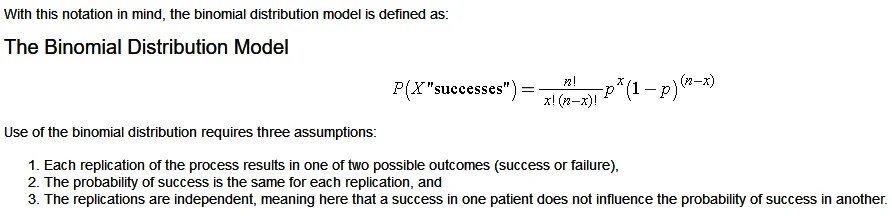
The binomial distribution model allows us to compute the probability of observing a specified number of “successes” when the process is repeated a specific number of times (e.g., in a set of patients) and the outcome for a given patient is either a success or a failure. We must first introduce some notation which is necessary for the binomial distribution model.

First, we let “n” denote the number of observations or the number of times the process is repeated, and “x” denotes the number of “successes” or events of interest occurring during “n” observations. The probability of “success” or occurrence of the outcome of interest is indicated by “p”.

The binomial equation also uses factorials. In mathematics, the factorial of a non-negative integer k is denoted by k!, which is the product of all positive integers less than or equal to k. For example,

  • 4! = 4 x 3 x 2 x 1 = 24,
  • 2! = 2 x 1 = 2,
  • 1!=1.
  • There is one special case, 0! = 1.

Conditions

  • The number of observations n is fixed.
  • Each observation is independent.
  • Each observation represents one of two outcomes (“success” or “failure”).
  • The probability of “success” p is the same for each outcome

Constants

Fitting of Binomial Distribution

Fitting of probability distribution to a series of observed data helps to predict the probability or to forecast the frequency of occurrence of the required variable in a certain desired interval.

To fit any theoretical distribution, one should know its parameters and probability distribution. Parameters of Binomial distribution are n and p. Once p and n are known, binomial probabilities for different random events and the corresponding expected frequencies can be computed. From the given data we can get n by inspection. For binomial distribution, we know that mean is equal to np hence we can estimate p as = mean/n. Thus, with these n and p one can fit the binomial distribution.

There are many probability distributions of which some can be fitted more closely to the observed frequency of the data than others, depending on the characteristics of the variables. Therefore, one needs to select a distribution that suits the data well.

Permutation, Combination

Permutation

In mathematics, a permutation of a set is, loosely speaking, an arrangement of its members into a sequence or linear order, or if the set is already ordered, a rearrangement of its elements. The word “permutation” also refers to the act or process of changing the linear order of an ordered set.

Permutations differ from combinations, which are selections of some members of a set regardless of order. For example, written as tuples, there are six permutations of the set {1,2,3}, namely: (1,2,3), (1,3,2), (2,1,3), (2,3,1), (3,1,2), and (3,2,1). These are all the possible orderings of this three-element set. Anagrams of words whose letters are different are also permutations: the letters are already ordered in the original word, and the anagram is a reordering of the letters. The study of permutations of finite sets is an important topic in the fields of combinatorics and group theory.

Permutations are used in almost every branch of mathematics, and in many other fields of science. In computer science, they are used for analyzing sorting algorithms; in quantum physics, for describing states of particles; and in biology, for describing RNA sequences.

The number of permutations of n distinct objects is n factorial, usually written as n!, which means the product of all positive integers less than or equal to n.

Technically, a permutation of a set S is defined as a bijection from S to itself. That is, it is a function from S to S for which every element occurs exactly once as an image value. This is related to the rearrangement of the elements of S in which each element s is replaced by the corresponding f(s). For example, the permutation (3,1,2) mentioned above is described by the function alpha defined as:

α (1) = 3,

α (2) = 1

α (3) = 2

The collection of all permutations of a set form a group called the symmetric group of the set. The group operation is the composition (performing two given rearrangements in succession), which results in another rearrangement. As properties of permutations do not depend on the nature of the set elements, it is often the permutations of the set {1,2,…n} that are considered for studying permutations.

In elementary combinatorics, the k-permutations, or partial permutations, are the ordered arrangements of k distinct elements selected from a set. When k is equal to the size of the set, these are the permutations of the set.

Combination

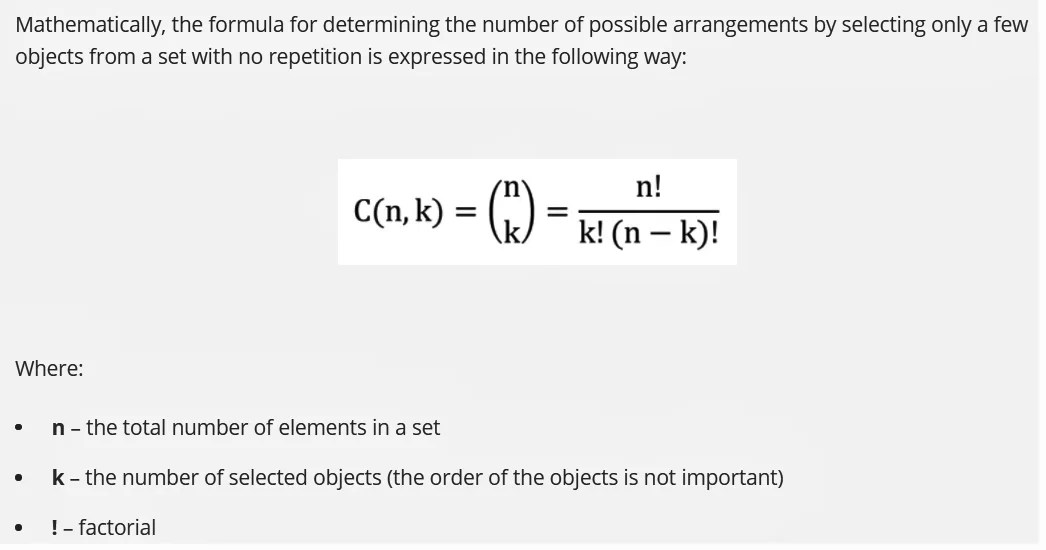
A combination is a mathematical technique that determines the number of possible arrangements in a collection of items where the order of the selection does not matter. In combinations, you can select the items in any order.

Combinations can be confused with permutations. However, in permutations, the order of the selected items is essential. For example, the arrangements ab and ba are equal in combinations (considered as one arrangement), while in permutations, the arrangements are different.

Combinations are studied in combinatorics but are also used in different disciplines, including mathematics and finance.

Basics of Set Theory

Set theory, branch of mathematics that deals with the properties of well-defined collections of objects, which may or may not be of a mathematical nature, such as numbers or functions. The theory is less valuable in direct application to ordinary experience than as a basis for precise and adaptable terminology for the definition of complex and sophisticated mathematical concepts.

Fundamental set concepts

In naive set theory, a set is a collection of objects (called members or elements) that is regarded as being a single object. To indicate that an object x is a member of a set A one writes x ∊ A, while x ∉ A indicates that x is not a member of A. A set may be defined by a membership rule (formula) or by listing its members within braces. For example, the set given by the rule “prime numbers less than 10” can also be given by {2, 3, 5, 7}. In principle, any finite set can be defined by an explicit list of its members, but specifying infinite sets requires a rule or pattern to indicate membership; for example, the ellipsis in {0, 1, 2, 3, 4, 5, 6, 7, …} indicates that the list of natural numbers ℕ goes on forever. The empty (or void, or null) set, symbolized by {} or Ø, contains no elements at all. Nonetheless, it has the status of being a set.

A set A is called a subset of a set B (symbolized by A ⊆ B) if all the members of A are also members of B. For example, any set is a subset of itself, and Ø is a subset of any set. If both A ⊆ B and B ⊆ A, then A and B have exactly the same members. Part of the set concept is that in this case A = B; that is, A and B are the same set.

Representation of Sets

Sets can be represented in two ways:

  • Roster Form or Tabular form
  • Set Builder Form

Roster Form

In roster form, all the elements of the set are listed, separated by commas and enclosed between curly braces { }.

Example: If set represents all the leap years between the year 1995 and 2015, then it would be described using Roster form as:

A = {1996,2000,2004,2008,2012}

Also, multiplicity is ignored while representing the sets. e.g. If L represents a set that contains all the letters in the word ADDRESS, the proper Roster form representation would be

L = {A, D, R, E, S }= {S,E,D,A,R} 

L≠ {A, D, D, R, E, S, S}

Set Builder Form

In set builder form, all the elements have a common property. This property is not applicable to the objects that do not belong to the set.

Example: If set S has all the elements which are even prime numbers, it is represented as:

S= { x: x is an even prime number}

where ‘x’ is a symbolic representation that is used to describe the element.

‘:’ means ‘such that’

‘{}’ means ‘the set of all’

So, S = { x:x is an even prime number } is read as ‘the set of all x such that x is an even prime number’. The roster form for this set S would be S = 2. This set contains only one element. Such sets are called singleton/unit sets.

error: Content is protected !!