Definition, Risk Process

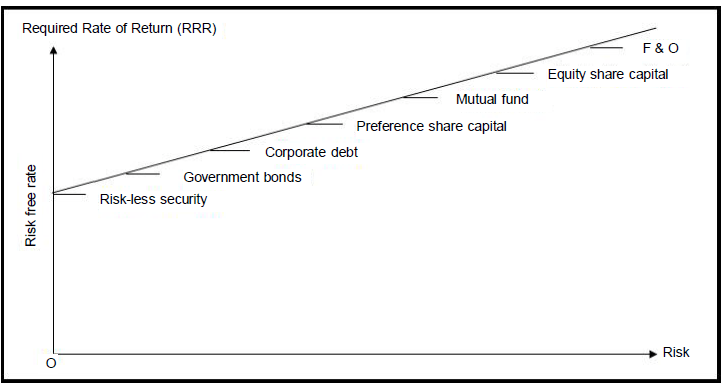
The risk of an investment refers to the variability of its rate of return from the expected rate of return. Statistically, it can be measured with variance, standard deviation, range, and beta.
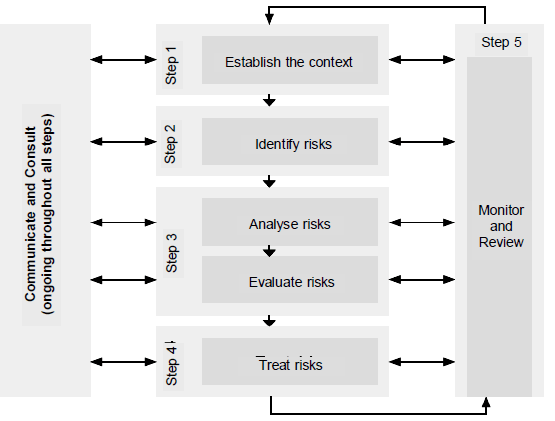
Risk Management is a five-step process:

Step 1: Establish the context

Step 2: Identify the risks

Step 3: Analyse the risks

Step 4: Evaluate the risks

Step 5: Treat the risks

Throughout each step, it is essential that there is consultation and communication with everyone

in organisation about its functions, activities and events (refer to diagram).

Step 1: Establish the Context

Before risk can be clearly understood and dealt with, it is important to understand the context in

which it exists. You should define the relationship between your club and the environment that it

operates in, so that the boundaries for dealing with risks are clear.

Establish the content by considering:

  • The strategic context: The environment within which the organisation operates
  • The organisational context: The objectives, core activities and operation’s of the club.

Step 2: Identify the Risks

The purpose of this step is to identify what could go wrong (likelihood) and what is the consequence (loss or damage) of it occurring.

Risks can be physical, financial, ethical or legal.

Physical risks are those involving personal injuries, environmental and weather conditions and the physical assets of the organisation such as property, buildings, equipment, vehicles, stock and grounds.

Financial risks are those that involve the assets of the organisation and include theft, fraud, loans, license fees, attendances, membership fees, insurance costs, lease payments, pay-out of damages claims or penalties and fines by the government.

Ethical risks involve actual or potential harm to the reputation or beliefs of your club, while legal risks consist of responsibilities imposed on providers, participants and consumers arising from laws made by federal, state and local government authorities.

Step 3: Analyse the Risks (& Evaluate)

This involves analysing the likelihood and consequences of each identified risk and deciding which risk factors will potentially have the greatest effect and should, therefore, receive priority with regard to how they will be managed. The level of risk is analysed by combining estimates of likelihood (table 1) and consequences (table 2), to determine the priority level of the risk (table 3).

It is important to consider the consequences and the likelihood of risk in the context of the activity, the nature of your club and any other factors that may alter the consequences of likelihood of risk.

Risk evaluation involves comparing the level of risk found during the analysis process with previously established risk criteria, and deciding whether risks can be accepted. If the risk falls into the low or acceptable categories, they may be accepted with minimal further treatment. These risks should be monitored and periodically reviewed to ensure they remain acceptable. If risks do not fall into the low or acceptable category, they should be treated using one or more of the treatment options considered in step 4.

Step 4: Treat the Risks

Risk treatment involves identifying the range of options for treating the risk, evaluating those

options, preparing the risk treatment plans and implementing those plans. It is about considering the options for treatment and selecting the most appropriate method to achieve the desired outcome. Options for treatment need to be proportionate to the significance of the risk, and the cost of treatment commensurate with the potential benefits of treatment.

According to the standard, treatment options include:

  • Accepting the risk: For example, most people would consider minor injuries in participating in the sporting activity as being an inherent risk.
  • Avoiding the risk: Is about your club deciding either not to proceed with an activity, or choosing an alternate activity with acceptable risk, which meets the objects of your club. For example, a cricket club wishing to raise funds, may decide that a rock-climbing competition without a properly trained and accredited instructor, equipment, etc. may be risky and may decide on a safer way of raising funds.
  • Reducing the risk: Likelihood, or consequences, or both, is commonly practiced treatment of a risk within sport; for example, use of mouth guards for players in some sports (i.e. contact sports).
  • Transferring the risk: In full or in part, will generally occur through contracts or notices, for example your insurance contract is perhaps the most commonly used risk transfer form used. Other examples include lease agreements, waivers, disclaimers, tickets, and warning signs.
  • Retaining the risk: Is knowing that the risk treatment is not about risk elimination, rather it is about acknowledging, the risk is an important part of the sport activity, and some must be retained because of the inherent nature of the sport activity. It is important to consider the level of risk which is inherent and acceptable.
  • Financing the risk: Means the club funding the consequences of risk i.e. providing funds to cover the costs of implementing the risk treatment. Most community nonprofit sport clubs would not consider this option.

Step 5: Monitor and Review

As with communication and consultation, monitoring and review is an ongoing part of risk management that is integral to every step of the process. It is also the part of risk management that is most often given inadequate focus, and as a result, the risk management programs of many organisations become irrelevant and ineffective over time. Monitoring and review ensure that the important information generated by the risk management process is captured, used and maintained.

Few risks remain static. Factors that may affect the likelihood and consequences of an outcome may change, as may the factors that affect the suitability or cost of the various treatment options.

Review is an integral part of the risk management treatment plan. As discussed earlier, risk management is an integral part of all core business functions, and it should be seen and treated as such. Risk management should be fully incorporated into the operational and management processes at every level of the organisation and should be driven from the top down.
Risk Immunization

Immunization, also known as multi-period immunization, is a risk-mitigation strategy that matches the duration of assets and liabilities, minimizing the impact of interest rates on net worth over time. For example, large banks must protect their current net worth, whereas pension funds have the obligation of payments after a number of years. These institutions are both concerned about protecting the future value of their portfolios and must deal with uncertain future interest rates.

Immunization helps large firms and institutions protect their portfolios from exposure to interest rate fluctuations. Using a perfect immunization strategy, firms can nearly guarantee that movements in interest rates will have virtually no impact on the value of their portfolios.

Immunization is considered a “quasi-active” risk mitigation strategy since it has the characteristics of both active and passive strategies. By definition, pure immunization implies that a portfolio is invested for a defined return for a specific period of time regardless of any outside influences, such as changes in interest rates.

The opportunity cost of using the immunization strategy is potentially giving up the upside potential of an active strategy for the assurance that the portfolio will achieve the intended desired return. As in the buy-and-hold strategy, by design, the instruments best suited for this strategy are high-grade bonds with remote possibilities of default. In fact, the purest form of immunization would be to invest in a zero-coupon bond and match the maturity of the bond to the date on which the cash flow is expected to be needed. This eliminates any variability of return, positive or negative, associated with the reinvestment of cash flows.

In finance, interest rate immunisation, as developed by Frank Redington is a strategy that ensures that a change in interest rates will not affect the value of a portfolio. Similarly, immunisation can be used to ensure that the value of a pension fund’s or a firm’s assets will increase or decrease in exactly the opposite amount of their liabilities, thus leaving the value of the pension fund’s surplus or firm’s equity unchanged, regardless of changes in the interest rate.

Interest rate immunisation can be accomplished by several methods, including cash flow matching, duration matching, and volatility and convexity matching. It can also be accomplished by trading in bond forwards, futures, or options.

Other types of financial risks, such as foreign exchange risk or stock market risk, can be immunised using similar strategies. If the immunisation is incomplete, these strategies are usually called hedging. If the immunisation is complete, these strategies are usually called arbitrage.

Cash flow matching

Conceptually, the easiest form of immunisation is cash flow matching. For example, if a financial company is obliged to pay 100 dollars to someone in 10 years, it can protect itself by buying and holding a 10-year, zero-coupon bond that matures in 10 years and has a redemption value of $100. Thus, the firm’s expected cash inflows would exactly match its expected cash outflows, and a change in interest rates would not affect the firm’s ability to pay its obligations. Nevertheless, a firm with many expected cash flows can find that cash flow matching can be difficult or expensive to achieve in practice. That meant that only institutional investors could afford it. But the latest advances in technology have relieved much of this difficulty. Dedicated portfolio theory is based on cash flow matching and is being used by personal financial advisors to construct retirement portfolios for private individuals. Withdrawals from the portfolio to pay living expenses represent the stream of expected future cash flows to be matched. Individual bonds with staggered maturities are purchased whose coupon interest payments and redemptions supply the cash flows to meet the withdrawals of the retirees.

Difficulties

Immunisation, if possible and complete, can protect against term mismatch but not against other kinds of financial risk such as default by the borrower (i.e., the issuer of a bond). It might also be difficult to find assets with suitable cashflow structures that are necessary to ensure a particular level of overall volatility of assets to have a proper match with that of liabilities.

Once there is a change in interest rate, the entire portfolio has to be restructured to immunise it again. Such a process of continuous restructuring of portfolios makes immunisation a costly and tedious task.

Users of this technique include banks, insurance companies, pension funds and bond brokers; individual investors infrequently have the resources to properly immunise their portfolios.

The disadvantage associated with duration matching is that it assumes the durations of assets and liabilities remain unchanged, which is rarely the case.

Risk Management V/s Risk Measurement

Risk Management

According to the Marquette University Risk Unit, risk management is the continuing process to identify, analyze, evaluate, and treat loss exposures and monitor risk control and financial resources to mitigate the adverse effects of loss. We typically simplify this a bit and describe it as the Identification, Analysis (or Measurement), Treatment and Monitoring of risk. 

Risk Management is the art, science, process and all the ongoing activities involved in identifying, understanding, assessing, monitoring and then effectively reducing one’s exposure to risks, and the likelihood, impact and undesirable results should any of those risks materialize.

Although risks can be managed, it’s important to appreciate that risks are always evolving (Old risks can metamorphose and change, while new, unfamiliar risks are always emerging) and can never be truly eliminated.

Risk Measurement is the effort to “quantify” the likelihood and potential impact of a given risk or set of risks occurring. It’s just one of the many possible elements of risk assessment.

Measuring risk is generally conducted by using probability and statistical analysis of historic data that conforms to a classic “normal” bell curve distribution. As a result “Standard deviation” is the most common unit now used for risk measurement.

This approach was first articulated by Prof. Frank Knight, in his 1921 book “Risk, Uncertainty, and Profit.” In that book Dr. Knight was the first person to observe that the principal difference between Risk and Uncertainty is that “Risk” can be measured (using statistical methods) and “Uncertainty” cannot be measured. That’s so because the variability of the range of outcomes of uncertain phenomena do not conform to the bell curve distribution model, and by definition cannot measured.

As a result its extremely important to recognize the risk measurement is only reliable when its used in analyzing phenomenon where bell curve distribution patterns are the norm, (outcomes are unknown, but probabilities are known) such as casino gambling, slot machines, lottery, height, weight, and life expectancy.

Attempting to measure risk in areas where uncertainty reigns, (Outcomes are unknown and probabilities are unknown) such as romance, war, earthquakes, business, and investing is flawed & problematic from the very start.

Risk Organization

Risk Organization is the process of identifying, quantifying, and managing the risks that an organisation faces. As the outcomes of business activities are uncertain, they are said to have some element of risk. These risks include strategic failures, operational failures, financial failures, market disruptions, environmental disasters, and regulatory violations. Risk is a statistical concept that is measured using statistical concepts that are related to the unknown future. Almost all investments are exposed to it.

Risk Organization involves identifying the types of risk exposure within the company, measuring those potential risks, proposing means to hedge, insure or mitigate some of the risks and estimating the impact of various risks on the future earnings of the company.

While it is impossible that companies remove all risk from the organisation, it is important that they properly understand and manage the risks that they are willing to accept in the context of the overall corporate strategy. The Organization of the company is primarily responsible for risk Organization, but the board of directors, internal auditor, external auditor, and general counsel also play critical roles.

Risk can be managed in a number of ways: by the buying of insurance, by using derivative instruments as hedges, by sharing risks with others, or by avoiding risky positions altogether.

Duration Analysis of Risk

Duration is a measure of the sensitivity of the price of a bond or other debt instrument to a change in interest rates. A bond’s duration is easily confused with its term or time to maturity because they are both measured in years. However, a bond’s term is a linear measure of the years until repayment of principal is due; it does not change with the interest rate environment. Duration, on the other hand is non-linear and accelerates as time to maturity lessens.

Duration measures how long it takes, in years, for an investor to be repaid the bond’s price by the bond’s total cash flows. At the same time, duration is a measure of sensitivity of a bond’s or fixed income portfolio’s price to changes in interest rates. In general, the higher the duration, the more a bond’s price will drop as interest rates rise (and the greater the interest rate risk). As a general rule, for every 1% change in interest rates (increase or decrease), a bond’s price will change approximately 1% in the opposite direction, for every year of duration. If a bond has a duration of five years and interest rates increase 1%, the bond’s price will drop by approximately 5% (1% X 5 years). Likewise, if interest rates fall by 1%, the same bond’s price will increase by about 5% (1% X 5 years).

Certain factors can affect a bond’s duration, including:

  • Time to maturity. The longer the maturity, the higher the duration, and the greater the interest rate risk. Consider two bonds that each yield 5% and cost $1,000, but have different maturities. A bond that matures faster say, in one year would repay its true cost faster than a bond that matures in 10 years. Consequently, the shorter-maturity bond would have a lower duration and less risk.
  • Coupon rate. A bond’s coupon rate is a key factor in calculation duration. If we have two bonds that are identical with the exception on their coupon rates, the bond with the higher coupon rate will pay back its original costs faster than the bond with a lower yield. The higher the coupon rate, the lower the duration, and the lower the interest rate risk.

The duration of a bond in practice can refer to two different things. The Macaulay duration is the weighted average time until all the bond’s cash flows are paid. By accounting for the present value of future bond payments, the Macaulay duration helps an investor evaluate and compare bonds independent of their term or time to maturity.

The second type of duration is called “modified duration” and, unlike Macaulay duration, is not measured in years. Modified duration measures the expected change in a bond’s price to a 1% change in interest rates. In order to understand modified duration, keep in mind that bond prices are said to have an inverse relationship with interest rates. Therefore, rising interest rates indicate that bond prices are likely to fall, while declining interest rates indicate that bond prices are likely to rise.

Macaulay Duration

Macaulay duration finds the present value of a bond’s future coupon payments and maturity value. Fortunately for investors, this measure is a standard data point in most bond searching and analysis software tools. Because Macaulay duration is a partial function of the time to maturity, the greater the duration, the greater the interest-rate risk or reward for bond prices.

Macaulay duration can be calculated manually as follows:

CRM Trends, Challenges and Opportunities

Customer Relationship Management (CRM) continues to evolve, driven by technological advancements and shifting customer expectations. Understanding the current trends, challenges, and opportunities in CRM can help businesses adapt and thrive in a competitive landscape. Here’s a detailed look at the trends, challenges, and opportunities in CRM:

Trends

  • Artificial Intelligence (AI) and Automation:

AI and machine learning are increasingly integrated into CRM systems to automate routine tasks, provide predictive analytics, and enhance decision-making. AI can help personalize customer interactions and improve service efficiency by offering insights based on customer data.

  • Omnichannel Customer Experience:

Businesses are focusing on providing a seamless customer experience across all channels, including social media, mobile, email, and in-person interactions. This holistic approach ensures consistent service and communication, regardless of how or where a customer reaches out.

  • Increased Focus on Customer Data Protection:

With data breaches and privacy concerns on the rise, there is a greater emphasis on securing customer data. Compliance with regulations like GDPR and others has become a priority for CRM systems.

  • Social CRM:

Integrating social media with CRM allows businesses to engage directly with customers on social platforms, providing support and harnessing customer insights from social interactions.

  • Mobile CRM:

As mobile usage continues to grow, mobile CRM has become essential. This trend includes everything from mobile-friendly CRM applications to features that enable sales teams to access information and interact with CRM systems from anywhere.

Challenges

  • Data Integration and Silos:

Integrating data from various sources and breaking down data silos within an organization remain significant challenges. Ensuring that CRM systems can communicate effectively with other data systems is crucial for a unified view of the customer.

  • Adapting to New Technologies:

Keeping up with rapid technological changes and choosing the right technologies to invest in can be daunting for businesses. There’s a risk of falling behind if new tools and functionalities are not adopted timely.

  • User Adoption:

Despite the deployment of advanced CRM systems, user adoption can be low due to complexity or change resistance. Training and change management are critical to maximizing the benefits of CRM investments.

  • Maintaining Personal Touch:

In the age of automation and digital interaction, maintaining a personal touch in customer relationships is challenging but crucial for customer loyalty.

Opportunities

  • Enhanced Customer Segmentation:

Advanced data analytics provided by CRM systems allow for more detailed customer segmentation. This can lead to more precisely targeted marketing campaigns and more personalized customer service.

  • Predictive Analytics:

Using predictive analytics, businesses can forecast customer behaviors, purchase patterns, and potential churn. This enables proactive strategies for customer retention and upselling.

  • Customer Service Innovation:

CRM technologies enable innovative customer service solutions like chatbots, virtual assistants, and interactive self-service portals that can operate 24/7, enhancing customer satisfaction.

  • CRM as a Strategic Asset:

Beyond managing customer interactions, CRM systems are increasingly viewed as strategic assets that can drive decision-making and business growth.

  • Expanding into New Markets:

Global accessibility and data insights can help businesses understand new markets better and tailor their strategies accordingly when expanding globally.

Different Levels of e-CRM

eCRM, or electronic-Customer Relationship Management, is typically structured at various levels to cater to different aspects of customer interactions and business processes in a digital environment. These levels of e-CRM help organizations optimize their customer relationship management strategies according to their specific operational needs and customer engagement goals.

  • Foundational Services:

This level includes the basic services necessary for managing customer relationships through electronic systems. It involves the integration of web-based technologies to support direct interactions with customers via the internet. Services such as website management, email communications, and basic customer data analytics fall under this category.

  • Customer-Centric Services:

At this level, the focus shifts from foundational web services to more personalized and customer-focused interactions. This includes services that enhance the customer experience, such as personalization engines, tailored marketing communications, and enhanced online support. The goal here is to understand and address the individual needs and preferences of each customer.

  • Value-Added Services:

This advanced level involves creating additional value for both the customer and the company through sophisticated e-CRM tools. These services might include advanced analytics, real-time customer support (like chatbots), mobile CRM capabilities, and integration with other advanced technologies such as AI and IoT. The emphasis is on offering unique and premium services that differentiate the company’s offerings and enhance customer satisfaction and loyalty.

  • Collaboration Services:

Collaboration services involve facilitating interaction not only between the company and its customers but also between customers themselves and between employees. This can include features such as forums, customer reviews, collaborative filtering, and social media integration. The idea is to create a community around the brand, encouraging engagement and feedback.

  • Integration Services:

At the highest level of e-CRM, services are fully integrated across all departments and touchpoints. This includes seamless integration of back-end and front-end systems, cross-channel customer service, and unified views of customer data across all platforms. Integration services ensure that all parts of the organization are aligned in understanding and serving customers, leading to a consistent and holistic customer experience.

Features, Advantages and Functional Components of eCRM

Electronic Customer Relationship Management (eCRM) is a technology-driven approach to managing customer interactions and relationships through internet-based platforms and digital tools. eCRM integrates various forms of digital communication technologies, such as web services, email, and social media, to facilitate real-time, personalized customer support and services. This strategy enables businesses to engage customers more effectively by providing tailored marketing, sales, and customer service experiences across digital channels. eCRM leverages data analytics and automated systems to gather insights about customer preferences and behaviors, allowing for more efficient and targeted outreach. The ultimate goal of eCRM is to enhance customer satisfaction and loyalty, streamline service processes, and boost business profitability by optimizing digital interactions.

Features of eCRM:

  • Multichannel Integration:

eCRM systems are designed to consolidate customer interactions across various digital channels such as email, social media, live chat, and websites. This integration ensures a seamless customer experience and centralized data management.

  • Customer Analytics:

eCRM tools include advanced analytics capabilities that track and analyze customer behavior, preferences, and engagement across digital platforms. These insights help businesses tailor their marketing and customer service strategies to better meet individual customer needs.

  • Personalization:

By leveraging data collected through customer interactions, eCRM systems enable businesses to deliver personalized content, recommendations, and offers to individual customers, enhancing the customer experience and increasing engagement and loyalty.

  • Automation:

eCRM systems automate routine tasks such as sending follow-up emails, marketing messages, and alert notifications. Automation increases efficiency and consistency in customer communications and operational processes.

  • Customer Segmentation:

Effective segmentation tools within eCRM allow businesses to divide their customer base into distinct groups based on demographics, behavior, purchasing patterns, and other criteria. This enables more targeted and effective marketing campaigns.

  • Self-Service Portals:

Many eCRM systems include self-service portals where customers can access information, manage their accounts, and resolve issues on their own. This feature enhances customer satisfaction by providing immediate assistance and empowering customers to find quick solutions.

  • Mobile Compatibility:

With the increasing use of smartphones and tablets, eCRM systems are optimized for mobile access, allowing both customers and business users to interact with the system from anywhere, enhancing accessibility and convenience.

  • Social Media Management:

eCRM integrates social media management tools that help businesses monitor and engage with customers on various social media platforms. This feature is crucial for managing public relations, customer service, and marketing efforts in today’s highly connected digital environment.

Advantages of eCRM:

  • Enhanced Customer Insights:

eCRM systems use data analytics to provide deep insights into customer behavior, preferences, and needs. This allows businesses to make data-driven decisions and tailor their strategies to better meet customer expectations.

  • Improved Customer Service:

With tools like live chat, FAQs, and automated responses, eCRM enables faster and more effective customer service. The ability to quickly resolve issues and provide support enhances customer satisfaction and loyalty.

  • Increased Efficiency:

Automation of routine tasks such as data entry, customer notifications, and marketing campaigns reduces the workload on staff and increases operational efficiency, allowing teams to focus on more strategic activities.

  • Higher Sales and Marketing Effectiveness:

eCRM systems facilitate targeted marketing campaigns based on customer data and behavior. This targeted approach leads to higher conversion rates and more effective sales strategies.

  • Centralized Communication:

By integrating all customer interactions into one platform, eCRM ensures that communication is consistent and all team members are on the same page, reducing the likelihood of customer relationship mismanagement.

  • Scalability:

eCRM solutions are typically scalable, meaning they can grow with your business. Whether adding new features, integrating additional communication channels, or expanding the customer base, eCRM systems can adapt to changing business needs.

  • Cost Reduction:

By automating processes and improving customer interaction efficiency, eCRM can significantly reduce costs associated with customer management, including labor costs and investment in multiple disparate tools.

  • Improved Customer Retention:

Personalized interactions and quicker, more responsive customer service foster a positive customer experience. eCRM tools help in predicting customer churn and taking proactive steps to retain customers, thus improving overall retention rates.

Functional Components of eCRM:

Electronic Customer Relationship Management (eCRM) integrates various functional components that enable businesses to optimize their interactions with customers through digital platforms. These components are crucial for managing different aspects of customer relationships and delivering personalized services efficiently.

  • Sales Force Automation (SFA):

SFA tools help streamline all phases of the sales process, from lead management to closing deals. This includes automating sales tasks, tracking customer interactions, managing contacts, scheduling appointments, and monitoring sales performance metrics.

  • Customer Service and Support:

This component focuses on providing after-sales support through various digital channels such as email, live chat, and social media. It includes features for managing tickets, FAQs, knowledge bases, and customer feedback. Automation of responses and issue tracking helps in resolving customer issues faster and more effectively.

  • Marketing Automation:

Marketing tools within eCRM systems help in automating repetitive tasks like email marketing, social media posts, and campaign tracking. These tools also assist in segmenting customers, personalizing marketing messages, and analyzing the effectiveness of different marketing strategies.

  • Customer Analytics and Data Management:

This crucial component involves collecting, analyzing, and managing customer data to derive insights that inform business decisions. Analytics can reveal patterns in customer behavior, preferences, and engagement levels, helping to shape personalized marketing and sales strategies.

  • Customer Interaction Management (CIM):

CIM tools ensure that every customer interaction across multiple channels is tracked and managed effectively. This helps in creating a cohesive view of the customer journey, enhancing the ability to respond to customer needs promptly.

  • E-commerce Integration:

For businesses that sell products or services online, eCRM integrates e-commerce functionalities such as shopping carts, product catalogs, and online payment systems. This integration ensures a seamless shopping experience for customers and a unified backend for sales and inventory management.

  • Mobile CRM:

Mobile CRM functionalities enable sales and customer service teams to access CRM data from mobile devices, facilitating real-time updates and interactions, even when they are away from the office. This is particularly beneficial for field sales professionals and service teams.

  • Social CRM:

This component integrates social media platforms into the CRM system, allowing companies to monitor social conversations, engage with customers directly on social platforms, and gather valuable insights from social media interactions.

  • Workflow Automation:

Workflow automation tools within eCRM help in designing and automating business processes based on CRM data. This includes automating tasks such as lead routing, approval processes, and alert notifications to streamline operations and reduce manual intervention.

Ethical issues in CRM

Customer Relationship Management (CRM) can be beneficial to both supplier and customer. The supplier reduces costs by offering only products that are wanted, when they are wanted, and he passes the cost savings on to the customer who signed up for the company’s CRM. To implement such a system, extensive information about the customer must be collected and stored. The two concerns with regard to this system are customer privacy and the accuracy of the information collected.

Collecting Customer Data

Ethical issues originating with the collection of customer data for CRM are related to secure collection methods and to the verification of the information. Ethical companies ensure that sensitive information such as credit credit card numbers or medical histories are collected in a secure environment and transmitted back to the databases securely. During data collection, it is also critical to verify the identity of the customer and the accuracy of the information being submitted. High security for these functions is costly but ethically necessary.

Storing CRM Data

Once customer data is safely in a company database, ethical companies adhere to four principles regarding storage. Data is only stored with the agreement of the customer. Customers must be able to view their data and either change their data or ask for it to be changed. Customers can withdraw from the program, and such a withdrawal causes their data to be erased. The ethics behind these principles are that the data belongs to the customer and the customer must be able to control his data.

Using CRM Data

Given that much of the customer data for CRM is sensitive, ethical companies ensure the data is kept private to the maximum extent possible. To achieve this, the company must store the data in a form or in a location not generally accessible. The data must only be consulted when necessary for the fulfillment of a CRM task, and only those employees who handle the data to complete the task are able to access the data. When sub-suppliers need to use the data, they must first commit to restrictions similar to what the CRM company has in place.

Disposing of CRM Data

Since customers must be able to withdraw from the CRM program and since their data is then erased, the company needs a procedure in place for safely destroying customer data when it is no longer needed. While deletion from the database is initially sufficient as long as the database remains secure, data on obsolete equipment and equipment that changes status to non-secure is at risk. An ethical company has detailed policies and procedures for tracking and destroying data and keep accurate records of such activities.

Mobile CRM

Mobile CRM, or Mobile Customer Relationship Management, is a CRM tool designed for mobile devices including smartphones and tablets. By connecting through mobile CRM, you allow your sales team’s access to customer data through a mobile CRM app or through a web-based browser with cloud CRM. A key benefit of using mobile CRM is to allow your sales force to access real time data while out in the fields meeting prospects and customers.

Getting started with Mobile CRM

Before you begin to implement your mobile CRM, it is important that you define goals on what you want to achieve by having a mobile CRM and what your work force needs in order to take advantage of real time data access.  I’ve outlined three highly important areas you will need to address before launching:

  1. Internal buy-in

Before you implement a mobile CRM app, it is important that you get internal buy-in from the sales force. Your sales teams are the ones that will be using the smart phone application daily and in order to get their buy-in, you need to implement extensive in-house training on how to use the application in the form of user guides and training programs as well as explaining the key benefits of what they can achieve by working with the mobile CRM.

  1. Provide the device

People love getting things for free and one of the easiest ways to get your sales team to adopt a smart phone CRM is to provide the device itself to your sales force and include the application pre-installed. Although most CRM mobile apps are supported by iOS, Android and Blackberry, make sure that you check with the provider before giving it to your sales force.

  1. Mobile app usability

Your sales force will rarely need access to complete functionality on their CRM mobile app to all the same data and reporting they would access via their desktop. Start out by providing only basic access that the teams use on a day to day basis. For example, writing and sending an email, scheduling a meeting and/ or updating contact information.

Selling on the move – The next generation of CRM

Introducing mobile CRM to your sales operation can be a dramatic change for the better. Your salespeople can update and synchronise information on the move, sharing real-time data from across the business. Day-to-day sales tasks are freed from the desktop, so a salesperson carrying a tablet or smartphone can:

  • Plan the day with calendar integration
  • Dial in to meetings with click-to-call
  • Access and update leads, contacts and oportunities
  • Open and share files
  • Access dashboards

But today’s mobile CRM platforms can do so much more. Add cloud storage to mobile CRM functionality and you’re no longer synchronising data with a local copy you’re accessing live, centrally held information from whichever device you choose. Distributed teams can share files and background information and can update, share and send proposals on the move.

Custom apps can feed information directly into your CRM back end, with new app releases rolled out to your sales team in real time. Every salesperson has the benefit of complete CRM data, analytics and customer-facing material at their fingertips, on any device freeing them to spend more time on sales and less on administrative tasks.

Expert answers, anytime, anywhere

Using a CRM platform to handle and track customer service activity already makes sense, and adding a mobile dimension brings even more benefits. Combining mobile with social CRM gives you a whole new range of capabilities. Not only can your customers now contact you where and when they choose, but you can track, manage and respond to every case with the full capability of your CRM platform.

A mobile CRM platform means instant, simple escalation, with issues routed straight to the right subject matter expert, product manager or executive, regardless of location. You can implement round-the-clock cover for urgent queries and respond on the same platforms your customers use no more losing issues as they change from one channel to another.

error: Content is protected !!