Relationship between Elasticity of Demand and Revenue

It’s human nature. If the price of a product goes up, consumers buy less of it. If the price goes down, consumers buy more. In economic terms, that’s called price elasticity. But what if the price of gasoline goes up, the gas tank in your SUV is on empty, and you have to be at work in 20 minutes? Will you refuse to buy gasoline because the price is high? Of course not. You don’t have any alternative, so you pay the higher price, buy the needed quantity of gasoline and go to your job. That’s called price inelasticity.

Price Elasticity

Price elasticity measures the changes in demand for a product in reaction to changes in the price for that product. It’s a ratio of percentages, and the formula is as follows:

Price elasticity of demand = Percentage change in demand ÷ Percentage change in price

When this ratio is greater than one, the price is considered to be elastic, and demand declines as the price increases. When the ratio is less than one, the demand for a product does not change substantially with changes in price. In this case, a company could increase its prices and not suffer a significant decline in sales volume.

Example of Price Elasticity

Let’s suppose that a 10-count box of Quaker Instant Oatmeal sells for $2.18. When the price goes up to $2.59, the demand drops from 500 boxes per week to 350 boxes per week. The elasticity is calculated as follows:

Price elasticity = ((500 – 350)/500) ÷ (($2.18-$2.59)/$2.18)

= (150/500) ÷ ($0.41/$2.18)

= 30 percent ÷ 19 percent

= 1.6

Since the result, 1.6, is greater than one, the price elasticity for an increase in the price of Quaker Oatmeal is high. The price for oatmeal goes up, and consumers buy less of the product. They may start buying other cereal products, or they might switch to the grocery store’s generic brand of oatmeal.

Factors That Affect Elasticity

The factors that affect the price elasticity of any product include:

(i) Substitutes

As in the case of rising prices for oatmeal, consumers can shift their purchases to similar products if they are readily available. Coca-Cola and Pepsi are products that can be easily substituted for each other when prices change. This is an example of elastic demand. If the alternatives are limited, the demand is less elastic.

(ii) Necessities versus luxuries

Necessities are products that people must have regardless of the price. Everyone has to drink water, so if the water company raises prices, people continue to consume and pay for it. Luxuries are optional; they aren’t necessary to live. Large-screen HDTVs are nice to have, but if the prices go up, consumers can put off buying them.

(iii) Share of the consumer’s income

Products that consume a high proportion of a family’s income are sensitive to price increases. A car is a good example. Increases in car prices can cause a family to delay purchasing a new car. They keep their old car longer and make the necessary repairs. However, if a grocery store increases the price of toothpicks, consumers still buy them because the price isn’t a big piece of their income.

(iv) Short-term versus long-term timing

Gasoline is an excellent example of a product that prices inelastic in the short term but elastic in the long term. When gas prices go up, the consumer still has to buy gas to get to work. However, if gas prices stay high for the long term, consumers make changes. They may buy more fuel-efficient cars, set up a carpool with other workers, or start taking a train or bus to work.

Why Elasticity Is Important?

Marketers must have some knowledge about the elasticity of their products to set pricing strategies. If marketers know that the demand for their products is inelastic, then they can raise prices without fear of losing sales. On the other hand, if demand for their products is highly elastic, then raising prices could be a dangerous game.

The relationship between price elasticity and total revenue is an important metric for marketers to understand. Understanding whether the price of a product is elastic or inelastic is essential for a company to develop an effective marketing campaign and survive in the marketplace. Price elasticity is a tool that marketers can use against their competitors to increase their share of a market.

Demand Estimation and Forecasting

Demand Estimation is the process of predicting the future demand for a product or service based on historical data, market trends, and influencing factors. It involves analyzing variables such as price, income levels, population, consumer preferences, and substitute goods to determine the quantity consumers are likely to purchase. Demand estimation is crucial for businesses to plan production, set prices, allocate resources efficiently, and develop strategies for market penetration. Methods include statistical techniques, surveys, and econometric models. Accurate demand estimation helps minimize risks, reduce costs, and align supply with anticipated consumer needs, ensuring better decision-making and market competitiveness.

Demand Forecasting refers to the process of predicting future consumer demand for a product or service over a specific period. It is based on the analysis of historical sales data, market trends, and external factors like economic conditions, seasonal variations, and industry developments. Businesses use demand forecasting to make informed decisions about production planning, inventory management, staffing, and financial budgeting. Techniques include qualitative methods like expert opinion and quantitative approaches such as time-series analysis and regression models. Accurate forecasting helps companies meet customer demand efficiently, avoid overproduction or stockouts, and improve overall operational and financial performance.

1. Survey Methods

Survey methods are qualitative approaches that gather firsthand information from consumers, experts, or market participants. These methods are particularly useful for new products or when historical data is unavailable.

Techniques in Survey Methods

  1. Consumer Survey

    • Directly asks consumers about their future purchasing intentions.
    • Methods include interviews, questionnaires, or focus groups.
    • Effective for products with short purchase cycles or in small markets.
  2. Sales Force Opinion

    • Relies on the insights of sales representatives who interact with customers.
    • Aggregates predictions from sales teams to estimate demand.
    • Useful when sales teams have a deep understanding of customer behavior.
  3. Expert Opinion (Delphi Method)

    • Gathers insights from industry experts or specialists.
    • Repeated rounds of discussion refine estimates, leading to consensus.
    • Best for forecasting in industries with rapid technological changes.
  4. Market Experimentation

    • Tests demand by introducing the product in a limited market or under controlled conditions.
    • Provides empirical data for forecasting in wider markets.

Advantages

  • Provides real-time and targeted information.
  • Particularly helpful for new products or industries.
  • Easy to adapt to specific markets or customer segments.

Limitations

  • Expensive and time-consuming, especially for large-scale surveys.
  • Responses may be biased or inaccurate.
  • Results are often subjective and less reliable for long-term forecasts.

2. Statistical Methods

Statistical methods use quantitative techniques to analyze historical data and predict future demand. These methods are preferred for established products with available historical data.

Techniques in Statistical Methods

  1. Time-Series Analysis

    • Studies historical data to identify patterns or trends.
    • Techniques include moving averages, exponential smoothing, and seasonal decomposition.
    • Suitable for stable markets with predictable demand cycles.
  2. Regression Analysis

    • Examines relationships between demand (dependent variable) and influencing factors (independent variables like price, income, or advertising).
    • Helps identify key determinants of demand and predict changes based on these factors.
  3. Trend Projection

    • Extends historical trends into the future using graphical or mathematical methods.
    • Simple and effective for products with consistent growth or decline patterns.
  4. Econometric Models

    • Builds complex models using economic theories to predict demand.
    • Incorporates multiple variables and interdependencies.
    • Useful for detailed analysis and policy evaluation.
  5. Seasonal Index

    • Adjusts forecasts to account for seasonal variations in demand.
    • Common in industries like retail, tourism, and agriculture.

Advantages

  • Based on objective and reliable data.
  • Effective for long-term and large-scale forecasting.
  • Provides quantifiable and reproducible results.

Limitations

  • Requires accurate and extensive historical data.
  • Assumes past patterns will continue in the future, which may not hold true.
  • Complex methods may require expertise and advanced tools.

Demand Estimation

It’s difficult to plan your future sales and success if you don’t have any idea what the appetite is in the marketplace for your goods and services. Although there is no perfect way of predicting what your customers may want to buy in the future, there are some demand estimation methods that can give you a quantifiable idea of what you can expect. While these demand estimation methods vary slightly in how they are implemented, they will help you plan your marketing strategies to account for anticipated sales. Using demand estimation methods, you can gauge how many goods to produce and how many services to offer, and you can also determine whether or not expansion is feasible.

Elements of Demand Estimation

Demand estimation in managerial economics refers to predicting how consumers will behave in relation to your products and services in the future. The estimation is often based on a number of different variables that can include changes in price, changes in how your competition increases or decreases its prices, and economic factors such as a recession, which would affect consumer buying. By applying these variables, you can analyze how your customer’s demands might change for the better or for the worse depending on a specific factor. As a result, you may decide that you can raise prices because demand will remain steady or even increase, or you may decide that you will have to pull back on production because circumstances are not likely to be favorable. Demand estimation in managerial economics is an important way for you to determine the short-term and long-term course of your business.

Methods of Demand Estimation

There are several methods of demand estimation in managerial economics that can help you obtain a clear picture of what might happen to customer demand level in the future. One of the popular steps in demand estimation is to conduct a survey, which often includes focus groups and direct interviews with customers. Surveys are useful because you are obtaining information from your target market and they can tell you their fears, hopes, and future plans. However, there are some drawbacks with this method because customers may tell you what they will do in the future and circumstances could quickly change those purchasing plans. It’s also difficult to get a truly representative sample when you conduct surveys.

Another of the common steps in demand estimation is regression analysis in which a dependent variable such as demand for a product or service is compared to an independent variable such as price. Regression analysis relies heavily on statistics to create a comprehensive picture of future consumer demand based on specific independent variables. A basic regression analysis model will only make comparisons between the dependent variable and one independent variable. A more complex regression analysis model will make comparisons between the dependent variable and multiple independent variables.

Demand Estimation Considerations

Regardless of the steps in demand estimation that you use, it’s important to understand that this process can help you when it comes to pricing and production. When you offer a new product or start a new business, you may not have any idea how to price your product. When you have an idea what the demand will be for the product or service, you know approximately how much you can charge for that product or service. This can help you avoid overpricing your product or service. Demand estimation can also help you with production. For example, if the demand in your market is projected to be for 50,000 units, you can produce enough goods to account for that demand without over-producing. Remember also that these estimations are only educated guesses as to what the demand for a product or service will be. Always allow some room for error in the estimation of the demand for your business or you may be in for some surprises.

Methods of Demand Estimation

Good business decisions are almost always based on fact. Factual data provides a measure of objectivity, even when a decision ultimately comes down to your best educated guess. Although demand estimation is really an educated guess, it can include the use of fact, up to and including a set of complex statistical calculations that can be difficult to understand and to complete. While other available methods may be less scientific, they are also easier to use. Because demand estimation provides crucial information, every business owner should be familiar with the concept and know how to apply estimation results.

The Basics

Demand estimation is a prediction focusing on future consumer behavior. It predicts demand for a business’s products or services by applying a set of variables that show how, for example, price changes, a competitor’s pricing strategy or changes in consumer income levels will affect product demand. Once armed with this information, management can then begin to make strategic business decisions ranging from reviewing pricing strategies to setting product inventory levels to deciding whether to make fixed asset investments and whether to introduce a new product or enter a new market.

  1. Survey Method

Consumer interviews, surveys and focus group meetings are a grass-roots method of estimating demand. The method operates under the idea that consumers know themselves best and that interacting with consumers directly is the best way to estimate future product demand. Getting information directly from consumers, however, decreases objectivity and increases the chance of errors. It can be difficult, for example, to get a truly random sample of the target consumer population. Consumer responses may also be biased in that responses may not reflect what a consumer will do, but rather what they would like to do, or a consumer may be unable to provide a precise or accurate response.

  1. Market Study Method

Market studies are a direct demand estimation method that combines consumer interaction with science. The process starts by setting a constant, such as price, and variables such as size and/or color. Market studies then display products at, for example, the same price, but in a variety of sizes and locations or settings over a period of time. Once the study is complete, analyzing the results reveals how demand for the product at that price changes according to, in this case, size or color.

  1. Regression Analysis Method

Demand estimation can also rely on regression analysis, a statistical way to find the best relationship between a dependent variable in this case, product demand and one or more independent variables, such as price or location. Although fully understanding demand estimation calculations requires a background in statistics, the process is not difficult to understand. Setup starts by identifying and obtaining data, such as cross-sectional market data or results of a time study or consumer survey on the independent variable or variables to be used in the calculation. Next comes choosing between using a simple or multiple regression model, depending on whether the calculation includes one or multiple variables. Both models display demand as an unknown. Parameters such as a specific price or average annual income are set. Statistical calculations can then begin, and management can move on to interpreting results.

Short Run Equilibrium of a Competitive Firm and of Industry

It is essential to know the meaning of firm and industry before analyzing the two. Firm is an organization which produces and supplies goods that are demanded by the people with the goal of maximizing its profits.

According to R.L.Miller, “Firm is an organization that buys and hires resources and sells goods and services.” To Lipsey, “Firm is the unit that employs factors of production to produce commodities that it sells to other firms, to households, or to the government.”

Industry is a group of firms producing homogeneous products in a market. According to Lipsey, “Industry is a group of firms that sells a well-defined product or closely related set of products.” For example, Raymond, Maffatlal, Arvind, etc., are cloth manufacturing firms, whereas a group of such firms is called the textile industry.

Conditions of Equilibrium of the Firm and Industry

A firm is in equilibrium when it has no tendency to change its level of output. It needs neither expansion nor contraction. It wants to earn maximum profits in by equating its marginal cost with its marginal revenue, i.e. MC = MR.

Diagrammatically, the conditions of equilibrium of the firm are:

(1) The MC curve must equal the MR curve. This is the first order and necessary condition. But this is not a sufficient condition which may be fulfilled yet the firm may not be in equilibrium.

(2) The MC curve must cut the MR curve from below and after the point of equilibrium it must be above the MR. This is the second order condition.’ Under conditions of perfect competition, the MR curve of a firm coincides with the AR curve. The MR curve is horizontal to the X- axis. Therefore, the firm is in equilibrium when MC=MR=AR (Price).

In Figure 1(A), the MC curve cuts the MR curve first at point A. It satisfies the condition of MC = MR, but it is not a point of maximum profits because after point A, the MC curve is below the MR curve. It does not pay the firm to produce the minimum output OM when it can earn larger profits by producing beyond OM.

Point В is of maximum profits where both the conditions are satisfied. Between points A and B. it pays the firm to expand its output because it’s MR > MC. It will, however, stop further production when it reaches the OM1 level of output where the firm satisfies both the conditions of equilibrium.

If it has any plans to produce more than OM1 it will be incurring losses, for its marginal cost exceeds its marginal revenue beyond the equilibrium point B. The same conclusions hold good in the case of a straight line MC curve as shown in Figure 1. (B)

An industry is in equilibrium: firstly when there is no tendency for the firms either to leave or enter the industry, and secondly, when each firm is also in equilibrium. The first condition implies that the average cost curves coincide with the average revenue curves of all the firms in the industry. They are earning only normal profits, which are supposed to be included in the average cost curves of the firms.

The second condition implies the equality of MC and MR. Under a perfectly competitive industry these two conditions must be satisfied at the point of equilibrium, i.e.

MC = MR … (1)

AC = AR … (2)

AR = MR

MC = AC = AR

Such a situation represents full equilibrium of the industry.

Short-Run Equilibrium of the Firm and Industry

SHORT-RUN EQUILIBRIUM OF THE FIRM

A firm is in equilibrium in the short-run when it has no tendency to expand or contract its output and wants to earn maximum profit or to incur minimum losses. The short-run is a period of time in which the firm can vary its output by changing the variable factors of production. The number of firms in the industry is fixed because neither the existing firms can leave nor new firms can enter it.

Assumptions:

This analysis is based on the following assumptions

  • All firms use homogeneous factors of production.
  • Firms are of different efficiency.
  • Cost curves of firms vary from each other.
  • All firms sell their products at the same price determined by demand and supply of the industry so that the price of each firm, P (Price) = AR = MR.
  • Firms produce and sell different quantities.

The short-run equilibrium of the firm can be explained with the help of marginal analysis and total cost- total revenue analysis.

  1. Marginal Cost-Marginal Revenue Analysis

During the short run, a firm will produce only if its price equals the average variable cost or is higher than the average variable cost (AVC). Further, if the price is more than the averages total costs (SAC or АТС), i.e., P— AR > SAC, the firm will be earning supernormal (or abnormal) profits.

If price equals the average total costs, i.e., P = AR = SAC, the firm will be earning normal (or zero) profits or breaks-even. If price equals AVC, the firm will be incurring a loss. If price falls even a little below AVC, the firm will shut down because in order to produce it must cover at least its AVC during the short-run.

So during the short-run under perfect competition, a firm is in equilibrium in all the above noted situations. We illustrate them diagrammatically as under.

(a) Supernormal Profits

The firm will be earning supernormal profits in the short-run when price is higher than the short-run average cost, as shown in Figure 2 (A). The firm is in equilibrium at point E1 where SMC=MR and SMC cuts MR from below. OQ, is the equilibrium output and OP (=Q1E1) is the equilibrium price. Q1S are the short-run average costs.

SE1 (=Q1E1-Q1S) is the profit per unit. TS (equilibrium output) (per unit profit) = TSE1P area is the supernormal profits.

(b) Normal Profits

The firm may earn normal profits when price equals the short-run average costs as shown in Figure 2 (B). The firm is in equilibrium at point E2 where SMC =MR and SMC cuts MR from below. OQ2 is the equilibrium output and OP (=Q2E) is the equilibrium price. The firm is earning normal profits because Price = AR = MR =SMC= SAC at its minimum point E2.

(c) Minimum Loss

The firm may be in equilibrium and yet incur a loss when price is less than the short-run average costs, as shown in Figure 2 (C). The firm is in equilibrium at point E3 where SMC = MR and SMC cuts MR from below. OQ3 is the equilibrium output and OP (=Q3E3) is the equilibrium price.

Since the average costs Q3B are higher than the price Q3E3, E3B is the loss per unit (Q3B-Q3E3). The total loss is PE3 x E3B = PE3BA. The firm will continue to produce OQ3 output so long as it is covering its average variable cost plus some of its fixed cost.

(d) Maximum Loss

If the price fig. 2 falls to the level of AVC, the firm will just cover its average variable cost, as shown in figure 2 (D). It is indifferent whether to operate or close down because its losses are the maximum.

It will pay such a firm to continue producing OQ4 output and incur PE4GF losses rather than close down in the short-run. OQ4 is the shutdown output because if the price falls below OP, the firm will stop production. E4 is, therefore, the shutdown point.

(e) Shut Down Stage

Figure 2. (E) shows a firm which is unable to cover even its AVC at OQ0 level of output because the price OP is below the AVC curve. It must shut down.

Thus in the short-run, there are firms which earn normal profits, supernormal profits and incur losses.

  1. Total Cost-Total Revenue Analysis

The short-run equilibrium of the firm can also he shown with the help of total cost and total revenue curves. The firm is able to maximize its profits when the positive difference between TR and TC is the greatest. This is shown in Figure 3 where TR is the total revenue curve and TC the total cost curve.

The total revenue curve is an upward sloping straight line curve starting from O. This is because the firm sells small or large quantities of its product at a constant price under perfect competition. If the firm produces nothing, total revenue will be zero the more it produces, the larger is the increase in total revenue. Hence the TR curve is linear and slopes upward.

The firm will maximize its profits at that level of output where the gap between the TR curve and the TC curve is the maximum. Geometrically, it is that level at which the slope of a tangent drawn to the total cost curve equals the slope of the total revenue curve. In Figure 3, the maximum amount of profit is measured by TP at OQ output.

At outputs smaller or larger than OQ between A and B points, the firm’s profits shrink. If the firm produces OQ1 output, its losses are the maximum because the TC curve is above the TR curve. At Q1 its profits are zero.

This is the break-even point of the firm. It starts earning profits when it produces beyond OQ1 output level. At OQ2 level, its profits are again zero. If it produces beyond this level, it incurs losses because TC > TR.

SHORT-RUN EQUILIBRIUM OF THE INDUSTRY

An industry is in equilibrium in the short-run when its total output remains steady, there being no tendency to expand or contract its output. If all firms are in equilibrium, the industry is also in equilibrium. For full equilibrium of the industry in the short-run, all firms must be earning only normal profits.

The condition for this is SMC = MR = AR = SAC. But full equilibrium of the industry is by sheer accident because in the short- run some firms may he earning supernormal profits and some incurring losses. Even then, the industry is in short-run equilibrium when its quantity demanded and quantities supplied are equal at the price which clears the market.

This is illustrated in Figure 4 where in Panel (A), the industry is in equilibrium at point E where its demand curve D and supply curve S intersect which determine OP price at which its total output OQ is cleared. But at the prevailing price OP, some firms are earning supernormal profits PE1ST, as shown in Panel (B), while some other firms are incurring FGE2P losses, as shown in Panel (C) of the figure.

Long-Run Equilibrium of the Firm and Industry

LONG-RUN EQUILIBRIUM OF THE FIRM

The long run is a period of time in which the firm can change its plant and scale of operations. Thus in the long-run all costs are variable and there are no fixed costs. The firm is in the long-run equilibrium under perfect competition when it does not want to change its equilibrium output.

It is earning normal profits. If some firms are earning supernormal profits, new firms will enter the industry and supernormal profits will be competed away. If some firms are incurring losses, some of the firms will leave the industry till all earn normal profits.

Thus there is no tendency for firms to enter or leave the industry because every firm must earn normal profits. “In the long-run, firms are in equilibrium when they have adjusted their plant so as to produce at the minimum point of their long-run AC curve, which is tangent (at this point) to the demand (AR) curve defined by the market price” so that they earn normal profits.

Assumptions

This analysis is based on the following assumptions

  • Firms are free to enter into or leave the industry.
  • All firms are of equal efficiency.
  • All factors are homogenous. They can be obtained at constant and uniform prices. SMC
  • Cost curves of firms are uniform.
  • The plants of firms are equal, having given technology.
  • All firms have perfect knowledge about price and output.

Given these assumptions, each firm of the industry will be in long-run equilibrium when it fulfils the following two conditions.

(1) In equilibrium, its short-run marginal cost (SMC) must equal to its long-run marginal cost (LMC) as well as its short-run average cost (SAC) and its long-run average cost (LAC) and both should equal MR=AR=P.

Thus the first equilibrium condition is

SMC = LMC = MR = AR = P = SAC = LAC at its minimum point, and

(2) LMC curve must cut MR curve from below: Both these conditions of equilibrium are satisfied at point E in Figure 5 where SMC and LMC curves cut from below SAC and LAC curves at their minimum point E and SMC and LMC curves cut AR = MR curve from below. All curves meet at this point E and the firm produces OQ optimum output and sells it at OP price.

Since we assume equal costs of all the firms of industry, all firms will be in equilibrium in the long-run. At OP price a firm will have neither a tendency to neither leave nor enter the industry and all firms will earn normal profits.

LONG-RUN EQUILIBRIUM OF THE INDUSTRY

The industry is in equilibrium in the long-run when all firms earn normal profits. There is no incentive for firms to leave the industry or for new firms to enter it. With all factors homogeneous and given their prices and the same technology, each firm and industry as a whole are in full equilibrium where LMC = MR = AR (-P) = LAC at its minimum.

Such an equilibrium position is attained when the long-run price for the industry is determined by the equality of total de­mand and supply of the industry.

The long-run equi­librium of the industry is illustrated in Figure 6 (A) where the long-run price OP is determined by the intersection of the demand curve D and the supply curve S at point E and the industry is producing OM output. At this price OP, the firms are in equilibrium at point A in Panel (B) at OQ level of output where LMC = SMC = MR =P ( = AR) = SAC = LAC at its minimum.

At this level, the firms are earning normal profits and have no incentive to enter or leave the industry. It follows that when the industry is in long-run equilibrium, each firm in the industry is also in long-run equilibrium. If both the industry and the firms are in long-run equilibrium, they are also in short-run equilibrium.

Monopoly: Short Run and Long Run Equilibrium of a Firm Under Monopoly

A monopoly refers to when a company and its product offerings dominate one sector or industry. Monopolies can be considered an extreme result of free-market capitalism in that absent any restriction or restraints, a single company or group becomes large enough to own all or nearly all of the market (goods, supplies, commodities, infrastructure, and assets) for a particular type of product or service. The term monopoly is often used to describe an entity that has total or near-total control of a market.

Monopolies typically have an unfair advantage over their competition since they are either the only provider of a product or control most of the market share or customers for their product. Although monopolies might differ from industry-to-industry, they tend to share similar characteristics that include:

  • High or no barriers to entry: Competitors are not able to enter the market, and the monopoly can easily prevent competition from developing their foothold in an industry by acquiring the competition.
  • Single seller: There is only one seller in the market, meaning the company becomes the same as the industry it serves.
  • Price maker: The company that operates the monopoly decides the price of the product that it will sell without any competition keeping their prices in check. As a result, monopolies can raise prices at will.
  • Economies of scale: A monopoly often can produce at a lower cost than smaller companies. Monopolies can buy huge quantities of inventory, for example, usually a volume discount. As a result, a monopoly can lower its prices so much that smaller competitors can’t survive. Essentially, monopolies can engage in price wars due to their scale of their manufacturing and distribution networks such as warehousing and shipping, that can be done at lower costs than any of the competitors in the industry.

Monopolistic Competition, Concepts, Meaning, Definitions, Characteristics, Price Determination, Advantages and Disadvantages

Monopolistic competition is a market structure that combines elements of both monopoly and perfect competition. In this system, a large number of firms operate in the market, each producing a product that is similar but not identical to others. Product differentiation is the core concept of monopolistic competition. Firms attempt to distinguish their products through branding, quality, design, packaging, or services. Although firms enjoy some degree of monopoly power over their own products, this power is limited due to the presence of close substitutes.

Meaning of Monopolistic Competition

Monopolistic competition refers to a market situation where many sellers sell differentiated products to a large number of buyers. Each firm acts independently and has limited control over price. Consumers perceive differences among products, even though they serve the same basic purpose. Because of differentiation, firms face downward-sloping demand curves. Entry and exit of firms are relatively free, which ensures that abnormal profits exist only in the short run, while in the long run firms earn normal profits.

Definitions of Monopolistic Competition

  • Edward Chamberlin’s Definition

According to Edward Chamberlin, “Monopolistic competition is a market structure in which there are many sellers selling differentiated products. Each firm has a certain degree of monopoly power over its own product due to differentiation, but close substitutes are available in the market, limiting excessive pricing.”

  • Joan Robinson’s Definition

Joan Robinson defined monopolistic competition as “a market structure where many firms produce similar but not identical products, and each firm competes independently with limited control over price.”

  • Leftwich’s Definition

According to Leftwich, “Monopolistic competition is a market structure in which there are many firms producing differentiated products, and there is freedom of entry and exit in the long run.”

Characteristics of Monopolistic Competition

  • Large Number of Buyers and Sellers

Monopolistic competition involves many buyers and sellers operating in the market. However, unlike perfect competition, each firm holds a relatively small market share and operates independently. No single firm has enough influence to affect overall market supply or pricing significantly. The presence of numerous sellers ensures that customers have multiple choices. Each firm faces competition from others offering close substitutes, although products are not identical. This structure encourages innovation and marketing strategies to capture consumer attention and retain a loyal customer base.

  • Product Differentiation

One of the most defining features of monopolistic competition is product differentiation. Firms sell products that are similar but not identical, which gives consumers the perception of uniqueness. Differentiation can be based on quality, packaging, features, branding, style, or customer service. This perceived uniqueness allows firms to charge slightly higher prices than competitors. For example, different brands of toothpaste or clothing are essentially the same but marketed differently. Product differentiation creates brand loyalty and gives firms a degree of pricing power in the market.

  • Freedom of Entry and Exit

Monopolistic competition allows free entry and exit of firms in the long run. New firms can enter the market when existing firms are earning supernormal profits, increasing competition and reducing profit margins over time. Conversely, firms that incur losses can leave without major obstacles. This flexibility ensures that no single firm dominates the market permanently. As firms enter or exit, the number of sellers stabilizes, and long-run equilibrium is achieved where each firm earns normal profit. This characteristic promotes healthy competition and market dynamism.

  • Some Degree of Price Control

Firms in monopolistic competition have some pricing power due to product differentiation. Unlike perfect competition, where firms are price takers, here each firm faces a downward-sloping demand curve, allowing them to set prices independently within a certain range. However, the presence of close substitutes limits this power. If a firm charges significantly higher prices, consumers may shift to competing products. Thus, while firms can influence prices to a limited extent, their pricing decisions are closely tied to how well they differentiate their product.

  • Non-Price Competition

In monopolistic competition, firms often engage in non-price competition to attract and retain customers. Since raising prices can drive customers to competitors, businesses focus on marketing tactics such as advertising, sales promotions, improved packaging, customer service, or introducing new features. These strategies build brand identity and customer loyalty without directly altering the price. For instance, mobile phone brands emphasize camera quality or screen resolution over price cuts. Non-price competition is vital in this market structure to maintain customer base and market share.

  • Independent Decision Making

Each firm in monopolistic competition makes its own independent business decisions regarding pricing, output, marketing, and product design. There is no formal coordination among firms as seen in oligopolies. The strategic decisions are based on individual cost structures, market analysis, and competitive positioning. Although firms are aware of competitors’ actions, they don’t engage in collective behavior like price fixing. This autonomy allows firms to experiment, innovate, and adopt different business strategies tailored to their product and target customers.

  • Elastic Demand Curve

A firm in monopolistic competition faces a highly elastic but not perfectly elastic demand curve. Because there are many close substitutes available, a small increase in price may lead to a significant decrease in quantity demanded. However, due to product differentiation, the firm retains some customers who are loyal to the brand or specific features. This elasticity reflects the balance between customer preference and market competition. Firms must therefore carefully assess the price sensitivity of their consumers to maintain sales volume and revenue.

  • High Selling and Promotional Costs

Advertising, promotional campaigns, and other selling efforts are prominent in monopolistic competition. Since products are differentiated, firms spend heavily on selling costs to inform, persuade, and remind customers of their product’s uniqueness. These costs are necessary to sustain brand loyalty and attract new buyers in a highly competitive environment. Companies may invest in social media, endorsements, packaging innovations, or after-sale services. Though these expenses don’t directly enhance production, they significantly impact consumer perception and play a central role in business success.

Price Determination under Monopolistic Competition

Price determination under monopolistic competition explains how firms fix prices in a market where many sellers offer similar but differentiated products. Each firm has limited control over price because its product is unique, yet close substitutes restrict excessive pricing. Price is not decided by the entire industry but by individual firms based on demand, cost, and competition. This pricing mechanism combines elements of monopoly power and competitive pressure, making it highly relevant to real-world markets.

  • Nature of Demand Curve

In monopolistic competition, each firm faces a downward-sloping demand curve. This is because product differentiation creates brand loyalty, allowing firms to reduce prices to increase sales. However, demand is relatively elastic since consumers can switch to close substitutes if prices rise. The downward slope indicates that firms must lower prices to sell more units, which directly influences how price is determined in the market.

  • Role of Product Differentiation

Product differentiation plays a crucial role in price determination. Firms differentiate products through quality, design, packaging, brand image, and services. Greater differentiation reduces price sensitivity and gives firms more control over pricing. Consumers are willing to pay higher prices for preferred brands. However, differentiation does not eliminate competition, as substitute products limit excessive price increases. Entrepreneurs rely on differentiation to influence demand and pricing flexibility.

  • Cost Conditions and Pricing

Cost conditions strongly influence price determination under monopolistic competition. Firms analyze average cost and marginal cost before fixing prices. Profit maximization occurs where marginal cost equals marginal revenue. The price is then determined from the demand curve at that output level. If production or selling costs increase, firms may raise prices, provided consumers accept the increase. Efficient cost management is therefore essential for competitive pricing.

  • Short-Run Price Determination

In the short run, firms under monopolistic competition may earn supernormal profits, normal profits, or incur losses. When demand is high and costs are low, firms can charge prices above average cost. Price is determined where marginal cost equals marginal revenue. Short-run profits attract new firms, increasing competition. Thus, short-run price determination reflects temporary market conditions rather than long-term equilibrium.

  • Long-Run Price Determination

In the long run, free entry of firms eliminates supernormal profits. New firms introduce close substitutes, reducing the demand for existing firms. The demand curve shifts leftward until it becomes tangent to the average cost curve. At this point, firms earn only normal profits. Price equals average cost but remains higher than marginal cost, reflecting product differentiation and excess capacity.

  • Role of Selling Costs

Selling costs such as advertising and promotion influence price determination under monopolistic competition. Firms incur selling costs to shift the demand curve to the right by increasing brand awareness and loyalty. These costs raise total cost and often lead to higher prices. While selling costs strengthen competitive position, excessive advertising increases prices without proportionate consumer benefit, affecting overall efficiency.

  • Impact of Competition on Pricing

Competition limits price control under monopolistic competition. Firms must consider competitor prices and consumer reactions before fixing prices. Excessive pricing may lead to loss of customers to substitutes. At the same time, price wars are uncommon because firms prefer non-price competition. This balanced competitive pressure ensures moderate prices, innovation, and product variety while preventing monopolistic exploitation.

Advantages of Monopolistic Competition

  • Wide Variety of Products

One of the major advantages of monopolistic competition is the availability of a wide variety of products. Firms differentiate their goods based on quality, design, packaging, branding, and features. This variety satisfies diverse consumer tastes and preferences. Consumers can choose products that best match their needs, income levels, and lifestyles. Unlike perfect competition, where products are homogeneous, monopolistic competition enhances consumer satisfaction through choice and diversity.

  • Consumer Satisfaction

Monopolistic competition increases consumer satisfaction by offering differentiated products and improved services. Firms focus on customer needs to maintain brand loyalty. Better after-sales services, warranties, and attractive packaging enhance consumer experience. Consumers are not forced to buy a single standardized product and can switch brands easily. This freedom of choice empowers consumers and encourages firms to continuously improve product quality and customer service.

  • Freedom of Entry and Exit

Another important advantage is the freedom of entry and exit of firms. New firms can easily enter the market if they perceive profit opportunities. Similarly, inefficient firms can exit without major barriers. This flexibility promotes healthy competition and innovation. It prevents long-term monopolistic profits and ensures efficient resource allocation. Free entry and exit also make the market dynamic and adaptable to changing consumer preferences.

  • Encouragement to Innovation

Monopolistic competition strongly encourages innovation and creativity. Firms continuously introduce new designs, features, and improvements to differentiate their products from competitors. Innovation helps firms attract consumers and gain a competitive edge. This leads to technological advancement and improved product quality over time. Continuous innovation benefits consumers and contributes to overall economic development by promoting research and development activities.

  • Limited Price Control

Firms under monopolistic competition enjoy limited price control due to product differentiation. They can set prices slightly above competitors without losing all customers. However, this control is not absolute because close substitutes exist. This balance allows firms to recover costs and earn normal profits while protecting consumers from excessive pricing. Thus, price stability is maintained through competitive pressure.

  • Role of Non-Price Competition

Non-price competition is a significant advantage of monopolistic competition. Firms compete through advertising, branding, quality improvement, and customer service rather than aggressive price wars. This reduces the risk of destructive competition and encourages market stability. Non-price competition enhances product awareness and helps consumers make informed choices. It also strengthens brand identity and long-term customer relationships.

  • Better Quality and Services

Under monopolistic competition, firms focus on improving quality and services to retain customers. Since consumers can easily switch to substitutes, firms strive to maintain high standards. Better quality, innovation, and customer-oriented services become essential survival strategies. This results in overall improvement in market offerings and enhances consumer welfare.

  • Balanced Market Structure

Monopolistic competition provides a balanced market structure by combining competition and monopoly elements. It avoids the extremes of perfect competition and pure monopoly. Consumers enjoy choice and quality, while firms benefit from product differentiation and reasonable pricing power. This balance makes monopolistic competition suitable for real-world markets such as retail, clothing, restaurants, and consumer goods industries.

Disadvantages of monopolistic competition

  • Inefficiency in Resource Allocation

Monopolistic competition often leads to inefficient allocation of resources. Firms do not produce at the minimum point of their average cost curve, unlike in perfect competition. Since each firm has some market power due to product differentiation, they charge a higher price than marginal cost, causing underproduction and inefficiency. This misallocation leads to deadweight loss and limits overall welfare. It implies that the economy does not make the best use of its resources, resulting in reduced productivity and consumer surplus.

  • Excess Capacity

Firms in monopolistic competition often operate with excess capacity, meaning they do not produce at full potential or minimum average cost. Due to downward-sloping demand curves and market saturation, firms can’t maximize their scale. This inefficiency results from the competitive pressure to differentiate and maintain uniqueness. Firms intentionally avoid producing large quantities to preserve price control. This leads to wasted resources, higher unit costs, and underutilization of infrastructure and labor, which ultimately reflects a less-than-optimal economic output for the industry.

  • Higher Prices for Consumers

Due to product differentiation, firms in monopolistic competition have some price-setting power, leading to higher prices than in perfect competition. Consumers end up paying more for essentially similar products just because of perceived differences. This pricing strategy reduces consumer welfare, especially when the higher price is not justified by proportional quality improvements. In the long run, although supernormal profits are eroded by new entrants, prices still remain above marginal cost, resulting in persistent market inefficiency and higher expenditure for consumers.

  • Wastage on Advertising and Selling Costs

Firms in monopolistic competition incur excessive costs on advertising, branding, packaging, and other selling expenses to differentiate their products. These selling costs are not directly related to improving product quality or quantity but aim to manipulate consumer perception. This results in a significant portion of resources being used for persuasive rather than productive purposes. From a societal point of view, this is considered wasteful, as these expenditures could have been used for more value-adding activities or price reductions.

  • Misleading Product Differentiation

Product differentiation in monopolistic competition is often more artificial than real. Firms use branding, slogans, and packaging to create a false sense of uniqueness. This may lead consumers to believe one product is significantly better than another, even if the actual difference is minimal. Such strategies may manipulate customer decisions rather than improve the product itself. It can also promote consumerism and irrational buying behavior, where choices are driven more by image than by real value or utility.

  • Lack of Long-Term Innovation

Firms in monopolistic competition may lack incentives for long-term innovation. Since the market is crowded and profits are normal in the long run, firms often focus on short-term promotional gains rather than investing in research and development. Innovation may be limited to superficial changes like packaging or color variants. In contrast to monopolies that can invest in technological advancement due to sustained profits, monopolistic firms are under constant pressure and may avoid risky, long-term improvements that require substantial capital.

  • Unstable Market Structure

The ease of entry and exit in monopolistic competition creates a dynamic yet unstable market structure. Continuous entry of new firms erodes existing profits, while poorly performing firms frequently exit. This causes fluctuating market shares, inconsistent pricing strategies, and unpredictable consumer loyalty. The lack of stability makes it difficult for firms to plan for long-term investments or build lasting competitive advantages. This volatility can also confuse consumers due to rapidly changing product varieties and brands.

  • Duplication of Resources

Due to multiple firms offering similar yet differentiated products, there is often a duplication of efforts and resources. Each firm invests separately in advertising, packaging, distribution, and retail space for products that fulfill nearly the same function. This redundancy leads to higher production and operating costs industry-wide. It also creates environmental and logistical inefficiencies, such as excess packaging waste or transport emissions, which could be reduced in a more centralized or coordinated market structure like perfect competition or monopoly.

Equilibrium of a Firm under Monopolistic Competition

Short Run Equilibrium

Equilibrium of a firm under monopolistic competition is often couched in terms of short period and long period. In the short run, Chamberlin’s model of monopolistic competition comes closer to monopoly.

That is to say, there is virtually no difference between monopolistic competition and monopoly in the short run. Thus, Chamberlin’s firm may earn supernormal profit, normal profit, or incur loss in the short run—since entry and exit are not allowed during this time period.

In Fig. 1, the short run marginal cost curve, SMC, is equal to MR at point E. Thus E is the equilibrium point. Corresponding to this equilibrium point, the firm produces OQ output and sells it at a price OP. Thus, the firm earns pure profit to the extent of PARB since total revenue (OPAQ) exceeds total cost of production (OBRQ).

A firm, in the short run, may earn only normal profit if MC = MR < AR = AC occurs. A loss may result in the short run if MC = MR < AR < AC happens

Long Run Equilibrium

In the long run, monopolistic competition comes closer to perfect competition because the freedom of entry and exit allows firms to enjoy only normal profit.

Whenever some firms earn pure profit in the long run some other firms may be attracted to join this product group, thereby shifting the demand curve or AR curve downward and to the left. Thus, entry of new firms would cause decline in market share by reducing the demand for its product.

Consequently, excess profit will be reduced to zero. Further, if the existing firm experiences losses then the exit of firms will bring about an opposite effect and the process will continue until normal profit is earned driving excess profit to zero. Seeing losses for a long time, losing firms may be induced to leave the product group thereby eliminating losses. Thus all firms in the long run earn only normal profit.

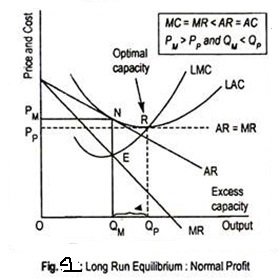
Long run equilibrium is achieved at point E where LMC equals MR (Fig. 2). The equilibrium output thus determined is OQM. At this output, AR equals AC. The firm gets normal profit by selling OQM output at the price OPM. Note that a monopolistically competitive firm always operates somewhere to the left of the minimum point of its AC curve.

In other words, as the demand curve is not perfectly elastic, or, as the demand curve is negative sloping, the AR curve becomes tangent to the left of the lowest point of the AC curve (say, point N). Each firm thus produces at a cost higher than the minimum and gets only normal profit.

Under perfect competition, long run equilibrium is achieved at that point where MC = MR = AR = AC. Because of the perfectly elastic AR curve, a tangency occurs between AR and AC at the latter’s lowest point. In Fig. 2 the dotted AR = MR curve is the demand curve faced by a competitive firm.

Equilibrium is attained at point R where LMC = MR = AR = lowest point of LAC. The competitive output thus determined is OQP which will be sold at the price OPP. So, we can conclude that monopolistically competitive output (OPM) is less than the perfectly competitive output (OQP), and monopolistically competitive price (OPM) is larger than competitive price (OPP).

Thus, the difference in output — QMQP— measures excess capacity or unused capacity faced by monopolistically competitive firms. Production at a higher cost implies wastage of resources or underutilization of resources.

Since production takes place at the lowest point of AC curve under perfect competition, there does not occur any wastage of resources. Hence a perfectly competitive market is ‘efficient’ in the sense that resources are allocated efficiently. Society gets larger output and consumers get output at a low price. Thus, as perfect competition maximizes social welfare, it is an ideal market.

But as the monopolistically competitive firm operates to the left of the minimum point of its AC curve, this market is considered as an ‘inefficient’ one. As a result, social welfare is not maximized under monopolistic competition since society gets lower output compared to perfectly competitive output and buyers buy the differentiated products at a high price.

Dominick Salvatore argues:

“Excess capacity permits more firms to exit (i.e., it leads to overcrowding) in monopolis­tically competitive markets as compared with perfect competition. Consumers, however, seem to prefer that firms selling some services operate with same unused capacity (i.e., they are willing to pay a slightly higher price…) so as to avoid waiting in long lines.”

However, Chamberlin’s notion of excess capacity does not fall with the arguments advanced here.

Role of Advertising under Monopolistic Competition

Advertising is information provided by a company about its product or operation, usually through media such as television, radio, newspapers, magazines, and the Internet, to promote or maintain sales, revenue, and/or profit.

Advertising is frequently used by monopolistic competition to accomplish two related goals product differentiation and market control. To the extent that a firm can inform buyers about physical differences or create the perception of such differences, then product differentiation increases.

Moreover, with product differentiation comes market control. If advertising convinces buyers that a good is different (and better) than comparable products, then a firm can charge a higher price.

The exhibit to the right can be used to illustrate how advertising can affect the demand facing a monopolistically competitive firm. This particular situation is that facing Manny Mustard’s House of Sandwich for the production of his famous Deluxe Club Sandwich. Manny suspects that he can enhance his sales and profitability through advertising.

Perfect competition arises from the equilibrium state of supply and demand. A firm in perfect competition is selling the same undifferentiated product as other firms, and their demand is directly based on market equilibrium factors. Because of this, there is no need for marketing, because the business will exist and the demand will continue as long as the market dictates it.

For monopolistic competition, everyone is trying to gain market share, and all firms have differentiated products. Because of this, firms have to advertise their particular strengths to drive more traffic to their business. For instance, a fast food restaurant will advertise their expansive breakfast menu to capitalize on those customers who desire breakfast food quick, as opposed to another firm exclusively advertising their low prices. A firm in monopolistic competition will have to sell its benefits in order to increase demand for its product.

Oligopolistic Competition

An oligopoly is a market structure in which a few firms dominate. When a market is shared between a few firms, it is said to be highly concentrated. Although only a few firms dominate, it is possible that many small firms may also operate in the market. Considering the market for air travel,  major airlines like British Airways (BA) and Air France often operate their routes with only a few close competitors, but there are also many small airlines catering for the holidaymaker or offering specialist services.

Characteristics of Oligopoly

Now that the Oligopoly definition is clear, it’s time to look at the characteristics of Oligopoly:

  1. Few firms

Under Oligopoly, there are a few large firms although the exact number of firms is undefined. Also, there is severe competition since each firm produces a significant portion of the total output.

  1. Barriers to Entry

Under Oligopoly, a firm can earn super-normal profits in the long run as there are barriers to entry like patents, licenses, control over crucial raw materials, etc. These barriers prevent the entry of new firms into the industry.

  1. Non-Price Competition

Firms try to avoid price competition due to the fear of price wars in Oligopoly and hence depend on non-price methods like advertising, after sales services, warranties, etc. This ensures that firms can influence demand and build brand recognition.

  1. Interdependence

Under Oligopoly, since a few firms hold a significant share in the total output of the industry, each firm is affected by the price and output decisions of rival firms. Therefore, there is a lot of interdependence among firms in an oligopoly. Hence, a firm takes into account the action and reaction of its competing firms while determining its price and output levels.

  1. Nature of the Product

Under oligopoly, the products of the firms are either homogeneous or differentiated.

  1. Selling Costs

Since firms try to avoid price competition and there is a huge interdependence among firms, selling costs are highly important for competing against rival firms for a larger market share.

  1. No unique pattern of pricing behavior

Under Oligopoly, firms want to act independently and earn maximum profits on one hand and cooperate with rivals to remove uncertainty on the other hand.

Depending on their motives, situations in real-life can vary making predicting the pattern of pricing behavior among firms impossible. The firms can compete or collude with other firms which can lead to different pricing situations.

  1. Indeterminateness of the Demand Curve

Unlike other market structures, under Oligopoly, it is not possible to determine the demand curve of a firm. This is because on one hand, there is a huge interdependence among rivals. And on the other hand there is uncertainty regarding the reaction of the rivals. The rivals can react in different ways when a firm changes its price and that makes the demand curve indeterminate.

Firms behaviour under Oligopoly

Based on the objectives of the firms, the magnitude of barriers to entry and the nature of government regulation, there are different possible outcomes in relation to a firm’s behavior under Oligopoly. These are:

  • Stable prices
  • Price wars
  • Collusion for higher prices

Further, Oligopoly can either be collusive or non-collusive. Collusive oligopoly is a market situation wherein the firms cooperate with each other in determining price or output or both. A non-collusive oligopoly refers to a market situation where the firms compete with each other rather than cooperating.

Non-Collusive Oligopoly-Sweezy’s Kinked Demand Curve Model (Price-Rigidity)

Usually, in Oligopolistic markets, there are many price rigidities. In 1939, Paul Sweezy used an unconventional demand curve the kinked demand curve to explain these rigidities.

Reason for the kink in the demand curve

It is assumed that firms behave in a two-fold manner in reaction to a price change by a rival firm. In simple words, firms follow price cuts by a rival company but not price increases. So, if a seller increases the price of his product, his rivals do not follow the price increase.

Therefore, the market share of the firm reduces significantly as a result of the price rise. On the other hand, if a seller reduces the price of his product, then the rivals also reduce their price to bring it at par with the price reduction of the firm.

This ensures that they prevent their market share from falling. Once the rivals react, the firm lowering the price first cannot gain from the price cut.

error: Content is protected !!