Importance of Business Economics

Business economics is generally applied microeconomics. It normally bridges up the business gap that exists between business practices and pure economic theory. It encompasses logical science, mathematics, decision science, and economics. These concepts usually help in taking rational and optimal business decisions. Business economics integrates theories of economics with business practice. In short, business economics is a decision making science.

I am going to provide copious details on the importance of business economics. They are not limited to the following benefits.

  1. It covers demand analysis and forecasting

Demand analysis is always crucial in identifying the different factors that often influence the demand for the product of the firm. It offers clear guidelines on how to manipulate demand. Normally, the core area of business decision making relies on demand accurate estimate.

Forecasting is a critical topic that is studied in business economics. Each business enterprise initiates and progresses in its process of production based on the demand anticipation for its products in the future. It conducts a market survey and enables research with a view to understanding the fashions, tastes, and preferences of consumers. Business economics usually analyzes the behavior of the demand and predicts the quantity that is demanded by the consumers.

  1. Plays a key role in cost analysis

Business economics often handles the analysis of various costs that business firms incur. Every business always desires to minimize their costs and maximize its profits by embracing different economies of scale. Nonetheless, the firms fail to determine exact costs that are involved in the production process. Business economics often deals with the cost estimates and offers knowledge to the business people concerning cost analysis of their enterprise.

  1. Profit analysis

Most firms desire to gain maximum profits, however, they often experience risk and uncertainty in getting the maximum profits. The business has to come up with new innovations in marketing and production of its products. Business economics handles issues regarding profit analysis such as profit policies, techniques and even break down the analysis.

  1. Capital management

Business economics covers capital management where it further denotes control and planning of expenditure of capital in a business firm. It normally covers areas such as rate of return, selection of best project, cost of capital and evaluation among other topics.

  1. It covers and determines production analysis

One feature of factors of production is that are normally scarce and usually have alternative uses. In most cases, producers conjoin these factors of production in a certain way in the production process to accomplish maximum output. Business economics sheds more light concerning factor productivity, production function, least cost inputs combination among others.

  1. Price determination and its techniques

Appropriate pricing decisions normally influence on how a firm can maximize its profits. Business economics deals with different techniques of price determination under various categories of market structures. Other topics related to price determination and their methods that are covered by business economics are not limited to pricing objectives, price discrimination, pricing methods, pricing of a joint product among others.

  1. Has an influence on objectives of a business firm

It is important to appreciate the fact that, each and every business enterprise has an objective to achieve. A firm should ensure that its objectives should work with the way business wants to accomplish its goals. The objectives of a business entire often offer a clear guideline to the owner of the business while he/she focuses on making informed decisions concerning its output and price. The objective of the firm might revolve around sales maximization, profit maximization, satisfaction maximization, utility maximization among other objectives. Business economics normally covers theories concerning the objectives of a business organization propounded by various economics.

  1. Business environment

It goes without saying that the business environment always has a significant effect on business organizations. Note that, business economics usually studies about several categories of business environment inclusive of business phase cycle, capital market and situation of money, market structure among other crucial topics. Business environment and business economics are complementary to each other.

Of late, there has been a new trend regarding integration of operation research and business economics, where methods like inventory models, linear programming, the theory of games are regarded as part of important areas to study in business economics. Therefore, business economics is a very important element that allows most organizations and individuals to accomplish their goals.
Basic Tools Business Economics

Economic theory offers a variety of concepts and analytical tools which can be of considerable assistance to the managers in his decision making practice. These tools are helpful for managers in solving their business related problems. These tools are taken as guide in making decision.

Following are the basic economic tools for decision making:

  • Opportunity cost
  • Incremental principle
  • Principle of the time perspective
  • Discounting principle
  • Equi-marginal principle
  1. Opportunity cost principle

By the opportunity cost of a decision is meant the sacrifice of alternatives required by that decision.

For e.g.

  • The opportunity cost of the funds employed in one’s own business is the interest that could be earned on those funds if they have been employed in other ventures.
  • The opportunity cost of using a machine to produce one product is the earnings forgone which would have been possible from other products.
  • The opportunity cost of holding Rs. 1000as cash in hand for one year is the 10% rate of interest, which would have been earned had the money been kept as fixed deposit in bank.

Its clear now that opportunity cost requires ascertainment of sacrifices. If a decision involves no sacrifices, its opportunity cost is nil. For decision making opportunity costs are the only relevant costs.

  1. Incremental principle

It is related to the marginal cost and marginal revenues, for economic theory. Incremental concept involves estimating the impact of decision alternatives on costs and revenue, emphasizing the changes in total cost and total revenue resulting from changes in prices, products, procedures, investments or whatever may be at stake in the decisions.

The two basic components of incremental reasoning are

  • Incremental cost
  • Incremental Revenue

The incremental principle may be stated as under:

“A decision is obviously a profitable one if:

  • It increases revenue more than costs
  • It decreases some costs to a greater extent than it increases others
  • It increases some revenues more than it decreases others and
  • It reduces cost more than revenues”
  1. Principle of Time Perspective

Managerial economists are also concerned with the short run and the long run effects of decisions on revenues as well as costs. The very important problem in decision making is to maintain the right balance between the long run and short run considerations.

For example

Suppose there is a firm with a temporary idle capacity. An order for 5000 units comes to management’s attention. The customer is willing to pay Rs 4/- unit or Rs.20000/- for the whole lot but not more. The short run incremental cost(ignoring the fixed cost) is only Rs.3/-. There fore the contribution to overhead and profit is Rs.1/- per unit (Rs.5000/- for the lot)

Analysis

From the above example the following long run repercussion of the order is to be taken into account:

  • If the management commits itself with too much of business at lower price or with a small contribution it will not have sufficient capacity to take up business with higher contribution.
  • If the other customers come to know about this low price, they may demand a similar low price. Such customers may complain of being treated unfairly and feel discriminated against.

In the above example it is therefore important to give due consideration to the time perspectives. “a decision should take into account both the short run and long run effects on revenues and costs and maintain the right balance between long run and short run perspective”.

  1. Discounting Principle

One of the fundamental ideas in Economics is that a rupee tomorrow is worth less than a rupee today. Suppose a person is offered a choice to make between a gift of Rs.100/- today or Rs.100/- next year. Naturally he will chose Rs.100/- today. This is true for two reasons:

  • The future is uncertain and there may be uncertainty in getting Rs. 100/- if the present opportunity is not availed of
  • Even if he is sure to receive the gift in future, today’s Rs.100/- can be invested so as to earn interest say as 8% so that one year after Rs.100/- will become 108
  1. Equi marginal Principle

This principle deals with the allocation of an available resource among the alternative activities. According to this principle, an input should be so allocated that the value added by the last unit is the same in all cases. This generalization is called the equi-marginal principle.

Suppose, a firm has 100 units of labor at its disposal. The firm is engaged in four activities which need labors services, viz, A,B,C and D. it can enhance any one of these activities by adding more labor but only at the cost of other activities.

Basic Economic Relations

Tables are the simplest and most direct form for presenting economic data. When these data are displayed electronically in the format of an accounting income statement or balance sheet, the tables are referred to as spreadsheets. When the underlying relation between economic data is simple, tables and spreadsheets may be sufficient for analytical purposes. In such instances, a simple graph or visual representation of the data can provide valuable insight.

Complex economic relations require more sophisticated methods of expression. An equation is an expression of the functional relationship or connection among economic variables. When the underlying relation among economic variables is uncomplicated, equations offer a compact means for data description; when underlying relations are complex, equations are helpful because they permit the powerful tools of mathematical and statistical analysis to be used.

Functional Relations: Equations

The easiest way to examine basic economic concepts is to consider the functional relations incorporated in the basic valuation model. Consider the relation between output, Q, and total revenue, TR. Using functional notation, total revenue is

TR = f(Q)

Equation is read, “Total revenue is a function of output.” The value of the dependent variable (total revenue) is determined by the independent variable (output). The variable to the left of the equal sign is called the dependent variable. Its value depends on the size of the variable or variables to the right of the equal sign. Variables on the right-hand side of the equal sign are called independent variables. Their values are determined independently of the functional relation expressed by the equation.

Equation does not indicate the specific relation between output and total revenue; it merely states that some relation exists. Equation provides a more precise expression of this functional relation:

TR = P×Q

where P represents the price at which each unit of Q is sold. Total revenue is equal to price times the quantity sold. If price is constant at $1.50 regardless of the quantity sold, the relation between quantity sold and total revenue is

TR = f(Q)

Data in Table are specified by Equation and graphically illustrated in Figure.

Total, Average, and Marginal Relations

Total, average, and marginal relations are very useful in optimization analysis. Whereas the definitions of totals and averages are well known, the meaning of marginals needs further explanation. A marginal relation is the change in the dependent variable caused by a one-unit change in an independent variable. For example, marginal revenue is the change in total revenue associated with a one-unit change in output; marginal cost is the change in total cost following a one-unit change in output; and marginal profit is the change in total profit due to a one-unit change in output.

Relation Between Total Revenue and Output; Total Revenue = $1.50

Average and Marginal Cost

Marginal cost

The marginal cost is the increase in total cost as a consequence of an increase in a production unit, or in mathematical terms, it is the first differential quotient of the total cost function. This can be expressed as a partial derivative of change of total costs and variation in one unit of production.

It is useful using marginal cost to check the convenience of velocity of production of a firm into multiple levels of production:

The law of increasing returns implies that production is increasing more with impact of one additional unit of production, therefore the marginal cost gradient, as the second derivate of marginal cost is below 0 and firm is reducing marginal costs as result of production.

The second scenario is law of constant returns, where the total cost curve is regular and smooth and change in productions maintain the same marginal cost and marginal cost gradient is equal to 0.

The law of diminishing returns applies where total cost curve is convex and marginal cost increases monotonically, being marginal cost gradient positive when production increase.

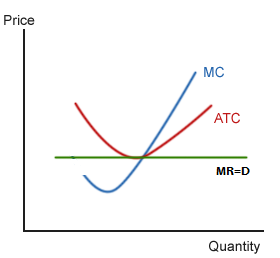
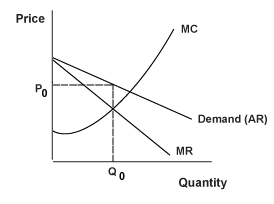
Firm´s decision to maximize profit depend greatly if marginal cost are lower than price of product, expanding production until marginal cost is equal to price.

Average cost

Average costs represent the quotient of the ordinate and abscissa of a point on the total cost curve. Also it is named as cost of velocity of production, where it measures the cost per unit, taking in consideration fixed cost and variable costs, divided on total production.

The average cost can be explained in two components:

  • Variable cost: where it is included only costs related to velocity of production.
  • Fixed cost: related with investment required to produce the firm but it does not depend on velocity of production.

The average cost start declining as result of average fixed cost falls with velocity of production. However, it will rise, as impact of fixed factors constrains production, limiting the benefits of increase production and impact in total cost per unit. To move from a lower average cost, firm requires increase the fixed factors of production to move to a new lower point, developing scale economics. As result of behavior of fixed and variable cost, average cost shape is U form.

The usage of average cost is useful to know about total costs incurred by firm based on units of productions. Every velocity of production has a cost covering price and depending the amount of production with lowest cost covering prices is where enterprise can sell without generating losses. However, if firm is looking return investment, the respective price must be equal to average cost to recover fixed cost and variable costs.

Average Cost vs. Marginal Cost Comparison Table

Average Cost

Marginal Cost

Definition
It is per unit cost of goods or services manufactured.   It is the extra cost incurred for the manufactured of one extra unit of goods or services.
Purpose/Intention

The average cost is calculated to evaluate the effect on total unit cost due to the change in the output unit.

Marginal cost is calculated to check if it is beneficial to manufacture an extra unit of goods/services or not.

Component
The average cost is separated between Fixed cost and Variable cost.

Marginal cost considered all costs it cannot separate between Variable cost and Fixed cost. Fixed cost remains constant up to a certain level of production.

Formula
AC = TC (FC+VC) Divided by the Total number of units manufactured.        MC = Change TC Divided by change in the Total number of units manufactured.
Business decision               With the help of Average cost, an organization can take the decision to reduce cost at a production level With the help of Marginal cost, an organization can take a decision to increase profit at the production level.
Profitability If an organization is looking for a return on investment, in that case, the price of the product must be equal to the average cost to recover the fixed cost and variable cost.

If an organization is looking for increasing Profits in that case marginal cost must be lower than the price of the product and the organization may expand production until marginal cost equal to the price of the product.

 Average Cost vs. Marginal Cost

  1. Average cost is nothing but the Total cost divided by the number of units manufactured which shows the result as per unit cost of the product, whereas Marginal cost is extra cost generated while producing one or some extra unit of products and it is calculated by dividing the change in total cost with Chang in total manufactured unit.
  2. Marginal cost considered all cost which fluctuates during the level of production and fixed cost remain constant up to a certain level of production, whereas Average cost considered Fixed cost and Variable cost. In Average cost, both Fixed and Variable cost is product cost whereas in margin cost Fixed cost is considered as period costs and Variable cost is product cost.
  3. Average cost calculates the effect on total unit due to change in output level whereas marginal cost is calculated to find out if producing one extra unit of product is profitable or not.
  4. Average cost method also called a weighted average method and Marginal cost method is also called as variable costing.
  5. Both average cost vs marginal cost is measured under the same units and obtain the result from Total cost.
  6. If an objective is to increase profit during production level than the marginal cost technique is useful and when an objective is to reduce cost during production level, in that case, the Average cost technique is used.

Marginal cost vs. Average cost both are costing technique used to calculate the cost of the product which incurred while manufacturing. It helps an organization to set the final price of the product and cover all its expenses through it. Marginal cost method helps an organization to increase profitability at the production level and the Average cost method helps an organization to reduce cost at the production level. Average cost helps to understand how much expenses incurred while producing a single of product and Marginal cost helps to understand how much extra cost will incur while producing one extra unit of product.

Marginal cost does not depend on fixed cost because it does not change with output, or it remains constant up to a certain level of production whereas variable cost change with the output, so in short marginal cost is due to change in variable cost. The average cost considers both fixed cost and variable cost of the product which is called Total cost. The average cost and Marginal cost effect each other as the production varies. When average cost decreases in that case marginal cost is less than the average cost and vice versa and when the average cost is the same or constant in that case both are equals to each other. Marginal cost plays an important role in economics as it shows the costs at a very definite point in time. Even though the average and marginal cost is an important concept for an organization but some time pricing of products with this method leads to a significantly different result.

Use of Marginal Analysis in Decision Making

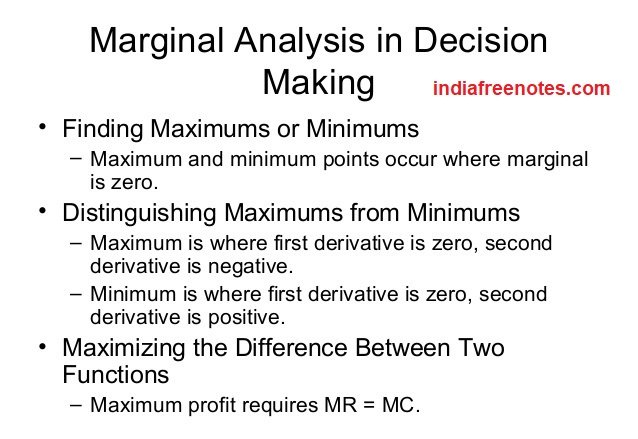
Marginal analysis plays a crucial role in managerial economics, the study and application of economic concepts, to guide in making managerial decisions. The idea is to predict and measure the impact of per unit changes of an organization’s goals, ultimately identifying the optimal resource allocation given the constraints of the business.

The Value of Marginal Analysis for Management

Most of the microeconomic theory of marginalism was developed by Cambridge University professor and economist Alfred Marshall. He stated that production is only beneficial for a firm when marginal revenue exceeds marginal cost, and it is most beneficial when the difference is largest.

For instance, a toy manufacturer should only produce toys until marginal expense is equal to marginal benefit. By breaking down decisions into measurable, smaller pieces, the toy manager can optimize profits.

Marginal analysis has applicability well outside the range of for-profit production processes. Every resource allocation decision can benefit from marginal analysis as long as costs and benefits are identifiable.

Attaining the Highest Net Benefit

Suppose a company is able to measure the additional benefits and costs of extra economic activity. The theory of marginal analysis states that whenever marginal benefit exceeds marginal cost, a manager should increase activity to reach the highest net benefit. Similarly, if marginal cost is higher than marginal benefit, activity should be decreased.

Sunk costs, fixed costs, and average costs do not affect marginal analysis. They are irrelevant to future optimal decision-making. Marginal analysis can only address what happens if the firm hires one additional employee, produces one additional product, devotes additional space to research and so forth.

Marginal Analysis and Opportunity Cost

Managers should also understand the concept of opportunity cost. Suppose a manager knows that there is room in the budget to hire an additional worker. Marginal analysis tells the manager that an additional factory worker provides net marginal benefit. This does not necessarily make the hire the right decision.

Suppose the manager also knows that hiring an additional salesperson yields an even larger net marginal benefit. In this case, hiring a factory worker is the wrong decision because it is sub-optimal.

Market Demand

Market demand is similar to industry demand. It is a broader concept and it involves total demand of a product in an industry. For example, demand of two wheelers in India implies demand of two wheelers produced and marketed by all the companies. It reveals the broader picture of demand. Marketer should keep in mind the wider scenario of industry/market demand to see his position, often called market share of company in an industry. Market demand plays a vital role in formulating the broad marketing programme.

Philip Kotler: “Market demand for the product is the total volume that would be bought by a defined customer group in a defined geographical area in a defined time period in a defined marketing environment under a defined marketing programme.”

Thus, market demand indicates total sales of the product to the specific groups of buyers in a specific period and in defined geographical areas in a given marketing environment.

Elements of Market Demand

Systematic analysis of above stated definitions necessarily reveals following elements:

  1. Product

Market demand indicates the total demand of specific products in an industry. The place or scope of product must be specified. In which category or industry the product of company falls. It can be decided on the basis of who are the users and the purpose of using the product. Thus, we must mention the market demand in relation to the specific product.

  1. Total Volume

It shows the total volume of sales in form of unit or value. It suggests the total sales of the product in the industry. For example, total volume means the amount (or units) of total demand of refrigerator in India.

  1. Purchase or Buying

Only the quantity, that is ordered and purchased is included in market demand. Market demand includes units, which are ordered, delivered, or consumed.

  1. Customer Groups

Market demand is expressed in term of different users. Total volume demanded by different groups of customers, such as industrial customers, institutional customers, and individual customers.

  1. Geographic Area

Market demand can be specified in term of different geographical areas or localities. It may be in term of country, state, region, district, or any geographic unit.

  1. Fixed Time Duration

Market demand is meaningful only if it is expressed in relation to time. For example, demand of two-wheeler during the year 2007. Time may be in term of week, months, quarter, or year.

  1. Marketing Environment

Obviously, market demand is influenced by several factors. These factors constitute the marketing environment. So, it is necessary to mention assumptions about marketing environment comprising economic, cultural, social, political, etc., forces.

  1. Definition of Marketing Programme

Market demand is affected by marketing programme/strategy. So, it is clarified with reference to a specific marketing programme including product, price, promotion, and distribution. Thus, market demand is stated in context with the definite marketing programme.

While estimating market demand, these all elements should be considered for meaningful picture of total demand. Here, we must distinguish market demand from company demand. Market demand is total demand of the product in an industry, and company demand means demand of the individual business unit’s products. Market forecast relates with market demand and sales forecast relates with company demand. However, market demand forecast and sales forecast are taken loosely (i.e., more or less similar).

Market Supply

The market supply is the total quantity of a good or service all producers are willing to provide at the prevailing set of relative prices during a defined period of time.  The market supply is the sum of all individual producer supplies. It is understood that “Supply” means Market Supply, unless it refers to one producer.

Market Supply Function:

Market supply function refers to the functional relationship between market supply and factors affecting the market supply of a commodity.

As discussed before, market supply is affected by all the factors affecting individual supply. In addition, it is also affected by some other factors like number of firms, future expectations regarding price and means of transportation and communication.

Market supply function is expressed as:

Sx = f (Px, Po, Pf, St, T, G, T, G, N, F, M)

Where,

Sx = Market supply of given commodity x;

Px = Price of the given commodity x;

P0 = Price of other goods;

Pf = Prices of factors of production;

St = State of technology;

T = Taxation policy;

G = Goals of the market;

N = Number of firms;

F = Future expectation regarding Px;

M = Means of transportation and communication.

Functions of Market Supply

Some of the main features of Market supply are as follows:

Before we proceed with the meaning of supply, it is important to understand some special features of supply:

  1. Supply is a desired quantity

It indicates only the willingness, i.e., how much the firm is willing to sell and not how much it actually sells.

  1. Supply of a commodity does not comprise the entire stock of the commodity

It indicates the quantity that the firm is willing to bring into the market at a particular price. For example, supply of TV by Samsung in the market is not the total available stock of TV sets. It is the quantity, which Samsung is willing to bring into the market for sale.

  1. Supply is always expressed with reference to price

Just like demand, supply of a commodity is always at a price because with a change in price, the quantity supplied may also change.

  1. Supply is always with respect to a period of time

Supply is the quantity, which the firm is willing to supply during a specific period of time (a day, a week, a month or a year).

Supply and Stock

The term ‘supply’ is often confused with ‘stock’ of the commodity. However, in economics, the two terms are different. Stock refers to total quantity of a particular commodity that is available with the firm at a particular point of time.

On the other hand, supply is that part of stock which is actually brought in to the market for sale. Stock can never be less than the supply. For example, if a seller has 50 tonnes sugar in his godown and he is willing to sell 30 tonnes @ Rs. 37 per kg, then supply is 30 tonnes and stock is 50 tonnes.

Supply Vs. Stock

  1. Supply refers to the quantity offered for sale which changes with change in price, whereas, stock indicates a fixed quantity.
  2. Supply relates to a period of time, whereas, stock relates to a particular point of time.

Determination of Equilibrium Price and Quantity

Equilibrium means a state of no change. Evidently, at the equilibrium price, both buyers and sellers are in a state of no change. Technically, at this price, the quantity demanded by the buyers is equal to the quantity supplied by the sellers. Both market forces of demand and supply operate in harmony at the equilibrium price.

The equilibrium price is the price where the quantity demanded is equal to the quantity supplied. That quantity is known as the equilibrium quantity.

Graphically, this is represented by the intersection of the demand and supply curve. Further, it is also known as the market clearing price. The determination of the market price is the central theme of microeconomics. That is why the microeconomic theory is also known as price theory.

Equilibrium means a state of no change. Evidently, at the equilibrium price, both buyers and sellers are in a state of no change. Technically, at this price, the quantity demanded by the buyers is equal to the quantity supplied by the sellers. Both market forces of demand and supply operate in harmony at the equilibrium price.

Graphically, this is represented by the intersection of the demand and supply curve. Further, it is also known as the market clearing price. The determination of the market price is the central theme of microeconomics. That is why the microeconomic theory is also known as price theory.

Process of Finding Equilibrium:

To determine the equilibrium price and quantity, we must analyze both the demand and supply curves.

Step 1: Identifying the Demand and Supply Functions

The demand curve can be expressed as a function:

Qd = f(P)

where Qd is the quantity demanded and PP is the price.

Similarly, the supply curve is expressed as:

Qs = g(P)

where Qs is the quantity supplied.

At equilibrium, the quantity demanded equals the quantity supplied, so:

Qd = Qs

Step 2: Setting Quantity Demanded Equal to Quantity Supplied

Set the demand function equal to the supply function to solve for the equilibrium price. For example, if the demand function is:

Qd = 100 − 2P

And the supply function is:

Qs = 3P

Set these two equal to each other:

100 − 2P = 3P

Step 3: Solving for Equilibrium Price

Now solve for the price (PP):

100 =5P

So, the equilibrium price is 20.

Step 4: Solving for Equilibrium Quantity

Substitute the equilibrium price back into either the demand or supply equation to solve for the equilibrium quantity. Using the demand equation:

Qd = 100 − 2(20) = 100 − 40 = 60

Thus, the equilibrium quantity is 60 units.

Effects of Changes in Demand and Supply

The equilibrium price and quantity are not fixed; they change when there is a shift in either the demand or the supply curve.

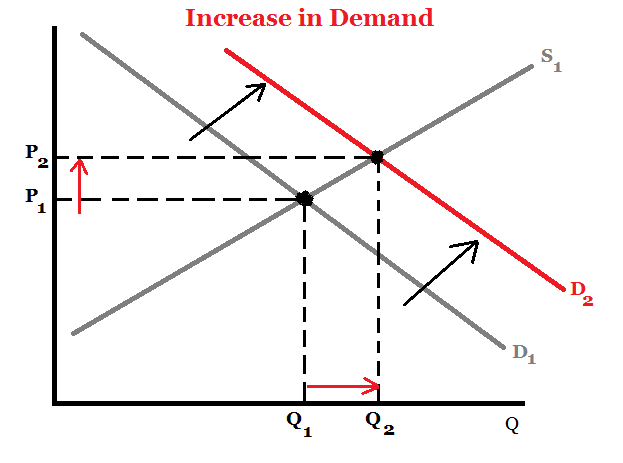
Increase in Demand

If demand increases due to factors such as higher consumer income or changes in preferences, the demand curve shifts to the right. This results in a higher equilibrium price and quantity.

Example:

  • If more consumers want to buy a good (shift in demand to the right), the equilibrium price will rise, and producers will supply more to meet the increased demand.

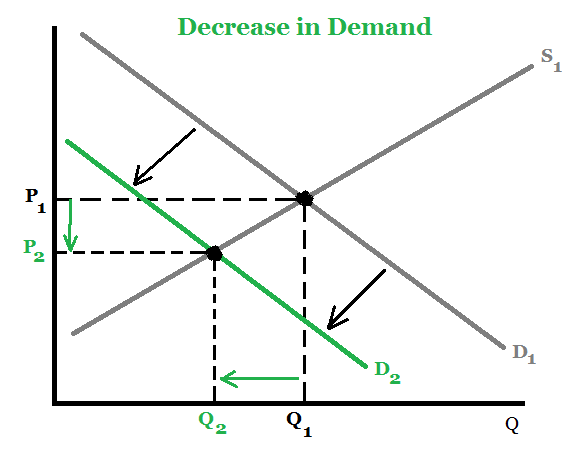
Decrease in Demand

If demand decreases (due to factors such as falling income or changes in preferences), the demand curve shifts to the left. This results in a lower equilibrium price and quantity.

Example:

  • If consumers no longer desire a good, the equilibrium price falls, and producers may reduce the quantity supplied.

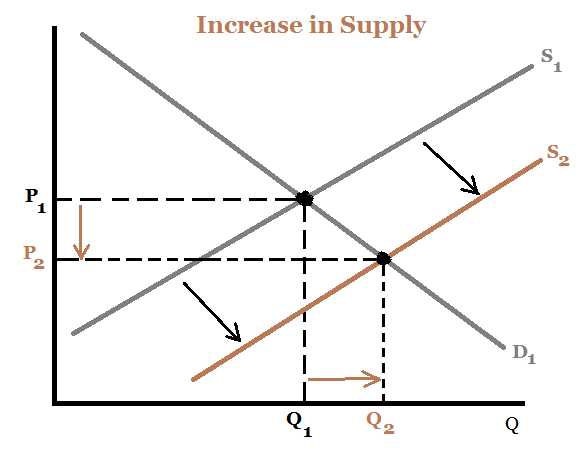
Increase in Supply

If supply increases (due to factors such as technological improvements or lower production costs), the supply curve shifts to the right. This results in a lower equilibrium price and a higher equilibrium quantity.

Example:

  • If a new technology reduces the cost of producing a good, the supply curve shifts rightward, leading to a lower price and higher quantity.

Decrease in Supply

If supply decreases (due to factors such as higher production costs or natural disasters), the supply curve shifts to the left. This results in a higher equilibrium price and a lower equilibrium quantity.

Example:

  • If a natural disaster disrupts the production of a good, the supply decreases, leading to higher prices and lower quantities available.

Role of Price Mechanism in Reaching Equilibrium

The price mechanism plays a crucial role in reaching equilibrium. If there is a surplus (where supply exceeds demand), producers will lower prices to encourage consumers to buy more. Conversely, if there is a shortage (where demand exceeds supply), consumers will compete to buy the good, causing prices to rise. This process continues until the market reaches equilibrium.

  • Surplus: If the price is above equilibrium, supply exceeds demand, and producers reduce the price.
  • Shortage: If the price is below equilibrium, demand exceeds supply, and prices rise as consumers compete for the limited supply.

Shifts in the Supply and Demand Curve

Definitely, if there is any change in supply, demand or both the market equilibrium would change. Let’s recollect the factors that induce changes in demand and supply:

Shift in Demand

The demand for a product changes due to an alteration in any of the following factors:

  • Price of complementary goods
  • Price of substitute goods
  • Income
  • Tastes and preferences
  • An expectation of change in the price in future
  • Population

Shift in Supply

The supply of product changes due to an alteration in any of the following factors:

  • Prices of factors of production
  • Prices of other goods
  • State of technology
  • Taxation policy
  • An expectation of change in price in future
  • Goals of the firm
  • Number of firms

Now let us study individually how market equilibrium changes when only demand changes, only supply changes and when both demand and supply change.

When only Demand Changes

A change in demand can be recorded as either an increase or a decrease. Note that in this case there is a shift in the demand curve.

(i) Increase in Demand

When there is an increase in demand, with no change in supply, the demand curve tends to shift rightwards. As the demand increases, a condition of excess demand occurs at the old equilibrium price. This leads to an increase in competition among the buyers, which in turn pushes up the price.

  • Shifts in Demand and Supply
  • Equilibrium, Excess Demand and Supply

Of course, as price increases, it serves as an incentive for suppliers to increase supply and also leads to a fall in demand. It is important to realize that these processes continue to operate until a new equilibrium is established. Effectively, there is an increase in both the equilibrium price and quantity.

(ii) Decrease in Demand

Under conditions of a decrease in demand, with no change in supply, the demand curve shifts towards left. When demand decreases, a condition of excess supply is built at the old equilibrium level. This leads to an increase in competition among the sellers to sell their produce, which obviously decreases the price.

Now as for price decreases, more consumers start demanding the good or service. Observably, this decrease in price leads to a fall in supply and a rise in demand. This counter mechanism continues until the conditions of excess supply are wiped out at the old equilibrium level and a new equilibrium is established. Effectively, there is a decrease in both the equilibrium price and quantity.

When only Supply Changes

A change in supply can be noted as either an increase or a decrease. Note that in this case there is a shift in the supply curve.

(i) Increase in Supply

When supply increases, accompanied by no change in demand, the supply curve shift towards the right. When supply increases, a condition of excess supply arises at the old equilibrium level. This induces competition among the sellers to sell their supply, which in turn decreases the price.

This decrease in price, in turn, leads to a fall in supply and a rise in demand. These processes operate until a new equilibrium level is attained. Lastly, such conditions are marked by a decrease in price and an increase in quantity.

(ii) Decrease in Supply

When the supply decreases, accompanied by no change in demand, there is a leftward shift of the supply curve. As supply decreases, a condition of excess demand is created at the old equilibrium level. Effectively there is increased competition among the buyers, which obviously leads to a rise in the price.

An increase in price is accompanied by a decrease in demand and an increase in supply. This continues until a new equilibrium level is attained. Further, there is a rise in equilibrium price but a fall in equilibrium quantity.

When both Demand and Supply Change

Generally, the market situation is more complex than the above-mentioned cases. That means, generally, supply and demand do not change in an individual manner. There is a simultaneous change in both entities. This gives birth to four cases:

  • Both demand and supply decrease
  • Both demand and supply increase
  • Demand decreases but supply increases
  • Demand increases but supply decreases

(i) Both Demand and Supply Decrease

The final market conditions can be determined only by a deduction of the magnitude of the decrease in both demand and supply. In fact, both the demand and supply curve shift towards the left. Essentially, there is a need to compare their magnitudes. Such conditions are better analyzed by dividing this case further into three:

The decrease in demand = decrease in supply

When the magnitudes of the decrease in both demand and supply are equal, it leads to a proportionate shift of both demand and supply curve. Consequently, the equilibrium price remains the same but there is a decrease in the equilibrium quantity.

The decrease in demand > decrease in supply

When the decrease in demand is greater than the decrease in supply, the demand curve shifts more towards left relative to the supply curve. Effectively, there is a fall in both equilibrium quantity and price.

The decrease in demand < decrease in supply

In a case in which the decrease in demand is smaller than the decrease in supply, the leftward shift of the demand curve is less than the leftward shift of the supply curve. Notably, there is a rise in equilibrium price accompanied by a fall in equilibrium quantity.

(ii) Both Demand and Supply Increase

In such a condition both demand and supply shift rightwards. So, in order to study changes in market equilibrium, we need to compare the increase in both entities and then conclude accordingly. Such a condition is further studied better with the help of the following three cases:

The increase in demand = increase in supply

If the increase in both demand and supply is exactly equal, there occurs a proportionate shift in the demand and supply curve. Consequently, the equilibrium price remains the same. However, the equilibrium quantity rises.

The increase in demand > increase in supply

In such a case, the right shift of the demand curve is more relative to that of the supply curve. Effectively, both equilibrium price and quantity tend to increase.

The increase in demand < increase in supply

When the increase is demand is less than the increase in supply, the right shift of the demand curve is less than the right shift of supply curve. In this case, the equilibrium price falls whereas the equilibrium quantity rises.

(iii) Demand Decreases but Supply Increases

This condition translates to the fact that the demand curve shifts leftwards whereas the supply curve shifts rightwards. As they move in opposite directions, the final market conditions are deduced by pointing out the magnitude of their shifts. Here, three cases further arise which are as follows:

The decrease in demand = increase in supply

In this case, although the two curves move in opposite directions, the magnitudes of their shifts is effectively the same. As a result, the equilibrium quantity remains the same but the equilibrium price falls.

The decrease in demand > increase in supply

When the decrease in demand is greater than the increase in supply, the relative shift of demand curve is proportionately more than the supply curve. Effectively, both the equilibrium quantity and price fall.

The decrease in demand < increase in supply

Here, the leftward shift of the demand curve is less than the rightward shift of the supply curve. It is important to realize, that the equilibrium quantity rises whereas the equilibrium price falls.

(iv) Demand Increases but Supply Decreases

Similar to the aforementioned condition, here also the demand and supply curve moves in the opposite directions. However, the demand curve shift towards the right(indicating an increase in demand) and the supply curve shift towards left(indicating a decrease in supply). Further, this is studied with the help of the following three cases:

Increase in demand = decrease in supply

When the increase in demand is equal to the decrease in supply, the shifts in both supply and demand curves are proportionately equal. Effectively, the equilibrium quantity remains the same however the equilibrium price rises.

Increase in demand > decrease in supply

In this case, the right shift of the demand curve is proportionately more than the leftward shift of the supply curve. Hence, both equilibrium quantity and price rise.

Increase in demand < decrease in supply

If the increase in demand is less than the decrease in supply, the shift of the demand curve tends to be less than that of the supply curve. Effectively, equilibrium quantity falls whereas the equilibrium price rises.

Nature of Demand Curve Under Different Markets

Firm Demand (company demand) denotes the demand for the product/s of a particular firm. While Industry demand means the demand for the product of a particular industry. An industry comprises all the firms or companies producing similar products which are quite close substitutes to each other irrespective of the differences in their brand names. To understand the relation between company and industry demand necessitates an understanding of different market structures.

  1. Demand Curve under Perfect competition

Under Perfect Competition industry demand is completely different from the individual firm demand. The industry demand curve is downward sloping. The price in the market is determined by the interactions of the forces of demand and supply. The point of intersection between demand and supply curves determines the equilibrium price of the product. Now the number of firms under Perfect Competition is so large that a single firm has no influence on either the total output or the price. Its contribution to total output is just microscopic. If a new firm enters or an existing firm takes an exit the total output does not get affected much. A firm under Perfect Competition cannot fix the price of its product. It will have to sell its product at the going market price as it is determined by demand and supply forces in the market. A firm under Perfect Competition is a price taker and not a price maker. Price is given to the firms and each unit of its output is sold at the given market price and thus the demand curve of firm or its average revenue curve becomes horizontal. Horizontality of average revenue curve (demand curve) is the acid test of a firm under Perfect Competition.

Nature of Demand Curve under Perfect competition

In case of perfect competition, there are very large no. of buyers and sellers selling a homogeneous product at a price fixed by the market. Therefore, each firm is a price taker and faces a perfectly elastic demand curve.

  1. Demand Curve under Monopolistic competition

Under Monopolistic Competition there is competition among a group of monopolists producing differentiated product. The product of each firm is slightly different from that of other. There are also substitutes and therefore the demand curve of each firm’s product is downward sloping and is relatively elastic in nature. In monopolistic competition there are many sellers with differentiated product and hence industry demand curve hardly has any meaning.

Nature of Demand Curve under Monopolistic competition

Under monopolistic competition, large no. of firms selling closely related but differentiated products makes the demand curve downward sloping. It implies that a firm can sell more output only by reducing the price of its product.

  1. Demand Curve under Monopoly competition

The demand curve of an individual firm is not the same as the industry or market demand curve except in case of monopoly. Monopoly is that market category in which there is only a single seller and therefore there is no difference between a firm and an industry. The firm is itself an industry and therefore the demand curve of the individual firm as well as the industry demand curve under monopoly will be the same and as we shall see later is downward sloping. Moreover as there are no close substitutes under monopoly the demand curve is relatively steeper showing relatively inelastic demand under monopoly.

Nature of Demand Curve under Monopoly competition

A monopoly firm is like an industry as the single seller constitutes the entire market for the product, which has no close substitutes. So, a monopolist has full freedom and power to fix price for the product. However, demand of the product is not in the control of monopoly firm. In order to increase the output to be sold, the monopolist will have to reduce the price. Therefore, monopoly firm faces a downward sloping demand curve.

  1. Demand Curve under oligopoly competition

In case of Oligopoly market there are few sellers producing either differentiated or homogenous products. The demand for a firm’s product is influenced by the actions of its rivals. The demand curve of a firm under oligopoly has a kink.

Nature of Demand Curve under oligopoly competition

The demand curve for an oligopoly firm is indeterminate, i.e. it cannot be drawn accurately as exact behavior pattern of a producer cannot be ascertained with certainty.

error: Content is protected !!