Conflict Meaning and Features

Conflict can be defined in many ways and can be considered as an expression of hostility, negative attitudes, antagonism, aggression, rivalry and misunderstanding. It is also associated with situations that involve contradictory or irreconcilable interests between two opposing groups.

A few definitions of conflict are as given below:

“A simple definition of conflict is that it is any tension which is experienced when one person perceives that one’s needs or desires are or are likely to be thwarted or frustrated.” Follett simply defines conflict as, “the appearance of difference, difference of opinions, of interests.”

Chung and Megginson define conflict as, “the struggle between incompatible or struggling needs, wishes, ideas, interests or people. Conflict arises when individuals or groups encounter goals that both parties cannot obtain satisfactorily.”

According to David L. Austin, “It can be defined as a disagreement between two or more individuals or groups, with each individual or group trying to gain acceptance of its view or objectives over others.”

Louis R. Pondy has given a very comprehensive definition of conflict.

According to him the term conflict is used in four ways in the literature to describe:

(i) Antecedent conditions of conflictual behaviour such as scarcity of resources or policy differences.

(ii) Affective states of individuals involved such as stress, tension, hostility, anxiety etc.

(iii) Cognitive state of individuals, that is their perception or awareness of conflictual situation.

(iv) Conflictual behaviour ranging from passive resistance to over aggression.

Thus, we can say that fighting, hostility and controversy, all of which can be called conflict, are nearly every day fare for individuals and groups, although they are not always evident. It is an absolutely predictable social phenomenon and it should be channeled to useful purposes.

Features of Conflict

A state of conflict is characterized by the following features:

  1. It arises when two or more individuals or groups think differently.
  2. It is caused by different perceptions that different individuals hold about the same object or goal. While A thinks a course of action is right, B does not hold the same opinion. This leads to conflict of opinion on the same subject.
  3. It usually arises because of scarcity of resources. When people compete for scarce resources, they hold different views about how best they can utilise those resources to achieve the organizational goals.

Philosophy of Conflict

The concept of conflict has evolved over a period of time from classical philosophy of conflict to interactionist philosophy. There are three approaches on how management views conflict.

These are:

  1. Classical approach

According to this approach, management views conflict as bad and destructive for organizational performance. Conflict of opinion meant to result in anger and resentment. This creates disorder in the organization and effects its smooth functioning.

Conflict was, thus, dysfunctional (negative) in nature. If there was conflict in the organizational interest and individual interest, it gave importance to organizational interest as individual interest is considered subordinate to organizational interest (as advocated by Fayol). Conflict is thus, destructive as it cannot bind the management and workers together.

Management should, therefore, design organization structure in a manner that everyone understands the policies and rules clearly. Authority-responsibility structure should be well-defined so that everyone knows his limits of discretion. This would lead to quick resolution of conflict, if at all it arises.

  1. Human relations approach

This is also known as the behaviouralists approach to conflict. While the classical approach views that organizations should not have conflict at all, the human relations approach assumes that conflict is unavoidable. It is bound to happen because of differences in opinion and perception amongst individuals.

As conflict cannot be avoided, it should be resolved in a friendly way. Conflict, thus, naturally occurs in all organizations but should be resolved for the benefit of the organization and individuals.

  1. Interactionist approach

While the human relations approach accepts that conflict is inevitable and, therefore, acceptable, the interactionist approach takes a broader view of conflict. It encourages conflict in the organization as conflict promotes diverse opinions and beliefs. This promotes new ideas and easy adaptability to environmental changes.

Conflicts keep the group members lively in discussions and creative in idea generation. Thus, conflict is promoted as it promotes organizational performance.

Causes of Conflict

Conflicts arise due to the following reasons:

  1. Differences in perception

Differences in perceptions, values and attitudes of individuals or groups over the same problem leads to interpersonal or intergroup conflicts. For example, one group of individuals may want that all employees use HP computers to maintain standardisation while another group may promote different brands of computers to maintain individuality. Differences in views lead to conflicts.

  1. Excessive competition

Organizational resources (men, material, money, space etc.) are scarce and each unit wants maximum share of it. Competition amongst units for maximum share of resources leads to conflict.

  1. Differences in goals

Different goals of individuals or groups leads to conflict amongst them. In order to maximize profits, production department may want to produce limited varieties in large volume so that costs are minimized. Sales department, on the other hand, may feel that selling products of different sizes, colours and models can increase sales and, thus, minimize costs. Differences in group goals leads to conflict between the two. It may even affect the quality of products.

  1. Interdependence of tasks

When work is passed from one unit to the other, interdependence amongst units can lead to conflict. Output of first unit becomes input of second unit. If first unit fails to process its work on time, the second unit will have to wait and stay idle till it receives the process. This can cause inter-group conflict.

  1. Habit patterns

Some people like to argue and debate. They enjoy conflict as a matter of habit. It acts as a motivator for them to improve their performance.

  1. Personal characteristics

When group members differ in work attitudes, age, education, temperament and status levels, the potential for inter-group conflict is high.

  1. Ill defined authority: responsibility relationships

When authority and responsibility of individuals and groups is not properly defined, people do not understand each other’s role. There is lack of consistency in work activities and communication distortions take place. This becomes a source for inter-group conflict.
Types of Conflict

The definition of conflict exists in the struggle among varying and opposing forces – it is this conflict that drives a story forward. Conflict examples in literature include man vs. society or man vs. nature. Conflict in your office works similarly to conflict in literature, but instead halts forward progress. It can increase anxiety and tension between staff and managers. As anxiety and tension increase, productivity often slows. It is imperative for every business leader to understand how conflict arises in the office, and what can be done to effectively manage it and keep everyone on staff working efficiently with the least amount of anxiety or tension.

Conflict is classified into the following four types:

  1. Interpersonal Conflict

Interpersonal conflict refers to a conflict between two individuals. This occurs typically due to how people are different from one another. We have varied personalities which usually results to incompatible choices and opinions. Apparently, it is a natural occurrence which can eventually help in personal growth or developing your relationships with others. In addition, coming up with adjustments is necessary for managing this type of conflict. However, when interpersonal conflict gets too destructive, calling in a mediator would help so as to have it resolved.

  1. Intrapersonal Conflict

Intrapersonal Conflict occurs within an individual. The experience takes place in the person’s mind. Hence, it is a type of conflict that is psychological involving the individual’s thoughts, values, principles and emotions. Interpersonal conflict may come in different scales, from the simpler mundane ones like deciding whether or not to go organic for lunch to ones that can affect major decisions such as choosing a career path. Furthermore, this type of conflict can be quite difficult to handle if you find it hard to decipher your inner struggles. It leads to restlessness and uneasiness, or can even cause depression. In such occasions, it would be best to seek a way to let go of the anxiety through communicating with other people. Eventually, when you find yourself out of the situation, you can become more empowered as a person. Thus, the experience evoked a positive change which will help you in your own personal growth.

  1. Intragroup Conflict

Intragroup conflict is a type of conflict that happens among individuals within a team. The incompatibilities and misunderstandings among these individuals lead to an intragroup conflict. It is arises from interpersonal disagreements (e.g. team members have different personalities which may lead to tension) or differences in views and ideas (e.g. in a presentation, members of the team might find the notions presented by the one presiding to be erroneous due to their differences in opinion). Within a team, conflict can be helpful in coming up with decisions which will eventually allow them to reach their objectives as a team. However, if the degree of conflict disrupts harmony among the members, then some serious guidance from a different party will be needed for it to be settled.

  1. Intergroup conflict

Intergroup conflict takes place when a misunderstanding arises among different teams within an organization. For instance, the sales department of an organization can come in conflict with the customer support department. This is due to the varied sets of goals and interests of these different groups. In addition, competition also contributes for intergroup conflict to arise. There are other factors which fuel this type of conflict. Some of these factors may include a rivalry in resources or the boundaries set by a group to others which establishes their own identity as a team.

Conflict may seem to be a problem to some, but this isn’t how conflict should be perceived. On the other hand, it is an opportunity for growth and can be an effective means of opening up among groups or individuals. However, when conflict begins to draws back productivity and gives way to more conflicts, then conflict management would be needed to come up with a resolution.

Causes Leading to Organizational Conflicts

Everything you need to know about the causes of organizational conflict. Conflict is a psychological state of mind when people are in a state of dilemma whether to do or not to do a thing.

In organizational conflict, it may imply difference of opinion with persons or groups and sometimes they manage to show down and slow down other and plan strategies for that.

Conflict is an essential fact of organizational life. In fact, the very nature of an organization guarantees the emergence of conflict.

Firstly, organizations consist of people with divergent personalities, perceptions, and values. Secondly, these people are put on jobs with contrasting features that impart unequal degrees of status and frequently foster competition.

Some of the causes of organizational conflicts are:

  1. Inter-Relation-Dependence of Departments

In a business organization various activities / functions are divided into various departments. There is a specialization work and there is inter relationship and interdependency of department, the departmental executives have to interact and communicate each other on variety of matters for the attainment of organizational objectives.

During this process there are the chances of difference of opinion, disagree on some matters, clashes friction and all this ultimately resulted into the conflicts which harmful to the organization.

  1. Due to Scarcity or Limited Resources

Wherever the resources are limited every departmental head trying to get maximum resources their respective departments and this may give rise to conflict. Moreover if there is unequal distribution of resources, conflict may be arisen. Even if there is any error is made distribution of resources indifferent operative areas may give rise to organizational conflict.

  1. Ambiguous Objectives and Goals

If the organizational objectives and goals are not clear cut and easily understandable conflict may arise and obstruct the smooth flow of work.

  1. Individual Difference

Very individual is differ from the other individual. Every employee possess a different personality traits and characteristic or features. This ultimately resulted in behaviour, conduct and attitude of the employees and may give rise to organizational conflict. Individual differences is one of the main causes of the conflict.

  1. Absence of Time Management

For smooth running of organization and timely attainment of objectives, makes the organization profitable. If proper schedules are maintained for various activities the developmental executives may try to shift their responsibilities on one another and start blaming one another it gives rise to conflicts among departments.

  1. Lack of Accurate Forecasting of Eventualities

In modern times changes are taking place very fast in and around the business concern. The environment changes are indispensable and unavoidable in the world. If there is lack of accurate predictions of coming eventualities may give rise to conflicts in the organization. The adverse effects these eventualities creates, problems tension, clashes, friction, and conflicts among the people working in an organization.

  1. Employees Dissatisfaction

The employees may be dissatisfied due to number of reasons such as wrong placement, no promotion, poor wages and salaries, lack of leadership and motivation, demotion, transfer, changes in duties or responsibilities, unhealthy working conditions, lack of welfare facilities etc. Such conditions depressed the employers. The stress, strain, tension, depression, frustration will be found among the employees at work place causes conflicts for other organizations.

  1. Poorly Defined Responsibilities, Authority and Role

If the duties, responsibilities and authority of the employee is poorly defined, chaos and disorder may occur in the organization. If the role of the employee is also not clear, the role conflict is likely to occur.

  1. Undesirable Demands of Trade Union / Workers

One of the leading causes of organizational conflict is undesirable, unjustifiable demands of organizational conflict between the management and workers.

  1. Lack of Communication

If there is no proper communication between the employees definitely it gives rise to conflict among the employees. In the absence of proper communication network, misunderstanding, confusion doubts may be created in the mind of the employees which ultimately resulted into organizational conflicts.

  1. Poorly Defined System of Payment

The poorly defined system of wage and salary payment is one of the leading cause of conflicts among the employees at workplace.

  1. Lack of Discipline and Rules and Regulation

If there is no code of discipline, and formal rules and regulation for leaves, promotion, transfer, training, demotion, holidays may give the scope for chaos and disorder, irregularities, indiscipline among the employees which give rise to organizational conflict.

  1. Faulty Performance Appraisal and Reward System

If there is faulty or defective performance appraisal and reward system is adopted, it definitely give rise to conflict among the employees and management.

  1. Poor, Imbalanced Authority / Power Distribution

Whenever there is imbalance between authority and responsibility of the executives as well as employees give rise to conflicts. Moreover if there is authority hierarchy is not properly maintained there are chances of conflicts. The executives who gets more power may misuse it and conflicting situations may be arise.

Levels of Conflict

  1. Intrapersonal

This level refers to an internal dispute and involves only one individual. This conflict arises out of your own thoughts, emotions, ideas, values and predispositions. It can occur when you are struggling between what you “want to do” and what you “should do.”

Factors of Conflict in Individuals:

  • Unacceptability:

Every individual has a known acceptable alternative in terms of his own goals and perceptions. Since the alternative preferred by the organisation is not satisfactory to him, he is unable to accept it. Unacceptability is subjective because the alternative unacceptable to one may be acceptable to another individual. When the alternative is unacceptable to an individual, he will search for new alternatives. His search for acceptable alternative continues. But sometimes, repeated failure to discover acceptable alternatives leads to a redefinition of acceptable.

  • Incomparability:

The individual knows the probability distribution of the alternatives but he is not able to take decision because the outcomes are incomparable. When the results are not comparable, no decision could be taken. Similarly, an individual is also unable to make proper comparison of alternatives. Comparison requires clarity, technique of comparison including assigning weights to different components, rationality in attitude and behaviour and the competence to perform the task.

The procedure of comparison depends also on the clarity and decisiveness of the individual regarding the minimum standard of achievement. If the individual does not have much clarity as to the expectancy, he will not be able to make comparison. The state of incomparability causes lot of tension and conflict to the individual.

  • Uncertainty:

Individuals are uncertain about the environments within and outside the organisations. If the environment could be properly depicted, the behaviour of the people regarding acceptability of the alternative and efficacy of the alternative could be ascertained with certainty. In a state of uncertainty, the individual feels frustrated which is ultimately reflected in conflict. Within an individual there are usually a number of competing goals and roles.

  1. Interpersonal

This conflict occurs between two or more people in a larger organization. It can result from different personalities or differing perspectives on how to accomplish goals. Interpersonal conflict may even occur without one party realizing there was ever conflict.

Interpersonal conflict involves conflict between two or more individuals I and is probably the most common and most recognized conflict. All conflicts are basically interpersonal conflicts because most of the conflicts involve conflict between a person in one organisation or a group and another person in other organisation or a group.

Every individual has a separate acceptable alternative course of action and different individuals prefer different alternatives. The organisation itself creates situations in which two individuals are placed in conflict situations. This may involve conflict, for example, between two managers who are competing for limited capital and manpower resources.

Another type of interpersonal conflict can relate to disagreement over goals and objectives of the organisation. These conflicts are highlighted when they are based upon opinions rather than facts. Opinions are highly personal and subjective and may lead to criticism and disagreements. These conflicts are often the result of personality clashes.

According to Whetten and Cameron there are four sources of interpersonal conflict.

(1) Personal Differences:

Personal differences can be a major source of conflict between individuals. Individual differ because of one’s upbringing, cultural and family traditions, family background, education experience and values.

(2) Information Deficiency:

Lack of information can be another source of interpersonal conflict. This type of conflict often results from communication breakdown in the organisation.

(3) Role Incompatibility:

Another source of interpersonal conflict can be role in compatibility. In today’s inter functional organisations, many managers have functions and tasks that are interdependent and the individual roles of these managers may be incompatible.

(4) Environment Stress:

The interpersonal conflict can also be due to environmental stress. Stress from environment arises because of scarce or shrinking resources, downsizing, competitive pressures and high degree of uncertainty. Interpersonal conflicts have a tendency to resolve themselves because the conflicting parties are not in a position to remain tense for a very long time. Time is the healing factor for these conflicts. In case the inter-personal conflicts are of persisting nature it can be resolved through counselling, effective communication, win negotiation and transactional analysis. Management must analyze the reasons for conflict and resolve to create an atmosphere of openness and mutual trust in the organisation.

  1. Intragroup

This level of conflict occurs between members of a single group when there are multiple people with varying opinions, backgrounds and experiences working toward a common goal. Even though they may all want to achieve the same goal, they may disagree about how to reach it. Intragroup conflict can also occur when team members have differences in communication styles and personalities.

Intra group conflict arises when differences crop up between the members of the group. The individual may want to remain in the group for social needs but may disagree with the group methods. Intra-group conflict may arise in three ways.

(i) When the group faces a new problem

(ii) When new values are imported from the social environment into the group and

(iii) When a person’s extra group role comes into conflict with his intra group role.

Intra group conflict is like the interpersonal conflict with the difference that the persons involved in the conflict episode belong to a common group. The causes are similar to those of interpersonal conflicts.

  1. Intergroup

This level of conflict occurs between different groups within a larger organization or those who do not have the same overarching goals.

Conflicts between different groups in the organisation are known as intergroup conflicts. Inter-group conflict may also be stated in terms of organisational conflict.

Causes of intergroup conflict may be summarized under four heads:

(i) Absence of joint decision making

(ii) Difference in goals

(iii) Difference in perception and

(iv) Difference in goals as well as perception.

(i) Absence of joint decision making:

Organisation is comprising of different groups. Each group puts its urgency for having maximum share in the limited resources and press for the acceptance of its own time schedule for the performance of a task. If the wishes of a group in respect of resources and time schedule are accepted, justice cannot be done to other groups, which will ultimately lead to organisational ineffectiveness. Joint decision making is the only solution to resolve the conflict. The conflicting parties may sit together and discuss their own needs in the overall organisational perspective.

(ii) Difference in goals:

Difference in goals arises due to the following reasons:

(a) Factors which affect the commonality within the organisation such as heterogeneity in groups

(b) Factors that affect the clarity and consistency of reward structure and

(c) Factors which affect comparability of reward structure

(iii) Difference in Perception:

Differences in perception causing intergroup conflict arise due to:

(a) Members having different sources of information

(b) Different techniques of processing the information

(c) Different time horizons and

(d) Difference in goals.

  1. Organizational conflict

All the conflicts discussed in the preceding discussion relate to conflicts within the organisational settings. Inter organisational level conflict occur between organisations which are in some way or the other dependent upon each other. Conflicts at individual level, group level or inter group level are all inherent in the organisation level conflict. The organisation level conflict can be between the buyer and seller organisation, between union and organisations employing the members, between government agencies that regulate certain organisations and the organisations that are affected by them.

Managers must try to live with this type of conflict. If the conflict is properly handled it can be constructive in achieving the results. It can act as a stimulus it may be a challenge and motivational force to keep the organisation moving.

Ways to Resolve Conflict through Five Conflict Resolution Strategies with Outcomes

People deal with conflict in a variety of ways, therefore you need different conflict resolution strategies.

We at Participation Company spend a lot of time talking about conflict resolution through active listening and training people to resolve conflict using a variety of strategies. This is how the Thomas-Kilmann measurement instrument and their five conflict resolution strategies came to our attention.

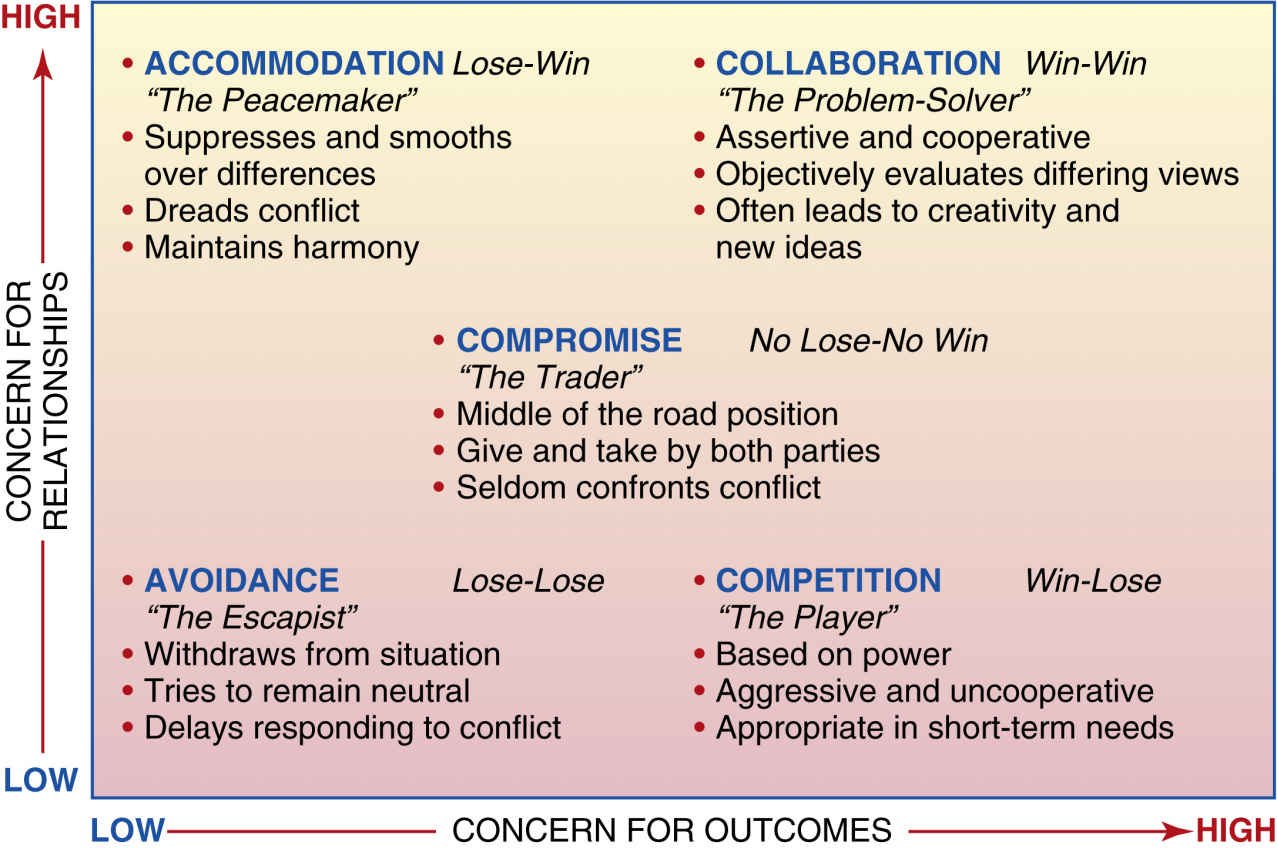
Kenneth Thomas and Ralph Kilmann developed five conflict resolution strategies that people use to handle conflict, including avoiding, defeating, compromising, accommodating, and collaborating.

This is based on the assumption that people choose how cooperative and how assertive to be in a conflict. It suggests that everyone has preferred ways of responding to conflict, but most of us use all methods under various circumstances. It is helpful to understand the five methods, particularly when you want to move a group forward.

Conflict Resolution Strategy 1: Avoiding

Avoiding is when people just ignore or withdraw from the conflict. They choose this method when the discomfort of confrontation exceeds the potential reward of resolution of the conflict. While this might seem easy to accommodate for the facilitator, people aren’t really contributing anything of value to the conversation and may be withholding worthwhile ideas. When conflict is avoided, nothing is resolved.

Conflict Resolution Strategy 2: Competing

Competing is used by people who go into a conflict planning to win. They’re assertive and not cooperative. This method is characterized by the assumption that one side wins and everyone else loses. It doesn’t allow room for diverse perspectives into a well informed total picture. Competing might work in sports or war, but it’s rarely a good strategy for group problem solving.

Debra wrote an illuminating article on how conflict resolution failure can lead to revolution. It’s what can happen when people feel like they aren’t being listened to and start being assertive.

Conflict Resolution Strategy 3: Accommodating

Accommodating is a strategy where one party gives in to the wishes or demands of another. They’re being cooperative but not assertive. This may appear to be a gracious way to give in when one figures out s/he has been wrong about an argument. It’s less helpful when one party accommodates another merely to preserve harmony or to avoid disruption. Like avoidance, it can result in unresolved issues. Too much accommodation can result in groups where the most assertive parties commandeer the process and take control of most conversations.

Conflict Resolution Strategy 4: Collaborating

Collaborating is the method used when people are both assertive and cooperative. A group may learn to allow each participant to make a contribution with the possibility of co-creating a shared solution that everyone can support.

A great way to collaborate and overcome conflict is to reach out and touch them.

Conflict Resolution Strategy 5: Compromising

Another strategy is compromising, where participants are partially assertive and cooperative. The concept is that everyone gives up a little bit of what they want, and no one gets everything they want. The perception of the best outcome when working by compromise is that which “splits the difference.” Compromise is perceived as being fair, even if no one is particularly happy with the final outcome.

Organizational Culture, Definitions, Characteristics, Importance

Organizational Culture refers to the shared values, beliefs, norms, and behaviors that define the collective identity of an organization. It encompasses the way people interact, make decisions, and solve problems within the workplace. A strong organizational culture fosters unity, loyalty, and a sense of belonging among employees, guiding their actions and shaping the organization’s reputation. It influences employee engagement, job satisfaction, and ultimately, organizational performance. A positive culture that prioritizes collaboration, innovation, and transparency can lead to higher productivity, better employee retention, and a competitive advantage in the marketplace. Cultivating and nurturing a healthy organizational culture requires leadership commitment, consistent communication, and alignment with the organization’s mission and values.

Definitions of Organizational Culture:

  • Edgar Schein:

Organizational culture is the pattern of shared basic assumptions that a group learns as it solves its problems of external adaptation and internal integration, which has worked well enough to be considered valid and, therefore, to be taught to new members as the correct way to perceive, think, and feel in relation to those problems.

  • Charles Handy:

Organizational culture is the way we do things around here.

  • Terrence E. Deal and Allan A. Kennedy:

Culture is the way things are done around here.

  • Peter Drucker:

Culture eats strategy for breakfast.

  • McKinsey & Company:

Organizational culture is the collective programming of the mind that distinguishes the members of one organization from others.

  • Denison Consulting:

Organizational culture is the set of beliefs, values, and assumptions that shape behavior and practices within an organization.

  • Cameron and Quinn’s Competing Values Framework:

Organizational culture is the underlying pattern of shared basic assumptions that people in an organization learn as they solve problems of external adaptation and internal integration, which has worked well enough to be considered valid and, therefore, to be taught to new members as the correct way to perceive, think, and feel in relation to those problems.

Characteristics of Organizational Culture:

  • Mission and Vision:

A clear mission and vision statement that outlines the organization’s purpose and direction, guiding employees in their daily activities and decisions.

  • Values and Beliefs:

Core values and beliefs that shape the attitudes and behaviors of employees, influencing how they interact with each other and approach their work.

  • Norms and Expectations:

Established norms and expectations regarding work ethics, communication styles, collaboration, and performance standards that define acceptable behavior within the organization.

  • Leadership Style:

The leadership style prevalent within the organization, which sets the tone for how decisions are made, conflicts are resolved, and employees are motivated and supported.

  • Communication Channels:

The communication channels and processes through which information flows within the organization, including formal channels such as meetings and memos, as well as informal channels like water cooler conversations and social media.

  • Employee Engagement:

The degree to which employees are engaged and committed to the organization’s goals, reflected in their motivation, satisfaction, and willingness to contribute beyond their basic job requirements.

  • Adaptability and Innovation:

The organization’s openness to change, willingness to experiment, and ability to adapt to new challenges and opportunities, fostering a culture of innovation and continuous improvement.

  • Inclusivity and Diversity:

The extent to which the organization values and promotes diversity, equity, and inclusion, creating a welcoming and supportive environment for employees from different backgrounds and perspectives.

Importance of Organizational Culture:

  • Employee Engagement and Retention:

A positive organizational culture fosters employee engagement by creating a sense of belonging, purpose, and fulfillment. Engaged employees are more likely to stay with the organization, reducing turnover and associated costs.

  • Performance and Productivity:

A strong culture aligned with the organization’s goals and values motivates employees to perform at their best. It promotes accountability, teamwork, and a shared commitment to achieving objectives, ultimately leading to higher productivity and performance.

  • Innovation and Adaptability:

A culture that encourages creativity, risk-taking, and learning fosters innovation and adaptability. Employees feel empowered to experiment, share ideas, and challenge the status quo, driving continuous improvement and resilience in the face of change.

  • Customer Satisfaction and Loyalty:

Organizational culture influences how employees interact with customers and deliver products or services. A customer-centric culture that prioritizes quality, responsiveness, and empathy enhances customer satisfaction and loyalty, contributing to long-term business success.

  • Brand Reputation:

The culture of an organization reflects its values, ethics, and behavior, shaping its reputation in the marketplace. A positive culture can enhance the company’s brand image, attracting customers, investors, and top talent, while a negative culture can damage reputation and deter stakeholders.

  • Leadership Effectiveness:

Organizational culture influences leadership effectiveness by shaping leadership styles, communication practices, and decision-making processes. Strong leaders who embody and promote the organization’s culture can inspire trust, alignment, and commitment among employees.

  • Risk Management and Compliance:

A culture of integrity, transparency, and ethical behavior reduces the likelihood of unethical conduct, fraud, and compliance violations. It fosters a culture of trust and accountability, where employees feel comfortable speaking up about issues and adhering to regulations.

  • Organizational Resilience:

A resilient culture enables organizations to navigate challenges, setbacks, and disruptions more effectively. It promotes a mindset of agility, collaboration, and problem-solving, enabling the organization to bounce back from adversity and thrive in dynamic environments.

Organizational Culture: Types and Functions

The practices, principles, policies and values of an organization form its culture. The culture of an organization decides the way employees behave amongst themselves as well as the people outside the organization.

Types of organization culture

  1. Normative Culture

In such a culture, the norms and procedures of the organization are predefined and the rules and regulations are set as per the existing guidelines. The employees behave in an ideal way and strictly adhere to the policies of the organization. No employee dares to break the rules and sticks to the already laid policies.

  1. Pragmatic Culture

In a pragmatic culture, more emphasis is placed on the clients and the external parties. Customer satisfaction is the main motive of the employees in a pragmatic culture. Such organizations treat their clients as Gods and do not follow any set rules. Every employee strives hard to satisfy his clients to expect maximum business from their side.

  1. Academy Culture

Organizations following academy culture hire skilled individuals. The roles and responsibilities are delegated according to the back ground, educational qualification and work experience of the employees. Organizations following academy culture are very particular about training the existing employees. They ensure that various training programmes are being conducted at the workplace to hone the skills of the employees. The management makes sincere efforts to upgrade the knowledge of the employees to improve their professional competence. The employees in an academy culture stick to the organization for a longer duration and also grow within it. Educational institutions, universities, hospitals practice such a culture.

  1. Baseball team Culture

A baseball team culture considers the employees as the most treasured possession of the organization. The employees are the true assets of the organization who have a major role in its successful functioning. In such a culture, the individuals always have an upper edge and they do not bother much about their organization. Advertising agencies, event management companies, financial institutions follow such a culture.

  1. Club Culture

Organizations following a club culture are very particular about the employees they recruit. The individuals are hired as per their specialization, educational qualification and interests. Each one does what he is best at. The high potential employees are promoted suitably and appraisals are a regular feature of such a culture.

  1. Fortress Culture

There are certain organizations where the employees are not very sure about their career and longevity. Such organizations follow fortress culture. The employees are terminated if the organization is not performing well. Individuals suffer the most when the organization is at a loss. Stock broking industries follow such a culture.

  1. Tough Guy Culture

In a tough guy culture, feedbacks are essential. The performance of the employees is reviewed from time to time and their work is thoroughly monitored. Team managers are appointed to discuss queries with the team members and guide them whenever required. The employees are under constant watch in such a culture.

  1. Bet your company Culture

Organizations which follow bet your company culture take decisions which involve a huge amount of risk and the consequences are also unforeseen. The principles and policies of such an organization are formulated to address sensitive issues and it takes time to get the results.

  1. Process Culture

As the name suggests the employees in such a culture adhere to the processes and procedures of the organization. Feedbacks and performance reviews do not matter much in such organizations. The employees abide by the rules and regulations and work according to the ideologies of the workplace. All government organizations follow such a culture.

Functions of Organizational Culture

  1. The first function of culture is that it has a Boundary-Defining role which means that culture helps to create distinctions between one organization and others.
  2. Culture helps to create a sense of identity for the organization members.
  3. Culture facilitates the generation of commitment to something larger the than one’s individual self interest. Culture encourages the members of the organization to give priority to organizational interests over and above their personal interests.
  4. Culture enhances the Social System Stability. Culture is also known as the social glue that helps to hold the organization together by providing appropriate standards for what employees should say and do. It provides a list of social do’s and don’ts for the employees.
  5. Culture finally, serves as a sense making and control mechanism that guides and shapes the attitudes and behaviours of employees. This function is particularly important in the study of organizational behaviour. Every organization has its own set of assumptions, understandings and implicit rules to guide the day to day behaviour of the employees. The newcomers will be accepted as fully fledged members of the organization only when they learn to obey these rules. Conformity to the rules is generally the primary basis for rewards and promotions.

Thus, culture is beneficial to the organization as it enhances organizational commitment and increases the consistency of employee behaviour. Culture is beneficial to the employee also as it reduces ambiguity. Employees become very clear as to how things are to be done and what is more important for the organization.

Barriers of Organizational Culture

Change is one of few certainties in our work lives. Regardless of industry, company size, or leadership team experience, your team or organization is bound to experience several major transitions.  If you are in a leadership role, you are in a unique position to anticipate and plan for change so as to maximize its benefits and mitigate disruption in your organization.  Why does this matter?  Because research tells us that initiatives with excellent change management are six times more likely to meet objectives than those with poor change management.  Just increasing your change management rating from “poor” to “fair” means you are three times more likely to meet objectives.

Below are six common barriers to effective organizational culture

  1. Individual Change Resistance

Most people don’t enjoy change.  The status quo tends to be more convenient and comfortable, so our resistance to a new process, strategy or organizational structure (no matter how logical or promising) is almost inevitable.  Part of our human nature involves us being very sensitive to certain kinds of perceived threats in our social environment, which by extension includes our workplace.  Harvard Business Review outlines ten reasons why individuals tend to resist change:

  • Loss of control, especially over processes that have been built up over time.
  • Excess uncertainty, which we seek to avoid at all costs.
  • Surprise changes with little to no room for mental preparation.
  • Changes to everyday work habits and routines.
  • Loss of face, particularly for those who have built their reputation on the status quo.
  • Concerns about competence as it relates to the new environment.
  • More work, especially in the transition period.
  • Ripple effects, as the change begins to affect other departments and even customers.
  • Past resentments that can spring up against the person responsible for or affecting the change.
  • True risks, to both your team’s happiness and livelihood.

Addressing these perceived threats at both an individual, as well as the team and organizational levels, is key to successful change management.

  1. Lack of Communication

At its core, successful organizational change is really a successful communication exercise.  In fact, one study found that the single biggest reason for organizational failure to successfully implement any kind of change is “clear and frequent communication.”  When combined with your team’s natural resistance for change outlined above, this barrier makes sense. In fact, every single one of the 10 reasons for individual change resistance can least be partially mitigated through intentional and proactive communication.

Communication should take center stage in both the planning and implementation phases of change management.   Whenever a project or new direction is planned, communication should begin before its actual implementation or execution. Set clear expectations, communicate potential timelines, and report organizational progress to plan at regular intervals.  During unplanned or crisis-driven change, keeping everyone on the same page is just as critical. In a recent article, the Harvard Business Review outlined additional strategies to communicate effectively during times of intense organizational change.

  1. Lack of Strategic Direction

Communication is key but will be unsuccessful if it lacks direction or a cohesive message. From the moment you begin to plan or implement any type of organizational change, first clarify your objectives.  Think of your objectives as the roadmap that will guide you to your intended destination.  Ideally, your change management strategy should include the following five components:

  • An overarching goal or intended outcome of the process.
  • Clear, measurable objectives related to the overall outcome.
  • An estimated timeline of achieving your objectives.
  • Regular benchmarks or check-ins to evaluate your progress toward goal.
  • An outline of strategic communication to keep everyone involved on the same page.

With the right strategy, you will improve your chances of getting buy in so staff are more likely to take a productive vs. disruptive role in the change process.

  1. Lack of Consistency

We all experience it, and we can all become frustrated by it. Cognitive dissonance describes what happens when your ideas, beliefs, or behaviors contradict each other. You see an ad, but the product doesn’t deliver on its promises. You experience one of your role models commit an unethical act. You hear great things about organizational change, but all you can see is the increased workload it will bring you for the next six months.

During organizational change or transition, some cognitive dissonance is inevitable. Your team will experience an initial increase in their workload and painfully discover many ways in which the new way of doing things (such as a new business software platform) is actually more time consuming or initially cumbersome than the old one.  If the gap between the perceived benefits of the change and the real work it will take to accomplish change is too long or too great, progress stalls and problems can arise.

Observing positive benefits that were promised actually materialize helps to generate buy-in on and maintain energy for change on behalf of your employees. That’s why planning so you can achieve a few early “wins” and then reinforce them frequently through communication, is so important to a successful change process.

Encourage your implementation team to speak out. Left alone, contradictions between hoped for benefits and lived reality will fester and cause resentment, which in turn will undermine the change. Then, align your communication with expectations to make sure that people experience as much consistency between their expectations and actual outcomes as possible.

  1. Cultural Barriers

As soon as a project involves or affects multiple people from diverse groups, cultural barriers can emerge.  For example, if your organization is geographically dispersed, it is likely that people working in different regions will disagree not only on the impact of the change itself, but also regarding the “right” way to go about implementing it.  The often-cited 6-D Model of National Cultures by Gert Hofstede offers some insight into ways in which people in from various cultures may differ in how they perceive the world and approach their work.  Various sub-cultures within your organization can have similar effects on whether or not your change management process will be successful.

Overcoming cultural barriers to change management requires an in-depth understanding of who all the stakeholders in a change process are and what they care most about.  Frequent communication, proportional representation within your implementation team, and upward feedback channels are key to managing change in a way that integrates instead of alienating diverse groups of stakeholders within your organization.

  1. Lack of (Perceived) Leadership Buy-In

The old cliché that states, “change starts at the top but happens at the bottom” still rings true.  Few organizational changes are successful without strong support and sponsorship from people at the highest levels of the organization.  Here, perception is key. You might have the necessary buy-in from the CEO, but that matters little if front line employees don’t actually know about it. Wherever possible, involve top leadership in high visibility activities that range from all staff kickoff meetings to regular small group feedback sessions. The more active and visible your organizational leaders are throughout the change process, the better.  Ideally, everyone in management should be involved in the change and actively sponsoring it.

Way of Creating and Maintaining Effective Organization Culture

Companies with impressive employee retention rates and high employee satisfaction levels, all have one thing in common they understand the importance of a strong workplace culture. They also know that you must truly invest in your people if you want to get the best out of them.

A poor workplace culture could actually end up costing an employer money, as it could result in absenteeism, employee stress, poor health and a high turnover of staff.  Therefore, working hard to achieve a good culture is not only beneficial for those you employ, it’s also good for the productivity of your business.

These things are easy to talk about, but often less easy to achieve. So, what does a good company culture actually look like?

Responsive to employee needs

Aside from salary and pension schemes, employees have become increasingly interested in ‘lifestyle benefits’ that respond to their personal circumstances and aid a healthier work/life balance. These can include things such as flexitime working, work from home options and study days.

Ongoing development

Does your company promote continuous employee growth and development? It’s important for an employee know their employer is invested in their personal and professional development take the necessary steps to do so. Promoting a culture of continuous development can be done so by developing mentoring schemes or training days.

Social calendar

A good balance of social interaction alongside business activity is good for morale. A healthy calendar of social events outside of the office can help instigate inter-team bonding as well as creating a buoyant atmosphere.

Open, honest feedback

Employers need to create an open culture that allows employees at every level to share their ideas, suggestions and concerns. With structured feedback strategies in place, employers can then monitor employee satisfaction levels and help alleviate issues as they arise.

A little extra

Alongside the more traditional benefits, employees usually respond well to other smaller, more personalised perks – such as free breakfast, early Friday finish or a charity partnership that’s chosen by employees.

Innovative approach

This applies to the innovative ways in which the company conducts business, but also the way it engages with its staff. Is your company striving to be a thought-leader in its sector? Do employees have the chance to attend industry events to keep up with the latest trends and advancements in their field? Do they feel able to incorporate new ideas and technology into their work?

Committed leadership

A great workplace needs buy-in from all team members – but particularly from those at management level. Clear, committed and inclusive leadership will be an essential component in maintaining a great company culture. Make sure the leaders in your organisation understand the culture and are able to effectively communicate and uphold it.

Motivation Concept, Forms, Need, Nature, Importance

Motivation is the internal or external drive that initiates, directs, and sustains goal-oriented behavior. It involves psychological processes that arouse enthusiasm and persistence in individuals to accomplish tasks. Motivation is essential for individuals and organizations because it energizes people to work towards objectives, personal or professional. It can come from intrinsic factors like personal satisfaction or from extrinsic factors like rewards, recognition, and incentives. In organizations, motivation is key for improving productivity, job satisfaction, and achieving long-term goals.

Forms of Motivation:

  • Intrinsic Motivation:

Intrinsic motivation comes from within the individual and is driven by personal satisfaction, passion, or the desire for self-fulfillment. People with intrinsic motivation engage in activities because they find them enjoyable or rewarding in themselves, not because of external rewards or pressures. For example, a person may work hard on a project because they are passionate about the subject or because they find it intellectually stimulating.

  • Extrinsic Motivation:

Extrinsic motivation is driven by external factors such as rewards, recognition, or the avoidance of punishment. This type of motivation often involves tangible rewards like money, promotions, or praise. Employees may be extrinsically motivated when they work to earn a bonus or to avoid reprimand. Extrinsic motivation is common in workplace environments where performance-based incentives are used to encourage productivity.

Needs of Motivation:

  • Basic Physiological Needs:

At the most fundamental level, motivation stems from the need to satisfy basic physiological needs such as food, water, shelter, and rest. These needs form the foundation of Maslow’s Hierarchy of Needs and must be met before individuals can focus on higher-order desires.

  • Safety and Security Needs:

After basic needs, individuals are motivated by the need for safety and security. This includes physical safety, job security, financial stability, and a safe working environment. Organizations must ensure that employees feel secure in their roles to maintain motivation.

  • Social Needs:

Humans are social beings and are motivated by the need for belonging, relationships, and interaction. In the workplace, this need is fulfilled by being part of a team, having friends, and building healthy interpersonal relationships. A sense of belonging motivates employees to be committed to the organization.

  • Esteem Needs:

Individuals are motivated by the need for self-esteem, respect, and recognition. Esteem needs involve both internal esteem (self-respect) and external esteem (respect from others). In a professional setting, employees seek recognition, titles, and appreciation for their efforts, which enhances their motivation to perform better.

  • Self-Actualization Needs:

The highest need in Maslow’s hierarchy is self-actualization, where individuals strive to reach their fullest potential and achieve personal growth. Employees are motivated by opportunities for creativity, innovation, and realizing their talents and skills.

  • Achievement Needs:

People are motivated by the desire to achieve personal and professional goals. This need drives individuals to set targets, pursue challenges, and work toward their own sense of accomplishment. In the workplace, providing employees with challenging tasks and opportunities for personal success fuels motivation.

  • Power Needs:

Some individuals are motivated by the need for power and influence over others. This can involve both personal power (control over one’s own life) and social power (influence over others). In organizations, leadership roles often satisfy this motivational need.

  • Affiliation Needs:

The need for affiliation is the desire to establish and maintain positive interpersonal relationships. Employees are motivated when they feel connected and supported by their peers and superiors. This sense of affiliation can increase loyalty and reduce turnover.

Nature of Motivation:

  • Continuous Process:

Motivation is not a one-time effort but an ongoing process. As individuals achieve one goal, they are motivated to pursue the next one. Organizations must continuously foster motivation through feedback, new challenges, and rewards.

  • Dynamic in Nature:

Motivation is dynamic and can change over time depending on circumstances, experiences, and individual desires. What motivates an employee today might differ in the future, requiring managers to stay adaptable in their motivational approaches.

  • Goal-Oriented Behavior:

Motivation drives individuals toward specific goals. It directs behavior toward the accomplishment of personal or organizational objectives. Without clear goals, motivation becomes ineffective and unfocused.

  • Influenced by Internal and External Factors:

Motivation can arise from both internal factors (like personal growth and satisfaction) and external factors (such as rewards or recognition). Effective motivation strategies often combine both types to maintain employee engagement.

  • Complex Process:

Motivational process is complex because it is influenced by a variety of personal, psychological, and organizational factors. Different individuals may have different motivational triggers, and managers must understand this complexity to effectively motivate their teams.

  • Individual Differences:

Motivation varies from one person to another based on individual differences such as personality, values, and expectations. What motivates one employee may not necessarily motivate another. Customizing motivational techniques is key to addressing these differences.

  • Leads to Action:

Motivation directly leads to action or behavior. It is the driving force that pushes individuals to work towards achieving goals, whether personal or organizational. Without motivation, even the most capable individuals may fail to act.

  • Affects Performance:

High levels of motivation are closely linked to improved performance. Motivated employees tend to be more productive, efficient, and engaged in their tasks, resulting in better organizational outcomes.

Importance of Motivation:

  • Increases Productivity:

Motivation plays a critical role in enhancing employee productivity. Motivated employees are more focused, engaged, and committed to their work, leading to higher output levels and better performance.

  • Encourages Innovation:

When employees are motivated, they are more likely to be creative and innovative in their work. A motivated workforce is driven to find new solutions, embrace challenges, and contribute ideas that can lead to organizational growth.

  • Reduces Turnover:

High levels of motivation can lead to greater job satisfaction, reducing the likelihood of employees leaving the organization. A motivated workforce is more likely to be loyal and less likely to seek employment elsewhere.

  • Promotes Employee Development:

Motivation encourages employees to pursue personal and professional growth. They are more likely to invest in learning new skills, taking on new challenges, and developing their abilities, which benefits both the individual and the organization.

  • Enhances Teamwork and Collaboration:

Motivated employees are more inclined to work collaboratively with their colleagues. Motivation fosters a positive work environment where individuals feel connected, valued, and motivated to achieve collective goals.

  • Drives Achievement of Organizational Goals:

Motivated workforce is essential for achieving organizational objectives. When employees are aligned with the company’s goals and motivated to contribute, the entire organization benefits from improved performance and efficiency.

  • Boosts Employee Morale:

Motivation is key to maintaining high levels of morale among employees. When employees feel motivated and valued, they experience higher levels of job satisfaction, which translates to a positive attitude toward their work.

  • Improves Decision Making:

Motivated employees are more confident in their decision-making abilities. When employees feel supported and empowered, they take ownership of their work and make decisions that align with organizational goals.

error: Content is protected !!