Management Process

Management process is a process of setting goals, planning and/or controlling the organizing and leading the execution of any type of activity, such as:

  • A project (project management process) or
  • A process (process management process, sometimes referred to as the process performance measurement and management system).

An organization’s senior management is responsible for carrying out its management process. However, this is not always the case for all management processes, for example, it is the responsibility of the project manager to carry out a project management process.

Nature of Management Process

Management is a process which brings the scarce human and material resources together and motivates people for the achievement of objectives of the organization. Management is not a onetime act but an on-going series of interrelated activities. The sum total of these activities is known as management process. It consists of a set of interrelated operations or functions necessary to achieve desired organizational goals. A process is a systematic way of doing things. It is concerned with conversion of inputs into outputs. An analysis of management process will enable us to know the functions which managers perform.

Features of Management Process

  1. Social Process

The entire management process is regarded as a social process as the success of all organizational efforts depends upon the willing co-operation of people. Managers guide, direct, influence and control the actions of others to achieve stated goals. Even people outside the organization are influenced by the actions of managers.

  1. Continuous Process

The process of management is on-going and continuous. Managers continuously take up one or the other function. Management cycle is repeated over and over again, each managerial function is viewed as a sub-process of total management process.

  1. Universal

Management functions are universal in the sense that a manager has to perform them irrespective of the size and nature of the organization. Each manager performs the same functions regardless of his rank or position in the organization. Even in a non-business organization managerial functions are the same.

  1. Iterative

Managerial functions are contained within each other the performance of the next function does not start only when the earlier function is finished. Various functions are taken together. For example, planning, organizing, directing and controlling may occur within staffing function. Similarly, organizing may require planning, directing and controlling. So all functions can be thought of as sub-functions of each other.

  1. Composite

All managerial functions are composite and integrated. There cannot be any sequence which can be strictly followed for performing various functions. The sequential concept may be true in a newly started business where functions may follow a particular sequence but the same will not apply to a going concern. Any function may be taken up first or many functions may be taken up at the same time.

Four Functions of Management Process: Planning, Organizing, Leading, Controlling

Functions of management is a systematic way of doing things. Management is a process to emphasize that all managers, irrespective of their aptitude or skill, engage in some inter-related functions to achieve their desired goals.

Planning, organizing, leading, and controlling are the 4 functions of management;  which work as a continuous process. First; managers must set a plan, then organize resources according to the plan, lead employees to work towards the plan, and finally, control everything by monitoring and measuring the effectiveness of the plan.

Management process/functions involve 4 basic activities
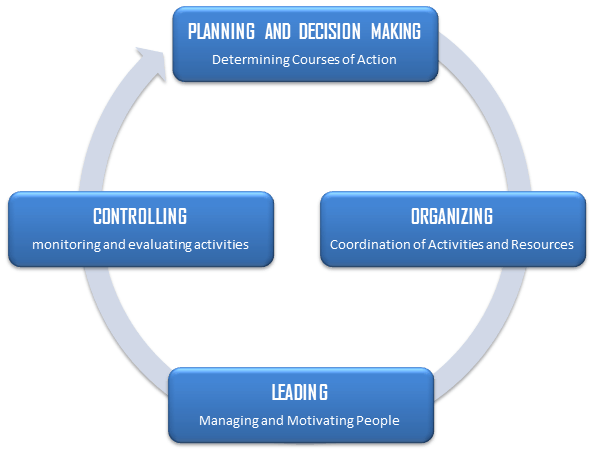
Four Functions of Management Process

  1. Planning and Decision Making: Determining Courses of Action

Looking ahead into the future and predict possible trends or occurrences which are likely to influence the working situation is the most vital quality as well as the job of a manager.

Planning means setting an organization’s goal and deciding how best to achieve them. Planning is decision making, regarding the goals and setting the future course of action from a set of alternatives to reach them.

The plan helps to maintain managerial effectiveness as it works as a guide for the personnel for future activities. Selecting goals as well as the paths to achieve them is what planning involves.

Planning involves selecting missions and objectives and the actions to achieve them, it requires decision-making or choosing future courses of action from among alternatives.

In short, planning means determining what the organization’s position and the situation should be at some time in the future and decide how best to bring about that situation.

Planning helps maintain managerial effectiveness by guiding future activities.

For a manager, planning and decision-making require an ability to foresee, to visualize, and to look ahead purposefully.

  1. Organizing: Coordinating Activities and Resources

Organizing can be defined as the process by which the established plans are moved closer to realization.

Once a manager set goals and develops plans, his next managerial function is organizing human resource and other resources that are identified as necessary by the plan to reach the goal.

Organizing involves determining how activities and resources are to be assembled and coordinated.

The organization can also be defined as an intentionally formalized structure of positions or roles for people to fill in an organization.

Organizing produces a structure of relationships in an organization and it is through these structured relationships that plans are pursued.

Organizing, then, is that part of managing which involves: establishing an intentional structure of roles for people to fill in the organization.

It is intentional in the sense of making sure that all the tasks necessary to accomplish goals are assigned to people who can do the best.

The purpose of an organization structure is to create an environment for the best human performance.

The structure must define the task to be done. The rules so established must also be designed in light of the abilities and motivations of the people available.

Staffing is related to organizing and it involves filling and keeping filled, the positions in the organization structure.

This can be done by determining the positions to be filled, identifying the requirement of manpower, filling the vacancies and training employees so that the assigned tasks are accomplished effectively and efficiently.

The managerial functions of promotion, demotion, discharge, dismissal, transfer, etc.  Are also included with the broad task “staffing.” staffing ensures the placement of the right person in the right position.

Organizing is deciding where decisions will be made, who will do what jobs and tasks, who will work for whom, and how resources will assemble.

  1. Leading: Managing, Motivating and Directing People

The third basic managerial function is leading it is the skills of influencing people for a particular purpose or reason. Leading is considered to be the most important and challenging of all managerial activities.

Leading is influencing or prompting the member of the organization to work together with the interest of the organization.

Creating a positive attitude towards the work and goals among the members of the organization is called leading. It is required as it helps to serve the objective of effectiveness and efficiency by changing the behavior of the employees.

Leading involves several deferment processes and activates.

The functions of direction, motivation, communication, and coordination are considered a part of the leading processor system.

Coordinating is also essential in leading.

Most authors do not consider it a separate function of management.

Rather they regard coordinating as the essence of managership for achieving harmony among individual efforts towards accomplishing group targets.

Motivating is an essential quality for leading. Motivating is the function of the management process of influencing people’s behavior based on the knowledge of what cause and channel sustain human behavior in a particular committed direction.

Efficient managers need to be effective leaders.

Since leadership implies fellowship and people tend to follow those who offer a means of satisfying their own needs, hopes and aspirations, understandably, leading involves motivation leadership styles and approaches and communication.

  1. Controlling: Monitoring and Evaluating Activities

Monitoring the organizational progress toward goal fulfillment is called controlling. Monitoring progress is essential to ensure the achievement of organizational goals.

Controlling is measuring, comparing, finding deviation and correcting the organizational activities which are performed for achieving the goals or objectives. Controlling consists of activities, like; measuring the performance, comparing with the existing standard and finding the deviations, and correcting the deviations.

Control activities generally relate to the measurement of achievement or results of actions that were taken to attain the goal.

Some means of controlling, like the budget for expenses, inspection records, and the record of labor hours lost, are generally familiar. Each measure also shows whether plans are working out.

If deviations persist, correction is indicated. Whenever results are found to differ from the planned action, persons responsible are to be identified and necessary actions are to be taken to improve performance.

Thus outcomes are controlled by controlling what people do. Controlling is the last but not the least important management function process.

It is rightly said, “planning without controlling is useless”. In short, we can say the controlling enables the accomplishment of the plan.

All the management functions of its process are inter-related and cannot be skipped.

The management process designs and maintains an environment in which personnel’s, working together in groups, accomplish efficiently selected aims.

All managers carry out the main functions of management; planning, organizing, staffing, leading and controlling. But depending on the skills and position on an organizational level, the time and labor spent in each function will differ.
Managers Need for Understanding Internal and External Environment

It is important for managers to understand this aspect of the business environment because it can affect their firm and how it should be run. No business is insulated from the outside environment.  Things like political decisions, for example, can have a huge impact on a firm by changing tax laws or regulatory regimes. As another example, the managers must be aware of things like new competitors entering their market.  Clearly, managers would need to be aware of these sorts of changes.

A Manager is the person responsible for planning and directing the work of a group of individuals, monitoring their work, and taking corrective action when necessary. For many people, this is their first step into a management career.

Managers may direct workers directly or they may direct several supervisors who direct the workers. The manager must be familiar with the work of all the groups he/she supervises, but does not need to be the best in any or all of the areas. It is more important for the manager to know how to manage the workers than to know how to do their work well.

A manager may have the power to hire or fire employees or to promote them. In larger companies, a manager may only recommends such action to the next level of management. The manager has the authority to change the work assignments of team members.

One of management main task is to keep the company alive and as resilient as possible. Understanding external environmental components are key to survive. What if a heavy rain is coming down and the sewage cannot handle it. It could mean that operations are forced to stop due to lack of energy or other water problems. If management takes these external environmental components into account, it will certainly enhance it’s ability to continue or to start up as quickly as possible. In this way, operations can continue and the company stays focused on their core activities.  And if they enlarge this thinking also for the well being of their employees, than they are truly building resilient and sustainable surroundings.

  1. Internal Environment of Organization

Forces or conditions or surroundings within the boundary of the organization are the elements of the internal environment of the organization.

The internal environment generally consists of those elements that exist within or inside the organization such as physical resources, financial resources, human resources, information resources, technological resources, organization’s goodwill, corporate culture and the like.

The internal environment includes everything within the boundaries of the organization.

Some of these are tangible, such as the physical facilities, the plant capacity technology, proprietary technology or know-how; some are intangible, such as information processing and communication capabilities, reward and task structure, performance expectations, power structure management capability and dynamics of the organization’s culture.

Based on those resources, the organization can create and deliver value to the customer. This value is fundamental to defining the organization’s purpose, and the premise on which it seeks to be profitable.

Are we adding value by research and development or by customer service, or by prompt delivery or by cutting any intermediary which reduces the customers’ costs?

Organizations build capabilities over a long time. They consistently invest in some areas so that they can build strong competitive businesses based on the uniqueness they have created.

The manager’s response to the external environment would depend upon the availability and the configuration of resource deployment within the organization.

The deployment of resources is a key managerial responsibility.

Top management is vested with the responsibility of allocating resources between the ongoing operations/activities and also with future operations which are of strategic nature, that is they might yield returns in some future time which require resources now to be nurtured and have some associated risks. The top management has to balance the conflicting demands of both as resources are always finite.

For example, General Electric is an aggressive innovator and marketer who has been ruthless in its approach to changing proactively as well as reactively to sustain its competitive positions in the respective industries. This implies that over the years General Electric has invested in developing those capabilities, systems, and processes that enable it to respond.

Elements of internal environment are

  • Owners and Shareholders.
  • Board of Directors.
  • Employees
  • Organizational Culture.
  • Resources of the Organization.
  • Organization’s image/goodwill.

The internal environment consists mainly of the organization’s owners, the board of directors, employees and culture.

(i) Owners and Shareholders

Owners are people who invested in the company and have property rights and claims on the organization. Owners can be an individual or group of persons who started the company; or who bought a share of the company in the share market.

They have the right to change the company’s policy at any time.

Owners of an organization may be an individual in the case of sole proprietorship business, partners in a partnership firm, shareholders or stockholders in a limited company or members in a cooperative society. In public enterprises, the government of the country is the owner.

Whoever the owners, they are an integral part of the organization’s internal environment. Owners play an important role in influencing the affairs of the business. This is the reason why managers should take more care of the owners of their organizations.

(ii) Board of Directors

The board of directors is the governing body of the company who is elected by stockholders, and they are given the responsibility for overseeing a firm’s top managers such as the general manager.

(iii) Employees

Employees or the workforce, the most important element of an organization’s internal environment, which performs the tasks of the administration. Individual employees and also the labor unions they join are important parts of the internal environment.

If managed properly they can positively change the organization’s policy. But ill-management of the workforce could lead to a catastrophic situation for the company.

(iv) Organizational Culture

Organizational culture is the collective behavior of members of an organization and the values, visions, beliefs, habits that they attach to their actions.

An organization’s culture plays a major role in shaping its success because the culture is an important determinant of how well their organization will perform.

As the foundation of the organization’s internal environment, it plays a major role in shaping managerial behavior.

An organization’s culture is viewed as the foundation of its internal environment. Organizational culture (or corporate culture) significantly influences employee behavior.

Culture is important to every employee including managers who work in the organization.

A strong culture helps a firm achieve its goals better than a firm having a weak culture. Culture in an organization develops and ‘blossoms’ over many years, starting from the practices of the founder(s).

Since culture is an important internal environmental concern for an organization, managers need to understand its influence on organizational activities.

(v) Resources of the Organization

An organization s resources can be discussed under five broad heads: physical resources, human resources; financial resources, informational resources, and technological resources. Physical resources include land and buildings, warehouses, all kinds of materials, equipment and machinery.

Examples are office buildings, computers, furniture, fans, and air conditioners.

Human resources include all employees of the organization from the top level to the lowest level of the organization. Examples are teachers in a university, marketing executives in a manufacturing company, and manual workers in a factory.

Financial resources include capital used for financing the operations of the organization including working capital. Examples are investment by owners, profits, reserve funds, and revenues received out of a sale. Informational resources encompass ‘usable data needed to make effective decisions.

Examples are sales forecasts, price lists from suppliers, market-related data, employee profile, and production reports.

(vi) Organization’s image/goodwill

The reputation of an organization is a very valuable intangible asset. High reputation or goodwill develops a favorable image of the organization in the minds of the public (so to say, in the minds of the customers).

‘No- reputation’ cannot create any positive image. A negative image destroys the organization’s efforts to attract customers in a competitive world.

The internal environment of an organization consists of the conditions and forces that exist within the organization.

Internal environment {sometimes called micro-environment) portrays an organization’s ‘in-house’ situations.

An organization has full control over these situations. Unlike the external environment, firms can directly control the internal environment.

Internal environment includes various internal factors of the organization such as resources, owners/shareholders, a board of directors, employees and trade union, goodwill, and corporate culture. These factors are detailed out below.

  1. External Environment of Organization: Factors Outside of Organization’s Scope

Factors outside or organization are the elements of the external environment. The organization has no control over how the external environment elements will shape up.

The external environment embraces all general environmental factors and an organization’s specific industry-related factors. The general environmental factors include those factors that are common ir\ nature and generally affect all organizations.

Because of their general nature, an individual organization alone may not be able to substantially control their influence on its business operations.

Managers have to continuously read signals from the external environment to spot emerging opportunities and threats. The external environment presents opportunities for growth leadership, and market dominance, it also poses the threat of obsolescence for products, technology, and markets.

While one section of an organization faces opportunities, another faces threats from a similar environment, perhaps because there is differentiation in their respective resources, capabilities and entrenched positions within the industry.

For example, the burgeoning mobile telephone market in India provides enormous opportunities for different types of organizations from handset manufacturers, content developers, application developers, mobile signal tower manufacturers, to service providers.

At the same time, it poses a threat to the fixed-line telephone business which for a long time, has been the monopoly of public sector enterprises.

The increasing demand for telecommunication services in India post-deregulation was an enormous opportunity for early entrants to enter the telecom services business and compete for revenue with state-owned organizations.

At the same time, the growing demand for mobile services led to an expansion of industrial capacity, price wars, lowering of call tariffs, acquisitions, and declining industry profits.

India has one of the lowest call rates in the world. As the industry matured and consolidation took place, the old players had to alter their business models and strategies.

The external environment can be subdivided into 2 layers

  • General Environment
  • Task / Industry Environment

Analysis of accounting information, Financial statement analysis and application

Accounting analysis, also referred as financial analysis or financial statement analysis, can be explained as an assessment of the stability, viability, and profitability of a business, sub-business, or project. A financial analysis is carried out by professionals who prepare reports through the use of info obtained from financial statements and other reports. Besides, one key area of financial analysis is the extrapolation of company’s past performance into an estimate of its future performance.

As explained by Investopedia, accounting analysis is one of the most common techniques for accounting analysis is calculating ratios from the data to compare with those of other companies or with the past performance of the company. For instance, return on assets is a common ratio which is used for determining the efficiency of a company at utilization of its assets as well as a measure of its profitability.

Methods of Accounting Analysis

The main methods adopted for accounting analysis include:

  • Past performance

The accounting analysis uses past statistics across historical time periods for a single company, for example, the last 5 years.

  • Future performance

The accounting analysis is performed by utilizing historical figures and certain statistical and mathematical techniques, counting present and future values. This extrapolation method acts as the main source of errors in accounting analysis for past statistics can play poor predictors for future prospects.

  • Comparative performance

The accounting analysis is also done through comparison between similar business companies.

Objectives of accounting analysis

Carrying out accounting analysis is helpful in solving the following purposes:

  • Solvency

Accounting analysis is helpful in assessing the ability of a company to repay its obligations to creditors and similar third parties in the long run.

  • Profitability

Accounting analysis facilitates the ability of a company to earn income in addition to sustaining short term as well as long term growth. A company’s profitability level is based on the income statement, which provides reports on the company’s operation results.

  • Liquidity

Accounting analysis aims at assessing a company’s ability to maintain positive cash flow in addition to satisfying immediate debts.

  • Stability

Accounting analysis aims at assessing the company’s ability of sustaining itself in the long run, without the existence of significant losses in the business conduct. 

Overview of Financial Statement Analysis

Financial statement analysis involves gaining an understanding of an organization’s financial situation by reviewing its financial reports. The results can be used to make investment and lending decisions. This review involves identifying the following items for a company’s financial statements over a series of reporting periods:

  • Trends. Create trend lines for key items in the financial statements over multiple time periods, to see how the company is performing. Typical trend lines are for revenue, the gross margin, net profits, cash, accounts receivable, and debt.
  • Proportion analysis. An array of ratios are available for discerning the relationship between the sizes of various accounts in the financial statements. For example, one can calculate a company’s quick ratio to estimate its ability to pay its immediate liabilities, or its debt to equity ratio to see if it has taken on too much debt. These analyses are frequently between the revenues and expenses listed on the income statement and the assets, liabilities, and equity accounts listed on the balance sheet.

Financial statement analysis is an exceptionally powerful tool for a variety of users of financial statements, each having different objectives in learning about the financial circumstances of the entity.

Users of Financial Statement Analysis

There are a number of users of financial statement analysis. They are:

  • Creditors. Anyone who has lent funds to a company is interested in its ability to pay back the debt, and so will focus on various cash flow measures.
  • Investors. Both current and prospective investors examine financial statements to learn about a company’s ability to continue issuing dividends, or to generate cash flow, or to continue growing at its historical rate (depending upon their investment philosophies).
  • Management. The company controller prepares an ongoing analysis of the company’s financial results, particularly in relation to a number of operational metrics that are not seen by outside entities (such as the cost per delivery, cost per distribution channel, profit by product, and so forth).
  • Regulatory authorities. If a company is publicly held, its financial statements are examined by the Securities and Exchange Commission (if the company files in the United States) to see if its statements conform to the various accounting standards and the rules of the SEC.

Methods of Financial Statement Analysis

There are two key methods for analyzing financial statements. The first method is the use of horizontal and vertical analysis. Horizontal analysis is the comparison of financial information over a series of reporting periods, while vertical analysis is the proportional analysis of a financial statement, where each line item on a financial statement is listed as a percentage of another item. Typically, this means that every line item on an income statement is stated as a percentage of gross sales, while every line item on a balance sheet is stated as a percentage of total assets. Thus, horizontal analysis is the review of the results of multiple time periods, while vertical analysis is the review of the proportion of accounts to each other within a single period.

The second method for analyzing financial statements is the use of many kinds of ratios. Ratios are used to calculate the relative size of one number in relation to another. After a ratio is calculated, you can then compare it to the same ratio calculated for a prior period, or that is based on an industry average, to see if the company is performing in accordance with expectations. In a typical financial statement analysis, most ratios will be within expectations, while a small number will flag potential problems that will attract the attention of the reviewer. There are several general categories of ratios, each designed to examine a different aspect of a company’s performance. The general groups of ratios are:

  1. Liquidity ratios. This is the most fundamentally important set of ratios, because they measure the ability of a company to remain in business. Click the following links for a thorough review of each ratio.
    • Cash coverage ratio. Shows the amount of cash available to pay interest.
    • Current ratio. Measures the amount of liquidity available to pay for current liabilities.
    • Quick ratio. The same as the current ratio, but does not include inventory.
    • Liquidity index. Measures the amount of time required to convert assets into cash.
  2. Activity ratios. These ratios are a strong indicator of the quality of management, since they reveal how well management is utilizing company resources. Click the following links for a thorough review of each ratio.
    • Accounts payable turnover ratio. Measures the speed with which a company pays its suppliers.
    • Accounts receivable turnover ratio. Measures a company’s ability to collect accounts receivable.
    • Fixed asset turnover ratio. Measures a company’s ability to generate sales from a certain base of fixed assets.
    • Inventory turnover ratio. Measures the amount of inventory needed to support a given level of sales.
    • Sales to working capital ratio. Shows the amount of working capital required to support a given amount of sales.
    • Working capital turnover ratio. Measures a company’s ability to generate sales from a certain base of working capital.
  3. Leverage ratios. These ratios reveal the extent to which a company is relying upon debt to fund its operations, and its ability to pay back the debt. Click the following links for a thorough review of each ratio.
    • Debt to equity ratio. Shows the extent to which management is willing to fund operations with debt, rather than equity.
    • Debt service coverage ratio. Reveals the ability of a company to pay its debt obligations.
    • Fixed charge coverage. Shows the ability of a company to pay for its fixed costs.
  4. Profitability ratios. These ratios measure how well a company performs in generating a profit. Click the following links for a thorough review of each ratio.
    • Breakeven point. Reveals the sales level at which a company breaks even.
    • Contribution margin ratio. Shows the profits left after variable costs are subtracted from sales.
    • Gross profit ratio. Shows revenues minus the cost of goods sold, as a proportion of sales.
    • Margin of safety. Calculates the amount by which sales must drop before a company reaches its break even point.
    • Net profit ratio. Calculates the amount of profit after taxes and all expenses have been deducted from net sales.
    • Return on equity. Shows company profit as a percentage of equity.
    • Return on net assets. Shows company profits as a percentage of fixed assets and working capital.
    • Return on operating assets. Shows company profit as percentage of assets utilized.

Problems with Financial Statement Analysis

While financial statement analysis is an excellent tool, there are several issues to be aware of that can interfere with the interpretation of the analysis results. These issues are:

  • Comparability between periods. The company preparing the financial statements may have changed the accounts in which it stores financial information, so that results may differ from period to period. For example, an expense may appear in the cost of goods sold in one period, and in administrative expenses in another period.
  • Comparability between companies. An analyst frequently compares the financial ratios of different companies in order to see how they match up against each other. However, each company may aggregate financial information differently, so that the results of their ratios are not really comparable. This can lead an analyst to draw incorrect conclusions about the results of a company in comparison to its competitors.
  • Operational information. Financial analysis only reviews a company’s financial information, not its operational information, so you cannot see a variety of key indicators of future performance, such as the size of the order backlog, or changes in warranty claims. Thus, financial analysis only presents part of the total picture.

Accounting for inventories

The accounting for inventory involves determining the correct unit counts comprising ending inventory, and then assigning a value to those units. The resulting costs are then used to record an ending inventory value, as well as to calculate the cost of goods sold for the reporting period. These basic inventory accounting activities are expanded upon in the following bullet points:

  • Determine ending unit counts. A company may use either a periodic or perpetual inventory system to maintain its inventory records. A periodic system relies upon a physical count to determine the ending inventory balance, while a perpetual system uses constant updates of the inventory records to arrive at the same goal.
  • Improve record accuracy. If a company uses the perpetual inventory system to arrive at ending inventory balances, the accuracy of the transactions is paramount.
  • Conduct physical counts. If a company uses the periodic inventory system to create ending inventory balances, the physical count must be conducted correctly. This involves the completion of a specific series of activities to improve the odds of counting all inventory items.
  • Estimate ending inventory. There may be situations where it is not possible to conduct a physical count to arrive at the ending inventory balance. If so, the gross profit method or the retail inventory method can be used to derive an approximate ending balance.
  • Assign costs to inventory. The main role of the accountant on a monthly basis is assigning costs to ending inventory unit counts. The basic concept of cost layering, which involves tracking tranches of inventory costs, involves the first in, first out (FIFO) layering system and the last in, first out (LIFO) system. A different approach is the assignment of a standard cost to each inventory item, rather than a historical cost.
  • Allocate inventory to overhead. The typical production facility has a large amount of overhead costs, which must be allocated to the units produced in a reporting period.

The preceding bullet points cover the essential accounting for the valuation of inventory. In addition, it may be necessary to write down the inventory values for obsolete inventory, or for spoilage or scrap, or because the market value of some goods have declined below their cost. There may also be issues with assigning costs to joint and by-product inventory items. We expand upon these additional accounting activities in the following bullet points:

  • Write down obsolete inventory. There must be a system in place for identifying obsolete inventory and writing down its associated cost.
  • Review lower of cost or market. The accounting standards mandate that the carrying amount of inventory items be written down to their market values (subject to various limitations) if those market values decline below cost.
  • Account for spoilage, rework, and scrap. In any manufacturing operation, there will inevitably be certain amounts of inventory spoilage, as well as items that must be scrapped or reworked. There is different accounting for normal and abnormal spoilage, the sale of spoiled goods, rework, scrap, and related topics.
  • Account for joint products and by-products. Some production processes have split-off points at which multiple products are created. The accountant must decide upon a standard method for assigning product costs in these situations.
  • There are a small number of disclosures about inventory that the accountant must include in the financial statements.

Accounting for Receivables

When goods or services are sold to a customer, and the customer is allowed to pay at a later date, this is known as selling on credit, and creates a liability for the customer to pay the seller. Conversely, this creates an asset for the seller, which is called accounts receivable. This is considered a short-term asset, since the seller is normally paid in less than one year.

An account receivable is documented through an invoice, which the seller is responsible for issuing to the customer through a billing procedure. The invoice describes the goods or services that have been sold to the customer, the amount it owes the seller (including sales taxes and freight charges), and when it is supposed to pay.

If the seller is operating under the cash basis of accounting, it only record transactions in its accounting records (which are then compiled into the financial statements) when cash is either paid or received. Since issuing an invoice does not involve any change in cash, there is no record of accounts receivable in the accounting records. Only when the customer pays does the seller record a sale.

If the seller is operating under the more widely-used accrual basis of accounting, it records transactions irrespective of any changes in cash. This is the system under which an account receivable is recorded. In addition, there is a risk that the customer will not pay. If so, the seller can either charge these losses to expense when they occur (known as the direct write-off method) or it can anticipate the amount of such losses and charge an estimated amount to expense (known as the allowance method). The latter method is preferred, because the seller is matching revenues with bad debt expenses in the same period (known as the matching principle).

We will illustrate these concepts below.

Recording Sales of Services on Credit

When services are sold to a customer, the seller normally creates an invoice in its accounting software, which automatically creates an entry to credit the sales account and debit the accounts receivable account. When the customer later pays the invoice, the seller would debit the cash account and credit the accounts receivable account. For example, ABC International billings a customer for $10,000 in services, and records the following entry:


Debit

Credit

Accounts receivable 10,000  
     Sales   10,000

This journal entry increases the accounts receivable asset for ABC, which appears as a short-term asset in its balance sheet. In addition, it increases sales, which appear in ABC’s income statement.

Recording Sales of Goods on Credit

If the seller were to sell goods to a customer on credit, then not only would it have to record the sale and related account receivable (as was the case for the sale of services), but it would also record the reduction in inventory that was sold to the customer, which then appears in the cost of goods sold expense. This later transaction reduces the inventory asset in the balance sheet and increases the expenses in the income statement. For example, if ABC International were to conclude a sale transaction for $25,000 in which it sold $12,000 of merchandise to the customer, its journal entry would be:


Debit

Credit

Accounts receivable 25,000  
     Sales   25,000
Cost of goods sold 12,000
     Inventory   12,000

There is an issue with the timing of the preceding sale transaction. If the sale is made under FOB shipping point terms, the seller is supposed to record both the sale transaction and related charge to cost of goods sold at the time when the shipment leaves its shipping dock. From that point onward, the delivery is technically the responsibility of either a third-party shipper or the buyer.

If the sale is made under FOB destination terms, then the seller is supposed to record these transactions when the shipment arrives at the customer; this is because the delivery is still the responsibility of the seller until it reaches the customer’s location.

From a practical perspective, many companies record their sale transactions as though the delivery terms were FOB shipping point, because it is easy to verify. Recording the transaction upon arrival at the customer requires substantially more work to verify.

Accounting for Bad Debt

If a company sells on credit, customers will occasionally be unable to pay, in which case the seller should charge the account receivable to expense as a bad debt. The best way to do so is to estimate the amount of bad debt that will eventually arise, and accrue an expense for it at the end of each reporting period. The debit is to the bad debt expense account, which causes an expense to appear in the income statement. The credit is to the allowance for bad debts account, which is a reserve account that appears in the balance sheet. Later, when a specific invoice is clearly identifiable as a bad debt, the accountant can eliminate the account receivable with a credit, and reduce the reserve with a debit. 

For example, ABC International invoices $1 million of invoices to various customers in January and estimates that $40,000 of this amount will not be paid. Accordingly, it records the following entry to create a bad debt reserve:


Debit

Credit

Bad debt expense 40,000  
     Allowance for doubtful accounts   40,000

In March, ABC clearly identifies $18,000 of invoices that will not be paid. It uses the following entry to eliminate the invoices and draw down the reserve balance:


Debit

Credit

Allowance for doubtful accounts 18,000  
     Accounts receivable   18,000

If the customer were to later pay the invoice, ABC would simply reverse the entry, so that the allowance account is increased back to its former level.

An alternative method is the direct write-off method, where the seller only recognizes a bad debt expense when it can identify a specific invoice that will not be paid. Under this approach, the accountant debits the bad debt expense and credits accounts receivable (thereby avoiding the use of an allowance account). It is not the preferred method for recording bad debts, because it introduces a delay between the recognition of a sale and the recognition of any related bad debt expense (which violates the matching principle).

Accounting for Early Payment Discounts

If a company offers customers a discount if they pay early and they take advantage of the offer, then they will pay an amount less than the invoice total. The accountant needs to eliminate this residual balance by charging it to the sales discounts account, which will appear in the income statement as a profit reduction.

For example, ABC International offers a $100 discount to a customer if it pays a $2,000 invoice within 10 days of the invoice date. The customer does so. ABC uses the following entry to record the transaction:


Debit

Credit

Cash 1,900  
Sales discounts 100  
     Accounts receivable   2,000

The Accounts Receivable Aging

All outstanding accounts receivable are compiled into the accounts receivable aging report, which is typically structured to show invoices that are current, overdue by 0 to 30 days, by 31 to 60 days, 61 to 90 days, or 90+ days. This report is used to derive the allowance for bad debts, and is also a key tool of the collections department, which uses it to determine which invoices are sufficiently overdue to require follow-up action.

Accounts Receivable Reconciliation

The accounts receivable aging report itemizes all receivables in the accounting system, so its total should match the ending balance in the accounts receivable general ledger account. The accounting staff should reconcile the two as part of the period-end closing process. If there is a difference between the report total and the general ledger balance, the difference is likely to be a journal entry that was made against the general ledger account, instead of being recorded as a formal credit memo or debit memo that would appear in the aging report.

Accounting for Share capital

A company, being an artificial person, cannot generate its own capital which has necessarily to be collected from several persons. These persons are known as shareholders and the amount contributed by them is called share capital.

Since the number of shareholders is very large, a separate capital account cannot be opened for each one of them. Hence, innumerable streams of capital contribution merge their identities in a common capital account called as ‘Share Capital Account’.

Categories of Share Capital

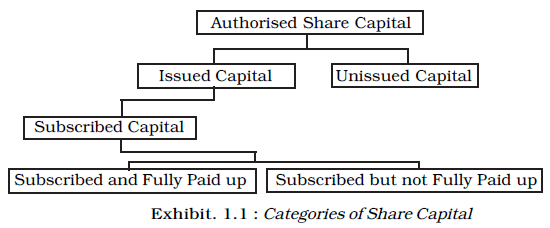
From accounting point of view the share capital of the company can be classified as follows:

Authorised Capital: Authorised capital is the amount of share capital which a company is authorised to issue by its Memorandum of Association. The company cannot raise more than the amount of capital as specified in the Memorandum of Association. It is also called Nominal or Registered capital. The authorised capital can be increased or decreased as per the procedure laid down in the Companies Act. It should be noted that the company need not issue the entire authorised capital for public subscription at a time. Depending upon its requirement, it may issue share capital but in any case, it should not be more than the amount of authorised capital.

  • Issued Capital: It is that part of the authorised capital which is actually issued to the public for subscription including the shares allotted to vendors and the signatories to the company’s memorandum. The authorised capital which is not offered for public subscription is known as ‘unissued capital’. Unissued capital may be offered for public subscription at a later date.
  • Subscribed Capital: It is that part of the issued capital which has been actually subscribed by the public. When the shares offered for public subscription are subscribed fully by the public the issued capital and subscribed capital would be the same. It may be noted that ultimately, the subscribed capital and issued capital are the same because if the number of share, subscribed is less than what is offered, the company allot only the number of shares for which subscription has been received. In case it is higher than what is offered, the allotment will be equal to the offer. In other words, the fact of over subscription is not reflected in the books.
  • Called up Capital: It is that part of the subscribed capital which has been called up on the shares. The company may decide to call the entire amount or part of the face value of the shares. For example, if the face value (also called nominal value) of a share allotted is Rs. 10 and the company has called up only Rs. 7 per share, in that scenario, the called up capital is Rs. 7 per share. The remaining Rs. 3 may be collected from its shareholders as and when needed.
  • Paid up Capital: It is that portion of the called up capital which has been actually received from the shareholders. When the shareholders have paid all the call amount, the called up capital is the same to the paid up capital. If any of the shareholders has not paid amount on calls, such an amount may be called as ‘calls in arrears’. Therefore, paid up capital is equal to the called-up capital minus call in arrears.
  • Uncalled Capital: That portion of the subscribed capital which has not yet been called up. As stated earlier, the company may collect this amount any time when it needs further funds.

Accounting for Share Capital

  • Reserve Capital: A company may reserve a portion of its uncalled capital to be called only in the event of winding up of the company. Such uncalled amount is called ‘Reserve Capital’ of the company. It is available only for the creditors on winding up of the company.

Let us take the following example and show how the share capital will be shown in the balance sheet. Sunrise Company Ltd., New Delhi, has registered its capital as Rs. 40,00,000, divided into 4,00,000 shares of Rs. 10 each. The company offered to the public for subscription of 2,00,000 shares of Rs. 10 each, as Rs. 2 on application, Rs.3 on allotment, Rs.3 on first call and the balance on final call. The company received applications for 2,50,000 shares. The company finalised the allotment on 2,00,000 shares and rejected applications for 50,000 shares. The company did not make the final call. The company received all the amount except on 2,000 shares where call money has not been received.

The above amounts will be shown in the Notes to Accounts of the balance sheet of Sunrise Company Ltd. as follows:

Notes to accounts

Share Capital

(Rs.)

Authorised or Registered or Nominal Capital:

4,00,000 Shares of Rs. 10 each


40,00,000

Issued Capital

2,00,000 Shares of Rs. 10 each


20,00,000

Subscribed Capital

Subscribed but not fully paid up

2,00,000 Shares of Rs. 10 each, Rs. 8 called up

Less: Calls in Arrears


16,00,000

6,000


15,94,000

Accounting for Liabilities

A liability is a legally binding obligation payable to another entity. Liabilities are a component of the accounting equation, where liabilities plus equity equals the assets appearing on an organization’s balance sheet.

Examples of liabilities are:

  • Accounts payable
  • Accrued liabilities
  • Accrued wages
  • Deferred revenue
  • Interest payable
  • Sales taxes payable

Accounting for Liabilities

For all of these sample liabilities, a company records a credit balance in a liability account. There may be rare cases where there is a negative liability (essentially an asset or a decline in a liability), in which case there may be a debit balance in a liability account. The basic accounting for liabilities is to credit a liability account. The offsetting debit can be to a variety of accounts. For example:

  • Accounts payable. The offsetting debit may be to an expense account, if the item being purchased is consumed within the current accounting period. Alternatively, the offsetting debit may be to an asset account, if the item is to be used over several periods (as is the case with a fixed asset).
  • Accrued liabilities. The offsetting debit is nearly always to an expense account, since accrued liabilities are usually only recognized as part of the closing process, where there is an expense but no documentation in the form of a supplier invoice.
  • Accrued wages. The offsetting debit is to the wage expense account, and reflects earned but unpaid hours at the end of the reporting period.
  • Deferred revenue. The offsetting debit is usually either the cash account or the accounts receivable account, and reflects a situation where a customer has at least been billed for services rendered or goods shipped, but the revenue creation process is not yet complete. A variation on this concept is a customer prepayments account, or a customer deposits account.
  • Interest payable. The offsetting debit is to the interest expense account, and indicates the amount of interest expense accrued by a business, but not yet billed to it by a lender.
  • Sales taxes payable. The offsetting debit is the accounts receivable account, which is where the sales tax billing to the customer is located.

In short, there is a diversity of treatment for the debit side of liability accounting.

Liability Classifications

When presenting liabilities on the balance sheet, they must be classified as either current liabilities or long-term liabilities. A liability is classified as a current liability if it is expected to be settled within one year. All other liabilities are classified as long-term. Accounts payable, accrued liabilities, and taxes payable are usually classified as current liabilities. If a portion of a long-term debt is payable within the next year, that portion is classified as a current liability. Most liabilities are classified as current liabilities.

Contingent Liabilities

There are also cases where there is a possibility that a business may have a liability. This is known as a contingent liability. You should record a contingent liability if it is probable that a loss will occur, and you can reasonably estimate the amount of the loss. If a contingent liability is only possible, or if the amount cannot be estimated, then it is (at most) only noted in the disclosures that accompany the financial statements. Examples of contingent liabilities are the outcome of a lawsuit, a government investigation, or the threat of expropriation. A warranty can also be considered a contingent liability.

Other Liability Issues

When you record a liability in the accounting records, this does not mean that you are also setting aside funds to pay for the liability when it must eventually be paid recording a liability has no immediate impact on cash flow.

Internal control systems or cash

Internal Control comprises of the plan of the organization and all the co-ordinate methods and measures adopted within a business to safeguard its assets, check the accuracy and reliability of its accounting data to promote operational efficiency and to encourage adherence to prescribed managerial policies.

Purpose of Internal Control

Let us now understand the purpose of Internal Control from different points of view.

From Auditor’s Point of View

It is very important from the Auditor’s point of view to study and evaluate the system of internal control. To obtain an adequate understanding of the internal control system, that must be tested. The Auditor has to determine whether audit is possible, if yes, then he should determine the scope of audit.

From Client’s Point of View

  • Internal control system provides reliable and accurate data that is necessary for decision making and to run business activity efficiently.
  • Adequate internal control system safeguard business assets, in absence of it, assets of the company may be stolen, misused or accidentally destroyed.
  • Internal control system within organization is necessary to discourage and stop non performing business activities and to protect business from wastage is all aspects of the business.
  • Internal control system insures that rules and procedures are to be followed by business personnel.

Characteristics of Internal Control

Following are the main characteristics of Internal Control usually abbreviated as CROSSASIA:

  • Competent and trustworthy personnel
  • Records, Financial and other Organization plan
  • Organizational plans
  • Segregation of duties
  • Supervision
  • Authorization
  • Sound practice
  • Internal Audit
  • Arithmetic and accounting controls

Limitations of Internal Control

Following are the inherent limitations of Internal Control:

  • Management decision to choose cost effective control system may reduce the effectiveness of internal control system.
  • There are chances of misuse by a person of authority who is operating on internal control system.
  • Objectives of internal control systems may be defeated by manipulation of management.
  • Since internal control system is involved in routine transactions, irregular transactions may be overlooked.
  • Changes in conditions may affect the effectiveness of internal control system.

Scope of Internal Control

Following are the main areas which are generally covered by a good internal control system:

  1. Cash

Here, internal control is applied over payments and receipts of an organization. This is to safeguard from misappropriation of cash.

  1. Control over Sale and Purchase

With proper and efficient control system for transactions regarding purchase and sale of material, handling of material and accounting for the same is must.

  1. Financial Control

It deals with the efficient system of accounting, recording and supervision.

  1. Employee’s Remuneration

Internal control system is applied to preparation and maintenance of records of employees and the payment methods also. It is also necessary to safeguard against misappropriation of cash.

  1. Capital Expenditure

Internal control system ensures the proper sanction of capital expenditure and also the use of it for the purpose intended.

  1. Inventory Control

It covers the proper handling of inventory, minimization of slow moving items or dead stock, proper valuation of stock, recording of it, etc.

  1. Control over Investments

Internal control system is applied to the proper recording of transactions be it purchases, additions, sale or redemption, income on investments, profit or loss on investment.

Internal Control and Auditor

An Auditor should ensure that certain rules and procedures are followed by the business unit he is working on, in spite of the fact that a sound system of internal control is as sole responsibility of the management. The Auditor can simply guide or help the management if he is asked to do so, because he has no authority to prescribe such rules and procedures. The degree of reliance on the system depends upon the effectiveness of internal control system; therefore, the Auditor should review and evaluate the internal control system of an organization to prepare his audit Program.

Review of Internal Control System

Internal control system should be reviewed by the Auditor before star audit as described below:

  • Reviewing the system of accounting entries, whether recorded as per accounting standard or not.
  • To frame audit program according to present circumstances.
  • Frauds, errors and mistakes are likely to be located or not.
  • To review existence of internal audit program and to check the efficiency of internal control system.
  • To review the reliability of reports, records and certificates as presented by the management.
  • To check if there is any possibility of improvement in existing internal control system.

Internal control procedures for the receipt of cash help your small business prevent loss due to employee fraud and accounting errors. These controls are intended to limit access to cash to specified employees and verify that all receipts, refunds or transfers are documented correctly and in a timely manner. Any withdrawals of company cash must be accompanied by the proper authorization from a supervisor or manager. The company should never use cash receipts from customers for petty cash or check cashing.

Job Duties

Separating the key tasks involved in cash processing makes it more difficult for a dishonest employee to conceal fraudulent transactions. The person who receives and deposits the cash should not also perform the reconciliations. This also serves as a double-check to find and correct clerical mistakes and bank deposit errors. In smaller companies, it may not be possible to split the accounting duties between more than one employee. In this case, a supervisor should carefully review the cash receipt logs and reconciliations every month to ensure there are no discrepancies.

Access

All employees who handle cash should complete a training course on the appropriate procedures before having access to the log and safe. These procedures should be documented in writing and handed to the employee at the start of training. Store all cash in a safe or lockbox until it is deposited in the bank. Only the cash handling clerk and one backup employee should have a key to the lockbox or the combination to the safe. If either of these employees leaves the company or is reassigned to another position, change the lock or safe combination.

Documentation

When a payment comes into the office, the cash processing clerk should immediately record the transaction into the cash receipt log and assign it an identification number. If the payer is present in the office, the clerk should issue a signed receipt listing the date and amount received. The transaction numbers must be unique and sequential so an auditor can quickly see if a cash receipt is missing from the log. If an employee transfers possession of a cash receipt to another employee, both parties must sign a receipt stating the date and dollar amount of the transfer.

Reconciliation

Each day, the employee responsible for preparing the reconciliations should compare the day’s total from the cash receipts log with the daily bank deposits and the cash held in the lockbox or safe. At the end of the month, he will print the general ledger reports for the company’s cash account and compare them to the monthly totals on the cash receipt log. Any discrepancies not due to deposits in transit should be investigated and the reasons noted on the reconciliation report. Each reconciliation must be signed and dated by the person who prepared it.

  1. Segregation of duties: On the accounts receivable side, ensure that the same person who is receiving cash, is not also depositing it and recording it in the accounting records. For accounts payable, ensure that the same person approving payments is not also writing the checks and reconciling the bank account.
  2. Make timely deposits: Cash and checks received at a business should be deposited daily to decrease the chance of the money being stolen.
  3. Review check signing authority: Review the records with the bank to ensure that the appropriate team members have check signing authority. Consider requiring more than one signature for checks above a certain threshold.
  4. Control access to check stock, accounting systems, and cash: Unused check stock should be locked up. Access to computer systems or banking systems where checks can be generated should require strong passwords. Cash and checks waiting for deposit should be securely stored in a safe.
  5. Discourage management override of controls: Management override of existing controls should be strongly discouraged as it sets a poor example for team members about the importance of internal controls, and because external thieves are targeting businesses this way. We have seen thieves pretend to email as the company CEO requesting funds be wired, and the accounting employees follow those instructions without following the normal process and controls for purchases resulting in payments made to cybercriminals.
  6. Reconcile the bank accounts: All bank accounts should be reconciled on at least a monthly basis. Ideally, a person uninvolved in the day to day accounting activities for cash receives an unopened bank statement with canceled check copies to reconcile the bank account from so that the statement activity and canceled checks can be reviewed for irregularities. If there are not enough team members for this to happen, it is important that an owner, manager, or board member obtain the bank statement and review for irregularities prior to the regular bookkeeper preparing the reconciliation.
  7. Utilize technology to help: New technology exists to help businesses prevent theft. Segregation of duties can be easily accomplished via system-based approval processes for purchases and payments. Controls on customer payments received can be gained by streamlining client payment collection via lockbox services. The risk of stolen check stock can be reduced by utilizing a bill payment service. Positive pay systems can be enabled at the bank to ensure fraudulent checks are not paid.

Steps of Cash Control are

  1. Cash transactions of a business are to be accounted for properly to know cash flow and cash balance.
  2. Cash sufficiency is to be ensured on due dates of notes payable.
  3. Idle cash should be minimal because additional cash investment earns more revenue.
  4. Loss caused due to misappropriation and forgery is to be controlled and stopped.

The necessity of cash control is very clear and it has many sides. A business cannot survive without time-related cash flow and proper cash management.

At this stage cash receipts, control and cash disbursement control are discussed.

Controlling of Cash Receipts

A business concern can receive’ cash of sale proceeds immediately after the sale or at an interval of some days or weeks.

A cash counter clerk records cash receipts immediately and posts them into the cash register.

If cash receipts of cash sales are recorded in the cash register in the presence of the customers, it is almost certain that the cashier has recorded be a correct figure of cash in cash register.

At the close of the day, the accountant reconciles the balance of cash register with that of cash register-tape or computer statement (for register concerned).

Later, when a cheque is received for sale, the accountant records it immediately in the books of accounts. A business concern receives cash through cheques from customers after the expiry of a certain period.

Meaning and reporting of Assets & Liabilities

Difference between assets and liabilities is assets gives you future financial benefit, and on the other hand, liabilities will give you a future obligation. The proportion of assets to liabilities should always be higher. The difference between assets and liabilities is your equity in the company. We classify these assets and liabilities into different parts.

Classification of Assets and Liabilities:

Classification of Assets:

  1. Fixed Assets
  2. Current Assets
  3. Liquid Assets
  4. Wasting Assets
  5. Intangible Assets
  6. Fictitious Assets

1. Fixed Assets:

Fixed Assets are those assets which are not to be sold by the firm and to be used for a long period of time, such types of assets are also known as Long-term Assets.

For example, land and building, plant and machinery, vehicles, equipment, patents, trademarks etc, are examples of Fixed Assets.

  1. Current assets:

Currents assets are those assets which can be converted into cash easily from the market. Generally within a year. For example cash in hand, cash at bank, trade receivables, inventory, etc.

  1. Liquid Assets:

Liquid Assets are those which are already in the form of cash or can easily be convertible into cash and has a negligible effect on the price available in the market.

For example marketable securities, government bonds, certificates of deposits etc.

  1. Wasting Assets:

Wasting Assets are the assets that have a useful life and as we use it depreciates with the time and after some time or years, it becomes useless.

For example Natural resources such as gas, timber, coal. The value of these assets goes down as we take out the contents. And when we take out these completely, it will become useless.

  1. Intangible assets:

Intangible Assets are the assets which cannot be seen or touched. These are not necessarily useless.

For example goodwill, patents, copyrights, etc.

  1. Fictitious Assets: 

The assets which are valueless but are shown in the financial statements or the expenses which are treated as assets are known as Fictitious Assets.

For example, preliminary expenses which incur at the time of establishment of the company.

Classification of Liabilities:

We can classify the liabilities into three parts. These are:

  1. Long-term liabilities
  2. Fixed Liabilities
  3. Current Liabilities
  4. Contingent Liabilities

1. Long-term liabilities:

Long-term liabilities are those which exists for one or more than one year. For example a long-term loan from the bank.

  1. Fixed Liabilities:

Liabilities which are paid at the time of termination of the business are known as Fixed Liabilities.

For example proprietor’s capital.

  1. Current liabilities:

Current liabilities or short-term liabilities are those which are to be settled within a year.

For example trade payables, creditors, outstanding expenses, etc.

  1. Contingent Liabilities:

Liabilities which are not actual liabilities but these can become the actual liability and it depends on the happening of certain events.

Shares Buyback, Reasons, Process, Advantages

Share buyback refers to a companies repurchase of its own shares from the existing shareholders, usually at a premium price. This process reduces the number of outstanding shares in the market, which can increase the earnings per share (EPS) and potentially elevate the stock price. Companies typically buy back shares to utilize surplus cash, improve financial ratios, or signal confidence in their future prospects. Buybacks can be executed through open market purchases, tender offers, or private negotiations, subject to regulatory guidelines.

Reasons of Buy Back of Share:

  1. Increase Earnings Per Share (EPS):

By reducing the number of outstanding shares, a buyback can increase the earnings per share (EPS). With fewer shares in circulation, the same net income results in a higher EPS, making the company appear more profitable and attractive to investors.

  1. Support Share Price:

Companies often buy back shares to support or stabilize their share price during market downturns or periods of volatility. A buyback can signal to investors that the company believes its shares are undervalued, potentially restoring market confidence and increasing demand.

  1. Utilization of Surplus Cash:

When a company has excess cash reserves and limited investment opportunities, a buyback can be a strategic way to utilize that cash. Instead of holding cash that may yield low returns, companies can repurchase shares, providing immediate value to shareholders.

  1. Return Capital to Shareholders:

Buybacks serve as an alternative to dividends for returning capital to shareholders. While dividends are taxable, buybacks may offer a tax-efficient way for shareholders to realize returns, as they can choose when to sell their shares and incur capital gains tax.

  1. Improve Financial Ratios:

Repurchasing shares can improve various financial ratios, such as return on equity (ROE) and debt-to-equity ratio. This can enhance the company’s financial profile, making it more appealing to investors and analysts.

  1. Reduce Dilution from Employee Stock Options:

Many companies offer stock options to employees as part of compensation packages. A buyback can help offset the dilution that occurs when employees exercise their options, ensuring that existing shareholders’ interests are preserved.

  1. Signal Confidence:

Share buyback can signal management’s confidence in the company’s future prospects. By investing in its own shares, the company communicates that it believes the stock is undervalued and has strong growth potential, which can attract more investors.

  1. Flexible Capital Allocation:

Unlike dividends, which create a recurring obligation, buybacks offer flexibility. Companies can choose to repurchase shares based on market conditions and their financial situation, allowing them to manage capital efficiently.

  1. Mitigate Hostile Takeovers:

Share buybacks can serve as a defense mechanism against hostile takeovers. By reducing the number of shares available in the market, a company can make it more challenging for an outside party to accumulate a controlling interest.

Process of Buy Back of Share:

  1. Board Approval:

The buyback process begins with obtaining approval from the company’s board of directors. The board must pass a resolution outlining the buyback’s details, including the maximum number of shares to be repurchased, the price range, and the rationale for the buyback.

  1. Shareholder Approval:

In many jurisdictions, shareholder approval is required, particularly for significant buybacks. The company may need to convene a general meeting to obtain the necessary approvals from shareholders, providing details about the proposed buyback.

  1. Compliance with Regulatory Framework:

Companies must ensure compliance with relevant regulations, such as those set by the Securities and Exchange Board of India (SEBI) in India or other regulatory bodies in different jurisdictions. This includes adhering to guidelines on the maximum buyback amount, pricing, and timing.

  1. Public Announcement:

Once approvals are obtained, the company must publicly announce the buyback. This announcement typically includes key details such as the number of shares to be bought back, the price range, the time frame for the buyback, and the purpose behind it. Transparency is essential to maintain investor trust.

  1. Buyback Mechanism:

The company can choose from different methods to execute the buyback, including:

  • Open Market Purchase: The company buys its shares from the stock market at prevailing market prices.
  • Tender Offer: The company offers to buy back shares directly from shareholders at a specified price, often at a premium to the market price.
  • Private Negotiations: The company may negotiate directly with specific shareholders for the repurchase of their shares.
  1. Execution of Buyback:

The company executes the buyback based on the chosen method. If it’s an open market purchase, the company will work with brokers to buy back shares over a designated period. If it’s a tender offer, shareholders will have the opportunity to submit their shares for repurchase within the specified timeframe.

  1. Payment and Cancellation of Shares:

After acquiring the shares, the company makes payment to the selling shareholders. Subsequently, the repurchased shares are canceled, reducing the total number of outstanding shares in circulation.

  1. Regulatory Filings:

Companies must file necessary documents with regulatory authorities, including details of the buyback, financial reports, and changes to the capital structure. Compliance with reporting requirements is critical to maintain transparency and uphold investor confidence.

  1. Communication with Stakeholders:

After the completion of the buyback, companies should communicate the outcome to stakeholders, explaining the benefits of the buyback and its impact on the company’s financials. This helps maintain a positive relationship with investors and other stakeholders.

Advantages of Buy Back of Share:

  1. Increased Earnings Per Share (EPS):

One of the most immediate benefits of a share buyback is the potential increase in earnings per share (EPS). By reducing the number of shares outstanding, the same level of earnings is spread over fewer shares, resulting in a higher EPS. This can make the company more attractive to investors and analysts.

  1. Enhanced Shareholder Value:

Share buybacks can enhance shareholder value by providing immediate returns. When a company buys back shares at a premium, it can lead to an increase in the share price, benefiting existing shareholders. This creates a sense of value and boosts investor confidence.

  1. Tax Efficiency:

Unlike dividends, which are subject to immediate taxation, share buybacks offer a more tax-efficient way to return capital to shareholders. Shareholders can choose to sell their shares at their discretion, allowing them to manage their tax liabilities more effectively.

  1. Flexibility in Capital Management:

Share buybacks provide companies with flexibility in managing their capital structure. Unlike dividends, which create a recurring obligation, buybacks can be initiated based on market conditions and the company’s financial situation. This allows management to respond to changing economic environments effectively.

  1. Improved Financial Ratios:

Repurchasing shares can improve various financial ratios, such as return on equity (ROE) and debt-to-equity ratio. These improvements can enhance the company’s overall financial health and make it more attractive to investors and analysts.

  1. Reduction of Dilution:

Buybacks can help offset the dilution of existing shareholders’ equity caused by employee stock options or convertible securities. By repurchasing shares, the company can maintain its existing shareholders’ interests and minimize the impact of dilution.

  1. Signaling Effect:

A share buyback can signal management’s confidence in the company’s future prospects. When a company buys back its shares, it conveys to the market that it believes its stock is undervalued and has growth potential. This can positively influence investor perception and attract new investors.

  1. Defense Against Hostile Takeovers:

Share buybacks can act as a defense mechanism against hostile takeovers. By reducing the number of shares available in the market, it becomes more difficult for a potential acquirer to accumulate a controlling interest, protecting the company’s independence.

error: Content is protected !!