Channel Management and Channel integration

Channel management involves creating operational strategies that go beyond a single organization. Channel management strategies bring together partners in a supply chain, including material suppliers, manufacturers, distributors and resellers, in an effort to lower costs and increase operational efficiency throughout the chain.

Strategic Partnerships

Developing long-term relationships with your suppliers and retail customers is the first step toward effective channel management. Rather than switching suppliers for price discounts and promotional offers, build a solid supplier base by entering into price/volume contracts, cooperative marketing arrangements, inter-company financing arrangements or other activities designed to strengthen your relationships. Develop a loyal reseller base by helping your resellers to market and sell your product effectively. Provide credit arrangements to loyal retail customers, and offer price/volume contracts to your customers as well.

Technology Leveraging

Technological tools can be used to increase efficiency along a supply chain, but dedication and cooperation is required of all parties. Automatic order systems can instantly place orders along the supply chain when stock levels reach economic quantities. Picking, packing and shipping activities can be tied into automatic order systems to further improve efficiency and decrease delivery lead times. Order tracking technology can help individual companies to provide better customer service by knowing exactly when materials and other orders will arrive.

Vertical Integration

Vertical integration is the act of purchasing or building your own suppliers or customers. This technique can be costly and sophisticated compared to others, but vertical integration can provide the most significant cost savings and quality control of all channel management options. Owning your own supplier or retail customer can allow you to set your own prices along the supply chain and exercise total control over operational procedures and quality standards.

Logistical Support

Acting as a consultant to your suppliers and resellers may be one of the most hands-off channel management techniques, but it can still improve efficiency and productivity across the supply chain. Sharing best practices, technological innovations and managerial expertise can help your strategic partners to get their houses in order, resulting in lower prices and higher quality from suppliers, as well as more reliable orders from resellers. Providing marketing materials and sales training to resellers’ employees can help to boost sales for your brands as well.

Monitoring

Continually monitor and assess the performance and progress of your supply chain. Create thorough monitoring systems to accompany each channel management technique, whether it be something as simple as employee and customer surveys or something as complex as statistical reports from a chain-wide automatic order system. Reassess your supply chain strategies regularly and adjust them to respond to changes in the market or in a particular link in the chain.

Channel integration

Supply chain integration is a process where the all the parties involved with the fulfillment of a product are integrated into a single system. This requires significant coordination and alignment in order to ensure everyone is effectively working toward the same goal at all times.

Having the parts required for a product show up where they are needed, when they are needed, helps to not only prevent delays in the manufacturing process, but also eliminates a lot of wasted time, storage space, and more. When done properly, supply chain integration will bring parties that are often at odds together with a single focus.

All of the materials and components from along the supply chain are needed, and by integrating everything into a single system, it is much easier for effective product creation.

Information Sharing in Supply Chain Integration

The concept of supply chain integration goes back many decades, and it has been used by companies around the world to improve their systems dramatically. While there are many different ways that this type of thing can be implemented into a system, one of the most important things regardless of how it is used is going to be information sharing.

When looking at the information sharing of supply chain integration, most companies go through a series of stages once they begin working toward a full supply chain integration. These stages are as follows:

  • Baseline: This is the first stage, and it is when every department or system within a company is managing their own supply chain, and related issues. Companies also refer to this as a siloed approach, and while it can have some benefits, it is quite inefficient.
  • Functional Integration: In this next stage, all the different departments within a company will work together to help to improve efficiency and reduce cost. This could be done by combining orders, scheduling jobs together, or other important steps.
  • Internal Supply Chain Integration: All the departments within a company are connected using the same systems. This will almost always involve using some type of IT infrastructure solution that allows the departments to work efficiently together, share their needs, and identify collaboration opportunities.
  • External Supply Chain Integration: The final stage involves external vendors as well as all of the internal departments. Providing a vendor with system access, and encouraging them to function almost as another department helps to generate the best possible results.

Integrating Supply Chains

When it comes to integrating supply chains within a company, there are quite a few things that need to come together. The following are some of the key steps that most companies will need to take during this process:

  • Choosing Vendors: Choosing vendors is more than just finding one that can provide the necessary parts. In addition to that, the vendor must be able to supply their piece at the needed time and place based on the overall supply chain.
  • Internal Teams: Working with the internal teams of a company to work based on the needs of the overall system rather than just their department. Having set procedures based on the big picture can help to eliminate waste, and improve efficiency.
  • Waste Elimination: While often overlooked, waste elimination should be an important part of an effective supply chain integration. This can happen when either a vendor or an internal team will physically relocate in order to more efficiently complete the work that needs to be done.

There are many other things involved with effective supply chain integration. This can seem like a very complex process, and in many ways, it really is. Once the initial integration is completed, the system should run very smoothly for years to come.

In most cases, the initial integration of the supply chain will require that all parties get together to discuss their abilities, as well as their needs. Going over all the logistics in an open environment will help provide everyone the opportunity to make suggestions, express concerns, and overcome obstacles, before it is ever implemented into a production environment.

Supplier Integration

There are many points along the production process where the suppliers and the producers meet. This would be where the suppliers bring specific parts, resources, or other items to the producer for use. Ideally the supplier will deliver their supplies directly to where they are going to be used, or at least as close as possible.

This requires that those who produce products provide their suppliers with more access, training, and other resources than many companies are used to. In essence, this can move the relationship from a supplier-customer relationship to a true partnership.

This often requires some additional investment on the part of the company, and may even mean higher overall prices for the products because more expected from the suppliers. On the surface, this may not seem to make sense, but the added efficiencies can really make this relationship pay off. In addition, when there is a symbiotic partnership between two companies like this, it is much more likely that the supplier will go above and beyond to meet the producer’s needs when things aren’t going according to plan.

Key differences between Logistics and Supply Chain Management

Logistics

Logistics refers to the process of planning, implementing, and controlling the efficient flow and storage of goods, services, and information from point of origin to point of consumption. It encompasses activities such as transportation, warehousing, inventory management, packaging, and distribution, all aimed at meeting customer requirements while minimizing costs and maximizing efficiency. Logistics plays a critical role in supply chain management by ensuring timely delivery of products, optimizing transportation routes and modes, and managing inventory levels effectively. It involves coordination and collaboration with various stakeholders, including suppliers, manufacturers, retailers, and transportation providers, to streamline operations, reduce lead times, and enhance overall customer satisfaction in today’s complex and dynamic business environment.

Characteristics of Logistics:

  • Coordination:

Logistics involves coordinating various activities such as transportation, warehousing, and inventory management to ensure smooth flow throughout the supply chain.

  • Efficiency:

Logistics aims to optimize resources and processes to achieve cost-effective and timely delivery of goods and services, minimizing waste and maximizing productivity.

  • Reliability:

Reliable logistics ensures that goods are delivered to the right place, at the right time, and in the right condition, meeting customer expectations and building trust.

  • Flexibility:

Logistics operations must be adaptable to changing circumstances, such as fluctuations in demand, unexpected disruptions, or shifting market conditions, to maintain responsiveness and agility.

  • Visibility:

Effective logistics provides visibility into the movement and status of goods throughout the supply chain, enabling real-time tracking, monitoring, and decision-making.

  • Safety and Security:

Logistics prioritizes the safety and security of goods, facilities, and personnel through measures such as proper handling, packaging, transportation, and risk management practices.

  • Sustainability:

Sustainable logistics practices focus on minimizing environmental impact by optimizing transportation routes, reducing emissions, and promoting eco-friendly packaging and energy-efficient operations.

  • Customer Focus:

Logistics places a strong emphasis on meeting customer needs and expectations by delivering products and services reliably, efficiently, and with high quality, fostering customer satisfaction and loyalty.

Supply Chain Management

Supply Chain Management (SCM) is the strategic coordination and integration of all activities involved in sourcing, procurement, production, logistics, and distribution to efficiently manage the flow of goods, services, information, and finances across the entire supply chain. SCM aims to optimize processes, minimize costs, and enhance customer value and satisfaction by synchronizing activities and resources from suppliers to end consumers. It involves strategic planning, execution, and continuous improvement initiatives to achieve competitive advantage, resilience, and sustainability in a global marketplace. Effective SCM fosters collaboration among supply chain partners, enhances visibility, and enables proactive decision-making to meet dynamic market demands and deliver superior products and services.

Characteristics of Supply Chain Management:

  • Integration:

Supply Chain Management (SCM) involves the seamless integration of various processes, activities, and stakeholders across the entire supply chain, from sourcing to delivery.

  • Collaboration:

SCM emphasizes collaboration and cooperation among suppliers, manufacturers, distributors, and other partners to achieve common goals, share information, and address challenges collectively.

  • Visibility:

Effective SCM provides visibility into the flow of goods, services, and information across the supply chain, enabling stakeholders to track and monitor processes, identify bottlenecks, and make informed decisions.

  • Efficiency:

SCM aims to optimize processes, resources, and costs to achieve efficient operations and minimize waste, excess inventory, and unnecessary delays.

  • Resilience:

SCM focuses on building resilience by implementing strategies and practices to mitigate risks, such as supply chain disruptions, demand fluctuations, or geopolitical uncertainties.

  • Customer Orientation:

SCM prioritizes meeting customer needs and expectations by delivering products and services reliably, timely, and with high quality, enhancing customer satisfaction and loyalty.

  • Continuous Improvement:

SCM fosters a culture of continuous improvement, where processes, technologies, and strategies are regularly evaluated, refined, and optimized to adapt to changing market conditions and improve performance.

  • Sustainability:

Sustainable SCM practices consider environmental, social, and economic factors to minimize negative impacts on society and the environment, promoting responsible sourcing, green logistics, and ethical business practices.

Key differences between Logistics and Supply Chain Management

Aspect Logistics Supply Chain Management
Scope Transportation & Warehousing End-to-end Integration
Focus Flow of Goods Entire Value Chain
Perspective Operational Strategic
Activities Transportation & Storage Procurement to Delivery
Time Horizon Short-term Long-term
Objective Efficiency Customer Value
Coordination Internal External & Internal
Responsibility Movement & Storage Coordination & Strategy
Relationship Management Limited Extensive Collaborative
Decision Making Tactical Strategic
Information Sharing Limited Extensive
Risk Management Limited Scope Comprehensive
Performance Measurement Operational Metrics Key Performance Indicators
Technology Utilization Basic Advanced
Environmental Impact Limited Sustainable Practices

Forecasting Methods

Forecasting methods refer to systematic techniques used by organizations to predict future demand for products and services. In Supply Chain Management (SCM), accurate forecasting is crucial for planning production, inventory control, capacity utilization, procurement, and distribution. Since demand is influenced by various internal and external factors, different forecasting methods are adopted depending on data availability, time horizon, and business environment. Broadly, forecasting methods are classified into qualitative methods and quantitative methods, each having distinct applications and limitations.

1. Qualitative Forecasting Methods

Qualitative forecasting methods rely on judgment, experience, intuition, and expert opinions rather than numerical data. These methods are particularly useful when historical data is unavailable or unreliable, such as during the launch of new products or entry into new markets.

  • Delphi Method

The Delphi method is a structured forecasting technique that gathers opinions from a panel of experts through multiple rounds of questionnaires. Each expert provides independent estimates, which are summarized and shared anonymously among the group. Experts are then encouraged to revise their forecasts based on collective feedback until a consensus is achieved.

This method reduces bias, avoids domination by influential individuals, and incorporates diverse perspectives. In supply chain planning, the Delphi method is useful for long-term demand forecasting, technological forecasting, and strategic decision-making. However, it is time-consuming and depends heavily on the quality and expertise of participants.

  • Market Research Method

Market research forecasting is based on collecting information directly from customers through surveys, interviews, focus groups, and observation. It helps organizations understand customer preferences, buying behavior, and future purchase intentions.

In SCM, this method is useful for forecasting demand for new or customized products. It provides valuable insights into market trends and consumer expectations. However, market research can be expensive, and results may be influenced by respondent bias or inaccurate responses, limiting its reliability.

  • Sales Force Composite Method

Under this method, forecasts are prepared by aggregating estimates from sales representatives who are closest to customers and markets. Salespeople predict demand based on customer interactions, order patterns, and regional conditions.

This method benefits from real-time market knowledge and practical experience. It also encourages accountability and involvement of the sales team. However, forecasts may be overly optimistic or pessimistic due to personal incentives, lack of analytical rigor, or inconsistent judgment.

  • Executive Opinion Method

In this method, top management executives collectively estimate future demand based on their experience, intuition, and strategic outlook. It is often used when quick forecasts are required or when data is insufficient.

Executive opinion is easy to apply and cost-effective. However, it may lack objectivity and accuracy, as it relies heavily on subjective judgment and may ignore ground-level market realities.

2. Quantitative Forecasting Methods

Quantitative forecasting methods use historical data and mathematical models to predict future demand. These methods are more objective and accurate when reliable data is available and demand patterns are stable.

Quantitative methods are broadly classified into time series methods and causal (explanatory) methods.

(A) Time Series Forecasting Methods

Time series methods assume that future demand can be predicted by analyzing past demand patterns. These patterns include trend, seasonality, cyclical variations, and random fluctuations.

  • Naive Forecasting Method

The naive method assumes that demand in the next period will be equal to demand in the current period. It is simple and requires no complex calculations.

Although this method is easy to use and inexpensive, it is only suitable for short-term forecasting in stable environments. It ignores trends, seasonality, and market changes, making it unreliable for dynamic supply chains.

  • Moving Average Method

The moving average method calculates the average of demand over a fixed number of past periods to forecast future demand. As new data becomes available, the oldest data point is dropped, and a new average is computed.

This method smooths random fluctuations and is useful when demand is relatively stable. However, it lags behind actual demand trends and does not account for seasonality or sudden changes in demand.

  • Weighted Moving Average Method

The weighted moving average method improves upon the simple moving average by assigning different weights to past observations. More recent data is given higher importance than older data.

This method is more responsive to recent demand changes and offers greater flexibility. However, selecting appropriate weights can be subjective and requires managerial judgment, which may affect accuracy.

  • Exponential Smoothing Method

Exponential smoothing is one of the most widely used forecasting techniques in SCM. It assigns exponentially decreasing weights to older data, giving more importance to recent demand.

This method is simple, efficient, and requires minimal data storage. Variants such as single exponential smoothing, double exponential smoothing, and triple exponential smoothing can handle trend and seasonality. However, it may not perform well when demand patterns change abruptly.

(B) Trend Projection Methods

Trend projection methods identify long-term patterns in historical data and extend them into the future using mathematical equations.

  • Linear Trend Method

The linear trend method assumes that demand changes at a constant rate over time. A straight-line equation is fitted to historical data using statistical techniques such as the least squares method.

This method is useful for long-term forecasting where demand shows a consistent upward or downward trend. However, it ignores seasonal and cyclical variations and may lead to inaccurate forecasts if the trend changes.

  • Regression Analysis

Regression analysis is a statistical technique that establishes a relationship between demand (dependent variable) and one or more independent variables such as price, income, advertising expenditure, or economic indicators.

In SCM, regression analysis helps identify demand drivers and improves forecast accuracy. It is particularly useful for strategic and long-term forecasting. However, it requires reliable data and strong statistical expertise, and incorrect assumptions may lead to misleading results.

(C) Causal Forecasting Methods

Causal forecasting methods assume that demand is influenced by certain factors and attempt to model these relationships.

  • Econometric Models

Econometric models use complex mathematical equations to forecast demand based on economic variables such as GDP, inflation, interest rates, and consumer income.

These models are useful for macro-level forecasting and policy analysis. In supply chains operating at national or global levels, econometric models help anticipate demand fluctuations due to economic changes. However, they are complex, expensive, and time-consuming to develop.

  • Input–Output Models

Input–output models analyze interdependencies among industries to forecast demand. They estimate how changes in one sector affect others.

These models are useful for long-term capacity planning and industrial forecasting. However, they are data-intensive and may not be suitable for short-term or operational forecasting.

3. Simulation Forecasting Methods

Simulation models replicate real-world supply chain scenarios using computer-based techniques. Different demand conditions and assumptions are tested to evaluate possible outcomes.

Simulation helps organizations assess risks, plan for uncertainty, and improve decision-making. It is particularly useful in complex and dynamic supply chains. However, simulations require advanced technology, skilled personnel, and high-quality data.

4. Machine Learning and Advanced Forecasting Methods

With advancements in technology, machine learning and artificial intelligence (AI) techniques are increasingly used for demand forecasting.

These methods analyze large datasets, identify hidden patterns, and continuously improve forecast accuracy. Techniques such as neural networks, decision trees, and predictive analytics are widely adopted in modern supply chains.

While these methods offer high accuracy and adaptability, they involve high implementation costs, data dependency, and require specialized skills.

Green logistics

Green logistics has its origin in the mid-1980s and was a concept to characterize logistics systems and approaches that use advanced technology and equipment to minimize environmental damage during operations

As concern for the environment rises, companies must take more account of the external costs of logistics associated mainly with climate change, air pollution, noise, vibration and accidents.

Green logistics is a form of logistics which is calculated to be environmentally and often socially friendly in addition to economically functional. It describes all attempts to measure and minimize the ecological impact of logistics activities. This includes all activities of the forward and reverse flows of products, information and services between the point of origin and the point of consumption. Its aim is to create a sustainable company value using a balance of economic and environmental efficiency.

Importance of Green Logistics:

Green logistics has its importance from the view point of business, society and environment at large. It benefits could be understood with the help of following points:

(a) Better Transportation ideas: Green management endeavors at finding out innovative methods of transporting goods to the customers. In some countries trends have begin of using electric vehicles rather than using traditional vehicles consuming lot of fuel like diesel and petrol.

(b) Lesser Pollution: Greener techniques of logistics also aim at keep the environment clean and green. Pollution free land, air and water is the agenda of green logistics.

(c) Reduction in Company’s Costs: The green logistics is not very much expensive. On the contrary it is cheaper the traditional methods. For instance using electric vehicles in transportation is much cheaper than using diesel trucks. This reduces the overall costs of the company.

(d) Increase in revenues: Green logistics saves energy costs, reduces operational costs, maintains steady supply of materials and creates a safer, secure working environment for the business. This contributes to higher revenues for the company.

(e) Customer loyalty: We are now in an era with highly informed customers who care more about what they use and how it is produced. So when a company communicates its green supply chain, company is bound to retain and attract more customers than a company without a green supply chain

(f) Increases company’s longevity: At times, most companies die prematurely because they cannot survive market competition and innovation. Green supply chain supports sustainability on very important levels for continuous business growth.

(g) Human health: Green logistics help’s to decrease several kind of emissions such as CO2 and CO. For example, using non-fossil fuel such as electric cars help to decrease air pollution which impact on human health when they breathe the air.

(h) Waste Management: Green logistics also aims at waste management and carrying out proper disposal. Waste can create lots of environmental hazards which gets reduced by implementing green logistics.

(i) Better Corporate Image: Companies that follow the green logistical practices are bound to be liked by the public. Efforts of such companies are embraced by the public. Such companies enjoy good reputation in the market and it leads to a better corporate image.

Inbound Logistics, inprocess Logistics, Outbound Logistics

  • Inbound Logistics is concerned with pre-production activities of logistics i.e. arranging resources and raw materials for further manufacturing. It constitutes Procurement Performance Cycle
  • In Process Logistics is production logistics and provides support activities to the manufacturing. It constitutes Manufacturing Performance Cycle.
  • Outbound Logistics includes all those activities which are concerned with physical distribution of finished goods from warehouse to the customer. It constitutes physical Distribution Performance Cycle.

Difference between Inbound and Outbound Logistics

Inbound logistics

The inbound logistics process refers to the inflow of raw materials from suppliers to manufacturing plant. This is the first phase of the value chain. It involves various activities, such as the storage and delivery of raw materials and parts that are going to be used in production. It also includes sourcing the materials, tracking inventory and optimizing the movement of products from suppliers to the store, warehouse or manufacturing unit.

Phases

  • Supply flow management. This consists of deciding on and managing the product quantities you need as well as the frequency of procurement to ensure the availability of these goods whenever necessary.
  • Procurement of stock. This refers to the purchase of the products required by the production and/or sales department. To purchase goods, you need to select a supplier taking into account factors such as price, quality, delivery date, payment terms, etc.
  • Transportation planning. Planning for the arrival of goods is paramount for preventing bottlenecks at your warehouse docks. Everyone involved in this stage should be aware of expected orders and their estimated time of arrival.
  • Unloading and receipt of material. This relates to the unloading of goods from the trucks and their movement to the receiving or consolidation area. It’s critical to make sure that the products you receive match those you ordered. The package is also checked in this phase to ensure that it is in perfect condition.
  • Choice of unit load. Once the goods have been verified and have undergone quality control, they are placed on/in the appropriate unit load pallets, boxes, or containers which will be used to store, transport, and handle the products.
  • Product labeling and consolidation. All information relating to the goods received needs to be recorded in order to add the new products to the existing stock in the system, thus updating the inventory status.
  • Storage in the ideal system. Goods that have been labeled and are ready to be stored are moved to the storage system best adapted to their characteristics. The products remain there until they are required in the next stage of the supply chain.

Outbound logistics

Outbound logistics involves the flow of finished products from a company to its end customers. These activities are mainly concerned with the distribution channels and customer service. Outbound logistics, as the name indicate, is the collection, storage, and distribution of the final goods and related information flows, from the manufacturing plant to the end user. It covers all those activities (i.e. selecting, packaging, transporting, etc.) which are involved in the outflow of merchandise from seller to the buyer.

Process:

Storage

The storage process depends on a warehouse using the correct methods to keep the finished goods in a safe environment and ensuring they’re easy for staff to access. Because a customer can order a product at any time, effective organization of the warehouse is essential. It can also be more cost-efficient to store as little product as possible because stored goods aren’t earning a profit, and they occupy space the business can use for other purposes.

Transportation

Transportation is the main process of outbound logistics. Logistics depends on transportation, and companies try to move products from one location to another as efficiently as possible while using the most effective methods. Many factors impact transportation, such as:

  • Delays
  • Fluctuations in fuel prices
  • The dependability of the transport team

Components:

Outbound process

There are numerous essential stages that businesses follow in the outbound logistics process. For example, if a sales department receives a customer purchase order, it first checks the inventory to confirm it can fulfill the order. The department then sends this order to the warehouse, where staff find the product and pack it for delivery to the client. The sales team then charges the customer for the order.

Channels of distribution

Many businesses use channels of distribution instead of working directly with the client. A channel of distribution can be an individual or another business that specializes in distribution. For example, a company that manufactures chairs may have a variety of clients in its distribution channels.

These channels may be websites, shops or other vendors, and they’re responsible for promoting, storing and transporting the chairs. A key part of outbound logistics is selecting distributors that promote the product and have a strong delivery network, which can provide greater reliability.

Inventory system

An effective inventory system is essential for ensuring outbound procedures operate efficiently. Businesses often use their past sales and inventory record to predict future demand and make certain they have enough goods to fulfill orders. Having too much or too little product can cause challenges for a business, whereas having the right quantity can increase the order fulfillment rate and raise profits.

Delivery optimization

Optimizing distribution and delivery is another essential component of outbound logistics. A common approach is to use system barcode scanning for inventory tracking. This helps to keep the client updated on the status of the order, and it helps to prevent errors by making them easily identifiable to both the customer and the fulfilling business. Such a process allows the business to meet its delivery deadlines and increase customer satisfaction.

Differences between Inbound and Outbound Logistics

Inbound Logistics refers to the buying, storage, and dispersal, of the incoming goods, to the manufacturing unit. On the other side, outbound logistics implies the transmission, selection, packaging, and distribution of final goods to the end users.

The inbound logistics is aligned towards the usage of resources and raw materials, within the manufacturing or assembly plant. On the contrary, outbound logistics focused on the outflow of final goods or product from the firm to the end customers.

Inbound logistics, is all about sourcing and receiving of raw material and its management, in the organization. Conversely, outbound logistics is mainly deal with customer service and distribution channels.

In inbound logistics, the relationship is between the supplier and the company. Unlike outbound logistics, in which the relationship is between the company and the ultimate customer.


Integrated logistics

Integrated Logistics Management can be defined as the process of anticipating customer needs and wants, acquiring the capital, materials, people, technologies and information necessary to meet those needs, optimizing the goods or service, producing a network to fulfill customer requests and utilizing the network to fulfill customer requirements in a timely manner.

Integrated logistics is thus concerned with bringing connectivity in various logistical activities and performing the logistics function as one single chain rather than many isolated functions. This helps in reducing the operational efforts and costs and performance wise it leads to better customer service and higher revenues for the company.

Flows in Integrated Logistics:

As logistical activities need to be integrated in one single chain, efforts are taken to unite two main categories of flows of logistics viz. Information Flow and Inventory Flow.

(a) Inventory flow: It is concerned with how the raw materials are purchased from suppliers, processed and finally delivered to the customer. It represents the Logistical performance cycle encompassing inbound, in process and outbound logistics. Inventory Flow thus, covers procurement, manufacturing support and physical distribution.

(i) Procurement: Procurement is concerned with getting raw materials from the vendor and make available for further processing as and when required. It aims at carrying out logistics elements related to procurement of materials at lower price. It involves all preproduction logistical activities.

(ii) Manufacturing Support: Manufacturing support is an interface between the procurement and physical distribution. The activities under this flow aims at providing basic support in manufacturing. It includes material handling, managing work in progress inventory and transferring finished goods to warehouse.

(iii) Physical Distribution: includes all those elements of logistics which are necessary to distribute the goods from the manufacturer’s warehouse to the customer’s warehouse. It ensures that goods are delivered to the customer according to his order following 7Rs principle of Customer Service.

(b) Information Flow: Information flow aims at developing coordination among various ends and performs the logistical functions in the righteous manner enabling logistical competency. It includes Planning and Coordination Flow and Operations Flow:

(i) Planning and Coordination Flow: Planning and Coordination is the base of logistics chain that provides an integrated method of working by the participants of value chain. Requirements are consolidated and finally a plan is made to carry out logistical operations in an integrated way to satisfy all the value chain participants.

(ii) Operations Flow: It is concerned with directing operations to receive the order, process it, carrying our functions like warehousing, material handling and transportation and finally distributing the goods according to an order.

Barriers to Integrated Logistics:

Integration of Logistics is not an easy task. There are certain barriers in the whole process. These barriers could be listed as follows:

(a) Organization Structure: Integration of logistical function requires on the part of manager to look beyond the aspects of authority and hierarchy in the organization structure. Traditional perspectives by managers need to be ignored and new integrated approach is essential.

(b) Measurement Systems: Managers generally have a thinking to look their functions individually but integrated logistics require from the part of managers to see their functions as a part of business system. A new measurement system with holistic approach is needed.

(c) Inventory Ownership: Integrated logistics aims at managing inventory in altogether a different way. Whereas, traditionally inventories are managed to maintain sufficient supply and remain in a comfort zone. Integrated logistics aims at modern inventory management techniques like JIT wherein inventory carrying costs are reduced considerably.

(d) Information Technology: Information technology that is required to meet the requirements of integrated logistics is not available easily as it requires cross functional approach. Moreover such technologies are really very expensive.

(e) Knowledge: Competency among the employees involved in integrated logistics is essential Failure to have such competency may not serve the purpose.

Levels of customer service in Logistics

Improving service level usually means an increase of costs. The service costs are caused e.g. complaints and correction of mistakes and work phase be done twice. Quality assurance contribute to reducing bad quality and mistakes, but in this case, service level production costs may increase considerably high.

Increasing the number of products stored in warehouse adds more rapid product availability to customer, but increases storage costs and the cost of tied up capital.

Therefore, it is important to find an optimum level, where service is good enough, but at the same time costs as low as possible.
Collection of customer feedback and its processing is necessary in order to identify satisfactory service level for customers.

Customer needs can be met, for example, by packing products for store handling and ensuring their handleability. Customer needs are often associated with delivery time or reliability of delivery and companies give related to them service promises. Well-managed complaint may increase company’s image and ultimately, turn to a clear competitive advantage.

Three principals of service

Service can be planned by three different principals or by a combination of them, depending on customer and product:

  • Self-service principal: Customer orientation can be based on self-service principal, if customer doesn’t see service to create delivery process value. Typical to this service is customer’s own participation, use of up to date information networks, low unit cost of the process and ease of service
  • Normal service: when share of service increases it is so called normal service, which means traditional customer service and requires service personnel presence. For example, visiting store’s fish desk or pharmacy.
  • Tailor-made service: tailored services are characterized by customer fitting room, appointment and expensive process cost. As examples, investment advisory, legal clearance or negotiating mortgage.

The danger of part optimization

In logistics, there is a risk of part optimization. In this case, in one function service level is high, but measures implemented in other functions of the company tears it up. Such situations may arise e.g. between storage and transportation and buying and selling, for example, so that customer’s urgently needed spare parts kept in the stock, but they are transported to customer very rarely then the warehouse operates in vain or sales promises quick delivery but purchase keep deliveries from sub-suppliers with long delivery periods so that the product can not be delivered quickly.

Service may suffer too in connection with, for example, packing or delivery, and it is particularly harmful if carefully planned and implemented supply chain management fails in the final stage of logistics chain, for example, product is damaged during assembly in customer’s premises. In this case, resources being wasted and it will lead to financial losses and failure of customer promises.

Customer Satisfaction

Having good customer service in the transportation industry will ultimately improve your customer satisfaction levels. Customer satisfaction is important, even in the logistics industry in fact, especially in the logistics industry. Why the whole process might seem as simple as picking up a customer’s delivery and delivering it to its destination, customer satisfaction ultimately comes down to what your business can offer them outside of that simple process. Online services to track their shipments can work wonders, but human interaction is just as effective. Keep your customers up to date on their shipments if you can, or explain to them from the outset what will happen with their deliveries. Keeping a customer satisfied will keep them a customer.

Customer Relationships

Customer relationships play a part in customer satisfaction, but will also play a part in the success of your business. A good customer relationship will not only keep them coming back as ‘repeat customers’, but they are also more likely to suggest your business to other people and bring you in more clients over time. They chose your business initially, so make sure you give them enough reasons to come back and not look elsewhere to your competitors. Customer relationships can be a simple way of doing this with minimal, if any, costs so it’s well worth the bit of extra effort.

Brand Image

Good customer service in the transportation industry is going to make your brand look good. Poor customer service is what drives people to leave bad reviews. When someone complains about a company, it’s usually about the customer service they received as opposed to the product. If a product is faulty, customers can be appeased by good customer service whether that’s an apology or a replacement and this works in Logistics too. If your company is apologetic if something goes wrong, bad reviews and complaints are less likely. Showing you care through good customer service will do your business and your brand image a world of good.

Logistical Competency

Logistics is not just concerned with material or information transitions but it support marketing function, product development, price promotion and helps in bringing new ideas to provide customer service. It ensure that firm should provide fast, accurate and quality service.

Logistical competency leads to increased revenue, create opportunity for major cost savings in operations and simplify complexity of distribution network. Logistics competency includes the ability to analyze and design new distribution networks and optimize existing networks.

It also include management of information required of order processing and demand forecasting. It encompasses managing of all logistical performances in such a manner that it results into optimization.

Thus, summing up, it could be said that Logistical competency is the assessment of a firm’s capability to provide competitive services to the customers at the lowest possible cost.

3 Cs Model of Logistical Competency:

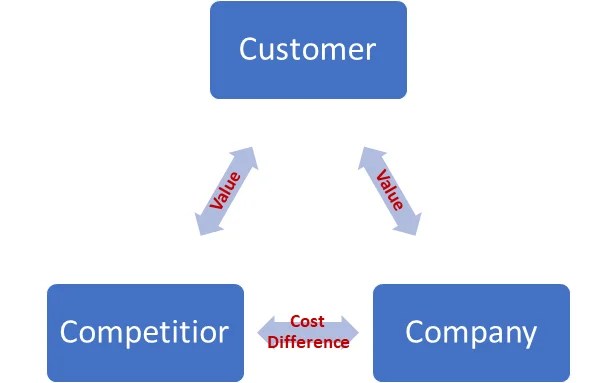
3 Cs model of Logistical competency suggests that the three Cs in Logistics i.e.  Company, Customer and Competitor, all are quite important for the growth and survival of business and economy at large. The 3 Cs model of Logistical competency generates competitive advantage for the firm. The 3 Cs are discussed herewith:

There exists a 3 way relationship between three parties as represented in the above diagram. Customer is one who shows the desire to buy the products. He always search for products with best quality and low price. Company works hard for selling their products so as to satisfy these desires of customers. It utilizes all its assets in the optimum way and always see to it that customers are influenced to buy their products only. Competitor is one that tries to fascinate an magnetize the customer. He also utilizes all his assets in the best possible way and tries to influence the customer.

There exists a 3 way relationship between three parties as represented in the above diagram.

  • Customer is one who shows the desire to buy the products. He always search for products with best quality and low price.
  • Company works hard for selling their products so as to satisfy these desires of customers. It utilizes all its assets in the optimum way and always see to it that customers are influenced to buy their products only.
  • Competitor is one that tries to fascinate an magnetize the customer. He also utilizes all his assets in the best possible way and tries to influence the customer.

Thus Company has to strive very hard in order to retain the customers. They do so by providing cost advantage to the customers and value advantage to the customer. Competitors also tries to bring down their cost and provide value advantage to the customers. Company and competitors strive for cost differentials.

And that’s how in the whole process, wherein company and competitors, both are trying to provide value advantage to the customers by becoming efficient, the logistical competency is achieved.

Parameters to achieve Logistical Competency:

Logistical Competency can be achieved with the help of certain parameters. These parameters stand like five pillars in completing the logistics mission of the company. These parameters are as described as follows:

(a) 1st- Network Design: A manufacturer may have multiple facilities of plant, warehouses and distribution centres. Network design aims at forming a structure so as to perform logistical activities efficiently and effectively. The manufacturing units and warehouses may be located in various geographical areas, far from each other. In the same way distribution centres will be disperse across different areas. Network design tries to establish connectivity among all these facilities for better performance of logistics operations and more importantly to provide better customer services resulting in customer satisfaction.

(b) 2nd– Information Management: Information Management is essential component here. It is required for demand forecasting and order processing. Logistical performance depends a lot upon how the information is received, shared among the different facilities in the network and ultimately used to make the customer delivery according to the order placed by him. Contemporary technology is used in logistics for the same. Softwares like ERP, CRM, and technologies like EDI, ePOS, etc. are widely used for information management.

(c) 3rd- Transportation: Transportation is required for the movement of goods from one party to another. Transportation accounts for 60 to 70% of the logistics costs. Logistical function of transportation deals with decision like choosing right mode of transport, deciding to have one’s own feet or to outsource, deciding on the total cost, transportation infrastructure, reliability of mode and so on.

(d) 4th Inventory Management: In order to control total cost it is quiet significant to control and manage the inventory. Inventory management is concerned with maintaining the requisite levels of inventory in such a way that there is neither understocking nor overstocking. Sufficient levels of stock are to be maintained to satisfy the customers’ requirements.

(e) 5th- Warehousing, Material Handling and Packaging: Logistics is also concerned with maintaining the storage area wherein heaps of goods are stored till they are demanded by customers. Such logistical function is called as warehousing. Logistical function of warehousing deals with the decision size, number, layout, location and nature of warehousing.

Material handling is an art and science of moving, packaging and storing of substances in a form. It includes lifting and shifting of materials in order to save space, cost and time. The overall productivity of logistics is improved with automation and mechanisation of material handling system.

On other hand, incorrect methods and system of material handling results in high costs. Packaging is required for efficient handling and storage of goods. It is also essential for protection of goods from any loss or damage, specially during transit. Packaging adds to the shelf life of any product and makes it durable for longer time. Packaging, which is quiet attractive, make the goods easily saleable in the market. Packaging is also very much necessary for providing convenience and ease of handling to the end users.

Thus Logistical competency can be enhanced by right logistics mix and proper network design.

Logistical performance cycle

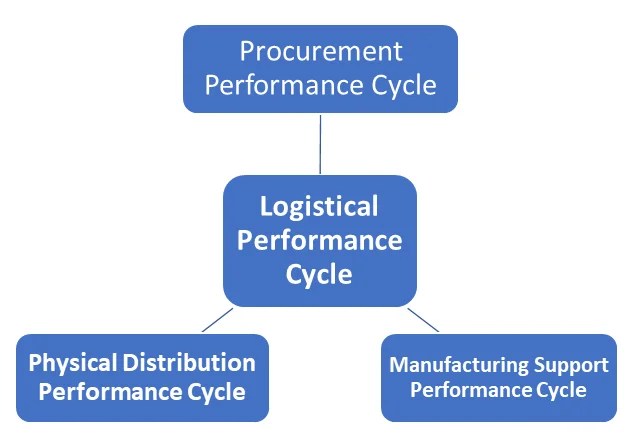
When a firm receives an order, it carries out certain activities to complete that order. These activities take a recurring form as they need to be carried out with every order. Thus, a cycle is formed of these activities, which is called Performance Cycle. To sum up, in simple terms, Logistical Performance Cycle comprise of series of activities that are required to receive the orders from the customer, process this order and make the final delivery to him.

Based on the timings of these activities to be carried out, there exist three logistical performance cycles.

  1. Procurement Performance Cycle
  2. Manufacturing Support Performance Cycle
  3. Physical Distribution Performance Cycle

  1. Procurement Performance Cycle: (Inbound Logistics/Upstream Logistics)

As the name suggest, this cycle is concerned with procuring raw materials

from the vendor and make available for further processing as and when required. It is also called as Inbound Logistics or Upstream Logistics. Procurement performance cycle aims at carrying out logistics elements related to procurement of materials at lower price.

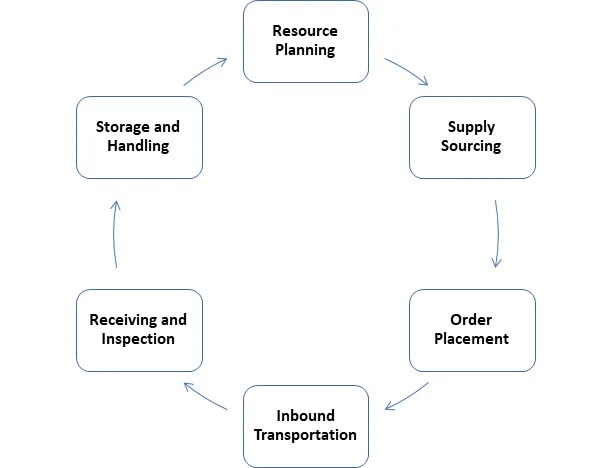
Thus, this cycle involves all preproduction logistical activities. Procurement Performance cycle ensures that firm has sufficient materials to carry out the production activities and deliver to the customer. It is a base of logistical performance cycle. Various activities that are part of Procurement Performance cycle or Inbound Logistics are:

(a) Resource Planning: It aims at planning for the physical and financial resources that are required to be with the firm so as to procure the materials aptly on time.

(b) Supply Sourcing: Supply sourcing means making an effort to find out the right vendor from whom materials can be purchased.

(c) Order Placement: Once the list of vendors is finalized from whom firm is going to buy the materials, a confirmed order is placed to them.

(d) Inbound Transportation: Inbound transportation means transportation of materials from place of supplier to the place of manufacturer. It is also called as carriage inward.

(e) Receiving and Inspection: Once the consignment of materials reaches to the manufacturer, he receives the consignment and transfer these materials in the storage area. As he receives the materials, he also inspects the same and assure that material is received according to the order placed.

(f) Storage and Handling: Till the materials are processes, they require proper storing facility. Also, material handling techniques are used so as to manage the same.

  1. Manufacturing Support Performance Cycle: (In process Logistics/Production Logistics)

Manufacturing performance cycle is an interface between the procurement performance cycle and physical distribution performance cycle. To meet the production schedule, this cycle plays a significant role. The activities under this cycle, aims at providing basic support in manufacturing. It is not directly concerned with how manufacturing is done but certainly it is associated with how well the support activities are carried out in order to complete the manufacturing. This cycle includes various activities:

(a) Receiving Materials from Stores: Before the actual production take place, materials are stocked in the stores area. To begin with the production, materials are received from stores to shop floor for processing.

(b) Receiving Components: For the production to begin, certain components, loose tools, small equipment’s may be received for operating on machines.

(c) Managing Inventories of WIP: Once the production process has started, materials are converted to WIP or semi-finished goods. Many a times, it becomes essential to manage and store properly this WIP inventory till further processing takes place.

(d) Transfer of Finished Goods: As the production process is over, materials get

converted into final saleable product. This batch of finished goods is then sent to warehouse for packaging and distribution.

  1. Physical Distribution Performance Cycle:

(Outbound Logistics/Downstream Logistics) This is the 3rd and also the most important cycle under logistical performance cycle. It covers all major activities of logistics and thus it contributes the major cost of logistics. As the goods are transferred from factory to warehouse, it marks the end of Manufacturing support cycle and beginning of Physical Distribution cycle. It includes all those elements of logistics which are necessary to distribute the goods from the manufacturer’s warehouse to the customer’s warehouse. It ensures that goods are delivered to the customer according to his order following 7Rs principle of Customer Service. This cycle provides a support framework for the sales and marketing activities of business. It is also called as Outbound logistics as it includes all post production activities. It includes following set of activities:

(a) Placing of order by Customer: This cycle begins with placing of order by the customer at a selected retail outlet.

(b) Order Transmission to Distribution Centre: Once the customer order is received at the retail outlet, it is further transmitted to the distribution centre without wasting time so that timely delivery can be made.

(c) Order Processing: As soon as the distribution centre receives the order, it is further processed which means an attempt is made to know what kind of goods customer want, in what quantities, how they shall be packaged, how they shall be transported.

(d) Order Selection: Distribution centre checks the availability of goods ordered and based on it select the goods from the warehouse, package the goods according to the customer’s requirement and load the goods in a transportation vehicle.

(e) Transportation: Using the right vehicle and the principles of transportation, goods are finally transported from warehouse to the customer. Right mode of transportation is selecting looking on to the nature of goods and other factors.

(f) Customer Delivery: Once the goods are reached at the customer’s warehouse, goods are unloaded from the transportation vehicles and handed over to the customer which completes the delivery cycle.

Meaning of Customer Service, Objectives

Customer service in logistics is the activities, service actions are provided, acting as added value. The aim is to bring more value than the core service that customers need and bring the most satisfaction to customers. For businesses or business organizations today offer more services to customers besides their main products.

The bigger your business is, the more complex your supply chain gets. It can be hard to maintain perfect customer service because everyone involved in the shipping process is constantly affecting a company’s reputation through customer experience. In client service, it’s impossible to be perfect, but it is possible to be better and provide your customers with the best service possible. Customers want to have a smooth, easy experience when working with a company. It is up to the company on how good that service can be delivered.

If you are striving to build long-term relationships with your customers and gain their loyalty, you should consider shifting from product-oriented strategy to customer-focused one. Here are some useful tips on how to take customer service to the next level:

  1. Choose the tools and partners accurately. No matter what strategies and technologies you use, there is always a human factor present. That’s the reason why choosing partners properly will enhance your customers’ experience. If you are outsourcing your logistics to a 3PL provider, make sure they have skilled and professional brokers and a network of experienced and reviewed carriers. Such services offer logistics management from A to Z and will take most of the hassle away. But as you select a key link in your logistics, you should invest time researching how to pick the best third-party logistics provider.
  2. Transparency and personal approach. Try to make the process as easy as possible for the customer. Supply chain visibility will reduce the time your client’s spending on shipping, therefore improving the overall experience they get from working with you. Transparency involves not only shipment tracking but also the option to compare available prices, services and understand how they work without any trouble. The more personalized approach you provide, the higher your chances are to retain customers. Send tracking updates and reports to customer to keep them in the loop, ranging from shipment transits to weather reminders. This strengthens your company’s credibility and simplifies the process for your customers.
  3. Establish the last mile delivery. This is a final and crucial element in the transportation process and obviously demands more concentration. The last stage of delivery is the most vulnerable to mistakes or damages that may occur due to different reasons. To reduce the likelihood of such circumstances, assure that everything goes the way it should.
  4. Provide feedback. No matter what issue took place, the response should be swift and intended to solve the customer’s problem, or at least to figure out what is the issue. Businesses should invest more in their staff training to reduce the chance of errors while interacting with customers. Solving problems that occurred on behalf of your company can make a big difference in a customer’s experience with your company. Many 3PL companies provide customer service and can help their customers simplify this complicated process.
  5. Technology & analysis. Don’t underestimate the power of data: new technologies let businesses track every step of the customer, existing or potential. Knowing the deep insights of your audience leads to better performance, updated strategies, and better service. Such innovations like transportation management systems, tracking devices and CRM systems let businesses study customer’s behavior and improve marketing strategies. So, researching and analyzing big data is the best way to achieve a better understanding of customers’ demands.

Important factors for customer service in logistics

1. Time

For today’s life, time is always the most important factor. Therefore, in customer service of logistics, time is an extremely important factor to create customer satisfaction.

Not only for the logistics industry but for any industry, the shorter the time the customer receives the product, the more satisfied the customer will be.

2. Reliability

This is an indispensable factor for customer service in logistics. For reliability, the brand will always be the most important factor for customers. If the brand of service that your company provides is more reliable. Then customer service has the opportunity to satisfy larger customers.

Typically, when we buy products, if we buy in reputable brands, we will always feel safer. We will not need to worry or pressure on fraud or anything like that when using that product.

3. Price

The price competition has never cooled down in the market today. Especially when customers always like cheaper products. Or rather, there is a price that suits their needs.

If your logistics service can provide the same items, same quality (or higher quality). But with cheaper prices, obviously, you will have a huge advantage.

4. Flexibility

Flexibility is the ability to flexibly deliver products according to customers’ needs. Currently, customers always want to use products that can solve their problems. Therefore, if possible, always customize the product so that it can best suit customer needs.

Elements

1. Supply chain management:

For supply chain management in logistics services, customers only need to deliver goods, the rest of your company will help them design a reasonable supply chain. In addition, you will also receive orders, plan to ship and collect invoices. In order to create a trust for your customers, do these tasks quickly and responsibly.

2. Shipping service

3. Warehousing service

To create a customer service in professional and methodical logistics. You create a storage service with the cross-docking system. This will significantly reduce the storage costs of goods and increase business efficiency.

4. Other services

Other services in logistics include:

  • Customs procedures.
  • Additional insurance procedures for goods.
  • Advising and guiding customers on the shipping process.
error: Content is protected !!