Role of Social Media in Communication

Social Media has transformed the way people interact, share information, and communicate globally. Platforms like Facebook, Twitter, Instagram, LinkedIn, and WhatsApp have made communication more accessible, interactive, and dynamic.

1. Instant Communication

Social media enables real-time communication regardless of geographical barriers. Messages, updates, and responses are transmitted instantly, allowing individuals and organizations to connect with their audiences effectively and efficiently.

2. Enhancing Accessibility

Social media platforms are easy to use and widely available, making communication accessible to a diverse audience. They enable individuals, businesses, and organizations to reach people from all walks of life, regardless of socioeconomic or geographical limitations.

3. Promoting Engagement

Social media fosters two-way communication, allowing users to interact through comments, likes, shares, and direct messages. This engagement creates a sense of community and builds stronger relationships between individuals, businesses, and their audiences.

4. Supporting Collaboration

Social media platforms serve as tools for collaboration, enabling users to share ideas, work on projects, and connect with like-minded individuals. Platforms like LinkedIn and Facebook groups encourage networking and teamwork among professionals and communities.

5. Amplifying Reach

With millions of active users, social media allows messages to reach a global audience instantly. Organizations and individuals can use platforms to broadcast updates, promote products, or spread awareness on a large scale.

6. Facilitating Marketing and Branding

Social media is a powerful tool for marketing and building brand identity. Businesses can create targeted campaigns, engage with customers, and enhance brand visibility. Platforms like Instagram and Facebook help showcase products and services to a broader audience.

7. Driving Social Change

Social media has become a critical platform for activism and raising awareness about social issues. Movements like #MeToo, #BlackLivesMatter, and environmental campaigns have gained momentum through social media, driving real-world change.

8. Providing Real-Time News and Updates

Social media acts as a primary source of news and information. Platforms like Twitter provide real-time updates on events, enabling users to stay informed about global and local happenings.

9. Personalizing Communication

Social media enables personalized communication by allowing users to tailor messages to specific audiences. Businesses can use analytics and targeting tools to deliver content that resonates with particular demographics or interests.

10. Enhancing Visual Communication

With features like photos, videos, stories, and live streams, social media emphasizes visual content, making communication more engaging and impactful. Platforms like Instagram and TikTok thrive on creative visual storytelling.

Business Communication LU BBA 1st Semester NEP Notes

Unit 1 [Book]
Introduction to business communication VIEW
Characteristics of effective organizational communication VIEW
Basic forms of communication VIEW
Process of communication VIEW
Barriers to Communication VIEW
Principles of effective business communication VIEW


Unit 2 [Book]
Oral communication: Purpose, Advantages & Disadvantage VIEW
Principles of Oral Communication VIEW
Effective Listening VIEW
Non-verbal Communication VIEW
Written communication: Purpose, Advantages & Disadvantage VIEW
Principles of Written Communication VIEW
Effective writing techniques VIEW
Employment Communication: Application letter and Resume writing VIEW


Unit 3 [Book]
Conduct of meeting Agenda VIEW
Notice, Notes, Minutes VIEW
Office memorandum, Office orders, Press release VIEW
Business Letter Writing Need, Functions VIEW
Business Letter Layout VIEW
Business Letter Types VIEW
Report writing: Problems VIEW
Organization and Techniques of Writing VIEW


Unit 4 [Book
Corporate Communication: Scope, Components VIEW
Corporate communication and Public relations VIEW VIEW
Role of Social Media in Communication VIEW
Role of Technology in Communication (ICT’s) VIEW VIEW
Business Etiquettes VIEW

Negotiation Skills, Principles and Tactics

Negotiation Skills refer to the ability to reach mutually beneficial agreements through discussion and compromise. They are vital in business, sales, conflict resolution, and workplace collaboration. Good negotiation involves clear communication, emotional intelligence, problem-solving, and understanding the interests of all parties involved. It’s not about winning or losing but finding a solution that satisfies everyone to some extent. Effective negotiators prepare well, listen actively, and remain calm and respectful even during disagreements. Developing strong negotiation skills boosts confidence, builds better relationships, and results in favorable outcomes for individuals and organizations alike.

Principles of Negotiation:

  • Preparation

Preparation is the foundation of successful negotiation. It involves gathering relevant facts, identifying goals, knowing your limits, and understanding the other party’s interests. Well-prepared negotiators anticipate counterarguments and develop strategies to address them. They also determine their BATNA (Best Alternative to a Negotiated Agreement), which gives them leverage. Good preparation includes researching market data, competitor positions, and potential compromises. This groundwork ensures confidence, clarity, and adaptability during discussions. Without preparation, negotiators may appear disorganized or uninformed, reducing their credibility. Thorough preparation transforms a negotiation from guesswork into a strategic conversation, increasing the likelihood of favorable outcomes.

  • Active Listening

Active listening means fully focusing on what the other party is saying without interrupting or formulating a reply prematurely. It includes observing non-verbal cues, summarizing points, and asking clarifying questions. By actively listening, negotiators build trust and gather critical information about the other party’s needs, fears, and expectations. This creates a respectful environment and allows for deeper understanding, helping to identify areas of agreement and potential trade-offs. Active listening also reduces miscommunication and defuses tension. Effective negotiation is not just about speaking persuasively, but listening carefully—ensuring both sides feel heard and understood.

  • Win-Win Mindset

A win-win mindset focuses on solutions that benefit all parties rather than prioritizing personal gain. This collaborative approach builds long-term relationships, trust, and goodwill. It involves identifying shared interests and creatively exploring options that maximize mutual benefit. Negotiators with a win-win attitude avoid adversarial behavior and focus on cooperation. They also remain flexible and open-minded, willing to adjust terms to meet the other side halfway. This principle is especially important in business environments where relationships are ongoing. A win-win outcome fosters satisfaction, loyalty, and smoother future negotiations, whereas a win-lose mentality may damage trust and lead to future conflict.

  • Clarity and Assertiveness

Clarity ensures that your message, expectations, and terms are understood by all parties, leaving no room for ambiguity. Assertiveness involves expressing your needs and boundaries confidently and respectfully. Together, they create a negotiation environment where goals are clearly communicated without being aggressive. Assertive negotiators maintain control over the conversation, set boundaries, and stand firm on key issues. They are direct, yet considerate—balancing firmness with cooperation. Lack of clarity can lead to misinterpretation, while passive behavior may lead to unfavorable agreements. Clear and assertive communication helps ensure fair deals, prevents misunderstandings, and projects confidence and professionalism.

  • Emotional Control

Keeping emotions in check is crucial during negotiations. Emotional control allows negotiators to stay calm, rational, and focused—even when discussions become tense or confrontational. Emotions like anger, frustration, or anxiety can derail the conversation and lead to poor decision-making. Skilled negotiators maintain composure, listen actively, and respond thoughtfully rather than react impulsively. They may use breathing techniques, mental reframing, or strategic pauses to remain collected. Emotional control also helps build trust and credibility, allowing for more constructive dialogue. By managing their emotions, negotiators stay in control of both the situation and the outcome.

  • Ethics and Integrity

Honesty, transparency, and fairness are essential in ethical negotiations. These qualities foster trust and long-term relationships. Ethical negotiators avoid manipulation, false promises, or hidden agendas. They clearly state their positions, respect confidentiality, and honor commitments. Acting with integrity also enhances credibility and personal reputation. While unethical tactics may offer short-term gains, they often damage relationships and lead to conflict or legal consequences. Practicing ethics doesn’t mean compromising one’s interests—it means negotiating in good faith and striving for fair, respectful agreements. In professional settings, integrity is not just a principle—it’s a standard that elevates the entire negotiation process.

Tactics of Negotiation:

  • Anchoring

Anchoring is the tactic of setting the initial offer to influence the negotiation range. By making the first offer—especially one that’s ambitious but reasonable—you establish a psychological “anchor” that frames the rest of the discussion. People tend to gravitate toward the initial figure, making it harder to stray far from it. Anchoring can be effective in pricing, salary negotiations, or sales discussions. However, it must be supported by logic or data to remain credible. A poor anchor (too extreme or baseless) can alienate the other party, while a strategic one gives you control over the negotiation landscape.

  • Silence

Silence is a powerful but often overlooked tactic. After making a point or offer, staying silent forces the other party to fill the gap, potentially revealing more information or softening their position. Silence creates psychological pressure and encourages the other side to speak more freely or reconsider. It can also be used to signal dissatisfaction or create space for reflection during tense moments. Silence should not be confused with passivity; rather, it is an intentional strategy that helps slow down the pace, shift dynamics, and maintain composure. Mastering silence makes negotiators appear thoughtful, confident, and in control.

  • Mirroring and Labeling

Mirroring involves subtly repeating key words or phrases the other person uses, while labeling means acknowledging their emotions or perspective. For example, saying, “It sounds like you’re concerned about cost,” shows empathy and understanding. These techniques build rapport, lower defenses, and encourage openness. Mirroring helps people feel heard and respected, while labeling allows you to name emotions, reducing tension. Used together, they create a psychologically safe space for dialogue. These are powerful tools from the world of negotiation psychology that help uncover hidden needs and build trust—especially useful in conflict resolution and sensitive discussions.

  • The “Good Cop, Bad Cop” Tactic

This classic tactic involves two negotiators taking opposite roles—one appears tough and uncompromising (bad cop), while the other is friendly and flexible (good cop). The goal is to pressure the other party into accepting terms from the more agreeable negotiator, believing they’re getting a better deal. Though still used, this method can seem manipulative if overdone or transparent. It works best when the “bad cop” sets a tough standard, and the “good cop” offers a reasonable compromise. Caution is advised: modern negotiations value authenticity, so this tactic should be used subtly, if at all.

  • Flinch Technique

The flinch is a visible reaction—facial expression, body movement, or exclamation—that signals surprise or displeasure when hearing an offer. It’s a psychological tactic designed to make the other party second-guess their position or pricing. For instance, if a buyer flinches at a price quote, the seller might feel pressured to lower it. The flinch works by tapping into the human tendency to adjust based on perceived rejection. When done convincingly but respectfully, it can shift negotiations in your favor. However, overuse may damage credibility or rapport, so it should be used selectively and with restraint.

  • “Nibbling” Technique

Nibbling involves asking for small extras after the main deal is agreed upon. For example, after negotiating a price, a buyer might ask for free delivery or extended warranty. These add-ons often seem minor and are granted easily, especially when the other party is relieved the main negotiation is over. Nibbling is effective because the requests appear reasonable and are made after trust is established. However, it must be ethical—nibbling too much or asking for hidden extras can be seen as manipulative. When used strategically, nibbling helps maximize value without jeopardizing the overall agreement.

Employment Communication: Job Application letter and Resume writing

Employment Communication refers to the exchange of information between employers and employees or job seekers regarding employment-related matters. It encompasses various forms such as job applications, resumes, cover letters, interviews, performance appraisals, workplace instructions, and exit communications. Effective employment communication ensures clarity, professionalism, and alignment between organizational goals and individual aspirations. It plays a crucial role in recruitment, onboarding, career development, and employee engagement. This communication fosters transparency, builds trust, and enhances workplace relationships. By adhering to principles of clarity, respect, and professionalism, employment communication contributes to a positive work environment and supports the achievement of organizational and career objectives.

Tips for Writing a Job Application Letter

  1. Do not copy your resume

A cover letter is a sales pitch. The purpose of this letter is to convince the hiring manager that you’re a strong candidate and to highlight your relevant experience and abilities. Your application letter should show how exactly your background makes you a good fit for a particular position. In contrast, your resume is a general record of your experience, education, and accomplishments.

  1. Tailor each application letter to the job

As mentioned above, emphasize in your letter why you are an ideal candidate for the specific job. This requires that you personalize each letter to fit the company and position. Match your qualifications to the job posting by highlighting the skills, experience, and requirements listed in the description.

  1. Be professional

Application letters have a fairly rigid format as hiring managers read your letter, they will expect to see certain information included in set areas. You have freedom within the structure to be personable, but it is important to stick to a certain level of formality. Pay particular attention to the professionalism of your salutation. You wouldn’t, for instance, want to refer to the letter’s recipient by their first name unless specifically requested.

  1. Carefully proofread

Employers are likely to overlook an application with a lot of errors. Therefore, read through your cover letter, and even consider asking a friend or career counselor to read the letter. Proofread for grammar and spelling errors. Be particularly mindful to spell the letter recipient’s name correctly, as well as the company name.

  1. Follow business letter format

Use business letter format when writing your letter. If you’re sending a typed hard-copy letter, be sure to lead with a paragraph containing your address, followed by the date, followed by the address of the recipient. If you’re sending an email, you can omit the address and date sections.

  1. Decide whether to send a hard copy or email

The main difference in formatting an email application letter is that you need to include a subject line that clearly lays out your purpose for writing, e.g. “Graphic Designer—Joe Smith.” And, instead of placing your contact information at the top of the letter, as you would in a hard copy, you’ll include it below your signature.

Job Application Letter Format

Use this formatting information as a guideline when writing your customized application letters, so you know what information goes where.

Contact Information

Name

Address

City, State Zip Code

Phone Number

Email Address

Date

Employer Contact Information (if you have it)

Name

Title

Company

Address

City, State Zip Code

Salutation

Dear Mr./Ms. Last Name, (leave out if you don’t have a contact)

Body of Application Letter

The body of your application letter lets the employer know what position you are applying for, why the employer should select you for an interview, and how you will follow up. See below for a paragraph-by-paragraph breakdown of the body of the letter.

First Paragraph

The first paragraph of your letter should include information on why you are writing. Mention the job you are applying for and where you found the job listing. Include the name of a mutual contact, if you have one. You might conclude by briefly and concisely saying why you think you are an ideal candidate for the job.

Middle Paragraph

The next section of your application letter should describe what you have to offer the employer.

It can be a single paragraph, or you can break it up into a couple of paragraphs. If the section gets lengthy, you may use bullet points to break up the text. Remember, you are interpreting your resume, not repeating it.

Mention specifically how your qualifications match the job you are applying for. In this portion of the letter, make your case for your candidacy.

Use specific examples whenever possible. For example, if you say that you have lots of experience working successfully on team projects, provide an example of a time you worked in a group and achieved success.

Final Paragraph

Conclude your application letter by thanking the employer for considering you for the position. Include information on how you will follow up.

Complimentary Close (examples)

Sincerely,

Signature (for a hard copy letter)

Typed Signature

Job Application Letter Example

Theintactone

11 South Street

Harbor View, Maine 04005

555-555-5555

theintactone@email.com

March 5, 2020

Jason Rivera

Human Resources Director

Avery Solutions, Inc.

700 Commerce Way

Harbor View, Maine 04005

Dear Mr. Rivera,

I was excited when my former colleague, Stephanie Taylor, told me that you were hiring for a Human Resources Specialist at Avery Solutions.

Stephanie has told me how important teamwork is to your group at Avery, and how much you need an HR Specialist who can fit in with the department and hit the ground running on day one. I believe that I am the ideal candidate for your team.

In my current job at Smith Group, I created and run our onboarding program, including organizing background checks and new hire orientation. I also have extensive experience in:

Data reporting/data entry on HRIS software

Recruiting and hiring processes, including creating job descriptions and postings, screening resumes, and scheduling interviews

Producing company events, such as the annual company-wide picnic (100+ employees from across the country)

I’d love to speak with you about my qualifications and what I can do for your team. I’ve attached my resume for your consideration. Please don’t hesitate to contact me on my cell at 555-555-5555 with questions or to arrange an interview.

Best regards,

Theintactone

Resume writing

resume is a formal document that summarizes an individual’s professional history, skills, education, and accomplishments. It serves as a critical tool for job applications, helping potential employers evaluate a candidate’s qualifications. Writing an effective resume involves presenting information clearly, concisely, and tailored to the desired job.

Key Components of a Resume

  1. Contact Information

    • Include your full name, phone number, email address, and LinkedIn profile (if relevant).
    • Ensure the contact details are current and professional.
  2. Objective or Summary Statement

    • A brief statement highlighting your career goals and what you bring to the role.
    • Keep it specific and aligned with the job you’re applying for.
  3. Work Experience

    • List jobs in reverse chronological order, starting with the most recent position.
    • Include job title, company name, location, and employment dates.
    • Use bullet points to describe responsibilities and achievements, focusing on quantifiable results (e.g., “Increased sales by 20% in six months”).
  4. Education
    • Mention your degrees, institutions, and graduation dates.
    • Include relevant certifications or additional courses.
  5. Skills
    • Highlight technical and soft skills relevant to the job.
    • Use keywords from the job description to align with employer expectations.
  6. Achievements and Certifications

    • Add any awards, accolades, or certifications that make you stand out.
    • Ensure they are relevant to the job.
  7. Hobbies and Interests (Optional)

Include only if they are relevant to the role or reflect desirable traits like teamwork or creativity.

Tips for Effective Resume Writing

  1. Tailor Your Resume

Customize your resume for each job application, focusing on relevant skills and experience.

2. Use Action Verbs

Begin bullet points with strong action verbs like “managed,” “developed,” “led,” or “optimized.”

3. Quantify Achievements

    • Provide measurable results to demonstrate your impact (e.g., “Reduced costs by 15% by optimizing processes”).

4. Keep it Concise

Limit the resume to one or two pages. Avoid lengthy paragraphs; use bullet points for readability.

5. Professional Format

    • Choose a clean, easy-to-read layout with consistent formatting.
    • Use a professional font like Arial or Times New Roman, and keep font size between 10 and 12 points.

6. Proofread Thoroughly

    • Check for spelling, grammar, and formatting errors.
    • Consider using tools or seeking feedback from peers to ensure accuracy.

7. Include Relevant Keywords

Incorporate industry-specific terms and phrases from the job description to pass Applicant Tracking Systems (ATS).

8. Avoid Unnecessary Details

Skip irrelevant personal details like age, marital status, or a photo unless required by the employer.

Public Speaking, Components, Overcoming Stage fear

Public Speaking is the art of delivering a speech or presentation to a live audience. It involves effectively communicating ideas, information, or opinions in a clear, engaging, and persuasive manner. The primary goal of public speaking is to inform, influence, entertain, or motivate the audience. Successful public speakers use techniques such as proper body language, vocal variation, storytelling, and audience interaction to maintain attention and ensure the message is understood. Public speaking is an essential skill in various fields, including business, education, and leadership, as it helps build confidence and convey ideas with impact.

Components of Public Speaking Skills:

Public speaking skills are comprised of several key components that contribute to effective communication and engagement with an audience. These components work together to ensure that the speaker delivers a clear, impactful, and memorable message. Here are the key components of public speaking skills:

1. Content/Message

  • Clarity of Message: The content of the speech should be clear, concise, and relevant to the audience. The message should be well-organized, with a strong introduction, body, and conclusion.
  • Research and Knowledge: A speaker must have a deep understanding of the topic they are discussing. Research ensures the speaker can provide accurate, credible, and insightful information.
  • Tailored to Audience: The content should be adapted to the audience’s needs, interests, and level of understanding. This helps make the speech more relatable and engaging.

2. Delivery

  • Tone and Pitch: The tone of voice should vary to keep the audience engaged, and the pitch should be adjusted to emphasize key points. A monotone voice can make the speech dull and disengaging.
  • Pace: The speaker should control the speed of speech, speaking slowly enough for clarity but quickly enough to maintain interest. Pauses should be used effectively to allow the audience to absorb important points.
  • Volume: The speaker’s voice should be loud enough to be heard by everyone in the audience. Adjusting volume can also help emphasize certain points or add drama to the speech.

3. Body Language

  • Posture: Standing tall and maintaining an open posture conveys confidence and authority. Slouching or closed-off body language (like crossed arms) can suggest insecurity or disinterest.
  • Gestures: Hand gestures should be used to emphasize points and add dynamism to the speech. Overusing gestures or using distracting ones can detract from the message.
  • Eye Contact: Maintaining eye contact with the audience builds trust, engages listeners, and shows confidence. It helps create a connection and allows the speaker to gauge the audience’s reaction.

4. Visual Aids

  • Slides and Visuals: Visual aids like PowerPoint slides, charts, or videos can help clarify points and make the presentation more engaging. They should be simple, clear, and not overdone, as too many visuals can distract from the message.
  • Handouts or Props: In some cases, handing out material or using props can reinforce the speech’s key points and create a more memorable experience.

5. Audience Interaction

  • Engagement: Asking questions, encouraging participation, and using interactive activities can keep the audience involved. This fosters a sense of connection and helps reinforce the message.
  • Feedback: Observing the audience’s reactions, both verbal and non-verbal, allows the speaker to adjust their delivery if needed. A speaker should be flexible enough to respond to the audience’s mood and energy.

6. Confidence and Presence

  • Self-assurance: Confidence is crucial for delivering an effective speech. A confident speaker is more likely to capture the audience’s attention and be perceived as credible.
  • Stage Presence: A speaker should command attention through their overall presence, which includes posture, eye contact, energy level, and the ability to stay composed under pressure.

7. Language and Style

  • Clarity and Simplicity: The language used should be simple and easy to understand, avoiding jargon or overly complex terms unless appropriate for the audience.
  • Engaging Style: A good speaker should adopt an engaging and conversational style, using stories, anecdotes, and humor to make the speech more interesting.
  • Rhetorical Devices: Techniques like repetition, metaphors, analogies, and rhetorical questions can enhance the effectiveness of the speech and make it more memorable.

8. Listening Skills

  • Active Listening: Effective public speakers also know how to listen to their audience, particularly during Q&A sessions or interactions. Active listening helps respond to questions or concerns thoughtfully and respectfully.
  • Non-verbal Listening: Paying attention to the audience’s non-verbal cues (like body language, facial expressions, and posture) helps the speaker adjust their delivery in real time.

9. Time Management

  • Pacing the Speech: An effective public speaker knows how to manage time to ensure all points are covered without running over time. This requires balancing the depth of content and speaking speed.
  • Avoiding Rambling: Staying on topic and avoiding unnecessary elaboration is key to keeping the audience’s attention.

10. Preparation and Practice

  • Rehearsing: Preparation is one of the most important components of public speaking. Practicing the speech multiple times allows for smoother delivery and better time management.
  • Anticipating Challenges: A good speaker prepares for potential challenges, such as unexpected questions, technical difficulties, or nervousness, ensuring that they can handle these situations with ease.

How to improve Public Speaking Skills:

Improving public speaking skills is a gradual process that requires consistent practice and attention to various aspects of communication.

  • Practice Regularly

The more you practice, the more confident and comfortable you will become. Rehearse your speech multiple times in front of a mirror, with friends, or in front of a camera. This helps you refine your delivery and become more familiar with your material.

  • Know Your Audience

Understand the needs, interests, and expectations of your audience. Tailoring your message to resonate with your listeners increases the effectiveness of your presentation. Consider their age, knowledge level, and any other factors that may influence how they perceive your message.

  • Master Your Material

Being well-prepared is key to delivering a confident speech. Know your topic thoroughly, and be ready to answer questions. It helps to organize your content into clear sections, such as an introduction, body, and conclusion. The more familiar you are with your material, the less you’ll have to rely on notes.

  • Work on Your Body Language

Non-verbal communication plays a crucial role in public speaking. Use positive body language, such as standing tall, making eye contact, and using gestures to emphasize points. Avoid closed-off postures like crossing your arms, as they can convey insecurity.

  • Focus on Voice Modulation

A monotone voice can quickly lose the audience’s attention. Vary your pitch, speed, and volume to make your speech more dynamic. Pauses are also important for emphasizing key points and allowing the audience time to absorb information.

  • Engage with Your Audience

Incorporate interactive elements like asking questions or encouraging audience participation. This keeps your audience engaged and creates a connection with them. It can also help you gauge their interest and adjust your delivery accordingly.

  • Overcome Nervousness

It’s normal to feel nervous before speaking, but with practice, you can manage anxiety. Use relaxation techniques such as deep breathing or visualization before taking the stage. Focus on delivering your message rather than worrying about how you’re being perceived.

  • Receive Constructive Feedback

After your speeches, ask for feedback from trusted friends or colleagues. Understand what went well and identify areas for improvement. This can be instrumental in building your skills over time.

  • Watch Experienced Speakers

Learn from the best by watching TED Talks, public speeches, or presentations by professional speakers. Pay attention to their delivery, language, gestures, and audience engagement techniques. Try to incorporate some of these elements into your own presentations.

  • Start with Small Groups

If you’re new to public speaking, begin by practicing in front of small, supportive groups before working your way up to larger audiences. This helps build confidence and reduces the fear of speaking in front of a crowd.

Introduction to Business Communication, Types, Purpose

Business Communication refers to the exchange of information, ideas, and messages within and outside an organization to achieve its objectives. It involves verbal, non-verbal, and written forms of communication to convey messages effectively among employees, management, and external stakeholders like customers, suppliers, and investors. Clear and efficient business communication enhances collaboration, decision-making, and operational efficiency. It includes tools such as reports, emails, presentations, and meetings. Effective communication skills are essential for building relationships, resolving conflicts, and ensuring organizational success. In a globalized business environment, understanding cultural nuances and leveraging technology are critical to improving communication processes.

Types of Business Communication:

Business communication can be classified into various types based on its purpose, direction, and methods.

1. Internal Communication

Internal communication occurs within the organization and is crucial for ensuring that employees and management are on the same page. It can be further divided into:

  • Upward Communication: Information flows from employees to managers or higher authorities. For example, feedback, reports, and suggestions.
  • Downward Communication: Information flows from management to employees, such as instructions, policies, and announcements.
  • Lateral Communication: Communication among employees or departments at the same organizational level. For instance, team discussions or inter-departmental collaboration.

2. External Communication

External communication involves interactions with individuals or entities outside the organization, such as customers, suppliers, investors, or regulators. It aims to build relationships, share information, or market products and services. Examples include press releases, advertisements, and client negotiations.

3. Verbal Communication

Verbal communication uses spoken words for the exchange of information. It is quick and allows for immediate feedback. Examples are:

  • Face-to-Face Communication: Meetings, interviews, or presentations.
  • Telephonic Communication: Calls or virtual meetings using tools like Zoom or Teams.

4. Non-Verbal Communication

Non-verbal communication includes gestures, facial expressions, posture, and tone of voice that complement or reinforce the message. For example, a firm handshake during a business meeting conveys confidence, while positive body language enhances understanding.

5. Written Communication

Written communication involves the use of written or printed words. It is used for record-keeping, formal communication, or when accuracy is essential. Examples include emails, reports, memos, proposals, and business letters. Written communication is reliable and provides a reference for future use.

6. Formal Communication

Formal communication follows predefined channels and structures, such as official memos, policies, and reports. It ensures clarity, professionalism, and adherence to organizational protocols.

7. Informal Communication

Informal communication, or the “grapevine,” occurs without formal structures. It includes casual conversations among colleagues, which can help build relationships but might also lead to misinformation if unchecked.

8. Digital Communication

In the digital era, communication increasingly relies on technology. Tools like emails, instant messaging (e.g., Slack), social media, and video conferencing are integral to modern business operations.

Purpose of Communication in Business:

  • Information Sharing

Communication serves as the foundation for sharing essential information within a business. Employees, managers, and stakeholders exchange data, updates, and reports to ensure that everyone is aligned with organizational goals. For instance, a manager communicates a project timeline to a team to keep them informed about deadlines and deliverables.

  • Decision-Making

Effective communication facilitates sound decision-making by providing relevant information and insights. Managers rely on clear communication to gather feedback, analyze options, and make informed choices. For example, data-driven reports and collaborative discussions help leaders decide on resource allocation, market strategies, or product launches.

  • Building Relationships

Strong communication fosters relationships within the organization and with external stakeholders. It helps establish trust, collaboration, and goodwill. Internal communication among employees enhances teamwork, while communication with customers, suppliers, and investors builds long-term partnerships. For example, personalized customer interactions strengthen brand loyalty.

  • Motivating Employees

Communication is crucial for motivating employees by providing clear objectives, recognition, and constructive feedback. Leaders use communication to inspire and align employees with the company’s vision. For instance, regular meetings, praise for achievements, and transparent discussions about career growth boost morale and engagement.

  • Conflict Resolution

Misunderstandings and disagreements are inevitable in business, but effective communication helps address and resolve conflicts. By fostering open dialogue and encouraging empathy, businesses can find mutually acceptable solutions. For instance, a mediated discussion between two departments can resolve resource allocation issues.

  • Promoting Innovation

Clear and open communication channels encourage employees to share ideas and suggestions. By fostering a culture of innovation, businesses can develop creative solutions and stay competitive. For example, brainstorming sessions and feedback platforms enable teams to propose and refine new product concepts.

  • Enhancing Customer Satisfaction

Businesses rely on communication to understand and meet customer needs. Effective customer service involves listening to feedback, resolving complaints, and providing timely information about products or services. For instance, a well-trained support team that communicates clearly can enhance the overall customer experience.

  • Facilitating Organizational Change

In times of change, such as mergers, restructuring, or technological upgrades, communication helps manage transitions effectively. Clear messaging reduces resistance, provides clarity, and aligns employees with new processes or goals. For example, regular updates and training sessions ensure that staff understand and adapt to changes.

Characteristics of Effective Organizational Communication

Organizational Communication refers to the structured exchange of information, ideas, and messages within an organization to achieve its goals. It encompasses formal and informal communication across all levels—upward, downward, and lateral. Effective organizational communication ensures clarity, collaboration, and alignment among employees, management, and external stakeholders, fostering productivity, decision-making, and a positive work environment.

Effective organizational communication ensures smooth operations, fosters collaboration, and drives success.

1. Clarity

The message must be clear, concise, and free from ambiguity to ensure that the recipient understands it accurately. Avoiding jargon and using simple language ensures that the communication achieves its intended purpose.

2. Conciseness

Effective communication eliminates unnecessary details, focusing only on relevant information. This saves time and ensures the recipient remains engaged and can easily comprehend the core message.

3. Completeness

The communication should provide all the necessary information to avoid confusion and ensure that the recipient can take appropriate action. For example, including deadlines, expectations, and required resources in instructions ensures completeness.

4. Consistency

Messages should align with organizational goals, values, and past communications. Consistent communication builds trust and prevents contradictions that might confuse employees or stakeholders.

5. Appropriateness

Effective communication considers the audience’s needs, level of understanding, and cultural context. For example, technical details might be simplified when addressing non-specialist audiences.

6. Feedback Mechanism

Communication should be a two-way process, allowing recipients to provide feedback or ask questions. This ensures that the message has been understood correctly and provides opportunities for clarification or improvement.

7. Timeliness

Timing is critical for effective communication. Messages should be delivered promptly to ensure relevance. For instance, informing employees about a policy change well in advance allows them to adapt.

8. Empathy

Effective communication demonstrates understanding and respect for the recipient’s perspective. Empathy fosters positive relationships and reduces resistance to the message, especially during conflict resolution or organizational change.

9. Medium Selection

Choosing the right medium enhances the effectiveness of communication. For example, urgent messages might be best conveyed through direct verbal communication, while detailed reports are better suited for written formats.

10. Engagement

Effective communication engages the audience, making them active participants in the process. This involves using storytelling, visuals, or interactive elements to make the message more impactful and memorable.

Importance of Effective Communication in Organizations

  • It improves decision-making by providing accurate and timely information.
  • It fosters teamwork and collaboration by ensuring that all members are aligned with organizational goals.
  • It enhances employee morale and productivity through clear expectations and recognition of achievements.
  • It strengthens relationships with external stakeholders by ensuring transparency and trust.

Basic Forms of Communication

Forms of Communication refer to the various ways in which information, ideas, and messages are exchanged between individuals or groups. The primary forms include verbal communication, which uses spoken or written words; non-verbal communication, expressed through body language, gestures, and facial expressions; and visual communication, which employs images, charts, and graphs. These forms can occur in person, over digital platforms, or via traditional media. Effective use of these forms enhances understanding, collaboration, and relationship-building in personal and professional settings.

Forms of Communication on the Basic of Expression

The method or way of conveying and exchanging one’s ideas, opinions and emotions is known as communication medium. Keeping in view the objects and utility of the message, different modes are used in conveying the message.

  1. Verbal Communication

Communication through spoken and written words is known as verbal communication. In other words, When message is transmitted by sender to receiver with the help of words spoken or written, it is called as verbal communication. The process of communication involves the use of common set of symbols between the sender and the recipient. Words are most accurate and powerful set of symbols, Therefore most of the communication take place through words. Verbal communica5ion can be to of two types.

(i)  Oral Communication: When communication is done by words spoken, it is called oral communication. In this type of communication, exchange of opinions is done through face to face communication or through some mechanical device. Oral communication takes place in different ways such as personal talks, speeches, interviews, seminars, telephone talks etc. In the oral communication , receiver also comes to know the body language of the sender. If the receiver cannot understand the messages, he can also get clarified at once form the sender. Oral communication is speedy, saves time , provide immediate feedback and provides better under- standing by removing doubts and fears.

(ii) Written Communication:  Exchange of messages in written or printed form is known as written communication . This type of communication takes place in different ways such us letters, memos, reports, notices, circulars, magazines etc. It need utmost care while preparing the written message. The choice of words should be done carefully in written communication and the words should be such so as to convey a specific meaning. In the modern age, need and importance of written communication is increasing day by day.

  1. Non Verbal Communication

Any communications without the use of words is known as non-verbal communication. It is a process of communication in which transmission of messages is done through facial expressions, body posture, eye contact, appearance, silence it. Studies reveal that more than 65% of human communication is done through non-verbal clues. It makes verbal communication complete and more effective. By using non-verbal form of communication, a person can express his feelings to other quickly and economically. Raising eyebrows, lines on the forehead, raising hands, shaking the head, smiling, clapping etc. communicate much more than words. While communicating it should be remembered that the way of speaking is as important as what you speak. Infact one expert contends that only 7% of as impact of our face to face  communication comes from the words we spoke, the other 93% comes form our vocal intonation, facial expressions, posture and appearance.

(i) Body language or kinesics: The study of message conveyed by body movements is known as body language. Just as language uses symbols to convey message, our body movements convey messages such as rubbing the nose for feeling tense, putting the hand on forehead for distress, raising hand by a traffic policeman to stop the traffic etc. are the examples of body language. Body language helps to complete the verbal communication. Man may play with words but his body movements speak the truth.

(ii)  Sing Language: It is a method in which different signs, pictures, signals, colours are used to convey the message. Signs can be of two types- audio signs and visual signs.

Audio sign include buzzers, electric bells, sirens, hooters etc. which produce different sounds to convey the messages. For example hooting of siren in a factory immediately makes the workers active. Visual signs such as posters, cartoons, pictures, colours etc. are used to convey message for general information and education. People all over the worlds recognize what the traffic lights red, yellow and green. The symbols of two crossed bones below a skull means danger and a crossed cigarette means no smoking.

(iii)  Para language:  In the Para language tone of voice, pitch, rhythm, volume, break in sentences etc. are used to convey the message. In Para language, we examine the sound of someone speech. Voice tells us so much about the speaker sex, background, education and temperament. Clearer the voice is more effective will be the communication. In the same way, stress on different words changes the meaning of message every time. For example, in a sentence ‘you may go’ if stress is laid on the word go then it shows anger. With the help of para language mental situation of a person can be studied easily.

On the Basic of Direction

On the basic of direction of flow of communication, is can be classified as under:

  1. Vertical communication

Every organization has a hierarchical line of authority along which runs a communication channel used for transmitting all written and oral messages. When message flow from higher authorities to subordinates or from subordinates to higher authorities along with different levels of organization structure is known as vertical communication. In this type of communication, messages and direction passes along the scalar chain for example, board of director( highest authority of the organization ) passes his orders and direction to the managing director and managing director passes on necessary and relevant information to departmental managers, who in turn, issue instructions to supervisors. Vertical communication can be of two forms :

(i) Downward communication: When message is transmitted from higher authorities to subordinates and lover class of employees, it is known as downward communication. Through this managers provide information to his subordinates regarding the policies, plans and programmers of the enterprise. Orders, bulletin, job-sheets, manuals, guidelines are its main examples. It can be shown as follows:

(ii) Upward Communication:  When message is transmitted from subordinates to higher authorities then it is known as upward communication. This communication system is usually used to communicate the problems grievances, suggestions and reactions of workers to managers. For the success of this system, it is necessary to have open door policy, management workers meetings, participation attitude in the business etc. This system increases the morale and productivity of workers.

  1. Lateral or Horizontal Communication

When communication takes place between two or more persons who are linked to each other by equal status or equality of relationship. The meeting of general managers of various units of the company, communication between territorial sales managers are the examples of horizontal communication. The main objective of this communication is to establish co-ordination in the business so that works and decisions are fulfilled quickly and efficiently.

  1. Diagonal Communication

The transfer of information among people who are neither in the same department nor on the same level of organizational hierarchy is called diagonal communication. In other words it refers to the interchange of messages among the persons located at different levels of hierarchy and outside the direct chain of command. When the assistant Finance manager communicates with the accounts clerk directly is an example of diagonal communication. Diagonal flow of communication short- circuits the rigid chain of command. Informal meeting. Lunch hour meeting, conference project organization meeting etc. is the main media of this type of communication.

On the Basic of Organizational Structure

Communication on the basic of organizational structure may be classified into two categories formal and informal.

  1. Formal Communication

Formal communication is closely associated with a formal organizational structure. Under this system, the message flows according to a fixed and prescribed way. It follows the pre- decided procedures, rules and regulation for the transmission of messages. Formal channel of communication recognizes superior and subordinate positions and relationship. This system ensures flow of information in a planned route smoothly, accurately and timely. Infact, this communication takes place between two positions and not between persons.

  1. Informal Communication

It is not a planned or deliberately created channel of communication. It is free from all formalities. No formal organization chart is followed to convey the messages. It is based on the informal relations of the two persons. Body language is also used in informal communication like to show anger, to smile, remain silent etc. it is most flexible and speedy channel of communication. But his type of communication is difficult to control and often misunderstanding .

Process of Communication

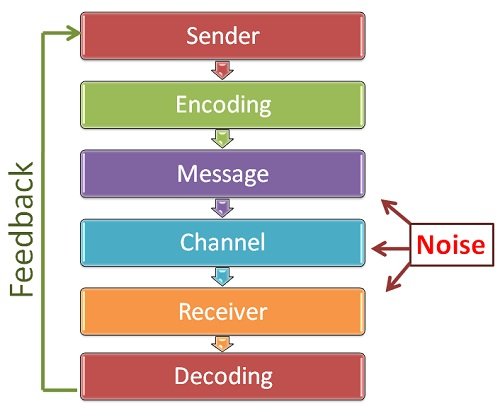
The process of communication involves the systematic exchange of information between a sender and a receiver. It begins with the sender encoding a message and transmitting it through a chosen medium (e.g., verbal, written, or digital). The receiver decodes the message, interprets its meaning, and provides feedback to complete the process. Effective communication relies on clarity, the right medium, and mutual understanding while minimizing barriers like noise, misinterpretation, or distractions that can disrupt the flow of information.

Communication Process:

The communication is a dynamic process that begins with the conceptualizing of ideas by the sender who then transmits the message through a channel to the receiver, who in turn gives the feedback in the form of some message or signal within the given time frame.

  1. Sender

The sender is the source of the message that initiates the communication. The sender has a message or purpose of communicating to one or more people. A manager in an organization has to communicate information about the tasks to be achieved or a production deadline to be met by his subordinate employees. Without a reason, purpose, or desire, the sender has no information/message to send.

  1. Encoding

In the next stage, encoding takes place when the sender translates the information or message into some words, signs or symbols. Without encoding the information cannot be transferred from one person to another. In encoding the message, the sender has to choose those words, symbols or gestures that he believes to have the same meaning for the receiver. While doing so, the sender has to keep the level of the receiver in mind and accordingly communicate with him in the way the receiver understands it.

The message may be in any form that can be understood by the receiver. Speech is heard; words are read; gestures are seen or felt and symbols are interpreted. For example, there are several communications we make with a wave of the hand or with a nod of the head, a pat on the back, blinking of eyes.

  1. Message

Once the encoding is finished, the sender gets the message that he intends to convey. The message can be written, oral, symbolic or non-verbal such as body gestures, silence, sighs, sounds, etc. or any other signal that triggers the response of a receiver.

Message is the idea or information that the sender wants to convey. He may convey it verbally (by writing or speaking) or non-verbally (through gestures or body language). Whatever the form, the message should be clearly formed so that the objective is accomplished.

  1. Channel

The channel is the medium used for transmission of information or message from sender to receiver. There are various media like telephone, mail through post, internet, radio, TV, press etc. For communication to be effective and efficient, the channel must be appropriate for the message. A phone conversation is not a suitable channel for transmitting a complex engineering diagram.

An express mail may be more appropriate. The needs and requirements of the receiver must also be considered in selecting a channel. If the receiver is illiterate, sending the message through postal mail is not relevant. Similarly, you cannot select the medium of telephone, if the receiver does not have a telephone with him. Therefore, in choosing the appropriate channel, the manager must decide whether feedback is important or not.

  1. Receiver

The receiver is the person who senses or perceives or receives the sender’s message. There may be just one receiver or a large number of receivers. The message must be prepared with the receiver’s background in mind. An engineer in a software organization should avoid using technical terms in communicating with his family members. It should be recognized that if the message does not reach a receiver, no communication takes place. Even, when the message reaches the receiver, if he cannot understand it, again there is no communication.

  1. Decoding

Decoding is the process through which the receiver interprets the message and translates it into meaningful information. It may be remembered that decoding is affected by the receiver’s past experience, personal assessments of the symbols and gestures, expectations, and mutuality of meaning with the sender.

  1. Noise

It represents the disturbing factor in the process of communication. It interferes with effective communication and reduces clarity of the message. The message may be interpreted differently than intended by the sender. Conversing near a machine making sounds, disturbance in telephone line, physical ailment or mental distress of sender or receiver are the common causes of noise that obstruct the quality of message transmitted from sender to the receiver.

  1. Feedback

Feedback is receiver’s response to the sender’s message. The receiver communicates reaction to the sender through words, symbols or gestures. It is the reversal of communication process where receiver becomes the sender and sender becomes the receiver. Unless the receiver responds to the message, communication process is incomplete. Feedback helps the sender transform his message, if needed. It also allows the receiver to clear doubts on the message, ask questions to build his confidence and enables the sender to know efficiency of the message. Feedback of information makes the communication process complete.

In face-to-face communication, sender can immediately receive the feedback. Written communication, on the other hand, takes longer for the sender to receive feedback on the message.

Feedback plays important role in two-way communication. In one-way communication, sender communicates with the receiver without getting any feedback but in two-way communication, the receiver provides feedback to the sender. Though one-way communication takes less time and is more orderly (it avoids noise and chaos), feedback in two-way communication makes it more accurate and precise.

Principles of Effective Business Communication

Effective Business Communication is critical to ensuring that information is conveyed clearly, accurately, and efficiently, fostering collaboration and productivity. Following certain principles can help individuals and organizations communicate more effectively, reducing misunderstandings and improving decision-making.

1. Clarity

Clarity is the foundation of effective communication. The message should be clear and straightforward, with no ambiguity. Using simple, precise language ensures that the audience fully understands the message without confusion. For example, when giving instructions or providing updates, be specific and avoid vague terms. Clear communication helps prevent errors and misunderstandings in business processes.

2. Conciseness

Conciseness means delivering the message in as few words as necessary, without sacrificing essential information. It eliminates redundancy and unnecessary details, saving time for both the sender and the receiver. Concise communication is particularly important in busy environments where individuals may be pressed for time. For instance, an email that conveys the key points without excessive elaboration increases the likelihood of a timely response and action.

3. Completeness

A message must be complete, containing all the information required by the receiver to understand and act upon it. It should answer the “5 Ws” (Who, What, Where, When, and Why), providing context, facts, and instructions. Incomplete communication can lead to confusion, delays, and mistakes. For example, a project update should include not only the status but also any potential risks, timelines, and resources needed.

4. Consideration

Effective business communication requires consideration of the receiver’s perspective. The sender should anticipate how the audience will interpret the message and ensure it aligns with their expectations, background, and needs. This principle emphasizes empathy—being aware of the receiver’s emotions, experiences, and knowledge level. For instance, when delivering bad news, it’s important to be sensitive and respectful to the recipient’s potential concerns.

5. Concreteness

Concreteness involves using specific facts, figures, and examples to support your message. Concrete communication is more impactful and leaves less room for misinterpretation. Rather than saying, “Sales have increased a lot,” a more concrete statement would be, “Sales have increased by 25% over the past quarter.” Specificity strengthens credibility and helps the receiver make informed decisions.

6. Correctness

Correctness in business communication refers to using proper grammar, punctuation, and spelling, as well as ensuring that the message is factually accurate. Incorrect information can damage credibility, lead to confusion, and harm professional relationships. Whether sending an email or giving a presentation, attention to detail in terms of language and facts is essential for maintaining professionalism.

7. Courtesy

Courtesy means communicating in a polite, respectful, and considerate manner. In business, maintaining a courteous tone fosters positive relationships and creates a collaborative environment. This principle involves being mindful of the receiver’s feelings, using appropriate language, and being diplomatic, especially when discussing sensitive topics. For example, a “thank you” at the end of a meeting or email strengthens interpersonal relationships.

8. Emphasis on Feedback

Effective communication is a two-way process, which includes providing and receiving feedback. Regular feedback helps clarify misunderstandings, reinforces key points, and allows for continuous improvement. In a business context, feedback can come in the form of performance reviews, surveys, or informal check-ins. An open feedback loop also ensures that communication remains dynamic and adaptable to changing needs.

9. Consistency

Consistency in communication ensures that the messages being communicated do not contradict each other and that they align with the organization’s values, goals, and objectives. Discrepancies in messages can lead to confusion, lack of trust, and decreased morale. For example, if a company communicates a commitment to innovation, this should be reflected in its actions, policies, and public statements.

10. Appropriateness

The principle of appropriateness refers to adapting the message to the audience and the context. The tone, medium, and level of detail should vary depending on the audience. For instance, a formal business letter would be appropriate for communicating with investors, while an informal email might be better for communicating with colleagues. Knowing the audience and situation ensures that communication is effective and well-received.

error: Content is protected !!