Channels in Rural communication, Developing effective communication

Promotion mix decision is very important especially for a low involvement product category like FMCG. It is not only the cost factor, but the dependence of overall results on this decision makes the in-depth analysis very important. The right promotion tool needs to be identified and then only marketer can dream of any success in a complex rural market of India.

To communicate effectively with rural audiences, it is important to understand the aspirations, fears and hopes of the rural customers, in relation to each product category, before developing a communication package. The organisation may have a national strategy but it has to act locally. They have to develop special creative strategy aimed at homogeneous rural segments, which may be quite different from urban market communication.

A well-known brand of shampoo which entered the Rajasthan market some decades ago with a creative commercial that showed a beautiful model featuring bouncing hair, the product bombed. Post-research showed that it was considered indecent for a girl to show off her hair and the audience refused to connect with the brand.

Though rural communication is so vital in rural marketing, it is being given a step-motherly treatment by most organisations resulting in their getting inadequate results from the efforts. This clearly indicates poor understanding of rural marketing in general and the role of rural communication, in particular, in building brands in rural India.

Though companies have total advertising annual spends amounting to Rs. 1,00,000 crores, rural advertising budgets are minuscule. The rural advertising budget of companies is generally between Rs. 6 crores and Rs. 15 crores. Though it does not seem enough but Rs. 10 crores spent in rural market in the villages achieve the same ‘visibility’ as Rs. 50 crores in the towns and cities.

Thus, when it comes to promotions in rural markets, most of the companies are only doing some short-term sales-oriented below the line activities without laying any emphasis on how the core message of the brand is communicated to the rural masses. Most of them use the same communication package, which they are already using to target urban audiences.

Doing just a van campaign, once in a blue moon, is not rural marketing in true sense. To dub a film from one language to another using the same characters relevant to one region can have only limited effect. For sustained results it is important to plan an integrated campaign covering both mass media and below the line activities.

Integrated rural campaigns of Philip’s Consumer Electronics Division, ACC’s Suraksha Cement and Shriram Transport Finance have proved this point. It is very important to invest in developing the specific and right communication package aimed at the rural audience, if an organisation expects to build a brand, in the rural market.

Some of the promotional strategies for the rural markets, which can be adopted by different organisations, are classified here below:

(i) Education Instead of Promotion:

The basic premise for communicating a promotional message for rural market is that it has to be essentially an educational message. This education provider in interactive, interesting and entertaining format brings better results. Rural consumers’ needs not only to be told the benefits delivered by a brand convincingly but also how the benefits outweigh cost that he is going to incur.

The important thing to be considered is that the benefits that have to be projected in the rural areas should be in accordance with the needs and lifestyle of the rural consumer. If the benefits, which are highlighted in the urban areas, are presented to the rural consumers they may not produce desired results all the time.

The rural buyers who are entering the market for the first time for many product categories need to be guided with regard to usage and benefits of products also. Therefore, demonstration becomes very important in the rural market. When benefits of brands like Chik for shampoo, Colgate for toothpaste and toothpowder were demonstrated, there was creation of a huge market, which did not exist earlier altogether. If they had just relied on ten seconds commercial on the mass media then the results might not have been the same in the rural market.

(ii) Customization of the Promotional Message:

Tricky, clever, gimmicky or even suggestive advertising does not work with the rural audience. All flicks using expensive computer graphics without human elements go over the head of rural audience. The communication targeted at the rural audience must address the specific problems, needs, aspirations and the hopes of the rural folks.

Slice of life stories having characters that rural consumer can identify with will help create a greater empathy and understanding. Using aspirational urban looking model but using simple and direct communication which is not complicated, works well with the rural audience. The anchors conducting demonstration in rural areas needs to be trained to speak in the local language or dialect during the road shows so that they can connect better with the audience.

(iii) Regionalization of Advertisement:

The first step in the development of any communication package is the in-depth study of the mindset of consumers of each region and for each product category. Perceptions, traditions and values vary from state to state and in some cases from a region to region within a state.

MRF, while marketing bullock cart tires found glaring differences between western UP and eastern UP with regard to requirement of cart tires. While bullock carts in western UP were smaller with a single buffalo, in eastern UP there were bigger vehicles pulled by two bullocks. In western UP the villagers spoke Hindustani whereas in eastern UP they spoke Bhojpuri. To develop the communication packages these facts had to be kept into consideration.

Unique promotions need to be designed as what work in north may not in the south. At times even dubbing the commercials in local linguistics may not work. Emami had Madhuri Dixit and Amitabh Bachchan as brand ambassadors but for Andhra Pradesh, it signed Chiranjeevi for the same. When Phillips was developing rural campaign for their radio for rural Tamil Nadu, they developed the punch line Enga Veetu Superstar meaning; ‘The superstar of my home’ based on Tamil superstar Rajnikant.

But when campaign was to be developed for Andhra Pradesh punch line developed was Maa Inty Mega Star-that is, ‘mega star of my home’, reflecting, Chiranjeevi, the most popular cinestar of Andhra Pradesh. Had they used the word ‘superstar’ it would have meant Late N.T. Rama Rao, the superstar of Andhra Pradesh but not the current one.

In order to build the association with the promotion, Philips used photograph of village’s own girl – to sell transistors, TV’s, so that the rural audience of a region can relate to it and perceives that the product meant for them.

The regionalization of advertising campaigns by many leading multinational companies indicates a healthy trend for the advertising business. Few clients are looking at developing special advertisements for rural markets. The success of ‘Thanda Matlab, Coca Cola’ campaign, which was aimed at the rural market, is a case in point. The marketer therefore needs to specify region, use specific media and then develop, ‘regional messages’.

(iv) Understanding Role of Mass Media:

Mass media with its known and perceived to be efficient cost per contact is the most favorite medium to spread the promotional message. The benefit of mass media is its huge reach and the easy tracking comparison with other below the line promotional activities.

TV is the most preferred mass media a significant part of the budget of rural marketing companies goes to TV because no other medium has that wide a reach across the country. According to the National Readership Survey, the print media reaches about 23 per cent of rural consumers in India, while 36 per cent have access to TV. The reach of cinema stands at approximate 26 per cent.

The mass media reaches about 57 per cent of the rural population, although, the reach of television rural India is high. Frequent power-cuts restrict viewing time considerably. Two out of five Indians were unreachable by mass media.

Rural India has a very high ownership of transistor radios and as these run on batteries, radio; can once again be expected to become a popular medium for reaching rural masses.

Mass media is too glamorous, interpersonal and unreliable in contrast with the familiar performance of traditional artist whom the villager could not only see and hear, but even touch. Television also does not distinguish between urban and rural. For marketers who use mass media like TV, this becomes a big challenge, as television does not distinguish between urban and rural audiences. There can be a common TV commercial for both urban and rural audience particularly for FMCG products provided the communication is not gimmicky or suggestive and is easy to comprehend.

(v) Outdoor Media Options:

Large numbers of outdoor media options are available with the media planner to lake the message to the rural market. Different options can be selected based on the demographic profile of the population of a region. Available infrastructure of the post offices, weekly markets, exhibitions, public distribution system, cooperative societies and banks could help in strengthening the existing promotional efforts. A vast network of 1.38 lakh rural post offices and 22,000 primary health centres need to be tapped imaginatively for education and information.

Some of the available outdoor media are described below:

(a) Wall Paintings: They are an effective and economical medium for advertising in rural areas. They are silent but a speech or film comes to an end, but wall painting stays as long as the weather allows it to. Retailer normally welcomes paintings of their shops, walls, and name boards, because it makes the shop look cleaner and better.

(b) Video Vans: Video van concept started with the political parties who were not getting access on Doordarshan to have contact with the rural masses. The video van is one of the very effective means of reaching out physically to the rural consumers and providing them with touch and feel of product and the brand.

The promotion using these vans create a lot of word of mouth publicity for a brand in the region which is much more effective than the promotional campaign run on any mass media. The people who have experienced the benefit themselves are likely to talk about to many people who were not present. If conducted in a proper manner then the promotional campaign can be the regular discussion at choupal for many days.

These vans although have a very good potential to deliver the intended communication and demonstration, but are costly to hire and maintain. Considering the vast spread of the rural market, cost per contact can come to many times more than what the conventional mass media can achieve in the urban markets.

(vi) Unconventional Platforms to Promote Brands:

In order to communicate the message to vast multitude of rural population, marketers have to experiment also with unconventional media along with the traditional mass media options. Rural Market offers the opportunity to the media planner with a wide range of platforms that can be used to carry the message ‘to the target market residing in rural areas’. These platforms can be used as complementary to the mass media options.

Using these media, the marketer can provide touch and feel aspect with regard to their brands, which is very essential in rural areas where good number of consumers are living in media dark villages. In the area of communication, corporate marketers have perhaps failed to recognise that a rural consumer may be buying a particular brand or even the product categories itself (particularly durables) for the first time.

With hardly any key influencer within the village and few sources of information (since print and electronic media have limited reach), the rural consumer feels inhibited and ill equipped to buy confidently.

Hence, there is a strong need to build the reassurance and trust about product quality, service support and company credentials in the minds of rural consumers. This is best done through the face to face below the line touch, feel and talk mode at haats, melas and mandis.

This not only spreads the message amongst the audience at these platforms but it also creates word of mouth stories, which carry the message in the entire region. Some of the platforms available for brand promotion are presented below. The relevant platform according to the product categories can be selected for communicating with the rural audience.

Creating Advertisements for Rural Audiences

Rural advertising is increasingly evident throughout the countryside. The majority of advertisements and hoardings are for fertilizers, hybrid seeds, diesel pumps and pesticides, not to men­tion the message of family planning. Once you selected a communication media, follow the steps:

Steps:

Step1: Try to develop an objective for the media/material. Here the objective means as to what the selected media/material is expected to achieve. Let us take an example. Suppose you have selected Flipcharts as your media for communicating a message about family planning measures to be adopted by the villagers. Your media objective will be “By using the flipcharts majority of the family planning workers will be able to more effectively describe various methods than they could without the mela.

Step2: You will have to identify as ta who will be using the media and when. For example, if we continue above example, you can say that family planning workers will be using it during their home visits.

Step3: You will have to decide about the time frame. Here a time frame is needed for three main activities:

i) Preparation of porotype

ii) Pre-testing

iii) Preparation production of final versions.

Step 4: It includes identification of persons responsible for each activity under medial material production.

Step 5: You may have to estimat6 cost(s) for media/material production, wherever applicable. The main areas to be taken into account while working out the cost include cost for:

a) Developing prototype

b) Pre-testing

c) Modification and production and

d) Distribution

Distribution Models of FMCG like HUL & ITC

Low unit packs were there since long; only denomination is different now. The pioneers in this category were tea and coffee marketers. Brooke Bond pack was available earlier in 5 paise, later in 10 paise, 25 paise and 50 paise and then with inflation it became Rs. 1 pack. Now it is the time of Rs. 5 pack.

The current craze for Rs. 5 positioning could be because of Coke’s success in promoting the pouch strategy. Colas helped to highlight the price point to the consumer and their medium weight really threw open the gates for other manufacturers to come and ride piggyback on the Rs. 5 price point. And what is different from the past is that large numbers of product categories are now available in small packs and it has taken the shape of mega trends.

The small packs increase user base, usage occasion and can thus explode the market. The consumer base of soft drink increased from 16 crores in 2002 to 24 crores in 2004. A two-year period for which the Rs. 5-price point remained in force.

The Colas started it but host of other branded products are now realising the importance of being present at Rs. 5 price point. Ready availability of five rupees coin has been an advantage and many consumers are not worried as much about grammage as price. They are used to ask for Rs. 2 or Rs. 5 worth of commodity.

Some of the brands that HUL sells for Rs. 5 are Pond’s Talc, Pond’s Cold Cream, Rin, Taaza, Fair & Lovely and Lux. The price point also helps branded FMCGs, which are battling fakes from unorganized sector. Rs. 5 price point leads to growth in user base of brands and increased category penetration for those who have introduced such packs.

Rural marketing problem is essentially a distribution problem. This is evident from an empirical study that though rural consumers are aware of substitutes but they are compelled to accept the product available in nearby retail outlets. Rural marketing depends on getting the distribution and pricing right. Even expensive brands such as Close-up and Marie biscuits were doing well because of deeper distribution.

HUL, ITC, Wimco, Eveready, Dabur, Nirma, Britannia, Arvind Mills are some of the select organisations who have done a great job of rural penetration and have managed to tap the rural markets successfully. But regional players have a stronger presence than national companies in rural markets because of the region specific strategies.

There are few corporates who have started establishing separate verticals in terms of sales and marketing teams devoted lo rural market and also have started allotting special rural budgets (though proportionately very low). The emphasis for the present seems to be on distribution to ensure availability of their brand even in smaller markets. The marketer can adopt any of the strategies given below to make their products available to the rural world.

Sales-Women Network:

A unique way to extend availability in rural market may be distribution through saleswomen network. The women can go to different homes, when their husbands are away, establish confidence and personally sell to other ladies many FMCG products they may not be exposed to. HUL has very successfully employed this strategy through its Project Shakti and TTK group has also developed an integrated strategy to promote its Prestige brand through the network of self-employed saleswomen.

Converting Unorganised Sector Manufacturers into Distributors:

Small or tiny scale manufacturers are finding it difficult in the times of intense competition from domestic and international products. They have good knowledge of the territory and have good sales network, credibility and relationship with the retailers and consumers. Organisations like Exide are attempting to convert these small manufacturers in the unorganised sector in Punjab and Haryana to become their dealers.

This can prove to be good strategy as these manufacturers have the knowledge of the industry and the consumer behavior and it is likely that they will be more professional and financially strong to create the distribution network in the rural areas. Not only the organisation has a knowledgeable dealer but this also reduces the competition offered by that local brand.

Company’s Own Distribution Network:

Some of the organisations are feeling that distributors and wholesalers in the traditional distribution channel areas. These organisations are contemplating and pilot testing their own direct distribution network in order to promote their brands directly to the retailers and consumers in the rural areas.

Rasna Enterprises was building such network to promote its soft drink concentrate in rural areas of Uttar Pradesh, Rajasthan, Maharashtra, Gujarat and Tamil Nadu. This strategy provides to an organisation valuable learning’s about the rural marketing as they have the direct feel of the market. An organisation’s own effort brings in financial strength and aggressiveness. They also get valuable information with regard to selling to the rural retailer as well as the consumer.

Collaboration for Distribution:

Various organisations with comparatively lesser distribution reach can collaborate with organisations that already have achieved high penetration levels in rural areas.

Cost of setting up a huge retail network on one’s own has seen many casualties, the notable being P&G, which abandoned its plan to fight the likes of Lever in rural segment on its own. Instead, it is aiming to piggyback on Marico Industries. Procter & Gamble had tie-ups with Godrej, Marico Industries and now it is planning one with Nirma for distribution of Camay Soaps. Godrej Tea has tied up with Jyothi Lab to use its extensive distribution network that is not only deep but is also serviced quite frequently too.

These tie-ups are of immense benefit for both the organisation as one gets an immediate reach to millions of retail outlets and the other can leverage its distribution network over larger range of products and get better returns on existing networks. This provides them with better return on their sales effort and can invest even more for achieving even deeper penetration.

Even the smaller non-competing organisations can collaborate with each other to develop a joint distribution infrastructure. This will reduce the cost of distribution per organisation and thus can make the seemingly unviable operation financially viable. JK Dairy employed this strategy for distributing milk powder sachets. It took along three companies, which were not competing with its products for selling their products.

In the same rural market for sharing the van cost. A sachet sale of Rs. 500 per day that is 77 sachets daily covered all expenses and fetched some profit on account of sharing of expenses of distribution.

Delivery Vans:

Certainly, reaching out to 33 lakh retail outlets in rural areas is an uphill task. Company delivery vans which can serve two purposes; they can take the products to the customers in select rural areas and also enable the firm to establish direct contact with them and thereby provide an opportunity for promotion. However, only the bigwigs can adopt this channel.

The companies with relatively fewer resources can go in for syndicated distribution where a tie-up between non-competitive marketers can be established to facilitate distribution. In order to move products in rural areas in cost effective manner, the organisation and distributors can make use of rural makeshift transport vehicles known in different areas.

They are very cost effective as their acquiring cost is very low and is not a barrier. They are very rugged to handle the excessive wear and tear that happens on the rural roads. These vehicles are very popular in the rural areas of Uttar Pradesh, Haryana and Punjab and can be easily available to different organisations to transport their products in remote villages at a low cost. These vehicles were employed quite effectively by the rural sub-stockist of Coca Cola to distribute soft drinks in the rural market.

Targeting Larger Villages:

For FMCGs distribution becomes complex. The distributor in the towns needs to have a supply network of hundred plus outlets in 50 odd locations, which cover villages up to 200 plus population. There are only 85,000 larger villages out of more than 6,38,000 villages. But they have 40 per cent of the rural population and 60 per cent of total consumption.

Many of the established packaged goods companies reach more than 20 lakh retail outlets using trains, trucks, bullock drawn carts, camels, and bicycles and many companies claim to service each one of those Outlet once a week. As, only small percentage of consumables can reach the rural market automatically through the retailers and consumer coming to the town for the purchases.

This pain of reaching the rural consumer is worth taking as this direct contact with the retail in the rural world enables a closer relation with the trade, as retailer is a critical link in the overall chain for supplying products to the rural consumer. In a study, to measure the level of influence that the rural retailer has on the rural consumers, it was found that in about 35 purchase occasions, rural retailer was able to influence the sales to the rural consumers.

Therefore, rural retailer needs to be targeted effectively through various strategies so that he sides with the company’s products whenever he is in a position to do so.

Ensuring Reach and Visibility:

The rural marketing effort of the companies can be focused at growing the pie and not just fighting amongst themselves for the existing pie. Brands rarely fight with one another in the rural market, they just have to be present at the right place, ‘Joh Dikhta hai, woh Bikta hai’ (what is seen, sells) many of the brands are building stronger rural bases without much advertising support. The thing, which is critical, is to get the Stock Keeping Unit (SKU) right, as rural retailer cannot afford to keep many different SKUs.

In such an environment, being first on the shelf in the product category and developing a privilege relationship with the retailer is a source of competitive advantage to consumer good companies. And usually the brands that are first on the shelves become synonymous with product category and are difficult to dislodge, thereafter. For example Maggi noodles reached the rural shelves before anyone and remains the market leader ever since. The drive down the rugged countryside sans facilities is surely torturous but pains worth bearing.

Jobbers:

The army of mobile traders that go from house to house in rural India to sell a variety of FMCG products could be motivated, to convert some of them to sell company brands. These are high involvement, touch, feel and demonstration channels that offer greater possibility of convincing ill-informed rural consumers lacking confidence to buy.

Continuous Availability of the Brand:

Habitually rural consumers do not like change and are wary of it. Therefore, they want to stick to one particular brand. This acts as a big barrier for the new brands. But the non-availability of their favorite brand especially in the case of FMCGs creates an opportunity for trial of competitive bandit. It is less likely for rural consumer to move to another shop for purchasing their favorite brand, as shop loyalty in rural areas is, more important than the brand loyalty. This is the result of large number of factors like relationship, credit availability, etc.

The retailer also has immense influence and can make the consumer opt for another brand if the favourite brand of consumer is not available. This trial may not be for just one time and the loyalty can shift to another brand if it provides satisfying experience. In oral culture of the rural areas the news of satisfaction and dissatisfaction spreads very fast. There can be wider demands for the new brand as the promotion spreads through word of mouth publicity.

This might encourage the retailer to stock new brand and as he has to stock only limited number of brands, he will drop one of the brands, which he was carrying earlier. Then it becomes difficult for the once established brand to regain the previous like position. Therefore, the organisations need to make sure that their brands are available at the retailer’s shelves by servicing the rural retailer on a regular basis.

Distribution networks, ideal Distribution model for Rural market

One of the ways would be using company delivery mass, which can serve two purposes it can take the products to the customers in every hook and corner of the market and it also enables the firm to establish direct contact with them and thereby facilitate sales promotion.

Project Shakti:

HLL has come out with a new distribution model with main objective to develop income-creating capabilities of underprivileged rural women by providing a sustainable enterprise opportunity and to improve rural living standards through health and hygiene awareness.

Typically, a woman from the Self Help Group is selected as a Shakti entrepreneur and receives stocks Lifebuoy, Wheel, Pepsodent, Annapurna salt, Clinic Plus, Ponds, LUX, Nihar, 3 Roses tea, etc. at her doorstep from the HLL rural distributor. She sells directly to consumers as well as to small merchants in the village.

Each Shakti entrepreneur services 6-10 villages in the population range of 1000-2000 people. With training and hand-holding by the company for the first three months, she begins her journey selling the products door-to-door. Normally the entrepreneur has a turnover of Rs.10,000 to Rs.25,000 per month and earns a profit of Rs.800 to Rs.2,000 a month.

Back-haul method for the distribution vehicles:

Organising a suitable back-hual method for distribution vehicles may prove to be an economic to transport the “urban goods” like soap, detergent, oil, cream, shampoo, tooth paste, and other daily necessary items for the rural consumers and in the return journey, the energy verticals will transport the fruit and vegetables etc. from rural areas to the nearest towns and cities for distribution among the urban consumers.

But this needs a well co-ordinated “VMS” distribution strategy in which the manufacturer, distributor/relation and the customers jointly make a strong distribution chain. Annual “melas” and “fairs” organized are quite popular and provide a very good platform for distribution because profit visits them to make several purchases. According to the Indian Market Research (IMRB) Burean, around 8000 such nulas and fairs are held in the rural India every year.

Rural markets have the practice of faxing specific days in a week as weekly market days, i.e., “Haats” when exchange of goods and services are carried out. This is another potential low cost distribution channel available for the marketers.

Also, every region consisting of several villages is generally served by one satellite town, formed as “Mandia” or Agri-markets where people prefer to go and buy from their commodities. The marketers using their feeder fown will be able to cover a large section of rural population.

The other distribution strategies for the rural population are as under:

  • The general insurance companies may promote their policies of health insurance, crop insurance and vehicle insurance through the existing co-operatives.
  • Marketers may arrange more number of wave-houses for storage and re-packaging into smaller pouches for which employing local villages will work profitable and popular.
  • All communication in the rural areas must be in the regional language and dialects.
  • Markets need to develop innovative packaging technology which would be economic, protective and improve shelf-life of goods.
  • In addition to focusing on targeted promotions and advertising, there is an urgent need to work on economical packaging, dual pricing and special size of PMCQ and household products.
  • Marketers need to place emphasis on retailers directly rather than depending on the wholesalers for distribution in the rural market as this has not proved to be very effective marketing channel.
  • Marketers targeting the rural market should be well aware about the seasonality of the business. Because the trade is seasonal, employment and disposable income can fluctuate arrange the villages during the year. This means that business should view market research data that relies on yearly aggregate statistics with caution.
  • Marketers must trade off the distribution cost with incremental market penetration.

Syndicate Distribution:

Companies selling non-competitive goods can join together and distribute the products through a common distribution channel. Example- P&G has made use of the distribution channel of Marico for selling their product.

Satellite Distribution:

In this system, the company appoints stockists in important towns. These stockists are responsible for placing orders with the company, receiving the stocks, sorting of stocks and supply the goods in small lots to the retailers and merchants situated in rural areas and in and around the towns.

The stockist is given 15-30 days’ credit by the company. Over a period of time, along with increase in business, some of the good retailers will be elevated as stockists. Therefore, many retailers hover around a particular stockist. The advantage of this system is it enables the organisation to penetrate interior markets. Example- Companies like Nestle, Marico, Eveready batteries have appointed stockists to service the village merchants and the merchants are met at fortnightly/monthly intervals through van operations.

Essential things for effective distribution

  • Focus on the local market is essential for a better grip on the situation. Since localized distribution hubs are supposed to cater a limited geography, they can work in a better way.
  • All the stakeholders should be provided with adequate training. Yes, it is very much required because everyone has to be on the same page when you address the needs of rural consumers. Align your customers, vendors, and employees before you derive and implement effective marketing strategies.
  • Tweak the product promotion and marketing tactics to the local needs. Since there is incredible diversity in cultures, traditions, and languages in rural India, the model has to be flexible and adaptive.
  • Your company should make effective use of technology to reach the masses. Yes, there are ways to unleash the immense potential by thinking out-of-the-box ways of reaching people. Companies like Vritti iMedia have proved it. They made outstanding use of bus stands to promote products and services. Audiowala Bus Stand is a brilliant example of creative thinking and innovation.
  • Service delivery is equally important. Marketing strategy shouldn’t be limited to promotion and distribution only. Rather, it should be equally efficient when it comes to delivering services.
  • Always remember that an emotional touch works excellently in the rural areas. Once the trust is developed in the product, it is important that you live up to it.

Distribution strategies for Rural Consumers: HAATS, Mandis, Public distribution System, Co-operative Society

Research indicates that only those companies could perform brilliantly that developed multiple distribution centers catering a limited geography. Thus, they can reach the consumers quickly. There is a better control on product promotion and distribution.

A few essential things for effective distribution

  • Focus on the local market is essential for a better grip on the situation. Since localized distribution hubs are supposed to cater a limited geography, they can work in a better way.
  • All the stakeholders should be provided with adequate training. Yes, it is very much required because everyone has to be on the same page when you address the needs of rural consumers. Align your customers, vendors, and employees before you derive and implement effective marketing strategies.
  • Tweak the product promotion and marketing tactics to the local needs. Since there is incredible diversity in cultures, traditions, and languages in rural India, the model has to be flexible and adaptive.
  • Your company should make effective use of technology to reach the masses. Yes, there are ways to unleash the immense potential by thinking out-of-the-box ways of reaching people. Companies like Vritti iMedia have proved it. They made outstanding use of bus stands to promote products and services. Audiowala Bus Stand is a brilliant example of creative thinking and innovation.
  • Service delivery is equally important. Marketing strategy shouldn’t be limited to promotion and distribution only. Rather, it should be equally efficient when it comes to delivering services.
  • Always remember that an emotional touch works excellently in the rural areas. Once the trust is developed in the product, it is important that you live up to it.

Shandies/Haaths/Jathras/Melas: These are places where the rural consumers congregate as a rule. While shandies/heaths are held a particular day every week, Jathras and melas are held once or twice a year for longer durations. They are normally timed with religious festivals. Such places attract large number of itinerant merchants. Only temporary shops come up selling goods of all kinds. It can be beneficial for companies to organize sales of their product at such places. Promotion can be taken, as there will be ready captive audience. For convincing the manufacturing and marketing man with regard to the importance of these places from rural marketing point of view a visit to such places is necessary. It is estimated that over 5,000 fairs are held in the country and the estimated attendance is about 100 million rural consumers. Biggest fair ‘Pushkar Mela’ is estimated to attract over 10 million people. There are 50 such big rural fairs held in various parts of country, which attract urbanite also like ‘Mankanavillaku’ in Malappara in Kerela, Kumbh Mela at Hardwar in U.P. ‘Periya Kirthigai’ at Tiruparunkunaram in Tamil Nadu. These mandis located in agricultural area with population more than 10,000 on an average cater to 1,36,000 people. Cash-rich farmer can be directly contacted by setting up brand stalls in mandis. Sampling, free gifts can be provided along with the consumer research at these places where farmers have time and are in joyous mood. These mandis are also good platforms for promoting high-end durables, besides agri-input products.

The country’s oldest tradition holds the key to solving the promotion problems of the corporate world. 75% of the mobile supermarkets of rural India are held once a week, 20% are organized twice a week and rests are held daily. Rural people have evolved these systems of selling and communicating which have served them well for centuries. Corporate marketers have not used these platforms effectively, so far. There are 42,000 of such haats, each catering to daily needs of 10 to 20 villages. These haats can serve as good platform to promote brands through demonstration.

Public distributory system: The PDS in the country is fairly well organised. The revamped PDS places more emphasis on reaching remote rural areas like the hills and tribals. The purpose of PDS is to make available essential commodities like food grains, sugar, kerosene, edible oils and others to the consumers at a reasonable price. The shops that distribute these commodities are called fair price shops. These shops are run by the state civil Supplies Corporation, co-operatives as well as private entrepreneurs. Here again there is an arrangement for centralized procurement and distribution. The manufacturing and marketing men should explore effective utilization of PDS.

Co-operative societies: There are over 3 lacks co-operative societies operating in rural areas for different purposes like marketing cooperatives, farmers service cooperatives and other multi-purpose cooperatives. These cooperatives have an arrangement for centralized procurement and distribution through their respective state level federation. Such state level federation can be motivated to procure and distribute consumables items and low value durable items to the members to the society for serving to the rural consumers.

Distribution upto feeder markets/mandi towns: Keeping in view the hierarchy of markets for the rural consumers, the feeder markets and mandi towns offer excellent scope for distribution. The rural customers visit these towns at regular intervals not only for selling the agricultural produce but also for purchasing cloth, jewellery, hardware, radios, torch cells and other durables and consumer products. From the feeder markets and mandi towns the stockist or wholesaler can arrange for distribution to the village shops in the interior places. This distribution can be done by mopeds, cycles, bullock-carts, camel-backs etc. depending upon the township.

Rural Media: Mass media, Non-conventional Media, Personalized Media

Mass Media:

Mass media with its known and perceived to be efficient cost per contact is the most favorite medium to spread the promotional message. The benefit of mass media is its huge reach and the easy tracking comparison with other below the line promotional activities.

TV is the most preferred mass media a significant part of the budget of rural marketing companies goes to TV because no other medium has that wide a reach across the country. According to the National Readership Survey, the print media reaches about 23 per cent of rural consumers in India, while 36 per cent have access to TV. The reach of cinema stands at approximate 26 per cent.

The mass media reaches about 57 per cent of the rural population, although, the reach of television rural India is high. Frequent power-cuts restrict viewing time considerably. Two out of five Indians were unreachable by mass media.

Rural India has a very high ownership of transistor radios and as these run on batteries, radio; can once again be expected to become a popular medium for reaching rural masses.

Mass media is too glamorous, interpersonal and unreliable in contrast with the familiar performance of traditional artist whom the villager could not only see and hear, but even touch. Television also does not distinguish between urban and rural. For marketers who use mass media like TV, this becomes a big challenge, as television does not distinguish between urban and rural audiences. There can be a common TV commercial for both urban and rural audience particularly for FMCG products provided the communication is not gimmicky or suggestive and is easy to comprehend.

Unconventional Platforms to Promote Brands:

In order to communicate the message to vast multitude of rural population, marketers have to experiment also with unconventional media along with the traditional mass media options. Rural Market offers the opportunity to the media planner with a wide range of platforms that can be used to carry the message ‘to the target market residing in rural areas’. These platforms can be used as complementary to the mass media options.

Using these media, the marketer can provide touch and feel aspect with regard to their brands, which is very essential in rural areas where good number of consumers are living in media dark villages. In the area of communication, corporate marketers have perhaps failed to recognise that a rural consumer may be buying a particular brand or even the product categories itself (particularly durables) for the first time.

With hardly any key influencer within the village and few sources of information (since print and electronic media have limited reach), the rural consumer feels inhibited and ill equipped to buy confidently.

Hence, there is a strong need to build the reassurance and trust about product quality, service support and company credentials in the minds of rural consumers. This is best done through the face to face below the line touch, feel and talk mode at haats, melas and mandis.

This not only spreads the message amongst the audience at these platforms but it also creates word of mouth stories, which carry the message in the entire region. Some of the platforms available for brand promotion are presented below. The relevant platform according to the product categories can be selected for communicating with the rural audience.

(a) Mandis:

These are agricultural markets, known by different names as terminal markets/ primary or secondary wholesale market and are set up by state governments to procure agriculture produce from farmers. 7,000 in number and located in high production centers of different crops, they can serve as a good platform for product demonstration, brand building and on the spot sales.

These mandis located in agricultural area with population more than 10,000 on an average cater to 1,36,000 people. Cash-rich farmer can be directly contacted by setting up brand stalls in mandis. Sampling, free gifts can be provided along with the consumer research at these places where farmers have time and are in joyous mood. These mandis are also good platforms for promoting high-end durables, besides agri-input products.

(b) Haats:

The country’s oldest tradition holds the key to solving the promotion problems of the corporate world. 75% of the mobile supermarkets of rural India are held once a week, 20% are organized twice a week and rests are held daily. Rural people have evolved these systems of selling and communicating which have served them well for centuries. Corporate marketers have not used these platforms effectively, so far. There are 42,000 of such haats, each catering to daily needs of 10 to 20 villages. These haats can serve as good platform to promote brands through demonstration.

(c) Melas:

The companies need to have innovative methods of advertising and brand building in fairs or melas to reach their potential customer base. There are 25,000 melas in India (90 per cent are religious and one day affairs), the 1,000 being larger and frequented by hundreds of thousands of visitors. About 5,000 are commercial in nature and could be targeted for brand promotion.

Melas provide a platform for communicating with rural masses. Organisations have an opportunity to present brand stories and exposures can be provided at a low cost per contact with relatively larger retention time. The marketer can use better display tools, i.e., large screens, animations, gizmos, etc.

Women folks of the rural areas are difficult to contact in the village setting and they do not visit the nearby towns often. But in melas they are present in large number. Thus, mela provides the organisations with an excellent opportunity to target rural women for research, brand promotion, demonstration and trial.

Some of the widely visited melas include Kumbh Mela at Haridwar, Allahabad, Ujjain, Nasik and Sonepur Mela in Bihar. FMCG giants – like HUL, P&G and many other companies set up branded kiosks in “Kumbh Mela” at Nasik, Maharashtra, similarly some tried at “Pushkar Mela” near Ajmer, Rajasthan, where Mahindra & Mahindra set up information counter for its farm tractor, and Nestle arranged coffee and Maggie shop.

Melas work best for introducing new brands and building brands through the organisation of events at the venue. Many companies congregate at the Ganges River for the Kumbh Mela festival, where about 3 crore people, mostly from rural areas, come over the span of a month. Companies provide ‘touch and feel’ demonstrations and distribute free samples. This proved to be extremely effective in advertising to the rural market.

(d) Mills:

Market Researchers conducted a study in 24 villages across Uttar Pradesh and Punjab and found that the creative use of avenues like mills, rural games, tournaments, service camps and appointment of local brand ambassadors can appreciably increase communication effectiveness in the rural areas.

It was found that more than 200 tractors visit a mill in a day during the peak season. This gives a very good opportunity to the marketer to target farmers. As they are relatively free just waiting for their turn, they would be more receptive than in other settings. Farmers in order to pass their time would keenly lend their ears and also see their demonstrations. There is a good probability of their participating in the interactive formats, which could provide useful inputs to the marketing organisations.

(e) Pilgrim Sites:

The vast potential of pilgrims’ sites to promote brands especially for rural market has not been exploited to a great extent. Most of the organisations do not have a proper marketing plan for utilising marketing potential of such locations. Vaishno Devi, Ashtaateerathadham are few examples of pilgrim sites visited by crores of people every year. These and other pilgrim sites, which attract lakhs of visitors, can be ideal platforms to promote the brands by integrating the brand and the promotional campaign with the occasion.

For example, one pilgrim centre, Khalgam, about 20 km from Daman (Gujarat), on an average draws a crowd of 20,000 to 30,000 people every Tuesday and Saturday and 50,000 people during the month of Shrawan. There must be at least 10,000 such sites in the country each of which could be marketer’s dream for promoting their brand, yet it would be surprising if these sites are even documented. Having the religious consumers in a large number at one place is a good opportunity to promote a brand.

(f) Rural Games:

Focus of rural marketers can be on events like Quila Raipur Olympics and Nehru Boat Race, which are annual extravaganzas for promotion of their brands. Nearly one lakh spectators turn up to watch the rural sports at Quila Raipur village being played out in three daylong events.

Punjab has 25 popular festivals in the year, which include sports festival, agriculture as well as cultural festivals, in addition to the religious festivals. It is here that the rural marketers need to focus their attention, as the eyeballs of captive audience are available at these meets. The latest estimates are that in most of these festivals 50,000 visitors turn out on an average.

Rural games and tournaments are hugely popular in rural areas and are attended by rural people in large numbers. These tournaments can be sponsored at a reasonable price and could be utilized as a platform to put the company’s stall for brand building and demonstration. The company’s products could also be given as prizes to increase the brand awareness. These products, given as prizes would lead to lot of word of mouth publicity in the rural areas as it would be talk of many villages for good number of days.

(g) Primary Health Centre:

The primary health centres are very good platforms to promote products that have to be sold on health and hygiene grounds. The campaign in these centres can be executed in coordination with the NGO state health departments. Medical Council or Dental Associations and even international aid agencies.

Swasthya Chetna Campaign to promote the habits of washing of hands by HUL in rural areas is a good example of this form of promotion; this would have directly or indirectly promoted sale of Lifebuoy, its leading brand, in rural areas.

(h) Schools:

Young children are emerging as the change agent in the rural areas. Organisations like HUL and Colgate are targeting the children in the schools. They are not only educating them about the product benefits but are also demonstrating the benefits offered by their brands for the health of children and the entire family.

Personalized Media

In the marketing of textiles, highly personalized selling by vans and participation in rural fairs and festivals and mobile units/stalls may play a useful role.

Similarly, for cycles and sewing machines, sales vans and parti­cipation in fairs may be supplemented by billboard’s, hoardings and point of-sale materials. Sewing machines and cycles may be adver­tised on the radio and TV. Sewing schools and the organization for training would promote the sales of sewing machines.

In Mandi towns and rural markets, cinema slides, wall posters, paintings on walls, coupled with a mobile sales stall at rural fairs and festivals would go a long way in promoting footwear sales. It is necessary to establish individual brands to win rural consu­mer loyalty.

Rural marketing involves more intensive personal selling efforts compared to urban marketing. Firms should refrain from pushing goods designed for urban markets to the rural areas. To effectively tap the rural market a brand must associate it with the same things the rural consumers do.

This can be done by utilizing the various rural folk media to reach them in their own language and in large number so that the brand can be associated with the myriad rituals, celebration, festivals, melas, fairs and weekly hats.

Selecting the communication channels for rural Marketing

TV/Regional Language Channels:

Over 75 percent of India’s urban households own a TV set, compared to just one-third of rural households, according to 2011 Census figures. The census also reveals that only 9.4 percent of households in the country have either a laptop or a computer and only 3 percent of them have an Internet connection. While 20 percent of urban and 5 percent of rural house­holds now own a computer or laptop, just 1 percent of rural Indian households own a com­puter with Internet.

However, measuring the audiences or identifying who was watching which channel has so far been a huge challenge. The problem is more acute in rural areas, where people receive TV signals from antennas, cable or dish. Earlier, TV audience data was provided by Television Audience Measurement (TAM), a joint venture between Nielsen and Kantar Media. It enjoyed a monopoly for years, but its data was inadequate. It captured data through TAM ‘people- meters’, which were installed in selected homes. But the people meters about 9,000 were installed were not only inadequate but they were not installed in rural areas. Charges of cor­ruption were also being levelled against the agency.

we can classify rural India into four groups:

  • Diamonds:

High growth rate districts from FY07 to FY10. There are 79 diamond dis­tricts in India, which have seen high growth. These districts have contributed close to 28 percent of India’s rural growth and constitute 25 percent of rural population.

  • Resilient:

Moderate to high growth every year between FY07 to FY10. There are 119 resilient districts, together contributing to 31 percent of rural growth and 22 percent of rural demand. The diamond and the resilient groups comprise 198 districts with 35 percent of the rural population. More than 90 percent of the growth in demand is accounted for by the diamond and resilient districts put together.

  • Emerging:

Districts that have picked up growth from FY08 onwards, showing growth rates of 12 percent per annum. There were 173 emerging districts which generate 31 percent of the demand, but contributed only to 20 percent of rural growth. These dis­tricts demonstrated low growth in FY08 but picked up speed in subsequent years.

  • Laggards:

Districts which are growing at a low rate of less than 5 percent per annum since 2008. There are 201 laggard districts which comprise one-third of the rural popu­lation, contribute to around 30 percent of the demand but capture only 20 percent of rural growth.

These districts do not follow the generally accepted wisdom of rich states and poor states. Most of the 198 diamond and resilient districts are seen to be clustered in multiple regions forming growth pockets. For example, northern Odisha accounts for a large part of the resil­ient rural growth in the country. Other such prominent clusters are found in the states of Andhra Pradesh, Madhya Pradesh and Rajasthan. Uttar Pradesh and Bihar do not seem to show consistent high growth and account for only nine such districts.

Wall Paintings:

Wall paintings reach even the smallest villages where mass media has not made inroads. These are cheap and serve as fixtures on walls with high visibility. Local painters do the job and villagers welcome these messages as the paint helps to protect walls. For consumer durables, direct marketing campaigns are effective. A dealer push combined with wall paintings and attractive schemes and exchange offers can give a lot of mileage in rural markets.

Many durables companies such as Bajaj Auto, Hero Motocorp, LG and so on are tapping rural markets through wall paintings and have made significant inroads in rural market. Wall painting is the most widespread form of advertising and well accepted among rural consumers, and so are an effective promotional tool, because they constantly remind rural people about names and logos.

Village Newspaper or Local Editions of Large Newspapers:

A look at mass circulated newspapers shows that villages are largely invisible to mainstream media. Apart from news of a farmer suicide or an accident, villages find very little coverage on nationally circulated newspapers. Some regional language newspapers or regional editions of larger newspapers are popular in towns but have very little reach in villages.

Among the exceptions is Eenadu, published in Telugu. It regularly carries tips on agricul­ture and animal husbandry and encourages reader participation by publishing their politi­cal opinions and grievances. Local editions of Rajasthan Patrika and Dainik Bhaskar cover local concerns.

BTL Techniques, Vans and Demonstrations:

Mobile van campaign is one of the most effective communication channels for rural consum­ers, since it involves interpersonal communication with direct experience, creating greater visibility and deep reach. Van campaigns in rural areas pull crowds. Vehicles carrying adver­tisements always grab attention, thus helping better brand building, creating visibility and also encouraging trials.

Rural service camps and creation of local brand ambassadors also serve as means of effective communication. Some companies put stalls at prominent locations in vil­lages. Such stalls are not only cost effective but can also target high potential consumers, especially during festive seasons. Other crowd pullers in rural areas are rural games and tour­naments. These are very popular; companies put stalls or banners at such avenues and sponsor the events.

In many instances, they offer their products as prizes. Service camps are another effective brand building activity. Since word-of-mouth recommendations are very popular in rural areas, and people in the villages consult their friends, relatives or neighbours before buying any durable product, keeping the existing customers happy through service camps leads to more referrals and sales.

Community Radio or AIR Local Channels:

Community radio is a type of radio service that caters to the interests of a certain area, broadcasting content that is popular to a local audience which is often overlooked by com­mercial or mass media broadcasters. Globally, community radios have proliferated and provide people living in remote or isolated areas access to information. In India, the govern­ment restricts its spread.

In other parts of the world, modern-day community radio stations serve listeners by offer­ing a variety of content that is not provided by larger commercial radio stations. Such stations carry local area news and information programmes, particularly useful for farming communi­ties that are poorly served by other media channels.

Community radio stations provide spe­cialized content that is immediately relevant to villagers. In India, community village radio could not develop properly as government guidelines permit only NGOs and civil society organizations to own and operate community radio stations. Most community stations in India are thus run by NGOs or educational institutions and have little presence in rural areas.

Melas and Fairs:

Instead of media campaigns, rural markets are more influenced by BTL techniques at the vil­lage level and at events such as Kumbh Mela, Onam, Rathyatra, Baliyatra and Dhanuyatra. Bloomberg (2013) reports that outdoor marketing campaigns at events like the Kumbh are becoming very popular with a large number of companies. Fairs and melas represent rural marketing opportunities for companies. People come to these gatherings in huge numbers.

The biggest such gathering is the Kumbh Mela, described as the world’s largest gathering. The Maha Kumbh in 2013 drew some 100 million people to Ganges in Allahabad. It was a once-in-a-decade chance for companies to reach consumers who are otherwise hard to reach. Reaching all of 100 million people from rural areas in one place was a dream for advertisers. The 2013 Maha Kumbh saw companies such as Colgate, Vodafone, Dabur and HUL participat­ing and reaching the mass of the consumers directly.

The Kumbh is a huge draw and is an opportunity for brands, but smaller melas held all over the country, which gather some 10,000 to 20,000 people per day, are useful for experien­tial marketing and are therefore more marketing friendly.

Determining rural communication objectives, Designing the message

An objective is the goal or target or aim set to be achieved before commencing a work. It underlines the purpose behind taking a course of action. The audience analysis report helps to a great extent to determine communication objectives. The determination of objectives can also be guided by the information collected through secondary sources- study of existing documentation and reports and other methods like group discussion, consultation with knowledgeable persons, observation etc. The objectives are mostly concerned with expected changes through a particular activity up to a particular degree of success. Since we are here concerned with communication objectives, let us see how it has been defined and then how it can be analysed.

“Communication objective is a target which spec~fies the intended audiences, the type of change that is expected, when and where the communication activity is to take place and finally, what criteria will be- used to measure its degree of succes.k.”

Steps have involved in preparing an objective.

  • Identifying the problem
  • Knowing the audience
  • Specifying the intervention
  • Preparing an objective

The objectives should state’ specifically the improvements/changes that are expected to occur through a particular communication intervention.

  • Relevant: To the “audience” (trainees’ job)
  • Logical: In accordance with the need
  • Unequivocal: Should be beyond controversy or argument
  • Feasible: Within limits or means
  • Observable: The net result can be seen or observed
  • Measurable: The changes expected to occur should be measurable (the rise in performance should be measurable)

Communication strategy is a combination of approaches, messages, methods and channels, and directed towards the achievement of a particular communication goal or objective. Let us now take an example of a selected area where a pest disease has spread and is expected to destroy the crops, unless some immediate measures are taken. How to develop a communication strategy? We have the problem before us. Our audience is farmers from the target area. The audience analysis should be able to provide us an insight into the level of knowledge, attitude of the audience as well as audience access to communication media. This should help us to set a communication objective through which we may expect farmers to identify the diseases and select and use appropriate pesticides. Simultaneously, we may have to decide approach, message, method and channel.

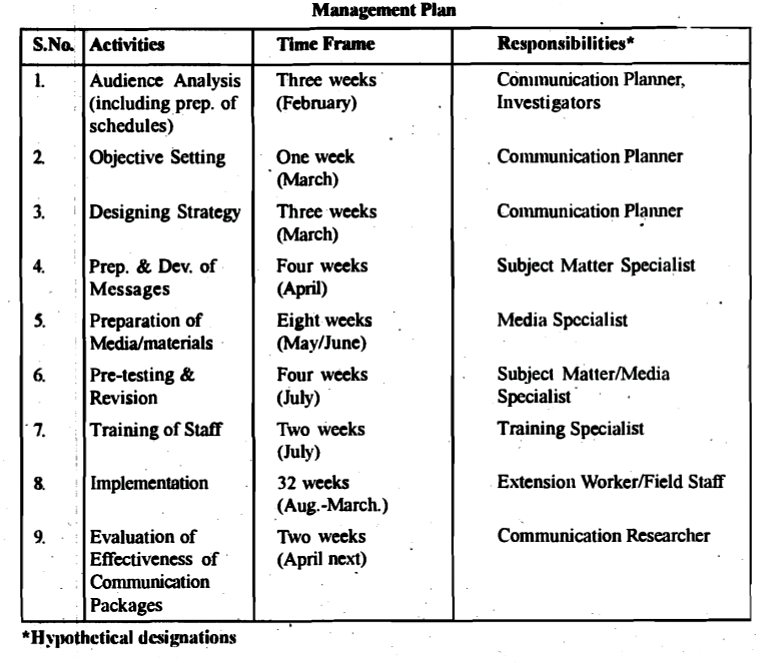
Once you have identified the problem, known the audience, and developed a communication strategy, you should be able to draw up a detailed management plan which will also specify activities, responsibilities and time frame. This management plan should be used as tool for effective implementation of communication package.

Targeting for Rural Market

For FMCGs distribution becomes complex. The distributor in the towns needs to have a supply network of hundred plus outlets in 50 odd locations, which cover villages up to 200 plus population. There are only 85,000 larger villages out of more than 6,38,000 villages. But they have 40 per cent of the rural population and 60 per cent of total consumption.

Many of the established packaged goods companies reach more than 20 lakh retail outlets using trains, trucks, bullock drawn carts, camels, and bicycles and many companies claim to service each one of those Outlet once a week. As, only small percentage of consumables can reach the rural market automatically through the retailers and consumer coming to the town for the purchases.

This pain of reaching the rural consumer is worth taking as this direct contact with the retail in the rural world enables a closer relation with the trade, as retailer is a critical link in the overall chain for supplying products to the rural consumer. In a study, to measure the level of influence that the rural retailer has on the rural consumers, it was found that in about 35 purchase occasions, rural retailer was able to influence the sales to the rural consumers.

Therefore, rural retailer needs to be targeted effectively through various strategies so that he sides with the company’s products whenever he is in a position to do so.

Understanding of Peak Seasons:

Different regions of India especially the rural parts have different peak seasons of demand. These times are associated with the festivals, harvest and marriage seasons. Bulk of the demand for the consumer durables is concentrated during these times. Organisations have to ensure that their products are available in accordance with the increased demand the rural consumers are in shopping mood and have the same at this time. On account of their joyous mood they are more acceptable to try new and somewhat premium brands.

As these peak seasons are at different times in different parts of India, organisations can focus their distribution energy for that time to that particular region. Sankranti during Kharif harvest or Pongal in South India. Baisakhi during the Rabi harvest and Diwali in North, Durga Puja in the East are coming at different times in different regions. Even the marriage season, which is in winter in North India, it is in summer in the Southern part.

Missing these times for a particular region is almost equivalent to missing the year in that rural market for any product categories. Quantity discounts can be offered to the rural stockists in small towns and gift schemes should be launched for the bigger shops in feeder villages. This will motivate the distributors to be more aggressive in taking these goods to the rural retailer’s shelves. The rural retailer considering the peak season could be willing to stock more brands. Even the promotional campaigns at local and regional level can be customized according to the theme of the festivity.

Delivery Vans:

Certainly, reaching out to 33 lakh retail outlets in rural areas is an uphill task. Company delivery vans which can serve two purposes; they can take the products to the customers in select rural areas and also enable the firm to establish direct contact with them and thereby provide an opportunity for promotion. However, only the bigwigs can adopt this channel.

The companies with relatively fewer resources can go in for syndicated distribution where a tie-up between non-competitive marketers can be established to facilitate distribution. In order to move products in rural areas in cost effective manner, the organisation and distributors can make use of rural makeshift transport vehicles known in different areas.

They are very cost effective as their acquiring cost is very low and is not a barrier. They are very rugged to handle the excessive wear and tear that happens on the rural roads. These vehicles are very popular in the rural areas of Uttar Pradesh, Haryana and Punjab and can be easily available to different organisations to transport their products in remote villages at a low cost. These vehicles were employed quite effectively by the rural sub-stockist of Coca Cola to distribute soft drinks in the rural market.

Promotional strategies for Rural Market

Sales Promotion

It is a short term tool adopted by the marketer to increase the sales of the particular product / service in a particular area for a particular period of time.

According to marketers, sales promotion includes those sales activities that supplement both personal selling and advertising, and coordinating. It also involves making the advertisements effective, such as displays, shows and exhibitions and demonstrations.

Types of Sales Promotion

The following are the different types of sales promotion:

Push-up Sales Promotion

It is the technique where marketers persuade third parties i.e. intermediaries like dealers, retailers etc. to stock the products of the respective company and push them towards the ultimate customers.

Marketers started providing various incentives, pop material etc. to the intermediaries which encourage them to sell the products to the customers. To increase product sales ratio push-up sales promotion is the important part of promotion efforts taken up by the companies.

In case of rural marketing the companies also follow push-up sales promotion strategies. The commonly followed push-up sales promotion strategies include:

  • Free display materials: Free display materials like banners, sign boards, neon lights etc. are distributed among dealers to attract and inform the customers about the products.
  • Storage materials: Storage materials like racks, shelves, refrigerators etc. are distributed among shopkeepers who help in visual merchandising and also aid in storing the product.
  • Demonstrations: Important technique of push-up sales promotion, free demos at dealers’ shops inform the consumers about the handling of the product.
  • Incentives to dealers: Under the push-up sales promotion special incentives are provided to dealers on the number of units sold to the ultimate consumers.
  • Lucky draw contest: It is to motivate dealers to stock the company’s products and promote sales, and lucky draw contest are organized among dealers.
  • Free gifts: It is a common strategy adopted by the companies and free gifts are often distributed among dealers during festive seasons to increase the consumer base.
  • Pull-up sales promotion: As the name suggests, pull-up sales promotion is the tool where marketer pulls the customers towards their product through various promotional strategies and advertising.

Personal Selling

It is a process of face-to-face interaction between the salesperson and the prospective customer. Through a proper training and guide, a salesman can be a valuable medium between the marketer and the prospective customer.

A good salesperson is the one who has thorough knowledge about the product he is about to sell and tries to strike a common point of link between the product and the customer needs.

Personal Selling in Rural Region

Most of the marketers think personal selling is not feasible in rural areas because of various reasons ranging from scattered population to a large number of villages to be covered.

Though still not a prevalent practice adopted by the national level marketers, personal selling is widely done by the local manufacturers of utensils, garments, edible good etc.

For the marketer to adopt personal selling as a tool of promotion in rural area, following are few of the basic requirements that need to be present in their salesperson:

  • Familiarity with the Rural Area: It is difficult for the salesperson to be familiar with rural area. As the population of rural region is scattered, it becomes a lot more important for the salesperson to have sufficient knowledge about rural area which he is supposed to cover.
  • Proficiency in Local Language: Fluency in the local language is another key skill that must be present in the salesperson. It acts as a major communication point in converting prospective customer into an actual one.
  • Acquaintance with the Rural Folks: It is a common tendency among rural people that they only pay attention to those people whom they can consider as a part of their social group. Thus, if the salesperson belongs to the particular rural district, in that case his job not only becomes easy but also chances of success in achieving his sales target increase strongly.
  • Be Persuasive but not Pushy: A good salesperson is one who is persuasive but not pushy in nature. Rural people are always skeptical in nature about the new product and strongly hesitate to purchase it due to lack of faith.
  • Here a salesperson needs to remove the doubts of the prospective customer and make him believe to purchase the product. But being too pushy in his approach can ruin the chances of sale of the product.
  • Public Relations: Public relations in case of marketing promotions in case of rural areas are highly important so as to create the formal relationship with the newly acquired customers. Also, dissemination of information concerning the rural folk is possible only through effective public relations.

Educating rural people about the importance of administering polio drops to children, vaccination to mother and child, sanitation, hygiene etc. has become possible only through the publicity health campaigns.

Free Distribution of Samples

Distributing free samples among rural people not only popularize the product but also gain huge acceptance among them. When the company decides to enter into new market and launch the new product, in such cases free distribution of samples is an effective pull-up sales promotional activity.

As compared to urban consumers, the tendency to try the new product is low in case of rural consumers because they have lack of faith about the new products. Free samples encourage trial purchase among consumers.

With-pack Premiums

Here, a free product is given either inside the pack or outside the pack. This attracts the rural customers to purchase the product. This is successful only when the free product is either complementary or useful to the consumers. For example, a free toothbrush that comes complementary with toothpaste.

Price-off Premiums

This refers to the cut-price technique for a product. This is useful not only in case of FMCGs but also in case of consumer durables if the discount is appropriate.

Money Refund Premiums

It refers to the price of the product, which is partially refunded to the consumers on the repurchase of same product by showing of proof of previous purchase like cash memo, empty wrapper, poly packs etc.

Exchange Premiums

It is quite similar to the above strategy, under which instead of refund of money a new product is given to consumers on showing of proof of previous purchase.

Interactive Games

Innovative fun-filled games generate interest among the rural crowd. The winner of the game can be rewarded with the product of the company which sponsored such games. Sometimes such games ensure high customer involvement and also increase the interaction between the marketer and target customers.

Fairs and Exhibitions

Fairs are a part of rural people’s life. For the rural people, they are the source of entertainment and a good opportunity to launch their products for the marketers in the rural market. It has mass appeal as several villagers come to fairs.

Customers may be attracted by using the mass media like organizing folk songs competition, folk dances, magic shows, puppetry shows, street theatre, acrobatic skills, juggler, etc.

Village Haats

Haats are the weekly markets from where rural people buy the items of daily necessities, garments, farm inputs etc. They are the source for rural people and a place of social gettogether. The existence of haats can be traced back to ancient times the times of Chandragupta Maurya.

Haats provide to the marketers an opportunity to display their products. Consumers are ready to try the product by overcoming all inhibitions and can get the touch and feel of the product and this will further generate sales as most of the people come to the haats with an intention to buy.

Melas

Melas are again the essential element of India’s culture and pull masses. In a trade mela, one can find variety of products. Melas are held usually in festive seasons like Dussehra, Diwali, Holi, Eid etc.

During melas, marketers get to interact with a large number of consumers and encourage for trial purchase. These melas help the marketers target large audience.

Mandis

Mandis are the place for agricultural produce and inputs. Mandis can be a good platform for manufacturers of agri-inputs both durables and non-durables. Durable are tractors, pump sets, threshers etc. Non-durable includes seeds, fertilizers etc.

error: Content is protected !!