Advertising Agency: Compensation Strategies

An advertising agency is a specialized service firm that assists companies in planning, creating, and managing advertising and other forms of promotion. It offers expertise in market research, strategy development, creative design, media planning, and buying, aiming to boost brand awareness and drive sales through targeted advertising campaigns.

Advertising agency compensation refers to the payment structure agreed upon between a client and an advertising agency for the services rendered. This compensation can take several forms, reflecting the nature of the work, the complexity of tasks, and the agency’s involvement in the client’s projects. Common models:

Fee-Based:

Fixed fee is agreed upon for services over a specified period, often used for project-based work or ongoing services.

  • Strategy:

The client pays the agency a set fee for its services, which can be billed as a flat fee for a project, an hourly rate, or a monthly retainer.

  • Use Case:

Suitable for project-based work or when the scope of services is well-defined.

Commission:

The agency earns a commission, typically a percentage, from the media purchases made on behalf of the client. This model is traditional but less common now.

  • Strategy:

The agency earns a commission, usually a fixed percentage, from media buys or other advertising expenditures made on behalf of the client.

  • Use Case:

Commonly used in traditional advertising settings but less frequent now due to the complexity of digital media.

Retainer:

The client pays a set amount regularly (e.g., monthly) for an agreed-upon range of services, providing a stable income for the agency and ongoing support for the client.

  • Strategy:

The client pays a recurring fee, typically monthly, for an agreed-upon basket of services, ensuring the agency’s availability and ongoing support.

  • Use Case:

Best for long-term relationships where the agency acts as an extension of the client’s marketing team.

Performance-Based:

Compensation is tied to the achievement of specific results or KPIs, aligning the agency’s incentives with the client’s goals.

  • Strategy:

The agency’s compensation is tied to the achievement of specific performance metrics, such as sales targets, lead generation numbers, or other key performance indicators (KPIs).

  • Use Case:

Ideal for clients focused on measurable results and looking to align the agency’s incentives with their business goals.

Hybrid:

A combination of the above models, tailored to suit the specific needs and preferences of both the client and the agency.

  • Strategy:

A combination of the above methods, tailored to the needs of both the client and the agency.

  • Use Case:

Offers flexibility and can be adjusted based on campaign success, ensuring fair compensation for the agency and accountability towards achieving client objectives.

Value-Based Compensation

  • Strategy:

Fees are based on the value or impact the agency’s work has on the client’s business, rather than on hours worked or media spend.

  • Use Case:

Suitable for high-stakes campaigns where the agency’s work can significantly affect the client’s bottom line.

Place of Advertising in Marketing Mix

Small businesses use the terms “advertising,” “sales,” “marketing” and “promotions” to refer to their overall selling activities, even though each has a different meaning. Advertising is a specific marketing communication activity that falls under the “promotion” element of the classic marketing mix also known as the Four Ps of product, price, place and promotion. Sales is a broader function that’s involved in all four elements of the marketing mix.

The Marketing Mix

Selling a product or service requires a coordinated effort that takes into account four key marketing areas. You first develop the right product for a specific target audience, using research that can include focus groups, customer surveys and an analysis of your competition. After you know the benefits customers want and you create the optimal product for them, you price your product or service to create the best combination of sales volume and profit margin. The “place” aspect of the marketing mix refers to how and where you distribute what you sell, which can include a retail store, online shopping, catalogs or wholesalers and distributors. The final part of the marketing mix concerns how you promote your product and includes advertising, public relations, social media campaigns, sponsorships and sales promotions. Sales promotions include such marketing tools as rebates, coupons, temporary discounts and buy-one-get-one-free deals.

Advertising

Advertising is one form of promotion and includes paid messaging. Unlike public relations, which attempts to get newspapers, magazines, broadcasts and websites to talk about your company without paying a fee, advertising lets you control your message by purchasing print space, air time, website banners or outdoor signs with a message you create and display. Even if you have a limited budget, it’s a good idea to divide your promotional efforts into advertising, PR, sponsorship and sales promotions activities.

Sales

The word “sales” has different meanings for different businesses and refers to the broad spectrum of planning and personal customer-contact activities you use to generate purchases of your product or service. Sales planning activities span all four elements of the marketing mix, and sales managers should be involved in product development, pricing strategy decisions, distribution discussions and promotional activities. Customer-contact sales activities include tactics such as selling over the phone or in person, direct mail solicitations and customer service. These are both promotional and distribution activities because they not only require salesmanship but also include methods of delivering product to the marketplace. When you use the word “sales” to refer to temporary discounts, one-time liquidations or short-term markdowns on products or services, that falls under the promotions element of the marketing mix.

Interrelationships

As your company grows and you assign different people to work on different areas of marketing, such as your online sales pages, print ads, press releases, distribution channels and pricing strategies, bring all your marketing staff members and contractors together to make sure your efforts support one another and avoid clashes. For example, if your website shows that you are an upscale product or service provider, but your advertising staff is running buy-one-get-one-free or senior-discount coupons in local print publications, the conflicting message can damage your brand. Your sales staff needs to know the prices, sale dates, warranties, benefits and other offerings that will appear in your ads before they run. This prevents sales people from making statements on the phone that your advertising later contradicts.

Indian Advertising Industry

Firms in the advertising industry prepare advertisements for other organizations and design campaigns to promote the interests and image of their clients.

This industry also includes media representative-firms that sell advertising space for publications, radio, television, and the Internet; display advertisers-businesses engaged in creating and designing public display ads for use in shopping malls, on billboards, or in similar media; and direct mail advertisers. A firm that purchases advertising time (or space) from media outlets, thereafter reselling it to advertising agencies or individual companies directly, is considered a media buying agency.

Advertising industry market size and growth

Advertising spends in India are expected to grow 12.6% year on year to Rs 48,977 crore for the year 2015. The ad spend in 2014 was Rs. 43,490 crore, which reflected a 12.5% increase over 2013.

The higher growth has been attributed to increase in spending due to elections (both general and state elections) and advertising from categories like e-commerce and telecom.

Between 2013 and 2018, India is projected to be the second fastest growing advertising market in Asia, topped only by China.

Indian advertising industry has changed since independence

The very first case of using advertising as a tool can be traced back to ancient Egypt. Scientists have unearthed steel carvings which are thought to be the very first advertising tool. Since those times, humans have constantly developed new ways to peddle their goods to an audience that is spoiled for choice.

During the 1500s, the printing press was invented by Johannes Gutenberg, and advertising was never the same again. Then came television and the whole industry went through a tremendous change. Now, with the advent of digital publications, there is a chance that the entire advertising industry might need to adapt very quickly.

To trace the routes of how advertising has changed since independence, we are going to break it into three different phases.

  • Phase 1 (Post Independence to late 70s)
  • Phase 2 (1981-1989)
  • Phase 3 (1991- Present)

Phase 1

When India got its independence in 1947, most of the advertising agencies operating in India were owned by Britishers. After the transfer of power, a lot of these companies were either shut down or were sold to Indians. But due to the prestigious tag attached to them a lot of these agencies continued to work with their British counterparts. One reason for this can be attributed to the fact that a lot of machinery like printing presses were manufactured abroad and import costs on them were often quite prohibitive. People exploited legal loopholes to avoid expenses and often disguised themselves as foreign subsidiaries of British businesses.

During this period, the country was still grappling with changes. Even though the first advertising agency was established in Mumbai by Mr. B Dattaram as early as in 1905, Mr. J Walter Thomson is credited with establishing an agency that could really compete with International Ad agencies.

Indians were warming up to the idea of getting their information from the television rather than going through the newspapers every day. Please note that during this time, the literacy rate in India was also quite low, and a lot of people were dependent on postmasters even to decipher the letters that they were receiving.

During this period the radio was commercialized in the year 1967, and radio ads became a big hit. Unlike televisions, radios were quite popular even in villages; radio spots became widely popular. From cricket matches to general news, everything was broadcasted through the radio.

One of the most iconic campaigns of this period was run for Amul Butter. The phrase ‘utterly butterly delicious’ will forever remain in all our hearts. Rahul daCunha was the brainchild behind this campaign. Rahul had inherited Amul from his father, and with free reign, he went all guns blazing to promote his business. The savvy businessman used all the mediums like TV ads, newspaper announcements, and radio spots to promote his product. All his efforts were rewarded as today it is one of the most recognized brands in India.

Phase 2

A lot of people were buying televisions in the eighties. Earlier, the TV was considered a luxury good, but during this period, a lot of middle-class Indians were buying televisions even if the black and white version was all that they could afford.

Indian companies, by now had seen the power of advertising and were engaging agencies to increase sales and to bolster their brand value. A lot of advertising agencies were set up to cater to the needs of the businesses.

During this time television advertisements ruled the roost. The main reason for such a shift can be attributed to commercialization of Door Darshan channel. The quality of programs available increased immensely. Smart advertisers were quick to take advantage of this, and they started to market their products aggressively.

Most of the products sold during this time were targeted at the great Indian middle class. Be it a Bajaj scooter or Parle G biscuits there were a lot of things offered to the common man.

Doordarshan also showed programs designed specifically for farmers, and this also contributed to their increased viewership. Providing something for everyone proved very beneficial for the new channel.

This trend continued till the late 1980s, but after 1991 the whole scenario changed.

Phase 3 (Post liberalization)

After Mr. Manmohan Singh opened up the Indian economy in 1991, there was a frenzy. Foreign companies were itching to set up shop in the Indian subcontinent. This led to a very sophisticated change in the Indian advertising scenes. Advertising agencies were sensitive to the needs of their new customers and quickly adapted to the change.

In the early 1990s and 2000s, Indian advertising agencies became as sophisticated as their foreign counterparts. As the competition grew, so did the need to keep innovating. Earlier advertisers use to target a niche segment and clients, but now they had to cater to the needs of the millions.

Even though Print, Television, and Radio were dominant forms of advertising during this period, the Internet had just started to spread its wings. The Internet ushered in a new era of advertising.

From the early 2000s onwards digital marketing has indeed taken off. Now you can see that almost all the large and medium companies have a presence online. As internet penetration is increasing day by day, the power of digital marketing cannot be ignored.

Digital advertising is going to be the dominant form of advertising in the coming years. However, one thing we need to consider is the fact that in India, there is no model that works for everyone. We need an amalgamation of all mediums to advertise effectively.

As you can see from this write-up, we have come a long way since independence. The Indian advertising community has innovated, adapted, and excelled in every given situation. Even though the road ahead might be a little rocky, the Indian advertising community will lead ahead like they always did.

Copywriting: Different Elements of a Copy and Layout

Copywriting is the process of writing advertising promotional materials. Copywriters are responsible for the text on brochures, billboards, websites, emails, advertisements, catalogs, and more.

This text is known as “copy.” Copy is everywhere it’s part of a $2.3 trillion industry worldwide.

Unlike news or editorial writing, copywriting is all about getting the reader to take action. That action might be to purchase, opt-in, or engage with a product, service, or company.

That’s why a copywriter is often referred to as “a salesman in print.”

Copywriting should not be confused with “copyright.” Copyright means an individual or company has the exclusive legal right to reproduce, publish, sell, or distribute someone’s work (such as books, music, artistic items). The purpose of a copyright is to protect that material and prevent illegal use of it by unauthorized agents. The owner designates the material is copyrighted with the symbol ©.

Copy writing in different elements of copy and layout

An ad copy consists of various parts, elements, or ingredients. Which parts and how many parts should be included depend on the media through which the advertising message is to be communicated. Layout of ad copy shows the coordination of various parts of ad copy like headlines, slogans, test, illustrations, pictures, sponsor, and logotype.

It is a physical arrangement of presenting the message. It is like a map, design, or structure of advertising message. It is a technical job that requires a high degree of expertise, skills, and experience. All ingredients are presented in such a way that attracts the reader, listener, and/or viewer to attend the advertisement. Order must be decided carefully.

Practically, an advertising copy includes one or more of the following parts:

  1. Headlines

Headlines are crucial for print advertisements. They include attractive description written in colorful bold letters at the top or anywhere in the advertisement. Attractive fonts are used to make the headline eye-catching. Headlines may contain slogans. For example, More Smile per Mile by TVS Victor, Japanese quality, at Chinese price, available in India by Orpat Home Appliances, Elora Times Ltd. Mostly, headlines are written in bold letters. Headlines suggest major benefits, offers, or time limit. For example, special offers open only for two days.

  1. Slogans

Slogans are made of words and sentences. They are expressed in a rhythmic manner. Slogans are used for every type of advertisement such as TV, radio, outdoor, and print media. Slogans are presented or written at the beginning, at the middle, or at the end of advertisement.

In audio-visual media, a slogan is presented with musical effect by using persons or cartoon characters. For example, Hero Honda, Des Ki Dhadkan; TVS Victor, More Smile Per Mile; Raymond, The Complete Man; Sansui, Better than the best; Onida Television, Change the World; Coca-Cola, Life Ho To Asi, and Thanda Matalab Coca-Cola; Tata Namak, Desh Ka Namak, etc., slogans have popularized some brands and companies. Sometimes, songs are used. For example, Nirma Chemicals, MDS masala, etc., used songs in their advertisement. Slogans are indicative of key themes the advertiser insists to appeal the audience.

  1. Text

The text is the central part of ad copy. It contains a description. It is prepared with reference to advertising objectives. For example, a company gives more description if company’s objective is to provide more information. Text should neither be too lengthy nor be too short. Text includes theme or appeal to the customers.

It describes major benefits of products. The claim must suggest an absolute or a comparative superiority of the products. Most text shows product benefits, special offers, time, availability, quality, etc. Text is prepared differently for different media. For example, space is important for print media; time is important for audio-visual media; size is important for outdoor media.

  1. illustration

Illustrations are used to make the advertising claim clear and attractive. Here picture, character, cartoons, charts, etc., are used to illustrate an use of the product. In the illustration, claims are made through celebrities. In many cases, they are shown using the products.

TV advertisement uses film stars, artists, or cricketers to illustrate the use of the product. For example, Film stars Sharukh Khan and Priti Jinta are shown driving Santro Car. Children are used for illustrating different brands of toothpastes, chocolates, bicycles, and biscuits. Similarly, Coca-Cola illustrates its product through film stars and cricketers.

  1. Pictures

Use of pictures is more or less similar to illustration. However, pictures are more relevant to print media. Pictures include products, brands, persons, etc., presented in systematic manner. Here, also, products and brands are associated with film stars, cricketers, and well-known cartoon characters.

  1. Sponsor and logotype

Ad copy also includes name of company, sponsor, brand or logotype to assist customers recognize the name of producers and/or marketers. Name of producer or logotype is kept either at the beginning or at the end of advertisement. Some advertisements include full name and address of company, including registered office, regional offices, its website, e-mail, phone, fax, etc. Use of sponsor or logotype popularizes name of a company along with products and brands. In audio-visual advertisements, the name of company is shown and/or spoken.

What kind of qualifications do you need to be a copywriter?

Zero! There are successful copywriters with college degrees and some who didn’t finish high school. Some copywriters are only 18 and some are retired. Some copywriters are stay-at-home moms and some left six-figure corporate jobs.

The only thing you need is a computer and an Internet connection. Everything else can be learned. If you can write a letter to a friend, you have all the qualifications you need to get started now.

Can you really make six-figures as a copywriter?

Yes, and many copywriters do! But, how much you make depends on how much time and effort you put into it.

For example, one copywriter I know works decent hours, not only on copywriting, but also on the growth and development of her freelance business. She makes over $120,000 a year.

Another freelance copywriter is a real go-getter. He has a talent for copywriting and he’s a terrific networker and business developer. He has negotiated some lucrative contracts with a number of big companies and will be making more than $300,000 this year!

If you don’t want to work full-time, that’s okay. You can also make a very good living working just part-time.

Another copywriter I know wants to earn some extra money for vacations and her family’s savings plan. She works some during the evenings and on weekends and makes $25,000 a year. (Although she’s hoping to make $50K this year!) Not bad for a very part-time job.

Another example is a copywriter I know who is a stay-at-home single mom. She has two young children to care for so she only works four hours a day in her freelance copywriting business. She makes $75,000 a year!

Meet real people who make a very good living through their copywriting jobs.

A great thing about being a freelance copywriter is you can work as much or as little as you want. It all depends on how much you want to earn and how often you want to work.

Advertising Media, Industry structure, Functions, Types

Advertising Media refers to the various channels and platforms through which advertising messages are conveyed to the target audience. These media serve as the vehicles for delivering promotional content aimed at informing, persuading, or reminding consumers about products, services, or brands. The choice of advertising media is critical, as it determines the reach, effectiveness, and cost-efficiency of advertising campaigns. Traditional advertising media include television, radio, newspapers, magazines, and outdoor billboards, which offer broad reach but may vary in terms of targeting precision and engagement levels. With the advent of digital technology, online and social media platforms such as websites, search engines, social networks, and email have become increasingly popular due to their ability to offer targeted, interactive, and measurable advertising opportunities. The selection of advertising media depends on factors such as the campaign’s objectives, target audience characteristics, budget constraints, and the desired impact, making the strategic use of media essential for successful advertising outcomes.

Advertising Media Industry Structure:

  1. Advertisers

Advertisers are companies or individuals that want to promote their products, services, or brand messages to a target audience. They are the driving force behind advertising spending, seeking to achieve various marketing objectives such as increasing brand awareness, generating leads, or boosting sales.

  1. Advertising Agencies

Advertising agencies provide creative and strategic services to advertisers. They help in designing and executing advertising campaigns across various media. Agencies can specialize in certain types of advertising (digital, outdoor, TV, etc.) or serve as full-service agencies that offer a comprehensive range of marketing and advertising solutions.

  1. Media Owners/Publishers

Media owners, or publishers, own the platforms or channels through which advertising messages are disseminated. This group includes traditional media companies that own TV stations, radio stations, newspapers, and magazines, as well as digital media owners like websites, social media platforms, and streaming services. They sell advertising space or airtime to advertisers or their agencies.

  1. Media Buying and Planning Agencies

Media buying and planning agencies specialize in purchasing media space and optimizing the placement of advertisements. They analyze various media options, negotiate rates with media owners, and develop strategies to ensure that the advertising reaches its intended audience in the most effective and cost-efficient manner.

  1. Ad Tech Companies

Ad tech (advertising technology) companies provide the software and tools needed to target, deliver, and measure digital advertising. This category includes demand-side platforms (DSPs), supply-side platforms (SSPs), ad exchanges, and data management platforms (DMPs), among others. Ad tech facilitates programmatic buying and selling of advertising, making the process more efficient and data-driven.

  1. Research and Measurement Firms

Research and measurement firms offer services that help advertisers, agencies, and media owners understand the impact of their advertising efforts. They provide insights into audience demographics, advertising effectiveness, brand awareness, and consumer behavior. Companies like Nielsen, Kantar, and Comscore are examples of entities that specialize in media measurement and analytics.

  1. Regulatory Bodies

Regulatory bodies oversee the advertising industry to ensure fairness, accuracy, and ethical standards are maintained. They establish guidelines and rules to protect consumers from misleading advertising and to promote healthy competition among businesses. Examples include the Federal Trade Commission (FTC) in the United States and the Advertising Standards Authority (ASA) in the UK.

Advertising Media Functions:

  • Reach

One of the fundamental functions of advertising media is to extend the reach of an advertising message to a broad audience or a specific target market. Different media platforms have varying reach potentials, with some offering global coverage and others providing more localized or niche audiences.

  • Targeting

Advertising media enable advertisers to target their messages to specific segments of the market. Through demographic, psychographic, and behavioral data, media platforms can help advertisers focus their efforts on the audience segments most likely to respond to their messages, thereby increasing the efficiency of advertising campaigns.

  • Engagement

Media platforms provide various ways for advertisers to engage with their audiences. This can range from interactive digital ads that invite user participation to compelling video ads that tell a brand’s story. The goal is to capture the audience’s attention and create a memorable impression that influences behavior.

  • Frequency

Frequency refers to the number of times an audience is exposed to an advertising message within a specific period. Advertising media help control the frequency of message exposure to ensure optimal message reinforcement without causing ad fatigue.

  • Branding

Advertising media play a crucial role in brand building and management. Through consistent and strategic use of media channels, advertisers can establish brand identity, enhance brand awareness, and foster brand loyalty among consumers.

  • Information Dissemination

Media platforms serve as channels for disseminating information about products, services, and brands. They help communicate features, benefits, prices, and other key information that assists consumers in making informed purchasing decisions.

  • Persuasion

A core function of advertising media is to persuade the audience towards taking a desired action, such as making a purchase, visiting a website, or adopting a new behavior. Effective media selection and creative messaging are critical to achieving this goal.

  • Measurement and Feedback

With advancements in digital media, advertisers can now measure the impact of their advertising efforts in real-time and receive immediate feedback. This function is crucial for evaluating campaign performance, optimizing strategies, and improving return on investment (ROI).

  • Cost Efficiency

Different advertising media offer varying cost structures, from high-cost options like national TV ads to more budget-friendly digital ads with pay-per-click models. Advertisers can select media channels that offer the best balance between cost and effectiveness, maximizing their advertising spend.

  • Innovation and Creativity

Advertising media provide a canvas for creativity and innovation in presenting advertising messages. From augmented reality experiences to personalized video messages, the choice of media can significantly enhance the creativity and impact of advertising campaigns.

Advertising Media Types:

  1. Television:

Offers broad reach and visual impact, suitable for reaching a wide audience with dynamic and engaging content.

  1. Radio:

Provides audio-based advertising opportunities, ideal for targeting local audiences and driving brand recall through jingles and slogans.

  1. Print Media:
    • Newspapers: Reach a wide, varied audience, good for local targeting and timely content.
    • Magazines: Offer high-quality visual presentation, targeting specific interests or demographics.
  2. Outdoor Advertising:
    • Billboards: High visibility in high traffic areas, good for brand exposure.
    • Transit Advertising: Advertisements on buses, subways, and taxis, reaching commuters and city dwellers.
    • Street Furniture: Advertising on bus shelters, benches, and kiosks, integrating into the urban landscape.
  3. Direct Mail:

Personalized advertising sent directly to homes or businesses, allowing for targeted messaging and offers.

  1. Digital/Online Media:
    • Display Ads: Visual ads placed on websites, offering targeted visibility across the web.
    • Social Media: Utilizes platforms like Facebook, Instagram, and Twitter for targeted ads based on user behavior and preferences.
    • Email Marketing: Direct, personalized communication with customers, useful for promotions, updates, and customer engagement.
    • Search Engine Marketing (SEM): Includes paid search ads (PPC) and search engine optimization (SEO) strategies to increase visibility on search engines.
    • Video Advertising: Online video ads on platforms like YouTube or within streaming content, combining the visual and auditory appeal of TV ads.
    • Influencer Marketing: Leveraging influencers on social media to promote products or services to their followers.
  2. Cinema Advertising:

Ads shown before movies, reaching a captive audience in a unique entertainment setting.

  1. Sponsorships:

Supporting events, teams, or individuals, linking the brand with certain activities, interests, or values in the minds of consumers.

  1. Interactive and Emerging Technologies:
    • Augmented Reality (AR) and Virtual Reality (VR): Creating immersive experiences to engage consumers in innovative ways.
    • Mobile Advertising: Ads and apps designed for smartphones and tablets, including location-based advertising for reaching consumers on the go.

Functions of Advertising Media

An advertising media plan is a strategy for marketing your business through certain media channels to achieve a business goal, such as raising brand awareness to obtain new customers. Maximizing your chances of success depends on careful research and implementation, as well as your knowledge of media buying and basic marketing strategies.

Function

The main function of a media plan is to create an advertising campaign that will achieve your strategic objective. Specifically, an advertising media plan defines your strategic marketing objectives, chooses media channels suitable for achieving those objectives and identifies the specific advertising tactics that will achieve your objectives given the limitations of the chosen media channels.

Strategic Marketing Objectives

Without a clear objective, you can’t form a marketing plan, according to “Marketing Plans: How to Prepare Them, How to Use Them.” a book by Malcolm McDonald and Hugh Wilson. A typical marketing objective is to gain new customers, but companies sometimes have other goals, such as to restore goodwill after a scandal, announce a name change or declare a new philanthropic commitment. The marketing objective is the guiding force of your campaign, so each subsequent choice must take your overall objective into account.

Choosing Media Channels

If you don’t target the right people, it won’t matter how well you execute other elements of your plan, according to “Advertising Media Planning: A Brand Management Approach,” a book by Larry D. Kelley and Donald W. Jugenheimer. Consider your intended audience while choosing media channels. For example, if your goal is to catch the attention of young housewives, magazines that cater to the elderly are unsuitable. Instead, you might use market research to identify radio and television shows that young housewives enjoy so you can buy advertising time. Other examples of media channels include billboards, newspapers, direct mail advertisements, brochures and branded items, such as matchbooks, pens or refrigerator magnets emblazoned with your marketing message.

Tactics

Your choice of specific tactics for example, the wording, color and location of a print advertisement depends on the general requirements and limitations of the medium. Consequently, unless you have extensive experience, hire a marketing consultant or advertising agency to obtain expert insight. For example, to conjure an image for the listening audience, a radio advertisement might require sound effects, background music, an expert announcer and evocative writing, according to “Marketing Communications.” a book by Ludi Koekemoer and Steve Bird. Each element requires expert insight to ensure it conforms to the radio station’s specifications as well as supporting effective marketing strategies.

Merits and Demerits of Advertising Media

Advertising Media refers to the various channels and platforms through which advertising messages are conveyed to the target audience. These media serve as the vehicles for delivering promotional content aimed at informing, persuading, or reminding consumers about products, services, or brands. The choice of advertising media is critical, as it determines the reach, effectiveness, and cost-efficiency of advertising campaigns. Traditional advertising media include television, radio, newspapers, magazines, and outdoor billboards, which offer broad reach but may vary in terms of targeting precision and engagement levels. With the advent of digital technology, online and social media platforms such as websites, search engines, social networks, and email have become increasingly popular due to their ability to offer targeted, interactive, and measurable advertising opportunities. The selection of advertising media depends on factors such as the campaign’s objectives, target audience characteristics, budget constraints, and the desired impact, making the strategic use of media essential for successful advertising outcomes.

Advantages of Advertising Media:

Television (TV) Advertising:

  • Wide Reach:

TV advertising has the potential to reach a broad audience, including diverse demographics and geographic regions.

  • Visual Impact:

TV commercials allow for dynamic visuals, audio, and storytelling, making it an effective medium for engaging and capturing viewers’ attention.

  • Brand Building:

Television provides a platform for building brand awareness and credibility through high-quality production values and association with popular programming.

  • Targeted Placement:

With targeted advertising options and audience segmentation, advertisers can reach specific demographic groups or interests through niche channels or time slots.

Radio Advertising:

  • Cost-Effectiveness:

Radio advertising can be more affordable than other traditional mediums like TV or print, making it accessible to businesses with smaller budgets.

  • Local Targeting:

Radio stations often cater to specific local or regional audiences, allowing advertisers to target consumers based on geographic location.

  • Immediacy:

Radio ads can be quickly produced and aired, providing advertisers with the flexibility to react to timely events or promotions.

  • Audience Engagement:

Radio offers a highly engaged audience, as listeners often tune in during specific times of the day or for particular programs, creating opportunities for targeted messaging.

Print Advertising (Newspapers, Magazines):

  • Tangibility:

Print advertisements provide a tangible format that consumers can hold, revisit, and share, enhancing brand recall and message retention.

  • Targeted Audience:

Print publications often cater to specific interests or demographics, allowing advertisers to reach niche audiences with relevant content.

  • Credibility:

Print media, especially newspapers and magazines, are perceived as credible sources of information, lending credibility to advertised brands or products.

  • Longevity:

Print ads can have a longer lifespan compared to digital media, as they can be kept or displayed for extended periods, reinforcing brand messaging.

Digital Advertising (Online, Social Media):

  • Targeting Capabilities:

Digital advertising offers sophisticated targeting options based on demographics, interests, behavior, and location, ensuring messages reach the right audience segments.

  • Measurable Results:

Digital platforms provide robust analytics and tracking tools, allowing advertisers to measure campaign performance in real-time and optimize strategies accordingly.

  • Interactivity:

Digital ads can engage audiences through interactive elements, such as clickable links, videos, quizzes, and social media interactions, encouraging active participation and engagement.

  • Cost Efficiency:

Digital advertising often offers cost-effective options, such as pay-per-click (PPC) or cost-per-impression (CPM) pricing models, enabling advertisers to maximize their budgets and ROI.

Outdoor Advertising (Billboards, Transit Ads):

  • High Visibility:

Outdoor advertising provides exposure to a captive audience in high-traffic areas, such as highways, city centers, or public transportation hubs.

  • Local Branding:

Outdoor ads can reinforce local branding efforts, increasing brand visibility and recognition within specific geographic regions.

  • 24/7 Exposure:

Billboards and transit ads offer round-the-clock exposure, ensuring continuous visibility to commuters and pedestrians throughout the day.

  • Creativity:

Outdoor advertising allows for creative and eye-catching designs, leveraging bold visuals, witty messaging, and unique formats to capture attention and leave a lasting impression.

Direct Mail Advertising:

  • Targeted Messaging:

Direct mail allows for highly targeted messaging based on demographics, purchase history, or other customer data, increasing relevance and response rates.

  • Tangible Impact:

Direct mail pieces are physical and tangible, making them more memorable and likely to be noticed compared to digital communications.

  • Personalization:

Direct mail can be personalized with individualized offers, coupons, or messages, creating a sense of exclusivity and relevance for recipients.

  • Response Tracking:

Direct mail campaigns can include response mechanisms, such as QR codes or personalized URLs, enabling advertisers to track and measure campaign effectiveness.

Disadvantages of Advertising Media:

Television (TV) Advertising

  • High Costs:

TV advertising, especially on national networks, can be prohibitively expensive, including production and airing costs.

  • DVRs and Ad Skipping:

With the rise of digital video recorders (DVRs) and on-demand streaming services, viewers can easily skip commercials, reducing ad effectiveness.

  • Fragmentation:

The proliferation of channels and platforms has fragmented audiences, making it more challenging to reach a broad audience through traditional TV advertising.

Radio Advertising

  • Audio-Only:

The lack of visual elements can limit the message’s appeal and memorability compared to media that utilize both visual and auditory stimuli.

  • Background Medium:

People often listen to the radio while doing other activities, which can diminish the attention paid to advertisements.

  • Limited Segmentation:

While radio stations often target specific demographics, the segmentation capabilities are not as sophisticated as those in digital advertising.

Print Advertising (Newspapers, Magazines)

  • Declining Readership:

The popularity of print media has been declining, with more people turning to digital sources for news and entertainment, potentially reducing ad reach.

  • Long Lead Times:

Print media often requires long lead times for ad submission, making it less flexible for time-sensitive promotions.

  • Environmental Concerns:

The environmental impact of paper production, ink, and waste is a growing concern for both consumers and advertisers.

Digital Advertising (Online, Social Media)

  • Ad Blockers:

The use of ad-blocking software has risen, making it difficult to reach certain audiences through digital channels.

  • Ad Fatigue:

Consumers can become overwhelmed or annoyed by the sheer volume of digital ads, leading to banner blindness or negative brand perceptions.

  • Privacy Concerns:

Increasing concerns over data privacy and tracking have led to stricter regulations and pushback against targeted advertising practices.

Outdoor Advertising (Billboards, Transit Ads)

  • Limited Engagement:

Outdoor ads do not allow for direct interaction or engagement, making it difficult to measure effectiveness or capture leads.

  • Visibility Issues:

Weather conditions, location, and visibility can significantly impact the effectiveness of outdoor advertisements.

  • Regulatory Restrictions:

There are often strict regulations governing outdoor advertising, including size, placement, and content, which can limit creativity and effectiveness.

Direct Mail Advertising

  • High Costs:

Printing and postage costs can make direct mail campaigns expensive, especially for large-scale or frequent mailings.

  • Environmental Impact:

Like print advertising, the environmental impact of paper waste is a concern for both consumers and marketers.

  • Low Response Rates:

Direct mail can suffer from low response rates, as many recipients may disregard unsolicited mail as junk.

General Disadvantages Across Media

  • Saturation:

Markets are often saturated with advertisements, making it challenging for any single message to stand out.

  • Misalignment:

There’s always a risk that the chosen medium may not align well with the target audience’s preferences or habits, leading to wasted resources.

Selection of Media and its Vehicles

  1. Objectives of Firm

Company’s general and advertising objectives are the prime considerations in media selection. Those media capable to meet company’s expectations are likely to be selected. Advertising objectives may be to inform, remind, convince, create prestige, or to increase sales and profits. Different media have varying capacity to meet these objectives.

  1. Costs Media and Company’s Financial Position

Media selection decision is highly influenced by media costs and firm’s ability to pay. Company has to pay for buying space or time and preparing advertising copy fit for the media to be selected. TV, radio, films are costly in terms of buying time and preparing advertising copy. Print media are relatively cheaper in both space and preparation of advertising message. Some outdoor media are quite low in cost. As per media costs and company’s financial capacity, the appropriate media should be selected.

  1. Reach or Number of People Exposed to the Message

It is an important criterion to choose among ad media. Reach means the number of different people exposed to a particular medium at least once during a specified time period. Mass media are capable to reach millions of people by just one exposure. Television has more exposure capacity compared to outdoor media in a particular time.

Local media can expose the message to limited persons. In the same way, frequency (the number of times within a specified time period the average person exposed to the message), and impact (the impact created on audience by an exposure through given medium) are also key criteria to choose among advertising media. Reach, frequency, and impact are important variables that determine cost-effectiveness of various media.

  1. Company’s Advertising Policy and Approach

Company’s advertising policy and approach determine which of the media should be selected. For example, if company’s policy is not to spend more money for advertisement and to offer the product at a low price, it may go for cheaper media.

  1. Type of Buyers

People to be influenced should be taken into account while selecting the media. Buyers can be classified into various classes as discussed in market segmentation. Each medium has its special viewers, readers, or audience. For the firm, it is important to know whether the target groups can be exposed by the particular medium.

Television is the most common medium, but can be made more particular by selecting the special programme. Magazines are capable to appeal particular sex, age groups, or professionals. Daily newspapers are again very general in nature.

  1. Condition under which Customers are Influenced

Readers’/viewers’ mood and interest determine receptivity of message. Television is the best-fit medium to associate advertising message when people are watching or enjoying related programmes. For example, advertising TVS Victor motorbike on television during the live telecast of the TVS Cup One-day Series.

However, it is difficult to determine mood or interest of readers for daily newspapers. It is relatively easy to determine mood of people during a specific programme in radio or television. In case of outdoors media, the place is very important to judge mood of people. For example, hoardings, posters, or banner near gardens or picnic places are more likely to be attracted.

  1. Circulation/Coverage

The area covered by (or number of people exposed to) the medium is an important criterion. Some media are capable to cover the globe while some can cover only the limited locality. For example, the local newspapers cover limited areas, the national newspapers like The Time of India and The Economic Times cover the whole nation.

Similarly, certain magazines have national and international circulation. And, the same is true with audio-visual and outdoor media. As per geographical concentration of customers, the suitable media should be selected.

  1. Repetition or Frequency

Repetition or frequency implies the number of times within specific time period an average person is exposed to the message by specific medium. Most of the outdoor media hold the message for relatively long time. Magazines or periodicals publish monthly or quarterly; mostly they publish advertisements only in a particular edition.

The more is the repetition of advertising message, the more is the effect of the medium on people. Naturally, advertisement appears frequently is more likely to read or attend than if it appears only once. However, repetition in case of newspapers, TV, radio, etc., depends on company’s ability to pay.

  1. Credibility and Image of Media

In case of newspapers and magazines, the factor is critical. Naturally, advertising message appears in the reputed newspapers or magazines carry heavy impression and effect than substandard media. People don’t trust the appeal published in the lower standard media. Prestige of media becomes the prestige of advertiser. Firms opt for credible or prestigious media to carry the advertising message.

  1. Past Experience

Company’s own past experience may be instrumental to decide on advertising media. For example, if company has satisfactory experience of using a particular medium, there are more chances to use the same medium and vice versa.

  1. Experience of other Companies

Experience of other companies is one of the important considerations in media selection. Company may try to know what other companies say about applicability and usefulness of various media. Views of other companies must be followed with care and caution.

  1. Expert Opinion

Marketing experts or consultants who work on professional basis can be consulted to suggest an appropriate medium to carry the message. These experts, on the basis of analysis of market situations in relation to products to be advertised, can recommend the suitable media. Since they have experience and expertise in the field, they are in better position to judge the suitability of each of the media in relation to product and company’s financial position. They charge fees for their consultancy services.

  1. Type of Advertising Message

Each advertising message needs specific advertising vehicle. If a message is simple, print media are sufficient. If a message is complicated, and the company wants to demonstrate and explain, audiovisual media suit the needs.

  1. Others

Apart from above mentioned factors, there are certain factors that affect media selection decision.

They are listed as under:

  • Effectiveness of Media
  • Availability of Media
  • Government Rules and Regulations
  • Time and Place

Media Vehicle

A media vehicle refers to a specific method (like digital, radio, newspaper etc) of media used by a business to deliver advertising messages to its target audience. The first step is to pick a suitable media class, that is, a general category of media, like radio, television, the Internet, newspapers or magazines. This is followed by selection of the right media vehicle, such as a specific radio station, television channel, online website or print publication. The aim is to reach the target consumer group and receive a good response to the advertising messages from the group.

The different kinds of media vehicles have been explained below:

  1. Broadcast Vehicles

This includes television and radio stations. Such vehicles can be used to target mass audiences, and the cost per target is low. They are more effective than print media as the ads include audio and video. They can be effectively used for low involvement products because of short ad durations and lack of excessive detail-sharing. Television vehicles in India include networks such as STAR India, Network 18, Zee Network, UTV and so on. Sometimes, small businesses can not afford to advertise on national networks, and so they often associate themselves with local network affiliate stations, or radio vehicles.

  1. Print Vehicles

Newspapers are also feasible for small businesses owing to relatively low ad costs. Both national newspapers and community newspapers (that can reach a local audience) are good options. Magazines are not quite as accessible for small businesses as they cater to a niche audience and cost per target is therefore high. However, some regions have local magazines that offer community events, entertainment and themed topics.

  1. Digital Vehicles and Others

Online or digital/interactive vehicles along with mobile communication opportunities provide low cost advertising options. Other supportive media vehicles include directories, buses, billboards and benches. These are usually used to reinforce messages that have been delivered through broader mass media. Billboards are comparatively expensive, but they have a very wide reach.

Individual Behaviour: Concept of a Man

Individual behavior can be defined as a mix of responses to external and internal stimuli. It is the way a person reacts in different situations and the way someone expresses different emotions like anger, happiness, love, etc.

To get a brief idea about the individual behavior let us learn about the individual behavior framework and other key elements related to it.

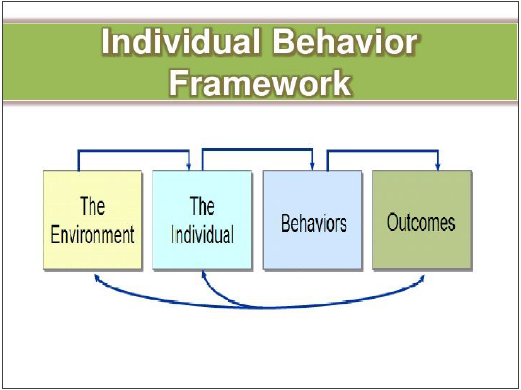
Individual Behavior Framework

On the basis of these elements, psychologist Kurt Lewin stated the Field theory and outlined the behavior framework. This psychological theory studies the patterns of interaction between an individual and the environment. The theory is expressed using the formula

B = F(P,E)

where, B – Behavior, F – Behavior Function, P – Person, and E – Environment around the person.

Say for example, a well payed person who loses his job in recession may behave differently when unemployed.

Causes of Individual Behavior

Certain individual characteristics are responsible for the way a person behaves in daily life situations as well as reacts to any emergency situations. These characteristics are categorized as −

  • Inherited characteristics
  • Learned characteristics
  1. Inherited Characteristics

The features individuals acquire from their parents or from our forefathers are the inherited characteristics. In other words, the gifted features an individual possesses by birth is considered as inherited characteristics.

Following features are considered as inherited characteristics:

  • Color of a person’s eye
  • Religion/Race of a person
  • Shape of the nose
  • Shape of earlobes
  1. Learned Characteristics

Nobody learns everything by birth. First our school is our home, then our society followed by our educational institutions. The characteristics an individual acquires by observing, practicing and learning from others and the surroundings is known as learned characteristics.

It consists of the following features:

  • Perception: Result of different senses like feeling, hearing etc.
  • Values: Influences perception of a situation, decision making process.
  • Personality: Patterns of thinking, feeling, understanding and behaving.
  • Attitude: Positive or negative attitude like expressing one’s thought.

From Latin “Humanitas”, the concept of Man means human nature, general culture of the mind. It is also “men” in general, the human race taken as a unit. Most philosophers defined as any human being endowed with reason. What man is the ultimate metaphysical question.

Definitions of man by the Philosophers

Simone de Beauvoir:

“Humanity is a discontinuous series of free men permanently isolate their subjectivity. ”

Husserl (phenomenology):

“Each figure is spiritual in nature in the space of world history. This trial shows humanity as a single life kissing men and peoples and linked only by spiritual traits: it envelops a multitude of types of humanity and culture, but by imperceptible transitions, melt into each other. ”

Nietzsche (see Nietzsche Philosophy Summary):

“Mankind! He was never between all the old, old one more horrible (except perhaps the truth is a problem with the use of philosophers?”

“Man is a rope stretched between the animal and the Superman, a rope over an abyss”

Merleau-Ponty:

“Man is a historical idea and not a natural kind”

Sartre (Existentialism is a humanism):

“Man is nothing else than his plan, it exists only insofar as it is realized, so it is nothing but the whole ”

Heidegger (Being and Time)L

“Man is a creature of the distant”

Pascal:

“Man is a reed, the weakest of nature, but it is a thinking reed. It is not necessary that the entire universe arm itself to crush: a vapor, a drop of water suffices to kill him. But when the universe to crush him, man would still be nobler than what kills him, because he knows that he dies and the advantage that the universe has over him The universe knows nothing “

Individual Differences and Factors affecting Individual Differences

Dissimilarity is principle of nature. No two persons are alike. All the individuals differ from each other in many a respects. Children born of the same parents and even the-twins are not alike. This differential psychology is linked with the study of individual differences. Wundt, Cattel, Kraepelin, Jastrow and Ebbing Haus are the exponents of differential psychology.

This change is seen in physical forms like in height, weight, colour, complexion strength etc., difference in intelligence, achievement, interest, attitude, aptitude, learning habits, motor abilities, skill. Each man has an intellectual capacity through which he gains experience and learning.

Every person has the emotions of love, anger, fear and feelings of pleasure and pain. Every man has the need of independence, success and need for acceptance.

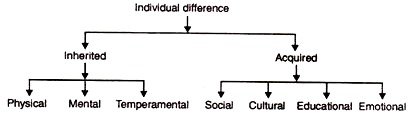
Broadly individual difference may be classified into two categories such as inherited traits and acquired traits:

Factors affecting Individual Differences

There are various causes which are responsible in bringing individual differences.

They are narrated below:

  1. Heredity

Some heretical traits bring a change from one individual to other. An individual’s height, size, shape and color of hair, shape of face, nose, hands and legs so to say the entire structure of the body is determined by his heretical qualities. Intellectual differences are also to a great extent influenced by hereditary factor.

  1. Environment

Environment brings individual differences in behaviour, activities, attitude, and style of life characteristics. Personality etc. Environment does not refer only physical surroundings but also it refers the different types of people, society, their culture, customs, traditions, social heritage, ideas and ideals.

  1. Race and Nationality

Race and Nationality is one cause of individual difference. Indians are very peace loving, Chinese are cruel; Americans are very frank due to race and nationality.

  1. Sex

Due to sex variation one individual differs from other. Men are strong in mental power. On the other hand women on the average show small superiority over men in memory, language and aesthetic sense. Women excel the men in shouldering social responsibilities and have a better control over their emotions.

  1. Age

Age is another factor which is responsible in bringing individual differences. Learning ability and adjustment capacity naturally grow with age. When one grows in age can acquire better control over our emotions and better social responsibilities. When a child grows then this maturity and development goes side by side.

  1. Education

Education is one major factor which brings individual differences. There is a wide gap in the behaviors of educated and uneducated persons. All traits of human beings like social, emotional and intellectual are controlled and modifies through proper education.

This education brings a change in our attitude, behaviour, appreciations, Personality. It is seen that uneducated persons are guided by their instinct and emotions where as the educated persons are guided by their reasoning power.

Educational Implications of Individual Differences

Educational implications of Individual differences are listed below:

(i) Aims of education, curriculum, method of teaching should be linked with individual differences considering the different abilities and traits individual.

(ii) Curriculum should be designed as per the interest, abilities and needs of different students.

(iii) The teacher has to adopt different types of methods of teaching considering individual difference related to interest, need, etc.

(iv) Some co-curricular activities such as Drama, music, literary activities (Essay & Debate Competition) should be assigned to children according to their interest.

(v) Teacher uses certain specific teaching aids which will attract the children towards teaching considering their interest and need.

(vi) Various methods such as playing method, project method, Montessori method, story telling methods are to be used considering/discovering how different children respond to a task or a problem.

(vii) The division of pupils into classes should not be based only on the mental age or chronological age of children but the physical, social and emotional maturity should be given due consideration.

(viii) In case of vocational guidance the counselor is to plan the guidance technique keeping in view the needs and requirements of the students.

error: Content is protected !!