Group Formation and Development

Group development is a dynamic process where groups evolve through various stages as they work together toward common goals. The most widely accepted model of group development is Bruce Tuckman’s “Stages of Group Development”, which outlines five key stages that groups typically go through: Forming, Storming, Norming, Performing, and Adjourning. Each stage represents a different phase of group interaction, and understanding these stages can help optimize group performance and dynamics.

1. Forming (Initial Stage)

The forming stage occurs when a group is first created. During this phase, members are introduced to each other and begin to understand the group’s objectives. The interactions are typically polite, and members are tentative, testing boundaries, and trying to understand their roles. There is little conflict at this stage, as group members are still getting to know one another and are focused on understanding the group’s purpose and structure. Leadership is usually provided by a formal leader or an external facilitator. The group’s success in this stage depends on creating a welcoming environment that fosters open communication and trust-building.

Key Characteristics:

  • Members are polite and cautious.
  • Group goals and roles are unclear.
  • Leadership is directive, as members depend on the leader for guidance.
  • Uncertainty about individual roles and tasks.

2. Storming (Conflict Stage)

The storming stage is characterized by conflict and competition as group members start to assert their individuality. Differences in ideas, working styles, and values become apparent, leading to disagreements and tensions. This stage is often marked by frustration as members challenge each other’s opinions or question the leadership. Despite the conflict, this stage is essential for group development, as it allows members to work through differences, establish clearer roles, and develop a sense of mutual respect. Effective conflict management and open communication are key to moving through this stage successfully.

Key Characteristics:

  • Increased conflict and disagreements.
  • Individuals assert their ideas and challenge each other.
  • Struggles for power and leadership may emerge.
  • Group cohesion may be low due to conflicts.

3. Norming (Cohesion Stage)

In the norming stage, group members begin to resolve their differences and develop a sense of unity and cohesion. The conflicts that arose in the storming phase are addressed, and the group starts to establish norms, values, and expected behaviors. Communication becomes more open, and collaboration increases as trust builds among members. Roles become clearer, and people understand their responsibilities within the group. Members are more willing to share ideas, give constructive feedback, and support one another in achieving the group’s goals. Leadership is often shared, with members taking on different roles depending on their strengths.

Key Characteristics:

  • Improved communication and cooperation.
  • Group norms, roles, and expectations are established.
  • Greater cohesion and trust among members.
  • The focus shifts toward achieving group goals collaboratively.

4. Performing (High-Functioning Stage)

The performing stage is when the group reaches its peak in terms of productivity, collaboration, and efficiency. At this stage, the group has a clear understanding of its goals, roles, and processes, and members work together harmoniously. There is minimal conflict, and the group’s energy is focused on achieving objectives. Decision-making is collaborative, and members take initiative and contribute actively. Leadership is often shared, and the group operates with high levels of trust, respect, and autonomy. The group is now highly effective at solving problems and executing tasks with minimal supervision.

Key Characteristics:

  • High productivity and goal achievement.
  • Effective collaboration with minimal conflict.
  • Clear roles and responsibilities.
  • Self-directed work with shared leadership.

5. Adjourning (Termination Stage)

The adjourning stage (sometimes called the “mourning” stage) occurs when the group has completed its goals or tasks. At this point, members may feel a sense of loss or sadness as the group disbands or transitions to a new phase. This stage often involves reflection on the group’s accomplishments, celebrating successes, and recognizing individual contributions. If the group was working on a temporary project or task, members will move on to other assignments or groups. It’s important to provide closure and acknowledge the group’s achievements to ensure that members leave with a sense of accomplishment and positive feelings.

Key Characteristics:

  • The group’s tasks are completed.
  • Members experience a sense of closure or loss.
  • Reflection on the group’s accomplishments.
  • Transition or disbandment of the group.

Inter Group Conflict

Intergroup relations between two or more groups and their respective members are often necessary to complete the work required to operate a business. Many times, groups inter-relate to accomplish the organization’s goals and objectives, and conflict can occur. Some conflict, called functional conflict, is considered positive, because it enhances performance and identifies weaknesses. Dysfunctional conflict, however, is confrontation or interaction between groups that harms the organization or hinders attainment of goals or objectives.

Intergroup conflict refers to disagreements that exist between two or more groups and their respective members. However, this can also reflect any type of formal or informal disagreements between varying groups such as political parties or activist groups. Intergroup conflict is in many ways the source of the out group bias that discriminates against those that are not part of the “in-group.”

Causes of Inter-Group Conflict

(i) Lack of Communication

Faulty communication leads to suspicion and a lack of trust.

(ii) Relative Deprivation

It arises due to comparison when members of a group feel that they do not have what they desire to have or are not doing well in comparison to other groups.

(iii) Belief of being Superior from the Other

It occurs when one party believes it is better than the other and every member wants to respect the norms of his/ her group.

(iv) Respect for Norms

Conflict arises when there is a feeling that the other group violates norms.

(v) Harm done in the Past

Some harm done in the past could be the reason for conflict.

(vi) Biased Perception

Feelings of ‘they’ and ‘we’ lead to biased perceptions.

(vii) Competition

Groups compete over scarce resources both material resources e.g. territory and money as well as social resources e.g. respect and esteem.

(viii) Contributions

If you contribute more and get less, you are likely to feel irritated and exploited.

Solutions to Intergroup Conflict

There are numerous choices available to circumvent conflict, to keep it from becoming damaging, and to resolve conflict that is more serious. These include simple avoidance where possible, problem solving, changing certain variables in the workplace, and in-house alternative dispute resolution (ADR) programs. Any resolution method should depend on why the conflict occurred, the seriousness of the conflict, and the type. A face-to-face meeting, as in problem solving, can be very effective in conflicts of misunderstanding or language barriers. The groups can discuss issues and relevant information, with or without a facilitator, to reach resolution.

Where groups have differing goals, it may be prudent to establish some type of goal that can only be reached when the conflicting groups work together. A superordinate goal not only helps alleviate conflict, it focuses more on performance, which is what the organization needs to survive. A downside to this option is the identification of a common enemy of the conflicting groups, who must come together to prevail. Eventually, the solidarity crumbles and groups begin to again turn against each other.

Another stopgap solution to conflict is simply avoiding it. Although this does not resolve the problem, it can help get a group through a period of time, in which those involved may become more objective, or a greater, more immediate goal would have been met. Along those lines, another solution is smoothing the groups by focusing on common interests and de-emphasizing the differences between them. This approach is especially effective on relatively simple conflicts and is viewed as a short-term remedy.

Yet another quick fix is the authoritative command, where groups, who cannot satisfactorily resolve their conflict, are commanded by management. This response does not usually deal with the underlying cause of the conflict, which is likely to surface again in some way. This would probably be a choice of last resort in this era of individual independence and self-determination.

Although it is not always possible to change a person’s behavior, by focusing on the cause of the conflict and the attitudes of those involved, it will lead to a more permanent resolution. It is also possible to change the structural variables involving the conflicting groups, such as changing jobs or rearranging reporting responsibilities. This approach is much more effective when the groups themselves participate in structural change decisions. Without meaningful input, this resolution method resembles avoidance or forcing and is not likely to succeed, further frustrating all involved.

Any method or response to conflict, lost productivity, miscommunication, or unhealthy work environment can be reconstituted in many forms of ADR. Alternative dispute resolution should also be appropriate to the needs of those involved. It is crucial that the organization determines the needs of its stakeholders, the types of conflict that occur, and the conflict culture (how conflict is dealt with) within the organization before initiating an ADR program. Any program must allow for creativity, approachability, and flexibility if people are asked to utilize it. All employees should be aware or involved in the establishment of an ADR program, if it is to work properly. Without full involvement or input, needs assessment is hit or miss, and assumptions lead to actions, which lead to the same place you were before. This assumicide behavior by an organization’s leadership would not be tolerated in marketing a new product or acquiring a capital asset, so why are people less important?

Any collaborative process intended to address and manage intergroup conflict should have objectives to encourage it. In this major commitment of time and resources, success is its best reward, but to ensure an ADR approach suitable for you, it is important to:

  • Build trust
  • Clearly define participants’ roles and authorities
  • Establish ground rules
  • Promote leadership
  • Bring a collaborative attitude to the table
  • Maintain participant continuity
  • Recognize time and resource constraints
  • Address cultural differences and power imbalances
  • Build accountability and organizational commitment
  • Make this a consensus process
  • Produce early measurable results
  • Link decision making and implementation
  • Promote good communication and listening skills

Conflicts within or between groups can be destructive or constructive, depending on how the conflict is handled.

When an organization is creating a dispute resolution process, there are key factors to success:

  • A critical mass of individuals who are committed to the process;
  • A leadership group who perceive it in their best interest and the best interests of the people they serve;
  • Strategic cooperation among historical enemies;
  • Realistic and satisfactory outcomes;
  • A moratorium on hostilities or conflict-seeking behavior.

There also are barriers to success:

  • Fear of losing power
  • Unwillingness to negotiate
  • No perceived benefit
  • Corporate philosophy
  • Top leadership reluctance
  • Lack of knowledge about ADR
  • Lack of success stories

Responsible measures to reduce barriers and encourage a true paradigm shift are training, incentives, marketing, periodic review, case studies, and top management support and participation. Facilitators trained in mediation and other forms of ADR are a necessary resource from outside or within the organization. The workplace of the new millenium will have in-house mediation or other conflict management programs to reduce formal claims and act as a risk management business practice.

Process of Organizational Conflict

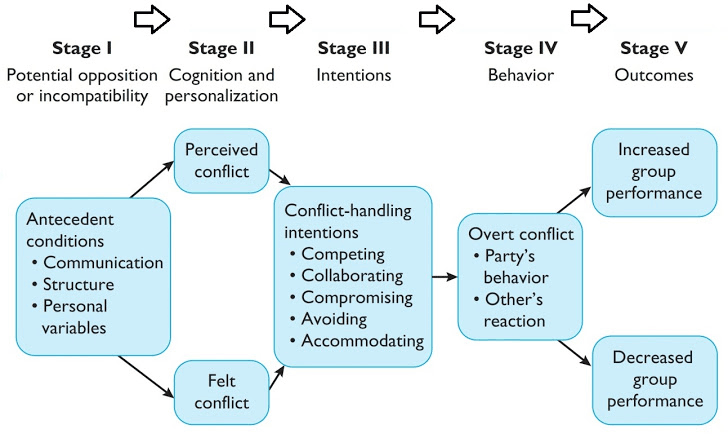
Organizational conflict arises when the goals, interests or values of different individuals or groups are incompatible and those individuals or groups block or thwart one another’s attempts to achieve their objective. Conflict Process shows how conflict works within the organization.

We can identify the stages that a conflict born and grows in an organization. In this post, we will look at the stages of a conflict covering the birth, rise, and ending in it.

Five Stages Conflict Process are:

  1. Potential Opposition or Incompatibility
  2. Cognition and Personalization
  3. Intentions
  4. Behavior
  5. Outcomes

Conflict Process consists of five stages that show how conflict begins, grows, and unfolds among individuals or groups with different goals, interests or values of the organization.

Stage 1: Potential Opposition or Incompatibility

The first step in the conflict process is the presence of conditions that create opportunities for conflict to develop. These cause or create opportunities for organizational conflict to rise.

They need not lead directly to conflict, but one of these conditions is necessary if the conflict is to surface.

For simplicity’s sake, these conditions have been condensed into three general categories.

  • Communication
  • Structure
  • Personal Variables

These 3 conditions cause conflict are explained;

(a) Communications

Different words connotations, jargon insufficient exchange of information and noise in the communication channel are all antecedent conditions to conflict.

Too much communication, as well as too little communication, can lay the foundation for conflict.

(b) Structure

In this context, the term structure is used to include variables such as size, the degree of specialization in the tasks assigned to group members, jurisdictional clarity, members/goal compatibility, leadership styles, reward systems and the degree of dependence between groups.

The size and specialization act as forces to stimulate conflict. The larger the group and the more specialized its activities, the greater the likelihood of conflict. Tenure and conflict are inversely related.

The potential for conflicts tends to be greatest when group members are younger and when turnover is high.

In defining where responsibility for action lies; the greater the ambiguity is the greater the potential for conflict to the surface. Such Jurisdictional ambiguity increases inter-group fighting for control or resources and territory.

(c) Personal Variables

Certain personality types- for example, individuals who are highly authoritarian and dogmatic- lead to potential conflict. Another reason for the conflict is the difference in value systems.

Value differences are the best explanations of diverse issues such as prejudice disagreements over one’s contribution to the group and rewards one deserves.

Stage 2: Cognition and Personalization

Conflict must be perceived by the parties to it whether or not the conflict exists is a perception issue, the second step of the Conflict Process.

If no one is aware of a conflict, then it is generally agreed that no conflict exists. Because conflict is perceived does not mean that is personalized.

For example

A may be aware that B and A are in serious disagreements but it may not make A tense or nations and it may have no effect whatsoever on A’s affection towards B.

It is the felt level when individuals become emotionally involved that parties experience anxiety, tension or hostility.

Stage-2 is the place in the process where the parties decide what the conflict is about and emotions play a major role in shaping perception.

Stage 3: Intentions

Intentions are decisions to act in a given way, intentions intervene between people’s perception and emotions and their overt behavior.

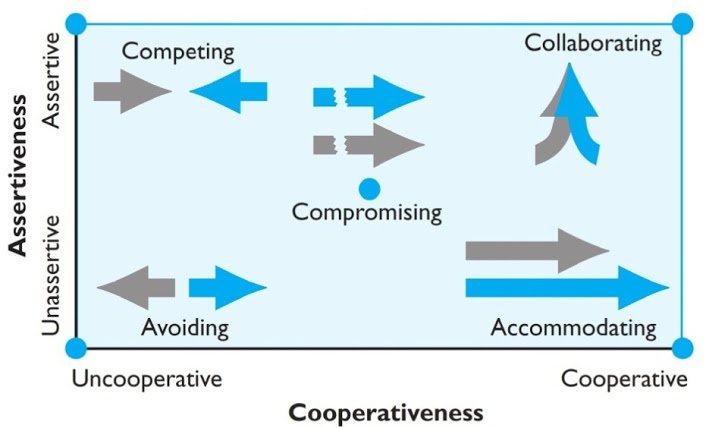
Using two dimensions cooperativeness (the degree to which one party attempts to satisfy the other party’s concerns) and assertiveness (the degree to which one party attempts to satisfy his or her concerns) five conflict-handling intentions can be identified.

5 Conflict-Handling Intention

There are 5 conflict-handling intentions:

  • Competing (I Win, You Lose)
  • Collaborating (I Win, You Win)
  • Avoiding (No Winners, No Losers)
  • Accommodating (I lose, You win)
  • Compromising (You Bend, I Bend)

Stage 4: Behavior

This is a stage where conflict becomes visible. The behavior stage includes the statements, actions, and reactions made by the conflicting parties.

These conflict behaviors are usually overt attempts to implement each party’s intentions.

When most people think of conflict situations, they tend to focus on Stage 4.

Why?

Because this is a stage Where conflict becomes visible. The behavior stage includes the statements, actions, and reactions made by the conflicting parties;

These conflict behaviors are usually overt attempts to implement each party’s intentions. But these behaviors have a stimulus quality that is separate from intentions.

As a result of miscalculations or unskilled enactments, overt behaviors sometimes deviate from original intentions.

It helps to think of stage 4 as a dynamic process of interaction.

Stage 5: Outcomes

The action-reaction interplay between the conflicting parties results in consequences.

These outcomes may be functional in that the conflict results in an improvement in the group’s performance, or dysfunctional in that it hinders group performance.

Conflict is constructive when it improves the quality of decisions that stimulates creativity and innovations encourage interest and curiosity among group members to provide the medium through which problems can be aired and tensions released and foster an environment of self-evaluation and change.

Conflict is dysfunctional when uncontrolled opposition breeds discontent, which acts to dissolve common ties and eventually leads to the destruction of the group.

Among the more undesirable consequences are a retarding of communication, reductions in group cohesiveness and subordination of group goals to the primacy of infighting between members.

Conflict Resolution Techniques

Conflicts are inevitable when number of people will be working together. Conflict is defined as “difference in opinion or some kind of disagreement between two or more parties”. Conflicts need to be resolved effectively. It is not only important to resolve the conflict, but also is equally important to ensure that the parties involved in conflict do not unnecessarily end up being in any kind of emotional stress during the resolution process of the conflict. Striking a balance between resolving the conflict to find the decision and maintaining the emotional wellbeing of people involved will be critical to successful conflict management.

Hence it is important to understand clearly, what is a conflict, why conflict occurs, challenges in resolving conflicts and various methods for resolving conflicts.

There are two views on conflicts or the so called differences in opinion between people. The traditional view says “conflicts are bad and should be totally discouraged”, and the new modern view says” conflicts can be constructive and good and different ways of thinking should be encouraged to get multiple ideas and solutions to problems in hand”.

Some of the conflict resolution techniques are as follows:

  1. Problem Solving / Collaboration / Confronting

In this method, people involved in the conflict or having a difference in opinion, they come forward to discuss the problem at hand with a very open mind. They focus on resolving the conflict and finding the best alternative/solution for the team. They discuss by rising above personal emotions with the sole intention to finding what is best for the team. This leads to a win-win kind of an outcome. Here everyone collaborates.

  1. Compromising/Reconciling

Sometimes for certain conflicts, there will be a need for the involved parties to think of a middle path wherein both parties decide to give up something and identify a resolution. This kind of solution will be temporary for that moment and are not long lasting solution. This leads to  lose-lose kind of an outcome as both parties may feel they have lost something.

  1. Withdrawing/Avoiding

In some situation one of the parties in the conflict may decide to retract from the discussion and allows going with the other person’s opinion. Or some situation, one of the parties may decide to completely avoid the conflict by maintaining silence. This works well in situation where one of the parties in the conflict is emotionally charged up or is angry. Hence avoiding any conflict resolution provides a “cooling off” period to the people involved so that they can later come back for meaningful resolution.

  1. Forcing/Competing

In some situations, a person with authority and power can force his/her opinion and resolves the conflict without giving any chance to the other party/person. This leads to a win-lose kind of an outcome. Someone may end up feeling as a loser while the other person with authority may feel as a winner. This technique can be used if we see the conflicts are unnecessary and mostly destructive for the team.

  1. Smoothing/Accommodating

This is a technique which is used when the atmosphere seems to be filled with apprehension/distrust among the parties involved. And no one is coming forward for resolving the conflict. In these kind of scenarios, one of the parties can take charge and tries to smooth the surrounding by using nice words and by emphasizing on the points of agreements and playing down on the points of disagreements. This can work as catalyst to break the discomfort between the involved parties by creating a feeling of trust and encourages them to come forward and resolve the conflict.

Models of Leadership

  1. Transformational

When a leader follows the transformational model of managing employees, they can provide quite effective support of the company’s operation by inspiring workers.

Although such managers can be considered quite demanding, they motivate individuals to perform their job duties “beyond the expected levels” and “think beyond self-interest” since they show “positive qualities and ethics”, as it was noted by Opoku and Ahmed in Leadership and Sustainability in the Built Environment.

Such a model of leadership is quite effective in achieving organizational goals.

  1. Charismatic

The charismatic model of leadership is no less effective than a transformational one since it also includes creating enthusiasm for the team.

However, in contrast, this one implies that a leader shapes the values of other people instead of making them work beyond requirements.

So a charismatic leader can achieve a company’s goals via personal “characters and behaviors” because they are communicative and responsive.

  1. Ethical

Consequently, such a leader is following their own ethics, providing employees with both fair rewards and reasonable criticisms.

Moreover, ethical leaders are good at decision-making because their way of thinking is primarily moved by logic and justice, but not always emotions and feelings.

There may be no doubts that the manager, following an ethical leadership model, will perform consistently for the team and the company’s goals.

  1. Laissez-faire

A laissez-faire model of leadership contains both the pros and cons of its implementation.

On the one hand, laissez-faire leaders let their employees do the job and make decisions by themselves. And it can be considered as a positive and beneficial action when workers are entirely educated, experienced, and skilled.

On the other hand, such passiveness in performing leadership duties can lead to such an issue as uncontrolled production. I can note that laissez-faire leaders have a lack of motivational influence on employees.

For instance, when the manager takes a small part in performing a job, their opinion about work can be considered insufficient.

  1. Bureaucratic

The bureaucratic leadership model is quite useful in the field of production. Such leaders are primarily moved by established rules, standards, and norms.

Thus, while working with mechanisms requires following safety regulations and properly using the equipment, the bureaucratic leader can control these processes effectively.

However, it is also necessary to take into account that the bureaucratic leadership model has a lack of flexibility. So it can have an adverse impact on performance if the leader works with creative tasks.

  1. Democratic

In contrast to more passive models of leadership like laissez-faire and bureaucratic, a democratic model can really motivate team members to work effectively. This model goes about involving employees in the decision-making process.

So employees become more motivated to work, knowing their mission at a company. Despite the fact that such a model of leadership can lead to slow performance, the results pay off.

This way of being a leader can be used in various fields of activity, both creative and routine.

  1. Autocratic

One more model of leadership is autocratic, which is quite different from the above-noted models.

To exemplify, if a person is following the autocratic model, then their team members will not have any chance to make suggestions concerning work.

While in creative work, the autocratic model of leadership is not an effective way to manage employees, a routine job with no necessity for specific skills can benefit from such an approach.

However, my personal experience has shown that an autocratic leader lacks strong communication with employees, which has an adverse impact on relations between workers and managers.

Organizational Goals

In conclusion, it is worth saying that the listed models of leadership are effective in performing management. It is evident that all of them can not be without cons, but can be implemented in all fields of activity.

Nevertheless, these models follow organizational goals and are useful in managing your team.

Stages of Stress

Stress is an inevitable part of life, something we must all deal with at some point. And although everyone will have different types of stress and individual ways to deal with it, stress generally progresses through the same general stages.

Learning the different stages of stress is important to identify what stage you may be experiencing. By knowing the different stages of stress, and being able to identify what you’re experiencing, you can take the appropriate steps to resolve it before it progresses to an unhealthy stage.

Stress can be helpful at times in the sense it may motivate us to achieve tasks, but if not kept in check, it can lead to a chronic condition that can have detrimental impacts to your overall health.

These are the 5 Stages of Stress

  1. The Alarm Stage

The first stage of stress is commonly referred to as the “fight or flight” response. It is how your body immediately reacts to something that is stressful. Adrenaline quickly pulses throughout your body, increasing your mental focus and reflexes. Your heart rate quickens in order to send increased blood flow and oxygen to your limbs, readying them for whatever response you decide.

The alarm stage prepares your body the best it can in order to deal with or solve the stress you’re facing. Situations that can induce the alarm stage may include things like needing to stop a vehicle suddenly to avoid an accident, or realizing you forgot to perform a task like meeting a deadline or paying a bill.

Although the alarm stage can cause a great deal of changes within your body, it usually has no long-lasting detrimental effects so long as the stress is quickly dealt with. Only when something continues to bring on continual stress can it become more harmful.

  1. The Resistance Stage

During the resistance stage, your body tries to return back to its normal state. Many of the changes that occur to your body during the alarm stage cause inflammation, therefore your body releases anti-inflammatory hormones to try and ease things.

Your body’s reactions during the resistance stage attempts to make the initial shock of stress fade away, which might make it seem like the stressful event has been dealt with effectively. However, this is simply a temporary fix until you fully solve or remove the stressor at fault. If not truly dealt with, the stress can ultimately lead to the exhaustion stage. This will, in turn, create even more stress on your body, where you run the risk of chronic debilitating disease brought on by tissue breakdown.

  1. The Recovery Stage

Hopefully, you can solve the stressful situation and your body can begin to recover, restoring your body’s systems to natural healthy levels. Even if the stressful event has not been fully dealt with, taking a step back to calm down and relax can allow your body to recover so you can effectively deal with the stress at hand without causing lasting harm to your body.

The cellular demand for vitamins and minerals needed during the alarm stage may need to be replaced with the help of supplements. Restoring your body’s normal biology is vital for a successful recovery. Adequate sleep along with taking time out of your busy schedule to unwind will allow for a quicker and more effective recovery.

  1. The Adaptation Stage

If you do not take the necessary steps to recover by either solving your stress or resting, you then enter what is known as the adaptation stage. Instead of dealing with stress, you simply accept it as a part of your everyday life. Your stress becomes chronic which begins to really take a toll on your overall health.

When you are chronically stressed, you may have difficulty sleeping and therefore have decreased energy. You may find that both your eating habits and weight will change and you will have a harder time dealing with your emotions. Your relationships may begin to suffer and you may find you have less motivation even in regards to enjoying your hobbies.

The adaptation stage is definitely not a solution to dealing with stress, and steps must be taken in order to avoid the next stage which is exhaustion.

  1. The Exhaustion Stage

The body can only handle so much, and can only adapt to deal with short-term stress. If stress becomes chronic, your body begins to break down and its nutrients begin to be depleted. Hospitalization may be required at this stage or you may need the assistance of a mental health doctor to deal with depression-like symptoms.

You may be unaware of just how much of an impact stress is having on your body. Your body’s continual battle with stress can lead to a weakened immune system, making you more prone to sickness and you may develop a range of skin problems such as acne or breakouts.

Now is the time to fully make strides to remove whatever it is that is causing you stress. You may need to seek the help of close family members or friends and quite possibly professional treatment. Until the stress is resolved, your body will not be able to recover and may continue to only get worse.

Organizational Change and Development

Organizational change can be defined as the alteration in structure, technology or people in an organization or behavior by an organization. Here we need to note that change in organizational culture is different from change in an organization. A new method or style or new rule is implemented here.

An organizational change occurs due to two major factors namely:

  • External factor: External factors are those factors that are present outside the firm but force the firm to change or implement a new law, rule etc. For example, all banks are bound to follow the rules laid down by the RBI.
  • Internal factor: Internal factors are those factors that are caused or introduced inside an organization that forces a change. For example, no smoking in the workplace.

Kurt Lewin’s Force Field Analysis

Kurt Lewin, is a noted organizational theorist, who proposed the force field analysis for organizational change. In this theory, he has prioritized two factors for change in an organization, namely:

  • Driving force: Driving force can be defined as an organizational force that makes a change with respect to structure, people and technology. In short, it drives the organization from one culture to another.
  • Restoring force: Restoring force is the force which changes the culture from the existing state to the old state. It indicates a backward motion while the driving force indicates a forward motion.

Importance of Organizational Change

There is a need of change in an organization because there is always a hope for further development, and in order to survive in a competitive market, the organization needs to be updated with changes. However, we have listed some reasons to explain why changes are deliberately made and carefully planned by the organization before implementation.

  • It improves the means to satisfy the economic requirements of people.
  • It enhances the profitability of organization.
  • It promotes employee satisfaction and well-being.

Planned Change

We can define planned change as any kind of alteration or modification which is done in advance and differently for improvement.

The Need for Planned Change

Planned change takes places in an organization when there is a demand for change due to two types of forces. These forces are grouped into internal sources and external sources.

Internal forces that lead to a planned change in an organization include obsolescence of production and service, new market opportunities, new strategic direction, increasing workforce diversity, and shift in socio-cultural values.

External forces that lead to a planned change in an organization include regulators, competitors, market force, customers, and technology. Each of these forces can create pressing demand for change in small or big, public or private, business or non-business organizations.

Process of Planned Change

Once the management decides to implement some changes in the organization, it needs to be done carefully as it is a very sensitive issue. It is very important for all the employees to adapt to change. According to Kurt Lewin, the planned organizational change is implemented in three different stages. They are −

  1. Unfreezing

In this stage, the organization studies if the change is required or not, what and why is the change necessary. Considering the entire situation, the organization decides for appropriate change. Thus a plan and strategy is formulated as required.

  1. Changing

In this stage, the organization executes the plan and program for change. For this purpose, proper precautions are taken in order to maintain cooperation and coordination between the employees and management, avoiding miscommunication or disputes. Adequate supervision and control is arranged as needed.

  1. Refreezing

This is the final stage, in order to bring organizational change. By way of supervision, the organization tries to evaluate the effectiveness of change. Collecting all this information, the management interprets whether to continue or replace change by some other alternatives or to make further minor changes.

Types of Planned Change

On the basis of a company’s requirement planned change is classified into three types. They are:

  • Change in structure
  • Change in technology
  • Change in people
  1. Change in Structure

We say that the planned change required is change in structure when development is required in these following areas:

  • Change in management
  • New management
  • Change in position or location
  • Change in objective, rules, regulations etc.
  • Launching new branches
  1. Change in Technology

We say that the planned change required is change in technology when development is required in these following areas:

  • Need of office automation
  • Installing new hardware and software
  • Executing new working procedures
  • New methods in production function
  • Producing new products and devices
  • New training, research and development program
  1. Change in People

We say that the planned change required is change in people when development is required in these following areas:

  • New candidate requirement
  • Promotion or demotion
  • Transfer to other location
  • Suspension or dismissal
  • Deputation
  • Training and development

Organizational development

Organizational Development is a field of research, theory, as well as practice devoted to expanding the knowledge and effectiveness of how people accomplish successful organizational change and performance.

Organizational development is not an overnight transformation that can be done in an organization, rather it is a gradual process that has to be executed systematically and by taking care of the external environment.

Organization Development Techniques

Companies adopt organizational development technique to modify the behavior of people who are resisting change. It is a program to bring a change in the values, norms, attitudes, perception, and behavior of people and improve the quality of inter-personal relations. Some of the major organizational development techniques are:

  • Sensitivity technique
  • Survey feedback
  • Process consultation
  • Team building
  • Intergroup development
  1. Sensitivity Technique

Here sensitivity refers to the psychological aspect of human mind that has to be shaped to act as expected by the group. In this technique, one’s own weakness is exposed and members understand how others react towards them. Stress is on group dynamics and tackling inter-relationship disputes.

The idea is to improve the behavior of people in order to maintain smooth inter-personal relationship without any power or influence. Members are motivated to have an open, heart-to-heart talk to develop mature relationship. Sensitivity training borders on psychotherapy where the emotions as well as body language are considered.

  1. Survey Feedback

In this technique, the discrepancies among a group are weeded out using questionnaires, which identify the difference in perception amongst the same working family, group or department. The collected data is then tabulated and distributed for further deliberations. This acts as the basis for further discussions and the discrepancies if any can be sorted out by open discussions with all concerned, defending and opposing till a consensus is reached. This technique mainly focuses on ideas and not on persons who put up those ideas.

  1. Process Consultation

In this technique, a firm may either seek the support of experts from within the firm or from outside. The firm must check that process consultation is done through an external expert with the needed support provided by the authorities from within the organization.

  1. Team Building

In this technique, attempts are made at the group or inter-group level. The main objective is to improve co-ordination thereby improving the performance as a group. This can be done by goal setting, development of inter-personal relations, role analysis to identify roles and responsibilities and team process analysis.

  1. Intergroup Development

Inter group development technique attempts to change the perceptions of groups about themselves or about other groups. This can be done by organizing independent group meeting, developing a list consisting of perception of itself, views about other departments and how others view them, trying to understand and resolve the actual cause of conflicts, or sub grouping the groups to remove difference in perceptions and impressions that groups have about each other.

Advertising, Meaning and Objectives, Types of Advertisement

Advertising is a paid, non-personal form of communication used by businesses, organizations, or individuals to promote products, services, ideas, or causes to a target audience. It is a persuasive tool that aims to influence consumer behaviour, build brand awareness, and generate sales. Unlike personal selling, advertising reaches a large number of people simultaneously through various channels such as television, radio, newspapers, magazines, social media, outdoor billboards, and digital platforms. It plays a crucial role in modern marketing by connecting businesses with potential customers and creating demand. Advertising also helps in differentiating products from competitors by highlighting their unique features, quality, or benefits.

Definition of Advertising:

According to the American Marketing Association (AMA), Advertising is any paid form of non-personal presentation and promotion of ideas, goods, or services by an identified sponsor.” This definition emphasizes three essential elements: (1) it is a paid activity, (2) it is non-personal communication aimed at mass audiences, and (3) it has an identified sponsor, usually the company or organization behind the message. In simple terms, advertising is a strategic communication process designed to inform, persuade, and remind consumers about products or services, ultimately influencing their buying decisions and supporting business growth.

Objectives of  Advertisement:

  • Creating Awareness

One of the primary objectives of advertising is to create awareness about a product, service, or brand. Awareness is crucial when launching new products or entering new markets. Advertising helps inform potential customers about the existence, features, and benefits of offerings. By using different media channels such as print, television, and digital platforms, businesses can reach a wide audience. Creating awareness ensures that consumers recognize the brand and recall it during purchase decisions. Without awareness, even high-quality products may fail, as customers must first know about a product before considering it for purchase.

  • Providing Information

Another key objective of advertising is to provide consumers with detailed information about a product or service. This may include its features, uses, prices, availability, and special offers. Informative advertising helps customers understand the product better, compare it with alternatives, and make informed buying decisions. For example, advertisements may highlight product specifications, health benefits, or technical details that guide consumer choices. Informative advertising is especially important for new or complex products, as it educates the audience about how the product works and why it is useful. Thus, it bridges the gap between businesses and consumers.

  • Persuading Customers

Advertising also aims to persuade potential buyers to prefer one brand over another. Persuasive advertising emphasizes the unique benefits of a product and attempts to influence consumer attitudes and buying behaviour. By using emotional appeal, celebrity endorsements, or strong messages, advertisers seek to create a desire for their product. For instance, a soft drink brand may highlight refreshment and happiness associated with its consumption. Persuasive advertising strengthens brand loyalty, encourages customers to switch from competitors, and motivates repeat purchases. It is especially useful in competitive markets where brands must stand out to gain customer attention and trust.

  • Building Brand Image

Advertising plays an important role in developing and maintaining a strong brand image. Beyond selling products, advertisements communicate values, emotions, and lifestyle associations linked with the brand. For example, luxury brands use advertising to position themselves as symbols of status and exclusivity. Consistent advertising builds credibility and trust, ensuring that consumers associate the brand with quality and reliability. A positive brand image enhances long-term customer loyalty and enables companies to charge premium prices. It also helps businesses survive in competitive environments, as customers often prefer trusted brands over unfamiliar alternatives, even when prices differ.

  • Stimulating Demand

One of the crucial objectives of advertising is to stimulate demand for products and services. Through attractive messages, offers, and creative visuals, advertisements encourage customers to try, buy, or increase consumption. For instance, promotional campaigns with discounts or seasonal deals are designed to push sales during specific periods. Stimulating demand is especially important when introducing new products or during off-seasons to maintain consistent sales levels. Effective advertising creates a sense of urgency and convinces consumers of the need to purchase. By stimulating demand, businesses can expand their market share and improve profitability over time.

  • Educating Consumers

Advertising is not just about selling; it also educates consumers about safe usage, new technologies, and product innovations. For example, pharmaceutical ads inform patients about medicines, while banking advertisements explain digital transactions. Educational advertising increases consumer knowledge, enabling them to use products effectively and responsibly. It is particularly valuable in industries where consumer safety and awareness are critical. In addition, educational ads help introduce social messages, such as energy conservation, health awareness, and road safety. By educating the public, advertising enhances social welfare while simultaneously building a company’s credibility and customer trust.

  • Reminding Customers

Finally, advertising serves the purpose of reminding existing customers about a brand and its products. In today’s competitive markets, where consumers are bombarded with options, reminder advertising helps maintain brand recall. This ensures that customers do not forget about a product and continue to choose it over competitors. For instance, Coca-Cola and Pepsi consistently advertise to remain at the top of consumers’ minds despite being well-known globally. Reminder advertising strengthens brand loyalty, encourages repeat purchases, and helps in retaining market share. It is particularly important for mature products that already enjoy a loyal customer base.

Types of Advertisement based on Media:

  • Print Advertising

Print advertising refers to promotional messages delivered through printed media such as newspapers, magazines, brochures, and pamphlets. It is one of the oldest and most traditional forms of advertising, offering detailed information with visuals and text. Print ads are particularly useful for targeting local markets and specific reader segments, such as business professionals, students, or homemakers, depending on the publication. They are often considered more credible because of the association with established newspapers or journals. However, the reach may be limited compared to digital media, and effectiveness relies on design, placement, and frequency of publication.

  • Broadcast Advertising

Broadcast advertising includes television and radio commercials aimed at reaching a mass audience. Television ads use both audio and visual elements, making them highly persuasive and memorable, while radio ads rely on sound, creativity, and repetition. Broadcast advertising is effective for creating brand awareness and influencing consumer emotions through music, jingles, or storytelling. It allows businesses to reach millions of viewers or listeners at once, making it suitable for consumer products. However, it can be very expensive, especially during prime-time slots. Despite digital advancements, TV and radio advertising remain influential for mass communication and brand positioning.

  • Outdoor Advertising

Outdoor advertising promotes products or services through physical displays placed in public spaces. Examples include billboards, posters, transit ads on buses and trains, hoardings, and banners. This type of advertising is highly visible, reaching a large number of people who pass by the location daily. Outdoor ads are best for creating brand recall through bold designs, short messages, and creative visuals. They are often used by FMCG brands, real estate firms, and events to capture attention quickly. While outdoor advertising is cost-effective in terms of impressions, it provides limited information due to space constraints and fleeting viewer attention.

  • Digital Advertising

Digital advertising uses online platforms and digital technologies to promote products or services. It includes search engine ads, social media ads, display banners, influencer marketing, and video ads on platforms like YouTube. Digital advertising offers precise targeting based on demographics, location, interests, and behaviour, making it more efficient than traditional methods. It also allows real-time performance tracking through analytics, ensuring better ROI. Businesses of all sizes use digital ads for cost-effective brand promotion. However, it requires expertise in digital tools and constant monitoring. Digital advertising is rapidly growing due to the increasing internet penetration and smartphone usage worldwide.

  • Direct Mail Advertising

Direct mail advertising involves sending promotional materials like letters, catalogs, flyers, and postcards directly to consumers’ mailboxes. It is a personalized form of advertising where businesses can target specific customers based on preferences, demographics, or past purchases. Direct mail allows detailed product descriptions, discount offers, and call-to-action messages, making it useful for building customer relationships. Although slower than digital methods, it can create a personal connection and generate higher trust. However, its effectiveness depends on the quality of mailing lists, creative design, and message relevance. High printing and mailing costs can also be a limitation for businesses.

Types of Advertisement based on Objective:

  • Informative Advertising

Informative advertising focuses on educating consumers about a product, service, or idea. Its main objective is to provide essential details such as product features, usage, price, availability, or benefits. This type is commonly used for new product launches or when entering a new market, as it creates awareness and builds knowledge among potential buyers. Informative ads help customers make rational decisions by clarifying doubts and presenting facts. Examples include ads for smartphones explaining specifications or banks highlighting new financial schemes. Although not emotionally persuasive, informative advertising builds trust and credibility by presenting clear and accurate information.

  • Persuasive Advertising

Persuasive advertising aims to influence consumer attitudes, emotions, and purchase decisions. Its objective is to convince customers that a brand’s product is superior to competitors and essential to their lifestyle. This type often uses emotional appeal, storytelling, endorsements, or comparative claims to build preference and loyalty. Persuasive ads are commonly seen in FMCG, cosmetics, automobiles, and luxury products, where differentiation is crucial. By highlighting benefits and creating desire, persuasive advertising drives brand switching and repeat purchases. While effective in increasing sales, it must balance persuasion with authenticity, as exaggerated claims may reduce consumer trust over time.

  • Reminder Advertising

Reminder advertising is designed to keep a brand or product fresh in the minds of consumers. Its objective is not to introduce or persuade but to reinforce brand recall and maintain loyalty. This type is commonly used by well-established brands like Coca-Cola, Pepsi, or Colgate, which already have widespread awareness. Reminder ads are often short, catchy, and repetitive, appearing on television, billboards, or digital platforms. They emphasize slogans, logos, and consistent messaging to strengthen long-term relationships. While not focused on immediate sales, reminder advertising helps companies sustain brand presence in competitive markets and prevents customers from shifting to rivals.

  • Reinforcement Advertising

Reinforcement advertising aims to reassure existing customers that they made the right purchase decision. Its objective is to strengthen consumer satisfaction, build trust, and encourage repeat buying. Companies use reinforcement ads to highlight customer testimonials, awards, or consistent product quality. For example, a bank may run ads assuring customers of its secure services, or a car company may emphasize after-sales support. This type of advertising helps reduce post-purchase dissonance, ensuring customers feel confident and proud of their choice. By reinforcing positive experiences, it promotes brand loyalty and long-term relationships, ultimately leading to higher customer retention and advocacy.

Evolution of Advertising

In ancient times the most common form of advertising was by word of mouth. The archaeologists have found Babylonian clay tablet dated 3000 BC having inscription of a shoemaker, a scribe and an ointment dealer. Commercial messages and political campaign displays have been found in the ruins of Pompeii, where little shops used to have inscriptions on walls near the entrance to inform the pedestrians about the products to be purchased.

Egyptians used papyrus to create sales messages and wall posters. Such one document found in the ruins of Thebes bears announcements offering rewards for the return of fugitive slaves. In Greece and Rome, lost-and-found advertising on papyrus was common. Wall or rock painting for commercial advertising is manifestation of ancient outdoor advertising form, which, is present to this day in many parts of Asia, Africa, and South America.

For instance, the tradition of wall paintings can be traced back to Indian rock-art paintings that goes back to 4000 BC. Phoenicians used to pain commercial messages on prominent rocks along the frequently travelled trade routes. The other mode of advertising was town crying that was used in Greece and India, where town criers were paid to go around town spreading news and making announcements in the streets.

As printing developed in the 15th and 16th century especially after the invention of movable type by Johann Gutenberg in 1438 AD, advertising flourished. The first known print advertisement in English appeared nearly 40 years after this inventions in the form of handbill of rules for the guidance of clergy at Easter released by William Caxton of London. In about 1525, one ad eulogising the virtues of mysterious drug printed on a circulated sheet appeared in German news pamphlets.

This was followed by a rapid spurt in the growth of newspapers the first of which in English came out in 1622 named Weekly News of London. The first advertisement appeared in an English newspaper in 1625. The first ad in America appeared in 1704 in Boston Newsletter offering a reward for the capture of a thief. In the 17th century, weekly newspapers called ‘mercuries’ started to be published in England, which used to feature many advertisements most of which were in the form of announcements made by the importers of products new to England like coffee in 1652, chocolate in 1657 and tea in the next year.

The other print ads were used mainly to promote books (which became increasingly affordable thanks to the printing press) and medicines (which were increasingly sought after as disease ravaged Europe). However, false advertising and so-called “quack” ads became a problem, which ushered in regulation of advertising content.

As the economy was expanding during the 19th century, the need for advertising grew at the same pace. In the United States, classified ads became popular, filling pages of newspapers with small print messages promoting all kinds of goods. The success of this advertising format led to the growth of mail-order advertising such as the Sears Catalog, at one time referred to as the “Farmer’s Bible”.

In 1843 Volney Palmer established the first advertising agency in Philadelphia, who worked as an agent for around 1400 newspapers. He only used to sell space to advertisers and did not provide any creative or account planning services to clients. But by the 20th century, agencies started to take over responsibility for the content also in addition to being just brokers for ad space in newspapers.

The Early years of Advertising in America:

  1. 1843: Volney B. Palmer opens the first American advertising agency, in Philadelphia.
  2. 1852: First advertisement for Smith Brother’s Cough Candy (drops) appears in a Poughkeepsie, New York paper – the two brothers in the illustration are named “Trade” and “Mark.”
  3. 1856: Mathew Brady advertises his services of “photographs, ambrotypes and daguerreotypes” in the New York Herald paper. His inventive use of type in the ad goes against the newspaper industry standard of all-agate and all same-size type used for advertisements in the papers.
  4. 1856: Robert Bonner is the first to run a full-page ad in a paper, advertising his own literary paper, the New York Ledger.
  5. 1861: There are twenty advertising agencies in New York City.
  6. 1864: William James Carlton begins selling advertising space in newspapers, founding the agency that later became the J. Walter Thompson Company, the oldest American advertising agency in continuous existence.
  7. 1865: George P. Rowell and his friend Horace Dodd open their advertising agency in Boston.
  8. 1867: Lord & Taylor is the first company to use double-column advertising in newspapers.
  9. 1869: N. W. Ayer and Sons advertising agency is founded in Philadelphia, Pennsylvania, and the following year begins advertising its own agency in both general and trade publications.
  10. 1869: E. C. Allan starts the People’s Literary Companion, marking the beginning of the “mail­order” periodical.
  11. 1869: The first advertisement for Sapolio soap is published.
  12. 1869: George P. Rowell issues the first Rowell’s American Newspaper Directory, providing advertisers with information on the estimated circulation of papers and thus helping to standardize value for space in advertising.
  13. 1860s – Advertising begins to appear in nationally distributed monthly magazines.
  14. 1870 – 5,091 newspapers are in circulation, compared to 715 in 1830.
  15. 1872 – Montgomery Ward begins mail order business with the issue of its first catalog.
  16. 1879 – John Wanamaker places the first whole-page newspaper advertisement by an American department store.
  17. 1870s – Charles E. Hires begins advertising Hires Root Beer in the Philadelphia Ledger, expanding over the next two decades into national magazines.
  18. 1870s – $1 million dollars is spent annually advertising Lydia Pinkham’s Pink Pills.
  19. 1870s – Louis Prang, a lithographer and printer, develops the idea of mass-producing small “trade cards” that could be adapted to the needs of individual advertisers at low cost. Thread companies, such as Clark’s O.N.T., are among the first to begin nationwide distribution of advertising trade cards.
  20. 1870s – In response to the high volume of outdoor advertising (including posters and signs painted on rocks, buildings and barns) in cities and rural areas, several states begin to impose limitations to protect natural scenery from sign painters.
  21. 1880 – John Wanamaker hires John E. Powers, who brings a fresh style to advertising – an honest, direct and fresh appeal emphasizing the style, elegance, comfort and luxury of products. Powers is later called “the father of honest advertising.”
  22. 1886 – Sears, Roebuck & Company begins mail-order business.
  23. 1880s – Illustrated trade cards reach the height of their popularity, not only with advertisers but also with the American public, which becomes remarkably interested in collecting them.
  24. 1890 – J. Walter Thompson Company’s billings total over one million dollars.
  25. 1891 – The precursor organization to the Outdoor Advertising Association of America (OAAA) is created under the name Associated Bill Posters Association of United States and Canada. OAAA is not used as the organizational name until 1925.
  26. 1891 – Batten and Co. advertising agency is founded by George Batten in New York, merging with another agency in 1928 to form Batten, Barton, Durstine and Osborne (BBDO).
  27. 1891 – Nathan Fowler, in Advertising Age, recommends that because women make most of the purchasing decisions of their household, manufacturers would do well to direct their advertising messages to them.
  28. 1900 – 1920
  29. 1902 – Packard begins use of the long-lasting slogan “Ask the man who owns one.”
  30. 1902 – Unilever hires the J. Walter Thompson Company for advertising Lifebuoy Soap and later Lux and other products in America. Unilever is still with J. Walter Thompson and represents the oldest client relationship in the advertising industry.
  31. 1904 – Cigarette coupons are first used as a draw for a new chain of tobacco stores.
  32. 1914 – The first full-length feature comedy motion picture, Tillie’s Punctured Romance, stars Marie Dresser, Mabel Normand, and newcomer Charlie Chaplin.
  33. 1917 – A massive advertising campaign for Lucky Strike tobacco gets underway, employing the slogan “It’s Toasted.”
  34. 1917 – The American Association of Advertising Agencies is formed.

The 1960s saw advertising transform into a modern, more scientific approach in which creativity was allowed to shine, producing unexpected messages that made advertisements more tempting to consumers’ eyes. The Volkswagen ad campaign featuring such headlines as “Think Small” and “Lemon” ushered in the era of modern advertising by promoting a “position” or “unique selling proposition’ designed to associate each brand with a specific idea in the reader or viewer’s mind.

The late 1980s and early 1990s saw the introduction of cable television and particularly MTV. Pioneering the concept of the music video, MTV ushered in a new type of advertising: the consumer tunes in for the advertisement, rather than it being a byproduct or afterthought. As cable (and later satellite) television became increasingly prevalent, “specialty” channels began to emerge, and eventually entire channels, such as QVC and Home Shopping Network and Shop TV, devoted to advertising merchandise, where again the consumer tuned in for the ads.

Marketing through the Internet opened new frontiers for advertisers and led to the “dot-com” boom of the 1990s. Entire corporations operated solely on advertising revenue, offering everything from coupons to free Internet access. At the turn of the 21st century, the search engine Google revolutionized online advertising by emphasizing contextually relevant, unobtrusive ads intended to help, rather than inundate, users. This has led to a plethora of similar efforts and an increasing trend of interactive advertising.

The share of advertising spending relative to total economic output (GDP) has changed little across large changes in media. For example, in the U.S. in 1925, the main advertising media were newspapers, magazines, signs on streetcars, and outdoor posters. Advertising spending as a share of U.S. GDP was about 2.6% in 1925. By 1998, television and radio had become major advertising media. Nonetheless, advertising spending as a share of GDP was slightly lower — about 2.4%.

A recent advertising innovation is “guerrilla promotions”, which involve unusual approaches such as staged encounters in public places, giveaways of products such as cars that are covered with brand messages, and interactive advertising where the viewer can respond to become part of the advertising message. This reflects an increasing trend of interactive and “embedded” ads, such as via product placement, having consumers vote through text messages, and various innovations utilizing social networking sites such as MySpace and Orkut.

An early advertising success story is that of Pears Soap. Thomas Barratt married into the famous soap making family and realised that they needed to be more aggressive about pushing their products if they were to survive. He launched the series of ads featuring cherubic children which firmly welded the brand to the values it still holds today, he took images considered as “fine art” and used them to connote his brand’s quality, purity (ie untainted by commercialism) and simplicity (cherubic children). He is often referred to as the father of modern advertising.

However, it was not until the emergence of advertising agencies in the latter part of the nineteenth century that advertising became a fully-fledged institution, with its own ways of working, and with its own creative values. These agencies were a response to an increasingly crowded marketplace, where manufacturers were realising that promotion of their products was vital if they were to survive. They sold themselves as experts in communication to their clients  who were then left to get on with the business of manufacturing.

World War 1 saw some important advances in advertising as governments on all sides used ads as propaganda. The British used advertising as propaganda to convince its own citizens to fight, and also to persuade the Americans to join. No less a political commentator than Hitler concluded (in Mein Kampf) that Germany lost the war because it lost the propaganda battle: he did not make the same mistake when it was his turn. One of the other consequences of World War I was the increased mechanisation of industry and hence increased costs which had to be paid for somehow: hence the desire to create need in the consumer which begins to dominate advertising from the 1920s onward.

Advertising quickly took advantage of the new mass media of the first part of the twentieth century, using cinema, and to a much greater extent, radio, to transmit commercial messages. You can listen to some early radio advertising here (RealPlayer req’d). This was beginning to show signs of working effectively in the 1920s but the Wall St crash put an end to widespread affluence, and the Great Depression and World War Two meant that it was not really until the 1950s that consumers had enough disposable income to really respond to the need creation message of advertisers.

The 1950s not only brought postwar affluence to the average citizen but whole new glut of material goods for which need had to be created. Not least of these was the television set. In America it quickly became the hottest consumer property – no home could be without one. And where the sets went, the advertisers followed, spilling fantasies about better living through buying across the hearthrug in millions of American homes.

The UK and Europe, with government controlled broadcasting, were a decade or so behind America in allowing commercial TV stations to take to the air, and still have tighter controls on sponsorship and the amount of editorial control advertisers can have in a programme. This is the result of some notable scandals in the US, where sponsors interfered in the content and outcome of quiz shows in order to make their product seem, by association, sexier.

Unhappy with the ethical compromise of the single-sponsor show, NBC executive Sylvester Weaver came up with the idea of selling not whole shows to advertisers, but separate, small blocks of broadcast time. Several different advertisers could buy time within one show, and therefore the content of the show would move out of the control of a single advertiser – rather like a print magazine. This became known as the magazine concept, or participation advertising, as it allowed a whole variety of advertisers to access.

Functions of Advertising

Advertising has become an essential marketing activity in the modern era of large-scale production and severe competition in the market.

Advertising permeates the Internet, network television, daily newspapers and roadside billboards. Products, services and ideas are sold through advertising, enabling businesses to attract customers for their wares. Internet advertising is rapidly displacing print advertising, due its convenience of use, cost effectiveness, and ease of distribution.

It performs the following functions:

  1. Identifying Brands and Products

Products, services and ideas are sold through businesses that are differentiated by their brand identities. Brand identity is communicated to the public via advertising. Consumers build emotional relationships with certain brands with which they become increasingly familiar through the years, thanks to advertising.

  1. Providing Information to Consumers

Advertising supplies the necessary information to consumers so that they know what is available and where to buy it. It broadcasts information on products, services and ideas sold on the open market through a variety of media portals. It reveals the special features being sold, what color and size the product is and which stores carry it.

  1. Persuading Consumers to Purchase

Powerful, visual advertising presentations compel consumers to purchase goods, services and ideas as a way to achieve emotional fulfillment. Persuasion is the core mission of advertising. Advertising tells you how the product, service or idea you are considering will improve your life. According to Jeremiah O’Sullivan R, author of “The Social and Cultural Effects of Advertising,” advertising feeds on the concepts of ideology, myth, art, sexual attraction and religion.

Advertising infuses images and ideas into products and services, just as the meanings of products and services are infused into images and ideas, notes O’Sullivan.

  1. Previewing New Trends

Previews about the virtues of new products, services and ideas motivate consumers to obtain them because they don’t want to be left out. Advertising lets consumers in on up-and-coming trends and new markets. They offer coupons, rebates and trial offers on new products, services or ideas to recruit new customers and induce existing customers to try things. Advertisers preview new or improved products, services and ideas to consumers in order to appeal to their sense of wanting to be in the know about leading edge trends.

Previewing new trends is a technique employed by advertisers that capitalizes on consumers’ desires to “keep up with the Jones” by owning the latest and greatest product, service or idea.

  1. Generating Product Demand

The demand generated by advertising, public relations, and sales promotion “pulls” the goods or services through channels of distribution, notes “Reference for Business.” One of the powerful functions of advertising is to generate consumer demand for specific products, services and ideas through ad campaigns that target the audiences that are most likely to buy them.” Products, services and concepts are sold in volume, according to the consumer demand for them.

  1. Building a Customer Base

Consistent quality advertising increases consumer loyalty for a product, service or idea. Advertising seeks to maintain the current customer base by reinforcing purchasing behavior with additional information about the benefits of brands. The goal of advertising is to build and reinforce relationships with customers, prospects, retailers and important stakeholders.

  1. Displaying Competitive Pricing

Advertising displays consumer goods with competitive prices relative to the current market, thus educating consumers about what things should cost. Advertising lets you know what the competition is doing, when the next sale is, and how you can receive the latest coupon or rebate and seeks to assure you that you are receiving the best value for your money.

error: Content is protected !!