Overhead costing: Primary and Secondary

Primary distribution involves apportionment or allocation of overhead to all departments in a factory on logical and rational basis. This process of apportionment is also known as departmentalisation of overhead. It is to be carefully noted that at the time of making primary distribution, the distinction between production and service departments is ignored.

Following points should be considered for primary distribution of items of overheads:

(i) Basis for distribution should be equitable and practicable;

(ii) Method adopted for distribution should not be time-consuming;

(iii) Overhead expenses should be distributed among different departments on the basis of benefits received by departments;

For the purpose of primary distribution, a departmental distribution summary is prepared in the following way:

Basis of Apportionment of Factory Overhead:

Expenses:

  1. Lighting, heating, rent, rates and taxes, depreciation on building, repair cost of building, caretaking etc.
  2. Insurance on Plant and Machinery, Building; Depreciation on Plant and Machinery; Maintenance of Plant and Machinery.
  3. Insurance on tools and fixtures, power, repairs and maintenance cost etc.
  4. Canteen subsidy or expenses, pension, medical expenses, personnel department expenses, cost of recreational facilities. Expenses of wage department
  5. Cost of supervision.

Base:

  1. Floor area occupied by each department. Light points for lighting.
  2. Capital values of Assets.
  3. Direct Labour hours or Machinery hours.
  4. Number of employees or workers.
  5. Time devoted.

Apportionment of Overhead

Secondary Distribution:

In a factory a product does not pass through Service department (S), but service department renders service to production departments for carrying on production function. It is, therefore, logical that the product cost should bear the equitable share of cost of service department. Under this backdrop, the second step is to distribute the total cost of service departments among the production departments.

The process of redistributing the cost of service departments among production departments is known as secondary distribution. Here, the cost of service department means the apportioned overheads plus direct materials plus direct labour and direct expenses of concerned service department.

Bases for Secondary Distribution:

Service Department Costs:

(i) Employment department

(ii) Maintenance department

(iii) Purchase department

(iv) Store keeping

(v) Canteen, welfare and recreation

Basis of Redistribution:

(i) Rate of labour-turnover or number of employees.

(ii) Hours worked for each department.

(iii) No. of purchase orders or value of materials purchased.

(iv) No. of requisitions.

(v) No. of employees of each department.

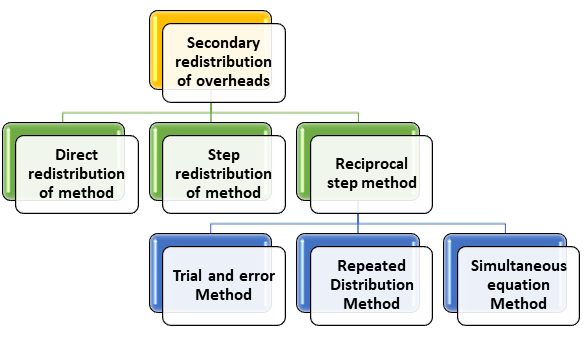
(i) Direct Redistribution Method:

Under this method, service department’s costs are apportioned to production depart­ments only ignoring service rendered by one service department to another. When this method is followed, the number of secondary distribution will be equal to number of secondary department.

(ii) Step Method:

This method of redistribution gives cognizance to the service rendered by one service department to another service department. The cost of service department which renders service to the largest number of other departments is distributed first.

After this is done, the cost of service department serving the next largest number of department is apportioned. This process continues till the cost of last service department is apportioned. The cost of last service department is apportioned among production departments only.

(iii) Reciprocal Distribution Method:

There may be two or more service departments in a factory and they may render service to each other. In that situation it is logical to give weight to inter-departmental services while distributing the expenses of service departments.

There are three methods for dealing with the distribution of inter-departmental services:

(A) Trial and Error Method

(B) Repeated Distribution Method

(C) Simultaneous Equation Method.

Stock Valuation

Stock Valuation refers to the process of determining the value of inventory held by a business at the end of an accounting period. Accurate stock valuation is crucial for financial reporting, profit calculation, and proper cost management. Inventory is classified as a current asset on the balance sheet, and its valuation directly affects both the cost of goods sold (COGS) and the net income of the business.

Objectives of Stock Valuation:

  • Accurate Profit Determination

Proper valuation of inventory ensures accurate determination of COGS and, consequently, the correct profit or loss for the period.

  • True Financial Position

Inventory is a significant asset, and its correct valuation is essential for presenting a true and fair financial position of the company.

  • Efficient Cost Control

Stock valuation helps in monitoring and controlling production and operational costs by providing insights into material consumption and wastage.

  • Compliance with Accounting Standards

Accurate stock valuation ensures adherence to accounting principles and standards, such as the Generally Accepted Accounting Principles (GAAP) and International Financial Reporting Standards (IFRS).

Methods of Stock Valuation:

There are several methods for valuing stock, depending on the nature of the business and accounting policies adopted. The commonly used methods are:

1. First-In, First-Out (FIFO)

The FIFO method assumes that the oldest inventory items are sold first. Therefore, the ending inventory consists of the most recent purchases.

Advantages:

  • Provides a realistic view of ending inventory value, as it is based on the most recent prices.
  • Useful in periods of inflation, as the cost of goods sold is lower, resulting in higher profits.

Disadvantages:

  • Higher profits may result in higher tax liability during inflationary periods.

Example:

Date Units Purchased Cost per Unit (₹) Total Cost (₹)
1 Jan 100 10 1,000
5 Jan 200 12 2,400
Total Units Sold = 150

COGS for 150 units:

  • 100 units @ ₹10 = ₹1,000
  • 50 units @ ₹12 = ₹600

Total COGS = ₹1,600

2. Last-In, First-Out (LIFO)

LIFO method assumes that the most recent inventory items are sold first, and the ending inventory consists of the oldest purchases.

Advantages:

  • In periods of inflation, LIFO results in higher COGS and lower profits, which can reduce tax liability.

Disadvantages:

  • The ending inventory may be undervalued since it consists of older costs, which may not reflect current market prices.
  • LIFO is not permitted under IFRS.

Example:

Using the same data as in the FIFO example:
COGS for 150 units:

  • 150 units @ ₹12 = ₹1,800

    Total COGS = ₹1,800

3. Weighted Average Cost (WAC)

WAC method calculates the cost of ending inventory and COGS based on the average cost of all units available for sale during the period.

Formula:

Weighted Average Cost per Unit = Total Cost of Inventory / Total Units

Example:

Using the same data:

Total units = 100 + 200 = 300

Total cost = ₹1,000 + ₹2,400 = ₹3,400

Weighted average cost per unit = ₹3,400 ÷ 300 = ₹11.33

COGS for 150 units = 150 × ₹11.33 = ₹1,699.50

Comparison of Methods

Criteria FIFO LIFO WAC
Cost Flow Assumption Oldest items sold first Newest items sold first Average cost
Ending Inventory Value Higher during inflation Lower during inflation Moderate
Profit Impact Higher profit Lower profit Average profit
Permitted by IFRS Yes No Yes

Importance of Consistency

Once a method of stock valuation is adopted, it should be consistently applied across accounting periods. Changing methods frequently can distort financial results and reduce comparability. However, any change in the valuation method must be disclosed, along with its financial impact, as per accounting standards.

Cost Sheet: Current and Estimated

A cost sheet is a statement prepared at periodical intervals of time, which accumulates all the elements of the costs associated with a product or production job. It is used to compile the margin earned on a product or job and forms the basis for the setting of prices on similar products in the future.

Objects of Cost Sheet

  1. For determining the selling price

A cost sheet helps in determination of selling price of a product or of a service. Cost sheet ascertains cost at each stage of the product and also the total cost of the product, where a margin of profit is added and thus the selling price is ascertained.

  1. Facilitating in managerial decision making

Preparation of cost sheet helps managers at various levels in their decision-making process such as

  • To produce or buy a component,
  • What price of goods to quote in the tender,
  • Whether to retain or replace an existing machine,
  • How to reduce costsand maximize profit.
  • Identify and make decisions whether they need to continue with the product or not.
  1. Preparation of budgets

Organizations can prepare a budget with the help of a cost sheet. We can prepare the budget by using the current or previous year’s data.

Elements of Cost

Prime Cost: It comprises of direct material, direct wages, and direct expenses. Alternatively, the Prime cost is the cost of material consumed, productive wages, and direct expenses.

Factory Cost: Factory cost or works cost or manufacturing cost or production cost includes in addition to the prime cost the cost in indirect material, indirect labor, and indirect expenses. It also includes amount or units of WIP or incomplete units at the end of the period.

Cost of Production: When Office and administration cost at the end of the period are added to the Factory cost, we arrive at the cost of production or cost of goods sold. Here, we make an adjustment for opening and Closing finished goods.

Total Cost: Total cost or alternatively cost of sales is the cost of production plus selling and distribution overheads.

  • A Cost Sheet depicts the following facts:
  • Total cost and cost per unit for a product.
  • The various elements of cost such as prime cost, factory cost, production cost, cost of goods sold, total cost, etc.
  • Percentage of every expenditure to the total cost.
  • Compare the cost of any two periods and ascertain the inefficiencies if any.
  • Information to management for cost control
  • Calculate and summarize the total cost of the product.

Proforma of a Cost Sheet

  PARTICULARS  AMOUNT  AMOUNT
 TOTAL
  DIRECT MATERIAL-PURCHASED
ADD OP STOCK OF RAW MATERIAL
LESS CL STOCK OF RAW MATERIAL
  MATERIAL CONSUMED
ADD DIRECT WAGES
ADD DIRECT EXPENSES
  PRIME COST
ADD WORKS OR FACTORY OVERHEADS
   Factory Overheads
ADD OP STOCK OF WIP
LESS CL STOCK OF WIP
  WORK COST
ADD ADMINISTRATION OR OFFICE OVERHEADS
  COST OF PRODUCTION
ADD SELLING AND DISTRIBUTION OVERHEADS
 
ADD OP STOCK OF FG
LESS CL STOCK OF FG
  COST OF SALES
ADD PROFIT MARGIN
SELLING PRICE  

Method of Preparation of Cost Sheet

Step I Prime Cost =  Direct Material Consumed + Direct Labour + Direct Expenses

Direct Material= Material Purchased + Opening stock of raw material-Closing stock of raw material.

Step II  Works Cost = Prime Cost + Factory Overheads (Indirect Material + Indirect Labour + Indirect Expenses)+opening Work in progress-Closing Work in progress
Step III Cost of Production = Works Cost + Office and Administration overheads + Opening finished goods-Closing finished goods
Step IV Total Cost = Cost of Production + Selling and Distribution Overheads
Profit Sales – Total Cost

Reconciliation of Financial accounts and Cost accounting

Reconciliation of financial accounts and cost accounts refers to the process of matching and comparing the data recorded in the financial accounting system with that in the cost accounting system. While financial accounts focus on preparing financial statements for external reporting, cost accounts are designed to provide detailed cost information for internal management purposes. Since these systems may use different methods and principles, reconciliation is essential to ensure accuracy, identify discrepancies, and provide a unified view of financial and operational performance.

Need for Reconciliation:

  • Differences in Objectives

Financial accounting aims at reporting an organization’s financial position and performance to external stakeholders, adhering to standardized rules like Generally Accepted Accounting Principles (GAAP). Cost accounting, on the other hand, focuses on internal decision-making, cost control, and efficiency improvements.

  • Variations in Treatment of Costs

Financial accounting categorizes costs into fixed, variable, and mixed costs for reporting purposes. Cost accounting uses classifications like direct and indirect costs, product costs, and period costs for analysis and control.

  • Separate Sets of Books

Often, organizations maintain separate records for financial and cost accounting, leading to differences that necessitate reconciliation.

  • Compliance and Accuracy

Reconciling financial and cost accounts ensures compliance with statutory requirements, eliminates errors, and provides reliable data for stakeholders.

Causes of Discrepancies:

  • Valuation of Inventory

Financial accounts typically value inventory using methods like FIFO, LIFO, or weighted average. Cost accounts may use different valuation bases, such as standard cost or marginal cost.

  • Depreciation Methods

Financial accounts might use straight-line or reducing-balance methods for depreciation, whereas cost accounts may allocate depreciation based on machine hours or production units.

  • Overhead Allocation

Overheads are distributed differently in financial and cost accounts. Financial accounts allocate actual overheads, while cost accounts often use predetermined overhead rates.

  • Inclusion of Non-Cost Items

Financial accounts include items such as interest, dividends, and abnormal losses or gains. Cost accounts exclude these as they are not directly related to production or operations.

  • Treatment of Profits

Cost accounts may calculate profit differently, excluding certain incomes or allocating costs differently than financial accounts.

Steps in Reconciliation:

  1. Preparation of Cost and Financial Statements
    Gather the financial profit and loss account and the cost accounting profit statement to begin the reconciliation process.
  2. Identify Variances
    Examine differences in treatment of costs, incomes, overheads, and inventory valuation between the two systems.
  3. Categorize Discrepancies
    Classify discrepancies as either:

    • Additions: Costs or expenses recorded in financial accounts but not in cost accounts.
    • Deductions: Costs or expenses recorded in cost accounts but not in financial accounts.
  4. Reconcile Profits
    Adjust the profit reported in cost accounts by adding or subtracting the variances identified to arrive at the financial profit figure.
  5. Prepare a Reconciliation Statement
    Create a structured statement showing the adjustments made to reconcile the cost accounts profit with the financial accounts profit.

Format of Reconciliation Statement

Particulars Amount
Profit as per Cost Accounts XXXX
Add: Items in Financial Accounts only
– Income not recorded in Cost Accounts XXXX
– Overheads undercharged in Cost Accounts XXXX
– Abnormal Gains XXXX
Total Additions XXXX
Less: Items in Cost Accounts only
– Overheads overcharged in Cost Accounts XXXX
– Non-cost Items (e.g., interest) XXXX
– Abnormal Losses XXXX
Total Deductions XXXX
Adjusted Profit as per Financial Accounts XXXX

Benefits of Reconciliation

  • Accuracy in Reporting

Ensures that both cost and financial data are aligned, enhancing the reliability of financial statements.

  • Enhanced Decision-Making

Reconciled data provides management with a clear understanding of cost structures, enabling better strategic decisions.

  • Error Detection

Identifies discrepancies, errors, or omissions in either set of accounts, ensuring that they are rectified promptly.

  • Regulatory Compliance

Supports compliance with statutory requirements by aligning cost and financial data for audit and reporting purposes.

  • Improved Efficiency

Streamlines processes by identifying inefficiencies in cost allocation and financial reporting.

Challenges in Reconciliation

  • Complexity in Large Organizations

Reconciling data in large firms with numerous transactions and cost centers can be time-consuming and complex.

  • Variability in Accounting Policies

Differences in policies, such as depreciation or inventory valuation, can complicate the reconciliation process.

  • Resource-Intensive Process

Requires skilled personnel and dedicated resources, which might be a constraint for smaller businesses.

Uniform costing and interfirm comparison

Inter-firm comparison is a natural outcome of uniform costing system. Uniform costing is the foundation stone over which the structure of IFC is developed and adopted in a large scale. Inter-firm comparison can be defined as the technique of evaluating the relative performance, efficiency, costs and profits of firms in a given industry’. The meaning of IFC can be easily explained by considering the main object of the system.

In other words IFC consists of following procedure:

(a) Data are collected from participating organization or firm by their trade organization or centre of inter-firm comparison.

(b) The management of an organisation is provided with information which will allow them to determine the efficiency being achieved, measured by comparing the performances of other business.

(c) An attempt is made to show why results vary from one business to another, i.e., any weakness is highlighted.

(d) Extensive use is made of financial and cost ratios.

Objects of Inter Firm Comparison:

The main purpose of IFC is improvement of efficiency by showing the management of participating firm its present achievements and possible weaknesses. These firms have to contribute their data to the central body which acts as a neutral body. This central body ensures confidence and it gives report regarding comparisons only to participants.

Following are important objectives of inter-firm comparison:

(a) IFC analyses costs of different firms with a view to spot out relative efficiency.

(b) IFC provides aid to management in enforcing and reviewing budgetary control and standard costing. These techniques enforced in one firm are compared with those in other firms making more efficient use of the same. Inadequacies of standard costing and budgetary control are located by making inter-firm comparisons and remedial measures are introduced.

(c) IFC helps to prepare a comprehensive and detailed plan for firms or units to obtain optimum use of human and material resources.

The main objection of IFC is the improvement of efficiency and identification of weak points. IFC is a scheme consisting of exchange of information with regard to cost, profit, productivity and efficiency between the participating firms through a central organisation. IFC focuses the remedial measure of a number of problems related to profit, sales and production.

In inter-firm comparison coordinated and monitored through an apex body or central organisation, attention is usually concentrated on the following major important are:

(i) Is profit adequate?

(ii) How efficient is selling?

(iii) How efficient is production?

Organisation of IFC:

The organisational set up for inter firm comparison may be in the form of either a trade association or a Government department or centre for inter-firm comparison. There may be a trade association of participating firms. Firms submit their required information to the association. Trade association analyses the information collected from firm and presents report to each member firm.

The job of coordinating and analyzing of data provided by firms of an industry may be entrusted to a Government Department. The main objective of such organisation structure of IFC is to exercise price control and regulation of firms.

In UK, the British Institute of Management had set up centre for Inter-firm comparison in association with British Productivity council. The centre was established just to meet the demands of trade and industry for an expert body for inter-firm comparison. Such a type of organisation has to prepare schemes for inter firm comparison. In India also there is need of such centre. Thus there should be a central body to coordinate and monitor inter-firm comparison.

Method or Approach for Inter-Firm Comparison:

Firms wishing to obtain the benefits of inter-firm comparison have to approach the central body or apex body constituted for IFC. A fee may be charged for carrying out comparisons. The method of approach adopted by the central body will be governed by the type of industry or trade and the problems and circumstances present.

The possible procedure may be as below:

  1. Firms which are to participate in an inter-firm comparison have to submit their data to the central body. These figures are compiled on the basis of uniform definitions of terms, procedures, methods and accounting periods.
  2. After all necessary steps have been taken to ensure that the participating firms can benefit from the comparison, a number of ratios are compiled. These ratios are shown in a summary form distinguishing.

(a) Ratios for the group of firm participating in the inter-firm comparison.

(b) Ratios for a single firm.

Each firm is given a report compiled along these lines.

  1. The ratios for the group and the ratios for the single firm are compared one by one.
  2. Once any significant deviation from the norm (average return on capital employed) is established, the possible reasons for this deviation may be located by examining other ratios.

Ratios of Inter-Firm Comparison:

Ratios used in the inter-firm comparison are of four types:

(i) Primary Ratios

(ii) Supporting Ratios

(iii) General Explanatory Ratios

(iv) Specific Explanatory Ratios

All the ratios can be taken together to form a pyramid as given below:

In addition to above ratios, some other ratios may be used for the purpose of systematic analysis of operational results. These cover all aspects of business activities and are meant for measurement of effectiveness of the resources.

These additional ratios are briefly explained below:

(A) Ratios of Performance Measurement:

  1. Value of Direct Material/Value of Production
  2. Cost of Materials/Quantity Produced
  3. Cost of Scrap / Cost of Raw Material
  4. Quantity of Scrap / Quantity of Raw Material
  5. Cost of Rejection / Cost of Production
  6. Total Output / No. of Workers
  7. Cost of Production/Machine Hours or Labour Hours
  8. P.V. Ratio i.e., Contribution x 100/Sales
  9. Contribution / Labour Hours
  10. Wages/No. of Workers
  11. Total Fringe Benefits/No. of Workers
  12. Idle Time / Total Time
  13. Overtime Hours / Total Labour Hours
  14. Standard Hours for Actual Production / Actual Hours
  15. Actual Hours / Budgeted Hours
  16. Power Cost / Machine Hours
  17. Repair and Maintenance Cost / Cost of Production
  18. Advertising Cost / Selling Cost

(B) Ratios to Judge Profitability:

These ratios show how profitable are company’s operations.

  1. Gross Profit Ratio i.e., (GP/Sales) ×100
  2. Net Profit Ratio i.e., (NP / Sales) × 100

GP ratio indicates manufacturing or trading efficiency while NP ratio shows overall profitability

  1. Return on capital employed i.e., Profit / Capital employed

ROLE indicates overall performance from the stand point of profitability. It is primary ratio in the pyramid of ratios

(C) Ratios related to Turnover:

Turnover Ratio show how efficiently company is managing current assets.

  1. Stock turnover ratio i.e., cost of sales/Average stock

This ratio shows the efficiency of inventory management. Average stock is average of opening and closing stock

  1. Debtors Turnover Ratio i.e., Debtors * Days or Months in a year / Annual Credit Sales

Debtor’s turnover measures the efficiency in collection of debts

  1. Creditors Turnover Ratio i.e., (Creditors x No. of days of months in a year)/Annual Credit Purchases.

This ratio measures the efficiency of purchase department in realizing credit facilities

(D) Liquidity Ratios:

These ratios show the liquidity position of the company to meet its day to day needs of working capital

  1. Current Ratio i.e., Current Assets/Current Liabilities

Current Ratio shows the ability of the company to meet its maturing current liabilities. An ideal ratio is 2:1 but it may differ due to nature of business.

  1. Quick Ratio or Acid Test Ratio i.e., Quick Assets i.e., Current Assets excluding inventory/ Current Liabilities

Quick Ratio indicates ability of the company to meet its immediate current liabilities out of readily realizable current assets.

Reporting:

The central body collects and analysis the data supplied by participating firm, calculates relevant ratios and prepares report to be sent to individual member firm. Normally code numbers are used in place of names of the firms so that information may remain confidential. The results and interpretations are presented in the report in such a way that individual firm data could not be identified.

On receipt of the comparative data and report of inter-firm comparison, it is the job of the management of the firm to compare operating and other results and the corresponding ratios with ratio furnished by the central body of IFC.

Advantages of Inter-Firm Comparison:

  1. Under IFC the weakness of participating firms are revealed and the management will be guided to remedial actions.
  2. The firm will come to know the trend of sales, profit and cost of an industry or trade as shown by different ratios. If all firms are suffering from falling sales, it will be indicated by sales to capital or asset employed ratio. When an individual firm compares its own ratio with the ratio of the group, it will see that there are general reduction sales.
  3. Management of participating firm are provided with most significant facts on the basis of ratios carefully selected by the central body. The firm will have to do only the study of the ratios and the necessary action.
  4. Whether firm is doing better or worse than other firms is made known through the ratios. The firm can take positive steps to improve efficiency.
  5. The experience of the central body is at the disposal of participating firms. This knowledge can be very valuable in the analysis of performance and profitability of the firm.
  6. Participating firm provide information willingly knowing that this remains confidential.
  7. IFC develops cost consciousness among participating firm.
  8. IFC leads to avoidance of unfair competition. It guides in the direction of proper and positive efforts towards improvement of performances.
  9. Inter-firm comparisons and related data help in representing the problem of the industry to regulating authorities and the Government in an effective and convincing matter. Information regarding entire industry can be presented before the Government and not the isolated problem of individual firm.
  10. Collective information provided under IFC can help the industry in its negotiations with trade unions.

Limitations of IFC:

It is obvious that inter-firm comparison is useful in improving productivity, efficiency and profitability. But benefits are obtained only when ratios are properly calculated and impartially used. The limitations of ratio analysis should be taken into consideration. It should be noted that a single ratio is of a limited value and their trend is most important. Moreover the limitation of uniform costing should also be taken into consideration because uniform costing provides the very basis of inter-firm comparison

It should also not be ignored that certain extraneous factors such as prolonged strike, power shortage may also adversely affect the performance of the industry in a particular period. Limitations and short comings of annual returns and data may also affect the reliability of conclusions.

It can also be pointed out that there are practical limitation in the formation and maintenance of an independent central agency for inter-firm comparisons. The cost of introducing uniform costing may make the management of firm reluctant to participate in a scheme of inter-firm comparison.

Target costing

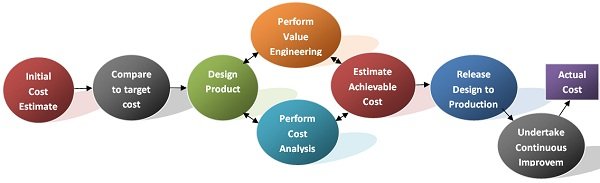
Target costing can be viewed as a proactive cost management tool used to reduce the total cost of the product, over its complete lifecycle, through production, engineering, research and design. It helps the firm in managing the business in reaping profits in the extremely competitive market.

Simply put, target costing is a process of ascertaining and attaining full stream cost, at which the intended product with specific requirements, must be produced so as to realise the desired profits, at an anticipated selling price over a specified period. It involves the discernment of maximum cost to be incurred on a new product, followed by the development of sample that can be profitably created for that target cost figure.

Target Costing and Product Development Phase

In this technique, the costs are planned and managed out of the product or process early in the introduction phase like development or designing, instead of performing it in the latter phase of product development.

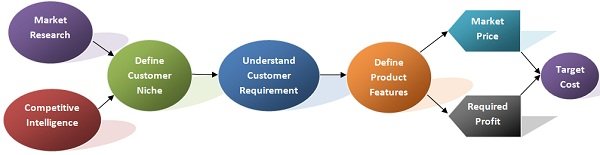
Target Costing applies to new products and succeeding generations of a product. It begins with understanding the market thoroughly and an intention to satisfy customer needs, concerning product quality, features, timeliness and price.

Target Cost

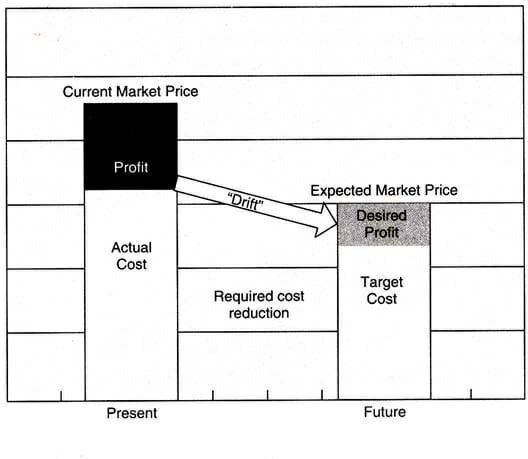
Target Cost = Anticipated selling price – Desired profit

Target Cost refers to an estimate of product cost reached by deducting a desired profit margin from the competitive market price.

Target Costing Process

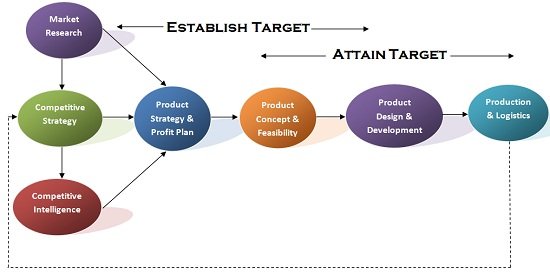
Establishment Phase of Target Cost

  1. Determine selling price for the new product and estimated output from market analysis and target profit.
  2. Ascertainment of the target cost by deducting the profit from the selling price.
  3. Functional cost analysis for specific components and processes
  4. Decide the estimated product cost.
  5. Make comparison between estimated cost and target cost.
  6. If the estimated cost is greater than the targeted one, then repeat cost analysis, to reduce the estimated cost.
  7. Final decision to be taken, on the introduction of the product, once the estimated cost is on target.
  8. Cost management while production is performed.

Attainment Phase of Target Cost

In target costing process, the cost which is directly influenced by it is given priority, which includes material and purchase parts, tooling cost, conversion cost, development expenses and depreciation. Nevertheless, it is a comprehensive cost management technique, so all those cost and assets which are influenced by initial product planning decision are taken into account.

Target Costing Principles

  • Price-led costing
  • Cross functional teams
  • Customer focus
  • Focus on product design and process
  • Lifecycle cost reduction
  • Value Chain involvement

Target Costing is all about planning or projecting the cost of a product prior to its introduction, to make sure that products with low margin are not introduced, as they are not able to reap sufficient returns. It is also used for controlling the design specification and production techniques, and encouraging a focus on the customer.

Advantages of Target Costing:

  • It shows management’s commitment to process improvements and product innovation to gain competitive advantages.
  • The product is created from the expectation of the customer and hence cost is also based on similar lines. Thus, the customer feels more value is delivered.
  • With the passage of time, the company’s operations improve drastically, creating economies of scale.
  • The company’s approach to designing and manufacturing products becomes market-driven.
  • New market opportunities can be converted into real savings to achieve the best value for money rather than to simply realize the lowest cost.

Benchmarking Concept, Essence, Levels, Process

Benchmarking is a Strategic Management tool used to compare an organization’s performance, processes, or practices against those of industry peers or best-in-class companies. It involves identifying key performance indicators (KPIs), metrics, or standards that are relevant to the organization’s goals and objectives. By benchmarking, organizations can gain insights into their strengths, weaknesses, and areas for improvement relative to competitors or industry standards. This process enables organizations to identify best practices, adopt innovative strategies, and drive continuous improvement in areas such as quality, efficiency, customer satisfaction, and profitability. Benchmarking can be applied to various functions and processes within an organization, including operations, finance, marketing, human resources, and supply chain management, to enhance performance and competitiveness.

Essence of Benchmarking:

At its core, the essence of benchmarking lies in the pursuit of excellence through comparison, learning, and improvement. Benchmarking enables organizations to assess their performance, processes, and practices against industry standards, best practices, or competitors to identify opportunities for enhancement. By understanding where they stand relative to others, organizations can set realistic goals, prioritize areas for improvement, and implement strategies to bridge performance gaps. The essence of benchmarking is not merely about emulation but rather about gaining insights, adapting successful practices to suit specific contexts, and driving continuous improvement. Ultimately, benchmarking fosters a culture of innovation, excellence, and competitiveness, empowering organizations to evolve, thrive, and achieve their strategic objectives in a dynamic and ever-changing business environment.

  • Comparison:

Benchmarking involves comparing an organization’s performance, processes, or practices against those of industry peers, competitors, or best-in-class companies. This comparison provides valuable insights into relative strengths, weaknesses, and areas for improvement.

  • Learning:

Benchmarking is fundamentally a learning process. It enables organizations to gain knowledge about best practices, innovative strategies, and performance standards employed by top performers in their industry or sector.

  • Improvement:

The primary objective of benchmarking is improvement. By identifying performance gaps and learning from others, organizations can implement changes and initiatives to enhance their performance, efficiency, and competitiveness.

  • Adaptation:

Benchmarking involves adapting successful practices and strategies discovered through comparison to fit the organization’s unique context, culture, and objectives. It’s not about blindly copying but rather about leveraging insights for tailored improvement.

  • Innovation:

Benchmarking fosters a culture of innovation by exposing organizations to new ideas, approaches, and technologies. It encourages experimentation, creativity, and the adoption of emerging trends to stay ahead of the competition.

  • Continuous Improvement:

Benchmarking is a continuous process. It’s not a one-time exercise but rather an ongoing commitment to monitor performance, seek new benchmarks, and strive for excellence. It involves setting new targets, measuring progress, and iterating to drive sustained improvement over time.

Levels of Benchmarking:

  • Internal Benchmarking:

Internal benchmarking involves comparing performance, processes, or practices within different departments, divisions, or units of the same organization. It aims to identify best practices and opportunities for improvement by leveraging internal expertise and resources.

  • Competitive Benchmarking:

Competitive benchmarking involves comparing an organization’s performance, processes, or practices against direct competitors within the same industry or sector. It helps organizations understand their competitive position, strengths, weaknesses, and areas for differentiation.

  • Functional Benchmarking:

Functional benchmarking involves comparing specific functions, processes, or practices across different industries or sectors. It allows organizations to gain insights from best practices in unrelated industries that may have relevance or applicability to their own operations.

  • Strategic Benchmarking:

Strategic benchmarking involves comparing overall strategies, business models, and performance metrics across industries or sectors. It focuses on understanding how top-performing organizations achieve strategic objectives and competitive advantage, enabling organizations to identify strategic opportunities and challenges.

  • Process Benchmarking:

Process benchmarking involves comparing specific processes, workflows, or procedures within an organization or across industries. It aims to identify inefficiencies, bottlenecks, and opportunities for process improvement by analyzing best practices and performance metrics.

  • Performance Benchmarking:

Performance benchmarking involves comparing key performance indicators (KPIs), metrics, or financial ratios against industry benchmarks, standards, or peer group averages. It helps organizations assess their performance relative to industry norms and identify areas for performance improvement.

  • Best-in-Class Benchmarking:

Best-in-class benchmarking involves comparing performance, processes, or practices against top-performing organizations within a specific industry or sector. It focuses on identifying and adopting best practices and strategies from industry leaders to achieve superior performance and competitive advantage.

Process of Benchmarking:

  • Identify Objectives and Scope:

Define the objectives of the benchmarking initiative and the scope of the comparison. Determine what aspects of performance, processes, or practices you want to benchmark and the criteria for selection.

  • Select Benchmarking Partners:

Identify potential benchmarking partners, which could include internal departments, external organizations within the same industry, or companies in unrelated industries with relevant best practices.

  • Gather Data and Information:

Collect relevant data and information related to the performance, processes, or practices to be benchmarked. This may include financial metrics, operational data, process documentation, and qualitative insights.

  • Analyze Performance Metrics:

Analyze the collected data and performance metrics to understand current performance levels, identify areas of strength and weakness, and determine opportunities for improvement.

  • Identify Best Practices:

Research and analyze best practices employed by benchmarking partners or industry leaders. Identify innovative strategies, processes, or practices that contribute to superior performance or outcomes.

  • Perform Gap Analysis:

Compare your organization’s performance, processes, or practices against benchmarking partners or industry benchmarks. Identify performance gaps and areas where improvements can be made to align with best practices.

  • Develop Action Plan:

Based on the findings of the benchmarking analysis, develop a comprehensive action plan outlining specific initiatives, strategies, and timelines for improvement. Assign responsibilities and resources for implementing the action plan.

  • Implement Improvements:

Implement the identified improvements and initiatives as outlined in the action plan. This may involve process redesign, technology adoption, organizational changes, or training and development programs.

  • Monitor and Measure Progress:

Continuously monitor and measure progress against the established benchmarks and performance targets. Track key performance indicators (KPIs), metrics, and outcomes to assess the effectiveness of implemented improvements.

  • Review and Iterate:

Regularly review benchmarking results, performance metrics, and outcomes to evaluate the effectiveness of implemented improvements. Identify further opportunities for refinement, iteration, and continuous improvement.

  • Share Learnings and Best Practices:

Share learnings, insights, and best practices gained through the benchmarking process with stakeholders, teams, and relevant departments within the organization. Encourage knowledge sharing and collaboration to foster a culture of continuous improvement.

  • Repeat Benchmarking Process:

Periodically repeat the benchmarking process to ensure ongoing performance improvement and to stay aligned with industry standards, market trends, and evolving best practices.

Just in Time (JIT), Features, Components, Challenges

Just-in-Time (JIT) is an inventory management system that focuses on reducing waste by ordering and receiving materials only when they are needed in the production process. This minimizes holding costs, improves efficiency, and enhances cash flow. JIT relies on accurate demand forecasting and strong supplier coordination to avoid delays. It is widely used in industries like manufacturing and retail to maintain lean operations. While JIT reduces excess inventory, it also poses risks if there are supply chain disruptions. Successful JIT implementation requires efficient logistics, reliable suppliers, and a flexible workforce to meet production demands efficiently.

Features of Just in Time (JIT):

  • Elimination of Waste

JIT focuses on reducing waste in inventory, time, and resources by producing only what is required, when it is needed. Waste in the form of excess inventory, overproduction, defective products, and waiting time is minimized. By streamlining operations, businesses can optimize resource utilization and lower costs. This lean approach ensures that raw materials, work-in-progress, and finished goods do not pile up unnecessarily, leading to better efficiency. Companies using JIT aim for a zero-waste production system, making operations more sustainable and cost-effective.

  • Demand-Driven Production

JIT operates on a pull-based system, meaning production is initiated only when there is actual customer demand. Unlike traditional systems that rely on forecasts, JIT ensures that goods are produced based on real-time orders, reducing the risk of overproduction. This approach helps businesses align supply with demand, improving responsiveness to market changes. It also minimizes unsold inventory, ensuring that resources are allocated effectively. By adopting demand-driven production, companies can enhance customer satisfaction while avoiding excessive stockpiling of goods.

  • Strong Supplier Relationships

JIT requires timely and reliable deliveries of raw materials and components, making strong supplier relationships essential. Businesses must work closely with their suppliers to ensure a steady supply of materials without delays. Long-term partnerships, frequent communication, and trust are key to a successful JIT system. Companies often choose local or strategically located suppliers to reduce lead time and transportation costs. A well-integrated supply chain helps in maintaining smooth production flow without the need for large safety stocks.

  • Continuous Improvement (Kaizen)

JIT is closely linked with the philosophy of Kaizen, or continuous improvement. Businesses using JIT constantly strive to enhance their processes by identifying inefficiencies and making incremental improvements. This ensures higher quality, better productivity, and cost reduction. Employees at all levels are encouraged to participate in problem-solving and innovation. Regular performance evaluations, training programs, and lean management techniques help companies achieve operational excellence while maintaining flexibility in production.

  • Small Lot Production

JIT emphasizes producing in small batches rather than in large quantities. This reduces inventory holding costs and allows businesses to quickly adapt to changing customer demands. Small lot production minimizes storage space requirements and reduces the risk of defects going unnoticed. It also improves cash flow, as businesses do not have to invest heavily in raw materials upfront. By keeping batch sizes small, companies can be more agile and responsive to shifts in the market.

  • Zero Inventory Concept

JIT aims to maintain minimal inventory levels by ensuring that raw materials arrive just in time for production and finished goods are dispatched immediately after manufacturing. This reduces storage costs and prevents capital from being tied up in unused stock. While complete zero inventory may not always be practical, the goal is to keep inventory levels as low as possible without disrupting production. Businesses implementing JIT must have accurate demand forecasting and a reliable supply chain to avoid stockouts.

  • High Product Quality

Since JIT operates with minimal stock, businesses must maintain high-quality standards to prevent defects and rework. There is little room for errors, as defects can cause delays and production stoppages. JIT promotes a “right first time” approach, where quality control is integrated into every stage of the production process. Companies use techniques like Total Quality Management (TQM) and Six Sigma to ensure consistent quality. By focusing on defect prevention rather than correction, JIT helps in reducing waste and improving overall efficiency.

Components of Just in Time (JIT):

  • Continuous Improvement (Kaizen)

Kaizen, meaning “continuous improvement”, is a key component of JIT that focuses on incremental improvements in processes, products, and workflows. It involves identifying inefficiencies, reducing waste, and enhancing productivity through employee participation and innovation. Continuous monitoring, feedback loops, and performance evaluations help ensure that businesses achieve operational excellence while minimizing costs.

  • Waste Elimination (Muda)

JIT emphasizes reducing waste (Muda) in various forms, including overproduction, excess inventory, unnecessary transportation, defects, waiting time, and inefficient processes. The goal is to create a lean system where only the required materials are used, ensuring smooth and cost-effective operations. Businesses use lean manufacturing techniques to identify and eliminate waste.

  • Demand-Pull System

Unlike traditional push systems where production is based on forecasts, JIT operates on a pull system, where production is triggered by actual customer demand. This minimizes overproduction, reduces inventory costs, and ensures that only necessary goods are produced. Companies use real-time data, market trends, and customer orders to optimize production schedules.

  • Supplier Integration

JIT requires a strong relationship with reliable suppliers to ensure timely delivery of high-quality materials. Businesses often adopt long-term contracts, just-in-time delivery agreements, and vendor-managed inventory (VMI) systems to streamline procurement. Effective communication and coordination with suppliers help maintain a steady supply chain without excessive stockpiling.

  • Total Quality Management (TQM)

Quality is crucial in JIT since there is no buffer stock to compensate for defects. TQM ensures that every stage of production maintains high quality through continuous monitoring, process standardization, employee training, and defect prevention techniques. Companies use statistical process control (SPC) and six sigma methodologies to minimize errors.

  • Flexible Workforce

A skilled and adaptable workforce is essential for JIT to function effectively. Employees must be trained in multiple roles, problem-solving techniques, and quick decision-making to handle fluctuations in demand. Cross-training and team collaboration enhance efficiency and prevent bottlenecks in production.

  • Cellular Manufacturing

JIT promotes cellular manufacturing, where machines and workstations are arranged in a way that minimizes movement and handling. This layout increases efficiency, reduces setup time, and ensures a seamless flow of materials and products through the production process.

Challenges of Just in Time (JIT):

  • Supply Chain Disruptions

JIT heavily depends on a smooth and uninterrupted supply chain, making it vulnerable to disruptions. Any delay in the delivery of raw materials can halt production, leading to missed deadlines and customer dissatisfaction. Factors like natural disasters, supplier failures, political instability, and transportation issues can severely impact operations. Unlike traditional systems that maintain buffer stock, JIT has minimal inventory, leaving no room for error. Businesses using JIT must establish strong supplier relationships and contingency plans to mitigate risks and avoid production stoppages.

  • High Dependence on Reliable Suppliers

JIT requires frequent and timely deliveries of materials, making supplier reliability crucial. If a supplier fails to meet the required quality standards, quantity, or delivery schedule, production can be severely affected. Companies must carefully select and monitor suppliers, ensuring they adhere to strict performance standards. A single unreliable supplier can disrupt the entire production process. To minimize risk, businesses often establish long-term partnerships, use multiple suppliers, or implement backup supply strategies to maintain a steady flow of materials.

  • Increased Production Pressure

Since JIT minimizes inventory, production processes must be highly efficient and error-free. Employees often face pressure to meet strict deadlines, leading to stress and potential burnout. The system requires continuous monitoring, coordination, and quick decision-making to ensure smooth operations. Any minor mistake can cause delays, leading to significant losses. Businesses must train employees, invest in process automation, and implement effective workflow management to handle the fast-paced production environment without compromising quality or worker well-being.

  • Demand Fluctuations

JIT works best in a stable demand environment, but unexpected demand fluctuations can create challenges. If customer demand suddenly increases, companies may struggle to fulfill orders due to limited raw material availability. On the other hand, a sudden drop in demand can lead to wasted resources and operational inefficiencies. Accurate demand forecasting is essential, but predicting market trends is never foolproof. Businesses must adopt flexible production strategies and data-driven forecasting techniques to manage fluctuating demand effectively.

  • High Implementation Costs

Setting up a JIT system requires significant investment in technology, supplier relationships, and process optimization. Businesses need advanced inventory tracking systems, real-time data analytics, and skilled personnel to implement JIT successfully. Small and medium-sized enterprises (SMEs) may struggle with the initial costs and complexity of integrating JIT into their operations. While JIT can lead to long-term savings, companies must assess their financial capabilities and ensure they have the necessary infrastructure before transitioning to a JIT model.

  • Quality Control Challenges

JIT requires strict quality control because there is no buffer stock to compensate for defective products. Any defects in materials or production errors can halt operations, delay shipments, and increase costs. Unlike traditional systems that allow room for minor quality issues, JIT demands a “zero-defect” approach to avoid disruptions. Companies must implement robust quality control measures, conduct frequent inspections, and train employees in quality management techniques to ensure smooth production without defects affecting output.

  • Risk of Over-Reliance on Technology

JIT relies on real-time data, automated systems, and digital supply chain management for efficiency. Any technical failure, cyberattack, or system malfunction can disrupt the entire workflow, leading to production delays and financial losses. Companies must ensure strong IT security, regular system maintenance, and backup solutions to prevent data breaches or operational failures. Over-reliance on technology also means businesses must continuously upgrade their systems, which can be costly and require specialized expertise.

Preparing to Build Your Balanced Scorecard, Features, Benefits, Limitations

Balanced Scorecard (BSC) is a strategic planning and management system that organizations use to align business activities to the vision and strategy of the organization, improve internal and external communications, and monitor organizational performance against strategic goals. It was originated by Drs. Robert Kaplan and David Norton in the early 1990s as a performance measurement framework that added strategic non-financial performance measures to traditional financial metrics to give managers and executives a more ‘balanced’ view of organizational performance.

Building a Balanced Scorecard is a detailed and nuanced process that requires careful planning, execution, and maintenance. It involves understanding the organization’s strategic direction, engaging leadership, developing a multidisciplinary team, defining strategic objectives, and setting measurable targets. Through this process, the Balanced Scorecard becomes a living document that guides strategic execution, facilitates communication, and drives performance improvement. By following the steps outlined above and remaining aware of potential challenges, organizations can successfully implement a Balanced Scorecard to transform their strategic vision into operational reality, ensuring sustained strategic success.

Understanding the Balanced Scorecard

The Balanced Scorecard transforms an organization’s strategic plan from an attractive but passive document into the “marching orders” for the organization on a daily basis. It provides a framework that not only provides performance measurements but helps planners identify what should be done and measured. It enables executives to truly execute their strategies.

This system divides the Business Environment into Four perspectives:

  1. Financial Perspective

The Financial Perspective focuses on the financial objectives of an organization and allows managers to track financial success and shareholder value. This perspective answers the question, “How do we look to our shareholders?” Key performance indicators (KPIs) in this perspective typically include measures such as return on investment (ROI), economic value added (EVA), revenues, profits, cost reduction, and cash flow. The goal is to provide a clear view of whether the company’s strategy, implementation, and execution are contributing to bottom-line improvement.

  1. Customer Perspective

This perspective emphasizes the importance of customer satisfaction and measures the company’s performance from the viewpoint of its customers. It answers the question, “How do customers see us?” KPIs under the customer perspective include customer satisfaction scores, customer retention rates, new customer acquisition, customer loyalty, and market and account share in target segments. The focus is on creating and maintaining value for the customer, which is considered a leading indicator of future financial performance.

  1. Internal Process Perspective

The Internal Process Perspective looks at the internal operational goals of the organization and focuses on the critical operations that enable the organization to satisfy customer and shareholder expectations. This perspective answers the question, “What must we excel at?” It involves identifying and measuring the key processes that drive business success, focusing on areas such as process efficiency, throughput, quality, and delivery performance. KPIs might include measures of process efficiency, cycle times, quality levels, and productivity.

  1. Learning and Growth Perspective

Also known as the Innovation and Growth Perspective, this dimension focuses on the intangible drivers of future success—employee capabilities, information system capabilities, and the organization’s climate for action. It answers the question, “Can we continue to improve and create value?” This perspective emphasizes the role of organizational culture, employee training and development, knowledge management, and the ability to innovate and adapt to changes in the business environment. KPIs might include employee satisfaction, employee retention, skill sets, the availability of critical information, and the effectiveness of information systems.

Balanced Scorecard Features:

  • Strategic Alignment:

Integrates and aligns business activities with the vision and strategy of the organization.

  • Holistic View:

Provides a comprehensive view of the business by incorporating financial and non-financial measures across multiple perspectives.

  • Performance Measurement:

Goes beyond traditional financial metrics to include measures of performance in areas that are critical for future success, such as customer satisfaction, internal processes, and learning and growth.

  • Management Tool:

Serves as a management system for strategic decision-making and focusing the entire organization on what’s important.

  • Communication Tool:

Facilitates communication and understanding of business goals and strategies at all levels of the organization.

  • Feedback and Learning:

Encourages feedback and continuous improvement by tracking progress against strategic targets and facilitating strategy adjustment in response to changes in performance.

Steps

  • Step 1: Establish a Vision for the Initiative

Before embarking on the development of a Balanced Scorecard, it is crucial to have a clear understanding of the organization’s vision and strategic objectives. This vision will guide the entire process, ensuring that the Balanced Scorecard aligns with the overarching goals of the organization.

  • Step 2: Secure Executive Sponsorship

For the Balanced Scorecard to be successful, it must have strong support from the top management. Executive sponsorship provides the necessary authority and resources for the initiative and helps in overcoming resistance to change within the organization.

  • Step 3: Create a Balanced Scorecard Team

Assemble a cross-functional team that represents all major areas of your organization. This team will lead the development and implementation of the Balanced Scorecard. The team should include individuals with strategic insight, operational expertise, and financial acumen to ensure a comprehensive approach.

  • Step 4: Conduct a Strategic Review

A thorough review of the organization’s strategic documents (mission, vision, strategic plans, etc.) is essential. This helps in reaffirming the strategic objectives that the Balanced Scorecard will support. Understanding the current strategic objectives and performance measures is critical for developing a Balanced Scorecard that truly reflects the organization’s strategy.

  • Step 5: Define Strategic Objectives

With a clear understanding of the organization’s vision and strategy, the next step is to define specific, measurable, achievable, relevant, and time-bound (SMART) strategic objectives for each of the four perspectives of the Balanced Scorecard.

  • Step 6: Develop Strategic Measures and Targets

For each strategic objective, develop metrics that will be used to measure performance. These should be a mix of leading and lagging indicators that provide insights into both current performance and future trends. Alongside each measure, set realistic yet challenging targets.

  • Step 7: Identify Strategic Initiatives

Once you have your measures and targets in place, identify the strategic initiatives or actions that need to be taken to achieve the targets. These initiatives should be directly linked to the strategic objectives and measures.

  • Step 8: Build the Scorecard

With strategic objectives, measures, targets, and initiatives defined, you can now build the Balanced Scorecard. This involves creating a framework that visually represents the strategy and how the objectives, measures, targets, and initiatives interconnect across the four perspectives.

  • Step 9: Validate and Refine

Present the draft Balanced Scorecard to stakeholders (including leadership and employees) for feedback. Use this feedback to refine and improve the Scorecard. Validation ensures that the Scorecard accurately reflects the strategic priorities and is understood by all.

  • Step 10: Implement the Balanced Scorecard

The implementation involves integrating the Balanced Scorecard into the organization’s management processes. This includes setting up reporting systems, aligning organizational and individual goals with the Scorecard, and ensuring that resources are allocated to strategic initiatives.

  • Step 11: Training and Communication

To ensure the successful adoption of the Balanced Scorecard, it is vital to conduct comprehensive training and communication across the organization. Everyone should understand how the Scorecard works, its relevance to their role, and how it will be used to measure and guide performance.

  • Step 12: Monitor, Review, and Adapt

The Balanced Scorecard is not a set-and-forget tool; it requires ongoing monitoring and review. Regularly review the Scorecard to assess performance against targets, learn from the outcomes, and make necessary adjustments to strategies, objectives, and targets.

Challenges and Solutions

Implementing a Balanced Scorecard is not without challenges. These can include resistance to change, difficulties in selecting the right metrics, and ensuring data accuracy. To overcome these challenges, organizations should focus on strong leadership, clear communication, ongoing education, and the flexibility to adjust the Scorecard as necessary.

Build Your Balanced Scorecard Benefits:

Strategic Alignment

  • Aligns Activities with Strategy:

The BSC helps ensure that the day-to-day activities of the organization are aligned with its strategic objectives. This alignment ensures that all efforts are directed towards achieving the long-term goals of the company.

  • Clarifies Strategy:

By breaking down strategic objectives into specific, measurable goals across different perspectives, the BSC clarifies the strategy, making it easier for employees at all levels to understand and engage with it.

Improved Performance Measurement

  • Balanced Perspective:

The BSC provides a more balanced view of organizational performance by including financial and non-financial metrics. This holistic approach helps organizations focus on long-term success and sustainability.

  • Enables Performance Analysis:

By tracking performance against predefined targets, the BSC allows organizations to analyze where they are succeeding and where they need improvement, enabling more informed decision-making.

Enhanced Communication and Focus

  • Improves Internal and External Communications:

The BSC facilitates clearer communication of the organization’s strategy both internally and externally. It helps ensure that all stakeholders, including employees, management, and external partners, have a consistent understanding of the organization’s strategic goals.

  • Focuses Efforts on Strategic Priorities

 By making strategic objectives clear and measurable, the BSC helps employees understand how their work contributes to the company’s strategic goals, focusing their efforts on activities that are most impactful.

Better Strategic Planning

  • Facilitates Strategic Review and Learning:

The BSC framework encourages regular strategic review meetings to assess performance, discuss strategic initiatives, and adapt plans based on results and changing conditions. This iterative process fosters organizational learning and agility.

  • Supports Strategy Refinement:

Continuous monitoring and analysis of performance data help organizations refine their strategies based on empirical evidence, ensuring that strategic plans evolve with changing market conditions and internal capabilities.

Enhanced Organizational Growth and Learning

  • Promotes Learning and Growth:

The learning and growth perspective of the BSC emphasizes the importance of employee development, organizational culture, and the capacity to innovate. By focusing on these areas, organizations can improve their adaptability, innovation, and competitiveness.

  • Encourages a Forward-Looking Approach:

By incorporating leading indicators into the scorecard, organizations can focus not only on past performance but also on future potential, encouraging a proactive rather than reactive approach to management.

Improved Resource Allocation

  • Optimizes Resource Allocation:

With clear strategic priorities and performance metrics, organizations can make more informed decisions about where to allocate resources for maximum strategic impact.

  • Links Budgets with Strategy:

The BSC helps align budgeting and financial planning with strategic priorities, ensuring that financial resources are allocated to support the achievement of strategic objectives.

Enhanced Stakeholder Satisfaction

  • Improves Customer and Stakeholder Satisfaction:

By incorporating the customer perspective, the BSC ensures that strategies are aligned with customer expectations and needs, leading to improved customer satisfaction. Similarly, understanding and addressing the needs of other stakeholders enhances overall stakeholder satisfaction.

Build Your Balanced Scorecard Challenges:

  1. Lack of Understanding or Commitment

Without a clear understanding of the BSC’s purpose and benefits, there may be a lack of commitment from leadership and staff. This can hinder the effective implementation and utilization of the BSC.

  1. Misalignment with Strategy

The BSC must be closely aligned with the organization’s strategic objectives. Misalignment can lead to efforts that do not support the overarching goals of the organization.

  1. Resistance to Change

Implementing a BSC often requires changes in culture, processes, and systems. Resistance from employees, who are accustomed to traditional ways of working, can impede progress.

  1. Overemphasis on Financial Metrics

Organizations might struggle to move beyond financial metrics to include non-financial measures that are equally important for long-term success.

  1. Difficulty in Selecting Appropriate Measures

Identifying the right metrics that accurately reflect the performance and health of the organization can be challenging.

  1. Data Collection and Analysis

Collecting and analyzing data for the chosen metrics can be time-consuming and resource-intensive. Additionally, ensuring data accuracy and integrity can be difficult.

  1. Creating Overly Complex Scorecards

There is a risk of creating a BSC that is too detailed and complex, making it difficult to use effectively for strategic management.

  1. Failure to Integrate with Other Management Systems

The BSC should not operate in isolation but needs to be integrated with other management systems and processes within the organization.

  1. Lack of Continuous Review and Adaptation

Failing to regularly review and update the BSC can lead to it becoming outdated and irrelevant.

  1. Insufficient Communication

Inadequate communication about the progress and results of the BSC can lead to disengagement and skepticism among stakeholders.

error: Content is protected !!