Cost of Debt, Functions, Theories, Applications, Challenges
 by
by Cost of debt represents the effective rate a firm pays on its borrowed funds, including loans, bonds, and debentures, reflecting the return required by lenders for providing capital. Unlike cost of equity, cost of debt is generally more straightforward to determine, as it is often based on the contractual interest rate specified in borrowing agreements, adjusted for any associated issuance costs or premiums. Since interest payments are typically tax-deductible, firms usually calculate the after-tax cost of debt to reflect the actual cost borne after accounting for tax benefits, making debt a relatively cheaper source of financing compared to equity. Cost of debt plays a crucial role in determining a firm’s overall weighted average cost of capital and influences capital structure decisions significantly.
Functions of Cost of Debt:
1. Determinant of Weighted Average Cost of Capital
Cost of debt serves as a critical input in calculating a firm’s Weighted Average Cost of Capital, as it represents one of the primary components of the overall capital structure alongside cost of equity. Since debt is generally cheaper than equity due to its tax-deductible interest payments and lower risk to lenders, the proportion and cost of debt significantly influence the blended overall cost of capital used for investment appraisal. An accurate estimation of cost of debt ensures that the WACC reflects the true cost of financing, enabling firms to make sound decisions regarding project acceptance, rejection, and overall capital budgeting processes.
2. Basis for Capital Structure Decisions
Cost of debt plays a central role in guiding a firm’s capital structure decisions, as management compares the relative costs of debt and equity financing to determine the optimal mix that minimizes the overall cost of capital while balancing financial risk. A lower cost of debt, especially after accounting for tax shields, often makes borrowing an attractive financing option compared to equity, which carries no tax deductibility on returns paid to shareholders. However, firms must weigh this cost advantage against the increased financial risk and potential distress costs associated with higher leverage, making cost of debt a key factor in structuring the firm’s financing decisions.
3. Tool for Evaluating Financing Alternatives
Cost of debt enables firms to systematically compare different borrowing options, such as bank loans, debentures, bonds, or commercial paper, each carrying different interest rates, terms, and associated costs. By calculating and comparing the effective cost of each financing alternative, management can select the most cost-efficient source of debt capital for a given financing need. This function is particularly important when firms have access to multiple funding sources with varying risk profiles, maturities, and covenants, as understanding the true cost of each option allows for more informed and financially sound borrowing decisions across different market conditions.
4. Influences Investment Appraisal and Project Selection
Cost of debt directly affects the discount rate used in evaluating projects financed partly or wholly through borrowed funds, influencing key investment appraisal metrics such as net present value and internal rate of return. Since debt-financed projects must generate returns sufficient to cover the cost of servicing that debt, an accurate cost of debt calculation ensures that project evaluation reflects the true financial burden of the chosen financing method. This function helps firms avoid accepting projects that fail to generate adequate returns to justify the cost of the debt capital used to fund them, protecting long-term financial stability.
5. Reflects Firm’s Credit Risk and Market Perception
The cost of debt a firm faces serves as an indicator of how lenders and credit markets perceive its overall creditworthiness and financial risk, with higher costs signaling greater perceived risk of default. Firms with strong credit ratings and stable cash flows typically secure debt at lower interest rates, while those with weaker financial positions face higher borrowing costs. This function makes cost of debt a useful external signal, allowing management, investors, and analysts to gauge market confidence in the firm’s financial health and stability based on the terms at which the firm is able to raise debt capital.
Theories of Cost of Debt:
1. Yield to Maturity Theory
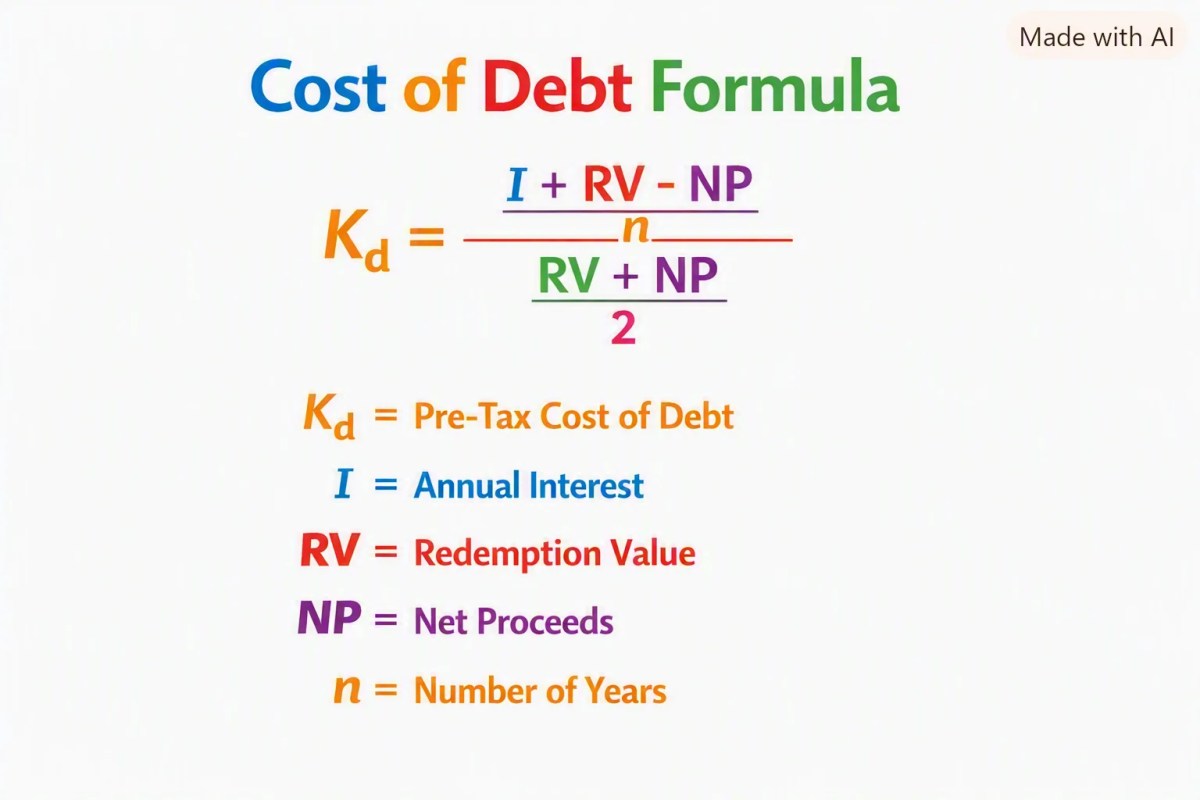
The Yield to Maturity approach estimates the cost of debt by considering the return required by lenders on a debt instrument until its maturity. It considers the current market price of the debt, annual interest payments, redemption value and remaining maturity period. This approach provides a market based estimate of the borrowing cost, particularly for market traded bonds and debentures. When the debt is issued at a discount or premium, the effective cost may differ from the stated interest rate. Therefore, Yield to Maturity provides a comprehensive measure of the actual pre tax cost of debt.

2. Net Proceeds Approach
The Net Proceeds Approach calculates the cost of debt by comparing the annual interest and repayment obligations with the actual amount of funds received by the company. It is particularly useful when debt is issued at a discount or when flotation and issue expenses are involved. The approach provides an effective borrowing cost rather than simply considering the stated interest rate. If issue expenses or discounts reduce the amount received, the effective cost of borrowing increases. Therefore, this approach helps management evaluate the actual cost associated with raising debt finance.
3. Present Value Approach
The Present Value Approach determines the cost of debt by finding the discount rate that equates the present value of future debt cash outflows with the net proceeds received by the company. Future interest payments and redemption amounts are discounted at the rate representing the effective cost of debt. This approach is more accurate because it considers the timing and amount of all relevant cash flows. It is especially useful when debt has different payment patterns or when the simple approximation method may not provide a sufficiently accurate estimate.

4. After Tax Cost of Debt Theory
The After Tax Cost of Debt approach recognises that interest expense on debt may provide a tax benefit to the company, subject to applicable tax rules. Since interest is generally deductible for corporate tax purposes under applicable conditions, the effective cost of debt after tax is lower than its pre tax cost. This makes debt financing relatively attractive compared with equity in many situations. However, the actual tax benefit depends on the company’s taxable income and applicable tax provisions. Therefore, after tax cost of debt is widely used in calculating the company’s overall cost of capital.

5. Cost of Irredeemable Debt Theory
For irredeemable or perpetual debt, the company does not have a fixed redemption date. Therefore, the cost of debt is calculated by relating the annual interest payment to the current market price or net proceeds of the debt. Since the principal is not repaid during the life of the instrument, the interest payments continue indefinitely. This method is relatively simple and is suitable for perpetual debentures and similar instruments. The after tax cost can also be calculated when the tax effect of interest is considered.

6. Cost of Redeemable Debt Theory
The Cost of Redeemable Debt approach considers both periodic interest payments and the amount payable when the debt is redeemed. Unlike irredeemable debt, redeemable debt has a specified maturity date. The effective cost therefore depends on the interest payments, redemption value, issue price or net proceeds and maturity period. This approach provides a more realistic estimate of borrowing cost because it considers the complete cash flow pattern of the debt instrument. It is commonly applied to redeemable debentures, bonds and other fixed maturity debt instruments.

Applications of Cost of Debt:
1. Capital Structure Decisions
Cost of debt is an important factor in determining the appropriate mix of debt and equity in a company’s capital structure. Management compares the cost of debt with the cost of equity to identify a suitable financing combination. Debt may be attractive because interest expenses can provide a tax benefit, subject to applicable tax rules. However, excessive borrowing increases financial risk and repayment obligations. Therefore, cost of debt helps management evaluate the benefits and risks of debt financing and select a capital structure that balances financing cost, financial risk and shareholder interests.
2. Capital Budgeting
Cost of debt is used in capital budgeting to assess the financing cost associated with investment projects. When a project is financed through debt, management needs to consider the cost of borrowing while evaluating the project’s expected returns and cash flows. The after tax cost of debt may also be considered where applicable. Cost of debt can form part of the discount rate through the Weighted Average Cost of Capital. Therefore, it helps determine whether the expected returns from an investment are sufficient to cover the cost of funds used for financing the project.
3. Calculation of WACC
Cost of debt is an essential component of the Weighted Average Cost of Capital. WACC combines the costs of different sources of finance according to their proportion in the company’s capital structure. The after tax cost of debt is generally used when interest provides a tax benefit. Accurate estimation of debt cost is therefore necessary for calculating WACC correctly. WACC is widely used in investment appraisal and business valuation. Hence, cost of debt directly affects the company’s overall financing cost and influences investment and valuation decisions.
4. Debt Financing Decisions
Cost of debt helps management evaluate whether borrowing is an appropriate source of finance for a particular financial requirement. Before obtaining a loan or issuing bonds, the company can estimate the interest cost, issue expenses and other borrowing charges. Management can then compare the effective cost with alternative sources such as equity and retained earnings. This helps identify the most economical financing option while considering risk and repayment capacity. Therefore, cost of debt provides an important basis for selecting suitable debt instruments and financing arrangements.
5. Company Valuation
Cost of debt is used in company valuation because it contributes to the calculation of the overall discount rate, particularly through WACC. Future operating cash flows of a business may be discounted using WACC to determine their present value. Since debt is one component of the financing structure, its cost affects the overall discount rate. A higher cost of debt may increase WACC and reduce the estimated value of future cash flows. Therefore, accurate estimation of cost of debt is important for business valuation and investment analysis.
6. Loan and Bond Evaluation
Cost of debt helps companies evaluate different loan and bond financing options. Borrowing arrangements may differ in terms of interest rates, maturity periods, issue prices, processing charges and other costs. Management can calculate the effective cost of each alternative rather than comparing only the stated interest rates. This allows the company to identify the financing option that provides funds at a suitable overall cost. Therefore, cost of debt is useful when selecting between different debt instruments and negotiating borrowing arrangements with financial institutions and investors.
7. Financial Risk Management
Cost of debt is relevant to financial risk management because borrowing creates fixed financial obligations such as interest and principal repayment. A company with a high cost of debt may face greater pressure on cash flows, especially when operating performance declines. Management can therefore use cost of debt to evaluate the affordability and risk associated with additional borrowing. Monitoring borrowing costs also helps the company assess whether refinancing or restructuring existing debt may be beneficial. Thus, cost of debt supports decisions aimed at controlling financial risk and maintaining adequate debt servicing capacity.
8. Refinancing Decisions
Cost of debt is useful when a company considers replacing existing debt with new borrowing. Management can compare the cost of existing debt with the cost of new financing after considering interest rates, transaction costs, penalties and other charges. If new debt can reduce the effective financing cost without creating excessive risk, refinancing may improve financial efficiency. However, the complete cash flow impact must be considered before making the decision. Therefore, cost of debt provides an important benchmark for evaluating refinancing opportunities and managing the company’s long term borrowing costs.
9. Dividend and Retention Decisions
Cost of debt can indirectly influence dividend and retained earnings decisions. If borrowing is relatively expensive, management may prefer to use internal funds rather than take additional debt, provided sufficient funds are available. Conversely, when borrowing costs are favourable and the company has profitable investment opportunities, debt may be considered as an additional financing source. Management must also consider the effect of borrowing on financial risk and future cash flows. Therefore, cost of debt helps determine whether internal funds, debt or a combination of financing sources should be used to meet investment requirements.
10. Investment and Financing Planning
Cost of debt supports long term financial planning by helping management estimate future borrowing costs and financing requirements. Companies can use the estimated cost of debt while preparing financial projections, investment plans and capital expenditure budgets. It helps determine the likely cost of financing expansion, acquisition, replacement of assets and other major investments. By considering expected interest rates, tax effects and repayment obligations, management can develop a more realistic financing plan. Therefore, cost of debt is an important input in coordinating investment decisions with the company’s overall financing strategy.
Challenges of Cost of Debt:
1. Fluctuation in Interest Rates
One major challenge in determining the cost of debt is the fluctuation in market interest rates. Companies with variable rate loans may experience changes in interest payments when market rates increase or decrease. Even fixed rate debt may become relatively expensive if market interest rates fall after borrowing. Changes in interest rates therefore affect the actual financing cost and future cash flows of the company. Management must monitor interest rate movements and consider refinancing, hedging or suitable debt structures where appropriate. Hence, changing interest rates make accurate long term estimation of cost of debt difficult.
2. Difficulty in Estimating Effective Cost
The stated interest rate does not always represent the actual cost of debt. Companies may incur processing fees, issue expenses, underwriting charges, discounts, premiums and other borrowing costs. These additional amounts affect the net proceeds received and therefore change the effective cost of borrowing. Calculating the true cost requires consideration of all relevant cash flows throughout the debt’s life. This can become complicated when repayment schedules or interest payments vary. Therefore, management must carefully analyse the complete terms of a debt instrument rather than relying only on its stated interest rate.
3. Tax Rate Changes
The after tax cost of debt depends partly on the applicable tax rate and the tax treatment of interest expenses. Changes in tax laws, tax rates or restrictions on interest deductions can alter the effective cost of borrowing. A company may initially estimate a particular tax benefit, but changes in regulations may reduce or modify that benefit. Differences in the company’s taxable income can also affect the actual usefulness of tax deductions. Therefore, uncertainty regarding future taxation creates challenges when estimating the long term after tax cost of debt.
4. Credit Rating Changes
A company’s credit rating can significantly affect its borrowing cost. Companies with strong credit ratings are generally able to borrow at relatively favourable rates because lenders perceive lower default risk. If the company’s financial position deteriorates, its credit rating may decline and lenders may demand a higher interest rate. This can increase the cost of new borrowing and refinancing. Therefore, changes in creditworthiness create uncertainty in estimating future debt costs. Management must monitor financial performance, debt levels and repayment capacity to maintain a favourable credit position.
5. Debt Maturity Period
The maturity period of debt creates challenges in estimating its cost because longer maturity generally involves greater uncertainty about future interest rates and economic conditions. Long term debt may also carry different interest rates compared with short term borrowing. For redeemable debt, the calculation must consider interest payments, issue price, redemption value and the period until maturity. Changes in market conditions during this period can affect refinancing requirements. Therefore, management must carefully consider maturity structure when estimating and managing the company’s overall cost of debt.
6. Market Conditions
Overall financial market conditions influence the cost at which companies can obtain debt. Economic growth, inflation, monetary policy, liquidity conditions and investor sentiment can affect interest rates and credit spreads. During periods of economic uncertainty or tight liquidity, lenders may demand higher returns for providing funds. Conversely, favourable market conditions may allow companies to borrow at lower rates. Since market conditions can change unexpectedly, estimating future borrowing costs can be difficult. Therefore, management must consider both current market conditions and possible future changes while planning debt financing.
7. Credit Risk
Credit risk represents the possibility that a borrower may fail to meet its interest or principal repayment obligations. Lenders consider the financial strength, profitability, cash flow position and existing debt of the company when determining the interest rate. Companies perceived as having higher default risk may have to pay higher interest rates, increasing their cost of debt. Changes in business performance can also affect perceived credit risk over time. Therefore, accurately estimating cost of debt requires careful assessment of the company’s creditworthiness and ability to service its financial obligations.
8. Complex Debt Instruments
Modern companies may use various debt instruments with different interest structures, conversion features, repayment terms and embedded options. Bonds, convertible debentures, floating rate loans and other instruments may require different methods for calculating their effective cost. The presence of discounts, premiums, transaction costs and special repayment conditions can make calculations more complicated. Management must carefully identify all relevant cash flows before estimating the cost of such instruments. Therefore, the complexity of debt contracts can make accurate measurement and comparison of borrowing costs difficult.
9. Refinancing Risk
Refinancing risk arises when a company needs to replace existing debt with new borrowing after maturity. The future cost of refinancing may be higher than the original borrowing cost because market interest rates, credit conditions or the company’s financial position may have changed. This creates uncertainty regarding future financing expenses. A company may also face difficulty obtaining new funds during adverse market conditions. Therefore, management should consider refinancing requirements when evaluating the cost of long term debt and avoid relying solely on the current borrowing rate.
10. Excessive Dependence on Debt
Excessive dependence on debt can increase financial risk and indirectly raise the company’s cost of borrowing. As debt levels increase, lenders may perceive greater risk of financial distress and demand higher interest rates. Higher debt also creates larger fixed payment obligations, which can place pressure on cash flows during periods of weak profitability. Although debt may provide tax benefits, excessive borrowing can reduce financial flexibility. Therefore, management must balance the potential advantages of debt financing with its effect on credit risk, repayment capacity and the overall cost of capital.


