Product and Social Product

A product is the item offered for sale. A product can be a service or an item. It can be physical or in virtual or cyber form. Every product is made at a cost and each is sold at a price. The price that can be charged depends on the market, the quality, the marketing and the segment that is targeted. Each product has a useful life after which it needs replacement, and a life cycle after which it has to be re-invented. In FMCG parlance, a brand can be revamped, re-launched or extended to make it more relevant to the segment and times, often keeping the product almost the same.

A product needs to be relevant: the users must have an immediate use for it. A product needs to be functionally able to do what it is supposed to, and do it with a product quality.

A product needs to be communicated: Users and potential users must know why they need to use it, what benefits they can derive from it, and what it does difference it does to their lives. Advertising and ‘brand building’ best do this.

A product needs a name: a name that people remember and relate to. A product with a name becomes a brand. It helps it stand out from the clutter of products and names.

A product should be adaptable: with trends, time and change in segments, the product should lend itself to adaptation to make it more relevant and maintain its revenue stream.

Social Product

A social product is something that benefits the largest number of people in the largest possible way, such as clean air, clean water, healthcare, and literacy. Also known as “common product,” social product can trace its history to Ancient Greece philosophers and implies a positive impact on individuals or society in general. It also provides the basis for charity or philanthropic work.

The capitalism-based definition of business states that companies exist only to provide the maximum possible return to shareholders. This has often not run parallel to serving the common product in ways such as promoting clean air and water or financial independence for all citizens. As corporations focus more on corporate sustainability efforts and social responsibility in recognition of a de facto social contract with the public, their business models may expand to include more work to promote social product in their day-to-day strategies and operations.

Social Product and Corporations

The decision of Microsoft founder Bill Gates, the wealthiest person in the world, to allocate a significant sum of his wealth to solving some of the world’s most intractable problems is an example of work benefiting the social product. The Bill and Melinda Gates Foundation runs programs to alleviate and cure diseases such as HIV, malaria, neglected tropical diseases, and more in developing countries.

Corporations keen to promote an image of themselves as socially conscious and responsible have created programs that seek to highlight their work toward social product. Aside from the positive feelings such programs generate, doing work that benefits the social product can give a company a sense of purpose and passion. That can help with productivity, innovation, and growth, as employees who believe in their company’s mission tend to invest more of their effort and passion into their work. Working toward a social product also has the effect of building bonds with the community. In helping a community or group of people, a company may hope that their effort is rewarded with sales.

Corporate investment in the social product can also help a company build and maintain its brand and its identity, as well as loyalty. A product example of this is the Newman’s Own brand, which discloses clearly on its label, “all profits to charity.” Those charities include ones related to ecology, conservation, and religious causes, among others.

Social Product and Social Media

Increasingly, social product has been connected with social media in that its definition has expanded to include a shareable deed or sentiment. Social media platforms are becoming a part of the social product in that they are an efficient way to educate the public, and advocate and fundraise for programs that support the social product. It also means that individuals, not just governments, corporations, or charities, can advocate for social product.

Aristotle described the common product as “proper to, and attainable only by, the community, yet individually shared by its members.”

Example of Social Product

As climate change becomes a mainstream issue, oil companies have increasingly come in for criticism due to their role in polluting the atmosphere. They have created separate divisions in order to promote their environmental image. For example, Total, France’s biggest petroleum major, allocated 4.3% of its budget to investing in renewable energy technologies in 2018. Equinor, Norway’s biggest energy company, plans to spend between 15–20% of its budget on renewable energy by 2030. British Petroleum has created a separate division to invest in renewable energy ventures.

  • In recent times, social product is used to refer to corporate initiatives that aim to enhance the social contract of corporations by promoting practices that are better for the environment and overall society.
  • Corporations gain employee trust and loyalty by providing them with a sense of purpose and loyalty in their work.
  • Social media has become an important tool to promote social product

Level of Product

According to Philip Kotler, who is an economist and a marketing guru, a product is more than a tangible ‘thing’. A product meets the needs of a consumer and in addition to a tangible value this product also has an abstract value. For this reason Philip Kotler states that there are five product levels that can be identified and developed. In order to shape this abstract value, Philip Kotler uses five product levels in which a product is located or seen from the perception of the consumer. These 5 Product Levels indicate the value that consumers attach to a product. The customer will only be satisfied when the specified value is identical or higher than the expected value.

  • Need: A lack of a basic requirement.
  • Want: A specific requirement of products to satisfy a need.
  • Demand: A set of wants plus the desire and ability to pay for the product.

Customers will choose a product based on their perceived value of it. Satisfaction is the degree to which the actual use of a product matches the perceived value at the time of the purchase. A customer is satisfied only if the actual value is the same or exceeds the perceived value. Kotler attributed five levels to products:

The five(5) product levels are:

  1. Core Benefit

The fundamental need or want that consumers satisfy by consuming the product or service. For example, the need to process digital images.

  1. Generic/Basic Product

A version of the product containing only those attributes or characteristics absolutely necessary for it to function. For example, the need to process digital images could be satisfied by a generic, low-end, personal computer using free image processing software or a processing laboratory.

  1. Expected Product

The set of attributes or characteristics that buyers normally expect and agree to when they purchase a product. For example, the computer is specified to deliver fast image processing and has a high-resolution, accurate colour screen.

  1. Augmented Product

The inclusion of additional features, benefits, attributes or related services that serve to differentiate the product from its competitors. For example, the computer comes pre-loaded with a high-end image processing software for no extra cost or at a deeply discounted, incremental cost.

  1. Potential Product

This includes all the augmentations and transformations a product might undergo in the future. To ensure future customer loyalty, a business must aim to surprise and delight customers in the future by continuing to augment products. For example, the customer receives ongoing image processing software upgrades with new and useful features.

Added value of the Five Product Levels

Each level of the five product levels adds value for the customer. The more efforts production companies make at all levels, the more likely they are to stand a chance to be distinctive. At the Augmented Product level, the competition is observed in order to copy certain techniques, tricks and appearance of each other’s products. This makes it increasingly difficult for a consumer to define the distinctiveness of a product. To be able to tower over the competition, production companies focus on factors which consumers attach extra value to such as extreme packaging, surprising advertisements, customer-oriented service and affordable payment terms. This is not just about satisfying the customers and exceeding their expectations but also about surprising them.

What benefits does the model provide?

Kotler’s Five Product Level model provides businesses with a proven method for structuring their product portfolio to target various customer segments. This enables them to analyse product and customer profitability (sales and costs) in a structured way. By organizing products according to this model, a business’ sales processes can be aligned to its customer needs and help focus other operational processes around its customers – such as design and engineering, procurement, production planning, costing and pricing, logistics, and sales and marketing. Grouping products into product families that align with customer segments helps modelling and planning sales, as well as production and new product planning.

Social Product Branding Decision

Branding consists of a set of complex branding decisions. Major brand strategy decisions involve brand positioning, brand name selection, brand sponsorship and brand development.

Before going into the four branding decisions, also called brand strategy decisions, we should clarify what a brand actually is. A brand is a company’s promise to deliver a specific set of features, benefits, services and experiences consistently to buyers. However, a brand should rather be understood as a set of perceptions a consumer has about the products of a particular firm. Therefore, all branding decisions focus on the consumer.

We will take a close look at each of these four branding decisions.

  1. Brand Positioning

A brand must be positioned clearly in target customers’ minds. Brand positioning can be done at any of three levels:

  • On product attributes
  • On benefits
  • On beliefs and values.

At the lowest level, marketers can position a brand on product attributes. Marketing for a car brand may focus on attributes such as large engines, fancy colours and sportive design. However, attributes are generally the least desirable level for brand positioning. The reason is that competitors can easily copy these attributes, taking away the uniqueness of the brand. Also, customers are not interested in attributes as such. Rather, they are interested in what these attributes will do for them. That leads us to the next level: Benefits.

A brand can be better positioned on basis of a desirable benefit. The car brand could go beyond the technical product attributes and promote the resulting benefits for the customer: quick transportation, lifestyle and so further.

Yet, the strongest brands go beyond product attributes and benefits. They are positioned on beliefs and values. Successful brands engage customers on a deep, emotional level. Examples include brands such as Mini and Aston Martin. These brands rely less on products’ tangible attributes, but more on creating passion, surprise and excitement surrounding the brand. They have become “cool” brands.

Brand positioning lays the foundation for the three other branding decisions. Therefore, brand positioning should also involve establishing a mission for the brand and a vision of what the brand should be and do. The brand’s promise must be simple and honest.

  1. Brand Name Selection

When talking about branding decisions, the brand name decision may be the most obvious one. The name of the brand is maybe what you think of first when imagining a brand – it is the base of the brand. Therefore, the brand name selection belongs to the most important branding decisions. However, it is also quite a difficult task.

We have to start with a careful review of the product and its benefits, the target market and proposed marketing strategies. Having that in mind, we have to find a brand name matching these things. Naming a brand is part science, part art, and certainly a measure of instinct.

Although finding the right name for a brand can be a challenging task, there are some guidelines to make it easier. Desirable qualities for a brand name include:

  • It should suggest something about a product’s benefits and qualities. Think of the wadding polish “Nevr Dull”. The brand name indicates the benefit of using this product: the treated metal will never be dull.
  • It should be easy to pronounce, recognise, and remember. iPod and Nike are certainly better than “Troglodyte Homonculus” a clothing brand.
  • The brand name should be distinctive, so that consumers don’t confuse it with other brands. Rolex and Bugatti are good examples.
  • It should also be extendable. Think of Amazon.com, which began as an online bookseller but chose a name that would allow expansion into other categories. If Amazon.com had chosen a different name, such as books.com, it could not have extended its business that easily.
  • The brand name should translate easily into foreign languages. The Ford Pinto line had some struggles in Brazil, seeing as it translated into “tiny male genitals”. Or the Mitsubishi Pajero, which means in Spanish “man who plays with himself and enjoys it a bit too much”. More famous: Coca-Cola reads in Chinese as “female horse stuffed with wax”.
  • It should be capable of registration and legal protection. In other words, it must not infringe on existing brand names.

Worthy of note is the fact that brand name preferences are changing continuously. After a decade of choosing quirky names (such as Yahoo!, Google) or fictional names, today’s style is to build brands around names that carry real meaning. For instance, names such as Blackboard, a school software, make sense. However, with more and more brand names and trademark applications, available new names can be hard to find.

Choosing a brand name is not enough. It also needs to be protected. Many firms attempt to build a brand name that will eventually become identified with a product category. Examples for these names include Kleenex, Tip-ex and Jeep. However, their success can also quickly threaten the company’s rights to the name. Once a trademark becomes part of the normal language (called “genericization”), it is not protected anymore. For that reason many originally protected brand names, such as aspirin, Walkman (by Sony) and many other names are not protected anymore.

  1. Brand Sponsorship

Branding decisions go beyond deciding upon brand positioning and brand name. The third of our four branding decisions is the brand sponsorship. A manufacturer has four brand sponsorship options.

A product may be launched as a manufacturer’s brand. This is also called national brand. Examples include Kellogg selling its output under the own brand name (Kellog’s Frosties, for instance) or Sony (Sony Bravia HDTV).

The manufacturer could also sell to resellers who give the product a private brand. This is also called a store brand, a distributor brand or an own-label. Recent tougher economic times have created a real store-brand boom. As consumers become more price-conscious, they also become less brand-conscious, and are willing to choose private brands instead of established and often more expensive manufacturer’s brands.

Also, manufacturers can choose licensed brands. Instead of spending millions to create own brand names, some companies license names or symbols previously created by other manufacturers. This can also involve names of well-known celebrities or characters from popular movies and books. For a fee, they can provide an instant and proven brand name. For example, sellers of children’s products often attach character names to clothing, toys and so on. These licensed character names include Disney, Star Wars, Hello Kitty and many more.

Finally, two companies can join forces and co-brand a product. Co-branding is the practice of using the established brand names of two different companies on the same product. This can offer many advantages, such as the fact that the combined brands create broader consumer appeal and larger brand equity. For instance, Nestlé uses co-branding for its Nespresso coffee machines, which carry the brand names of well-known kitchen equipment manufacturers such as Krups, DeLonghi and Siemens.

  1. Brand Development

Branding decisions finally include brand development. For developing brands, a company has four choices: line extensions, brand extensions, multibrands or new brands.

Line extension refers to extending an existing brand name to new forms, sizes, colours, ingredients or flavours of an existing product category. This is a low-cost, low-risk way to introduce new products. However, there are the risks that the brand name becomes overextended and loses its specific meaning. This may confuse consumers. An example for line extension is when Coca-Cola introduces a new flavour, such as diet cola with vanilla, under the existing brand name.

Brand extension also assumes an existing brand name, but combines it with a new product category. Thus, an existing brand name is extended to a new product category. This gives the new product instant recognition and faster acceptance and can save substantial advertising costs for establishing a new brand. However, the risk that the extension may confuse the image of the main brand should be kept in mind. Also, if the extension fails, it may harm consumer attitudes toward other products carrying the same brand name. For this reason, a brand extension such as Heinz pet food cannot survive. But other brand extensions work well. For instance, Kellog’s has extended its Special K healthy breakfast cereal brand into a complete line of cereals plus a line of biscuits, snacks and nutrition bars.

Multibrands means marketing many different brands in a given product category. P&G (Procter & Gamble) and Unilever are the best examples for this. In the USA, P&G sells six brands of laundry detergent, five brands of shampoo and four brands of dishwashing detergent. Why? Multibranding offers a way to establish distinct features that appeal to different customer segments. Thereby, the company can capture a larger market share. However, each brand might obtain only a very small market share and none may be very profitable.

New brands are needed when the power of existing brand names is waning. Also, a new brand name is appropriate when the company enters a new product category for which none of its current brand names are appropriate.

As you might have recognised, these four branding decisions are all interrelated. In order to build strong brands, brand positioning, brand name, brand sponsorship and brand development have to be in line with each other.

Price: Monetary and Non Monetary Incentives for Desired Behaviour

Price

A value that will purchase a finite quantity, weight, or other measure of a good or service.

As the consideration given in exchange for transfer of ownership, price forms the essential basis of commercial transactions. It may be fixed by a contract, left to be determined by an agreed upon formula at a future date, or discovered or negotiated during the course of dealings between the parties involved.

Monetary and Non Monetary Incentives for Desired Behaviour

Money doesn’t grow on trees, but you’re thinking about extending a branch from your desk. It could “grow” from there, in the form of monetary and non-monetary incentives to your employees. As a small-business owner, you well know: No matter how driven an employee is, there’s nothing like an incentive to light the fire of motivation. Incentives can improve employee morale and bolster productivity, leading to improved customer service, efficiency, sales and profits.

If you’re new to the concept of incentives, what you may not know is that there’s a difference between monetary and non-monetary incentives. They obviously differ in form, but they also differ in how they’re perceived by employees. These differences are worth considering before you put a pair of hedge clippers next to your desk.

Monetary Incentives

If you want to get technical about it, as human resource professionals are prone to do, monetary incentives are designed to reward employees for outstanding job performance or longevity.

As its name implies, a monetary incentive has an explicit monetary value; an employee knows exactly what one is worth. In addition to cold, hard cash, monetary rewards can take the form of:

  • Bonuses
  • Commissions
  • Merit pay
  • Profit sharing
  • Stock options
  • Vacation time (beyond an employee’s normal paid time)

Non-Monetary Incentives

Non-monetary incentives are designed to recognize a special achievement or the completion of something that enhances an employee’s job performance or value to a company. Such a meritorious category might include the attainment of a sales goal, the culmination of a special research project or graduation from a training program that leads to a desirable certification.

A non-monetary incentive does not take the form of cold, hard cash, but this doesn’t mean an employee cannot discern its monetary value. Some traditional favorites among employers include:

  • Healthcare benefits
  • Life insurance
  • Promotion
  • Vehicle or vehicle allowance

Expand Upon Traditional Non-Monetary Incentives

If you’re considering using non-monetary incentives as a motivational tool, it’s fair to say that they’re limited only by your imagination, and maybe the needs or wants of your employees.

If you’re looking for ideas, employers are known to turn to non-cash incentives such as:

  • Charitable donations made in an employee’s name.* Concert tickets.
  • Gift cards.
  • Luxury gifts, such as designer clothing, watches and laptops.* Vacation packages, including airfare and accommodations.

Study Reveals Strong Preference

Despite the differences, there are no hard-and-fast rules governing the use of monetary and non-monetary incentives. In other words, who’s to say that you can’t write a bonus check to an employee who just finished an intensive training program? Or that you shouldn’t surprise an employee celebrating his 10th anniversary with your company by gifting him a weekend getaway package?

You’re the boss, so it’s up to you to decide how best to incentivize your employees. However, if you’re interested in knowing how other business owners are lining up on the topic, then you might cast your lot with non-cash incentives. Between 1996 and 2016, the number of businesses that rely on non-cash rewards increased from 26 percent to 84 percent, according to The Incentive Research Foundation.

How does the foundation explain such a dramatic increase? Two possible influences in the world of work may account for it:

CEOs play a more hands-on role in the day-to-day operation of businesses, putting them in the same realm as employees more frequently than in the past. This greater insight compels CEOs to reward employees more often.* Many employees’ roles have expanded well beyond their basic job description, and CEOs feel duty-bound to acknowledge employee contributions, beyond their usual paycheck.

Assess the Advantages of Monetary Incentives

Before you officially cast your vote, you may wish to assess the advantages and disadvantages of monetary and non-monetary incentives. Some of them may surprise you, especially if you think nothing “talks” more persuasively than money. Monetary incentives:

  • Are instantly recognizable and simple for employees to comprehend.
  • Hold universal appeal.
  • Are favored by employees who prefer to add them to their annual salary.
  • Do not require personalization in the way that a non-monetary incentive requires forethought.
  • Can solve a financial dilemma for a small-business owner who may want to give an employee a pay raise but cannot afford to do so.

Assess the Disadvantages of Monetary Incentives

You would be hard-pressed to find an employee who would say, “No thanks, boss; I don’t care much for money.” Remember that in this context, as an incentive, money might talk, alright. It just might speak a different language. It’s wise to consider that maybe – just maybe – the monetary benefits you hope to reap could backfire if:

  • Employees don’t see a clear and direct correlation between the benchmark and the incentive. These employees could undercut even the most lucrative incentive program unless they view it as worthwhile.
  • They create a sense of inequality. Since “top” employees often get monetary rewards, those who are left out may become a drag on employee morale and teamwork. They lead to a sense of entitlement among top employees, who may even turn up their noses to the non-monetary incentives you offer. They “supercharge” cut-throat, competitive employees to sabotage the work of their colleagues to attain the incentive.* They are unfairly distributed among a group. This is why many business owners get ahead of this approaching storm cloud and either establish individual incentives or distribute incentives to all team members.
  • You include them as an addendum to an employee’s paycheck. In this case, the incentive doesn’t stand out; it’s simply absorbed in an employee’s earnings and probably goes to pay the rent or mortgage and other monthly bills and is quickly forgotten.

Assess the Top Advantages of Non-Monetary Incentives

The businesses that The Incentive Research Foundation found are turning to non-monetary incentives may be on to something: Employees seem to ascribe a greater value to gifts, even if they can place a dollar value on them. As an employer, you may see little difference between, say, writing a $1,000 bonus check and bestowing a $1,000 laptop on a deserving employee.

But the employee? Multiple research studies show that employees show greater enthusiasm and appreciation for tangible things they can use (like a laptop), enjoy (like a vacation) or show off and brag about to others (like jewelry and clothing). And the more they can use or show off these incentives, the more likely they are to think of the employer in a favorable light.

If this still doesn’t compute to you, try relating non-monetary incentives to the burgeoning gift card industry. Give someone $50 in cash and they will surely appreciate it – before putting it promptly in their wallet and probably forgetting about it. But give them a $50 gift card and they will regard it for what it is: A gift, and something they can redeem for something pleasurable. Gift cards are stamped with a dollar amount, just like cash. But somehow, they signal greater thought and consideration on the part of the giver.

Assess the Other Advantages of Non-Monetary Incentives

Research also shows that the psychology of offering non-monetary incentives intensifies when employees are given a choice or are at least asked about their preferences. This is no small insight for any small-business owner who hopes to incentivize her staff.

In addition to being tangible items that hold bragging rights, non-monetary incentives:

  • Serve as a lasting reminder of an employee’s accomplishment.
  • Can serve as an in-house marketing tool, especially if you photograph the employee with the incentive and post it on your business website.
  • Can be used as a recruiting tool if you “advertise” the incentive in the same way.* Can be deducted as a business expense.

Assess the Disadvantages of Non-Monetary Incentives

It would be wrong to say that non-monetary incentives have no drawbacks. They exist, but they seem to be mostly self-inflicted by the business owner who neglects to:

  • Ensure that the incentives are appealing to employees. A weekend ski package or a Las Vegas getaway may be up your alley but not necessarily so for an employee who has never snapped on ski boots or who doesn’t like to gamble.
  • Do his homework when selecting employee incentives.

Like many business owners, you might need to experiment with monetary and non-monetary incentives, until you find the right offering for your employees. But compared to the other dilemmas you face, this task might be one of the most fun – with or without the hedge clippers.

Pricing Objectives

Pricing can be defined as the process of determining an appropriate price for the product, or it is an act of setting price for the product. Pricing involves a number of decisions related to setting price of product. Pricing policies are aimed at achieving various objectives. Company has several objectives to be achieved by the sound pricing policies and strategies. Pricing decisions are based on the objectives to be achieved. Objectives are related to sales volume, profitability, market shares, or competition. Objectives of pricing can be classified in five groups as shown in figure 1.

  1. Profits-related Objectives

Profit has remained a dominant objective of business activities.

Company’s pricing policies and strategies are aimed at following profits-related objectives:

(a) Maximum Current Profit

One of the objectives of pricing is to maximize current profits. This objective is aimed at making as much money as possible. Company tries to set its price in a way that more current profits can be earned. However, company cannot set its price beyond the limit. But, it concentrates on maximum profits.

(b) Target Return on Investment

Most companies want to earn reasonable rate of return on investment.

Target return may be:

  • Fixed percentage of sales
  • Return on investment
  • A fixed rupee amount

Company sets its pricing policies and strategies in a way that sales revenue ultimately yields average return on total investment. For example, company decides to earn 20% return on total investment of 3 crore rupees. It must set price of product in a way that it can earn 60 lakh rupees.

  1. Sales-related Objectives

The main sales-related objectives of pricing may include:

(a) Sales Growth

Company’s objective is to increase sales volume. It sets its price in such a way that more and more sales can be achieved. It is assumed that sales growth has direct positive impact on the profits. So, pricing decisions are taken in way that sales volume can be raised. Setting price, altering in price, and modifying pricing policies are targeted to improve sales.

(b) Target Market Share

A company aims its pricing policies at achieving or maintaining the target market share. Pricing decisions are taken in such a manner that enables the company to achieve targeted market share. Market share is a specific volume of sales determined in light of total sales in an industry. For example, company may try to achieve 25% market shares in the relevant industry.

(c) Increase in Market Share

Sometimes, price and pricing are taken as the tool to increase its market share. When company assumes that its market share is below than expected, it can raise it by appropriate pricing; pricing is aimed at improving market share.

  1. Competition-related Objectives

Competition is a powerful factor affecting marketing performance. Every company tries to react to the competitors by appropriate business strategies.

With reference to price, following competition-related objectives may be priorized:

(a) To Face Competition

Pricing is primarily concerns with facing competition. Today’s market is characterized by the severe competition. Company sets and modifies its pricing policies so as to respond the competitors strongly. Many companies use price as a powerful means to react to level and intensity of competition.

(b) To Keep Competitors Away

To prevent the entry of competitors can be one of the main objectives of pricing. The phase ‘prevention is better than cure’ is equally applicable here. If competitors are kept away, no need to fight with them. To achieve the objective, a company keeps its price as low as possible to minimize profit attractiveness of products. In some cases, a company reacts offensively to prevent entry of competitors by selling product even at a loss.

(c) To Achieve Quality Leadership by Pricing

Pricing is also aimed at achieving the quality leadership. The quality leadership is the image in mind of buyers that high price is related to high quality product. In order to create a positive image that company’s product is standard or superior than offered by the close competitors; the company designs its pricing policies accordingly.

(d) To Remove Competitors from the Market

The pricing policies and practices are directed to remove the competitors away from the market. This can be done by forgoing the current profits by keeping price as low as possible in order to maximize the future profits by charging a high price after removing competitors from the market. Price competition can remove weak competitors.

  1. Customer-related Objectives

Customers are in center of every marketing decision.

Company wants to achieve following objectives by the suitable pricing policies and practices:

(a) To Win Confidence of Customers

Customers are the target to serve. Company sets and practices its pricing policies to win the confidence of the target market. Company, by appropriate pricing policies, can establish, maintain or even strengthen the confidence of customers that price charged for the product is reasonable one. Customers are made feel that they are not being cheated.

(b) To Satisfy Customers

To satisfy customers is the prime objective of the entire range of marketing efforts. And, pricing is no exception. Company sets, adjusts, and readjusts its pricing to satisfy its target customers. In short, a company should design pricing in such a way that results into maximum consumer satisfaction.

  1. Other Objectives

Over and above the objectives discussed so far, there are certain objectives that company wants to achieve by pricing.

They are as under:

(a) Market Penetration

This objective concerns with entering the deep into the market to attract maximum number of customers. This objective calls for charging the lowest possible price to win price-sensitive buyers.

(b) Promoting a New Product

To promote a new product successfully, the company sets low price for its products in the initial stage to encourage for trial and repeat buying. The sound pricing can help the company introduce a new product successfully.

(c) Maintaining Image and Reputation in the Market

Company’s effective pricing policies have positive impact on its image and reputation in the market. Company, by charging reasonable price, stabilizing price, or keeping fixed price can create a good image and reputation in the mind of the target customers.

(d) To Skim the Cream from the Market

This objective concerns with skimming maximum profit in initial stage of product life cycle. Because a product is new, offering new and superior advantages, the company can charge relatively high price. Some segments will buy product even at a premium price.

(e) Price Stability

Company with stable price is ranked high in the market. Company formulates pricing policies and strategies to eliminate seasonal and cyclical fluctuations. Stability in price has a good impression on the buyers. Frequent changes in pricing affect adversely the prestige of company.

(f) Survival and Growth

Finally, pricing is aimed at survival and growth of company’s business activities and operations. It is a fundamental pricing objective. Pricing policies are set in a way that company’s existence is not threatened.

Pricing Strategies

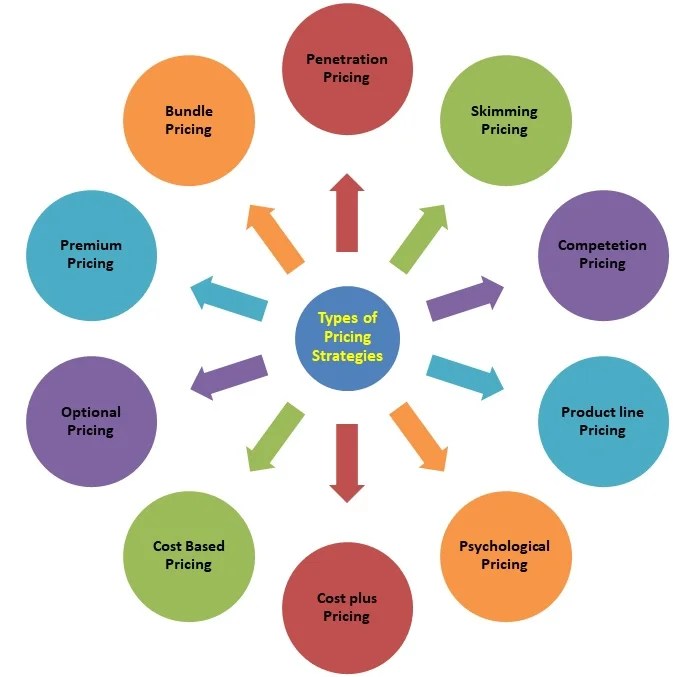
A business can use a variety of pricing strategies when selling a product or service. The price can be set to maximize profitability for each unit sold or from the market overall. It can be used to defend an existing market from new entrants, to increase market share within a market or to enter a new market.

Types of Pricing Strategies:

  1. Penetration Pricing

The price charged for products and services is set artificially low in order to gain market share. Once this is achieved, the price is increased. This approach was used by France Telecom and Sky TV. These companies need to land grab large numbers of consumers to make it worth their while, so they offer free telephones or satellite dishes at discounted rates in order to get people to sign up for their services. Once there is a large number of subscribers prices gradually creep up. Taking Sky TV for example, or any cable or satellite company, when there is a premium movie or sporting event prices are at their highest so they move from a penetration approach to more of a skimming/premium pricing approach.

  1. Skimming Pricing

Price skimming sees a company charge a higher price because it has a substantial competitive advantage. However, the advantage tends not to be sustainable. The high price attracts new competitors into the market, and the price inevitably falls due to increased supply.

Manufacturers of digital watches used a skimming approach in the 1970s. Once other manufacturers were tempted into the market and the watches were produced at a lower unit cost, other marketing strategies and pricing approaches are implemented. New products were developed and the market for watches gained a reputation for innovation.

  1. Competition Pricing

Competitive pricing consists of setting the price at the same level as one’s competitors. This method relies on the idea that competitors have already thoroughly worked on their pricing. In any market, many firms sell the same or very similar products, and according to classical economics, the price for these products should, in theory, already be at an equilibrium (or at least at a local equilibrium). Therefore, by setting the same price as its competitors, a newly-launched firm can avoid the trial and error costs of the price-setting process. However, every company is different and so are its costs. Considering this, the main limit of the competitive pricing method is that it fails to account for the differences in costs (production, purchasing, sales force, etc.) of individual companies. As a result, this pricing method can potentially be inefficient and lead to reduced profits.

For example, a firm needs to price a new coffee maker. The firm’s competitors sell it at $25, and the company considers that the best price for the new coffee maker is $25. It decides to set this very price on their own product. Moreover, this pricing method can also be used in combination with other methods such as penetration pricing for example, which consists of setting the price below that of its competition (for instance, in this example, setting the price of the coffee maker at $23).

  1. Product Line Pricing

Where there is a range of products or services the pricing reflects the benefits of parts of the range. For example car washes; a basic wash could be $2, a wash and wax $4 and the whole package for $6. Product line pricing seldom reflects the cost of making the product since it delivers a range of prices that a consumer perceives as being fair incrementally – over the range.

If you buy chocolate bars or potato chips (crisps) you expect to pay X for a single packet, although if you buy a family pack which is 5 times bigger, you expect to pay less than 5X the price. The cost of making and distributing large family packs of chocolate/chips could be far more expensive. It might benefit the manufacturer to sell them singly in terms of profit margin, although they price over the whole line. Profit is made on the range rather than single items.

  1. Psychological Pricing

This approach is used when the marketer wants the consumer to respond on an emotional, rather than rational basis. For example Price Point Perspective (PPP) 0.99 Cents not 1 US Dollar. It’s strange how consumers use price as an indicator of all sorts of factors, especially when they are in unfamiliar markets. Consumers might practice a decision avoidance approach when buying products in an unfamiliar setting, an example being when buying ice cream. What would you like, an ice cream at $0.75, $1.25 or $2.00? The choice is yours. Maybe you’re entering an entirely new market. Let’s say that you’re buying a lawnmower for the first time and know nothing about garden equipment. Would you automatically by the cheapest? Would you buy the most expensive? Or, would you go for a lawnmower somewhere in the middle? Price therefore may be an indication of quality or benefits in unfamiliar markets.

  1. Cost Plus Pricing

Your company has been developing a new printer that will streamline many processes for your small business customers. Your job is to determine the price of the printer. After doing some research, you determine that the best method for pricing the printer is the cost-plus method.

Cost-plus pricing is a straightforward and simple way to arrive at a sales price by adding a markup to the cost of a product. In our example of the printer, you first have to determine the break-even price, which is the sum of all of the expenses involved in creating a product, including expenses like supplies, production costs, and marketing costs. When you pull all of the expenses together to determine the cost of each printer, you determine that each one will cost $78 to produce. If you sold the printer at $78 your company would break even, meaning there would be no profit or loss.

  1. Cost-based Pricing

Cost-based pricing involves setting prices based on the costs for producing, distributing and selling the product. Also, the company normally adds a fair rate of return to compensate for its efforts and risks. To begin with, let’s look at some famous examples of companies using cost-based pricing. Firms such as Ryanair and Walmart work to become the low-cost producers in their industries. By constantly reducing costs wherever possible, these companies are able to set lower prices. Certainly, that leads to smaller margins, but greater sales and profits on the other hand. But even companies with higher prices may rely on cost-based pricing. However, these companies usually intentionally generate higher costs so that they can claim higher prices and margins.

  1. Optional Product Pricing

Companies will attempt to increase the amount customers spend once they start to buy. Optional ‘extras’ increase the overall price of the product or service. For example airlines will charge for optional extras such as guaranteeing a window seat or reserving a row of seats next to each other. Again budget airlines are prime users of this approach when they charge you extra for additional luggage or extra legroom.

  1. Premium Pricing

Use a high price where there is a unique brand. This approach is used where a substantial competitive advantage exists and the marketer is safe in the knowledge that they can charge a relatively higher price. Such high prices are charged for luxuries such as Cunard Cruises, Savoy Hotel rooms, and first class air travel.

  1. Bundle Pricing

The act of placing several products or services together in a single package and selling for a lower price than would be charged if the items were sold separately. The package usually includes one big ticket product and at least one complementary good. Bundled pricing is a marketing method used by retailers to sell products in high supply.

Place: 5 A’s of Distribution of Product in Social Marketing

Place

Place refers to where the product/service of the business is seen, made, sold, or distributed. In essence, place decisions are associated with distribution channels and ways of getting the product to target key customers.

It is important to consider how accessible the product or service is and ensure that customers can easily find you. The product or service must be available to customers at the right time, at the right place, and in the right quantity.

For example, a business may want to provide their products over an e-commerce site, at a retail store, or through a third-party distributor.

Distribution can make or break a company. A good distribution system quite simply means the company has greater chance of selling its products more than its competitors. The company that spreads its products wider and faster into the market place at lower costs than its competitors will make greater margins absorb raw material price rise better and last longer in tough market conditions. Distribution is critical for any type of industry or service. The best price product, promotion and people come to nothing if the product is not available for sale at the points at which consumers can buy.

Types of Distribution Channel

  1. Indirect distribution

Indirect distribution is when the product reaches the end customer through numerous channels in between. For example The product goes from manufacturer to C&F, then to the distributor, then to the retailer and finally to the customer. Thus the chain is long.

  1. Direct distribution

Direct distribution is when the company either directly sends the product to end customer or when the channel length is very less. A company selling on an e commerce portal or selling through modern retail is the form of Direct distribution.

Further more, distribution strategies are also decided based on the level of penetration that the company wants to achieve. This level of penetration is decided again by the remaining 3 P’s of the marketing mix – Product, price and promotions. However, based on the level of penetration, the distribution strategies vary as follows.

  1. Intensive distribution

When the company is having a mass marketing product, then it uses intensive distribution. Intensive distribution tries to cover as much of the market as it can. Typical FMCG and consumer durable products are best example of intensive distribution strategy. You can read this detailed article on Intensive Distribution.

  1. Selective distribution

A company like Armani, Zara or any other such branded company will have selective distribution. These companies are likely to have only limited outlets. For example: In an urban city, Armani might have 2-3 outlets at the maximum whereas Zara might have 4-5. You can read this detailed article on Selective Distribution.

  1. Exclusive distribution

If Zara has 4-5 outlets in a city, how many outlets would a company like Lamborghini have? Probably one in a region of 5-7 cities. That’s exclusive distribution for you. If a company wants to give a big region to one single distributor then it is known as exclusive distribution strategy. In some cases, a distributor might be appointed for a complete country. There would be no one other then that distributor operating in that company. You can read this detailed article on Exclusive Distribution

Overall, distribution strategies depend a lot on the various products which the companies might have. A single company might have multiple product line and lengths, each with its own distribution strategy.

Some products, which are premium, might need selective distribution whereas others which are mass products, may need intensive distribution. The strategies for both types will be different. So, in the end, the distribution of a company is dynamic in nature and it contributes a lot to the competitive advantage of the company.

Promotions: Developing a Promotional Mix for Social Product

Promotions refer to the entire set of activities, which communicate the product, brand or service to the user. The idea is to make people aware, attract and induce to buy the product, in preference over others.

There are several types of promotions. Above the line promotions include advertising, press releases, consumer promotions (schemes, discounts, contests), while below the line include trade discounts, freebies, incentive trips, awards and so on. Sales promotion is a part of the overall promotion effort.

Developing a Promotional Mix for Social Product

  1. Personal Selling

This is often referred to as one-on-one or face-to-face selling. As the name implies, it establishes a direct in-person connection with a prospective customer that may build trust and lead to a sale; it is the only means of promotion that allows you to adjust the message as the sales situation is unfolding. The downside is that it is a very costly means of selling. Examples would be a salesman on the floor of a home improvement company or a representative in a booth at a trade show.

  1. Advertising

This is almost the exact opposite of personal selling because it involves no direct face-to-face customer contact at all. It happens when companies make expenditures to promote their product through such things as media and the internet. The main advantage of this type of marketing is it’s a one-way conversation that helps the customer focus on the benefits of your product or service for them. As mentioned, its biggest drawback is establishing trust because of its impersonal nature. Examples of advertising are television commercials and pop-up ads on websites.

  1. Direct Marketing

This type of marketing tries to narrow the focus to a selected group of people who would be more interested in your product or service than others. Direct marketing can generate more sales because of its specific focus and it normally does it at less cost to the company; however, this type of marketing may be ill-received due to the sheer amount of it that people receive daily. Examples of this type of marketing are e-mail and direct mail advertising campaigns.

  1. Sales Promotion

This is actually a catch-all term that covers any type of promotions other than the ones that are specifically mentioned here. The advantage of them is that they can induce traffic and sales by changing a buyer’s perception of a product or service value. The disadvantage of sales promotions is the short-term nature of them often overshadows your company’s long-term sales goals. Sales promotions can be done by putting coupons on a flyer or snack chips being sold on a point-of-purchase display.

  1. Public Relations

This type of promotion has to do with creating a favorable image for your company as opposed to supplying direct information about a particular product or service. The advantage of public relations is that it can raise the appeal and image of your company for future purchasing decisions in a cost effective way. It must be noted also that it is very difficult to judge the effectiveness of this promotional campaign.

Good examples of this are a company that encourages others to give to disaster relief by matching donations or that hosts a run benefitting cancer research.

  1. Corporate Image

This is very similar to public relations except it is more direct in nature. It seeks to shape the company’s image in a very specific way; this is closely related to branding. The benefit of a corporate image promotion is it can stop a declining sales trend because of poor perceptions about your product or service. The drawback to using this method is that people may see it for exactly what it is and be further dissuaded about purchasing your product or service.

A few very good examples of this are an airline that starts a campaign to fix its perceived uncaring image after a fatal crash of one of its aircrafts or a restaurant chain that needs to fix the negative publicity of a severe food illness outbreak at one of their locations.

  1. Sponsorship

This type of advertising is very similar to public relations in that it deals with a company’s image. It takes place when your company links itself to an event that makes it look good in the community or gives the impression your company is giving back something to the public. It can also be a non-charitable event that your product closely relates to, like sponsoring a sports team.

A sponsorship can do such things as brand enhancement if you do it in conjunction with another strong name, and it can also help your company’s entry into niche markets that are typically hard to break into. It is also normally cost effective for what your company gets out of it. The drawbacks to sponsorship are tarnishing your image if the event or team you sponsor gets caught doing something wrong, and you also have little control over the sponsorship situation.

Examples of a sponsorship are a beer company that sponsors a football (soccer) team or partnering with the Red Cross on a fundraising project after a natural disaster.

  1. Internet Presence

How big a role are internet promotions playing in the marketing mix these days? Let’s just say that they have their own category here where years ago they were just an afterthought. There is absolutely no doubt that the internet is now a very big promotional marketing channel, and most companies are highly aware of this fact. You would have to look far and wide these days for a company that does not have a website or at least a blog. There are also many specialty businesses that have been born for the sole purpose of helping other companies with their internet presence.

A big part of using the internet as a promotional tool has to do with the rise of social media. Sure it’s free to get on and participate with such social media providers such as Facebook and Twitter, but it is far from free for businesses to advertise on social media. These providers know what a powerful tool social media has become for advertising and marketing, and it costs a fair amount for those who use it.

People often refer to the world nowadays as a digital globe because of all the high-tech things like computers and smartphones that dominate life for people. In order for companies to compete for business, they definitely need to firmly establish an online presence. The best way to do this is to have a website that is comprised of factual and relevant data to your product or service and then optimize your site to drive traffic to it. If a website is optimized for search engines (SEO), then it will show up on the first few pages after internet users search a generic keyword.

Big companies have whole departments that specialize in building websites and driving traffic to them, but small businesses often lack an online presence and are poorly optimized to drive traffic to them. Some studies suggest that over 90% of small business websites are not search engine optimized, and it puts them at a big competitive disadvantage. If these sites were optimized, there is no doubt that their sales would increase if their product was good and priced fair. Establishing an internet presence is a big key for promoting products and services.

Message Strategy

If you’re beginning to think about taking your organization’s marketing plan to the next level with an advertising campaign, then it might be time to think about the message you want to send. In advertising, there are six messaging strategies that are most commonly used: emotional, unique selling proposition, generic, positioning, brand image or preemptive. Knowing which messaging strategy you want your organization to use is a big first step towards creating a successful ad campaign. A good messaging strategy can also help position your brand for scalability and big wins. According to Spellbrand, “One of the fundamental differences between Fortune 500 companies and Small & Medium Enterprises (SMEs) is the clarity of marketing messages and the importance placed on strategic marketing using brand storytelling.”

  1. Emotional

An emotional message strategy uses feeling to sell. An ad using this tactic should make their target audience feel an emotional connection to the product or brand. For a powerful example of emotional advertising, watch this ad about the importance of first aid. Emotion is more than just a handy tool to sprinkle throughout marketing tactics, it has a very real, scientifically-proven impact on consumer decision-making.

  1. Unique Selling Proposition

This strategy highlights something unique about your product or brand that others do not offer. What is the differentiated factor that sets your organization apart? What resonates with your prospects? This is the main selling point. A great example of this is included in Simon Sinek’s Golden Circle TED Talk in which he expresses a simple but powerful model for inspirational leadership; starting with a golden circle and the question “Why?”

The essence of a Unique Selling Proposition can be difficult to pin down, as it varies so wildly based on the offerings of specific companies. To make matters more confusing, a USP is not a slogan, but can be used as such. One of the best examples of a successful USP is the classic Domino’s Pizza offer of “fresh hot pizza delivered to your door in 30 minutes or less or it’s free.” While no longer offered, this highly specific offering helped the Domino’s brand stand out in a competitive industry by expressing a unique proposition that benefitted the consumer in either scenario.

When writing your USP, experts advise breaking up the process into these 3 steps:

  • Analyzing your competitors
  • Putting yourself in your customers’ shoes
  • Brainstorming emotional concepts for your business
  1. Generic

Don’t be confused or put off by the word “generic.” This does not mean that you should use uninspired, non-descriptive language in your messaging. When an ad is using a generic strategy, it is focusing on selling the category rather than the specific brand. For example, you may choose to highlight why visiting a clinic is a smart choice rather than highlighting why visiting your specific organization is a good choice. For example, a dentist might use the category of teeth whitening to drive traffic to their office without specifically selling people on it first.

Before pursuing this strategy, be warned: the marketing landscape has seen a marked shift away from generic messaging in recent years. In 2015, marketing software firm Marketo conducted a survey of 2,200 consumers worldwide. The results found that “a whopping 63% of respondents said they are highly annoyed by the way brands continue to blast out generic messaging repeatedly, and 78.6% of consumers say they will only engage with a brand’s coupon or offer if it directly relates to how they have interacted with brands previously.”

  1. Positioning

Positioning identifies the product or brand as the best in comparison to the competition. Oftentimes these ads will boast features such as #1 in customer service.

For a more clear understanding, take a look at this 7 Step Brand Positioning Strategy Process, courtesy of Cult Branding:

In order to create a position strategy, you must first identify your brand’s uniqueness and determine what differentiates you from your competition.

There are 7 key steps to effectively clarify your positioning in the marketplace:

  • Determine how your brand is currently positioning itself
  • Identify your direct competitors
  • Understand how each competitor is positioning their brand
  • Compare your positioning to your competitors’ to identify your uniqueness
  • Develop a distinct and value-based positioning idea
  • Craft a brand positioning statement
  • Test the efficacy of your brand positioning statement
  1. Brand Image

If you decide to create a psychological connection with a brand/product, then you are likely using this message strategy. This strategy oftentimes creates a personality for a brand and may not always specifically sell a product. For example, Johnson & Johnson used the idea of “love” in one of their ads, not necessarily targeted at a specific product.

Your brand image plays perhaps the most important role in how consumers perceive your brand. It encompasses everything from the colors in your logo to the imagery in your marketing materials. It’s crucial that you stay consistent in your imagery so that consumers think of you when they see it. A great way to help narrow down the brand image is to

  1. Pre-emptive

Last but not least is the choice to use a preemptive strategy. This means that you are choosing to be the first to make a claim about your product or service. This claim may also be true for your competition, but you are the first to tell your target audience about it. Listerine used this strategy in their ads that claimed their breath strips would be like covering up a crime scene. If you plan to use this approach, make sure that you are extremely thorough in your research of competitors and their marketing approaches and strategies.

Success depends on first finding the right message, but it’s equally critical to distribute this message effectively. Download our white paper on Disruptive Marketing Technologies to learn more about the methods shaking up the industry and how to leverage them for success.

Creativity Strategy

Every brand and business needs a creative strategy in order to be intriguing and successful. The creative strategy a business chooses to implement will determine pivotal marketing and advertising efforts that define who they are as a brand. Although many use a set strategy, it is important to take creative risks to make a unique breakthrough and be noticed.

Marketing Measurement

Many marketing benchmarks such as sales, web traffic, SEO, social engagement, and conversion rates are all fairly simple to measure. These results are tracked with analytical data, thus making their performance measurable. If one tactic isn’t working, it’s easy to figure out why, and try an alternative approach. However, before you can help build the results that you want for your brand, there should be a strategy in place. The backbone of every strategy is based on a creative idea–and all interesting, creative ideas are fueled by extensive research and detailed insights. The purpose of Creative Strategy is to set the foundation for business growth, and can be considered in three core steps.

  • Research
  • Creativity
  • Strategic Planning

essential to any marketing plan–especially for the launch of a new website. Any cohesive strategy will address and outline the following–all of which impact business growth:

  1. Needs and Goals

The only way to get a clearly defined answer is to ask clearly defined questions. A well thought-out Creative Strategy will uncover the most pertinent business and brand needs to address and leverage both consumer and industry insights, illustrating a custom solution. Take Dominos’ Pizza Turnaround Campaign for example. Once Dominos began taking customer feedback and applying it to its creative marketing strategy, sales skyrocketed. With Dominos’ Pizza Turnaround Campaign, the recipes and style of pizza changed to suit customer preferences. Once altering their product to target customers, Dominos came out victorious in a pizza taste test. Dominos engaged in several sales tactics such as contests awarding customers free pizza, being featured on Gayle King’s talk show, celebrity endorsements, and much more. The hashtag #NewPizza trended on social media. Dominos allowed its satisfied customers to do the marketing for them.

  1. Create a Roadmap

Solutions are a great starting point – but how do we get there? It’s the job of a Creative Strategist to determine the most effective way to get from Point A to Point B. What threats stand in the way and how can they be avoided? What mistakes have other businesses made and what can be learned from them? Creating a roadmap that addresses these questions is essential to mobilize your team with a bird’s eye view of clear next steps. Creating a roadmap will allow for employees to clearly understand the company’s creative marketing strategy. Sometimes a business should prepare multiple marketing plans to address specific targets.

A marketer could use a SWOT analysis to answer questions and identify the next steps for a business. The SWOT analysis is a useful technique for understanding your business’s strengths and weaknesses, and to identify both the opportunities open to your business and the threats you face (the elements that make up the acronym: SWOT). By assessing your company’s strengths, weaknesses, opportunities, and threats, you can properly format a creative marketing plan to move your company forward. Sedibeng Breweries devised a new business plan once assessing a SWOT analysis of their business. Based on their several strengths, weaknesses, opportunities, and threats, they were able to better orchestrate a creative marketing strategy.

  1. What’s Happening?

Simply put, a Creative Strategy must be informed. What’s going on in your industry? What is the competition doing? What new technology is on the horizon? What’s going on in the digital and social space? A roadmap can’t weave through the complexities of the business world without being well informed on what’s happening… everywhere.

By staying informed on industry changes, you can stay on top of your industry. A competitive analysis is a good strategy to keep your company as up- to-date as possible. A completive analysis involves identifying your competition and comparing their products and services as well as their strengths and weaknesses to your own. You can also stay up-to-date by reading trade magazines, visiting online news sites about your business field, and attending industry conferences.

  1. Tell a Story

Content drives online success, but what drives content? A brand’s point of view – their story – should set the foundation for all communication efforts. What is your brand’s unique perspective and position? This will determine your messaging strategy and visual vocabulary. Every audience loves a story. What’s yours?

Beardbrand, a company that sells facial hair grooming supplies, is a story of beard-lovers and their efforts to market their unique product to their target customers appropriately. Founder Eric Bandholz discovered his passion when he entered in the 2012 West Coast Beard & Mustache Championships. While at the competition, he fell in love with the culture. He was inspired to unite beardsmen and build a community that would turnaround the negative stereotype of bearded men being lazy and unkempt. Eric states that Beardbrand produces a steady stream of quality content aimed at men “who are passionate not only about their facial hair, but their style, their careers and their independence”.

  1. Influence Behavior

Great – the goals are now determined and the plan is in place. Now, what is the desired action we want the end user (the audience) to take? The more specific the action, the more effective the conversion will be. By establishing direct calls to action and intuitive online pathways for users, the strategy will translate into consumer-focused terms that are both relatable and relevant. Take CloudSponge for example, once they redesigned their website; they achieved a 33% Conversion Rate Optimization (CRO) increase. By making their website interactive and adding a call to action, CloudSponge was able to influence the behavior of their customers by converting page visitors into customers.

error: Content is protected !!