Labour Remuneration Methods

There are two basic methods of labour remuneration, i.e., time rate and piece rate system of wage payment. In modern days a number of incentive plans to induce workers to work hard so as to produce more and earn more are being used.

Method 1. Time Rate System:

Under this system of wage payment, workers are paid according to the time for which they work. Payment may be on hourly basis, daily basis, weakly basis, or monthly basis. In this system, no consideration is given to the quantity and quality of work done.

When payment is made on hourly basis, total wages payable are calculated as follows:

Wages = No. of hours worked x Rate per hour

For example – if a worker is paid at the rate of Rs. 7.50 per hour, his wages for a day of 8 hours will be 7.5 × 8 = Rs. 60.

Though this is the oldest system of wage payment, yet it is commonly used these days.

Suitability:

This method of wage payment is suitable under the following type of situations:

  1. Where quality of work is more important than quantity of work (i.e., high class tailoring)
  2. Where output cannot be measured in quantitative terms, e.g., in the case of indirect workers like watch man, cleaners and sweepers, etc.
  3. Where output is beyond the control of the worker, e.g., in process industries, where the work of a worker is dependent on the work of other workers.
  4. Where work is being done on a small scale so that close supervision is possible.
  5. Where the worker is a learner or an apprentice.

Advantages:

Following are the main advantages of this method:

  1. Simplicity:

The system is simple and calculation of wages is easily understood by the workers.

  1. Security to Workers:

Under this method, workers are assured of a certain amount of wages payable even if there is stoppage of work due to power failure, machine break-down etc. This gives a sense of security to workers.

  1. Quality of Work:

As this method does not give weight to the quantity of work done, workers can concentrate on the quality of goods produced. Thus, the quality of work under this method is better.

  1. Economical:

Under this method, no detailed records are required to be maintained regarding the work done by workers. This results in saving of clerical costs. Moreover, workers avoid over-speeding and causeless damage to Plant and Machinery and also materials. This also results in economy.

  1. Accepted by Trade Unions:

This method is favoured by trade unions because it treats all workers alike and no distinction is made between efficient and inefficient workers.

  1. Unity in Labour:

No hard line of distinction is drawn between an efficient and inefficient worker on the basis of production. This promotes a feeling of unity among the workers.

Disadvantages:

The main disadvantages of this method are:

  1. Lack of Incentive:

This method of wage payment offers no positive inducement to workers to improve performance as it does not distinguish between an efficient and inefficient workers.

  1. Lower Production:

As workers are paid on time basis, they tend to be slow in work. This results in lower production quantity.

  1. More Supervision:

Under this method, more supervision is required, so that workers may not waste time. Appointment of additional supervisors increases supervision costs.

  1. Idle Time:

Under this method of wage payment, workers waste a lot of time resulting in increasing in idle time.

  1. Costing Difficulties:

From costing point of view, it creates difficulties in the calculation of labour cost per unit because the output is quite fluctuating.

  1. It Makes Workers Lazy and Dull:

Due to the adoption of this method, workers become lazy and dull and try to avoid work, and thus production suffers.

Method 2. Piece Wage System:

Under this method, workers are paid in proportion to the work done by them. The rate is fixed per unit of output, per article, per commodity, etc. The worker is paid for the total units manufactured. The system is thus is result oriented. For example, if the rate per unit is Rs. 5 and the worker manufacturers 100 units in a week, his week’s wages shall be Rs. 500 (i.e., 100 x 5).

It may be expressed in the form of the following formula:

Total earnings = Units Manufactured x Rate per unit

Suitability:

Conditions under which piece rate method of wage payment may be usefully employed are:

  1. Where the output of workers can be measured.
  2. Where production is standardised and repetitive in nature.
  3. When the aim is continuous maximum production.
  4. Where workers continue at the same job for a long period.
  5. Where the standard time required to complete a job can be measured accurately.

Advantages:

Piece rate system has the following advantages:

  1. Incentive to Efficient Workers:

Under this method, as remuneration is paid in proportion to the worker’s effort, the method provides a strong incentive to work move.

  1. Increase in Production:

Under this method, each worker tries his best to produce more to earn higher wages. This results in increase in production.

  1. Decrease in Supervision:

Under this method of wage payment, strict supervision is not required because the workers are themselves interested in maximising their earnings through the maximisation of output.

  1. Equitable Wages:

This system is more equitable in comparison to time rate system because wages are paid according to the efficiency of each worker.

  1. Simple and Easy:

This method is simple and easily understood by the workers.

  1. Simplifies Costing:

As, under this method, wages are paid at a rate per unit, it simplifies cost ascertainment because labour cost per unit is known in advance.

  1. Decreased Cost:

On account of increase in production, fixed cost per unit is reduced resulting in higher profit.

Disadvantages:

Piece rate system of wage payment suffers from the following demerits:

  1. Lack of Secured Wages:

This system does not guarantee of minimum wage to a worker. If a worker is not able to complete his allotted work in a day, due to any reason, he is paid less amount of wages. Thus, under this method, earnings of workers are uncertain.

  1. Inferior Quality of the Product:

Under this method, much emphasis is given on quantity of production and ignores quality of the product. In order to maximise their wages, workers try to produce more and more without caring for the quality of production.

  1. Injurious to Health of Workers:

In an effort to earn more wages, workers try to work excessively with greater speed. This proves to injurious to health of workers.

  1. Misuse of Equipment and Materials:

In the greed to produce more, workers cause extra wastage of material and damage plant and machinery.

  1. Unsuitable in Certain Cases:

This method does not suit where work is of artistic and refined nature.

  1. Difficulties in Fixing Piece Rate:

Fixing equitable piece rate is quite a difficult task and may require considerable amount of work in the form of time studies.

  1. Opposed by Trade Unions:

Price rate system is generally opposed by trade unions because it creates inequality in the wages of workers. Slow and inefficient workers feel jealous of the higher of their follow workers.

Incentive Plans:

Both time rate system and piece rate system discussed above have their merits and demerits. Incentive plans attempt to combine the good points of both the systems.

The primary purpose of an incentive plan is to induce a worker to produce more to earn a higher wage. Naturally, producing more in the same period of time should result in higher wages for the workers. Because of greater number of units produced, it should also result in a lower cost per unit for fixed factory cost and also for labour cost.

Objectives of Incentive Plans:

The main objectives of incentives wage plans are:

  1. To induce the workers to increase their productivity.
  2. To provide additional remuneration to the workers to their efforts and efficiency.
  3. To have a contented labour force, and to reduce the labour turnover.
  4. To keep the morale of the workers high.
  5. To have increased production from the improved productivity of the workers.
  6. To have reduction in the fixed overhead cost per unit through increased production.

Suitability of the Plan:

Incentive wage plans are suitable in the following cases:

  1. Those industries where proper time and motion studies can be undertaken and proper standards of time and output can be fixed.
  2. Those industries where overhead charges are considerable and which can be reduced through increased production resulting from incentive schemes.

Essentials of a Good Incentive Plan:

A good incentive plan should contain certain essentials.

The essentials of a good incentive plan are:

  1. For the successful implementation of an incentive plan, proper and accurate time and motion studies should be conducted and proper standards should be fixed.
  2. The standard set for production should be such that any worker of normal efficiency can attain them.
  3. The standards, on set, should not be changed unless there is a change in the method of production.
  4. Job analysis and standardisation must be made on scientific and equitable basis.
  5. Tools, equipment and machines must be maintained in efficient working condition.
  6. Proper and comfortable working conditions should be provided to workers.
  7. Uniform working conditions should be provided to all the workers.
  8. Regular flow of materials and other supplies should be ensured.
  9. Every worker should be given equal opportunity to earn.
  10. The workers should be taught the proper way of doing the work.
  11. The workers should not suffer on account of factors beyond their control, such as – break-down of machines, power failure, etc.
  12. The incentive plan should be permanent and not temporary.
  13. The plant should be flexible enough to permit changes to suit the changes in the method of work.
  14. The plan should be easy for the workers to understand.
  15. The workers should be properly educated about the scheme and motivated to improve their efficiency and earn more.
  16. It should be economical to operate.
  17. The plan should be acceptable to both employer and the employees.
  18. The incentive provided should be sufficiently attractive.
  19. There should be no maximum limit on the amount of earnings of the workers.
  20. Indirect workers should also be included under the incentive scheme.
  21. The scheme should have the approval of workers and the union.

Advantages of Incentive Plan:

Incentive wage schemes have the following advantages:

  1. The workers are assured of their time rates or day rates of wages, whether they attain the standard or not.
  2. In-efficiency is not penalised, as the workers are assured of their day rates of wages, whether they attain the standard or not.
  3. Efficiency is rewarded, as the workers of higher efficiency are given bonus in addition to their time wages.
  4. Incentive is given to workers to increase their productivity.
  5. Opportunity is given to workers to increase their earnings by efficient work.
  6. It keeps the labour force contented, and thereby, helps to reduce labour turnover.
  7. The increase in production leads to reduction in cost per unit.
  8. The gain or losses arising from the efficiency of the workers are shared by both the employer and the employees.

Disadvantages of Incentive Plan:

The incentive schemes are not without drawbacks. They suffer from several drawbacks.

Their main drawbacks are:

  1. The incentive schemes cannot be gain-fully employed in concerns where the overheads are less.
  2. These schemes cannot be adopted in undertakings where proper standards cannot be fixed.
  3. It is difficult to calculate indirect labour under the common incentive schemes.
  4. These schemes require careful determination of standard time and standard output which involves additional work and expenditure.
  5. The bonus paid to workers under these schemes may not be proportionate to the improved efforts or productivity of the workers.
  6. The quality of the product may suffer, because of their eagerness to save time and earn more.
  7. Once an incentive scheme is introduced, it will be very difficult to withdraw that scheme later, it becomes uneconomical.
Labour Turnover, Meaning, Causes and Effects

Labour Turnover refers to the establishment of a relationship between the number of employees leaving during a period of time to the average number of employees during that period. It may also denote the percentage change in the labour force of an organisation.

A higher percentage of labour turnover will mean that employees are not stable and new employees join while old employees leave the organisation. A lower labour turnover, on the other hand, means that only small number of employees have come in and gone out of the organisation.

The extent of labour turnover can be judged with the help of following formulas:

(a) Separation Rate Method:

Labour Turnover = No. of workers separated during the period/Average number of workers during the period x 100. In this method the number of persons separating from the organisation in a particular period is counted and this figure is divided by the average number of workers in that period to find out labour turnover rate.

(b) Replacement Rate Method:

In this method the number of workers replaced, and not separated is taken into account. For example, if 100 workers have left the organisation in a particular period but 80 persons have joined on their place, the figure of 80 will be used for calculating labour turnover rate.

Labour Turnover = No. of persons replaced during the period/Average number of persons during the period x 100

(c) Labour Flux Rate Method:

Flux Rate Method takes into account both the separations and their replacements. The number of persons who have left the organisation and those who have joined their place are totalled for calculating labour turnover.

Labour Turnover = No. of workers separated during the period + No. of workers replaced during the period/Average number of persons during the period x 100

Any of these three formulas may be used for calculating labour turnover rate. Once this percentage is calculated with the help of a specific method, the same should be used again for finding out comparable position. Every organisation should try to keep labour turnover to the minimum because workers are an asset and they should be retained for as much period as possible.

Causes of Labour Turnover:

  • Personal causes
  • Unavoidable causes
  • Avoidable causes

1. Personal Causes:

Workers may leave the organisation purely on personal grounds, e.g.

  • Domestic troubles and family responsibilities.
  • Retirement due to old age.
  • Accident making workers permanently incapable of doing work.
  • Women workers may leave after marriage in order to take up household duties.
  • Dislike for the job or place.
  • Death.
  • Workers finding better jobs at some other places.
  • Workers may leave just because of their roving nature.
  • Cases involving moral turpitude.

In all such cases, labour turnover is unavoidable and the employer can practically do nothing to reduce the labour turnover.

2. Unavoidable Causes

In certain circumstances it becomes necessary for the management to ask some of the workers to leave the organisation.

These circumstances may be as follows:

  • Workers may be discharged due to insubordination or inefficiency.
  • Workers may be discharged due to continued or long absence.
  • Workers may be retrenched due to shortage of work.

3. Avoidable Causes

(a) Low wages and allowances may induce workers to leave the factory and join other factories where higher wages and allowances are paid.

(b) Unsatisfactory working conditions e.g., bad environment, inadequate ventilation etc. leading to strained relations with the employer.

(c) Job dissatisfaction on account of wrong placement of workers may become a cause of leaving the organisation.

(d) Lack of accommodation, medical, transport and recreational facilities.

(e) Long hours of work.

(f) Lack of promotion opportunities.

(g) Unfair methods of promotion.

(h) Lack of security of employment.

(i) Lack of proper training facilities.

(J) Unsympathetic attitude of the management may force the workers to leave.

Effects of Labour Turnover:

There must be some labour turnover due to personal and unavoidable causes. It has been observed by employers that a normal labour turnover, which is between 3% and 5%, need not cause much anxiety. But a high labour turnover is always detrimental to the organisation. The effect of excessive labour turnover is low labour productivity and increased cost of production.

This is due to the following reasons:

  1. Frequent changes in the labour force give rise to interruption in the continuous flow of production with result that overall production is reduced.
  2. New workers take time to become efficient. Hence lower efficiency of new workers increases the cost of production.
  3. Selection and training costs of new workers recruited to replace the workers who have left increase the cost of production.
  4. New workers being unfamiliar with the work give more scrap, rejects and defective work which increase the cost of production.
  5. New workers being inexperienced workers cause more depreciation of tools and machinery. Due to faulty handling of new workers, breakdown of tools and machinery may also occur very often and hamper production.
  6. New workers being inexperienced workers are more prone to accidents. Consequently, all costs associated with accidents such as loss on account of output lost, compensation for the injured workers, damage of materials and equipment due to accidents etc. increase the cost of production.

Causes of Labour Turnover

Labour turnover refers to the rate at which employees leave an organisation and are replaced by new workers. High labour turnover increases recruitment and training costs, reduces productivity, and affects quality. The causes of labour turnover can be broadly classified into personal causes, organisational causes, industrial causes, and external causes.

  • Personal Causes

Personal causes are related to the individual circumstances of employees. These include illness, poor health, old age, family responsibilities, marriage, migration, or change of residence. Sometimes employees leave due to lack of interest in the job or mismatch between their skills and job requirements. Such causes are generally beyond the control of management but contribute significantly to labour turnover.

  • Organisational Causes

Organisational causes arise due to inefficiencies in management policies and practices. Low wages, irregular payment of wages, lack of incentives, poor working conditions, absence of promotion opportunities, and job insecurity lead employees to quit. Poor supervision, harsh discipline, and lack of recognition also demotivate workers. These causes are largely controllable and require effective labour management.

  • Industrial Causes

Industrial causes are related to the nature of the industry. Seasonal industries, such as sugar or construction, experience high labour turnover due to temporary employment. Industries involving hazardous work, long working hours, or monotonous jobs also face higher turnover. Lack of job satisfaction and limited career growth in certain industries push workers to seek alternative employment.

  • Economic Causes

Economic factors such as inflation, rising cost of living, and availability of better-paying jobs elsewhere encourage employees to change jobs. During periods of economic growth, labour turnover increases as workers have more employment opportunities. Conversely, during recession, turnover may reduce due to job insecurity.

  • Technological Causes

Technological changes and automation may lead to displacement of workers who lack technical skills. Introduction of new machines or production methods can make certain jobs obsolete, forcing workers to leave. Fear of redundancy and lack of training opportunities also contribute to labour turnover.

  • Psychological Causes

Psychological factors such as lack of motivation, job dissatisfaction, stress, and low morale lead to voluntary resignations. Poor relationships with supervisors or colleagues, absence of teamwork, and lack of employee engagement also increase labour turnover.

  • External Causes

External causes include government policies, labour laws, trade union activities, and social factors. Changes in labour regulations, industrial disputes, or political instability can affect employment continuity. Attractive employment opportunities in other regions or industries also lead to higher labour turnover.

Reduction of Labour Turnover:

As already pointed out, normal labour turnover is advantageous because it allows injection of fresh blood into the firm. But excessive labour turnover is not desirable because it shows that labour force is not contended. Therefore, every effort should be made to remove the avoidable causes which give rise to excessive labour turnover.

Following steps may be taken to reduce the labour turnover:

  • A suitable personnel policy should be framed for employing the right man for the right job and giving a fair and equal treatment to all workers.
  • Good working conditions which may be conducive to health and efficiency should be provided.
  • Fair rates of pay and allowances and other monetary benefits should be introduced.
  • Maximum non-monetary benefits (i.e., fringe benefits) should be introduced.
  • Distinction should be made between efficient and inefficient workers by introducing incentive plans whereby efficient workers may be rewarded more as compared to inefficient workers.
  • An employee suggestion box scheme should be introduced whereby workers who suggest improvements in the method of production should be suitably rewarded.
  • Men-management relationships should be improved by encouraging labour participation in management.

In addition to the above steps, the personnel department should prepare periodical reports on the labour turnover listing out the various reasons due to which workers have left the organisation. The report should be sent to the management with the necessary recommendations so that corrective measures may be taken to reduce labour turnover.

Cost of Labour Turnover:

The cost of labour turnover can be divided under two heads:

(i) Preventive Costs.

(ii) Replacement Costs.

(i) Preventive Costs:

These are costs which are incurred to prevent excessive labour turnover. The aim of these costs is to keep the workers satisfied so that they may not leave the factory.

These costs may include:

  • Cost of providing good working conditions.
  • Cost of providing medical, housing and recreational facilities to workers.
  • Cost of providing educational facilities to the children of the workers.
  • Cost of providing subsidised meals.
  • Cost of providing other welfare facilities.
  • Cost of providing safety measures against working conditions.
  • Measures of security and retirement benefits such as pension, gratuity, employer’s contribution to provident fund and other measures over and above the compulsory legal provisions.

As “prevention is better than cure” preventive cost should be incurred to prevent excessive labour turnover. This cost of labour turnover should be apportioned among different departments on the basis of average number of employees in each department and justifiably treated as overhand.

If preventive cost is incurred for reasons of image or status of the employer or non-economical corporate goals, it may be debited to the Costing Profit and Loss Account. If preventive cost is incurred for a particular department, it may be taken as overhead of that department.

(ii) Replacement Costs:

These costs are associated with replacement of workers and include:

  1. Cost of recruitment of new workers.
  2. Cost of training new workers.
  3. Loss of production due to

(a) Interruption in production, and

(b) Inefficiency of new workers.

  1. Loss of profit due to loss of production.
  2. Loss in fixed overhead cost because of less production on account of new inexperienced workers.
  3. Wastage due to excessive spoilage on account of inept handling of machines, tools and materials by new workers recruited as a result of labour turnover.
  4. Cost of accidents because of new workers having more proneness to accidents.

These costs should be distributed among different departments on the basis of actual number of workers replaced in each department and treated as overhead.

Meaning, Definition and Use of Cost Accounting

Cost Accounting is a business practice in which we record, examine, summarize, and study the company’s cost spent on any process, service, product or anything else in the organization. This helps the organization in cost controlling and making strategic planning and decision on improving cost efficiency. Such financial statements and ledgers give the management visibility on their cost information. Management gets the idea where they have to control the cost and where they have to increase more, which helps in creating a vision and future plan. There are different types of cost accounting such as marginal costing, activity-based costing, standard cost accounting, lean accounting. In this article, we will discuss more objectives, advantages, costing and meaning of costs.

Features of Cost Accounting

  • It is a sub-field in accounting. It is the process of accounting for costs
  • Provides data to management for decision making and budgeting for the future
  • It helps to establish certain standard costs and budgets.
  • provides costing data that helps in fixing prices of goods and services
  • Is also a great tool to figure out the efficiency of a unit or a process. It can disclose wastage of time and resources

Types and Classification of Cost Accounting

  • Activity Based Costing
  • Lean Accounting
  • Standard Accounting
  • Marginal Costing

Standard Accounting

Standard costing is a technique where the firm compares the costs that were incurred for the production of the goods and the costs that should have been incurred for the same.

Marginal Costing

This type of costing is based on the principle of dividing all costs into fixed cost and variable cost.

Fixed costs are unrelated to the levels of production. As the name suggests these costs remain the same irrespective of the production quantities.

Variable costs change in relation to production levels. They are directly proportionate. The variable cost per unit, however, remains the same.

Importance and Objectives of Cost Accounting

  • Classification of Cost
  • Cost Control
  • Price Determination
  • Fixing of Standards

Advantages

  • Measuring and Improving Efficiency
  • Identification of Unprofitable Activities
  • Fixing Prices
  • Price Reduction
  • Control over Stock
  • Evaluates the Reasons for Losses
  • Aids Future Planning

Nature

Helps in Decision Making: Cost accounting helps in decision making. It provides vital information necessary for decision making. For instance, cost accounting helps in deciding:

  1. Whether to make a product buy a product?
  2. Whether to accept or reject an export order?
  3. How to utilize the scarce materials profitably?

Helps in fixing prices: Cost accounting helps in fixing prices. It provides detailed cost data of each product (both on the aggregate and unit basis) which enables fixation of selling price. Cost accounting provides basis information for the preparation of tenders, estimates and quotations.

Formulation of future plans: Cost accounting is not a post-mortem examination. It is a system of foresight. On the basis of past experience, it helps in the formulation of definite future plans in quantitative terms. Budgets are prepared and they give direction to the enterprise.

Avoidance of wastage: Cost accounting reveals the sources of losses or inefficiencies such as spoilage, leakage, pilferage, inadequate utilization of plant etc. By appropriate control measures, these wastages can be avoided or minimized.

Highlights causes: The exact cause of an increase or decrease in profit or loss can be found with the aid of cost accounting. For instance, it is possible for the management to know whether the profits have decreased due to an increase in labour cost or material cost or both.

Reward to efficiency: Cost accounting introduces bonus plans and incentive wage systems to suit the needs of the organization. These plans and systems reward efficient workers and improve productivity as well improve the morale of the work -force.

Prevention of frauds: Cost accounting envisages sound systems of inventory control, budgetary control and standard costing. Scope for manipulation and fraud is minimized.

Improvement in profitability: Cost accounting reveals unprofitable products and activities. Management can drop those products and eliminate unprofitable activities. The resources released from unprofitable products can be used to improve the profitability of the business.

Preparation of final accounts: Cost accounting provides for perpetual inventory system. It helps in the preparation of interim profit and loss account and balance sheet without physical stock verification.

Facilitates control: Cost accounting includes effective tools such as inventory control, budgetary control and variance analysis. By adopting them, the management can notice the deviation from the plans. Remedial action can be taken quickly.

 Scope

The term scope here refers to field of activity. Cost accounting refers to the process of determining the cost of a particular product or activity. It provides useful data both for internal and external reports reporting. Internal reporting presents details of cost data in a summarized and aggregate form. For instance, in case a company manufacturing electrical goods cost of each product.

In order that cost accounting satisfies the requirements of both internal and external reporting, the following are the different activities which are undertaken under cost accounting system:

Cost Determination: This is the first step in the cost accounting system. It refers to determining the cost for a specific product or activity. This is a critical activity since the other three activities, explained below, depend on it.

Cost Recording: It is concerned with recording of costs in the cost journal and their subsequent posting to the ledger. Cost recording may be done according to integral or non-integral system a separate set of books is maintained for costing and financial transactions.

Cost Analyzing: It is concerned with critical evaluation of cost information to assist the management in planning and controlling the business activates. Meaningful cost analysis depends largely upon the clear understanding of the cost finding methods used in cost accounting.

Cost Reporting: It is concerned with reporting cost data both for internal and external reporting purpose. In order to use cost information intelligently it is necessary for the managers to have good understanding of different cost accounting concepts.

Limitations

In spite of the various advantages claimed by cost accounting, the discipline suffers from the following limitations:

Cost Accounting is costly to operate: It involves heavy expenditure to operate. The benefits derived by operating the system are more than the cost.

Cost Accounting involves many forms and statements: It involves usage of many forms and statements which leads to increase of paper work.

Costing may not be applicable in all types of Industries: Existing methods of cost accounting may not be applicable in all types of industries. Cost accounting methods can be devised for all types of industries, and services.

It is based on Estimations: Costing system relies on predetermined data and therefore it is not reliable. Costing system estimates costs scientifically based on past and present situations and with suitable modifications for the future. This leads to accurate cost figures based on which management can initiate decisions. But for the predetermined costs, cost accounting also becomes another ‘Historical Accounting’.

It is not an exact science: Like any others accounting system, it is not an exact science but an art that has developed through theories and practices.

Bias Judgments: Many judgments are biased and depend on individual discretion.

Difference in opinion: Different views are held by different cost accounts about the items to be includes in cost.

Methods of Pricing issues, wastage, scrape spoilage and Defectives

Material Losses:

Material losses may take the form of waste, scrap, defectives and spoilage. Problems of spoilage, waste, defective units and scrap are bound to arise in almost all manufacturing concerns, so there is usually a difference between the quantity of the output and the input.

Usually the quantity of the output is less than that of the input because of waste, scrap or spoilage. Efforts should be made to reduce the difference between the quantities of the output and the input so that cost of production may be reduced.

Methods of treatment of spoilage, waste etc. and the interpretations given to these terms vary considerably from one industrial concern to another because of different situations arising in different concerns. The terms are also loosely used; for example, waste and scrap may be taken to have the same meaning.

1. Waste:

Waste is defined as discarded substances having no values. In many industries, some waste is inevitable. Such waste may arise due to the inherent nature of materials, chemical reaction, evaporation, drying, sublimation of goods etc. Waste can also be in the form of smoke, gas, slag or dust which arises in the course of a manufacturing process.

Waste may be invisible or visible. The former type of waste (i.e., waste due to drying, evaporation etc.) is invisible whereas the latter type of waste (i.e., gas, smoke, slag etc.) is visible. Waste has practically no measureable value. Rather in some industries, the waste instead of realising any value creates a problem for its disposal incurring further costs. The waste may be normal and abnormal from the point of view of treatment in costing.

Normal Waste:

It is the loss which is unavoidable on account of inherent nature of material. Some materials such as liquid materials lose their weight due to evaporation. Similarly, there are some materials (i.e. coal) which are wasted due to loading and unloading. Materials may be wasted due to breaking the bulk into smaller parts.

Normal waste is unavoidable and as such may be reduced to some extent if there is strict control but cannot be totally eliminated. Such loss can be estimated in advance on the basis of past experience or chemical data. As waste has practically no value, its treatment in costing is relatively simple. The normal process loss is recorded only in terms of quantity.

Abnormal Waste:

Any loss caused by unexpected or abnormal conditions such as sub-standard materials, carelessness, accident etc. or loss in excess of the margin anticipated for normal process loss should be regarded as abnormal waste.

All cases of abnormal waste should be thoroughly investigated and steps taken to prevent their recurrence in future. Responsibility for abnormal wastage should be fixed on purchasing, storage, production and inspection staff to maintain standards. Abnormal waste should not be allowed to affect the cost of production as it is caused by abnormal or unexpected conditions.

Such loss representing the cost of materials, labour and overhead incurred on the wastage should he transferred to Profit and Loss Account (Costing Profit and Loss Account where no integral system of accounting is maintained) and not added to the cost of production so as to make meaningful comparison of costs of production of different periods.

2. Scrap:

Scrap is discarded material having some values. It represents fragments or remnants of material that are left from certain type of manufacture. It is a material loss but has small value without further processing. Examples of scrap are available in operations like turning, boring, punching, sawing, shavings, moulding, etc. from metals on which machine operations are carried out; saw dust and trimmings in the timber industry; dead heads and bottom ends in foundries; and cuttings, pieces and splits in leather industry.

Such scrap can be solid because it can be used by other industries by melting in furnaces. Scrap is always physically available unlike waste which may or may not be physically present in the form of a residue. Thus scrap is always visible whereas waste may or may not be visible. Further, waste may not have any value whereas scrap must necessarily have a value.

There are three types of scrap, namely:

(a) Legitimate scrap,

(b) Administrative scrap,

(c) Defective scrap.

Legitimate scrap arises due to the nature of operation like turning, boring, punching etc. as discussed above. This type of scrap can be pre-determined and efforts should be made that it should not be more than the pre-determined quantity. Administrative scrap arises due to administrative action, such as, a change in the method of production.

Defective scrap arises because of use of inferior quality of material or bad workmanship or defective machines. Such type of scrap is abnormal because it arises due to abnormal reasons.

Treatment of Scrap:

The useful methods for the treatment of scrap are as follows:

  1. If realisable value of normal scrap is insignificant (i.e., legitimate scrap and administrative scrap) it may be credited to Profit and Loss Account like other income. This method of treatment of scrap is suitable when the scrap is of very little value and when the market for it is uncertain. This method is known as treatment by neglect.

This method is not suitable for effective control over scrap because detailed records of scrap are not kept and scrap cost is not shown as an element of cost in the cost sheet. Scrap which is not sold and is in stock is valued at nil for balance sheet purposes and thus vitiates the valuation of closing stock.

Accounting of scrap by this method is also inaccurate as there is a time lag between the sales and the production. There is also a possibility that scrap may arise in one period but may be accounted (i.e., sold) in another period and thus distorts the profits of two periods.

  1. The sale value of scrap may be deducted from the cost of materials consumed or factory overhead. This method is suitable when several production orders are commenced at a time and it is not possible to find scrap for each other. This method is, however, not effective in controlling scrap arising in different processes, jobs or orders.

When overheads are absorbed on the basis of pre-determined rates, it is more appropriate to credit an estimated allowance for the scrap instead of the amount of actual scrap.

The journal entries for recording the scrap are:

(i) Dr. Scrap Account (with an estimated allowance) Cr. Factory Overhead Control Account

(ii) Dr. Cash/Debtors (Amount realised on sale) Cr. Scrap Account.

Profit or loss on sale of scrap may be transferred to the Profit and Loss Account at the end of the year. When scrap is sold on a day-to-day basis and no stock is maintained, the journal entry is: Dr. Cash/Debtors Account (with realisable value) Cr. Factory Overhead Control Account

  1. The scrap may be assigned a cost if it can be related to the job which yielded the scrap. It will help in giving reasonable credit to the jobs which yielded scraps. This method of treatment is suitable when scraps from the various jobs widely differ in nature.
  2. It is possible that scrap arising in one job may be used in another job. In such a case material transfer note for transfer of scrap from one job to another job should be prepared and credit should be given to the job where scrap arises and debit should be given to the job for the amount of scrap transferred to it.

Sometimes, scrap may be returned to stores when some further processing has to be done before that can be utilised for other jobs. Job returning the scrap is credited with the value of the scrap returned to stores.

  1. When the actual scrap is in excess of the pre-determined quantity (i.e., normal quantity), the cost of the excess scrap is transferred to Costing Profit and Loss Account after deducting there-from the sale proceeds of such excess scrap. The valuation of excess scrap is done in the same way as the valuation of abnormal waste is done.
  2. The cost of defective scraps after deduction there-from the sale a proceeds of such scrap is transferred to Costing Profit and Loss Account because it is an abnormal loss.

3. Defectives:

Defective products or units are those which do not meet with dimensional or quality standards and are reworked for rectification of defects by application of material, labour and/or processing and salvaged to the point of either standard product or sub­standard product to be sold as seconds. Therefore, defectives are that portion which can be rectified at some extra cost of re-operation.

Defectives may arise due to the following reasons:

  1. Sub-standard materials.
  2. Poor workmanship.
  3. Poor maintenance of machines.
  4. Wrong tool setting.
  5. Faulty design of products.
  6. Bad supervision.
  7. Careless inspection.
  8. Poor working conditions.
  9. Lack of control, such as humidity, furnace temperature etc.
  10. Excessive short runs.

Defectives are bad products which are not totally spoiled and can be rectified or restored to original or near-original condition at some extra cost of re-operation. The additional cost of rectifying the defectives is added to the total cost and the quantity of defectives rectified is added to the quantity of good output because defective units rectified can be sold as “seconds”. Rectification of defective units is advisable only when the cost of rectification is low and more profitable than to sell as spoil 3d units.

Treatment of Cost of Rectification of Defectives:

Following methods may be adopted for the treatment of this cost:

  1. If the defective production is identified with a specific job or department, the cost of rectification is charged to that specific job or department.
  2. If the defective production is not identified with a particular job or department, the cost of rectification is added to general factory overhead.
  3. If the defective production is due to abnormal reasons, the rectification cost is transferred to Costing Profit and Loss Account.

Every possible effort should be made to reduce the number of defectives because they increase the cost of production. Control of defectives is an operational correction, so steps should be taken to eliminate the reasons responsible for defectives. Right from the design stage to the output of the final product stage, each one should be looked into carefully for avoiding defectives.

Standardisation of products and operations, comparison of actual performance with standards laid down in regard to defectives, feedback and reporting and incentive scheme for minimising defectives will go a long way in reducing the quantity of defectives.

4. Spoilage:

Spoilage refers to production that does not meet with dimensional or quality standards in such a way that it cannot be rectified economically and is junked and sold for a disposal value. So it occurs when goods are so damaged in course of manufacturing process as to become not rectifiable with some additional cost.

Material used in spoiled units can be used again as material by the same or another process or product. Spoilage cost is the difference between the cost incurred upto the point of rejection less salvage value or cost of material used.

Spoilage arises due to sub-standard materials, poor workmanship, faulty tool setting, poor maintenance of machines, bad supervision and careless inspection.

Spoilage should not be confused with scrap. Scrap arises at the initial stages of production operations whereas spoilage takes place more towards the finishing production stages with larger loss of added value to the cost of material used.

Spoilage can be of two types:

(1) Normal spoilage and

(2) Abnormal spoilage.

According to Charles T. Horngren, “Normal spoilage is what arises under efficient operating conditions; it is an inherent result of the particular process and is thus uncontrollable in the short run.

Abnormal spoilage is spoilage that is not expected to arise under efficient operating conditions; it is not an inherent part of the selected production process”. Abnormal spoilage can be controlled because it arises as a result of inefficient operating conditions.

Normal spoilage is planned spoilage that management is willing to accept and is controllable by higher level of management which determines the nature of products and processes. On the other hand, abnormal spoilage can be controlled by first-line supervision which can exert influence over inefficiency.

Treatment of Cost of Spoilage:

The treatment of cost of spoilage depends upon the nature of spoilage. If the spoilage is normal, the cost is borne by good units of output. In case of abnormal spoilage, cost of spoilage is transferred to Costing Profit and Loss Account. When, however, the normal spoiled units are used again as raw material in the same manufacturing process, no separate treatment becomes necessary.

If they are used for another process, job or order, a proper credit should be given to the process job or order giving rise to the spoilage keeping in view the utility value of the spoilage to the process, job or order for which the same is used.

Control of Wastage, Scrap, Defectives and Spoilage:

Every effort should be made to reduce the cost of production by exercising control on wastage, scrap, defectives and spoilage.

Following steps may be taken in this direction:

  1. Reports relating to the wastage, scrap, defectives and spoilage should be prepared in time to locate the reason responsible for the wastage etc. An immediate corrective action should be taken on the basis of the reasons responsible for the loss.
  2. Wastage, scrap, defectives and spoilage should be standardised by following standard costing system. It should be seen that actual wastage, scrap, etc. should be within normal limits allowed.
  3. Good quality of materials should be used. Better the quality of materials less is the wastage, scrap and spoilage.
  4. Control of wastage, scrap, defectives and spoilage should start with the designing of the products. The type of materials that will result in the minimum wastage, scrap, defectives and spoilage are decided at the designing stage. Better quality of equipment should be used to get better return, so type and shape of equipments to be used for manufacturing process should be decided at the designing stage.
  5. Properly trained personnel should be employed to reduce the quantum of wastage, scrap, defectives and spoilage.

Purchase and Store routine

The normal process of purchasing, storing, control and issue of materials consists of the following documents:

Document 1. Bill of Materials:

Bill of Materials is a comprehensive list of materials, with specifications, material codes and quantity of each material required for a particular job, process or production unit. It will also include the details of substitute materials. It is prepared by the engineering or planning department for submission of quotation and after the receipt of work order. It is a method of documenting materials required for execution of the specified job work.

Bill of Material acts as an authorization to the Stores Department in procuring the materials and the concerned department in material requisition from the stores. It is an advance intimation to the concerned departments of the job, work order to be completed.

It is circulated to:

(a) Purchase Department,

(b) Stores Department,

(c) Cost Accounts Department, and

(d) Product Department.

Advantages:

(a) It acts as a guide in planning the execution of job, process or product units by documenting all materials required for that specified work.

(b) It is a base for action to be initiated by the Stores Department in placing the purchase requisition with the purchase department.

(c) The information mentioned in the bill of materials act as a standard with which any deviation can be detected and remedial measures are taken if deviations take places.

(d) It is a good control measure on material cost.

(e) The material cost to be charged to a particular unit, job or process can easily be determined beforehand.

(f) It helps in submission of tenders and quotations.

(g) It is a planning exercise for the proposed production or work.

(h) It serves as an advance intimation to stores department about the raw material requirement.

Document 2. Purchase Requisition:

CIMA defines Purchase Requisition as “an internal instruction to a buying office to purchase goods or services. It states their quantity and description and elicits a purchase order”.

The manager in-charge of Purchase Department should obtain requisition from the Stores in- charge, departmental head or similar person requiring goods before placing orders on suppliers. If the present stock run down to the reorder level, then the stores department send a Purchase Requisition to Purchase Department, authorizing the department to order further stock.

Document 3. Purchase Order:

If the Purchase Requisition received by the Purchasing Department is in order then it will call for tenders or quotations from the suppliers of materials. It will send enquiries to prospective suppliers giving details of requirement and requesting details of available materials, prices, terms and delivery etc. Quotations will then be compared and will place order with those suppliers who will provide the necessary goods at competitive prices.

The number of copies of routing of Purchase Orders depends on the procedure followed in the organization. Normally, the copies of the purchase orders will be sent to the Supplier, Department originating Purchase Requisition, Inspection Department, and Accounting Department.

Document 4. Material Inspection Note:

When materials are delivered, a supplier’s carrier will usually provide a document called ‘delivery note’ or ‘delivery advice’ to confirm the details of materials delivered. When materials are unloaded, the warehouse staff check the material unloaded with the delivery note. Then the warehouse staff prepares a Materials Receipt Note, a copy of which is given to the supplier’s carrier as a proof of delivery.

After receiving the materials the Inspection Department thoroughly inspects whether the quality of material is in accordance with the purchase order and the quality of material received and it prepares a note called ‘material inspection note’, copies of which are sent to the supplier and stores department.

Document 5. Goods Received Note (GRN):

Once the inspection is completed, GRN is prepared by the stores department, and copies of GRN is sent to the purchasing department, costing department, accounts department and production department, which initiated purchase requisition.

After receipt of GRN from the Stores Department and invoice from the supplier, the accounts department will check with the purchase order and take necessary steps for making payment to the supplier.

Document 6. Stores Requisition Note:

It is also called ‘materials requisition note’. When Production or other departments requires material from the stores it raises a requisition, which is an order on the stores for the material required for execution of the work order. This note is signed by the department in-charge of the concerned department. It is documents which authorize the issue of a specified quantity of materials.

It will include the cost centre or job number for which the requisition is being made, a specimen stores requisition note.

Any person who requires materials from the stores must submit stores requisition note. The store keeper should only issue materials from stores against such a properly authorized requisition and this will be entered in the bin card and stores ledger. A copy of the requisition will be sent to the costing department for recording the cost or value of materials issued to the cost centre or job.

Document 7. Material Transfer Note:

If materials are transferred from one department or job to another within the organization, then material transfer note should be raised. It is a record of the transfer of materials between stores, cost centres or cost units showing all data for making necessary accounting entries.

Document 8. Material Return Note:

If materials received from the stores are not of suitable quality or if there is surplus material remaining with the department, they are returned to stores with a note called ‘material return note’ evidencing return of material from department to stores.

Document 9. Bin Card:

A ‘bin card’ indicates the level of each particular item of stock at any point of time. It is attached to the concerned bin, rack or place where the raw material is stored. It records all the receipts of a particular item of materials and its issues. It gives all the basic information relating to physical movements. It is a record of receipts, issues and balance of the quantity of an item of stock handled by a store.

Document 10. Stores Ledger:

Stores department will maintain a record called ‘stores ledger’ in which a separate folio is kept for each individual item of stock. It records not only the quantity details of stock movements but also record the rates and values of stock movements.

With the information available in the stores ledger, it is easier to ascertain the value of any stock item at any point of time. The minimum, maximum and reorder levels of stock are also mentioned for taking action to replenish the stock position.

Store Keeping

After materials purchased have been received and checked, the next step in the process of material control is the storing of materials or store keeping.

A storehouse is a building provided for preserving materials, stores and finished goods. The in-charge of store is called storekeeper or stores manager. The organisation of the stores department depends upon the size and layout of the factory, nature of the materials stored and frequency of purchases and issue of materials.

According to Alford and Beatty “storekeeping is that aspect of material control concerned with the physical storage of goods.” In other words, storekeeping relates to art of preserving raw materials, work-in-progress and finished goods in the stores.

Objectives of storekeeping:

  • To prevent overstocking and understocking of materials.
  • To ensure uninterrupted supply of materials and stores without delay to various production and service departments of the organisation.
  • To protect materials from pilferage, theft fire and other risks.
  • To ensure proper and continuous control over materials.
  • To minimise the storage costs.
  • To ensure most effective utilisation of available storage space and workers engaged in the process of storekeeping.

Functions of Store Keeping

The principal functions of store-keeping to be performed by the Stores Department in an organization, are as follows:

  • Receiving purchased stores from the Receiving Department and verifying that every lot of stores is supported by an indent, a purchase order and an inspection note.
  • Issuing purchase requisitions as and when material is required.
  • Preparing ‘Goods Received Note’ in accordance with the different stores lots received.
  • Placing and arranging stores received at proper and appropriate places and adhering to the golden principle of store keeping i.e., ‘A place for everything in its place. ‘
  • Minimizing the storage, handling and maintaining costs by preserving and handling the materials in the most economical and efficient manner.
  • Ensuring that all the Goods Received Notes are regularly posted to the Bin Card.
  • Issuing stores to various departments of the business and ensuring that all issues are properly authenticated and accounted for.
  • Ensuring the adherence to the proper issuing procedure and system followed in the organization.
  • Taking a periodical review of inventory by initiating various inventory control systems viz., perpetual inventory control system and ABC system of inventory control.
  • Disclosing fullest and up-to-date information about the availability of stores whenever required, by maintaining proper stores records with the help of Bin Cards and Stores Ledger.
  • Ensuring proper safety of materials against theft, pilferage and fire, etc.
  • Supervising and co-ordinating the duties of different types of staff working under the headship of the store-keeper.
  • Preventing entry of unauthorized persons in the stores.
  • Maintaining proper stock-levels fixed in respect of every item of stores and replenishing them as and when necessary.

Location of Stores

Location’ means the site for the store. The location of the stores should be carefully planned. An important factor to be considered when establishing a store set up is the question of locating it in the most appropriate place. The stores must be set up at a convenient and safe place, near to Receiving Department, easily accessible from all parts of the factory and by means of transport and free from the risk of fire, theft, etc. The general principle in determining the location of stores is to minimize the total kg. km. cost of transportation of materials.

Factors determining the location of stores

  • Nature of the Materials: The nature of the materials to be stored also affects the location of the store. Material that is not damaged by weather can be stored out of doors in a shed. But materials such as cement, plaster, etc., must not only be protected from the weather but must also be stored in a dry place.
  • Minimization of Material Handling Efforts: Minimisation of material handling efforts implies location of raw material store near the production shops and location of finished goods store and packing materials store near the assembly shop. The stores should be easily accessible by means of transport.
  • Quantity, Weight, etc., of the Materials: The quantity of each of the goods to be stored must be taken into account for determining the location. When the quantities are known, adequate provision may be made for immediate and future storage needs.
  • Free from Risk of Loss: Store must be set up at a safe place which is free from the risk of loss due to fire, theft, moisture, etc.
  • Flow of Materials: Location of store should be convenient which allows for steady and regular flow of store items without any obstruction.
  • Flexibility: The location of store must be such which provides for its future expansion.

Treatment of idle times, Overtime Premium, fringe Benefits

Time keeping

  1. Preparation of Pay Rolls in case of time-paid workers.
  2. Meeting the statutory requirements.
  3. Ensuring discipline in attendance.
  4. Recording of each worker’s time ‘in’ and ‘out’ of the factory making distinction between normal time, overtime, late attendance and early leaving.
  5. for overhead distribution when overheads are absorbed on the basis of labour hours.

Time Recording for Piece Workers:

Recording of time in case of piece workers is necessary due to the following reasons:

  1. Workers should come and leave the factory in time, as there cannot be a uniform flow of production if workers come late or leave early. Time cards should be maintained for piece workers to ensure discipline otherwise workers who are paid by time are likely to be dissatisfied.
  2. Time cards are to be maintained for piece workers if they are guaranteed a minimum payment for the time spent by them irrespective of their output.
  3. Time recoding is essential if apportionment of overheads is made on the basis of labour hours.
  4. Time recording is essential because it facilitates the calculation of overtime wages, dearness allowance leave with pay and production bonus.
  5. Time recording facilitates the fixation of differential piece rates.
  6. Time recording is necessary when statistical records of time may be required for research or complying with legal requirements.

Essentials of a good Time-keeping System

  1. Good time keeping system prevents ‘proxy’ for one another among workers
  2. Time-keeping has to be done for even piece workers to maintain uniformity, regularity and continuous flow of production.
  3. Both the arrival and exit of workers is to be recorded so that total time spent by workers is available for wage calculations.
  4. Mechanised methods of time keeping are to be used to avoid disputes.
  5. Late arrival time and early departure time are to be recorded to maintain discipline.
  6. The time recording should be simple, quick and smooth.
  7. Time recording is to be supervised by a responsible officer to eliminate irregularities.

Methods of time keeping

  1. Time Recording Clocks or Clock Cards: This is mechanized method of time recording. Each worker punches the card given to him when he comes in and goes out. The time and date is automatically recorded in the card. Each week a new card is prepared and given to the worker so that weekly calculation of wages will be possible.
  2. Disc Method: This is one of the older methods of recording time. A disc, which bears the identification number of each worker, is given to each one. When the worker comes in, he picks up his disc from the tray kept near the gate of the factory and drops in the box or hooks it on a board against his number. Same procedure is followed at the time of leaving the factory. The box is removed at starting time, and the time keeper becomes aware of late arrivals by requiring the workers concerned to report him before starting. The time keeper will record in an Attendance Register any late arrivals and workers leaving early. He will also enter about the absentees in the register on daily basis.
  3. Attendance Records: This is the simplest and the oldest method of marking attendance of workers. In this method, every worker signs in an attendance register against his name. Leaves taken by workers as well as late reporting is marked on the attendance register itself.

Time booking

Time booking signifies the time spent by a worker on each job, process or operation. It is more important in case of direct workers as compared to indirect workers.

Objectives of Time-Booking:

(i) To calculate the labour cost of jobs done;

(ii) To apportion overheads against jobs;

(iii) To evaluate performance of labour and to make comparison of actual labour time with budgeted time;

(iv) To ascertain idle time for the purpose of control;

(v) To determine overhead rates for absorbing overhead expenses under labour hour and machine hour methods; and

(vi) To calculate bonus and wages provided the system of payment of wages depends on the time taken.

Methods of Time-Booking:

(i) Daily time sheets:

It gives in detail the activities of the worker and the time spent in each job. One sheet is allotted to each worker and a daily record is made therein. It is suitable for small organisation where the number of employee and job is small.

(ii) Weekly Time Sheets:

Each worker is given a time sheet wherein jobs done in a week are recorded. It is quite similar to Daily Time Sheet. It reflects a consolidation of the total hours worked during a particular week. This method is useful where there are few jobs in a work.

(iii) Job Cards or Job Tickets:

A separate job card for each job or operation is prepared. This card is allotted to each worker whenever a worker takes up a particular job. In this card the worker enters the time of commencement of a job as well as time of finishing the job. The entries in the job card may be made with the help of machines like time-recording clock.

Treatment of idle time:

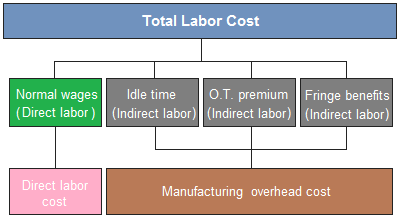
Idle time means the amount of time the workers remain idle in a normal working day. The idle time is usually caused by a sudden fault in machine or equipment, power failure, lack of orders for the product, inefficient work scheduling, defective materials and shortage of raw materials etc. The cost associated with idle time is treated as indirect labor cost and should, therefore, be included in manufacturing overhead cost. For example, the normal weekly working hours of a worker are 48 and he is paid @ $8 per hour. If he remains idle for 6 hours due to power failure, then the cost of 42 hours would be treated as direct labor cost and the cost of 6 hours (idle time) would be treated as indirect labor cost and included in manufacturing overhead cost.

Direct Labor 336 $
Manufacturing overhead (6 hours* 8$) 48 $ (idle Time)
Total cost 384 $

Treatment of overtime premium:

Overtime premium is the amount that is paid, for the overtime worked,  in excess of the normal wage rate. Like idle time, overtime premium is also treated as indirect labor cost and  included in manufacturing overhead cost. For example, a worker normally works for 48 hours per week @ $8 per hour. In a particular week, if he works for 52 hours and company pays him $12 for every hour worked in excess of 48 hours, the allocation of the labor cost of the worker would be made as follows:

Direct Labor (52hrs * 8$ 416 $
Manufacturing overhead (4 hours* 4$) 16 $ (idle Time)
Total cost 432 $

The amount of $16 is overtime premium and is a part of manufacturing overhead cost.

Treatment of labor fringe benefits:

Fringe benefits are benefits that employers provide to employees in addition to normal salaries or wages. Examples of fringe benefits are hospitalization, insurance programs, retirement plans, paid holidays and stock options etc. Most of the companies treat labor fringe benefits as indirect labor and, therefore, include them in manufacturing overhead costs.

A few firms treat direct labor related fringe benefits as addition to direct labor cost which is considered a more superior practice.

The above information has been summarized below:

e-commerce Meaning, Characteristics, Advantage and Disadvantage, Future

E-Commerce or Electronic Commerce means buying and selling of goods, products, or services over the internet. E-commerce is also known as electronic commerce or internet commerce. These services provided online over the internet network. Transaction of money, funds, and data are also considered as E-commerce. These business transactions can be done in four ways: Business to Business (B2B), Business to Customer (B2C), Customer to Customer (C2C), Customer to Business (C2B). The standard definition of E-commerce is a commercial transaction which is happened over the internet. Online stores like Amazon, Flipkart, Shopify, Myntra, Ebay, Quikr, Olx are examples of E-commerce websites. By 2020, global retail e-commerce can reach up to $27 Trillion.

E-commerce is a popular term for electronic commerce or even internet commerce. The name is self-explanatory, it is the meeting of buyers and sellers on the internet. This involves the transaction of goods and services, the transfer of funds and the exchange of data.

So when you log into your Amazon and purchase a book, this is a classic example of an e-commerce transaction. Here you interact with the seller (Amazon), exchange data in form of pictures, text, address for delivery etc. and then you make the payment.

Characteristics of E-Commerce

E-commerce is characterized by the following features:

(i) The business tools are electronic and the application is commerce, i.e. profit motive.

(ii) Business is externally focused on those with whom business is conducted.

(iii) Most of the transactions are processed automatically.

(iv) Uses a gamut of business support services, such as inter-organizational e-mail and on-line directories.

Examples of E-Commerce

  • Amazon
  • Flipkart
  • eBay
  • Fiverr
  • Upwork
  • Olx
  • Quikr

Scope of e-commerce

The scope of e-commerce is broad and continues to expand as technology advances and consumer behaviors evolve. It encompasses various dimensions, including types of transactions, market participants, technological platforms, and industries it affects.

Types of Transactions

  1. Business-to-Business (B2B):

E-commerce transactions between businesses, such as between manufacturers and wholesalers, or between wholesalers and retailers.

  1. Business-to-Consumer (B2C):

Transactions between businesses and individual consumers. This is the most recognized form of e-commerce, including online retail and services.

  1. Consumer-to-Consumer (C2C):

Transactions between consumers, usually facilitated by a third party that provides an online platform (e.g., eBay, Etsy).

  1. Consumer-to-Business (C2B):

Individuals sell products or services to businesses, which is common in freelancing platforms and stock photo websites.

  1. Business-to-Government (B2G) or Government-to-Business (G2B):

Transactions between companies and public sector organizations, often related to tenders and procurement.

  1. Government-to-Citizen (G2C):

Services provided by the government to its citizens through online platforms, which can include tax filing, registration services, and information dissemination.

Market Participants

  • Retailers:

Both traditional brick-and-mortar stores expanding online and online-only retailers.

  • Wholesalers and Distributors:

Entities involved in the bulk selling and distribution of products to retailers or other wholesalers.

  • Manufacturers:

Producers of goods selling directly to consumers, businesses, or through intermediaries.

  • Service Providers:

Companies offering services (e.g., streaming, cloud computing, online education) rather than tangible goods.

  • Consumers:

Individuals purchasing goods or services for personal use.

  • Governments:

Engaging in e-commerce for procurement, service delivery, and information dissemination.

Technological Platforms

  • Online Marketplaces:

Platforms that connect sellers and buyers, facilitating transactions (e.g., Amazon, Alibaba).

  • E-commerce Websites:

Dedicated websites owned by retailers or brands that offer goods or services directly to consumers or businesses.

  • Mobile Apps:

Applications designed for smartphones and tablets, enabling mobile commerce (m-commerce).

  • Social Commerce:

The use of social media platforms to promote and sell products and services directly within the platform.

  • Electronic Data Interchange (EDI):

The computer-to-computer exchange of business documents in a standard electronic format, primarily used in B2B transactions.

Industries Affected

Virtually every industry has been impacted by e-commerce, including:

  • Retail: Clothing, electronics, home goods, groceries, and more.
  • Services: Banking, travel, education, entertainment, real estate.
  • Manufacturing: Direct-to-consumer sales, customization, and global supply chain management.
  • Healthcare: Telemedicine, online pharmacies, and personal health records.
  • Finance: Online banking, digital wallets, and fintech services.

Future Scope

The future scope of e-commerce includes further integration of artificial intelligence for personalized shopping experiences, expansion of augmented reality to try products virtually, growth of voice commerce, and the exploration of new payment methods like cryptocurrencies. Additionally, the global nature of e-commerce will continue to emphasize cross-border trade, logistics innovations, and the digital transformation of traditional businesses.

Benefits of e-Commerce:

For Businesses:

  • Wider Market Reach:

E-commerce breaks down geographical barriers, enabling businesses to reach a global audience without the need for physical stores.

  • Lower Operational Costs:

Operating an online store can significantly reduce the need for physical space, resulting in lower rent, utilities, and staffing costs.

  • Open 24/7:

Online stores can operate around the clock, allowing businesses to generate sales even outside of traditional business hours.

  • Data Collection and Personalization:

E-commerce platforms facilitate the collection of valuable customer data, which can be used to personalize marketing efforts and improve product offerings.

  • Scalability:

E-commerce businesses can easily scale their operations up or down based on market demand without substantial investments.

  • Faster Go-to-Market Time:

Launching products online is quicker and less costly, allowing businesses to capitalize on trends and market demand efficiently.

For Consumers:

  • Convenience:

E-commerce offers the ultimate convenience of shopping from anywhere at any time, without the need to visit physical stores.

  • Broader Selection:

Online stores often provide a wider variety of products than physical stores, including items that are rare or not locally available.

  • Price Comparisons:

Consumers can easily compare prices and read reviews from other customers before making a purchase decision.

  • No Pressure Sales:

Shopping online eliminates the pressure often felt from sales staff in physical stores, allowing for more relaxed decision-making.

  • Access to International Products:

E-commerce makes it easier for consumers to purchase products from abroad that may not be available in their home country.

  • Personalized Shopping Experience:

Online stores can offer personalized recommendations based on previous purchases and browsing behavior.

For Society:

  1. Environmental Impact:

With reduced needs for physical infrastructure and the potential for more efficient logistics, e-commerce can contribute to lower carbon footprints compared to traditional retail.

  1. Job Creation:

While e-commerce changes the nature of retail jobs, it also creates new opportunities in areas such as digital marketing, data analysis, IT, and logistics.

  1. Accessibility:

E-commerce provides access to goods and services for people who are physically unable to visit stores, such as the elderly or individuals with disabilities.

Limitations of e-Commerce:

For Businesses:

  • Intense Competition:

The ease of setting up online businesses leads to increased competition, making it harder for individual businesses to stand out and retain market share.

  • Technical Issues:

Dependency on technology means that technical glitches, website downtime, or cybersecurity breaches can have significant negative impacts on sales and customer trust.

  • Customer Service Challenges:

Providing effective and timely customer service can be more challenging online, especially with high volumes of inquiries and the lack of face-to-face interaction.

  • Return and Refund Processes:

Handling returns and refunds can be more complicated and costly for online businesses, affecting profitability.

  • Fraud and Security Concerns:

E-commerce sites are attractive targets for cybercriminals, necessitating ongoing investment in security measures to protect customer data.

For Consumers:

  • Lack of Physical Examination:

Consumers cannot touch, feel, or try products before purchase, leading to uncertainty and potential dissatisfaction.

  • Privacy and Security Risks:

Online shoppers are at risk of personal data breaches, identity theft, and fraud if they use insecure or fraudulent sites.

  • Delivery Issues:

Delays, lost packages, and damage during shipping can detract from the online shopping experience.

  • Difficulty in Returning Items:

The process of returning products can be cumbersome and sometimes costly for consumers, dissuading them from making online purchases.

  • Overwhelming Choices:

While a wide selection is an advantage, it can also overwhelm consumers, leading to decision fatigue.

For Society:

  • Impact on Local Retailers:

The growth of e-commerce can negatively impact physical stores and local economies, leading to closures and job losses in traditional retail sectors.

  • Environmental Impact of Deliveries:

Although e-commerce reduces the need for physical stores, the increase in packaging waste and emissions from increased delivery traffic can have negative environmental impacts.

  • Digital Divide:

The benefits of e-commerce are not equally accessible to all, with disparities based on internet access, digital literacy, and socioeconomic status.

  • Work Conditions:

Some e-commerce fulfillment centers have faced criticism for poor working conditions, including intense work pace and inadequate labor rights.

  • Consumerism:

The ease and convenience of online shopping may encourage excessive consumerism and wasteful purchasing behaviors.

Future of E-Commerce:

  • Technological Advancements

The future of e-commerce will be driven by cutting-edge technologies like artificial intelligence, virtual reality, and blockchain. AI will personalize shopping experiences, while VR will enable virtual try-ons and immersive product demos. Blockchain will ensure secure and transparent transactions. Voice-assisted shopping and drone deliveries will further enhance convenience. As these technologies become more accessible, e-commerce platforms will evolve into intelligent, seamless, and highly efficient ecosystems, creating a competitive edge for businesses and delivering faster, smarter, and more engaging experiences for consumers globally.

  • Customer-Centric Experience

E-commerce in the future will be shaped by customer expectations for speed, personalization, and sustainability. Consumers will demand same-day deliveries, personalized recommendations, and eco-friendly packaging. Businesses will invest in AI chatbots, hyper-personalized content, and real-time support to enhance customer satisfaction. User experience will become central, with intuitive interfaces, fast checkouts, and flexible return policies. Trust, convenience, and emotional connection with brands will drive loyalty. Companies that prioritize customer-centric strategies will lead the market in building lasting relationships and increasing lifetime customer value.

  • Global and Rural Expansion

The e-commerce sector will expand beyond urban areas to rural and international markets due to increasing internet penetration and mobile access. Governments and private players will invest in digital infrastructure, digital literacy, and logistics networks, enabling broader outreach. Localization of language, payment systems, and customer service will make online shopping inclusive. Cross-border e-commerce will grow as platforms offer global shipping and multiple currency options. This rural and global integration will open new consumer bases and help small businesses tap into large, underserved markets.

Origin of e-commerce

One of the most popular activities on the Web is shopping. It has much allure in it  you can shop at your leisure, anytime, and in your pajamas. Literally anyone can have their pages built to display their specific goods and services.

History of ecommerce dates back to the invention of the very old notion of “sell and buy”, electricity, cables, computers, modems, and the Internet. Ecommerce became possible in 1991 when the Internet was opened to commercial use. Since that date thousands of businesses have taken up residence at web sites.

At first, the term ecommerce meant the process of execution of commercial transactions electronically with the help of the leading technologies such as Electronic Data Interchange (EDI) and Electronic Funds Transfer (EFT) which gave an opportunity for users to exchange business information and do electronic transactions. The ability to use these technologies appeared in the late 1970s and allowed business companies and organizations to send commercial documentation electronically.

Although the Internet began to advance in popularity among the general public in 1994, it took approximately four years to develop the security protocols (for example, HTTP) and DSL which allowed rapid access and a persistent connection to the Internet. In 2000 a great number of business companies in the United States and Western Europe represented their services in the World Wide Web. At this time the meaning of the word ecommerce was changed. People began to define the term ecommerce as the process of purchasing of available goods and services over the Internet using secure connections and electronic payment services. Although the dot-com collapse in 2000 led to unfortunate results and many of ecommerce companies disappeared, the “brick and mortar” retailers recognized the advantages of electronic commerce and began to add such capabilities to their web sites (e.g., after the online grocery store Webvan came to ruin, two supermarket chains, Albertsons and Safeway, began to use ecommerce to enable their customers to buy groceries online). By the end of 2001, the largest form of ecommerce, Business-to-Business (B2B) model, had around $700 billion in transactions.

According to all available data, ecommerce sales continued to grow in the next few years and, by the end of 2007, ecommerce sales accounted for 3.4 percent of total sales.

Ecommerce has a great deal of advantages over “brick and mortar” stores and mail order catalogs. Consumers can easily search through a large database of products and services. They can see actual prices, build an order over several days and email it as a “wish list” hoping that someone will pay for their selected goods. Customers can compare prices with a click of the mouse and buy the selected product at best prices.

Online vendors, in their turn, also get distinct advantages. The web and its search engines provide a way to be found by customers without expensive advertising campaign. Even small online shops can reach global markets. Web technology also allows to track customer preferences and to deliver individually-tailored marketing.

History of ecommerce is unthinkable without Amazon and Ebay which were among the first Internet companies to allow electronic transactions. Thanks to their founders we now have a handsome ecommerce sector and enjoy the buying and selling advantages of the Internet. Currently there are 5 largest and most famous worldwide Internet retailers: Amazon, Dell, Staples, Office Depot and Hewlett Packard. According to statistics, the most popular categories of products sold in the World Wide Web are music, books, computers, office supplies and other consumer electronics.

Amazon.com, Inc. is one of the most famous ecommerce companies and is located in Seattle, Washington (USA). It was founded in 1994 by Jeff Bezos and was one of the first American ecommerce companies to sell products over the Internet. After the dot-com collapse Amazon lost its position as a successful business model, however, in 2003 the company made its first annual profit which was the first step to the further development.

At the outset Amazon.com was considered as an online bookstore, but in time it extended a variety of goods by adding electronics, software, DVDs, video games, music CDs, MP3s, apparel, footwear, health products, etc. The original name of the company was Cadabra.com, but shortly after it become popular in the Internet Bezos decided to rename his business “Amazon” after the world’s most voluminous river. In 1999 Jeff Bezos was entitled as the Person of the Year by Time Magazine in recognition of the company’s success. Although the company’s main headquarters is located in the USA, WA, Amazon has set up separate websites in other economically developed countries such as the United Kingdom, Canada, France, Germany, Japan, and China. The company supports and operates retail web sites for many famous businesses, including Marks & Spencer, Lacoste, the NBA, Bebe Stores, Target, etc.

Amazon is one of the first ecommerce businesses to establish an affiliate marketing program, and nowadays the company gets about 40% of its sales from affiliates and third party sellers who list and sell goods on the web site. In 2008 Amazon penetrated into the cinema and is currently sponsoring the film “The Stolen Child” with 20th Century Fox.

According to the research conducted in 2008, the domain Amazon.com attracted about 615 million customers every year. The most popular feature of the web site is the review system, i.e. the ability for visitors to submit their reviews and rate any product on a rating scale from one to five stars. Amazon.com is also well-known for its clear and user-friendly advanced search facility which enables visitors to search for keywords in the full text of many books in the database.

One more company which has contributed much to the process of ecommerce development is Dell Inc., an American company located in Texas, which stands third in computer sales within the industry behind Hewlett-Packard and Acer.

Launched in 1994 as a static page, Dell.com has made rapid strides, and by the end of 1997 was the first company to record a million dollars in online sales. The company’s unique strategy of selling goods over the World Wide Web with no retail outlets and no middlemen has been admired by a lot of customers and imitated by a great number of ecommerce businesses. The key factor of Dell’s success is that Dell.com enables customers to choose and to control, i.e. visitors can browse the site and assemble PCs piece by piece choosing each single component based on their budget and requirements. According to statistics, approximately half of the company’s profit comes from the web site.

In 2007, Fortune magazine ranked Dell as the 34th-largest company in the Fortune 500 list and 8th on its annual Top 20 list of the most successful and admired companies in the USA in recognition of the company’s business model.

History of ecommerce is a history of a new, virtual world which is evolving according to the customer advantage. It is a world which we are all building together brick by brick, laying a secure foundation for the future generations.

Process of e-commerce

Selling online has become easily possible nowadays. In fact, it has become one of the most popular platforms people prefer buying from.

If you plan to start a business of your own, and wondering how to go about it, then this post will help you learn the complete e-Commerce Selling Process.

Follow the steps as mentioned, and to the end, you’ll be done.

Step #1: Give your business a name – Register it

The first and foremost requirement is to give your business an identity in terms of a name. The name is something your audience will recognize your business with. Thus, choosing a good name is imperative.

Once you select a name, make sure you register it.

Why is registration important?

This is because if someday someone else comes up in the market with the same name, you will stand nowhere since you do not have proof that you own that title.

Moreover, one needs to comply with the registration as mandatory per law. Thus, it is essential to get your business registered. Each state may have its own policies; therefore, you may refer to your respective state policies for registration.

Step #2: Create a domain name and a website – Register as a seller

Once you are registered, either create your own website using a hosting platform or register as a seller. There are two different possibilities you might want to opt, i.e.

Register as a seller on popular websites like Amazon, and eBay OR start your own e-commerce business by buying space at popular sites such as Shopify, BigCommerce, etc.

The other possibility that arises when you want to set your own e-commerce store is to build a website using web hosting platforms and register your domain.

For example, buy a domain for the e-commerce platform through WordPress and install plugins that help you set up your business and sell online.

Registering as a seller on e-commerce platforms is the easiest way to start selling.

The complexity level increases when you opt for platforms to open up your own store. However, the primary benefit here is that you have your own store where you can sell unlike being just a seller on other e-commerce platforms.

You actually tend to build your own brand here. The most complicated method is to create a new website altogether to start a business.

However, if you plan to do business on a massive scale, it is the optimum choice to make.

Step #3: Upload Products

Once you’ve chosen where you want to sell and have a space to upload your stock, you may now start uploading high-quality images of your products.

Give them a name and mention their price.

If you are into selling various categories of products, make sure to categorize them. This makes the website look neater and easy to use for the customer.

Give the products a suitable description that is easy to understand and explains each and every feature of the product.

When doing business online, your interaction with customers is not direct. The customer cannot touch and feel the product physically. Thus, in order to succeed despite the demerit, it is important to explain each and everything about the product through descriptions.

Step #4: Use SEO

In order to get your website or listed products to rank on top of the Google search results, it is essential to have relevant keywords in the content.

For example, if a person is looking out for a juicer, and you have it as one of your products, then make sure your product title has the word juicer. This will help the search engines identify that you have the same thing that the buyer is looking for and will list your products on the top.

Similarly, make sure that the description along with being informative and easy to read, is also SEO optimized.

Step #5: Choose your shipping method

The next and most important thing is to choose a shipping strategy. Make sure you connect with only famous shipping companies who can make sure that they will deliver your product timely without any damage.

Final words

You are all set to start selling. You have an e-commerce store, have your shipping planned and the products are listed.

Now the buyers will simply have to click on the buy now option, make payments through the payment gateway you’ve opted for and buy your product.

In order to attract more customers, use all the digital marketing tactics and take your business to greater heights.

Key Drivers of E-Commerce

Following are the key drivers of e-commerce:-

  1. Make sure your e-commerce efforts are in sync with corporate goals
  • Have a clear understanding of company’s overall growth objectives.
  • Have a clear understanding of company’s branding and marketing objectives.
  • Have a clear understanding of company’s target customers and demographics.
  • Have a clear understanding of company’s products/margins which product sales move the bottom line needle the most.
  • Have a clear understanding of company’s financial targets (revenues, margins, ROI).
  1. Omni-channel design/customer of one
  • You are not building a website in isolation from other customer channels break down divisional silos.
  • All decisions should be made with a customer-centric mindset.
  • Allow customers to shop where, how and when they choose, anytime and anyplace.
  • This means integrating all website, mobile, store, call center systems, etc.
  • This means tailoring offering and messaging down to the person-by-person basis.
  1. Driving new users to the site
  • Determine the proper marketing plan that works within your budgets.
  • Bias online marketing as most trackable and one-click away from your site.
  • Constantly test and iterate all offers and creative strategies used to maximize engagement.
  • Drive traffic to specific product landing pages, which should be unique and tested.
  • Have a clear understanding of the keywords that matter most for your business and optimize your site for SEO and PPC efforts.
  • Cross-promote e-commerce capabilities across all channels of your business.
  • Cross-promote e-commerce links across within all other channel marketing.
  • Leverage the power of social media maintain and promote your own profile pages on major social networks (e.g., Facebook, Twitter, Pinterest) and allow for social sharing from all product pages and conversational communications/viral marketing therefrom.
  1. Getting existing users more engaged
  • Continually optimize and fine-tune the product/pricing offering to match demand.
  • Maintain consistent communication with customers via monthly newsletters or other means.
  • Create loyalty programs that reward increased spending with increased rewards.
  • Allow customers to create wishlists that they can send to their friends and family.
  • Tailor product offers to specific customer profile data.
  • Optimize upselling and cross-selling techniques (e.g., promote related items and “people who bought this, also bought that” functionality).
  • Use machine learning techniques to keep a “memory” of user behaviors in session and over time to allow for behavioral targeting.
  • Use targeted pull back ads after a user leaves the site without buying
  • Employ automated repurchase reminders for things that need to be replaced over time
  • Opt customers into company newsletters during the time of e-commerce purchases.
  1. Website Design/Functionality
  • It needs a clear and simple way to navigate the site (e.g., think “one click” away).
  • Constantly test page layouts to increase user engagement, using eye pattern heat maps, user mouse tracking or otherwise.
  • Constantly test shopping cart flow to limit abandon rates.
  • Study all abandon rates to figure out why customers end up not buying—and address such concerns.
  • Leverage video where you can, as it is much more effective than static images and text in terms of driving engagement.
  • Leverage the reviews and feedback of other customers who bought same items.
  1. Fulfillment/customer service
  • Offer two-way free shipping for orders over a certain size (e.g., $50) don’t give users any reason not to buy.
  • Offer no-hassle customer satisfaction guarantees for a full refund if they are not satisfied for any reason.
  • Provide clear communication on all shipping-related issues (e.g., time to ship, expected arrival dates) with opportunities to get overnight, if needed.
  • Provide the ability to check inventory online for items available in the stores for same day pickup.
  • Simple credit card processing online and the ability to collect payment information via phone.
  • Allow returns either via mail or direct to the stores.
  • Consider kiosk or tablet-based opportunities and services within the stores.
  1. CRM/BIG DATA
  • Invest in customer CRMs as a central repository to track all client profile, preferences, sales and social media history behavior.
  • Invest in big data analytics technology to make sense of the fire hose of data available.
  • The future of marketing is moving toward person-by-person targeting of products, offers and messaging based on their past behaviors and profile preferences. It is no longer mass-marketing of the same messaging to all.
  • Study cross-channel behaviors to learn how customers prefer to engage with the company (e.g., they researched first online but bought in the store, or vice versa).
  • Test, test and retest all marketing activities and look to sharpen efforts with each iteration.
  1. Mobility
  • The PC market is actually declining, while the mobile market is exploding—you need to have native mobile apps built for each major platform (e.g., Apple, Android), or a mobile friendly touch site.
  • Take advantage of mobile locations of your customers with targeted offers and services related to their exact location (e.g., “Check out our new store near your location,” “here are local restaurant deals to go with your recent movie tickets purchase,” “here is our mobile mapping app to go with your new car”).
error: Content is protected !!