Human Resources Manager Duties and Responsibilities

Duties

Hire Resources

This is where the recruitment strategies are put into action. In the current age, there’s a ton of competition vying for the attention of the best talent in the market. The HR manager needs to run all possible engines to go out there in the market and find that one suitable gem.

This part of the role includes things like finding relevant locations to look in, reach out to maximum potential candidates using mass communication mediums, aggregate all responses, filter out irrelevant applications, judge suitable incumbents and coordinate internally to get them interviewed. Once the finalists are decided, the HR manager turns into a ‘negotiator’ of sorts, working as a mediator between the company and the candidate to find that win-win ground.

Attract Talent

Attracting talent starts with first planning the requirement of manpower in the organization. Gauging needs of the organization’s human resource requirements, and accordingly putting a plan of action to fulfill those needs with the placement of “talented professionals”. That’s followed by creating an “employer brand” which will be representative of the organization’s good image and portray an attractive impression in the minds of potential candidates.

Training

Not all is done once you’ve recruited a suitable candidate for the job. Many organizations perform tasks a tad differently. Training employees is important to help the new hires get acquainted with the organization’s work pattern. It is imperative for the HR department to incorporate a training program for every new employee based on the skill set required for their job. It will further also contribute to employee motivation and retention.

For the training to be effective, every new employee can be subjected to an on-the-job training for the initial days to get him in sync with the work guidelines of the organization. This training will not only be of assistance to the employee but also give the HR team an insight into the employee’s workmanship. On completion of the training, HR plays a significant role in assessing the results of the training program and grading employees on the same.

Appraisals

Since HRM is a body meant for the employees, carrying out timely performance appraisals is a given. Performance appraisals help in employee motivation by encouraging them to work to their fullest potential. It also enables to give them feedback on their work and suggest necessary measures for the same. This helps employees to have a clear view of what is expected of them and what they are delivering. They can thus, work better towards improving their performance and achieving targets.

Resolving Conflicts

Where different people have different views, conflicts are almost inevitable. Whether the dispute is amongst two or more employees or between the employee and the management, an HR manager has the right to intervene and help map out a solution.

The HR should be available at the disposal of the conflicting parties and hear out their issues without being judgmental. Prior investigations are a must before passing any judgment. The HR head is not expected to discriminate or play favorites in this matter and always deliver an unbiased and practical decision. A reimbursement in case of any loss caused and strict actions against the defaulter should be practiced for effective conflict resolution by the HRM.

Rewards and Incentives

Rewarding the employees for a work well done imparts motivation and at the same time induces a desire to excel at tasks in hope of obtaining rewards. It serves as bait for inculcating a healthy competitive environment amongst employees to achieve targets and meet deadlines. A reward need not be materialistic always. It could just be a word of appreciation in front of all coworkers for a menial task done with complete honesty.

However, with globalization and evolving trends, compensations like holiday packages, pay incentives, bonuses, and promotions are taking a backseat. If as an HR manager you are wanting to reward your employees efficiently, it’s time you adopt new ways of awarding benefits such as flexible work times, paternity leave, extended holidays, telecommuting, etc. These non-traditional rewards will prove fruitful not only in engaging the existing workforce but also as an added benefit to attract new talent to your organization.

Employee Relations

Human Resources is called so because its major responsibility is dealing with the human part of the organization and this involves having great interpersonal skills. An HR manager who sits in the office all day will not turn out to be good at building connections with the employees and thus fail to serve the purpose of being an HR head. As an HR person, employees should feel comfortable coming up to you with their problems and for that, it is important that the HR team builds a good public image within the organization.

Responsibilities

  • Managing company staff, including coordinating and supporting the recruitment process
  • Onboarding newcomers to the company
  • Determining suitable salaries and remuneration
  • Providing the necessary support systems for payroll requirements
  • Developing adequate induction and training
  • Supporting employee opportunities for professional development
  • Managing succession planning of staff
  • Assisting with the performance management and review process
T-group, Job expectation Technique

A T-group or training group (sometimes also referred to as sensitivity-training group, human relations training group or encounter group) is a form of group training where participants (typically between eight and fifteen people) learn about themselves (and about small group processes in general) through their interaction with each other. They use feedback, problem solving, and role play to gain insights into themselves, others, and groups.

Experimental studies have been undertaken with the aim of determining what effects, if any, participating in a T-group has on the participants. For example, a 1975 article by Nancy E. Adler and Daniel Goleman concluded that “Students who had participated in a T-group showed significantly more change toward their selected goal than those who had not.” Carl Rogers described sensitivity groups as “…the most significant social invention of the century”.

The concept of encounter as “a meeting of two, eye to eye, face to face,” was articulated by J.L. Moreno in Vienna in 1914–15, in his “Einladung zu einer Begegnung” (“Invitation to an Encounter”), maturing into his psychodrama therapy. It was pioneered in the mid-1940s by Moreno’s protege Kurt Lewin and his colleagues as a method of learning about human behavior in what became the National Training Laboratories (also known as the NTL Institute) that was created by the Office of Naval Research and the National Education Association in Bethel, Maine, in 1947. First conceived as a research technique with a goal to change the standards, attitudes and behavior of individuals, the T-group evolved into educational and treatment schemes for non-psychiatric patient people.

A T-group meeting does not have an explicit agenda, structure, or expressed goal. Under the guidance of a facilitator, the participants are encouraged to share emotional reactions (for example, anger, fear, warmth, or envy) that arise in response to their fellow participants’ actions and statements. The emphasis is on sharing emotions, as opposed to judgments or conclusions. In this way, T-group participants can learn how their words and actions trigger emotional responses in the people they communicate with.

There are a number of group types.

Task groups focus on the here and now, involving learning through doing, activity and processing; and involves daily living skills and work skills.

Evaluative groups focus on evaluating the skills, behaviors, needs, and functions of a group and is the first step in a group process.

Topical discussion groups focus on a common topic that can be shared by all the members to encourage involvement.

Developmental groups encourage the members to develop sequentially organized social interaction skills with the other members.

  • Parallel groups are made up of clients doing individual tasks side by side.
  • Project groups emphasize task accomplishment. Some interaction may be built in, such as shared materials and tools and sharing the work.
  • Egocentric cooperative groups require the members to select and implement the task. Tasks are longer term and socialization is required.
  • Cooperative groups require the therapist only as an advisor. Members are encouraged to identify and gratify each other’s social and emotional needs in conjunction with task accomplishment. The task in a cooperative group may be secondary to social aspects.
  • Mature groups involve the therapist as a co-equal member. The group members take on all leadership roles in order to balance task accomplishment with need satisfaction of the members.

Self-help groups are supportive and educational, and focus on personal growth around a single major life disrupting problem (for example, Alcoholics Anonymous).

Support groups focus on helping others in a crisis and continue to do so until the crisis is gone and is usually before the self-help group.

Advocacy groups focus on changing others or changing the system, rather than changing one’s self: “getting one from point A to point B”.

Psychotherapy groups focus on helping individuals in the present that have past conflicts which affect their behavior.

Controversial

This type of training is controversial as the behaviors it encourages are often self-disclosure and openness, which many people believe some organizations ultimately punish. The feedback used in this type of training can be highly personal, hence it must be given by highly trained observers (trainers).[citation needed]. In the NTL-tradition, the T-group is always embedded in a Human Interaction Laboratory, with reflection time and theory sessions. In these sessions, the participants have the opportunity to make sense of what’s happening in the T-group.

Job expectation Technique

Behaviors in the workplace:

  • Display a positive and respectful attitude.
  • Work with honesty and integrity.
  • Represent the organization in a responsible manner.
  • Perform their jobs to a reasonable, acceptable standard.
  • Maintain good attendance.
  • Conduct themselves in a professional manner, even when off duty.
  • Follow set policies and procedures when dealing with problems or issues.

Team member should be accountable for:

  • Respect each other, and be courteous and sensitive to everyone’s needs and concerns.
  • Be accountable for your work.
  • Be flexible about job and task assignments.
  • Be willing to help each other instead of displaying an “it’s not my job” attitude.
  • Ask for help when needed.
  • Work safely together.
  • Be open to constructive feedback without being defensive or negative.
  • Be self-motivated and reliable.
  • Share ideas for improvement.
  • Be cheerful, positive and encouraging to other team members.

Since an employee’s position affects their performance expectations, Wee created this table to illustrate the performance expectations for different job levels:

Position level of employee Performance expectations
Senior-level manager or executive Focus on departmental performances
Manager or supervisory position Focus on unit and functional results of the work team
Professional or technical position Focus on project-related performances
Individual contributor Focus on assigned tasks and contributions to the work team
Major project member or departmental initiator Focus on the major projects/departmental initiatives specifically

To improve the chances of employees meeting or exceeding your expectations, follow these steps when you plan and set them.

  1. Determine what your expectations are.

Before you can have a conversation with your staff members, you need to have a conversation with yourself and write down what your realistic expectations are. For example, you may expect staff members to do the following:

  • Complete projects within the given timeframe.
  • Have a positive attitude.
  • Take initiative on starting new projects and coming up with new ideas that can benefit the company.
  • Come to work on time.
  • Follow the dress code.
  • Remain professional at all times when communicating with clients and other staff members.
  • Follow up with clients within two business days.
  • Respect each other.
  1. Minimize confusion by making expectations clear.

Clear communication from leaders is imperative for success. If staff members don’t fully understand what you expect from them, it’ll be difficult for them to meet your expectations. You can do these things to make them clear:

  • Lay out exactly what your expectations are in paperwork for new hires.
  • Provide existing employees with a digital or print guide as an amendment to your employee handbook or their job responsibilities.
  • Don’t just hand staff members your expectations guide meet with them to discuss what they are.
  • Address any questions employees have about your expectations.
  • Ensure they understand what your expectations are.
  1. Let staff members know why your expectations are important.

When employees understand why expectations are important, it can help them see the bigger picture and feel like their role in the company matters.

  • Don’t just tell staff members what your expectations are – communicate why they are important.
  • Help staff members see how the company as a whole can benefit when they meet or exceed your expectations.
  • Beyond communicating the importance of your expectations, break down the “why” in as much detail as possible to minimize confusion.
  1. Provide examples of why expectations are important.

Offer concrete examples as to why you’ve set certain expectations, and explain to your team how these expectations connect to the big-picture goals of the company.

  • Being on time for work ensures operations run smoothly.
  • Adhering to the dress code casts the company in a professional light among customers.
  • Displaying a positive attitude at work helps employees deal with stress and keeps morale up.
  1. Get an agreement and commitment.

Formalize the expectations by requiring employees to sign off on them. When employees sign off on your expectations, it makes them feel more serious. In the event they don’t meet your expectations, you will have the documentation to hold them accountable and make a case as to how they have fallen short of the agreement.

Individual change: Concept, Need, Importance

Individual change management is an understanding of how one person makes a change successfully. Whether at home, in the community or at work, individuals move through the change process in a predictable and expected path. Individual change management provides a framework for enabling one person to make a transition.

The role of the individual in the overall change process is one such factor that is gaining increasing consideration. As after all, while a new tool can be implemented on schedule and on budget it does not automatically begin generating value for an organisation until it becomes adopted and individuals begin to use it with the required level of proficiency.

With the growing recognition for enterprise change management the need to understand the change management capabilities of the organisation as whole are evident but without a solid understanding of how individuals perceive and succeed in changing there are a number of associated risks.

One of the biggest risks is the idea that the implementation process of enterprise change management is ‘recipe-driven’: a list of actions or requirements that can be simply checked off. As it is important that each and every individual achieves a successful change in behaviour and/or attitudes, focus must be given to the progress of every employee in their transition and this requires continuous measurement. 

Increased communication, although one particular indicator of enterprise change management capabilities, does not ensure an organisation can expect to send X-X-number of emails about a change and not face any resistance; these emails must also contain considerations of the individual and indeed emails may not be an individual’s preferred method of receiving messages. Increasing communications activities in an unplanned, unstructured and intangible way is evidence of an organisation ‘doing’ change management without including a focus of what they were trying to achieve or why.

The next biggest consequence of not giving consideration to individual change management is the increasing difficulty in determining when success has been achieved. Time scales and budget are success factors of project implementation; but determining how successful the people side of the change has been, requires consideration of what is expected from each individual in order to generate the true value of a project; ensuring real acceptance, adoption of new ways of working with measurable proficiency.

Desire to Participate in and Support the Change

  • What are the personal motivators and organizational drivers that would cause me to support the change?

Knowledge on How to Change

  • What knowledge, skills and behaviors are required during and after the change is implemented?

Ability to Implement Required Skills and Behaviors

  • How do I demonstrate the ability to do my job the new way?
  • What barriers may inhibit me making the change?

Reinforcement to Sustain the Change

  • What will make the change stick?
  • What are the rewards, recognition, incentives and consequences?

ADKAR is an individual model, so it describes the change process from the perspective of one impacted employee whose job is being changed as a result of a project or initiative. Whether it is a new process, a new technology, a new job role or a new behavior, a person makes the change successfully when they have awareness, desire, knowledge, ability and reinforcement. If the change impacts 1,000 people, then the change will only happen when all 1,000 people have awareness, desire, knowledge, ability and reinforcement. An individual change management model is crucial for effective change management because of the reality that change must happen one individual at a time. Each impacted employee must move from their own current state to their own future state.

ADKAR is used in a number of ways:

  • Making sense of change
  • Guiding change management plans
  • Measuring progress
  • Diagnosing gaps
  • Developing corrective actions
  • Enabling managers and supervisors

Importance

Ensures a Match Between Requirements and Results

Through change management, you are aware of how to effectively equip and support people who will drive the change and bring it to life. You also have a process to have the right people in place to ensure success.

Increases Probability of Project Success

Research is clear that the better an organization is on change management the more likely project objectives are met. Harvard Business school research shows that initiatives with excellent change management are six times more likely to meet objectives than those with poor change management.

Improves Revenues

Solves problems reduces operation cost, helps seize emerging opportunities, or aligning work with strategy.

Helps in Remaining Profitable and Relevant

By remaining competitive through innovation companies can drive sales for their products. We no longer leave in a world changes occurs after 3 years. Businesses are facing complex and fast changes than ever before. An organization must, therefore, apply change management to enable it to build competencies that grow the organization’s ability to change as soon as they need arises. Only through changes can you remain relevant today. For example, social media has really changed how businesses operate so you have to change and incorporate it into your day to day operations.

Integration and Future of Talent Management

  • Typically, labor accounts for about 65 % of every business in any industry. The percentage is more for labor intensive businesses for example those in manufacturing.
  • The performance difference between talented and lesser talented employees is huge.
  • Employees and how they are managed is the most important source of most organizational competencies and strengths.

Talent management is not only important for hiring people as per the need, it is also important for determining when to hire. In the traditional model of hiring supply meant developing people internally for future. There was an upfront investment in candidates recovered through an enhanced performance over time. This was a good perspective; there were equal chances of making and losing money by investing in your people.

Hiring from outside or temporary employment on the other hand was seen as something that cannot fetch your substantial returns and or act as potential source of knowledge and competitive advantage.

Benefits of Integrated Talent Management

Companies especially growing ones are constantly changing. Change management strategy dovetails nicely with integrated talent management to ensure that talent can respond to change and adapt to it.

Technology in Integrated Talent Management

Technology that enables easy sharing of data across departments and processes is yet another essential component of integrated talent management. In some cases it might be possible to sustain communication without a technology solution, but a technology solution is necessary for scalability as companies grow larger and larger.

Consistency of Terms and Language

Communication is only effective if all parties understand what is being communicated. One essential part of integrated talent management is using a common language or consistent terms to talk about the talent management process. This helps all parties evaluate the process and share data that can lead to improvements.

Benefits of Talent Management Review

Organization Appraiser Appraisee
  • Recognize and manage talent performance.
  • Planning and decision making.
  • Improved staff retention.
  • Framework for sharing feedback.
  • Promote career planning and benefits.
  • Feedback on management style and leadership.
  • Reflection on areas of weakness and strength.
  • Opportunity to raise issues.
  • Focus on developing individual performance.
  • Better understanding of goals and requirement.
  • Identify action plan for future development.

Talent management teams observe the following competencies while undertaking managerial talent and reward score when the requirements are met.

  • Communication: The review team analyzes communication skills among the performers. It also reviews the channels of communication in the organization.
  • Leadership: The team identifies leadership qualities and takes a note of effective and emerging leaders in the organization.
  • Resource Management: The team evaluates the resource management styles of the employees.
  • Teamwork: The team underscores team performance of individual employees.

Global Talent Management

The primary purpose of talent management is to create a motivated workforce who will stay with your company in the long run. The exact way to achieve this will differ from company to company.

A multi-year, collaborative research study set out to examine the steps global companies can take to ensure that they recruit, develop and deploy the right people.  Researchers from institutions including INSEAD, Cornell, and Cambridge University came together and analysed companies that were selected based on superior business performance and reputation.

They found that in addition to adhering to a common set of talent management principles, leading companies follow many of the same talent-related practices. During their study, they asked interviewees why they thought their company’s individual practices were effective and valuable. As a result of their responses, the authors formulated six core principles.

Adopting a set of principles rather than best practices is more effective at challenging current thinking. Moreover, best practices are only ‘best’ in the context for which they were designed; principles, on the other hand, have broad application.

Principles

  • Alignment with strategy: managers should ask themselves, given the company’s strategy, what kind of talent do we need? Strategic flexibility is important, and organizations must be able to adapt to changing business conditions and revamp their talent approach when necessary. Examples of companies that have done so include; GE and Oracle.
  • Internal consistency: implementing practices in isolation may not work and can actually be counter productive. The principle of internal consistency refers to the way the company’s talent management practices fit with each other. Consistency is crucial. The emphasis placed on consistency at companies such as BAE Systems and IBM can help to illustrate why that is paramount.
  • Cultural embeddedness: many successful companies make deliberate efforts to integrate their stated core values and business principles into talent management processes such as hiring methods, leadership development activities, performance management systems, and compensation and benefits programs. IKEA, the Sweden-based furniture retailer, for example, where applicants are selected using tools that focus on values and cultural fit. Another approach to promoting the organization’s core values and behavioural standards can through secondary socialization and training.
  • Management involvement: successful companies know that the talent management process needs to have broad ownership, not just by HR, but by managers at all levels, including the CEO. Senior leaders need to be actively involved in the talent management process and make recruitment, succession planning, leadership development and retention of key employees their top priorities. One of the most potent tools companies can use to develop leaders is to involve line managers. It means getting them to play a key role in the recruitment of talent and then making them accountable for developing the skills and knowledge of their employees. The research cites the example of Unilever to demonstrate how this can be done.
  • Balance of global and local needs: for organizations operating in multiple countries, cultures and institutional environments, managers need to figure out how to respond to local demands while maintaining a coherent HR strategy and management approach. The research found different methods of doing this, giving examples of Matsushita, Rolls Royce, Shell and others. However, among all the companies they studied, there was no single strategy.
  • Employer branding through differentiation: companies should find ways to differentiate themselves from their competitors, in order to attract employees with the right skills and attitudes. The companies studied differed considerably in how they resolve the tension between maintaining a consistent brand identity across business units and regions and responding to local demands. One-way companies are trying to get an edge on competitors in attracting talent is by stressing their corporate social responsibility activities.

The differentiated approach. Although the practice of sorting employees based on their performance and potential has generated criticism, many companies in our study placed heavy emphasis on high-potential employees. Companies favoring this approach focused most of the rewards, incentives and attention on their top talent (“A players”); gave less recog­nition, financial rewards and development attention to the bulk of the other employ­ees (“B players”); and worked aggressively to weed out employees who didn’t meet performance expectations and were deemed to have little potential (“C players”). This approach has been popularized by General Electric’s “vitality curve,” which differentiates between the top 20%, the middle 70% and the bottom 10%. The actual definition of “high potential” tends to vary from company to company, but many factor in the employee’s cultural fit and values. Novartis, the Swiss pharmaceutical company, for example, looks at whether someone displays the key values and behaviors the company wants in its future leaders.

The percentage of employees included in the high-potential group also differs across companies. For example, Unilever, the Anglo-Dutch consumer products company, puts 15% of employees from each management level in its high-potential category each year, expecting that they will move to the next management level within five years. Other companies are more selective. Infosys, a global technology services company headquartered in Bangalore, India, limits the high-potential pool to less than 3% of the total work force in an effort to manage expectations and limit potential frustration, productivity loss and harmful attrition.

The inclusive approach. Some companies prefer a more inclusive approach and attempt to address the needs of employees at all levels of the organi­zation. For example, when asked how Shell defined talent, Shell’s new head of talent management replied, Under an inclusive approach, talent management tactics used for different groups are based on an assessment of how best to leverage the value that each group of employees can bring to the company.

The two philosophies of talent management are not mutually exclusive; many of the companies we studied use a combination of both. Depending on the specific talent pool (such as senior executive, technical expert and early career high-potential), there will usually be different career paths and development strategies. A hybrid approach allows for differentiation, and it skirts the controversial issue of whether some employee groups are intrinsically more valuable than others.

Talent Management initiatives

  • Recognition: Recognising employees’ contribution and their work on individual grounds, boost up self-confidence in them.
  • Remuneration and Reward: Increasing pay and remuneration of the employees as a reward for their better performance.
  • Providing Opportunities: Giving the charge of challenging projects to the employees along with the authority and responsibility of the same, makes them more confident.
  • Role Design: The role of employees in the organisation must be designed to keep them occupied and committed, it must be flexible enough to inculcate and adapt to the employee’s talent and knowledge.
  • Job Rotation: Employees lack enthusiasm if they perform the same kind of work daily. Thus, job rotation or temporary shifting of employees from one job to another within the organisation is essential to keep them engaged and motivated.
  • Training and Development: On the job training, e-learning programmes, work-related tutorials, educational courses, internship, etc. are essential to enhance the competencies, skills and knowledge of the employees.
  • Succession Planning: Internal promotions helps identify and develop an individual who can be the successor to senior positions in the organisation.
  • Flexibility: Providing a flexible work environment to the employees makes them more adaptable to the organisation and brings out their creativity.
  • Relationship Management: Maintaining a positive workplace where employees are free to express their ideas, take part in the decision-making process, encourage employees to achieve goals and are rewarded for better performance leads to employee retention.
  • Self-motivation: Nothing can be effective if the employee is not self-determined and motivated to work.

Talent Management Introduction, Principles, Process

Talent Management is a strategic approach to attracting, developing, retaining, and utilizing the best talent within an organization to achieve its objectives. It involves identifying high-potential individuals, nurturing their skills, and providing opportunities for growth to maximize their contributions.

Key components of talent management include recruitment, onboarding, performance management, learning and development, succession planning, and employee engagement. By aligning talent strategies with organizational goals, businesses can build a competitive edge, foster innovation, and enhance overall productivity.

Effective talent management ensures that employees feel valued and supported, which improves retention rates and cultivates a motivated workforce. It is an ongoing process that adapts to changing organizational needs and market dynamics, making it a critical factor for sustainable growth and long-term success in today’s competitive business environment.

Principles of Talent Management:

  • Alignment with Organizational Goals

Talent Management strategies must align with the organization’s vision, mission, and long-term objectives. This alignment ensures that talent acquisition, development, and retention efforts directly contribute to achieving business outcomes and fostering a culture that supports organizational values.

  • Focus on Talent as a Critical Asset

Employees are the most valuable resource of any organization. Talent Management emphasizes treating employees as critical assets, investing in their skills, and creating opportunities for growth. Recognizing and nurturing talent ensures a workforce capable of meeting current and future challenges.

  • Proactive Recruitment and Retention

Effective Talent Management involves proactive efforts to attract top talent and retain high-performing employees. It includes creating an attractive employer brand, offering competitive compensation, and building a supportive work environment. Proactive retention strategies, such as career development opportunities and regular engagement initiatives, help reduce turnover.

  • Employee Development and Growth

A key principle of Talent Management is fostering continuous learning and professional development. Organizations should provide employees with training programs, mentorship opportunities, and resources to enhance their skills and advance their careers. This not only benefits employees but also strengthens the organization’s overall capabilities.

  • Data-Driven Decision Making

Talent Management relies on data analytics to identify workforce trends, measure performance, and predict future needs. By leveraging tools like performance reviews, employee feedback, and workforce analytics, organizations can make informed decisions about hiring, promotions, and training investments.

  • Diversity and Inclusion

Diversity and inclusion are integral to Talent Management. Organizations should strive to create an inclusive workplace that values diverse perspectives and ensures equal opportunities for all employees. This fosters innovation and broadens the organization’s problem-solving capabilities.

  • Succession Planning

Talent Management emphasizes preparing for future leadership needs through succession planning. By identifying and grooming high-potential employees for critical roles, organizations ensure continuity and reduce the risks associated with leadership transitions.

  • Employee Engagement and Well-Being

Engaged employees are more productive and committed to their organizations. Talent Management involves creating a positive work environment that prioritizes employee well-being, fosters strong relationships, and recognizes contributions.

  • Flexibility and Adaptability

Talent Management must be dynamic and responsive to changing market trends, workforce demographics, and organizational priorities. A flexible approach allows organizations to adapt their strategies to evolving needs and remain competitive.

Process of Talent Management:

Talent Management process is a strategic approach to attracting, developing, and retaining the best talent to meet organizational goals. It encompasses a series of interconnected steps, each contributing to building a skilled and engaged workforce.

1. Workforce Planning

The process begins with understanding the organization’s current and future talent needs. Workforce planning involves analyzing the workforce’s composition, identifying skill gaps, and forecasting future requirements based on business objectives and market trends.

2. Talent Acquisition

This stage involves attracting and recruiting the right talent. It includes crafting job descriptions, sourcing candidates through various channels, conducting interviews, and selecting individuals whose skills and values align with the organization’s needs. Building a strong employer brand is crucial to attracting top talent.

3. Onboarding

Once candidates are hired, a structured onboarding process ensures they are integrated smoothly into the organization. This includes introducing them to company culture, setting clear expectations, and providing the necessary tools and training to perform effectively. A strong onboarding process enhances employee retention and engagement.

4. Performance Management

Performance management focuses on monitoring and evaluating employee performance to ensure alignment with organizational goals. It includes setting clear objectives, providing regular feedback, and conducting periodic performance reviews. Effective performance management helps identify areas for improvement and recognize high performers.

5. Learning and Development

Developing employees’ skills is a core component of Talent Management. Organizations provide training programs, workshops, and mentorship opportunities to enhance technical, leadership, and interpersonal skills. Continuous learning fosters employee growth and prepares them for future challenges.

6. Career Development and Succession Planning

Employees seek career growth, and organizations must support their aspirations. This stage involves creating personalized development plans and identifying high-potential employees for leadership roles. Succession planning ensures continuity and minimizes disruptions during leadership transitions.

7. Employee Engagement and Retention

Employee engagement strategies focus on creating a positive work environment, fostering open communication, and recognizing contributions. Retention efforts include offering competitive benefits, promoting work-life balance, and ensuring job satisfaction.

8. Exit Management

When employees leave the organization, exit management ensures a smooth transition. Conducting exit interviews provides insights into areas for improvement, and maintaining relationships with former employees helps build a strong alumni network.

Management Development Programs, Importance, Components, Evaluation

Management Development Programs (MDPs) are structured initiatives designed to enhance the managerial capabilities and leadership skills of current and future managers. These programs focus on improving decision-making, problem-solving, communication, and strategic thinking abilities. MDPs aim to groom managers for higher responsibilities, helping organizations build a strong leadership pipeline. They include a range of activities such as workshops, seminars, executive education courses, mentoring, and on-the-job training. By fostering continuous learning and professional growth, MDPs ensure that managers are well-equipped to handle complex business challenges, drive organizational success, and adapt to changing market dynamics.

Importance of Management Development Programs:

Management Development Programs (MDPs) play a critical role in enhancing managerial competencies, ensuring sustainable growth for organizations, and fostering leadership.

  • Enhances Leadership Skills

MDPs are designed to strengthen the leadership abilities of managers. They provide exposure to modern leadership techniques, helping managers inspire and guide their teams effectively. Strong leadership contributes to better decision-making, strategic vision, and improved organizational performance.

  • Increases Managerial Efficiency

Through various learning modules, MDPs equip managers with the necessary tools and skills to handle day-to-day operations efficiently. These programs focus on critical areas such as time management, problem-solving, and conflict resolution, enabling managers to enhance productivity.

  • Prepares Managers for Higher Roles

MDPs help organizations groom potential leaders for higher responsibilities. By offering training in areas like strategic planning, financial management, and cross-functional coordination, they prepare managers to take on senior-level roles, ensuring a smooth leadership transition.

  • Boosts Employee Morale and Engagement

Well-trained managers foster a positive work environment by engaging employees, addressing concerns effectively, and encouraging collaboration. MDPs help managers develop the emotional intelligence required to build trust and motivate their teams, leading to higher morale and job satisfaction.

  • Promotes Organizational Adaptability

In a rapidly changing business environment, adaptability is crucial. MDPs equip managers with the ability to anticipate changes, develop innovative solutions, and implement them effectively. This helps organizations remain competitive and thrive in dynamic markets.

  • Aligns Individual Goals with Organizational Objectives

MDPs align the personal development goals of managers with the broader organizational objectives. By improving individual competencies, they contribute to achieving strategic business goals, resulting in better overall performance and profitability.

  • Encourages Knowledge Sharing

Participating in MDPs allows managers to share knowledge, best practices, and innovative ideas. This cross-functional collaboration enhances organizational learning, fosters creativity, and promotes a culture of continuous improvement.

  • Enhances Employee Retention

Organizations that invest in the professional development of their managers create a culture of growth and learning. This leads to higher job satisfaction, reducing turnover rates among high-potential employees. Effective managers who have undergone MDPs are more likely to foster a supportive work environment, further contributing to employee retention.

Components of Management Development Programs:

1. Needs Assessment

The first and foremost component of any MDP is identifying the development needs of managers. This involves assessing the current skills, competencies, and knowledge gaps of the participants. Techniques such as performance appraisals, feedback from superiors and subordinates, and self-assessment surveys are used to determine areas for improvement. A well-conducted needs assessment ensures that the program addresses relevant managerial challenges.

2. Clear Objectives

Every MDP must have well-defined objectives that outline what the program intends to achieve. These objectives could range from enhancing leadership skills and strategic thinking to improving communication and team management. Clearly stated goals help in structuring the program content and evaluating its success.

3. Curriculum Design

The curriculum is the core component of any MDP. It includes carefully selected topics relevant to the participants’ roles and responsibilities. Common topics include leadership development, financial management, conflict resolution, organizational behavior, decision-making, and strategic planning. The curriculum should be flexible to accommodate emerging trends and industry needs.

4. Training Methods

Effective delivery of MDPs relies on a mix of training methods to enhance learning outcomes. Common methods are:

  • Lectures and Seminars: For theoretical knowledge.
  • Case Studies: To analyze real-world business scenarios.
  • Workshops and Simulations: For hands-on experience.
  • Role-Playing and Group Discussions: To develop interpersonal and problem-solving skills.

This blended approach ensures a balanced learning experience for participants.

5. Mentoring and Coaching

Mentoring and coaching are critical components of MDPs. They provide personalized guidance, helping managers apply theoretical knowledge to real-life situations. Mentors, typically senior executives, share their experiences and offer practical insights to help participants grow professionally.

6. Performance Evaluation

Evaluating participants’ performance during and after the program is essential to measure learning outcomes. This can be done through tests, assignments, or practical projects. Performance evaluation helps determine whether participants have acquired the intended skills and knowledge.

7. Follow-Up and Reinforcement

A well-designed MDP includes follow-up activities to reinforce learning. These may involve periodic reviews, refresher courses, or on-the-job training. Follow-up ensures that participants continue to apply what they have learned and improve continuously.

Evaluation of Management Development Programs:

The evaluation of Management Development Programs (MDPs) is essential to determine their effectiveness, justify the investment, and ensure continuous improvement. Since MDPs aim to enhance the managerial competencies of participants and contribute to organizational success, a systematic evaluation helps assess whether these objectives are being met.

1. Setting Clear Objectives

Before conducting an MDP, organizations should establish clear, measurable objectives. These could include skill enhancement, leadership development, increased productivity, or improved decision-making abilities. The evaluation process involves checking whether these goals have been achieved by comparing pre- and post-program performance.

2. Participant Feedback

One of the primary ways to evaluate MDPs is through participant feedback. Surveys, questionnaires, or interviews can capture participants’ perceptions about the program’s content, trainers, and overall learning experience. Positive feedback indicates that the program was well-received, while constructive criticism helps identify areas for improvement.

3. Knowledge and Skill Assessment

Assessing the knowledge and skills of participants before and after the program is a direct way to measure its impact. This can be done using:

  • Pre- and post-training tests: Comparing results shows knowledge gained.
  • Case study analysis or role-play exercises: These demonstrate participants’ ability to apply newly acquired skills to real-life scenarios.

4. Behavioral Change in the Workplace

The real test of an MDP’s effectiveness lies in its impact on the participants’ behavior in their work environment. Managers should be observed over time to see if they apply the learned skills in areas such as decision-making, communication, and team management. Tools like 360-degree feedback from peers, subordinates, and supervisors can help measure behavioral changes.

5. Impact on Organizational Performance

MDPs should ideally lead to improvements in key organizational metrics, such as productivity, profitability, employee engagement, and retention. By comparing these metrics before and after the program, organizations can evaluate the tangible benefits of the development initiative.

6. Return on Investment (ROI)

Calculating the ROI of MDPs involves comparing the cost of conducting the program with the financial gains it brings. This can include increased productivity, reduced turnover, and better decision-making that contributes to overall profitability. A positive ROI indicates that the program delivered value for money.

7. Continuous Improvement

Evaluation is not a one-time process. Regular assessments of MDPs help in refining the content, methodology, and delivery. This ensures that future programs remain relevant, effective, and aligned with the organization’s changing needs.

Overview of Career Development Concept, Scope, Importance, Need, Features

Career Development is essential for the implementation of career planning. It refers to a set of programmes designed to match an individual’s needs, abilities and goals with current or future opportunities in the organisation. It is the process through which the action plans are implemented. Developmental activities include all of the off-the-job and on-the-job training techniques.

Career development is an integral aspect of career management with major emphasis being on the enhancement of employees’ career which commensurate with the requirements of the organisation.

In the case of an employee, career planning provides an answer to his question as to where he will be in the organisation after five years or ten years or what the prospects of advancing or growth are in the organisation. Career planning is not an event or an end in itself, but a process of development of human resources. In short, it is an essential aspect of effective management of people at work.

A career path is the sequential pattern of jobs that forms a career. Career goals are the future positions one strives to reach as part of a career. Career planning is the process by which one selects career goals and the path to these goals.

The basic, if implicit, assumption underlying the focus on human resource planning and development is, thus that the organization has an obligation to utilise its employees’ abilities to the fullest and to give every employee an opportunity to grow and to realise his or her full potential.

To some experts, this means that the organization has an obligation to improve the “quality of work life” of its employees notice again though, that quality of work life” refers not just to things like working conditions or pay but also to the extent to which each employee is able to utilise fully his or her abilities, engage in interesting jobs and obtain the training and guidance that allows the person to move up to jobs that fully utilise his or her potential.

One way this trend is manifesting itself is in the increased emphasis many managers are placing on Career Planning and Development, an emphasis, in other words, on giving employees the assistance and opportunities that will enable them to form realistic career goals and realise, them.

Enabling employee to pursue expanded, more realistic career goals should be, many experts believe, the major aim of an organization’s personal system. By doing so, for the employees, satisfaction, personal development and quality of work life are the clearest benefit.

For the organization, increased productivity levels, creativity and long-range effectiveness may occur, since the organization would be staffed by a cadre of highly committed employees who are carefully trained and developed for their jobs.

Scope

  • Enhancing the Career Satisfaction:

Organizations especially design career development systems for enhancing the career satisfaction of their employees. Since they have to retain their valuable assets and prepare them for top notch positions in future, they need to understand their career requirements and expectations from their organization.

  • Creating a Pool of Talented Employees:

Creating a pool of talented employees is the main objective of organizations. After all, they need to meet their staffing needs in present and future and a career development system helps them fulfil their requirements.

  • Feedback:

Giving feedback on every step is also required within an organization to measure the success rate of a specific policy implemented and initiatives taken by the organization. In addition to this, it also helps managers to give feedback for employees’ performance so that they can understand what is expected of them.

  • Fostering Better Communication in Organization:

The main objective of designing a career development system is to foster better communication within the organization as a whole. It promotes communication at all levels of organizations for example manager and employee and managers and top management. Proper communication is the lifeblood of any organization and helps in solving several big issues.

  • Setting Realistic Goals:

Setting realistic goals and expectations is another main objective of a career development system. It helps both employees and organization to understand what is feasible for them and how they can achieve their goals.

  • Better Use of Employee Skills:

A career development system helps organization in making better use of employee skills. Since managers know their skills and competencies they are put them at a job where they will be able to produce maximum output.

  • Assisting with Career Decisions:

A career development system provides employees as well as managers with helpful assistance with career decisions. They get an opportunity to assess their skills and competencies and know their goals and future aspirations. It helps them give a direction so that they can focus on achieving their long term career goals.

Importance

  • Providing financial inducements and facilities to employees for acquisition of new skills and capabilities
  • Obtaining relevant information about individual employees’ interests and preferences
  • Providing career path information to employees to enable them to make their career plans
  • Matching individuals’ career interests and aptitudes to job requirements
  • Developing a suitable T&D programme both within the organisation and outside to help employees improve their career.

Need

  • Improving Organizational Goodwill:

It is quite natural that if employees think their organizations care about their long-term well-being through career development, they are likely to respond in kind by projecting positive images about their organizations. Career development does help organization in impressing image and goodwill.

  • Enhancing Cultural Diversity:

Fast changing scenarios in globalization reflects a varied combination of workforce representing different types of races, nationalities, religious faiths, ages and values in the workplaces. Effective career development programmes provide access to all levels of employees.

  • Reduced Employee Frustration:

Along with educational level and knowledge, the aspirational level of occupations is also increasing. When these levels are not met due to economic stagnation frustration sets in. When organizations downsize to cut costs, employee career paths, career tracks and career ladders tend to collapse resulting in aggravation of frustration. Career counseling comes a long way in reducing frustration.

  • Attracting and Retaining Talents:

There is always a scarcity for talented people and there is competition to secure their services. Talented people always prefer to work in organizations which care for their future concern and exhibit greater loyalty and commitment to organizations where there is career advancement. As career development is an important aspect of work life as well as personal life, people prefer to join firms which offer challenges, responsibility and opportunities for advancement.

  • Making Available Needed Talent:

Career development is a natural extension of strategic and employee training. Identifying staff requirements over the intermediate and long-term is necessary when a firm sets long-term goals and objectives. Career development will help organizations in putting the right people in the right job.

Features

  • It defines life, career, abilities, and interests of the employees.
  • It is an ongoing process.
  • It strengthens work-related activities in the organization.
  • It helps individuals develop skills required to fulfil different career roles.
  • It can also give professional directions, as they relate to career goals.

Career Development, Career Development Cycle

Career Development or Career Development Planning refers to the process an individual may undergo to evolve their occupational status. It is the process of making decisions for long term learning, to align personal needs of physical or psychological fulfillment with career advancement opportunities. Career Development can also refer to the total encompassment of an individual’s work-related experiences, leading up to the occupational role they may hold within an organization. Career Development can occur on an individual basis or a corporate and organizational level.

One might engage in classroom training in-house or at universities, or opt for special job or task force assignments, or especially early in the career, job rotation. Lateral moves and promotions are more difficult to use for developmental purposes. Managers with vacancies have their own objectives to meet and may be reluctant to fill openings with candidates designated for career development, rather than with those who have the best skills to do the job.

It is essential that career development be fully integrated with internal staffing activities. Career development provides a supply of talents and abilities. Individuals must be committed to and accept responsibility for their career development.

  • Growth Opportunities:

Individuals can expand their abilities by enrolling for training programmes, acquiring an additional degree, seeking new work assignments. When an opportunity arises in the organisation, employees with the required skills would be placed in that position.

  • Resignations:

When an individual sees career opportunity elsewhere which are not available in the existing organisation, resignation may be the only alternative. When used sparingly, it results in promotion, salary increase and a new learning experience.

  • Job Performance:

Career progression largely depends on the job performance; the better the performance, the higher the chances of going up the corporate ladder.

  • Mentors:

Mentors can aid career development by sharing their knowledge and insights and wisdom to help junior managers.

Process

(1) Staffing and Orientation:

This phase is composed of providing career information to the job candidate (whether internal or external) and using selection techniques so as to match potential workers with the right job. The type of career information provided may include knowledge of jobs within the organization and possible career paths for the employee.

Selection techniques that are used to match employee and employment opportunity include assessment center exercises and job posting systems even for positions that are to be filled internally (a form of self-selection).

(2) Evaluation Phase:

This phase is characterized by two important aspects, namely performance review and succession planning. The purpose of performance review, from a career development perspective, is to provide feedback to employees on their skills and knowledge, both to increase job satisfaction and to help them prepare for their next job. Succession planning links information from and about individual employees to the human resource needs of the organization.

(3) Development Phase:

During the developing phase, more visible career development strategies are employed. Tools used during this phase include career discussions between employee and supervisor, career resource centers, self- assessment and career counseling, and career planning workshops.

Career Development Planning

On an individual basis, career planning encompasses a process in which the individual is self-aware of their personal needs and desires for fulfillment in their personal life, in conjunction with the career they hold. While every person’s experiences are unique, this contributes to the different careers that people will acquire over their lifespan.

  • Long Term Careers

Careers that are long term commitments throughout an individual’s life are referred to as ‘Steady-State Careers.’ The person will work towards their retirement with specialized skillsets learned throughout their entire life. For example, somebody would be required to complete a steady process of graduating from medical school and then working in the medical profession until they have retired. Steady-state careers may also be referred to as holding the same occupational role in an organization for an extended period and becoming specialized in the area of expertise. A retail manager who has worked in the sales industry for an extended period of their life would have the knowledge, skills, and attributes regarding managing non-managerial staff and coordinating job tasks to be fulfilled by subordinates.

A career that requires new initiatives of growth and responsibility upon accepting new roles can be referred to as ‘Linear Careers,’ as every unique opportunity entails a more significant impact of responsibility and decision making power on an organizational environment. A linear career path involves a vertical movement in the hierarchy of management when one is promoted. For example, a higher-level management position in a company would entail more responsibility regarding decision-making and allocation of resources to effectively and efficiently run a company. Mid-level managers and top-level managers/CEOs would be referred to as having linear careers, as their vertical movement in the organizational hierarchy would also entail more responsibilities for planning, controlling, leading, and organizing managerial tasks.

  • Short Term Careers

When individuals take on a short term or temporary work, these are ‘Transitory Careers’ and ‘Spiral Careers’. Transitory Careers occur when a person undergoes frequent job changes, in which each task is not similar to the preceding one. For example, a fast-food worker who leaves the food industry after a year to work as an entry-level bookkeeper or an administrative assistant in an office setting is a Transitory Career change. The worker’s skills and knowledge of their previous career will not be applicable to their new role.

A spiral career is any series of short term jobs that are non-identical to one another, but still contribute to skill-building of a specific attribute that individuals will accept over their lifetime. Many individuals can undergo slight career transitions or accept short-term contract work in the same work field, to build on different skill sets needed for them to succeed in an organizational environment. For example, an individual with a degree in Business hired to do ‘project management’ in one area of a department can be promoted or transferred to complete another task in the same department to work on ‘marketing’.

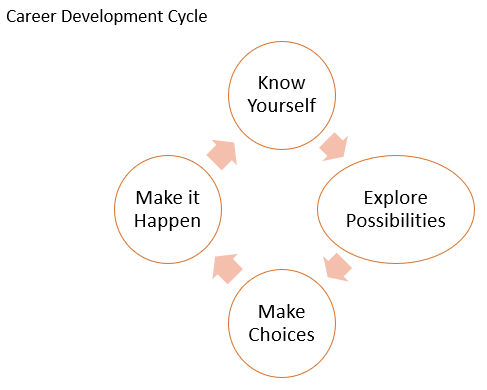
Career Development Cycle

  • Know Yourself

Interest, Values, Skills, Assets, Resources, Personality

  • Explore Possibilities

Research, try things out, Narrow choices, and explore new possibilities

  • Make Choices

Set Goals, develop a plan, Remove Barrier

  • Make it Happen

Convert plan into action, learn along the way, Achieve goals

Steps in Career Development cycle

  • Step 1: Needs:

This step involves in the conducting a needs assessment as a training programme.

  • Step 2: Vision:

The needs of the career system must be linked with the interventions. An ideal career development system known as the vision links the needs with the interventions.

  • Step 3: Action Plan:

An action plan should be formulated in order to achieve the vision. The support of the top management should be obtained in this process.

  • Step 4: Results:

Career development programme should be integrated with the organisation on-going employee training and management development programmes. The programme should be evaluated from time to time in order to revise the programme.

Career Life Cycle is a model that describes the stages of an individual’s career development. It is a useful tool for both individuals and organizations in understanding the different stages of a career and the corresponding developmental tasks that need to be accomplished at each stage. The career life cycle typically consists of four stages: exploration, establishment, maintenance, and decline.

  • Exploration:

This stage usually occurs during the early years of a career. During this stage, individuals are exploring different career options and trying to identify their interests, skills, and values. The primary developmental task during this stage is to gain self-awareness and explore different career options to find a good fit.

  • Establishment:

This stage occurs when individuals have found a career path that aligns with their interests, skills, and values. The primary developmental task during this stage is to establish oneself in a career and develop the necessary skills and competencies to succeed in that career.

  • Maintenance:

This stage occurs when individuals have established themselves in their careers and are focused on maintaining their success. The primary developmental task during this stage is to continue to develop one’s skills and competencies, expand one’s network, and take on new challenges to continue to grow and advance in one’s career.

  • Decline:

This stage occurs when individuals begin to transition out of their careers, either by choice or due to circumstances such as retirement. The primary developmental task during this stage is to plan for and manage the transition out of one’s career, including preparing for retirement or finding a new career path.

Succession Planning

Succession Planning is a process for identifying and developing new leaders who can replace old leaders when they leave, retire or die. Here the planning is usually a close process, so that those who have been selected are not likely to know that they are on a succession list or chat. Succession planning increases the availability of experienced and capable employees that are prepared to assume these roles as they become available. Succession planning is a strategy for passing on leadership roles often the ownership of a company to an employee or group of employees.

Succession planning is a process that ensures an organization has a plan in place to identify and develop internal talent to fill key leadership roles when the current leaders leave their positions. A succession planning program is a formal program that helps organizations identify and develop their future leaders.

A well-designed succession planning program involves several key steps. The first step is to identify the key leadership positions that need to be filled in the future. This involves analyzing the organization’s strategic objectives and identifying the critical roles that are necessary to achieve these objectives.

The next step is to assess the current talent within the organization to identify potential successors for these key positions. This involves evaluating the skills, experience, and potential of current employees to determine who is ready to take on leadership roles in the future.

Once potential successors have been identified, the organization can begin developing them through training, mentoring, and other development opportunities. This involves creating a development plan that outlines the specific skills and experiences that potential successors need to acquire to prepare them for future leadership roles.

In addition to developing potential successors, the organization should also establish a process for regularly reviewing and updating the succession plan. This involves monitoring the progress of potential successors, updating development plans as needed, and identifying new potential successors as the organization’s needs change.

A well-designed succession planning program has several benefits for organizations. It helps ensure continuity of leadership and reduces the risks associated with unexpected departures of key leaders. It also promotes employee engagement and retention by providing clear career paths and development opportunities.

Also known as “replacement planning,” it ensures that businesses continue to run smoothly after a company’s most important people move on to new opportunities, retire, or pass away. Succession planning can also provide a liquidity event enabling the transfer of ownership in a going concern to rising employees. Taken narrowly, “replacement planning” for key roles is the heart of succession planning.

  • In dictatorships, succession planning aims for continuity of leadership, preventing a chaotic power struggle by preventing a power vacuum.
  • In monarchies, succession is usually settled by the order of succession.
  • In business, succession planning entails developing internal people with the potential to fill key business leadership positions in the company.

Effective succession or talent-pool management concerns itself with building a series of feeder groups up and down the entire leadership pipeline or progression. In contrast, replacement planning is focused narrowly on identifying specific back-up candidates for given senior management positions. Thought should be given to the retention of key employees, and the consequences that the departure of key employees may have on the business.

Types of Succession Planning programs:

  • High-potential Program:

This program identifies employees who have the potential to fill key leadership positions in the future and provides them with targeted development opportunities to prepare them for these roles.

  • Talent Review Program:

This program involves assessing the current talent within the organization to identify potential successors for key leadership positions. The program focuses on evaluating the skills, experience, and potential of current employees to determine who is ready to take on leadership roles in the future.

  • Career Development Program:

This program helps employees identify and develop the skills and experiences they need to advance their careers within the organization. It provides employees with a clear career path and development opportunities that prepare them for future leadership roles.

  • Executive Coaching program:

This program provides one-on-one coaching and mentoring to potential successors to help them develop the skills and experience they need to take on leadership roles in the future.

  • Succession Planning Task force:

This program involves creating a task force that is responsible for overseeing the organization’s succession planning efforts. The task force is typically composed of senior leaders and HR professionals who work together to identify potential successors and develop them through training and development opportunities.

Process and Practices

Companies devise elaborate models to characterize their succession and development practices. Most reflect a cyclical series of activities that include these fundamentals:

  • Identify key roles for succession or replacement planning
  • Define the competencies and motivational profile required to undertake those roles
  • Assess people against these criteria – with a future orientation
  • Identify pools of talent that could potentially fill and perform highly in key roles
  • Develop employees to be ready for advancement into key roles; primarily through the right set of experiences.

Research indicates that clear objectives are critical to establishing effective succession planning. These objectives tend to be core to many or most companies that have well-established practices:

  • Identify those with the potential to assume greater responsibility in the organization
  • Provide critical development experiences to those that can move into key roles
  • Engage the leadership in supporting the development of high-potential leaders
  • Build a database that can be used to make better staffing decisions for key jobs

In other companies these additional objectives may be embedded in the succession process:

  • Improve employee commitment and retention
  • Meet the career development expectations of existing employees
  • Counter the increasing difficulty and costs of recruiting employees externally

Process of Succession Planning

  • Identifying Key Business Areas and Positions:

First and foremost, the key business areas are identified, i.e. the areas which are significant with respect to the operational activities and strategic objectives. After that, those positions are identified which if vacant can cause difficulty in achieving business objectives.

  • Ascertaining Competencies for Key areas and positions:

Next, you need to determine the required competencies for key business areas and position, in order to create the selection criteria, establish performance standards and fill the difference between what the viable successors know and what they need to know, through the training and development process.It determines the knowledge, skills, ability and experience required to achieve business goals.

  • Find out the interested and potential candidates and assess them as per the competencies:

After competency is analysed, the next step is to identify among various employees working in the organization, who are interested as well as they have the capability to fill key business areas and positions. The Human Resource Manager discusses future career plans and interests with the candidates and identifies the potential successors who are ready to replace the old ones and can be trained and developed for future contingencies.

  • Develop and Implement Succession Strategies:

Strategies for learning, training, development, knowledge transfer, experience sharing is developed and implemented for potential successors.

  • Evaluate Effectiveness:

The last step to the succession planning process is to evaluate the succession planning and management, to ensure that all the key business areas and positions are covered under the succession planning. Further, it also ensures that in case of any sudden vacancies in future, key positions can be filled as soon as possible and the successors perform effectively when they hold the position.

A larger business might groom mid-level employees to one day take over higher-level positions.

  • Recruitment

Succession planning starts with proper hiring practices with the goal of choosing candidates that are capable of rising through the ranks as time goes on. For example, an experienced person from another company might be courted and groomed for an executive-level position.

  • Training

Training includes the development of skills, company knowledge, and certifications. The training might include having employees cross-train and shadow various positions or jobs in all the major departments. This process can help the person become well rounded and understand the business on a granular level. Also, the cross-training process can help identify the employees that are not up to the task of developing multiple skill sets needed to run the company.

Benefits of Succession Planning

There are several advantages for both employers and employees to having a formalized succession plan in place:

  • Shareholders of publicly traded companies benefit from proper succession planning, such as the case when the next candidate for CEO is involved in business operations and is well respected years before the current CEO retires. Also, if investors observe a well-communicated succession plan, they won’t sell the company’s stock when the CEO retires.
  • With Baby Boomer business owners and leadership retiring in huge numbers, a new generation of leaders will be needed.
  • Employees know that there is a chance for advancement and possibly ownership, which can lead to more empowerment and higher job satisfaction.
  • Management keeps better track of the value of employees so that positions can be filled internally when opportunities arise.
  • Knowing that the company is planning for future opportunities reinforces career development among employees.
  • Management’s commitment to succession planning means that supervisors will mentor employees to transfer knowledge and expertise.
  • With succession planning, leadership and employees are better able to share company values and vision.

Need for Succession Planning

Succession Planning is a part and parcel of the Human Resource Planning, which acknowledges that the employees may or may not work with the organization in the future. And so to be at the safer side, a succession plan is developed to analyse the vacancies which might take place when an employee leaves the organization, the business areas which might be affected, job requirements and the skills of the existing incumbent.

error: Content is protected !!