EBIT-EPS analysis for Capital Structure Decision

EBIT-EPS Analysis is a financial tool used to determine the impact of different financing options (debt and equity) on a company’s Earnings Per Share (EPS) at various levels of Earnings Before Interest and Taxes (EBIT). It helps in capital structure decision-making, allowing firms to choose between debt financing (which increases financial leverage) and equity financing (which avoids fixed interest costs but dilutes ownership). The analysis involves computing EPS for different EBIT levels to identify the indifference point, where EPS remains the same regardless of financing choice. Companies aim to maximize EPS while managing financial risk and shareholder value.

Meaning of EBIT

Earnings Before Interest and Taxes (EBIT) refers to the operating profit of the firm.
It is the income earned from business operations before deducting interest on loans and income tax.

EBIT = OperatingRevenue – OperatingExpenses

It measures the earning capacity of the firm independent of financing decisions.

Meaning of EPS

Earnings Per Share (EPS) represents the earnings available to each equity shareholder.
It indicates the profitability of the company from the shareholders’ point of view.

EPS = Earnings available to equity shareholders / Number of equity shares

Higher EPS means higher return to shareholders and increased market value of shares.

Financial Leverage and EBIT–EPS

The analysis is closely related to financial leverage.

Financial leverage means the use of debt in capital structure to increase return to equity shareholders.

  • If EBIT is high → Debt financing increases EPS

  • If EBIT is low → Debt financing decreases EPS

Therefore, proper use of debt can increase shareholders’ wealth.

Advantages of EBIT-EPS Analysis

  • Helps in Selecting Optimum Capital Structure

EBIT–EPS analysis helps management compare different financing alternatives such as equity shares, preference shares and debt. By calculating earnings per share under each plan, the company can identify the most profitable financing option. The plan that provides higher EPS at a particular level of EBIT is selected. Thus, it guides the finance manager in designing an optimum capital structure that balances cost and return while improving the financial performance of the organization.

  • Maximizes Shareholders’ Earnings

The main objective of financial management is to maximize the wealth of equity shareholders. EBIT–EPS analysis directly focuses on earnings available to shareholders. It shows how different financing plans affect EPS and helps management select the alternative that produces higher earnings per share. By choosing the plan with the highest EPS, the firm increases returns to shareholders, enhances investor confidence and improves the market value of shares.

  • Measures the Effect of Financial Leverage

EBIT–EPS analysis clearly explains the effect of financial leverage on shareholders’ earnings. It shows how the use of borrowed funds can increase EPS when operating profits are high. At the same time, it also reveals the negative impact when profits decline. Therefore, it helps management understand both benefits and dangers of debt financing. This knowledge assists in maintaining a proper balance between risk and return while planning the capital structure.

  • Useful in Financial Planning

The analysis is very helpful in financial planning and forecasting. It enables the company to estimate the level of operating profit required to meet interest and dividend obligations. Management can predict future earnings and evaluate the financial viability of proposed financing plans. This makes planning more systematic and reduces uncertainty in financial decision-making. As a result, the company can arrange funds in advance and avoid financial difficulties.

  • Facilitates Comparison of Financing Alternatives

A company often has several alternatives for raising funds, such as issuing shares or taking loans. EBIT–EPS analysis provides a numerical comparison of these alternatives. It presents the impact of each option on EPS in a clear and measurable form. This makes decision-making logical and objective rather than based on assumptions. Hence, management can select the most beneficial financing source after evaluating all possible alternatives.

  • Identifies the Indifference Point

EBIT–EPS analysis helps determine the indifference point, which is the level of EBIT where EPS remains the same under two financing plans. This point guides management in understanding the level of operating income required for debt financing to become advantageous. Above this level, debt financing is preferable, while below it equity financing is safer. Therefore, the indifference point provides a clear basis for selecting suitable financial strategies.

  • Improves Decision-Making

The technique promotes scientific and rational financial decision-making. Instead of relying on guesswork, management uses calculated figures of EPS to choose financing sources. It provides a clear picture of expected returns and financial obligations. This reduces uncertainty and improves confidence in financial decisions. Consequently, the organization can adopt policies that are more effective, practical and aligned with long-term business goals.

  • Assists in Profit Planning

EBIT–EPS analysis also helps in profit planning. By analyzing different EBIT levels, the firm can set profit targets required to achieve desired EPS. Management can evaluate whether expected operating profits are sufficient to cover fixed financial charges. This enables better budgeting and performance evaluation. Therefore, the analysis acts as a useful tool for planning profitability and monitoring the financial performance of the business.

Limitations of EBIT-EPS Analysis


Although EBIT–EPS analysis is a useful technique for selecting an appropriate financing plan and capital structure, it is not free from defects. The analysis mainly concentrates on earnings per share and ignores several practical aspects of financial decision-making. Therefore, it should not be used as the only basis for financing decisions.

The major limitations of EBIT–EPS analysis are explained below:

  • Ignores Business Risk

EBIT–EPS analysis assumes that the operating income (EBIT) is known and stable. In reality, business earnings fluctuate due to changes in demand, competition, economic conditions and technology. If EBIT decreases unexpectedly, the company may not be able to meet interest obligations on debt. Hence, the analysis does not properly consider business risk, which is an important factor in financial planning.

  • Focuses Only on EPS

The technique gives importance only to earnings per share. However, maximizing EPS does not always mean maximizing shareholders’ wealth. Shareholders are also concerned with share price, dividends, safety of investment and future growth. A plan with higher EPS may involve higher risk and may reduce the market value of shares. Therefore, EPS alone is not a complete measure of financial performance.

  • Neglects Financial Risk

EBIT–EPS analysis encourages the use of debt because it often increases EPS at higher levels of EBIT. However, excessive debt increases financial risk and the possibility of insolvency. The company must pay interest regardless of profit. The analysis does not give adequate weight to the risk arising from heavy borrowing, which may endanger the long-term stability of the firm.

  • Assumes Constant Interest and Tax Rates

The analysis assumes that interest rates and tax rates remain constant. In actual business conditions, interest rates change due to market fluctuations and government policies. Similarly, tax rates may also vary. Changes in these rates directly affect EPS and the cost of capital. Hence, results of the analysis may become unrealistic or misleading.

  • Ignores Market Conditions

EBIT–EPS analysis does not consider the condition of the capital market. Sometimes it may not be possible to issue shares or debentures due to unfavorable market situations. Investor preferences, economic recession and stock market trends also affect financing decisions. Since these practical aspects are ignored, the analysis may not always be applicable in real situations.

  • No Consideration of Control

Issue of equity shares reduces the ownership control of existing shareholders. Many companies avoid issuing new shares to maintain management control. EBIT–EPS analysis does not consider this important aspect. It only compares EPS and ignores the effect of financing decisions on voting rights and managerial control.

  • Unrealistic Assumption of Fixed EBIT Levels

The technique compares financing plans at different EBIT levels, but predicting exact EBIT in advance is difficult. Business profits are uncertain and affected by several external factors. If the actual EBIT differs from estimated EBIT, the selected financing plan may not be suitable. Therefore, the analysis may lead to wrong decisions when profit estimates are inaccurate.

  • Does Not Consider Cash Flow Position

EBIT–EPS analysis is based on accounting profits rather than cash flows. However, interest and loan repayments require actual cash payments. A firm may show high EPS but may still face cash shortage. Ignoring liquidity position may create financial difficulties and even bankruptcy.

  • Short-Term Perspective

The analysis mainly focuses on immediate effect on EPS and does not consider long-term consequences such as growth opportunities, financial flexibility and sustainability. A financing plan beneficial in the short run may harm the company in the long run. Therefore, it provides only a partial view of financial decision-making.

Indifference Points:

The indifference point, often called as a breakeven point, is highly important in financial planning because, at EBIT amounts in excess of the EBIT indifference level, the more heavily levered financ­ing plan will generate a higher EPS. On the other hand, at EBIT amounts below the EBIT indifference points the financing plan involving less leverage will generate a higher EPS.

Indifference points refer to the EBIT level at which the EPS is same for two alternative financial plans. According to J. C. Van Home, ‘Indifference point refers to that EBIT level at which EPS remains the same irrespective of debt equity mix’. The management is indifferent in choosing any of the alternative financial plans at this level because all the financial plans are equally desirable. The indifference point is the cut-off level of EBIT below which financial leverage is disadvanta­geous. Beyond the indifference point level of EBIT the benefit of financial leverage with respect to EPS starts operating.

The indifference level of EBIT is significant because the financial planner may decide to take the debt advantage if the expected EBIT crosses this level. Beyond this level of EBIT the firm will be able to magnify the effect of increase in EBIT on the EPS.

In other words, financial leverage will be favorable beyond the indifference level of EBIT and will lead to an increase in the EPS. If the expected EBIT is less than the indifference point then the financial planners will opt for equity for financing projects, because below this level, EPS will be more for less levered firm.

  • Computation:

We have seen that indifference point refers to the level of EBIT at which EPS is the same for two different financial plans. So the level of that EBIT can easily be computed. There are two approaches to calculate indifference point: Mathematical approach and graphical approach.

  • Graphical Approach:

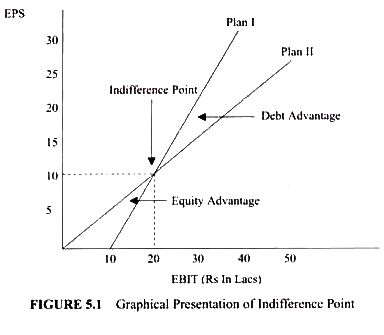
The indifference point may also be obtained using a graphical approach. In Figure 5.1 we have measured EBIT along the horizontal axis and EPS along the vertical axis. Suppose we have two financial plans before us: Financing by equity only and financing by equity and debt. Dif­ferent combinations of EBIT and EPS may be plotted against each plan. Under Plan-I the EPS will be zero when EBIT is nil so it will start from the origin.

The curve depicting Plan I in Figure 5.1 starts from the origin. For Plan-II EBIT will have some positive figure equal to the amount of interest to make EPS zero. So the curve depicting Plan-II in Figure 5.1 will start from the positive intercept of X axis. The two lines intersect at point E where the level of EBIT and EPS both are same under both the financial plans. Point E is the indifference point. The value corresponding to X axis is EBIT and the value corresponding to 7 axis is EPS.

These can be found drawing two perpendiculars from the indifference point—one on X axis and the other on Taxis. Similarly we can obtain the indifference point between any two financial plans having various financing options. The area above the indifference point is the debt advantage zone and the area below the indifference point is equity advantage zone.

Above the indifference point the Plan-II is profitable, i.e. financial leverage is advantageous. Below the indifference point Plan I is advantageous, i.e. financial leverage is not profitable. This can be found by observing Figure 5.1. Above the indifference point EPS will be higher for same level of EBIT for Plan II. Below the indifference point EPS will be higher for same level of EBIT for Plan I. The graphical approach of indifference point gives a better understanding of EBIT-EPS analysis.
Financial Breakeven Point:

In general, the term Breakeven Point (BEP) refers to the point where the total cost line and sales line intersect. It indicates the level of production and sales where there is no profit and no loss because here the contribution just equals to the fixed costs. Similarly financial breakeven point is the level of EBIT at which after paying interest, tax and preference dividend, nothing remains for the equity shareholders.

In other words, financial breakeven point refers to that level of EBIT at which the firm can satisfy all fixed financial charges. EBIT less than this level will result in negative EPS. Therefore EPS is zero at this level of EBIT. Thus financial breakeven point refers to the level of EBIT at which financial profit is nil.

Financial Break Even Point (FBEP) is expressed as ratio with the following equation:

Calculation of Weighted Cost of Capital

Weighted average Cost of Capital (WACC) is a financial metric used to determine the cost of financing a company’s operations. It reflects the average cost of all sources of financing, including debt and equity, weighted by their proportion in the company’s capital structure. The WACC is an important factor in determining a company’s value and profitability, and is used in various financial analysis and decision-making processes.

Components of WACC:

The WACC is composed of two main components:

  • Cost of equity
  • Cost of debt

Cost of Equity:

The cost of equity is the return required by investors in exchange for owning a company’s stock. It reflects the risk associated with owning the stock and is influenced by factors such as market conditions, the company’s financial performance, and the company’s growth prospects. The cost of equity can be calculated using various models, including the dividend discount model, the capital asset pricing model (CAPM), and the arbitrage pricing theory.

Cost of Debt:

The cost of debt is the interest rate paid by a company on its debt financing. It reflects the creditworthiness of the company and market conditions, and is typically lower than the cost of equity. The cost of debt can be calculated using the yield to maturity of the company’s existing debt or by estimating the interest rate the company would have to pay on new debt.

Calculation of WACC:

WACC is calculated by weighting the cost of equity and cost of debt based on their proportion in the company’s capital structure.

WACC = (E/V x Re) + (D/V x Rd x (1 – Tc))

Where:

E = Market value of equity

D = Market value of debt

V = Total market value of the company (E + D)

Re = Cost of equity

Rd = Cost of debt

Tc = Corporate tax rate

The first part of the equation (E/V x Re) represents the cost of equity weighted by the proportion of equity in the company’s capital structure. The second part of the equation (D/V x Rd x (1 – Tc)) represents the cost of debt weighted by the proportion of debt in the company’s capital structure, adjusted for the tax deductibility of interest payments.

Advantages of WACC:

  • Considers all Sources of Financing:

WACC considers the cost of all sources of financing, including debt and equity, which provides a more comprehensive view of the company’s cost of capital.

  • Useful in Decision-making:

WACC is used in various financial analysis and decision-making processes, such as determining whether to undertake a new project or make an acquisition.

  • Reflects Market Conditions:

WACC reflects current market conditions, such as interest rates and the risk premium for equity, which helps companies make informed financial decisions.

  • Easy to Calculate:

WACC is a relatively simple calculation that can be easily understood and communicated to stakeholders.

Limitations of WACC:

  • Assumes constant Capital Structure:

WACC assumes a constant capital structure, which may not be realistic for companies that frequently issue or retire debt or equity.

  • Sensitive to input assumptions:

WACC is sensitive to input assumptions, such as the cost of debt and equity, which can vary depending on the method used to calculate them.

  • Ignores other factors:

WACC does not consider other factors that may affect a company’s cost of capital, such as market risk and company-specific risk.

  • Does not account for Project risk:

WACC is based on the company’s overall risk, and may not accurately reflect the risk associated with a specific project or investment.

Business Finance, Features, Scope, Challenges

Business finance is the art and science of managing a company’s money to achieve its objectives and maximize shareholder value. Its core principle is the time value of money, which states that a dollar today is worth more than a dollar in the future. Key functions include making strategic investment decisions (capital budgeting), determining the optimal mix of debt and equity financing (capital structure), and managing day-to-day operational cash flows (working capital management). The overarching goal is to ensure the firm has the necessary funds to operate, grow, and generate profits while carefully balancing risk against potential returns. Sound financial management is thus fundamental to the survival, stability, and long-term success of any business.

Features of Business Finance:

  • Essential for Business Operations

Finance is the lifeblood of any business, as it ensures smooth functioning of day-to-day operations. Businesses need funds to purchase raw materials, pay wages, cover overhead expenses, and manage working capital requirements. Without adequate finance, even profitable businesses may face liquidity crises and operational difficulties. Proper financial planning helps in timely availability of funds, avoiding disruptions in production and services. Hence, finance acts as the foundation upon which all other business activities—such as production, marketing, and distribution—are built. Inadequate finance can restrict growth, while efficient financial management ensures stability and continuity of business operations.

  • Wide Scope

Business finance covers a broad range of activities, extending beyond just arranging funds. It includes estimating financial requirements, determining the sources of funds, allocating them efficiently, managing working capital, and ensuring proper utilization of financial resources. The scope also involves investment decisions, financing decisions, and dividend policies that impact the long-term growth and profitability of the enterprise. Additionally, it covers risk management, cost control, and compliance with financial regulations. Thus, business finance is not confined to raising money but also ensures that funds are used effectively to maximize returns, reduce risks, and enhance the overall value of the firm.

  • Involves Raising and Using Funds

One of the key features of business finance is that it deals with both raising funds and their effective utilization. Businesses raise finance from various sources such as equity, debt, retained earnings, or external borrowings. Once funds are raised, financial managers must allocate them in the most productive areas, ensuring maximum return at minimum risk. Merely raising funds is not enough; their proper utilization is critical to avoid wasteful expenditure and achieve financial goals. Therefore, business finance emphasizes not only mobilization of resources but also their efficient management to ensure profitability, liquidity, and long-term sustainability of the business.

  • Involves Risk and Uncertainty

Business finance is always associated with risk and uncertainty, as future returns on investments cannot be predicted with absolute certainty. Market fluctuations, changing interest rates, inflation, and unforeseen events like economic slowdowns or policy changes affect financial decisions. Investment in projects may or may not yield expected returns, and sources of finance may carry risks such as repayment obligations or shareholder pressure. Financial managers must evaluate risk factors before making decisions to balance profitability and safety. Effective risk analysis and planning are therefore essential in business finance to minimize potential losses and maximize long-term wealth creation for stakeholders.

  • Continuous Process

Finance in business is not a one-time activity but a continuous and ongoing process. From the inception of a business, funds are required for setup, and as the business grows, additional finance is needed for expansion, modernization, and diversification. Similarly, businesses need to manage working capital requirements daily to pay salaries, purchase raw materials, and meet routine expenses. Financial planning, raising funds, allocation, monitoring, and reinvestment continue throughout the life of the business. Since financial needs evolve with changing business conditions, business finance remains a dynamic and continuous function, crucial for maintaining growth and sustainability over time.

Scope of Business Finance:

  • Investment Decision (Capital Budgeting)

This involves the long-term allocation of a firm’s capital to viable projects and assets. It encompasses identifying, evaluating, and selecting investment opportunities that are expected to yield returns greater than the company’s cost of capital. Techniques like Net Present Value (NPV) and Internal Rate of Return (IRR) are used to assess the profitability and risk of proposals such as new machinery, plants, or product lines. This decision is crucial as it shapes the company’s future earning potential and strategic direction, committing large funds for long periods.

  • Financing Decision (Capital Structure)

This scope deals with procuring the necessary funds for investments and operations. It involves determining the optimal mix of debt and equity—known as the capital structure—to finance the firm’s assets. The goal is to minimize the overall cost of capital (WACC) while balancing the risk of bankruptcy associated with debt against the dilution of ownership from equity. Decisions include choosing between short-term and long-term financing, public issues, loans, and retained earnings to ensure funds are available at the right time and cost.

  • Dividend Decision (Profit Allocation)

This area focuses on determining the proportion of a company’s earnings to distribute to shareholders as dividends versus the amount retained within the business for reinvestment. The decision directly impacts shareholder wealth and the firm’s internal financing capacity (retained earnings). Management must strike a balance between providing immediate returns to investors and funding future growth opportunities, all while considering the “dividend policy” that signals financial health and prospects to the market.

  • Working Capital Management (Liquidity Decision)

This involves managing the firm’s short-term assets and liabilities to ensure smooth day-to-day operations. It includes managing cash, inventory, and receivables (current assets) against payables and short-term debt (current liabilities). The primary goal is to maintain sufficient liquidity to meet operational expenses and short-term obligations without tying up excessive capital in unproductive assets. Effective management ensures operational efficiency and protects the company from the risk of insolvency.

  • Risk Management

This scope involves identifying, analyzing, and mitigating various financial risks that threaten the firm’s profitability and survival. Key risks include market risk (from price fluctuations), credit risk (from customer non-payment), operational risk (from internal failures), and liquidity risk. Firms use tools like hedging with derivatives, insurance, diversification, and internal controls to manage these exposures. The objective is not to eliminate all risk but to understand it, ensure it is appropriately compensated, and protect the company’s assets and earnings from unforeseen events.

  • Financial Analysis and Planning

This is the foundational scope that involves analyzing historical performance and forecasting future financial needs. It includes interpreting financial statements through ratio analysis (profitability, liquidity, leverage), creating budgets, and formulating proforma financial statements. This analytical process is essential for setting financial goals, evaluating past decisions, and creating a roadmap for future growth. It ensures that the firm’s strategic objectives are translated into concrete financial targets and that resources are allocated efficiently to achieve them.

  • Corporate Restructuring and Governance

This area deals with major strategic financial actions that alter a company’s structure or ownership to enhance value. It includes activities like mergers and acquisitions (M&A), divestitures, spin-offs, and leveraged buyouts. Furthermore, it encompasses corporate governance—the system of rules and practices by which a company is directed and controlled. This ensures that management acts in the best interests of shareholders, maintains ethical standards, and provides accurate financial disclosure, which is crucial for maintaining investor confidence and access to capital.

Challenges of Business Finance:

  • Maintaining adequate cash flow

The paramount challenge is ensuring sufficient cash is available to meet immediate obligations like payroll, supplier payments, and rent. Profitability on paper does not guarantee liquidity. Late customer payments, high inventory levels, and unexpected expenses can quickly create a cash crunch, even for thriving businesses. Meticulous cash flow forecasting and active working capital management are essential to avoid insolvency, where a company fails not from lack of potential but from a lack of accessible funds.

  • Managing Financial Risks

Businesses face a multitude of financial risks, including fluctuating interest rates on debt, foreign exchange movements for importers/exporters, customer defaults (credit risk), and changing commodity prices. A significant challenge is identifying these exposures and implementing effective, cost-efficient strategies to hedge against them. Failure to manage these risks can lead to devastating losses, eroding profit margins and jeopardizing financial stability, requiring constant vigilance and sophisticated financial tools.

  • Accessing Capital and Funding

Securing affordable financing for operations and growth is a persistent hurdle. The challenge is choosing the right source (debt vs. equity) and convincing lenders or investors of the business’s viability. New ventures and SMEs often struggle with this, facing high interest rates or demanding repayment terms. The cost of capital must be low enough to allow for profitable investment, making this a critical barrier to expansion and innovation for many firms.

  • Navigating Economic Uncertainty

Macroeconomic factors like inflation, recession, changing government policies, and geopolitical events create an unpredictable environment. These conditions make accurate financial planning, forecasting, and budgeting extremely difficult. Inflation erodes purchasing power and can increase costs faster than prices can be adjusted. A challenge is building financial resilience and flexibility into the business model to withstand economic shocks and volatility beyond the company’s control.

  • Making Optimal Investment Decisions (Capital Budgeting)

Choosing which long-term projects to invest in is fraught with challenge. It requires accurately forecasting future cash flows, assessing project-specific risks, and selecting the correct hurdle rate. There is always the risk of over-investing in a failing project or under-investing and missing a key opportunity. The complexity of evaluating intangible benefits and the potential for biased projections make this a critical test of strategic financial management.

  • Achieving Optimal Capital Structure

Striking the perfect balance between debt and equity financing is a complex challenge. Too much debt increases financial risk and interest burdens, potentially leading to bankruptcy. Too much equity dilutes ownership and can be more expensive. The challenge is to find the mix that minimizes the overall cost of capital while maintaining financial flexibility and acceptable risk, a balance that shifts with market conditions and the business’s life cycle stage.

  • Compliance and Regulatory Adherence

The financial landscape is governed by a complex web of ever-changing laws, accounting standards (like IFRS or GAAP), and tax regulations. The challenge is twofold: the cost of ensuring compliance (hiring experts, implementing systems) and the risk of severe penalties, legal issues, and reputational damage for non-compliance. This burden is particularly heavy for businesses operating across multiple jurisdictions, each with its own unique regulatory framework.

Financial Management, Introductions, Concept, Introduction, Objectives, Scope, Functions and Goals

Financial Management involves planning, organizing, directing, and controlling financial activities to achieve an organization’s objectives. It focuses on the efficient procurement and utilization of funds while balancing risk and profitability. Key aspects include capital budgeting, determining financial structure, managing working capital, and ensuring liquidity. It aims to maximize shareholder wealth by optimizing resource allocation and minimizing costs. Effective financial management supports decision-making related to investments, financing, and dividends, ensuring sustainable growth. It also involves analyzing financial risks and returns, maintaining financial stability, and complying with legal and regulatory requirements.

Financial Management is a critical function in business management, dealing with the planning, procurement, and utilization of funds to achieve organizational objectives. It ensures that adequate funds are available at the right time and are used efficiently to maximize returns while maintaining liquidity and solvency. It integrates financial planning, control, and decision-making to support business growth, stability, and profitability.

In a business, financial management plays a pivotal role in sustaining operations, investing in new opportunities, and managing risks. It acts as the backbone for decision-making in areas like capital budgeting, financing, dividend policy, and working capital management. A sound financial strategy enables organizations to achieve both short-term operational efficiency and long-term strategic goals.

Objectives of Financial Management

  • Ensuring Adequate Funds

One of the primary objectives of financial management is to ensure that a business always has adequate funds to meet its operational, investment, and contingency needs. This involves careful planning of financial requirements, estimating cash inflows and outflows, and maintaining liquidity. Adequate funds ensure smooth functioning, prevent financial crises, and help the organization fulfill its commitments to employees, suppliers, and creditors.

  • Maximizing Profitability

Financial management aims to maximize the profitability of the business by making sound investment and financing decisions. Profitable operations increase the value of the business, provide higher returns to shareholders, and create resources for growth and expansion. Decisions related to cost control, pricing, and investment appraisal are made to enhance profit while managing risks effectively.

  • Ensuring Liquidity

Maintaining liquidity is crucial for meeting short-term obligations, such as paying salaries, creditors, and taxes. Financial management focuses on balancing liquidity and profitability to avoid insolvency. Sufficient liquid resources enable the organization to handle emergencies and sustain operations without disrupting production or service delivery.

  • Optimal Utilization of Funds

Financial management ensures that the funds available are used in the most efficient manner. Resources should be allocated to the most profitable projects and departments, avoiding wastage or underutilization. This objective supports cost control, resource efficiency, and higher returns on investment, ensuring that every rupee invested contributes to business growth.

  • Minimizing Cost of Capital

Another objective is to procure funds at the lowest possible cost while balancing risk and ownership control. Financial managers strive to maintain an optimal mix of debt and equity to reduce the overall cost of capital. Efficient financing reduces interest expenses, improves profitability, and enhances the organization’s financial stability.

  • Maximizing Shareholder Wealth

Financial management aims to maximize the wealth of shareholders by ensuring a steady growth in earnings and dividends. Long-term strategies, such as profitable investments and prudent financing, contribute to increasing share value. Shareholder wealth maximization aligns financial decisions with owners’ interests, creating trust and attracting further investment.

  • Financial Planning and Forecasting

Financial management involves systematic planning and forecasting to predict future financial requirements. Proper financial planning helps in anticipating fund shortages or surpluses, reducing uncertainties, and ensuring timely availability of resources. Forecasting also supports investment decisions, risk management, and long-term business growth.

  • Ensuring Financial Stability and Risk Management

Maintaining financial stability is a key objective to protect the business from unexpected losses or economic downturns. Financial management incorporates risk assessment and mitigation strategies, such as diversification, insurance, and hedging. A stable financial position allows the organization to survive crises, maintain creditworthiness, and plan for sustainable growth.

Scope of Financial Management

  • Financial Planning

Financial planning is the first and most important area in the scope of financial management. It involves estimating the amount of funds required for starting and operating the business. The finance manager forecasts future sales, production costs, expenses and capital requirements. He prepares budgets and financial policies to avoid shortage or excess of funds. Proper financial planning ensures that the organization always has adequate funds at the right time and avoids financial uncertainty and risk.

  • Financing Decision (Capital Structure Decision)

Financing decision refers to the selection of appropriate sources of funds for the business. The finance manager decides the proportion of equity shares, preference shares, debentures and borrowed funds. This is also known as capital structure decision. The main objective is to minimize the cost of capital and maximize returns to shareholders. An improper mix of debt and equity may increase financial risk, whereas a proper financing decision helps in maintaining financial stability and control over the company.

  • Investment Decision (Capital Budgeting Decision)

Investment decision is concerned with the allocation of funds into long-term assets or projects. It includes decisions regarding purchase of machinery, expansion of plant, modernization, or starting new projects. The finance manager carefully evaluates different investment proposals by considering profitability, cost and risk. Since these decisions involve large amounts and long-term commitment of funds, wrong decisions may cause heavy losses. Therefore, proper investment decisions help in increasing productivity, profitability and overall growth of the business.

  • Dividend Decision

Dividend decision deals with the distribution of profits earned by the company. The management must decide how much profit should be distributed to shareholders as dividend and how much should be retained for future expansion. If more profit is distributed, shareholders remain satisfied but internal funds reduce. If more profit is retained, growth opportunities increase but shareholders may feel dissatisfied. Hence, financial management tries to maintain a proper balance between dividend payment and retention of earnings to maximize shareholders’ wealth.

  • Working Capital Management

Working capital management relates to the management of short-term assets and short-term liabilities. It includes management of cash, inventory, receivables and payables. The business requires sufficient working capital to carry out daily operations such as purchase of raw materials, payment of wages and meeting operating expenses. Excess working capital leads to idle funds, while inadequate working capital creates liquidity problems. Therefore, proper management ensures smooth functioning of business activities and maintains operational efficiency and financial stability.

  • Cash Management

Cash management is an important component of financial management. It involves planning and controlling cash inflows and outflows in the business. The finance manager ensures that the firm has enough cash to meet day-to-day expenses like salaries, rent and utility payments. At the same time, he avoids keeping excess idle cash because it does not earn returns. Proper cash management maintains liquidity, prevents insolvency and improves the financial position and reputation of the organization in the market.

  • Credit Management

Credit management refers to granting credit to customers and collecting payments on time. Many businesses sell goods on credit to increase sales and attract customers. The finance manager formulates credit policies, credit period and collection procedures. If credit is given without proper control, bad debts may increase and funds may get blocked. Efficient credit management helps in increasing sales while maintaining liquidity and reducing the risk of non-payment, thereby improving profitability and financial discipline in the organization.

  • Risk Management

Risk management is also a part of financial management because business activities always involve financial risk. Risks may arise due to changes in interest rates, market demand, exchange rates or business competition. The finance manager identifies possible financial risks and takes preventive measures such as insurance, diversification and hedging. The main objective is to reduce uncertainty and protect the financial resources of the firm. Effective risk management ensures stability, continuity and long-term survival of the business organization.

Functions of Financial Management

Financial management involves a wide range of activities aimed at ensuring the effective acquisition, allocation, and control of funds in an organization. Its primary functions can be classified into three broad categories: Investment, Financing, and Dividend decisions, along with supportive functions like financial planning and control.

  • Investment or Capital Budgeting Function

This function involves deciding where and how to invest the funds of the organization to generate maximum returns. It includes analyzing long-term investment proposals, evaluating risks, and choosing projects that align with the company’s objectives. Proper capital budgeting ensures efficient utilization of resources and supports growth while balancing profitability and risk.

  • Financing Function

Financing deals with raising funds from appropriate sources at the right time and cost. This includes selecting the optimal mix of debt, equity, and retained earnings to finance operations and investments. Efficient financing ensures sufficient funds are available without overburdening the company with high costs or risking financial stability.

  • Dividend Decision Function

This function focuses on deciding the portion of profits to be distributed as dividends and the portion to be retained for business growth. Dividend decisions affect shareholders’ satisfaction and the company’s ability to reinvest in expansion or meet financial obligations. A balanced dividend policy maintains investor confidence while supporting long-term financial goals.

  • Financial Planning Function

Financial planning involves forecasting future financial needs and determining strategies to meet them. It includes estimating capital requirements, projecting cash flows, and planning for contingencies. Proper financial planning ensures the availability of funds when needed, minimizes financial risk, and avoids liquidity crises.

  • Financial Control Function

Financial control focuses on monitoring and regulating financial resources to ensure they are used efficiently. It involves budgeting, cost control, auditing, and financial reporting. Effective financial control prevents misuse of funds, improves accountability, and supports strategic decision-making.

  • Working Capital Management

This function deals with managing short-term assets and liabilities to ensure smooth day-to-day operations. It includes managing cash, inventory, receivables, and payables. Efficient working capital management maintains liquidity, reduces financing costs, and ensures the company can meet its short-term obligations.

  • Risk Management Function

Financial management also involves identifying, assessing, and mitigating financial risks. This includes interest rate risk, credit risk, market risk, and operational risk. Proper risk management protects the organization from potential losses and ensures long-term financial stability.

  • Profit Planning and Management

Financial management ensures that funds are used efficiently to maximize profits. It involves cost analysis, revenue planning, and investment appraisal to achieve optimal returns. Profit planning helps in achieving business growth, enhancing shareholder wealth, and maintaining competitive advantage.

Goals of Financial Management

Financial management involves planning, acquiring, and utilizing funds to achieve organizational objectives. Its goals represent the desired outcomes that guide financial decisions and strategies. These goals ensure the business uses its resources efficiently while maintaining stability and growth. Broadly, financial management goals can be classified into primary goals and secondary goals.

  • Primary Goal: Wealth Maximization

The foremost goal of financial management is maximizing the wealth of shareholders. Wealth maximization focuses on increasing the market value of the company’s shares over the long term. This goal ensures that financial decisions, whether related to investment, financing, or dividend distribution, aim to enhance the overall value of the firm. It balances risk and return, prioritizing long-term sustainability over short-term profits.

  • Profit Maximization

Profit maximization refers to increasing the company’s earnings in the short term by efficiently managing costs and revenues. While important, this goal does not consider the time value of money, risk factors, or long-term growth. Hence, wealth maximization is often preferred as it provides a broader perspective, ensuring both profitability and sustainable growth.

  • Ensuring Liquidity

A vital goal of financial management is maintaining adequate liquidity to meet short-term obligations like salaries, taxes, and creditor payments. Without sufficient liquidity, a company may face insolvency despite being profitable on paper. Proper cash flow management ensures smooth operations, financial stability, and the ability to respond to emergencies.

  • Efficient Fund Utilization

Financial management aims to allocate resources optimally across various projects and departments. Efficient fund utilization avoids wastage, reduces costs, and ensures maximum returns from investments. Proper budgeting, cost control, and performance monitoring contribute to this goal, enhancing overall organizational efficiency.

  • Risk Management

Financial management seeks to identify, assess, and mitigate financial risks, such as market fluctuations, credit risk, and operational risk. By adopting hedging techniques, diversification, and insurance, organizations can safeguard their resources and ensure stability in uncertain economic conditions. Effective risk management protects both the company and its shareholders.

  • Ensuring Financial Stability

Maintaining a stable financial position is a key goal. Stability enables the organization to sustain operations, attract investors, and maintain creditworthiness. A stable financial environment supports long-term growth, facilitates expansion plans, and improves stakeholder confidence.

  • Optimal Capital Structure

Financial management aims to achieve an optimal mix of debt and equity to finance operations. A balanced capital structure reduces the overall cost of capital, enhances profitability, and minimizes financial risk. It ensures that funds are available when needed without overburdening the company with debt obligations.

  • Social and Ethical Goals

Modern financial management also considers social responsibility and ethical practices. This includes responsible investment, compliance with regulations, and fair treatment of stakeholders. Incorporating ethical considerations ensures sustainable growth and enhances the company’s reputation.

Financing Decision, Introductions, Meaning, Definitions, Objectives, Types, Factors and Importance

Financing decision is one of the most crucial areas of financial management, as it determines how a business raises funds required for its operations and growth. Every organization needs finance to start, run, and expand its activities, and acquiring these funds involves choosing the best possible sources. The financing decision focuses on determining the optimal mix of debt, equity, and other financial instruments. An efficient financing decision ensures that the cost of capital is minimized while the value of the firm is maximized.

This decision is not only about arranging funds but also about balancing risk and return. Too much debt increases financial risk but may reduce the cost of capital, while too much equity reduces risk but increases cost. Hence, the manager must decide the most appropriate capital structure that supports long-term stability and growth. In modern financial management, financing decisions also include evaluating market conditions, investor expectations, tax implications, and financial flexibility. An effective financing decision strengthens the company’s financial health and improves shareholder wealth.

Meaning of Financing Decision

Financing decision refers to the process of selecting the best sources of funds for meeting the financial needs of a business. It involves decisions related to the proportion of debt and equity, known as the capital structure. The primary aim is to choose sources that minimize the cost of capital and maximize returns for shareholders. It ensures the company has sufficient funds at the right time while maintaining an acceptable level of financial risk.

Definitions of Financing Decision

1. Howard & Upton

“A financing decision is a decision that involves the choice of sources of funds for the firm and the proportion in which the funds should be raised.”

2. Solomon

“A financing decision refers to the firm’s choice of the best financing mix or capital structure that minimizes the cost of capital and maximizes the value of the firm.”

3. James C. Van Horne

“A financing decision is concerned with determining how the firm’s assets are to be financed and what combination of debt and equity should be used.”

4. Gitman

“Financing decisions deal with the selection of external and internal sources of funds that best suit the financial objectives of the business.”

Objectives of Financing Decisions

  • Minimizing the Cost of Capital

A primary objective of financing decisions is to minimize the overall cost of raising funds. Managers evaluate different financing sources such as debt, equity, and retained earnings to choose the most cost-effective option. Lower cost of capital increases the net present value of projects, enhances profitability, and strengthens financial performance. Selecting funds at minimum cost helps the firm maintain competitiveness and achieve long-term financial efficiency.

  • Maximizing the Value of the Firm

Financing decisions aim to select a capital structure that increases the overall market value of the firm. When funds are raised through an optimal mix of debt and equity, the firm’s earnings and valuation improve. Investors prefer companies with stable and efficient financing policies, which enhances their confidence. Maximizing the firm’s value ultimately leads to increased shareholder wealth, which is the core goal of financial management.

  • Ensuring Financial Flexibility

Another important objective is to maintain adequate financial flexibility so the company can raise funds easily in the future. Flexibility helps firms respond quickly to market changes, economic downturns, or unexpected financial needs. A good financing strategy balances debt obligations and equity financing to avoid excessive financial stress. Companies with higher flexibility can seize investment opportunities, negotiate better terms, and maintain smooth business operations.

  • Maintaining an Optimal Capital Structure

Financing decisions strive to determine the most appropriate mix of debt and equity, known as the optimal capital structure. Too much debt increases the risk of insolvency, while too much equity can dilute ownership and increase cost. The objective is to strike a balance where risk is minimized and returns are maximized. Maintaining an optimal capital structure supports stability, reduces financial risk, and enhances long-term growth.

  • Minimizing Financial Risk

Effective financing decisions aim to minimize financial risk arising from excessive debt, high interest obligations, or fluctuating market conditions. Companies must evaluate their repayment capacity, cash flow strength, and profitability before choosing a financing source. Lower financial risk ensures better credit ratings, reduced borrowing costs, and improved investor trust. By managing risk effectively, firms safeguard their financial stability and avoid situations of distress or bankruptcy.

  • Ensuring Availability of Funds at the Right Time

One key objective is to secure funds when they are needed for operations, expansion, or investment. Timely availability of funds prevents delays in projects, maintains production cycles, and supports growth strategies. Financing decisions evaluate both short-term and long-term needs to ensure proper fund allocation. Having adequate finance at the right time enhances efficiency, maintains business continuity, and supports smooth organizational functioning.

  • Supporting Long-Term Strategic Goals

Financing decisions are aligned with the organization’s long-term objectives such as expansion, modernization, or diversification. Choosing the right financing source allows the company to undertake projects that support innovation and future growth. Long-term planning ensures sustainability, strengthens the company’s market position, and enables stable development. Sound financing supports strategic initiatives and helps the firm achieve its mission and vision effectively.

  • Maximizing Shareholders’ Wealth

The ultimate objective of financing decisions is to maximize shareholders’ wealth by increasing earnings, reducing cost of financing, and maintaining stability. By selecting the best financing mix, companies can increase profits and distribute higher dividends. Wealth maximization also improves stock prices and investor confidence. When financing decisions are efficient, they create long-term value for shareholders, making the company more attractive and financially strong.

Types of Financing Decisions

1. Long-Term Financing Decisions

Long-term financing decisions involve selecting sources of funds that will be used for more than one year. These funds are typically required for fixed assets, expansion, modernization, or strategic investments. Options include equity shares, preference shares, debentures, long-term loans, and retained earnings. The decision focuses on choosing a mix that minimizes cost and risk while maximizing returns. These decisions greatly influence the capital structure and long-term financial stability of the firm.

2. Short-Term Financing Decisions

Short-term financing decisions concern meeting the firm’s day-to-day operational and working capital needs. Funds are required for inventory, wages, raw materials, and overheads. Sources include trade credit, bank overdraft, short-term loans, and commercial paper. The objective is to maintain liquidity and ensure smooth operations without excessive borrowing costs. Proper short-term financing is essential to avoid cash shortages and maintain efficient working capital management.

3. Capital Structure Decisions

Capital structure decisions relate to determining the appropriate proportion of debt and equity in the firm’s financial structure. These decisions aim to maintain an optimal capital structure that minimizes the overall cost of capital and maximizes firm value. Factors such as risk, profitability, financial flexibility, and market conditions influence the choice. A well-designed capital structure ensures financial stability and supports sustainable growth.

4. Financing Mix Decisions

Financing mix decisions involve choosing the correct combination of internal and external sources of finance. Internal funds include retained earnings and reserves, while external funds consist of debt, equity, and hybrid instruments. The goal is to select the best mix that balances cost, control, and risk. Firms prefer internal financing when available, but external financing becomes necessary for large projects. A balanced financing mix improves financial performance and strategic flexibility.

5. Dividend Financing Decisions

Dividend decisions indirectly influence financing decisions because they determine how much of a firm’s earnings are distributed to shareholders and how much is retained. Retained earnings serve as an internal financing source, reducing reliance on external funds. A company must decide whether to distribute profits as dividends or reinvest them. These decisions impact shareholder satisfaction, future growth, and the availability of internal funds for financing business activities.

6. Lease or Buy Decisions

These decisions determine whether a firm should purchase an asset outright or lease it. Leasing may provide tax benefits, lower upfront costs, and greater financial flexibility. Buying increases ownership, control, and long-term financial benefits but requires substantial capital investment. The decision depends on cash flow, cost comparison, and operational needs. Choosing the right option reduces financial burden and supports efficient asset utilization.

7. Working Capital Financing Decisions

These decisions focus on financing the current assets and short-term operational needs of the business. Firms must determine how much working capital is needed and the best sources to finance it. Options include trade credit, bank loans, commercial paper, and factoring. The objective is to maintain adequate liquidity while minimizing financing cost. Effective working capital financing ensures business continuity and operational efficiency.

8. Investment Financing Decisions

These decisions involve raising funds for specific investment projects such as expansion, diversification, or new product development. The firm must assess project requirements, risks, expected returns, and financing options. Sources may include loans, equity, venture capital, or retained earnings. Investment financing aims to support growth opportunities while maintaining financial balance. Proper decisions lead to value creation and long-term profitability.

Factors Influencing Financing Decisions

  • Cost of Capital

The cost of capital is a major factor affecting financing decisions because firms aim to choose sources of finance with the lowest possible cost. Debt is generally cheaper due to tax benefits, while equity is more expensive as shareholders expect higher returns. Managers compare the costs of various sources and select the most economical option. Lower financing cost increases profitability, supports expansion, and enhances shareholder wealth in the long run.

  • Risk Associated with Sources of Finance

Each source of finance carries a different level of risk. Debt increases financial risk due to fixed interest obligations and repayment commitments, while equity poses lower financial risk but increases ownership dilution. Firms with stable cash flows may take more debt, whereas riskier businesses prefer equity. Managers must balance risk and return to maintain financial stability. The level of business risk and market uncertainty also influences these decisions significantly.

  • Availability of Funds

The availability of finance from specific sources also affects decision-making. Well-established firms with strong credit ratings can easily access loans, issue debentures, or raise equity. New firms or those with weak financials may find it difficult to obtain external funding and may rely more on internal sources. Market conditions, investor confidence, and lender preferences all influence fund availability. Firms choose sources that are accessible, reliable, and convenient to obtain.

  • Control Considerations

Financing decisions impact ownership and control of the business. Equity financing dilutes control because shareholders get voting rights, whereas debt financing allows promoters to retain ownership. Companies that want to preserve control may prefer debt despite its risk. On the other hand, businesses comfortable sharing ownership may issue equity. The decision depends on how much authority management is willing to share and the strategic importance of maintaining control.

  • Flexibility and Financial Freedom

A flexible financial structure allows firms to raise funds quickly when needed without excessive constraints. Too much debt limits borrowing capacity, whereas excessive equity may reduce financial discipline. Firms choose a financing pattern that allows future borrowing without financial strain. Flexibility ensures the company can respond to opportunities, economic changes, or sudden challenges. Thus, financing decisions consider how each source affects long-term financial freedom.

  • Cash Flow Position of the Firm

A company’s cash flow strength significantly impacts financing decisions. Firms with stable and predictable cash flows can take more debt because they can meet interest and repayment obligations. Businesses with uncertain or fluctuating cash flows tend to avoid high levels of debt and instead rely more on equity or retained earnings. Strong cash flow improves creditworthiness, reduces borrowing cost, and supports sustainable financing decisions.

  • Tax Considerations

Tax implications play an important role in choosing finance sources. Interest on debt is tax-deductible, making debt financing more attractive in high-tax environments. Equity financing does not provide such tax benefits, making it relatively more expensive. Companies analyse the tax impact before selecting the financing mix. The goal is to reduce the overall tax burden and improve after-tax profits. Effective tax planning enhances the efficiency of financing decisions.

  • Market Conditions and Economic Environment

Prevailing market conditions influence the ease and cost of raising funds. During periods of economic stability, interest rates may be low, making debt financing attractive. In volatile markets, equity may be preferred as investors seek long-term opportunities. Market sentiment, stock market performance, investor appetite, and economic policies impact financing choices. Firms track market trends to select the most favourable timing and method of raising funds.

Importance of Financing Decisions

  • Ensures Availability of Funds

Financing decisions ensure that the firm has adequate funds to meet its operational and investment needs. Whether for working capital, fixed assets, or expansion projects, proper financing guarantees liquidity. Without sufficient funds, operations may be disrupted, and growth plans may be delayed. Effective financing decisions ensure timely access to required capital, maintaining business continuity and supporting smooth operations.

  • Helps in Minimizing Cost of Capital

A primary importance of financing decisions is reducing the cost of funds. By choosing the optimal mix of debt and equity, firms can minimize the Weighted Average Cost of Capital (WACC). Lower financing costs enhance profitability and make projects more viable. Cost-effective financing ensures that the firm can achieve maximum returns on investments while maintaining financial stability.

  • Maximizes Shareholders’ Wealth

Financing decisions directly impact shareholders’ wealth by influencing profitability, dividends, and stock value. Selecting the best sources of finance allows the company to invest in projects with returns higher than the cost of capital. By maximizing net returns and maintaining financial health, firms enhance investor confidence and create long-term value for shareholders.

  • Maintains Financial Flexibility

Financing decisions help firms maintain flexibility in raising funds in the future. Proper planning balances debt and equity, allowing the firm to respond to investment opportunities or unforeseen financial needs without strain. Flexibility ensures that the company can adapt to market changes, economic fluctuations, and strategic initiatives, supporting sustainable growth and risk management.

  • Supports Capital Structure Optimization

Financing decisions are vital for determining the optimal capital structure. An optimal structure minimizes costs, balances risk, and ensures stability. Excessive debt increases financial risk, while excessive equity may increase the cost of capital. Effective decisions help maintain an appropriate mix of funding sources, improving financial performance and the firm’s overall value.

  • Guides Investment and Expansion Decisions

Sound financing decisions provide the financial backing necessary for investments, expansion, and diversification. Companies can confidently undertake projects knowing that adequate and cost-effective funds are available. Financing decisions ensure that strategic objectives are achievable and that resources are allocated efficiently to support growth initiatives.

  • Facilitates Risk Management

Financing decisions help in managing financial risk associated with debt repayment, interest obligations, and market volatility. By selecting appropriate sources and levels of financing, companies can minimize insolvency risk and maintain operational stability. Proper financing ensures a balance between risk and return, safeguarding the firm’s financial health and sustainability.

  • Improves Decision-Making and Planning

Financing decisions provide a framework for systematic financial planning and resource allocation. Managers can plan budgets, forecast cash flows, and evaluate projects effectively. This structured approach ensures better decision-making, supports long-term strategic goals, and enhances overall organizational efficiency. Well-informed financing decisions contribute to financial discipline, transparency, and sustainable growth.

Cost of Capital, Introduction, Meaning, Definitions, Significance, Types and Advantages

Cost of Capital is the required return necessary to make a capital budgeting project, such as building a new factory, worthwhile. When analysts and investors discuss the cost of capital, they typically mean the weighted average of a firm’s cost of debt and cost of equity blended together.

As it is evident from the name, cost of capital refers to the weighted average cost of various capital components, i.e. sources of finance, employed by the firm such as equity, preference or debt. In finer terms, it is the rate of return, that must be received by the firm on its investment projects, to attract investors for investing capital in the firm and to maintain its market value.

The factors which determine the cost of capital are:

  • Source of finance
  • Corresponding payment for using finance

On raising funds from the market, from various sources, the firm has to pay some additional amount, apart from the principal itself. The additional amount is nothing but the cost of using the capital, i.e. cost of capital which is either paid in lump sum or at periodic intervals.

Meaning of Cost of Capital

The Cost of Capital refers to the minimum rate of return that a business must earn on its investments to maintain its market value and satisfy its investors. It represents the cost of obtaining funds—whether through equity, debt, or retained earnings—to finance business operations or projects. In simple terms, it is the price a firm pays for using financial resources.

Since different sources of finance have different costs, the cost of capital helps managers choose the most economical mix. It also serves as a benchmark for evaluating investment proposals and determining whether a project will add value to the firm. A project is considered beneficial only if it earns more than its cost of capital. Thus, it is an essential tool in financial planning, capital budgeting, and corporate decision-making.

Definitions Cost of Capital

1. According to Solomon Ezra

“Cost of capital is the minimum return a firm must earn on its investments to keep its market value unchanged.”

2. According to James C. Van Horne

“Cost of capital is the required rate of return that a firm must achieve to cover all its financing costs.”

3. According to John J. Hampton

“Cost of capital is the rate of return the firm must earn on its investment projects to maintain the market value of its shares.”

4. According to Gitman

“Cost of capital is the firm’s weighted average cost of the various sources of funds used.”

5. General Definition

Cost of capital is the opportunity cost of using funds for a specific purpose, representing the return that could have been earned if funds were invested elsewhere.

Significance of Cost of Capital

  • Capital Allocation and Project Evaluation

The cost of capital is paramount in capital allocation decisions. Companies must decide where to invest their limited resources, and the cost of capital serves as a benchmark for evaluating potential projects. By comparing the expected returns of a project with the cost of capital, firms can make informed investment decisions that align with shareholder value maximization.

  • Financial Performance Measurement

It serves as a yardstick for assessing financial performance. A company’s ability to generate returns above its cost of capital indicates operational efficiency and effective resource utilization. Shareholders and investors often scrutinize this metric as it reflects the company’s capacity to create value and generate sustainable profits.

  • Cost of Debt and Equity Balancing

The cost of capital guides the balance between debt and equity in a firm’s capital structure. As companies strive to minimize their overall cost of capital, they navigate the trade-off between the lower cost of debt and the potential risks associated with increased leverage. Striking the right balance ensures an optimal capital structure that minimizes costs while maintaining financial flexibility.

  • Investor Expectations and Market Perception

It influences investor expectations and market perception. A company’s cost of capital is indicative of the returns investors require for providing funds. If a company consistently exceeds or falls short of this benchmark, it can impact investor confidence and influence stock prices. Managing and meeting these expectations are crucial for maintaining a positive market perception.

  • Risk Management

The cost of capital integrates risk considerations. The cost of equity, for instance, incorporates the risk premium investors demand for investing in a particular stock. Understanding these risk components aids in strategic decision-making and risk management. Companies can adjust their capital structure and investment strategies to mitigate risk and align with their cost of capital.

  • Capital Structure Optimization

It facilitates capital structure optimization. Achieving the right mix of debt and equity is essential for minimizing the cost of capital. Firms aim to find the optimal capital structure that maximizes shareholder value. This involves assessing the impact of various financing options on the overall cost of capital and choosing the combination that minimizes this metric.

  • Market Competitiveness

The cost of capital impacts a company’s competitiveness. In industries where access to capital is a critical factor, having a lower cost of capital can provide a competitive advantage. This advantage enables companies to undertake projects and investments that might be financially unfeasible for competitors with higher capital costs.

  • Dividend Policy and Shareholder Returns

It guides dividend policy. Companies consider the cost of capital when determining whether to distribute profits as dividends or reinvest in the business. This decision affects shareholder returns and influences the overall attractiveness of the company’s stock to investors.

  • Economic Value Added (EVA) and Shareholder Wealth

The cost of capital is integral to Economic Value Added (EVA), a measure of a company’s ability to generate wealth for shareholders. By deducting the cost of capital from the Net Operating Profit After Taxes (NOPAT), EVA provides a clear picture of whether a company is creating or eroding shareholder value.

  • Strategic Planning and Long-Term Viability

It informs strategic planning and ensures long-term viability. By aligning investment decisions with the cost of capital, companies can focus on projects that contribute most significantly to shareholder value over the long term. This strategic alignment is crucial for sustainable growth and maintaining a competitive edge in the dynamic business environment.

Types of Cost of Capital

  • Explicit Cost of Capital

Explicit cost refers to the actual, measurable cost a firm incurs to obtain funds. It is calculated as the rate of return required by investors or lenders. For example, interest paid on loans or dividends paid on preference shares represent explicit costs. This cost reflects the discount rate that equates the present value of cash inflows with the present value of cash outflows. It helps managers understand the real cost of raising funds from various sources for decision-making.

  • Implicit Cost of Capital

Implicit cost represents the opportunity cost associated with choosing one financing option over another. It does not involve direct payment but reflects the return foregone by employing funds internally instead of investing them elsewhere. For instance, using retained earnings for a new project instead of distributing dividends involves an implicit cost equal to shareholders’ required return. It is crucial for evaluating internal financing decisions and ensures that resources are allocated to the best-returning opportunities.

  • Specific Cost of Capital

Specific cost refers to the individual cost associated with each source of finance such as equity, debt, preference shares, or retained earnings. Since each source has different risk levels and expectations, their specific costs vary. For example, debt has interest cost, while equity has dividend expectations. Calculating specific costs helps a firm assess the relative cost-effectiveness of each financing option before deciding how much of each component to include in its capital structure.

  • Composite or Weighted Average Cost of Capital (WACC)

WACC represents the average cost of all capital sources, weighted according to their proportion in the firm’s capital structure. It blends debt, equity, and other financing costs to show the overall required return for the business. WACC is essential for investment decisions, valuation of projects, and determining whether a project will create or destroy value. A lower WACC indicates cheaper financing and greater potential for profitable investments, making it a core measure in financial management.

  • Marginal Cost of Capital

Marginal cost refers to the cost of raising one additional unit of capital. It changes as the company raises more funds, often increasing when attractive financing options are exhausted. It is important for decisions regarding incremental investments because it captures the current cost of acquiring new funds, not historical averages. Marginal cost helps firms determine the feasibility of expanding operations or initiating new projects under current market conditions, ensuring optimal financing decisions.

  • Average Cost of Capital

Average cost of capital is the simple average of costs from all capital sources, without applying weights. It provides a basic overview of the cost of funds but is less accurate than WACC, as it ignores proportional contributions of each source. This measure is sometimes used for quick estimations or in businesses where capital structure is fairly uniform. Although not ideal for major investment decisions, it is useful for preliminary evaluations and comparisons across firms.

  • Historical Cost of Capital

Historical cost refers to the cost incurred in the past to raise existing capital. It is derived from previous financing arrangements and reflects conditions that existed at that time. While historical cost helps evaluate past financing policies, it is not reliable for future decision-making since market conditions, interest rates, and investor expectations change. It is mainly used for performance analysis, auditing, and understanding trends in the firm’s financial strategy over time.

  • Future or Opportunity Cost of Capital

Future cost represents the expected cost of funds that the firm anticipates in the future. It considers projected market conditions, interest rate trends, investor expectations, and risk levels. Future cost is vital for strategic planning, capital budgeting, and forecasting the viability of long-term projects. By estimating future financing costs, firms can better manage risk, debt levels, and growth opportunities, ensuring financial stability and competitive advantage in dynamic markets.

Advantages of Cost of Capital

  • Helps in Capital Budgeting Decisions

Cost of capital acts as a benchmark or discount rate for evaluating investment proposals. It helps firms determine whether a project will generate returns greater than the minimum required return. When the internal rate of return (IRR) is higher than the cost of capital, the project is accepted. Thus, it ensures that scarce financial resources are allocated to value-creating investments, improving long-term profitability and strategic growth.

  • Aids in Designing an Optimal Capital Structure

A clear understanding of cost of capital enables firms to choose the most cost-effective mix of debt and equity. Companies can compare the costs and risks of each source and design a structure that minimizes the Weighted Average Cost of Capital (WACC). When WACC is minimized, firm value maximizes. This promotes efficient financing decisions and ensures that the company maintains a balanced, stable, and sustainable capital structure.

  • Helps in Measuring Financial Performance

Cost of capital is a useful tool for assessing the performance of management and the effectiveness of financial decisions. By comparing actual returns with the cost of capital, firms can determine whether they are generating sufficient value for shareholders. It highlights whether operations are meeting expected standards and helps identify areas requiring improvement. Thus, it supports accountability, transparency, and improved financial discipline within the organization.

  • Useful for Dividend Policy Decisions

Cost of equity, which is part of overall cost of capital, guides decisions relating to dividend distribution. Management can determine whether retained earnings will generate higher returns than the cost of equity. If returns exceed cost, retention is justified; otherwise, dividends should be paid. This ensures that shareholders’ wealth is maximized and that the firm’s earnings are used in the most efficient and profitable manner, balancing growth and investor expectations.

  • Facilitates Better Financing Decisions

Cost of capital helps firms choose between alternative financing options such as debt, equity, preference shares, or retained earnings. By comparing the specific costs of each source, companies can select the one that offers the lowest financing cost with acceptable risk. This leads to efficient resource utilization, better financial planning, and stronger control over funding expenses. It also helps firms maintain financial stability and competitiveness in dynamic markets.

  • Enhances Shareholders’ Wealth Maximization

A firm that effectively manages its cost of capital can increase its market value. Lowering the cost of capital increases the net present value (NPV) of future cash flows, making the firm more attractive to investors. When investment decisions consistently generate returns above the cost of capital, shareholders’ wealth increases. Thus, understanding and managing cost of capital directly supports the primary financial goal of maximizing shareholders’ wealth.

  • Helps in Business Valuation

Cost of capital is a key input in valuation models such as Discounted Cash Flow (DCF). It serves as the discount rate to calculate the present value of future earnings. A lower cost of capital increases valuation, while a higher cost decreases it. Accurate valuation is essential for mergers, acquisitions, financial restructuring, and assessing the fair value of shares. Thus, cost of capital ensures more reliable and realistic valuation outcomes.

  • Supports Long-Term Strategic Planning

Cost of capital provides insights into future financing costs, risk levels, and expected returns, helping firms shape their long-term financial strategies. It guides decisions regarding expansion, diversification, new ventures, and technological investments. By understanding the cost of acquiring funds, companies can align their plans with financial capabilities and market expectations. This leads to sustainable growth and effective strategic decision-making, ensuring long-term competitiveness and stability.

error: Content is protected !!