Foreign Investment

Foreign direct investment (FDI) is an investment from a party in one country into a business or corporation in another country with the intention of establishing a lasting interest. Lasting interest differentiates FDI from foreign portfolio investments, where investors passively hold securities from a foreign country. A foreign direct investment can be made by obtaining a lasting interest or by expanding one’s business into a foreign country.

Foreign investment involves capital flows from one country to another, granting the foreign investors extensive ownership stakes in domestic companies and assets. Foreign investment denotes that foreigners have an active role in management as a part of their investment or an equity stake large enough to enable the foreign investor to influence business strategy. A modern trend leans toward globalization, where multinational firms have investments in a variety of countries.

Benefits of Foreign Direct Investment

Foreign direct investment offers advantages to both the investor and the foreign host country. These incentives encourage both parties to engage in and allow FDI.

  • Market diversification
  • Tax incentives
  • Lower labor costs
  • Preferential tariffs
  • Subsidies

Disadvantages of Foreign Direct Investment

  • Displacement of local businesses
  • Profit repatriation

The entry of large firms, such as Walmart, may displace local businesses. Walmart is often criticized for driving out local businesses that cannot compete with its lower prices.

Advantages of Foreign Direct Investment.

  1. Economic Development Stimulation

Foreign direct investment can stimulate the target country’s economic development, creating a more conducive environment for you as the investor and benefits for the local industry.

  1. Easy International Trade

Commonly, a country has its own import tariff, and this is one of the reasons why trading with it is quite difficult. Also, there are industries that usually require their presence in the international markets to ensure their sales and goals will be completely met. With FDI, all these will be made easier.

  1. Employment and Economic Boost

Foreign direct investment creates new jobs, as investors build new companies in the target country, create new opportunities. This leads to an increase in income and more buying power to the people, which in turn leads to an economic boost.

  1. Development of Human Capital Resources

One big advantage brought about by FDI is the development of human capital resources, which is also often understated as it is not immediately apparent. Human capital is the competence and knowledge of those able to perform labor, more known to us as the workforce. The attributes gained by training and sharing experience would increase the education and overall human capital of a country. Its resource is not a tangible asset that is owned by companies, but instead something that is on loan. With this in mind, a country with FDI can benefit greatly by developing its human resources while maintaining ownership.

  1. Tax Incentives

Parent enterprises would also provide foreign direct investment to get additional expertise, technology and products. As the foreign investor, you can receive tax incentives that will be highly useful in your selected field of business.

  1. Resource Transfer

Foreign direct investment will allow resource transfer and other exchanges of knowledge, where various countries are given access to new technologies and skills.

Disadvantages of Foreign Direct Investment

Hindrance to Domestic Investment.

As it focuses its resources elsewhere other than the investor’s home country, foreign direct investment can sometimes hinder domestic investment.

Risk from Political Changes.

Because political issues in other countries can instantly change, foreign direct investment is very risky. Plus, most of the risk factors that you are going to experience are extremely high.

Negative Influence on Exchange Rates.

Foreign direct investments can occasionally affect exchange rates to the advantage of one country and the detriment of another.

Higher Costs.

If you invest in some foreign countries, you might notice that it is more expensive than when you export goods. So, it is very imperative to prepare sufficient money to set up your operations.

Economic Non-Viability.

Considering that foreign direct investments may be capital-intensive from the point of view of the investor, it can sometimes be very risky or economically non-viable.

Expropriation.

Remember that political changes can also lead to expropriation, which is a scenario where the government will have control over your property and assets.

Ricardo’s Theory of Comparative cost advantage, Gain from Trade

In an economic model, agents have a comparative advantage over others in producing a particular good if they can produce that good at a lower relative opportunity cost or autarky price, i.e. at a lower relative marginal cost prior to trade. Comparative advantage describes the economic reality of the work gains from trade for individuals, firms, or nations, which arise from differences in their factor endowments or technological progress. (One should not compare the monetary costs of production or even the resource costs (labor needed per unit of output) of production. Instead, one must compare the opportunity costs of producing goods across countries.

David Ricardo believed that the international trade is governed by the comparative cost advantage rather than the absolute cost advantage. A country will specialise in that line of production in which it has a greater relative or comparative advantage in costs than other countries and will depend upon imports from abroad of all such commodities in which it has relative cost disadvantage.

Suppose India produces computers and rice at a high cost while Japan produces both the commodities at a low cost. It does not mean that Japan will specialise in both rice and computers and India will have nothing to export. If Japan can produce rice at a relatively lesser cost than computers, it will decide to specialise in the production and export of computers and India, which has less comparative cost disadvantage in the production of rice than computers will decide to specialise in the production of rice and export it to Japan in exchange of computers.

David Ricardo developed the classical theory of comparative advantage in 1817 to explain why countries engage in international trade even when one country’s workers are more efficient at producing every single good than workers in other countries. He demonstrated that if two countries capable of producing two commodities engage in the free market, then each country will increase its overall consumption by exporting the good for which it has a comparative advantage while importing the other good, provided that there exist differences in labor productivity between both countries. Widely regarded as one of the most powerful yet counter-intuitive insights in economics, Ricardo’s theory implies that comparative advantage rather than absolute advantage is responsible for much of international trade.

Assumption’s

(i) There is no intervention by the government in economic system.

(ii) Perfect competition exists both in the commodity and factor markets.

(iii) There are static conditions in the economy. It implies that factors supplies, techniques of production and tastes and preferences are given and constant.

(iv) Production function is homogeneous of the first degree. It implies that output changes exactly in the same ratio in which the factor inputs are varied. In other words, production is governed by constant returns to scale.

(v) Labour is the only factor of production and the cost of producing a commodity is expressed in labour units.

(vi) Labour is perfectly mobile within the country but perfectly immobile among different countries.

(vii) Transport costs are absent so that production cost, measured in terms of labour input alone, determines the cost of producing a given commodity.

(viii) There are only two commodities to be exchanged between the two countries.

(ix) Money is non-existent and prices of different goods are measured by their real cost of production.

(x) There is full employment of resources in both the countries.

(xi) Trade between two countries takes place on the basis of barter.

Two-commodity model can be analysed through the Table.

Table Labour cost of Production

Country

Labour cost per unit of commodity in Man-Hours
  Commodity X Commodity Y

A

12

10

B 16

12

The Table indicates that country A has an absolute advantage in producing both the commodities through smaller inputs of labour than in country B. In relative terms, however, country A has comparative advantage in specialising in the production and export of commodity X while country B will specialise in the production and export of commodity Y.

In country A, domestic exchange ratio between X and Y is 12 : 10, i.e., 1 unit of X = 12/10 or 1.20 units of Y. Alternatively, 1 unit of Y= 10/12 or 0.83 units of X.

In country B, the domestic exchange ratio is 16 : 12, i.e., 1 unit of X = 16/12 or 1.33 units of Y. Alternatively, 1 unit of Y = 16/12 or 0.75 unit of X.

From the above cost ratios, it follows that country A has comparative cost advantage in the production of X and B has comparatively lesser cost disadvantage in the production of Y.

In algebraic terms, let labour cost of producing X-commodity in country A is a1 and in country B is a2. The labour cost of producing Y-commodity in countries A and B are respectively a3 and a4.

The absolute differences in costs can be measured as:

a1/a2 < 1 < a3/a4

It shows that country A has absolute advantage in producing X and country B has an absolute advantage in commodity Y.

The comparative differences in costs can be measured as:

a1/a2 < a3/a4 < 1

The Table satisfies the condition specified for comparative difference in costs;

a1/a2 < 1 < a3/a4 < 1

12/16 < 10/12 < 1

In case a1/a2 = a3/a4, there are equal differences in costs and there is no possibility of trade between the two countries.

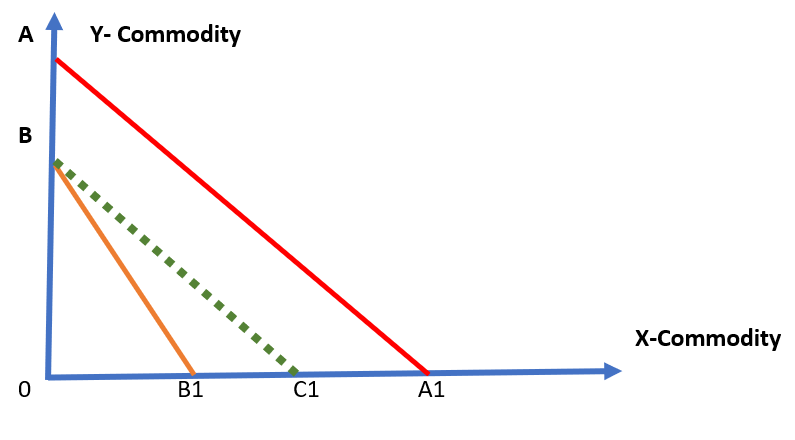
In Fig. 2.2, AA1 and BB1 are the production possibility curves pertaining to countries A and B. Given the same number of productive resources, A can produce larger quantities of both the commodities than the country B. It means country A has absolute cost advantage over B in respect of both the commodities.

If the curve BC1 is drawn parallel to AA1; the curve BC1 can represent the production possibility curve of country A. If country A gives up OB quantity of Y and diverts resources to the production of X, it can produce OC1 quantity of X, which is more than OB1. It means the country A has comparative cost advantage in the production of X-commodity.

From the point of view of B, it can produce the same quantity OB of Y, if it gives up the production of smaller quantity OB1 of X. If signifies that country B has less comparative disadvantage in the production of Y commodity. Accordingly, country A will specialise in the production and export of X commodity, while country B will specialise in the production and export of Y-commodity.

Gain from Trade:

The comparative cost principle underlines the fact that two countries will stand to gain through trade so long as the cost ratios for two countries are not equal. On the basis of Table , country A specialises in the production of X commodity, while country B specialises in the production of Y commodity.

In the absence of international trade, the domestic exchange ratio between X and Y commodities in these two countries are:

Country A: 1 unit of X = 12/10 or 1-20 units of Y

Country B: 1 unit of Y = 12/16 or 0-75 unit of X

If trade takes place and two countries agree to exchange 1 unit of X for 1 unit of Y, the gain from trade for country A amounts to 0.20 units of Y for each unit of X. In case of country B, the gain from trade amounts to 0.25 unit of X for each unit of Y. Thus the comparative costs principle confers gain upon both the countries.

Role of Multinational corporations

A multinational corporation (MNC) is a company that operates in its home country, as well as in other countries around the world. It maintains a central office located in one country, which coordinates the management of all its other offices, such as administrative branches or factories.

Multinational corporations are those large firms which are incorporated in one country but which own, control or manage production and distribution facilities in several countries. Therefore, these multinational corporations are also known as transnational corporations. They transact business in a large number of countries and often operate in diversified business activities. The movements of private foreign capital take place through the medium of these multinational corporations. Thus multinational corporations are important source of foreign direct investment (FDI).

Besides, it is through multinational corporations that modern high technology is transferred to the developing countries. The important question about multinational corporations is why they exist. The multinational corporations exist because they are highly efficient. Their efficiencies in production and distribution of goods and services arise from internalising certain activities rather than contracting them out to other firms. Managing a firm involves which production and distribution activities it will perform itself and which activities it will contract out to other firms and individuals.

In addition to this basic issue, a big firm may decide to set up and operate business units in other countries to benefit from advantages of location. For examples, it has been found that giant American and European firms set up production units to explore and refine oil in Middle East countries because oil is found there. Similarly, to take advantages of lower labour costs, and not strict environmental standards, multinational corporate firms set up production units in developing countries.

  1. Filling Savings Gap: The first important contribution of MNCs is its role in filling the resource gap between targeted or desired investment and domestically mobilized savings. For example, to achieve a 7% growth rate of national output if the required rate of saving is 21% but if the savings that can be domestically mobilised is only 16% then there is a ‘saving gap’ of 5%. If the country can fill this gap with foreign direct investments from the MNCs, it will be in a better position to achieve its target rate of economic growth.
  2. Filling Trade Gap: The second contribution relates to filling the foreign exchange or trade gap. An inflow of foreign capital can reduce or even remove the deficit in the balance of payments if the MNCs can generate a net positive flow of export earnings.
  3. Filling Revenue Gap: The third important role of MNCs is filling the gap between targeted governmental tax revenues and locally raised taxes. By taxing MNC profits, LDC governments are able to mobilize public financial resources for development projects.
  4. Filling Management/Technological Gap: Fourthly, Multinationals not only provide financial resources but they also supply a “package” of needed resources including management experience, entrepreneurial abilities, and technological skills. These can be transferred to their local counterparts by means of training programs and the process of ‘learning by doing’.

Moreover, MNCs bring with them the most sophisticated technological knowledge about production processes while transferring modern machinery and equipment to capital poor LDCs. Such transfers of knowledge, skills, and technology are assumed to be both desirable and productive for the recipient country.

  1. Other Beneficial Roles: The MNCs also bring several other benefits to the host country.

(a) The domestic labour may benefit in the form of higher real wages.

(b) The consumers benefit by way of lower prices and better quality products.

(c) Investments by MNCs will also induce more domestic investment. For example, ancillary units can be set up to ‘feed’ the main industries of the MNCs

(d) MNCs expenditures on research and development(R&D), although limited is bound to benefit the host country.

Apart from these there are indirect gains through the realization of external economies.

Role of a Multinational Corporation

  1. Very high assets and turnover

To become a multinational corporation, the business must be large and must own a huge amount of assets, both physical and financial. The company’s targets are high, and they are able to generate substantial profits.

  1. Network of branches

Multinational companies maintain production and marketing operations in different countries. In each country, the business may oversee multiple offices that function through several branches and subsidiaries.

  1. Control

In relation to the previous point, the management of offices in other countries is controlled by one head office located in the home country. Therefore, the source of command is found in the home country.

  1. Continued growth

Multinational corporations keep growing. Even as they operate in other countries, they strive to grow their economic size by constantly upgrading and by conducting mergers and acquisitions.

  1. Sophisticated technology

When a company goes global, they need to make sure that their investment will grow substantially. In order to achieve substantial growth, they need to make use of capital-intensive technology, especially in their production and marketing activities.

  1. Right skills

Multinational companies aim to employ only the best managers, those who are capable of handling large amounts of funds, using advanced technology, managing workers, and running a huge business entity.

  1. Forceful marketing and advertising

One of the most effective survival strategies of multinational corporations is spending a great deal of money on marketing and advertising. This is how they are able to sell every product or brand they make.

  1. Good quality products

Because they use capital-intensive technology, they are able to produce top-of-the-line products.

Terms of Trade, Meaning and Types

The terms of trade refer to the rate at which one country exchanges its goods for the goods of other countries. Thus, terms of trade determine the international values of commodities. Obviously, the terms of trade depend upon the prices of exports a country and the prices of its imports.

When the prices of exports of a country are higher as compared to those of its imports, it would be able to obtain greater quantity of imports for a given amount of its exports. In this case terms of trade are said to be favourable for the country as its share of gain from trade would be relatively larger.

On the contrary, if the prices of its exports are relatively lower than those of its imports, it would get smaller quantity of imported goods for a given quantity of its exports. There­fore, in this case, terms of trade are said to be unfavourable to the country as its share of gain from trade would be relatively smaller. In what follows we first explain the various concepts of the terms of trade and then explain how they are determined.

Types

  1. Commodity or Net Barter Terms of Trade:

If one good is considered export good and the other good is supposed import good then “the ratio between prices of exports to price of imports is given the name of net barter terms of trade”. If we include so many goods then the ratio of price index of exports to price index of imports is called net barer terms of trade.

  1. Income Terms of Trade:

The income terms of trade allow the capacity to import of a country on the basis of imports.

  1. Single Factor Terms of Trade:

Single factor terms of trade show the number of imports which can be obtained against the domestic factor employed in export sector.

  1. Double Factor Terms of Trade:

Such terms of trade measures that how much of factors used in export sector could be substituted against how much of factors employed in import sector.

  1. Utility Terms of Trade:

The utility terms of trade are presented to explain welfare changes. The utility terms of trade indicate the total amount of gain from trade, as excess of total utility which is obtained from imports over the total sacrifice of utility in surrender of export.

Equation/Formula:

The terms of trade can be expressed in the form of equation as such:

Terms of Trade = Price of Imports and Volume of Imports/Price of Exports and Volume of Exports

The terms of trade are of economic significance to a country. If they are favorable to a country, it will be gaining more from international trade and if they are unfavorable, the loss will be occurring to it. When the country’s goods are in high demand from abroad, i.e., when its terms of trade are favorable, the level of money income increases. Conversely, when the terms of trade are unfavorable, the level of money income falls.

Measurement of Change in Terms of Trade:

 The changes in terms of trade can be measured by the use of an import and export index number. We here take only standardized goods which have internal market and give them weight according to their importance in the international transactions. A certain year is taken as base year and the average of the countries import and export prices of the base year is called 100. We then work out the index of subsequent year. These indices then show as to how the commodity terms of trade move between two countries. The ratio of exchange in export prices to the change in import prices is put in the form of an equation as under:

Commodity Terms of Trade = Change in Export Prices/Change in Import Price

Concepts of Terms of Trade:

Net Barter Terms of Trade:

The most widely used concept of the terms of trade is what has been caned the net barker terms of trade which refers to the relation between prices of exports and prices of imports. In symbolic terms:

Tn = Px/Pm

Were

Tn stands for net barter terms of trade.

Px stands for price of exports (x),

Pm stands for price of imports (m).

When we want to know the changes in net barter tends of trade over a period of time, we prepare the price index numbers of exports and imports by choosing a certain appropriate base year and obtain the following ratio:

Px1/ Pm1 : Px0/ Pm0

Px„ Pm„

where Pxo and Pm0 stand for price index numbers of exports and imports in the base year re­spectively, and Px1) and Pm1) denote price index numbers of exports and imports respectively in the current year.

Since the prices of both exports and imports in the base year are taken as 100, the terms of trade in the base year would be equal to one

Px0/ Pm0 = 100/100 = 1

Gross Barter Terms of Trade:

This concept of the gross terms of trade was introduced by F.W. Taussig and in his view this is an improvement over the concept of net barter terms of trade as it directly takes into account the volume of trade. Accordingly, the gross barter terms of trade refer to the relation of the volume of imports to the volume of exports. Thus,

Tg = Om/Qx

Where

Tg = gross barter terms of trade, Qm = quantity of imports

Qx = quantity of exports

Income Terms of Trade:

In order to improve upon the net barter terms of trade G.S. Dorrance developed the concept of income terms of trade which is obtained by weighting net barter terms of trade by the volume of exports. Income terms of trade therefore refer to the index of the value of exports divided by the price of imports. Symbolically, income terms of trade can be written as

Ty = Px.Qx/Pm

Were,

Ty = Income terms of trade

Px = Price of exports

Qx = Volume of exports

Pm= Price of imports

The Heckshers-ohlin Theory of factor endowments

The Heckscher–Ohlin model (H–O model) is a general equilibrium mathematical model of international trade, developed by Eli Heckscher and Bertil Ohlin at the Stockholm School of Economics. It builds on David Ricardo’s theory of comparative advantage by predicting patterns of commerce and production based on the factor endowments of a trading region. The model essentially says that countries export products that use their abundant and cheap factors of production, and import products that use the countries’ scarce factors.

The Heckscher-Ohlin model is an economic theory that proposes that countries export what they can most efficiently and plentifully produce. Also referred to as the H-O model or 2x2x2 model, it’s used to evaluate trade and, more specifically, the equilibrium of trade between two countries that have varying specialties and natural resources.

The model emphasizes the export of goods requiring factors of production that a country has in abundance. It also emphasizes the import of goods that a nation cannot produce as efficiently. It takes the position that countries should ideally export materials and resources of which they have an excess, while proportionately importing those resources they need.

Features of the model

Relative endowments of the factors of production (land, labor, and capital) determine a country’s comparative advantage. Countries have comparative advantages in those goods for which the required factors of production are relatively abundant locally. This is because the profitability of goods is determined by input costs. Goods that require locally abundant inputs are cheaper to produce than those goods that require locally scarce inputs.

For example, a country where capital and land are abundant but labor is scarce has a comparative advantage in goods that require lots of capital and land, but little labor such as grains. If capital and land are abundant, their prices are low. As they are the main factors in the production of grain, the price of grain is also low and thus attractive for both local consumption and export. Labor-intensive goods, on the other hand, are very expensive to produce since labor is scarce and its price is high. Therefore, the country is better off importing those goods.

Theoretical Development

The Ricardian model of comparative advantage has trade ultimately motivated by differences in labour productivity using different “technologies”. Heckscher and Ohlin did not require production technology to vary between countries, so (in the interests of simplicity) the “H–O model has identical production technology everywhere”. Ricardo considered a single factor of production (labour) and would not have been able to produce comparative advantage without technological differences between countries (all nations would become autarkic at various stages of growth, with no reason to trade with each other). The H–O model removed technology variations but introduced variable capital endowments, recreating endogenously the inter-country variation of labour productivity that Ricardo had imposed exogenously. With international variations in the capital endowment like infrastructure and goods requiring different factor “proportions”, Ricardo’s comparative advantage emerges as a profit-maximizing solution of capitalist’s choices from within the model’s equations. The decision that capital owners are faced with is between investments in differing production technologies; the H–O model assumes capital is privately held.

Evidence Supporting the Heckscher-Ohlin Model

Although the Heckscher-Ohlin model appears reasonable, most economists have had difficulty finding evidence to support it. A variety of other models have been used to explain why industrialized and developed countries traditionally lean toward trading with one another and rely less heavily on trade with developing markets.

The Linder hypothesis outlines and explains this theory. It states that countries with similar incomes require similarly valued products and that this leads them to trade with each other.

Heckscher-Ohlin Theorem:

According to Ricardo and other classical economists, international trade is based on differences in comparative costs. It is important to note that Heckscher and Ohlin agreed with this fundamental proposition and only elaborated this by explaining the factors which cause differences in compara­tive costs of commodities between different regions or countries. Ricardo and others who followed him explained differences in comparative costs as arising from differences in skill and efficiency of labour alone.

This is not a satisfactory explanation of differences in comparative cots. Ohlin pointed out more significant factors, namely, differences in factor endowments of the nations and difference in factor proportions of producing different commodities, which account for differences in com­parative costs and hence from the ultimate basis of inter-regional or international trade.

Thus, Heckscher-Ohlin theory does not contradict and supplant the comparative cost theory but supple­ments it by offering sufficiently satisfactory explanation of what causes differences in comparative costs.

According to Ohlin, the underlying forces behind differences in comparative costs are two­fold:

  1. The different regions or countries have different factor endowments.
  2. The different goods require different factor-proportions for their production.

It is a well-known fact that various countries (regions) are differently endowed with productive factors required for production of goods. Some countries posses relatively more capital, some rela­tively more labour, and some relatively more land.

The factor which is relatively abundant in a country will tend to have a lower price and the factor which is relatively scarce will tend to have a higher price. Thus, according to Ohlin, factor endowments and factor prices are intimately associ­ated with each other.

Suppose K stands for the availability or supply of capital in a country, L for that of labour and PK for price of capital and PL for the price of labour. Further, take two countries A and B; in country A capital is relatively abundant and labour is relatively scarce. The reverse is the case in country B. Given these factor-endowments, in country A capital will be relatively cheaper.

In symbolic terms:

Since (K/L)A > (K/L)B

Since (PK/PL)A < (PK/PL)B

Thus, the differences in factor endowments cause differences in factor prices and therefore ac­count for differences in comparative costs of producing different commodities. Together with the difference in factor-endowments, differences in factor proportions required for the production of different commodities also constitute an important force underlying differ­ences in comparative costs as between different countries.

Some commodities are such that their production requires relatively more capital than other factors; they are therefore called capital- intensive commodities. Still other commodities require relatively more land than capital and labour and are therefore called land-intensive commodities.

These differences in factor-productions (or what is also called differences in factor-intensities) needed for the production of different commodi­ties account for differences in comparative costs of producing different commodities. The differ­ences in comparative costs of producing different commodities lead to the differences in market prices of different commodities in different countries.

It follows from above that some countries have a comparative advantage in the production of a commodity for which the required factors are found in abundance and comparative disadvantage in the production of a commodity for which the required factors are not available in sufficient quanti­ties.

Thus, a country A which has a relative abundance of capital and relative scarcity of labour will have a comparative advantage in specialising in the production of capital-intensive commodities and in return will import labour-intensive goods. This is because (PK/PL)A < (PK/PL)B.

On the other hand, a labour-abundant country B with a scarcity of capital will have a compara­tive advantage in specialising in the production of labour-intensive commodities and export some quantities of them and in exchange for import capital-intensive commodities. This is because in this country (PL/PK)B < (PL/PK)A.

If factor endowments in the two countries are the same and factor-productions used in the production of different commodities do not differ, there will be no differences in relative factor prices [i.e. (PK/PL)A < (PK/PL)B] which will mean differences in comparative costs of producing commodities in the two countries will be non-existent. In this situation the countries will not gain from entering into trade with each other.

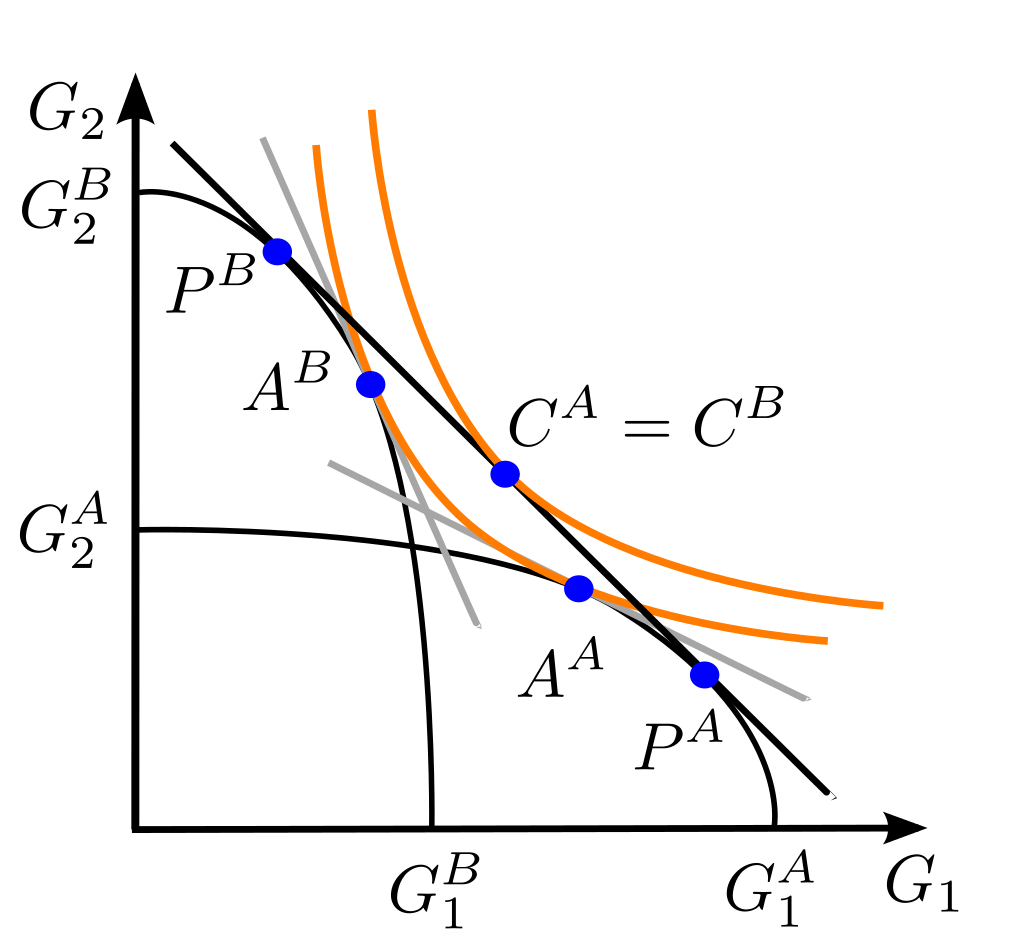
Let us graphically explain the Heckscher-Ohlin theory of international trade. Take two coun­tries U.S.A. and India. Assume that there is a relative abundance of capital and scarcity of labour in U.S.A. and, on the contrary, there is a relative abundance of labour and scarcity of capital in India. (This is the real situation as well).

By WissensDürster – Own work, CC BY-SA 4.0, https://commons.wikimedia.org/w/index.php?curid=41687581

Burden of Debt finance

It is said that an internal debt has no direct money burden since the interest payment on debt and the imposition of taxation to pay interest to the lenders is simply a transfer of purchasing power from one to another. This means that in case of internal debt, money is borrowed from individuals and institutions within the country.

Repayment (raised from taxation) constitutes just a transfer of resources from one group of persons to another. In other words, these are transfer payments and do not affect the total resources of the community Truly speaking, govern­ment collects money through taxation imposed on the richer people who are also the buyers of government bonds.

Burden of public debt is a misleading and highly confused concept. The 1930’s and 1940’s witnessed an array of debate over the issue of debt burden. The focus of debate was between those who feared that the creation of debt in course of deficit finance would burden the future and others who believed that such finance would not do so.

Later on, two extreme views emerged in this regard. The burden con­troversy attained its logical end in the pronouncement of A.C. Pigou, A.P. Lerner, Alwin. H. Hansen and Prof. P.E. Taylor.

In this context, Prof. Taylor point out that “the nature and severity of the burden have however frequently been improperly understood largely because of the temptation to think of public debt in terms of private debt and to apply identical standards to both”.

Moreover, while discussing the burden of public debt, we have to bear in mind not only the amount of debt but also the corresponding credit. As A.P. Lerner point out “the great misconception lies in looking at only one side of debt-credit relationship.

Every debt has a corresponding credit and this fact is frequently over looked when considering the burden of public debt. In this context, Taylor point out “the liability of the debtor to the creditor is matched by the asset value of the creditors claim.

This is a rou­tine fact which is frequently over looked when considering the nature of debt”. The views of these economists remained unchanged for quite a long time. The Keynesian approach disagreed with the clas­sical burden thesis.

Burden of External Debt:

During a given period, the direct money burden of external debt is the interest payment as well as the principal repayment (i.e., debt servicing) to external creditors. The direct real burden of such external borrowing is measured by the sacrifice of goods and services which these payments involve to the members of the debtor country.

There is also indirect money burden of external debt. Loan repayment by the debtor country implies more exports of goods and services to the creditor country. Thus, a debtor country experiences a fall in welfare of the community.

  1. Traditional Views on the Burden of Public Debt:

The traditional view is that public debt as in the case of private debt imposes a real burden on the community. The classical view main­tains that if the government expenditure is financed through taxation the present generation bears the burden. But if government expendi­ture is financed through public borrowing, the present generation gets relieved from the cost and burden is shifted to the future genera­tion.

The future generation suffers when present generation reduces its saving in-order to meet the debt finance and leave a smaller amount of capital resources for the future. This will reduce the productive capacity of the future generation and accordingly they will stand to lose.

In a sense, war finance through public debt has double effect. For example, in-order to contribute to war finance, the present gen­eration has either to curtail its consumption or saving or both. If savings are reduced the future generation suffers on account of re­duced inherited capital.

On the other-hand, if the present generation does not reduce its consumption, burden of public debt may pass on to the future generation. This view is held by David Hume, Adam Smith and David Ricardo.

According to the classists public debt necessitate a transfer of resources from the private sector to the government in the form of additional taxation. Secondly, the classist held the view that public debt is a more costly method of financing public expenditure than taxation.

This is so because interest payment is an additional cost burden in the case of public debt. Thirdly as stated earlier, public debt tends to transfer the burden of a particular outlay to the future generation.

Moreover, excess borrowing and mounting public debt of the government may undermine the very creditworthiness of the gov­ernment. Hence the traditional economists strongly argued that public debt should be kept to the minimum and should be redeemed as early as possible.

  1. Modern Views:

Economists like J.M. Keynes, Harris, Buchanan, Musgrave, and Modigliani are the chief exponents of the modern version of debt burden. The modem theory of public debt is put as “the new ortho­doxy” by Prof. Buchanan.

The worldwide depression of 1930’s and the emergence of Keynesian economics paved the way for the de­velopment of the new theory of public debt. The new theory is dia­metrically opposed to the classical concept of public debt. Modern theory firmly advocates that large volume of public debt is a national asset rather than a liability. This theory recognizes that persistent deficit spending is a tonic to the economic development of nations.

During periods of depression, the technique of deficit budget financed through borrowing can be fruitfully utilized to improve employment situation and generating effective demand and thereby raising the level of economic activity.

Under the shadow of Says Law, propa­gated the misconception that persistent technique of unbalancing the budget coupled with increasing proportion of public debt endangers the very economic stability of the nation.

However, the modern theories strongly believe that public expenditure is not at all wasteful. To them, public expenditure can be made productive and an impor­tant means to increase employment in the economy.

As a corollary to this concept, Prof. A.H. Hansen, the chief advocate of modern theory states that public debt is an essential means of increasing employment and it has become an instrument of modern economic policy of nations.

Prof. James Buchanan in his book “Public principles of public debt”, states that debt burden implies a compulsory sacrifice. He argued that the primary burden of the internally held public debt is always in the future.

Buchanan held the view that burden of debt should be considered in terms of reduction in personal satisfaction. When a public debt is floated, the lenders voluntarily purchase bonds. There is no loss of satisfaction in the process of exchanging more liquid money for less liquid bonds. Here people prefer government bonds as a good form of investment.

  1. Direct Money Burden:

Repayment of public debt involves payment of interest and the prin­ciple by the government. Hence the government will have to raise the necessary resources by way of taxation.

The direct money burden of public debt consists of the tax burden imposed on the public and it is equal to the sum of money payments for interest and the principle components. In the case of an internal debt, there will be no direct money burden because all the money payments and receipts can­cel out.

In this context, Dalton observes “thus all transactions con­nected with an internal debt resolve themselves into a series of transfers of wealth within the community. It follows that there can never be any direct money burden or direct money benefit of an internal debt”. However, in the case of external debt money pay­ments by the debtor nations to the creditor constitute a clear direct money burden.

  1. Direct Real Burden:

Real burden of public debt refers to the distribution of tax burden and public securities among the people. In a sense, it is the hardship sacrifice and loss of economic welfare shouldered by the taxpayers on account of increased taxation imposed for repayment of public debt.

It is a fact that people hold public debt and they also pay taxes towards the cost of debt service. If the proportion of taxation paid by the rich towards the cost of debt, service is smaller than the propor­tion of public securities held by them, whereas, if the proportion of taxation paid by the poor and middle-income group towards the cost of debt service is larger than the proportion of public securities held by them, there is a direct real burden from public debt.

Whereas suppose government bonds and securities are held by the working classes, while the taxation towards the cost of debt service is paid by the rich only, then public debt will help to reduce the inequalities of income in the community. In such a circumstances there is no direct burden; instead there is a direct real benefit to the community.

  1. Indirect Money Burden and Real Burden:

It is argued that heavy taxation to meet debt service charges may reduce taxpayers ability and willingness to work an save. In turn this will check production. Moreover, heavy debt charges may also force the government to curtail and economies some desirable social ex­penditure, which may promote economic development.

However, if it is possible to neutralize the adverse effect of taxation resulting from the problem of debt service by some favourable effect of public ex­penditure, the indirect burden of public debt can be cancelled out. Dalton observes that practically this is not possible. In the case of external debt, indirect money and real burden arise from its bad effect on production because of additional taxation to pay for debt charges.

Burden of Internal Debt:

Internal debt involves no significant burden on the community as a whole. The payment of interest and increased taxation to meet the servicing and principle component of debt involves a transfer of pur­chasing power from one section of the community to another.

In the case of internal debt, the people owe themselves the debt and the question of the burden need not be treated as raising any major issue. Money does not flow out of the domestic market.

However, if the creditors (bond holders) and the taxpayers belong to different income strata’s, there may occur a change in the distribution of in­come among different sections of the community. But Dalton observes that while estimating the burden of public debt, we should consider the purpose for which the loan is raised.

Suppose if the public debt is floated specifically for raising invest­ment funds for a productive activity, the profit generated from it can be used to pay off the debt, where as a debt raised for financing a war may be a dead weight and it will have to be paid out of increased taxation.

So in the first case there is no burden as such. In the second case also it is argued that the burden imposed by taxation upon the taxpayers will be offset by the benefit which the taxpayers receive in the form of interest on public debt.

However, if the rich pays taxes less than proportionately, to the proportion of public securities held by them, then there will be a direct real burden. The reason is that usually public securities are held mainly by the wealthier class.

Progressive taxation doesn’t tend to be sharply progressive to counterbalance the gain obtained by wealthier class from the possession of public debt. In usual prac­tice, the debt servicing burden will fall upon the poor section in the form of heavy taxation on commodities.

As a result there is a net increase in the burden on the community. Sometimes this may ad­versely affect the power and willingness to work and save and even the productive capacity of the economy.

Hence, the repayment pro­cess of public debt should be managed in such a way that, it may not exert any adverse effect on production and distribution. So it maybe concluded that if not planned and utilized scientifically, inter­nal debt can practically impose a burden on the community, even though theoretically it is not correct.

On several aspects external debts differ from internal debt. Still in the case of burden of debt, both share some similar characteristics. For the payment of internal and external debt, imposition of additional taxation is imperative.

In the words of Prof. Dalton “as a general rule, an internal debt is likely to involve an additional and indirect burden on a community, an external debt does the same”.

But in another sense, external debt involves greater burden than internal debt. In the case of internal debt there is no resource trans­fer to outside the country. The repayment of principle and interest charges doesn’t lead to the transfer of resources from the country to another country.

It merely results in the transfer of income from one section of the community to another section. Moreover, the taxpay­ers and receivers of interest constitute the same class of people. Whereas external debt specifically involves resource transfer to for­eign nation.

By way of interest charges and repayment of principle, resources are transferred to the creditors abroad. Therefore, pay­ment of interest on foreign debt reduces the net income of the debtor country. Internal debt carries with it no such evil effect. Hence, we can safely say that external debt involves a greater burden than internal debt.

Measurement of the Burden of Debt:

Usually, burden of debt refers to financial burden of the government.

But as it does not indicate true burden, we consider following ratios to estimate the burden of debt:

  • Income-Debt Ratio:

It is estimated as:

size of public debt/national income = D/Y

If Y remains at a very high level, the burden of debt, D, will be insignificant. However, if the ratio becomes high, debt then poses a great burden.

  • Debt-Service Ratio:

This ratio is measured as:

Annual interest payments of borrowing/National income = i/Y

Increase in Y means lower debt-service ratio. However, taxes are collected for the repayment of public debt. Thus, this ratio indicates the necessity of imposing higher taxes.

  • Debt Service-Tax Revenue Ratio:

It is worked out as:

Annual interest payments/Aggregate tax revenue = i/T

An increase of this ratio indicates the financial weaknesses of the government.

Contra cyclical Fiscal policy

Government’s fiscal policy has big role in stabilizing the economy during business cycles. The two important phases of business cycles are boom and recession. A recession should not be allowed to grow into a deep recession. Similarly, a boom should not explode bigger. We may say that amplifying the business cycle is dangerous (growing boom and deepening recession).

Practically fiscal policy responses using taxation and expenditure can go in two ways in response to the business cycle: Countercyclical and procyclical.

Countercyclical fiscal policy

Procyclical and countercyclical variables are variables that fluctuate in a way that is positively or negatively correlated with business cycle fluctuations in gross domestic product (GDP). The scope of the concept may differ between the context of macroeconomic theory and that of economic policy–making.

The concept is often encountered in the context of a government’s approach to spending and taxation. A ‘procyclical fiscal policy’ can be summarised simply as governments choosing to increase government spending and reduce taxes during an economic expansion, but reduce spending and increase taxes during a recession. A ‘countercyclical’ fiscal policy takes the opposite approach: reducing spending and raising taxes during a boom period, and increasing spending and cutting taxes during a recession.

A counter-cyclical fiscal policy refers to strategy by the government to counter boom or recession through fiscal measures. It works against the ongoing boom or recession trend; thus, trying to stabilize the economy. Understandably, countercyclical fiscal policy works in two different direction during these two phases.

Countercyclical fiscal policy during recession

Recession is a business cycle situation where there is slowing demand and falling growth in the economy. Here, the Government’s responsibility is to generate demand by fine-tuning taxation and expenditure policies. Reducing taxes and increasing expenditure will help to create demand and producing upswing in the economy.

Countercyclical fiscal policy during boom

In the case of boom, economic activities will be on upswing. Amplifying the boom is disastrous as it may create inflation and debt crisis and the government’s responsibility here is to bring down the pace of economic activities. Increasing taxes and reducing public expenditure will make boom mild. Thus, slowing down demand should be the nature of countercyclical fiscal policy during boom.

Procyclical fiscal policy

Procyclical is the opposite of countercyclical. Here, fiscal policy goes in line with the current mood of the business cycle; amplifying them. For example, during the time of boom, government makes high expenditure and doesn’t hike taxes. Thus, boom grows further. Such a policy is dangerous and brings instability in the economy.

Boom: total government spending as a percentage of GDP goes up and tax rates go down, increasing government deficit.

Recession: total government spending as a percentage of GDP goes down and tax rates go up, decreasing government deficit.

So procyclical fiscal policy is undesirable for the economy.

History shows that governments follow often procyclical fiscal policy more during boom. Such a situation increases government debt and creates inflationary pressure especially in developing countries.

Economic policy making

Procyclical

Procyclical has a different meaning in the context of economic policy. In this context, it refers to any aspect of economic policy that could magnify economic or financial fluctuations. Of course, since the effects of particular policies are often uncertain or disputed, a policy will be often procyclical, countercyclical or acyclical according to the view of the one judging it.

Thus, the financial regulations of the Basel II Accord have been criticized for their possible procyclicality. The accord requires banks to increase their capital ratios when they face greater risks. Unfortunately, this may require them to lend less during a recession or a credit crunch, which could aggravate the downturn. A similar criticism has been directed at fair value accounting rules. The effect of the single Eurozone interest rate on the relatively high-inflation countries in the Eurozone periphery is also pro-cyclical, leading to very low or even negative real interest rates during an upturn which magnifies the boom (e.g. ‘Celtic Tiger’ upturn in Ireland) and property and asset price bubbles whose subsequent bust magnifies the downturns.

Countercyclical

Conversely, an economic or financial policy is called countercyclical if it works against the cyclical tendencies in the economy. That is, countercyclical policies are ones that cool down the economy when it is in an upswing, and stimulate the economy when it is in a downturn.

Keynesian economics advocates the use of automatic and discretionary countercyclical policies to lessen the impact of the business cycle. One example of an automatically countercyclical fiscal policy is progressive taxation. By taxing a larger proportion of income when the economy expands, a progressive tax tends to decrease demand when the economy is booming, thus reining in the boom. Other schools of economic thought, such as new classical macroeconomics, hold that countercyclical policies may be counterproductive or destabilizing, and therefore favor a laissez-faire fiscal policy as a better method for maintaining an overall robust economy. When the government adopts a countercyclical fiscal policy in response to a threat of recession the government might increase infrastructure spending.

Business cycle theory

Procyclical

In business cycle theory and finance, any economic quantity that is positively correlated with the overall state of the economy is said to be procyclical. That is, any quantity that tends to increase in expansion and tend to decrease in a recession is classified as procyclical. Gross Domestic Product (GDP) is an example of a procyclical economic indicator. Many stock prices are also procyclical because they tend to increase when the economy is growing quickly.

Countercyclical

Conversely, any economic quantity that is negatively correlated with the overall state of the economy is said to be countercyclical. That is, quantities that tend to increase when the overall economy is slowing down are classified as ‘countercyclical’. Unemployment is an example of a countercyclical variable.[4] Similarly, business failures and stock market prices tend to be countercyclical. In finance, an asset that tends to do well while the economy as a whole is doing poorly is referred to as countercyclical, and could be for example a business or a financial instrument whose value is derived from sales of an inferior good.

Discretionary Fiscal Policy

Fiscal Policy is changing the government’s budget to influence aggregate demand. i.e., changing taxes and spending.

These are intentional government policies to increase or decrease government spending or taxation. For example, Keynesian economists might favour a deliberate increase in the size of the fiscal deficit when private sector demand and confidence is low during an economic recession.

Discretionary fiscal policy means the government make changes to tax rates and or levels of government spending. For example, cutting VAT in 2009 to provide boost to spending.

Expansionary fiscal policy is cutting taxes and/or increasing government spending. Lower taxes increase disposable income and in theory, should encourage people to spend.

Discretionary fiscal policy is different to automatic fiscal stabilisers. Automatic stabilisers occur where in a recession a government automatically spends more because there are more claiming unemployment benefits. However, the government may feel these automatic stabilisers are insufficient and so they decide to increase public work spending schemes too.

Types

There are two types of discretionary fiscal policy. The first is expansionary fiscal policy. It’s when the federal government increases spending or decreases taxes. When spending is increased, it creates jobs. It happens directly through public works programs or indirectly through contractors. Spending on public works construction is one of the four best ways to create jobs.

Job creation gives people more money to spend, boosting demand. According to Keynesian economic theory, that increases economic growth.

Supply-side economics says that a tax cut is the best way to stimulate the economy. Stronger economic growth will make up for the government revenue lost. That’s because it generates a larger tax base. But tax cuts only work if taxes were high in the first place. According to the underlying economic theory, the Laffer Curve, the highest tax rate must be above 50% for supply-side economics to work. Tax cuts are not the best way to create jobs.

Expansionary fiscal policy creates a budget deficit. This is one of its downsides. It’s because the government spends more than it receives in taxes. Often there’s no penalty until the debt-to-GDP ratio nears 100%. At that point, investors start to worry the government won’t repay its sovereign debt. They won’t be as eager to buy Treasurys or other sovereign debt. They will demand higher interest rates. This makes the debt even more expensive to pay back. It can create a downward spiral. For example, look at the Greek debt crisis.

Contractionary fiscal policy is when the government cuts spending or raises taxes. It slows economic growth. A spending cut means less money goes toward government contractors and employees. That then reduces job growth.

Discretionary fiscal policy should work as a counterweight to the business cycle. During the expansion phase, Govt. should cut spending and programs to cool down the economy. If done well, the reward is an ideal economic growth rate of around 2% to 3% a year.

Factors influencing incidence of Taxation

In economics, tax incidence or tax burden is the effect of a particular tax on the distribution of economic welfare. Economists distinguish between the entities who ultimately bear the tax burden and those on whom tax is initially imposed. The tax burden measures the true economic weight of the tax, measured by the difference between real incomes or utilities before and after imposing the tax, taking into account how the tax leads prices to change. If a 10% tax is imposed on sellers of butter, for example, but the market price rises 8% as a result, most of the burden is on buyers, not sellers. The concept of tax incidence was initially brought to economists’ attention by the French Physiocrats, in particular François Quesnay, who argued that the incidence of all taxation falls ultimately on landowners and is at the expense of land rent. Tax incidence is said to “fall” upon the group that ultimately bears the burden of, or ultimately suffers a loss from, the tax. The key concept of tax incidence (as opposed to the magnitude of the tax) is that the tax incidence or tax burden does not depend on where the revenue is collected, but on the price elasticity of demand and price elasticity of supply. As a general policy matter, the tax incidence should not violate the principles of a desirable tax system, especially fairness and transparency.

  1. The Nature of a Tax:

The nature of a tax as to whether it is a tax on the production or sale of some commodities or it is a personal income or property tax. Tax shifting can easily take place in the case of taxes on the production and sale of commodities. The taxes on pro­duction or sale of commodities are called indirect taxes. The important examples of indirect taxes are excise duties and sales tax. On the other hand, the burden of direct taxes such as income and wealth taxes cannot be shifted.

  1. Market Conditions:

Whether commodity is being produced under conditions of perfect competition, monopolistic competition or monopoly goes to determine the extent to which the burden of the tax can be shifted. A monopolist who has a full control over the supply of a commodity is in a better position to shift the burden of a tax on the commodity produced.

Likewise, a producer working under monopolistic competition who produced a product somewhat different from others exercises a good deal of influence over the price of its product and therefore can pass on a part of the burden of the tax to the buyers.

Even the firms working under perfect competition can shift the tax burden as the tax levied on a commodity raises its supply price for all of them. The difference in the three market forms lies in the extent to which the burden of the tax can be shifted.

  1. Physical Conditions of Production:

The shifting of the tax burden on a commodity also depends upon whether the commodity is being produced under increasing, constant or diminishing returns. This will be explained in detail a little later.

Factors Determining Incidence of Indirect (Commodity) Taxes:

The questions of tax shifting especially arise in the case of indirect taxes, that is, taxes on the production and sale of goods such as excise duties and sales tax. In this regard, whether and to what extent a tax on commodity can be shifted depends on the price elasticity of demand for and supply of a commodity.

It is these elasticity’s of demand and supply that determine the bargaining strengths of the sellers and buyers of the taxed commodity. Sellers can shift the tax burden to the buyers if they are able to re­duce the supply of the commodity and thereby raise its price.

Thus, the power to shift the tax depends on the elasticity of supply of the taxed commodity. The elas­ticity of reducing supply of a commodity will be relatively smaller if there is excess capacity in the industry producing it. Fur­ther, the elasticity of supply of a commod­ity will be larger in the long run than in the short run.

Apart from the elasticity of supply, power to transfer the tax burden depends on the-elasticity of demand for a commod­ity. The greater the elasticity of demand of the buyers, the smaller the extent to which the tax will be shifted to them.

1. Elasticity of Demand:

Elasticity of demand affects the shifting process. If the taxed com­modity is having perfectly elastic demand price cannot be raised at all.

Hence the incidence will be wholly on the seller. On the other hand, when the demand is perfectly inelastic, the incidence will be wholly on the buyer. In between these two extremes, the incidence of tax will be shared by the buyer and seller.

2. Elasticity of Supply:

Price is determined by the interaction between demand and supply of a commodity. Hence incidence of a tax will be fully borne by the buyer, when the taxed commodity is having perfectly elastic supply. Likewise, when the supply of a commodity is perfectly inelastic, the whole incidence will be on the seller.

3. Price acts an Engine of Shifting:

Price act as a media of shifting. It is the vehicle, which carries money burden of tax from the point of view of legal liability. If the tax is shifted through a raise in price, it is called forward shifting. If the price cannot be rise, tax cannot be shifted. Hence the character of price flexibility is the most important factor that determines the shift- ability of a tax.

4. Tax Area:

The nature of the area in which the tax is imposed also affect shifting of a tax. If the tax is imposed on a commodity, having local market, it will be difficult to shift the tax by raising the price.

In such a case, people can avoid the tax by purchasing a commodity from neighborhood market, where it is cheap. This also gives rise to smug­gling of commodities from non-tax levying locality to avoid taxes.

5. Time Period:

Time factor influence the shift ability of a tax. In the short period supply is inelastic. Hence, during this period greater part of tax bur­den will be borne by the seller.

In the long-run, supply is more elastic. Hence, there is a better scope for shifting tax burden upon the buy­ers. Therefore, in the short period, shifting of a tax is difficult, where as in the long period it is easy to do.

6. Coverage of Tax:

If the tax is general in character, falling on wide range of commodi­ties, it is easy to shift the burden.

For example, if the tax levied on tooth paste is general in nature, covering all brands and kinds, it will be readily shifted.

However, if a tax is imposed on one brand of tooth paste, excluding the other brands, it is not possible to shift the tax burden. So we can say that shifting of a tax is rendered easier in general tax than in non-general taxes.

7. Availability of Substitutes:

Taxes imposed on a commodity having no close substitutes, can be easily shifted to the buyer. Here the buyer cannot find an alternative product as substitute to satisfy his demand.

Hence, he will be ready to purchase the taxed commodity by giving higher prices. On the other hand, if the taxed product has close substitute, shifting the money burden to buyers, is difficult.

Any rise in price due to tax will be opposed by the buyer, and he will go for the non-taxed substi­tutes. So the seller will himself bear the burden of tax, instead of attempting to shift it.

8. Nature of Demand for Commodities:

By this, we mean whether the taxed commodity is falling under the category of necessaries, comforts or luxuries. The nature of demand is different for different commodities. In the case of necessary goods, demand is inelastic.

Hence the burden of tax is higher upon the buyer, than on seller. In the case of comforts, demand is more elas­tic, hence burden of tax will be divided between buyer and seller. Coming to the case of luxuries, demand is elastic. Hence the bur­den of tax is more on the seller. It cannot be easily shifted to the consumers.

9. Business Conditions:

Shifting of a tax is influenced by the existing business condition in the economy. During periods of rising prices and economic prosper­ity, taxes can be shifted more easily. However, during periods of depression, forward shifting of tax liability is very difficult. Depres­sion is a situation of falling prices. Seasonal changes also will affect the shifting of tax.

10. Types of Tax:

Shifting depends upon nature or type of tax imposed. If a tax is imposed on the excess profits of a firm under monopoly or imperfect competition, the incidence will not be shifted. On the other hand, if the tax is levied on the output of the firm, a part of incidence can be shifted on to the consumers.

11. The Policy of the Government:

Shift ability of a tax is determined by the tax laws and public policy. In India, a tax law clearly indicates the price to be charged and to be printed on the product cover. For example, sales tax legislation stipu­lates that the burden of sales tax is to be borne by the consumers.

Likewise, government fixes maximum retail price and through law makers it binding to print it on the product. Then those who charge higher prices are legally punished. Hence, whenever a tax is im­posed the law abiding citizen will pay it rationally.

On the other hand, if prices are increased due to the attempt to shift some taxes to be paid by the seller, awareness of tax laws helps the consumer to resist it.

12. Market Conditions:

Shifting of a tax is influenced by the conditions of market for the product taxed.

The theory of shifting can be analyzed under:

(a) Per­fection competition,

(b) Monopoly, and

(c) Monopolistic competition.

(a) Shifting Under Perfect Competition:

Given the assumptions of perfect competition, the price is deter­mined by the interaction of demand and supply. The demand curve faced by each firm is perfectly elastic. Hence, a tax imposed cannot be shifted forward by increasing the price of the taxed commodity.

Likewise, the tax cannot be shifted backward because the supply of the factors is also perfectly elastic. However, the incidence of tax can be shifted in the long-run by reducing the supply and thereby raising the price of the commodity.

Moreover, if the taxed commodity is perishable, its supply curve is perfectly inelastic and the entire tax burden will be borne by the sellers. If the taxed commodity is of durable nature, the entire tax burden can be shifted forward to the buyers.

(b) Shifting under Monopoly:

Under conditions of monopoly, a tax on the monopolist will certainly increase the cost of production. But the incidence sharing between the monopolists and consumers will depend upon the respective elasticity of demand and supply of the commodity produced by the monopolist.

Theoretically, the profit will be at the maximum, when marginal revenue equals marginal cost and price is higher than ei­ther. Any tax on the monopolist which raises his marginal cost would cause him to reduce his output and raise his price.

The extent to which the monopolist would succeed in shifting the burden of a tax depends on three factors.

They are:

(1) The nature of the tax

(2) The nature of the demand for the article

(3) The cost condition under which production takes place.

If a tax is levied upon profit or sales, the monopolists cannot shift the burden on to the consumers. This is because the position of costs and revenue curves cannot be changed according to his favour.

If the taxed commodity is having inelastic demand, the entire burden of tax will fall on con­sumers. Contrary, if the demand for the taxed commodity is elastic, the entire burden of tax will fall on monopolies.

Likewise if the supply of monopolist product is inelastic, the burden of tax will fall on the monopolist. If supply is elastic, the entire burden of tax will be on the consumer. On the other hand if the demand for the monopolist prod­uct is more elastic than its supply, the burden of tax will fall more on the monopolist, than on consumers.

In a situation, when demand is less elastic than its supply, the monopolist will bear less burden of tax than the consumers. A monopolist can be taxed in three differ­ent ways. A tax can be imposed, proportionate to output, a tax can be imposed independent of output produced or a tax can be im­posed which diminish with an increase in output.

When the tax is independent of production and is levied on profit, it is difficult to shift. The output before the levy of tax would have been adjusted, to yield the minimum profit. The monopolist may have a greater profit after paying the tax by leaving the price unchanged.

When a tax is im­posed in proportion to output, a partial shifting of the tax is possible, as it increases the marginal cost of the monopolists firm. When the tax diminishes with the increase in output, the monopolist will in­crease his output and reduce the price of the commodity, produced by him. In this case the monopolist will bear the entire burden of the tax.

Any definite conclusion cannot be arrived at in the matter of the shifting of the tax under monopoly conditions. The reason is that, perfect monopoly is a very rare phenomenon. Moreover, the mo­nopolist usually will not charge the theoretical monopoly price.

The monopolist will always fix a price lower than this level, owing to the threat of governmental intervention or emergence of competitive ele­ment.

(c) Shifting Under Monopolistic Competition:

Monopolistic competitions is characterized by few firms in produc­tion arena, existence of product differentiation and a situation in which price is determined by the price leaders. In such markets one or two firms may act as the price leaders.

Hence if a tax imposed, affects the cost of production of the price setters, burden can be shifted to the consumers, if the demand for the product is inelastic. However, if the imposition of tax affects the cost of production of only small firms, it cannot be easily shifted to the consumers.

Here the small firms are bound to follow the price determined by the price leaders. Hence small firms have to bear the tax burden. But the process of shifting in its ultimate analysis will be determined by the elasticities of demand and supply of taxed commodity.

(d) Shifting Under Different Cost Conditions:

Commodities can be produced under decreasing, increasing or con­stant cost conditions. The nature of the cost condition also influences the shifting of a tax.

(i) Decreasing cost condition:

If costs are decreasing, any decline in demand and consequent reduction in output will increase cost per unit. If under this condition, a tax is imposed on the producer and the producer attempting to shift the burden by raising the price, the demand for his product will decline and the cost per unit will rise. In that case, price will have to be raised by more than the amount of the tax, to cover increase in cost resulting from output restriction.

(ii) Increasing Cost:

If costs are increasing, a decline in output will lower cost per unit. A tax imposed under this condition, will raise the price of the commodity by an amount less than the amount of tax. As such, only a part of the tax burden will be shifted to the buyers.

This happen because imposition of a tax, will reduce the demand for the taxed commodity. Consequently, supply will have to be reduced. This reduction in supply leads to lower average cost.

(iii) Constant cost:

If a tax is shifted under constant cost conditions, price will rise exactly by the amount of the tax. However, fall in output will vary according to the nature of demand. The supply curve under constant cost condition will be perfectly elastic and as such price will rise to the full amount of the tax. In this situa­tion, entire burden will fall on consumers.

The demand and supply theory of tax shifting is abstract and is entirely based on deductive reasoning. Observations and experimen­tation were never used to approve or disapprove the theory.

The theory ignores the effect of government expenditure. Public expenditure is an important macroeconomic variable affecting the shifting of tax. However, the effects of government expenditure are complicated and very difficult to measure.

Moreover, the demand and supply theory of tax shifting consti­tute only a part of the general theory of value. The modern industrial productive sector is a combination of competitive and monopolistic practices.

Moreover, government function has embraced different economic spheres. Government’s role in development activities of the economy, provision of public goods, price control and other regu­latory measures do affect the working of the price system.

A com­prehensive theory of shifting alone can take into consideration, all these factors influencing the economy. Hence the demand and sup­ply theory cannot be considered as full-fledged incidence theory.

The theory also does not take into consideration the indirect money burden arising from the imposition of a tax. For a balanced analysis of the effect of tax, both direct and indirect money burden should be taken into consideration.

In this sense, the theory is one sided. Shifting power depend upon strength of bargaining power of sellers and buyers. The theory has given insufficient weightage to the strategic factor like bargaining power.

A theory of tax shifting cannot be considered comprehensive and complete unless the above said factors are duly considered in the analysis. In spite of these limitations, the demand and supply theory of incidence is the best available tool to analyses the inci­dence problem in taxation.

Fiscal Responsibility and Budget Management Act

Fiscal responsibility implies a government pursues the appropriate level of government spending and tax to:

  • Maintain sustainable public finances.
  • Ensure fiscal policy aids the optimal rate of economic growth.
  • Maintain appropriate levels of public investment.

This means that if the economic cycle is at a stage of ‘normal growth’ then government tax receipts must be greater than government spending. If a government is running a budget deficit, then it will be forced to cut spending or increase taxes to meet the shortfall.

The Fiscal Responsibility and Budget Management Act, 2003 (FRBMA) is an Act of the Parliament of India to institutionalize financial discipline, reduce India’s fiscal deficit, improve macroeconomic management and the overall management of the public funds by moving towards a balanced budget and strengthen fiscal prudence. The main purpose was to eliminate revenue deficit of the country (building revenue surplus thereafter) and bring down the fiscal deficit to a manageable 3% of the GDP by March 2008. However, due to the 2007 international financial crisis, the deadlines for the implementation of the targets in the act was initially postponed and subsequently suspended in 2009. In 2011, given the process of ongoing recovery, Economic Advisory Council publicly advised the Government of India to reconsider reinstating the provisions of the FRBMA. N. K. Singh is currently the Chairman of the review committee for Fiscal Responsibility and Budget Management Act, 2003, under the Ministry of Finance (India), Government of India.

Enactment

The Fiscal Responsibility and Budget Management Bill (FRBM Bill) was introduced in India by the then Finance Minister of India, Mr.Yashwant Sinha in December 2000.

  • Firstly, the bill highlighted the terrible state of government finances in India both at the Union and the state levels under the statement of objects and reasons.
  • Secondly, it sought to introduce the fundamentals of fiscal discipline at the various levels of the government.

The FRBM bill was introduced with the broad objectives of eliminating revenue deficit by 31 March 2006, prohibiting government borrowings from the Reserve Bank of India three years after enactment of the bill, and reducing the fiscal deficit to 2% of GDP (also by 31 March 2006). Further, the bill proposed for the government to reduce liabilities to 50% of the estimated GDP by year 2011. There were mixed reviews among economists about the provisions of the bill, with some criticising it as too drastic. Political debate ensued in the country. Several revisions later, it resulted in a much relaxed and watered-down version of the bill (including postponing the date for elimination of revenue deficit to 31 March 2008) with some experts, like Dr Saumitra Chaudhuri of ICRA Ltd. (and now a member of Prime Ministers’ Economic Advisory Council) commenting, “all teeth of the Fiscal Responsibility Bill have been pulled out and in the current form it will not be able to deliver the anticipated results.” This bill was approved by the Cabinet of Ministers of the Union Government of India in February, 2003 and following the due enactment process of Parliament, it received the assent of the President of India on 26 August 2003. Subsequently, it became effective on 5 July 2004. This would serve as the day of commencement of this Act.

Objectives

The main objectives of the act were:

  • To introduce transparent fiscal management systems in the country
  • To introduce a more equitable and manageable distribution of the country’s debts over the years
  • To aim for fiscal stability for india in the long run

Additionally, the act was expected to give necessary flexibility to Reserve Bank of India for managing inflation in India.

Fiscal management principles

The Central Government, by rules made by it, was to specify the following:

  • A plan to eliminate revenue deficit by 31 March 2008 by setting annual targets for reduction starting from day of commencement of the act.
  • Reduction of annual fiscal deficit of the country
  • Annual targets for assuming contingent liabilities in the form of guarantees and the total liabilities as a percentage of the GDP

Features of the FRBM Act

  • It was mandated by the act that the following must be placed along with the Budget documents annually in the Parliament:
  • Macroeconomic Framework Statement
  • Medium Term Fiscal Policy Statement and
  • Fiscal Policy Strategy Statement
  • It was proposed that the four fiscal indicators i.e, revenue deficit as a percentage of GDP, fiscal deficit as a percentage of GDP, tax revenue as a percentage of GDP, and total outstanding liabilities as a percentage of GDP be projected in the medium-term fiscal policy statement.
error: Content is protected !!